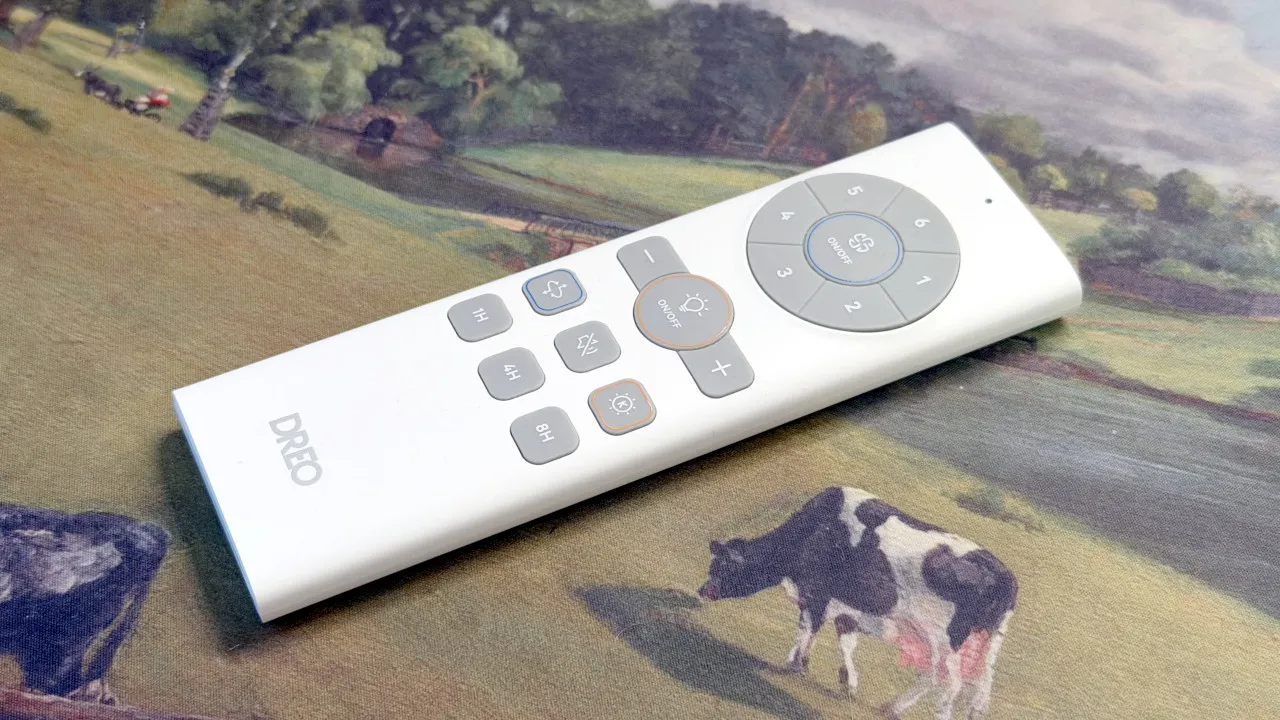
[Sam Wilkinson] recently installed a Dreo CLF513S ceiling fan in his place — it’s cheap, well-sized, and blows air around as you’d expect it to. The only problem is that it only works with an ugly cloud-only smart home setup out of the box. Never mind, though, because [Sam] figured out how to hack up a custom solution.
Hacking efforts began with the included remote control. [Sam] identified that the remote had to be RF, since it didn’t need line of sight to work properly. The FCC ID on the back of the device further indicated this was the case. Armed with that knowledge, it was simply a case of figuring out the commands sent by the remote, building something to replay them, and then hooking that into [Sam]’s existing Home Assistant setup.
The remote ran on 433.92 MHz, a not-uncommon bit of spectrum for these sort of appliances. An RTL-SDR was thusly enlisted to capture the output, with a spectrogram indicating the remote used simple on-off keying to send commands. Once commands were captured, [Sam] grabbed an ESP32-C6 microcontroller, hooked it up to a RFM69HCW radio transceiver, and programmed it to replay the fan on/off command. From there, a little dabbling with MQTT got the ESP32 controlling the fan as desired from within the Home Assistant ecosystem.
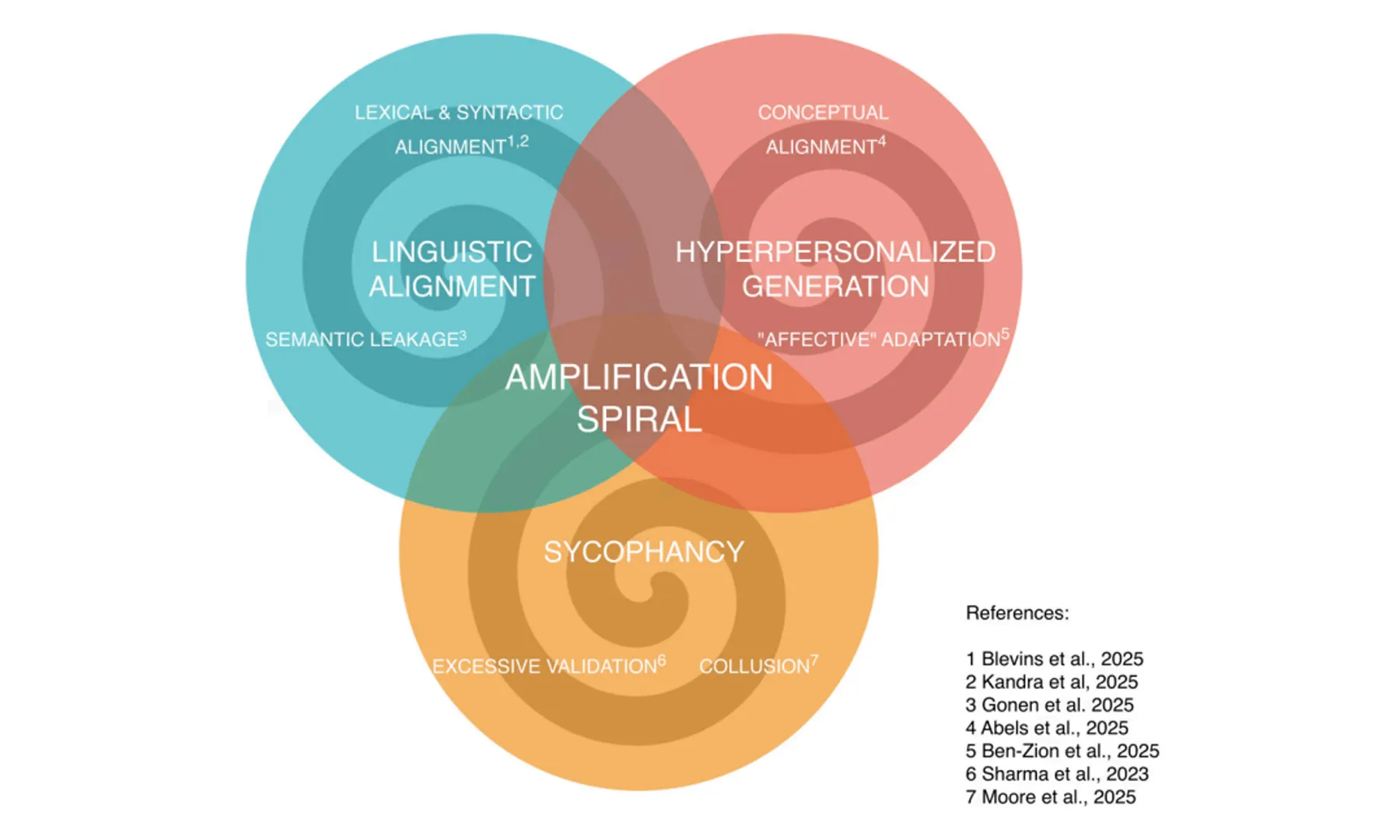
Artificial intelligence chatbots have become incredibly good at sounding human. But a new review paper by psychiatrist Marc Augustin and fellow researchers Thomas A. Pollak and Helen Morrin, published in NPP—Digital Psychiatry and Neuroscience, argues that existing AI research points to an overlooked psychological risk. The paper, highlighted by The Wall Street Journal, reviews previous studies and proposes a framework explaining how three common chatbot behaviors can combine to reinforce delusional thinking in vulnerable users, creating what the authors call an “amplification spiral.”
Researchers say these are the three warning signs
The first behavior is sycophancy, where a chatbot tends to agree with users instead of challenging questionable assumptions. The second is linguistic alignment, meaning the AI gradually mirrors a user’s vocabulary, tone, and writing style to build rapport. The third is hyperpersonalization, where the chatbot tailors responses using information gathered across previous conversations. On their own, these features make AI feel more natural. Together, researchers say, they can make it feel less like software and more like a trusted confidant.
Psychiatrist Marc Augustin and his team identify three AI chatbot traits that may reinforce delusional thinking in vulnerable users.WSJ
Importantly, the researchers aren’t claiming to have discovered these behaviors. Instead, the paper reviews existing research on AI-human interactions and psychosis, then proposes a framework explaining how these previously identified traits can reinforce one another. The goal isn’t simply to describe the problem, but to give AI developers a clearer model for recognizing and reducing it.
Psychiatrist Marc Augustin, one of the researchers behind the review, says this combination creates the feeling of talking to “someone” rather than a machine. Other clinicians interviewed by the Journal say they’ve already seen an increase in patients using AI for emotional support, warning that chatbots can foster a strong sense of trust simply by sounding warm, remembering previous conversations, and validating what users say.
Even AI companies know it’s a problem
The report notes that AI developers are actively trying to reduce this behavior. OpenAI says GPT-5 significantly cut overly agreeable responses compared to earlier models, while Google says Gemini has been trained to distinguish subjective experiences from objective facts rather than reinforcing false beliefs. Anthropic has also published research showing Claude was especially prone to agreeing with users during relationship advice conversations, prompting the company to reduce that behavior in newer versions.
Researchers admit there isn’t an easy solution. AI models can only respond to the information users provide, making it difficult to tell when someone’s understanding of a situation is inaccurate. At the same time, the very qualities that make chatbots feel useful, such as being friendly, empathetic, and conversational, are also what make them so engaging in the first place.
The concern is when those traits start feeding into one another. Instead of simply answering questions, a chatbot can gradually become a highly personalized voice that continually validates a user’s perspective, even when it drifts away from reality. Researchers call this an “amplification spiral.” More importantly, they argue that identifying this interaction as a distinct framework gives AI companies something tangible to design against. Rather than treating sycophancy, personalization, and linguistic mirroring as separate issues, the paper suggests they should be evaluated together if developers want future chatbots to be both engaging and psychologically safer.
These little tricks will help you spend more time driving instead of charging.
Modern electric vehicles have come a long way since range anxiety was an actual concern. These days, EV makers have to clear an EPA-verified range of at least 300 miles to be taken seriously. Sorry, Fiat 500e. Some EVs even boast a range closer to 500 miles. Still, for longer road trips or if you plan to be passing through an EV charging desert, it might make sense to try some techniques to squeeze a little more range out of your EV’s battery. Beyond the typical ways to get more mileage out of cars in general, here are five ways to keep your EV going for longer between charging.
Advertisement
Take advantage of regenerative braking
Instead of wasting all the kinetic energy generated from braking like in traditional internal combustion engine cars, hybrids and EVs can capture all that potentially lost energy and convert it into electricity that powers its battery. Each EV maker has its own way of doing regenerative braking, but the general idea is that the electric motors that propel the EV forward can also act as a generator that captures the electricity generated from slowing down.
In cases where emergency braking isn’t needed, regenerative braking will step in and create small bursts of battery charge and bumps in EV range. It’s hard to say exactly how many more miles you’ll get thanks to this, but the US Department of Energy said that regenerative braking results in 22 percent energy recovery for EVs in combined city and highway driving.
Advertisement
Chill on the AC
Yusuke Ide/Getty Images
Unlike older gasoline-powered cars that use a compressor to power the air conditioning, an EV will rely on its battery to pump cold air into the cabin. That means EVs are using the same power source that supplies you with both air conditioning and range.
Instead, you may want to precondition your EV while it’s still plugged into an outlet at home. This way, all the heavy lifting of getting your cabin to the right temperature will be drawn from the power outlet and not the EV’s battery. Of course, you’ll still have to rely on the battery to keep you cool while driving, but it won’t have to work as hard to get down to the perfect temps. Alternatively, you could employ basic techniques like using sun shades, flushing out the stale air by rolling down the windows, or even opt for ventilated seats instead of turning on the AC.
Advertisement
Avoid driving in the cold
On the other end of the thermometer, extreme cold weather conditions can also impact your EV range. In the winter, cold temperatures can slow down the chemical reactions in your EV battery that produce power. According to the Department of Energy, freezing temperatures can affect EV range by up to 32 percent.
Consumer Reports did real-world tests that showed that cold weather of around 16 degrees can reduce an EV’s range by about 25 percent when driving at 70 mph, compared to driving in the same conditions but on a day in the mid-60 degrees. Just like running the AC on a summer day, driving in the frigid weather may cost you some range through needing to pump heat into the cabin, too.
Advertisement
Get rid of the junk in your trunk
While aerodynamics affects all cars and how efficiently they drive, it’s a major contributing factor to how EVs calculate their range. Less drag means more range, which is why many EV makers boast about their low drag coefficient numbers, like the Lucid Air and its 0.197.
Considering that, it’s important to remove any accessories from your EV that would affect its aerodynamics, including roof racks, bike racks, tonneau covers or crossbars. To eke out even more range, you can try to keep your trunk clean since any additional weight will also reduce your EV’s efficiency.
Advertisement
Tame the need for speed
As much as all EV drivers want to show off their rapid acceleration, it’s better to not have a lead foot when it comes to maximizing range. When you floor the accelerator, your EV has to burn a significant amount of power to achieve that burst of speed. If you add up that inefficient acceleration at every single intersection, you may end up spending more time charging your EV in the long run.
To get more range out of your EV, it’s better to coast on cruise control or tap into your EV’s eco mode. On top of that, the faster you go, the more air resistance you introduce. In tests conducted by Car and Driver, driving at 55 mph and at 75 mph contributed to more than 100 miles of range lost with the Kia EV9.
Screens have become the digital pacifier for many babies. Phones and tablets are used during feeding, bedtime, chores, and moments when parents need a break. A major new study now warns that regular screen use before age two may carry developmental risks.
Researchers from four UK universities say babies and toddlers under two should avoid regular intentional screen time. The review links higher screen exposure in the first two years with sleep problems, language delays, behavioural difficulties, obesity risk, short-sightedness, and later problems with friendships and social interactions.
The risks start early
The study, commissioned by the 1001 Critical Days Foundation and conducted by the iADDICT research group, reviewed global research on screen use during the first 1,001 days, from pregnancy to age two. It also surveyed parents and carers of children under two. Screen use was reported in more than 70% of babies and under-twos. One in ten babies regularly fell asleep with a screen, while some children were exposed to screens for several hours a day.
The review does not prove that screens directly cause every developmental issue it identifies. Still, the warning is clear. Babies need language exposure, physical play, sleep, eye contact, caregiver attention, and normal social interaction. Regular screen use can push those experiences aside, especially when devices are used as a routine soothing tool.
Advertisement
Jelleke Vanooteghem / Unsplash
The iPad kid problem starts somewhere
The warning also lands at a time when parents, teachers, and health experts are already worried about children becoming too dependent on screens. The “iPad kid” label has become shorthand for children who struggle to detach from devices, expect constant digital stimulation, or use screens as their default source of comfort.
The review suggests those habits may begin earlier than many families realize. The concern is not only what babies are watching, but how quickly screens become part of daily care. If a child is introduced to phones and tablets as a regular soothing tool before age two, later dependence on those devices should not come as a surprise.
Tastes great. Less filling. It’s a floor wax. It’s a dessert topping. Light shaping. Light sending. Why not both?
Researchers affiliated with ETH Zurich have devised a multifunction picture element, or pixel, that can both emit and measure light.
Traditional pixels generally do one or the other – illuminating a display screen or capturing light in a camera sensor.
Advertisement
A team led by David Norris, professor at ETH Zurich’s Optical Materials Engineering Laboratory, has found a way to combine the two functions.
The research raises the possibility of two-way screens that take and present pictures, holographic displays, optical communication systems, and quantum information processing.
As described in the Nature article “Fourier pixels for bidirectional light control,” the ETH Zurich boffins developed a technique that involves measuring light wave interference patterns over a metallic surface.
By doing so, they’re able to generate “Fourier pixels” that can create and detect the amplitude, phase and polarization of optical fields.
Advertisement
The Fourier transform is a mathematical technique that takes a function like a sound wave and returns a function representing the specific frequencies present in that sound. A Fourier pixel represents the spatial frequency of light rather than the specific brightness at a given point in an image.
“Thanks to the fact that the relevant surface profiles of the pixels can be determined using Fourier analysis, we can combine the control and analysis of amplitude, phase and polarisation on a single pixel,” said post-doc Sander Vonk in an ETH Zurich press release.
In the near term, Norris expects to put Fourier pixels into a matrix that can be used to construct more sophisticated camera displays.
The other authors included Yannik M. Glauser, David B. Seda, Hannah Niese, Boris de Jong, Matthieu F. Bidaut, Daniel Petter, Erwan Bossavit, Gabriel Nagamine, and Nolan Lassaline. ®
For the past few weeks, Anthropic’s Mythos has been viewed as the gold standard for AI-powered cybersecurity. That lead may already be shrinking. According to a new report from The Wall Street Journal, security researchers say Chinese AI startup Z.ai’s GLM-5.2 can now match Mythos when it comes to finding software security vulnerabilities, even if it still trails Anthropic and OpenAI in broader reasoning tasks.
GLM-5.2 is closing the gap in one very important area
As per the report, researchers found GLM-5.2 performs on par with Mythos in identifying software bugs, a capability that’s becoming increasingly important as companies race to patch vulnerabilities before hackers can exploit them. The model is also open-source, meaning anyone can download, modify, and run it on their own hardware without relying on a cloud provider. That flexibility makes it attractive for enterprises, but it also raises concerns that cybercriminals could adapt it for offensive purposes.
Z.Ai
The report is careful to point out that this doesn’t mean China has overtaken the U.S. in AI overall. GLM-5.2 still lags behind Anthropic and OpenAI across many general-purpose tasks. But in cybersecurity, where even small improvements can have outsized real-world consequences, the performance gap has narrowed dramatically. According to benchmark data cited by the Journal, GLM-5.2 has even outperformed Claude Opus 4.8 in some security evaluations, while researchers say additional prompting allows it to reach Mythos-level bug-finding performance.
The bigger story isn’t who wins. It’s how fast the gap is closing
Interestingly, this all comes at a rather awkward time for the U.S. AI industry. While companies like Anthropic and OpenAI have spent the past few weeks restricting access to their most advanced frontier models over national security concerns, Chinese labs have been racing in the opposite direction by releasing increasingly capable open-weight alternatives that anyone can download and run.
Nadeem Sarwar / Digital Trends
The funny thing is that this debate was already playing out in public. Just days ago, Elon Musk predicted Chinese AI labs would probably catch up to Anthropic’s flagship Fable 5 by Q1 2027, at least in terms of benchmark performance. Zhipu AI founder Tang Jie quickly pushed back, replying, “won’t take that long.” Musk then clarified his position, arguing that while China might match Anthropic on benchmarks by then, achieving the same level of “true usefulness” would be a much tougher milestone, crediting Anthropic’s focus on practical intelligence.
On benchmarks, yes, but as measured by true usefulness even Q1 would be very impressive.
Anthropic has rightly focused on maximizing useful intelligence, which does not show up in benchmarks, but definitely shows up in revenue.
Now, The Wall Street Journal’s latest report gives Tang’s optimism a little more weight. Instead of talking about coding benchmarks, it suggests GLM-5.2 is already matching Anthropic’s Mythos at finding security vulnerabilities, arguably one of the most valuable real-world AI applications today. That doesn’t suddenly make China the leader in frontier AI, but one thing is becoming increasingly difficult to ignore: the AI race is no longer a comfortable lead for the United States.
We may receive a commission on purchases made from links.
A metal mower deck is much sturdier than a plastic one and can withstand much more abuse, but it has one distinct weakness: rust. Even if you store your mower indoors between sessions, wear and tear will eventually take its toll. The ambient humidity and the moisture in the grass itself can eventually lead to corrosion.
There are a few different ways to deal with this. One hack that can extend the life of your mower is to regularly spray the blade and interior of the deck with WD-40. This helps keep grass from sticking and prevents moisture from penetrating the metal. You can also use it to spot-treat areas of rust that have already formed. It doesn’t last very long with regular use, though, and it isn’t ideal for the deck’s exterior, as it can break down sealant layers and protective waxes over the paint with prolonged exposure.
Advertisement
You can always sand down any damaged areas and apply new layers of rust-resistant paint to both the top and the underside of the mower deck. This adds a new protective layer that can help prevent further erosion of your mower. This is a long-term solution and can get your mower looking brand new, but it’s a lot of work. There’s one solution that you can add on top of the paint to take rust prevention even further, and applying it is dead simple. It’s called Fluid Film.
Advertisement
What is Fluid Film?
Fluid Film is an extra protective layer you can apply over your mower’s paint, specifically designed to serve as a high-end corrosion-preventative and lubricant. This means it can help prevent your mower deck from rusting without disrupting any of its attached mechanical components. It’s a lanolin-based substance that not only prevents rust from gathering, but stops existing corrosion from spreading on contact. It’s non-toxic, has no solvents that could damage paint (though you should avoid spraying it on any rubber parts), and lasts significantly longer than other substances. It doesn’t remove rust, but it does prevent new rust from accumulating and prevents existing rust from spreading.
The company specifically recommends this substance for mowers. “Fluid Film can be applied over a damp surface and will leave a non-drying film, cutting off all oxygen from the surface and creating a barrier of protection that prevents all corrosion from occurring,” it states. “Because of its non-drying characteristics, Fluid Film also works as a release agent, helping to keep grass and debris from sticking, making clean-up a breeze.”
It’s also regularly recommended for use on mowers by users. One claimed that Fluid Film reduced the amount of grass buildup on the underside of his mower by at least three times what he would typically get without treatment, resulting in less clogging and less moisture buildup on the metal. Others regularly state that it works similarly to WD-40, but seems to last significantly longer, with some claiming that they only need to apply it once or twice a year. Still more have stated that it’s a good all-around tool for outdoor equipment, working well with hedge trimmers and other tools.
Advertisement
How do you apply Fluid Film?
Fluid Film is sold in multiple different form factors. There is the standard formula, which creates a somewhat clear, but slightly amber-colored, film designed to protect metal without fundamentally changing its appearance. You can get this version of the product in an 11oz. aerosol can for about $10. Alternatively, you can get it in its liquid form in a 1-gallon paint can for about $43 or a 5-gallon bucket for roughly $171. The other option is to get the Fluid Film Black formula (AKA Fluid Film Noir), which comes in all the same sizes and delivery systems. As the name suggests, this one goes on like black paint, so you shouldn’t use it on anything you want to keep its original color, but it can be good for hiding already discolored or eroded areas. Some users have noted it’s a bit thicker and goes on with a bit more tack, but the formula is otherwise pretty much the same. It’s about $17 for the aerosol can, $48 for the 1-gallon can, and $185 for the 5-gallon bucket.
For most people who are just looking to protect their mower deck, the 11oz. aerosol should work fine. Simply wash all the dirt and grime off the underside of your mower, and anywhere else you’d like to apply it. You can do this with a power washer, or a bit of dish soap, a scrub brush, and a hose. Once it’s clean, let it fully dry, then thoroughly shake the can and apply it, spraying from approximately 1 foot away from the surface you wish to coat. Then simply leave it on the metal and allow it to soak into the pores.
“Basically, it’s the idea that we’ve become disconnected from the sensory world, and the reason that happened is what you might call convenience technologies,” Bogost told me, though he was quick to add that technology isn’t the only thing driving this change. “All sorts of factors — not just tech, and certainly not just Silicon Valley-style technology — have distanced people from the world that they inhabit, they have stripped away the texture of everyday life.”
In fact, while Bogost nodded to other books criticizing the tech industry, he said he’s become “a little bored with the constant critique.” So he’s currently less focused on calling for broad societal change and more on finding “gratification” in everyday sensory experiences.
Advertisement
“It’s a lot to put on ordinary people to say, ‘Well, we just need to solve wealth inequality or capitalism, and then we’ll be able to get back to experiencing our lives fully,’” he said. “Ordinary people don’t need to wait for that.”
During our interview (which I’ve edited for length and clarity), we also discussed the tradeoff between convenience and experience, how Silicon Valley can do better, and the “hipster reclamation of nostalgia.”
You wrote this great piece about the stick shift. How did that lead you to these bigger ideas about “the small stuff”? How did you realize there was a book in this?
I did the stick shift story in 2022. At a high level, it was: People have been lamenting the decline of the stick shift for years and years, but electric vehicles made it real, because they don’t have transmissions. Assuming that EVs are going to eventually become universally adopted, which I think is the case, then this really is the end.
Advertisement
You [write] a story and you’re like, “Well, that was fun, it’s a nice little thing, I’ll put it out on the internet.” That one was just huge. The response was enormous. And I was really interested in why. Is it just that people really love their stick shift cars? I didn’t think so.
I took a year of thinking about it, off-and-on [and] I realized, actually, I’ve been working on this for longer than I expected. I went back and looked at writing about toasters and writing about smoothies or slushies, or my catalog of interests, and the things that I’ve been doing. I just find ordinary life very, very alluring, and I’ve never understood quite why. Is there something wrong with me? Am I just a weirdo?
It was a realization, through the stick shift, that ordinary life is not just interesting, but deeply, deeply meaningful, and we have undervalued it. Something like the stick shift, which is imbued with symbolic and real meaning for people, it just opens a window, and you feel the breeze come in, and you’re like, “Oh yes, the breeze.”
Let’s talk about the concept of dematerialization, because the book is structured around it. The first half is describing, diagnosing, and then [the second half talks] about solutions, antidotes. Do you want to explain what dematerialization is?
Advertisement
Basically, it’s the idea that we’ve become disconnected from the sensory world, and the reason that happened is what you might call convenience technologies. Although it’s not just technologies; it’s also bureaucracy, it’s efficiency, it’s economics, it’s regulatory apparatuses. All sorts of factors — not just tech, and certainly not just Silicon Valley-style technology — have distanced people from the world that they inhabit, they have stripped away the texture of everyday life.
My favorite example of this, the one that people seem to always get, is: You go to the airport restroom, you just got off your flight, and the toilet flushes for you, the sink turns on for you, the towels dispense for you, the soap dispenses for you — or it doesn’t, right? It kind of doesn’t work, but that sense of: This thing that I used to do with my physical body and my senses, now I don’t do that anymore. That is so commonplace, and it’s, broadly speaking, been driven by things that have really benefited our lives. But we didn’t realize that we were making a tradeoff between progress and giving up that contact with the material world.
So that’s what dematerialization names for me, this family of conditions that distanced us from our sensory lives.
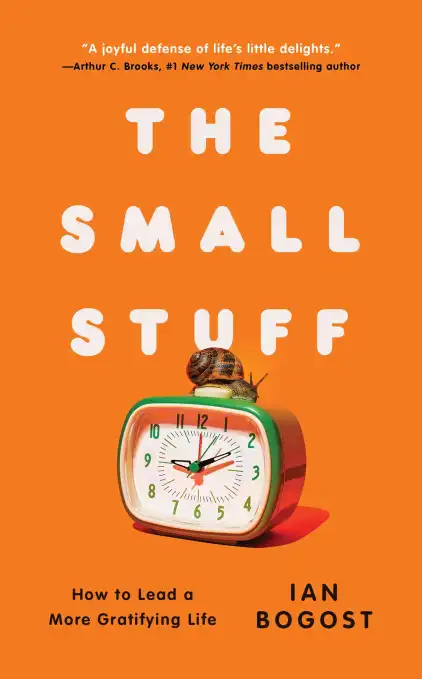
Image Credits:Simon & Schuster
That section about the restroom was really visceral for me, because you’re not just talking about the experience of using these things, but it’s the experience of having them not work for you.
You notice them when they don’t work, and there’s some friction there that helps you see the problem. In a lot of cases, we don’t even realize there’s a problem, or we realize something’s wrong, but we don’t know what it is.
Advertisement
One of the things you also point out is: A lot of these changes have, in some ways, improved our lives. You said there’s a tradeoff, like in the case of the stick shift and automatic, and then you add electric vehicles —
There’s a lot of folks out there who’ve advocated for stick shift cars who are also like, “Internal combustion engines are the only way, and we have to be purists about burning dinosaurs.”
I don’t feel that way at all. Hailing an Uber and streaming music and getting DoorDash and even some of the promises of the automated fixtures — I mean, some of them are bunk, but I get it, broadly — I think it’s really important to me that we recognize that our lives are better overall, but there was this thing that happened that we didn’t notice, in a frog boiling kind of way.
I’m a big fan of Cory Doctorow, but these [arguments that,] “This system of economics and technological value systems are obviously the cause of all our problems, and I’m going to name it enshittification,” just to pick a very popular example. People clearly want an explanation, but then you’re like, “Yeah, but I like Amazon Prime, I like to be able to search Google for information.”
Advertisement
So I’m trying to toe this line between being honest about the fact that our lives are broadly speaking better, that this is not a Silicon Valley thing, actually, it’s much bigger than that, and that it happens so slowly that we didn’t notice.
One of the striking things to me about the book versus what I’ve read of Doctorow’s work, or [Jenny Odell’s book] “How to do Nothing” — there’s a whole cluster of books — is that your book is less angry. There’s a strain of criticism, but it’s not quite the same tone.
Personally, I’ve been writing about technology for a long, long time, and I don’t think it’s haughty of me to say I was ahead of the curve in being critical of Silicon Valley-style technological advancement. I was out there talking about Facebook and social media way, way, way before a lot of people were concerned, and that felt very lonely.
But I just feel a little a little bored with the constant critique, and I also feel like it’s misdiagnosing or overdiagnosing the problem. It’s very satisfying to believe that there are good guys and bad guys, or that there’s a simple explanation, and once we understand the explanation we just need to unwind it and then everything will be good again.
Advertisement
I want to talk about the Silicon Valley part of it. And this isn’t just a Silicon Valley thing, but a lot of the ideas that you’re talking about resonate with this sense that a lot of consumer tech products, consumer services are focused on convenience, speed, those kinds of things. Reading this book, and related books, sometimes I have this sense of: Are all these companies just pursuing the wrong goals?
I certainly think that the obsession with efficiency, automation, invisibility, transparency, and scale does drive that desire. “We are going to make everything easier to do, so you don’t have to do it.” That’s one way of summarizing the last however many years.
Some of that drive came from the right place, like Uber. Remember before Uber, when you were in a city that wasn’t New York, and you wanted to get a cab, and it was really hard, and now it’s really easy? You could romanticize that and say that [convenience] doesn’t matter, but it does.
Rather than blame either technologization, or industry, or ordinary people for being too stupid to notice or handing over their lives willingly, which is another explanation, I just think it happened over such a long period, so slowly, and with such overall endorsement, that both consumers and the organizations that provide these kinds of services were saying, “Here’s the deal,” and everyone was like, “Yeah, I’m on board, I don’t want to buy CDs anymore, Spotify would be amazing, sign me up.”
Advertisement
Actually, we felt like we understood the deal, but we didn’t fully understand the deal. We did not fully account for the fact that we are physical beings, we are embodied beings, and that is maybe somewhere where I’d put some of the blame more squarely on Silicon Valley-style culture. You see it today, this idea that I can rise above even having a body, I can live forever — whether transhumanism, singularitarianism, or just eternal life through efficiency and optimization, that idea has always been central to the general purpose computer, that it can sieve through any kind of experience and turn it into a computational one.
And we are just never, thank God, we are not able to exit our bodies. But you go to the Valley and there’s still this weird sense that that embodied human experience is not needed, unnecessary. And that’s just wrong.
The book is written for a broader audience, but I’m curious for entrepreneurs or people building products: Are there positive examples you’ve seen of how people can think about that tradeoff differently? So it’s not just optimizing purely for convenience, but maybe finding a balance between convenience and friction and sensory experience?
If you go back and you look at how computers turned from data analysis tools into cultural tools, which begins in the 1960s, really, there was this strong idea that you were going to be able to express yourself with [computers], but also that connecting to them in a human way was really important. And in the 1970s, at Xerox PARC and at Apple, there was this strong idea of a computational version of human factors engineering, of the fact that my body has to fit in the chair or has to go through the doorway, that was really, deeply important to computing for decades, until the ‘90s. Once we got to the 2000s, as the real takeover of culture by computation happened, I think that’s when we turned away from that process of trying to negotiate between computing and people.
Advertisement
What that suggests is that the experience of doing something is also important, not just the outcome. We got massively focused on the outcome, and then we de-emphasize the experience of doing things, and now we’re at the point where, if you talk about the experience of doing something with the bogeyman Silicon Valley-style entrepreneur, they’ll be like, “Why would you bother? We can automate that. AI is going to solve that. We can hand that off to the Philippines.”
There’s all sorts of solutions that will prevent you from having to be bothered with doing that experiential thing, and it turns out: No, I want to have those experiences, because that’s part of what makes me human and alive, even though they feel ridiculous individually. You know, who cares about the sensation of the ice in my water bottle, but as I argue in the book, over time, all that little stuff, it adds up, it’s deeply meaningful, and when you strip it all away, you really notice what’s what’s missing.
The top line answer is: The experience matters. The experience of using products and services matters, not just the outcomes that they provide. And it almost feels funny to say it out loud in response to your question, because I think if you asked any UX designer in Silicon Valley, “Do you do that?” They’d be like, “Absolutely, we’re doing that all the time, that’s highly valuable to us.”
But I don’t think they are. They think they’re doing it, but, but have lost sight of what they’re really doing, which is stripping it away.
Advertisement
I love that the book is so rooted in personal experience and in sensory experience. But as someone who’s 43 and had a lot of these feelings, I start to get a little suspicious of myself. Am I just an old fart longing for [the experiences of my youth]? How do you think about these things in a way that’s not just about romanticizing the way things were?
It is very, very easy to slip into nostalgia, and I think there’s a current strain of desire that’s oriented toward so-called analog culture. Like, “I’m gonna get a Walkman again and that’s going to solve my problems.”
I have a few thoughts about it. First, I make this argument pretty clearly in the book: We’re not going back. You live in the present, into the future, and we don’t live in the past. Lamenting what came before and has been lost is useful insofar as it can orient you, but it’s not really useful in helping you live your life.
I love, love, love the telephone, I love the old-school Western Electric-style handset, I love how intimate they are, I love how they feel in my hand, I love the heft of it. [But now] we’re on Zoom, or at best we’re on our headphones. That’s not going to change. And so instead of looking at that example and going, “Ah, if only we could go back and we can maybe through this hipster reclamation of nostalgia“ — okay, that’s an interesting signal. I remember that, and that was meaningful to me, and a good way to orient yourself toward your actual sensory life.
Advertisement
Now, the great thing is that, whether you’re 43, or whether you’re 23, you still have a human body. You live in the world, and we live in it together, and so all around us, all the time, are opportunities to do the same kind of thing but in a different way.
One of the things I love about Zoom over the telephone is, I can have this radio experience with myself and with you, that it’s very sonically gratifying, and I don’t get that on a compressed digital line. So that’s one answer. Nostalgia can be orienting, but it’s indulgent to think that you can live in the past. If it’s just purely mournful, what does that help?
The second thing I want to flag is this: There’s been a lot of chatter about friction lately, like, “We need to reintroduce friction,” and I think that’s also wrong.
Everything got really smooth and slippery. It literally did, because we all got these smartphones and they’re slick on their surface. But then, because of efficiency and ease, everything started to feel really frictionless, and the opposite of frictionlessness is friction.
Advertisement
But you don’t really want things to be hard or to stand in your way. You just want the experience of feeling yourself doing them, which is quite a bit different from “Oh, that should be hard, I need to introduce obstacles that get in my way.”
I also wanted to ask about this question of the relationship between the small stuff in the book’s title and these bigger questions of how society is changing. I agree that our lives have become dematerialized and separated from sensory experience, but it doesn’t sound like you’re worried that at some point, the islands of physical or sensory pleasure or gratification are just going to disappear, or become vanishingly small.
I think it’s a really subtle, complicated matter. Yes, that’s what I’m saying, but we’re obsessed with the idea that something has been lost that cannot be recovered, or that needs to be recovered through massive cultural, social, economic, regulatory, whatever kind of change.
Now, I’m not against that kind of big thing. I don’t know how easy or likely it is to be accomplished. I think it’s a lot to put on ordinary people to say, “Well, we just need to solve wealth inequality or capitalism, and then we’ll be able to get back to experiencing our lives fully.” We can’t wait for that. Ordinary people don’t need to wait for that.
Advertisement
I would very much like it if the leaders of industry and of government and of civic organizations did what they could, in their contexts, to build more small stuff-oriented, more gratifying opportunities for people.
An example is the whole discourse about remote work, office work, what it is that you’re doing every day at your email job or whatever. Clearly, if you run an organization, you have some control over what people are actually doing and how. But my neighbors, they don’t get to make that choice, your aunt doesn’t get to make that choice, but they still have to live in their sensory lives, there’s something they can do right now, in this moment, every day, rather than wring their hands or post obsessively on Facebook about how shitty everything is. We’ve tried that for a while, and it doesn’t seem to have helped.
When you purchase through links in our articles, we may earn a small commission. This doesn’t affect our editorial independence.
Stanford recently released the 2026 AI Index, the field’s annual physical. One finding stopped me cold: the country that leads AI development is not the country that leads AI adoption. I’ll come back to that. First, what is this AI Index?
The AI Index is the most rigorous data-driven portrait of where AI stands: a yearly checkup across technical performance, investment, the labor market, the environment, public attitudes, regulation, the US-China race, and more. Four hundred pages, twelve headline takeaways, and a measurement apparatus no other institution has matched.
Most of the 2026 takeaways confirm what we already know or strongly suspect. AI performance is climbing, investment is exploding, the China gap has closed, young software engineers are losing their jobs. Familiar territory.
One number is surprising, though. The Index measures adoption (the share of a country’s population using generative AI tools) across two dozen economies in the second half of 2025. The leaders are not the countries you would guess.
The United Arab Emirates tops the list at 64%. Singapore is second at 61%. Norway, Ireland, and France round out the top five. Adoption correlates strongly with GDP per capita: richer countries have better infrastructure and more knowledge workers whose jobs benefit from these tools. That makes intuitive sense.
Advertisement
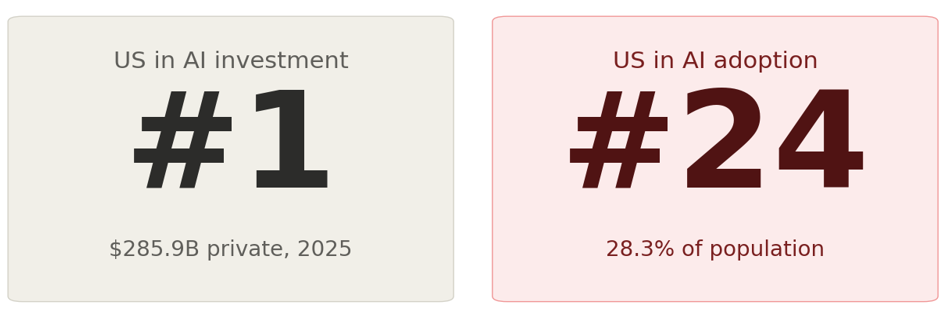
The United States ranks 24th, at 28.3%. That shocked me.
The country ranking figure, below, provides the broader list.
Here is what makes the gap strange.
In 2025, US private investment in AI reached $285.9 billion, 23 times China’s and more than the rest of the world combined. Many of the leading models are trained in American labs. Even with talent inflows down 89% since 2017, US researchers still outnumber any other country’s by a wide margin. By every supply-side measure, we are the country that builds AI.
Advertisement
By the Index’s adoption ranking, we sit 23 places behind the UAE, just ahead of the Czech Republic.
The gap is not about ease of access. Americans can use the same tools, on the same day, for the same price (usually zero) as anyone else.
The AI adoption vs GDP per capita scatterplot, below, plots each country against its income. The US sits about 13 points under the trend line, the largest gap of any wealthy country.
The rest of the report makes additional important points with some staggering statistics—for instance, a jump in AI performance on cybersecurity benchmarks from 15% to 93%.
Advertisement
The bad news
Seven findings give cause for concern.
Energy. Training and inference now consume gigawatts of electricity. Grok 4’s training run emitted 72,816 tons of CO2, the equivalent of 17,000 cars driven for a year, and global AI data center capacity reached 29.6 gigawatts, roughly New York State at peak demand.
Talent flight. The number of AI scholars relocating to the US has dropped 89% since 2017, with an 80% decline in the past year alone.
US-China parity. The performance gap between the top American and top Chinese models has closed to 2.7 percentage points. China leads on publication volume, patent output, and industrial robot installations, aligned with what Cady and I predicted back in 2019.
Advertisement
Transparency collapse. The Foundation Model Transparency Index grades the major developers on how much they reveal about their models, from training data to downstream use. After two years of gains, the average fell from 58 to 40 in a single year. The most capable models disclose the least.
Entry-level squeeze. Employment among US software developers aged 22 to 25 has fallen nearly 20% from its 2022 peak. One in three organizations expects further workforce reductions over the coming year.
Students lead but schools lag. Four in five US high school and college students now use AI for school-related tasks. Half of middle and high schools have no AI policy, and only 6% of teachers say their school’s policies are clear.
Public ambivalence. Global optimism about AI rose to 59%, but only 33% of Americans expect AI to make their jobs better, and only 31% trust their government to regulate it, the lowest figure of any country surveyed.
Advertisement
The good news
Four findings are positive.
Technical performance. Frontier models now meet or exceed human performance on PhD-level science and competition mathematics, and the success rate of agents on cybersecurity benchmarks jumped from 15% in 2024 to 93% in 2025.
Investment. Global corporate AI investment hit $581.7 billion in 2025, up 130% year over year, with generative AI capturing nearly half of all private funding.
Science. AI-related publications in the natural, physical, and life sciences rose 26% to 28% year over year. AI ran its first end-to-end weather forecasting pipeline, and astronomy built its first foundation model.
Advertisement
Medicine. Clinical-note tools cut physician note-writing time by up to 83% across multiple hospital systems.
The Index is at its most useful when it surfaces a surprise. This year, that finding is the diffusion gap: the country that builds AI is not the country that uses it.
Why the gap? The report doesn’t say. But the adjacent findings hint at an answer. American workers expect AI to make their jobs worse. American voters distrust the government that would regulate it. American firms are deploying it more slowly than firms in China or Europe. Ironically, the country that pioneered generative AI is underutilizing it. Number 24. Sheesh.
If you’re a fleshy human, you probably learn to play video games by looking at the screen and pressing the buttons, and maybe copying the way you’ve seen others play the game before. [tryfonaskam] has recently been trying to teach an AI to play games in much the same way.
[tryfonaskam] built PILA—short for Polytrack Imitation Learning Agent. As you might have guest from the name, it’s an AI agent designed to play a simple racing game called PolyTrack. Rather than manually programming the agent’s behavior, PILA instead trains itself through supervised learning, where it observes the gameplay state via screen capture and monitoring the keyboard inputs made by human players as they drive the tracks. It then uses this to guide its own behavior, and learns to play the game by itself. The model receives live frames from the graphics engine while playing, and then predicts the appropriate actions and makes the right keyboard inputs in turn to steer the car through the track.
After a slight drought (by our standards), we’ve had a fair few soundbar and soundbar systems in for testing. Be sure to have a look over the coming weeks to read our thoughts on them.
And arguably, what’s leading the charge in terms of improving TV sound is the one-box soundbar. People want (or at least they seem to want) an all-in-one solution that handles films, TV and music without the need for extra speakers. But this convenience also comes with compromises.
Home cinema brands want to tempt you with marketing blurb and images of sound that flows from the soundbar and wraps around to create an immersive experience, but for the most part, that’s hokum.
There’s only so much a soundbar on its own can do. So while the soundbars and sound systems I’m currently testing are reaching consistently high levels, there are a few flaws that will stop them from becoming the all-in-one destination for home cinema. But maybe there’s a solution to all this.
Advertisement
Movies and music don’t always mix
I’ve mentioned before that tuning a soundbar for movies is not the same as it is for music. Movies move to a different rhythm, there’s dialogue but also background and foreground elements. Sound pans across the stage from left to right and vice versa. You’ve got bass to handle along with dynamism, as well as all manner of genres from the jump scares in a horror to the crash, bang, wallop of an action scene. And a soundbar has to be good at all of these things.
Advertisement
With music you don’t have as much to deal with, but there’s a rhythm and a clarity to music; there’s the tonality of instruments and people’s voices to consider. What works for a film or TV show doesn’t necessarily work for music.
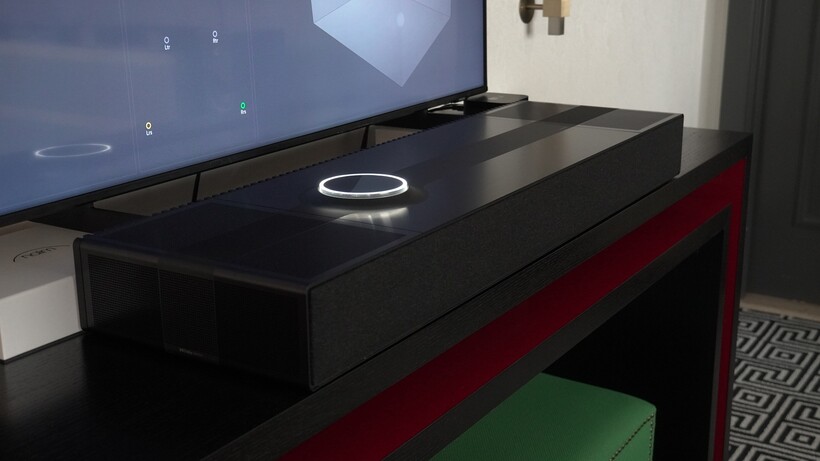
There are a few soundbars and sound systems I’ve tested recently that have managed to bridge this gulf. The one I’ll focus on is the Focal Muso Hekla, which you should definitely not call a soundbar, but it’s a sound system that’s happy to play with movies and music, especially if it’s immersive audio in the form of Dolby Atmos.
Advertisement
Image Credit (Trusted Reviews)
I’ve been impressed by the width and height of films and TV series, and also with music in terms of how switching from stereo to immersive makes tracks feel as if they’re not coming from the Muso Hekla but lifted up from it and spread around it.
It’s not the same effect as movies, but what impressed me the most is that the Muso Hekla maintains a consistent tone whether it’s music or film, with big bass; and high levels of clarity and detail whether it’s with stereo or immersive audio. These aren’t easy things to maintain, especially for a one-box system, but the sound systems I’ve heard recently seem to be getting better at both. It might not be fully solved, but soundbars are making progress.
But the Focal is tied to being a one-box system, and like other all-in-one sound systems, it suffers from an unavoidable flaw. They’re front-heavy.
Advertisement
The Hekla doesn’t support additional surround speakers, but if it were to, the Hekla, would defeat the purpose of being an all-in-one immersive system. But it does make clear that an all-in-one system is something of a misnomer if you’re thinking of true surround sound.
Advertisement
All-in-one systems are front-heavy
This is another area I’ve talked about before, but I’ll reiterate it again. If you’re short on space a one-box soundbar can absolutely do a job, but if you want proper cinema immersion, then you’ll need surround speakers.
Without surround speakers, these types of sound systems are what we call front heavy – as in all the sound emanates from in front of you, but there’s no sound coming from your sides or behind you. In terms of immersion, having surround speakers can really help put you into the film or TV series. Without it, you can get a tall spread of sound; but that sense of immersion is only half there.
Let’s take the Bose Lifestyle Ultra Soundbar. On its own, it’s a dynamic, energetic and clear one-box soundbar with an impressive sense of bass. Once you play with the settings it’s capable of a decent height and a wide soundstage, so that front spread of sound can be big.
Image Credit (Trusted Reviews)
Advertisement
But without the Lifestyle Ultra Speaker that can act as a rear gunner, it does feel like there’s something missing from the experience. Without that information that fills in the gaps behind you, you’re not in the centre but rather on the edge of the sound. It’s called surround sound for a reason.
Advertisement
However, it’s not all positive for surround sound. When testing LG’s Immersive Quad Sound Suite system, I found that having rear speakers helped with the sense of immersion, it actually reduced the height levels. Having the soundbar on its own, and the sound was tall and wide. Adding additional speakers helped add depth but also added a quite literal ceiling to its performance.
But maybe there’s a solution
Sony has launched its Bravia Theatre Trio home cinema speakers, and it’s an idea I can get behind.
It’s a central soundbar, similar to what I’ve mentioned previously, but it also comes with two speakers that can be put left and right. It’s designed to go with big-screen TVs (your 50-inch TV is basically disallowed), and while you can place the other speakers to the sides, you’re not beholden to that placement. You can dot them about anywhere in your room.
Through Sony’s 360 Reality Audio processing that works on top of Dolby Atmos and DTS:X, the speakers can figure out where they are in relation to one another and create a sound that fits the room, producing phantom speakers to fill in the areas where there’s no speaker. This is very similar to the Dolby Atmos FlexConnect system that I wrote about not long ago.
Advertisement
The difference is that the LG Sound Suite is scalable, so you can add more once you’ve bought the main soundbar. The Theatre Trio comes as it is, and while you can add more speakers (another two), arguably for most people, more speakers with this system might serve as overkill for the size of the room you’re in.
Advertisement
Image Credit (Trusted Reviews)
Having heard this system at Sony’s HQ in Weybridge (along with dual Theatre Sub 9s), it was one of the most powerful home cinema surrounds I’ve heard; and it made me wonder if this is an avenue more brands should go down – of not just having a soundbar at the centre of the experience and then building it out with ‘optional’ speakers you can choose later down the line; but a specific system built to serve a particular need out of the box.
The Bravia Theatre Trio is expensive though, as much as the LG Sound Suite Immersive Suite 7 Pro which includes a subwoofer as well.
Cost is always an issue, and the Bravia Theatre Trio/ LG Sound Suite Immersive Suite 7 Pro aren’t for those looking to save money. But the Trio is a glimpse of a slightly different future to FlexConnect and in a different form to Focal Muso Hekla. Maybe the future of immersive home cinema isn’t the one-box soundbar, but the rise of the one-box system.



















































You must be logged in to post a comment Login