
TL;DR
Amazon is looking at OpenAI and other alternatives after a renegotiated contract will shift Anthropic billing to per-token pricing next year.





Research
Tastes great. Less filling. It’s a floor wax. It’s a dessert topping. Light shaping. Light sending. Why not both?
Researchers affiliated with ETH Zurich have devised a multifunction picture element, or pixel, that can both emit and measure light.
Traditional pixels generally do one or the other – illuminating a display screen or capturing light in a camera sensor.
A team led by David Norris, professor at ETH Zurich’s Optical Materials Engineering Laboratory, has found a way to combine the two functions.
The research raises the possibility of two-way screens that take and present pictures, holographic displays, optical communication systems, and quantum information processing.
As described in the Nature article “Fourier pixels for bidirectional light control,” the ETH Zurich boffins developed a technique that involves measuring light wave interference patterns over a metallic surface.
By doing so, they’re able to generate “Fourier pixels” that can create and detect the amplitude, phase and polarization of optical fields.
The Fourier transform is a mathematical technique that takes a function like a sound wave and returns a function representing the specific frequencies present in that sound. A Fourier pixel represents the spatial frequency of light rather than the specific brightness at a given point in an image.
“Thanks to the fact that the relevant surface profiles of the pixels can be determined using Fourier analysis, we can combine the control and analysis of amplitude, phase and polarisation on a single pixel,” said post-doc Sander Vonk in an ETH Zurich press release.
In the near term, Norris expects to put Fourier pixels into a matrix that can be used to construct more sophisticated camera displays.
The other authors included Yannik M. Glauser, David B. Seda, Hannah Niese, Boris de Jong, Matthieu F. Bidaut, Daniel Petter, Erwan Bossavit, Gabriel Nagamine, and Nolan Lassaline. ®
Amazon is looking at OpenAI and other alternatives after a renegotiated contract will shift Anthropic billing to per-token pricing next year.
Amazon is looking for cheaper alternatives to Anthropic’s Claude models after a renegotiated contract will shift to token-based pricing that could substantially increase the company’s AI costs, according to The Information. The new pricing structure does not take effect until next year, but Amazon is already exploring options including OpenAI. The report highlights a deepening rift between two companies that were once inseparable partners in the AI race.
Amazon’s dependence on Claude runs deep. Its coding agent Kiro, workplace assistant Quick, and consumer-facing Alexa for Shopping all rely on Anthropic’s models, according to The Information. A shift to token-based billing would make that dependence far more expensive, particularly after Amazon recently scrapped an internal leaderboard that encouraged employees to burn through as many AI tokens as possible.
The search for cheaper models has sent Amazon toward OpenAI, a company it has already been growing closer to. Earlier this year Amazon committed $50 billion to OpenAI, giving the AI lab access to its cloud infrastructure in exchange for access to its models. That deal followed Amazon’s initial $4 billion investment in Anthropic, which has since grown to a potential $33 billion.
Anthropic, meanwhile, has been expanding its own relationships beyond Amazon. The company committed to spending $200 billion on Google Cloud and chips over five years, according to The Information, a deal that effectively makes Google a major infrastructure partner alongside AWS. Amazon’s latest $25 billion investment in Anthropic included a reciprocal commitment of more than $100 billion in AWS spending, but the Google arrangement signals Anthropic no longer depends on a single cloud provider.
The tension boiled over last month when the US government ordered Anthropic to shut down its Fable 5 and Mythos 5 models after a security report that originated from Amazon. Andy Jassy reportedly told government officials that Amazon researchers had used Fable 5 to obtain information useful for cyberattacks. The timing raised questions, coming as Amazon was preparing to launch its own cybersecurity-focused AI agent designed to spot vulnerabilities.
The contract dispute, the move toward OpenAI, and the Fable 5 incident together suggest the Amazon-Anthropic relationship has entered a new and more adversarial phase. Amazon remains one of Anthropic’s largest investors and cloud customers, but both companies now have reasons to reduce their dependence on each other. For the broader AI industry, the fracturing of its most prominent investor-model-provider partnership would redraw the competitive map.


Security
At least two vulnerabilities are already under attack
Not everyone is willing to follow responsible disclosure of vulns. An anonymous researcher has dumped what they say is working exploit code for zero-day vulnerabilities across 15 software products and open source projects without notifying any vendors or maintainers prior to publishing – and attackers are already exploiting at least two of these.
The first is CVE-2026-55200, a critical, pre-authentication remote code execution (RCE) vulnerability in libssh2, a popular client-side C library that implements the SSH2 protocol. Remote attackers can send crafted SSH packets with excessively large packet_length values to corrupt heap memory and achieve remote code execution.
A fix has been merged into the libssh2 mainline development source control branch, and maintainers are still preparing a libssh2 release containing the patch.
The second is CVE-2026-20896, a critical authentication bypass vulnerability affecting self-hosted Gitea Docker deployments that allows unauthenticated remote attackers to impersonate any user and fully take over the Git server. It’s fixed in Gitea 1.26.3.
The researcher, who goes by bikini, dropped the exploit code and vulnerability write-ups in a now-removed GitHub repository called exploitarium. They remind us of Nightmare Eclipse – the zero-day bug hunter who has been publishing Microsoft exploits over the past couple of months.
Unlike Nightmare Eclipse, however, bikini doesn’t appear to hold a grudge against any one vendor, publishing purported vulnerabilities across multiple products and projects including libssh2, Splunk, RustDesk, 7-Zip, VLC, AnyDesk, OpenVPN, c-ares, Gitea, and Floci.
Bikini claimed – and, to be clear, The Register has not verified these claims or that the code works – that none of the exploits in the repo have been reported.
“Feel free to report them yourself and take credit for the CVE if handed out lulz,” the anonymous researcher wrote, as shown in this screenshot posted on X by Ledger CTO Charles Guillemet. “Please do not abuse these. I do this so to allure people into the field.”
Other researchers, including Federal Signal analyst Ethan Andrews, suggested that bikini used advanced AI models – specifically GPT-5.5 Codex – to automate fuzzing and vulnerability discovery, in yet another indication that the AI-induced vulnpocalypse is nigh.
In response to bikini’s data dump, Andrews built 44 KQL detection rules covering the full exploitarium repo with language translation available for non-KQL stacks.
“The most technically significant findings – libssh2 pre-auth heap write and Gitea default Docker auth bypass – have been independently verified as high-risk with active exploitation observed,” Andrews wrote, noting that some of the exploitarium disclosures “have been dismissed by the community as low-impact AI-fuzzing noise.”
While the repository has since been removed by GitHub, nothing ever truly dies on the internet, and it’s safe to assume that attackers are now also using AI to scan for vulnerable instances. In many cases, bikini’s PoCs mean they don’t even have to spend time developing an exploit. ®
If you’ve ever been on vacation and chose to record video instead of taking photos only to avoid missing the fun moments, thinking you’d pause and take screenshots later, you might have ended up questioning your decision later.
You see, the process involves multiple steps, starting from hunting for the right frame, pausing, and taking a screenshot. If it doesn’t look good, you go back to the video, pause somewhere else, and try taking another screenshot. You see where I’m going with this?
It’s a specific little misery that iOS 27 has now quietly fixed, and I genuinely can’t believe it took this long.
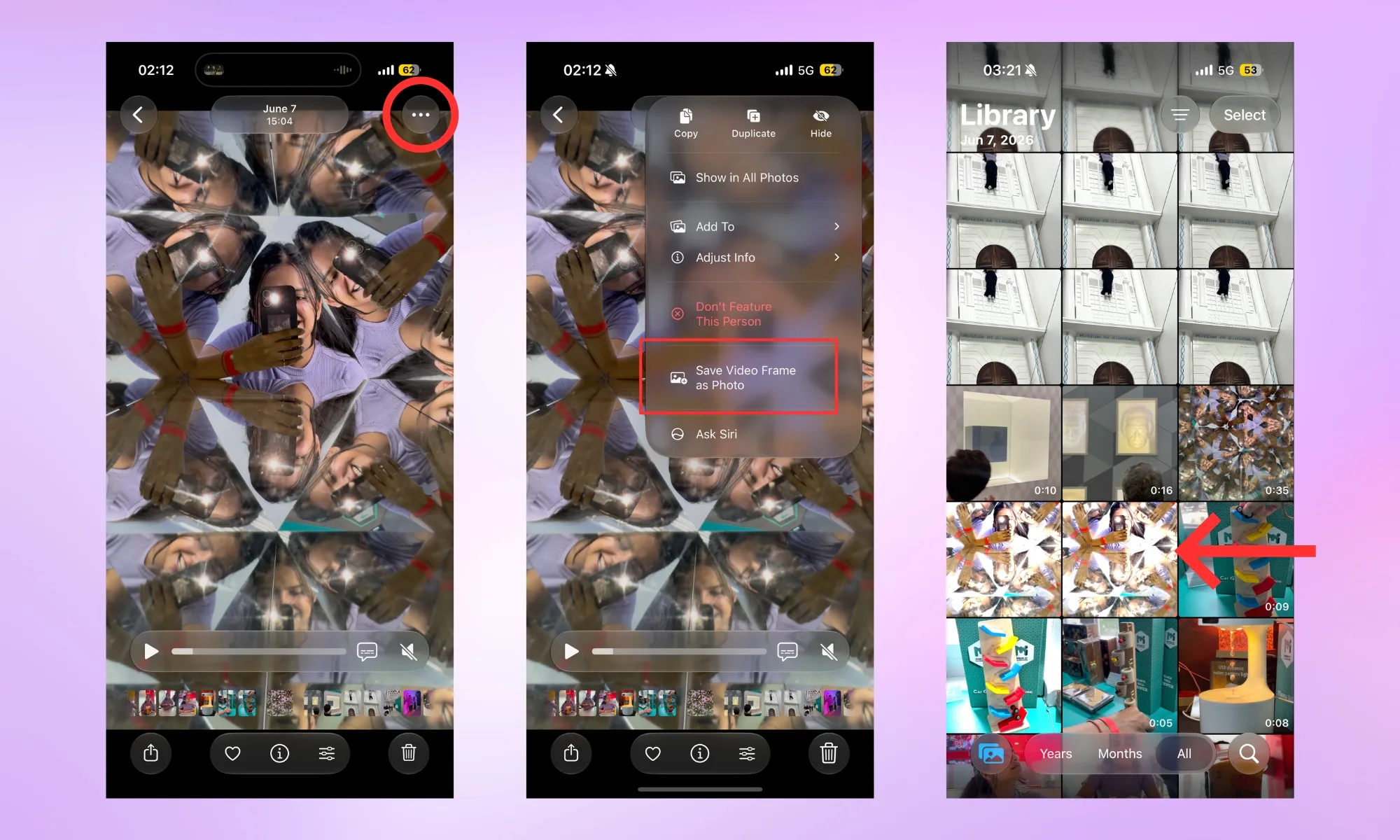
The new “Save Video Frame as Photo” option in the Photos app does exactly what it sounds like. You can save a single frame from a video directly to the gallery as a photo, without the hassle of capturing screenshots. You can use it in two ways.
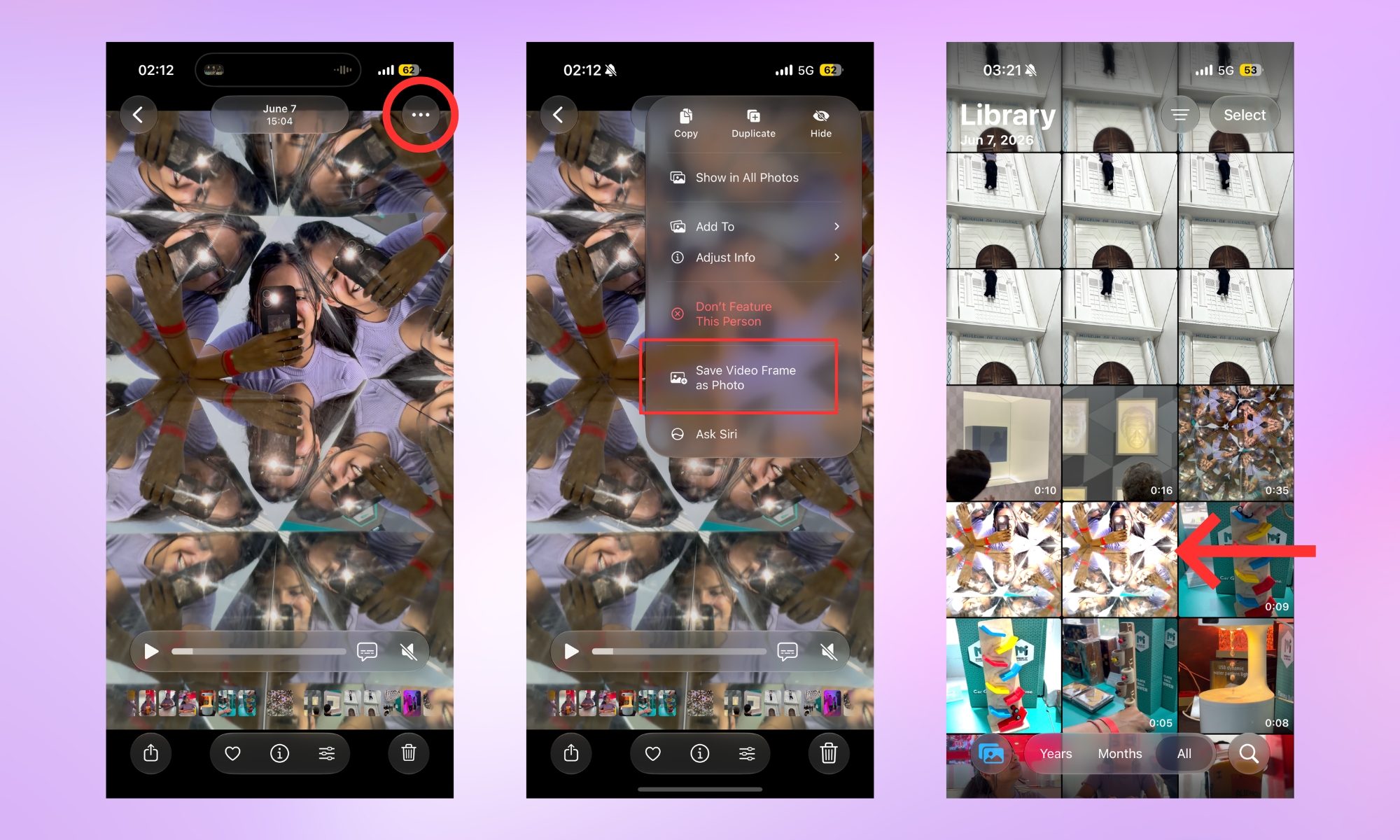
The first one lets you use the feature quickly and save a video frame as a photo in as little time as possible. Open the video in the Photos app, scrub to the moment you want, pause, tap the three-dot menu at the top right of the screen, then tap the “Save Video Frame as Photo” button.
You should see a “Saved Video Frame” dialogue box pop up at the bottom of the screen. The saved frame shows up in your library, right next to the video you’ve extracted it from.
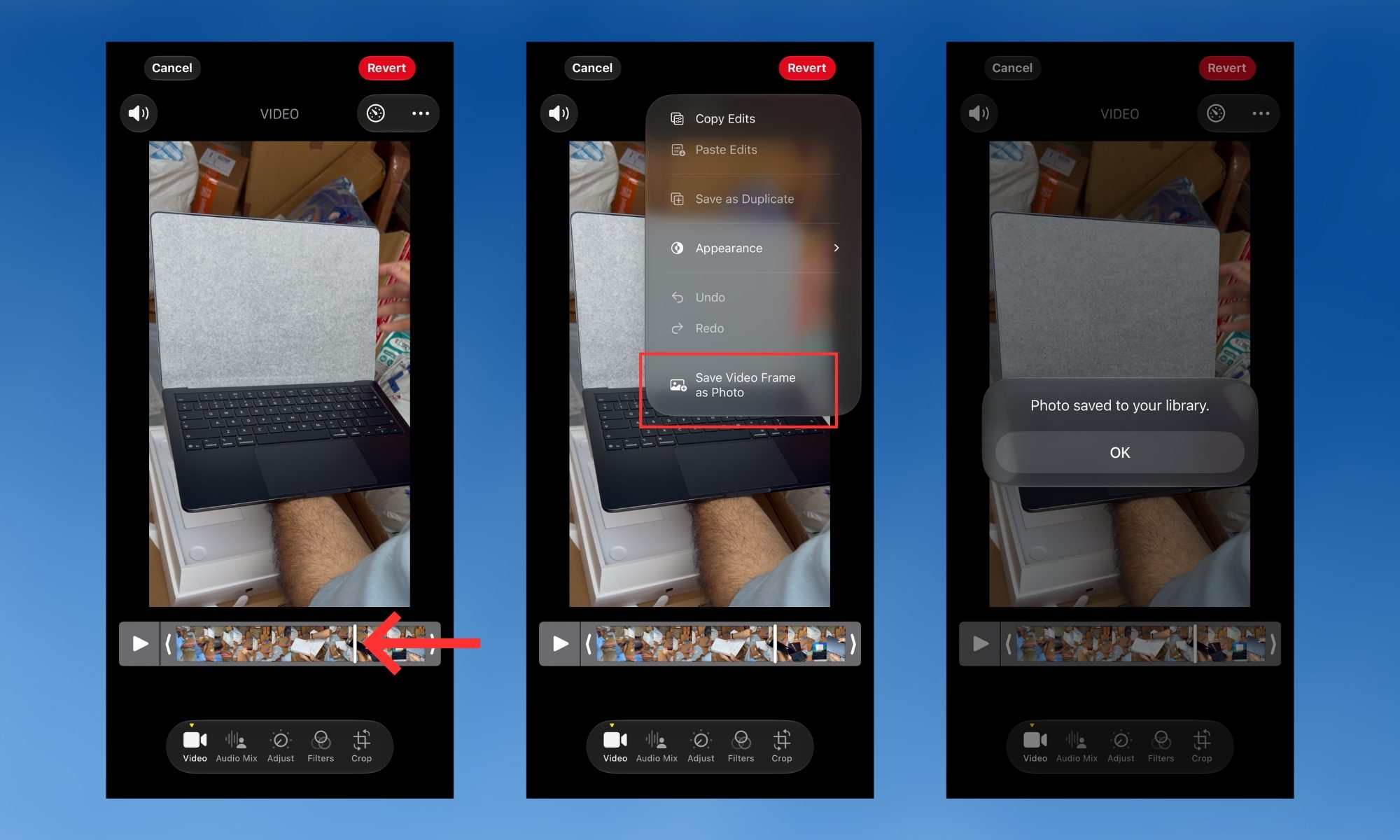
However, if you need frame-by-frame flexibility, open a video, then tap the hamburger menu at the bottom to enter the edit menu. Use the timeline at the bottom of the screen to scrub through the video one frame at a time.
Once you find the exact moment, tap the three-dot menu again and tap “Save Video Frame as Photo.” You should see a “Photo saved to your library” message on the screen. Tap the “OK” button below it, and you’re good to go.
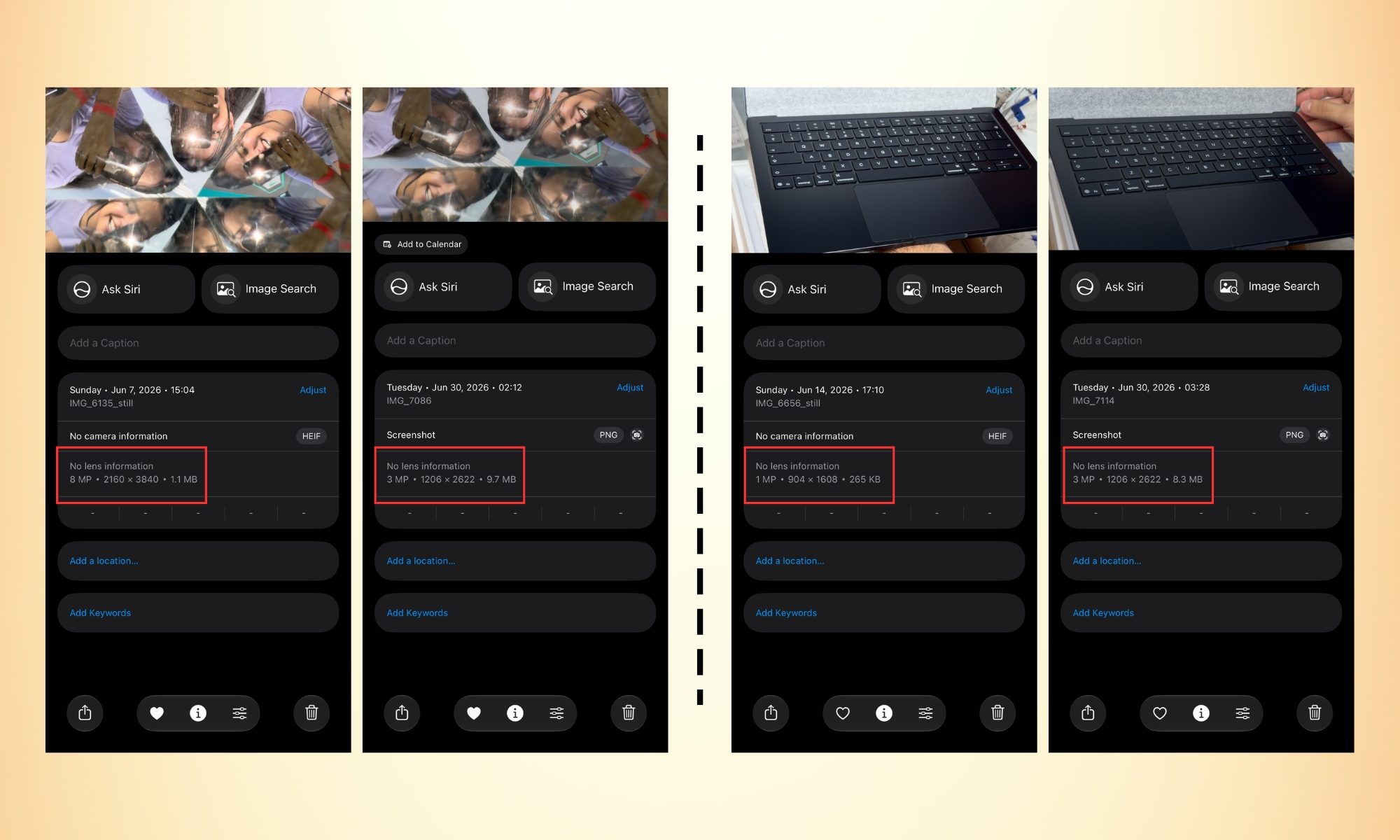
The difference in quality here is worth understanding. Saving a video frame as a picture is the same as taking a picture when you’re recording a 4K video at 60 fps; the saved frame comes out as an 8 MP photo (in Apple’s HEIF format).
Screenshots, on the other hand, save as PNG files that are lower in resolution but larger in file size. In a nutshell, the frame-extracted picture has both a smaller file size and a higher resolution than screenshots.
Furthermore, it doesn’t capture unwanted visual elements, such as the video progress bar at the bottom or a notification pop-up that shows up at the exact moment (I hate those).
It’s one of those iOS 27 features Apple didn’t announce onstage, and yet once you know it exists, you’ll wonder how you ever managed without it.


It’s not surprising that Microsoft is looking to turn its Copilot platform into a “Super App,” given that its rivals are doing the same. But Microsoft is going about the task in a way that doesn’t follow its usual playbook, by putting a big bet on a consumer-savvy hire from the outside with some feather-ruffling ways.
The company’s newly minted Copilot Executive Vice President Jacob Andreou came to Microsoft from Greylock Partners and before that, Snapchat-maker Snap. Andreou currently oversees more than 11,000 Microsoft employees, according to a recent profile in Fortune.
Microsoft is bringing onboard another former Snap (and Discord) vice president, Peter Sellis, to help, GeekWire has learned. Sources say Sellis will be leading Copilot Design, Growth and Engineering, reporting to Andreou.
Andreou is part of a recently formed Copilot Leadership Team. His charter is to lead the “Copilot experience” by driving design, product, growth and engineering, as outlined in a March 2026 reorg memo from CEO Satya Nadella. He is one of a small group charged with shaping the future of Copilot, alongside others focused on the underlying Copilot platform and AI models.
Given Andreou’s Snap background, his plan to meld Microsoft’s consumer and enterprise Copilot experiences makes sense. It won’t be a snap, however. (See what I did there?)
Even though both share the Copilot brand, consumer Copilot and Microsoft 365 Copilot don’t work the same way or use the same data sources or architecture. To boot, Microsoft hasn’t had a lot of luck with this kind of consumer-enterprise unification, as evidenced by the low interest in and uptake of its free, consumer-focused Teams product compared to its business-focused Teams collaboration offering.
The 33-year-old, Los Angeles-based Andreou seemingly is undaunted by the challenge and is pushing some employees to clock 12-hour days to keep up with younger, AI-focused companies, Fortune reports.
Microsoft was infamous for requiring employees to work long hours and weekends during crunch times leading up to delivering Windows NT and Windows 95, but not so much in recent years. Microsoft is known as a place where outsiders often struggle to thrive compared to those who climb the corporate ladder for years, making Andreou’s approach feel even riskier.
Andreou has been a big backer of the Tasks productivity layer in consumer Copilot, which is still in public preview. Tasks, which enables Copilot to handle actionable items, is similar to the recently released Copilot Cowork layer that is part of Microsoft 365 Copilot. (I asked Microsoft if the two would merge as a single Cowork-type offering at some point but was told the company had no comment.)
However, the holy grail remains the “Super App.” With the Copilot Super App, Microsoft is looking to give consumers and business users a reason to stay within Copilot regardless of the AI task with which they – or their agents – are engaging.
“Come summer, we will be bringing coding to all knowledge work within one Copilot Super App. That’s really exciting. So you’re going to have Chat, Cowork, and Code all in Copilot,” Nadella told Microsoft Build conference attendees in early June.
Microsoft isn’t the only AI-focused company working on extending its AI coding capability beyond just developers. Nor is it the only one betting on the Super App concept.
The Copilot Super App isn’t Andreou’s only focus. He tells Fortune that AI model choice and home-grown AI model excellence also are among his key priorities.
Microsoft is expanding model choice in the Copilot Cowork feature beyond Anthropic to include OpenAI and soon, Microsoft’s own Cowork 1 model – which may be based on Microsoft’s hosted version of the open-source DeepSeek model. Cowork 1 will be the newest addition to Microsoft’s growing pool of Microsoft-developed models, seven of which debuted at Build this year. Microsoft is seeking to position itself as the champion of lower cost, efficient models built for those who are token-maxxed out.
Andreou definitely has his work cut out for him as a consumer guy in a heavily enterprise-centric company.
Microsoft 365 Copilot and consumer Copilot are just two of more than two dozen different “Copilot”-branded commercial offerings available across the various Microsoft product teams, which can feel overwhelming.
Microsoft also needs to give users a clearer way to find and use the quickly expanding stable of first- and third-party agents, like the OpenClaw-based Microsoft Scout personal assistant. Will Andreou and his Super App quest bring at least some order to the Copilot and agent madness? We’ll know more sometime this summer.


EOFY is a good time to check gaming laptop deals, even if the laptop isn’t going to be used for work. Gaming laptops can be quite expensive, so a legitimate discount can make a bigger difference than it does on a basic everyday laptop.
That said, a gaming laptop can also be a powerful workstation if your work does need extra grunt. A fast CPU, dedicated GPU and plenty of RAM can help with video editing, 3D work, coding, running AI tools, creative apps or just keeping a lot of browser tabs and programs open at once.
It’s also worth checking our main EOFY laptop deals hub even after June 30, because in previous years we’ve seen some great laptop deals hang around or pop up in early July as retailers clear leftover stock.
For gaming laptops, we have deals from lower-cost RTX 5060 machines with generous RAM, through to much more expensive RTX 5090 desktop replacements.
The Acer Nitro V 16S is a good option for a buyer who wants current-gen gaming performance without paying big money. You still get an RTX 5060, 32GB RAM, a 1TB SSD and a 180Hz display for AU$1,777, which is a lot of hardware for the price.
The RTX 5060 is a lower-end current-gen GPU, but that’s still a good fit for 1080p or 1200p gaming, especially if you’re happy to use DLSS or turn down a few settings in the most demanding games. With RAM prices rising, 32GB of RAM is harder to take for granted at this price, so it’s good to see Acer include it rather than cutting back to 16GB.
The Lenovo Legion Pro 7i is at the other end of the scale. Our Lenovo Legion Pro 7i review described it as “perfect for a desktop replacement, just okay as a portable”, and that’s exactly how I’d frame this deal.
You’re not buying it because it’s cheap or easy to carry everywhere. You’re buying it because you want a very powerful 16-inch gaming laptop with an RTX 5090, 32GB RAM, a 1TB SSD and a 240Hz OLED screen.
Our review gave the Legion Pro 7i 4 stars and called out its excellent gaming performance, gorgeous OLED screen and useful port selection. That makes it a good fit if you want one machine for demanding games, an external monitor setup and heavier work like editing, rendering or development.
The big caveat is battery life, which our review said “is not great”, but that’s the trade-off with this kind of desktop-replacement gaming laptop.
If neither of these gaming laptop deals is quite right, our main EOFY laptop deals hub has more options across cheaper Windows laptops, MacBooks, 2-in-1s and higher-end gaming machines.

Several U.S. states are pushing to ban young people from social media entirely. This marks the latest wave of censorship bills masquerading as “children’s online safety” measures, with states like Massachusetts, Idaho, Minnesota, North Carolina, South Carolina, Illinois, and EFF’s home state of California leading the charge.
Just a few years ago, lawmakers supporting age-gating laws insisted their efforts were narrowly targeted at limiting young people’s access to adult content. At the time, we warned that they would not stop there: once the government established the authority and built the infrastructure to collect and “verify” massive troves of user data, it would inevitably sweep broader and broader categories of lawful speech into this mass surveillance and censorship system.
Unfortunately, our predictions came true. As legislators across the country advance proposals that would block all young people from accessing the “modern public square,” the Overton window has shifted dramatically towards mass censorship—and the speed of this shift should concern all of us.
This primer breaks down this dangerous wave of social media bans: how they work (and why they don’t), who they harm, and how we can fight back.
The details of these bills vary from state to state. Some (like California’s AB 1709) are a flat-out social media ban for all young people under a certain age, while other states (like South Carolina and Minnesota) allow access to young users who hand over even more data to show verifiable parental consent. Many bills regulate certain social media features, too, including by setting default privacy settings, time limits, or notification preferences for all accounts that fail the age-gate.
As for the age-gating mechanism itself, most proposals fall into two broad categories: age verification bills and behavioral age estimation bills.
Age Verification Bills require online services to collect highly sensitive data, including government ID and biometric information, from all users before either restricting or allowing them access.
For example, take California’s social media ban (AB 1709). Starting in January 2027, operating systems will be required to collect enough information from users to sort them into age groups, or “brackets.” Under AB 1709, social media apps would then use that age bracket information to completely block anyone under 16, while supposedly letting everyone else through. By contrast, Florida’s law (HB 3) takes a more aggressive route by forcing platforms to verify users’ identities directly, usually by contracting with private third-party companies to perform verification services.
Behavioral Age Estimation Bills, on the other hand, are a more recent innovation of states like Minnesota (HF 1438) and South Carolina (H 4591). These bills require platforms to estimate the ages of users based largely on data that they already collect, including self-attested age, behavioral information, and account history and activity. In practice, these bills enable tech companies to use algorithms and/or AI to analyze our online behavior and estimate age based on that.
Proponents of behavioral age estimation bills claim that their proposals avoid the massive security risks that come with mandatory age verification bills. However, much of the data that social media platforms collect from us “in the ordinary course of operation” is collected in order to serve us targeted behavioral ads. If we force platforms to use this imperfect data to make more important judgments about who can access their services, we risk entrenching those insidious data collection practices. Surely we don’t want to give social media companies more reasons to justify and sustain their reliance on this exploitative business model.
If you want to dig into the nuance here, our terminology guide sheds more light on the technical differences between age verification and age estimation bills.
Overall, it’s a lose-lose scenario: either platforms collect new forms of our most sensitive and immutable data, or they unleash their AI and algorithms on our existing behavioral data to make creepy guesses about who we are and what we deserve to see. No matter which age-gating method your state chooses to execute its social media ban, there will be lots of error at the margins—and lots of users who will be blocked or chilled from access to lawful online speech.
Social media bans are unconstitutional, discriminatory, and deeply misguided. They reinforce existing structures of oppression, and they are broadly unsupported by young people, whose voices are conspicuously absent from this conversation. They undermine parental decision-making and replace tailored family-level solutions with a one-size-fits-all band-aid. And, in the places we have seen social media bans go into effect, early reports show that they don’t even work.
For example, in Australia, where a social media ban has been in effect since late 2025, a majority of young people can still access social media, those who can’t have lost their access to the news, and crisis helplines are reporting skyrocketing numbers of calls from youth left stranded without online community or resources.
We could go on and on about all of the inherent harms here, but we’ll try to keep this short as we walk through some of the major issues.
In order to ban some users, social media platforms first must confirm the ages of all users, regardless of age. Bans thus incentivize companies to force users of all ages to hand over government IDs, face scans, and other sensitive information. When parental consent is required, companies must collect even more verification data and often create explicit links between child and parent accounts—further destroying users’ anonymity.
Both of these databases create massive data “honeypots” that invite identity theft and permanent surveillance. We’ve already seen repeated data breaches involving age- and identity-verification services. Yet these laws would force both adults and the youth they claim to protect to feed their most sensitive data into this growing surveillance ecosystem.
If we don’t trust tech companies with our private information now, we shouldn’t pass laws that force us to give them even more of it.
Age-verification technology is deeply flawed and prone to discrimination. These systems frequently misidentify or lock out people of color, people with disabilities, and trans or gender-nonconforming individuals whose IDs may not match their appearance.
Where these bills require parental consent, they impose disproportionate access barriers on low-income, non-traditional, and immigrant families. These sorts of families are more likely to share a single family device or have strong reasons to not want the government to track family associations and ID documents.
Beyond the technical failures, these bans cut off a vital lifeline. For LGBTQ+ youth, foster kids, and those stuck in unsupportive home environments, social media is often the only place to find community, explore their identity, or access life-saving resources. Forcibly removing young people isolates those who need connection the most, while creating massive new barriers for adults.
You can read a breakdown of the diverse groups vulnerable to these laws here.
The current legislative push to ban young people from social media relies heavily on the idea that the “great rewiring” of the adolescent brain is a proven fact. This simply isn’t true.
Social science indicates that moderate internet use is a net positive for teens’ development, and negative outcomes are usually due to either lack of access or excessive use. For LGBTQ+ and marginalized youth in particular, social media offers an essential space to access support they might lack offline. By forcing youth into digital isolation, these bans cut off vital access to political news, community, and health resources. They also completely ignore the calls of young people themselves who favor digital literacy and education over restrictive government control.
Instead of cutting off these lifelines, we should support measures that arm all youth (and the adults in their lives) with the knowledge they need to navigate online spaces safely.
No matter your age, the First Amendment protects your right to speak and access information.
Blanket social media bans immensely and unconstitutionally chill all users’ exercise of this right. They cut off young people’s access to lawful speech, or ruin their privacy in the home by mandating parental consent and sometimes even parental access to their account activities and settings. They force all users (adults and young people alike) to hand private information over to tech companies before speaking or accessing information on social media platforms, imposing annoying obstacles on lawful online expression and wrongfully blocking some adults outright.
Critically, these bans destroy our right to online anonymity—a cornerstone of our right to free expression that protects whistleblowers, journalists, activists, immigrants, and everyone who has ever used a private browser or account to ask the internet an embarrassing question.
Social media bans weaponize parents’ concerns about children’s safety to justify unprecedented levels of surveillance and censorship. In the process, these laws deny young people their rights, threaten online anonymity for everyone, expose our sensitive personal data to breach and abuse, and replace parental decision-making with state authority. This is a battle over the future of the open, private, and free internet, and we must act now to protect it.
Here’s how you can help us fight back: Talk to your community (including young people!) about what’s at stake. If you’re a parent, lean on open conversations and platforms’ existing tools to tailor your child’s experiences instead of handing that power over to the government. And no matter where you live, contact your government representatives and tell them clearly that social media bans are not the answer to kids’ online safety.
Republished from the EFF’s Deeplinks blog.
Filed Under: age estimation, age verification, california, free speech, idaho, illinois, massachusetts, minnesota, moral panic, north carolina, social media, social media ban, south carolina


Ethan Tan, a memory industry consultant and former Samsung China executive, told Jefferies Equity Research analysts during a recent briefing that he expects memory prices to rise by 40% to 50% in the third quarter of 2026 compared to the prior quarter, and by another 30% to 40% in Q4….
Read Entire Article
Source link

Looking for a deal on a Yeti cooler for your July 4th celebrations? I’ve got you covered. As the former editor of an outdoor adventure website, I know exactly where to look to find the best offers on Yeti gear, and I have uncovered some great deals that will arrive in time for the big day.
Amazon has some great offers, particularly on soft coolers like the Hopper Flip 8 and 12, both of which are ideal for cans or lunches. There are also big discounts on the roomier Yeti M Series, including backpack-style coolers that make carrying your food and drinks a breeze.
Want a hard cooler? Take a look at Yeti Rescues, where you can find heaps of like-new coolers approved by the company itself, and with big price cuts. It’s a smart way to get a top-quality cooler for a lot less than list price. I’ve tested outdoor gear for years, and these price cuts are rare, so grab them while you can.
Yeti’s online store often holds seasonal sales and special deals on selected colors and product lines. Here are today’s best offers.
Can’t see the cooler you want in the Black Friday sale? Take a look at Yeti Rescues — an official Yeti program that takes coolers and other equipment that’s not brand spanking new (products that have been returned, for example, or that Yeti has used for demos or displays), inspects them, cleans them, and sells them at a bargain price.
Amazon and Yeti Rescues aren’t your only options when you’re shopping for a cheap Yeti cooler. Dick’s Sporting Goods has a decent selection of offers as well. I’ve rounded up a handful of the best below, but you can also check out the full sale yourself.

Follow TechRadar on Google News and add us as a preferred source to get our expert news, reviews, and opinion in your feeds.

Google announced on Monday that the Gemini app is now offering its personalized Nano Banana-powered image generation feature to a broader audience. Starting today, all eligible users in the U.S. can access the feature for free, a service that was previously only available to Plus, Pro, and Ultra subscribers.
Google initially announced that Gemini’s Personal Intelligence feature would get Nano Banana-powered image generation back in April, allowing users to create images that reflect their unique interests. This means that images can be generated based on Gemini’s understanding of your likes and preferences without you having to specify them in your prompt. Gemini utilizes data from your Google account connections — such as Gmail, Google Photos, YouTube, and Search — to achieve this.
For example, instead of saying, “Create an illustration of me and my favorite things, such as coffee and baking,” you can simply request, “Create an illustration of me and my favorite things.”
Gemini can also pull actual images of you from Google Photos, so you don’t need to manually upload photos.

Google initially rolled out the Personal Intelligence feature earlier this year, making it widely available to all U.S. users in March. The company recently expanded this functionality to users in India and Japan.
Personal Intelligence is an opt-in feature, allowing you to decide which apps Gemini can access. Once enabled, it is set as the default for every prompt, but you can disable it using a new toggle in the Tools menu.
Additionally, last month, Google announced several upcoming updates for the Gemini app, including a new “Daily Brief” feature, a revamped interface, access to AI video model Gemini Omni, and a personal AI agent named Gemini Spark.
Notably, Google’s AI chatbot Gemini surpassed 750 million monthly active users (MAUs) earlier this year, reinforcing its position as a major player in the AI space.
When you purchase through links in our articles, we may earn a small commission. This doesn’t affect our editorial independence.

Some of Apple’s corporate secrets aren’t so secret any more.

On top of leaks around its next smartphone generation, Apple has had sensitive details about its manufacturing processes revealed. Reuters reported that the documents posted on “the dark web” allegedly show information about both components and their suppliers for the iPhone 18 Pro. The leak included specifics on hundreds of parts, such as chips on the main circuit board and elements of the smartphone’s battery and cameras, according to the publication. Last week, AppleInsider first reported on the cyberattack, which took more than 630GB of data from India-based Tata Electronics. Fellow clients Tesla and Taiwan Semiconductor Manufacturing Co. also had documents in the leak, but much of the information seems to center on Apple.
Tata has risen to become one of Apple’s most prominent suppliers outside of China. Apple told Reuters that it is working on long-term security measures with Tata and that it is investigating this incident. The company has typically kept quiet about the specifics of its supplier relationships, and having these details exposed could put Apple on the back foot in terms of any future negotiations with its partners, particularly as it increases prices for many products in the wake of RAM shortages. Apple is expected to announce the iPhone 18 Pro, along with the iPhone 18 Pro Max and possibly its first foldable smartphone this fall.



Two goals and an assist by sheer aura: Cristiano Ronaldo just entered the World Cup chat


Weekend Open Thread: Staud – Corporette.com


The House | Manchesterism won’t survive the painful trade-offs unless it gets citizens on board


Potential 2028er World Cup attendee leaderboard


MAJOR BITCOIN & MARKET UPDATE!!!! (MUST WATCH ASAP!!!)


Asia stock markets slide as tech shares slump


A Look At A Gaggle Of Transputer Boards


Securitize Wraps Roubini's SEC-Registered ETF as Dubai VARA Digital Security
Bitcoin (BTC) Dips Below $62K, Ethereum (ETH) Plunges 6% Daily: Market Watch

Dell (DELL) Shares Tumble Over 5% Following Analyst Downgrade to Hold


Coinbase, Circle Deepen Crypto Stock Losses Despite Resilient S&P 500
Entergy settles forward sale agreements, raises $672 million in cash proceeds


Kraken's xStocks Opens Bending Spoons IPO Registration to EEA Retail


FIH Pro League: India defeat Pakistan 7-1, register biggest win of campaign | Other Sports News


Russian hackers now target Signal backup recovery keys


Bluekit phishing kit adopts browser-in-the-middle for login theft


Bitcoin Sparks $600M Hourly Liquidations With $65,000 Set To Become Resistance

Hyperliquid Named on Singapore MAS Investor Alert Register


RTX holders must register wallets before token distribution begins


Ripple and SBI launch RLUSD in Japan after JFSA approval


You must be logged in to post a comment Login