

Crypto World
Here’s How CoinEx Became a Critical Gateway for Iran’s Crypto Economy


More than $3.84 billion in blockchain transactions have been traced between crypto exchange CoinEx and sanctioned Iranian entities over a period of more than seven years.
The findings come shortly after the US Treasury’s Office of Foreign Assets Control (OFAC) sanctioned four Iranian exchanges, Nobitex, BitPin, Wallex, and Ramzinex, under Executive Orders 13224 and 13902.
TRM Maps CoinEx’s Expanding Iran Connections
According to the latest report by TRM Labs, the four exchanges represented roughly $7.7 billion, or 78%, of Iran’s estimated $10 billion in attributed crypto activity in 2025. Despite repeated enforcement actions, Iran’s annual crypto volumes have remained high. CoinEx, which was founded in 2017 by Haipo Yang and operated through entities in several jurisdictions, has processed more than $79 billion in trading volume.
The exchange has also faced regulatory actions in several countries. TRM’s findings reveal that CoinEx is the largest external counterparty of Iran’s biggest crypto exchange, Nobitex. Since late 2018, more than $2.7 billion has moved between the two platforms through roughly 6.2 million blockchain transfers, averaging about $1 million per day. Nobitex has sent around $360 million more to CoinEx than it received, which suggests that funds are consistently moving from Iran to international markets through CoinEx.
Activity between the two exchanges rose from about $13 million in 2020 to $575 million in 2021. After declining in 2022 and 2023, volumes recovered to $714 million in 2024 and $763 million in 2025. In fact, CoinEx accounted for over 16% of Nobitex’s yearly transaction activity.
TRM also identified direct links between CoinEx and more than 60 Iranian crypto businesses, including Wallex, Ramzinex, BitPin, Aban Tether, Excoino, Bit24, Ompfinex, Sarmayex, and Exir. The report said a similar share of transaction volumes was routed through CoinEx across multiple Iranian exchanges, along with the gradual onboarding of platforms over several years, which points to an organized relationship rather than independent market behavior.
The blockchain intelligence company further found that around $67 million originating from the Central Bank of Iran reached CoinEx through a complex laundering structure between June 2025 and June 2026. Funds reportedly moved through multiple blockchains, cross-chain bridges, Gnosis Safe contracts, and Aave tokens before eventually reaching CoinEx. The exchange also allegedly provided transaction fees that helped support these transfers.
ViaBTC, a mining pool operated by CoinEx’s parent company, was also closely tied to Iran. TRM traced more than $154 million between ViaBTC and Nobitex-linked wallets, and most transfers flowed from the mining pool to Iranian wallets. Following the 2025 cyberattack on Nobitex, previously inactive mining wallets transferred about $2.7 million to a new Nobitex wallet. ViaBTC also appeared in the transaction chain, which indicates that mining reserves were used to restore liquidity.
Conflict Altered Transaction Patterns
CoinEx’s exposure to wallets linked to the IRGC, Palestinian Islamic Jihad, Hezbollah, Garantex, Bitzlato, the CoinEx hack, BlackSuit ransomware, and the Wasabi mixing service was also found by TRM. Transaction patterns changed after the US-Iran-Israel conflict intensified in early 2026. Average transfer sizes increased sharply, and larger transactions became more common.
After OFAC sanctioned several Iranian exchanges earlier this month, transaction volumes between CoinEx and Iranian entities fell significantly, although the firm noted that private exchange accounts could still allow activity to continue outside public blockchain visibility.
Meanwhile, CoinEx denied having any relationship with the Iranian government or sanctioned entities and said it has never provided funding or support to them. The exchange further asserted that blockchain transactions do not prove involvement in illegal activity.
The post Here’s How CoinEx Became a Critical Gateway for Iran’s Crypto Economy appeared first on CryptoPotato.


Prediction markets are quietly becoming a new on-ramp to crypto. A 90-day Bitget Wallet study tracking onchain activity from 857,000 active Polymarket users found that about 60% of people who placed their first World Cup bets on the platform had never interacted with blockchain protocols before.
Separately, US crypto policy is still moving—albeit amid political crosswinds—after Donald Trump canceled the signing ceremony for a housing bill that includes a ban on central bank digital currencies (CBDCs). Meanwhile, Ethereum’s ecosystem is seeing fresh institutional positioning efforts, including new research-and-development backing aimed at supporting the network’s next adoption phase.
Key takeaways
- Bitget Wallet data suggests prediction markets can draw first-time crypto users without requiring prior blockchain familiarity.
- Trump’s delay of a housing bill highlights how CBDC-related provisions may remain entangled with broader US legislative priorities.
- New backing for an Ethereum R&D nonprofit, Ethlabs, targets “institutional adoption” readiness as ecosystem funding concerns persist.
- Crypto market coverage this week also pointed to growing scrutiny of US regulatory proposals and ongoing pressure on large holders’ liquidity management.
Prediction markets as a practical crypto on-ramp
According to the Bitget Wallet study, roughly six in ten Polymarket users who made their first World Cup bets had no prior experience with blockchain protocols. That pattern matters because onboarding into crypto has historically focused on teaching users the mechanics—wallets, custody, signing transactions—or at least easing those steps through better interfaces.
In an interview with Cointelegraph, Bitget Wallet COO Alvin Kan said earlier onboarding approaches often assumed users would still need to learn how crypto works before they could participate. Prediction markets, he argued, change the incentive: users arrive because they already have a view about what could happen in the real world, and the crypto component becomes secondary to the outcome betting.
“Prediction markets shifted that dynamic. Users show up because they have a view on something happening in the world,” Kan said.
The implication for the broader industry is straightforward: if prediction markets can repeatedly attract people who have never touched crypto, they may function like a bridge between mainstream “event-driven” behavior and onchain settlement. For builders, the operational question is how well these first-time users can be retained after the initial activity—whether they continue using wallets, understand transaction flows, and eventually seek out other onchain services beyond betting.
US housing bill CBDC ban delayed amid SAVE America Act linkage
US President Donald Trump canceled the signing ceremony for the 21st Century ROAD to Housing Act, a measure that had already passed the US House and Senate and includes a provision barring the Federal Reserve from issuing or creating a CBDC—or a digital asset “substantially similar”—until the end of 2030.
In a Truth Social post, Trump said the signing would be postponed “until such time as we pass the desperately needed SAVE America Act.” He has previously indicated he would not sign other bills until that voting-related legislation moves forward.
Coverage noted that the housing bill had been widely expected to be signed without complications, but the president’s stated approach ties the CBDC-adjacent timeline to a separate political objective in Congress. The SAVE America Act would require proof of US citizenship in person to register, a point that critics argue could disenfranchise eligible voters.
For crypto stakeholders, the immediate takeaway is less about the final fate of the housing bill and more about pacing: even when legislation includes concrete restrictions on CBDCs, political sequencing can still reshape when (and whether) the public policy signal fully lands.
Ethereum pushes for institutional readiness as funding pressures persist
Ethereum-related efforts this week centered on institutional readiness. Sharplink—backed by former Ethereum Foundation contributors and funded by Bitmine and Joe Lubin among others—announced the launch of Ethlabs, a new research and development nonprofit designed to help prepare Ethereum for what it described as a “next phase of institutional adoption.”
The group framed the moment in terms of market convergence: stablecoins, tokenized real-world assets, funds, and autonomous AI commerce are increasingly moving on-chain, and Ethlabs aims to ensure Ethereum can absorb the demand “at scale.”
The launch arrives against a backdrop of ecosystem concern about development resources. Cointelegraph previously reported warnings from former Ethereum Foundation contributor Trenton Van Epps about a potential core development funding crisis, and the Ethereum Foundation has also faced notable leadership departures, including the exit of co-executive director Hsiao-Wei Wang reported earlier.
What’s particularly relevant for investors and protocol participants is that Ethlabs signals parallel capacity-building outside the Foundation structure—an approach that may be increasingly common as the ecosystem searches for sustainable long-term funding models. However, readers should watch how these R&D efforts translate into measurable improvements—whether in scaling, privacy, security, or censorship resistance—rather than only in organizational announcements.
Strategy’s dividend strain revives liquidity and purchasing debate
While not tied to a single legislative or institutional headline, CryptoQuant’s analysis highlighted stress points in one of the largest Bitcoin treasury strategies. The analytics firm said Strategy’s dividend coverage fell to about 14 months from seven years, and recommended the company led by Michael Saylor pause Bitcoin purchases while replenishing its cash reserve, which it estimated has fallen 38% year-to-date.
CryptoQuant said Strategy’s dividend obligations have nearly quadrupled to $1.2 billion after the firm issued new STRC preferred stock with an 11.5% yield. In a Wednesday X post, CryptoQuant CEO Ki Young Ju urged a systematic framework for when Bitcoin purchases occur and also called for a “disciplined selling framework” for the next bull cycle.
Cointelegraph had earlier reported that Strategy repurchased $1.5 billion of its 2029 senior notes at a discount on May 26, and that its cash coffers recovered later after selling MSTR shares and adding $300 million to its US dollar reserve. Even so, CryptoQuant framed the remaining runway as near a record-low level of funds available to cover dividends.
For market participants, the broader lesson is that even in a Bitcoin-linked thesis, capital allocation discipline and liquidity planning remain the real constraints. Dividend mechanics can change the shape of risk regardless of long-term asset convictions.
Going forward, the most important thing to monitor is how these separate threads interact: whether prediction markets continue to widen crypto access without losing first-timers, whether US policy timelines involving CBDC restrictions accelerate or stall, and whether Ethereum’s new institutional readiness push can address ongoing development funding concerns with concrete, network-impacting outcomes.

About 60% of World Cup bettors on Polymarket are first-time crypto users
About 60% of users who placed their first World Cup bets on Polymarket had never interacted with blockchain protocols before, suggesting prediction markets are becoming an entry point into crypto.
The finding is based on a 90-day Bitget Wallet study that tracked the onchain activity of 857,000 active Polymarket users.
Alvin Kan, chief operating officer at Bitget Wallet, told Cointelegraph that earlier crypto onboarding efforts largely focused on making blockchain technology easier to understand through simpler wallets and better user interfaces, but users were still expected to learn how crypto worked before they could participate.
“Prediction markets shifted that dynamic. Users show up because they have a view on something happening in the world,” Kan said.
Trump cancels signing of housing bill with CBDC ban
US President Donald Trump canceled the signing ceremony for a housing bill containing a ban on a central bank digital currency (CBDC) as he looked for Republicans in Congress to prioritize a controversial voting bill.
In a Wednesday morning Truth Social post, Trump said that the signing for the 21st Century ROAD to Housing Act, passed by the US Senate and House of Representatives, would be canceled “until such time as we pass the desperately needed SAVE America Act.”
The housing bill, passed by the House on Tuesday, included a provision barring the US Federal Reserve from issuing or creating a CBDC “or any digital asset that is substantially similar” until the end of 2030.
Many had expected Trump to sign the bill, aimed at tackling housing affordability, into law on Wednesday without issues. However, the president said in March that he would “not sign other bills” until the SAVE America Act was passed. The legislation would require voters to provide proof of US citizenship in person to register, with critics saying the measure would disenfranchise citizens already eligible to vote.

Bitmine, Sharplink and Joe Lubin back Ethereum R&D nonprofit
Former Ethereum Foundation contributors and Ether treasury firms Bitmine and Sharplink have backed a new research and development nonprofit that aims to make Ethereum ready for institutional use.
Sharplink said on Monday that the organization, Ethlabs, was formed to “ready Ethereum for the next phase of institutional adoption,” with the company pitching in with Bitmine, Ethereum co-founder Joe Lubin and other Ethereum contributors on its funding effort.
“As stablecoins, tokenized real-world assets, funds and autonomous AI commerce move on-chain, they are converging on Ethereum as the neutral, credibly permissionless settlement layer for the global economy,” Sharplink said. “Ethlabs exists to ensure the network is ready to absorb that demand at scale.”
The launch comes days after former Ethereum Foundation contributor Trenton Van Epps warned that Ethereum is facing a core development funding crisis and amid an ongoing wave of departures from the Foundation, most recently co-executive director Hsiao-Wei Wang, who left last week.

CryptoQuant warns on Strategy’s dividend coverage as cash reserve falls 38%
After Strategy’s dividend coverage fell to 14 months from seven years, CryptoQuant said the company led by Michael Saylor should pause Bitcoin purchases and focus on replenishing its cash reserve, which is down 38% year-to-date.
Strategy’s dividend obligations have nearly quadrupled to $1.2 billion, as the company issued substantial new STRC preferred stock, which carries an 11.5% yield.
“They should pause Bitcoin purchases, rebuild cash reserves, and adopt a systematic framework for purchase timing,” wrote the market data analytics provider’s CEO Ki Young Ju in a Wednesday X post, adding that the biggest public Bitcoin treasury holder should also create a “disciplined selling framework” for the next bull market.
Strategy’s cash reserve fell 38% after the company repurchased $1.5 billion of its 2029 senior notes at a discount, Cointelegraph reported on May 26. Those coffers have since recovered to $1.4 billion after it sold $335.5 million in MSTR shares, which added $300 million to its US dollar reserve on Monday, although it is near a record-low of 14 months’ of funds available to pay dividends.
Catholic leaders, US authorities challenge CLARITY Act over illicit activity
A group of law enforcement organizations and a coalition of Catholic organizations have become the latest two groups urging caution over the US CLARITY Act, which is heading for a key hearing in July.
In letters sent Tuesday, four law enforcement organizations reached out to White House officials with concerns that the CLARITY Act could create oversight gaps when it comes to illicit activity.
“Regulatory certainty should not come at the expense of accountability, transparency, victim protection, or public safety,” they said. The Alliance to End Human Trafficking, founded by US Catholic Sisters, said these oversights could make it harder to crack down on human trafficking.
Senator Cynthia Lummis said this week, the final text for the bill would be released July 4, with the House Financial Service Committee scheduling a hearing into the Clarity Act on July 17.

Winners and Losers
At the end of the week, Bitcoin (BTC) is at $59,359 which represents a 6.8% decline, while Ether (ETH) is at $1,565, after falling 8.8% for the week. XRP (XRP) is at $1.04 and down 8% for the week. The total market cap is at $2.06 trillion according to CoinMarketCap.
Among the biggest 100 cryptocurrencies the top three altcoin gainers are Velvet (VELVET) at 290%, DeXe (DEXE) on 55% and Audiera (BEAT) which was up 49%.
The top three altcoin losers of the week are MemeCore (M), which lost 76%, WorldCoin (WLD), which lost 28%, and Mantle (MNT), which was down 20%.
Prediction of the week
Bitcoin may fall lower but BTC power-law frames crash to $58K as ‘normal’
Bitcoin’s drop to $58,000 lines up with the power-law model’s cycle lows, even though futures market data points to deeper lows for BTC price.
Giovanni’s Bitcoin power-law model places the network’s long-term trend price near $135,000, making the recent drop to $58,000 roughly 54% below the all-time high and 1.22 standard deviations beneath that trend.
According to the analyst, the key takeaway is straightforward: the previous cycle lows in 2012, 2015, 2019, 2020, and 2022 all fell within a similar statistical range. By that measure, the latest decline falls within a territory that has historically marked the deep bear-market lows rather than a break in Bitcoin’s long-term growth path.
Top FUD of the week
Binance faces EU service limits as MiCA rules take effect
Binance has notified European Union users that access to key services will be restricted after the exchange failed to secure Markets in Crypto-Assets (MiCA) authorization from a member state before a July 1 deadline.
Those restrictions include halting the onboarding of new EU users and limiting certain services for EU-based accounts effective July 1, according to exchange notices shared by users on social media.
The notices said users will still be able to withdraw their assets after that date, stating that “all digital assets are still available for withdrawal,” in line with applicable regulatory requirements.
The move marks one of the first major transitions under the EU’s MiCA framework after Binance announced it withdrew its MiCA license application in Greece on Wednesday.
Binance recorded over $400 million in net outflows during the week beginning June 22.
Binance’s public messaging is that the company intends to continue pursuing a MiCA license, despite being on pace to miss the July 1 buzzer.
Iran-linked entities moved $3.8B through CoinEx, TRM says
Wallets with identifiable links to sanctioned Iranian entities have moved over $3.84 billion through cryptocurrency exchange CoinEx since 2019, making it one of the main channels used to bypass US economic sanctions, according to blockchain analytics company TRM Labs.
About 60 Iranian platforms were tied to the funds, with $2.7 billion of this flowing between CoinEx and Nobitex, Iran’s largest domestic cryptocurrency exchange, at an average rate of about $1 million per day since 2018, wrote TRM Labs in a Wednesday report.
By 2024, CoinEx was Nobitex’s largest external counterpart, nearly nine times that of the next-largest exchange, a pattern that TRM Labs called “inconsistent with independent market behaviour.”
CoinEx denied having any commercial relationship with the Iranian government or domestic Iranian exchanges and disputed TRM Labs’ interpretation, saying onchain fund flows do not demonstrate a platform’s knowledge of or participation in illicit activity.
Ethereum Foundation sacks 20% of workforce amid strategic restructuring
The Ethereum Foundation (EF) has laid off 54 employees, roughly 20% of its workforce, as part of a major organizational restructuring.
According to a blog post published Tuesday, the EF will reorganize around five specialized clusters covering protocol, access, user, community and institutional work. The Foundation said the changes are intended to concentrate resources on Ethereum’s long-term technical priorities, including scaling, privacy, security and censorship resistance.
Under the new structure, separate teams will oversee Ethereum’s core protocol, user access tools, community engagement and work with institutions, while management and operations functions remain organized independently.
Ethereum co-founder Vitalik Buterin said the Ethereum Foundation is reducing its budget by roughly 40% as it transitions toward a long-term, endowment-based organization. He said the foundation aims to lower annual spending from about 15% of its remaining funds to roughly 5% after 2030, a shift he said necessitated difficult staffing decisions.
Top feature stories of the week
The failure of Botanix suggests that Bitcoiners still prefer Ethereum DeFi to Bitcoin L2s. How can Bitcoin L2s change to win hodlers over?
Ethereum’s latest “funding crisis” has triggered a fierce debate over whether to tax staking rewards or to pursue funding from large ETH holders for new organizations like EthLabs.
AI is banking the unbanked in Africa… faster than crypto
AI is widening access to banking for the unbanked across Africa. But used badly, it can simply automate financial exclusion at greater speed.
Nearly 60% of S&P 500 stocks now carry a Buy rating from Wall Street analysts, the highest level on record, after the United States and Iran agreed to halt strikes and ease geopolitical tensions.
The mix of record analyst optimism and cooling Middle East risk has reinforced bullish sentiment across US equities and other risk assets, including crypto.
S&P 500 Buy Ratings Climb Toward a Record
Nearly 60% of S&P 500 stocks carry a Buy rating, the highest on record, strategist Charlie Bilello says. FactSet data put Buy ratings at 59.4% of analyst calls in June.
Hold ratings have slipped to 35.7%, and Sell calls sit at 4.9%, below their five-year average. Such Sell calls are structurally rare, since Wall Street analysts lean toward Buy and Hold.
Bilello, chief market strategist at Creative Planning, framed the optimism as a caution rather than a green light.
“When everyone is expecting good news, there’s less room for positive surprises,” He shared the view in late June.
Analyst optimism firmed as the US and Iran agreed to stop all “kinetic activity,” according to Axios. They will meet Tuesday in Doha.
According to the report, U.S. officials said both sides will suspend hostilities for now, allowing commercial vessels to move freely while technical negotiations continue.
The talks will focus on implementing the ceasefire terms, including maritime security measures and a planned military hotline between the U.S. and Iran that has yet to become operational.
The deal extends a stop-start truce that began with a June 18 framework, which collapsed into fresh strikes days later. Cooling Middle East risk has helped reinforce the bullish mood across markets.
What It Means for Crypto and Risk Assets
The crypto stakes run through the Strait of Hormuz. About 20 million barrels of oil cross it each day, roughly a fifth of global consumption, per the EIA. Each flare-up there has battered crypto prices. A June 3 drop below $66,000 set off about $1.84 billion in liquidations, the most since February, per CoinGlass.
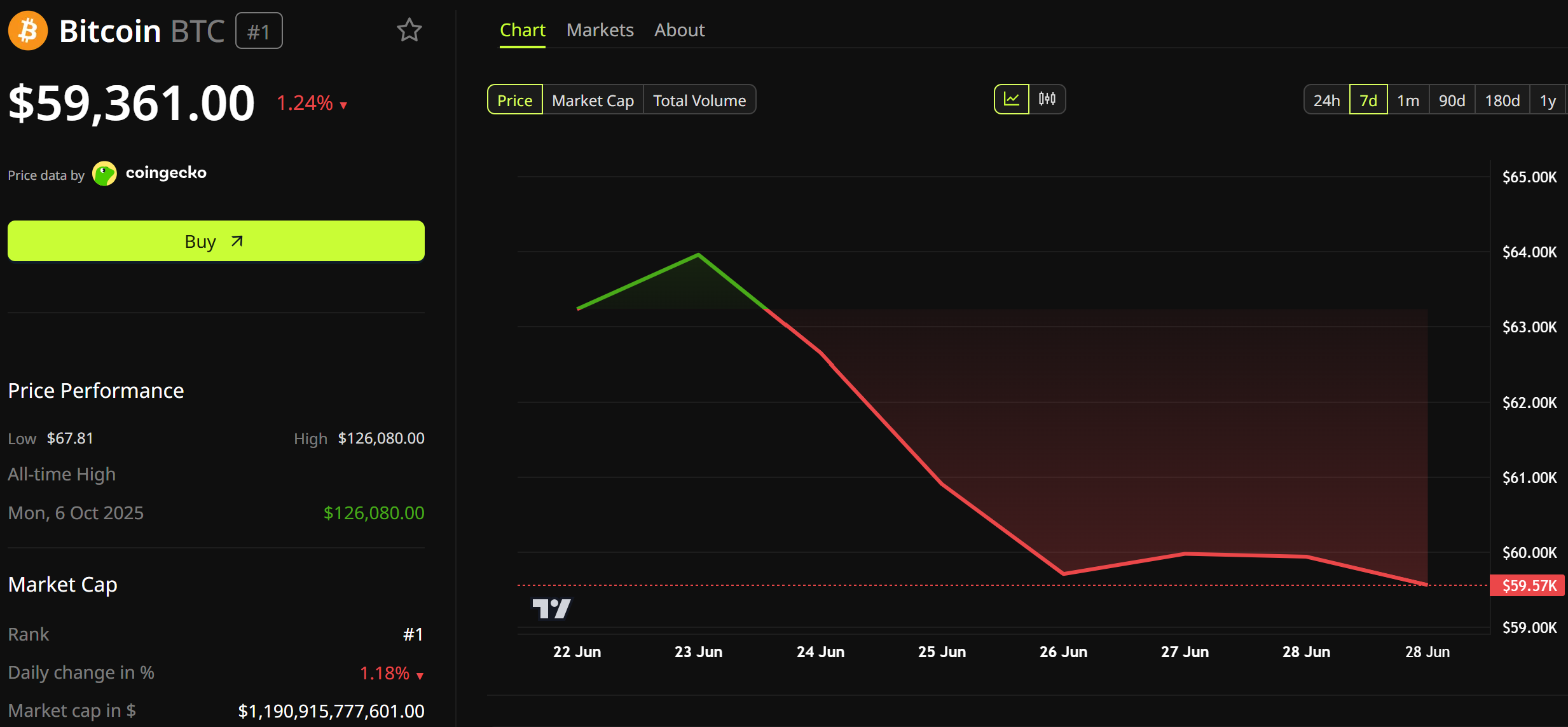
Stocks have held near highs while Bitcoin (BTC) has slumped to lows, a divergence worth watching for risk assets. Bitcoin’s spot price sat near $59,633 on Monday, down about 6% on the week despite the truce talks. That leaves it roughly 53% below its October 2025 peak near $126,080.

When the two sides signed the June framework, oil fell and US stocks rallied. Bitcoin trades around the clock, so it often moves on these headlines before equities open.
The setup stays fragile. President Trump has threatened to “complete the job,” and Iran’s Revolutionary Guard issued fresh warnings over the strait. Bank of America has long called Bitcoin a risk asset rather than an inflation hedge. Its tight link to stocks cuts both ways.
The combination of record optimism and easing tensions has lifted expectations for further gains. Those odds now hinge on whether Tuesday’s talks hold and oil stays calm, alongside the Fed and Bitcoin’s longer-term outlook.
The post 60% of S&P 500 Stocks Carry Buy Ratings as US, Iran Halt Strikes appeared first on BeInCrypto.


Austria has asked the EU to explore hosting Anthropic inside Europe, weeks after Washington restricted foreign access to the company’s most advanced artificial intelligence models.
State Secretary for Digitalization Alexander Pröll made the proposal in a letter to the European Commission. He admitted he could not say how the plan would work in practice.
Europe’s Bid to Host Anthropic
Pröll sent the letter to European Commission Executive Vice President Henna Virkkunen. He argued that Europe risks being cut off from frontier AI breakthroughs unless it acts now.
In his letter, Pröll asked member states to weigh a far bigger step.
“the strategic establishment and participation of Anthropic within the European Union”
His pitch dangled incentives such as legal certainty, fresh capital, and full access to Europe’s single market. He offered no funding figure, timeline, or build plan, and conceded skeptics would doubt whether the idea can work.
Brussels is already weighing fallout from the public controversy.
Follow us on X to get the latest news as it happens
The US Curbs That Triggered the Appeal
Washington set this in motion on June 12. The Commerce Department issued an export directive on the firm’s two strongest models. It barred every foreign national, even Anthropic’s own non-citizen staff.
The order hit Claude Fable 5 and Claude Mythos 5, its newest AI models, days after launch. Unable to screen users by nationality, Anthropic pulled both worldwide. Claude Opus 4.8 stayed online.
Officials cited national security. The warning came from Amazon, Anthropic’s biggest backer, after its researchers pulled restricted cyberattack guidance from Mythos. Anthropic CEO Dario Amodei called the bypass narrow, not a full jailbreak. The model had already shown it could crack guarded government systems.
On June 26, the government eased the export block for more than 100 trusted US institutions. Fable 5 stays restricted.
Any relocation runs into Anthropic’s American foundations. The firm is funding a $50 billion data center build in Texas and New York. Amazon has invested $13 billion and is its primary training partner. In return, Anthropic has committed to spend over $100 billion on Amazon’s cloud within a decade.
The company also estimates US AI will need roughly 50 gigawatts of new power by 2028. Europe sits far behind on the inputs. Its Chips Act targets a 20% share of global chip output by 2030, up from under 10% now. The bloc’s own forecast sees just 11.7%, and EU auditors call the goal very unlikely.
The appeal lands as Brussels weighs its answer to US control over frontier AI. Europe still leads on regulation through its own AI rules.
Yet it lacks the compute, capital, and power base that keeps Anthropic rooted in America. Whether the Commission sees a real option or a political signal should grow clearer soon.
The post Europe Makes Bold Play for Anthropic After US AI Restrictions appeared first on BeInCrypto.

The Bank for International Settlements (BIS) has issued a blunt warning that the fast-growing stablecoin market could undermine core pillars of the global monetary system—particularly sovereign control and the ability of banks to fund lending to the real economy. In its Annual Economic Report, published Sunday, the Basel-based institution assessed the stablecoin sector at roughly $316 billion and argued that most tokens pegged to fiat currencies do not have the institutional features needed to function as safe, reliable money at scale.
Rather than dismissing tokenization altogether, BIS said policymakers should push toward “tokenized” versions of central bank and commercial bank money on regulated infrastructures. The report also expands BIS’s critique of public, permissionless blockchains—arguing that the economic incentives and governance gaps in decentralized networks make them a poor fit for systemically important financial infrastructure.
Key takeaways
- BIS warns that stablecoin growth could fragment the monetary system and weaken central banks’ ability to control money and credit.
- The BIS report argues that fiat-pegged stablecoins lack the institutional design needed to operate as reliable money at the scale financial systems require.
- Tokenized central bank money and tokenized commercial bank deposits on regulated platforms are presented as a more robust alternative.
- BIS points to “stablecoin dollarization” as a risk factor for monetary sovereignty and bank intermediation, especially in emerging markets.
- The report renews BIS’s stance that permissionless public blockchains face structural hurdles tied to settlement economics and accountability.
Stablecoins, monetary sovereignty, and the bank funding question
In its assessment of stablecoins, BIS focused on what it sees as structural vulnerabilities in how reserve assets underpin many tokens. The report argues that stablecoins pegged to fiat currencies may not provide the same institutional safeguards expected of money used throughout payments and finance.
More broadly, BIS said that a meaningful shift by holders away from commercial bank deposits and into private digital tokens could reduce banks’ funding base. In BIS’s framing, that contraction could constrain banks’ capacity to extend credit to the real economy—an issue that connects stablecoin adoption not just to payments, but to financial intermediation and credit creation.
Equally important for central banks, BIS said the current regulatory approach may not be sufficient if private digital currencies continue to expand. The report’s policy signal is that stablecoins should not be treated as the foundation of the future monetary system without addressing the risks to monetary stability and sovereign control.
The “stablecoin dollarization” risk
BIS also highlighted a trend it calls “stablecoin dollarization”: the growing use of dollar-denominated stablecoins in countries with weaker domestic currencies. According to BIS, this pattern can impair monetary sovereignty and reduce the effectiveness of local monetary policy.
The BIS report further links stablecoin dollarization to weaker bank intermediation and greater exposure to volatile cross-border capital flows. BIS’s concern is that when dollar-linked tokens become an increasingly common store of value and medium of exchange, domestic policy tools can become less effective—particularly in emerging market economies where financial systems may already face constraints.
For market participants, the implication is that stablecoin growth does not occur in a policy vacuum. Adoption in jurisdictions with currency stress can change the transmission of monetary policy, alter deposit dynamics, and potentially amplify external shocks.
BIS presses for “unified ledger” tokenization
While BIS critiqued stablecoins as they currently operate, it did not reject the underlying idea of tokenization. Instead, the report advocates a “unified ledger” architecture that brings tokenized central bank money, tokenized commercial bank deposits, and tokenized financial assets together on programmable platforms—within regulated legal and institutional frameworks.
BIS’s underlying argument is that tokenization can deliver practical benefits—such as programmable transactions and faster settlement—without giving up the institutional foundations that, in its view, are necessary for financial integrity, public trust, and system-level stability.
This is also where BIS’s recommendations differ from the most common public narrative around stablecoins. Rather than emphasizing private tokens as the endpoint, BIS is effectively calling for tokenized money to remain anchored in the regulated institutions that already underpin payments, liquidity, and compliance in traditional finance.
For investors and builders, the “unified ledger” approach suggests a direction of travel: interoperability and programmability, yes—but paired with clearer governance, defined responsibilities, and institutional accountability.
Why BIS says permissionless public chains struggle with institutional finance
BIS’s report includes one of its strongest critiques yet of permissionless public blockchains such as Bitcoin and Ethereum as a foundation for the monetary system. The BIS position is that decentralized networks relying on distributed validation and lacking a central governance structure struggle to meet expectations for scalability, legal accountability, and settlement finality—qualities BIS argues are required for systemically important financial infrastructure.
A central part of BIS’s technical-economic reasoning is that decentralized consensus mechanisms tend to rely on incentives through transaction fees. In BIS’s description, these fee dynamics rise as network activity increases, which can make congestion, longer confirmation times, and higher costs inherent traits rather than solvable short-term bugs.
BIS also argues that permissionless networks do not provide the governance and accountability frameworks institutional finance requires. Without an identifiable entity responsible for maintaining integrity, resolving disputes, or ensuring compliance with financial integrity standards, BIS contends these networks face major obstacles to supporting large-scale regulated financial activity.
Importantly, BIS does not frame tokenization as a substitute for governance. Its emphasis is that programmable financial infrastructure must be paired with enforceable responsibility structures if it is meant to support money-like functions at systemic scale.
What to watch next
For policymakers and market participants, BIS’s report raises the question of whether stablecoin regulation will evolve toward tokenized forms of central bank and commercial bank money on regulated rails. The key uncertainty now is how quickly regulators and financial institutions will translate BIS’s “unified ledger” vision into practical standards—and how adoption of private stablecoins could respond in the meantime.
Inflation charts suggest GTA 6 could be the cheapest Grand Theft Auto game ever. This is based on adjusting the prices of the previous version to 2026 economic standards.
This is validated by assessing GTA launch prices using the Consumer Price Index, or CPI. GTA 3’s $50 launch price in 2001 would equal about $94.29 in 2026.
GTA 5’s $60 launch price would equal about $85.87. GTA 6, priced at $79.99, then appears cheaper than both.
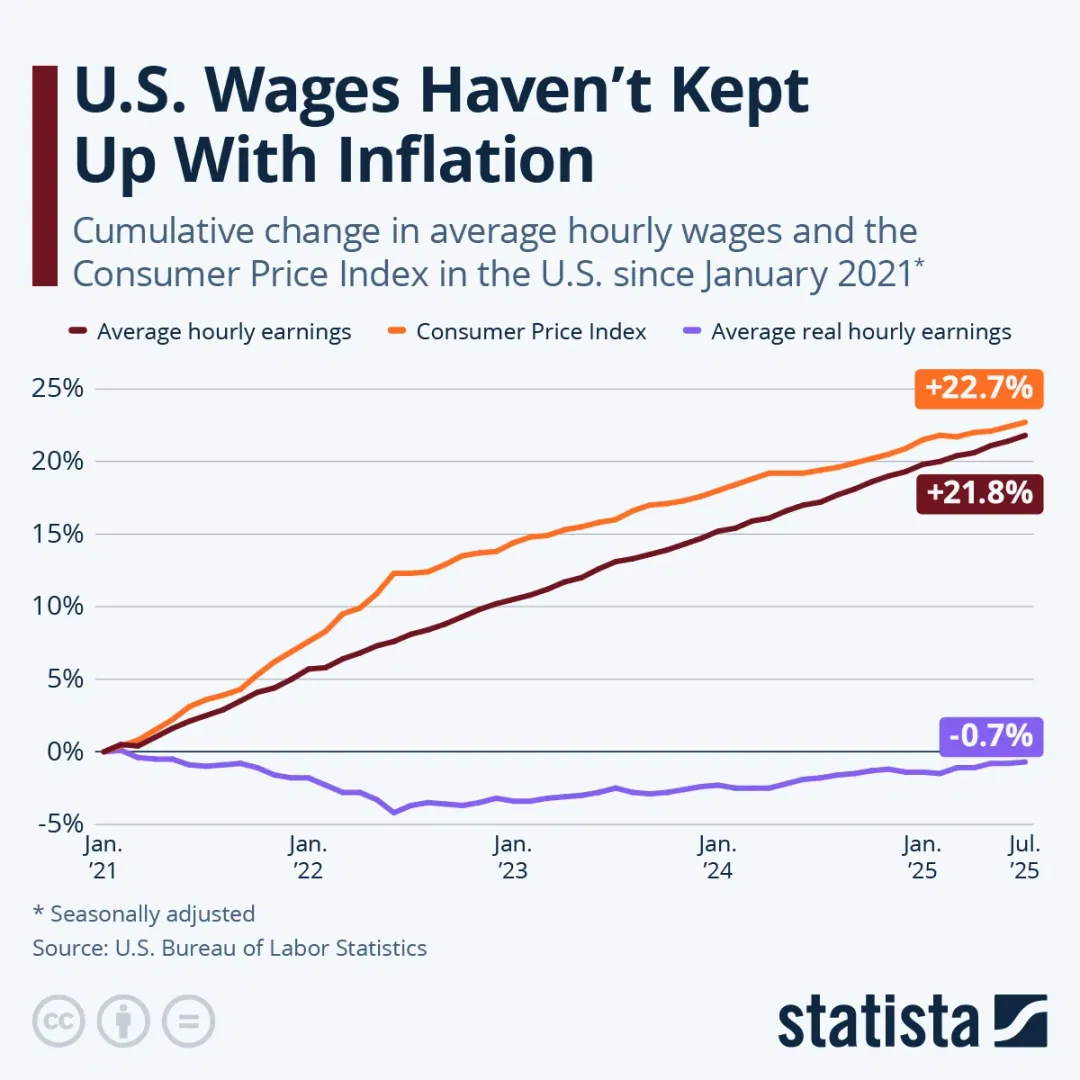
However, the problem is that CPI only tracks how prices change over time. It does not show whether people’s wages have kept up.
GTA VI Affordability Test
US Bureau of Labor Statistics data shows real average hourly earnings fell 0.7% between May 2025 and May 2026, after adjusting for inflation. That means the average worker had slightly less purchasing power, even before paying for a premium-priced game.
A better test is how many hours someone needs to work to buy the game. On that basis, GTA 6 may not feel cheaper for many buyers, especially if wages are flat and everyday costs remain high.
That creates a real challenge for Take-Two and Rockstar. GTA 6 is due to launch on November 19, 2026, for PlayStation 5 and Xbox Series X.
Its $79.99 standard edition is below the $90-plus price some investors expected, and Take-Two shares fell after the announcement.
The debate also comes at a sensitive time for gaming consumers. Digital ownership concerns and rising costs have made players more cautious about what premium prices actually offer.
Inflation-adjusted charts can show how GTA 6 compares with older games on paper. They cannot show whether buyers feel richer. On current wage data, many do not.

An inflation-adjusted chart can confirm that GTA 6 costs fewer historical dollars than its predecessors. What it cannot confirm is whether the people buying it have more real money to spend. On current BLS data, they have less.
The post GTA 6 May Be the Cheapest Edition Ever. So Why It Feels So Expensive? appeared first on BeInCrypto.
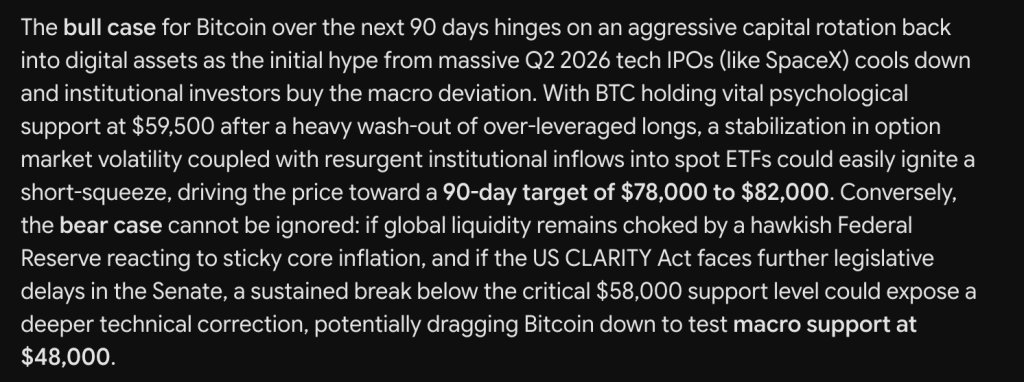
Google Gemini AI just zoomed in on a tighter window for Bitcoin price prediction that treats the next quarter as the real test rather than waiting for year end. The model predicts a 90 day target of $78,000 to $82,000, a sizable jump from where price sits today.
The bull case hinges on capital coming back home after chasing other shiny objects. Bitcoin is trading near $59,500 right now, and the thesis centers on an aggressive rotation back into digital assets once the initial hype from massive second quarter tech IPOs, including names like SpaceX, finally cools down.
As that excitement fades, institutional investors buying the macro deviation could redirect fresh capital straight back toward bitcoin.
The model points to $59,500 as vital psychological support, a level that has already absorbed a heavy washout of overleveraged long positions.
With that flush largely complete, a stabilization in option market volatility paired with resurgent institutional inflows into spot ETFs could easily ignite a short squeeze. That kind of squeeze, the model argues, is exactly what could drive price toward the $78,000 to $82,000 zone within the next three months.
The bear case is built around macro headwinds that have nothing to do with bitcoin itself. If global liquidity stays choked by a hawkish Federal Reserve responding to sticky core inflation, that kind of tightening tends to hit risk assets like bitcoin especially hard.
Further legislative delays on the US CLARITY Act in the Senate would remove one of the few near term catalysts bulls are counting on. If both of those pressures show up together, a sustained break below the critical $58,000 support level could expose a much deeper technical correction, potentially dragging bitcoin all the way down to test macro support at $48,000.
Bitcoin Price Prediction: BTC Hovers At The Line That Decides Its Next 90 Days
The daily chart shows bitcoin at $59,365 after a long decline from highs near $127,000 set back in October. That slide has been steep and persistent, with a brief relief rally into May that topped out near $83,000 before rolling over again into the current stretch of weakness.
Price has spent the last several sessions grinding just below $60,000, sitting right at the exact psychological level the prediction calls out as vital support.
That kind of tight consolidation right at a key round number often marks a genuine battle between buyers defending the level and sellers testing whether it breaks.
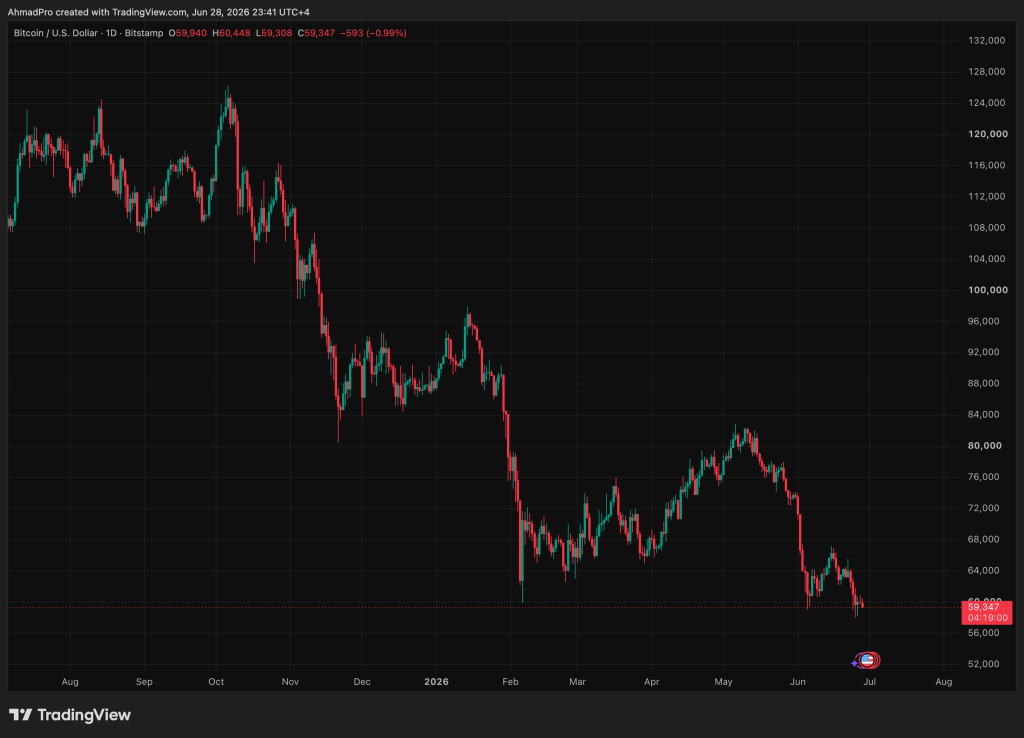
Immediate resistance sits near $64,000, a level price has rejected from multiple times during this recent stretch, with a heavier ceiling further up near $72,000 where the May rally eventually stalled out.
Support holds at $58,000, the exact threshold flagged in the bear case as the line that opens the door to deeper losses. The broader pattern here is one of lower highs and lower lows since October, a clean downtrend that has not yet shown any real sign of reversing.
Momentum on the daily candles looks weak and still leaning bearish, with red candles dominating the most recent sessions and limited buying response on the bounces.
Given how precisely price is testing the exact support level named in this prediction, the next move off $58,000 to $59,500 looks like it will determine which of these two scenarios actually plays out over the coming weeks.
Discover: The Best Token Presales
You Might Like What Gemini AI Predicts About LiquidChain
The rotation is already happening. Most people will only see it in hindsight.
Large-cap crypto is not failing. It is capped. Bitcoin, Ethereum, and XRP have been pressing against the same resistance bands for weeks. The macro tailwinds keep getting delayed.
The institutional inflows keep getting pushed to next quarter. Holding assets where the upside depends on catalysts you cannot control is not a strategy. It is waiting.
A capital that has navigated enough cycles does not wait at resistance. It moves before the destination becomes obvious.
Early-stage infrastructure plays operate on different math entirely. A small enough market cap means a modest rotation produces dramatic price movement. The asymmetry exists because the market has not priced in what is being built yet. That gap between current valuation and what the project is actually worth is where the returns come from.
Multi-chain fragmentation costs DeFi real money every single day. Bitcoin, Ethereum, and Solana run completely isolated liquidity systems with no native way to connect them. Every user moving value between ecosystems absorbs that cost directly in fees, slippage, and failed transactions.
LiquidChain collapses all 3 networks into a single execution layer. One deployment. Full ecosystem access. No cross-chain tax on every interaction.
The market has not found this yet. That is the entire point.
The presale is at $0.01454 with just over $840,000 raised. Ground floor is not a marketing phrase here. It is a description of where this actually sits in its lifecycle.
Execution is unproven. Adoption is unknown. Those risks are real and worth naming directly. Established assets offer a smoother ride toward a ceiling that is already visible. This offers an earlier seat at a table that has not been set yet.
Explore the LiquidChain Presale
The post Google Gemini AI Predicts Jaw-Dropping Bitcoin Price by Next 90 Days appeared first on Cryptonews.
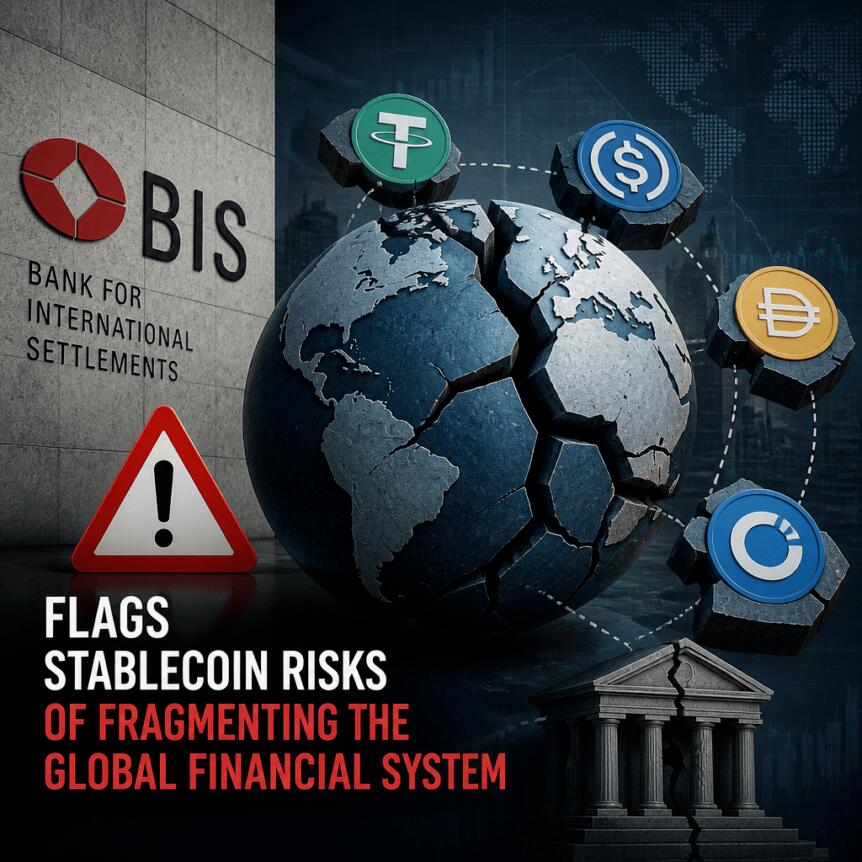
The Bank for International Settlements (BIS) has issued a warning that the fast-growing stablecoin market could destabilize the global monetary system—particularly by eroding central bank control and by pulling value away from bank deposits. In its Annual Economic Report published Sunday, the Basel-based institution says the scale of stablecoins has reached roughly $316 billion, and it argues that fiat-pegged tokens are not equipped with the institutional safeguards needed to function as “safe, reliable money” at system-wide levels.
Instead, BIS urges central banks and the broader financial sector to accelerate development of tokenized forms of central bank and commercial bank money on regulated infrastructures. The BIS message is not only a critique of today’s stablecoin structure, but also a policy signal that existing regulatory approaches may fall short as private digital currencies continue to expand.
Key takeaways
- BIS estimates the stablecoin market at about $316 billion and warns that its current design lacks features needed for large-scale “safe money.”
- Stablecoin growth could weaken banks and credit creation by enabling deposit migration into private digital tokens.
- BIS flags “stablecoin dollarization” as a risk to monetary sovereignty and domestic policy effectiveness, especially in emerging markets.
- Permissionless public chains face limits, in BIS’s view, due to scalability, legal accountability, and settlement finality requirements for systemic finance.
- BIS supports tokenization inside a regulated “unified ledger” model, combining tokenized central bank money and tokenized deposits.
Why BIS thinks stablecoins could strain the monetary system
In its report, BIS focuses on structural weaknesses it believes are inherent to stablecoins pegged to fiat currencies. The institution argues that these tokens do not carry the institutional features required to operate as trustworthy money at scale. A central part of BIS’s concern relates to how reserve assets are managed and governed.
BIS also highlights a potential macro-financial channel: if users shift value from commercial bank deposits into private digital tokens, banks could face reduced funding. In turn, that could constrain the credit banks provide to the real economy. The report frames this as a material risk created by stablecoins’ ability to transfer purchasing power outside the traditional deposit-based plumbing of the banking system.
For policymakers, BIS’s warning reads as a call for faster work on safer alternatives. Rather than aiming to position stablecoins as a lasting foundation for the monetary system, BIS says the more robust path is tokenized central bank and commercial bank money—supported by regulated infrastructures that preserve monetary stability and financial integrity.
Dollar-denominated stablecoins and the threat to sovereignty
BIS devotes particular attention to a trend it calls “stablecoin dollarization”—the increasing use of dollar-denominated stablecoins in jurisdictions with weaker domestic currencies. According to BIS, this pattern can have several second-order effects for countries that increasingly rely on external currency-linked digital products.
The report argues that stablecoin dollarization may undermine monetary sovereignty and reduce the effectiveness of domestic monetary policy. It also suggests the trend could decrease bank intermediation and heighten exposure to volatile cross-border capital flows, risks that BIS says are especially pronounced in emerging market economies.
For traders and market participants, this matters because stablecoin usage is not just a crypto-native phenomenon; it can reshape liquidity dynamics in foreign exchange-related channels by tying dollar value transfer more directly into the digital asset ecosystem.
BIS challenges permissionless networks as core monetary infrastructure
BIS goes beyond stablecoins themselves and delivers a sharply worded critique of the suitability of public permissionless blockchains—such as Bitcoin and Ethereum—as foundational layers for the monetary system. The report argues that decentralized networks that rely on distributed validation and lack central governance struggle to meet requirements that BIS believes systemically important financial infrastructure must satisfy, including scalability, legal accountability, and settlement finality.
A key part of BIS’s argument is that congestion and rising costs are not merely temporary bugs in permissionless systems, but rather are tied to their underlying economics. BIS contends that compensation for validators via transaction fees tends to increase with network activity, which can make congestion, slower confirmations, and higher costs persistent characteristics rather than solvable engineering limitations.
Just as importantly, BIS says permissionless networks generally lack the governance and accountability frameworks that institutional finance relies on. Without a clearly identifiable entity responsible for maintaining integrity, resolving disputes, or ensuring compliance with financial integrity standards, BIS argues that permissionless blockchains face major obstacles to supporting large-scale regulated financial activity.
Crucially, BIS is not rejecting tokenization outright. Instead, the BIS report argues for a different architecture—one where tokenized money and assets can be programmed for modern settlement benefits while remaining embedded in regulated, accountable institutional frameworks.
The “unified ledger” alternative BIS says can preserve stability
Rather than positioning tokenized assets to replace existing money mechanics, BIS proposes what it describes as a “unified ledger” approach. Under this model, tokenized central bank money, tokenized commercial bank deposits, and tokenized financial assets would be brought together on programmable platforms—within regulated legal and institutional boundaries.
In BIS’s framing, the objective is to keep the advantages that tokenization can bring—such as programmable transactions and faster settlement—while avoiding what it sees as the institutional risks associated with private fiat-pegged tokens operating outside traditional monetary controls.
This direction also signals an important policy tension: as private stablecoins expand, BIS suggests regulators and central banks may need to treat tokenized bank and central bank money as the more durable pathway for digital payments and settlement, not only a technological evolution but a governance one.
Going forward, investors, payment companies, and policymakers will likely watch whether jurisdictions move quickly toward regulated tokenized money pilots and whether new rules meaningfully address deposit-funding risks and dollarization dynamics—areas BIS singled out as central to its concerns.

TLDR:
- Coinbase introduced AI agent tools that connect autonomous software directly to crypto financial services.
- Agent financial accounts enable AI wallets, payments, and low-cost blockchain transactions through Base.
- Coinbase plans an Everything Exchange covering crypto, stocks, commodities, and tokenized assets.
- Payment upgrades include stablecoin rails, Coinbase One Card improvements, and direct deposit expansion.
Coinbase has expanded its artificial intelligence strategy with a new suite of products designed for autonomous software agents. In the last system update the company unveiled developer tool, AI-powered financial services, and crypto-native accounts.
The announcement also stated plans for a wider trading infrastructure expansion, beyond digital assets. The new offerings reflect Coinbase’s push to combine blockchain technology with AI-powered applications.
Coinbase Launches AI Financial Tools for the Intelligence Age
Coinbase CEO Brian Armstrong described the company’s latest vision by positioning Coinbase as a financial platform for the intelligence age. The announcement accompanied a product presentation focused on AI agents and crypto infrastructure.
According to Coinbase’s system update, the company introduced Coinbase for Agents. The developer toolkit allows creators to connect AI agents directly to existing Coinbase accounts for blockchain-based financial activity.
The company also revealed Coinbase Advisor. The feature brings AI-powered financial and investment assistance directly into the Coinbase application, allowing users to interact with digital financial guidance inside the platform.
Armstrong also presented agent financial accounts built on Base, MCP, and the x402 payment standard. According to the presentation, these accounts enable AI agents to hold wallets, process payments, access digital services, and complete transactions for less than one cent.
Coinbase Expands Trading Infrastructure Beyond Crypto Markets
Beyond artificial intelligence, Coinbase introduced its vision for an Everything Exchange. According to the company’s presentation, the platform aims to combine multiple asset classes within a unified global marketplace.
The proposed exchange includes tokenized equities, traditional stocks, commodities, and pre-IPO perpetual products. Coinbase said the goal is to provide unified liquidity across different financial markets through one trading platform.
The company also announced several payment improvements. These include updates to the Coinbase One Card, broader stablecoin payment rails, and expanded direct deposit capabilities for users.
Armstrong concluded the presentation by highlighting the growing role of AI agents in digital finance. The company stated that programmable intelligence paired with programmable money forms the foundation of its long-term product strategy as blockchain infrastructure continues to evolve.



CZ told CoinDesk over the course of two interviews that he saw multiple causes for crypto’s 2026 bear market including investors moving funds to AI, geopolitical events and the usual four-year crypto market cycle.
He laid out his goals for Binance.US — the U.S. crypto exchange he majority owns but does not run on a daily basis — saying he wanted to see the platform tap Binance Global — the global crypto exchange he majority owns but does not run — for its liquidity, as part of a broader push to make the U.S. market stronger.
And while he said his goal in Washington, D.C. was to clear up any “misunderstandings” about himself and Binance, he said that his pleading guilty to Bank Secrecy Act violations did not hurt his reputation.
Still, CZ told CoinDesk he does not want to run a crypto exchange again, saying he preferred to operate more as an informal adviser to the various companies he’s invested in.
Read more in CoinDesk.
There’s still no real word on where this bill is. As a reminder, the ethics provision remains the biggest hurdle to an agreement. Politico profiled White House crypto liaison Patrick Witt, confirming that any deal he helps broker will need presidential sign-off.

Scottie Scheffler’s clutch par saves set up Travelers playoff vs. Viktor Hovland

Stocks adrift, oil up as US-Iran halt renewed attacks

Amazon AU’s best early Prime Day deal gives you 3 months of free reading and listening

No Jackpot Winner as $257 Million Prize Rolls Over to $269 Million Monday Draw

Renter of Home in Anne Heche Crash Denies Settlement With Son

Blockchain.com files with SEC for U.S. IPO

#antique #money #jewelry #gold #reseller #goldjewellery #goldtooth #coins #silver #fyp #ytshorts

DON’T IGNORE THIS! My Biggest 2026 Prediction for BTC & Crypto | Mark Yusko

Rs 25 Billion Financial Irregularities Revealed in Benazir Income Support Program | Major Disclosure
-
 Sports5 days ago
Two goals and an assist by sheer aura: Cristiano Ronaldo just entered the World Cup chat
-

 Tech7 days ago
Microsoft accidentally kills epic Outlook email threads
-

 Fashion2 days ago
Weekend Open Thread: Staud – Corporette.com
-

 Politics3 days ago
The House | Manchesterism won’t survive the painful trade-offs unless it gets citizens on board
-

 Politics3 days ago
Potential 2028er World Cup attendee leaderboard
-

 Business3 days ago
Asia stock markets slide as tech shares slump
-

 Tech3 days ago
A Look At A Gaggle Of Transputer Boards
-
Crypto World5 days ago
Bitcoin (BTC) Dips Below $62K, Ethereum (ETH) Plunges 6% Daily: Market Watch
-
 Crypto World3 days ago
Dell (DELL) Shares Tumble Over 5% Following Analyst Downgrade to Hold
-

 Crypto World5 days ago
Securitize Wraps Roubini's SEC-Registered ETF as Dubai VARA Digital Security
-
Business5 days ago
Entergy settles forward sale agreements, raises $672 million in cash proceeds
-

 Crypto World2 days ago
Kraken's xStocks Opens Bending Spoons IPO Registration to EEA Retail
-

 Sports2 days ago
FIH Pro League: India defeat Pakistan 7-1, register biggest win of campaign | Other Sports News
-

 Crypto World1 day ago
Coinbase, Circle Deepen Crypto Stock Losses Despite Resilient S&P 500
-

 Crypto World2 days ago
RTX holders must register wallets before token distribution begins
-
Crypto World2 days ago
Hyperliquid Named on Singapore MAS Investor Alert Register
-
Crypto World3 days ago
The DATA Foundation Launches to Tackle AI’s Multi-Billion Dollar Training Data Bottleneck
-

 Crypto World3 days ago
21Shares Cuts 2026 Crypto Forecasts as Institutional Demand Rises
-

 Sports4 days ago
India vs Bangladesh LIVE Score, Women’s T20 World Cup: Bangladesh Opt To Bat; India Enter ‘Do-Or-Die’ Stage As Semi-Final Race Heats Up
-
 Crypto World3 days ago
AAVE price tests 9-month trendline after 17% rebound as breakout hopes build
You must be logged in to post a comment Login