

Crypto World
Dubai Crypto Market Adds 50th Licensed Firm as VARA Approves New Rules


Dubai’s crypto licensing ecosystem continues to expand. The emirate’s Virtual Assets Regulatory Authority (VARA) has granted its 50th virtual asset service provider (VASP) license, with tokenized-assets platform Tribe Tokenisation FZE receiving the latest approval on Monday.
While VARA’s license count is a useful headline for market growth, a regulator spokesperson cautioned that a granted license does not automatically mean a firm has already started commercial operations. Newly authorized companies may be required to go through a controlled operationalization period before offering services or onboarding customers.
Key takeaways
- VARA has issued its 50th VASP license to Tribe Tokenisation FZE, adding to Dubai’s rapidly growing authorization pipeline.
- VARA says an active license does not necessarily reflect that a company has completed its commercial launch.
- According to VARA, 39 licensed VASPs were considered fully operational at the end of 2025, with an updated 2026 figure being validated.
- Dubai’s licensing totals are higher than those seen in Hong Kong and Singapore, but the categories being counted are not directly comparable across jurisdictions.
What the 50th VASP license signals for Dubai
VARA’s approval of Tribe Tokenisation FZE reflects the continued rollout of Dubai’s standalone regulatory framework for virtual assets, created to attract digital asset businesses while keeping a distinct compliance track. VARA was established in March 2022 as Dubai’s dedicated crypto regulator.
The milestone matters most for firms planning expansions or new product launches, because licensing can influence whether customers, counterparties, and institutional partners treat a business as compliant and operationally ready. At the same time, VARA’s clarification helps calibrate expectations: the regulator indicated that licensing is only one step in a broader process that may include a period of controlled operationalization.
That distinction is important for investors and market observers because license approvals can outpace the moment when services actually become available to the public. Without additional context, a growing VASP count could look like instant market activation even when new entities are still preparing their infrastructure, controls, and customer-facing workflows.
Operational numbers: licenses versus “fully operational” status
VARA also pointed to the difference between being licensed and being active in the market. A spokesperson told Cointelegraph that holding an active license “does not necessarily” indicate a firm has completed its commercial launch. In practice, newly licensed companies may move through a controlled operationalization phase before they offer services or begin onboarding customers.
As of the end of 2025, VARA classified 39 licensed VASPs as fully operational. The spokesperson added that VARA is validating an updated figure for 2026, implying that the operational count may change as firms complete their rollout and as the regulator updates its assessment criteria.
For market participants, this creates a more nuanced way to interpret Dubai’s regulatory momentum: instead of treating license totals as a proxy for active competition, investors and users may want to monitor operationalization progress and VARA’s periodic “fully operational” updates.
How Dubai compares with Hong Kong and Singapore
Dubai’s 50 licensed VASPs place it above the headline numbers reported in Hong Kong and Singapore—two jurisdictions also attempting to position themselves as regulated destinations for crypto-related activity. However, VARA’s spokesperson emphasized that totals across jurisdictions are not directly comparable because each regime licenses different types of businesses.
In Singapore, the Monetary Authority of Singapore (MAS) listed 37 major payment institutions (MPI) authorized to provide digital payment token (DPT) services. Singapore regulates DPT services within its payments framework rather than operating a standalone VASP regulator that mirrors VARA’s approach.
Hong Kong provides another contrast. The Securities and Futures Commission (SFC) lists 13 formally licensed virtual asset trading platforms, but the scope is narrower because the regime is specifically limited to operators of trading platforms, rather than covering the broader range of VASP activities that VARA may license under its framework.
VARA attributed Dubai’s market growth to an activity-based regulatory framework and a wider financial ecosystem supporting digital asset businesses. Beyond licensing categories, VARA said it also evaluates evidence of market activity such as transaction volumes, assets under management, employment, and audited financial data when assessing how the sector is developing.
Why the “activity-based” approach may affect market quality
A key takeaway from VARA’s explanation is that the regulator appears to be measuring more than just compliance paperwork. By considering transaction volumes, assets under management, staffing, and audited financial information, VARA is effectively pushing regulated firms to demonstrate real operational substance—not only formal authorization.
This approach can influence how quickly regulated firms convert from “licensed” to “business generating activity.” It also suggests why VARA’s operational figure (39 fully operational at the end of 2025) may lag behind the total license count as the regulator processes new entrants and as firms transition through operationalization.
For the broader market, these differences are especially relevant at a time when jurisdictions are competing for crypto business but varying significantly in how they structure oversight, define licensing categories, and evaluate readiness to operate. Dubai’s latest license adds another data point, but the more informative metric may be how many of those approvals translate into fully operational entities capable of meeting the regulator’s broader activity checks.
Next, investors and builders looking at Dubai’s regulatory landscape should watch for VARA’s updated “fully operational” count for 2026 and for signals on how quickly newly licensed firms complete their operationalization stages—because that is where licensing momentum is most likely to translate into real market activity.


Loopring, the first project to launch a zero-knowledge rollup on Ethereum, has announced that its decentralized exchange will immediately stop all trading services. The relayer has already been taken offline.
The team said the decision was made with regret after years of trying to keep the platform operating.
Outdated Technology and Poor Adoption
According to the announcement, one of the main reasons behind the closure was the platform’s technical limitations. Loopring said its early zkRollup design did not include a virtual machine, which limited composability and prevented broader real-world applications, including payment use cases. These restrictions hindered ecosystem growth and made it difficult for the platform to compete with newer technologies.
The team also admitted that it had stronger engineering capabilities than business development skills, while describing itself as “engineers at heart, not business operators.” In addition, the delisting of LRC from major exchanges in 2026 added further pressure to the project.
“We poured countless late nights into building the very first zkRollup on the market. That achievement still fills us with pride. But today, we must face reality and announce, with deep regret, that Loopring DEX will cease all trading services effective immediately.”
Loopring explained that newer zkEVM solutions, which support Ethereum smart contracts and offer broader compatibility, have surpassed its specialized architecture. The team said its technology now feels outdated and that shutting down the service was preferable “rather than running a hollow service.”
The company stated that user funds remain safe and announced a distribution process to return assets. Instead of requiring users to submit Merkle proofs through the original self-custody withdrawal mechanism, Loopring said it will handle the entire process itself and cover all transaction fees. The team acknowledged that this method is more centralized but described it as the simplest option for users.
Loopring also revealed plans to publish a complete list of final account balances over the coming days. This includes spot holdings and liquidity pool positions, which will be converted into underlying tokens. A two-week review period will allow users to verify balances before distributions begin.
Loopring Hack
In June 2024, attackers stole an estimated $5 million from users of the Loopring wallet who relied solely on the platform’s Official Guardian service for account recovery.
The breach was traced to a flaw in the service’s two-factor authentication system, which allowed attackers to impersonate wallet owners and gain access to their accounts.
The post ‘Engineers, Not Business Operators’: Why Loopring Is Shutting Down Its DEX appeared first on CryptoPotato.


The European Banking Authority has proposed a standardized penalty framework that would allow the European Union to impose multimillion euro fines on issuers of significant crypto tokens that breach the bloc’s digital asset rules.
Summary
- European Banking Authority has proposed fines of up to 12.5% of annual turnover for major crypto token issuers that breach MiCA rules.
- Crypto firms must secure MiCA licenses by July 1 or risk enforcement action and restrictions on operating across the European Union.
- Binance has begun limiting services in the European Union while licensed rivals Coinbase and OKX continue competing for affected users.
The consultation paper, published on June 26, sets out a two-step methodology for calculating penalties under the Markets in Crypto Assets regulation. The EBA plans to first assess the seriousness of each infringement before adjusting the amount based on aggravating or mitigating circumstances.
Statutory penalties could reach up to 12.5% of annual turnover for issuers of significant asset-referenced tokens and 10% for issuers of significant e-money tokens. The consultation paper also allows fines of up to twice the profits earned from a violation, where applicable.
The proposal forms part of the enforcement framework for MiCA, which introduced a single regulatory regime for digital assets across the European Union. The regulation requires token issuers and crypto asset service providers to meet licensing, capital, consumer protection, and compliance requirements before operating across the bloc.
The EBA added that the proposed framework will establish a consistent process for calculating penalties across the European Union. As per the consultation paper, the methodology aims to ensure supervisory authorities apply financial sanctions in a uniform manner once the rules take effect.
July 1 licensing deadline approaches
The EBA released the consultation days before the July 1 MiCA licensing deadline, when crypto firms must obtain authorization from a national regulator to continue offering services or marketing stablecoins throughout the European Union.
Firms that fail to secure authorization could face enforcement action if they continue operating without approval or commit violations covered by the proposed penalty framework, including unauthorized public disclosures and organizational compliance failures.
The consultation period will remain open until Sept. 28, allowing industry participants to submit feedback before the EBA finalizes the methodology.
Binance has already begun restricting parts of its European business after failing to obtain MiCA authorization before the deadline. As previously reported, the exchange withdrew its MiCA application in Greece and has stated that it intends to seek approval through another European Union member state.
Exchange notices shared by users on social media confirmed that Binance will stop onboarding new European Union customers and limit selected services for existing users from July 1. The company also informed customers that digital assets will remain available for withdrawal after the restrictions take effect.
As uses moved out of Binance, Coinbase, OKX, and some other exchanges have responded by promoting their MiCA authorized operations to European customers. For instance, Coinbase launched a campaign across several European markets offering a 5% transfer bonus for eligible users who move assets before July 13, while OKX introduced welcome rewards and deposit matching of up to 8% for qualifying users in the European Economic Area.
BitMEX, the troubled cryptocurrency exchange reportedly looking for a buyer, has cleared out its executive team, removing chief executive Stephan Lutz, chief financial officer Ina Steiner, and chief growth officer Raphael Polansky, CoinDesk has learned.
The firm’s former global general counsel and chief operating officer, Peter Wilkinson, has taken over as CEO. The moves were highlighted in recent postings on LinkedIn.
Wilkinson, Lutz, Steiner and Polansky did not immediately respond to requests for comment.
Crypto exchange and derivatives trading platform BitMEX was co-founded in 2014 by Arthur Hayes, Ben Delo and Samuel Reed. In 2020, BitMEX was alleged to have failed to implement adequate anti-money laundering measures in place, and later pleaded guilty to the charges. Hayes, Delo and Reed resigned shortly after the U.S. brought criminal charges.
BitMEX is presumably looking to streamline its costs and appear more attractive to prospective buyers, as an ongoing depression in digital asset prices weights on the crypto industry.
It was during the last crypto downturn in 2022 that Lutz took over as CEO from Alexander Hoeptner, who became CEO in early 2021, when Hayes and his co-founders stepped down.
The latest crypto winter has prompted numerous crypto and tech firms to shed staff.
Key Takeaways
- YoungHoon Kim, holder of the world’s highest verified IQ score (276), declared that the XRP Supercycle has only just commenced
- Three concurrent indicators have emerged: TD Sequential “9” buy formation, Morning Star Doji reversal pattern, and dramatic spike in daily active addresses
- XRP Ledger daily active addresses surged from approximately 23,000 to nearly 39,500 within a two-week period
- Kim’s earlier forecast projects XRP reaching $5–$10 during this market cycle; achieving $10 would represent a 646%+ increase from current levels
- Single-day XRP ETF inflows reached $11.88 million in May, contributing to cumulative 2026 net inflows of approximately $1.42 billion
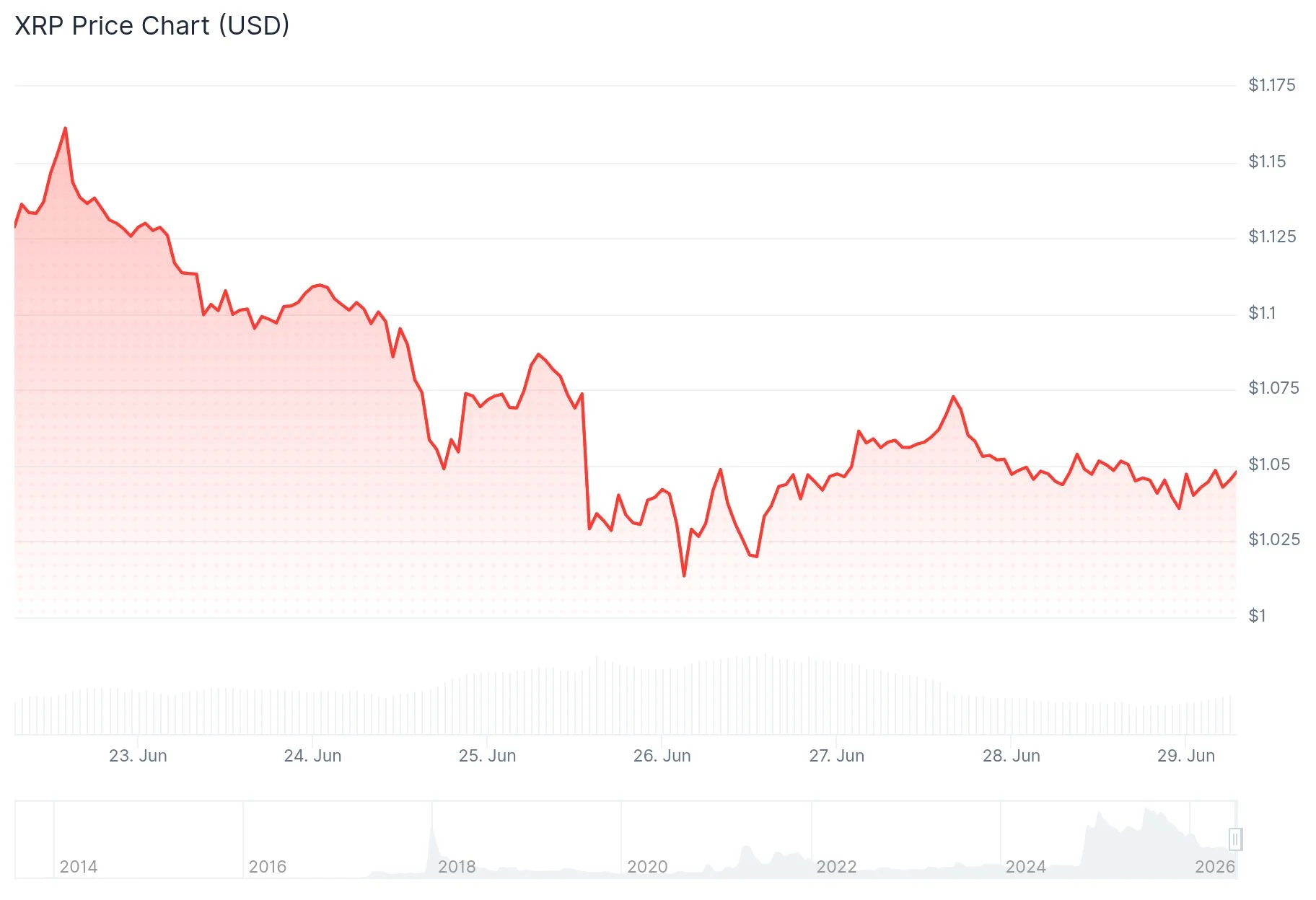
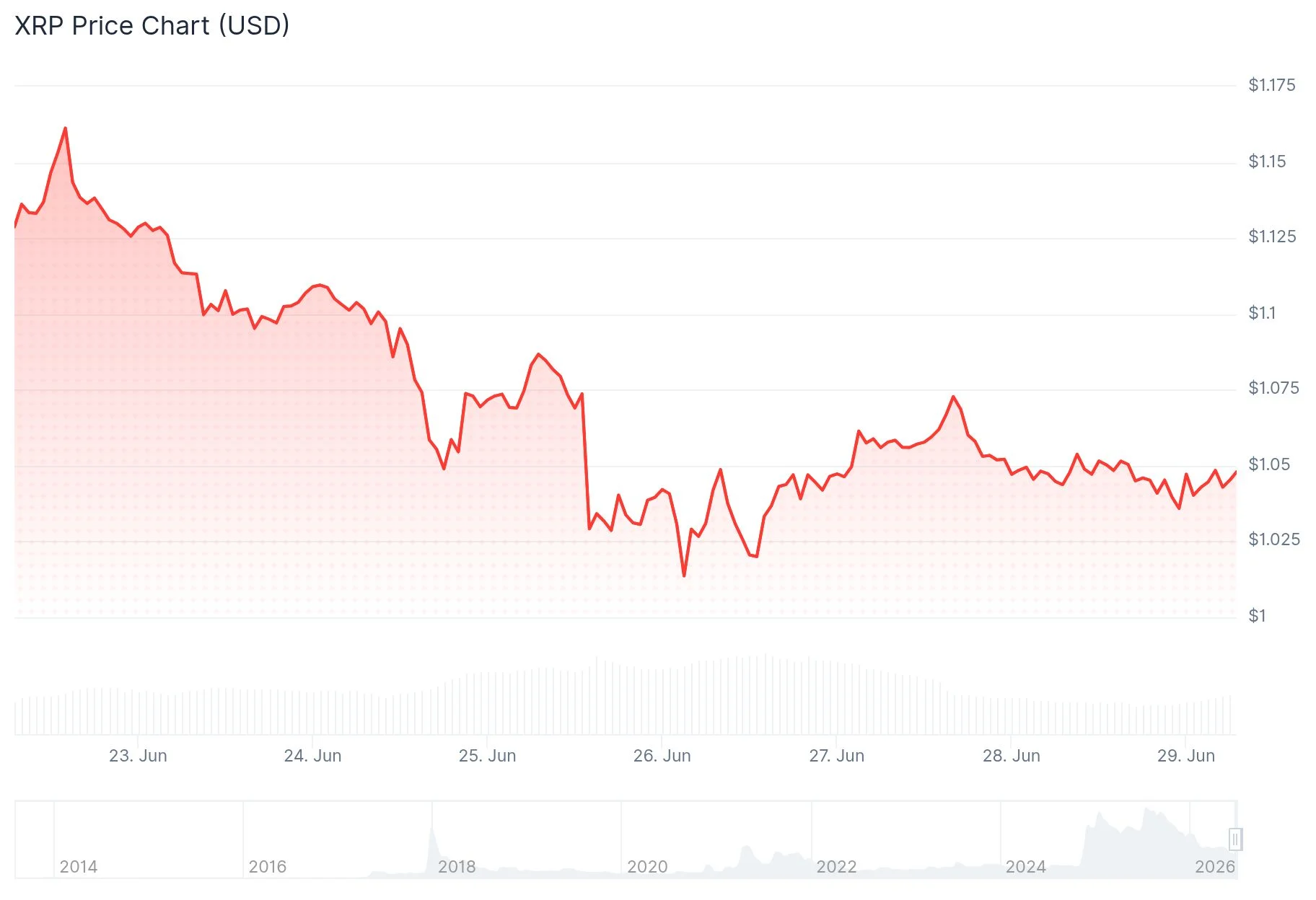
XRP currently trades around $1.05 following a convergence of technical indicators and a prominent market prediction that has refocused attention on the digital asset. A trio of signals has materialized simultaneously, capturing interest from traders monitoring both price charts and blockchain metrics.
YoungHoon Kim, who holds the verified world record for highest IQ score at 276, announced on X that the XRP Supercycle is merely in its initial phase. The statement rapidly circulated throughout cryptocurrency forums and rekindled debate surrounding XRP’s potential long-term valuation.
Kim had earlier established a price projection between $5 and $10 for XRP during this market cycle. From present levels around $1.05, ascending to $5 would necessitate approximately a 376% appreciation. Climbing to $10 would translate to roughly an 852% surge.
Not all market participants embrace Kim’s perspective. Multiple X users challenged his viewpoint, highlighting that his earlier XRP forecasts failed to materialize. Additional critics questioned both his authority and the foundation supporting his $10 projection.
XRP remains approximately 67% below its July 2025 all-time peak of $3.66. That substantial distance renders the higher boundary of Kim’s target an ambitious objective from current trading levels.
Convergence of Three Technical Indicators
Market analyst Ali Charts identified that the Tom DeMark Sequential indicator generated a “9” buy formation on XRP’s daily timeframe. This signal typically emerges near downtrend exhaustion points and may precede brief price rebounds spanning one to four trading sessions.
A Morning Star Doji reversal formation also materialized over three consecutive sessions within the $1.02 to $1.07 support range. This candlestick configuration suggests a possible near-term price floor.
The third indicator originates from blockchain data. Daily active addresses on the XRP Ledger climbed from approximately 23,000 on June 14 to nearly 39,500 recently, indicating genuine network engagement beyond purely speculative trading.
Market analyst ChartNerdTA observed that XRP’s cyclical peaks have traditionally occurred at three to five-year intervals. Should a cycle trough establish during 2026, the subsequent potential peak might materialize between 2028 and 2030.
Investment Product Flows and Market Metrics
XRP’s total market capitalization continues exceeding $65 billion, per CoinGecko data. Institutional appetite has remained consistent, with XRP-linked ETF products attracting $11.88 million during a single trading session on May 29.
Aggregate net inflows into XRP investment vehicles achieved approximately $1.42 billion throughout 2026, representing the most robust ETF capital influx period the token has experienced to date.
For near-term upward momentum confirmation, market analysts indicate XRP requires persistent buying pressure and a decisive breach above the $1.30 resistance threshold.



Loopring has announced the immediate closure of its decentralized exchange and automated market maker after concluding that years of limited adoption, business shortcomings, and technological competition left the project without a sustainable future.
Summary
- Loopring has shut down its decentralized exchange after citing weak adoption, business challenges and competition from newer Ethereum scaling networks.
- Users will receive their remaining balances through direct Ethereum wallet distributions, with Loopring covering the gas fees.
- More than 60 crypto projects have closed in 2026, with Pyra, Carrot, Botanix Labs and several others also ending operations.
Loopring disclosed the decision in a post on X on Sunday, confirming that all trading services have stopped and the protocol’s relayer has ceased operating. The team attributed the shutdown to three factors: weak user adoption, limited business development capabilities, and competition from newer zkEVM based Ethereum scaling networks.
The developers acknowledged that Loopring pioneered zero knowledge rollup technology but stated that the protocol’s architecture lacked a virtual machine, which prevented composability and limited practical payment use cases. These design constraints restricted ecosystem growth, the team wrote.
Engineers behind the project also admitted they excelled at technical development but failed to build the commercial side of the business. The announcement added that exchange delistings of LRC during 2026 accelerated a process that had already become unavoidable.
The team further stated that modern Ethereum compatible zkEVM networks eventually outpaced Loopring’s specialised design. Rather than continue operating what it described as a hollow service, the developers chose to discontinue the platform.
User withdrawals to continue after trading ends
Loopring confirmed it will calculate final user balances before distributing funds directly to users’ Ethereum wallets in batches. The team also committed to paying the gas fees associated with those withdrawals.
Wallet services had already closed in July 2025 after the project cited scaling challenges. The latest announcement completes the shutdown of Loopring’s remaining core products.
The protocol reached a total value locked of about $760 million during the crypto market peak in November 2021, but that figure has since fallen by almost 99% to roughly $8 million, based on L2Beat data. LRC has followed a similar trajectory, falling to about $0.01 from its all-time high of $3.75 recorded during the same month.
Loopring secured one of its highest-profile partnerships in 2021 when it agreed to power GameStop’s NFT marketplace, which launched the following year.
Crypto closures continue through 2026
RootData has recorded more than 60 crypto projects and protocols that have discontinued services during 2026, as prolonged market weakness and changing technology trends have affected businesses across the sector.
As previously reported by crypto.news, Pyra announced plans to wind down after concluding it could not recover from losses linked to the Drift exploit. The crypto payments platform halted new user registrations, cancelled payment cards, and gave customers until Sept. 15, 2026, to withdraw funds and export private keys through a dedicated web portal while it prepares to distribute any future Drift recovery tokens.
Other projects have also exited the market this year. Solana-based yield protocol Carrot attributed its shutdown to losses connected to the Drift Protocol exploit, while Bitcoin Layer 2 developer Botanix Labs stated that user demand had not reached a level capable of supporting long term operations.

The Bank for International Settlements (BIS) is warning that the current wave of AI investment could become a source of broader financial instability—especially if the optimism fueling new rounds of funding fades. In its annual economic report released Sunday, the Basel-based institution said heavy reliance on debt financing and elevated equity valuations raise the risk of a sharp market reversal and cascading defaults.
The BIS pointed to the sheer scale of expected spending: the five largest hyperscalers are projected to invest more than $1 trillion in AI-related capital expenditures from 2025 through 2026. Crucially, the bank said these commitments are outpacing earnings, leaving less room for setbacks if growth expectations fail to materialize.
Key takeaways
- The BIS warns that debt-funded AI expansion increases the risk of “cascading defaults” if investor sentiment turns.
- Projected AI capex from major hyperscalers through 2026 is larger than current earnings capacity, according to the BIS.
- High equity valuations and potential inflation pressure could amplify a downturn through “macro-financial feedback loops.”
- The BIS highlights systemic-risk concerns tied to AI firms’ rising leverage and their growing presence in credit markets.
- Rising hardware costs—often described as “chipflation”—may further complicate inflation dynamics that policymakers are trying to manage.
AI exuberance meets balance-sheet risk
At the center of the BIS’s concern is a mismatch between ambition and financial durability. The bank said equity valuations—particularly for companies central to AI development—remain elevated, and that sustaining high growth could become increasingly difficult.
The report links that valuation stretch to leverage. Where capital formation leans heavily on debt and highly leveraged financing structures, the BIS argues that optimism can unwind quickly. If that happens, distress can propagate beyond individual AI firms into wider financial channels, turning a market correction into a systemic problem.
“Should inflation rise significantly or AI-led investment turn to a bust, the macroeconomic consequences could be amplified by existing financial vulnerabilities.”
In other words, the BIS is not only warning about AI as a sector, but about the broader conditions that make a downturn more dangerous: fragile macroeconomic footing and financial vulnerabilities already visible elsewhere.
Why 2026 matters: from resilience to growing perils
The BIS acknowledged that the global economy showed “surprising resilience” in 2025 despite multiple shocks, and it credited AI investment as one of the forces supporting demand and growth.
But the tone shifts as 2026 approaches. The report says “perils have grown,” pointing to persistent inflation risks. According to TradingEconomics, US inflation (CPI) reached a three-year high of 4.2% in May. In such an environment, policymakers may need to tighten, and the BIS warned that tighter conditions could lead to a sharp pullback in AI asset prices after a prolonged stretch of risk-taking.
“A reversal of AI optimism could likewise have major financial consequences, given AI firms’ rising leverage and growing footprint in credit markets.”
For investors and market participants, the warning is practical: the main risk is not simply a decline in AI-related stock prices. The BIS suggests a wider set of linkages—policy tightening, valuation compression, leverage stress, and credit-market exposure—that could interact in destabilizing ways.
A “flashpoint” scenario and systemic-risk implications
The BIS cautioned that if AI valuations correct sharply, the resulting wealth effects could be stronger than in prior cycles, and consumption could pull back more abruptly. It also framed AI as a potential “flashpoint” for systemic risk, emphasizing that the United States’ market dominance could intensify the effects of any repricing.
In comments to Cointelegraph, Nick Ruck, director of LVRG Research, said the BIS was right to focus on the AI investment surge as a possible systemic trigger. He argued that financing has relied on “enormous debt” and “highly leveraged nonbank structures,” which can unwind quickly and magnify the cycle into a crisis.
“The current macroeconomic environment is already fragile from being stretched by inflation, record national debt, and disrupted commodity markets, so a bust of the AI capital stack could send shockwaves through an already strained global economy.”
Ruck’s point underscores why this matters for crypto and digital-asset markets as well: when traditional credit conditions tighten or confidence breaks, risk appetite often deteriorates quickly across asset classes. While the BIS discussion is framed in conventional finance terms, the transmission mechanisms—leverage, liquidity, and policy response—are the same forces that tend to spill over into broader markets.
The BIS also issued separate cautions about stablecoins, warning they could fragment the global financial system and weaken sovereign monetary control.
Chipflation may compound inflation pressure
Beyond financial leverage, the BIS also pointed to real-economy pressures tied to AI demand. It argued that AI-driven growth in data center capacity could strain semiconductor and memory supply, pushing chip prices higher. The result could be “chipflation”—a pathway where higher hardware costs ultimately feed into consumer and goods inflation.
That dynamic may be difficult for central banks to ignore. If the input costs associated with AI infrastructure raise broader inflation, it becomes harder to engineer a soft landing for risk assets.
The report references concerns previously raised by Morgan Stanley in June about chip-related inflation pressures. It also notes that BlackRock reported in March that surging semiconductor prices were posing upside risks to global goods inflation.
Some of that cost pressure is already reaching the consumer electronics cycle. For example, Apple has signaled that it would pass through part of the burden by raising prices across products, with increases described as ranging from 18% to nearly 33% due to higher memory and storage chip costs, according to an announcement covered by MSN.
Taken together, the BIS warning connects three moving pieces: an investment boom that relies on leverage, valuation levels that may not absorb shocks smoothly, and supply-driven cost inflation that can constrain policy flexibility.
Looking ahead, market participants should watch whether AI investment continues to translate into sustainable earnings rather than financing-driven growth, and whether inflation remains sticky enough to force tighter policy. The BIS’s core risk is a feedback loop: a valuation pullback triggered by macro pressure could stress leveraged balance sheets, and that stress could spread into credit markets—potentially faster than investors expect.

TLDR
- Analyst Alex Thorn at Galaxy Research lowered the CLARITY Act’s 2026 passage probability from 60% to 50%
- The crypto bill cleared the Senate Banking Committee 15-9 on May 14 but lacks a scheduled floor vote
- Limited Senate floor time remains available before the late July August recess begins
- Unresolved ethics requirements from Senate Democrats continue to stall progress
- Without a concrete schedule by early July, passage may delay until post-September
The CLARITY Act, a cryptocurrency market structure bill, secured bipartisan approval from the Senate Banking Committee on May 14 with a 15-9 vote. Yet despite this legislative advancement, Alex Thorn from Galaxy Research has reduced his probability estimate for the bill’s 2026 enactment to 50%, down from the previous 60% projection made just weeks earlier.
Currently positioned at number 423 on the Senate’s legislative calendar, the bill awaits scheduling for floor consideration.
The primary obstacle is the ticking clock. With the Senate’s August recess approaching at July’s end, only a handful of productive legislative weeks remain on the schedule.
Competing Priorities Consume Senate Session Time
Recent Senate proceedings lost an entire week to disputes surrounding an anti-weaponization funding measure. Additionally, efforts to reauthorize Section 702 of FISA collapsed when a procedural vote failed 47-52.
Section 702’s authorization expires June 12. Consequently, much of the upcoming week’s available floor time will address that urgent matter rather than cryptocurrency legislation.
While each individual delay appears minor, collectively they erode the already-limited window the CLARITY Act requires for passage.
For successful passage, Senate Majority Leader John Thune must allocate floor time during July. The legislation still requires floor debate, an amendment process, and reconciliation with corresponding Senate Agriculture Committee language before any House consideration can begin.
This represents a substantial procedural checklist with minimal calendar availability to accomplish it.
Democratic Support Remains Uncertain
Beyond scheduling challenges, a critical substantive obstacle persists. Senator Ruben Gallego and fellow Senate Democrats have established ethics provisions as mandatory requirements for their support. These provisions remain unaddressed after the committee deferred resolution to floor consideration.
The legislation requires a minimum of 60 votes for advancement. Galaxy Research anticipates two Republican opposition votes from Josh Hawley and Rand Paul, both of whom opposed last year’s GENIUS Act.
This vote arithmetic provides Thune limited incentive to schedule floor time without confirmed Democratic support.
Potential Factors That Could Improve Prospects
Thorn indicated he would increase his probability assessment if Thune publicly commits to scheduling floor time in early-to-mid July, and if the ethics and illicit finance concerns are demonstrably resolved with confirmed support from nine or more Democratic senators.
Announcement that the Banking and Agriculture Committee versions have been consolidated into a unified legislative package would also boost prospects.
Absent these developments within the next two to three weeks, Galaxy Research suggests the realistic timeline shifts to September. However, autumn legislative action encounters midterm election pressures, when floor availability becomes scarce and members concentrate on campaign activities.
Presently, Galaxy Research maintains the CLARITY Act is more likely than not to pass in 2026, though the probability margin continues narrowing.
Key Takeaways
- June witnessed unprecedented net outflows of $4.06 billion from U.S. spot Bitcoin ETFs, marking the highest monthly withdrawal figure to date
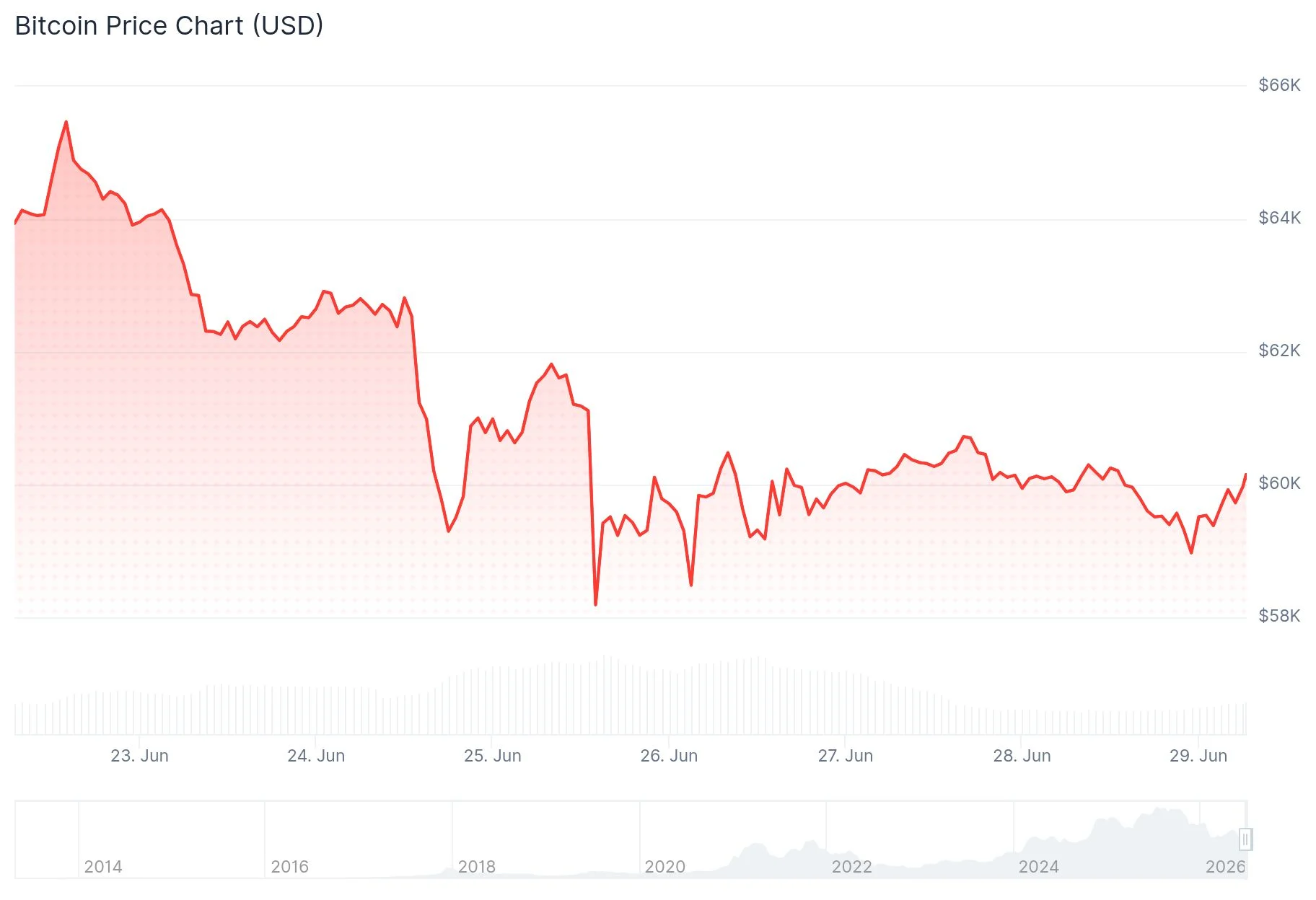
- Bitcoin has slipped beneath the $60,000 threshold, experiencing approximately 30% decline year-to-date
- BTC approaches its second consecutive quarterly decline, down 13% for the current quarter
- The Federal Reserve’s restrictive monetary policy combined with dollar strength continues applying downward pressure
- Market analyst Ted Pillows forecasts potential 60–65% correction before Bitcoin establishes a floor
Bitcoin has slipped beneath the $60,000 level as June concludes, with the digital asset hovering around $59,765 on Monday. This represents an approximately 30% decline from the start of the year.
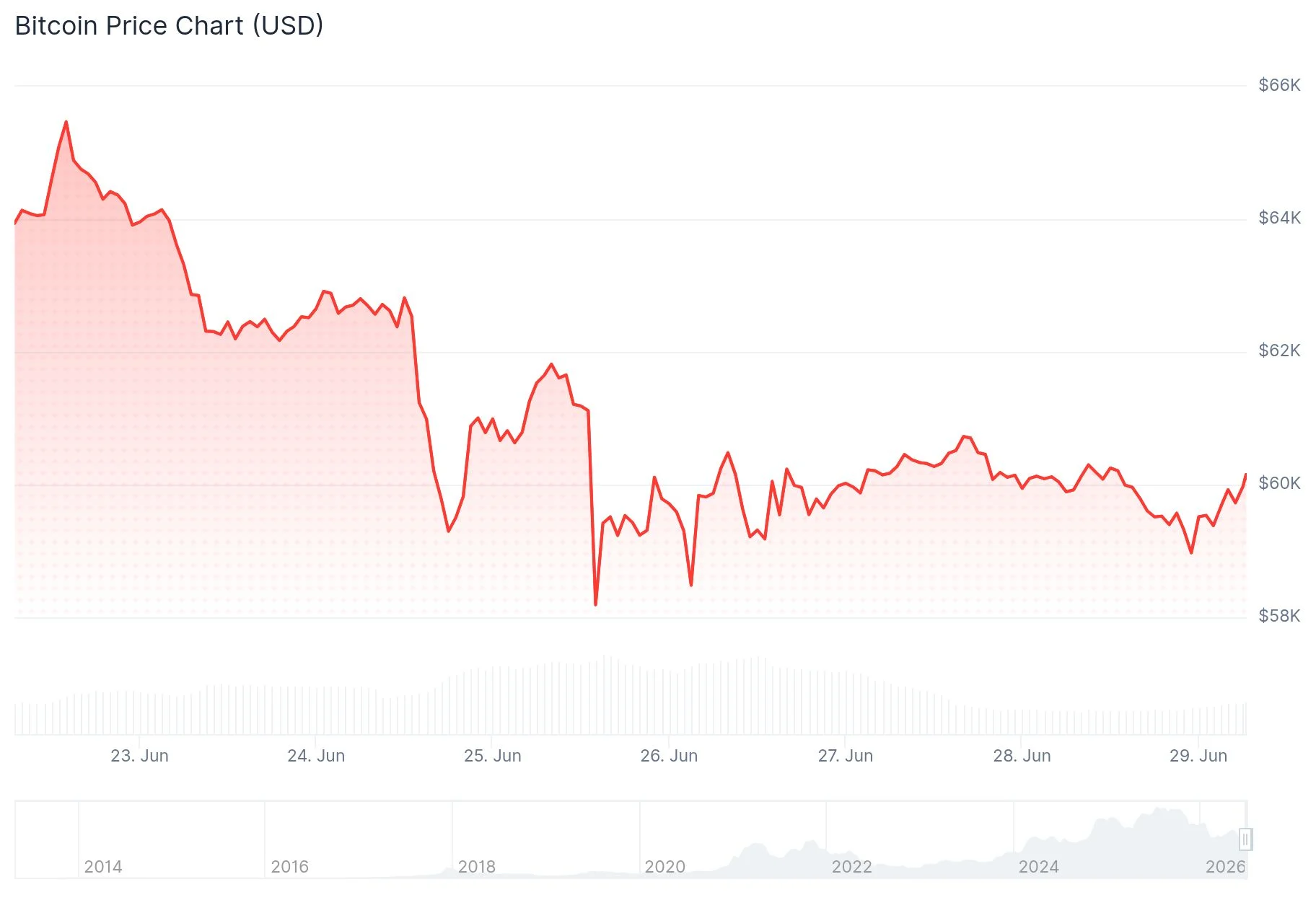
The quarterly performance paints an equally concerning picture. Bitcoin appears poised to conclude Q2 with a 13% deficit. Should this materialize, it would represent just the third occurrence in Bitcoin’s trading history of consecutive quarterly losses.
According to SoSoValue analytics, U.S. spot Bitcoin ETFs have witnessed $4.06 billion in net capital flight throughout June. This figure surpasses the previous monthly withdrawal record of $3.56 billion established in February 2025.
The preceding week alone experienced approximately $1.79 billion in redemptions, establishing it as the second-largest weekly outflow since these investment vehicles debuted in January 2024.
Persistent ETF Capital Flight Throughout 2026
June’s exodus represents part of a broader pattern. May recorded $2.43 billion in net withdrawals, pushing the combined two-month hemorrhage to nearly $6.5 billion.
Examining the full half-year picture, spot Bitcoin ETFs have experienced roughly $5 billion in net capital departure during the opening six months of 2026.
These investment products serve as critical barometers for institutional Bitcoin exposure. The magnitude of recent withdrawals signals diminishing enthusiasm among institutional market participants.
The erosion in institutional participation has mirrored Bitcoin’s price deterioration. Bitcoin has lagged behind virtually every significant asset category throughout 2026’s first half.
Strategy (MSTR), the prominent corporate Bitcoin holder, has experienced even steeper losses. The company’s equity has plummeted 45% year-to-date.
Federal Reserve Posture and Global Tensions
Beyond ETF dynamics, Bitcoin faces pressure from broader economic conditions. The Federal Reserve appears committed to maintaining elevated interest rates for an extended period, following recent indicators revealing persistent inflation and robust employment figures.
A strengthening U.S. dollar has compounded challenges for cryptocurrency valuations. Market participants have begun incorporating expectations for potential rate increases later this year.
Geopolitical instability in Middle Eastern regions has sustained market uncertainty. Weekend reports of tensions near the Strait of Hormuz disrupted energy markets before the U.S. and Iran reportedly committed to renewed diplomatic engagement.
Cryptocurrency analyst Ted Pillows (@TedPillows) offered perspective on Bitcoin’s potential trajectory, stating on X: “$BTC bottomed after 87% dump in 2015, 84% in 2018, and 78% in 2022. People are now thinking we’ll bottom after a 50% drop. IMO, Bitcoin will have at least a 60%–65% dump this time before the bottom.” His assessment highlights intensifying discussion regarding the depth of the current market correction.
Market participants are closely monitoring Friday’s U.S. employment data for insight into the Federal Reserve’s upcoming policy decisions.


SK Hynix has become the dominant supplier of those chips, a position that made it South Korea’s most valuable listed company this month, passing Samsung for the first time in 25 years. The two firms together supply most of the world’s HBM and have struck supply deals with Nvidia and OpenAI.
Such spending is a headwind for crypto because it is the same capital cycle that has competed with digital assets for investor money all year. Crypto fell through much of the month even on days when AI chip stocks rebounded – the divergence suggestive of how investors view the two classes.
Gabe Selby of CF Benchmarks said much of the new money and attention has flowed into AI plays, leaving crypto fighting for a smaller share of overall risk appetite.
The rotation has shown up in places that used to feed crypto directly.
When gold, silver and bitcoin sold off together in recent weeks as a hedge trade unwound, the cash leaving those hard assets moved into AI stocks rather than into bitcoin.
Even bitcoin miners have been redirecting computing capacity toward AI hosting, where contracted payments beat the swings of mining revenue.
South Korea’s $518 billion commitment is a decade-long bet that AI infrastructure spending is structural rather than a passing boom. Crypto has spent the year on the other side of that flow, and the open question is now whether the money chasing chips and AI listings eventually circles back or stays put.


Crypto opened Monday flat. Bitcoin traded near $59,700, down 0.3% on the day and 6.8% on the week, as a de-escalation in the U.S.-Iran conflict lifted equity futures but left digital assets unmoved, per CoinDesk data.
Ether edged up 0.3% to $1,572, Solana added 1.5%, while XRP and dogecoin continued to slide.
Axios reported Sunday that the U.S. and Iran agreed to fully halt strikes and meet this week in Qatar to resume talks over the Strait of Hormuz and a broader end to the conflict. S&P 500 and Nasdaq 100 futures gained 0.5% as of Monday, but crypto did not follow.
The non-reaction fits the pattern of the past two weeks. Bitcoin jumped on the peace deal signing June 19, then gave it back as the hawkish Fed and ETF outflows reasserted. Traders have now been burned by enough geopolitical relief rallies that the Qatar meeting registers as a maybe rather than a catalyst.
South Korea announced plans to double DRAM production capacity in the Seoul metro area over five years, with Samsung and SK Hynix committing 800 trillion won, about $518 billion, to build four new fabrication plants.
Asian tech hardware shares slid on the rotation, even as eight of eleven MSCI Asia Pacific subgroups gained. The same AI chip trade that whipsawed markets last week remains the dominant cross-asset current.
The test for crypto this week is whether the Iran talks in Qatar produce anything durable, and whether Thursday’s PCE print softens enough to shift the Fed narrative. Both need to land to give bitcoin a reason to move.

World Cup 2026: South Korea football coach quits as President Lee calls for probe
‘Engineers, Not Business Operators’: Why Loopring Is Shutting Down Its DEX

Collin Gosselin Says It ‘Hurts’ Seeing Sister Connect With Mom


-
 Sports6 days ago
Two goals and an assist by sheer aura: Cristiano Ronaldo just entered the World Cup chat
-

 Tech7 days ago
Microsoft accidentally kills epic Outlook email threads
-

 Fashion3 days ago
Weekend Open Thread: Staud – Corporette.com
-

 Politics3 days ago
The House | Manchesterism won’t survive the painful trade-offs unless it gets citizens on board
-

 Politics3 days ago
Potential 2028er World Cup attendee leaderboard
-

 Business3 days ago
Asia stock markets slide as tech shares slump
-

 Tech3 days ago
A Look At A Gaggle Of Transputer Boards
-
Crypto World5 days ago
Bitcoin (BTC) Dips Below $62K, Ethereum (ETH) Plunges 6% Daily: Market Watch
-
 Crypto World4 days ago
Dell (DELL) Shares Tumble Over 5% Following Analyst Downgrade to Hold
-

 Crypto World5 days ago
Securitize Wraps Roubini's SEC-Registered ETF as Dubai VARA Digital Security
-
Business5 days ago
Entergy settles forward sale agreements, raises $672 million in cash proceeds
-

 Crypto World2 days ago
Kraken's xStocks Opens Bending Spoons IPO Registration to EEA Retail
-

 Sports2 days ago
FIH Pro League: India defeat Pakistan 7-1, register biggest win of campaign | Other Sports News
-

 Crypto World2 days ago
Coinbase, Circle Deepen Crypto Stock Losses Despite Resilient S&P 500
-

 Crypto World3 days ago
RTX holders must register wallets before token distribution begins
-
Crypto World3 days ago
Hyperliquid Named on Singapore MAS Investor Alert Register
-

 Tech1 day ago
Bluekit phishing kit adopts browser-in-the-middle for login theft
-

 Sports4 days ago
India vs Bangladesh LIVE Score, Women’s T20 World Cup: Bangladesh Opt To Bat; India Enter ‘Do-Or-Die’ Stage As Semi-Final Race Heats Up
-
Crypto World3 days ago
The DATA Foundation Launches to Tackle AI’s Multi-Billion Dollar Training Data Bottleneck
-

 Tech2 days ago
Russian hackers now target Signal backup recovery keys
You must be logged in to post a comment Login