
Crypto World
CLARITY Act Faces Tougher Odds as Galaxy Research Downgrades 2026 Passage to 50%


TLDR
- Analyst Alex Thorn at Galaxy Research lowered the CLARITY Act’s 2026 passage probability from 60% to 50%
- The crypto bill cleared the Senate Banking Committee 15-9 on May 14 but lacks a scheduled floor vote
- Limited Senate floor time remains available before the late July August recess begins
- Unresolved ethics requirements from Senate Democrats continue to stall progress
- Without a concrete schedule by early July, passage may delay until post-September
The CLARITY Act, a cryptocurrency market structure bill, secured bipartisan approval from the Senate Banking Committee on May 14 with a 15-9 vote. Yet despite this legislative advancement, Alex Thorn from Galaxy Research has reduced his probability estimate for the bill’s 2026 enactment to 50%, down from the previous 60% projection made just weeks earlier.
Currently positioned at number 423 on the Senate’s legislative calendar, the bill awaits scheduling for floor consideration.
The primary obstacle is the ticking clock. With the Senate’s August recess approaching at July’s end, only a handful of productive legislative weeks remain on the schedule.
Competing Priorities Consume Senate Session Time
Recent Senate proceedings lost an entire week to disputes surrounding an anti-weaponization funding measure. Additionally, efforts to reauthorize Section 702 of FISA collapsed when a procedural vote failed 47-52.
Section 702’s authorization expires June 12. Consequently, much of the upcoming week’s available floor time will address that urgent matter rather than cryptocurrency legislation.
While each individual delay appears minor, collectively they erode the already-limited window the CLARITY Act requires for passage.
For successful passage, Senate Majority Leader John Thune must allocate floor time during July. The legislation still requires floor debate, an amendment process, and reconciliation with corresponding Senate Agriculture Committee language before any House consideration can begin.
This represents a substantial procedural checklist with minimal calendar availability to accomplish it.
Democratic Support Remains Uncertain
Beyond scheduling challenges, a critical substantive obstacle persists. Senator Ruben Gallego and fellow Senate Democrats have established ethics provisions as mandatory requirements for their support. These provisions remain unaddressed after the committee deferred resolution to floor consideration.
The legislation requires a minimum of 60 votes for advancement. Galaxy Research anticipates two Republican opposition votes from Josh Hawley and Rand Paul, both of whom opposed last year’s GENIUS Act.
This vote arithmetic provides Thune limited incentive to schedule floor time without confirmed Democratic support.
Potential Factors That Could Improve Prospects
Thorn indicated he would increase his probability assessment if Thune publicly commits to scheduling floor time in early-to-mid July, and if the ethics and illicit finance concerns are demonstrably resolved with confirmed support from nine or more Democratic senators.
Announcement that the Banking and Agriculture Committee versions have been consolidated into a unified legislative package would also boost prospects.
Absent these developments within the next two to three weeks, Galaxy Research suggests the realistic timeline shifts to September. However, autumn legislative action encounters midterm election pressures, when floor availability becomes scarce and members concentrate on campaign activities.
Presently, Galaxy Research maintains the CLARITY Act is more likely than not to pass in 2026, though the probability margin continues narrowing.



A Friday filing in the U.S. District Court for the Southern District of New York (SDNY) seeks to limit what prosecutors can use in the campaign-finance case involving Michelle Bond, the wife of former FTX Digital Markets co-CEO Ryan Salame.
Bond’s attorneys argued that evidence tied to Salame’s 2023 guilty plea—while relevant to his own conduct—should not be admitted against her because it carries a risk of unfair prejudice and, in their view, offers little direct proof of Bond’s knowledge or intent. The motion also asks the court to factor in details from Bond’s contemporaneous divorce and custody proceedings.
Key takeaways
- Michelle Bond wants the court to exclude evidence and “related plea materials” tied to Ryan Salame’s guilty plea, arguing they are not probative of her state of mind.
- Bond’s campaign-finance charges stem from allegations that contributions to her 2022 congressional bid were influenced by FTX-linked activity facilitated by Salame.
- The SDNY motion also requests inclusion of information about Bond’s divorce and custody proceedings, contending she was not an “ordinary” donor.
- Separately, the CFTC ordered former congressman George Santos to pay $35,000 in total—$17,500 in penalty and $17,570 in disgorgement—over trades connected to Kalshi prediction market event contracts.
- A soldier accused of making more than $400,000 on Polymarket event contracts linked to a military operation asked the SDNY court to dismiss charges, citing ambiguity in how “swap” definitions apply to event contracts under the Commodity Exchange Act.
Bond asks SDNY to keep Salame’s guilty plea out of her case
Bond faces campaign finance charges tied to her unsuccessful 2022 congressional run in New York. According to the criminal allegations, contributions to her campaign were partly funded through FTX-related channels that were facilitated by her husband, Ryan Salame.
In the latest SDNY filing, Bond’s legal team asked the court to preclude prosecutors from introducing Salame’s guilty plea and related plea materials. The filing points to the core logic of the request: Bond is not being tried for Salame’s admissions, and the defense claims the government’s use of those materials would not meaningfully establish Bond’s guilt, knowledge, or intent.
Bond’s attorneys argued that Salame’s plea is an admission of his own conduct, not evidence about Bond’s mental state or participation in the charged offense. They said the materials’ probative value is substantially outweighed by the risk of unfair prejudice to Bond.
Prosecutors are expected to weigh heavily on the narrative connecting alleged campaign funding to the conduct of individuals tied to FTX’s collapse. Bond’s motion, however, signals an effort to narrow what jurors are allowed to consider—particularly evidence that may influence them emotionally or circumstantially rather than strictly proving the elements of the charges against her.
Why the defense is raising divorce and custody proceedings
Alongside the evidentiary dispute over Salame’s plea, Bond’s filing also requested that the court include information related to Bond’s divorce and custody proceedings that were underway around the same time as the alleged crime.
Bond’s lawyers’ position is that the circumstances of her family life affect how her campaign-related donor status should be viewed. The filing argues that Bond should not be treated as an ordinary individual donor solely because she is facing personal charges in connection with her political bid, even if she and Salame were not married at the time of the alleged conduct.
Whether and to what extent these family-law details will be admissible is likely to be a key procedural issue. It can shape the tone and framing of the case—especially if the government seeks to portray the campaign finances as closely connected to Salame’s network rather than to Bond’s independent circumstances.
George Santos ordered to pay over Kalshi predictions market trading
In a separate development involving prediction markets, the U.S. Commodity Futures Trading Commission (CFTC) ordered former New York representative George Santos—who was expelled from Congress in 2023—to pay a total of $35,000. The figure breaks down into a $17,500 civil monetary penalty and $17,570 in disgorgement of profits.
The regulator said the action was tied to Santos trading on event contracts on Kalshi connected to whether he would attend the 2026 State of the Union address in Washington, DC. The CFTC stated that Santos made social media posts about his plans to attend or not attend the event and that those posts contained “material misrepresentations and omissions.”
According to the CFTC, after the posts, the contract prices moved in a way that became favorable to Santos’ positions and allowed him to make more than $17,500.
As part of the same order, Santos was barred from trading on prediction market platforms for three years. The order also comes against the backdrop of criminal proceedings: Santos was sentenced to 87 months in prison for wire fraud and aggravated identity theft in 2025, but served only three months before his sentence was commuted by U.S. President Donald Trump, as noted in earlier reporting.
Polymarket insider-trading allegations head toward dismissal arguments
Another SDNY filing, this time from the defense of Gannon Ken Van Dyke, challenges the legal foundation of allegations that he profited from Polymarket event contracts using nonpublic information.
The U.S. Justice Department says Van Dyke was involved in a military operation connected to the removal of Venezuelan President Nicolás Maduro in January, and prosecutors allege he later used insider information to bet whether Maduro would be removed from power—leading to criminal charges announced in April. The defense filing argues Van Dyke is facing accusations involving more than $400,000 in alleged profits from Polymarket event contracts.
Van Dyke’s attorneys filed a 51-page memo supporting a motion to dismiss the indictment based on multiple legal theories. One focus is the Commodity Exchange Act’s treatment of event contracts as “swaps,” which the defense characterizes as ambiguous.
While the CFTC under Chair Michael Selig has asserted that the agency has “exclusive jurisdiction” over prediction markets by treating event contracts as “swaps,” Van Dyke’s lawyers say the uncertainty itself is enough to dismiss at least some charges. In the filing, they argue that if lawmakers, executive agencies, and courts consider the “swap” definition ambiguous, then ordinary citizens cannot reasonably have fair notice that prediction market wagers fall under the CEA.
The case is expected to proceed on a timeline that could lead to trial in late 2026 or early 2027, based on a schedule submitted in June, and Van Dyke has pleaded not guilty to all charges.
The defense’s arguments also extend beyond Van Dyke’s personal exposure. The filing suggests the ruling could matter for lawmakers and government officials who have used prediction markets in connection with political events or public statements. Earlier coverage referenced by the filing indicates that Trump’s teleprompter operator reportedly placed more than $100,000 in bets on Kalshi event contracts tied to presidential speeches, underscoring how prediction markets can draw interest from political circles.
Across these cases, courts are being asked to decide what evidence is fair game, what definitions govern crypto-adjacent instruments, and how much clarity regulators must provide before individuals can be held criminally liable—issues that could determine how future crypto and prediction-market enforcement plays out.
Wife of former FTX executive seeks to preclude her husband’s guilty plea
In a Friday filing with the US District Court for the Southern District of New York (SDNY) over campaign finance charges, Michelle Bond’s legal team asked the court to consider precluding evidence related to former FTX Digital Markets co-CEO Ryan Salame, her husband who is currently serving a 90-month sentence after he pleaded guilty in 2023.
Bond faces campaign finance charges alleging that her unsuccessful 2022 congressional run in New York was partially funded by contributions from FTX facilitated by Salame. As part of the filings this week, Bond asked the court to exclude evidence of her husband’s guilty plea and “related plea materials,” in which the former executive admitted to making “political contributions in [his] name that were funded by transfers from the bank accounts” of an entity tied to FTX.
“The Court should preclude the government from introducing or referring to Mr. Salame’s guilty plea or any related plea materials, because their minimal probative value is substantially outweighed by the risk of unfair prejudice to Ms. Bond,” said the filing.
Bond’s lawyers added:
“[…] Mr. Salame’s plea materials lack any probative value as to Ms. Bond’s guilt, knowledge, or intent. Mr. Salame’s plea is an admission of his own guilt, not evidence of Ms. Bond’s state of mind or participation in any charged offense.”
The motion also requested the court include information related to Bond’s “contemporaneous divorce and custody proceedings,” arguing that though she and Salame were not married at the time of the alleged crime, the former FTX executive was not an “ordinary ‘individual’ donor” contributing to her campaign.
Related: US Senate unanimously adopts resolution opposing clemency for SBF
The criminal case is one of the latest involving individuals tied to the defunct crypto exchange following its 2022 collapse. Salame, former FTX CEO Sam Bankman-Fried and former Alameda Research CEO Caroline Ellison were all sentenced to prison for their role in the misuse of customer funds and related charges.
Former congressman ordered to pay $35,000 over Kalshi bet
George Santos, a former New York House representative who was expelled from Congress in 2023, was ordered to pay a $17,500 civil monetary penalty and $17,570 in disgorgement from profits earned over bets placed on prediction markets platform Kalshi. The order from the US Commodity Futures Trading Commission (CFTC) stemmed from Santos trading on event contracts betting on his appearance at the 2026 State of the Union address in Washington, DC.
“While buying and selling positions in this market, Santos posted on social media about his plans to attend or not attend the SOTU,” said the CFTC. “In his social media posts, Santos made a series of material misrepresentations and omissions about whether he would attend the SOTU. After these posts, the SOTU contract prices moved in a direction that was favorable to Santos’ positions which allowed him to make over $17,500.”
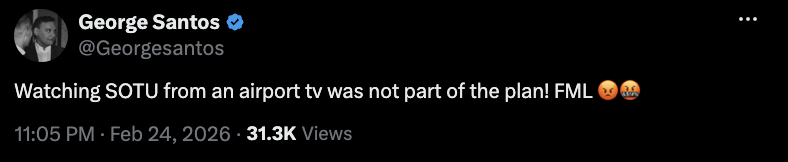
February X post about his State of the Union attendance. Source: George Santos
Santos is barred from trading on prediction market platforms for three years as part of the order. He was also previously sentenced to 87 months in prison for wire fraud and aggravated identity theft in 2025, but served only three months before his sentence was commuted by US President Donald Trump.
US solider accused of making $400,000 Polymarket bet seeks to dismiss charges
Gannon Ken Van Dyke is a US soldier who faces charges for allegedly making more than $400,000 on Polymarket event contracts using nonpublic information tied to a military operation involving the removal of Venezuelan President Nicolás Maduro in January. He was involved in the operation removing Maduro, according to the US Justice Department, and allegedly used insider information to bet whether the Venezuelan president would be removed from power, leading to criminal charges in April.
In a Friday SDNY filing, Van Dyke’s legal team filed a 51-page memo in support of a motion to dismiss the indictment based on different legal theories, including that the Commodity Exchange Act (CEA) at the center of three of the charges was “ambiguous” in treating event contracts as “swaps.”
Although the CFTC under Chair Michael Selig has claimed that the agency has “exclusive jurisdiction” over prediction markets on the basis that event contracts are treated as “swaps,” Van Dyke’s lawyers said the lack of clarity was sufficient to dismiss some of the charges.
“If Congress, executive branch agencies, and courts all find the ‘swap’ definition ambiguous, how can ordinary citizens have fair notice that prediction market wagers are covered by the CEA?” said the filing. “They cannot.”
The case is expected to have significant implications for lawmakers and government officials using prediction markets. Trump’s teleprompter operator reportedly made more than $100,000 using Kalshi event contracts related to the president’s speeches.
Based on a schedule filed in June, Van Dyke is potentially looking at a trial beginning in late 2026 or early 2027. He has pleaded not guilty to all charges.
Magazine: Here’s why the CLARITY Act’s ethics deal may be so hard to reach


The attacker working through Coldcard-generated keys is now emptying wallets worth a few thousand dollars each.
Galaxy Research flagged a third wave of sweeps early Sunday, roughly 208 bitcoin drained from 1,912 addresses between Friday midday and Saturday morning UTC.
That is just over a tenth of a bitcoin per victim. The July 30 opening wave averaged close to a full coin, 1,083 bitcoin from 1,196 addresses in 41 minutes.
Observed losses across all three waves now total 1,367 bitcoin, nearly $89 million, from 4,585 addresses.
Wave three sends each victim’s coins to its own destination rather than the handful of shared collector addresses that made the first two easy to map, and parks them in pay-to-witness-script-hash outputs, a format that can carry multisignature or timelock conditions, instead of the plain single-key outputs used before.
It batched an average of six victims into each sweep where wave one took exactly one at a time, and it scanned only the default derivation path, the standard branch of the key tree a wallet checks first, instead of testing several branches per seed.

Perhaps due to the quickly re-escalating tension in the Middle East, the cryptocurrency market has posted fresh losses over the past few hours, with BTC dropping to $62,000 after failing to reclaim the $63,000 support during the day.
XRP was not spared, as it just slipped below $1.05. The asset was rejected at $1.20 during the mid-July rally after the favorable US inflation data for June, and eventually lost the coveted $1.10 support. Now, it fights for the last line of defense before the bulls would have to defend the $1.00 zone.
Popular analyst EGRAG CRYPTO outlined the significance of the $1.05 level, calling it the ‘battlefield’ region. Although he noted earlier today that the cross-border token had managed to maintain that level, he acknowledged the predominantly bearish structure of lower highs on the 4-hour chart.
The short-term path of recovery would be a successful defense of $1.05 before XRP can bounce above $1.083 and eventually reclaim the $1.10 level, which now acts as resistance.
EGRAG laid out an even more promising road ahead for the asset if it manages to continue its recovery, with the “major price target” set at $1.30.
However, a decisive breakdown below $1.05 would essentially mean that XRP will head toward the notable liquidity zone at around $1.00, he warned.
Mikybull Crypto also believes XRP has the strength to stage a surprising comeback. The analyst claimed that the asset’s bullish reversal run is currently loading despite the negative outlook.
His long-term chart compares the current market structure with the one from two years ago when XRP was highly compressed at around $0.60. Once it broke out the upper boundary, though, it rocketed to a fresh all-time high within less than a year.
“Before the last run, I screamed for you to buy at a crazy discount. The opportunity is presenting again,” he said now.
History is not on XRP’s side at the moment, though, as August has been quite a painful month for the asset. As reported earlier today, the cross-border token was deep in the red in all four previous editions.
The post XRP Price Dips to ‘Battlefield’ Zone, but Analysts See Major Reversal Opportunity appeared first on CryptoPotato.

Pi Coin (PI) rose 8% on Saturday to $0.0870. The move pushed the token onto CoinGecko’s trending list, days before a hard deadline for Pi Network.
Nodes are the computers that check Pi transactions. The people who run them have until August 11 to install an update. Nodes that miss it get cut off.
Why Pi Coin Is Trending Again
CoinGecko ranked PI second on its trending board on Saturday. Most other coins on that list were falling. Pi Coin was one of the few going up.

The bigger picture is less kind. While PI has gained 7% over the past week, it is still down 25% over the past month. The token is worth about $957 million in total, making it the 67th largest coin.

Trading stayed thin. Pi Network market data shows roughly $8.6 million changed hands in 24 hours.
What the August 11 Deadline Means
Protocol v26 is the latest step in a long chain of updates that started at version 19. Pi says it makes smart contracts safer. It also improves how the network stores data and talks to other blockchains.
“Protocol 26 is a major milestone ahead of the final planned upgrade, Protocol 27. With 8 successful upgrades completed over the past few months, these final two upgrades will bring the network up to date with the latest protocol features, improvements, and functionality,” the team noted.
Follow us on X to get the latest news as it happens
Only node operators need to act. People who mine Pi on their phones do not. Pi lists every step on its node page.
Pi nodes agree on transactions in small trusted groups, a design borrowed from Stellar. The July 22 Protocol v25 rollout added the cryptography that privacy apps need.
Why Pi Coin Rallies Keep Fading
Traders have seen this before. PI jumped 24% ahead of the July 22 update. It handed the gain back once the day arrived. The Protocol 24 mainnet upgrade in June ended the same way.
Zoom out and it looks worse. PI hit a record low of $0.0710 on July 14. It now sits 79% below where it traded a year ago.
New supply is the main drag. PiScan data cited last month showed about 1.71 billion PI unlocking over the next year. That is a heavy load for a market trading under $10 million a day.

Protocol v27 is the last planned update. Whether August 11 shifts the PI price forecast outlook comes down to one thing. Buyers have to show up faster than the new coins do.
The post Pi Coin Defies Market Trend Before Key Deadline: Will the 10% Bounce Hold? appeared first on BeInCrypto.

Who are possible challengers to FIFA President Gianni Infantino?
Infantino was originally expected to easily retain his position at the helm of FIFA in March 2027.
Now, with public calls for review into his leadership, potential rivals may feel emboldened.
“FIFA is full of sharks, and there’s no question that many of them can smell blood. Infantino’s election in 2027, which seemed like a sure bet only a few days ago, is now an open question,” Boykoff says.
Challengers for his role must submit their candidacies by Nov. 18, and there has already been some speculation as to who might make a bid.
Sheikh Salman bin Ebrahim Al Khalifa, president of the Asian Football Confederation (AFC), was defeated by Infantino in 2016, the current administrator’s first term, but he could return a decade later as a frontrunner. He called Infantino’s investment proposal and his failure to consult AFC on it “totally unacceptable,” putting the two publicly at odds.
We will begin with the mandatory disclaimer, as we are well aware that historical performance does not guarantee similar moves in the future. However, history does tend to rhyme, and that’s what happened in July for BTC.
The question is: will August follow suit, as the month has not been kind to the largest cryptocurrency, especially the last four editions.
July Brought Some Gains
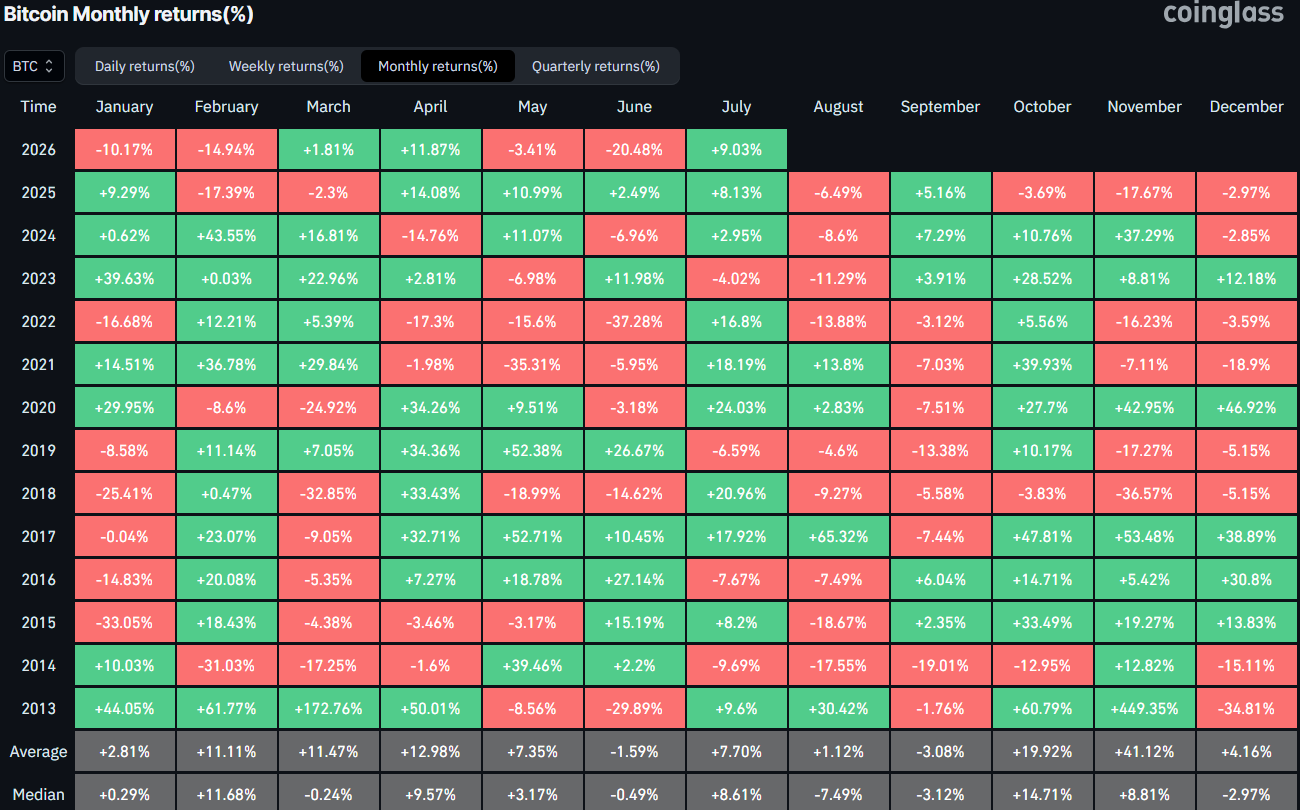
Before we explore what happened in July, here’s a brief outlook of the painful June, which set the stage for a rebound during the seventh month of the year. The 2026 edition of June became the most violent in terms of price moves for the cryptocurrency in precisely four years. It tumbled by 20.48% in 2026 compared to 37.28% in June 2022.
As such, it was almost expected that July would be a better month. History was also on BTC’s side as 9 out of the last 11 were in the green. However, the start was actually quite surprising as bitcoin dipped below $58,000 on July 1 for the first time in nearly two years.
The bears quickly lost control, though, and the asset reclaimed the coveted $60,000 level within a day or two. It wasn’t the most volatile of months, but BTC still managed to post some gains and peaked on July 21 at $67,000. This became its highest price tag in two months.
However, it was rejected there despite the softer-than-expected inflation data for June and the fact that the Fed refused to hike interest rates last week. Thus, bitcoin ended the month at under $64,000, which was still a 9% monthly increase.
Your Move, August
As popular analyst Ali Martinez put it yesterday: August hasn’t been kind to bitcoin. In fact, the last four have all been in the red, posting losses of 13.88%, 11.29%, 8.6%, and 6.49%, respectively. The silver lining is that the declines become less violent over time.
The broader August perspective is still deeply negative, though. Only three out of the last 12 editions have been in the green, with 2017 standing out as the most bullish one on record. At the time, BTC rocketed by over 65%, but it was a different time and a vastly different market phase.
For now, BTC enters August 2026 with lots of uncertainty not only within the industry itself, where interest has dwindled lately, but on a macro perspective as well. The war in the Middle East continues, and the one between Ukraine and Russia too, while inflation remains an issue, and Trump’s controversial actions tend to halt each breakout attempt in its tracks.
The post Bitcoin Rebounded in July, but Bears Target an August Pullback appeared first on CryptoPotato.


Cointelegraph is committed to providing independent, high-quality journalism across the crypto, blockchain, AI, and fintech industries.
All news, reviews, and analyses are produced with full journalistic independence and integrity. For more details on our standards and processes, please read our Editorial Policy.

A crypto-industry-backed political action committee affiliate has intensified its advertising push ahead of next week’s Michigan Republican primary, according to the latest Federal Election Commission (FEC) filings. Protect Progress PAC, which the filings indicate is funded largely by contributions from cryptocurrency companies Ripple Labs and Coinbase, has spent more than $2 million on media to influence the contest in Michigan’s 13th Congressional District.
The most recent updates, filed as of Thursday, show the committee ramping up spending in support of U.S. Representative Shri Thanedar while also funding opposition to his Democratic challenger, Donavan McKinney. The renewed disclosures come shortly after earlier reporting showed the PAC had already ramped up its buy—effectively doubling its reported ad spending from the prior week.
Key takeaways
- FEC filings show Protect Progress PAC has spent over $2 million on media for Michigan’s 13th district primary race.
- New disclosures add $884,240 to advertisements supporting Shri Thanedar and more than $150,000 to ads opposing Donavan McKinney.
- The PAC’s funding is described in the filings as being largely backed by cryptocurrency companies Ripple Labs and Coinbase.
- Thanedar’s legislative record includes support for crypto-related bills such as the GENIUS Act and the CLARITY Act.
- Protect Progress is an affiliate of Fairshake, a major outside spender in U.S. elections tied to crypto industry policy goals.
Michigan’s 13th district: Protect Progress increases ad buys
According to FEC disclosures accessed via the commission’s docquery system, Protect Progress PAC reported spending more than a combined $2 million on media in connection with Michigan Representative Shri Thanedar and his Democratic primary contest against Donavan McKinney.
As of Thursday, the filings reflect a further escalation: compared with what the PAC had already reported spending a week earlier, the committee’s latest report effectively doubled its media spending. The additional outlay includes $884,240 dedicated to ads supporting Thanedar and more than $150,000 aimed at opposing McKinney.
The Michigan primary is scheduled for Tuesday, but the filings underscore that the committee and its network have been willing to deploy substantial resources well before Election Day. Similar patterns have been visible across multiple congressional races during the 2026 cycle, according to the article’s referenced coverage and FEC-based reporting.
Why the race is drawing crypto-linked political money
Thanedar’s congressional record is at the center of the narrative around why outside groups see his candidacy as important for crypto policy. During his time in the House, he voted in favor of the stablecoin-focused GENIUS Act and supported the legislative push for clearer digital asset market structure—the Digital Asset Market Clarity (CLARITY) Act, which has been discussed in the Senate.
He also cosponsored the Promoting Innovation in Blockchain Development Act, an effort aimed at protecting developers. Supporters of crypto policy reform often point to such measures as steps toward a more predictable regulatory environment, while critics argue the industry has too much influence over the political process.
For voters watching the contest, the spending escalation suggests the primary is being treated as more than a local political test—it is being framed by donors and advocacy networks as part of a broader strategy to influence which lawmakers back specific digital asset legislation.
McKinney’s response and the broader allegations over crypto influence
McKinney has publicly characterized the ad push as a payoff for political favors. In a July 21 statement related to the PAC spending, he said “the crypto lobby is paying my opponent back for helping Trump make over $1 billion since taking office,” according to a video shared on his campaign’s Facebook page.
That comment appears to reference the U.S. President’s disclosures about crypto-related earnings, including a figure cited in earlier reporting referenced by the article—more than $1.4 billion from crypto investments in 2025—along with concerns raised by Democrats that Trump could be using his role to profit through policies such as GENIUS.
While those claims are rooted in political argument rather than direct proof of intent tied to the specific Michigan ads, they highlight a recurring tension in U.S. crypto politics: outside spending may be framed by industry-aligned PACs as policy support, while opponents often describe it as evidence of undue influence.
Cointelegraph reports that it reached out to both Thanedar’s and McKinney’s campaigns for comment on the PAC expenditures but did not receive an immediate response.
Fairshake’s affiliates: national momentum in multiple primaries
Protect Progress PAC is an affiliate of Fairshake, a political network that has become one of the most prominent outside spenders linked to crypto industry policy goals. Fairshake was responsible for spending more than $170 million across the 2024 election cycle through media buys supporting candidates it viewed as aligned with crypto-friendly regulation, as summarized in the article.
The article also notes that affiliates have already deployed millions of dollars in 2026 races beyond Michigan, pointing to activity in states including Texas and Illinois. In addition, it cites Public Citizen reporting from June that Fairshake and its affiliates accounted for more than $82 million out of roughly $189 million deployed by crypto companies during the 2026 election cycle.
Fairshake itself reportedly listed holding a $193 million “war chest” as of January, according to figures referenced in the piece. Taken together with the Michigan disclosures, the pattern suggests a sustained approach: deploy substantial resources early enough to shape narrative and voter attention around specific legislative priorities.
The article further describes similar affiliate activity in other congressional primaries. It says Defend American Jobs PAC spent more than $65,000 on media in Washington’s 4th congressional district to support a Republican candidate, with Washington holding primaries on the same day as Michigan.
In Alabama, scheduled primaries on Aug. 11 are also described as a focus for Fairshake-linked spending. FEC filings cited in the article indicate Defend American Jobs PAC spent more than $511,000 on media supporting Jerry Carl Jr., a Republican who represented Alabama’s 1st congressional district from 2021 to 2025.
For readers tracking the cycle, these parallel contests illustrate how crypto-aligned PAC affiliates appear to treat primary elections as strategic targets—places where candidate positioning on digital asset policy could be determined before general election dynamics begin.
What to watch as Michigan’s primary approaches
With Michigan’s 13th district primary scheduled for Tuesday, the key question is whether Protect Progress’s latest ad surge will further alter voter perceptions or turnout in the remaining days. More broadly, the filings reinforce that crypto-linked political spending is not limited to high-profile general election races—affiliates are actively contesting primaries with resources intended to influence policy direction well after election season announcements fade.

Firefighters memorial climb challenge at Clifford’s Tower

Key On-Chain Legal Updates This Week

A look back at Zinedine Zidane’s career as he becomes France’s new coach


-
 Sports6 days ago
Commonwealth Games boxing: Jadumani Singh seals dominant 5-0 win over Pakistan’s Sumama Rehman to enter quarter-finals | Commonwealth Games News
-

 Business3 days ago
Why Trees Belong on the Risk Register
-

 Fashion1 day ago
Weekend Open Thread: Wit & Wisdom
-

 Tech6 days ago
Intel is reversing course and bringing hyper-threading back to its server chips
-

 Politics1 day ago
Meta enters AI-training agreement with far-right ‘propaganda rag’ Newsmax
-

 Politics5 days ago
Luke Littler dismantles Gerwyn Price to retain title in Blackpool
-

 Crypto World7 hours ago
MicroStrategy Post-Earnings CLARITY Act Push Could Add New Catalyst for Its Stock
-

 Politics5 days ago
The Part of the Electric Transition Nobody Wants to Discuss
-

 News Videos6 days ago
BITCOIN JUST ENTERED THIS CRITICAL ZONE…
-
 Entertainment4 days ago
‘Stargate’ Creator’s New Sci-Fi Series Returns for Season 3 Tomorrow
-

 Business4 days ago
Major shareholder moves on Canyon
-

 Crypto World7 days ago
XRP Ledger adds $2.6B as RWA inflows rank second
-

 Politics6 days ago
Spain sweeps the board at 2026 World Cup with individual awards
-

 News Videos2 days ago
Bitcoin Enters the 3rd Stage of the Bear Market
-
Crypto World16 hours ago
XRP Ledger v3.3.0 brings five institutional features
-

 Entertainment7 days ago
Sara Gilson Killed By Husband After Viral “Pedophile” TikTok Video
-

 Crypto World4 days ago
Kraken Enables Retail Access to Jersey Mike’s IPO via Tokenized Shares
-

 Tech5 days ago
New macOS Sequoia & Sonoma security updates for older Macs
-

 News Videos4 days ago
Claude: Build Financial Dashboards in Minutes (2026)
-

 Politics2 days ago
Luke Littler’s dominance sparks GOAT debate
You must be logged in to post a comment Login