

Crypto World
What are “the trenches”? Solana memecoin culture



If you spend any time around Solana memecoins, you will hear about “the trenches.” It is where traders called degens fight over brand-new tokens that mostly go to zero, in a culture with its own language, rituals, and brutal economics. Here is what the trenches are, the slang you need to follow them, and the hard reality behind the romance.
Summary
- “The trenches” is crypto slang for the chaotic, high-risk frontier of on-chain memecoin trading, especially brand-new Solana tokens on launchpads like Pump.fun.
- The traders who operate there are called trenchers or degens, and the culture has its own dense vocabulary, rituals, and a war-themed self-image of survival against the odds.
- The trenches run on launchpads, decentralized exchanges, and fast trading tools, where tokens can rocket and collapse within minutes and bots compete for the first buys.
- The romance of life-changing gains is real but rare, and is built on heavy survivorship bias, since the large majority of tokens die fast and most participants lose money.
- Understanding the trenches and its slang is useful for following crypto culture and protecting yourself, but the honest framing is that it functions more like a casino than a market.
“The trenches” is crypto slang for the chaotic, high-risk frontier of on-chain memecoin trading, especially the world of brand-new Solana tokens launched on platforms like Pump.fun, where traders fight for fast profits amid rampant scams, bots, and a flood of coins that mostly go to zero. The phrase is a war metaphor, and it is chosen deliberately. To be “in the trenches” is to be down in the mud of the riskiest, fastest, most unforgiving part of crypto, trading tokens that are minutes old, against opponents who include automated bots and seasoned predators, where fortunes are made and lost in the time it takes to read a chart. It is a culture as much as an activity, with its own dense vocabulary, its own rituals and heroes, and its own grim economics.
The term has spread well beyond its origins, and you will now hear it used for the early, high-risk stage of any speculative crypto play, but its heartland is the Solana memecoin scene, where the conditions that birthed it, instant token creation, near-zero fees, and a permanent firehose of new coins, are most intense. This guide is a map of the trenches for people who want to understand the culture without necessarily entering it, or who are entering it and want to know what they are walking into. It explains what the trenches are and where they physically exist on-chain, the mindset and culture that define the people in them, a working glossary of the slang you need to follow any trenches conversation, how a typical trench play actually unfolds from launch to death or survival, a recent episode that captures the culture in motion, and, most importantly, the hard reality behind the romantic self-image.
That last part matters more than all the slang, because the trenches present themselves as a place of opportunity and camaraderie, and they are also a place where the overwhelming majority of participants lose money to a structure designed to extract it. Learning the language is the easy part. Understanding the economics is what protects you. This guide tries to do both, in that order, so that the culture is legible and the danger is unmistakable.
What the trenches are and where they live
At its core, the trenches refers to the earliest and riskiest stage of memecoin trading, where tokens are brand new and the action is fastest. The phrase captures both a place and a phase. As a phase, it means trading coins in their first minutes and hours of life, before they have established markets, when prices move violently and information is scarce. As a place, it refers to the venues and channels where this happens.
The trenches live on launchpads, above all the dominant Solana launchpad, where anyone can deploy a token in seconds and it begins trading immediately against a bonding curve. For readers new to that pricing model, the mechanism under every launch is the bonding curve, which automatically changes a token’s price as buyers and sellers move in and out. The trenches extend to the decentralized exchanges where tokens move after they graduate from those launchpads, and to the social channels, especially memecoin-focused chat groups, that are themselves often called the trenches, because that is where traders gather to share tips and coordinate.
The infrastructure of the trenches is built for speed, which shapes the entire experience. Traders use specialized tools and bots that let them buy a token within seconds of its launch, read on-chain data in real time, and execute faster than a human could click, because in a world where a coin can rise and fall in minutes, milliseconds of timing translate into enormous differences in entry price. This is why the trenches are not a level playing field: automated snipers and bots routinely buy into a token in its first moments, ahead of the humans who see it trending later. The reason all of this concentrated on Solana is structural: Solana’s very low fees and fast transaction speeds make it cheap and quick to launch coins and to trade them rapidly, which is exactly what a high-frequency, high-churn memecoin culture needs.
The launchpads that lowered the barrier to creating tokens did the rest. The trenches, then, are the on-chain frontier where the cheapest, fastest, most permissionless token creation meets the most speculative trading culture in crypto. The combination produces both the energy and the carnage the term implies. It is why the trenches feel like a live market, a chatroom, and a casino floor at the same time.
The mindset and the culture
The trenches have a distinct culture, and understanding the mindset is as important as understanding the mechanics, because the culture is part of what keeps people in a game that mostly loses them money. The self-image is heroic and martial: participants cast themselves as warriors surviving in hostile territory, enduring losses, hunting for the one coin that will pay for all the others. There is genuine camaraderie in it, a shared identity among people who understand a world outsiders find baffling or repellent, and a folklore of legendary trades and legendary traders. The dominant ethos is captured in the word degen, short for degenerate, which trenchers wear as a badge rather than an insult.
To be a degen in the trenches is to accept that you are gambling and to lean into it with a certain dark humor. That humor and identity are woven through the culture’s language and rituals. Trenchers talk about “locking in,” meaning to focus intensely on the goal of making money quickly with minimal effort, and about hunting for a “gem,” an undervalued coin spotted before the crowd. The culture prizes “alpha,” valuable information or insight shared among insiders, and it runs on a constant cycle of fear of missing out and fear of being wrong, the twin emotions that drive impulsive buying and panic selling.
There is a player-versus-player quality to it, an awareness that in a zero-sum scramble over a worthless token, your profit is someone else’s loss, which the culture acknowledges with a kind of cheerful brutality. All of this creates a powerful social pull. The trenches are not just a market; they are a community with a language, a value system, and an emotional rhythm. That social dimension is a large part of why people stay even as they lose, because belonging and the thrill of the hunt are their own rewards.
Recognizing the culture’s grip is important, because the same camaraderie that makes the trenches compelling is also what makes them hard to walk away from. The community tells itself stories about survival and conviction, and some of those stories are true. But many of them are also retrospective myths built around the tiny number of trades that worked. That is why the culture has to be understood together with the economics, not separately from them.
A working glossary of trench slang
To follow any conversation in the trenches, you need the vocabulary, and the slang is dense enough that an outsider can find a discussion incomprehensible. What follows is a working glossary of the most important terms, enough to read a typical trenches exchange. Begin with the people: a trencher or degen is a high-risk memecoin trader; a jeet is a derisive term for someone who sells too early or panic-sells, dumping on others; and a whale is a holder large enough to move a token’s price with their trades. The verbs of entry and exit matter too: to ape, or ape in, is to buy a token impulsively without much research; to snipe is to buy in the very first moments of a launch, usually with a bot; and to bundle is to coordinate multiple wallets to buy at launch, often to create a false impression of demand.
The lifecycle of a coin has its own terms. A fair launch means a token released with no presale or insider allocation, where everyone enters through the same curve. Graduation is the moment a token completes its bonding curve and moves to a normal exchange. A rug, or rug pull, is the most common trench ending: a scam where the creator pulls liquidity or dumps their holdings, collapsing the price to near zero.
A CTO, or community takeover, is when holders take over a coin the original creator abandoned, running it themselves to try to revive it. The emotional and evaluative vocabulary rounds it out: a gem is an undervalued find; alpha is valuable insight; FOMO and FUD are the fear of missing out and fear, uncertainty, and doubt that drive buying and selling; bags are the tokens you hold; to be underwater is to hold at a loss; and to moon or send it is to rise sharply or to take the plunge on a risky buy. Newer coinages appear constantly, such as a stimmy, slang adopted from stimulus payments to describe handing money to traders, which entered wide use when an influencer pledged to airdrop fees to the trenches. The vocabulary keeps evolving, but these terms form the durable core, and knowing them turns an impenetrable trenches conversation into something you can actually follow.
How a trench play unfolds
To see the culture and mechanics together, follow how a typical trench play unfolds from birth to death, because the lifecycle is remarkably consistent. It begins with a launch: someone deploys a new token on a launchpad, giving it a name, an image, and a ticker, and it starts trading instantly against its bonding curve. In the first seconds, before any human has really noticed, automated snipers and bots may buy in, taking the earliest and cheapest positions, sometimes coordinated across bundled wallets to create the look of organic demand. This is the first hard truth of the trenches: by the time a human sees a coin, bots have often already moved.
Next comes the attention phase. If the coin has a catchy theme, a connection to a trending narrative, or a push from an influencer or a coordinated group, it begins to spread across social channels, and human traders start to ape in, sending the price climbing up the curve as buying accelerates. If the momentum builds far enough, the coin graduates, its accumulated liquidity moving to a normal exchange, which can attract a fresh wave of traders who treat graduation as a sign of legitimacy. Then comes the decisive phase, which for the overwhelming majority of coins is the end.
As the early buyers and any insiders take profit, selling into the latecomers, the price stalls and reverses. If a creator or whale dumps a large position, or pulls liquidity outright in a rug, the price collapses toward zero, often within hours of the peak. Most coins simply fade as attention moves to the next launch and buyers stop arriving, the price bleeding down the curve as holders capitulate. A small number survive, and an even smaller number, occasionally, get a second life through a community takeover, when stubborn or spiteful holders seize the abandoned coin and try to rebuild momentum themselves, which usually fails but can, if executed well, give the holders a better exit.
This lifecycle, launch, snipe, hype, climb, distribution, collapse, plays out thousands of times a day, and recognizing its shape is the difference between understanding what you are watching and being its raw material. It is also why who profits from the churn matters. Launchpads, creators, and early entrants can profit from volume and timing even when the token itself has no lasting value. Late buyers often discover that the chart they are chasing is already in its distribution phase.
The trenches in action
A recent episode captures the culture vividly and ties the abstractions to a concrete moment. In late June 2026, a frenzy erupted around a cluster of Solana memecoins using the name of a prominent influencer, and it played out as a textbook trenches event. Multiple competing tokens using the same name launched at once, and the trading community flipped between them in exactly the player-versus-player scramble the culture is known for, with no single coin crowned the real one for a stretch as trenchers fought over which version would win. One version went parabolic, running to tens of millions in market cap within days, while dramatic individual outcomes, including a trader turning a few thousand dollars into hundreds of thousands, became the kind of folklore that draws more people into the next launch.
The episode also showcased the culture’s vocabulary and rituals in real time. The influencer at the center publicly took the side of the trenches against the launchpad, criticizing how it handled rewards and pledging to airdrop his accumulated fees back to traders, framing it in the community’s own slang as giving the trenches a stimmy because the platform would not. The word stimmy, the framing of small traders as a community owed a payout, the swarm of copycat tokens, the parabolic run, and the rapid churn all embodied the trenches in a single story. It also showcased the danger.
The same influencer disavowed other tokens trading on his name, copycats and impersonations proliferated, and the headline pump figures often did not survive a look at the actual on-chain data. The episode was the trenches in miniature, the camaraderie and the opportunity and the manipulation and the carnage all braided together, which is exactly why it drew such attention. For a student of the culture, it was a live demonstration of every dynamic this guide describes. It was also a reminder that behind the romance of the heroic trade sits a machine that mostly transfers money from latecomers to insiders and platforms.
The reality behind the romance
Strip away the war metaphors and the folklore, and the trenches are, in hard economic terms, a place where most participants lose money to a structure built to extract it, and saying so plainly is the most useful thing this guide can do. The data is unambiguous. Studies of Solana memecoin launches have found that roughly two out of three coins are effectively dead within their first day, with the vast majority of their liquidity gone, and that on the order of 80% or more lose over 90% of their value within about a week. Recent Pump.fun lifespan data showed the same pattern, with nearly seven in 10 reviewed launches recording their final bonding-curve trade on launch day.
By some estimates, the overwhelming majority of tokens launched on the dominant launchpad are scams, pump-and-dumps, or jokes with no lasting value. The life-changing gains that make the folklore are real, but they are extraordinarily rare, and they are visible precisely because they are rare, while the millions of losing trades are invisible. That produces a powerful survivorship bias: you hear about the trader who turned a few thousand into a fortune, never about the thousands who did the opposite. This is the same dynamic that makes the assets traded in the trenches so culturally powerful and financially dangerous.
The structural reality reinforces this. The platforms that host the trenches earn from trading volume regardless of whether any coin succeeds, so the house profits from the churn itself, much like a casino. Bots and insiders routinely get the earliest, cheapest positions, leaving the human trader who arrives on a trending coin to buy from people already in profit. Creator fees and large insider holdings give those who launch and promote coins tools and motives to manufacture hype around tokens they benefit from.
The emotional culture, the FOMO, the camaraderie, the heroic self-image, is itself part of what keeps people trading through losses. None of this means the trenches are not real or that no one ever profits; some skilled and disciplined traders do, and the culture has genuine creativity and community in it. But the honest framing, shared by the more responsible voices in the space, is that the trenches function far more like a casino than like an investment market, that the odds are structurally against the individual, and that anyone entering should treat it as gambling with money they can afford to lose entirely, not as a path to wealth. The slang is fun and the stories are thrilling, but the math is brutal, and the math is what determines what happens to almost everyone who goes in.
Frequently asked questions
What does “the trenches” mean in crypto?
The trenches is slang for the chaotic, high-risk frontier of on-chain memecoin trading, especially brand-new Solana tokens on launchpads like Pump.fun. It is a war metaphor: to be in the trenches is to trade coins that are minutes old, in the fastest and most unforgiving part of crypto, against opponents that include automated bots. The term refers to both a phase, the earliest and riskiest stage of a token’s life, and a place, the launchpads, exchanges, and chat groups where this trading happens. Memecoin-focused chat channels are themselves often called the trenches. The phrase has spread to mean the early high-risk stage of any speculative crypto play. In practice, though, its strongest association remains Solana memecoin trading, because Solana’s speed, low fees, and launchpad culture created the conditions where the slang took hold. It is less a formal market category than a cultural label for the most chaotic edge of on-chain speculation.
Who are “trenchers” and “degens”?
Trenchers are the traders who operate in the trenches, buying and selling brand-new memecoins. Degen, short for degenerate, is a closely related term that trenchers wear as a badge rather than an insult; it describes someone who takes large speculative risks, does minimal research, and embraces gambling openly. The culture is built around this identity: a self-image of risk-taking warriors hunting for the one coin that pays for all the losses. There is real camaraderie and folklore among them, a shared language and value system. That social identity is part of what makes the trenches compelling and part of what keeps people trading even as the structure causes most of them to lose money over time. It gives the activity a story larger than the trade itself. The danger is that the story can make repeated losses feel like proof of toughness rather than evidence that the odds are bad.
Where do the trenches actually happen?
On-chain, primarily on Solana. The trenches live on launchpads, above all the dominant Solana launchpad, where anyone can deploy a token in seconds and it trades instantly against a bonding curve, and on the decentralized exchanges where tokens move after they graduate. They also live in social channels, especially memecoin-focused chat groups that are themselves called the trenches. The infrastructure is built for speed, with specialized tools and bots that let traders buy within seconds of a launch and read on-chain data in real time. Solana became the heartland because its very low fees and fast transactions make it cheap and quick to launch and rapidly trade coins, which is exactly what the high-churn memecoin culture needs. The chain’s infrastructure makes small, fast trades economically possible in a way that would be harder on more expensive networks. That is why the trenches are as much a product of technical design as they are of internet culture.
What does “stimmy” mean, and other common slang?
A stimmy is slang, adopted from stimulus payments, for handing money to traders; it entered wide use when an influencer pledged to airdrop fees to the trenches. Other core terms include ape, to buy impulsively without research; snipe, to buy in a launch’s first moments, usually with a bot; rug, a scam where the creator collapses the price; CTO, a community takeover of an abandoned coin; jeet, a derisive term for someone who panic-sells; whale, a holder big enough to move the price; bags, the tokens you hold; alpha, valuable insight; and FOMO and FUD, the fear of missing out and the fear and doubt that drive buying and selling. The vocabulary evolves constantly, but these form its durable core. The slang matters because it does more than describe trades. It builds identity, signals belonging, and compresses complex market behavior into quick phrases that move through chats fast. Understanding it helps you follow the culture, but it should not make the activity seem safer than it is.
Can you actually make money in the trenches?
Some people do, but the odds are structurally against the individual, and most participants lose money. The data is stark: roughly two of three Solana memecoins are effectively dead within a day, and 80% or more lose over 90% of their value within about a week, while the overwhelming majority of launchpad tokens are scams, pump-and-dumps, or jokes. The life-changing gains that fuel the folklore are real but extremely rare, and they create survivorship bias because the countless losses are invisible. Bots and insiders get the earliest positions, platforms profit from the churn regardless of outcomes, and creator fees give promoters motives to manufacture hype. Skilled, disciplined traders exist, but the structure resembles a casino more than an investment market. The rare wins are easy to screenshot and share, while the typical losses disappear into wallet history. That imbalance is exactly why the romance of the trenches can be so misleading.
Is trading in the trenches a good idea?
This guide does not recommend it, and the honest framing is that the trenches function far more like a casino than an investment market, with the odds structurally against the individual participant. The platforms profit from trading volume regardless of whether coins succeed, bots and insiders take the best positions, and most tokens are designed to extract money from latecomers. The culture’s camaraderie and heroic self-image are genuine and are also part of what keeps people trading through losses. If someone chooses to participate anyway, the only responsible approach is to treat it strictly as gambling, risking only money they can afford to lose entirely, verifying contracts and holder concentration, and never mistaking the rare success stories for the typical outcome. That means treating every new coin as hostile until proven otherwise. It also means understanding that speed, information, and discipline matter, but even those do not erase structural disadvantages. The safest way to learn the trenches is as a culture and a warning before treating it as a trading venue.
This article is educational information about crypto culture, not financial advice or encouragement to trade memecoins. Descriptions of trenches culture, slang, and failure statistics reflect reporting available as of June 29, 2026, and can change. Memecoin trading is extremely high-risk, resembles gambling, and causes most participants to lose money. Verify any specific token or platform independently and consult a qualified professional before making any financial decision.

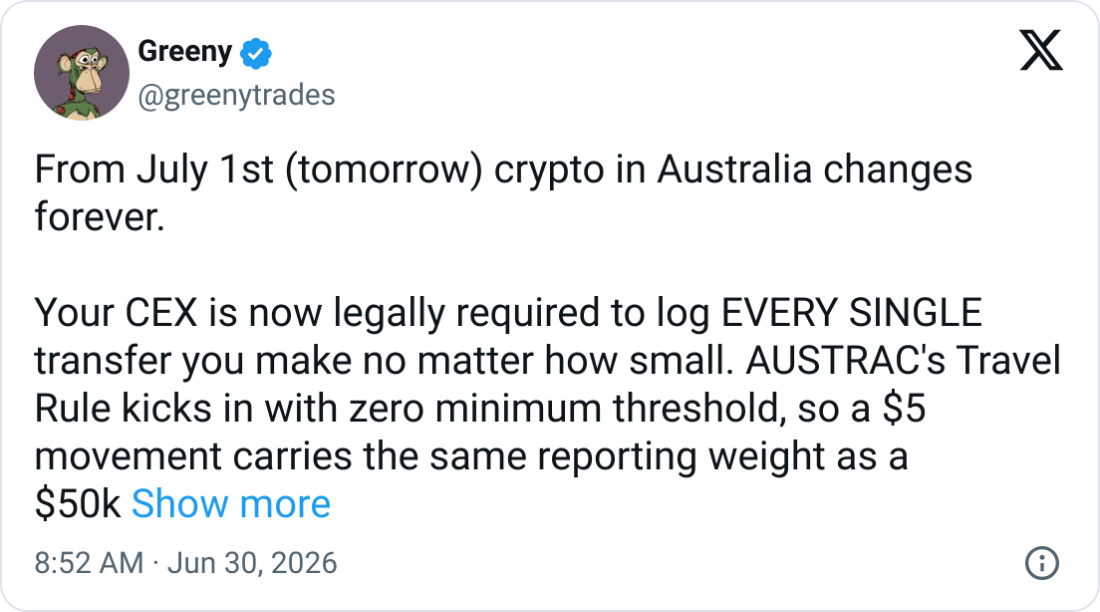
Crypto exchange users in Australia will soon face stricter rules on all transfers as the country’s travel rule is set to come into force on Wednesday, aligning it with similar rules in the EU, US and UK.
From July, all crypto sent and received on locally-regulated crypto exchanges will require users to provide additional information, such as the name of the person the crypto is being sent to or received from, and the name of the platform.
Gabby Lewis, the head of fraud and financial crime at Swyftx, told Cointelegraph that for most exchange users, “the impact should be very limited. They’ll provide the required details once, and then these will be saved for future use.”
The rules are set to bring Australia in line with other countries that have implemented the travel rule for years, which the Financial Action Task Force, an international policy-making body, first extended to crypto in 2019.
Crypto users have long expressed concern that the rule would impact the anonymity of the technology and the risks of data linking crypto transfers to personal information being leaked.
However, Lewis said that the “travel rule isn’t crypto-specific. It already applies across financial services and has been implemented in areas including Singapore, the United States, New Zealand and the UK. Australia is now following suit.”
The rule aims to prevent money laundering, terrorist financing and scams by increasing the traceability of crypto transfers. It will be enforced by the Australian Transaction Reports and Analysis Centre (AUSTRAC), the country’s financial intelligence agency.
Transfers from a regulated crypto exchange to a self-custodial address, such as a cold storage wallet, will also prompt a user to verify and declare that they are the owner of that address.
“We’re generally talking about a quick confirmation that the wallet is theirs,” Lewis said. “The additional steps mainly come into force for transfers that involve another party or another exchange.”
Australia’s travel rule has no minimum value threshold, meaning a transfer of any size will require an exchange to gather information, aligning it with countries including France, the Netherlands and Japan that have no minimum.
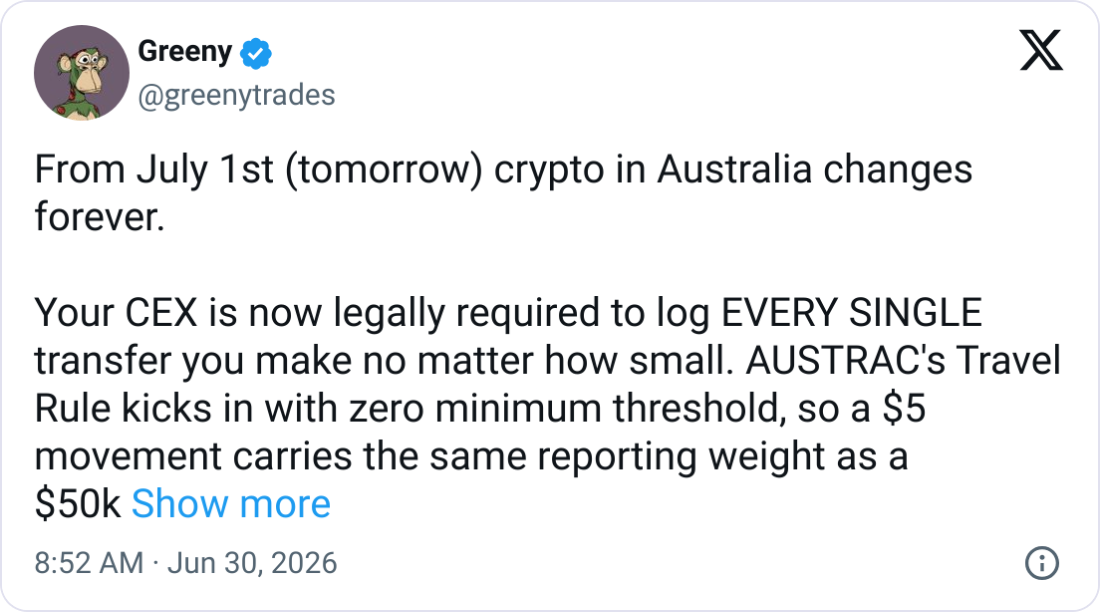
Source: Sam Green
Other countries have set minimum reporting thresholds, such as the US, which only collects information on transfers starting at $3,000.
Some crypto exchanges operating in Australia have already begun to implement the travel rule, such as Kraken, which started on March 31, and CoinJar, which started on Tuesday.
Related: Australia passes digital asset bill bringing crypto platforms under licensing
Crypto users online have recently given mixed reactions to the rule, which the Australian parliament passed into law in 2024.
“With these new rules, you can forget about sending crypto anonymously,” a Reddit user wrote earlier this month.
“New travel rule is insane,” another Reddit user wrote earlier in June. “Thinking of moving everything to cold storage instead now.”
In response, one Reddit user said that “the regulated platforms were never anonymous.”
“This is less of a problem than you’re making it out to be unless you’re involved in activities the authorities would be interested in already,” another user wrote.
Magazine: Crypto scammers face death, Aussie CGT makes Asian hubs attractive: Asia Express


Self-exiled Chinese billionaire Miles Guo has been sentenced to 30 years in a U.S. prison after being convicted in a fraud scheme that prosecutors said stole more than $1 billion from investors through multiple ventures, including cryptocurrency.
Summary
- Miles Guo was sentenced to 30 years in a U.S. prison and ordered to forfeit $889 million after his fraud conviction.
- Prosecutors said the scheme raised more than $1 billion from investors through multiple ventures, including the Himalaya Exchange and Himalaya Coin.
- The sentencing comes as crypto related financial crime continues to face tighter enforcement in both the United States and China.
According to multiple media reports, U.S. District Judge Analisa Torres handed down the sentence on Monday and ordered Guo, also known as Guo Wengui, to forfeit $889 million in restitution.
The sentencing follows a July 2024 jury verdict that found Guo guilty on nine fraud and conspiracy charges after prosecutors accused him of raising money from hundreds of thousands of online followers through false investment promises tied to businesses under his control.
Crypto scheme formed part of fraud case
Federal prosecutors had alleged that Guo attracted investors by presenting himself as a critic of the Chinese Communist Party after fleeing China more than a decade ago, while using that reputation to promote fraudulent investment opportunities.
According to the U.S. Department of Justice, one of those ventures was the Himalaya Exchange, a cryptocurrency ecosystem that collected more than $262 million from victims. The department said Guo later spent investor funds on luxury assets, including a mansion and high end vehicles.
Earlier court filings from the DOJ said Guo orchestrated a scheme that defrauded thousands of investors of more than $1 billion after his arrest in March 2023.
At the sentencing hearing, the Associated Press reported that Guo told the court he came to the United States “to destroy the CCP.” AP also reported that Judge Torres said Guo had preyed on supporters seeking democracy in China and had continued to deny causing financial harm.
SEC case remains part of wider enforcement action
Separate from the criminal prosecution, the U.S. Securities and Exchange Commission charged Guo and his financial adviser, William Je, in March 2023 over an alleged fraud that raised hundreds of millions of dollars through an unregistered crypto asset known as H Coin, or Himalaya Coin.
According to the SEC complaint, Guo falsely claimed the token was backed by gold and assured investors they would be reimbursed for any losses. The regulator also accused Guo and Je of diverting investor funds to finance luxury purchases, including a mansion and a Ferrari, while seeking permanent injunctions, civil penalties and the recovery of alleged illegal gains.
The SEC and DOJ announced their actions on the same day in March 2023, with the Justice Department filing a 12-count indictment that included securities fraud, wire fraud, investment fraud and money laundering charges against Guo. William Je was also charged with obstruction of justice, while authorities said they seized about $634 million held across 21 bank accounts linked to the investigation.
Guo is also known for his association with former Donald Trump strategist Steve Bannon. In 2020, the pair announced the New Federal State of China initiative, describing it as an effort to overthrow the Chinese government.
Elsewhere, Chinese authorities have also stepped up enforcement against cryptocurrency-related financial crimes.
China’s Supreme People’s Procuratorate said on June 25 that prosecutors had charged more than 1,200 people for drug related money laundering cases between January 2025 and May 2026, including schemes involving cryptocurrencies.
The disclosure came as China announced a death sentence for a convicted drug trafficker found to have laundered more than 48 million yuan, or about $7 million, through cryptocurrency as part of a cross-border narcotics operation.
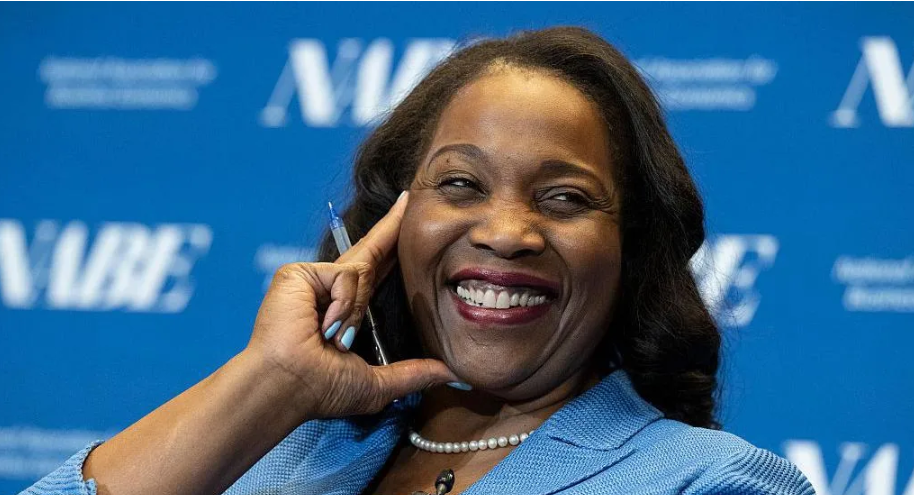
The US Supreme Court ruled 5-4 on June 29 that President Donald Trump cannot remove Federal Reserve Governor Lisa Cook, for now. Still, the decision preserves the Fed’s independence at the worst possible time for Bitcoin.
The ruling locks in a hawkish Fed that has already eliminated rate cut expectations for 2026 and put hikes back on the table. High rates keep pressure on zero-yield assets like Bitcoin, and Monday’s decision removes one of the few near-term paths to a more dovish board.
A Hawkish Fed Just Got More Secure
Cook’s survival matters for rate policy. Trump wanted her gone so he could, instead, install a governor more open to rate cuts. The court blocked that move.
The timing stings for crypto markets. The June Federal Open Market Committee meeting eliminated rate cut projections for 2026 entirely and put hikes back on the table. Bitcoin ETF outflows continued through June as investors rotated away from zero-yield assets.
BTC dropped below $60,000 on Monday, meaning it is now down more than 50% from its all-time high.
Monday’s ruling locks in the Warsh-led, hawkish Fed, at least until lower courts resolve the underlying case. Trump cannot sidestep that by firing governors at will.
“This was never about mortgage documents … It was an attempt to remove me on a manufactured pretext because I refused to bow to political pressure.”
— Lisa Cook, Federal Reserve Governor, statement
What Case Does Trump Have Against Cook?
The case against Cook centers on allegations from FHFA Director Bill Pulte, who accused her of mortgage fraud in August 2025. Pulte claims Cook listed two properties, one in Michigan and one in Georgia, as primary residences within weeks of each other in 2021, notably before she joined the Fed board.
Cook’s attorney called the claim baseless, saying it rests on a single ambiguous reference in one mortgage document.

Cook and her allies argue that the timing reveals the real motive. Trump moved to fire her after months of pressuring the Fed to cut rates faster, and Cook had voted to hold rates steady. Ultimately, the court said no to the firing.
Yet, the fact that this case reached the Supreme Court at all is proof of concept. As Trump’s appointment of Warsh showed, political pressure on the Fed does not require firing anyone. It just requires choosing the right chair.
The post Supreme Court Blocks Trump From Firing Governor Leaving Bitcoin with Hawkish Fed appeared first on BeInCrypto.

For years, crypto wallets have served as the gateway to decentralized finance (DeFi). They allow users to store digital assets, sign transactions, and interact with blockchain applications. While these functions remain essential, the next generation of wallets is evolving into something much more powerful: intelligent financial agents capable of managing digital assets autonomously, making informed decisions, and optimizing financial strategies.
This transformation marks a major milestone in the evolution of Web3, where artificial intelligence (AI) and blockchain technology converge to create smarter, more efficient financial systems.
The Evolution of Crypto Wallets
The earliest cryptocurrency wallets were simple tools designed to store private keys securely. As blockchain ecosystems matured, wallets expanded their capabilities by supporting decentralized applications (dApps), NFT management, staking, cross-chain transactions, and token swaps.
Despite these improvements, users still perform most tasks manually. Finding the best yield, monitoring market conditions, rebalancing portfolios, and protecting assets from emerging risks require continuous attention and technical knowledge. Intelligent financial agents aim to eliminate much of this complexity.
What Are Intelligent Financial Agents?
An intelligent financial agent is an AI-powered software system that operates on behalf of a user while respecting predefined rules and permissions. Instead of simply executing commands, these agents analyze blockchain data, evaluate market opportunities, and carry out financial actions automatically.
Unlike traditional automated trading bots that follow rigid instructions, intelligent agents continuously learn from changing market conditions and adapt their strategies based on user preferences and objectives.
For example, an intelligent agent could:
- Monitor multiple DeFi protocols for the highest risk-adjusted yields.
- Automatically rebalance a crypto portfolio.
- Pay recurring blockchain subscriptions.
- Execute cross-chain transfers at the lowest possible cost.
- Protect funds by moving assets away from protocols experiencing security concerns.
- Optimize tax reporting and transaction records.
The wallet becomes more than storage—it becomes an active financial assistant.
How AI Enhances On-Chain Decision Making
Artificial intelligence excels at processing enormous amounts of information far faster than humans. Blockchain networks generate vast streams of real-time data, including liquidity movements, governance proposals, protocol upgrades, transaction volumes, and market sentiment.
AI agents can analyze these data sources simultaneously to identify trends and opportunities that would be difficult for individuals to detect manually.
Rather than asking:
“Which lending protocol currently offers the best return?”
Users may simply instruct:
“Maximize my yield while keeping portfolio risk low.”
The intelligent agent can evaluate multiple protocols, compare risks, execute transactions, and continue monitoring performance after deployment.
Automation Beyond Trading
Many people associate AI in crypto with automated trading, but intelligent financial agents have much broader applications.
They can simplify everyday blockchain interactions by:
- Managing staking positions automatically.
- Claiming and compounding rewards.
- Voting in decentralized governance according to user preferences.
- Managing NFT collections.
- Scheduling recurring payments.
- Executing payroll for decentralized organizations.
- Monitoring wallet security continuously.
This allows users to focus on strategy instead of repetitive operational tasks.
Personalized Financial Management
One of the greatest strengths of intelligent financial agents is personalization.
Every investor has different goals, risk tolerance, liquidity needs, and investment horizons. AI agents can build customized strategies based on these individual preferences.
For example:
- Conservative users may prioritize capital preservation.
- Income-focused investors may maximize staking rewards.
- Active traders may seek short-term opportunities.
- Long-term holders may automate dollar-cost averaging.
Instead of offering generic financial advice, intelligent agents continuously adapt to each user’s evolving objectives.
Challenges and Risks
Despite their promise, intelligent financial agents introduce new challenges.
Security remains the highest priority. Permitting AI systems to manage digital assets requires robust safeguards, including permissioned execution, transaction limits, multi-signature approvals, and transparent audit trails.
Privacy is equally important. AI systems handling sensitive financial information must protect user data while maintaining decentralization whenever possible.
There are also regulatory considerations. As autonomous financial software becomes more sophisticated, governments and regulators will likely develop new frameworks governing AI-driven financial services.
The Future of Autonomous Finance
The long-term vision extends beyond individual wallets.
Future decentralized ecosystems may consist of networks of AI agents collaborating. One agent could negotiate loans, another could optimize liquidity, while another manages governance participation—all operating under user-defined objectives.
In this environment, financial management becomes increasingly autonomous, efficient, and accessible.
Rather than replacing human decision-making, intelligent financial agents serve as trusted assistants that help users navigate increasingly complex decentralized ecosystems with greater confidence.
Conclusion
The transition from traditional crypto wallets to intelligent financial agents represents one of the most exciting developments in Web3. By combining blockchain’s transparency with AI’s analytical capabilities, users can move beyond manual asset management toward autonomous, personalized financial assistance.
As these technologies continue to mature, wallets will no longer function solely as secure storage for digital assets. They will evolve into intelligent companions capable of monitoring markets, executing complex financial strategies, managing risk, and helping users achieve their financial goals with minimal friction.
The future of decentralized finance isn’t just about owning digital assets—it’s about empowering intelligent systems to help manage them responsibly, securely, and efficiently.
REQUEST AN ARTICLE
KuCoin is facing new scrutiny after blockchain investigator ZachXBT claimed the exchange sent legal warnings to a victim whose stolen funds were allegedly routed through KuCoin-linked accounts.
Summary
- A crypto investigator claims KuCoin sent legal warnings after stolen funds were allegedly routed through accounts.
- The case centers on a reported $250K Atomic stealer theft and five alleged KuCoin deposit addresses.
- The dispute adds pressure as KuCoin remains under scrutiny over past AML and compliance failures.
The case involves a reported $250,000 Atomic stealer theft from Aug. 18, 2025, according to ZachXBT’s Telegram post.
ZachXBT listed one theft address and five alleged KuCoin deposit addresses. He claimed the accounts involved “purchased mule KYC,” a term used for accounts verified with another person’s identity. The claims have not been confirmed by court filings or an official KuCoin statement.
The screenshot shared with the post appears to show a message signed by KuCoin Customer Care and Support Team. It says KuCoin respects the right to raise concerns through legal and regulatory channels, but warns that false or unlawful statements may lead to legal claims.
The message also says, “All rights are expressly reserved.” The post drew further attention after DNBWIZARD shared the exchange on X and said, “Hilarious @kucoincom threatening to sue me.”
KuCoin allegations echo earlier compliance concerns
The dispute comes after years of pressure on KuCoin’s compliance record. In January 2025, the U.S. Department of Justice said KuCoin pleaded guilty to operating an unlicensed money transmitting business and agreed to pay more than $297 million in penalties. The DOJ said KuCoin failed to maintain effective AML and KYC programs and allowed suspicious activity on its platform.
The DOJ had charged KuCoin and two founders in March 2024, alleging that the exchange failed to maintain proper anti-money laundering controls. Prosecutors said KuCoin had received more than $5 billion and sent more than $4 billion in suspicious and criminal funds between 2017 and 2024.
Related stolen funds cases remain in focus
As reported by crypto.news, a fake Ledger Live app stole at least $9.5 million from more than 50 victims earlier this year. That report said the stolen funds were routed through more than 150 KuCoin deposit addresses and into a centralized mixing service.
The same report said blockchain investigator ZachXBT traced stolen funds through transactions into KuCoin deposit addresses linked to AudiA6. It also noted that recovery would likely require law enforcement action and cooperation from exchanges.
As previously reported by crypto.news, KuCoin secured a MiCA license in Austria through its European subsidiary in late 2025. The approval allowed the exchange to offer regulated services across the European Economic Area under the EU’s passporting rules.
However, Austria’s regulator later barred KuCoin’s European arm from new business and onboarding customers, citing compliance staffing issues. The restriction followed KuCoin’s earlier push to present itself as a regulated European platform.
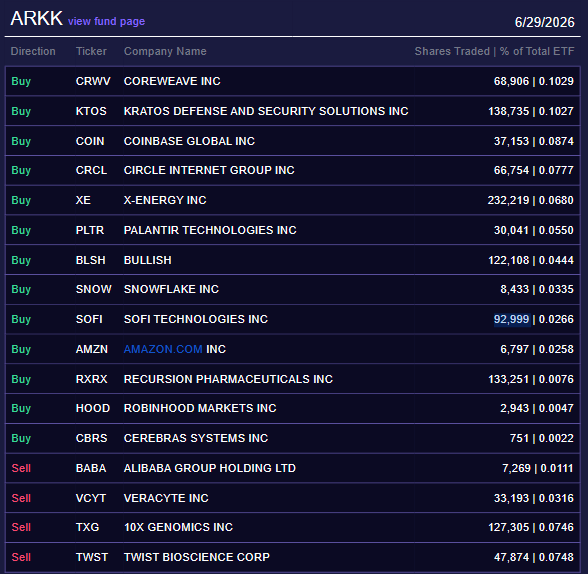
ARK Invest’s biggest crypto stock purchases over the past three trading days were Coinbase and Circle, whose shares have fallen 17% and 27.6%, respectively, over the past month.
Tech-focused asset manager ARK Invest has capitalized on the recent crypto market downturn, buying a combined $43.5 million worth of shares in crypto firms such as Coinbase and Circle over the past three trading days.
Data from ARK Invest shows the asset manager bought another 122,544 shares in Coinbase (COIN) worth about $18.6 million since Thursday, while adding another 169,777 shares in Circle (CRCL) worth roughly $12.9 million over the same time frame.
The firm also purchased nearly $5.2 million worth of shares in crypto exchange Bullish (BLSH) and added another $5.12 million in brokerage firm Robinhood (HOOD), which has pushed aggressively into the crypto tokenization space in recent months. It also bought $1.69 million worth of shares in crypto-friendly bank SoFi Technologies (SOFI) on Monday.
ARK’s purchases come as investors have turned bearish on these crypto-related stocks. CRCL, COIN and BLSH have fallen 27.6%, 16.9% and 26.3%, respectively, over the past month. During that time, Bitcoin (BTC) slipped to a near two-year low of $58,190, while confidence that the CLARITY Act will pass before the US midterm elections in November has faded.
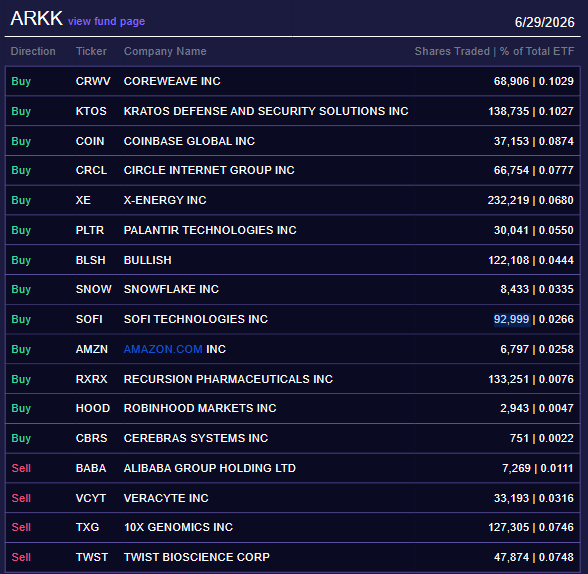
Changes made to ARK’s ARK Innovation ETF (ARKK) on Monday. Source: ARK Invest
Most of the newly purchased shares were added to the ARK Innovation ETF (ARKK), the firm’s flagship fund, followed by the ARK Next Generation Internet ETF (ARKW).
Related: Kiwoom eyes Bithumb stake as Korean brokerages push into crypto: Report
The ARK Blockchain & Fintech Innovation ETF (ARKF) was also topped up with crypto-related stocks.
ARK also added to its positions in Elon Musk’s SpaceX (SPCX) and software intelligence platform Palantir (PLTR) over the past three trading days.
Over the same period, ARK reduced positions in Alibaba (BABA), Roku (ROKU), Strata Critical Medical (SRTA) and several other companies.
Magazine: Bitcoin slides to $58K, XRP hits $1 but onchain data promising: Market Moves


Bitcoin is down over 1% on Tuesday as the Japanese yen slipped to four-decade lows against the U.S. dollar, triggering volatility in currency markets.
The leading cryptocurrency by market value traded below $60,000, holding below the pivotal 200-week simple moving average.
On Monday, Strategy, the world’s largest publicly listed BTC holder, authorized plans to buy back as much as $1 billion each of its preferred and Class A common shares, and is launching a $1.25 billion “monetization program” to raise capital with bitcoin sales. Essentially, it may sell BTC worth over a billion dollars in an already weak market — a sharp pivot from founder Michael Saylor’s longtime mantra of “never sell your bitcoin.”
This pivot, however, may offer little long-term solace, according to some observers. Strategy’s preferred stock STRC, a yield-generating play, has cratered in recent weeks, weakening the company’s major funding channel for BTC purchases.
“The can has been kicked down the road for a year or two,” Jeff Dorman, CIO of Arca, said on X.

Prediction-market platforms are increasingly trying to control more of their own trading stack—an “operational consolidation” trend that analysts at Bernstein say could accelerate mergers and acquisitions across crypto exchanges, brokerages, sportsbooks, and consumer trading apps.
In a research report released on Monday, Bernstein argued that major players are consolidating both distribution and execution functions, tightening links between what used to be separate parts of the market. The shift matters for investors and operators because it can change fee structures, reduce dependence on external infrastructure providers, and potentially reshape how regulators view these products.
Key takeaways
- Bernstein characterizes the sector’s shift as “operational consolidation,” with platforms merging distribution, brokerage, exchange, and clearing functions.
- Several mainstream consumer and prediction platforms have moved toward tighter in-house routing and infrastructure control, according to Bernstein’s examples.
- Owning more of the stack can preserve fees that previously went to outside partners, making acquisitions an efficient way to fill gaps or gain licenses.
- Greater vertical integration may also increase legal and regulatory pressure as the line between financial trading and gambling becomes harder to define.
- State-by-state approaches—alongside ongoing legal challenges—could limit how quickly consolidation proceeds.
Platforms move from partnerships to vertical control
Historically, prediction markets often relied on third-party infrastructure for routing, exchange operations, or clearing—arrangements that made it easier to launch products without building everything internally. Bernstein says that model is weakening as leading consumer platforms consolidate functions across the prediction-market workflow.
In its report, Bernstein pointed to examples spanning different parts of the ecosystem. Robinhood has routed major World Cup contracts through Rothera, the exchange it jointly owns with Susquehanna, according to Bernstein’s account. DraftKings is also cited by Bernstein for launching DKeX and shifting volume away from venues that previously handled some execution, including CME and Crypto.com infrastructure.
The report also highlights consolidation efforts at the crypto-operations layer. Bernstein cited Coinbase’s acquisition of The Clearing Company—framed in related coverage as a move tied to expanding prediction-market capabilities—and Coinbase’s launch of event contracts, adding to the pattern of larger consumer crypto firms seeking greater control over the prediction-market stack.
Why “owning the stack” can change deal economics
Bernstein’s central argument is straightforward: integration can be a direct business advantage. By controlling more of distribution, brokerage, execution, and clearing, platforms can keep revenue streams that would otherwise be shared with specialized partners.
That matters because acquisitions can become a faster path to operational control than building from scratch. Bernstein suggested that deal-making may accelerate as companies pursue missing components—whether that means distribution reach, exchange capabilities, or clearing infrastructure—using purchases to close gaps and strengthen end-to-end product delivery.
However, vertical integration doesn’t only affect profitability. It also reshapes the competitive landscape: businesses that historically operated in different industries—consumer finance apps, sportsbooks, exchanges, and crypto trading infrastructure providers—can end up competing under a single set of product and customer expectations.
Regulatory conflict is the largest constraint
Bernstein singled out regulation as the principal friction point for larger integrations. As prediction markets blend with brokerages, sportsbooks, and exchanges, regulators may scrutinize whether specific products should be treated as financial derivatives or as gambling.
The report suggests that these classifications are not merely academic. They drive enforcement priorities, licensing requirements, and how courts determine jurisdiction. Bernstein warned that such questions could feed antitrust disputes as firms attempt to merge capabilities across multiple market segments.
The regulatory tension has already played out in the U.S. Minnesota enacted what the CFTC described as the first outright ban on prediction markets, while Illinois adopted legislation requiring platforms to obtain a state license before offering sports event contracts—developments Bernstein cited through earlier coverage.
Kalshi challenged restrictions in both states, arguing that federally regulated exchanges fall under the CFTC’s exclusive authority. Bernstein’s framing implies that these legal fights create a practical uncertainty: consolidation may make commercial sense, but execution could remain constrained until regulators and courts clarify where federal derivatives oversight ends and state gambling authority begins.
What to watch as consolidation accelerates
With platforms continuing to move routing, exchange functions, and clearing in-house, the next phase of the sector may hinge less on product launches and more on legal outcomes—particularly whether courts establish a clearer boundary between federal trading regulation and state gambling rules. Until that boundary hardens, consolidation could keep happening, but with deal structures and operating decisions likely shaped by ongoing jurisdictional risk.


Onchain demand stayed soft through the slide, according to Glassnode data. The number of active addresses, a rough gauge of how many users are actually transacting, sat around 618,000, in the middle of its recent range rather than breaking higher.
The value of coins moving across the network held near $4.2 billion, just above the bottom of its range around $3.6 billion, pointing to subdued rather than surging activity, the firm said in a Monday report.
Total transaction fees, or what users pay to move funds and a read on competition for space in each block, kept contracting. Together, the three say demand has not picked up even with prices lower.
Adding to the caution, Strategy, the largest corporate holder of bitcoin, said Monday it may sell more than a billion dollars of the token under a new program to shore up its finances, a reversal of founder Michael Saylor’s long-standing refusal to sell.
The prospect of those sales hangs over an already thin market. That leaves crypto where it has traded for weeks, pinned by a strong dollar and a lack of fresh demand rather than any single shock.
The next tests are whether the dollar’s climb stalls and whether the yen’s slide forces Japan to step in, a move some warn could unwind the cheap-yen borrowing long used to fund risk trades worldwide.
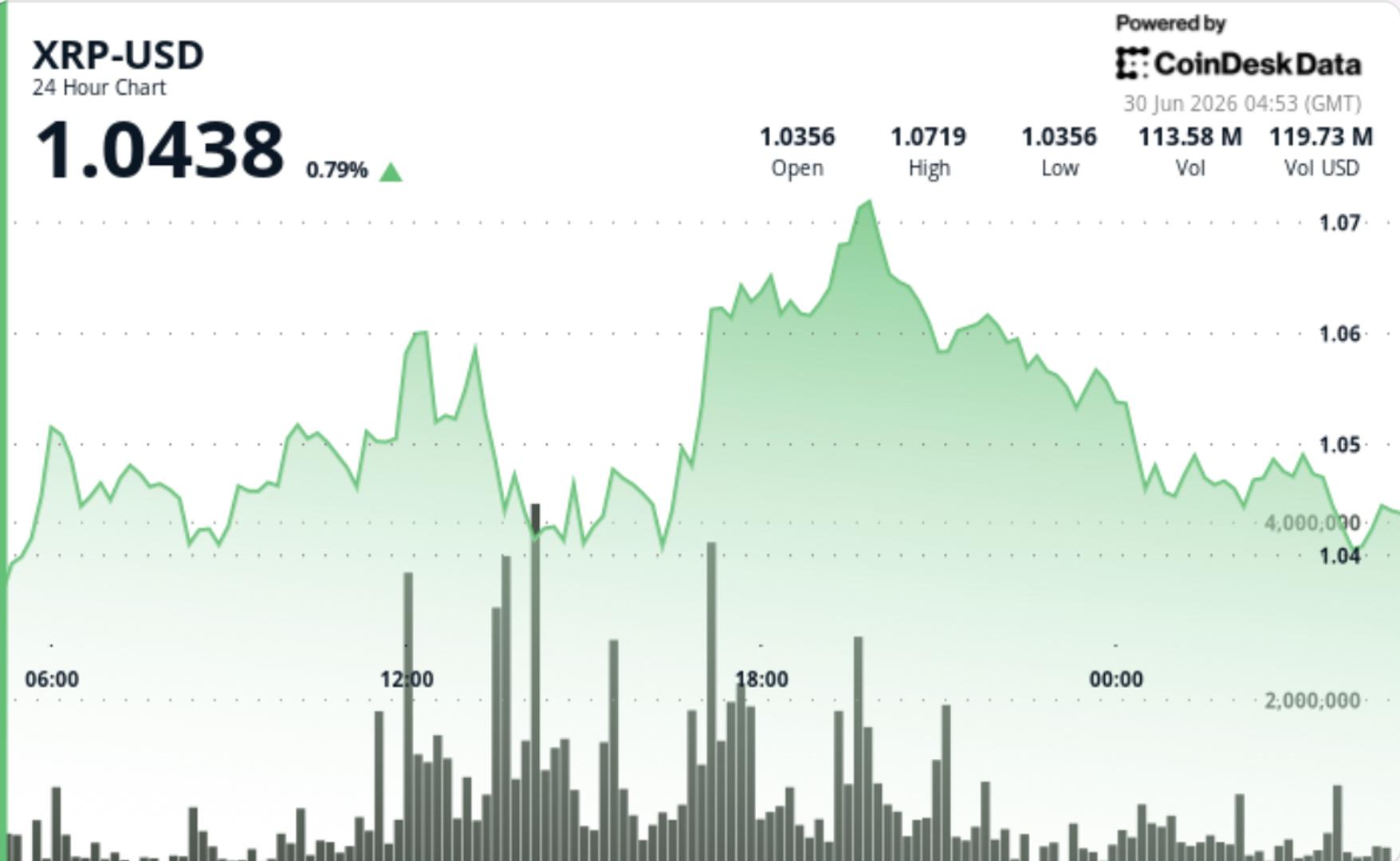
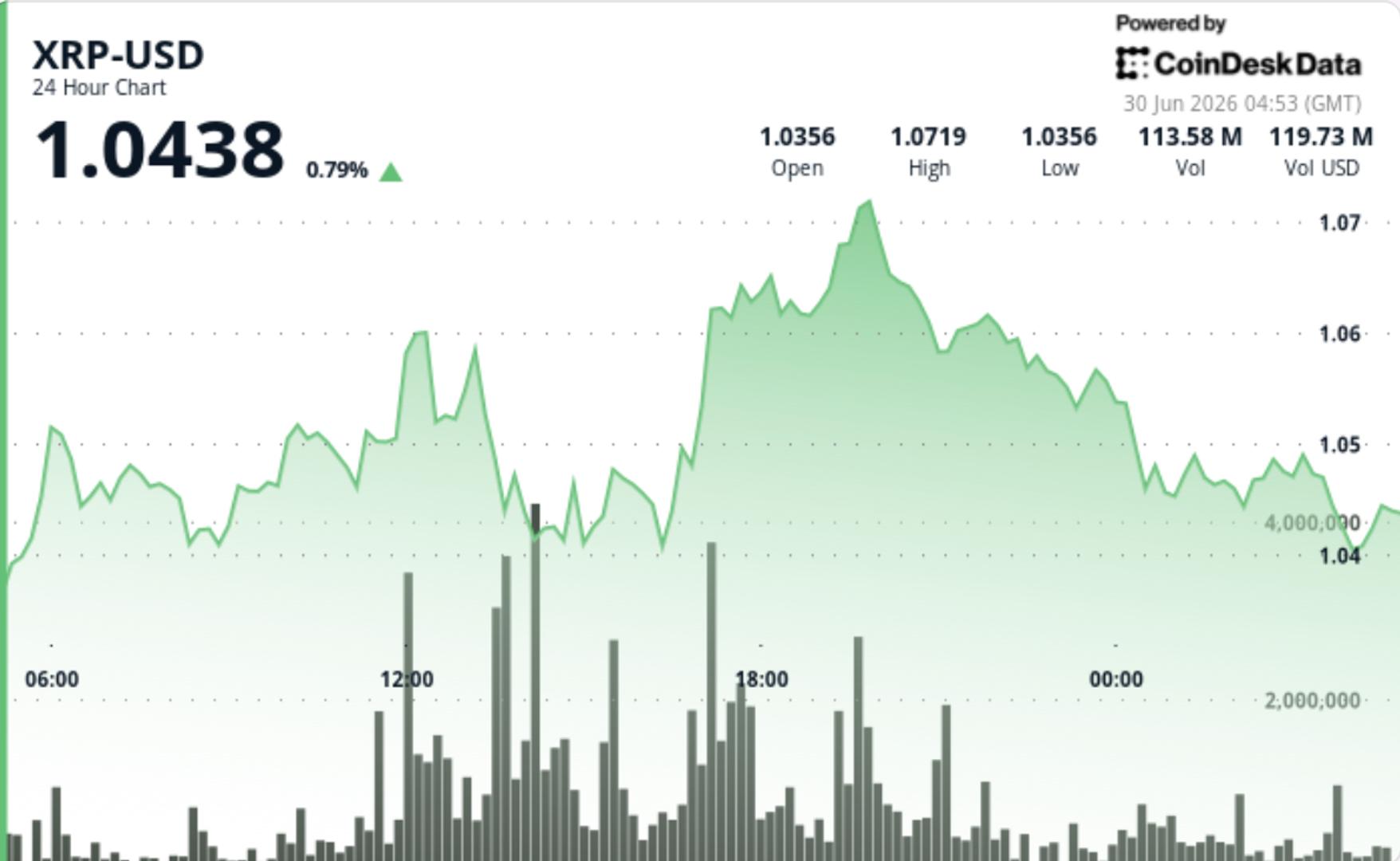
• The token traded in a $0.0435 range and continued to hold above the $1.00 psychological support level.
• The main burst of activity came on June 29 at 17:00, when volume reached 86.5 million XRP, about 67% above the 24-hour average.
• Price later consolidated between $1.03 and $1.06, leaving the market range-bound rather than in a confirmed recovery.
Technical Analysis
• The key development is that XRP continues to defend $1.00 even after a 19% monthly decline.
• The leverage reset improves the setup. Open interest has fallen sharply, funding has turned negative and forced long liquidations have cleared out crowded positioning.
• The on-chain picture is stronger than the chart. Active addresses are rising, ETF inflows are continuing and exchange reserves remain stable, but price is still below major moving averages.
• XRP remains capped by resistance near $1.10, with larger barriers near the 50-day EMA around $1.20 and the 100-day EMA around $1.31.
• The 4-hour RSI has recovered from oversold territory to 46, but momentum remains below the neutral 50 level.
What traders should watch
• $1.00 remains the key support level. A break below it would put $0.90-$0.87 back in focus.
• $1.06 is the first short-term resistance level, followed by $1.09-$1.10, where recent rallies have stalled.

Ex-police officer’s sexual relationship was ‘blatant abuse of trust’

Court rules over legal costs in Hancock, Wright, Rhodes dispute

What’s Changing With Australia’s Crypto Travel Rule


-
 Sports6 days ago
Two goals and an assist by sheer aura: Cristiano Ronaldo just entered the World Cup chat
-

 Fashion4 days ago
Weekend Open Thread: Staud – Corporette.com
-

 Politics4 days ago
The House | Manchesterism won’t survive the painful trade-offs unless it gets citizens on board
-

 Politics4 days ago
Potential 2028er World Cup attendee leaderboard
-

 News Videos1 day ago
MAJOR BITCOIN & MARKET UPDATE!!!! (MUST WATCH ASAP!!!)
-

 Business4 days ago
Asia stock markets slide as tech shares slump
-

 Tech4 days ago
A Look At A Gaggle Of Transputer Boards
-

 Crypto World6 days ago
Securitize Wraps Roubini's SEC-Registered ETF as Dubai VARA Digital Security
-
Crypto World6 days ago
Bitcoin (BTC) Dips Below $62K, Ethereum (ETH) Plunges 6% Daily: Market Watch
-
 Crypto World5 days ago
Dell (DELL) Shares Tumble Over 5% Following Analyst Downgrade to Hold
-

 Crypto World3 days ago
Coinbase, Circle Deepen Crypto Stock Losses Despite Resilient S&P 500
-
Business6 days ago
Entergy settles forward sale agreements, raises $672 million in cash proceeds
-

 Crypto World3 days ago
Kraken's xStocks Opens Bending Spoons IPO Registration to EEA Retail
-

 Sports3 days ago
FIH Pro League: India defeat Pakistan 7-1, register biggest win of campaign | Other Sports News
-

 Tech2 days ago
Bluekit phishing kit adopts browser-in-the-middle for login theft
-
 Crypto World4 days ago
Bitcoin Sparks $600M Hourly Liquidations With $65,000 Set To Become Resistance
-

 Tech3 days ago
Russian hackers now target Signal backup recovery keys
-
 Crypto World4 days ago
Hyperliquid Named on Singapore MAS Investor Alert Register
-

 Crypto World4 days ago
RTX holders must register wallets before token distribution begins
-
 Crypto World5 days ago
Ripple and SBI launch RLUSD in Japan after JFSA approval
You must be logged in to post a comment Login