

Crypto World
AVAX treasury company tells the SEC it might not survive the year

Yesterday, the largest publicly-traded Avalanche (AVAX) treasury company quietly told regulators it might not survive the year.
Last October, the company was talking about a $1 billion pile of AVAX tokens. Today, it has a market capitalization of less than $30 million.
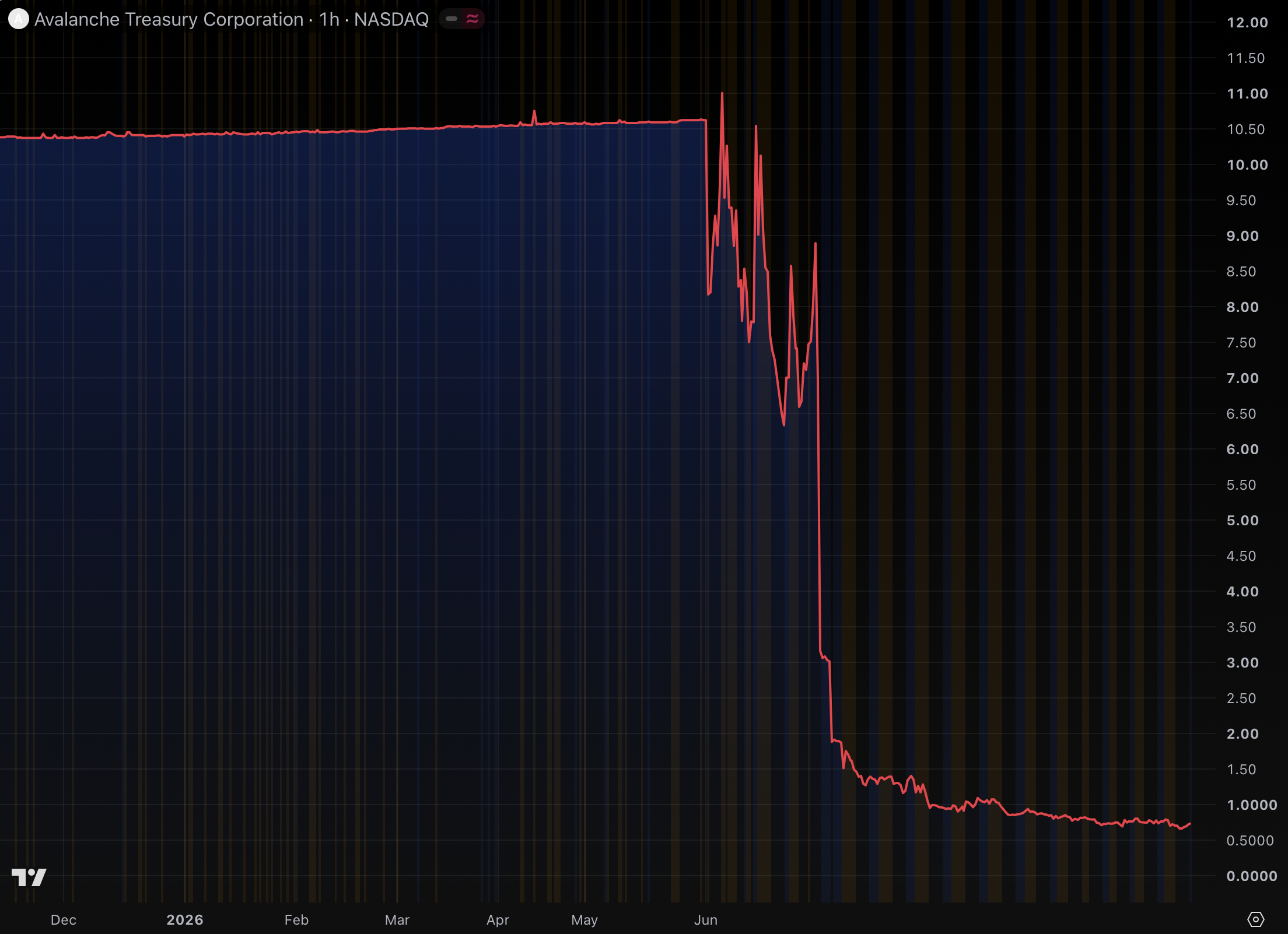
Avalanche Treasury Corp also filed a dire warning about its prospects just weeks after its once-highly-anticipated Nasdaq debut that actually resulted in a 93% sell-off in its stock price.
The company’s operating subsidiary lost more than $26 million in a single quarter, almost all of it a fair-value writedown on the AVAX it had hoarded. Indeed, AVAX has lost 47% of its value year-to-date, and nearly two-thirds of its value over the past 12 months.
The company paid roughly $265 million to acquire its coins, yet by the end of March, they were worth about $123 million, leaving the position more than half underwater.
AVAX treasury stock down 93% in one month
AVAT completed its merger with a blank-check company and filed listing documents in June. Optimism about the once-$10 blank check stock had already turned to pessimism. By June 10, the stock was pricing-in its deal finalization down 27% from the start of the month.
On June 10 and 11, investors, to their horror, read more documents about the deal filed with the SEC. Shares that had been trading above $10 at the start of the month closed at $1.85 per share on June 11.
Unfortunately, things have only gotten worse. Yesterday, shares were trading in penny stock territory below $0.73 per share.
In total, over the last month, shares have lost 93% of their value.
Worse, the company has also pledged a large share of its AVAX treasury to a lender, committing roughly 7.8 million of its 13.8 million AVAX as collateral on a loan.
Read more: China-linked TRUMP treasury stock crashes 98% after wild buyout claim
Public company going concern
In notes attached to its most recent financial statement, the company concluded that “substantial doubt about the Company’s ability to continue as a going concern is not alleviated.”
Building a publicly-traded digital asset treasury strategy has produced exactly what skeptics warned it would. Dozens of companies have declined in value since initial exuberance during a brief, mid-2025 mania.
Protos has documented the consistent, downward-sloping arc across the treasury sector.
AVAT isn’t alone in its doomed gamble on the value of AVAX.
Consider AgriFORCE Growing Systems, a struggling agritech firm that rebranded itself AVAX One last September.
It announced a roughly $550 million raise to buy more than $700 million of the same token. Anthony Scaramucci chaired its strategic advisory board, with a crowd of crypto funds behind the deal.
This company, which has undergone a name change, now carries a market value near $43 million, down 68% year to date and 93% over the past 12 months.
Got a tip? Send us an email securely via Protos Leaks. For more informed news and investigations, follow us on X, Bluesky, and Google News, or subscribe to our YouTube channel.

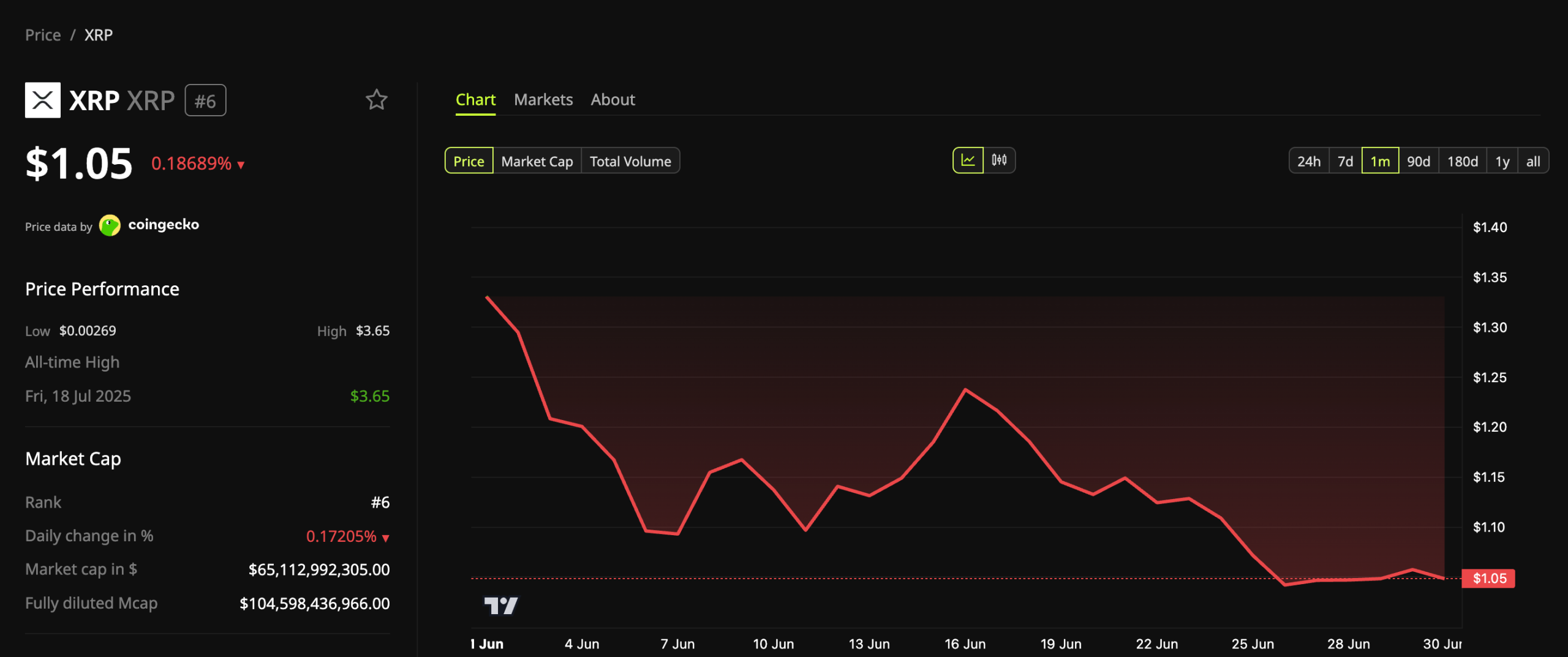
XRP (XRP) is holding above the $1.00 support zone amid a broader downturn. Yet, on-chain activity is rising.
New wallet, whale, and exchange-traded fund (ETF) activity suggest users are stepping in while the price looks fragile, pointing to demand below the surface.
XRP Price Slump Meets Steady Demand
XRP, like the broader market, has seen notable declines this month. The altcoin touched a 19-month low of $1.01 on June 25. It now trades near $1.05, down 0.18% over the past day.
Follow us on X to get the latest news as it happens

Yet, on-chain data paint a different picture. Santiment reported that the XRP Ledger added 4,941 new wallets in a single day, marking its strongest network growth in more than three months.
Social sentiment has also flipped bullish. The positive/negative social ratio reached 3.7 positive comments for every bearish one, a three-month high in FOMO, according to Santiment. Traders appear to treat the $1.00 to $1.05 band as a dip-buy area.
“Part of this optimism comes from XRP’s familiar rebound history, ongoing ETF and institutional narratives, and the idea that larger holders have continued building exposure even during ugly price action,” the firm said.

On-Chain Signals Point to Accumulation
On-chain data support that view. Santiment data shows accumulation across all three large cohorts in June despite a 21% price dip. The 10 million to 100 million XRP tier led with 160 million XRP added, the strongest bullish signal of the group.
Smaller cohorts followed. Wallets holding 100,000 to 1 million XRP added 30 million tokens, while those holding 1 million to 10 million XRP gained 20 million tokens. This suggested that large holders continued to accumulate despite the decline.

Institutional demand has also remained resilient. US spot XRP exchange-traded funds (ETFs) attracted $22.99 million in net inflows last week, extending their inflow streak to eight consecutive weeks.
The new week also began on a positive note, with the funds recording $15.34 million in net inflows on Monday. This trend stands in sharp contrast to Bitcoin and Ethereum ETFs.
Bitcoin ETFs have recorded seven consecutive weeks of net outflows totaling approximately $7.7 billion. Investors pulled another $231 million on Monday.
Ethereum ETFs have also experienced consecutive weekly outflows. XRP ETFs, by contrast, have not recorded a single day of net outflows since June 3, although several sessions have ended with flat flows.
Santiment said the open question is whether this wallet surge converts into sustained buying pressure or fades as short-term FOMO. With XRP sitting so close to $1.00, the coming sessions should reveal which way the on-chain demand breaks.
Subscribe to our YouTube channel to watch leaders and journalists provide expert insights
The post XRP Demand Builds On-Chain Even as Price Sinks to 19-Month Low appeared first on BeInCrypto.
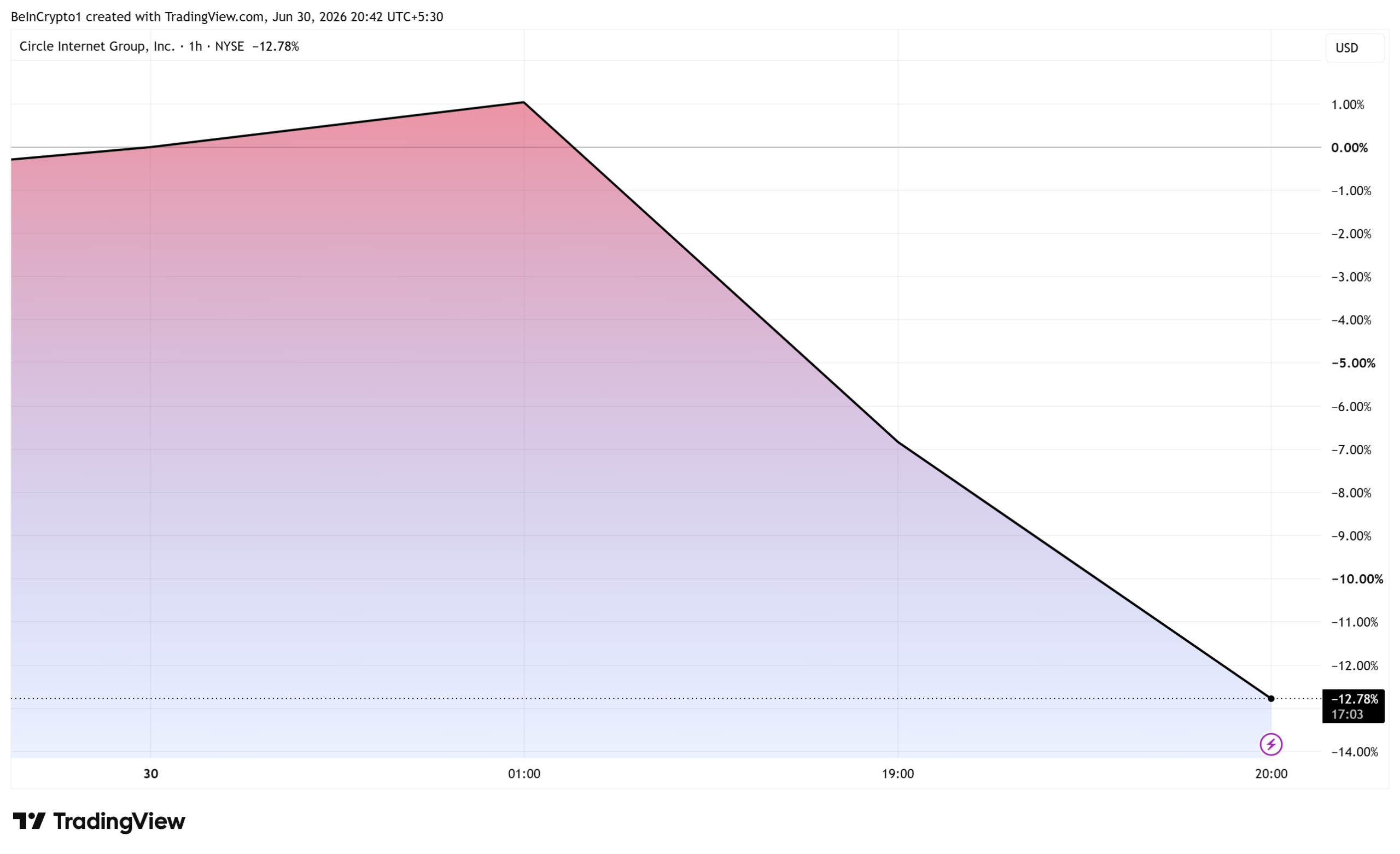
Shares of Circle Internet Group (CRCL) fell on Tuesday after Open Standard unveiled Open USD (OUSD), a dollar stablecoin backed by more than 140 companies, including Visa, Mastercard, and Coinbase, that targets the market its USD Coin (USDC) token leads.
The launch puts payment networks, banks, and crypto firms behind a single token. It lands as Circle’s USDC and Tether’s USDT control most of the stablecoin market.

Why Circle’s USDC Faces Pressure
Open USD goes after the enterprise users that drive USDC adoption. Businesses can mint and redeem it for free, and partners keep the earnings on its reserves after a small fee.
Follow us on X to get the latest news as it happens
That model strikes at how Circle makes money. Reserve interest produced 99% of its revenue in 2024, its filing shows.
Circle paid Coinbase $908 million that year to distribute USDC. Now Coinbase has joined a rival that lets partners keep those reserve earnings.
Circle stock fell nearly 15% on the news, touching its lowest level of the session. It extended a weak run after Circle’s stock rally from $50 to $129 in six weeks earlier this year.
The bigger risk is distribution. Circle gained ground as USDC overtook Tether in corporate transfers. Yet Open USD’s backers include the networks that move most of that money.
Circle still holds advantages. Its USDC carries regulatory standing in the US and Europe and deep exchange liquidity.
A Consortium Stands Behind Open USD
Open Standard will run the token through an independent board of its partners. Zach Abrams leads the company on an interim basis. He co-founded Bridge, the stablecoin firm Stripe bought for $1.1 billion in 2025.
The backers span finance and technology, from BlackRock and BNY to Google and Shopify. Many already run their own stablecoins or build stablecoin infrastructure firms, echoing Mastercard’s recent stablecoin payment integrations.
Stripe tied its payments business directly to the token.
“Open USD will be the default stablecoin for businesses running on Stripe…” read an excerpt in the announcement, citing Will Gaybrick, president of technology and business at Stripe.
Circle, Tether, and PayPal all sat out the venture. Tether’s USDT leads at about $185 billion and Circle’s USDC follows near $74 billion.

All these notwithstanding, the history is not encouraging for consortiums. Visa, Mastercard, and Stripe each backed Facebook’s Libra stablecoin in 2019, then abandoned it within months under regulatory pressure.
Open USD goes live later this year on Plasma and other chains built for stablecoin payments.
The timing matters for Circle, whose USDC revenue-sharing deal with Coinbase comes up for renewal in August.
The post Circle Stock Falls 15% as New Rival Stablecoin Targets USDC’s Enterprise Users appeared first on BeInCrypto.

The transitional grace period under the Markets in Crypto-Assets (MiCA) regulation officially ends across the EU on July 1, 2026.
It means that any firm still operating without a MiCA license will be breaking the law.
MiCA Rules Force Crypto Firms to Adjust
The European Securities and Markets Authority (ESMA) had ordered all unauthorized digital asset providers to close their businesses before the end of the transition period. The directive formed part of the EU’s MiCA rules that require firms to obtain authorization from a national regulator to continue operating.
Pre-MiCA categorization data suggested that Europe had over 3,000 legitimate virtual asset providers, but now, several exchanges have already announced changes to their European services. For instance, Binance said that it will suspend some of its operations in the market after failing to secure a MiCA license.
In an interview with the Block, former CEO Changpeng Zhao (CZ) revealed that the exchange’s license application in Greece had been “fully compliant” and days away from approval before political forces reportedly forced it to be withdrawn, with journalist Gareth Jenkinson alleging that sources had informed him that Christine Lagarde, the ECB president, had asked Greek authorities not to greenlight the permit.
The company is now seeking the same approval in other EU member states such as France, Ireland, and Latvia.
According to OKX’s European CEO Erald Ghoos, who was quoted in a recent report by CoinDesk, 80% of crypto companies won’t survive MiCA and will be pushed out of the EU completely. Some corroboration was offered in the same report by Dubai lawyer Irina Heaver, who said inquiries from European founders had surged as they weighed relocating to the UAE, where licensing through the Virtual Assets Regulatory Authority can take days instead of months.
For consumers, ESMA urged caution, saying that investors should verify whether their provider appears in the MiCA register and confirm which legal entity is actually holding their assets.
It also added that they should consider transferring funds if their platform remains unauthorized after July 1 since those using unauthorized providers may face reduced legal protections and a greater risk of losing access to their crypto assets.
Trading Surge Reported Elsewhere
But not every signal is pointing toward exodus. While policy analysts debate the theoretical impacts of the new framework, crypto platforms on the ground are already seeing a shift in capital deployment. Konstantins Vasilenko, co-founder and CBDO of Paybis, notes that the new rules are successfully unlocking access to larger institutional participants who require regulatory certainty before deploying capital.
Vasilenko shared directly with CryptoPotato that since securing their MiCA and PSD2 licenses in Latvia this past May, their EU trading volume has surged by 70% quarter-over-quarter, even as transaction counts held steady.
The post MiCA Deadline: New Rules Could Force 80% of Crypto Firms Out of EU appeared first on CryptoPotato.

Care Bears is becoming part of the Authentic Brands Group portfolio.
On Tuesday, the brand and entertainment platform said it has signed a definitive agreement to acquire the intellectual property of Care Bears, a global entertainment franchise that has generated more than $12 billion in retail sales since being introduced as a greeting card concept in the early 1980s.
More from WWD
Terms of the purchase from Ivest Consumer Partners and Cloverlay were not disclosed but the deal is expected to close in the third quarter. The private equity firms acquired Care Bears in 2023 from the Weiss family, sole owners of the brand for more than 40 years. The brand is on track to exceed $750 million in retail sales by year-end 2026.
Authentic Studios and Authentic Live, divisions of Authentic Brands Group, will be key to extending the Care Bears universe through new stories, audiences and fan experiences. Since launching in 2023, Authentic Studios has introduced new ways for audiences to engage with the company’s brands through original content and experiences, such as Beckham, Shaq’s Dunkman League and EPiC Elvis Presley. Authentic Live connects brands with the world’s biggest moments in sports, culture and entertainment through more than 60 annual events.
“Care Bears is the gold standard of family entertainment,” said Corey Salter, chief executive officer of Authentic’s entertainment division. “It arrives with a nearly 45-year history of genuine emotional connection, an active content pipeline, a vast network of more than 500 licensing partners and a devoted fan base that keeps growing. Our opportunity is not simply to steward the brand and its message of positivity; it’s to bring Care Bears into Authentic’s powerful platform and write the next great chapter in one of entertainment’s most enduring franchises.”
The company had no further comment on its plans on Tuesday. This marks the fourth merger or acquisition Authentic has made this year after Kevin Hart, Guess and Lee.
Since its founding, Care Bears has grown into one of the most loved family entertainment franchises. It offers more than 100 bears, each representing a distinct emotion such as Cheer Bear and Grumpy Bear. It reaches consumers in more than 190 countries and offers short-form content, gaming, live experiences and films in 26 languages.
Theo, an onchain capital markets platform, has invested $20 million in Fidelity International’s USD Digital Liquidity Fund (FILQ). Theo said the investment makes it the first crypto-native platform to allocate capital to the asset manager’s tokenized fund.
Executed through Sygnum, a Swiss digital asset bank that provides regulated banking, custody and tokenization services for institutional clients, the allocation adds FILQ to Theo’s institutional tokenized Treasury product, thBILL.
FILQ is a Moody’s Aaa-mf-rated tokenized US dollar liquidity fund built on Sygnum’s Desygnate platform that invests in diversified short-term money market instruments designed to preserve capital and liquidity. Chainlink provides onchain net asset value and distribution data for the fund through its Runtime Environment, while JPMorgan receives and approves the daily NAV data, according to the release.
Fidelity International managed $1.06 trillion in total assets as of March 31, according to the company, while Theo said its products have processed more than $1 billion in cumulative trading volume across more than 80,000 users in over 60 countries.
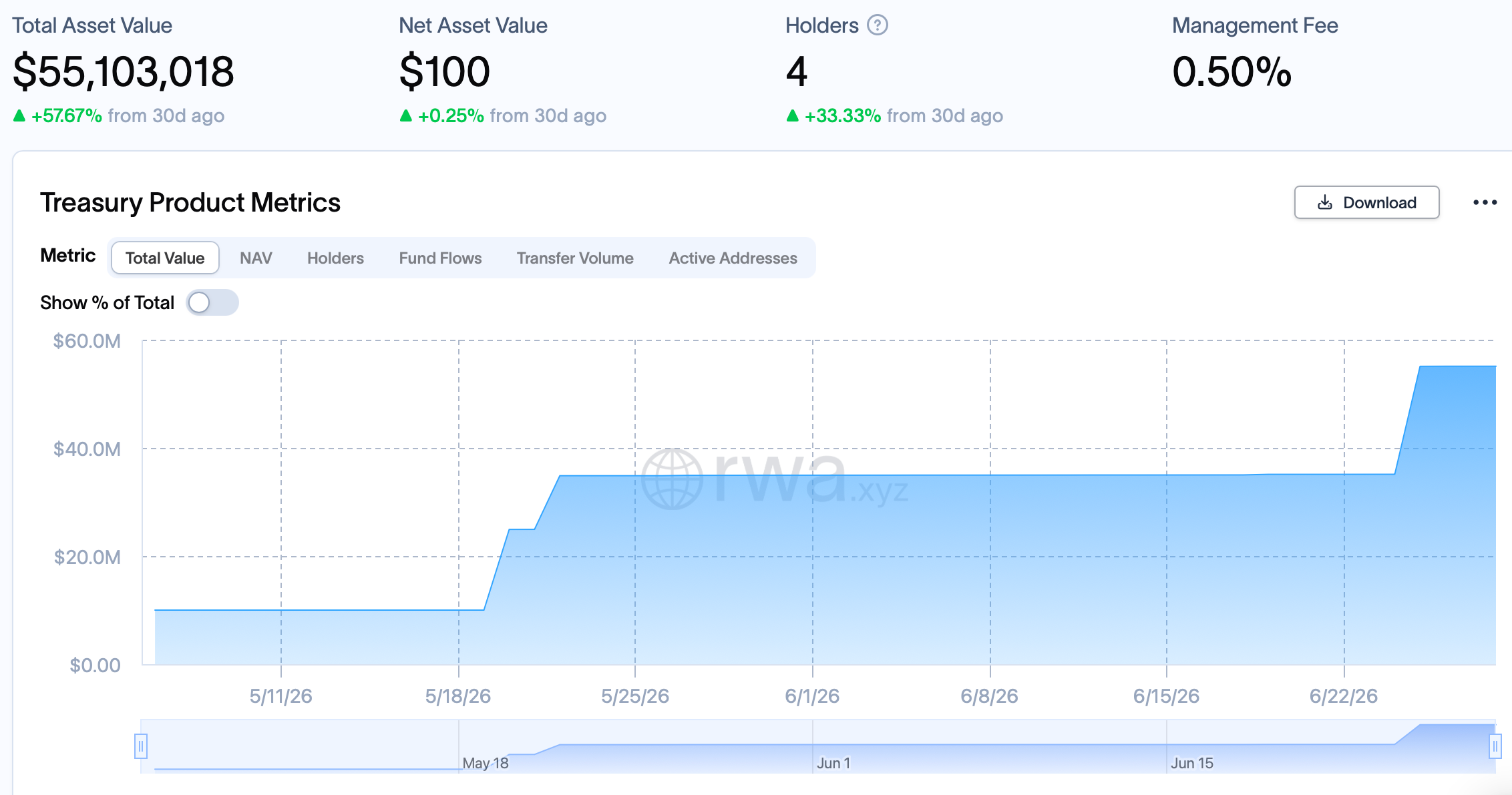
RWA.xyz data shows FILQ currently manages about $55.1 million in onchain assets, suggesting Theo’s $20 million allocation represents a significant share of the fund.
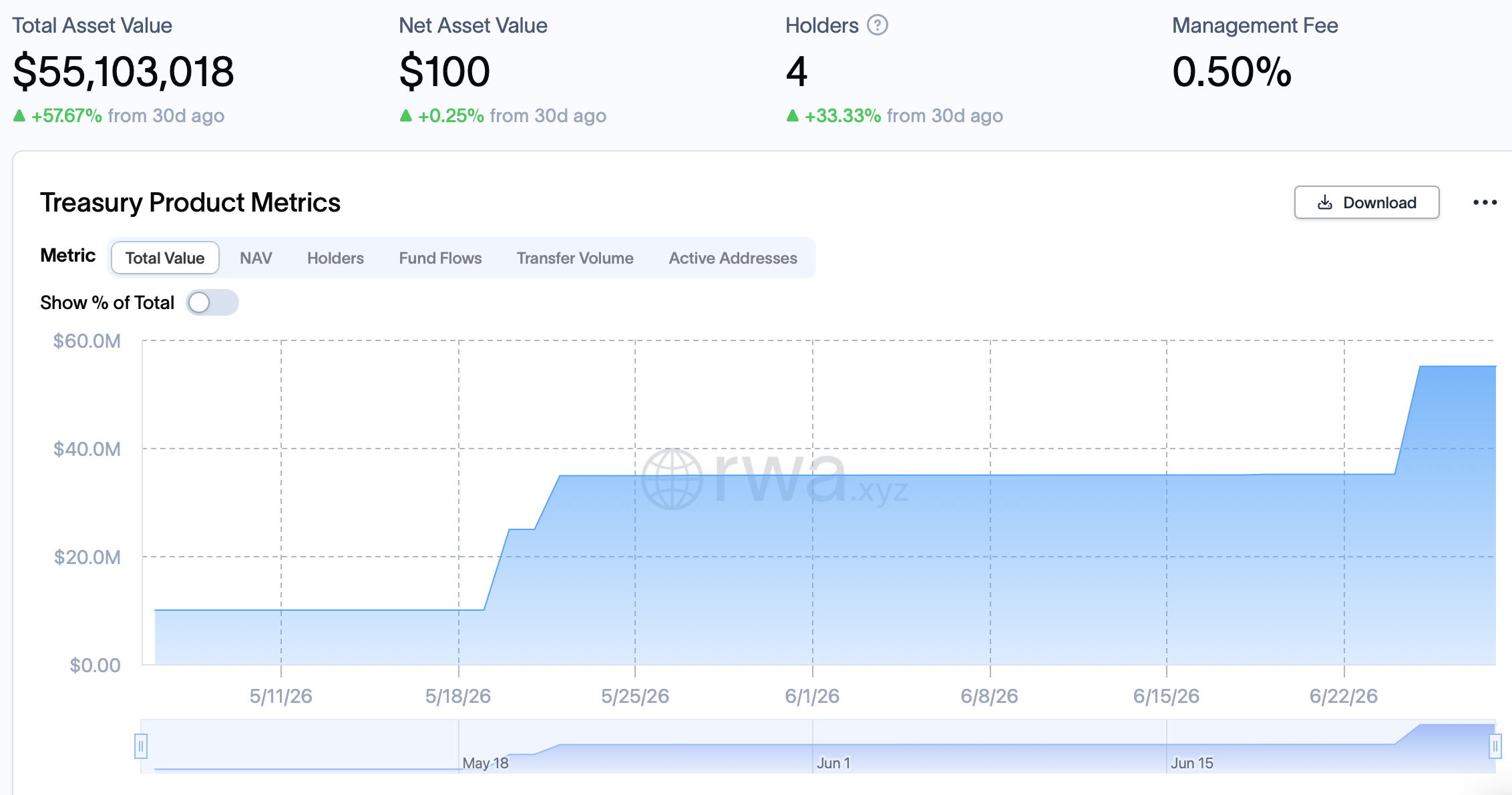
Source: RWA.xzy
Related: Franklin Templeton launches dedicated crypto division after closing 250 Digital acquisition
Traditional asset managers expand tokenized fund offerings
Tokenized US Treasury products have become the largest segment of the tokenized real-world asset market. According to RWA.xyz, the sector has more than doubled over the past year, growing from about $6.9 billion in distributed value in late June 2025 to approximately $14.6 billion as of late June 2026.
RWA.xyz tracks 83 tokenized Treasury products held by more than 64,000 investors, with offerings from Circle, BlackRock, Ondo, Franklin Templeton and Securitize each managing more than $2 billion in distributed value.
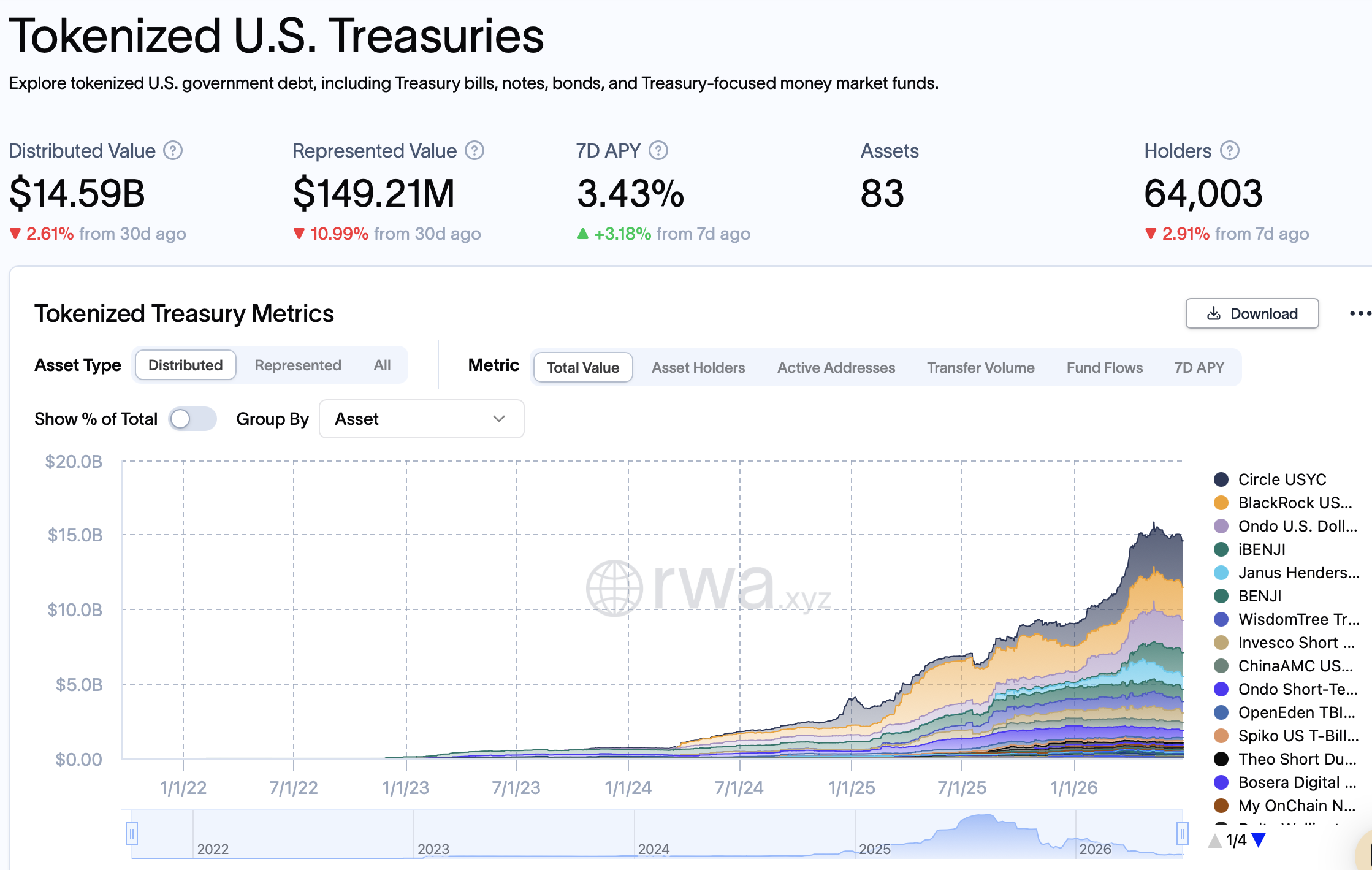
Tokenized US Treasuries. Source: RWA.xyz
The market’s growth has been accompanied by new fund launches and distribution partnerships from traditional financial firms. In May, JPMorgan launched JLTXX, a tokenized government money market fund on Ethereum (ETH) that invests in US Treasury bills and overnight repurchase agreements.
The following month, Franklin Templeton partnered with MoonPay to expand institutional access to its BENJI tokenized money market fund, allowing eligible institutions to move between supported stablecoins and tokenized fund exposure through an onchain trading workflow.
Magazine: Bitcoin decouples from tech stocks, Ether eyes ‘selling wave’: Market Moves
Michael Saylor’s Strategy won support from some Wall Street analysts after unveiling a new capital framework, but the changes also sparked debate over the company’s long-term Bitcoin strategy and sustainability.
Benchmark Equity Research on Monday reiterated its Buy rating on Strategy’s Class A stock MSTR and maintained a 12-month price target of $570, according to a report reviewed by Cointelegraph.
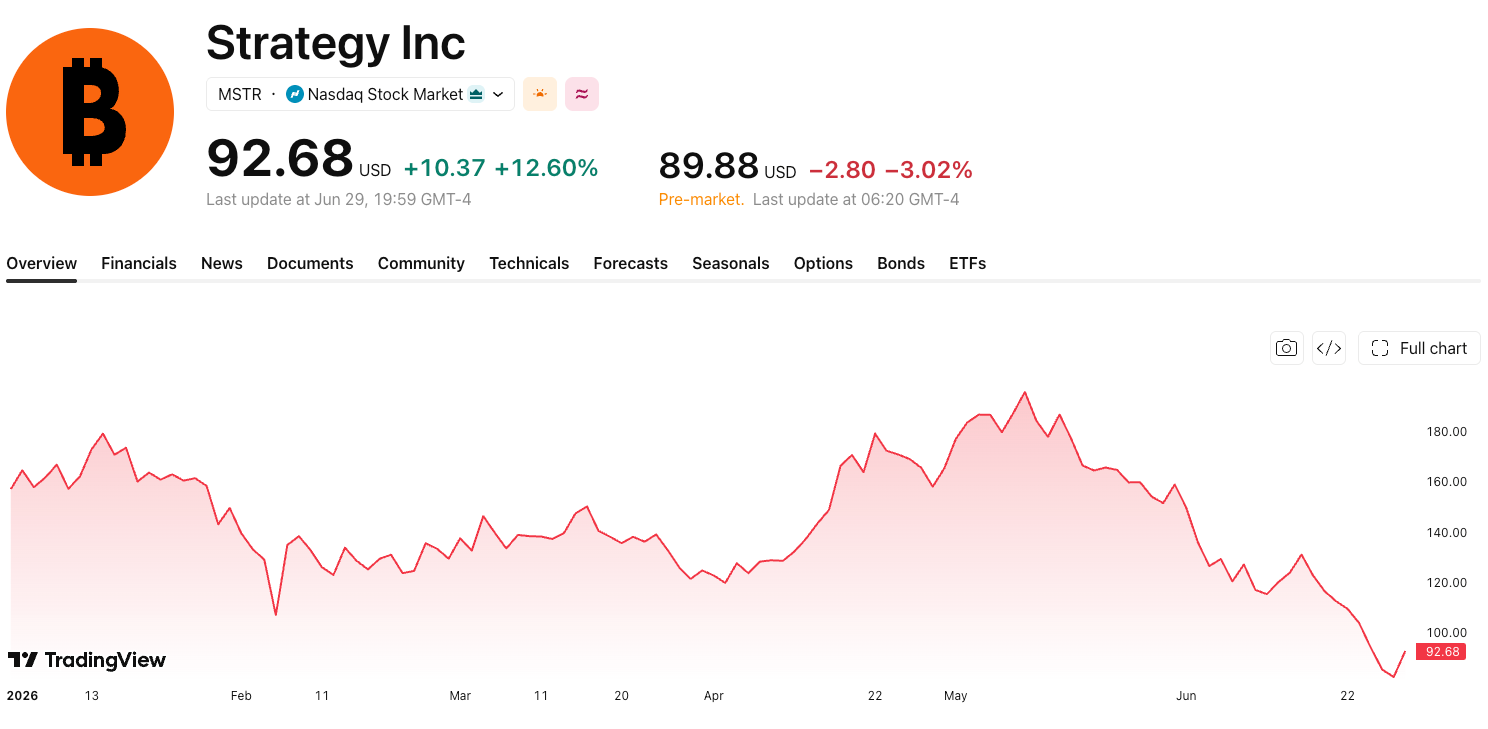
Strategy’s common Class A stock, MSTR, rose 12.6% to about $92.70 on Monday, while its STRC preferred shares climbed 12.2% to around $83.70, according to TradingView and Yahoo Finance.
However, both stocks edged lower in premarket activity on Tuesday as some investors and industry observers remained skeptical about the durability of the new capital model.
What changed in Strategy’s capital framework
With its latest capital framework update, Strategy authorized potential Bitcoin (BTC) sales of up to $1.25 billion to raise capital instead of relying solely on issuing stock or debt.
The amount is equal to roughly 21,082 BTC at current prices, according to CoinGecko, or about 2.5% of the company’s total holdings of 847,363 BTC.
Source: TradingView
While Strategy has long described itself as a long-term accumulator of Bitcoin, the move is not the first time it has sold the biggest cryptocurrency. The company sold 32 BTC for $2.5 million in May 2026 and previously sold 704 BTC in 2022 as part of a tax-related transaction strategy, later repurchasing a similar amount of BTC.
Why Benchmark sees framework as positive
Benchmark argued the new framework addresses the main concerns investors had raised following weeks of volatility, giving the company more flexibility to manage its capital structure.
In the report, the research analysts said the changes transform Strategy from a “one-way” Bitcoin accumulation vehicle into an active manager of both sides of its balance sheet.
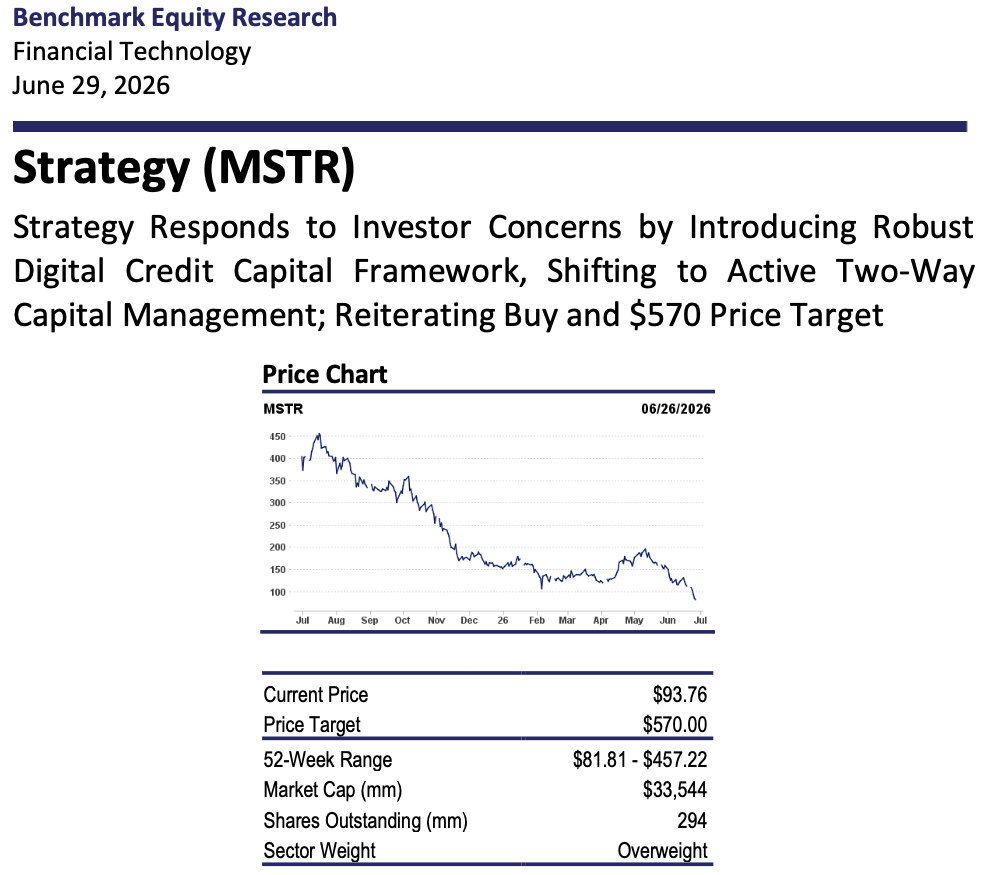
Source: Benchmark Equity Research
“The upshot is that Strategy is now an active manager of both sides of its capital structure, an approach that we view as a significant positive for its shareholders,” Benchmark’s analysts wrote.
Related: Grayscale’s Pandl says Strategy should sell $3B Bitcoin to restore confidence
Investor Simon Dedic said the move could mark a local bottom, suggesting that recent concerns around the company’s structure may have been overdone. The Moonrock Capital founder and managing partner also suggested some of the recent selling pressure may have come from Strategy preparing liquidity in advance of the update.
Skeptics question long-term implications
Not everyone viewed the new framework as a positive. Trader and investor Scott Melker said Strategy appears to be making the changes investors wanted to see, including building a larger cash reserve and adopting a more flexible capital strategy.
However, he cautioned that “only time will tell” whether the new framework restores investor confidence, adding that Strategy has been the market’s main Bitcoin buyer.
Arca chief investment officer Jeff Dorman said that Strategy may need to sell about $2 billion to $3 billion worth of Bitcoin to eliminate a “constant overhang” on the market.
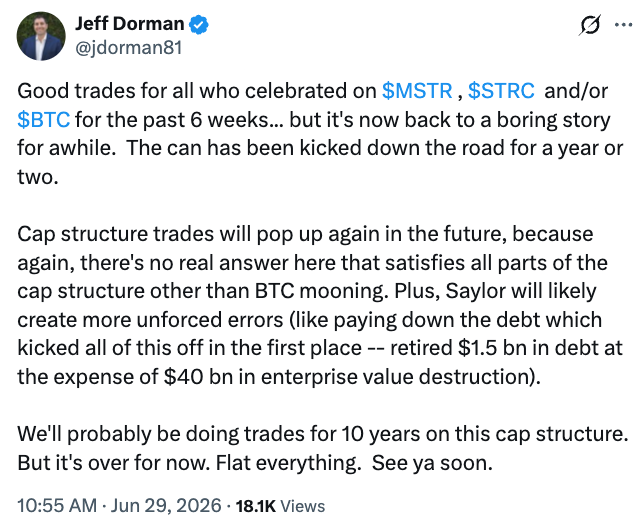
Source: Jeff Dorman
Ripple CEO Brad Garlinghouse also criticized the company’s approach, arguing that “financial engineering doesn’t drive long-term value.” He told CNBC’s “Squawk on the Street” that Michael Saylor’s team “wasn’t focused on the right stuff” and that the strategy had “hurt the overall market.”
Magazine: Bitcoin slides to $58K, XRP hits $1 but onchain data promising: Market Moves
Cryptocurrency exchange OKX has rolled out the beta launch of its marketplace for artificial intelligence (AI) agents.
The OKX AI platform enables users to list their own AI agents, enables AI agents to find work, transact autonomously and build an onchain reputation, according to a Tuesday announcement shared with Cointelegraph.
The platform connects two marketplaces: An agent marketplace where builders can earn income by listing their AI agents for services and a task marketplace where agents post work and find other agents for their tasks.
Agentic AI is expected to drive a 24-fold increase in token consumption, that is units of compute, by 2030 as consumers and enterprises adopt the technology, Goldman Sachs Research said last month. OKX is the latest crypto platform to venture into AI infrastructure, following similar initiatives from Coinbase, MetaMask and Nansen.
The marketplace will remain in beta until “consistent, repeat usage patterns” emerge among users, with trading, onchain activity and research tasks expected to become the primary early categories on the platform, a spokesperson for OKX told Cointelegraph.
“OKX is economic infrastructure for agentic commerce. Nobody is combining identity, reputation, payments, and a skills marketplace into one platform,” explained the spokesperson.
OKX AI agent marketplace. Source: OKX.ai
AI agent builds will be paid in Stablecoins, initially Tether’s USDT (USDT) and Paxos’ Global Dollar (USDG). Payments will settle through escrow-based contracts for complex work or instant pay-per-call transactions for standardized services.
Disputes will be resolved by a staked network of evaluators, instead of a central entity. All types of tasks will contribute to the same onchain reputation of AI agents, which is managed through the OKX Agentic Wallet.
The marketplace launches with support from companies including Amazon Web Services (AWS), AltLayer, CertiK, the Ethereum Foundation, the Solana Foundation, Opentensor Foundation and StraitsX.
Onchain reputation seeks to prevent malicious AI agents
The onchain reputation and escrow system is built to create trust in AI agents by tracking their work history. Agents with no track record or a history of failed or disputed work will be less likely to get hired by other agents.
For larger projects, payment sits in escrow until the task is completed and verified, which aims to “limit” the damage a bad actor can cause in a single transaction.
A spokesperson for OKX said that the onchain reputation system will prevent agents from hiring other malicious agents, especially as more transaction history accumulates.
The spokesperson said the platform is working on additional defense layers, including more sophisticated dispute resolution and an anomaly detection system against coordinated bad-actor behavior.
Crypto platforms join AI wave as agentic payments increase
Cryptocurrency platforms are venturing into autonomous AI infrastructure. On June 12, Coinbase launched a tool that allows AI agents to make payments and trade crypto on behalf of users.
Days earlier, MetaMask launched a self-custodial cryptocurrency wallet that enables AI agents to transact across decentralized finance protocols within user-defined spending and security limits, as reported by Cointelegraph on June 8.
In January, crypto analytics platform Nansen launched autonomous cryptocurrency trading tools that enabled users to execute trades through natural language prompts, instead of traditional charts or order books.
Related: Not every AI agent needs its own cryptocurrency: CZ
Agentic payment activity on Coinbase’s Base network topped 100 million transactions on June 3, signaling that machine-to-machine payments have moved beyond the proof-of-concept.
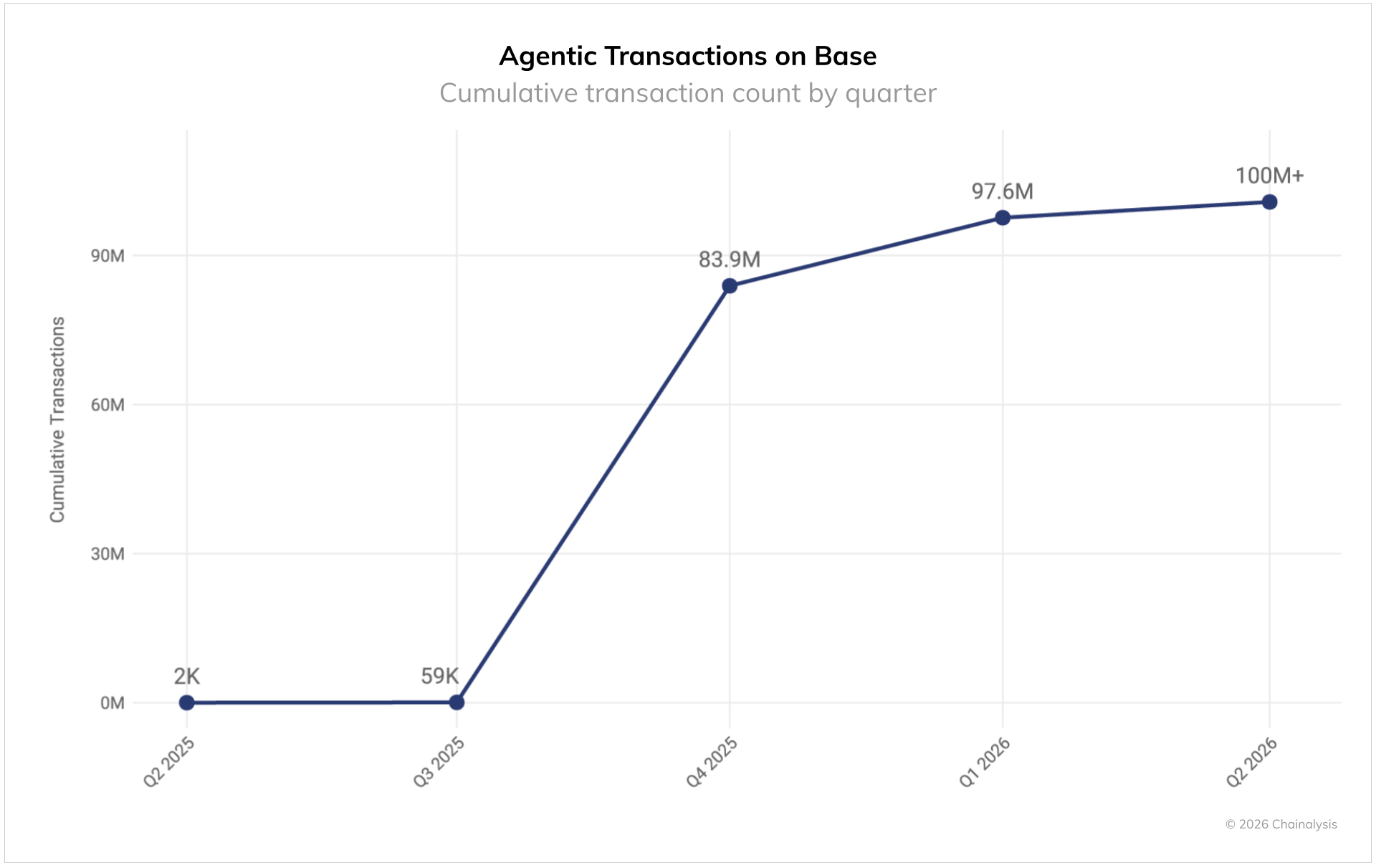
Cumulative agentic transfer volumes on Base. Source: Chainalysis
The x402 protocol allows software agents to make onchain payments directly through web requests.
Magazine: ‘Accidental jailbreaks’ and ChatGPT’s links to murder, suicide
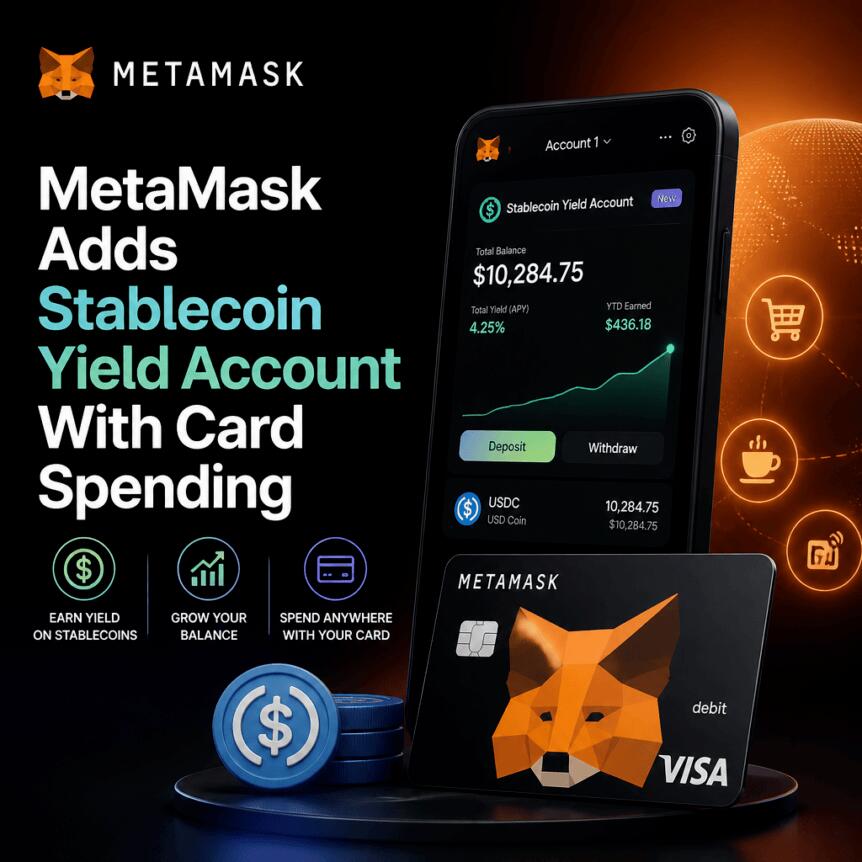
MetaMask is rolling out a new way for users to earn yield on its wallet-native MetaMask USD (mUSD) stablecoin—while keeping the wallet self-custodial. The Consensys-backed team says its newly launched Money Account can provide up to 4% variable APY on eligible deposits, with funds intended to be spent via a card on the Monad blockchain.
The launch lands at a moment when US regulators and lawmakers have been closely debating whether yield-bearing stablecoins—especially those that pay interest to token holders—should be treated like traditional financial products. MetaMask’s approach attempts to separate the stablecoin’s reserve backing from the mechanics of how returns are generated.
Key takeaways
- MetaMask Money Account targets up to 4% variable APY on eligible mUSD deposits in supported jurisdictions.
- Yield is described as coming from DeFi lending activity, not issuer-paid interest.
- mUSD reserves are said to be backed 1:1 by US dollar assets held by Bridge, a Stripe company.
- Availability is limited: the product excludes the UK, EU member states, and sanctioned jurisdictions.
- Because MetaMask is self-custodial, KYC is not performed by MetaMask itself, but is required for regulated features like fiat on-ramps and the MetaMask Card.
A yield product that MetaMask says is “structurally separate”
Consensys positions Money Account as a two-layer system that distinguishes how mUSD is backed from how users’ yield is produced. In an explanation provided to Cointelegraph, Johann Bornman, MetaMask senior director of product, said the design deliberately separates the stablecoin’s reserve backing from the yield layer.
According to Bornman, the first layer concerns reserve backing. He said Bridge, described as holding US dollar reserves and short-term Treasury bills, backs mUSD on a 1:1 basis. In this model, the issuer is not portrayed as paying yield to holders.
The second layer is the onchain yield engine. When users open a Money Account and deposit mUSD, the stablecoin is routed into a DeFi system managed through a vault provider called Veda. Veda then allocates capital into lending protocols including Aave and Morpho.
Bornman summarized the intent behind the product’s architecture by stating that reserve backing and yield generation are “structurally separate,” adding that the yield “doesn’t come from the issuer” but from DeFi protocol activity.
How users can earn—and where the spend flow fits
MetaMask says Money Account allows users to earn yield and spend without waiting to redeem. In remarks attributed to Consensys CEO Joe Lubin, the company characterized the product as enabling users to earn the moment funds are added and spend the moment they need to.
While MetaMask frames the yield mechanism as DeFi-driven, the company’s spending functionality is tied to a specific environment: yield-bearing funds are intended to be spent via a card exclusively on Monad. The product’s rollout therefore appears to combine an earnings layer built on DeFi lending with an application layer for spending within a particular blockchain ecosystem.
Investors and traders watching stablecoin yield mechanics will likely focus on whether this “separation” of backing versus yield impacts regulatory exposure. That question has been central in the broader US debate over whether certain stablecoin designs resemble interest-bearing investment products.
Regulatory friction in the US, and the CLARITY Act backdrop
MetaMask’s launch comes amid continued discussion in the United States around yield-bearing stablecoins. The article notes that the CLARITY Act contains provisions related to restricting payment of interest or yield on payment stablecoins when tied to holding.
MetaMask’s product design—using reserve backing by Bridge and generating yield via DeFi protocols—can be read as an attempt to fit into a narrower interpretation of how returns are created. Still, the practical regulatory classification will depend on how authorities interpret the overall arrangement, including how users experience “yield” and how control and economics are distributed.
For readers, the key takeaway is that Money Account may offer a clearer explanation of its mechanics, but it does not automatically resolve regulatory risk. What matters next is how regulators treat yield features in practice, especially where stablecoins are used with spending rails like cards.
Self-custody, KYC boundaries, and restricted access
Money Account is rolling out globally starting Tuesday, but excluding the United Kingdom, EU member states, and sanctioned jurisdictions, Bornman said.
MetaMask’s self-custodial model affects how compliance is implemented. The wallet itself, as described, does not require KYC because it does not custody user funds. However, Bornman emphasized that KYC is required for features that interact with regulated services—explicitly including fiat on-ramps and the MetaMask Card.
Bornman further said Money Account does not require KYC and that users can hold mUSD and earn yield with the “click of a button.” In cases where KYC is needed, he attributed the responsibility to third-party providers that operate regulated services, rather than MetaMask.
For users in eligible jurisdictions, this could reduce friction compared with yield products that require full identity verification before deposit. For builders and compliance teams, the model suggests a split between self-custody interfaces and regulated rails—something the market increasingly looks for as stablecoin products scale.
mUSD is still small—so the rollout is about distribution
The broader story here is not only the yield feature, but MetaMask’s push to expand the utility of mUSD. The launch follows MetaMask’s wallet-native stablecoin debut in September 2025. CoinGecko data cited in the article shows mUSD’s market capitalization briefly peaked above $100 million shortly after launch, then fell below $30 million. At the time of writing, mUSD’s market cap was around $32 million, placing it among smaller US dollar-pegged stablecoins by market size.
That context matters: Money Account could help drive additional demand for mUSD by turning a wallet-native token into an yield-bearing balance with a spending pathway. But market participants will likely watch whether the yield feature increases sustained usage—or whether deposits remain limited given the restricted geography and the narrower user flow to Monad-based card spending.
With Money Account now live, the next signals to monitor are user uptake in supported regions, any changes in APY as DeFi strategies and conditions evolve, and how the product’s “issuer vs DeFi yield” structure is received by regulators amid US debates over yield-bearing stablecoins.
The Clarity Act is widely viewed as the crypto industry’s most important market structure bill because it would establish clear rules for when digital assets are regulated as securities by the Securities and Exchange Commission (SEC) or commodities by the Commodity Futures Trading Commission (CFTC), replacing years of regulatory uncertainty.
Supporters say that legal clarity would make it easier for banks, asset managers and other institutions to launch tokenized products, custody services and blockchain-based financial offerings, potentially unlocking broader institutional adoption and investment in the sector.
According to Jefferies, passage would provide the durable regulatory framework banks, asset managers and exchanges need to expand tokenization, custody, staking, lending and other blockchain-based services. The bank also expects it to accelerate tokenized securities, broaden crypto exchange-traded fund (ETF) offerings beyond bitcoin and ether (ETH), and revive the pipeline for crypto infrastructure IPOs.
A delay, however, would extend regulatory uncertainty. While recent SEC, CFTC and OCC guidance has improved the outlook, the report said agency actions can be reversed by future administrations, potentially prompting regulated financial institutions to slow blockchain initiatives while reassessing legal and compliance risks.
The bank’s analysts expect the legislative process to drive volatility in crypto-linked equities including Circle (CRCL), Coinbase (COIN) and CoinDesk’s owner Bullish (BLSH), as well as select crypto tokens.

Key Takeaways
- Dish DBS, EchoStar’s satellite television division, is expected to enter chapter 11 bankruptcy protection this week, potentially by Tuesday.
- A pre-negotiated restructuring agreement has secured support from bondholders representing over 82% of approximately $10 billion in Dish DBS obligations.
- The parent company shoulders approximately $25 billion in aggregate debt while hemorrhaging subscribers—losing about 177,000 pay TV customers in the latest quarter.
- Awaited spectrum transactions with AT&T (valued at $22.65 billion) and SpaceX (valued at $17 billion) remain incomplete, preventing debt reduction.
- On Monday, SATS stock started trading at $103.80, carrying a consensus Hold recommendation with analysts projecting an average target of $137.71.
Shares of EchoStar (SATS) began Monday’s session at $103.80, slipping 0.1% as the company moves forward with plans to file chapter 11 bankruptcy for its Dish DBS satellite television division, the Wall Street Journal reports.
The bankruptcy petition could be submitted as early as this Tuesday. The move addresses close to $10 billion in Dish DBS liabilities that have burdened EchoStar’s balance sheet.
Underpinning the bankruptcy strategy is a restructuring framework negotiated earlier this year. Bondholders controlling more than 82% of Dish DBS debt have already committed to the arrangement.
The proposal seeks to reduce outstanding obligations, resolve bondholder litigation, and provide EchoStar with increased financial flexibility for future strategic transactions. White & Case has been retained for legal representation, while FTI Consulting serves as financial advisor for Dish DBS.
Financial Deterioration Drives Restructuring
EchoStar’s traditional pay television operations continue to deteriorate. The segment generated $2.26 billion in revenue during the most recent quarter, representing a year-over-year decline exceeding $260 million.
Customer attrition compounds the revenue challenge. Approximately 177,000 net pay TV subscribers departed during the quarter, reducing the total customer base to slightly above 6.6 million.
The company’s consolidated debt burden stands at roughly $25 billion. This substantial leverage poses increasing challenges for an enterprise confronting what EchoStar characterized as “intense and increasing competition” across video, broadband, and wireless markets.
This restructuring represents EchoStar’s latest attempt to stabilize its financial position. A proposed 2024 merger between Dish Network and DIRECTV ultimately failed after bondholders rejected a mandatory debt exchange.
Those creditors contended the transaction would improperly transfer billions in assets to entities controlled by EchoStar founder Charlie Ergen. That contentious episode clearly influenced the negotiation approach for the current restructuring plan.
Spectrum Asset Sales Remain Incomplete
Regulatory pressure from the FCC regarding 5G network deployment commitments has also complicated EchoStar’s situation. To resolve compliance issues, the company arranged spectrum asset sales to AT&T for $22.65 billion and to SpaceX for $17 billion.
Both transactions remain unconsummated. The combined proceeds are intended to substantially reduce EchoStar’s debt burden once the sales finalize.
The extended timeline has already created operational disruptions. EchoStar defaulted on interest obligations for multiple bonds scheduled for June 1 payment, attributing the missed payments to delayed AT&T transaction proceeds.
By mid-June, EchoStar announced that Dish DBS would satisfy those delinquent interest payments. This temporary solution maintained operational continuity while the comprehensive restructuring advanced.
Regarding operational performance, EchoStar reported a quarterly loss of $0.51 per share, underperforming analyst projections by three cents. Quarterly revenue reached $3.67 billion, marginally exceeding the $3.65 billion consensus estimate and representing improvement from the $0.71 per-share loss recorded one year prior.
Analyst sentiment toward SATS stock remains divided but generally cautious. The consensus recommendation stands at Hold, with price objectives spanning from Weiss Ratings’ sell recommendation to TD Cowen’s $155 buy-rated target.
CEO Hamid Akhavan executed a sale of 52,586 shares on June 5 at an average price of $121.00 per share, generating proceeds exceeding $6.36 million. The transaction occurred pursuant to a predetermined trading arrangement and reduced his holdings by 5.73%, though company insiders collectively maintain 55.90% ownership.


You’re not supposed to think about money this much

Defence Investment Plan: How much more is being spent and will the UK hit its targets?

Chat Without Sharing Your Phone Number


-
 Sports7 days ago
Two goals and an assist by sheer aura: Cristiano Ronaldo just entered the World Cup chat
-

 Fashion4 days ago
Weekend Open Thread: Staud – Corporette.com
-

 Politics4 days ago
The House | Manchesterism won’t survive the painful trade-offs unless it gets citizens on board
-

 Politics5 days ago
Potential 2028er World Cup attendee leaderboard
-

 Business4 days ago
Asia stock markets slide as tech shares slump
-

 News Videos2 days ago
MAJOR BITCOIN & MARKET UPDATE!!!! (MUST WATCH ASAP!!!)
-

 Tech5 days ago
A Look At A Gaggle Of Transputer Boards
-

 Crypto World14 hours ago
Strategy authorizes up to $1.25B in Bitcoin sales under new capital plan
-

 Crypto World6 days ago
Securitize Wraps Roubini's SEC-Registered ETF as Dubai VARA Digital Security
-
Crypto World7 days ago
Bitcoin (BTC) Dips Below $62K, Ethereum (ETH) Plunges 6% Daily: Market Watch
-
 Crypto World5 days ago
Dell (DELL) Shares Tumble Over 5% Following Analyst Downgrade to Hold
-

 Crypto World3 days ago
Coinbase, Circle Deepen Crypto Stock Losses Despite Resilient S&P 500
-
Business7 days ago
Entergy settles forward sale agreements, raises $672 million in cash proceeds
-

 Crypto World3 days ago
Kraken's xStocks Opens Bending Spoons IPO Registration to EEA Retail
-

 Sports4 days ago
FIH Pro League: India defeat Pakistan 7-1, register biggest win of campaign | Other Sports News
-

 Crypto World5 days ago
Bitcoin Sparks $600M Hourly Liquidations With $65,000 Set To Become Resistance
-

 Tech3 days ago
Bluekit phishing kit adopts browser-in-the-middle for login theft
-

 Tech3 days ago
Russian hackers now target Signal backup recovery keys
-
 Crypto World4 days ago
Hyperliquid Named on Singapore MAS Investor Alert Register
-

 Crypto World4 days ago
RTX holders must register wallets before token distribution begins
You must be logged in to post a comment Login