Database management work will soon be mostly automated by AI agents, just like coding, according to the CEO of Cockroach Labs, the company behind the distributed database of the same name.
Spencer Kimball told The Register that the proliferation of databases demanded by the explosion of AI agents in coding and business functions will mean that managing them in a largely manual way is out of the question.
“Nobody’s going to do manual work on a database, just like almost nobody’s doing manual coding anymore,” he said. “A lot of people don’t even know what’s within their code base anymore, like they only know the designs, specifications and guarantees. They’re still verifying the software, but in the end they’re just not down at the level of code, because it doesn’t make sense. It’s like nobody programs in Assembly,” he said.
Kimball is among the tech CEOs with the commensurate background in software engineering to make such statements. He helped build Google’s Colossus distributed file storage system and, as a computer science student at UC Berkely, developed FOSS image editor GIMP, which continues to this day.
Advertisement
You can imagine, the enterprise isn’t eager to turn over the keys to production to an agent. These agents are a second pair of eyes
Spencer Kimball
In the time since, he has seen shifts in the level of abstraction before. “These cycles happen all the time. It’s pretty easy to see what’s coming next, because ultimately agents beyond coding are going to be increasingly complementing and supplementing human-driven workloads. They’re going to use tools, tools are using APIs, and APIs are talking to operational databases, every single one. If you think about the implications of this massive scale-up of traffic, it means that operational databases are going to get busier, and a lot busier. We’re talking about exponential scale-up,” he said.
Cockroach Labs is not the only database company to see the level of AI agent demand on the enterprise as an opportunity. It’s where many vendors are positioning themselves. For example, vector database vendor Pinecone’s idea is that by compiling a knowledge base of an organization’s data structure and content, its technology can avoid burning through tokens back and forth between the data and AI agents. Tiger Data, the company behind TimescaleDB, has built Ghost, a technology designed specifically for developers working with AI agents, charging by compute, rather than by database.
Advertisement
Cockroach Labs, whose customers include OpenAI, CoreWeave, Booking.com, and Cisco, is pitching the idea of an Agentic Database Cloud to address this demand. Among the elements will be elastic compute and storage separation, unified estate management, database virtualization and agentic operations. It expects to announce a product around this idea later this year.
Nonetheless, in database estates, Kimball expects AI agents to act in an advisory role to avoid disruptions to operations. “You can imagine, the enterprise isn’t eager to turn over the keys to production to an agent. These agents are a second pair of eyes,” he said.
To this end, Cockroach has been building its own agents to improve its operations and how it manages databases.
Kimball said it had built AI agents in a layered approach, giving agents sub tasks to perform and then allowing agents to manage those agents, and other agents that verify the approach taken.
Advertisement
“There’s all kinds of hand-offs, there’s agents that help with migrations, agents that help with slow queries, agents that can diagnose problems with clusters, because they’ve been given the institutional knowledge. For example, our entire Zendesk history for the last two years — every customer ticket, every issue, the resolutions — has been digested and cross-indexed. The agents we’re building are the engineering of the prompts, the handoffs and the quality control,” he said.
The “thinking” is done by foundation models, he said. “We have some open-source ones we use that are very, very fast and inexpensive. Those do more… prosaic and mundane tasks that you do a lot of, quickly.”
Kimball said Cockroach also uses proprietary models including OpenAI gpt-oss and Claude Opus.
“We’re trying to provide a replacement for a lot of human labor. We provide corporate ‘Artificial General Intelligence’ for database roles, that once you used to have to hire humans for, but you simply cannot do that at 10x the scale, much less 100x the scale. You have to find that way to get these agents to do extremely useful work, very consistently, at a level that is as good or increasingly better than humans. Frankly, there are things the agents can do that are so grungy you couldn’t hire a human to do it, such as constantly looking through log files, and investigating threads. It’s just too boring,” Kimball said.
Advertisement
As such, Cockroach expects to be able to increase the scope of its products and the number of customers it serves, but only modestly increase its workforce.
“You can do different things right now with your resources. You can try to scale the human teams, or you can figure out how to make the human teams more efficient, and that’s what we’re doing internally. Fundamentally, this is what we’re going to do for our customers, because if you anchor yourself to what’s possible today, then you might say, ‘Oh, the AI is not completely ready,’ but like the speed at which these things are changing makes it all but inevitable at some point in the near future,” he said.
Whether Cockroach’s vision will become reality or not, the database market will have to respond to AI in the enterprise, spending on which shows no sign of letting up. Nonetheless, if agents need databases, and databases need agents to manage them, maybe it’s going to be turtles all the way down. ®
Anthropic today released Claude Sonnet 5, a new AI model that the company says delivers near-flagship performance at mid-tier prices — a move designed to give cost-conscious enterprise developers access to powerful agentic capabilities just as the San Francisco-based AI lab barrels toward an initial public offering that will test whether the private market’s staggering AI valuations can survive public scrutiny.
The release, which Anthropic describes as “the most agentic Sonnet model yet,” makes Sonnet 5 the default model for users on Anthropic’s Free and Pro plans, while also making it available to Max, Team, and Enterprise customers. Introductory API pricing is set at $2 per million input tokens and $10 per million output tokens through August 31, after which it rises to $3 and $15 respectively — still well below the $5 input and $25 output pricing of Anthropic’s top-of-the-line Opus 4.8.
The strategic logic is unmistakable: Anthropic is trying to democratize access to capabilities that until very recently only its most expensive models could deliver, while building the kind of broad-based developer adoption that will look attractive in an S-1 filing.
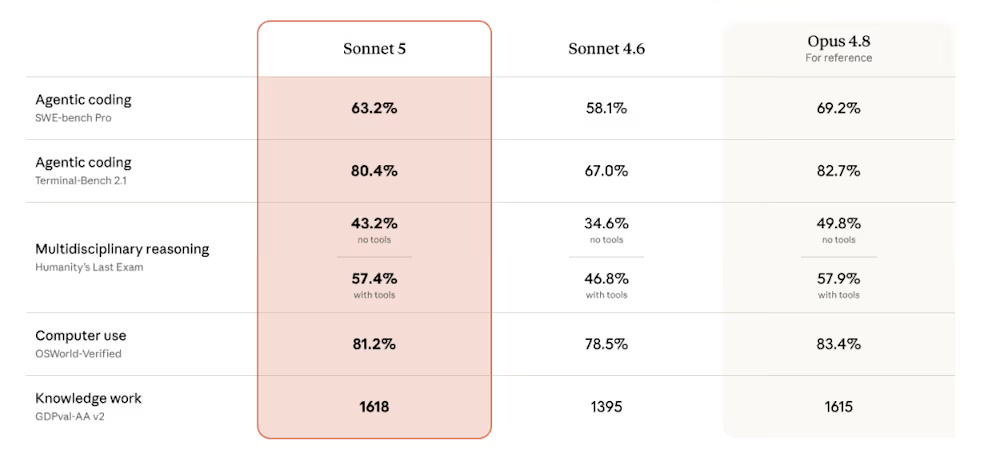
Sonnet 5 narrowed the gap with Anthropic’s flagship Opus model across five major evaluations, and surpassed it on one. (Source: Anthropic)
Advertisement
Sonnet 5 benchmarks show the mid-tier model closing in on Anthropic’s flagship Opus
Sonnet 5 posts major gains over its predecessor, Sonnet 4.6, across every evaluation Anthropic disclosed. On SWE-bench Pro, an agentic coding benchmark, Sonnet 5 scores 63.2% compared with Sonnet 4.6’s 58.1% — a jump that brings it within striking distance of Opus 4.8’s 69.2%. On Terminal-Bench 2.1, another coding evaluation, the gap narrows further: 80.4% for Sonnet 5 versus 67.0% for Sonnet 4.6 and 82.7% for Opus 4.8.
In multidisciplinary reasoning, as measured by Humanity’s Last Exam, Sonnet 5 scores 43.2% without tools and 57.4% with tools — the latter figure essentially matching Opus 4.8’s 57.9%. On computer use tasks evaluated through OSWorld-Verified, Sonnet 5 reaches 81.2%, up from 78.5%. And on GDPval-AA v2, a knowledge-work benchmark, it scores 1,618 — surpassing Opus 4.8’s 1,615 and far exceeding Sonnet 4.6’s 1,395.
The pattern across these evaluations tells a consistent story: Sonnet 5 doesn’t merely inch forward from its predecessor. It vaults into a performance tier that overlaps substantially with Anthropic’s flagship model, while costing roughly 60% less per token at standard pricing and even less during the introductory period.
Enterprise partners say Sonnet 5’s agentic AI capabilities finish jobs that previous models abandoned
The emphasis on agentic capabilities — the ability to plan, use tools like browsers and terminals, and execute multi-step workflows autonomously — reflects where the AI industry’s center of gravity has shifted in 2026. Enterprises are no longer simply asking chatbots questions; they are deploying AI systems that can navigate complex software environments, execute multi-step coding tasks, and operate with minimal human supervision.
Advertisement
Early access partners painted a picture of a model that doesn’t just start tasks but finishes them. Sualeh Asif, co-founder of Cursor, the AI-powered code editor that has become a bellwether for developer tool adoption, said that “with Claude Sonnet 5, agents stay on plan, follow our conventions, and ship clean multi-step changes, all at an efficient cost.” Daniel Shepard, a senior engineer at Zapier, described handing the model a two-part automation job — updating Salesforce account tiers and sending a launch announcement — that “used to stall halfway” with previous models but now completes end to end.
These testimonials matter because they describe exactly the kind of reliability gap that has kept many enterprises from moving agentic AI from pilot programs to production deployments. A model that gets 80% of the way through a complex task before stalling creates more problems than it solves; one that reliably completes the full workflow changes the economics of automation. Anthropic also introduced cost-performance curves showing that developers can now adjust effort levels across Sonnet 5 and Opus 4.8 to find the optimal balance of cost and accuracy for their specific use case — a granularity that reflects growing sophistication in how enterprises consume AI services.
On computer use tasks, Sonnet 5 neared the accuracy of Opus 4.8 at a significantly lower per-task cost. (Source: Anthropic)
An updated tokenizer boosts Sonnet 5 performance but could quietly raise costs for some workloads
One technical detail buried in the announcement’s footnotes deserves attention: Sonnet 5 uses an updated tokenizer that changes how the model processes text, similar to the change Anthropic introduced with Opus 4.7.
Advertisement
The tradeoff is that the same input can map to roughly 1.0 to 1.35 times as many tokens depending on content type. Anthropic says the introductory pricing is calibrated to make the transition “roughly cost-neutral,” but enterprise customers running high-volume workloads will want to benchmark their specific use cases carefully before assuming their bills won’t change.
Anthropic says Sonnet 5 is safer than its predecessor, but its most capable models still lead on alignment
Anthropic’s safety disclosures reveal a nuanced picture. The company reports that Sonnet 5 shows lower rates of hallucination and sycophancy than Sonnet 4.6, is better at refusing malicious requests, and is more resistant to prompt injection attacks in agentic contexts. On Anthropic’s automated behavioral audit — which tests for a wide range of misaligned behaviors including cooperation with misuse and deception — Sonnet 5 scored lower (meaning safer) overall than Sonnet 4.6.
However, Sonnet 5 showed “somewhat higher rates of misaligned behavior” compared with the more capable Opus 4.8 and Anthropic’s Claude Mythos Preview, the company’s powerful but tightly restricted cybersecurity-focused model. On a Firefox 147 exploit development evaluation created in collaboration with Mozilla, neither Sonnet model could develop a working exploit — both scored 0.0% — though Sonnet 5 showed a slightly higher partial success rate (13.2%) than Sonnet 4.6 (8.8%). Both remain far below Opus 4.8 (68.8% working exploits) and Mythos 5 (88.4%).
Because of these incremental gains in cyber-adjacent capabilities, Anthropic launched Sonnet 5 with cyber safeguards enabled by default — real-time systems that detect and block dangerous cybersecurity usage. The safeguards mirror those on Opus 4.7 and 4.8 but are less restrictive than those applied to Fable 5, the latest Mythos-class model that Bloomberg reported on June 10 is “blocked from responding to queries related to cybersecurity and biology.” Organizations enrolled in Anthropic’s Cyber Verification Program automatically receive the same access on Sonnet 5 without needing to reapply.
Advertisement
Neither Sonnet model produced a working exploit for a Firefox vulnerability, while Mythos 5 succeeded nearly 90 percent of the time. (Source: Anthropic)
From $14 billion to $47 billion in revenue: Sonnet 5 arrives as Anthropic’s IPO narrative takes shape
The Sonnet 5 launch arrives at what may be the most consequential moment in Anthropic’s short history. The company confidentially filed its IPO prospectus with the SEC in early June, setting up what CNBC has described as “the most scrutinized public offering in tech history.”
The financial trajectory has been extraordinary. In February, Anthropic raised $30 billion at a $380 billion valuation, with the company reporting $14 billion in annualized revenue that had “grown more than tenfold in each of the past three years,” as The Guardian reported.
By late May, Anthropic had closed a $65 billion Series H round at a $965 billion post-money valuation — co-led by Altimeter Capital, Sequoia Capital, and others — with a revenue run rate that had crossed $47 billion. Harrison Rolfes, an analyst at PitchBook, told CNBC that the number that will “either validate or collapse the entire narrative the private markets have been pricing for three years” won’t be the valuation or revenue, but gross margin — a figure no outside observer has yet seen.
Advertisement
In this context, Sonnet 5 serves a dual purpose. For developers, it offers genuine capability improvements at competitive prices. For Anthropic’s IPO narrative, it demonstrates the company can deliver a compelling product at a price tier that could drive the kind of broad adoption Wall Street rewards — high-volume, recurring API revenue from thousands of enterprise customers.
Government deals and growing competition define the market Sonnet 5 enters
The timing also aligns with Anthropic’s aggressive push into institutional contracts. Just yesterday, California Governor Gavin Newsom announced a first-of-its-kind partnership providing Claude to all state agencies at a 50% discount, with free workforce training.
Kate Jensen, Anthropic’s Head of Americas, called it an effort to “put Claude to work for the people who keep this state running.” The deal — which extends to California’s cities and counties — represents exactly the kind of durable, recurring adoption that could anchor revenue well beyond the developer community.
But Anthropic’s release lands in an increasingly crowded field. OpenAI, which raised a $122 billion round in March at an $852 billion valuation, is pursuing its own IPO. Elon Musk’s SpaceX, which merged with xAI, priced its IPO at $135 per share with a $1.77 trillion valuation. Google, Meta, and a growing wave of well-funded competitors — including Asian AI startups that, as the Wall Street Journal has reported, are developing Mythos-like cybersecurity capabilities — are all vying for the same enterprise market.
Advertisement
Gil Luria, head of technology research at D.A. Davidson, told CNBC that while Anthropic “appears to have the lead” in frontier AI models, “much of their current usage is for trials and experimentation and that may not sustain.” That observation cuts to the heart of the challenge facing every frontier AI lab: converting experimental developer usage into durable, production-grade revenue.
Anthropic’s more capable models showed lower rates of misaligned behavior than Sonnet 5, which nonetheless improved markedly over its predecessor. (Source: Anthropic)
The real test for Sonnet 5 isn’t benchmarks — it’s whether cheaper AI can sustain a trillion-dollar story
Sonnet 5’s positioning — offering near-Opus performance at Sonnet prices — is a direct play for that conversion. Enterprise customers experimenting with expensive Opus-class models may find that Sonnet 5 delivers sufficient quality for production workloads at a price point that finance teams can approve at scale. If it works, it could accelerate the shift from experimentation to deployment that every AI company needs to justify its valuation.
Three things will determine whether Sonnet 5 matters beyond the initial benchmark charts. Real-world agentic reliability is the first: benchmarks measure capability, but production deployments measure consistency, and the true test will come when thousands of developers push the model through messy, unpredictable workflows at scale.
Advertisement
The tokenizer economics are the second: the updated tokenizer’s 1.0 to 1.35x token expansion could quietly erode the pricing advantage for certain workloads, and enterprise customers should run their own cost analyses rather than relying on headline per-token prices. The third is the IPO narrative itself: when Anthropic’s S-1 eventually becomes public, investors will scrutinize whether the Sonnet tier — cheaper but high-volume — or the Opus tier — expensive but high-margin — drives the bulk of revenue and, critically, gross profit.
As PitchBook’s Rolfes told CNBC, the 2026 IPO window “either becomes the most consequential IPO cycle since the dot-com era or the most expensive lesson in narrative-versus-fundamentals that public markets have ever taught.”
Anthropic is betting that a model good enough to rival its flagship and cheap enough to run at scale is the product that closes the gap between those two outcomes. The public markets will soon decide whether they agree.
Looking to watch CazeTV – the Brazilian YouTube channel with the rights to all 104 World Cup 2026 games? Read on and we’ll show you how to watch CazeTV outside Brazil – including the US, Europe and beyond.
After starting out as a Twitch streamer, Casimiro Miguel has changed the game when it comes to sports broadcasts in the modern era with his CazeTV YouTube channel.
For fans in Brazil, it’s now easier than ever to watch the games – Caze offers easy access to all 104 matches, in crisp 4K quality, absolutely free of charge. No messy sign ups.
Advertisement
But, what if you’re away from Brazil when a big sporting event is on? How do you unlock CazeTV’s free streams?
Here’s the trick – and how to watch CazeTV from anywhere in the world.
How to watch CazeTV for free
The good news is CazeTV is a totally free YouTube channel which broadcasts live sporting events, like the World Cup.
Advertisement
The catch is it’s geo-locked to Brazil, with licensing limiting where you can watch live games and events.
If you’re living in Brazil, you’ll get access to football games, Olympics coverage, table tennis events, and more.
Traveling outside of Brazil? You can still watch your CazeTV stream for free thanks to Norton VPN (try for 60 days).
Advertisement
How to watch CazeTV from anywhere
Using a VPN is the best way to bypass geo-locked restrictions and access your usual content even if you’re away on holiday. Here’s how…
Do you need a VPN to watch CazeTV abroad?
Yes, if you’re anywhere outside Brazil, CazeTV will be blocked. You’ll see some recorded content and World Cup highlights – but you won’t be able to access the World Cup live streams.
Having a good VPN and a strong connection can fix that, though.
Advertisement
You can change your location and settings so that your device thinks you’re back in Brazil, and get access to your sporting content as normal. As we say, we recommend Norton VPN for this.
Quick warning – some VPNs don’t work with CazeTV but Norton does, we tested and it’s super-fast so you won’t miss a goal of have to worry about buffering during a penalty shootout.
What streaming devices are supported by CazeTV?
📱 Mobile & Web
Advertisement
Android phones & tablets (Android L or later) iPhone & iPad (iOS 15 or later) Web browsers — watch via tv.youtube.com on Chrome, Firefox, Safari, etc.
📺 Smart TVs
Samsung Smart TVs (2017 & newer) LG Smart TVs (2016 & newer) Vizio SmartCast TVs (select models) Hisense Smart TVs (select models) Sharp Smart TVs (select models) Sony Smart TVs (select models) (Support varies by model and app store availability)
🎮 Streaming Media Players & Set‑tops
Advertisement
Roku players & Roku TVs Apple TV (4th gen & 4K) Chromecast with Google TV / Google TV devices Android TV devices (including built‑in TVs and boxes) Amazon Fire TV devices & Fire TV Edition TVs (App must be available in the device’s store)
🎮 Game Consoles & Smart Displays
Xbox Series X|S, Xbox One PlayStation 5, PlayStation 4/Pro Google Nest Hub / Smart displays with YouTube support
Advertisement
How popular is CazeTV?
Tens of millions of people are using CazeTV now, and it’s breaking all kinds of records during the World Cup 2026.
Coverage of Brazil vs Morocco in the group stages of the World Cup brought in 12.4 million concurrent viewers at its peak.
That’s the biggest live audience in YouTube history, and it was also the first time a solo streamer exceeded 10 million viewers.
Advertisement
What can you watch on CazeTV?
It’s not just the World Cup you can watch on CazeTV. Here are all the other sports and content you can find on the YouTube channel:
English Premier League
La Liga
Bundesliga
Serie A
Ligue 1
The Olympics
NFL
World Table Tennis
Sports documentaries
Behind the scenes footage and training coverage
Influencer and lifestyle content
Who owns CazeTV?
CazeTV is the brainchild of streamer Casimiro Miguel. The 32-year-old from Brazil founded CazeTV when he was starting out on Twitch before migrating to YouTube.
However, there is a much bigger name attached to the business now. Portugal legend Cristiano Ronaldo bought a stake in LiveModeTV, the enterprise behind CazeTV. According to SportCal, Ronaldo made a significant investment in the company.
Advertisement
Is CazeTV legal?
Yes, CazeTV is totally legal and free. It’s just your standard YouTube account, but it’s special because it has official broadcast rights to stream every single game from the tournament.
The channel had some access to the 2022 World Cup in Qatar, and has been picking up more and more prestigious and expansive broadcast rights ever since.
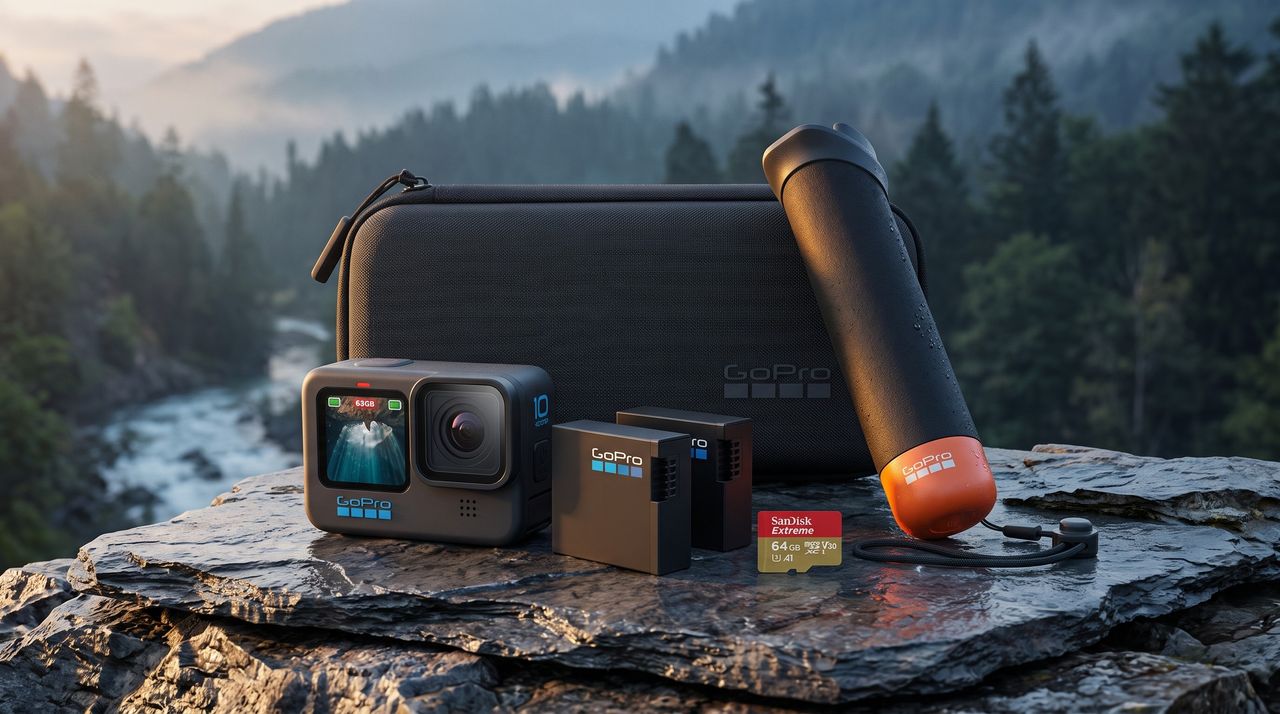
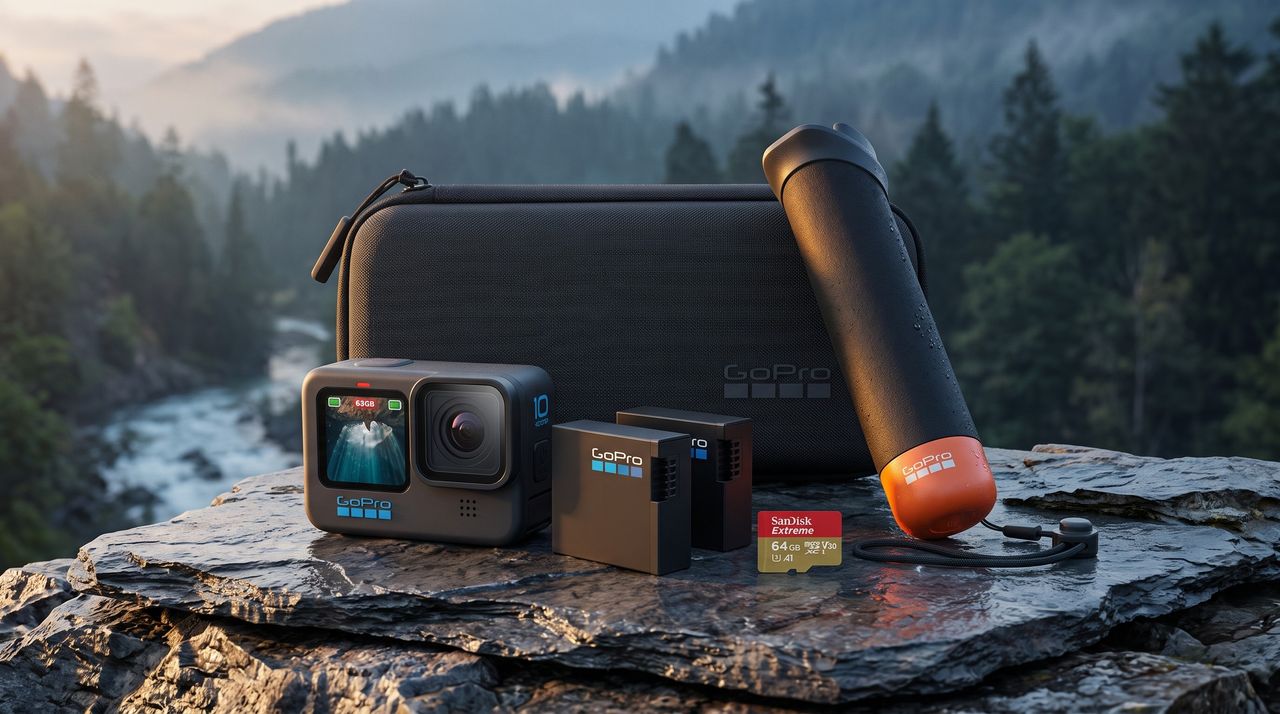
That’s a new record-low price for the highly rated 5.3K resolution camera from the industry’s leading brand. Considering the camera ordinarily retails for $429 by itself, this bundle deal is even more impressive.
In addition to the excellent GoPro camera, the bundle features a handle, two Enduro batteries, two curved adhesive mounts, a 64GB SanDisk MicroSD card, and a handy carrying case. That’s everything needed to get filming as soon as it arrives at your door.
Advertisement
Today’s best action camera deal
Competition for the top spot in our best action camera guide is fierce, but the GoPro Hero 13 Black has held prime position for a long time now. Its commendation is in large part thanks to the excellent-quality 5.3K video, a superb range of accessories, including new auto-detected Lens Mods, and improved battery life and heat dissipation.
You can read more about why we love it in our GoPro Hero 13 Black review. Specifically, we praised its Bluetooth audio support, versatile mounting options, and ability to capture great-looking footage in well-lit areas.
I don’t record much video for social media specifically, but if you do, then you’ll love the 27MP sensor, which enables footage to be recorded in an 8:7 aspect ratio. Say goodbye to the awkward cropping of landscape footage for portrait outputs.
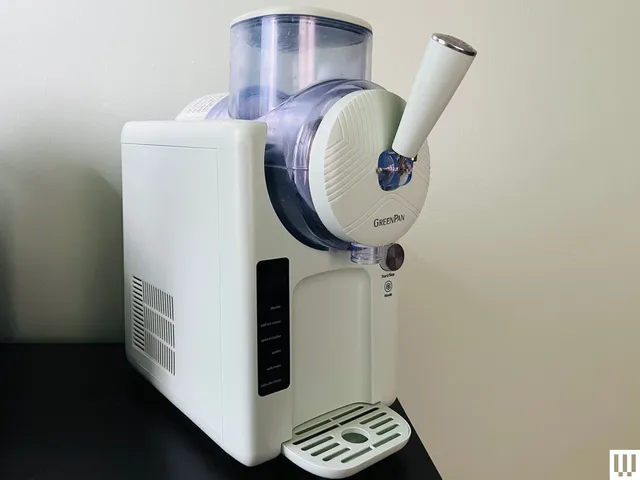
The slushie machine from Belgian-founded kitchen and wellness brand GreenPan is maybe the only slushie machine I’d describe as being even slightly attractive, or pleasant on a countertop—available in a trendy pistachio color scheme that a 21-year-old co-tester called “cute.” The slush produced by this device also had quite a nice consistency, perhaps due to a tighter auger around the cylinder that roiled the slush a little more. My colleague Martin Cizmar, who also tested this device, was able to recreate a Philly recipe for Italian-style water ice with Meyer lemons, and declared himself an unending fan.
Advertisement
The GreenPan slushed admirably, making a full chamber’s worth of spiked slush in about 25 minutes. This is nowhere near as fast as the XL or the Twist on slushing speeds, alas. The fill chamber is a little shallow, which means you have to pour slowly or you’ll make a mess. If you accidentally leave the handle down, you’ll also make a mess. Some reports online of cracks in the cylinder over use are also reason for pause. But if aesthetics are a prime consideration, this will slush handily. And look better while doing it.
Photograph: Matthew Korfhage
Photograph: Matthew Korfhage
Advertisement
The original Ninja Slushi was quite simply a triumph of industrial design when it arrived in 2024—the machine that managed to bring the cocktail bar or convenience-store slushie to the home kitchen countertop. Among many imitators, Ninja’s original design remained the most user-friendly and reliable until the next-generation Ninjas supplanted it.
I’ve made coconut-lime daiquiris for a family of visiting Brazilians, who joked that they planned to take the machine back with them on the airplane. I’ve entertained a party full of children with the nonalcoholic version of slushie. And I’ve made silly frozen cocktails at home, whether lime Jarritos slushies or tamarind michelada slushies. Everything frozen is better, it turns out. Freezing a cocktail adds fun and removes shame.
But it’s been replaced. I consider the original Slushi a good value model, but it’s no longer the top of the market. The original Slushi doesn’t slush as well on higher-alcohol slushies as the newer XL and Twist, even for ABV below 16 percent. (Really, with an OG Ninja Slushi, the sweet spot is around 10 to 12 percent ABV if you want good consistency.) Milkshakes/soft-serve are not really feasible on the original Ninja either, always either foamy or ice-gritty.
Advertisement
Which is all to say, buy the Slushi when it’s on a good sale at $250 or less—it served me well for a year—or when it’s updated with a compressor as good as the one on the XL or Twist.
Other Slushie Machines Tested
Ever since Ninja took slushies to the home market, the Amazon directories have filled with newer brands you’ve likely never heard of and whose names sometimes seem subject to a randomizer engine: Inoviva, Chivalz, Vibofrost, Friwest, Aekda, Syintao, Vischic, Ranvaira, Rinvotio, and the list goes on. Most are available at discounts compared to Ninja or other more recognizable brands.
I’ve tested three such brands: Chivalz, Invoviva, and Vibofrost. All three have had one form of reliability issue or another: basic design defects, inconsistency of performance, or simply disappearing from the market.
Advertisement
Chivalz Slushie Machine (no longer in stock): This was previously WIRED’s budget pick, which my co-tester Kat Merck called, without insult, “a quite respectable Ninja Slushi knockoff.” The device arrived with a welcome digital temp readout and a removable back panel that made cleaning easier on the slush chamber. Performance was comparable to the original Ninja, though the user interface was a bit janky. But since last year, the brand’s slushie machines seem to have disappeared, as the brand’s focus returned to air purifiers and humidifiers.
Vibofrost Slushie Machine ($235, sold out after Prime Day): This Vibofrost, like the Chivalz, freezes slushies comparably to the original Ninja Slushi. And like the Chivalz, it has a somewhat irritating child-lock feature, and a timed feature that seems of limited utility. Though it will slush within around 20 to 30 minutes, the oddly designed spout can spray wildly if there’s any liquid in the machine, the drip tray does not attach securely, and it kinda moans like a dying tauntaun while in operation.
Inoviva Slushie Machine for $120: I tested this Inoviva slushie machine twice. The first time, the device registered much louder than competitors, the drip tray arrived stuck to the machine, and the compressor began to fail after a week’s testing. The second time, it was still loud, and the user interface had a difficult-to-navigate locking feature, but freezing was indeed more consistent. The inconsistency in quality control makes this device difficult to recommend. But maybe you’re willing to brave this for a steeply discounted price. The Inoviva also has one terrific feature: The ability to adjust thickness for each drink setting.
Advertisement
My co-tester Kat Merck (on the now-discontinued Chivalz) and I made so very many slushies with each machine, from dairy to nondairy to coffee slushies to straight-up bottles of wine. Specifically, we tested every version of slush that a machine advertised. If Ninja or GreenPan says a machine can make frappés and milkshakes and frozen juices, we made frappés and milkshakes and frozen juices, tinkering where necessary. I froze orange juice and strawberry juice, slushed a bouquet’s worth of rosé, and made slushies from daiquiri to margarita to whiskey Coke. I slushed tamarind micheladas (an excellent idea) and Twisted Tea (a terrible idea).
Photograph: Kat Merck
I also raced the freezing capabilities of each machine by pouring a 16-ounce can of delicious Mike’s Harder Lemonade in each, then seeing which machine was fastest. (For the XL, I used a 24-ounce can.) And I made smooth and dense coconut-lime daiquiris with coconut milk, according to Ninja’s recipe, to test how well each machine’s dispenser handled a genuine dense-textured challenge.
How Do Home Slushie Machines Work?
The tech is pretty simple, almost ingeniously so: A beefy cylindrical freezing core in the center of the drink chamber continually cools any liquid in contact with it. It’s encircled by a plastic spiral auger attached to a motor. The auger mixes the drink, keeps it slushing instead of freezing solid, and also pushes the resulting slush toward the dispenser nozzle so you can have some. The resolute simplicity of this design allowed Ninja and others to scale down the commercial slushie maker for home consumers thirsty for frozen treats.
Advertisement
The main requirement on most machines is that the frozen beverage have more than 4 percent sugar—or between 3 percent and 16 percent alcohol (20 percent for the newest Ninjas). This lowers the freezing point of the resulting concoction, and makes slushing possible. Some slushie machine vendors recommend percentages more like 15 percent sugar, for perfect consistency. But I often balk at this. Coca-Cola and orange juice are each around 11 percent sugar—so that’s very sweet. Some hero of the internet has made a slush calculator for easy reference.
A minimum of 16 ounces of liquid is required for most 88-ounce home machines, for simple reasons: The liquid needs to be in physical contact with the core in order to slush up and also to keep ice from forming on the central cylinder’s surface. The Slushi XL requires a 24-ounce minimum, because it’s bigger.
Can You Put Diet Soda in a Slushie Machine?
No and yes. Slushies rely on a helpful property of water: Sugar (or salt) dissolved in water lowers its freezing point below 32 degrees Fahrenheit. Why? Solubles like sugar are chaos agents. Sugar molecules move randomly, refuse to dissolve into ice, and interfere with water’s ability to form hydrogen bonds and turn crystalline. Some water molecules freeze, but sugar water doesn’t. Tada! Slush.
Advertisement
If you try to make a slushie out of sugar-free soda, or sugar-free anything, ice crystals will instead form easily. The stainless steel freezing core will ice over and scrape on the auger, and ice cubes or hunks will gather mass in the slushie machine. The cylinder will start to shake, then the machine will clunk, then eventually you’ll probably break your machine: Low-sugar fail-safes on these devices have not been overly reliable, alas. So don’t try this at home!
This doesn’t mean you’re doomed to massive calories if you want to make a slushie. Not every artificial sweetener lowers the freezing point appropriately, but the one that Ninja recommends for diet slushies is allulose, a rare but naturally occurring sugar that’s 70 percent as sweet as basic sugar but is not metabolized effectively by the human digestive system. This means it’s low in calories and doesn’t cause insulin spikes—but as with a lot of indigestibles, note that side effects can include bloating or GI distress for some.
For easiest use in a slushie, buy liquid allulose. Powdered versions also exist, but to use them, you’ll need to make a simple syrup by heating up the powder in water to help it dissolve, then let it cool. If you just try to drop the allulose powder into your machine with some Diet Coke, it might not dissolve, and you might still get ice formation. Or at least, I definitely still got ice formation when I tried this on the OG Ninja, and had to stop my machine.
How Can You Stop Milkshakes From Getting Foamy in a Slushie Machine?
Advertisement
Bet you didn’t expect a lesson in milk proteins today! But here’s the deal: Milk proteins start to separate when agitated. Churning milk is, in fact, how butter gets made. Proteins separate out, and you get butter on the one side and buttermilk on the other. Both are delicious, but neither is wanted in a milkshake.
Photograph: Matthew Korfhage
If you try to make a milkshake in a churning slushie machine using just milk, you’ll eventually start to see the effects of these milk proteins separating out from buttermilk—which will manifest first as an undesirable foaminess. To avoid this, Ninja recommends also adding heavy cream or half-and-half to any milkshake recipe. The higher fat content will keep things smoother.
Note it’s easiest to use fruit syrups, rather than just juice, and add vanillin, or it’ll be a bit boring: The heavy fat tends to overwhelm any subtle fruit flavors. Another deep secret of the tasty milkshake? Salt. Add a tiiiinny pinch; it’ll help bring out flavor. A 16-ounce McDonald’s milkshake has 260 milligrams of sodium—about 1/16th of a teaspoon of table salt, or approximately the amount that fits between your index finger and your thumb.
But temper your expectations here. None of the slushie machines we tested made a texture comparable to a classic milkshake. On most machines, which don’t have compressors as powerful as the new-model Ninjas that are now our top picks, the texture is often a little ice-gritty and not as richly textured or integrated as the milkshake you’ll get from your local burger joint, let alone the soft serve from the famously broken ice cream machines at McDonald’s. Slushie machines also can’t handle chunks of frozen fruit, often the best part of a milkshake.
Advertisement
On the newer Ninjas, with their more powerful freezing power, I was able to get the smoothness and freeze I wanted. But because most recipes call for a high-fat mix of 2:1 milk and heavy cream in order to avoid churning foam and butter, the results still weren’t quite a light milkshake. It was more like a dense, rich, quite tasty soft serve. I learned the hard way that throwing in a half-teaspoon to a teaspoon of salt was necessary to drop freezing temps enough to get good cream formation.
Now, do I like being able to make 20-minute soft-serve in my home? From milk and heavy cream and sugar and a dash of salt and vanilla? Heck yes, I do.
That does not mean every networked audio system suddenly becomes ART-capable. The Dirac Live Processor can serve as the software hub for compatible playback systems with the appropriate licenses, and a properly measured speaker configuration. For listeners already using a PC or Mac at the center of a serious audio system, however, it creates a far more flexible path to Dirac’s most advanced low-frequency and room-acoustics tools.
What Is the Dirac Live Processor and Who Is It For?
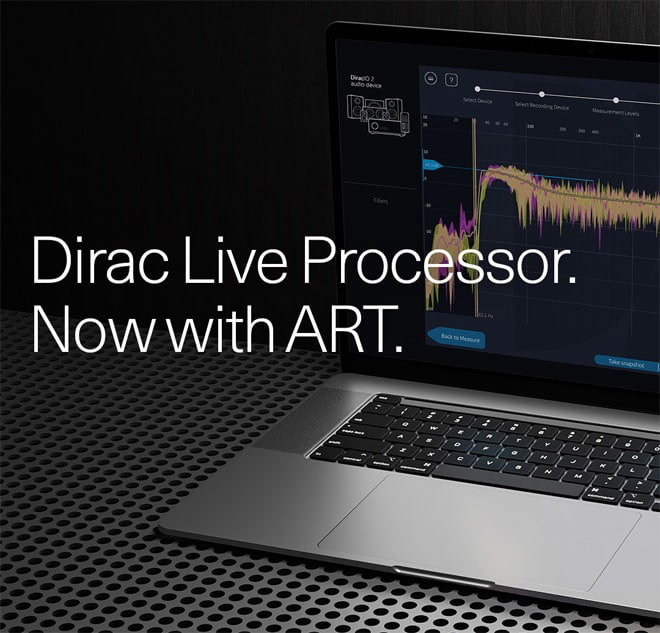
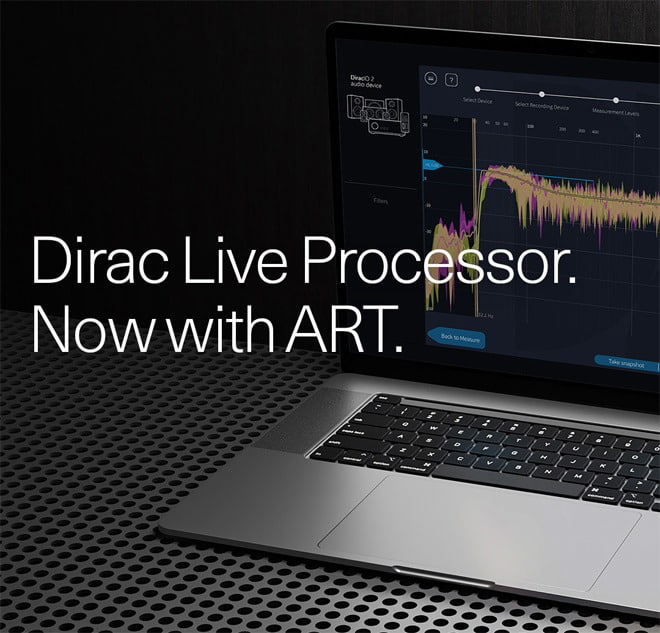
The Dirac Live Processor is a virtual audio processor for PC and Mac that applies room correction to audio before it reaches the sound system. It gives listeners a way to measure and optimize room and system performance using software and the computer they already own, including with audio systems where Dirac Live is not built in.
With continued support for VST, VST3, AAX, and AU plug-in formats, the Dirac Live Processor can also be used with compatible DAWs (digital audio workstations) and media players as part of an existing computer-based playback setup, including studio systems.
The Dirac Live Processor incorporates Dirac Live Room Correction, Dirac Live Bass Control, and Dirac Live Active Room Treatment. Together, these technologies establish the Dirac Live Processor as Dirac’s PC and Mac platform, giving listeners a single place to access its full suite of room-acoustics tools.
Advertisement
“Active Room Treatment is the most advanced room acoustics work we’ve done, and Dirac Live Processor is how we bring it to PCs and Macs,” said Nilo CasimiroEricsson, Product Manager for Dirac Live. “Starting today, anyone can install it on their PC or Mac and hear the difference Dirac Live Active Room Treatment can make in their own sound system, in their own room.”
Dirac Live Room Correction analyzes how a room and speaker setup affect the interaction between sound and space, then applies corrections intended to improve timing, phase alignment, frequency response, imaging, and tonal balance.
Dirac Live Bass Control optimizes low-frequency performance across speakers and subwoofers, aiming to deliver smoother, more consistent bass throughout the listening space.
With the addition of Active Room Treatment, the Dirac Live Processor supports Dirac’s complete approach to room acoustics management. Active Room Treatment builds on Dirac Live Room Correction by using the full speaker array as a coordinated acoustic system, actively helping control room resonances and sound decay to deliver a cleaner, more controlled soundstage with greater clarity, detail, and focus.
Advertisement
Over the past 12 months, Dirac has expanded access to Dirac Live Active Room Treatment through a growing range of home-audio collaborations and integrations with brands including AudioControl, Denon, Marantz, miniDSP, Monoprice, and StormAudio.
The Dirac Live Processor extends that access to PC and Mac users who want a software-based approach to room-acoustics optimization, without requiring their AVR, preamplifier, or other system component to have Dirac technology built in. Setup begins by connecting a measurement microphone to the computer. The software then guides users through the room-measurement process, analyzes room and system behavior, and creates filters tailored to the listening environment.
Advertisement. Scroll to continue reading.
“With Active Room Treatment now available, Dirac Live Processor becomes a powerful way to experience our most advanced room acoustics technology in any system,” continued Casimiro Ericsson.
Advertisement
Pro Tip: To use the Dirac Live Processor with an AVR or related component, the device and the PC or Mac running the software must be connected to the same network.
Dirac Live ART has quickly emerged as one of the more sophisticated room-acoustics solutions available to home-theater and two-channel listeners. With its addition to the newly renamed Dirac Live Processor, PC and Mac users can now access Dirac Live Room Correction, Dirac Live Bass Control, and Dirac Live Active Room Treatment from a single software platform.
Advertisement
Three Key Points
Dirac Live Room Correction Suite has been renamed Dirac Live Processor.
Dirac Live Active Room Treatment has been added to the Dirac Live Processor platform.
A PC or Mac can serve as the control and processing hub for Dirac Live in systems without Dirac built into the source hardware, although compatibility, licensing, and network requirements still apply.
There is no free lunch in acoustics, unfortunately. Unlike the basic room-correction systems bundled into many AVRs, Dirac Live Processor features require separate user licenses, with pricing dependent on the level of correction and bass-management capability required.
The Dirac Live Processor is aimed at serious computer-audio users, home-theater owners who may not have Dirac-compatible hardware (however, network connectivity is required), and studio or enthusiast listeners willing to measure their rooms rather than simply hope the sofa is in the right place.
When properly implemented, Room Correction, Bass Control, and ART can improve bass consistency, imaging, tonal balance, and overall clarity. Casual listeners may struggle to justify the added cost and setup, but for anyone trying to extract the full potential from a good loudspeaker system in a less-than-perfect room, it is a meaningful and potentially transformative tool.
Pricing & Availability
Active Room Treatment is available on the Dirac Live Processor starting June 30, 2026. Existing users of Dirac Live Room Correction Suite will automatically be transitioned to Dirac Live Processor together with their current licenses and settings. Licenses can be purchased with an optional 14-day free trial at www.dirac.com.
Dirac Live Room Correction – $349 (for Mono and Stereo) $499 (for Multichannel)
Dirac Live Bass Control – $299
Dirac Live Active Room Treatment – $299
Pro Tip: Dirac has a dedicated landing page for Dirac Live Processor licenses. During the launch period, this will be the main place to buy ART/DLP on the site. Going forward, Dirac Live Processor will be added to Dirac’s main device list when selecting a license, so that it shows up as an alternative alongside compatible hardware devices.
In 2016, the company was built around a straightforward idea: make hawker food more accessible to busy office workers in the CBD. After years of pivots, a pandemic-era detour into residential deliveries, and the hard lessons that came with it, the Singapore startup has appeared to have found a model that works—B2B corporate dining.
And the numbers are starting to show it.
WhyQ co-founders Varun Saraf and Rishabh Singhvi shared that the company hit baseline profitability in Singapore in Q2 2025 and has stayed there. They added that the business has maintained an annualised revenue run rate of about S$5 million through Q1 2026.
Advertisement
For a company that was burning through cash during its pandemic-era consumer delivery phase—dispatching individual riders for meals worth S$10 to S$15 with no economies of scale—that’s a meaningful turnaround.
“The more we scaled, the more we burned,” COO Singhvi said in a previous interview with Tech in Asia. The pivot to B2B, he shared, “solved our entire unit economics puzzle.”
Delivering over 2,500 corporate meals daily
Image Credit: WhyQ
WhyQ now operates exclusively as a B2B platform. Gone is the sprawling consumer app that once partnered with over 2,200 hawker stalls across 35 hawker centres.
In its place is a leaner corporate dining operation: just slightly over one-fourth the number of partners at 500 merchant partners, but with long-term contracts that give the business predictable, recurring revenue.
The biggest lesson [we] learned was trying to compete in the volatile consumer delivery market, where revenue simply lacks long-term predictability.
About 20% of orders still come from hawker partners, with the remaining 80% driven by curated restaurant brands. Meal prices range from S$8 to S$25 per head.
Advertisement
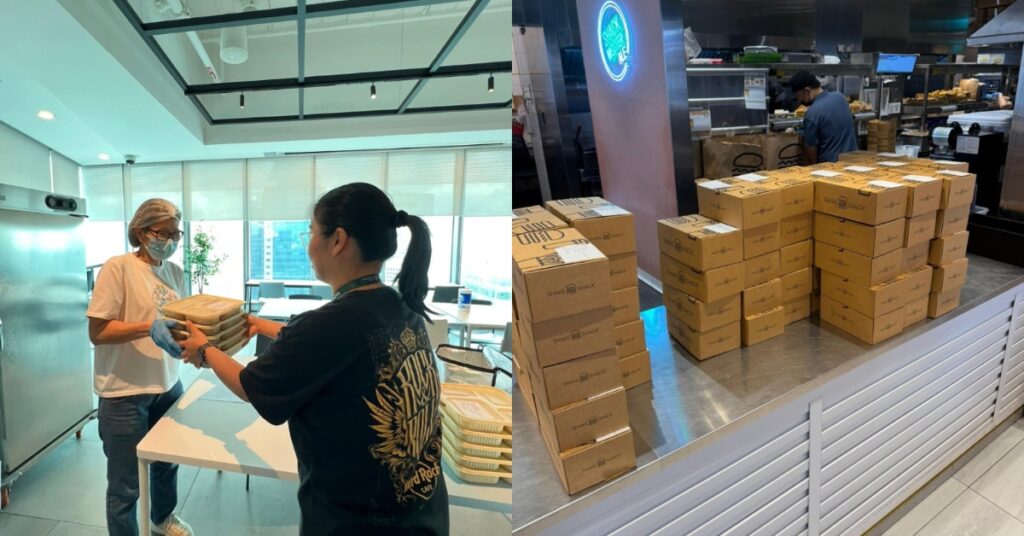
The company has also moved away from the third-party gig logistics that caused so many of its consumer-era headaches. WhyQ now runs its own dedicated delivery fleet, whose riders are trained to conduct quality checks at the kitchen and handle meal setup directly at client offices.
“HR doesn’t have to lift a finger,” Saraf said.
Image Credit: WhyQ
Today, WhyQ delivers more than 2,500 meals daily to corporate clients.
What makes it even more appealing to corporate clients is that WhyQ white-labels its ordering portals so they look like the client’s own internal platform. It also handles everything from daily lunches to pantry snacks, event catering, and live food stations.
The company claims 100% client retention among its corporate accounts.
Advertisement
Merchant partners are also benefiting from the predictability. Gyoza San’s founder Wilman Ng said the corporate order program has consistently boosted their monthly revenue by 15 to 20%. KinBaba Thai reported a similar 15% revenue lift since joining WhyQ’s network.
WhyQ’s next big bet
Gyoza San founder Wilman Ng./ Image Credit: WhyQ/ Millie Lee via Google Reviews
Assuming the B2B foundation holds, WhyQ’s next move is WhyQ Intelligence, an AI-powered nutrition and wellness tool currently in pilot, with a commercial launch targeted for Q3 2026.
The idea is to let employees track nutritional macros, set dietary targets, and chat with an AI assistant for menu recommendations—all tied to their company’s curated meal options. For HR teams, it connects meal participation data with attendance trends and employee engagement metrics.
Saraf frames it as both a client retention play and a new data layer: understanding what employees actually want to eat, which keeps menus fresh and deepens WhyQ’s grip on the accounts it already has.
The company is targeting a 70 to 80% engagement rate among employees at client companies in the tool’s first year.
Advertisement
Down the line, WhyQ Intelligence could potentially be spun out as a standalone product sold to companies managing their own food programs. That’s a longer runway, but it signals the founders are thinking beyond logistics.
“We have a long way to go here”
WhyQ is targeting 50% year-on-year revenue growth, driven largely by expanding within existing accounts. One enterprise client is reportedly adding 120 daily meals in Jun 2026 and another 250 in Oct.
Image Credit: WhyQ
Beyond Singapore, the founders see Hong Kong and Sydney as their next potential markets, pointing to similar competition for talent and existing enterprise customers with offices in both cities. Rather than expanding speculatively, WhyQ says it will only enter a new market after securing a profitable anchor contract.
It also plans to acquire local merchant networks where possible instead of building operations from scratch.
That said, overseas expansion isn’t new territory for the startup.
Advertisement
WhyQ previously operated in Malaysia, where it offered two free digital tools: WhyQ EBiz, an app that helped merchants manage their businesses online, and WhyQ Kira Kira, a digital bookkeeping app. The company has since exited the market.
We chose to exit that market because we feel we are still just scratching the surface of the Singapore market and have a long way to go here.
That opportunity remains significant.
Over the next three to five years, the founders plan to deepen their reach into industrial and commercial food deserts like Tuas and Jurong, areas where workers have historically had limited access to quality, convenient food options.
Years of pivots, a pandemic, and painful lessons have reshaped WhyQ into a business focused less on growth for growth’s sake and more on sustainable economics.
Advertisement
Whether that formula holds remains to be seen. But for now, the startup appears to have found something it spent nearly a decade searching for: a business model that actually works.
Read other articles we’ve written on Singaporean businesses here.
The Samsung R95H is one of many TVs to arrive in 2026 that use RGB backlighting to create images. Similar to the Sony Bravia 7 II, along with new models from Hisense, TCL, and LG, these replace the standard white or blue mini-LED modules in an LCD TV’s backlight array with micro-sized red, green and blue LEDs that can be independently controlled. The main benefit to RGB backlighting is expanded BT.2020 color space coverage, though there are other advantages, such as minimized backlight blooming and improved off-axis picture uniformity.
Samsung calls its take on the tech Micro RGB, and the Samsung R95H is its flagship Micro RGB model for 2026. Back in April, I had an opportunity to do hands-on testing of a pre-release 65-inch R95H at Samsung’s New Jersey headquarters, but the company later sent us a 65-inch production version so we could do a complete review.
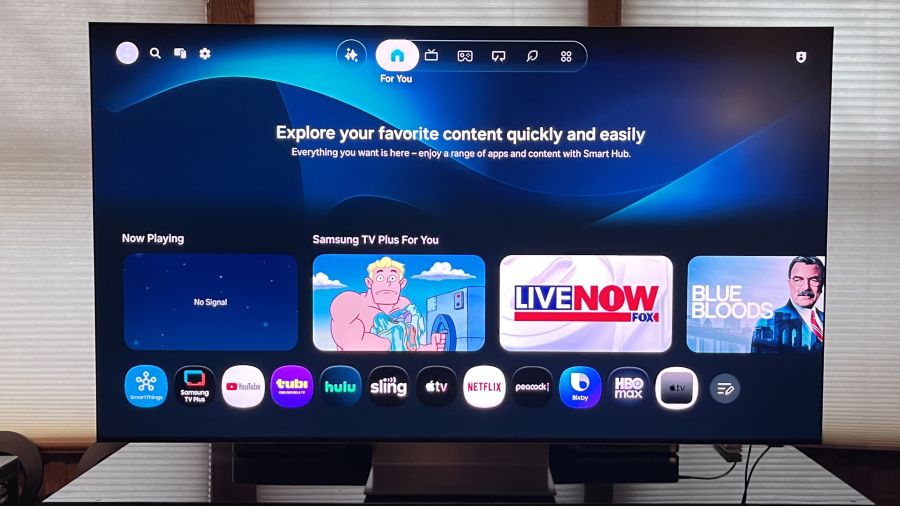
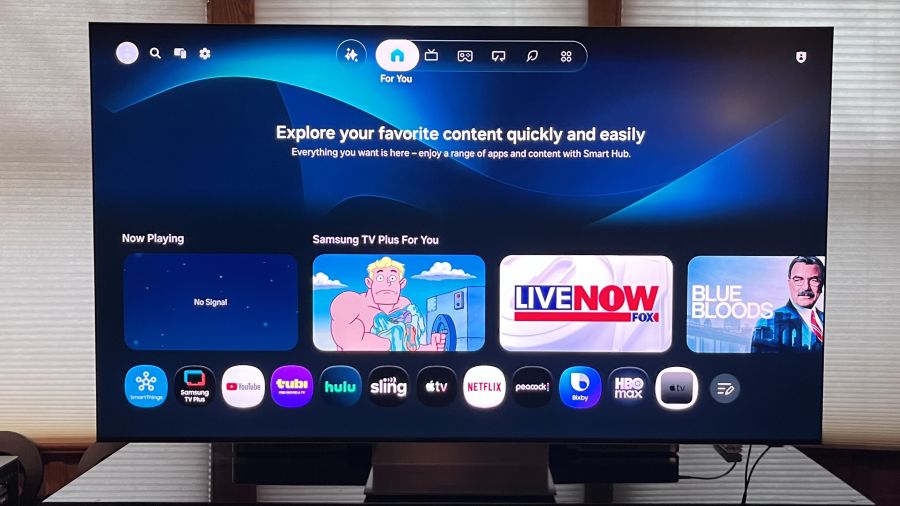
Samsung’s Tizen interface now features tabs at the top of the screen for a cleaner layout
What is it?
TheSamsung R95H is the top model in the company’s Micro RGB TV lineup, sitting above the Samsung R85H series. For 2026, Samsung also offers new Neo QLED models that use a standard mini-LED backlight, and its 2025 flagship Samsung QN90F Mini LED series carries over as well. Samsung R95H series TVs are available in 65, 75, and 85-inch screen sizes. Launch prices were $3,199.99, $4,499.99, and $6,499.99, respectively, though they have since dropped to $2,999.99, $4,299.99 and $5,999.99 (all MSRP; check retailers for current pricing).
Along with RGB backlighting, R95H series TVs include a Glare Free screen similar to the one found in the company’s 2025 flagship mini-LED and OLED models and the new Samsung S95H OLED TV. This provides a light-diffusing matte finish that’s very effective in eliminating screen reflections even when viewing in bright rooms with multiple lighting sources.
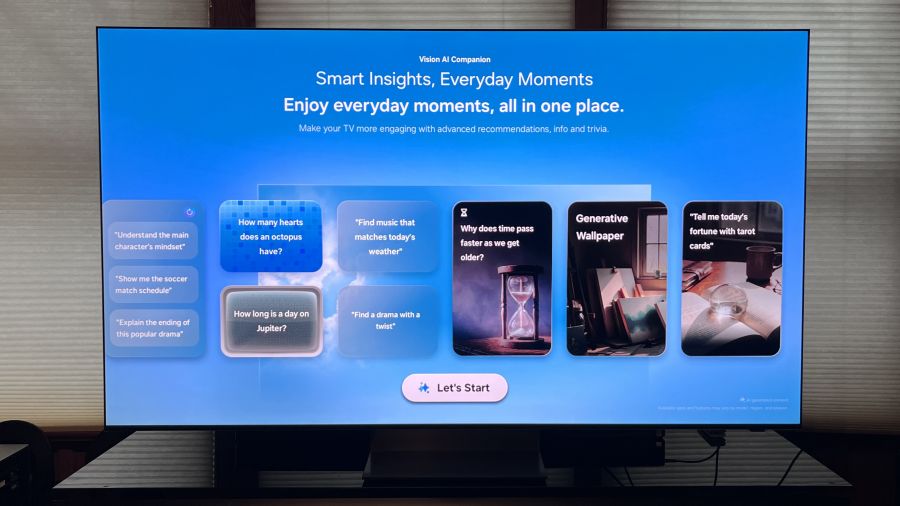
Samsung’s Vision AI Companion AI portal
Samsung’s Micro RGB AI Engine Pro processor uses AI to upconvert standard HD video to 4K resolution with enhanced color and expanded dynamic range. It also handles the backlight’s local dimming to improve contrast and black levels and reduce artifacts such as haloing and blooming. AI Motion Enhancer Pro works to eliminate motion blur in sports and movies with fast action, and there’s an AI Customization Mode that can intelligently optimize picture settings based on the type of content you’re viewing.
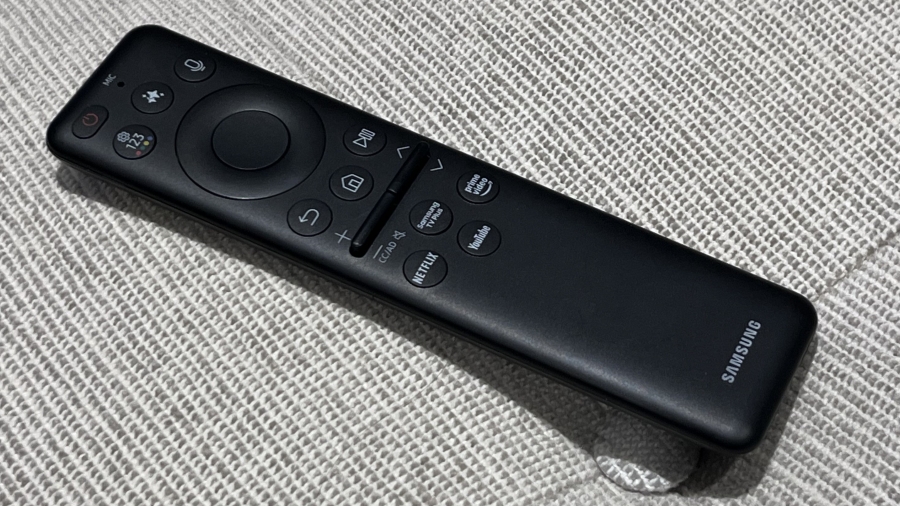
AI also gets top billing in Samsung’s updated Tizen Smart TV interface, which repositions tabs from the side to the top of the screen. The new layout is cleaner and more-user friendly, and it features a Vision AI Companion tab that lets you explore all manner of topics via Copilot or Perplexity using either the TV’s built-in far-field mic, or the one located in the TV’s Solar Cell Bluetooth remote control. The compact remote is small and only provides a limited number of controls, with the design reflecting Samsung’s emphasis on the Tizen interface, and voice commands in particular, for controlling most functions.
Advertisement
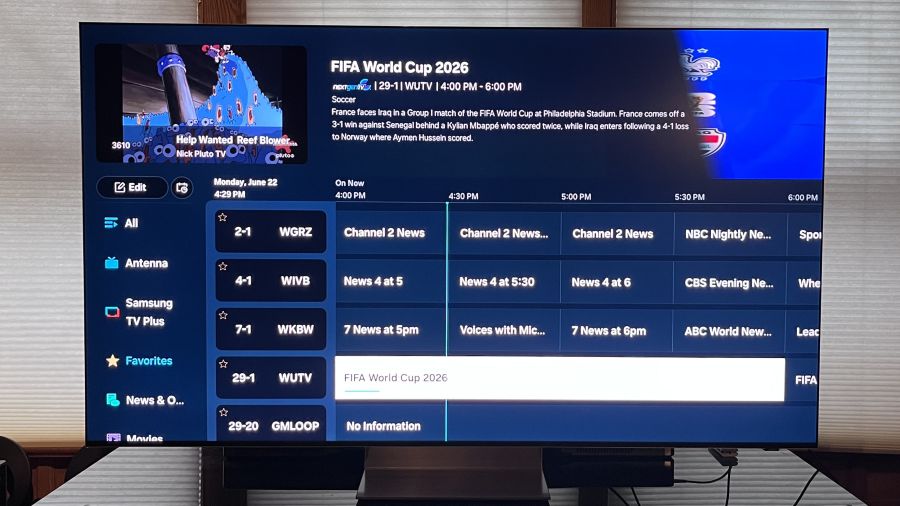
The Tizen Grid Guide allows you to browse free streaming and broadcast TV channels
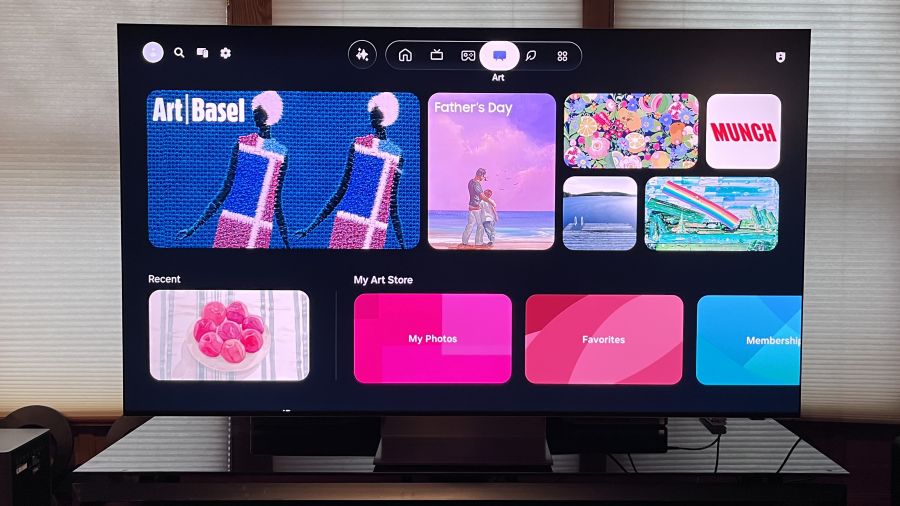
Other Tizen features include Generative Wallpaper for creating custom screensavers using AI, and access to the subscription-based Samsung Art Store that was previously limited to the company’s The Frame lifestyle TVs. Selecting the Live tab at the top of the screen presents an option to view a time-based grid guide for browsing Samsung TV Plus free streaming channels, and there’s also an option to display only local broadcast channels pulled in via a connected antenna. Unlike competitor LG, Samsung still includes an ATSC 3.0 (Next Gen TV) tuner on its flagship TVs (including the R95H) so you can tune in both ATSC 1.0 and ATSC 3.0 local OTA stations for free.
Gaming features on the R95H series include 4K/165Hz support, Freesync Premium Pro and HDR10+ gaming. Samsung’s Gaming Hub portal features Xbox, NVIDIA, GeForce Now, Luna, Blacknut, Antstream, Boosteroid and other cloud-based gaming apps, and it now also features personalized recommendations.
The Samsung Art Store allows you to download artsy screensavers. A $4.99/month subscription gives you full access to 5,000-plus images
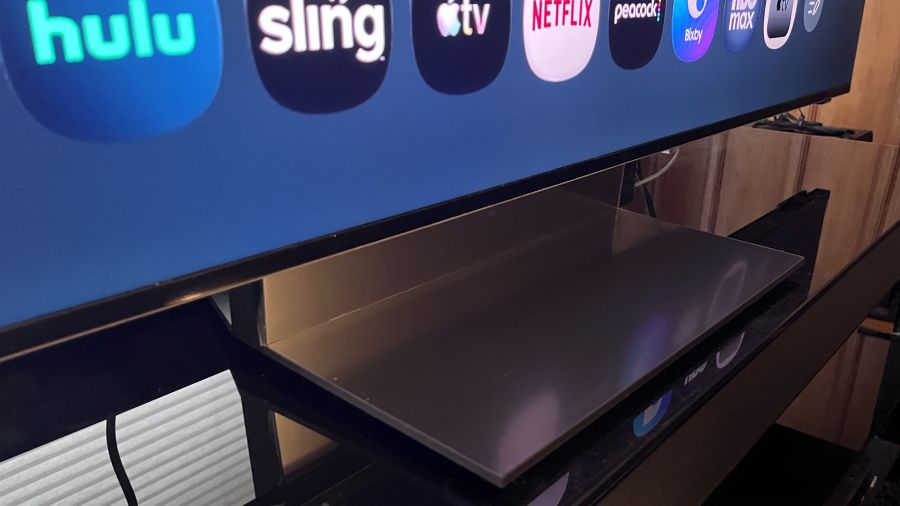
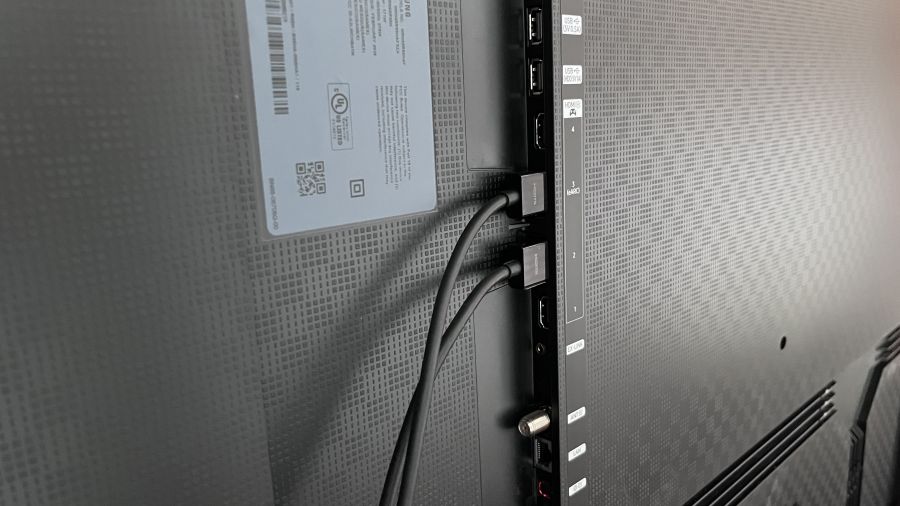
R95H series TVs feature a Space Graphite-colored Infinity Air stand that, combined with the four-side Bezel-less screen, gives the display a floating effect. Connections located on a side-mounted panel on the rear include four HDMI 2.1 ports, an optical digital audio output and an antenna input for the TV’s ATSC 3.0 tuner. Additionally, there are two USB type-A, Ethernet and Ex-Link (RS-232C) ports. The R95H is also Wireless One Connect Ready, which gives you the option for a wireless 165Hz connection using Samsung’s Wireless One Connect Box (not included).
On the audio front, a 4.2.2-channel speaker array powered by 70 Watts of on-board amplification delivers Dolby Atmos audio, Object Tracking Sound+ delivers precise positioning of sound effects to match the onscreen action and a Q-Symphony feature combines the TV’s speaker output with that of a compatible Samsung soundbar (if you’re into that). A new feature, Active Voice Amplifier Pro, taps the AI capabilities of the TV’s Micro RGB AI Engine Pro processor to identify voices in movie and TV soundtracks and amplifies them to enhance dialogue clarity.
The R95H’s Space Graphite-colored Infinity Air stand
Setup & Viewing Impressions
I used Portrait Display’s Calman Color Calibration software to run a basic set of measurements on the Samsung R95H. Aside from disabling the TV’s Brightness Optimization (located in the Power & Energy Saving menu) auto brightness feature, measurements were made using the default Filmmaker Mode and Standard picture presets.
Advertisement. Scroll to continue reading.
Peak HDR brightness measured on a white 10% window pattern in Filmmaker Mode was 2,039 nits and 642 nits on a 100% (fullscreen) white pattern. In Standard mode, the results on the same tests were 1,908 nits and 790 nits, respectively.
Advertisement
To give some perspective on those results, when I measured the Sony Bravia 7 II True RGB TV, peak HDR brightness was 1,800 nits for 10% and 701 nits (fullscreen). In Standard mode, the Sony results were 1,554 nits on a 10% pattern and 626 nits for fullscreen. Bottom line: Samsung’s flagship RGB TV has higher peak HDR brightness than the Sony (which, at $2,599 list for the 65-inch model, is a bit less expensive option than the Samsung).
In SDR (standard dynamic range) tests, the Samsung R95H measured 235 nits on a 10% pattern and 145 nits on a fullscreen pattern in Filmmaker Mode. In Standard mode, the results were 726 nits for 10% and 583 nits for fullscreen. Those Standard mode results are excellent, and they indicate that the R95H will be a great TV for daytime sports viewing.
For color measurements, the Samsung R95H’s color gamut coverage in Filmmaker Mode measured 93.3% for BT.2020 and 147.9% for DCI-P3 – both excellent results. Once again for comparison’s sake, the Sony BRAVIA 7 II’s BT.2020 color gamut coverage in Cinema Mode measured 88.5%.
In other measurements, the Samsung R95H’s Delta-E (the margin of error between the test pattern source and what’s displayed on-screen) in Filmmaker Mode averaged 6.2 for grayscale and 3.0 for color. That grayscale result is slightly higher than the 3.0 Delta-E considered to be the threshold for what’s indistinguishable from perfect to the human eye, though I was able to reduce it to 1.4 through calibration using the Samsung’s 2-point white balance adjustment. (A 20-point white balance adjustment is also available.)
Advertisement
The Samsung’s input lag, which I measured using a Bodnar 4K input lag meter with Game mode enabled, was 10.7ms. That’s a slightly higher level than previous Samsung TVs I’ve tested, though still it’s low compared to many other TVs.
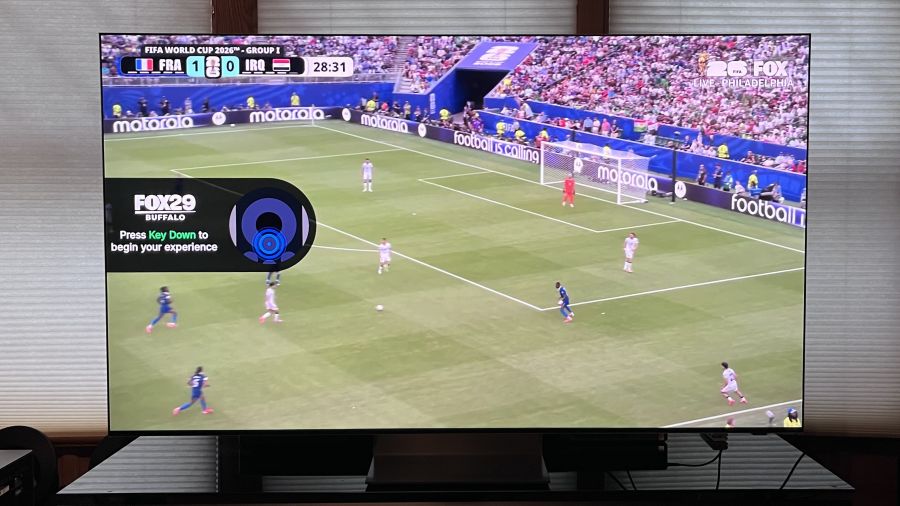
A World Cup Soccer game broadcast in ATSC 3.0.
As usual, I started out my subjective evaluation using the Spears & Munsil Ultra HD Benchmark disc played on an Oppo UDP-103 4K Blu-ray player. The disc’s dots pattern, which is used to test off-axis performance, revealed color and contrast to be impressively uniform when viewed at off-center seats. The starfield test clips showed the TV’s local dimming to be effective at all levels (there is no off setting for local dimming on the Samsung, so it is always active). I was surprised to see that the TV’s brightness uniformity was less impressive than its off-axis uniformity when viewing fullscreen gray patterns at various brightness levels, but that didn’t turn out to be an issue when viewing regular TV shows and movies.
Watching the disc’s demonstration reel, images of nature showed excellent contrast and rich color, and the picture was impressively clean and noise-free. There was also very minimal backlight blooming visible on the high-contrast images of animals and objects against a black background, and micro-contrast in the nighttime cityscapes was as good as I’ve seen on a non-OLED TV.
Watched on 4K Blu-ray, a scene from the James Bond film No Time to Die where 007 walks across a rocky hillside cemetery showed minimal judder and motion blur as the camera tracked his motion – not surprising given the combination of Samsung’s typically excellent motion processing and the TV’s high 165Hz refresh rate.
The four HDMI 2.1 ports on Samsung TVs provide advantages for gamers
The R95H’s impressive motion handling was also evident when I watched a Canada versus South Africa World Cup Soccer match broadcast via my local FOX TV network. The first half got off to a lively start, with both teams quickly turning over plays, and the Samsung Micro RGB rendered the ball as a consistently solid-looking circle as it traversed the field. New Samsung TVs for 2026 feature an AI Soccer Mode designed to specifically optimize the picture for soccer games, but I found that it made colors look neon-level bright and garish when active. The Standard picture mode looked better to me for sports, though it also made the faces of some players look overly pink. For sports, I ultimately settled on the Movie preset, which delivered a sufficiently bright picture with accurate-looking color.
Samsung’s Solar Cell Bluetooth remote control
With the more muted Movie preset active, the yellow and green uniforms of the South Africa team players still looked eye-catchingly vivid, and so did the red jerseys of the Canada team fans that seemed to constitute the bulk of the game’s audience. Importantly, the TV’s Glare Free screen was effective enough that turning on my room’s overhead lights didn’t impact picture quality at all while watching, and that extended to movies, which retained contrast and black detail during bright room viewing.
Stanley Kubrick’s 2001: A Space Odyssey is a movie that strongly benefitted from the 4K/HDR treatment it received when the 4K Blu-ray version was released back in 2018. Watching the “The Blue Danube” sequence where the space shuttle docks at the space station, the deep blacks of space and pinpoint lights of stars displayed powerful contrast on the Samsung R95H, and there was plenty of detail visible in the shots of earth and closeups of the space ships. Even more impressive knowing that this movie came out over a year before we landed on the moon and all of these effects of space and earth were done the old-fashioned way, with practical effects.
Advertisement
Advertisement. Scroll to continue reading.
Curious to see how the TV’s Auto HDR Remastering Pro feature would handle HDR upconversion, I switched that feature on and off while watching my regular Blu-ray disc version of 2001. While Samsung’s upconversion definitely made the picture brighter, with more powerful contrast, it also blew out highlight detail and made colors look oversaturated. It would have been helpful to have some type of control to vary the level of HDR remastering applied, but that feature sadly provides only on and off settings.
I would be remiss if I didn’t comment on how the R95H handled Season 3, episode 1, Salt and Sea, Fire and Blood, of the returning House of the Dragon on HBO Max. I found that the picture looked too dark in Filmmaker Mode, but switching to Movie mode and boosting the Shadow Detail slider a few notches in the Expert Settings menu went a long way to improve things. Roughly half of the episode is a protracted naval battle and, post-adjustment, the 4K/HDR picture looked considerably more immersive and 3D-like.
The Bottom Line
At its discounted $2,999.99 price, the 65-inch Samsung R95H is still expensive for a TV, even one with an advanced RGB backlight. But the R95H offers a number of advantages over its competition, and when you take those into account, it could easily sway your favor to this Samsung Micro RGB model when shopping for a new TV.
The most obvious advantage is Samsung’s extended color space coverage. At 93.3% for BT.2020, that’s about as good as new TVs get, and it easily exceeds that of flagship OLED TVs on the market, Samsung’s S95H included. The R95H is also impressively bright for both HDR and SDR viewing, and its Glare Free screen makes it a strong option for viewing in bright rooms.
Advertisement
Samsung’s Tizen is superior to most other smart TV platforms, including Google TV, in my opinion, even if you don’t bother to take advantage of its powerful new AI features or the category-leading Samsung Art Store. The R95H is also an exceptional gaming TV, with 4K/165Hz support across its four HDMI 2.1 ports and Samsung’s Gaming Hub portal for cloud-based gaming.
Where the R95H could be considered to fall short is its lack of support for the forthcoming Dolby Vision 2 format, but then again, Samsung never supported Dolby Vision HDR in the first place, choosing the open HDR10+ dynamic HDR standard instead. The bottom line is that the Samsung R95H is an excellent overall TV with a fantastic picture and great features – it easily lives up to the RGB hype.
Amazon Web Services is committing $1bn to embed its own engineers inside customer companies. It is the first cloud giant to copy a playbook that Palantir built and that OpenAI and Anthropic have since adopted.
Amazon Web Services said on June 30, 2026 that it would pour $1bn into a new Forward Deployed Engineering unit. The team’s job is to help customers build and run artificial intelligence systems.
Francessca Vasquez, the company’s vice-president of frontier AI engineering and services, set out the plan in an interview with CNBC. Her pitch came down to one word: speed.
A forward-deployed engineer, or FDE, is a technical specialist who works from inside a client’s business rather than from the vendor’s own offices. Palantir coined the term more than a decade ago. The idea has since spread to software firms that want faster adoption of their tools, and it now sits at the centre of the race to sell enterprise AI.
Advertisement
What AWS is actually building
The new unit will start with what AWS calls “thousands” of engineers. It will send them out in small pods, each with five or six people, embedded inside a single customer at a time. Those engineers will also work alongside AI agents, the software tools that can carry out tasks on their own.
The 💜 of EU tech
The latest rumblings from the EU tech scene, a story from our wise ol’ founder Boris, and some questionable AI art. It’s free, every week, in your inbox. Sign up now!
The pods are meant to move fast. AWS said in a blog post that its engineers would sit with a customer’s business, engineering, and security teams, then hand back a self-sufficient team within weeks.
Advertisement
“The currency that the customers are always talking about right now is speed,” Vasquez said. She added that the model suits firms chasing quick returns for their executives and stakeholders.
Vasquez framed the launch as a step change rather than a brand-new skill. “We’ve had capabilities over the years, but structurally this is like getting everybody together in one business unit with a common rubric of deployment,” she said. “It’s the first time we’re doing it in that way.”
Copying a model OpenAI and Anthropic already chose
AWS is late to a party its own partners started. In May 2026, Anthropic set up an AI services company with Blackstone, Hellman & Friedman, and Goldman Sachs to help mid-sized firms roll out its Claude models. Days later, OpenAI launched its deployment company with TPG, Advent International, Bain Capital, and Brookfield, among others.
Those rivals built their deployment arms as joint ventures, leaning on outside investors and consulting partners. AWS is taking a different route. It is funding the unit from its own balance sheet, with no partner firms attached. Google has made its own move too, with a $750mn partner fund aimed at agentic AI deployments.
Advertisement
Amazon has spent billions of dollars backing both Anthropic and OpenAI. It has also been clear about competing with them directly in places. An AWS spokesperson said the company still expected to work with the FDE arms of both labs, and promised more detail on its partner programmes soon. AWS has separately agreed to sell OpenAI’s models after Microsoft’s exclusivity lapsed.
Why a cloud giant wants bodies on the ground
The logic is about adoption, not headcount for its own sake. Companies have bought plenty of AI tools. Many have struggled to turn them into working systems. By placing engineers inside the customer, AWS hopes to close that gap and tie clients deeper into its cloud.
The move also shows how AWS plans to defend its lead. Amazon is the biggest cloud provider by revenue, and it is the first hyperscaler to commit to an FDE unit at this scale. The bet is that hands-on help, not just cheaper compute, will decide who wins enterprise AI. Amazon has also pushed customers toward cheaper AI options as model costs climb.
Not everyone will read the spend as a sure thing. Investors have grown wary of the huge sums flowing into AI, and they keep asking when the returns will land. A $1bn unit staffed by costly engineers adds to that bill. AWS is betting the outlay pays for itself in stickier, larger cloud contracts. The proof will sit in next year’s numbers, not in the launch.
Advertisement
There is a hiring story here as well. AWS wants thousands of engineers for the unit at a time when AI is eating into entry-level work. The roles it is creating are senior, client-facing, and hard to automate. That is a notable contrast with the junior jobs the same technology is removing.
The customers already signed up
AWS named several early adopters. They include the Allen Institute, the National Basketball Association, the National Football League, and Ricoh. Vasquez said the next wave would come from heavily regulated industries that hold large, varied datasets. Those are the firms with the most to gain from faster deployment, and the most to lose from getting AI wrong.
For now, the move sharpens a question hanging over the whole sector. Businesses have spent heavily on AI and seen patchy results. Whoever turns that spending into working systems fastest will pull ahead. AWS has just bet $1bn that the answer is people, sent to sit at the customer’s desk.
American insurance giant Aflac has disclosed a new data breach after attackers breached its Japan subsidiary’s systems and stole personal and bank account information.
Aflac (short for American Family Life Assurance Company) is a Fortune 500 company and the largest supplemental insurance provider in the United States, serving millions of customers in the U.S. and Japan.
“On June 30, 2026, Aflac Life Insurance Japan Ltd. (“Aflac Japan”), a wholly owned subsidiary of Aflac Incorporated, a Georgia corporation (the “Company”), issued a press release announcing that, on June 25, 2026, Aflac Japan discovered an unauthorized third-party had unlawfully accessed certain of Aflac Japan’s systems between June 15, 2026 and June 25, 2026,” the insurance company said.
“Upon identifying the unlawful access, Aflac Japan promptly took steps designed to contain the incident and prevent further intrusion, including suspending certain systems. Notwithstanding the suspension of certain systems, Aflac Japan continues to serve its policyholders as it responds to this incident.”
Advertisement
Aflac is now investigating the incident with the help of external cybersecurity experts and has revealed that the threat actors have gained access to some sensitive information stored on the affected systems.
The company has alerted Japanese authorities to the incident and will notify affected individuals of the data breach.
“Although the investigation remains ongoing, Aflac Japan has determined that certain impacted files contain policy and coverage details, personal information, and bank account information. Aflac Japan has notified the Japan Financial Services Agency and other relevant authorities, and intends to provide appropriate notifications to individuals affected by this incident.
“This incident is limited to systems in Japan, the Company’s systems related to its U.S. business were not accessed by the unauthorized third-party. At this time, the full scope and potential ultimate impact on the Company are not known.”
Advertisement
An Aflac spokesperson was not immediately available for comment when contacted by BleepingComputer earlier today.
One year ago, Aflac disclosed another data breach amid a broader campaign targeting insurance companies across the United States, saying that the attackers may have gained access to documents containing sensitive information about customers, beneficiaries, employees, agents, and other individuals.
While Aflac didn’t attribute last year’s breach to a specific threat group, the incident had all the signs of a Scattered Spider attack.
A malicious extension in the Chrome Web Store is masquerading as the Perplexity AI answer engine, intercepting search traffic and collecting browsing information.
Called “Search for perplexity ai,” the extension routed search queries and real-time suggestions through its infrastructure before redirecting users to the legitimate search services.
Microsoft Threat Intelligence researchers said that the extension did not steal credentials or other sensitive information but its permissions would easily allow it if the operator decided to extend the scope of the data theft.
Fake Perplexity AI extension
Perplexity AI is a research assistant that searches the web and synthesizes the information in a direct, conversational response instead of showing a list of links for the user to access to find their answer.
Perplexity AI is available on the web, on mobile (Android and iOS), and as a desktop app, and its official Chrome extension is named “Perplexity – AI Search.”
Advertisement
The fake extension that Microsoft spotted uses similar branding and the domain “perplexity-ai[.]online,” instead of the legitimate perplexity.ai.
Post-installation onboarding page Source: Microsoft
Once installed, it changes the browser’s search settings to replace the default search provider and to pass all address-bar queries through the attacker’s infrastructure.
“The extension overrides browser search settings through chrome_settings_overrides to replace the browser default search provider as well as intercept and redirect all queries in a Chromium browser’s Omnibox to an intermediary infrastructure not associated with the official vendor domain,” explains Microsoft.
This level of data collection is not accidental, based on the logging code Microsoft found on the extension’s server, which indicates intentional design.
The extension also requests Chrome permissions that allow redirections, URL rewriting, and monitoring when rules execute.
Advertisement
“The extension requests powerful DNR permissions that enable traffic redirection, URL rewriting, and selective request filtering, which aren’t consistent with expected AI assistant behavior,” the researchers mention.
Even though Microsoft found no evidence that the extension targeted credentials, its confirmed data collection routines still allowed for extensive profiling, creating potential avenues for exploitation.
Those who installed the extension with the ID “flkebkiofojicogddingbdmcmkpbplcd” should remove it from their browser and rotate their critical account passwords out of an abundance of caution.
Security teams log 54% of successful attacks and alert on just 14%. The rest move through your environment unseen.
The Picus whitepaper shows how breach and attack simulation tests your SIEM and EDR rules so threats stop slipping by detection.


































































You must be logged in to post a comment Login