Security teams log 54% of successful attacks and alert on just 14%. The rest move through your environment unseen.
The Picus whitepaper shows how breach and attack simulation tests your SIEM and EDR rules so threats stop slipping by detection.




A malicious extension in the Chrome Web Store is masquerading as the Perplexity AI answer engine, intercepting search traffic and collecting browsing information.
Called “Search for perplexity ai,” the extension routed search queries and real-time suggestions through its infrastructure before redirecting users to the legitimate search services.
Microsoft Threat Intelligence researchers said that the extension did not steal credentials or other sensitive information but its permissions would easily allow it if the operator decided to extend the scope of the data theft.

Perplexity AI is a research assistant that searches the web and synthesizes the information in a direct, conversational response instead of showing a list of links for the user to access to find their answer.
Perplexity AI is available on the web, on mobile (Android and iOS), and as a desktop app, and its official Chrome extension is named “Perplexity – AI Search.”
The fake extension that Microsoft spotted uses similar branding and the domain “perplexity-ai[.]online,” instead of the legitimate perplexity.ai.

Once installed, it changes the browser’s search settings to replace the default search provider and to pass all address-bar queries through the attacker’s infrastructure.
“The extension overrides browser search settings through chrome_settings_overrides to replace the browser default search provider as well as intercept and redirect all queries in a Chromium browser’s Omnibox to an intermediary infrastructure not associated with the official vendor domain,” explains Microsoft.
This level of data collection is not accidental, based on the logging code Microsoft found on the extension’s server, which indicates intentional design.
The extension also requests Chrome permissions that allow redirections, URL rewriting, and monitoring when rules execute.
“The extension requests powerful DNR permissions that enable traffic redirection, URL rewriting, and selective request filtering, which aren’t consistent with expected AI assistant behavior,” the researchers mention.
Even though Microsoft found no evidence that the extension targeted credentials, its confirmed data collection routines still allowed for extensive profiling, creating potential avenues for exploitation.
Those who installed the extension with the ID “flkebkiofojicogddingbdmcmkpbplcd” should remove it from their browser and rotate their critical account passwords out of an abundance of caution.

Security teams log 54% of successful attacks and alert on just 14%. The rest move through your environment unseen.
The Picus whitepaper shows how breach and attack simulation tests your SIEM and EDR rules so threats stop slipping by detection.

Ukraine’s drone program has become one of the most closely watched defense innovations of the current war, drawing global attention.
Analysts now argue that Washington is seeking direct access to that technology’s intellectual property rather than a formal partnership agreement.
Some experts compare the approach to how China previously extracted proprietary aerospace knowledge from Boeing through joint manufacturing deals years ago.
Latest Videos FromTechRadar
Ukraine’s drone ecosystem stands out not merely for its hardware, but for its software integration and battlefield resilience against jamming.
American systems have often struggled in contested electronic environments, while Ukrainian drones evolved rapidly against Russian electronic warfare tactics.
The Pentagon reportedly wants Ukraine’s AI-assisted terminal guidance, which lets drones strike objectives autonomously even after losing operator control.
Washington is also said to be interested in navigation systems capable of functioning reliably within GPS-denied combat environments overseas and abroad.
Kyiv has meanwhile launched a multi-year cooperative program involving nearly 20 countries, aimed at expanding defense capabilities through drone technology.
As of June 9, six agreements had already been signed, with additional contracts still in preparation.
Volodymyr Zelenskyy, the president of Ukraine, claims the framework will include at least 10 contracts covering weapons exports, co-production, and new technology development.
In March, Ukraine sent interceptor drones and a team of specialists to help defend American military bases located in Jordan.
The Pentagon later announced in May that U.S. personnel would travel to Ukraine to study combat drone operations firsthand on site.
Ukrainian drone strikes have been reportedly effective against Russian oil infrastructure, affecting 40% of its export capacity.
Unverified reports claim that these strikes pushed oil prices towards a near $100 per barrel spike back in March.
According to Zelenskyy, Washington is not comfortable with rising oil prices, and this is why it has been in quiet talks with Moscow.
American and Ukrainian defence industries currently follow contrasting manufacturing approaches despite pursuing similar objectives around autonomous military capability and battlefield effectiveness.
The United States typically produces a relatively limited number of expensive defence platforms built for precision rather than volume.
Ukraine, by contrast, has expanded decentralised manufacturing capable of producing hundreds of thousands of affordable FPV and long-range strike drones annually.
The recent conflict involving Iran appears to have taught Washington that sheer volume can matter as much as precision on today’s battlefield.
It simply does not make financial sense for 50 $10,000 drones to bring down a single $50 million fighter jet; therefore, the Ukraine route now seems as important for the U.S.
The U.S. is now demanding access to intellectual property rights covering Ukrainian drone technologies.
This would allow the United States to secure valuable Ukrainian technological advances without expanding formal commitments connected to Ukraine’s wartime operations.
The US will be able to manufacture comparable systems domestically while retaining greater control over supply chains and industrial capacity.
Analysts argue that legal ownership of those IP rights would permit future modification, replication, and scaling without continuous Ukrainian involvement or approval.
Even so…American manufacturers could still require Ukrainian production facilities, since wartime experience has produced a manufacturing speed that existing U.S. procurement systems may struggle to match.
“The question hanging over Washington is no longer whether Ukrainian drone technology is vital to U.S. national security, but how much control over that technology the U.S. can successfully extract,” an analyst said
Via DSM

Follow TechRadar on Google News and add us as a preferred source to get our expert news, reviews, and opinion in your feeds.


The Commission hopes to unlock at least €30bn in collective public and private funding.
The EU is pushing forward with its plans to become the “AI continent” with a fresh call for tenders to set up seven AI Gigafactories across the bloc.
The initiative is expected to help the EU develop advanced AI on its own infrastructure in line with the bloc’s rules and standards around model safety.
The Commission today (30 July) said it is setting aside $10bn in EU and national funding, and hopes to tap at least $20bn from the private sector.
Interested consortia or Special Purpose Vehicles (legal entities) have until 12 November to make their bid. Awards will be announced in early 2027, the EU authority said.
The fresh call comes as the EU ramps up efforts to compete with the US in the AI space.
The additional compute capacity is expected to give European enterprises, academia and public authorities access to the infrastructure needed to train and fine-tune advanced AI models. The bloc has an existing network of 19 AI Factories.
Funding is divided into into two consecutive development phases across two lots, with the 18 participating member states, including Ireland, Germany, France and Sweden, matching EU funding, the Commission said.
The first lot of the initiative will support four AI Gigafactories, with each one eligible to receive as much as €100m in EU funding in the first phase, and up to €400m in the second.
A second lot will support three projects, with each receiving up to €200m from the bloc to begin with, and up to €800m per project in a second phase.
Selected AI Gigafactories are expected to begin operations within 18 months after the consortia makes a successful bid.
The EU’s AI Continent action plan, announced in April last year, is a wide-ranging initiative to transform Europe’s strong traditional industries and its talent pool into “powerful engines of AI innovation and acceleration”.
“The opening of the AI Gigafactories call represents a milestone in our AI Continent ambitions. Access to the raw scale of computing power within AI Gigafactories is a strategic necessity for Europe as AI development accelerates,” said EU executive vice-president for tech sovereignty, security and democracy Henna Virkkunen.
“I am pleased to see member states, industry and the Commission coming together to work on these facilities that are key to our technological sovereignty.”
Don’t miss out on the knowledge you need to succeed. Sign up for the Daily Brief, Silicon Republic’s digest of need-to-know sci-tech news.

This year’s Gen Con is being held in Indianapolis July 30 through Aug. 2. In advance of the show, one of the biggest events on the calendar for North America’s tabletop gaming community, Wizards of the Coast invited press to take an early look at its scheduled announcements for the Dungeons & Dragons roleplaying game.
Wizards, headquartered in Renton, Wash., has published D&D since 1997, and has presided over the game’s meteoric rise in the last decade. Despite renewed competition and several unforced errors, D&D remains the single most popular game in the tabletop roleplaying space, to the point where it’s still often considered synonymous with the hobby as a whole.
In the next year, Wizards’ plans for D&D include a major brand revival, a substantial overhaul to its D&D Beyond online toolset, and a new publishing initiative that promises new and upcoming projects from several of D&D’s classic creators.
What might get the most attention from outside the hobby, however, is a new series of expansions for D&D that will be published under the banner of “Universes Beyond.” The first book for UB, coming on Nov. 17, is a D&D sourcebook based on Blizzard Entertainment’s long-running MMORPG World of Warcraft.
Co-created by long-time D&D designer (and WoW player) James Wyatt, the WoW sourcebook is designed to let players bring the characters, factions, and setting of WoW directly into D&D’s mechanics, with material that spans everything from the earliest days of the MMO to its most recent expansion, Midnight.
Warcraft began in 1994 as a real-time strategy franchise, built around a fantasy kingdom of humans and elves that was abruptly invaded by orcs from another world. The original Warcraft was essentially a fan production for the Warhammer Fantasy universe, but ended up becoming its own original IP.
Warcraft eventually branched out into the nascent MMORPG genre with 2004’s World of Warcraft, which rapidly became a smash hit and is still one of the most popular online games in the current market. WoW has evolved from its original dark fantasy roots into a sort of interplanetary space opera. Its current story arc, the “Worldsoul Saga,” involves the struggle to protect the world of Azeroth from the void priestess who’s out to corrupt it.

This includes D&D versions of trademark WoW species like tauren, dracthyr, earthen, and pandaren; multiple instances from WoW that have been translated into D&D-style dungeon crawls, including a high-level campaign set in Icecrown Citadel; and new D&D subclasses based on character options from WoW, such as death knights, shadow priests, and demon hunters.
This is technically the second time someone’s made Warcraft into a tabletop game, following Sword & Sorcery Studios’ 2003 Warcraft: The Roleplaying Game. According to Wyatt, Wizards’ 2026 book has little to do with that previous publication.
The Warcraft RPG was compatible with 3rd edition D&D but was meant as a standalone product, so it had to spend a lot of its word count on setting up the game’s rules. Wizards’ 2026 World of Warcraft book is an official release for D&D, so it can refer players to the core D&D books for its rules and save its space for more setting details.
The World of Warcraft Universes Beyond book is the first planned entry in what’s intended as an ongoing series of expansions. In the words of D&D franchise head Dan Ayoub, this will extend “Dungeons & Dragons into even more worlds we love.” Exactly which worlds those might be, however, has yet to be announced.

Other D&D announcements from Gen Con 2026 include:
One of D&D’s classic settings is coming back in 2027. Dark Sun was originally published in 1991 as a dark, post-apocalyptic take on D&D, taking place on a dying desert world ruled by crazed sorcerer-kings. Wizards’ revival of the setting will be the first official Dark Sun material since 2010, and will be the first Wizards of the Coast product to ship with a mature content warning.
D&D executive producer Greg Bilsland introduced a new initiative he called “Annual Setting Support,” where Wizards will partner with other publishers for yearly new releases to provide additional material for D&D‘s various ongoing campaign settings. 2027 will see a new Ravenloft book made by the Australian company Ghostfire Gaming (Grim Hollow); more Eberron material from Visionary Productions in Canada; and a Forgotten Realms sourcebook by Kirkland, Wash.-based Kobold Press.
Wizards has hired actor and high-profile D&D fan Joe Manganiello (Justice League, Magic Mike) as the creative director for D&D Icons. This new “content program” marks the return of several classic creators to D&D, such as Margaret Weis, Tracy Hickman, and R.A. Salvatore. (Not that Salvatore’s ever exactly left, since he’s been putting out new Drizzt Do’Urden novels almost annually since the 1980s, but you get the idea.)
Luke Gygax is working to finish a project left behind by his late father, Gary Gygax, one of the original co-creators of D&D. The result will be published under the Icons banner, and promises that Luke will “complete an adventure through his father’s eyes.” The result is tentatively planned for publication next year.
2027 will see the release of a new adventure in D&D’s original setting of Greyhawk. Crown of the Witch Queen pits players against the vampire warrior Drelnza, last seen in the classic adventure The Lost Caverns of Tsojcanth, as “she seeks to claim her birthright.”
The forthcoming video game Warlock: Dungeons & Dragons features a vocal performance from Maggie Robertson (Lady Dimitrescu from Resident Evil Village). Robertson voices one of the oldest signature characters in D&D, the archmage Tasha. A first look at Warlock’s gameplay is planned for Aug. 25 as part of the Gamescom conference in Germany.
D&D Beyond plans to revise its mobile experience, which will make it “easier and more intuitive to play D&D your way,” with your phone or tablet as an unobtrusive tool. It can be helpful to keep a browser window open while you play D&D, to look up rules on the fly, and the goal of this new Beyond is to make that process as painless as possible.
Beyond also has a new “Looking for Group” feature in the works, which is designed to help D&D players find people to play the game with, whether it’s locally, virtually, or by hiring professionals to run D&D for them. (The “paid Dungeon Master” has become a genuine thing in recent years. I know. It feels weird to me, too.)

The Samsung surge continues. The company confirmed on its earnings call this week that it will launch the Galaxy S26 FE phone and Tab S12 Android tablet later this year. The announcement comes a week after a Galaxy Unpacked event in London, where Samsung introduced the eighth-generation Galaxy Z foldable phones and new smartwatches.
The Galaxy S26 FE phone will be the final model of Samsung’s S26 series, which includes the Galaxy S26 Ultra, S26 Plus and S26. The Tab S12 will be the flagship of the next Galaxy tablet series.
The S26 FE phone could launch in August or September, and the Tab S12 tablet might come out in September or October, according to reports.
Read more: Samsung Expects the Chip Shortage to Get Worse Before It Gets Better
Samsung typically unveils several devices each year across product categories and prices. At its July Unpacked, the Seoul-based giant launched the Galaxy Z Fold 8 Ultra, Galaxy Z Fold 8, Galaxy Z Flip 8, Galaxy Watch Ultra 2 and Galaxy Watch 9. These phones and watches are now available for preorder.
Putting the S26 FE phone on sale will help the company “maintain S26 momentum,” said Daniel Araujo, head of Samsung’s strategic planning group for mobile experience. He also said on the earnings call that the company saw increased smartphone sales in the second quarter of the year, led by the S26 models.
Araujo confirmed that the Tab S12 tablet would go on sale in the second half of 2026, along with the new foldable phones and Watch Ultra 2.
A significant amount of information has been leaked about the design and specs of the S26 FE. Samsung news site SamMobile says the phone could have an Exynos 2500 chip — Samsung’s advanced mobile processor for powerful AI and high-end graphics — as well as the Android 17-based One UI 9 for the software interface.
SamMobile reports that the screen will be the same as the S25 FE, at 6.7 inches. There could be three cameras, a 4,900 mAh battery — good for an entire day after a full charge — and 45-watt wired charging. Prices could be around $800, and the product could go on sale in August or September.
As for the Tab S12, tech site Android Police reported there may be only two tablets in the series — the Galaxy Tab S12 Ultra and the Galaxy Tab S12 Plus — with no base model.
The Plus version could have a 12.4-inch Dynamic AMOLED 2X display, a Dimensity 9500 chip with 12GB RAM, up to 512GB storage and a 10,500mAh-plus battery.
A Samsung representative did not immediately respond to a request for comment.
Read more: How to Nab Samsung’s New Galaxy Foldables for Less
Despite industry-wide price hikes and intensifying competition — such as Apple’s widely rumored iPhone foldable coming this fall — Samsung consistently distinguishes itself from rivals, says CNET reporter and video producer Abrar Al-Heeti.
“Samsung was a pioneer in the foldable phones market and continues to be a leader there, and its display innovations always stir up a lot of hype at tech events and launches,” Al-Heeti said.
Al-Heeti said the Unpacked event, which she covered for CNET, was another example of Samsung trying to keep one step ahead of the competition, especially with Apple’s foldable looming on the horizon.
“Samsung decided to debut its own 4:3 foldable, the Z Fold 8, which is garnering plenty of buzz and earning several positive reviews,” she said.


Looking for a different day?
A new NYT Strands puzzle appears at midnight each day for your time zone – which means that some people are always playing ‘today’s game’ while others are playing ‘yesterday’s’. If you’re looking for Thursday’s puzzle instead then click here: NYT Strands hints and answers for Thursday, July 30 (game #879).
Strands is the NYT’s latest word game after the likes of Wordle, Spelling Bee and Connections – and it’s great fun. It can be difficult, though, so read on for my Strands hints.
Want more word-based fun? Then check out my NYT Connections today and Quordle today pages for hints and answers for those games, and Marc’s Wordle today page for the original viral word game.
SPOILER WARNING: Information about NYT Strands today is below, so don’t read on if you don’t want to know the answers.
Latest Videos FromTechRadar
• Today’s NYT Strands theme is… Summer sign
Play any of these words to unlock the in-game hints system.
• Spangram has 10 letters
• First side: left, 1st row
• Last side: right, 5th row
Right, the answers are below, so DO NOT SCROLL ANY FURTHER IF YOU DON’T WANT TO SEE THEM.

The answers to today’s Strands, game #880, are…
It took me far too long to understand that today’s words were about astrology.
My first word of CHARMING seemed to have nothing to do with the summer and so it continued until I realized that BOSSY, LOYAL and GENEROUS had nothing to do with the season and a lot to do with personality — and in particular the (supposed) personality of a LEO.
Strands is the NYT’s not-so-new-any-more word game, following Wordle and Connections. It’s now a fully fledged member of the NYT’s games stable that has been running for a year and which can be played on the NYT Games site on desktop or mobile.
I’ve got a full guide to how to play NYT Strands, complete with tips for solving it, so check that out if you’re struggling to beat it each day.

BYD sells more electric cars than anyone. Next month, it wants to sell you one using a robot.
China’s biggest EV maker will unveil its first humanoid robot in August, at its Di Space experience centres in Zhengzhou, the company told the South China Morning Post. It will be a working prototype, not a concept, and it will mingle with visitors.
The robot reportedly has a name and a job. According to Chinese outlet KrASIA, citing a since-deleted BYD post, it is called “Xiao Di,” a service humanoid that stands 1.61 metres, weighs 58.5kg and can translate between six Chinese dialects and six foreign languages in real time. BYD has not officially confirmed the specs.
The plan starts in the showroom. Executive vice-president Stella Li wants two or three robots in every BYD store, greeting customers and explaining cars. She insists they will assist human staff, not replace them.

The 💜 of EU tech
The latest rumblings from the EU tech scene, a story from our wise ol’ founder Boris, and some questionable AI art. It’s free, every week, in your inbox. Sign up now!
From there, the ambition widens: supermarkets, malls and warehouses in the medium term, and eventually homes, doing the cleaning, cooking and companionship. BYD says it will build an open platform that makes both its own robots and models co-developed with others.
Its pitch is manufacturing. BYD already builds its own batteries, motors and electronics at huge scale, and Li argues cars and robots share the same roots. That, in theory, lets it build robots more cheaply than a standalone startup can.
BYD is not early. It is late. Tesla’s Optimus is the headline rival, but China’s carmakers are swarming in. Xpeng is trialling its Iron robot, Li Auto is exploring designs, and Chery’s Aimoga is already selling to consumers.
The backdrop is a humanoid boom. China made about 20,000 humanoids in 2025 and more than 40,000 in the first half of 2026 alone, with the government pushing for far more. Some forecasts stretch to tens of millions of robot workers within a decade.
There is a reason for the robot rush, and it is not entirely rosy. BYD’s car business is under strain, with first-half sales down about 16% amid China’s brutal price war. A new growth story is welcome.
But a slick demo is not a business. Investors still have no price, no production timeline and no paid deployments to judge. BYD has also denied separate reports of a factory robot line, so much remains unconfirmed.
And the overseas door is closing. The move lands just as the US moves to bar imports of Chinese robots, which could keep Xiao Di out of one of its biggest potential markets. For now, BYD’s robot has one job: sell cars, in China, from a showroom floor.

Viaim RecDot
MSRP $199.00

“The Viaim RecDot’s are the perfect balance between great sound and AI transcription”
Pros
Cons
The Viaim RecDot grabbed my attention because they offer a truly unique feature to wireless earbuds. Rather than chase the best possible sound or the best noise cancellation, they’re built to capture, transcribe, and summarize everything you hear. Simply hit the record button (located on the case) and choose a record mode to turn calls, lectures, and in-person meetings into searchable transcripts. The Viaim app’s AI then gives you summaries and to-do lists within seconds. If you spend your day in back-to-back conversations and are ok giving up your AirPods, then the RecDot can be a very helpful companion.
The Viaim RecDot is a decent set of earbuds in their own right. The 11mm titanium-coated drivers produce fairly good, detailed, balanced sound that produces great vocals and acoustic tracks, and battery life runs up to nine hours per charge, or 36 with the case. Calls came through clearly for me in most calls, and the recording and transcription features are fast and dependable. Translation covers more than a dozen languages, and the whole system is easy to live with once you accept that the app is doing most of the work.
On the other hand, they’re not perfect. Noise cancellation is good, not great, and bass gets muddy on some deep house or hip-hop tracks. The build feels plasticky, and at full price they sit uncomfortably close to more polished all-rounders from Apple, Soundcore and Samsung. But if your main goal is capturing and organizing what’s said around you, the RecDot does it very well. For the right buyer, these are a great choice that I would recommend.
| Product | Viaim RecDot AI Recording True Wireless Earbuds |
| Drivers | 11mm titanium-coated dynamic drivers |
| Bluetooth | Bluetooth 5.2, multipoint (dual pairing) |
| Codecs | AAC (manufacturer does not detail full codec list) |
| Noise cancellation | Smart ANC, rated up to 48dB reduction; auto/low/mid/high modes |
| Battery life | Up to 9 hours (buds); up to 36 hours with charging case |
| Charging | USB-C and wireless charging |
| Water resistance | IPX5 |
| Weight | ~4.9 g per earbud |
| Eartips | 5 sizes included, with in-app fit test |
| AI features | Real-time transcription, summaries, to-do lists, mind-map, translation (14+ languages); 600 free minutes/month, 1800 minutes for $9.99/month and unlimited minutes for $19.99/month |
| Price | $249.99 MSRP (frequently $179–$219 at retail as of July 2026) |
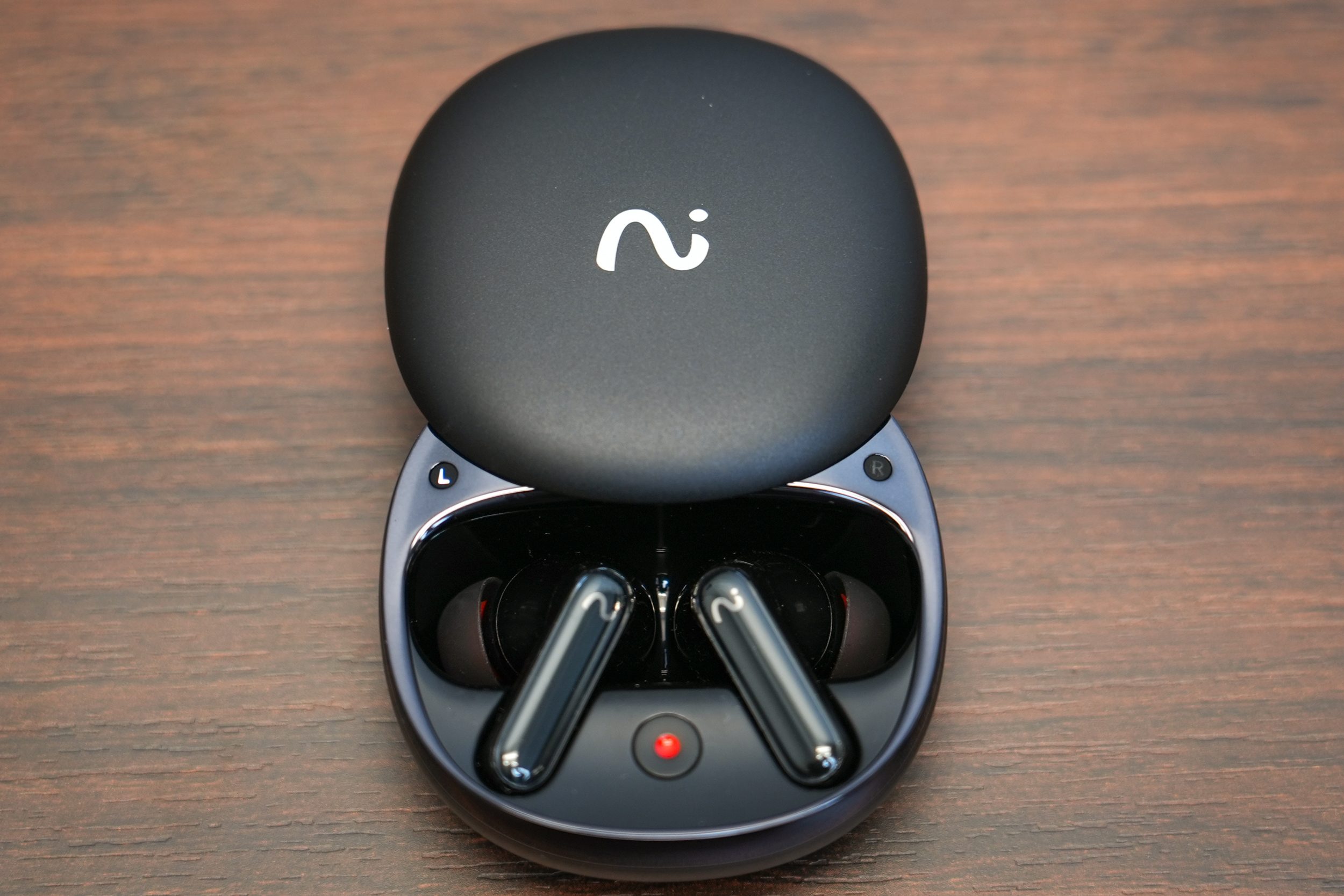
The RecDot follows the long-stem template Apple made famous, but these sit a touch chunkier in the hand than the AirPods 4 that I use on a regular basis and the AirPods Pros that I borrowed to compare these against – and you notice it. That extra bulk makes room for the recording hardware, so it’s easy to understand why it’s there. The build leans more plastic than premium, and the sliding lid on the charging case feels flimsier than the rest of the package at times. Everything else about the case is genuinely good. The buds snap into their magnetic cradles with a satisfying click and stay put no matter how hard you shake the thing.
Best of all is a physical record button on the outside of the case, which starts a meeting recording with a single press. It’s a smart, tactile touch, though the tiny blinking light that tells you recording is live could be far more obvious in direct sunlight. Viaim throws in five sizes of eartips, which is more generous than most, and an in-app fit test runs frequencies through the earbuds to check your seal. Swapping tips is a little fiddly, but once you land on your size, the fit holds up for long sessions. These aren’t gym buds, though.
The fit isn’t tight enough for running or hard training, but for sitting at a desk, commuting, or grinding through a day of meetings. Controls live on the stem as a touch sensor that handles play, pause, volume slides, and track skips. Overall, it works. There’s no haptic confirmation, though, so you sometimes can’t tell whether your tap registered, and the triple-press to jump back a track takes practice. If you plan on switching earbuds for different occasions (like running, flying, etc), then you might have a tough time remembering the tap sequences.
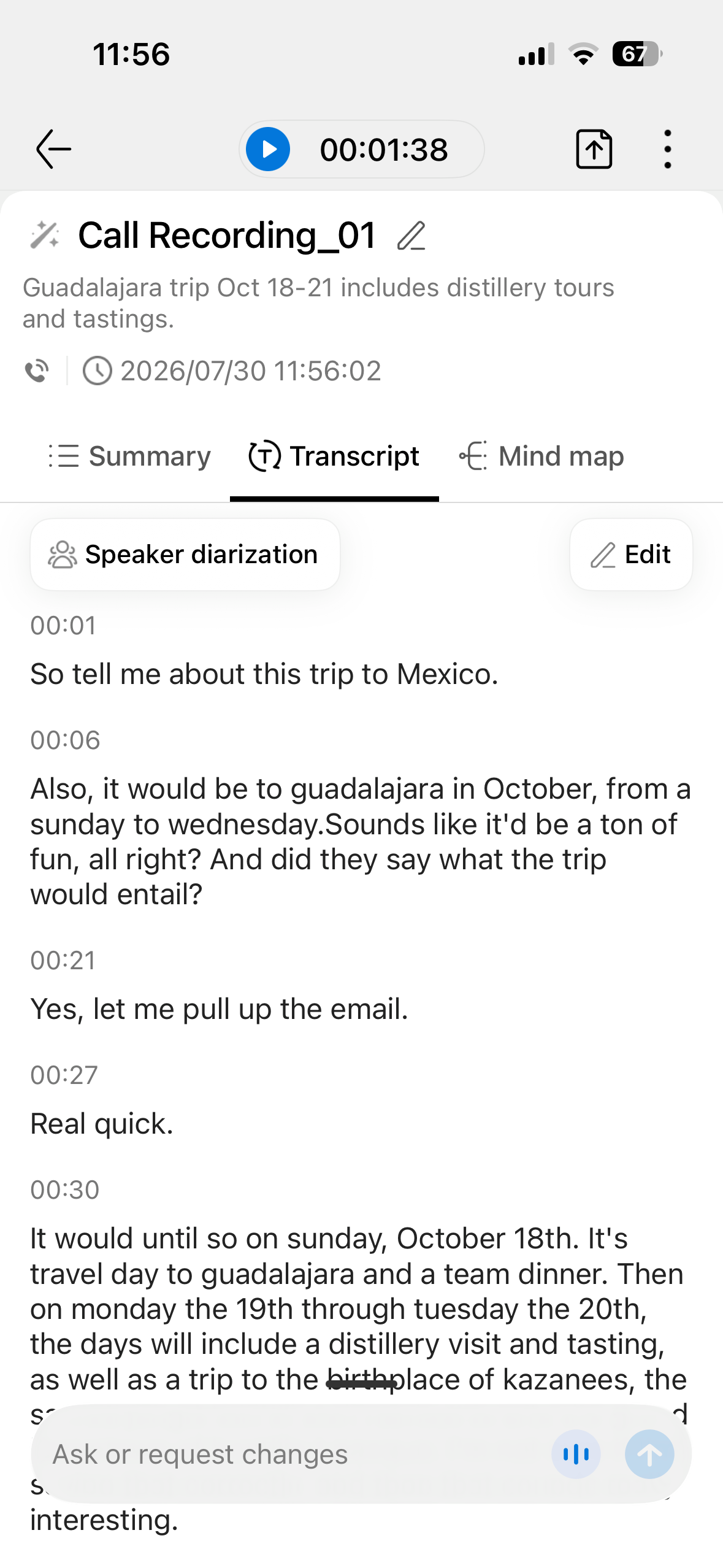
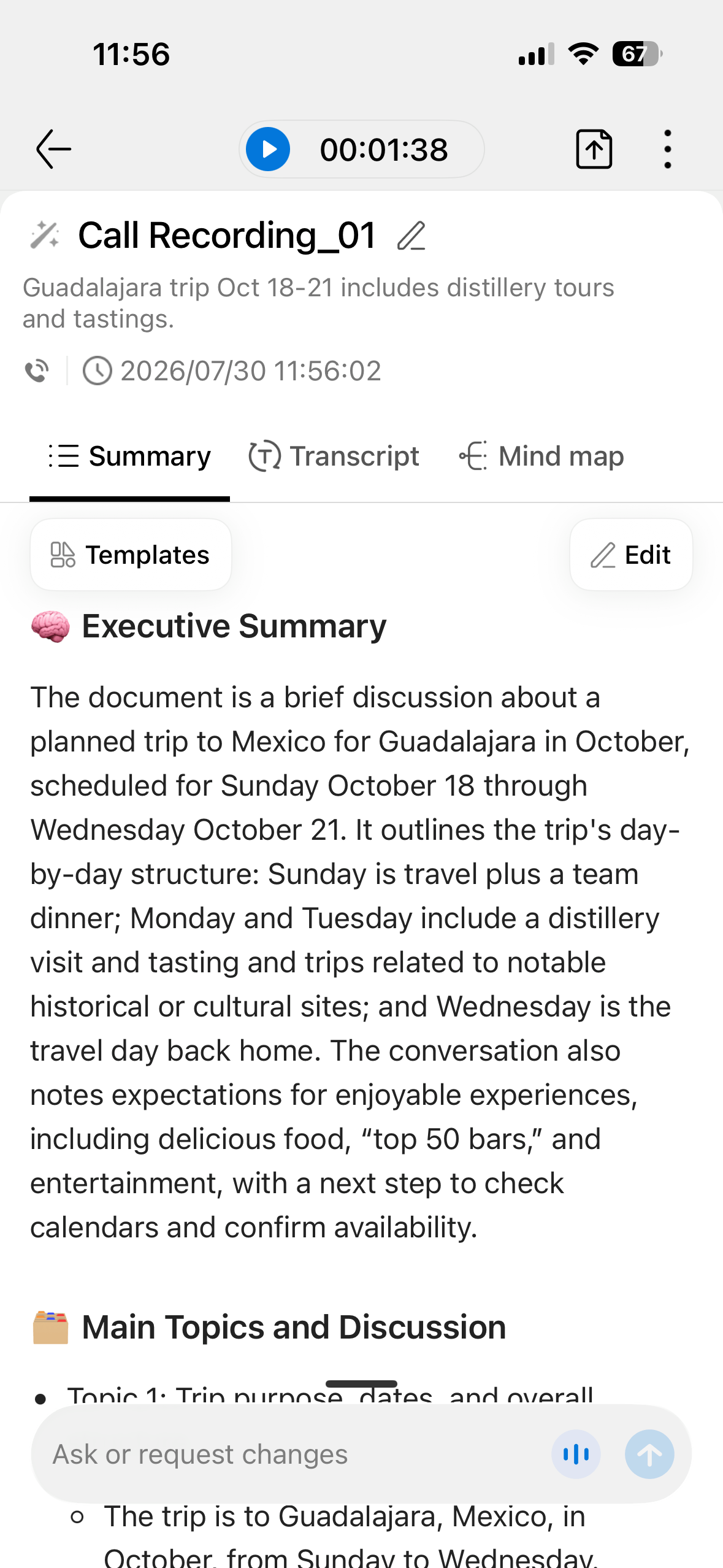
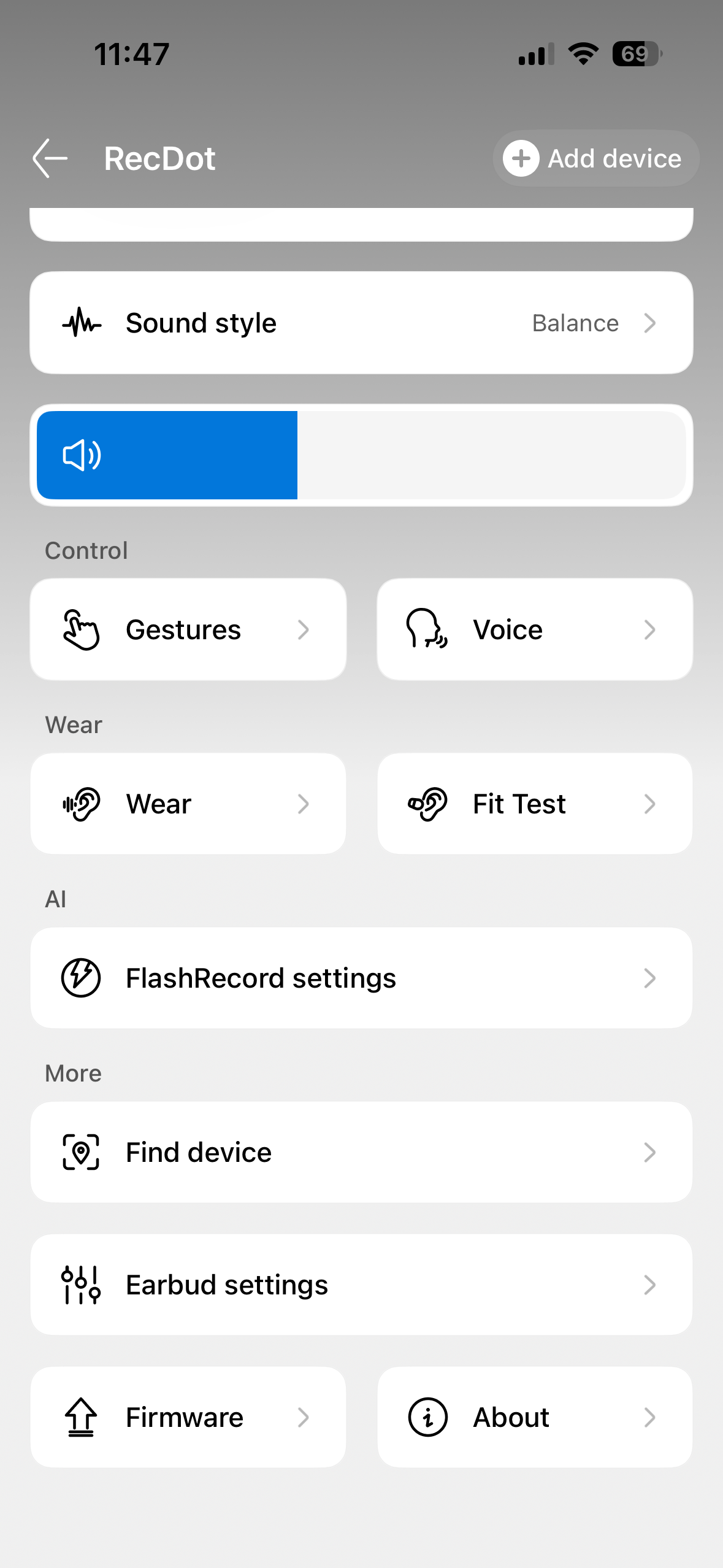
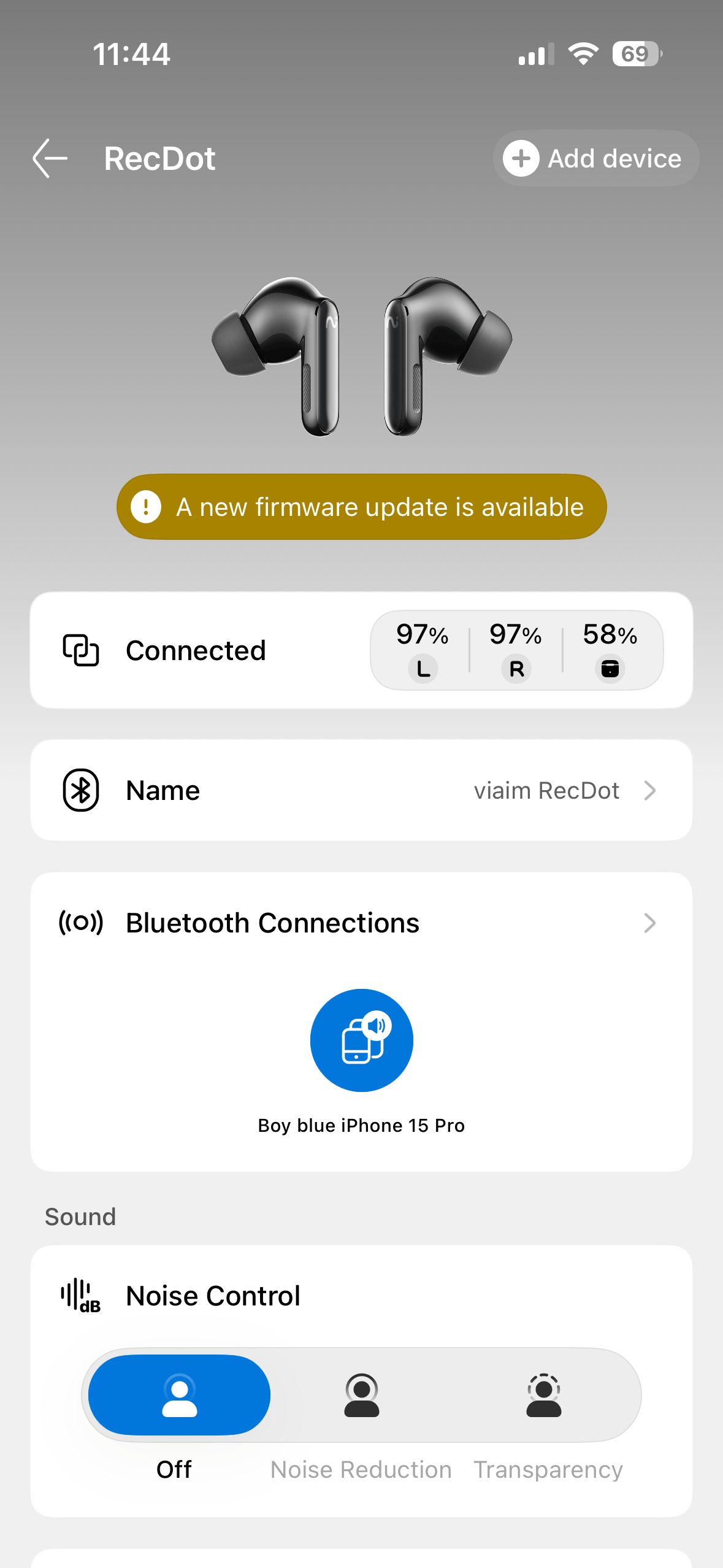
This is where the RecDot earn their name and why you would buy them. There are three ways to record: call recording that transcribes system or VoIP calls in real time, audio or video recording that transcribes a clip, and live recording for face-to-face conversations and small meetings. Starting a recording was fairly straightforward for me, whether you press the button on the case or hold the stem until you hear “recording start.” Pressing the button on the case was simpler for me.
You can choose to have every call auto-record as well. When you have this turned on, you will hear a voice telling you and the person on the other end that the call is being recorded. Everything winds up in the Viaim app, and this is the one thing I had to learn. Viaim markets recording on the buds themselves, but the transcription and AI features live in the app. Simply put, the app isn’t optional. You have to use it.
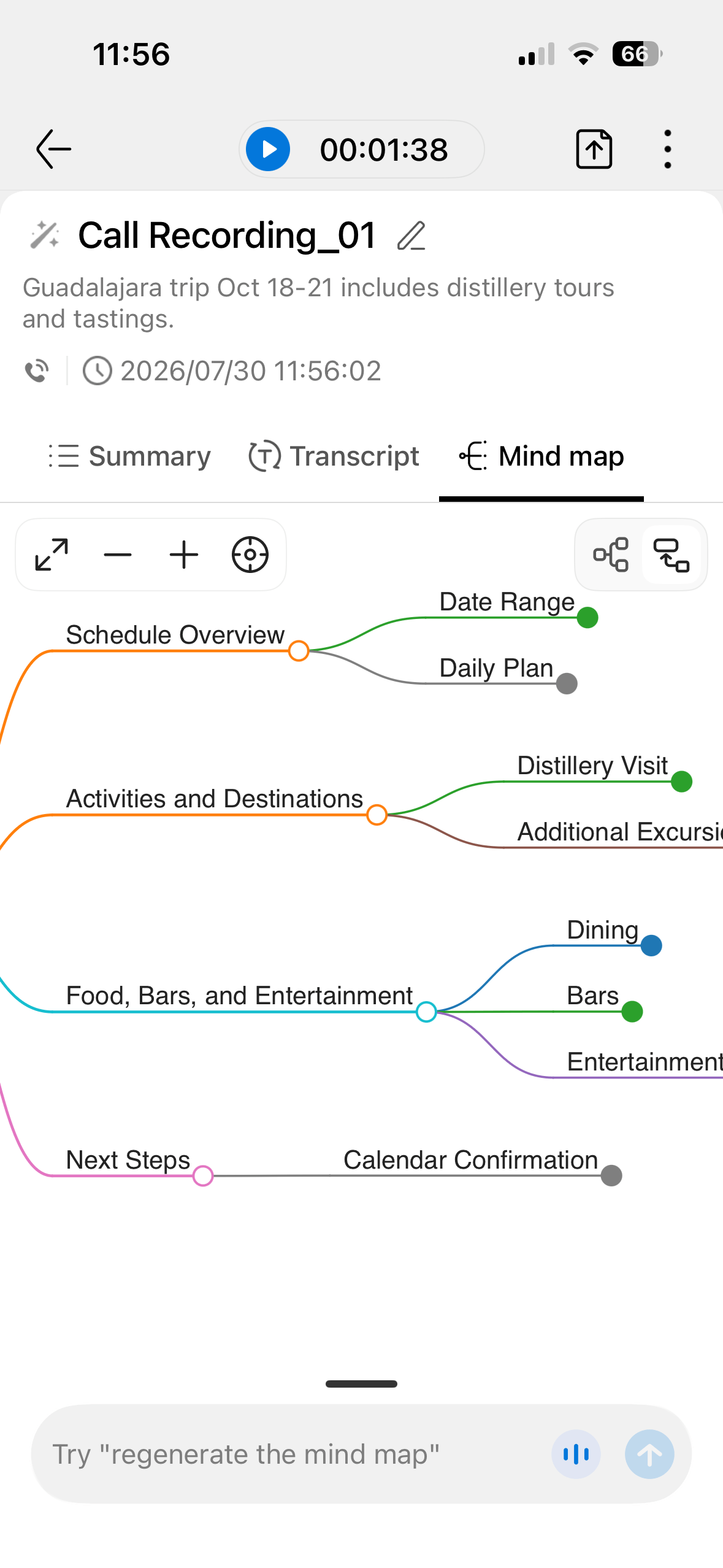
Once your audio is in, the AI does the work. Transcription was pretty reliable and thorough for me in my testing, picking up speech with few errors. The meeting assistant extracts concise summaries and pulls out actionable to-do items, and it does so quickly and with surprising accuracy about who owns what. There’s even a mind-map view, and the app taps large language models such as ChatGPT, Gemini, and Claude for its AI tools. Transcripts can be translated into more than a dozen languages, though translation is laggy, the way it is on rival systems.
Note: I only used Spanish in my translation testing.
Two quirks jumped out for me. A long pause makes the software insert a full stop or start a new sentence, so you’ll do some light cleanup afterward, and speaker separation is inconsistent, nailing it in some sessions and merging voices in others. My hope is that future firmware updates will fix this. You get 600 free transcription minutes a month, which most people won’t use up. If you want more minutes, you’ll need to spend extra per month for those (I listed them above in the specs, and below in the FAQs). One practical note the marketing skips: recording conversations carries legal and etiquette obligations that vary by location, so know the consent rules where you are before you hit record.
The rules depend on where you and the other person are. Federal law and most states use one-party consent, meaning if you’re part of the conversation, you can record it without telling anyone else. That covers states like New York, Texas, and Virginia. A minority of states like California require all-party consent, where everyone must be informed and agree before you record. In those states, quietly recording a meeting or call can be a crime even if you’re a participant.
For a product built around AI, the RecDot sounds better than I expected it to. The 11mm titanium-coated drivers put out a vibrant, detailed, crisp presentation that leans balanced rather than bass-heavy, great for vocals. Ed Sheeran’s Azizam (a recent favorite of mine, make fun all you want) serves up a dance beat that punches through without trampling the vocal, and the soundstage runs surprisingly wide for earbuds. Orchestral material holds up too, with clear separation between flutes, piano, and the rest of the sections.
Where the RecDot’s struggled for me is during dense, heavy music. Rock tracks can turn muddy and cluttered at times, the loudest sections sounding squashed rather than powerful. Bass occasionally feels stuck and short on depth, and percussion can lean tinny. Sparser genres like acoustic, singer-songwriter, soul, and ambient electronic are where these buds shined for me. There’s an EQ in the app with pop, bass boost, and electronic presets, and while a few nail specific tracks, none held up reliably across a broad library, so the default balanced profile is the one that I thought worked best for me. Audiophiles looking for next-level detail will want a dedicated pair of earbuds, or straight-up over-the-ear headphones. Everyone else will find the sound more than pleasant.
Viaim’s Smart ANC claims up to 48dB of reduction, and in daily use it does a decent job of quieting an office or a commute on a plane or bus. It isn’t class-leading, and I felt like it was on par with my AirPods 4 in most instances. To be fair though, I think the AirPods 4 do an OK job. I have been on plenty of calls where the person on the other end had ANC turned on, and they were difficult to hear during that call. Put the RecDots side-by-side with the best buds at this price, and the RecDot let more low-frequency rumble through, and jet-engine noise on a long-haul flight would test its limits. There are low, middle, and high manual modes, but none of them stayed reliable as environments changed, so the auto setting is the one I would recommend. Auto occasionally colors the sound in the process, but that beats fiddling with presets every time you move rooms. For everyday commuting and open-plan offices, the ANC is more than good enough.

The RecDot’s call quality is clear and dependable. In my tests, callers said my voice came through cleanly, with only a slight fuzziness on sharp sibilant sounds, and the mics keep background noise off the line. In a busy environment, you can still make out a caller’s words without straining. As I mentioned before, it’s not the best on the market, but it’s perfectly reliable for the meetings and 99 percent of the calls you will make.
Battery life really surprised me. Coming from my AirPods 4, I was expecting to get about 4 hours of continuous use, but was able to push beyond that in the 7-9 hour range with the RecDots. You get up to nine hours from the buds themselves and an extra 36 hours with the case as a charger, which comfortably outlasts AirPods Pro and Samsung’s Galaxy Buds. In my testing, eight hours of listening drained the buds to 80 percent, which is a lot given all the recording and processing happening in the background. The case charges over USB-C or wirelessly, which is a nice convenience at this price. Cheaper rivals push past 40 hours, but for a pair doing this much processing, the RecDot’s battery life is more than competitive.

Apple AirPods Pro remain the pick for anyone in the Apple ecosystem who cares most about noise cancellation, fit, and easy device switching, and they now do basic live translation, though they can’t come close to matching the RecDot’s structured summaries and to-do lists. Samsung Galaxy Buds are the equivalent choice for Galaxy owners, with strong ANC and longer battery than Apple, and they only cost a little more than the RecDot. For pure recording on the cheap, dedicated AI note-takers like the Plaud NotePin capture and summarize conversations for less, but you lose the everyday earbud. The RecDot’s whole argument is that it does both jobs in one device, and for the right person that combination justifies the premium. And I’d say for the average person, the premium is worth it.
The Viaim RecDot are a forward-looking pair of earbuds that do the one thing they set out to do, and they do it extremely well. Recording and transcription are fast, accurate, and super useful. The sound and battery life are much better than I expected. Holding them back from being a perfect 10 for me is the ANC that trails the best in class, bass that struggles with heavier music, a plasticky build, and a premium price. If your days are full of meetings, lectures, or interviews, nothing else at this price captures and organizes them as neatly. I found the RecDot to be the perfect companion for my work and play schedule. Score: 4 out of 5.
I tested the Viaim RecDot over three weeks of daily use, wearing them for meetings, calls, drive-time and plane commutes, and focused desk work, with listening sessions running well past two hours at a stretch. I streamed music from Spotify, Pandora, and Apple Music across an iPhone and a laptop, listening to EDM/House, Rock, classical, acoustic, and podcast material, and leaned on the recording and transcription features across real calls and in-person conversations. I compared them directly against Apple AirPods 4 and AirPods Pro for sound, ANC, and call quality.
Yes. Call recording transcribes system and VoIP calls in real time. You either hold the stem or press the button on the case to start. I found the button on the case to be the simplest. The transcript, summary, and any to-do items appear in the Viaim app afterward.
You get 600 free transcription minutes a month, which covers most people. Heavy, all-day recorders may hit that cap; the AI tools themselves run through the Viaim app. Viaim offers a Pro plan, which is $9.99/month or $79.99/Year and comes with 1800 minutes, and an Ultra plan, which is $19.99/month and $159.99/year and has unlimited minutes.
Transcripts can be translated into more than a dozen languages, including English, Chinese, French, and German. Translation works but lags in real time, much like it does on Apple and Samsung buds (from what I have researched).
Not really. The IPX5 rating shrugs off sweat and light rain, but the fit isn’t tight enough for running or hard training. They’re built for desks, commutes, and meetings. You’ll want dedicated earbuds for that.
Buy the RecDot if automatic transcripts, summaries, and to-do lists genuinely save you time. Choose AirPods Pro if you mainly want stronger noise cancellation, a snugger fit, and tight integration with Apple devices.

joshuark quotes a report from MIT Technology Review: It is impossible to make large language models fully secure against hacks because of a fundamental flaw in how they work, a team of researchers argue in a paper presented at the International Conference on Machine Learning, a top AI conference, this month. The claim has huge implications for the safety of this technology. By taking advantage of this flaw, which concerns how LLMs identify who or what is giving them instructions, the researchers were able to make popular LLMs spit out information they had been trained not to provide, such as how to synthesize cocaine and how to sabotage a commercial aircraft’s navigation system. “There’s a real probability that this is going to be a problem that’s fundamentally unsolvable,” says Charles Ye, an independent researcher and coauthor of the ICML paper. […]
The ICML paper describes attacks against several of OpenAI’s models, but Cui and Ye say that they have since seen similar results with models made by Anthropic, Alibaba, and DeepSeek. Cui and her colleagues wanted to find out why an attack like chain-of-thought forgery was so effective. They suspected it had something to do with the mechanism that LLMs use to keep track of where their instructions are coming from. But what Cui and her colleagues discovered is that LLMs are in fact very bad at keeping track of different roles.
In a series of experiments that looked at what was going on inside a handful of different models, the researchers found that LLMs seem to identify the role of a specific chunk of text not by the tags around it but by the style of that text and the words it contains. The upshot, the researchers claim, is that all an attacker needs to do to hack an LLM is write text that spoofs a certain role. And because roles are a fundamental part of how LLMs work, no amount of training will fully solve the problem. “There’s going to be a huge economic incentive for people to do jailbreaks and prompt injections,” says Cui. The best defense could be to expect the worst. Organizations shouldn’t trust LLMs, and they should expect that anything done by agents could be unsafe, he says: “That’s not a great solution, but it just might be what we have to do.”
“It’s really incredible that these things are being deployed everywhere to control super-critical systems. There’s been no study of the fundamental science here. We’re all doing it ad hoc.”
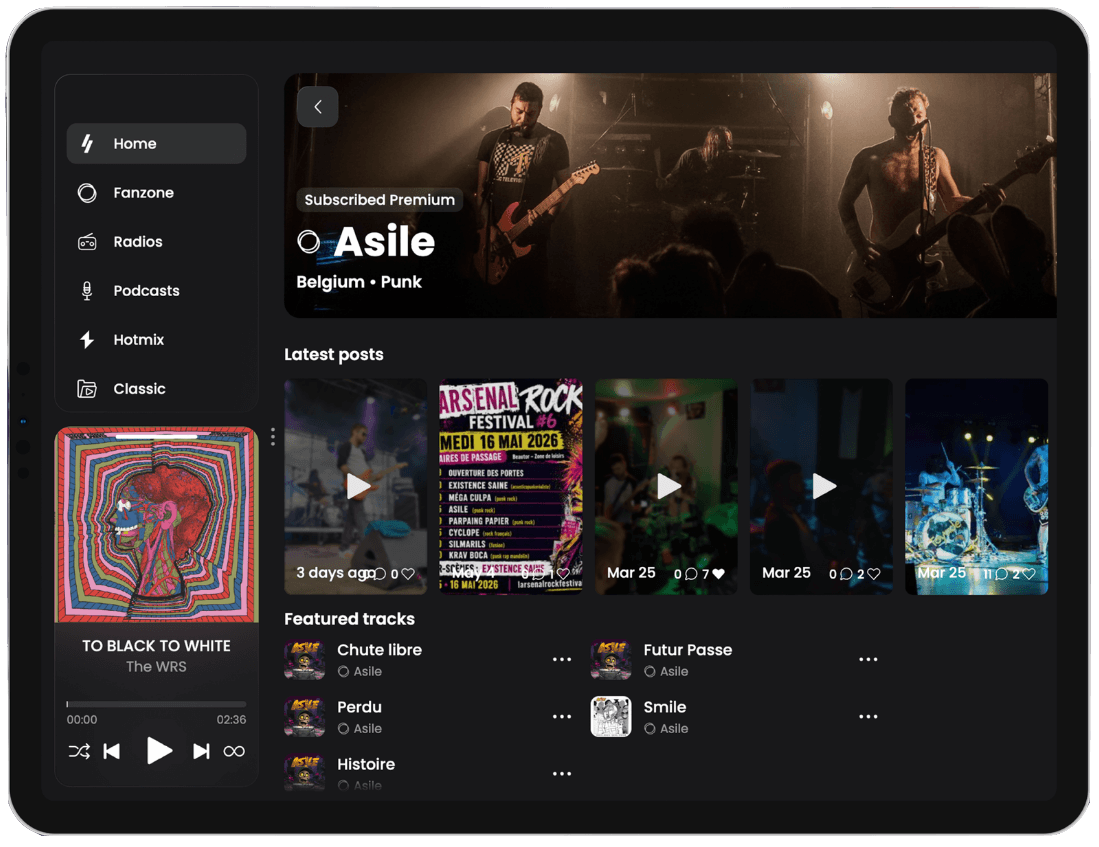
Winamp will use Deezer technology to launch a premium streaming service in 2027, combining subscription music with local files, radio, podcasts and cloud libraries. It sounds useful, but the important details remain missing.
Before Spotify, Apple Music and recommendation algorithms decided what everyone should hear next, millions of listeners stored their music on a computer. Those collections were assembled from ripped CDs, purchased downloads and MP3 files acquired through methods best left between the listener and their internet service provider.
Winamp was the software that made those libraries manageable.
The Windows music player let users organize playlists, adjust an equalizer, install plug-ins, run visualizations and completely change the interface through downloadable skins. It was fast, flexible and considerably more personal than most of the streaming apps that eventually replaced it.
Now Winamp wants another opportunity to shape digital music playback.
The company announced on July 29, 2026, that it has formed a strategic partnership with Deezer to develop a new Winamp Player. Scheduled for the first half of 2027, the software will combine a Winamp-branded premium streaming service with locally stored music, internet radio, podcasts, personal cloud collections and other audio sources.
That is considerably more interesting than launching yet another streaming service. The world already has enough of those, along with enough annual price increases to make renting the same albums indefinitely feel like a retirement strategy.
Winamp first appeared in 1997 and was developed by Justin Frankel through his company Nullsoft. It arrived as the MP3 format was beginning to change how music could be stored, shared and played on personal computers.
Winamp did not invent digital music, but it helped make large computer-based libraries practical for ordinary users. AOL acquired Nullsoft in 1999 after the software had attracted millions of listeners.
Its popularity was about more than playback. Winamp gave users control over how their music was organized and how the software looked. Thousands of skins and plug-ins turned it into something that felt personal rather than another corporate storefront.
The player later drifted through ownership changes and uncertain development. AOL announced plans to discontinue it in 2013, although the shutdown did not happen as expected. Belgian internet radio company Radionomy acquired Winamp and Shoutcast in 2014.
Winamp never completely disappeared. A legacy Windows version remains available, while newer mobile applications have been released for iOS and Android.
Calling the 2027 product a full comeback is therefore not entirely accurate. Winamp has been trying to rebuild itself for several years. The significant change is the addition of a complete subscription streaming service powered by Deezer.

Deezer will supply its catalog and white-label streaming technology, but the service will be presented as a native Winamp subscription rather than Deezer wearing someone else’s jacket.
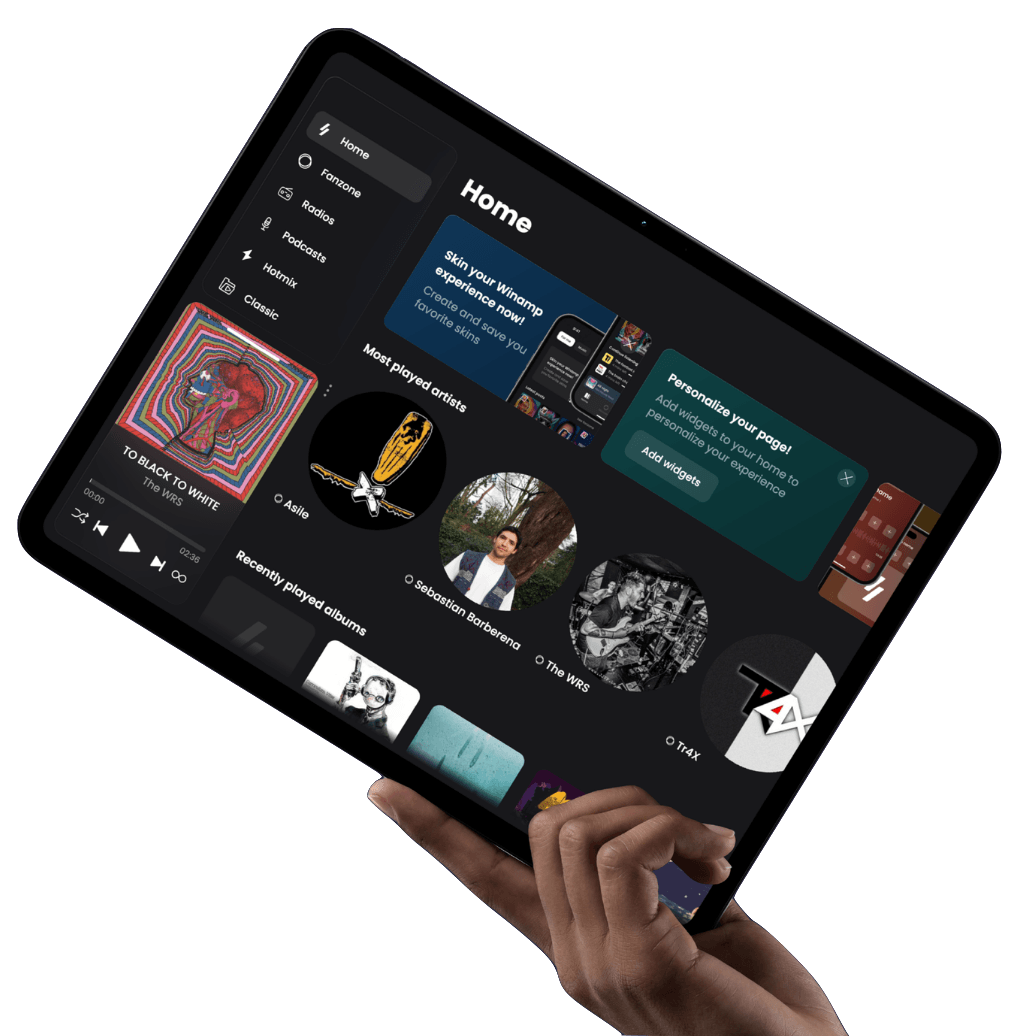
Winamp says the new player will bring together streaming music, local files, internet radio, podcasts and personal cloud libraries within one customizable interface. The company is also promising social features and new tools for music discovery and organization.
The existing desktop player will eventually gain access to the premium subscription.
Winamp and Deezer also claim that more than 40 million people still actively use the desktop software worldwide. That is an extraordinary figure for an application many listeners assumed had disappeared alongside dial-up modems, although neither company has provided independent verification.
Deezer is a logical infrastructure partner. It already operates a global streaming service and supplies music technology to telecommunications companies, hardware manufacturers and other third-party businesses.
For Deezer, Winamp creates another way to distribute its catalog without having to persuade Spotify and Apple Music subscribers to switch directly to the Deezer brand.

Deezer enters the Winamp partnership from a stronger financial position than its smaller market share might suggest.
The French streaming company reported revenue of €268.2 million for the first half of 2026, adjusted EBITDA of €8.5 million and net income of €6.7 million, reversing a €7.6 million loss from the same period one year earlier. Direct subscribers increased 8.7% to 5.8 million, although Deezer’s total subscriber base declined 3.5% to 8.9 million as subscriptions supplied through outside partnerships continued to fall.
Deezer is not remotely close to challenging Spotify or Apple Music on scale, but it has a licensed global catalog, lossless streaming technology and an expanding business supplying music infrastructure to other companies. Winamp does not need Deezer to become the world’s largest streaming platform. It needs Deezer to make the plumbing work.
Winamp will not be the first platform to combine locally stored music with subscription streaming.
Roon is the most obvious alternative for audiophiles. It merges local files with services including TIDAL and Qobuz, adds extensive metadata and discovery tools, supports bit-perfect playback and works with more than 1,000 compatible audio devices. It is also priced at $14.99 monthly, $149.88 annually or $829.99 for a lifetime subscription, before anyone buys a dedicated Roon server.
Audirvāna Studio also combines local files stored on computers, USB drives and NAS devices with TIDAL, Qobuz, Presto Music, HIGHRESAUDIO and internet radio. Its emphasis is more firmly placed on high-resolution playback and computer-based audio than mainstream discovery or social features.
Plexamp is another strong option for people who primarily want to organize and stream their own music collection. It offers gapless playback, loudness leveling, smart playlists, CarPlay, Android Auto, AirPlay and Chromecast, but it does not merge that library with a full subscription music catalog in the same way Winamp is proposing.
Winamp’s opportunity is therefore not proving that local and streamed music can coexist. Roon and Audirvāna already do that rather well. Its challenge is making the experience simpler, cheaper and more accessible to people who do not own a dedicated server or use “bit-perfect signal path” in casual conversation.

Streaming services have made access to music remarkably convenient, but they have also separated many listeners from the music they already own.
Someone with 2,000 ripped CDs, purchased FLAC downloads, independent releases, live recordings and carefully organized playlists often needs one application for local files and another for streaming. Internet radio, podcasts and cloud storage may require additional software.
Winamp wants to put those sources inside one player.
That could be genuinely useful because streaming and locally owned music serve different purposes. Streaming is excellent for discovery and immediate access. Local files offer permanence, specific masterings and control over recordings that may disappear when licensing agreements change.
Winamp is not the first company to attempt this. Roon combines local libraries with several streaming platforms, while music servers from companies such as Innuos merge stored files with subscription catalogs. Apple Music also allows listeners to manage local music alongside its streaming library.
The difference is that those solutions are either tied to specific ecosystems, require another subscription or work best with dedicated audio hardware.
A properly designed Winamp application could offer a broader software-based alternative for listeners who want one library without purchasing a dedicated music server.
The word “could” is carrying a rather large loudspeaker up the stairs.
The most obvious audience consists of listeners who built substantial digital music libraries during the CD-ripping and download eras and never deleted them simply because Spotify arrived.
That includes people with MP3, AAC, ALAC, WAV and FLAC collections stored on computers, external drives or cloud accounts. It also includes listeners who buy music directly from artists, collect alternate masterings or own recordings unavailable through mainstream services.
Existing Winamp users are another natural audience, assuming that 40 million figure is remotely close to reality.
The player could also appeal to people who dislike the increasingly uniform design of major streaming applications. Customization was central to Winamp’s original appeal, and the company says users will again be able to modify layouts and create skins.
Audiophiles should remain cautious.
Deezer currently offers lossless streaming, but neither company has confirmed that the Winamp subscription will include lossless audio. There is also no information about bit-perfect playback, exclusive audio modes, automatic sample-rate switching, USB DAC support or compatibility with network streamers.
Until those details emerge, this is a promising library-management concept rather than an audiophile playback platform.
Winamp has not announced the price, launch countries or which operating systems will be supported at launch. There are no confirmed details about streaming quality, offline downloads, family plans, playlist transfers or whether existing Deezer subscribers will have any upgrade path.
The company has not identified which cloud-storage platforms will work or whether the player will index NAS drives and shared network folders.
Hardware support is another large blank space. Winamp has not confirmed AirPlay, Google Cast, UPnP, DLNA, smart-speaker integration, automotive support or direct playback through connected audio components.
It has also not demonstrated the finished software.
At this stage, Winamp and Deezer have announced a partnership, a concept and a 2027 release window. That is not the same thing as delivering a stable player capable of merging a complicated local library with millions of streamed tracks.
Winamp and Deezer are pursuing an idea that deserves attention.
Major streaming services have spent years improving discovery and recommendation systems while often treating locally owned music as something listeners abandoned with CD binders and beige computers.
Millions of people still own large digital collections and should not require a separate archaeological expedition every time they want to play them.
Deezer gives Winamp a catalog, licensing relationships and streaming infrastructure. Winamp brings a recognizable brand and decades of experience with local music playback and customization.
That combination could produce a genuinely useful alternative to conventional streaming apps. It could also become another Deezer-powered service with a different logo, several customizable buttons and a marketing department leaning very heavily on the past.
The difference will come down to pricing, audio quality, hardware support and whether Winamp can combine local and streamed music without turning library management into unpaid technical support.
The llama may still whip the llama’s ass.
It also needs to support your DAC.
For more information: winamp.com

We can all see how the newest digital products require flexibility and the ability to scale quickly together with the business. At the same time, they must cope with growing workloads. That’s why teams choose is*hosting for their Linux VPS hosting to get the job done. Flexible server solutions make it possible to configure resources, select a suitable location, and deploy the environment automatically.
The list of users who will find this helpful is extensive: DevOps engineers, web application developers, SaaS platforms, and many others. Using open-source tools helps them create a reliable, transparent, and scalable environment for development and operations.
DevOps is today one of the key approaches to creating and managing software products. It connects development, testing, and operations, helping teams work faster. Open-source tools make workflows easier and flexible. Open source is basically built to bend. You can customize your tools, stitch them together, and automate the boring stuff. Honestly, it’s a perfect fit for pretty much anything — web, mobile, cloud, data, or AI.
It is fair to say that several specific DevOps components help automate processes, improve system stability, and shorten the time between product development and launch. These include:
Less manual grunt work means fewer mistakes. Auto-deploys let you ship updates in a flash, while smart monitoring catches performance bottlenecks before they become fires.
In practice, any DevOps model requires a reliable and powerful infrastructure. Every project, even the smallest one, must have the ability to quickly scale resources as more and more users join or as technical requirements change. The server environment must support flexible power settings, rapid creation of new environments, and stable service operation.
International IaaS providers offer VPS/VDS, dedicated servers, VPN services, and additional infrastructure solutions. Users can configure key server parameters, including:
A broad infrastructure geography makes it possible to select suitable locations for different projects and reduce access latency. Such opportunities are in demand in various fields. Online stores use scalable servers to handle large numbers of requests.
When choosing DevOps infrastructure, it is important to consider not only current challenges but also growth prospects. A flexible server platform should allow configuration changes without complex migrations. Among the most popular features are:
This model makes it easier for technicians and helps launch new projects faster. DevOps teams can create test environments, run experiments, and migrate applications between environments with minimal time investment.
As soon as digital products begin to evolve, securing the system as a whole becomes just as important as maintaining performance. Good companies must secure the users data, provide uninterrupted service, and minimize the risk of breakdowns.
It is exactly these advanced open-source tools that help not only manage the entire system but also monitor it clearly. Teams will be able to track changes, audit settings, and implement additional security measures. When building a secure DevOps environment, special attention is paid to the following aspects:
KVM technology ensures effective isolation of virtual machines and stable operation of VPS servers. SSDs and NVMe drives enable faster processing, and the latest generation of Intel Xeon and AMD EPYC processors allows you to run resource-intensive applications.
Choose a server that actually grows with you. You want to scale smoothly without hitting hidden fees. Look for clear, pay-as-you-go pricing — it’s the smartest way for startups to get top-tier tech without breaking the bank.
Flexible servers work for almost any project. Building an edtech app? Marketing tools? Analytics? AI? To summarize, good infrastructure is the secret sauce to keep your product growing smoothly.
When you need a comprehensive strategy, keep in mind that it can only be based on a successful combination of elements. This includes automation, open-source tools, and high-quality server infrastructure. Together, they create a secure and scalable DevOps environment. These technologies help developers build products faster, monitor all critical processes, and manage resources as efficiently as possible.





Weekend Open Thread: Brooks Brothers

Commonwealth Games boxing: Jadumani Singh seals dominant 5-0 win over Pakistan’s Sumama Rehman to enter quarter-finals | Commonwealth Games News


Why Trees Belong on the Risk Register


Intel is reversing course and bringing hyper-threading back to its server chips


Ripple bought a bank in pieces. The $4 billion audit


Luke Littler dismantles Gerwyn Price to retain title in Blackpool

A New Post-Apocalyptic Gundam Anime Series Blasts Into SDCC


The Part of the Electric Transition Nobody Wants to Discuss


BITCOIN JUST ENTERED THIS CRITICAL ZONE…


16 Dresses for the High Summer Event


2026 3M Open leaderboard: Scottie Scheffler finds putter in Round 1, sits three back


Major shareholder moves on Canyon


XRP Ledger adds $2.6B as RWA inflows rank second


Spain sweeps the board at 2026 World Cup with individual awards


Bitcoin Enters the 3rd Stage of the Bear Market

‘Stargate’ Creator’s New Sci-Fi Series Returns for Season 3 Tomorrow


Anthropic launches Claude Opus 5, a cheaper AI model for coding, agents and enterprise workflows


Kraken Enables Retail Access to Jersey Mike’s IPO via Tokenized Shares


Sara Gilson Killed By Husband After Viral “Pedophile” TikTok Video


Claude: Build Financial Dashboards in Minutes (2026)



You must be logged in to post a comment Login