

Crypto World
Taiwan Lawmakers Approve Crypto and Stablecoin Regulatory Rules


Taiwan has taken a major step toward formalizing the country’s crypto market, with lawmakers passing a new law that sets out a regulatory framework for virtual assets and stablecoins. The package establishes a licensing regime for virtual asset service providers (VASPs) and introduces specific approval, reserve, and audit requirements for stablecoin issuers.
According to Taiwan’s Financial Supervisory Commission (FSC), the Legislative Yuan passed the bill on Tuesday, requiring VASPs to obtain regulatory approval before operating. The FSC said the move is designed to strengthen protections for traders’ rights while helping Taiwan integrate with international financial markets.
Key takeaways
- Taiwan’s new law creates a licensing regime for virtual asset service providers, overseen by the FSC.
- Stablecoins issued in Taiwan must receive approval from both the central bank and the FSC, with reserve and audit requirements.
- The framework covers multiple VASP categories, including exchanges, trading platforms, custodians, and lenders.
- The law criminalizes crypto-related fraud and price manipulation, with penalties including prison time and substantial fines.
- Implementation timing depends on publication by the executive branch, with a post-implementation license application window for firms that already completed AML registration.
Licensing and oversight for VASPs
The FSC said all VASPs in Taiwan must be authorized by the regulator before they can legally operate. The law is described as Taiwan’s first comprehensive regime specifically addressing crypto and stablecoins, aligning the jurisdiction with other major Asian markets in the region—such as Japan, Singapore, and Hong Kong—that have already moved ahead with crypto legislation to encourage industry participation.
Under the rules, Taiwan defines seven types of VASPs, including exchanges and trading platforms, as well as custodians and lenders. Regardless of category, the law requires regulated firms to maintain robust internal controls and undergo audits. It also sets expectations around cybersecurity systems, listing and delisting standards for crypto assets, customer-asset segregation, and financial reporting.
Stablecoin approval, reserves, and audits
Stablecoins receive their own regulatory structure within the bill. The law states that any stablecoin issued in Taiwan must obtain approval from both the central bank and the FSC. Issuers are required to maintain sufficient reserves, with those reserves held with a trustee.
In addition, stablecoin issuers must undergo regular audits. By combining multi-agency approval with reserve custody and recurring review, the framework aims to reduce the risk of under-collateralization and improve transparency for token holders.
The FSC argued that stablecoin issuance can help Taiwan connect more effectively to international markets and strengthen its position in the global crypto sector.
Enforcement: fraud and unlicensed operation carry prison and fines
The bill also lays out enforcement measures aimed at preventing misconduct in the crypto sector. The law prohibits crypto-based fraud and price manipulation, and it sets penalties that range from three to 10 years in prison, along with fines estimated at roughly 10 million New Taiwan dollars (about $300,000) to 200 million New Taiwan dollars (about $6.3 million).
For individuals or entities that operate a VASP or issue a stablecoin without the required license, the law increases the stakes: CNA reported that unauthorized activity can result in up to seven years in prison and fines of up to 100 million New Taiwan dollars (about $3.1 million).
These figures signal that Taiwan intends to treat compliance as a central condition for market access, rather than a purely administrative requirement.
What happens next: publication, timing, and a follow-on derivatives proposal
While the legislative step is complete, the law’s timeline is not yet fully operational. The implementation date remains undecided, and the framework will only take effect after it is published by the government’s executive branch.
In the meantime, the FSC said VASPs that have already completed anti-money laundering (AML) registration before implementation can apply for a license within 12 months after the bill becomes effective. Institutions providing related services under the FSC also fall within the same general post-implementation window, according to the regulator’s comments.
Separately, CNA reported that lawmakers passed a resolution asking the FSC to propose a plan within a year detailing how the crypto industry could offer derivative crypto commodity services. The resolution frames the effort as a way to provide diversified investment options while improving the overall health of the sector—but it does not change the fact that the new law’s immediate focus is licensing, stablecoin rules, and market conduct.
Regional implications for traders and industry participants
For market participants, the practical effect of the bill will hinge on the licensing process that follows implementation—especially for platforms handling customer assets, custody, or market operations. The stablecoin provisions are likely to be particularly consequential for issuers and reserve holders, since the framework explicitly requires approvals from both Taiwan’s central bank and the FSC, along with trustee-held reserves and regular audits.
Readers should watch next for the executive-branch publication date and any subsequent guidance from the FSC on how it will evaluate VASPs across the seven defined categories, including cybersecurity expectations, customer-asset segregation practices, and listing/delisting rules. Until those details land, firms can prepare for compliance work, but the final operational path will depend on how regulators translate the law into enforceable procedures.
Sources: FSC statement (as reported in the provided material); CNA report on penalties and timelines; Cointelegraph link referenced for context.



Taiwan’s Legislative Yuan passed the Virtual Asset Service Act on its third reading on June 30, moving crypto oversight beyond narrow anti-money-laundering rules.
The law rewrites how virtual asset service providers (VASPs) and stablecoin issuers operate, introducing licensing requirements, reserve rules, and criminal penalties.
Taiwan Lawmakers Pass Sweeping Crypto Regulation Law
The Financial Supervisory Commission (FSC) said the framework lifts supervision of virtual asset service providers (VASPs) from a money-laundering focus toward full operational and market-conduct standards.
The Act defines seven VASP categories, spanning:
- Virtual asset exchanges
- Trading platform operators
- Transfer service providers
- Custodians
- Underwriters
- Lending service providers
- Other virtual asset service providers
The law requires VASPs to segregate customer assets and comply with internal control, cybersecurity, audit, and financial reporting requirements.
The Act grants a transition period to existing VASPs that completed anti-money laundering (AML) registration before the law takes effect, as well as financial institutions already providing virtual asset services under FSC regulations.
These entities must apply for an FSC license within 12 months of the Act’s implementation. They must also obtain regulatory approval and an operating license within 21 months. If necessary, the licensing deadline may be extended once by up to three additional months.
Follow us on X to get the latest news as it happens
Meanwhile, the Act also establishes regulatory requirements for stablecoin issuance. It requires entities seeking to issue stablecoins in Taiwan to obtain approval from the Central Bank of the Republic of China (Taiwan) and authorization from the FSC.
Furthermore, issuers must maintain full reserve backing for all issued stablecoins, place reserve assets in trust, undergo regular audits, and comply with periodic information disclosure requirements.
“At the same time, issuing stablecoins within the Republic of China will help Taiwan align with international standards and secure a place in the global virtual asset market, greatly benefiting the long-term, sound development of Taiwan’s virtual asset market,” the press release said.
Penalties escalate sharply for misconduct. Fraud or price manipulation carries a sentence of 3 to 10 years in prison, plus fines of NT$10 million to NT$200 million ($314,000 to US$6.3 million).
The Executive Yuan will determine when the legislation comes into force.
Subscribe to our YouTube channel to watch leaders and journalists provide expert insights
The post Taiwan Advances Crypto Regulation With New VASP and Stablecoin Framework appeared first on BeInCrypto.


A MiCA license issued in any EU country gives the holder access to the entire 27-nation bloc as well as Iceland, Liechtenstein, and Norway. That means Polish companies are likely to apply in countries such as Lithuania, Latvia or Germany before passporting their services back home.
“The business simply moves somewhere else,” Wojciech Kaszycki, chief strategy officer of Warsaw-based fintech BTCS, told CoinDesk in a video interview. “None of the Polish companies can receive the authorization in Poland.”
Nawrocki says the law, which he rejected for a third time earlier this month, gives regulators excessive powers, including the ability to block crypto companies’ websites and impose rules that could push businesses abroad. He’s also said it favors banks and large corporations over startups while creating an overly complex regulatory framework.
Kaszycki said he agreed with Nawrocki’s criticism that parts of the law went beyond MiCA itself. The draft, which has been passed by both houses of parliament, allows the Financial Supervision Authority (KNF) to freeze customer funds for months and block websites before companies have exhausted legal appeals.
Mateusz Kara, CEO of Morphic Financial Group, headquartered in London and with deep roots and operations in Poland, said the cost of a MiCA license and the political deadlock could “wipe out Polish crypto.”


Several threads are feeding the attention. Aave is rolling out the Ethereum version of its V4 upgrade, a rebuild of how the protocol handles lending, and has seen active governance debate over borrowing limits alongside a growing focus on protocol revenue through a mechanism it calls Smart Value Recapture, which routes value back to the system.
Standard Chartered also published a long-term price outlook in June, forecasting a $3,500 level by 2030 if it capitalizes on the growing tokenized assets trend. The mix has drawn renewed notice to DeFi at a moment when most of the market has been falling.
“For price, this is the kind of signal traders usually want to see as July begins,” Santiment said. “New wallets showing up at this pace suggests interest is growing beneath the surface and supporting the price momentum.”
Whether that holds is the open question, as new wallets show attention, not commitment, and the number matters only if it converts into deposits, borrowing and the revenue that follows.
Meanwhile, AAVE faces headwinds in the near term amid a tepid crypto market. Bitcoin , the largest cryptocurrency, is stuck below $60,000 and most large tokens fell in the first half.
If the participation deepens into real usage, it gives AAVE a firmer base than a price bounce alone. If it fades with the market, the wallet spike will read as a burst of speculative interest rather than the start of a recovery.

European Union crypto clients should be served through a Markets in Crypto-Assets Regulation (MiCA)-authorized legal entity after the bloc’s July 1 transitional deadline, the European Securities and Markets Authority (ESMA) told Cointelegraph, adding to questions over how global exchanges can keep servicing users in the region.
Crypto asset service providers (CASPs) must hold MiCA authorization to serve clients across the EU and European Economic Area, an ESMA spokesperson told Cointelegraph on Monday.
“EU clients should be serviced through a MiCA-authorized entity,” the ESMA representative said, adding that MiCA protections apply only to the legal entity that is licensed in the EU.
The clarification came shortly after Binance told its users it was adjusting services in certain EU countries, including Poland, France, Spain and Italy, as part of its MiCA transition. Binance said users in other countries would not need to take action if they were not based in a jurisdiction where the exchange operates through a local registered entity, saying in those cases that “no action is required at this time.”
ESMA cites “narrow exemption” for non-EU CASPs
The ESMA said CASPs based outside the EU cannot provide their services to local customers unless they fall under the “narrow exemption” of reverse solicitation provided by Article 61 of MiCA.
Article 61 allows a non-EU crypto company to serve an EU client without a MiCA license only when the client initiates the relationship entirely on their own, without any solicitation, marketing or promotion by the company.
However, the regulation makes clear that the exemption does not apply if a third-country company solicits clients in the EU.
“MiCA established that where a third-country firm solicits clients or prospective clients in the Union […] it shall not be deemed to be a service provided on the client’s own exclusive initiative,” an ESMA spokesperson told Cointelegraph.

Excerpt from ESMA’s list of examples of solicitation by third-country companies. Source: ESMA
The regulator also cited its official solicitation guidelines, which include activities such as operating websites, mobile apps, social media, online advertising, sponsorships and influencer campaigns targeting EU users.
Lawyer questions Binance’s Abu Dhabi servicing model
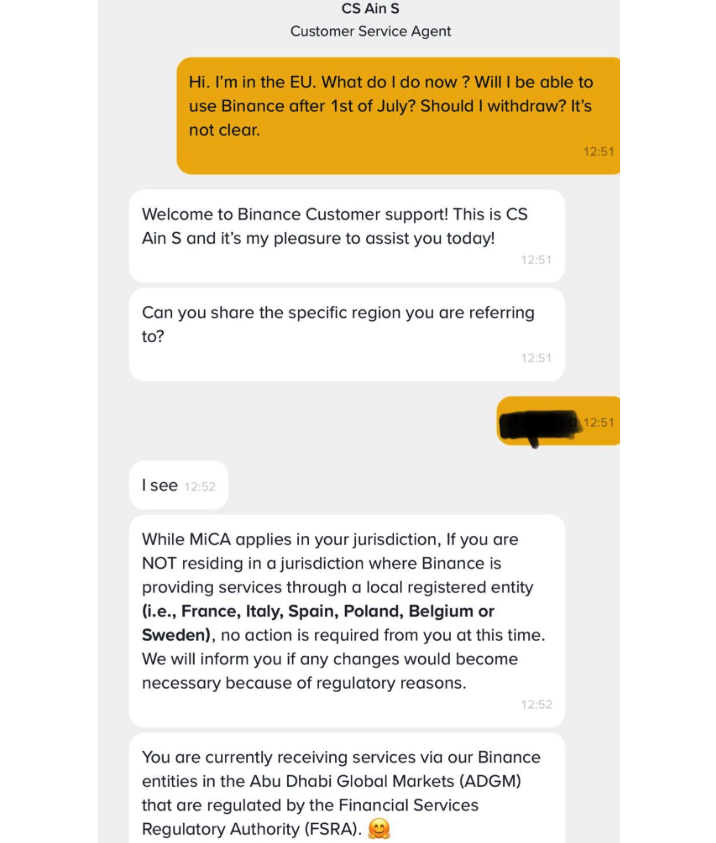
Screenshots of Binance customer support messages circulating on social media appeared to suggest that some EU users could be serviced through Binance’s Abu Dhabi Global Market entity.
Yuriy Brisov, a lawyer at Digital & Analogue Partners, said an Abu Dhabi license has no effect under MiCA because the jurisdiction is treated as a third country, alongside markets such as the United States or Singapore.
Source: Satoshi Club
“Being regulated in Abu Dhabi does nothing for Binance under MiCA,” Brisov said. “When Binance says some EU users are serviced through the ADGM entity, in MiCA terms that means a non-EU company is serving those users,” he added.
Related: Germany leads MiCA crypto authorization race as Europe’s deadline looms
Brisov said that the reverse solicitation exemption was designed for isolated cases where an EU customer independently approaches a non-EU company, not for maintaining an existing customer base built through years of marketing.
Binance did not respond to repeated Cointelegraph requests for clarification on whether any EU users would be serviced through its ADGM entity after the MiCA deadline.
Magazine: How crypto laws changed in 2025 — and how they’ll change in 2026

A former CEO of Goliath Ventures, Christopher Alexander Delgado, has entered a guilty plea in the U.S. Department of Justice’s cryptocurrency fraud case that prosecutors say relied on investor money to sustain promised returns. The DOJ said the scheme raised at least $400 million from investors through what it described as digital asset “liquidity pools,” with Delgado admitting to wire fraud conspiracy and related offenses.
According to the DOJ, Goliath marketed monthly returns between January 2023 and January 2026. Prosecutors contend that investor funds were not used as represented, but instead were diverted to pay earlier participants, handle withdrawal requests, cover personal luxury spending, and fund business events.
Key takeaways
- Delgado pleaded guilty to conspiracy to commit wire fraud, along with wire fraud and money laundering counts tied to the Goliath Ventures scheme.
- Prosecutors said Goliath promised monthly returns from crypto liquidity pools while using new investor money for withdrawals, payments, and expenses.
- The plea agreement states the scheme resulted in at least $250 million in investor losses and includes forfeiture of extensive luxury assets.
- Sentencing is scheduled for Oct. 8, with Delgado facing substantial prison time if convicted on the fraud and money laundering counts.
- The case has also raised questions about how financial institutions handled Goliath-related transactions, including litigation claims involving major banks and crypto custody.
What the DOJ says Delgado admitted
In a Tuesday announcement, the DOJ said Delgado pleaded guilty to a set of charges stemming from the cryptocurrency investment operation. Prosecutors described a program that promised regular returns using digital asset liquidity pools, spanning January 2023 through January 2026.
Delgado’s plea included admissions that the funds collected from investors were used for purposes inconsistent with the representations made to customers. The DOJ said money from the scheme went toward paying earlier investors and processing withdrawal requests, while also being used for luxury spending and to finance business events.
Under the plea agreement, Delgado admitted that investor losses linked to the scheme totaled at least $250 million. The agreement also requires forfeiture of a portfolio of luxury assets, according to the DOJ.
Forfeiture and sentencing exposure
The DOJ said Delgado agreed to surrender eight properties, 11 vehicles, and more than 50 luxury bags and wallets, along with at least 29 pieces of jewelry. The forfeiture list also includes bank accounts and crypto wallets identified by prosecutors.
From a potential punishment standpoint, the DOJ’s filing indicates that each fraud count carries up to 20 years in prison, while money laundering carries up to 10 years. Delgado’s sentencing has been set for Oct. 8.
Apology on television precedes the plea
Delgado’s guilty plea follows a public apology and television appearance that drew attention to the case. Earlier this year, on May 12, Delgado appeared in an interview with Florida television station WFTV, where he acknowledged he had let investors down and said he had returned to the U.S. and was cooperating with authorities.
In that interview, Delgado claimed that only about $160,000 remained in the company’s bank account at the time of his arrest. He also said other former colleagues were involved in the broader operation.
Scrutiny expands to banks and payment rails
Beyond Delgado’s plea, the Goliath case has drawn scrutiny regarding the financial institutions that processed transactions connected to the scheme. On March 12, investors reportedly filed a proposed class-action lawsuit against JPMorgan Chase, alleging that the bank ignored suspicious activity and allowed Goliath to route investor funds through its accounts.
That lawsuit, as described in earlier coverage, claimed that roughly $253 million moved through a JPMorgan account. It further alleged that about $123 million later transferred to Goliath’s wallets at Coinbase. A separate federal complaint, according to the DOJ, also identified flows involving Bank of America and transfers directly to Coinbase wallets.
For market participants and builders, these allegations underscore a recurring challenge in crypto markets: even when digital assets are involved, traditional banking channels can remain critical bottlenecks for detecting suspicious activity—or, if the system fails, for facilitating fraudulent structures.
With sentencing approaching on Oct. 8, investors and compliance professionals will likely focus on what the court order clarifies about the scheme’s mechanics, the scale of losses, and how payments moved between bank accounts and crypto wallets. The plea does not end the broader questions raised by parallel claims about financial institutions’ role, and future rulings could further shape expectations for safeguards across both traditional and on-chain settlement pathways.
Crypto World
FedEx (FDX) Shares Decline Nearly 4% Amid $1.4 Billion Logistics Unit Sale Negotiations

Key Highlights
- FDX shares declined 3.7% during Wednesday’s pre-market session following news of potential $1.4B Supply Chain unit divestiture
- CMA CGM, the globe’s third-largest container shipping operator, is identified as the prospective purchaser
- The company exceeded Q4 FY2026 expectations with earnings of $6.31 per share and revenue of $25.01B, reflecting a 12.5% annual increase
- Company insiders have divested 48,104 shares totaling approximately $17.6M in the previous quarter
- Analyst consensus points to a “Moderate Buy” rating with a mean price objective of $349.60
Shares of FedEx (FDX) experienced a 3.7% decline in Wednesday’s pre-market session, beginning trading at $313.44, following a Financial Times report indicating that negotiations to divest its third-party logistics division have reached an advanced phase.
The business unit under discussion is FedEx Supply Chain, responsible for warehousing operations, distribution services, and managing product returns. According to reports, CMA CGM, ranked as the world’s third-largest container shipping enterprise, stands as the potential acquirer.
Sources suggest the transaction carries an estimated valuation of approximately $1.4 billion.
This development represents another strategic step in FedEx’s initiative to concentrate on its primary air and ground transportation services. The logistics giant recently separated FedEx Freight (FDXF) into an independent trucking entity.
Divesting the Supply Chain business would further streamline FedEx’s operational structure and intensify its concentration on package delivery services.
Strong Quarterly Performance Amid Strategic Transitions
FedEx delivered impressive Q4 FY2026 financial results on June 23. The shipping giant reported earnings per share of $6.31, surpassing Wall Street projections of $5.91 by $0.40. Total revenue reached $25.01 billion, exceeding the consensus estimate of $24.04 billion and representing a 12.5% increase from the previous year.
FedEx also highlighted enhanced package volume metrics and ongoing cost reductions stemming from its comprehensive transformation initiative.
Stifel’s analyst J. Bruce Chan expressed optimism regarding continued enhancement in profit margins and asset efficiency.
Looking ahead to FY2027, FedEx has provided earnings guidance ranging from $16.90 to $18.10 per share. Wall Street analysts project an average of $20.89 in full-year earnings.
Notwithstanding the earnings outperformance, FDX shares have faced headwinds. The company’s transition to calendar-year financial reporting has introduced some investor ambiguity.
Notable Insider Transactions and Institutional Activity
Regarding insider activity, Executive Vice President Gina F. Adams divested 20,450 FDX shares on April 14 at a price of $366.45 per share, generating approximately $7.49 million in proceeds. This transaction reduced her holdings by 51%.
Board member Susan C. Schwab sold 5,795 shares the following day at $369.00 per share, totaling roughly $2.14 million — representing a 36.6% decrease in her ownership stake.
Cumulatively, company insiders have disposed of 48,104 FDX shares valued at approximately $17.6 million during the past 90-day period.
Institutional investor Janney Montgomery Scott reduced its FedEx holdings by 16.6% during Q1, selling 10,993 shares. The firm maintains ownership of 55,268 shares with an estimated value of $19.7 million.
Institutional investors control 84.47% of FedEx stock.
Wall Street analysts have recently adjusted their price projections. Truist reduced its target from $425 to $365 while retaining a Buy recommendation. Stifel decreased its objective from $442 to $326, also maintaining Buy. HSBC lowered its forecast to $289.89 with a Hold rating. Sanford C. Bernstein established a $397 target.
Morgan Stanley maintains the sole Underweight rating, projecting a $230 price target.
The prevailing Wall Street consensus stands at Moderate Buy, featuring an average price objective of $349.60.
FedEx’s 52-week trading range extends from a minimum of $172.88 to a maximum of $345.36. The equity’s 50-day moving average currently rests at $361.08.
A quarterly dividend distribution of $1.22 per share was issued on July 7, yielding 1.6%.

Artificial intelligence company Anthropic is set to restore public access to its most powerful AI models, Claude Fable 5 and Mythos 5, weeks after they were pulled offline under a directive from the US government.
Anthropic’s two latest models have been restricted from public access since June 12, when the government applied export controls following a report in which researchers bypassed Fable 5’s safeguards, forcing Anthropic to pull all access to the models immediately. The government lifted those restrictions on Wednesday, stated Anthropic.
“After a series of productive conversations with the US government, we’re redeploying the model with a new set of classifiers to target and block more cybersecurity tasks,” Anthropic said.
The suspension of the models raised concerns about state control over frontier AI technology and set a dangerous precedent, according to experts and technologists. The export controls also highlighted White House concerns about a potential national cybersecurity threat if these powerful models were jailbroken and used for malicious purposes.
Getting best tech deployed remains priority
US Secretary of Commerce Howard Lutnick said on X on Wednesday, “Over the past two weeks, we have worked closely with Anthropic to analyze and approve Fable 5 to ensure alignment across the US Government and to strengthen America’s leadership in AI.”
Meanwhile, White House Chief of Staff Susie Wiles said on X that government priority remains to “get the best [AI] tech deployed as quickly and safely as possible.”
Related: AI researcher claims he’s already bypassed Anthropic’s Fable 5 guardrails
The restrictions came after the government became aware of a report in which Amazon researchers found a method of bypassing Fable 5’s safeguards, prompting the model to identify several software vulnerabilities.
In a blog post, Anthropic argued this wasn’t a risk unique to Fable 5, as weaker models could also identify the same vulnerabilities and produce the same exploit.
AI jailbreak classifications proposed
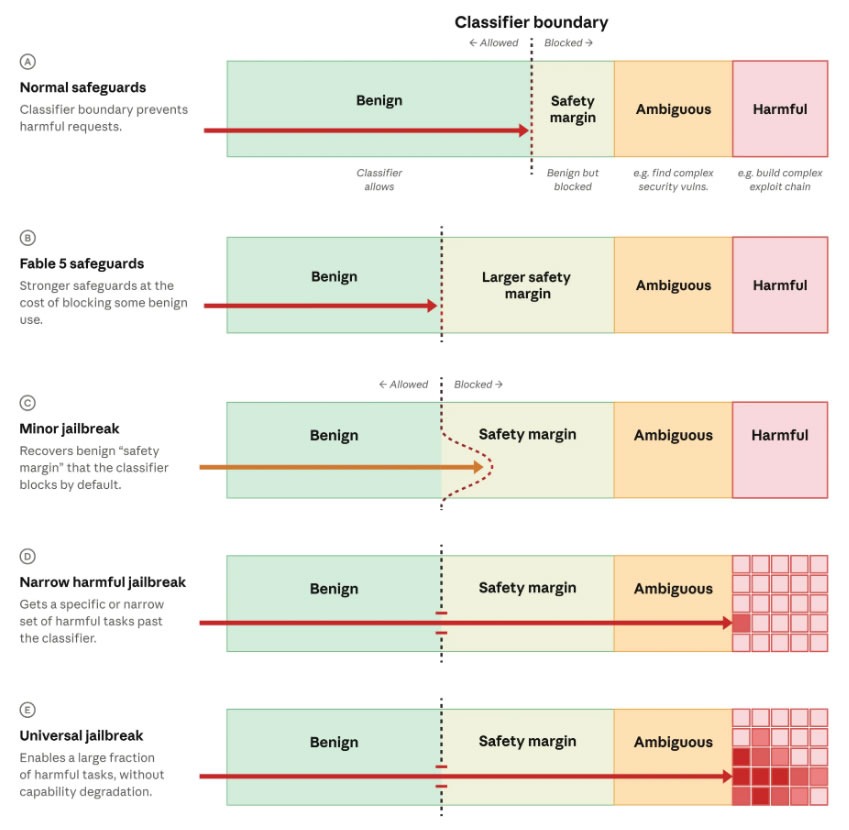
Anthropic has also begun drafting a consensus framework with Amazon, Microsoft, Google and other partners in its Project Glasswing — a collaboration announced in April to safeguard against AI cybersecurity threats — for “assessing the severity of AI jailbreaks.”
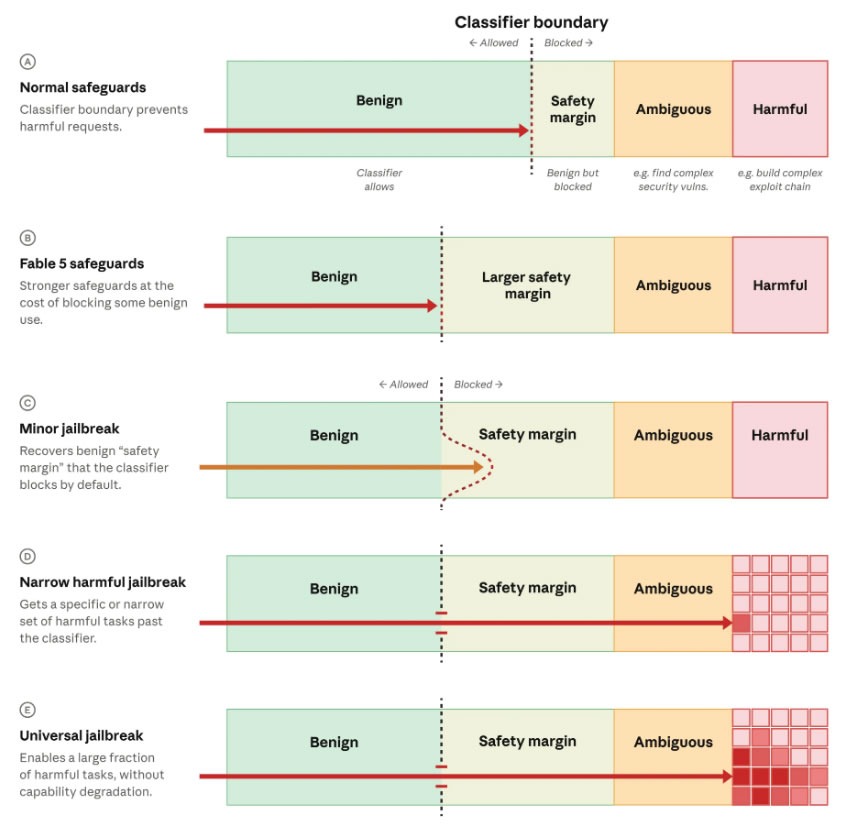
Anthropic’s cybersecurity safety classifiers and how jailbreaks interact with safety classifiers. Source: Anthropic
The company is also scaling up collaboration with the US government on AI model testing and safeguards. “This will include pre-release access to models and safeguards for evaluation, information sharing on jailbreaks and misuse, and dedicated resources for joint research,” it stated.
A well-known AI researcher claimed to have jailbroken Fable 5 within 48 hours of its launch in June, before the government restrictions, and shared screenshots showing how he bypassed the model’s safety guardrails.
Magazine: AI is banking the unbanked in Africa… faster than crypto
Crypto World
Bloom Energy (BE) Stock Surges 10% as Brookfield Quintuples AI Infrastructure Investment to $25B

Key Highlights
- Bloom Energy shares rose 10% during after-hours trading on July 1, 2026.
- Brookfield Asset Management expanded its financing pledge for Bloom-powered AI infrastructure from $5 billion to $25 billion.
- Capital originates from Brookfield’s AI Infrastructure Fund, focused on worldwide deployment of Bloom’s solid oxide fuel cell technology.
- Bloom’s current 2026 project roster features partnerships with Oracle and Nebius.
- BMO Capital maintained its Market Perform stance with a $279 target price, emphasizing the arrangement doesn’t translate to instant confirmed orders.
Bloom Energy shares experienced a 10% spike in extended trading hours on July 1 following the announcement that Brookfield Asset Management would dramatically expand their collaborative AI data center power initiative. Prior to the after-hours movement, shares were hovering near $302.70.
The partnership revealed that Brookfield plans to increase its financial backing for Bloom-equipped infrastructure from $5 billion to $25 billion — representing a 400% increase since the original agreement was established in late 2025.
Capital will be sourced from Brookfield’s AI Infrastructure Fund, designed to facilitate worldwide implementation of Bloom’s on-premises solid oxide fuel cell technology for data center applications.
This substantial expansion underscores accelerating requirements from hyperscale operators and AI developers seeking rapid, dependable power solutions that minimize grid dependency. Fuel cell technology delivers continuous, on-location energy generation — an increasingly attractive feature as AI computational demands escalate.
The partnership structure positions Brookfield as the financial provider with extensive global capabilities while Bloom furnishes rapidly deployable fuel cell systems. Their combined approach integrates power generation infrastructure directly into data center architecture.
Bloom’s Chief Commercial Officer Aman Joshi noted the increased commitment reflects the market’s accelerating pace, highlighting numerous large-scale AI power transactions. Brookfield’s AI Infrastructure division head Sikander Rashid characterized the expansion as reinforcing Brookfield’s position among leading global AI infrastructure investors, delivering comprehensive “end-to-end solutions, from electrons to tokens.”
Bloom’s Active 2026 Portfolio
The Brookfield partnership extension represents just one component of Bloom’s robust 2026 activity. The organization has secured a substantial agreement with Oracle and finalized a fresh partnership with Nebius — contributing to an increasingly active project pipeline.
Brookfield’s AI Infrastructure Fund, established in 2025, targets deployment of $100 billion across AI facilities, energy systems, computing infrastructure, and associated capital investments. The company maintains over $100 billion in existing digital infrastructure and renewable energy investments.
BMO Capital clarified the $25 billion commitment shouldn’t be interpreted as confirmed immediate backlog. Rather, it establishes a programmatic financing framework that reduces capital barriers for clients and may accelerate implementation timelines.
BMO presented three potential demand projections for Bloom, spanning 2.4 gigawatts to beyond 5.0 gigawatts of possible deployment, contingent on structural arrangements, tax considerations, and revenue composition.
Analyst Perspectives
BMO confirmed its Market Perform assessment and $279 target price on July 1. While recognizing the deal demonstrates increasing institutional trust in Bloom’s position within AI infrastructure, the firm maintained its current rating given the nascent stage of large-scale solid oxide fuel cell implementation.
The Street’s overall consensus stands at Moderate Buy, reflecting nine Buy recommendations and 10 Hold ratings. The mean price target reaches $269.42.
Bernstein SocGen Group initiated coverage recently with a Market Perform designation and $276 price objective. UBS maintains a Buy recommendation, referencing regulatory modifications enabling faster connection of major energy consumers to the national transmission infrastructure.
Bloom’s board additionally authorized a performance-linked restricted stock unit award for CEO Dr. KR Sridhar, with vesting conditions connected to revenue milestones spanning July 1, 2026, through December 31, 2029.
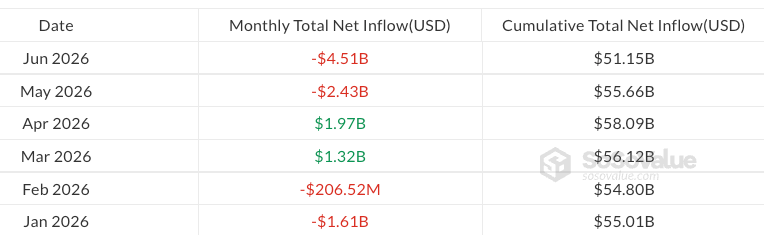
US-listed spot Bitcoin exchange-traded funds (ETFs) posted a record $4.5 billion in net outflows in June, more than three times the $1.25 billion Strategy is authorized to raise through its new Bitcoin monetization program.
The record monthly withdrawals pushed US spot Bitcoin ETFs to roughly $5.5 billion in year-to-date net outflows for 2026, reducing cumulative net inflows since the funds launched to about $51.2 billion, according to SoSoValue data updated on Wednesday.
BlackRock’s iShares Bitcoin Trust (IBIT) accounted for about 79% of June’s withdrawals, posting $3.55 billion in net outflows, according to Farside Investors.
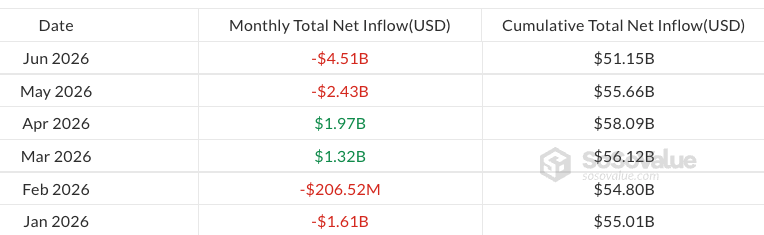
Monthly flows in US-listed spot Bitcoin ETFs. Source: SoSoValue
The figures highlight weakening demand for US spot Bitcoin ETFs, despite much of the market’s attention remaining fixed on developments surrounding the industry’s largest corporate Bitcoin treasury company.
Bitcoin ETF holdings fall below year-ago levels despite higher inflows
According to SoSoValue, cumulative net inflows into US spot Bitcoin ETFs have risen 4.6% from about $49 billion a year earlier. But CryptoQuant data shows the funds now hold less Bitcoin than they did at the same time last year.
“US-based Bitcoin ETF holdings are now lower than at this same day last year,” CryptoQuant’s head of research Julio Moreno wrote on X on Tuesday.
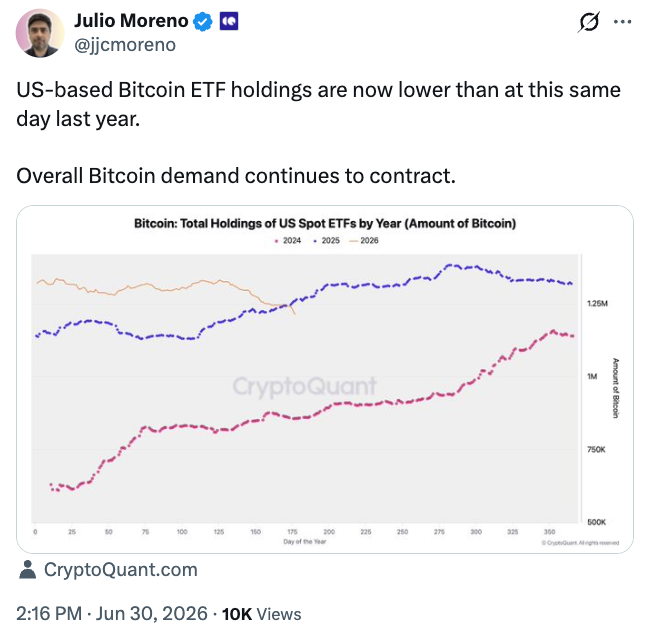
Source: Julio Moreno
Moreno said overall demand for Bitcoin continues to weaken, with total holdings across US spot Bitcoin ETFs falling below 1.25 million BTC.
Related: Swan’s Cory Klippsten sees record Bitcoin holder supply revealing early bottom
ETF withdrawals dwarf Strategy’s Bitcoin plan
Strategy announced its Bitcoin monetization program on Monday as part of a broader capital framework designed to support dividend obligations tied to its preferred securities, a move widely viewed by investors as a response to growing funding pressure within the company’s structure.
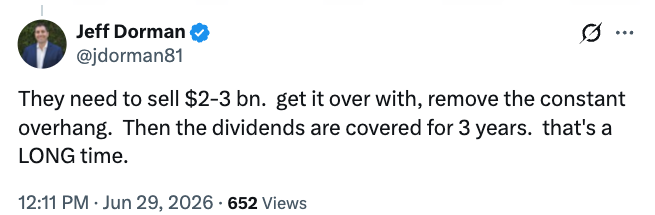
Source: Jeff Dorman
The move drew mixed reactions across the community, with some viewing it as financial flexibility while others flagged concerns over the new capital structure’s long-term sustainability and argued it could ultimately sell much more than $1.25 billion.
Strategy’s Class A common stock (MSTR) initially surged as much as 12% to above $90 following Monday’s announcement before reversing course and closing at $86.93 on Tuesday, down 6.2% on the day, according to Yahoo Finance.
Meanwhile, Strategy’s preferred stock (STRC) traded higher at $84.86 on Tuesday, according to Yahoo Finance.
Magazine: Bitcoin slides to $58K, XRP hits $1 but onchain data promising: Market Moves
June was brutal for the primary cryptocurrency, with its price crashing about 20% over the month. And even though July is usually a strong period for BTC, this one kicked off poorly, and the asset continues to trade well below $60,000.
Several altcoins have mimicked the move, posting additional losses, while Cardano (ADA) is among the few daily gainers.
BTC Under Pressure
The asset has been in a steep decline lately, driven by several key factors, including the prolonged bear market affecting the entire crypto sector, waning interest from institutional investors, uncertainty stemming from the conflict in the Middle East, and more.
Yesterday (June 30), BTC tried to reclaim the psychological level of $60,000, but the bulls quickly lost control, and the price started another downturn. As of this moment, it trades at around $58,900 (per TradingView), representing a 1.5% decline on a daily scale.
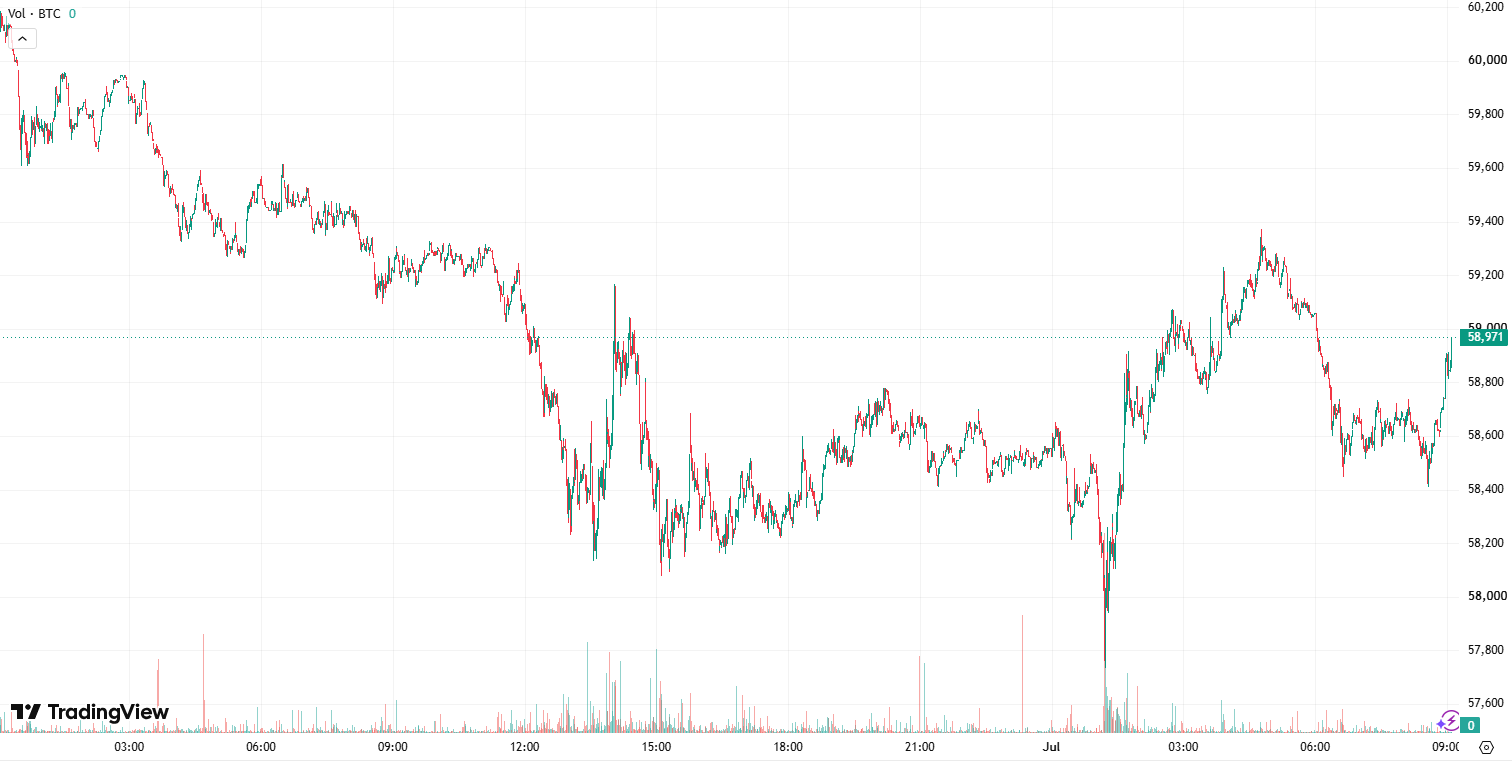
July has historically been a strong month for Bitcoin, and we have yet to see whether it could deliver a long-awaited revival in the weeks ahead. At the same time, many bearish signals point out to the possibility of a further pullback, while analysts believe the cycle’s bottom has not arrived yet.
Following the latest price slump, BTC’s market capitalization has dropped to approximately $1.18 billion, while its dominance over altcoins remains over 56% on CG.
ADA Re-Enters the Top 20 Club
Many alternative coins have followed BTC’s footsteps, registering mild declines over the last 24 hours. Ethereum (ETH) is down 0.5% for the day, whereas Hyperliquid (HYPE) has lost 2% of its valuation. LAB (LAB) is the worst-performing cryptocurrency from the top 100 list, posting a loss of 27%, with Audiera (BEAT) coming next at -7%.
Still, some have defied the bearish conditions. Cardano’s ADA has risen by 4% and reclaimed $0.15. Its market cap surged past $5.6 billion, meaning the token is once again among crypto’s 20 largest cryptocurrencies.
Other altcoins flashing in green today (July 1) include WBT (+15%), JPT (+13%), XLM (+12%), CC (+5%), and more. The total crypto market capitalization has remained rather unchanged at around $2.1 trillion.

The post Bitcoin (BTC) Starts July Under $60K, Cardano (ADA) Finally Rebounds: Market Watch appeared first on CryptoPotato.

West Lothian man rushed to hospital as ‘stabbing’ sees Co-op taped off
Tesla registrations in Spain climb 5.6% in June

Taiwan Advances Crypto Regulation With New VASP and Stablecoin Framework





-

 Fashion5 days ago
Weekend Open Thread: Staud – Corporette.com
-

 Politics5 days ago
The House | Manchesterism won’t survive the painful trade-offs unless it gets citizens on board
-

 Crypto World1 day ago
Strategy authorizes up to $1.25B in Bitcoin sales under new capital plan
-

 Politics5 days ago
Potential 2028er World Cup attendee leaderboard
-

 Business5 days ago
Asia stock markets slide as tech shares slump
-

 News Videos3 days ago
MAJOR BITCOIN & MARKET UPDATE!!!! (MUST WATCH ASAP!!!)
-

 Tech6 days ago
A Look At A Gaggle Of Transputer Boards
-
 Crypto World6 days ago
Dell (DELL) Shares Tumble Over 5% Following Analyst Downgrade to Hold
-

 Crypto World4 days ago
Coinbase, Circle Deepen Crypto Stock Losses Despite Resilient S&P 500
-

 Business1 day ago
Australia treasurer says alleged access of prime minister’s bank data ’incredibly concerning’
-

 Crypto World4 days ago
Kraken's xStocks Opens Bending Spoons IPO Registration to EEA Retail
-

 Sports5 days ago
FIH Pro League: India defeat Pakistan 7-1, register biggest win of campaign | Other Sports News
-

 Crypto World5 days ago
Bitcoin Sparks $600M Hourly Liquidations With $65,000 Set To Become Resistance
-

 Tech3 days ago
Bluekit phishing kit adopts browser-in-the-middle for login theft
-

 Tech4 days ago
Russian hackers now target Signal backup recovery keys
-
 Crypto World5 days ago
Hyperliquid Named on Singapore MAS Investor Alert Register
-

 Crypto World6 days ago
Ripple and SBI launch RLUSD in Japan after JFSA approval
-

 Crypto World5 days ago
RTX holders must register wallets before token distribution begins
-

 Tech1 day ago
Anonymous researcher drops 0-day ‘exploitarium’ repo
-
 Business2 days ago
The AI boom won’t burst all at once. It will pop in ‘rolling bubbles’: Macquarie
You must be logged in to post a comment Login