

Business
Accenture: One Of The Most Attractive Valuations I Have Ever Seen (NYSE:ACN)



For almost a decade, I held research analyst positions in various investment firms, mostly in Toronto. I started in sell-side research with a Canadian bank, then moved to a hedge fund, followed by a family office and then finished my career in wealth management. I was 20 on my first day on Bay Street. I will forever remember. I had worked so hard to get there, from a small French-speaking town in Québec. Getting my CFA and CAIA designations by 25 was another important milestone. I was a young man with a dream, wanting to make it big. However, life was about to teach me a painful lesson. Before conquering the world, a man must first conquer himself by going into the depths of his own abyss. Only then may he shed his naivety and become a man truly able to love.For the last four years, I have been living in a yurt in the boreal forest, approximately 100 kilometres away from the closest paved road or grocery store. In a forest full of birds, just beside a lake full of fish. For water, I go to the creek. For heat, there is plenty of white birch and quaking aspen around. If I need anything in town, I have plenty of money for my needs. I am now 30, in love, and as free as the birds in the skies, so what else can I ask for? In all humility, and in all gratitude, I say thank you to this grandiose symphony we call life.
Analyst’s Disclosure: I/we have a beneficial long position in the shares of ACN either through stock ownership, options, or other derivatives. I wrote this article myself, and it expresses my own opinions. I am not receiving compensation for it (other than from Seeking Alpha). I have no business relationship with any company whose stock is mentioned in this article.
Seeking Alpha’s Disclosure: Past performance is no guarantee of future results. No recommendation or advice is being given as to whether any investment is suitable for a particular investor. Any views or opinions expressed above may not reflect those of Seeking Alpha as a whole. Seeking Alpha is not a licensed securities dealer, broker or US investment adviser or investment bank. Our analysts are third party authors that include both professional investors and individual investors who may not be licensed or certified by any institute or regulatory body.


More members of limited liability partnerships could soon be taxed as employees rather than as genuine partners, pushing up their income tax bills and, crucially, exposing their firms to employer National Insurance, after HM Revenue and Customs secured a decisive win at the Supreme Court.
The long-awaited judgment in the BlueCrest Capital Management case has landed and, as widely expected across the tax profession, it has gone HMRC’s way. The decision opens the door for the taxman to treat a far wider pool of LLP members as employees, and it lands at a moment when payroll taxes are already a running sore for British business.
Sean Drury, head of tax at audit, tax and business advisory firm Blick Rothenberg, said the ruling was significant well beyond the hedge fund at the centre of it. “This opens the way for more limited liability partnership members to be treated as employees instead of true partners of the business, leading to an increased income tax and National Insurance burden,” he said.
The salaried members rules, introduced by the Finance Act 2014, set three tests, Conditions A, B and C, that determine whether an LLP member is taxed as a self-employed partner or as an employee. The Supreme Court trained its attention on the first two, and in doing so tightened the definitions considerably.
Condition A is the “disguised salary” test. As Drury explained, “If 80 per cent or more of a member’s pay is a fixed monthly salary or a bonus, or linked to personal and divisional performance rather than the overall profit of the LLP, HMRC deems this a disguised salary and therefore that this person should be taxed as an employee.”
Condition B turns on “significant influence”. A partner in a traditional partnership is integral to the business and has a genuine say in how it is run. Someone who merely works within it does not. “Therefore this person should be treated as an employee for tax purposes,” Drury said. Currently, partners are usually taxed as self-employed individuals, so the reclassification is far from academic.
The headline for most firms will not be income tax but National Insurance. Employers now face a 15 per cent employer NIC charge, and applying that to reclassified members’ remuneration is, in Drury’s words, “a significant win for HMRC”.
It may also prove to be the thin end of the wedge. “It may lay a path towards the general application of National Insurance to LLPs, as was widely speculated before the last Budget,” Drury said. That speculation has only intensified as the Treasury leans ever harder on payroll taxes, with employers already shouldering a record National Insurance bill following the rate rise and threshold cut.
LLP structures are commonplace across the professional and financial services sector, from law firms and accountancy practices to asset managers. That is precisely why the reach of this judgment matters.
“The implications of this judgment, not least in HMRC compliance activity, will be significant, and structures which relied on Condition A or Condition B alone will need to review and probably restructure to comply,” Drury warned. Firms that built their partner arrangements around passing just one of the two tests may now find that cushion has gone.
Condition C, which concerns a partner’s contribution to partnership capital, was not addressed by the Supreme Court because it was not relevant to the appeal. Drury expects it to move squarely into HMRC’s sights next. “Capital contributions will need to be genuine contributions of capital at the economic risk of the partner and meet the minimum 25 per cent of expected disguised salary rule,” he said, adding that arrangements underpinned by loans should expect particular scrutiny.
For firms weighing up whether to operate as a partnership, LLP or limited company, the calculus has shifted. Larger LLPs in particular are likely to find that Conditions A and B are now harder to satisfy for their current members, and Drury believes further litigation is a real prospect. “We may see a ‘BlueCrest 2’ appear at the First-tier Tribunal shortly,” he said.
The practical message is to act before HMRC does. With the taxman already sharpening its focus on aggressive planning, partnerships that have leaned on a single condition would be wise to review their member arrangements, capital contributions and profit-sharing mechanics now, rather than wait for a compliance letter to force the issue.

Amy Ingham
Amy is a newly qualified journalist specialising in business journalism at Business Matters with responsibility for news content for what is now the UK’s largest print and online source of current business news.

The company said the promoter group’s 4.97% stake addition during the quarter marks the latest step in a multi-year increase in promoter ownership. Promoter holding has risen from around 26% in FY19 to about 37% in FY25, 41.75% in FY26 and now 46.72% in Q1FY27.
According to the company, the increase in promoter shareholding reflects continued confidence in its long-term strategy, business model, governance, execution capabilities and its focus on delivering technology-enabled credit to MSMEs, micro-enterprises and underserved borrowers across Bharat.
Paisalo said its three-year roadmap targets doubling its assets under management (AUM), total income and profit after tax (PAT), while maintaining disciplined risk management and asset quality. It added that the company is transitioning from a “High Touch-High Tech” model to a “Fin AI”-led lending franchise by integrating artificial intelligence across customer acquisition, underwriting, risk assessment, portfolio monitoring and collections.
The company said its long-term growth strategy rests on four pillars. It plans to deepen the use of AI and machine learning across underwriting, fraud detection, early warning systems and collections, while maintaining asset quality through disciplined credit selection, robust collections infrastructure and real-time monitoring.

Paisalo also aims to expand its distribution network beyond its existing 5,299 touchpoints across 22 states and Union Territories, while scaling its MSME and micro-enterprise lending business, broadening its product portfolio, improving operating leverage and diversifying its liabilities to optimize the cost of capital.
Commenting on the development, Deputy Managing Director Santanu Agarwal said the increase in promoter shareholding to 46.72%, including the 4.97% addition during the quarter, reflects the promoters’ long-term confidence in Paisalo’s growth journey. Also read: Why KPIT Tech shares crashed today? The BMW & Volkswagen connection explained
He added that the company remains focused on building an AI-led and risk-disciplined lending franchise with responsible growth, technology-led underwriting, deep distribution, strong governance and asset quality, while pursuing its roadmap to double AUM, income and PAT.
(Disclaimer: Recommendations, suggestions, views and opinions given by the experts are their own. These do not represent the views of The Economic Times)
Business
LeBron James Is Officially a Free Agent and Open to Hearing From All 30 Teams, His Camp Confirms Today

LeBron James is officially a free agent, and according to his representatives, he is prepared to hear from every team in the NBA before making his decision on where he will play next season, a posture that opens what could become the most wide-ranging free agency process of the 41-year-old’s career.
LeBron James has instructed Rich Paul to talk to everyone around the league who is interested in him playing for them and come back to him with what the options are so he can make his decision, a source familiar with James’ thinking told ESPN’s Dave McMenamin. DraftKings Sportsbook
That directive effectively transforms the NBA’s opening week of free agency into a league-wide audition, with front offices from Atlanta to Washington now free to make their case for one of the greatest players in the sport’s history. The question is no longer simply which team LeBron will choose, but which of the 30 available pitches actually resonates.
The Golden State Warriors remain among the most discussed potential destinations. The team’s front office has been openly pursuing both LeBron and Washington Wizards center Anthony Davis, with Draymond Green’s decision Monday to decline his player option creating additional financial flexibility for the pursuit. The pitch from Golden State centers on a concept LeBron and Curry already tested together, winning gold at the 2024 Paris Olympics under current Warriors head coach Steve Kerr.
Cleveland has a compelling case that writes itself. LeBron grew up within an hour of the city, began his professional career there and delivered the franchise its only NBA championship with a comeback from 3-1 down against the Warriors in 2016. The current Cavaliers roster features Donovan Mitchell, Evan Mobley, Jarrett Allen and a returning James Harden, giving James a championship-caliber supporting cast and a clear positional fit at forward with a team that reached the Eastern Conference Finals last season.
The New York Knicks, the league’s reigning champions after ending a 50-plus-year title drought this past season, offer a different version of the same appeal: a ready-made title contender. LeBron would fit seamlessly into the Knicks’ switch-heavy wing rotations alongside OG Anunoby, Mikal Bridges and Josh Hart, and his playmaking would reduce the burden on Jalen Brunson while giving a team that already won a championship an even more formidable roster heading into next year.
San Antonio offers what may be the most forward-thinking narrative available to any team. Victor Wembanyama has emerged as the clear heir apparent to LeBron’s status as the face of the league, and the Spurs have surrounded the French center with a talented, young core in Dylan Harper, Stephon Castle and De’Aaron Fox. A single season pairing LeBron with Wembanyama, with LeBron serving simultaneously as a championship-caliber veteran presence and as a living bridge between the sport’s present and its near future, carries the kind of generational significance that has always appealed to James at key junctures of his career.
The Miami Heat, where LeBron won two of his four NBA championships, offer a reunion wrapped in unfinished business. The Heat now feature Giannis Antetokounmpo alongside Bam Adebayo following the blockbuster trade that sent Giannis from Milwaukee to South Beach earlier this offseason, giving Miami the kind of star-powered core that LeBron has always sought when evaluating potential moves. The spacing concerns of a James-Giannis-Adebayo lineup are real, but three elite passers sharing the floor creates enough offensive flexibility to work around them.
The Detroit Pistons, perhaps the most unexpected name near the top of any legitimate LeBron discussion, offer a pitch rooted purely in winning. Cade Cunningham is one of the league’s better point guards and would absorb the primary ball-handling duties that have become increasingly physically taxing for a 41-year-old LeBron. The Pistons’ roster is filled with aggressive, physical defenders who could cover for any defensive decline from James, and the team is close enough to contention that LeBron might not need to carry the scoring load the way he has at nearly every prior stop.
Oklahoma City, built around Shai Gilgeous-Alexander’s already established status as arguably the game’s best player, offers LeBron a scenario where the defensive attention flows toward someone else. SGA and Jalen Williams command enough defensive focus that LeBron could exist as a secondary offensive option while still controlling the game’s pace and facilitating for teammates, a role increasingly suited to his current physical stage.
The Toronto Raptors have acquired Kawhi Leonard from the Clippers and are building toward a deep Eastern Conference run. LeBron filling the role of primary playmaker alongside Leonard, Scottie Barnes and Collin Murray-Boyles would give Toronto legitimate Finals aspirations, though the irony of LeBron joining the same Raptors he repeatedly eliminated in the playoffs during his Cleveland and Miami years is not lost on anyone in the league.
The Washington Wizards have made their pitch by acquiring both Trae Young on a four-year, $212 million extension and first overall pick AJ Dybantsa. The team also still has Anthony Davis on the roster, the same Davis who helped LeBron win his most recent championship with the Lakers in 2020, making Washington’s pitch a reunion-and-rebuild hybrid that could appeal to James on both competitive and legacy grounds if the Warriors fail to land both players.
For his part, LeBron is said to be genuinely open-minded, unwilling to commit to any destination until he has canvassed the full landscape, and focused on identifying the situation that gives him the clearest path to a fifth championship ring rather than settling for loyalty, geography or narrative alone. The process of working through 30 pitches, with Rich Paul serving as the intermediary between James and every interested front office, is expected to unfold rapidly over the first week of free agency, with most observers expecting a decision before the end of next week regardless of how wide the initial net is cast.
A worker at Ford’s Kentucky Truck Plant on April 30, 2025.
Michael Wayland | CNBC
The U.S. automotive industry is entering a new phase of uncertainty as the USMCA trade agreement between the United States, Mexico and Canada is not expected to be extended by Wednesday, triggering what could be a yearslong review process or an expiration of the pact if no deal is reached by 2036.
The United States-Mexico-Canada Agreement, which replaced the North American Free Trade Agreement, was established during President Donald Trump‘s first term in 2020, but the administration has soured on the deal that governs roughly $2 trillion annually in goods and services between the three countries.
The auto industry represented about 18% of America’s trading with its neighboring countries last year, according to industry data, making it one of the key sectors in the discussions. Automakers and others watching the talks are concerned that reopening the deal could create additional trade uncertainty that leads to lower investments and fewer jobs.
“If we let this go on for a very long time, it’s very painful for everyone,” said Diego Marroquín Bitar, a fellow at the Washington, D.C.-based think tank Center for Strategic and International Studies. “That’s the last thing that the region needs.”
There’s also concern that the U.S. could pull out of the deal amid aggressive negotiation tactics by the Trump administration involving tariffs, trade and other issues.
The United States, Mexico and Canada could have agreed to a 16-year extension by Wednesday, but are not expected to meet that deadline. That opens up an annual review process instead.
U.S. officials had previously said they did not plan to extend the pact, as American representatives push for additional domestic investment and benefits under the deal.
U.S. Trade Representative Jamieson Greer in May said the U.S. wants to strengthen North American rules of origin “in a way that enhances U.S. content in these goods” to boost domestic manufacturing.
Bitar also said the Trump administration’s public discussions have been wide-ranging, touching on non-trade issues such as immigration, crime and other connections, which could make this round of talks more challenging than when USMCA was established.
“Everything is on the table. Not just the trade issues,” Bitar said. “The more things on the table, the longer it takes to negotiate and the more uncertainty it will generate.”
USMCA 2.0 auto expectations
The U.S. automotive industry has already dealt with a lot of uncertainty this decade, from pandemic production stoppages and supply chain shortages to ongoing changes to tariffs and other regulations. Now it’s bracing for the expected reopening of USMCA talks.
It’s not clear whether vehicles that meet compliance measures for the U.S. would continue to face tariffs, which Trump has used aggressively during his presidency as leverage in negotiations and to promote domestic production.
“All chips are on the table,” Aakash Arora, an automotive expert, partner and managing director at Boston Consulting Group, told CNBC. “But what is clear across all scenarios being discussed is No. 1: higher content from the U.S.”
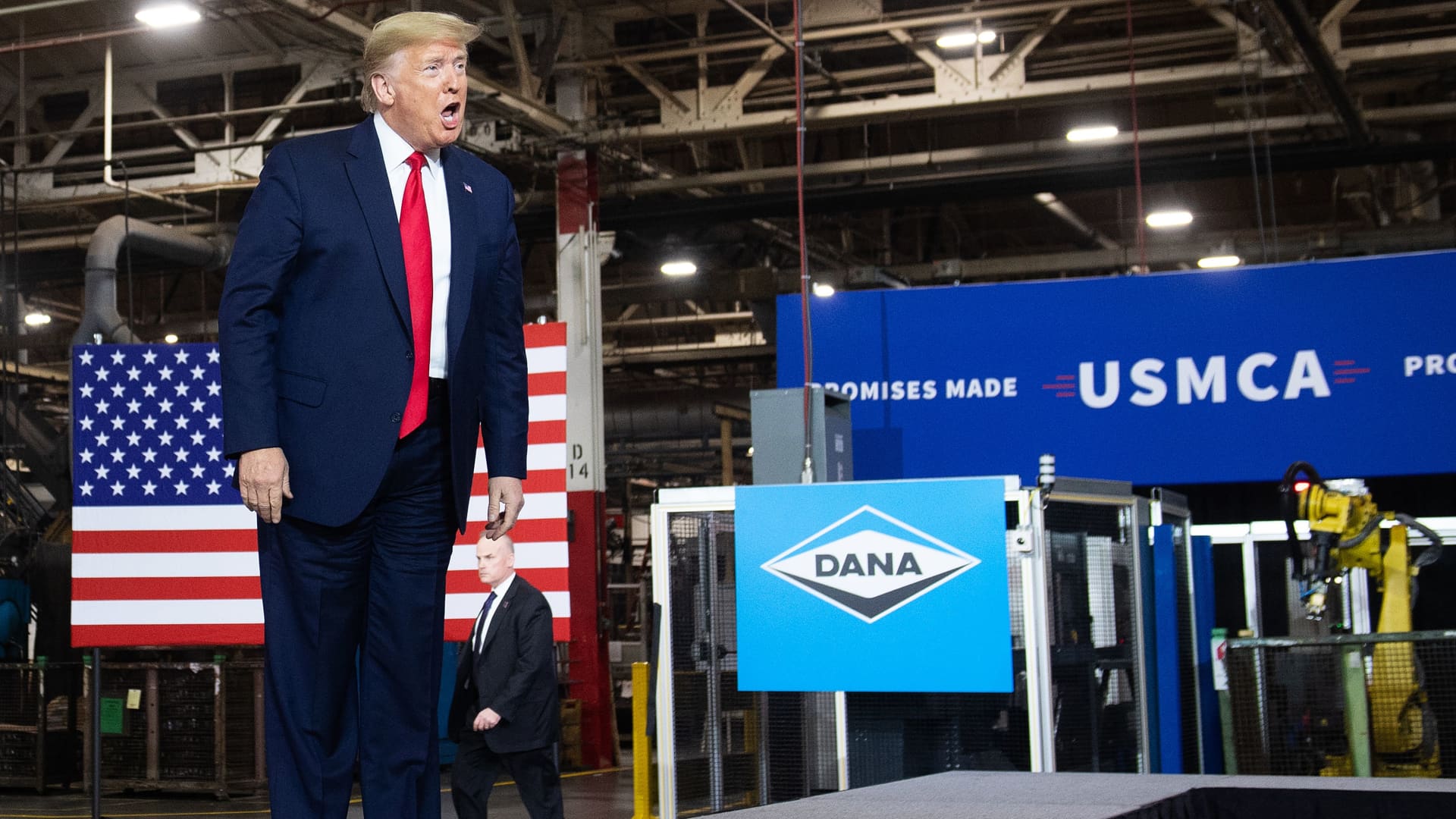
US President Donald Trump arrives to speak about the United States – Mexico – Canada agreement, known as USMCA, during a visit to Dana Incorporated, an auto supplier manufacturer, in Warren, Michigan, January 30, 2020.
Saul Loeb | Afp | Getty Images
Automakers operating in the U.S. would like the deal to remain an agreement between the three countries that “strengthens, rather than fragments, this critical economic foundation” for North American trade, according to a letter to Greer from leaders of the largest automotive trade groups in the U.S.
“We support U.S.-Mexico bilateral engagement and encourage trilateral discussions to support an efficient and effective review that will ultimately extend USMCA as a trilateral agreement,” the organizations that represent the vast majority of U.S. automakers, suppliers and dealers wrote May 7.
The trade groups have argued that companies have spent billions of dollars to address current USMCA standards and that many auto companies are already investing more in the U.S.
USMCA has driven $182 billion in North American investment, 86% of which has been announced for the U.S., according to U.S. automotive lobbying group data.
Across the northern border, Flavio Volpe, president of Canada’s Automotive Parts Manufacturers’ Association and a member of the Canadian prime minister’s council on Canada-U.S. relations, said he is optimistic a deal could be hammered out by fall.
“I’m bullish on where we’re headed,” he told CNBC during a phone interview Monday, citing increased discussions and public comments. “There are real issues on the table but, in my opinion, none of [those] are insurmountable.”
Rules of origin
One major issue for automakers and others in the industry is the deal’s rules of origin, which determine what country a product comes from and which goods are eligible for preferential treatment, such as reduced tariffs or duty-free trade.
The U.S. automotive market has expanded into Canada and grown its presence strongly in Mexico on the basis of free trade in North America since NAFTA was initiated in 1994. That has led to a large proportion of parts and vehicles traversing borders before being assembled in one of the countries.
USMCA currently requires 75% “regional value content” for passenger vehicles and light trucks be sourced from North America. The Trump administration reportedly wants to increase that level to 82%, with 50% of that value produced in the U.S.
Detroit, Michigan, 8 February 2026, President Donald Trump is threatening not to let the new Gordie Howe International Bridge open unless the U.S. is given half ownership.
Jim West | Universal Images Group | Getty Images
There is currently no requirement to separate the parts content between what’s made in the U.S. and what’s made in Canada. The new rules would require such a distinction, which would mean setting up new processes.
“The regional value content is what people are talking about a lot, but really it’s the U.S. content that’s going to matter,” said Mark Wakefield, a partner and global automotive market lead at consulting firm AlixPartners. “Some of these don’t even really have a plan as to how to even do them, and so it’s going to be a bumpy road, and a fairly expensive road.”
AlixPartners estimate there’s an up to 20% premium to move a product from Mexico to Canada and up to 50% increase in costs for moving some parts from China into the U.S.
BCG also argues that setting the standards too high could cause some companies to actually produce less in the U.S. Instead of striving to meet the standards, it said automakers could instead focus on producing vehicles with the least expensive parts outside of the U.S. to reduce the declared value of the vehicles for import to a level where paying tariffs on a less expensive product would still be financially beneficial.
“In that case, we do not get additional U.S. content,” Arora said. “It’s not a small lift, and because it’s not a small lift, there might be some unintended consequences.”
Roughly a dozen vehicles, including some single models, meet the current 75% threshold. None are at 80%, with the Volkswagen ID.4 all-wheel-drive Pro at 76% U.S./Canadian content topping the 2026 model year list of parts content published by the National Highway Traffic Safety Administration.
Automotive executives have said it would take years and billions of dollars in investments to onshore production to ensure vehicles sold in the U.S. have more American content. They’ve also argued that the U.S. may not be equipped to handle the collection and processing of some parts and raw materials.
S&P Global Mobility has said there are on average 20,000 parts in a vehicle when it’s torn down to its nuts and bolts. Parts may originate in anywhere from 50 to 120 countries.
BCG’s Arora noted one way to potentially boost the U.S. content could be to include the origin software, which is a growing part of new vehicles, in the rules of origin. That would help increase the percentage of a vehicle that qualifies as U.S. content, he said.
One of the U.S. government’s main goals is to improve production in the states, but also it’s looking to move the American automobile supply chain away from China. China has been rapidly expanding outside of its home base to flood markets with more affordable, subsidized vehicles in South America and Europe.
AlixPartners said it believes the ideal outcome for USMCA 2.0 would be to focus on competitiveness with China rather than Mexico or Canada, minimize the costs added to U.S. vehicles and support company investments, among other things.
“People have talked about sort of ‘fortress America’ and … it really needs to be North America,” Wakefield said. “[If] really the goal is to face off against China, then it doesn’t really make sense to be focusing so much on U.S. versus Mexico and Canada.”
Business
Supreme Court Rejects Trump’s Birthright Citizenship Order 6-3, President Vows to Fight It in Congress

WASHINGTON — The Supreme Court handed President Donald Trump a significant constitutional defeat Tuesday, voting 6-3 to strike down his executive order attempting to end birthright citizenship, with Chief Justice John Roberts writing for the majority that the Fourteenth Amendment’s guarantee of citizenship at birth reflects a promise rooted in the nation’s founding that the court was obligated to uphold.
Trump responded quickly and defiantly, brushing aside the ruling as a setback rather than a final verdict, and immediately pivoting toward a legislative strategy to accomplish through Congress what the court had refused to let him achieve by executive order.
“The Supreme Court upheld Birthright Citizenship, which is too bad for our Country, but we can easily make it up in Congress through Legislation, with the support of the President, that has now been determined during this process,” Trump wrote on his social media platform shortly after the ruling was issued.
He followed that post with a more specific call to action, urging Congress to begin work immediately on a legislative alternative and explicitly dismissing the constitutional amendment route as unnecessary.
“No long and unwieldy Constitutional Amendment is necessary,” Trump wrote. “Congress should start TODAY to work on ending expensive and unfair to our Country, Birthright Citizenship.”
Roberts, writing on behalf of the court’s majority, grounded his opinion in the text and history of the Fourteenth Amendment, which was ratified in 1868 following the Civil War and extended citizenship to all persons born on American soil. The chief justice characterized citizenship not merely as a legal status but as a foundational right rooted in the nation’s political identity.
“Citizenship, then and now, was the right to have rights — to freely participate in our political community,” Roberts wrote. “The Framers of the Fourteenth Amendment extended that promise to every free-born person in this land. We keep that promise today.”
The ruling struck down the executive order Trump signed on his first day back in the presidency, which had directed federal agencies to stop recognizing as citizens the American-born children of parents who are in the country illegally or on temporary visas. That order had been challenged almost immediately in federal court, with multiple district courts and federal appeals courts blocking its enforcement before the case reached the Supreme Court. Tuesday’s ruling represented the court’s definitive resolution of the constitutional question, concluding that the president lacked the authority to redefine birthright citizenship through executive action.
Birthright citizenship is embedded in both the Constitution and in the Nationality Act of 1940, which codifies into statute the principle that a person born in the United States and subject to its jurisdiction is a citizen from birth. Legal scholars watching the case had widely predicted that even if Congress were to pass legislation narrowing or eliminating birthright citizenship, such a law would almost certainly face immediate constitutional challenges that would return the issue to the Supreme Court, since any statute that conflicts with the Fourteenth Amendment would itself be subject to judicial review.
Trump acknowledged the legal reality Monday, saying he would accept the Supreme Court’s decision and recognized the court’s authority to issue a final ruling. Tuesday’s defiant posts, however, suggested the president had no intention of treating the ruling as a permanent resolution of his policy objectives on the issue.
House Speaker Mike Johnson, speaking to reporters at a House Republican news conference before Trump’s posts appeared, reflected a broadly shared sense of frustration within the Republican caucus about the court’s decision, while acknowledging the significant practical barriers to any congressional action.
“I think it subjects the country to serious challenges going forward and we’ll have to deal with it as a Congress,” Johnson said, calling the current interpretation of birthright citizenship a policy that has been “grossly abused.”
Johnson said Congress would examine all potential avenues in response to the ruling, including the constitutional amendment route, even while acknowledging the extraordinary difficulty of that path.
“I’m sure we will continue to look at that,” Johnson said. “I’m sure the conclusion from this opinion is going to be you’ve got to amend the Constitution to fix that.”
He acknowledged, however, that such an effort would be a “very complicated” and “many-years-long process,” a candid admission of the steep procedural challenge facing any effort to alter the constitutional text on this issue. Amending the United States Constitution requires a two-thirds supermajority vote in both the House of Representatives and the Senate, followed by ratification by three-quarters of the states, currently 38 of the 50 states. Republicans hold majorities in both chambers of Congress, but fall well short of the two-thirds threshold in either body, meaning any amendment effort would require substantial bipartisan support, which appears highly unlikely given current political alignments.
The legislative route Trump proposed in his posts faces a different but equally challenging set of obstacles. While a simple majority in Congress could theoretically pass a law redefining who is subject to the jurisdiction of the United States, and therefore whose American-born children would qualify for citizenship, legal experts across the political spectrum have cautioned that such a law would almost certainly be challenged as unconstitutional on Fourteenth Amendment grounds from the moment it was signed. Any challenge would likely proceed quickly through the courts and return to the Supreme Court, where Tuesday’s 6-3 majority would presumably be presented with an opportunity to determine whether Congress has the authority to modify the scope of birthright citizenship by statute rather than constitutional amendment, a question the court did not directly resolve in today’s ruling, which focused specifically on the executive order rather than the outer limits of congressional power.
The White House did not provide additional detail about the administration’s legislative strategy beyond pointing reporters back to the president’s social media posts.
Democrats and civil rights organizations responded to the ruling as a vindication of constitutional principles, while warning that Trump’s stated intention to pursue the issue legislatively demonstrated that the fight over birthright citizenship is far from over. The decision came the same day the court also issued a ruling in a related high-profile case involving state laws banning transgender girls from participating in girls’ sports, which the court upheld in a separate opinion, producing a mixed morning of results for the administration at the nation’s highest court.

I have spent more than 25 years working at the point where education, employability and opportunity meet, and I have rarely seen the stakes as high as they are today.
As I prepare to take up the role of chief executive at City Year UK this August, one number sits at the front of my mind. For the first time since 2013, more than a million young people aged 16 to 24 are not in education, employment or training. According to the Office for National Statistics, that is roughly one in eight of an entire generation standing outside the world of work and learning.
We have grown used to describing this as a social crisis, and it is. But I want to make the case to Britain’s business leaders that it is also, squarely, a business one. A government-commissioned review has estimated that youth disengagement now costs the country around £125 billion a year in lost productivity, weaker tax receipts and higher demand on public services. That is more than England spends on education. No employer, and certainly no small or medium-sized business trying to hire, is insulated from a figure of that scale.
A shrinking, skills-misaligned talent pool
For SMEs the implications are immediate and practical. When nine in ten businesses report that entry-level candidates arrive without the skills they need, recruitment becomes slower, costlier and riskier. At the same time, expectations on firms to show genuine social impact have never been higher. The temptation is to treat these as two separate problems, one for the finance director and one for the sustainability report. In truth they are the same problem, and they can share the same solution.
The crucial point, and the one I most want employers to grasp, is that the barriers holding young people back rarely appear at the point of hiring. By the time a young person reaches the labour market, the issues that limit their employability, low attendance, low confidence, weak foundational skills, are often already entrenched. If we wait until the graduate milk round or the apprenticeship application to intervene, we are intervening years too late.
What near-peer mentoring actually changes
City Year UK exists to intervene earlier. We place trained 18 to 25-year-olds as full-time, near-peer mentors in schools serving disadvantaged communities, where they support pupils at risk of falling behind academically or socially. Over 15 years, our 1,800 mentors have worked one to one and in small groups with more than 17,000 children, and contributed to a more positive school culture for over 136,000 pupils.
The results matter to educators and employers alike. Mid-year evaluation shows that 80 per cent of the pupils we support say their mentor helps them feel happier and more comfortable at school. Modelling suggests that sustained improvements in maths and English attainment could add £5.48 million in lifetime earnings across a single cohort, and generate a 29 per cent positive social return on investment if support continues through to Year 11.
There is a second dividend that businesses tend to overlook. Our mentors are young adults too, and they finish the year with an accredited leadership qualification, stronger employability skills and professional networks. More than nine in ten of them are in education, employment or training within three months of completing their City Year. In plain business terms, this is a long-horizon talent pipeline with measurable downstream impact at both ends.
From sponsorship to strategy
I am encouraged that corporate engagement is already shifting from ad-hoc charitable giving towards integrated workforce strategy. Leading employers are beginning to see three value drivers clearly: shaping the skills and aspirations of future entrants, reducing the risk of long-term economic inactivity in their communities, and delivering tangible, measurable social outcomes rather than vague goodwill.
The most effective partnerships go further than funding. When businesses actively engage with our work, through workplace visits that demystify industries, employee mentoring, employability workshops on CVs and interviews, or simple insight into apprenticeships and entry-level routes, they help young people translate aspiration into opportunity. For many, particularly those from underrepresented backgrounds, it is the first time they can clearly picture a path into work. This is precisely the moment when government efforts, such as the recent £725 million package to expand apprenticeships, need employers standing alongside them rather than waiting downstream.
The smart thing, not just the right thing
The companies that lead over the next decade will be those that treat social investment not as peripheral philanthropy but as core infrastructure for future growth. In an economy where skills, inclusion and productivity are so tightly bound together, supporting young people into education, employment and training is no longer only the right thing to do. It is increasingly the smart thing to do.
As I step into this role, my ask of Britain’s business community is straightforward. Look at that £125 billion figure, look at your own hiring challenges, and recognise that the two are connected. Then help us reach further into the schools that need us most. The talent you will be competing for in five years is sitting in a classroom today. The question is whether anyone is investing in them now.

Victoria Head
Victoria Head is joining City Year Uk the beginning of August as Chief Executive Officer, bringing more than 25 years of leadership experience across education, employability, skills development, youth services, and social impact.
Throughout her career, Victoria has focused on creating opportunities that enable young people and communities to thrive. She has a strong track record of leading large-scale transformation programmes, securing and managing multi-million-pound contracts, and building strategic partnerships across government, education, and the voluntary sector. Her expertise spans workforce development, social mobility, and systems change, with a consistent focus on improving outcomes for young people.
Prior to joining City Year UK, Victoria was Strategic Director for Learning, Skills and Employability at Catch22, where she led a broad portfolio of programmes spanning education, employability, and social inclusion. She has also held senior leadership roles in national employability and skills organisations, driving innovation, sustainable growth, and high-quality frontline delivery.
Alongside her executive career, Victoria is a Trustee of Changing Lives and a Council Member of UK Year of Service, reflecting her long-standing commitment to strengthening the social impact sector.
As CEO of City Year UK, she is focused on expanding the organisation’s reach and deepening its impact, ensuring more young people are supported to succeed in education, employment, and life.
For more information on how to be involved, please contact Victoria on
vhead@cityyear.org.uk
Business
(PHOTO) LEGO Unveils Five Olivia Rodrigo Sets Making Her the First Music Artist to Get a Full LEGO Wave

BILLUND, Denmark — The LEGO Group has unveiled a five-set wave built entirely around Olivia Rodrigo, making the 23-year-old Grammy Award-winning singer the first music artist in the company’s history to receive multiple dedicated LEGO sets, the Danish toy company announced Monday.
The LEGO Group and Olivia Rodrigo announced a new collaboration that invites fans to step inside the Grammy-award winning, multi-platinum artist’s universe across five collectible LEGO sets filled with hidden references, iconic looks and stories from every era of her career.
https://www.instagram.com/p/DaNZKMVDMAX/?hl=en&img_index=1
The full collection launches globally on August 1 at LEGO.com, LEGO stores and select retailers, with all five sets already available for pre-order. The line sits under the LEGO Editions banner, a relatively new product platform the company launched to connect fans with real-world athletes and cultural figures through collectible display-worthy builds. Until now, LEGO Editions had focused entirely on sport, encompassing football, Formula 1 and other athletic themes. The Rodrigo collaboration marks the platform’s first expansion into music.
The announcement arrived fresh off the release of Rodrigo’s third studio album, “you seem pretty sad for a girl so in love,” which debuted at No. 1 on the U.S. Billboard 200 in its first week of release, posting the biggest opening week of any solo artist in 2026 so far. The timing of the collection alongside a new album cycle positions the partnership as a major pop culture event rather than a standard licensed product announcement.
Speaking about the collaboration, Olivia Rodrigo said: “I’ve always loved hiding little details and meanings in my music and videos, so working with the LEGO team to bring something that fans can actually build and explore together has been so exciting. There are so many pieces of my world inside these sets — little nods to songs, memories, outfits and moments that mean a lot to me.”
Julia Goldin, Chief Product and Marketing Officer at the LEGO Group, said: “Olivia Rodrigo has created a world that fans feel deeply connected to — one filled with emotion, individuality, creativity and discovery. With this collection, we wanted to celebrate the passion Olivia brings to every lyric, every hidden clue and every album, while giving fans a meaningful way to connect with her. This collaboration is about more than recreating moments — it’s about inspiring fans to build, explore and express themselves through storytelling and creative building.”
The lineup includes the Olivia Rodrigo’s Flower Bouquet at $49.99, a 400-piece build centered around a purple flower made from electric guitars, along with nods to Rodrigo’s Filipino heritage and hidden references for fans to decode. Olivia Rodrigo’s Vinyl at $34.99 is a 360-piece brick-built record display inspired by her three chart-topping albums, while the GUTS World Tour gets its own tribute in Olivia Rodrigo’s Concert Moon at $49.99, a 670-piece set inspired by the viral concert moment in which Rodrigo soared above the crowd on a giant crescent moon.
The Concert Moon set includes hidden drawers revealed by pushing a lever on top, plus several photo holders allowing fans to customize the display. Rodrigo’s minifigure in that set recreates the outfit she wore during the GUTS World Tour shows, featuring dual-molded legs, side leg printing and a high degree of detail.
The two larger sets round out the wave at higher price points. Olivia Rodrigo’s Secret Storage at $79.99 and 1,085 pieces combines iconography from across the collection, including a guitar, a record, her red megaphone, a butterfly and stars, and continues the hidden storage motif built into the Concert Moon set. The largest set, Olivia Rodrigo’s Dual Guitar at $119.99, completes the lineup for collectors seeking the full range.
The new LEGO Botanicals and LEGO Editions Olivia Rodrigo Flower Bouquet is described as the first partner-specific Botanicals set, with both the Editions and Botanicals logos appearing on the packaging. The 400-piece set features a striking purple flower made from electric guitars, with the collection targeting ages 9 to 14.
The scope of the collaboration is notable even by the standards of LEGO Editions, which has previously released multiple sets for high-profile athletes. From a football perspective, Lionel Messi has maxed out at three LEGO sets under the Editions banner, Cristiano Ronaldo has two, while Kylian Mbappé and Vinícius Júnior have just one apiece. The theme’s Formula 1 helmets encompass four different drivers. By contrast, the Rodrigo wave focuses entirely on one artist across five distinct sets at different price points.
This makes Rodrigo the first music artist to receive multiple dedicated LEGO sets, following one-off releases for the likes of BTS, The Beatles, Elvis Presley and the Spice Girls.
Reaction to the announcement has been sharply divided along demographic lines. Within Rodrigo’s fan base, known as Livies, the response has been overwhelmingly enthusiastic, with comments across Instagram and social media expressing excitement about both the sets themselves and what they described as the hidden meanings and callbacks embedded throughout the designs. Outside that fan base, particularly in LEGO-focused communities where older collectors tend to skew male, the announcement has generated significant skepticism, with some questioning the commercial logic of dedicating five sets to a single artist and others expressing frustration that the resources were not directed toward relaunching classic LEGO themes like Castle or Space Police.
Defenders of the collaboration have pushed back firmly on those criticisms, pointing to the strategic rationale behind targeting a demographic the LEGO Group has historically struggled to reach. One industry observer noted that the sets are aimed at girls aged 9 to 14 and people into contemporary pop music, describing the targeting as dead-on for LEGO’s strategy of expanding its audience into different passion points and interests.
The five-set wave opens pre-orders immediately, with the first three sets available now at LEGO.com ahead of the global August 1 launch.

.webp?t=1754402730)
YumEarth is the first investment under Acon’s Evolution Fund.

.webp?t=1782908805)
Report identifies Oatly, The Hershey Co. and Flowers Foods as most vulnerable.


Trump secured over $50 million in loan from Charles Schwab in 2025, ethics filing shows

Would a Ripple IPO actually move XRP?
“Lethal Weapon” star Danny Glover reveals Alzheimer's diagnosis: 'Things are going to be different'

More LLP Members Face Employee Tax and 15% NIC





-

 Fashion5 days ago
Weekend Open Thread: Staud – Corporette.com
-

 Politics5 days ago
The House | Manchesterism won’t survive the painful trade-offs unless it gets citizens on board
-

 Crypto World1 day ago
Strategy authorizes up to $1.25B in Bitcoin sales under new capital plan
-

 Politics5 days ago
Potential 2028er World Cup attendee leaderboard
-

 Business5 days ago
Asia stock markets slide as tech shares slump
-

 News Videos3 days ago
MAJOR BITCOIN & MARKET UPDATE!!!! (MUST WATCH ASAP!!!)
-

 Tech6 days ago
A Look At A Gaggle Of Transputer Boards
-
 Crypto World6 days ago
Dell (DELL) Shares Tumble Over 5% Following Analyst Downgrade to Hold
-

 Crypto World4 days ago
Coinbase, Circle Deepen Crypto Stock Losses Despite Resilient S&P 500
-

 Business1 day ago
Australia treasurer says alleged access of prime minister’s bank data ’incredibly concerning’
-

 Crypto World4 days ago
Kraken's xStocks Opens Bending Spoons IPO Registration to EEA Retail
-

 Sports5 days ago
FIH Pro League: India defeat Pakistan 7-1, register biggest win of campaign | Other Sports News
-

 Crypto World5 days ago
Bitcoin Sparks $600M Hourly Liquidations With $65,000 Set To Become Resistance
-

 Tech4 days ago
Bluekit phishing kit adopts browser-in-the-middle for login theft
-

 Tech4 days ago
Russian hackers now target Signal backup recovery keys
-
 Crypto World5 days ago
Hyperliquid Named on Singapore MAS Investor Alert Register
-

 Crypto World6 days ago
Ripple and SBI launch RLUSD in Japan after JFSA approval
-

 Crypto World5 days ago
RTX holders must register wallets before token distribution begins
-

 Tech1 day ago
Anonymous researcher drops 0-day ‘exploitarium’ repo
-
 Business2 days ago
The AI boom won’t burst all at once. It will pop in ‘rolling bubbles’: Macquarie
You must be logged in to post a comment Login