‘What happened to me and my dad, I’d hate to see that happen to me and my sons. I’d never let it happen. It’s hard for everyone and it isn’t fair.’
These were the words of David Beckham in 2008, as he reflected on what had been a painful schism with his father, Ted.
Given David’s recent serious falling-out with his eldest son, Brooklyn, his words now seem painfully obtuse.
For just as he was with Brooklyn, David had been extraordinarily close to his own father, who had spent hours and hours drilling his son on the pitch and had been so personally invested in his career. Yet for two years the pair barely spoke, and it took around 15 years before they were fully at ease with each other.
Part of the cause of the fall-out had been Ted’s misgivings about David’s relationship with Victoria. Working-class gas fitter Ted had little in common with his daughter-in-law and her upwardly mobile family. He worried about Victoria’s influence on his son, and whether she would cause him to drift away.
Twenty-five years later, Brooklyn also married a girl from a different social bracket – American actress Nicola Peltz, daughter of billionaire businessman Nelson Peltz. And the complaint from David and Victoria to this day is that Brooklyn’s identity has been swallowed up by the woman he married.
But while Ted largely kept his mouth shut, David and Victoria haven’t attempted to hide their negative feelings about their son’s bride. So much so that, as Brooklyn, 27, claimed in his explosive six-page denunciation of his parents on Instagram earlier this year: ‘The night before my wedding, members of my family told me that Nicola was “not blood” and “not family”.’
Of course, David and Victoria themselves regularly declare family means everything to them. The stream of loving social media posts devoted to their children – who include Romeo, 23, Cruz, 21, and Harper, 15 – are clearly meant to underline that. But the building of their brand, with their family image as a lynchpin, has been meticulous, with a ferocious protection of all parties within it.
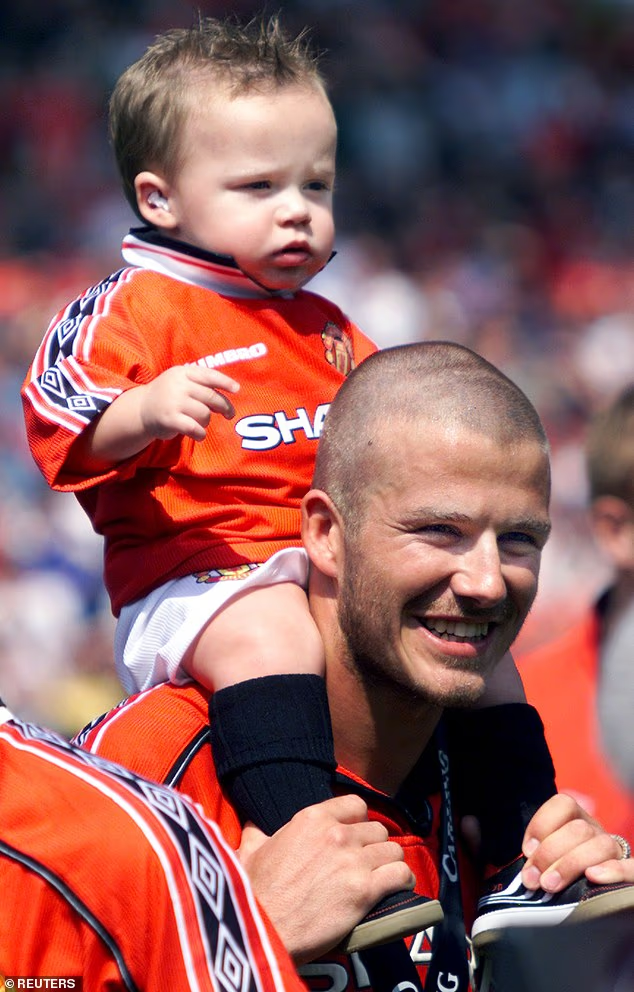
Brooklyn Beckham on dad David’s shoulders following Manchester United’s win against Tottenham Hotspur in May 2000
The disastrous fall-out with Brooklyn – who damningly claimed in his Instagram post that ‘inauthentic relationships have been a fixture of the life I was born into’ – has, then, been the ultimate test of this PR strategy.
For how would Brand Beckham react when threatened by one of its own? Speaking to me, a source close to Brooklyn and Nicola is clear on this point. The couple, it seems, are convinced the Beckham camp responded by briefing the media against their own son.
Brooklyn and the Peltzes believe one of the Beckhams’ closest aides, who travels with David internationally and is intimately involved in their business affairs, was responsible for stories calling Nicola a ‘spoiled brat’, a ‘viper’ and worse. The source goes on to tell me that Brooklyn could not believe the Beckhams had attacked him and Nicola so publicly.
The friend said: ‘There was a steady stream of stories intended to demonise and upset [Brooklyn and Nicola], much of it untrue.
Brand Beckham by Alison Boshoff, to be published by Century on August 13, priced £22. To order a copy for £19.80 (offer valid to August 23; UK p&p free on orders over £25) go to mailshop.co.uk/books or call 020 3176 2937.
‘It was very painful to him to think his own parents were briefing against him and the woman he was proud to call his wife. This remains the biggest barrier to the two sides making up.’
If it was indeed the Beckhams who were behind the deluge of negative stories against Nicola it’s hard to see what their end game was.
The more that it was briefed that Nicola was ‘mean’, ‘bad’ to the family, and ‘bad’ for Brooklyn, the tighter the couple stuck together. As a source tells me now: ‘The Beckhams don’t have to like Nicola… but you know, wake up – this is your son, so what are you doing?
‘The more they stick their foot down, the more Brooklyn and Nicola are going to make that marriage work. There’s nothing Brooklyn or Nicola did which would have deserved this treatment.
David Beckham with his dad Ted. The pair are close, but previously fell out and didn’t speak for two years
‘It seems [the Beckhams] thought they could heap abuse on Nicola without any consequence. They did not let up. There was a public trashing which kept on going.
‘It matters what was written. It seemed as if things were being said without any regard being paid to the impact on Brooklyn.
‘He is loyal to his wife. Someone should have told them to stop, because it was not in their best interests to do this to their own son, but nobody did.’
A SITUATION where a father seemingly deliberately trashed his firstborn son and new daughter-in-law to the world’s media was unthinkable back when – some six weeks after the birth of baby Brooklyn, in April 1999 – I interviewed David Beckham for the Daily Mail. He was clear he was in a new, family era. ‘We’re a family now and I’m the happiest I’ve been in a long time,’ he said.
As to his ambitions for the boy, David sounded as if he had been inspired by his own father’s spartan parenting ‘We are going to love him and look after him and we are going to be strict as well. Victoria is adamant about that. You know, we can’t stand those naughty little kids who run about in restaurants. He is going to be a well-behaved little boy.’
David had also been clear on another seeming ‘red line’.
‘We don’t want his picture splashed all over the papers – if he wants to do pictures when he’s old enough to make that decision for himself, then fine. It’s a different story with me and Victoria – we expect to be photographed because of what we do, but when we’re with Brooklyn… well, I don’t know how that’s going to be and, I’ll be honest with you, it worries me.’
Victoria echoed the sentiment in a paid-for interview in OK! magazine – reportedly worth £250,000 – insisting: ‘He’s the one thing that is totally private for us. He’s not a money-spinner. People were saying, “They left the hospital with their little asset,” and that really hurt a lot.’
Brooklyn Beckham and Nicola Peltz at the 2021 Met Gala, where Nicola wore Valentino, not Victoria Beckham
Yet before long that line vanished. Brooklyn, who had been shielded from paparazzi lenses and conscientiously cropped from photoshoots, made his front-page debut in pictures from the Beckhams’ £1 million OK! magazine wedding only four months later.
From almost the beginning, the couple’s publicists would brief journalists about the world of luxury the little lad, and later his siblings, were living in. Each small invasion of privacy kept the family in the limelight.
Brooklyn’s first birthday party, held at the Cottons Hotel in Cheshire, featured clowns, jugglers, stilt-walkers, magicians and a menu of champagne and lobster – although presumably not for the children – at a cost of £12,000. His third birthday treat was a £2,000 toy car and a private screening of Disney’s Treasure Planet.
For Christmas 2003, David splashed out £220,000 to fly Brooklyn and his 18-month-old brother Romeo to Santa’s grotto in Finland.
For his fourth birthday, Brooklyn got a Shetland pony. When he was five, Brooklyn tackled his first red carpet at the Scooby Doo 2 premiere, wearing a £6,000 watch. Newspapers were told by his parents’ PR this had been a gift from New York jewellers Jacob & Co, and was a copy of David’s £36,000 diamond-encrusted model.
At the family home in Sawbridgeworth, Hertfordshire, known as ‘Beckingham Palace’, his parents spent £20,000 installing hundreds of fibre-optic lights in Brooklyn’s bedroom to recreate the night sky, and had their faces superimposed on a Cinderella and Prince Charming Disney mural on the walls – all of which was shown off in OK! magazine.
Hand-in-hand with this luxury was a darker side, however. Both David and Victoria were sincerely convinced there were serious security threats against them and, in particular, against baby Brooklyn.
David at times slept on the floor of his room to be sure nobody could come through the door.
David and Victoria with baby Brooklyn. The pair were convinced there were serious security threats against them
This all led to a rather sheltered life for Brooklyn. Victoria herself recalled a moment when her mother’s friend took toddler Brooklyn shopping and it started raining.
Rather than seeking shelter, ‘he just stood there… his little hands held out trying to catch the drops, amazed. And everybody else was staring, wondering why he didn’t take shelter.
‘And she told me this – like here’s a funny story for you – but I was suddenly overcome by guilt. He did it because it was a new experience for him. He’d never been in the rain, he went everywhere by car.’
Victoria and David have said the Press attention focused on their family was worst in the wake of the Rebecca Loos affair allegations, when Brooklyn was just five.
Victoria said: ‘It was very difficult for Brooklyn because he was older, and he had photographers screaming things. They used to scream things to Brooklyn about his mum and his dad.’
And yet they continued to parade their children in front of the world’s cameras.
Little wonder Brooklyn grew up to be highly sensitive.
One friend of his told me: ‘The young man has anxiety issues and other educational issues that were not properly addressed when he was growing up. The kid never got the attention that he needed to deal with his issues properly. He is a good kid with good instincts and a good heart, but he is sensitive.’
Brooklyn in 2004. Due to David and Victoria’s security concerns, Brooklyn led a sheltered life
His family, for their part, say that this sensitivity means he falls in love fast – and hard.
Another family friend adds: ‘Jackie [Victoria’s mother] always says that Brooklyn gets completely absorbed by whoever he dates. You know, if they like poodles he likes poodles, if they drink milkshakes, then so does he.’
Brooklyn met his future wife Nicola at a Halloween party in Hollywood in 2019 and proposed just eight months later in July 2020 – something Victoria initially felt optimistic about.
Perhaps, she said, Nicola – driven and focused on her nascent acting career – might be ‘the making’ of Brooklyn. However, it was also noted by the Beckhams that Nicola seemed to be ‘in charge’ of Brooklyn when they saw them together.
One friend of the Beckhams says: ‘I always say he married his mother. Nicola and Victoria are very similar people. They both demanded and expected to have control over him.’
At first Nicola seemed to play ball with the Beckhams, wearing a canary yellow Victoria Beckham dress for her engagement photographs. The pictures were taken by Brooklyn’s sister, Harper. Online congratulations from the Beckham family appeared absolutely genuine.
But by September 2021 there were visible signs of fracture when Brooklyn and Nicola went to the Met Ball in New York.
There, Nicola wore Valentino, not Victoria Beckham – and in a world where social media ‘likes’ are as indicative as a Roman emperor’s thumb – Victoria and David didn’t offer a like on the pictures. In that same month, Brooklyn and Nicola went to the Paris fashion shows and Brooklyn expressed his admiration online for Givenchy and Valentino. Again, no likes from his parents.
Nicola wore a canary yellow Victoria Beckham dress for her engagement photographs
And when, soon afterwards, the couple were featured on the cover of the Hong Kong edition of Vogue magazine, the only image liked by David and Victoria was the digital cover of Brooklyn, solo. The cover which included them both was noticeably not liked by his parents.
In hindsight, it looks very much as if the Beckhams started to withhold social media approval from Nicola in 2021, just as Brooklyn moved permanently to the US. Some friends of his parents say Victoria can be manipulative and is uniquely sensitive to perceived slights. The not liking posts is undoubtedly pointed and petty but ‘is very Victoria,’ observed one of her friends.
‘She is 100 per cent the kind of person who will perceive a slight and nurse her upset over it. All the Spice Girls were like that back in the day. They were well schooled in the art of being a bitch.’
Then, in February 2022, with Brooklyn and Nicola’s wedding just months away, came an almighty row that brought all the toxicity to the fore and resulted in the families no longer speaking.
At its heart, it was a dispute about Brooklyn’s right to his own name. This had been bubbling away as an issue since 2018, when Brooklyn was just 19 and had come close to signing a £3 million deal with Boohooman clothing, to ‘design’ a range bearing his name.
A source close to the proposed deal says Victoria was involved throughout, and negotiations were at an advanced level before it all, perplexingly, collapsed into nothing. ‘There must have been a dozen meetings,’ they said. ‘At a late stage, Victoria decided to block Brooklyn from using the Beckham surname on the product. It did get into a bit of a war with the brand, and the deal then did not happen.
‘Brooklyn was like, “I can’t help it – this is my surname.” She had been OK about it in the beginning, but then she had a change of heart.’
At this stage in Brooklyn’s life, Victoria was in control, and he had no choice but to comply. But four years later, and with a confident fiancee in his corner, the outcome was rather different when Brooklyn’s parents then approached him with a proposition he believed was an attempt to sign away his rights to his name entirely.
Brooklyn and Nicola in 2023. Brooklyn believed the deal his parents approached him with was an attempt to sign away his rights to his name entirely
The situation arose because the Beckhams’ company, DB Ventures, had years previously taken out a trademark on all the names of the Beckham children. Sources familiar with this step explain other commercial entities had been trying to trademark the children’s names, so they had taken proactive steps to stop them.
In February 2022, however, David Beckham had entered into a strategic partnership with Authentic Brands Group (ABG), selling a 55 per cent stake in his company, DB Ventures, for about $269 million (£200 million).
This deal had a number of implications, including for the children’s trademarked names, as they were now owned partly by a new entity, over which the Beckhams did not have complete control. Brooklyn and Romeo, who were both over 18, were asked to sign a trademark co-existence agreement. This is a formal, negotiated contract between two parties allowing them to use similar or identical trademarks in the marketplace without infringing on each other’s rights.
A source familiar with the situation said: ‘It was to protect them [Brooklyn and Romeo] in case someone tried to use their names, but at the same time it would allow David and Victoria to use their names and their brand. Victoria signed it and Romeo signed it, but Brooklyn didn’t sign it.’
The Beckhams have apparently ‘decided to act as if he had signed it, so we protect his name as well’.
The source added: ‘He was never penalised or prejudiced in any way by not signing it.’
Soon-to-be-married Brooklyn saw the deal differently. It appears he had legal advice from the Peltz lawyers, who said that it wasn’t in his interests.
A source close to him insisted: ‘Brooklyn, his name and his brand, has been sold by the Beckhams from the beginning in order to benefit them. This was one of the biggest violations of trust between parents and child.
Nelson Peltz, Nicola’s father, officiating Brooklyn and Nicola’s vow renewal at the Peltz family estate in Bedford, New York
‘He refused to sign over his name in that deal right before his wedding. It was a big deal and they were trying to maximise their return. I guess their catalogue isn’t worth as much if you don’t have all the kids in it.’
Brooklyn gave his account in his Instagram post, writing: ‘Weeks before our big day, my parents repeatedly pressured and attempted to bribe me into signing away the rights to my name, which would have affected me, my wife, and our future children. They were adamant on me signing before my wedding date because then the terms of the deal would be initiated. My holdout affected the payday, and they have never treated me the same since.’
The Beckham source insists it would not have disadvantaged Brooklyn, and there was no effect on any payday.
They deny trying to ‘pressure or bribe’ him. But the Peltz-Beckham source says the episode is very much viewed as a clear example of attempted exploitation. The source explains: ‘They said when he was a baby that they didn’t want to exploit him and then they did. There is a straight line from that to this.
‘Wherever and whenever there is money available in return for exploitation of the names the Beckhams are open to doing it. They have the right to, up to a point.
‘At this time, Brooklyn was already having other input and advice. The concept is not one that is hard to understand: if you give this away then you are giving up the option of having your brand. Why would you give that up and have nothing for it?’
The feeling among Brooklyn’s friends is that ‘it was just exploit, exploit, exploit to whatever degree you can. What upsets them [David and Victoria] is when they lose control or the financial benefit.’
Those final weeks ahead of the wedding in April 2022 could scarcely, then, have been more awkward. What should have been a happy time anticipating the uniting of two families was, in fact, the point at which battle lines were drawn.
The reality is Brooklyn and his bride walked down the aisle with neither on speaking terms with his parents. In the Beckham camp, emotions were high – so much so that a source tells me Victoria ‘openly’ referred to her daughter-in-law as a ‘c-word’. Sources close to Victoria deny this.
Stories mounted about tensions between the Beckhams and the Peltzes – indeed, I was the first to report on them in July 2022.
And then, in September 2022, David – known for being prone to outbursts rather than reasoned argument – finally boiled over at his son.
In an interview that month with Grazia magazine to promote an acting role, Nicola had only stoked the fire of the tension rumours.
She exclaimed: ‘It’s not a feud! I keep seeing everywhere, that word “feud, feud, feud”. I don’t know why they say “feud”? I mean, maybe they picked up on something?’ before adding: ‘No family is perfect.’
Brooklyn added, in an aside that appeared to confirm the awkwardness was very real: ‘To be honest, my wife is obviously my first priority and I never want to see her upset ever. We have each other’s back 100 per cent and we just move on together.’
Short of wearing a ‘Team Peltz’ T-shirt, he could hardly have made it more obvious that there was an upsetting problem, and he was taking her side.
David, who had spent a couple of decades selling the story of the perfect Beckham family, was outraged by the indiscretion, and launched a ferocious, dressing down of his son. A well-placed source told me: ‘I don’t think David has ever lost his temper with Brooklyn or had cause to talk to him harshly, but that finally happened. David had it out with Brooklyn and told him, “We don’t do this in our family – and you know that we don’t do this in our family.” ’
David allegedly added to his son: ‘What happens next is up to you, but we are done with the drama.’
The source said: ‘David was really appalled by the Grazia interview because it seemed to be washing the family dirty linen in public, and he said Romeo and Cruz were also hurt by it.
‘It was probably a shock to Brooklyn, as David had never done anything other than tell Brooklyn how much he adores him. What was being said is Brooklyn forgot that he is a Beckham.’
By mid-2025, negative stories about Nicola were appearing almost daily.
At this point, the young couple started to plan a secret second wedding. Nicola’s view was the Beckhams had ‘ruined’ her special day and their bad behaviour tainted their happy memories.
Rather than move on, she wanted to do-over. Brooklyn agreed. His statement later elaborated: ‘We wanted to renew our vows so we could create new memories of our wedding day that bring us joy and happiness, not anxiety and embarrassment.’
Nelson Peltz agreed to officiate, and the venue chosen for the event, to be held on August 2, 2025, was the Peltz family estate in Bedford, New York.
A guest list of some 200 friends was drawn up. Not a single one had been at Brooklyn’s 21st birthday just four years earlier. There wasn’t a single Beckham invited. That was rather the point.
All involved must have known how deeply this would upset the Beckhams. A friend of the Peltz Beckhams now acknowledges the cruelty, saying: ‘It was a twist of the knife. It looked as if Nicola had done the whole thing out of spite.’
Then came the final bombshell: Brooklyn’s Instagram statement in January this year.
Today, though, the Beckhams remain particularly hopeful of a reconciliation. Friends of the Peltz-Beckhams are more circumspect about whether that is possible – even though Brooklyn feels the pain of separation keenly.
A friend says: ‘Nicola says she will never stop Brooklyn from having a relationship with his parents, and if he wants to go to London to see them she will never stop him.
‘But she is over it now. It doesn’t land in the same way with her. Brooklyn is so sad about it, still.’
With respect to whether the Beckham family brand can survive, it has certainly taken a big knock. But after years in the business, David and Victoria know it’s simply a matter of finding the right narrative.
An associate of Victoria says: ‘The Brooklyn problem has done them two big favours. Firstly, David and Victoria have never got on as well as they do now. The pain of it all has brought them closer together. They are in lockstep. I’ve not seen them so happy together since the really early days.
‘The other positive is it has humanised them. People who used to mock them in a snobby way now see them as human beings who you can relate to. David is kind of a national treasure, and people are softening towards Victoria, they can see how hard she has had it.’
Indeed, it seems a decision has been taken to incorporate ‘the feud’ into the ‘Brand Beckham’ narrative. The strategy is they will continue to remind us they are heartbroken, good parents who have done their best, and they love all their children.
The wheel of Brand Beckham will continue to turn – with or without Brooklyn inside the tent.
© Alison Boshoff, 2026
Click here to read part one of the Daily Mail’s serialisation of Brand Beckham by Alison Boshoff
Adapted from Brand Beckham by Alison Boshoff, to be published by Century on August 13, priced £22. To order a copy for £19.80 (offer valid to August 23; UK p&p free on orders over £25) go to mailshop.co.uk/books or call 020 3176 2937.





















































You must be logged in to post a comment Login