

Crypto World
Ripple’s OpenUSD Move: Payment Infrastructure Push or XRP Value Catalyst?

Ripple has joined the OpenUSD (OUSD) consortium as a launch integration partner, placing itself inside a stablecoin initiative backed by more than 140 companies across payments, banking, fintech, and crypto.
However, according to crypto analyst WrathofKahneman, there’s a catch: OpenUSD will be launching on Solana, Stellar, Base, and Polygon, but not on the XRP Ledger, which has left traders asking what Ripple will actually get out of the deal and whether XRP could benefit at all.
Ripple Joins OpenUSD as Questions Swirl Around XRP
In a July 1 thread on X, WrathofKahneman described OpenUSD as a consortium-backed dollar stablecoin designed to solve pain points for businesses by enabling free minting and redemption and removing volume limits. It will also distribute reserve earnings to partners after deducting management fees.
According to Open Standard, the independent entity that will govern the token, OpenUSD, will go live later this year, with Visa, Mastercard, Stripe, Coinbase, BlackRock, Google, and Bybit among the companies backing it.
The analyst argued that the project is in part an anti-USDC play engineered by Stripe. Recall that Stripe bought Bridge earlier this year specifically for its OCC bank charter, and per WratheofKahneman, OpenUSD will let Stripe “get out from under Circle by creating neutral infrastructure and shared economics.”
They think that positioning makes OpenUSD dangerous for Circle’s margins, since a stablecoin where every partner feels like a co-owner is a hard thing to compete against with a traditional single-issuer model.
As for Ripple, the industry observer doesn’t think the company had much choice.
“Ripple doesn’t want to be absent from a massive payments-stablecoin consortium, even if OpenUSD is not issued on XRPL, because they sell payments infra,” they wrote.
They also noted that Ripple’s business would be fine, even if it lost some RLUSD profit to the new stablecoin. And speaking of RLUSD, the analyst said there is only a small overlap, given that OpenUSD is built for the broader economy, while RLUSD is primarily used for settlements within Ripple’s own stack.
On XRP, WrathofKahneman was a bit more uncertain, suggesting that the worth of the Ripple token requires value coming into the ledger, and it may only be affected if OpenUSD is eventually issued on XRPL.
“It would only help,” they explained. “But this is a big ‘if’ and likely why Ripple got in the consortium even if not yet issuing.”
The market watcher also flagged the presence of Coinbase in the group despite its deep USDC ties, saying it showed platforms are hedging against getting boxed into a single stablecoin economy.
Competition Moving Toward Shared Infrastructure
OUSD is entering a market where stablecoin issuers and payment firms are increasingly competing over infrastructure instead of individual tokens.
For instance, earlier this month, Mastercard expanded support for several stablecoins, including RLUSD and USDC, across networks such as XRPL, Ethereum, Solana, Arbitrum, and Base. According to the company, the move was to position itself as a neutral infrastructure provider rather than backing one issuer.
The post Ripple’s OpenUSD Move: Payment Infrastructure Push or XRP Value Catalyst? appeared first on CryptoPotato.

Hyun Song Shin, the governor of the Bank of Korea, praised tokenization for its ability to simplify the issuance and management of government bonds.
Shin said during a Wednesday panel discussion at the European Central Bank (ECB) Forum on Central Banking in Sintra, Portugal, that tokenized bonds would make it easier to verify collateral, credit the asset provider’s account and reverse transactions at the appropriate time.
“The big prize is tokenizing government bonds,” Shin said, adding that it is “much easier, much less prone to mistakes if you have everything tokenized.”
US Treasury debt is the largest tokenized real-world asset category, representing $14.6 billion, or about 46% of the $31.7 billion RWA market, according to data provider RWA.xyz.
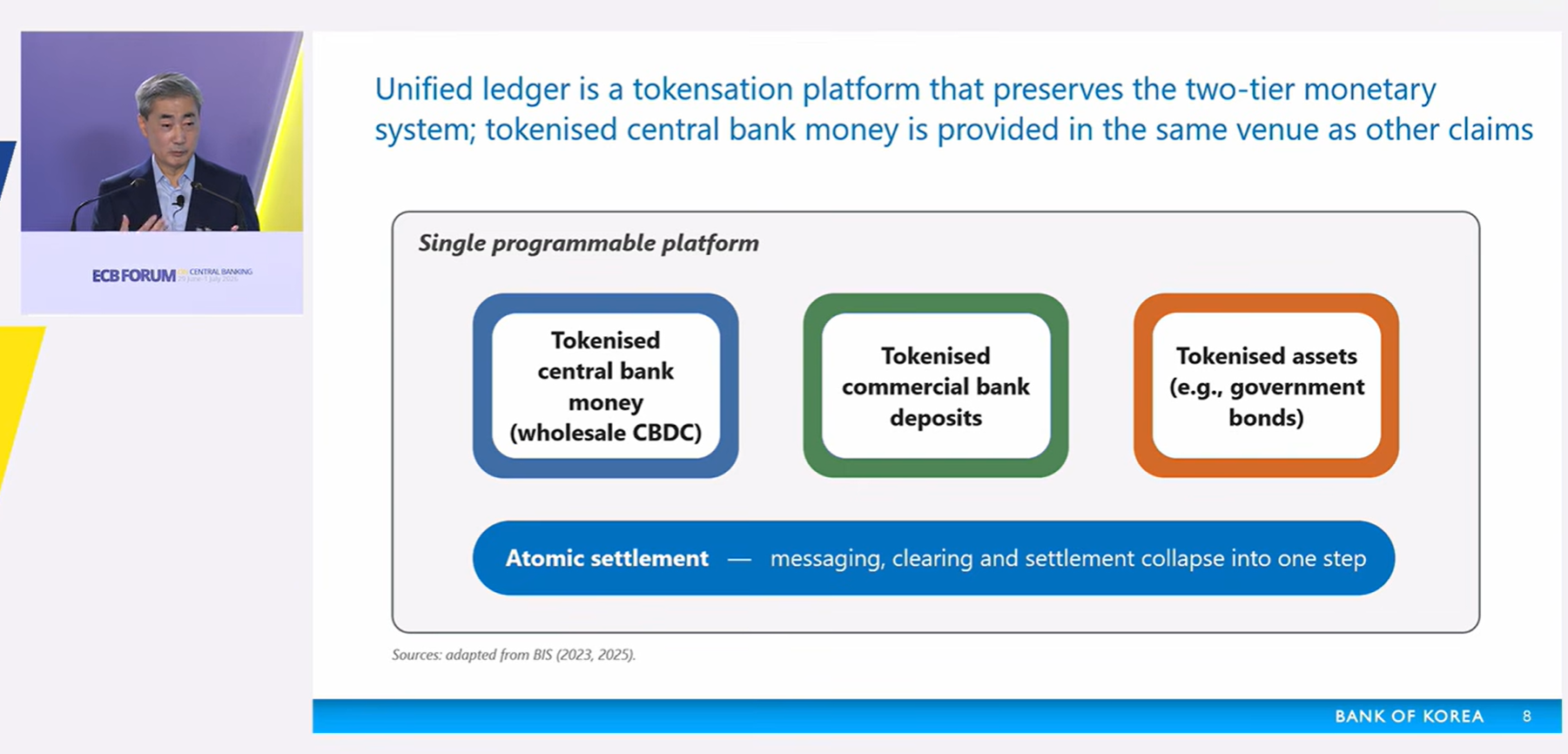
Shin also outlined plans to bring tokenized government bonds, wholesale central bank digital currencies and tokenized commercial bank deposits on a unified ledger, as part of an extension to “Project Hangang,” a Bank of Korea-led pilot project testing a blockchain-based wholesale CBDC system.
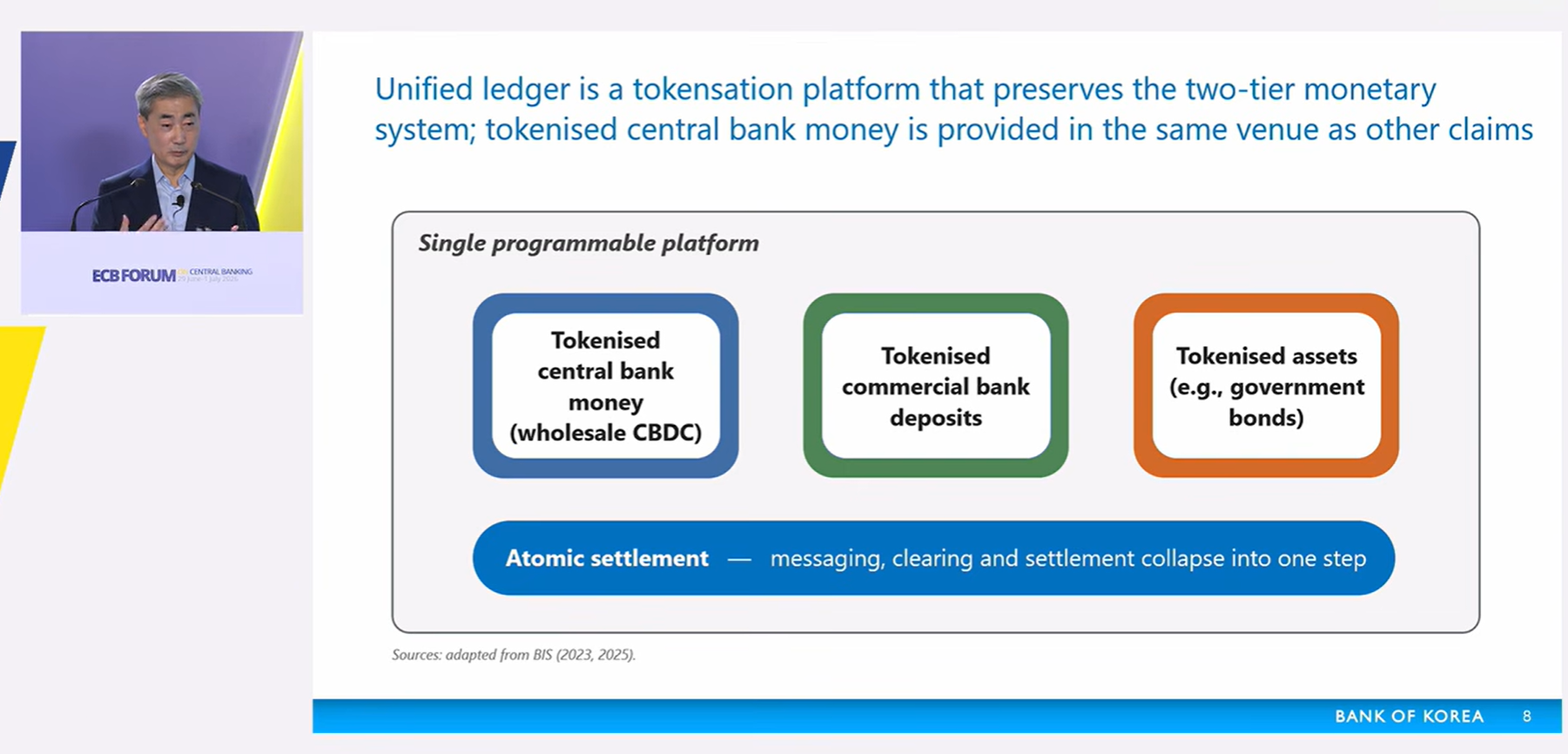
Hyun Song Shin, governor of the Bank of Korea, speaks during a panel discussion at the ECB Forum on Central Banking. Source: YouTube
Tokenized government bonds may boost financial innovation: BIS
Government bond tokenization could improve market efficiency and support financial innovation, provided regulatory and infrastructure challenges are addressed, according to a July 2025 report by the Bank for International Settlements (BIS).
Related: Former BIS chief softens stance on stablecoins, backs coexistence with fiat
Government securities play a crucial role in the financial system, acting as a savings vehicle for households and firms and as collateral in a range of transactions, the report said, adding:
“By enabling the contingent execution of actions, tokenisation can help to enhance the efficiency of markets, reduce settlement risk, broaden investment access and spur the creation of new financial services.”
The report examined 39 tokenized bonds, including 24 issued by corporations and 15 by governments. Compared with traditional, non-tokenized bonds, the BIS found “suggestive evidence” of lower bid-ask spreads and comparable issuance costs and yields.
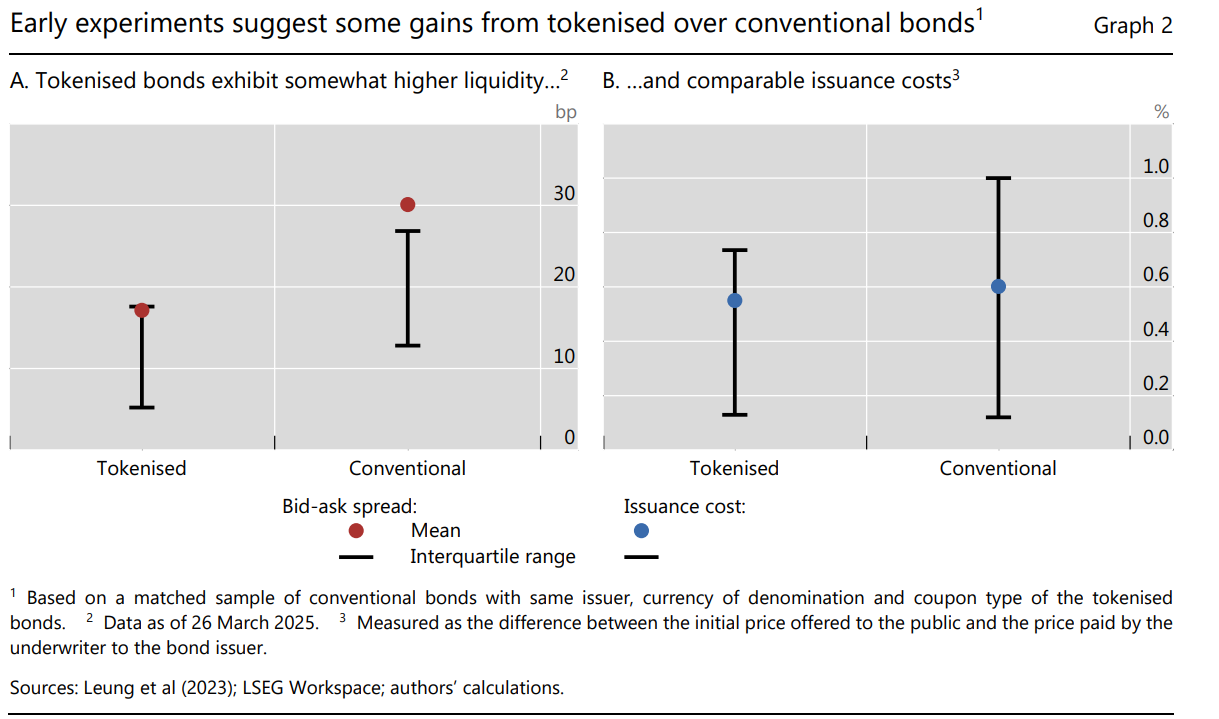
Tokenized bonds vs conventional, non-tokenized bonds, liquidity, issuance costs. Source: BIS
Magazine: Guide to the top and emerging global crypto hubs: Mid-2026


For now, most AI agents still live inside safe boxes. They summarize documents. Write code. Search databases. Help customer support teams move faster.
In finance, they are already creeping into fraud detection, compliance, research, and back-office workflows. Cambridge Judge Business School found this year that 52% of financial firms are actively adopting agentic AI, with 23% already scaling or transforming around it.
Bond Labs, a blockchain superapp network, is betting on the next step. It wants AI agents to trade, borrow, lend, move funds, and eventually spend money across crypto and traditional payment rails.
The company has launched on 0G, an AI-native blockchain network, with a DeFi platform designed for both humans and autonomous AI agents.
Bond says its platform combines
- A spot decentralized exchange,
- Perpetuals exchange
- Lending and borrowing markets,
And also a planned neobank layer with fiat on/off ramps, global transfers, on-chain IBAN access, Visa debit cards, and yield-bearing accounts.
That is a large promise. It also arrives at a moment when the financial industry is trying to work out how much autonomy it can safely give to software that can reason, plan, and act.
The Agent Needs a Wallet
The idea behind Bond is simple enough. If AI agents are going to become economic actors, they need financial infrastructure.
A chatbot can tell a user how to rebalance a portfolio. An agent could, in theory, do it. It could move idle funds into a yield account, borrow against collateral, hedge exposure, or route money across chains and payment systems.
That shift requires more than a prompt window. It needs liquidity, execution venues, credit markets, identity checks, payment access, and risk controls.
Bond is trying to put those pieces into one environment.
Its DeFi layer includes a spot DEX based on Uniswap V3-style automated market-making, a perpetual DEX using a central limit order book model, and lending markets with dynamic interest rates.
The company also plans to add a neobank layer within the next three months, bringing fiat access, global transfers, Visa card functionality, and accounts connected to 0G Chain.
Bond also says it will build a real-world asset division, giving users and agents exposure to tokenised assets for trading, settlement, and investment.
In plain terms, Bond wants to be the financial operating system for AI agents.
The Money Is Following the Thesis
The launch comes with direct ecosystem support from 0G Labs.
Bond is backed by a $10 million incentive programme from 0G Labs, a $3.5 million direct investment, and a stated $50 million TVL target. The incentive programme will run over 12 months and will be tracked on-chain. Bond says AI-agent trades will be included in the rewards structure.
The goal is liquidity. Without it, an agent-facing financial platform is just an interface. With it, agents can actually execute trades, access lending markets, and move value without waiting for a human to manually approve every step.
“The vision of AI agents managing someone’s finances has been held back by fragmented infrastructure,” said Bond Labs CEO Taweh Beysolow. “Bond provides the missing layer DeFi primitives and a neobank where agents can trade, borrow, spend, and earn, all within a single platform.”
Michael Heinrich, CEO of 0G Labs, framed Bond as part of a wider AI economy.
“0G is building the foundational infrastructure for an AI-native economy, and a core part of that vision is giving autonomous agents the ability to transact, manage assets, and access financial services as easily as any human,” Heinrich said. “Bond is the first platform to fully realize that vision, combining institutional-grade DeFi with a user-friendly neobank, all on a blockchain designed from the ground up for AI agents.”
The Pipes Behind the Platform
Bond has also lined up infrastructure and liquidity partners.
The company says Turtle will support liquidity and incentive distribution, Re7 will act as a DeFi vault curator, Midas will provide vault infrastructure, and Wormhole will support cross-chain interoperability.
It has also named Cicada Capital, Diffuse, GSR, and Flow Traders as liquidity providers.
Those names are important because AI-agent finance will not work without deep markets. An agent that manages capital needs execution quality, reliable settlement, and enough liquidity to avoid poor pricing.
Essi, CEO of Turtle Club, said the pre-deposit campaign had to work for different types of participants.
“Bond is building a superapp for an audience that spans retail and institutional. The pre-deposits campaign needed DeFi-native LPs who could underwrite both ends. We structured it with the Bond team until the economics held without compromising what Bond was committing to its users. Proud to be working alongside them.”
The Risk Is No Longer Theoretical
Deloitte’s 2026 enterprise AI survey found that 74% of companies expect to use AI agents at least moderately by 2027. In finance, Cambridge found agentic AI adoption is already further along among fintechs than traditional institutions.
Regulators are watching the same trend. The Financial Stability Board has warned that AI is spreading across AML, KYC, fraud detection, credit risk, cybersecurity, portfolio management, and compliance.
The Bank of England has gone further, warning that autonomous agents could eventually transact for consumers, execute trading strategies, and amplify market volatility if many systems behave in similar ways.
That makes security central to Bond’s pitch. The company says it has taken a security-first approach, including smart contract audits by Hashlock. That will matter as DeFi platforms remain exposed to exploits, oracle failures, bridge risk, liquidity shocks, and bad incentive design.
The harder question is governance. If an AI agent makes a trade, approves a payment, or borrows against collateral, the system needs clear rules for consent, limits, liability, and emergency shutdowns.
Bond’s launch is an early test of whether AI agents can move from assistants to financial actors. The infrastructure is starting to appear.
But the market now has to prove that autonomous finance can work without turning speed into fragility.
The post AI Agents are Starting to Handle Money. This Blockchain Wants to Build Their Bank appeared first on BeInCrypto.
Bitcoin’s battle around the $60K region is entering a decisive phase after sellers are forcing a breakdown below this major support area. With momentum still favoring the sellers, traders are now watching whether demand can prevent a deeper correction toward the mid-$50K region.
Bitcoin Price Analysis: The Daily Chart
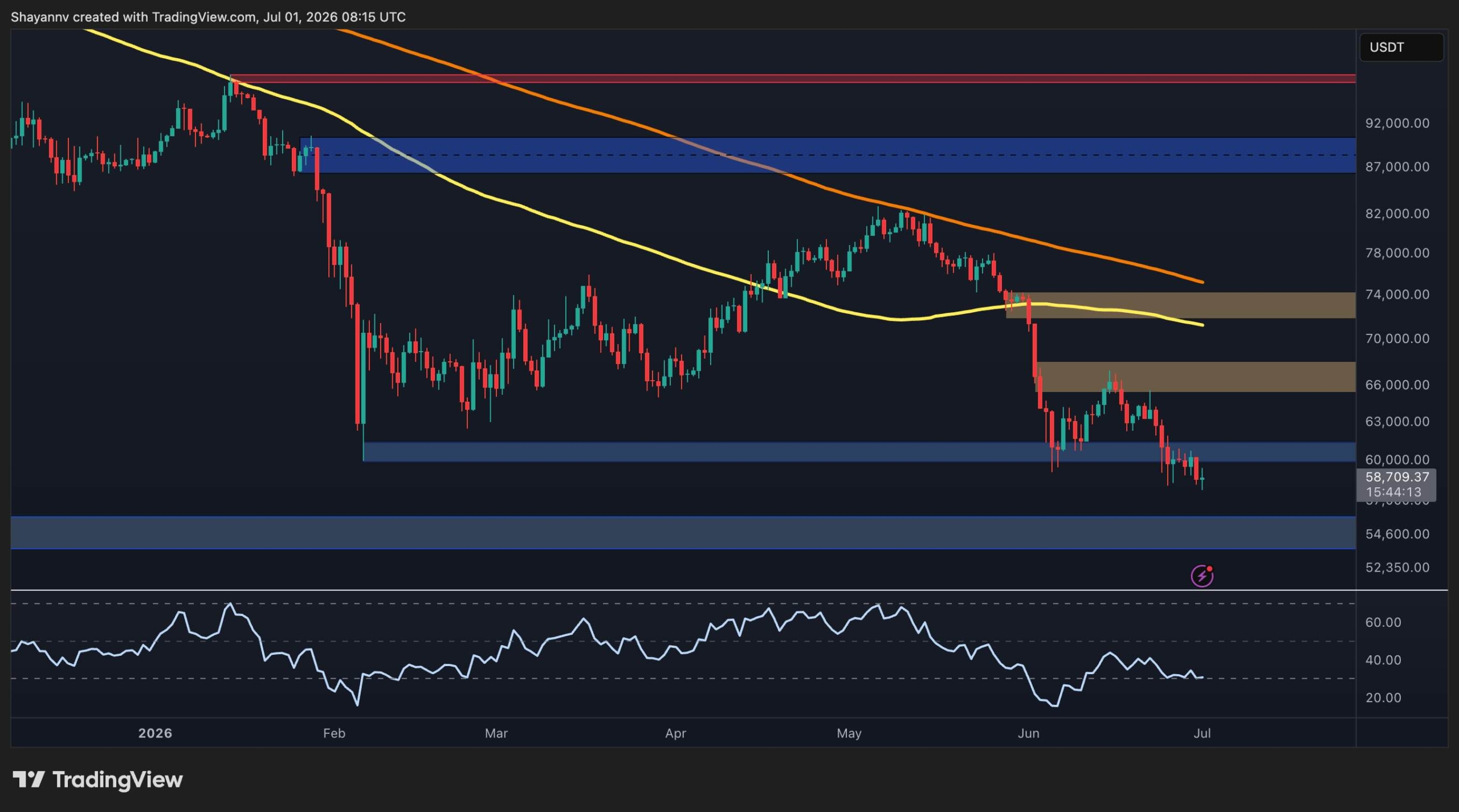
On the daily timeframe, BTC has extended its bearish trend after losing several major support zones. The recent rejection by the 200-day moving average around $80K and the breakdown of the 100-day moving average near $ 74 K have reinforced the longer-term downtrend, with both moving averages now sloping lower and acting as dynamic resistance.
The price is currently trading around $58.7K after breaking slightly below the $60K demand zone. This indicates that buyers have struggled to defend one of the market’s most important psychological levels. The next significant support lies around the $55K region, while a deeper correction could expose the broader demand area near $52K.
On the upside, Bitcoin would first need to reclaim the $60K level quickly before challenging the $66K to $68K resistance zone. Beyond that, the $72K to $74K area remains the primary barrier, as it coincides with the long-term moving averages. The broader bearish structure would only begin to improve if BTC manages to reclaim this region.
BTC/USDT 4-Hour Chart
The lower timeframe presents a similarly bearish picture. Bitcoin continues to trade inside a descending structure, respecting both the upper and lower boundaries throughout the recent decline. Every recovery attempt has produced another lower high, confirming that sellers remain in control.
The latest rejection from the $66K to $68K supply zone pushed BTC back toward the lower boundary of the channel. Price is now hovering around $58.7K, slightly beneath the $60K support area, increasing the probability of another test of lower liquidity and a breakdown of the channel structure.
Meanwhile, the RSI has formed a modest bullish divergence, with momentum making slightly higher lows while price printed fresh lows. Although this divergence could trigger a short-term relief bounce, it has yet to receive confirmation through a decisive breakout above nearby resistance.

On-Chain Analysis
Bitcoin’s Net Unrealized Profit/Loss (NUPL) has fallen sharply to approximately 0.09, placing the metric deep within the low-profit region shown on the chart.
NUPL measures the aggregate unrealized profit or loss held across the Bitcoin network. Higher readings generally reflect widespread investor optimism and elevated profitability, while lower values indicate shrinking profits and deteriorating market sentiment.
The current reading suggests that the majority of holders have seen a significant reduction in unrealized gains compared to previous months. Historically, such depressed NUPL levels have been associated with periods of capitulation or late-stage bear market conditions, when weak hands are gradually flushed out of the market.
While this does not guarantee an immediate reversal, it indicates that much of the speculative excess has already been removed. If selling pressure begins to ease and long-term investors continue accumulating, these historically depressed profitability levels could eventually provide the foundation for a broader recovery. Until price reclaims key resistance zones, however, the technical structure continues to favor the sellers.

The post Bitcoin Price Prediction: BTC Risks Drop Toward $55K After $60K Breakdown appeared first on CryptoPotato.
Open USD (OUSD) launched on Tuesday with more than 140 corporate backers, raising a pointed question for anyone earning yield on USD Coin (USDC) through Aave.
The new token lets businesses mint and redeem for free and routes its reserve income to partners. That model aims at Circle, yet the effects could reach the decentralized finance (DeFi) markets where USDC earns its keep.
How USDC Earns Yield on Aave
Lenders who supply USDC to Aave do not pay interest to Circle. They earn from borrowers who pay to withdraw USDC from the pool.
Aave ties those rates to utilization, the share of supplied USDC that borrowers have taken out. Once utilization pushes past its optimal point, supply rates climb fast to pull in deposits.
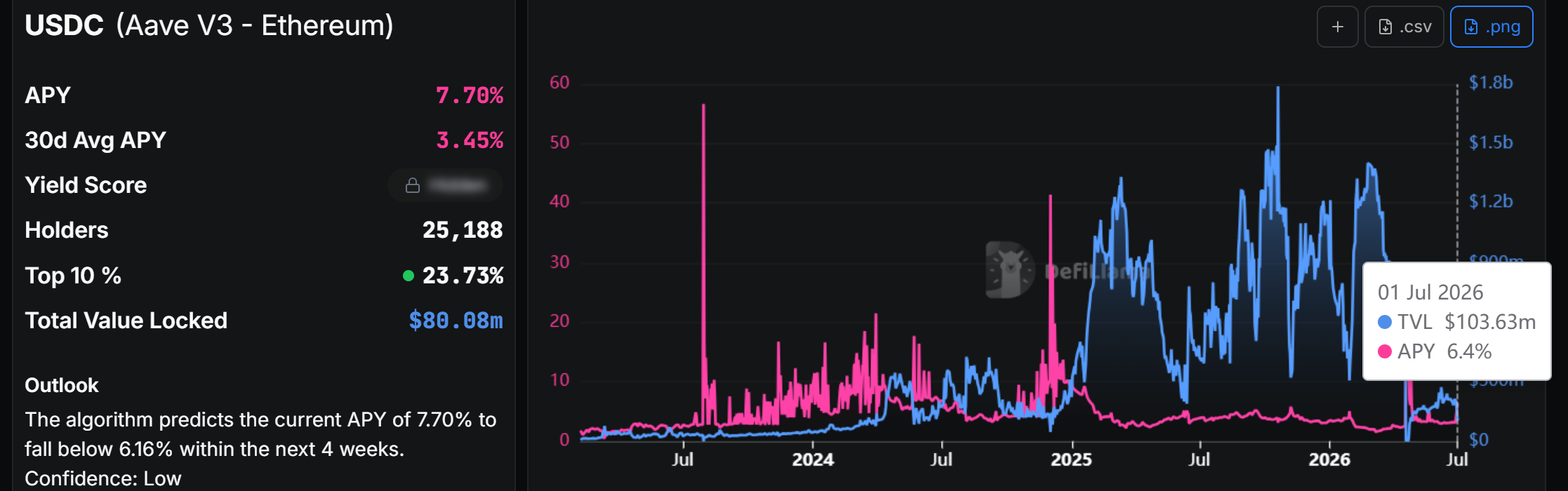
That makes borrowing demand the number that matters. USDC suppliers on Aave’s main Ethereum market earn around 3.4%, according to DefiLlama data, though the rate fluctuates with demand.

The same market paid mid-single digits and climbed near 18% at times in 2024.
Federal law pushes savers onchain in the first place. The GENIUS Act, signed in July 2025, bars stablecoin issuers from paying holders interest.
That stablecoin yield limit leaves lending venues like Aave as the main route to a return. Aave has since opened an institutional lending market for tokenized assets.
Why Open USD Could Pressure Those Yields
Open USD targets the demand side. Its backers include Visa, Mastercard, Stripe, Coinbase, and BlackRock, the networks that route much of the world’s business payments.
The design gives them a reason to switch. Partners keep most of the interest Open USD earns on its reserves. That income generated 99% of Circle’s 2024 revenue, its filing shows.
Coinbase is the clearest test. Circle paid it $908 million in 2024 to distribute USDC. The exchange also keeps every dollar of reserve income on balances held there.
Now, Coinbase backs the rival, and its Circle deal is set to renew in August.
Stripe has gone further and tied its platform to the token.
“Open USD will be the default stablecoin for businesses running on Stripe,” Will Gaybrick, President of Technology and Business at Stripe, said in the announcement.
Follow us on X to get the latest news as it happens
Stripe’s weight is not theoretical. Zach Abrams, who now leads Open Standard, cofounded Bridge, the stablecoin firm Stripe bought in early 2025.
If those firms route settlement flows through Open USD, demand that once leaned on USDC could soften. Lower USDC borrowing on Aave means lower utilization, which pulls down supply yields.
Circle built its lead as USDC’s corporate transfer growth outpaced Tether (USDT). Many of those same rails now back the rival. The catch is timing, since Open USD is not fully live and no Aave market lists it yet.

Circle’s Defense and What DeFi Users Should Watch
Circle argues its lead is hard to copy. Chief Executive Jeremy Allaire says scale and liquidity, built over the years, protect USDC.
“Stablecoin networks are platform and network effect businesses that are established over a long period of time, tend towards winner-take-most market structures, and resemble other internet platform utility markets,” Allaire wrote in a post.
USDC still holds deep exchange liquidity and licenses across the US and Europe. It has kept its European regulatory standing even as USDT retreats from the region. Its supply sits near $73 billion, behind USDT at about $184 billion.
History also gives Circle a talking point. Visa, Mastercard, and Stripe once backed Facebook’s Libra project in 2019, then walked away within months as regulators pushed back.
The sharpest immediate damage hit Circle’s stock, not USDC. Circle Internet Group (CRCL) fell about 17% on Tuesday and roughly 40% over the past month.

Its removal from the five major Russell Growth indexes added rules-based selling at the same time.
For DeFi users, the near-term steps are practical. They can track Aave utilization and rates on live dashboards. Spreading deposits across protocols and chains can lower single-venue risk.
Newer onchain yield strategies may also emerge as Open USD rolls out.
The coming months will test one question. Can Open USD pull enough demand from USDC to move Aave’s rates, or will Circle’s head start hold?
The post Could Open USD Crush Aave’s USDC Yields? Here’s What DeFi Users Need to Know appeared first on BeInCrypto.


Crypto markets have struggled in recent months, with bitcoin falling more than 50% from its late-2025 peak after a sharp June selloff driven by persistent exchange-traded fund (ETF) outflows, elevated interest rates and weaker risk appetite.
Ether (ETH) and most major altcoins have underperformed bitcoin during the downturn, although a handful of sectors, including decentralized finance (DeFi) and tokenization, have shown relative resilience.
While crypto adoption is expanding across stablecoins, tokenized real-world assets, onchain credit and DeFi, the bank argued that usage alone does not drive token value. Instead, long-term winners will convert activity into sustainable cash flow or lasting monetary demand.
Cantor identified Hyperliquid as the clearest example of fee-driven token economics through HYPE buybacks and burns, while bitcoin remains the benchmark monetary asset and Ethereum the dominant collateral layer for onchain finance.
Solana, Sui, XRP and Zcash each have differentiated strengths, the report said, but still need to prove they can translate ecosystem growth into durable token demand.
The bank also highlighted digital asset treasury companies as an overlooked investment theme, arguing the strongest firms are evolving beyond passive crypto holders into active operators that generate yield, build infrastructure and provide institutional access to digital assets.
It initiated coverage of digital asset treasury companies Forward Industries (FWDI) and Cypherpunk Technologies (CYPH) with overweight ratings and price targets of $7.90 and $0.90, respectively.


New York Life Investment Management, a $807 billion asset manager, is putting a high-yield corporate bond strategy onchain for the first time. The firm partnered with tokenization platform Centrifuge to launch the NYLIM Anemoy U.S. High Yield Corporate Bond Segregated Portfolio, ticker HYB. The… Read the full story at The Defiant
Ripple remains one of the most discussed subjects in the crypto space as the company continues to advance its ecosystem and participate in major initiatives.
However, XRP has faced heavy pressure in the extended bear market, struggling to maintain momentum and hold above the $1 psychological barrier.
Joining the Giants
Several hours ago, Ripple announced that it is “proud to join” Open USD as a “day-one integration partner,” reinforcing its commitment to multichain infrastructure supporting institutional adoption across the crypto space.
Open USD (OUSD) is a new stablecoin designed for large-scale global payments. It is built by the independent organization Open Standard and aims to address several issues businesses face when using such financial products. OUSD is expected to go live later in 2026, and prominent backers include BlackRock, Visa, Mastercard, American Express, Coinbase, and others.
Just a few days ago, Ripple received approval from the Japanese Financial Services Agency (JFSA) to launch its own stablecoin (called RULSD) in the country. Shortly after, it revealed that last year it had committed $25 million in RLUSD to support underserved US small business owners and career programs for military veterans.
Despite these efforts, the stablecoin has lost some steam lately. Its market capitalization has dropped to roughly $1.4 billion, making it the 49th-biggest cryptocurrency.
The ETFs
The institutional interest in XRP remains solid. Over the past several weeks, ETF inflows have far exceeded outflows, signaling that pension funds, hedge funds, and other conservative market participants continue to increase their exposure to the asset.

Since day one, these products have generated a cumulative total net inflow of almost $1.5 billion. Recall that the first company to launch a spot XRP ETF in the USA was Canary Capital, while shortly after, Bitwise, Franklin Templeton, 21Shares, and Grayscale followed suit.
It is important to note that such investment vehicles with BTC and ETH as underlying assets have been bleeding heavily in recent months, underscoring a clear decline in institutional appetite.
XRP Price Outlook
Despite the aforementioned developments, XRP continues its fight to stay above $1. As of press time, it trades at around $1.04, representing a 20% plunge on a monthly scale.

Earlier this week, analyst Ali Martinez revealed that the Tom DeMark Sequential Indicator has flashed a buy signal on XRP and outlined the rising network activity. At the same time, though, he noted that whales have reduced their exposure to the asset, which can be interpreted as a bearish factor.
The post Ripple News and XRP Price Update Today: July 1 appeared first on CryptoPotato.
[PRESS RELEASE – Dubai, UAE, July 1st, 2026]
BNB Chain, one of the largest blockchain ecosystems worldwide, today announced the launch of BNB Agent Studio, a new platform that creates a category of AI agents that survive infrastructure failure, accept payments, and can be provably owned and transferred: deployed from a simple prompt in ~15 minutes.
BNB Agent Studio is a developer platform that enables engineers to define what they want inside Claude Code, Cursor, or any MCP-compatible development tool. By abstracting away the complexities of building onchain applications, the launch addresses three fundamental challenges that have prevented AI agents from operating truly autonomously: deployment, discoverability, and continuity.
Co-engineered with the AWS Generative AI Innovation Center, the solution includes an Infrastructure-as-Code generator that automatically provisions an agent’s cloud environment in accordance with current security and least-privilege best practices. It simply generates the code needed and deploys the agent to Amazon Bedrock AgentCore, Amazon’s managed agent runtime.
“Building an autonomous AI agent has typically meant assembling a fragile stack of four or more separate vendor integrations: a wallet, an identity layer, payments, an AI model, and hosting. We’re talking days and weeks of integration work. BNB Agent Studio replaces all of that with a single install, designed as one product from the ground up.” said Nina Rong, Executive Director of Growth at BNB Chain.
Key capabilities:
- BNB Agent Studio agents natively integrate LLM aggregators, allowing them to charge for their services and accept crypto payments for the work they perform. Those earnings allow the agent to fund its own operating costs, creating a self-sustaining cycle that keeps the agent running as long as it has work to do.
- BNB Agent Studio combines AWS AgentCore as the runtime with BNB Chain’s onchain infrastructure, so an agent’s core intelligence is simultaneously hosted on AWS and persisted onchain. The agent can be paused, resumed, migrated, and passed to a new owner without losing any of its accumulated intelligence. Its existence is no longer contingent on any single environment.
- Each agent is issued a verifiable digital identity (ERC 8004) controlled by cryptographic keys that stay on the owner’s own machine: not held by BNB Chain, not stored with any third party.
‘’With Amazon Bedrock AgentCore as the runtime, BNB Chain will unlock an entirely new category: AI agents as owned, tradeable, persistent digital entities. This vision will enable agents to be paused, resumed, migrated, recovered, and transferred, including through tokenisation.” Nina continued.
Today’s launch builds on BNB Chain’s recently announced BNB Agent SDK, which established a modular standard for identity (ERC8004), commerce (ERC8183), payment, and memory in AI agents. BNB Agent Studio is designed to be the fastest path from concept to a fully operational agent.
This is the initial release of BNB Agent Studio. Financial decisions have always demanded human time and attention to find the right yield, compare options, and act before an opportunity closes. When agents can do all of this autonomously, and when those agents are owned assets that persist, earn, and compound, the way people interact with their money changes fundamentally. BNB Chain intends to ship new capabilities on a fortnightly basis, with each update expanding the platform’s tooling for developers building in the agentic economy.
About BNB Chain
BNB Chain is the leading community-driven decentralized blockchain ecosystem powering Web3 applications across DeFi, AI, gaming, and consumer use cases. Its multi-chain architecture spans BNB Smart Chain (BSC), opBNB, and BNB Greenfield, providing the infrastructure for builders deploying onchain applications at scale. For more information, visit the official website.
The post BNB Chain Launches BNB Agent Studio: The AI Agent Infrastructure Behind Smart Money appeared first on CryptoPotato.

TLDR
- Goldman Sachs increased its S&P 500 year-end projection to 8,000 from 7,600
- The upcoming Q2 earnings season beginning in mid-July represents a crucial moment for market direction
- Artificial intelligence infrastructure investments are projected to contribute approximately 50% of S&P 500 earnings expansion in 2026
- During the week closing June 25, hedge funds dumped technology equities at the most aggressive rate since 2016
- The Magnificent Seven tech giants shed more than $2.3 trillion in combined valuation throughout June
On May 26, Goldman Sachs elevated its S&P 500 year-end forecast to 8,000, marking an increase from its previous 7,600 projection. The investment bank’s chief U.S. equity strategist Ben Snider detailed this position in a research note dated June 28.
The foundation of Goldman’s thesis is simple. The 2026 equity market advance has been fueled predominantly by earnings expansion rather than multiple expansion — meaning actual profit growth, not investors willing to pay more for existing earnings.
Snider characterized the upcoming Q2 earnings cycle as “a critical test.” Strong corporate results would provide fundamental support for the rally’s continuation. Disappointing numbers, however, would represent the most significant threat to market stability this year.
Goldman’s Earnings Growth Projections
Goldman’s earnings-per-share projection for the S&P 500 in 2026 sits at $340, representing a 24% year-over-year jump. Looking ahead to 2027, the firm anticipates $385 per share, translating to an additional 13% gain.
FactSet data shows Q2 earnings growth estimates at 22%, a notable increase from the 18.7% expectation at the quarter’s outset. Revenue expansion is forecast at 12.1%, marking the most robust growth rate since the second quarter of 2022.
Market reactions to earnings disappointments have been particularly severe. Companies failing to meet analyst expectations have experienced average stock declines of 4.2%, significantly exceeding the historical norm of 2.9%.
With the S&P 500 currently positioned around 7,365, Goldman’s 8,000 forecast suggests approximately 9% additional upside potential.
Artificial Intelligence Spending Underpins Growth Thesis
According to Goldman’s analysis, AI infrastructure capital deployment will generate roughly half of total S&P 500 earnings growth during 2026.
The biggest technology corporations are projected to allocate approximately $754 billion toward capital expenditures this year. This represents an 83% surge compared to 2025 levels. Goldman forecasts this figure climbing to $905 billion in 2027.
Goldman’s proprietary basket tracking AI data center construction-related equities has delivered nearly 60% returns year-to-date. While semiconductor companies remain the primary direct winners, hardware manufacturers, industrial firms, and utility providers are also experiencing earnings tailwinds.
The S&P 500 currently trades at approximately 21 times forward earnings, a valuation higher than roughly 87% of readings over the past four decades. Goldman maintains that near-record corporate profit margins and comparatively moderate interest rates support this elevated multiple.
The seven dominant technology companies — Nvidia, Apple, Alphabet, Microsoft, Amazon, Broadcom, and Meta — collectively generate a 44% return on equity. Goldman projects this metric will decline by an average of 700 basis points next year as depreciation expenses increase at major tech firms.
Smart Money Retreats From Technology Sector
While Goldman maintains its optimistic earnings outlook, hedge funds are rapidly reducing technology sector allocations.
Goldman’s prime brokerage data revealed that hedge funds liquidated technology stocks during the week ending June 25 at the most intense pace since the firm initiated tracking in 2016.
The Magnificent Seven — Apple, Microsoft, Nvidia, Amazon, Alphabet, Meta, and Tesla — comprised approximately 21.5% of hedge fund U.S. equity portfolios at the beginning of 2026. This concentration has contracted to 14.5%, marking the steepest six-month decline since the 2022 bear market.
This elite group of stocks erased over $2.3 trillion in aggregate market capitalization during June alone.
Goldman’s baseline scenario maintains that robust earnings performance, propelled by AI-related spending, will sustain equity markets through year-end. Q2 earnings reporting commences in mid-July, led by major financial institutions.



Sam Bankman-Fried’s X account posted, “Another great quarter for stocks.” The message came despite his ongoing 25-year prison sentence for the FTX fraud.
A prison-approved proxy sent the post, since Bankman-Fried has no direct internet access behind bars. The timing lined up with the close of the stock market’s best quarter since 2020.
Stocks Close Out Their Best Quarter Since 2020
The Dow, S&P 500, and Nasdaq each closed higher on June 30. The S&P 500 gained 0.8%, and the Nasdaq rose 1.5%. Both posted their best quarterly performance since 2020.
The gains held even as the Middle East conflict weighed on broader sentiment. The Dow logged its biggest quarterly jump since 2022. Meanwhile, technology stocks led the advance, with a semiconductor index gaining 3.9% on the day.
The rally extends a longer trend. Stocks have outpaced Bitcoin over the past five years. A $1,000 stake in the S&P 500 from 2021 is now worth more than the same bet on the token.
Traditional markets grabbed other headlines this week too. SpaceX’s Nasdaq 100 debut is set for July 7. It marks the fastest index inclusion on record.
A quarter-end rally followed cooling jobs data and an Iran ceasefire. Together, they pushed indexes to fresh highs into the close.
SBF´s Pardon Play From Behind Bars
Market watchers view the tweet as part of a broader image campaign. Bankman-Fried wants to reposition himself as a market-savvy voice in traditional finance. That framing beats being remembered as the architect of an $8 billion collapse.
The framing lines up with his legal strategy. Bankman-Fried filed for a presidential pardon through the Justice Department in early June. Trump, however, has repeatedly ruled out clemency for him.
That bid faces long odds. A federal appeals court upheld his conviction and sentence earlier in June. Judges rejected claims that the trial judge excluded key evidence. The post follows the same playbook, aiming to reshape his image while his appeal continues.
FTX Token FTT Pumps, Then Crashes Back
Automated trading bots reacted within minutes to SBF’s X post. The FTX token, FTT, briefly jumped by as much as 11%. It then erased the entire move just as fast.
FTT now trades near $0.23, still far below its 2021 all-time high near $84. The token sits just above its multi-year low of $0.22, reached in early June.
Total FTT trading volume remains thin compared to major tokens. The swift reversal suggests thin liquidity, not renewed conviction, drove the spike.
Bankman-Fried’s proxy may keep posting market commentary. Whether it works depends on how much credibility, not just attention, the effort can still buy him.
The post Sam Bankman-Fried is Posting Market Takes From Prison Now appeared first on BeInCrypto.

Bank of Korea Governor Calls for Tokenized Government Bonds

Village People Frontman Victor Willis Dead at 74

#diamond #jewelry #joyeroprofesional #money





-

 Fashion5 days ago
Weekend Open Thread: Staud – Corporette.com
-

 Politics5 days ago
The House | Manchesterism won’t survive the painful trade-offs unless it gets citizens on board
-

 Crypto World2 days ago
Strategy authorizes up to $1.25B in Bitcoin sales under new capital plan
-

 Politics6 days ago
Potential 2028er World Cup attendee leaderboard
-

 Business5 days ago
Asia stock markets slide as tech shares slump
-

 News Videos3 days ago
MAJOR BITCOIN & MARKET UPDATE!!!! (MUST WATCH ASAP!!!)
-

 Tech6 days ago
A Look At A Gaggle Of Transputer Boards
-
 Crypto World6 days ago
Dell (DELL) Shares Tumble Over 5% Following Analyst Downgrade to Hold
-

 Crypto World4 days ago
Coinbase, Circle Deepen Crypto Stock Losses Despite Resilient S&P 500
-

 Business2 days ago
Australia treasurer says alleged access of prime minister’s bank data ’incredibly concerning’
-

 Crypto World4 days ago
Kraken's xStocks Opens Bending Spoons IPO Registration to EEA Retail
-

 Sports5 days ago
FIH Pro League: India defeat Pakistan 7-1, register biggest win of campaign | Other Sports News
-

 Crypto World6 days ago
Bitcoin Sparks $600M Hourly Liquidations With $65,000 Set To Become Resistance
-

 Tech4 days ago
Bluekit phishing kit adopts browser-in-the-middle for login theft
-

 Tech4 days ago
Russian hackers now target Signal backup recovery keys
-
Crypto World5 days ago
Hyperliquid Named on Singapore MAS Investor Alert Register
-

 Crypto World5 days ago
RTX holders must register wallets before token distribution begins
-
 Crypto World6 days ago
Ripple and SBI launch RLUSD in Japan after JFSA approval
-

 Tech2 days ago
Anonymous researcher drops 0-day ‘exploitarium’ repo
-
 Business2 days ago
The AI boom won’t burst all at once. It will pop in ‘rolling bubbles’: Macquarie
You must be logged in to post a comment Login