

Crypto World
Tennessee and Georgia Activate Crypto ATM Bans and Restrictions


Crypto ATM availability is shrinking in the United States as new state laws designed to curb fraud and tighten consumer protections move into force. Tennessee and Georgia are the latest states to impose restrictions effective this week, following earlier actions in Indiana and upcoming enforcement in Minnesota.
The changes reflect a broader pattern: regulators and lawmakers across the US are targeting kiosks after scammers used them—often to trick vulnerable residents—into sending funds. For operators, the result is a more complex compliance landscape and, in some cases, an unsustainable business model.
Key takeaways
- Tennessee has implemented a statewide ban that prohibits the use and installation of crypto ATMs and kiosks.
- Georgia allows crypto ATMs to operate but introduces transaction caps, customer warnings, and reporting requirements, with provisions that can include refunds in certain fraud cases.
- Earlier state bans include Indiana (effective in March), while Minnesota is set to enforce a ban on Aug. 1.
- Regulatory pressure is already showing up financially, with Bitcoin Depot filing for Chapter 11 bankruptcy after signaling “substantial doubts” about its future.
Tennessee and Georgia tighten rules on crypto kiosks
Georgia and Tennessee each passed crypto ATM legislation that takes effect on Wednesday, but the approaches differ sharply. Tennessee’s law—signed by Governor Bill Lee in April—implements a complete prohibition on both installing and using cryptocurrency ATMs and kiosks.
Georgia’s law is more permissive while still aiming to reduce consumer harm. It requires operators to limit the amount of money sent by users, issue warnings to customers, and in some scenarios refund people who may have been defrauded.
Before Tennessee’s statewide ban took effect on July 1, CoinATMRadar data cited by CoinATMRadar’s Tennessee listing indicates there were 185 crypto ATMs and kiosks operating in the state.
Why lawmakers are moving from “local bans” to statewide action
The Tennessee and Georgia measures follow a wave of earlier regulatory efforts aimed at crypto ATM operators. Cointelegraph previously reported that multiple jurisdictions and municipalities have begun cracking down on kiosks, largely in response to scams in which victims—particularly older adults—were persuaded to send cryptocurrency through ATM-style machines.
Delaware and New Jersey, for example, have considered proposals that would impose complete bans, according to earlier coverage referenced in the original reporting. The direction of travel is consistent: lawmakers increasingly view crypto ATMs as high-risk access points for fraud rather than neutral on-ramps.
As these restrictions expand, operators face more than just reduced machine counts. Compliance obligations—such as monitoring transactions, handling fraud-related disputes, and meeting consumer protection requirements—can increase costs while limiting revenue options.
Regulation’s downstream effects: bankruptcy risk for operators
For the industry, the regulatory tightening is not only theoretical. The restrictions may have already contributed to at least one major operator’s distress.
In May, Bitcoin Depot filed for Chapter 11 bankruptcy. In the days leading up to the filing, the company disclosed that it had “substantial doubts” about its future amid a challenging regulatory environment and ongoing litigation.
Roshan Dharia, CEO of Echo Base and a restructuring adviser, told Cointelegraph after the Chapter 11 filing that Bitcoin Depot’s bankruptcy likely foreshadows broader pressure on the crypto ATM sector. Dharia argued that the traditional operator model relied on relatively high transaction spreads and fewer regulatory constraints, which helped offset the high costs of compliance, cash logistics, fraud remediation, and retail revenue-sharing arrangements.
That equation, Dharia said, is breaking down as states increasingly impose consumer-protection standards. Those standards can compress fees while increasing operator liability for scam-related activity and raising expectations for transaction monitoring and reimbursement—factors that can strain business viability, especially for operators with thinner margins.
Canada signals a wider policy debate
While the latest developments are focused on US states, Canada’s regulatory conversation is also moving toward harsher restrictions. Earlier, federal policymakers in Canada proposed a total ban on crypto ATMs across the country.
The proposal would still allow Canadians to buy digital assets from brick-and-mortar money services businesses, but it would remove the kiosk pathway. Officials described crypto ATMs as the “primary method” used by scammers to defraud victims and as a channel for criminals to put cash proceeds of crime into the digital asset ecosystem.
What to watch next
With Tennessee now operating under a full ban and Georgia enforcing limits and reporting, attention will likely shift to how quickly other states follow suit—particularly Minnesota ahead of its Aug. 1 deadline—and whether operators adjust by exiting certain markets or restructuring their compliance and fraud-handling processes.

Crypto World
Kroger (KR) Stock Drops 2% Following $1.65 Billion Giant Eagle Acquisition Announcement

TLDR
- Kroger revealed plans to purchase Giant Eagle in a transaction valued at $1.65 billion, consisting of $1.25 billion cash and $400 million in liability assumption.
- The acquisition brings approximately $9 billion in yearly revenue, 197 grocery locations, and 11 independent pharmacy outlets.
- Shares of Kroger declined 2.12% during Wednesday’s session, adding to a year-to-date drop of 12.11%.
- Transaction completion is anticipated in 2027, contingent upon regulatory clearance.
- Analysts at Wolfe Research characterized the acquisition as evidence Kroger is operating “more offensively,” projecting approximately 6% revenue growth.
Shares of Kroger (KR) slipped 2.12% during Wednesday trading following the supermarket operator’s announcement that it would purchase family-run grocery chain Giant Eagle in a $1.65 billion transaction.
The transaction structure includes $1.25 billion in cash consideration alongside $400 million in liability assumption. The Cincinnati-based retailer stated the purchase won’t push its net total debt to adjusted EBITDA multiple beyond its designated target corridor of 2.3 to 2.5 times.
Giant Eagle maintains a footprint of 197 grocery stores and 11 independent pharmacy locations throughout northern Ohio, western Pennsylvania, West Virginia, Maryland, and Indiana—regions where Kroger maintains an established market position.
The regional chain generates approximately $9 billion in yearly sales—a substantial contribution to Kroger’s operations.
Greg Foran, Kroger’s Chief Executive Officer, characterized the transaction as an obvious “strategic fit,” highlighting Giant Eagle’s customer loyalty initiatives, pharmaceutical services, and proprietary brand offerings as valuable assets.
What the Numbers Look Like
Greg Badishkanian, an analyst at Wolfe Research, noted the purchase aligns with Kroger‘s leadership team’s “increased openness to do M&A” and will enable the retailer to strengthen its store concentration while expanding into neighboring territories.
Wolfe’s analysis suggests Giant Eagle’s EBIT margins fall within the 2.0–2.5% range—comparable to Albertsons—and anticipates an additional EBIT contribution between $200 million and $250 million.
With Kroger’s sales forecast to reach $151 billion by 2027, the acquisition would increase total revenue by approximately 6%, bringing it to roughly $160 billion. Badishkanian anticipates modest EPS accretion during the second complete year following transaction closure.
The 197 additional locations would expand Kroger’s total store portfolio by roughly 7% from its existing network of 2,739 stores.
When Does the Deal Close?
Kroger anticipates finalizing the Giant Eagle acquisition in 2027, pending regulatory approval and customary closing requirements.
The grocery retailer indicated the transaction will contribute positively to adjusted EPS during the second complete year post-closure—when excluding one-time transaction expenses and integration-related costs.
To reassure shareholders, the company reaffirmed its commitment to maintaining dividend distributions and continuing its $2 billion stock buyback initiative.
Wednesday’s trading volume registered approximately 1.86 million shares, significantly below Kroger’s three-month average daily volume of roughly 7.77 million.
KR shares have declined 12.11% year-to-date and dropped 20.93% over the trailing twelve-month period.
Analyst sentiment on KR reflects a Moderate Buy consensus, comprising six Buy recommendations and seven Hold ratings issued within the past three months. The mean price target stands at $69.33, suggesting potential upside of approximately 27.4% from present levels.

Tradeweb, an institutional electronic trading platform, has executed an onchain transaction involving tokenized US Treasuries, with Franklin Templeton transferring a tokenized Treasury security to Virtu Financial in exchange for tokenized cash over the Canton Network.
Tradeweb provided execution and price discovery, while the Canton Network synchronized settlement between the tokenized Treasury and tokenized cash. The companies said the trade settled in real time, but did not disclose its size.
A Tradeweb spokesperson told Cointelegraph the deal marked the industry’s first real-time purchase and sale of a tokenized US Treasury settled against USDCx, a USDC-backed stablecoin issued on Canton. Participants included Blockdaemon, Digital Asset, Societe Generale, Franklin Templeton, Tradeweb and Virtu Financial.
According to the announcement, the transaction precedes the planned launch of the Depository Trust & Clearing Corporation (DTCC) Tokenization Services later this year. DTCC said the service will allow participants to tokenize select stocks, exchange-traded funds (ETFs) and US Treasury securities while maintaining the same investor protections and ownership rights as traditional assets.
Related: Franklin Templeton launches dedicated crypto division after closing 250 Digital acquisition
The transaction is also the latest step in Franklin Templeton’s expansion into tokenized financial assets. Earlier this year, the asset manager partnered with Binance to let institutions use tokenized money market fund shares as trading collateral while the assets remained in regulated custody, and with Ondo Finance to bring tokenized ETFs onto blockchain networks.
Governments expand tokenized bond initiatives
Governments have also been expanding efforts to bring sovereign debt onto blockchain infrastructure. Several jurisdictions have launched digital bond programs to test blockchain-based issuance, settlement and market infrastructure.
Hong Kong was among the first jurisdictions to issue tokenized government bonds, launching its inaugural digital green bond in 2023. The government completed its third digital green bond issuance in November 2025, raising HK$10 billion ($1.3 billion) across four currencies, which it said was the world’s largest digital bond issuance at the time.
Last month, Hong Kong said it would build a digital asset platform through the Hong Kong Monetary Authority to support the issuance and settlement of tokenized bonds, with plans to expand the infrastructure to other digital assets and connect it with tokenization platforms across the region.
Elsewhere, the UK government appointed HSBC Orion to support its Digital Gilt Instrument pilot, which is designed to test blockchain-based issuance, settlement and secondary trading of government bonds.
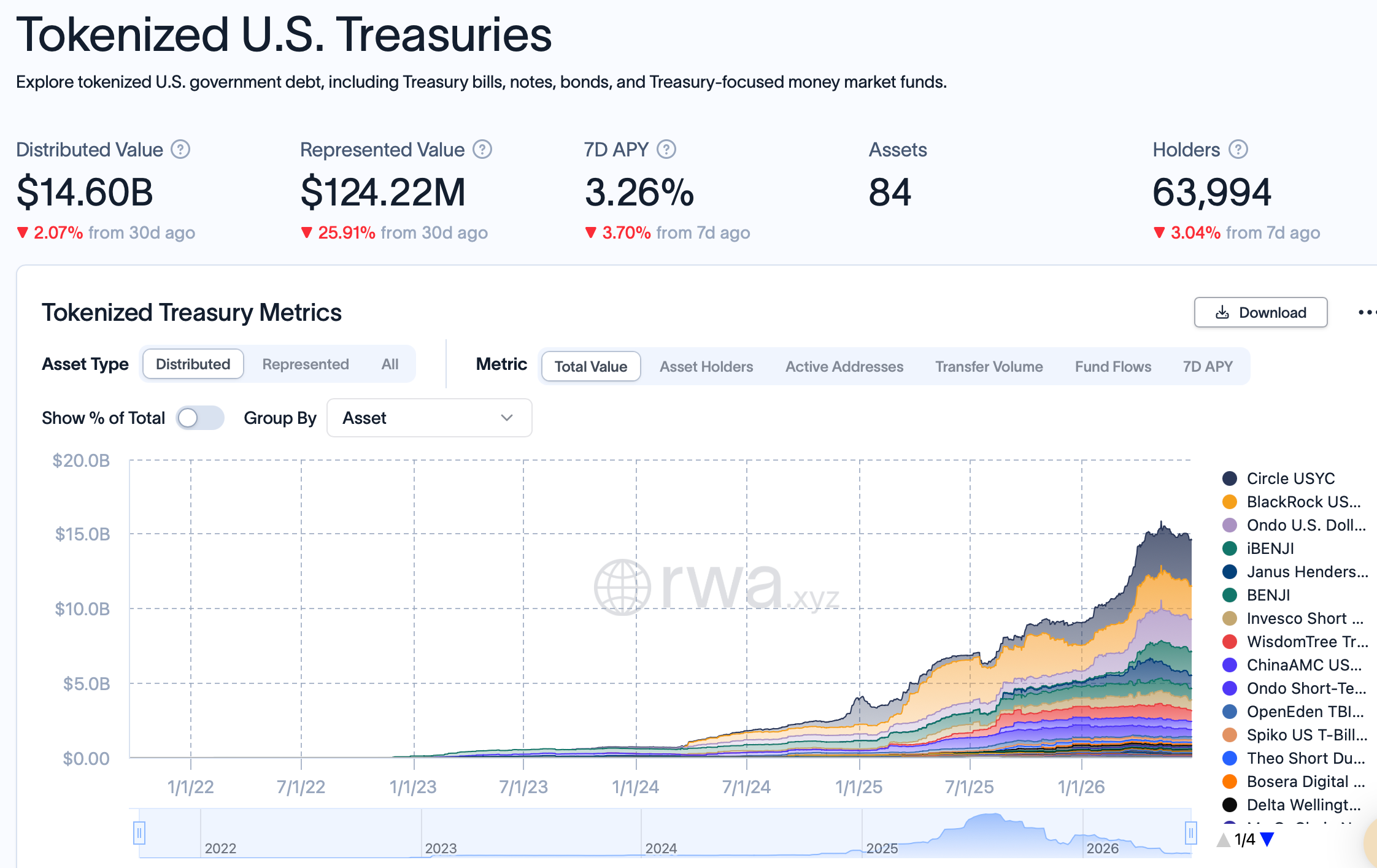
Meanwhile, tokenized US Treasury products have grown into a $14.6 billion market, according to data from RWA.xyz. The sector spans 84 on-chain products and is the largest segment of the tokenized real-world asset market.
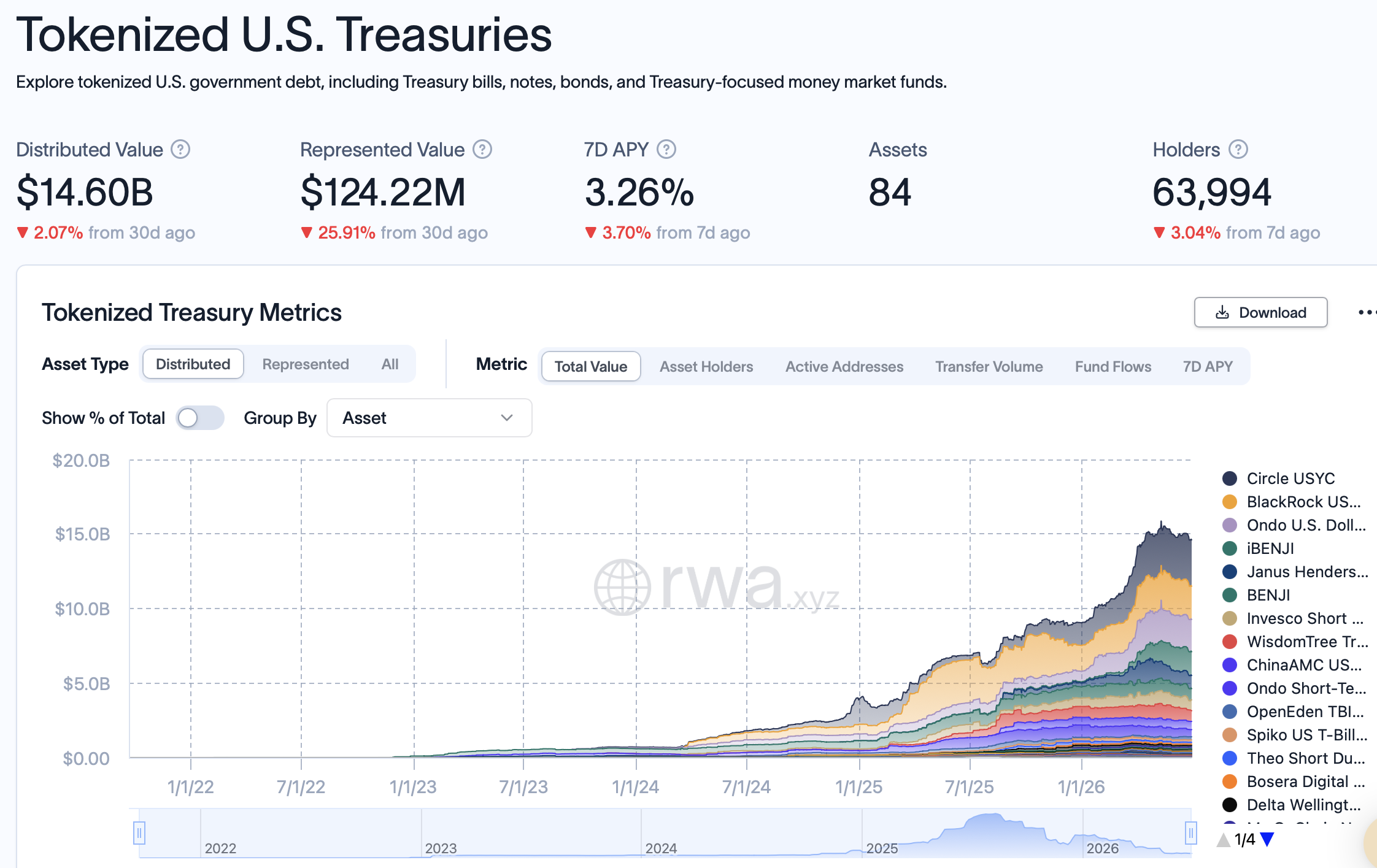
Tokenized US treasuries. Source: RWA.xyz
Magazine: Bitcoin decouples from tech stocks, Ether eyes ‘selling wave’: Market Moves
Crypto World
Market Movers: Meta’s Cloud Ambitions, Warsh’s Inflation Update, and Nike’s China Troubles

Key Takeaways
- Meta is preparing to enter the AI cloud infrastructure space, positioning itself against established enterprise providers
- Federal Reserve Chair Kevin Warsh indicated that inflationary pressures are subsiding while maintaining commitment to the 2% objective
- Major indexes including the S&P 500 and Dow Jones advanced as the second half of 2026 began
- Nike stock declined following cautious guidance on China market performance, overshadowing positive earnings results
- Crude oil values retreated as diplomatic progress between Washington and Tehran reduced supply concern
Meta Prepares to Challenge Cloud Giants With AI Infrastructure Offering
Meta emerged as a standout performer following news that the technology giant is developing a standalone AI cloud infrastructure platform.
This strategic expansion would mark a significant departure from Meta’s traditional advertising-focused revenue model, positioning the company against entrenched cloud computing leaders serving artificial intelligence enterprise clients.
Market participants have demonstrated considerable enthusiasm for firms expanding AI infrastructure capabilities throughout this year. Meta’s substantial experience operating massive-scale AI systems across its social media ecosystem is viewed as a competitive advantage in penetrating this expanding market segment.
Warsh Signals Declining Inflation Threat at Federal Reserve
Federal Reserve Chair Kevin Warsh communicated to financial markets that inflationary threats have diminished, while emphasizing the central bank’s continued focus on achieving its 2% inflation benchmark.
His remarks preceded Thursday’s employment data for June, which market observers are scrutinizing for indicators regarding the trajectory of monetary policy adjustments.
For technology-oriented and expansion-focused equities, declining inflation expectations typically represent favorable conditions. Reduced borrowing costs generally enhance the present value of projected earnings, particularly benefiting companies in rapid-growth industries.
Equity Markets Maintain Upward Trajectory as New Half-Year Begins
U.S. stocks continued their positive momentum, with both the S&P 500 and Dow Jones Industrial Average recording advances on July’s opening trading session.
These gains follow what proved to be one of the most robust quarterly performances for equity markets since 2020. Market participants maintained their optimistic stance on long-term profit expansion despite persistent questions surrounding interest rate policy and economic conditions.
Semiconductor equities experienced modest headwinds throughout the trading day, though robust performance across industrial, healthcare, and consumer sectors provided sufficient support to keep broader market indices in positive territory.
Nike Shares Retreat Despite Earnings Success on China Market Concerns
Nike delivered quarterly financial results exceeding analyst projections, yet the stock declined following management’s cautious assessment of persistent challenges in the Chinese market.
Market participants concentrated on the company’s forward-looking statements rather than historical performance metrics. Leadership suggested the recovery timeline may extend beyond previous market expectations.
Nike’s quarterly performance serves as an important barometer for international consumer demand patterns. The market’s reaction to the report exemplifies a consistent theme throughout this earnings cycle — forward guidance carries greater weight than retrospective achievements.
Crude Oil Values Decline Following Diplomatic Progress With Iran
Crude oil prices retreated after diplomatic engagement between the United States and Iran alleviated concerns regarding potential interruptions to global supply chains.
Declining energy prices help moderate inflationary forces while reducing operational expenses for sectors including aviation, retail distribution, and manufacturing operations.
Given inflation remains a primary consideration for market participants, developments in energy markets will continue receiving significant attention alongside forthcoming economic indicators.
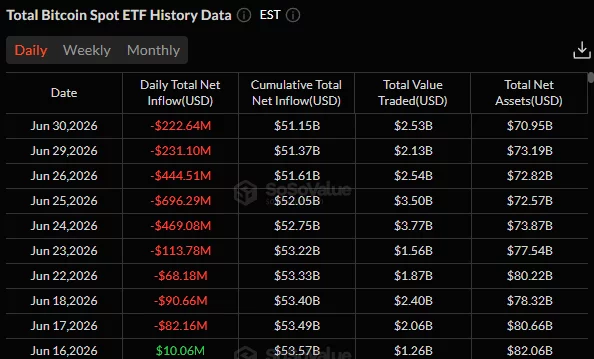
Bitcoin has remained under pressure after U.S. spot ETFs recorded $222.64 million in outflows, while Changpeng Zhao has reiterated his belief that the cryptocurrency can reach $1 million over the next decade.
Summary
- Changpeng Zhao says Bitcoin could reach $1 million as global ownership remains below 1%.
- U.S. spot Bitcoin ETFs recorded $222.64 million in net outflows, led by BlackRock’s IBIT.
- Bitcoin trades below key resistance, with $57.8K support and $63.7K–$65.3K as upside targets.
According to an interview Zhao gave to Block, the Binance founder argued that Bitcoin ownership remains extremely limited worldwide, with fewer than 1% of people currently holding the asset.
He said the low level of adoption leaves substantial room for future demand as more retail and institutional investors enter the market over multiple cycles.
Low ownership remains central to Zhao’s bullish outlook
Building on that argument, Zhao said Bitcoin could climb to around $600,000 during the next major market cycle, representing roughly a fivefold increase from current levels. He added that another cycle would only need to double that valuation for Bitcoin to reach the $1 million milestone, describing the scenario as achievable if adoption continues to expand.
Although Zhao acknowledged he could not predict exactly when those milestones would be reached, he maintained that long-term price appreciation would depend more on rising ownership than on short-term market speculation. He also noted that institutional participation, alongside continued retail adoption, could support Bitcoin’s value over time as ownership becomes more widespread.
Zhao’s comments come as long-term Bitcoin price forecasts remain a recurring topic across the digital asset industry, with several market participants continuing to argue that growing global acceptance could support higher valuations over the coming years.
Institutional demand pauses as technical resistance holds
While Zhao focused on Bitcoin’s long-term adoption story, U.S. spot Bitcoin ETFs experienced a setback on June 30 after recording $222.64 million in net outflows. Data from SoSoValue showed BlackRock’s IBIT accounted for the largest withdrawal, posting $212.45 million in net outflows during the session.
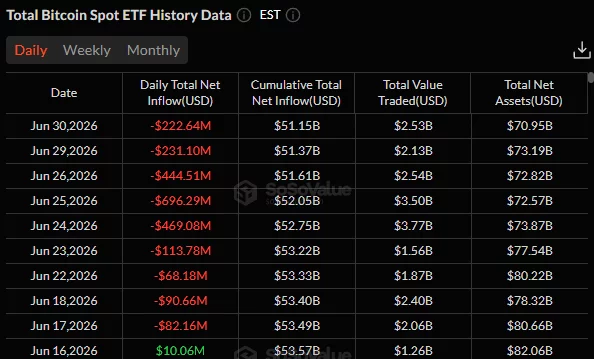
Even with the daily withdrawals, cumulative net inflows across U.S. spot Bitcoin ETFs stood at $51.15 billion, while total net assets remained at $70.95 billion. Daily trading volume reached $2.53 billion, indicating that investors continued to trade actively despite the temporary pullback in fund flows.
The ETF withdrawals also coincided with Bitcoin struggling to reclaim key technical levels. On the 4-hour chart, the cryptocurrency traded near $60,100, just above the 23.6% Fibonacci retracement around $60,065, while remaining below the Supertrend resistance near $60,900. A descending trendline connecting lower highs since mid-June continued to cap rallies, leaving sellers in control unless buyers reclaim nearby resistance.
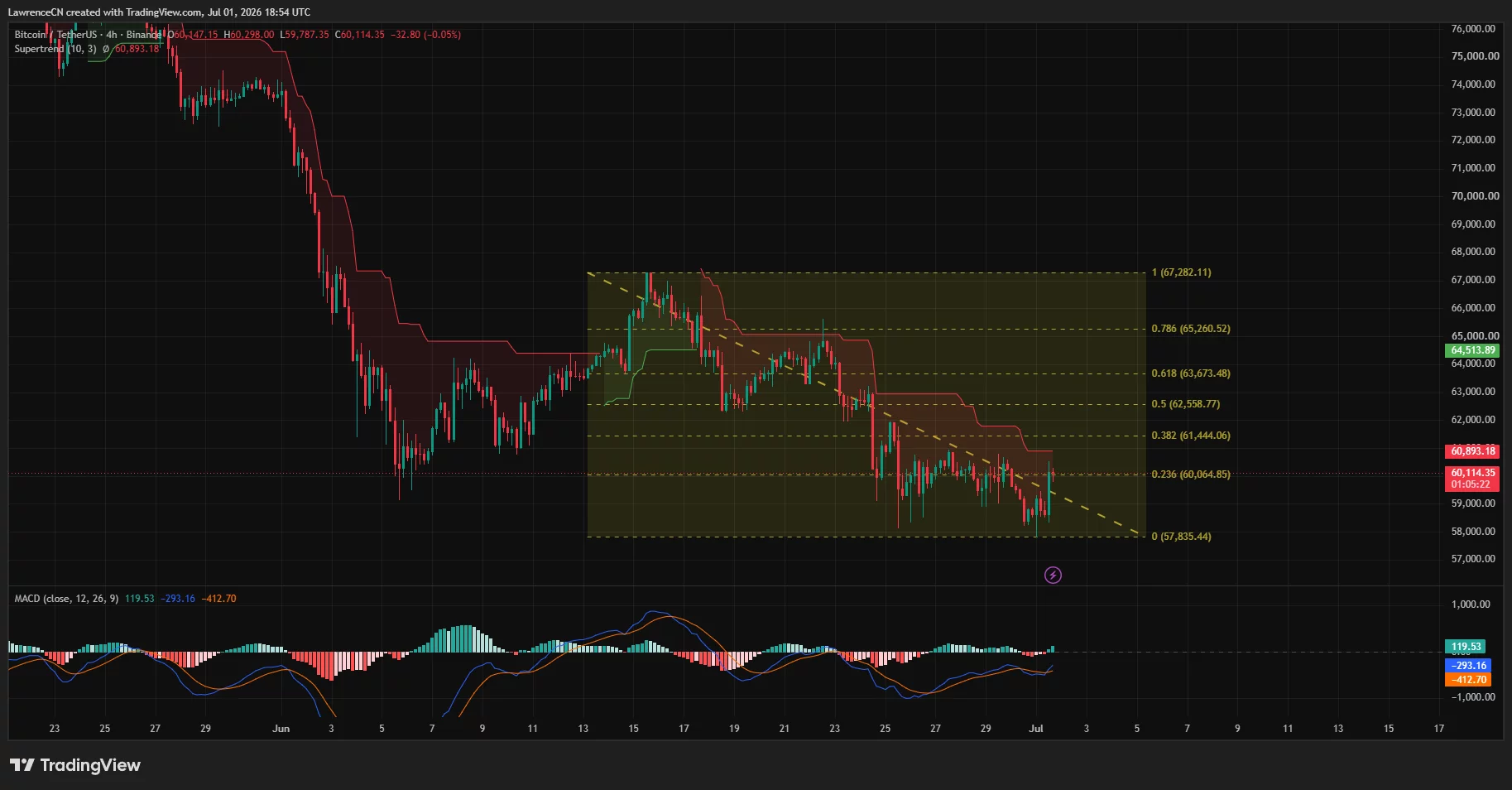
If buyers manage to break above the Supertrend and the descending trendline, Bitcoin could target the 38.2% Fibonacci level near $61,444, followed by $62,559 at the 50% retracement. A sustained move beyond those barriers would expose the 61.8% Fibonacci level around $63,673, with the 78.6% retracement near $65,261 becoming the next major upside objective.
On the downside, losing the $60,065 Fibonacci support could increase selling pressure toward the recent swing low around $57,835. A break below that level would invalidate the current rebound attempt and leave Bitcoin vulnerable to a deeper decline if buyers fail to step in.
Momentum indicators, however, hinted at improving conditions. The MACD histogram has turned positive and the MACD lines have started curling higher, suggesting bearish momentum is fading even though a confirmed bullish trend reversal has yet to develop.
For now, Bitcoin’s short-term direction may depend on whether institutional demand returns after the latest ETF outflows.
A recovery above nearby resistance could strengthen the case for a move toward the mid-$63,000 region, while another rejection may keep attention on support near $57,800. Zhao’s $1 million forecast, meanwhile, continues to rest on a much longer timeline driven by rising global Bitcoin ownership rather than short-term fund flows.
Disclosure: This article does not represent investment advice. The content and materials featured on this page are for educational purposes only.
Crypto World
Crypto claws back some losses but derivatives markets point to more pain ahead: Crypto Markets Today
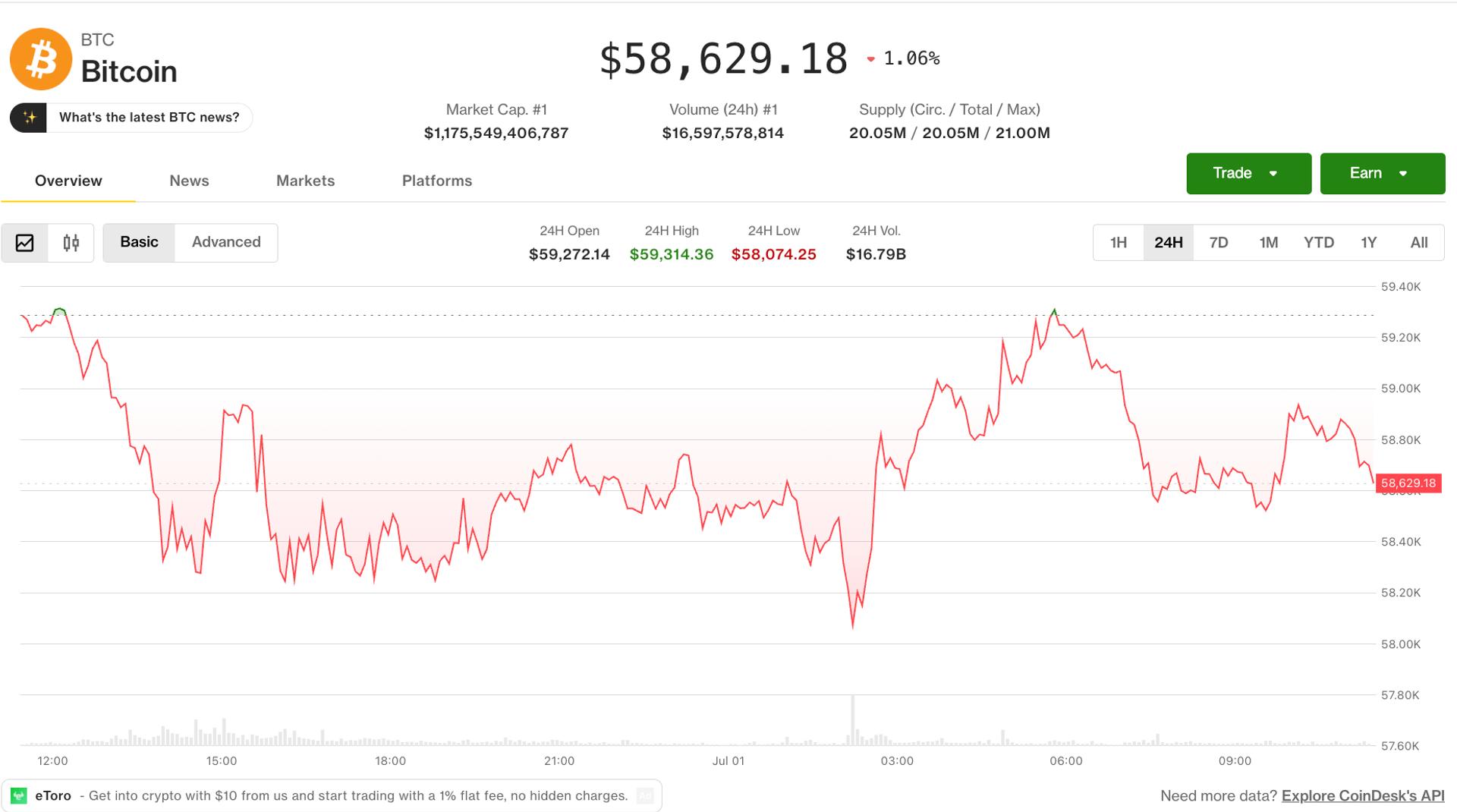
Bitcoin rose 0.3% to $58,700 on Wednesday, showing a sliver of strength after spiking down to $57,700, the lowest point since September 2024, shortly after midnight UTC.
Ether (ETH) is at $1,580, having also experienced a slight relief bounce since 01:00 UTC.
U.S. equity index futures are lower since midnight UTC, with S&P 500 futures and Nasdaq 100 futures in the red by 0.2%-0.4%
Risk assets like crypto and tech stocks have been struggling in recent weeks as concerns of impending inflation have lifted the U.S. dollar and made traders cautious.
The altcoin market has been the hardest hit because it lacks the liquidity and demand to deal with precipitous moves to the downside and liquidation cascades.
Derivatives positioning
- A total of $395 million worth of crypto futures bets have been liquidated in 24 hours, with bullish plays accounting for most of the tally. That’s hardly surprising given BTC’s dip to lows under $58,000 early in the day.
- The real story is crude futures listed on crypto exchanges. They have seen liquidations worth $15 million, the fifth-largest tally among all tokens. The figure shows just how popular TradFi trading has become on crypto exchanges.
- BTC’s futures open interest (OI) jumped to 768K BTC from 740K BTC a day ago. While the influx of money is encouraging, it’s unclear whether the bias is for bullish or bearish bets. For instance, the annualized funding rates hover near 5%, hinting at a bullish bias, while the 24-hour cumulative volume delta is negative, suggesting bears are being more aggressive and trading with market orders rather than passive limit orders.
- Gold perpetual futures OI hit a record high of 222K XAU tokens. This comes as the metal’s spot price shows a bearish death cross, signaled by the 50-day simple moving average crossing below the 200-day SMA. Prominent gold ETFs are displaying a similar bearish pattern.
- Bitcoin and ether’s 30-day implied volatility indexes are steady after June’s double-digit gains. Bitcoin’s index, BVIV, is now hemmed between the 200-day average as resistance and the 50-day as support. A break above the 200-day MA might mean new turbulence and a deeper price slide.
- On Deribit, bitcoin and ether puts remain pricier than calls across all time frames as traders seek downside protection.
- Key flows at over-the-counter desk Paradigm featured demand for the September expiry bitcoin put at the $50K strike price. This is a bet that prices could slide below $50K by the end of the third quarter. Meanwhile, someone lifted a SOL call option at the $86 strike. The token is currently trading around $75.
Token talk
- While the broader altcoin market is struggling, Solana-based DeFi token jupiter (JUP) has posted a trend reversal, rising by 11% since midnight UTC with a 55% increase in daily trading volume.
- The increase comes alongside a jump in total value locked (TVL), with the protocol, a decentralized exchange (DEX) aggregator. TVL has risen to more than 20 million SOL from 13.9 million in May.
- Stellar lumens (XLM) extended gains, rising from $0.168 on Sunday to $0.196, an increase of 17%.
- The strong performance of a select few altcoins kept CoinMarketCap’s “Altcoin Season” index sticky at around 48/100 after ending June little changed despite weakness across the sector.
- AI tokens have been the recipient of that weakness. Bittensor (TAO) lost 2.5% on Wednesday and is now down by over 30% since June 15.


Cloudflare opened a waitlist Wednesday for its Monetization Gateway, a new tool letting customers charge for any web page, dataset, API or MCP tool sitting behind its network. Payments settle in stablecoins over the x402 protocol. The announcement came from Cloudflare's official X account Wednesday… Read the full story at The Defiant

Jefferies analyst Andrew Moss and his team warned Monday that the CLARITY Act, the defining crypto regulation bill of this Congress, faces a compressing Senate window, with Polymarket odds of passage by end-2026 now sitting at 48%, down from 70% in mid-May.
The bank is flagging elevated near-term crypto volatility across both tokens and blockchain-related equities as the legislative outcome sharpens into a binary event.
The drop in prediction-market odds reflects three converging pressures: unresolved ethics provisions, outstanding disputes over illicit finance language, and a Senate floor calendar that offers roughly 20 legislative days before the August recess.
Miss that window and the market structure bill does not simply get rescheduled, it gets repriced entirely. “Failure to pass Clarity before the August recess could push the bill out to next year, or even later, if Democrats flip the Senate in November,” Moss and his colleagues said in the note.
Jefferies specifically flagged Coinbase (COIN), Circle (CRCL), and Bullish (BLSH) as the crypto-linked equities most exposed to legislative-driven swings, alongside select tokens.
Discover: The Best Token Presales
CLARITY Act: The August Recess Is the Real Deadline
The CLARITY Act cleared the Senate Banking Committee on May 14 in a 15-9 bipartisan vote, drawing all Republican members and two Democrats. That looks like momentum. The procedural math that follows does not.
Before any full Senate floor vote, lawmakers must reconcile two separate committee-passed versions, the Banking Committee’s bill and the Senate Agriculture Committee’s Digital Commodity Intermediaries Act, then align the merged text with the House-passed H.R. 3633 (which cleared 294-134 in July 2025), and clear a 60-vote cloture threshold to overcome a filibuster.
That is four distinct procedural gates, compressed into approximately 20 working legislative days before recess. First, the Banking and Agriculture versions contain substantively different approaches to CFTC jurisdiction over digital commodities, and no merged text has been published as of late June.
Second, the ethics provisions attached during committee markup have not found consensus, with some members seeking to strip them and others treating them as non-negotiable. Third, law enforcement agencies have raised objections to specific DeFi exemption language, adding another negotiating variable that could slow floor scheduling.
JPMorgan made a similar call earlier in June, warning that the crypto market structure bill may have only a limited window for passage this year as the congressional calendar tightens ahead of midterm elections.
The stablecoin yield debate, which Standard Chartered has estimated could redirect up to $500 billion in deposits if resolved permissively, remains an open variable that complicates any rushed compromise. If the bill slips past August, it re-enters a Senate environment potentially reshaped by November elections, at which point Democratic gains could shift the 60-vote calculus against it entirely.
What Jefferies Is Actually Flagging, And What Polymarket Already Priced In
The Jefferies note is not the first sell-side warning on this timeline, but the 22-point collapse in Polymarket odds since mid-May gives it harder backing than prior analyst commentary.
Galaxy Digital’s Alex Thorn cut his firm’s passage probability from 60% to 50% on June 26, citing calendar compression rather than policy disputes as the primary driver. Jefferies has now landed below that level on the prediction market, suggesting the street is converging on sub-50% as the base case.
What the Jefferies note adds is equity-specific granularity. For Coinbase, the exposure is direct: the exchange’s product suite, staking, lending, rewards on USDC holdings, operates in the regulatory gray zones the CLARITY Act would either sanction or constrain. A delay preserves the current ambiguity but also preserves enforcement risk, particularly with an SEC that has shown willingness to act on custody and yield products.

For Circle, the situation is genuinely mixed: the current bill text would reportedly close the loophole enabling third parties like Coinbase to offer rewards on USDC, which could suppress USDC growth metrics, while a delay gives Circle more runway to diversify revenue beyond stablecoin reserve income before that provision lands.
The detail most readers are missing is the asymmetry in the delay scenario. Recent guidance from the SEC, CFTC, and OCC has improved the near-term operating environment for institutional crypto participants, but Jefferies is explicit that agency guidance is reversible.
A future administration can undo every no-action letter and staff bulletin without legislation. The CLARITY Act would create durable statutory clarity that agencies cannot unwind unilaterally, that distinction is what makes the bill material beyond a single news cycle.
Don’t Miss Out on Our $1,000 USDT Airdrop on ByBit
The post CLARITY Act Faces Sub-50% Odds as Senate Clock Ticks Toward August appeared first on Cryptonews.

Key Takeaways
- OPEN shares climbed more than 9% Wednesday, reaching approximately $5.05
- Russell 3000 Index welcomed Opendoor, with inclusion taking effect June 26
- Leadership compensation structure emphasizes performance metrics, attracting investor focus
- Eric Jackson from EMJ Capital projects $82 per share by 2028 and $500 by 2033
- Options traders showed strong conviction: 99,802 call contracts at double normal volume, Put/Call Ratio at 0.14
Opendoor Technologies (OPEN) shares surged over 9% during Wednesday’s session, reaching the $5.05 level, fueled by a combination of benchmark index entry, optimistic Wall Street commentary, and aggressive derivatives positioning in the proptech name.
Opendoor Technologies Inc., OPEN
The rally followed confirmation that Opendoor secured a spot in the Russell 3000 Index, officially taking effect at market close on June 26. Such benchmark additions typically trigger institutional buying from passive funds replicating the index composition.
Market participants have also taken note of CEO Kaz Nejatian’s compensation framework, which emphasizes performance-driven incentives. This structure demonstrates executive alignment with shareholder value creation over the long haul rather than guaranteed base compensation.
The most vocal optimist remains Eric Jackson from EMJ Capital, who has characterized Opendoor as experiencing “real estate’s Tesla moment.” Jackson projects the stock could reach $82 per share by 2028, with an ambitious long-range forecast of $500 by 2033.
Jackson’s investment case centers on Opendoor’s vertical integration strategy, asset class ownership, and possibilities around real estate tokenization. While extremely aggressive, the thesis has captured market attention.
Chart Analysis and Key Price Levels
Examining the technical picture, OPEN currently trades 12.7% above its 20-day simple moving average of $4.51 and 5.8% above its 50-day average at $4.81. This positioning indicates near-term momentum favors buyers.
The extended timeframe presents a more complicated scenario. Shares remain 14.6% beneath the 200-day moving average of $5.96, indicating the long-term trend hasn’t completely reversed course.
The MACD indicator sits above its signal line with positive histogram readings, suggesting strengthening momentum. However, the death cross formation from March — when the 50-day average dropped below the 200-day — remains a technical headwind signaling unresolved long-term weakness.
Critical resistance appears at $5.50, a psychological level where previous rallies have encountered selling pressure. Downside support emerges at $4.50, coinciding with the 20-day moving average zone.
Derivatives Activity Signals Bullish Positioning
The options arena delivered perhaps the most compelling signal Wednesday. Total call volume reached 99,802 contracts in OPEN, approximately double normal activity levels.
The most heavily traded positions included the July 2nd weekly $5 calls and $5.50 calls, combining for nearly 32,200 contracts. Implied volatility expanded more than 3 points to 85.43%.
The Put/Call Ratio registered just 0.14 — an extremely low reading indicating traders are predominantly positioned for continued upside movement in coming sessions.
Opendoor is scheduled to report quarterly earnings on August 6.


Venice, a privacy-first AI platform founded by Erik Voorhees, raised a $65 million Series A at a $1 billion equity valuation in a round led by Dragonfly. It is the company's first outside capital since launching. Voorhees announced the round Wednesday morning, saying Venice hit profitability in the… Read the full story at The Defiant
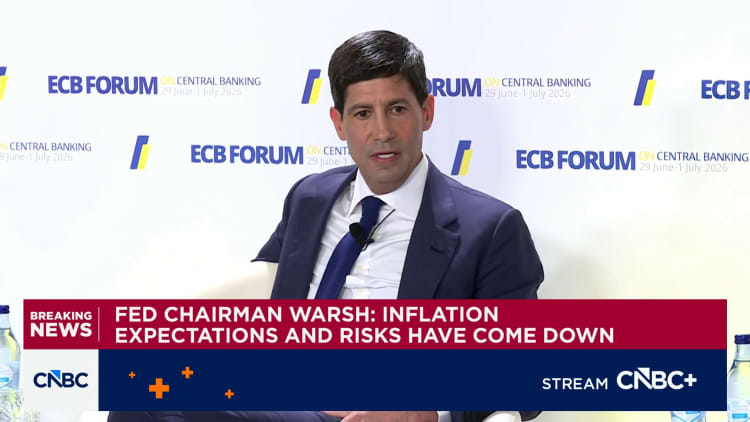
Kevin Warsh, Chairman of the Federal Reserve, speaking at the ECB Forum in Sintra, Portugal on July 1st, 2026.
CNBC
Federal Reserve Chairman Kevin Warsh has said that inflation is a “choice.” The same could also be true of how inflation is measured.
While the central bank has its own favorite metric courtesy of the Commerce Department, the public data base is rife with other gauges of how price pressures are best viewed.
It’s likely that many of them will get a serious look as the Warsh Fed plots what he called on Wednesday a “new course” for how it operates — and specifically what will be the data triggers for the ways it implements monetary policy.
“My hope, my aspiration, is that nine-12 months from now we’re going to be using new technologies to understand what’s happening in the real economy in a contemporaneous, real-time way that positions us as central bankers to make better decisions,” he said during a discussion at the European Central Bank Forum on Monetary Policy in Sintra, Portugal.
Warsh has formulated five task forces to look at an array of Fed functions. One will be data-focused while another will take a look at how officials measure, and react to, inflation.

The review is sure to be about more than the age-old battle between headline inflation and core inflation, the latter excluding the day-to-day necessities of gas and groceries because of how volatile those prices can be.
Instead, the Fed can use the process as a way to bring in other data points that paint a more complete picture of the cost-of-living challenges consumers face from inflation, which has been running hot for five years.
A variety of choices
These include measures from other central bank offices such as the Dallas Fed and its focus on “trimmed mean” inflation that includes outliers. Or the Atlanta Fed’s “sticky” and flexible” inflation that distinguishes between prices that tend to move up and down a lot and those that are steadier. There are also widely followed surveys from the University of Michigan and the New York Fed, as well as private sector measures such as the “Truflation” gauge that employs “cutting-edge technology to deliver the world’s only verifiable daily inflation indexes.”
Perhaps unsurprisingly, these measures can and do present very different pictures of inflation, with some reinforcing the view that prices are still too high and others saying the Fed might be closer to its 2% goal than traditional measures indicate.
“A good read on where inflation is headed is critical to whether the Fed needs to move rates,” Claudia Sahm, chief economist for New Century Advisors, wrote in a Substack post Tuesday. “But trend is not destiny — even a 2% trend is no guarantee of price stability, since actual inflation can diverge from trend as it does now.”
A basic view of the mainstream indicators shows inflation is well above the Fed’s 2% target.
The consumer price index — a broad amalgam of what consumers pay for goods and services — showed headline inflation running at a 4.2% annual pace in May, with core inflation at 2.9%.
At the same time, the personal consumption expenditures price index — the Fed’s preferred gauge that is more aggressive at adjusting for consumers’ behavioral changes like substituting less expensive items for costlier ones — put the respective numbers at 4.1% and 3.4%. Economists largely believe core is a better long-run gauge of inflation as it omits the most volatile categories, particularly important now considering the Iran war’s impact on energy prices.
Outside the norm
Other indicators, though, show different results.
The Dallas Fed “trimmed mean,” an average of inflation figures that tosses out the 24% of items that have the lowest price changes and 31% with the highest, shows a 12-month rate of just 2.4%. But there’s one important caveat with what is otherwise considered a trusty metric: Dallas Fed President Lorie Logan has warned that the methodology as currently deployed may be discarding the wrong prices.
Elsewhere, the Atlanta Fed’s flexible and sticky price gauges present a fascinating dichotomy: sticky prices running at a 3.1% 12-month annualized rate, and flexible prices at 7%, the highest since November 2022.
On the other hand, Truflation paints a much more benign picture, at just 1.75%. The measure has mostly moved in-step directionally with the CPI and PCE gauges but showed a much higher peak of 11.5% in June 2022, a time when CPI had topped out around 9%.
Finally, market-based measures also point to a less severe inflation backdrops.

The 2-year Treasury yield, sensitive to the vagaries of Fed rate policy, popped following Warsh’s first news conference in June but has since eased a bit. Similarly, the Treasury market’s five-year inflation indicator has plunged since May and is now at just 2.26% and the one-year “breakeven” rate has fallen nearly half a percentage point since May, albeit still elevated around 3%.
For Warsh, all of these data points, plus others from various agencies, present a complicated mosaic that his task forces will have to sift through. The chairman on Wednesday indicated that the Fed’s criteria will change dramatically and be more responsive to the current environment.
“We’re no longer going to have to rely solely on data that we get from government agencies with mismeasurement problems that have surveys that are no longer relevant,” Warsh said. “If we do our jobs, we’ll be here a year from now, and we’ll say we’ve discovered data that helps us make better decisions, and we live up to our promise.”

Why I Sold All My Bitcoin… it’s over.

Andy Burnham says ‘nothing is off the table’ as calls grow to deport Rochdale grooming gang leader
Kroger (KR) Stock Drops 2% Following $1.65 Billion Giant Eagle Acquisition Announcement





-

 Fashion5 days ago
Weekend Open Thread: Staud – Corporette.com
-

 Politics6 days ago
The House | Manchesterism won’t survive the painful trade-offs unless it gets citizens on board
-

 Crypto World2 days ago
Strategy authorizes up to $1.25B in Bitcoin sales under new capital plan
-

 Politics6 days ago
Potential 2028er World Cup attendee leaderboard
-

 Business6 days ago
Asia stock markets slide as tech shares slump
-

 News Videos3 days ago
MAJOR BITCOIN & MARKET UPDATE!!!! (MUST WATCH ASAP!!!)
-

 Tech6 days ago
A Look At A Gaggle Of Transputer Boards
-
 Crypto World6 days ago
Dell (DELL) Shares Tumble Over 5% Following Analyst Downgrade to Hold
-

 Crypto World4 days ago
Coinbase, Circle Deepen Crypto Stock Losses Despite Resilient S&P 500
-

 Business2 days ago
Australia treasurer says alleged access of prime minister’s bank data ’incredibly concerning’
-

 Crypto World5 days ago
Kraken's xStocks Opens Bending Spoons IPO Registration to EEA Retail
-

 Sports5 days ago
FIH Pro League: India defeat Pakistan 7-1, register biggest win of campaign | Other Sports News
-

 Crypto World6 days ago
Bitcoin Sparks $600M Hourly Liquidations With $65,000 Set To Become Resistance
-

 Tech4 days ago
Bluekit phishing kit adopts browser-in-the-middle for login theft
-

 Tech4 days ago
Russian hackers now target Signal backup recovery keys
-
Crypto World5 days ago
Hyperliquid Named on Singapore MAS Investor Alert Register
-

 Crypto World5 days ago
RTX holders must register wallets before token distribution begins
-

 Crypto World7 days ago
Ripple and SBI launch RLUSD in Japan after JFSA approval
-

 Tech2 days ago
Anonymous researcher drops 0-day ‘exploitarium’ repo
-
 Business2 days ago
The AI boom won’t burst all at once. It will pop in ‘rolling bubbles’: Macquarie
You must be logged in to post a comment Login