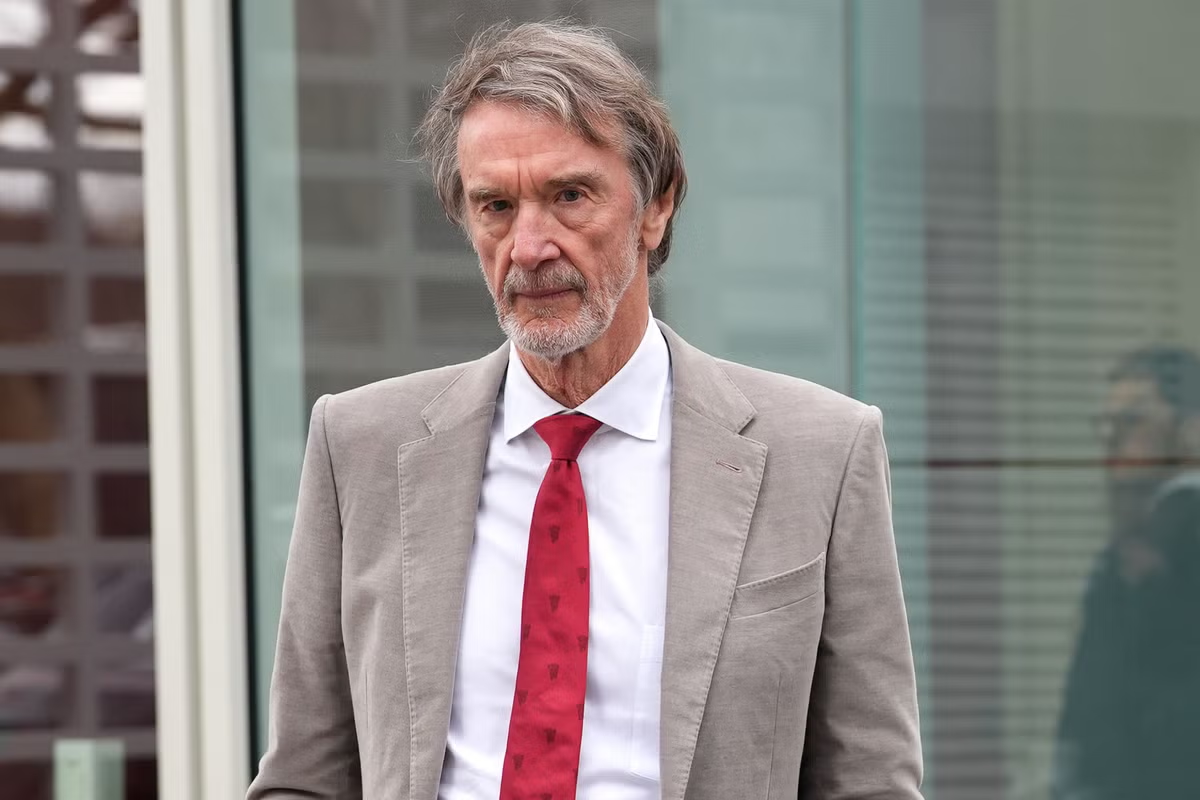
Manchester United co-owner Sir Jim Ratcliffe has apologised that his claim Britain has been “colonised” by migrants “offended some people in the UK and Europe”.
Sir Jim, one of Britain’s richest men, has been under pressure from a string of high-profile politicians, including Sir Keir Starmer, to apologise for the claim.
While the Ineos founder said he was sorry that his remarks “caused concern”, Sir Jim insisted that it was important to “raise the issue of controlled and well-managed immigration that supports economic growth”.
Following his statement, the club issued one of its own, insisting it was an “inclusive and welcoming club”.
Advertisement
It added: Our diverse group of players, staff and global community of supporters reflect the history and heritage of Manchester; a city that anyone can call home.”
In his statement released on Thursday, the billionaire said: “I am sorry that my choice of language has offended some people in the UK and Europe and caused concern, but it is important to raise the issue of controlled and well-managed immigration that supports economic growth.
“My comments were made while answering questions about UK policy at the European Industry Summit in Antwerp, where I was discussing the importance of economic growth, jobs, skills and manufacturing in the UK.”
He added: “My intention was to stress that governments must manage migration alongside investment in skills, industry and jobs so that long-term prosperity is shared by everyone. It is critical that we maintain an open debate on the challenges facing the UK.”
Advertisement
The Prime Minister’s official spokesman said it was “right” that Sir Jim apologised for his “offensive and wrong” comments.
Sir Keir was among the first major political figures to have called on the businessman to apologise.
Andy Burnham, the Labour mayor of Greater Manchester said they “go against everything for which Manchester has traditionally stood”.
Mr Burnham, who has backed plans driven by Sir Jim to regenerate Old Trafford and build a new stadium for Manchester United, also said “footballers who have arrived from all over the world to play in Greater Manchester have enhanced the life of our city region”.
Advertisement
He then appeared to hit out at United’s ownership, adding: “If any criticism is needed, it should be directed towards those who have offered little contribution to our life here and have instead spent years siphoning wealth out of one of our proudest institutions.”
Kick It Out – the anti-discrimination football campaign group – told the Press Association Sir Jim’s comments were “disgraceful and deeply divisive” and also criticised his claim that the UK population has swelled by 12 million since 2020, which has proved to be inaccurate.
In the interview with Sky News on Wednesday, Sir Jim – who founded chemical giant Ineos in 1998 – said: “You can’t have an economy with nine million people on benefits and huge levels of immigrants coming in.
“I mean, the UK is being colonised. It’s costing too much money. The UK has been colonised by immigrants.”
Advertisement
Sir Jim bought a minority share in Manchester United in late 2023 and his Ineos group has since taken control of football operations.
The billionaire has presided over a variety of contentious changes since becoming part of the ownership, with ticket pricing and availability causing particular anger among United fans.
A protest against the club’s owners, including for the first time towards Sir Jim as well as the Glazers, took place before Manchester United’s recent home game against Fulham.
The school – which is currently operating in a £2.7m deficit – has been accused of using gifts intended for some of their most disadvantaged pupils as promotional ‘prizes’
06:30, 02 Apr 2026
Advertisement
A West Belfast school is facing accusations it misappropriated donations of toys and electronics intended for 80 of the school’s most disadvantaged pupils – and used them for marketing purposes.
De La Salle College is understood to have received toys and other items through the Cash for Kids Mission Christmas Appeal in the run up to Christmas 2025.
The charity confirmed to Belfast Live that the school applied for support for 80 children, who were at risk of waking up with nothing on Christmas morning.
Cash for Kids said organisations applying to the appeal are asked to identify the children who will receive support, including details such as age and any additional needs, with items intended for those specific recipients. However, concerns have since been raised about how the donations were used.
Advertisement
Belfast Live spoke to multiple sources at the school who alleged not all of the items were distributed to the children identified in the application. It was further claimed that some of the goods were instead used as prizes at the school’s ‘Open Night’ in January and distributed more broadly in classrooms.
As part of our investigation, Belfast Live was shown footage that appears to show a large quantity of toys and high-end electronic items stored within the school. Separate footage, posted by the college on social media, shows similar items being distributed to local primary school children following the Open Night. It is not known whether the items shown in either video include those received as part of the Cash for Kids appeal.
When Belfast Live contacted Cash for Kids, the charity confirmed this was the first time they had been made aware of the allegations and are now in contact with the school.
Advertisement
Cash for Kids asks recipient groups to distribute items to children identified in their application and issues a monitoring form in January seeking feedback on how donations were used.
The terms and conditions set out for receipt of the grants explicitly state that: “donated goods must not be sold, cannot be used for fundraising purposes and are strictly non-transferable. Any unused donations must be returned to Cash for Kids for redistribution to support local underprivileged children.”
Organisations that do not meet the terms of a grant application may be refused future support, among other potential steps, depending on the circumstances.
These allegations come on the backdrop of financial pressures at the school. Education Authority records show that the school, which had been operating with a healthy surplus until 2019, is now operating in a budget deficit of £2.7m following a sharp decline in pupil numbers.
Advertisement
In 2016, De La Salle College had an enrolment of 1,117 pupils. By 2024/25, enrolment figures had fallen by more than 30% to just 774 pupils, with more than 50% in receipt of free school meals.
There is no suggestion that the school’s financial position is directly linked to the concerns raised about the use of the donated items.
Belfast Live contacted De La Salle College and presented them with the findings of this investigation. We posed a series of questions to the school, including whether all items were distributed to intended recipients and whether any were used as prizes at the school’s Open Night.
Advertisement
The school was also asked to clarify whether items had been distributed more broadly within the school and to outline its policy on handling charitable donations.
Despite multiple attempts to contact the school via phone and email, no response was received by the time of publication.
The 33-year-old goalkeeper, who has been absent with fitness issues on several occasions this term, withdrew from the Brazilian squad due to “injury,” according to the country’s football federation, while Slot – speaking in his last post-match press conference on March 21 – said “let’s see afterwards” after confirming that Alisson would “definitely be out during the international break”.
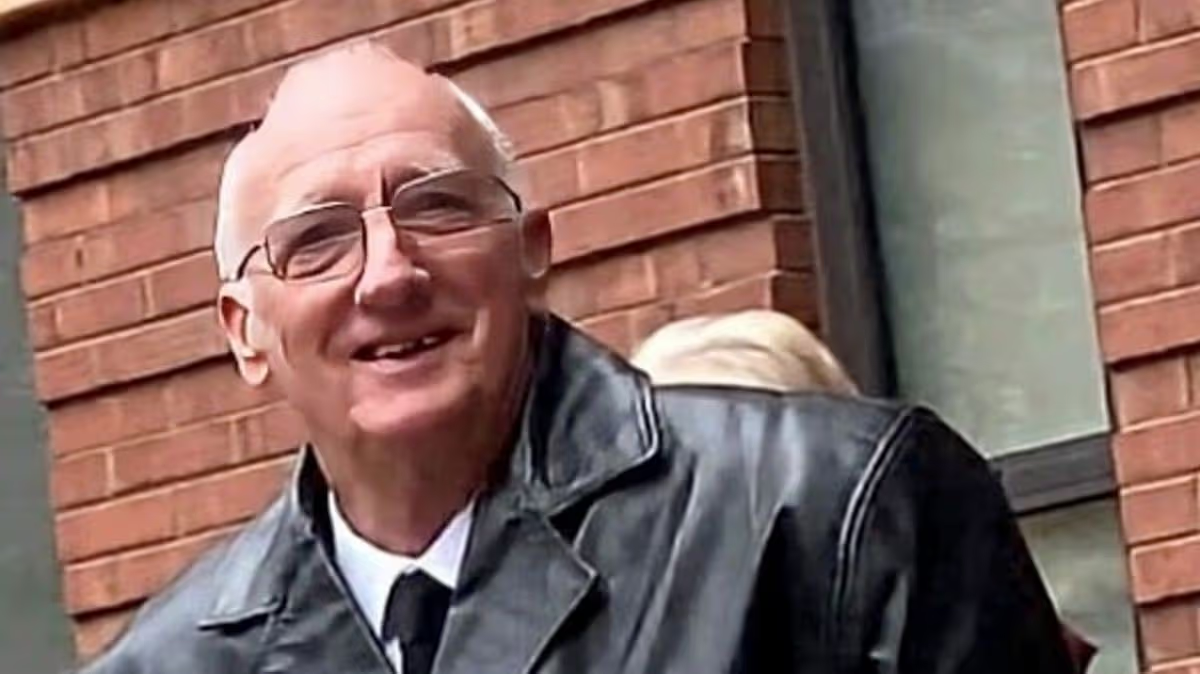
John Sandell, 75, was refused permission to return to Alicante, Spain, after he was found guilty of sexual offences in the UK relating to a young girl
An expat living in Spain has been refused permission to return as he faces sentencing after being found in a caravan with a young girl.
Advertisement
John Sandell was refused permission by a judge at Hull Crown Court to go back to Alicante and was ordered to surrender his passport within 24 hours.
The 75-year-old, who previously lived in the Withernsea, Yorkshire before later moving to Spain, denied six offences of indecency with a child but he was convicted by a jury after a trial on majority verdicts of 11 to one.
He also denied two other similar offences and two of indecent assault and he was cleared of those. The verdicts came after deliberations of 10 hours and 16 minutes spanning two days.
After the guilty verdicts, sentence was adjourned for reports and defence barrister Julia Baggs said that Sandell had, throughout the proceedings, been living in Alicante – but had returned to this country for court hearings without any problems.
She asked for his bail to be continued on the same terms. Deputy circuit judge Peter Kelson said, however, that allowing Sandell to continue living in Alicante “complicated” the situation.
“I am not comfortable with the defendant returning to Spain,” he said. “I impose a condition of bail that the defendant must reside in the UK and he must surrender his passport to the police within 24 hours. On that understanding, he can leave the dock.”
Advertisement
Sandell was ordered to live with his sister in the Withernsea area until the day of sentence and to speak to the police’s officer in the case, who was sitting in the public gallery, to arrange to hand over his passport. They spoke outside the courtroom to make arrangements for this.
During the trial, the court heard that Sandell was caught with the young girl while they were in a caravan in East Yorkshire. The girl’s mother heard laughing and discovered them together. “He just froze and didn’t say anything,” said the woman. There were two girls in the caravan.
“I didn’t expect to see such a sight,” the mother stated. “All I could think was to get the girls out of the caravan. He was saying it was not what it looked like and nothing had happened. I didn’t believe him.”
During his defence evidence, Sandell, also a former Blackpool hotelier, denied any indecency with the girl. “No, never,” he claimed. But prosecutor Ben Hammersley told him: “You are lying to this jury, aren’t you?” He claimed that Sandell groomed and sexually abused the girl.
Advertisement
“She had no reason to make it up,” said Mr Hammersley. “These things happened, didn’t they?” Sandell replied: “No, they didn’t. Not true.”
Mr Hammersley said: “You gave her cakes and treats.” Sandell replied: “No.” He denied taking the girl to Hull Fair and showing her videos that were inappropriate for her age.
Mr Hammersley claimed: “You were doing this to try to gain her trust and favour. You wanted to make her feel special, didn’t you? You wanted to build a closeness with her. You were grooming her.” Sandell replied: “No.”
Mr Hammersley said: “You knew it was wrong. You told her not to say anything. Your conversations with her became sexual.” Sandell replied: “Never.”
Advertisement
Mr Hammersley said of the caravan incident: “You were caught red-handed and tried to cover your tracks.” Sandell tried to pretend that there was “no hankypanky” involving the girl. He replied: “No.”
During police interview, Sandell made no comment to all questions. “I didn’t know what to do because I had never been in court before,” he claimed. “I was told to say ‘No comment’ so that’s what I said.” He had no previous convictions, the court heard.
Sandell told the court that he was arrested in Manchester and was taken to a police station after hearing that the police wanted to speak to him about something. “I thought I was going to be giving information about an ongoing trial,” he claimed.
Mr Hammersley told him: “Until you were faced with these allegations in 2022, you thought you had got away with it.” Sandell replied: “Not true at all. I didn’t know I was going to be arrested. I was in shock.”
WASHINGTON (AP) — The Senate is expected to try quickly passing a measure Thursday that would fund most of the Department of Homeland Security, though it’s unclear how soon the House will follow to largely end the longest partial government shutdown in history.
House Speaker Mike Johnson and Senate Majority Leader John Thune announced a plan Wednesday to fully fund the Department of Homeland Security as part of a two-step process. The agreement puts the leaders on the same page for ending the impasse after they pursued separate plans that resulted in Congress leaving Washington last week without a fix.
Johnson and Thune announced a return to the bipartisan Senate plan worked out with Democrats that funds most of the department, with the exception of U.S. Immigration and Customs Enforcement and U.S. Border Patrol. Republicans would then try later to fund those agencies on their own through party-line spending legislation that could take months to finish.
Neither outcome is guaranteed, and the strategy could potentially still face opposition from the GOP’s own ranks even though President Donald Trump has given his support.
Advertisement
“We appreciate and share the President’s determination to once and for all bring an end to the Democrat DHS shutdown,” said Johnson, R-La., and Thune, R-S.D.
House Republicans refused to go along with the Senate plan last week excluding ICE and Border Patrol, instead changing the bill to fund all of DHS for 60 days.
The DHS shutdown reached its 47th day on Wednesday. Senate Democratic leader Chuck Schumer said in a statement, “Republican divisions derailed a bipartisan agreement, making American families pay the price for their dysfunction.”
The two top Republicans hope to win over skeptical GOP colleagues, but the most conservative lawmakers are likely to seek full funding for all of Trump’s immigration and deportation operations.
Advertisement
“Let’s make this simple: caving to Democrats and not paying CBP and ICE is agreeing to defund Law Enforcement and leaving our borders wide open again,” Rep. Scott Perry, R-Pa., posted on X. “If that’s the vote, I’m a NO.”
The Senate meets for an early pro-forma session Thursday. Those generally last just a few minutes as the vast majority of senators are not present. Senators could take up the measure they passed just last week through a unanimous consent request, allowing it to pass if no senator objects. The Senate’s action would then send the bill back to the House, which is also holding a pro-forma session later in the morning.
Meanwhile, the narrow budget package that Trump wants prepared for later this year is expected to fund ICE and Border Patrol through the remainder of Trump’s term, as a way to try to ensure those agencies are no longer at risk from Democrats objecting to the president’s immigration enforcement agenda. Trump said he wants that legislation on his desk by June 1.
“We are going to work as fast, and as focused, as possible to replenish funding for our Border and ICE Agents, and the Radical Left Democrats won’t be able to stop us,” Trump said.
Advertisement
House Democratic leader Hakeem Jeffries released a statement after Johnson and Thune sent out their announcement, saying, “It’s time to pay TSA agents, end the airport chaos and fully fund every part of the Department of Homeland Security that does not relate to Donald Trump’s violent mass deportation machine.”
The vast majority of Homeland Security workers continue to report to work during the shutdown, but many thousands have been going without pay. That led to more Transportation Security Administration agents calling out from work, causing frustrating security lines at some of the nation’s biggest airports. Those bottlenecks appeared to be clearing this week as agents began receiving backpay, per an executive order from Trump.
___
Associated Press writer Lisa Mascaro in Washington contributed to this report.
The latest rugby news from Wales and around the world
Here are your rugby morning headlines for Thursday, April 2.
Advertisement
Star speaks out over Scotland v France controversy
Ben White has broken his silence on the flashpoint involving Antoine Dupont during Scotland’s dramatic Six Nations win over France, insisting he has “a lot of respect” for the French superstar.
The Scotland scrum-half found himself at the centre of controversy during the thrilling 50-40 victory at Murrayfield, where tensions boiled over between the two No 9s.
The key moment came after Kyle Steyn intercepted a Dupont pass and raced in for his second try of the afternoon. White, who had helped force the error with his pressure, appeared to celebrate directly in front of the France captain, prompting an angry reaction from Dupont.
The Toulouse star later refused to shake White’s hand at full-time and admitted afterwards he had “never had that kind of mindset on the field”.
Advertisement
Now White has addressed the incident for the first time, suggesting the moment was simply a product of emotion and adrenaline.
“It’s just that you want to win and you’re passionate about representing your country. There’s adrenaline. That’s all,” he said.
“I have no problem with Antoine Dupont. I have a lot of respect for him.
“He’s an incredible player, and if you want to stay in the game against him, you have to be at your best. It’s as simple as that.”
Advertisement
White, who plays his club rugby for Toulon, has previously spoken glowingly about Dupont and the pair are now set for another showdown in the Top 14 when Toulon host Toulouse in Marseille on May 9.
Given the bad blood that briefly surfaced in Edinburgh, that reunion will now carry even more intrigue.
Wales hooker Brodie Coghlan has committed his future to Dragons RFC after signing a new contract to remain at Rodney Parade.
Advertisement
The 25-year-old, who made his international debut against New Zealand last autumn, has agreed fresh terms with his home region after a breakthrough campaign for both club and country.
Coghlan brought up his 50th Dragons appearance in last weekend’s clash with the Lions, the same opposition he faced when making his debut back in the 2022-23 season, and has now chosen to continue his journey in Newport.
“This club means everything to me,” said the two-cap Wales international.
“I grew up in Newport as a fan of the Dragons and dreamt of playing for them one day. To continue to make my childhood dream come true and play for my home club is very special to me.
Advertisement
“This year has been an incredibly proud one. I was given the opportunity to represent my country and in the same season I got my 50th cap for the club.
“I’m now looking forward to the next step in my career, pushing myself to keep getting better.”
A former back-rower who switched to hooker as a teenager, Coghlan has developed into one of the region’s key front-row options and has scored four tries this season, including in the European win over Newcastle Red Bulls.
Dragons forwards coach Sam Hobbs said the region were delighted to retain a player who has emerged through their own pathway.
Advertisement
“Having come through our academy, he has really pushed on and developed in the last few seasons,” Hobbs said.
“He’s established himself as a senior hooker and after a taste of international rugby in the autumn we know how motivated he is to gain further success.”
Stephen Jones is hoping to roll back the years and repeat one of the most memorable European wins of his playing career when Newcastle Red Bulls host Ronan O’Gara’s La Rochelle this weekend.
Advertisement
The former Wales fly-half will come up against his old British & Irish Lions team-mate in Saturday night’s Challenge Cup last-16 clash at Kingston Park, with a place in the quarter-finals on the line.
Jones and O’Gara shared Lions tours in New Zealand in 2005 and South Africa in 2009, but friendship will be put to one side as the pair go head-to-head in the dugout.
For Jones, the meeting also brings back memories of a famous night in west Wales. He was part of the Scarlets side that stunned O’Gara’s Munster 24-15 at Stradey Park in 2007, ending the Irish province’s reign as Heineken Cup champions.
Now he is aiming to script another upset against a decorated French side.
Advertisement
Jones spoke kindly of O’Gara before the tie, praising both his achievements as a player and the success he has built as a coach with the Crusaders and La Rochelle.
But he also made clear Newcastle are embracing the challenge after an impressive European campaign so far, which has included wins over the Lions, Perpignan and Lyon.
“Obviously, respect him (O’Gara) for what he achieved as a player. We had quite a few games against each other for Munster and Ireland, and obviously teammates on the Lions,” Jones said.
“He’s gone on and had a very good coaching career, with the Crusaders and now with La Rochelle. Hence why he’s got trophies in the cabinet, and he’s built a good group there.
Advertisement
“I know there’s a bit of talk (O’Gara’s future) at the moment, but ultimately, he’s a quality coach and built up a very good group there. They’re very physical, very direct, and give the ball a bit more width, trying to stress us in the wide channels.
“This is a wonderful game for the club. We’re playing a really good side. It’s going to be a nice challenge for our defence. We need to be able to connect in the middle of the park and then make sure we work as a defensive line across the pitch.
“From our perspective, it’s a huge game for us, and it is a priority for us. We respect the competition. The group’s done well in Europe, and the boys should take confidence from that.”
Shanklin delivers Dragons verdict
Tom Shanklin says he has been impressed by the Dragons’ recent progress but admits their Challenge Cup trip to Stade Français looks the toughest task facing any Welsh side this weekend.
Advertisement
The Men of Gwent head to Paris for their EPCR Challenge Cup last-16 clash against a Stade side in ominous scoring form, having racked up 110 points across their two wins in March, including a 64-20 demolition of Clermont last weekend.
Former Wales centre Shanklin believes the scale of the challenge is huge, but says there is still plenty for the Rodney Parade side to gain even if they fall short.
“I’ve been impressed by them,” the Premier Sports pundit told the South Wales Argus.
“They’ve had decent games in the last two weeks. To go to the Stormers and Lions and be competitive all the way through is a promising sign.
Advertisement
“Stade Français will be tough and I can’t see them winning, but I hope they’re competitive and keep their momentum going until the end of the season.”
Shanklin stressed the financial gulf between the two clubs means expectations should be realistic, suggesting a spirited display and a couple of tries in Paris would still represent a positive outcome.
He also believes there are clear signs of growth in the Dragons’ URC campaign despite the mixed results.
“There’s been a lot of improvement,” he added.
Advertisement
“Maybe results haven’t shown that but you’ve certainly seen it in performances. They are far more competitive.
“They look more confident, they’re playing better rugby, but it shows you how tough the league is for them at the moment.”
Towards the back of the Laithwaite Community Stadium’s tin-roofed Directors’ Stand sits a long-disused telephone block terminal, once required to connect the football ground to the outside world. It is a relic almost as old as the stand itself, which has changed little in more than a century.
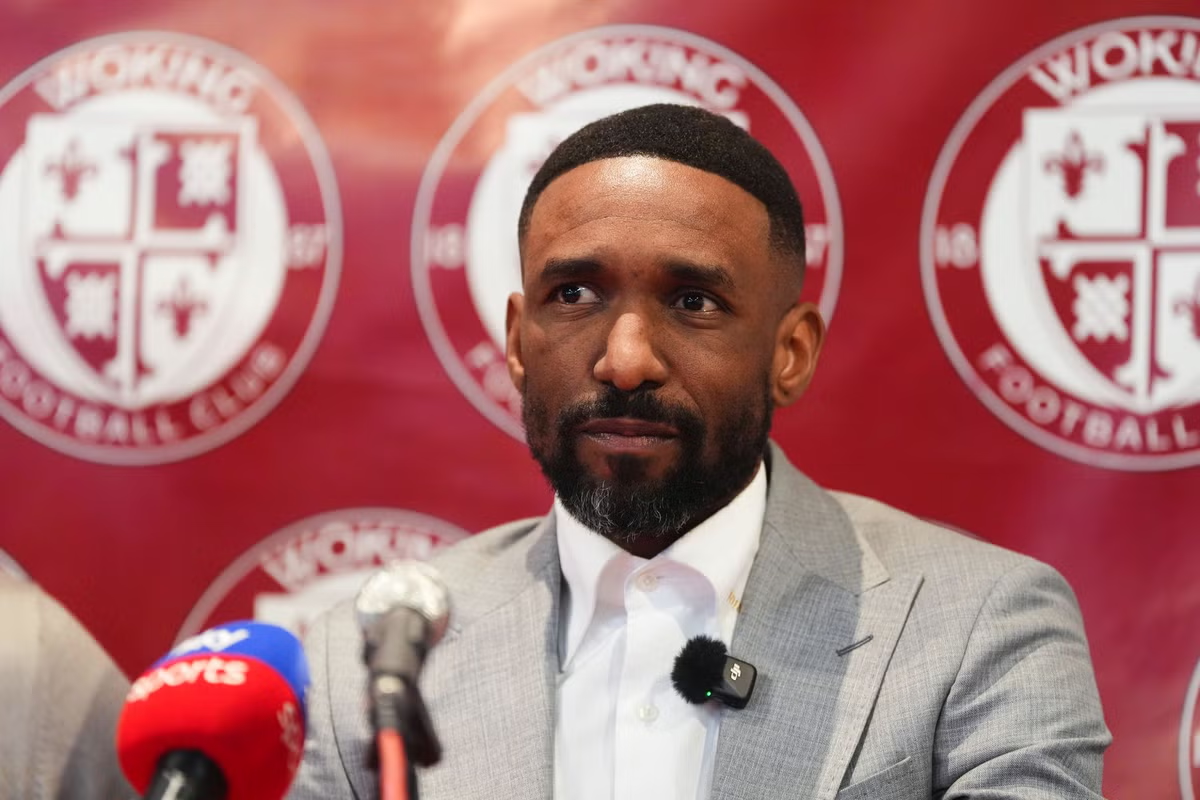
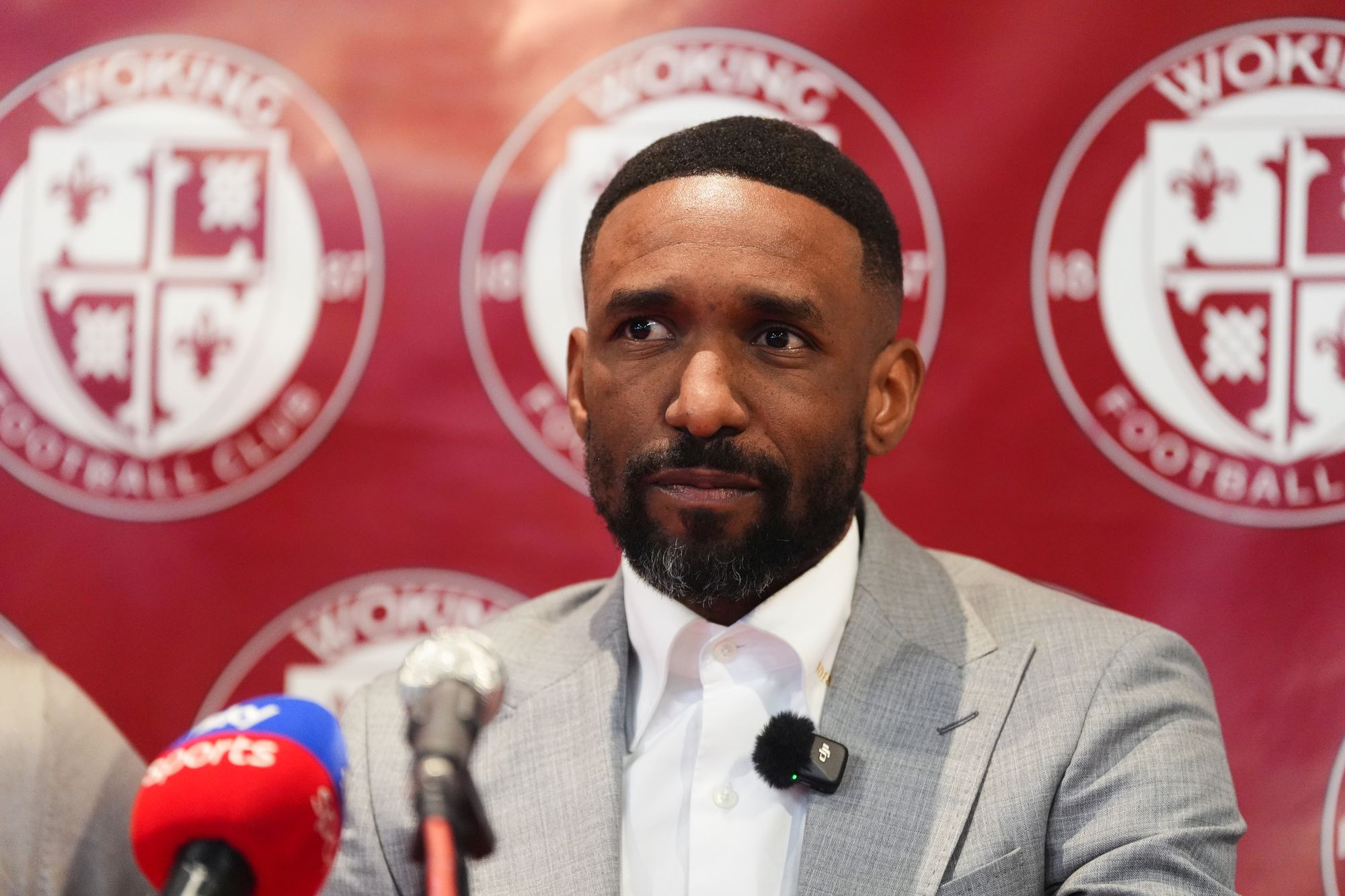
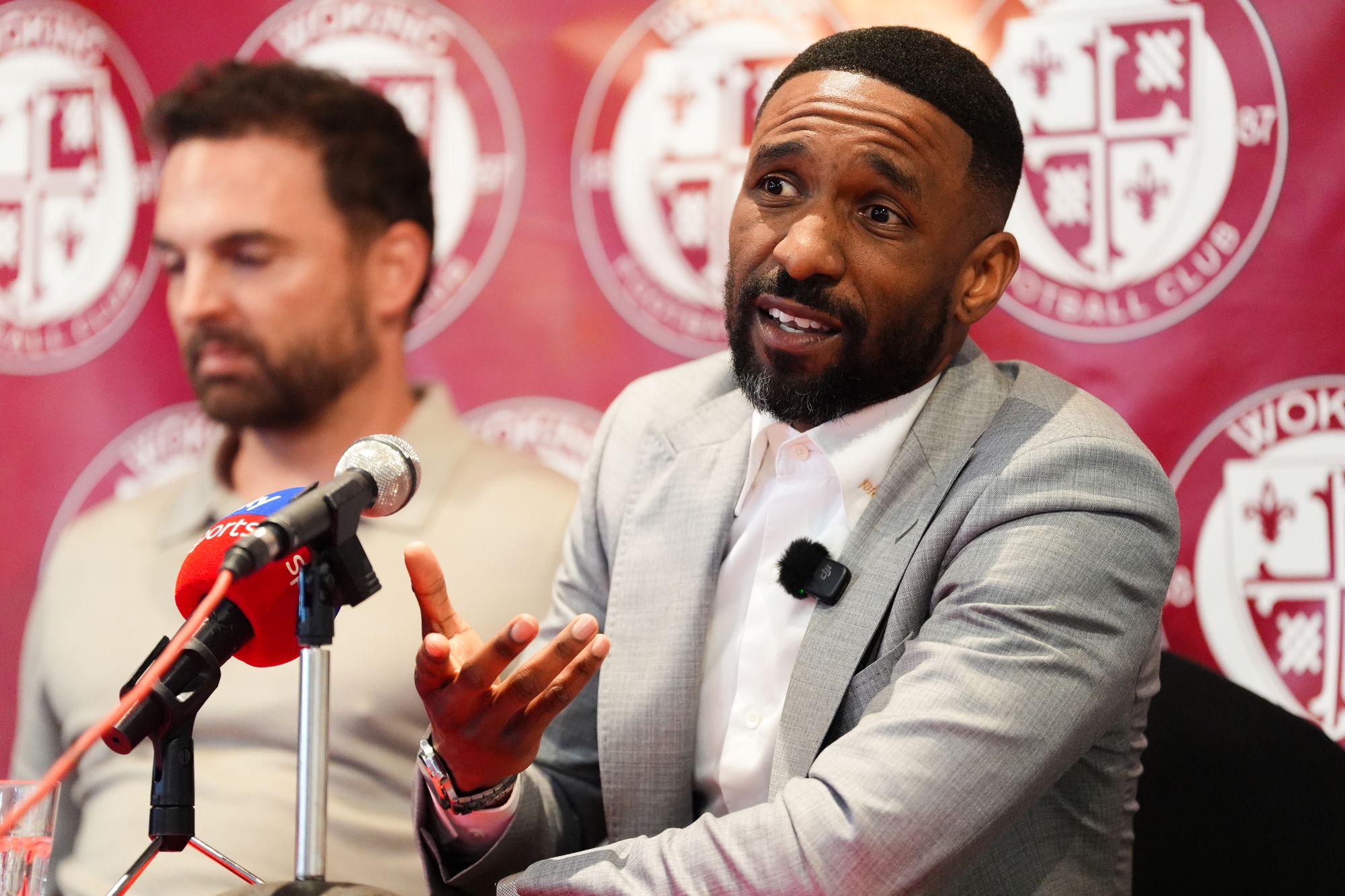
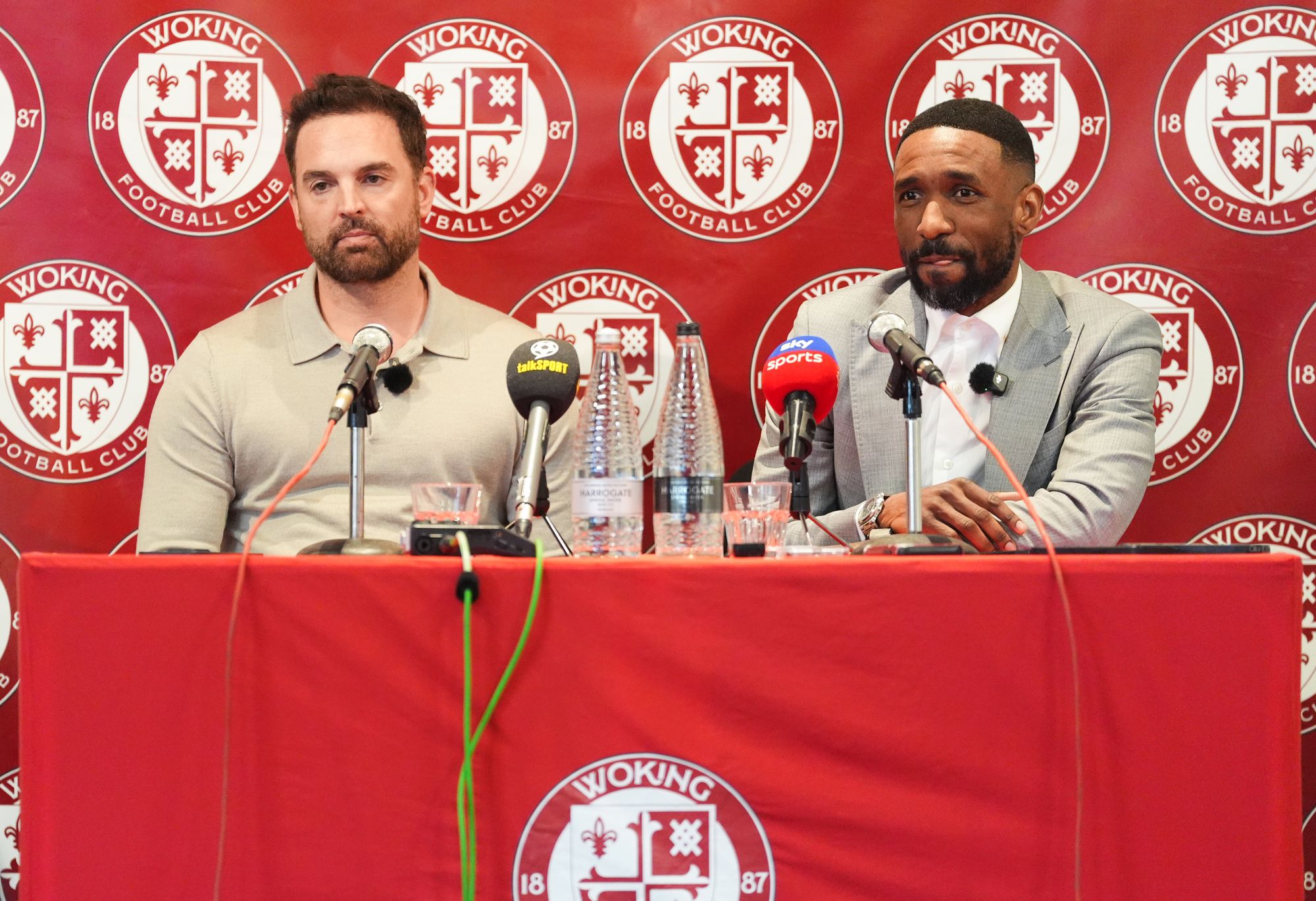
While Defoe name-checked Wayne Rooney, Harry Redknapp, Gareth Southgate and Sam Allardyce during his unveiling as the Surrey team’s unlikely new manager, a smattering of volunteers who often form the core of fifth-tier clubs busied themselves around the ground, forking the pitch and tidying the terraces following a disappointing 1-1 National League draw at home to fellow mid-table outfit Altrincham the previous evening.
Jermain Defoe is the new manager of National League side Woking (Adam Davy/PA Wire)
Defoe had watched from the stands as his new side toiled against their nine-man opposition, before he formally takes the reins for the visit of relegation-threatened Eastleigh on Good Friday in what will be the first match of his solo managerial career. It is an improbable turn of events for a figure who made 496 Premier League appearances and scored 20 international goals, but will now concern himself with the lower reaches of the English football pyramid usually only of interest to those in the immediate locality.
It has, suggested Defoe, “always been the plan”, with the former West Ham United, Tottenham Hotspur and Sunderland striker explaining how “towards the back end of my career I knew I wanted to go into coaching”.
Advertisement
He fulfilled a player-coach role during his final season at Rangers – where he also formed part of an interim coaching unit that took charge for a brief period in 2021 – and then returned to Spurs as an academy coach upon his playing retirement in 2022. Nonetheless, turning up at a club beneath the English Football League was a move few had anticipated.
Defoe gave an introductory press conference to lay out his vision for the Cards (Adam Davy/PA Wire)
The Laithwaite Community Stadium is very different to the grounds Defoe played at in the Premier League (Getty Images)
“My mum has always said to me in life you’ve got to be grateful for every opportunity you get,” said Defoe, who explained that he was smartly dressed in a buttoned-up white shirt and slick grey suit because his mum would be watching.
“It’s no different to when you’re a player. When I was a 16-year-old in the West Ham youth team, you had to earn your stripes and do your apprenticeship. Just because I’ve had a good career, I can’t just expect to get that big job.”
In the absence of personal experience, he has sought out the advice of others who have ploughed the non-league furrow to find out what it entails. More illustrious names he has also confided in include Allardyce, Redknapp and Robbie Keane. Ultimately, he insisted, playing in front of an average Laithwaite Community Stadium attendance of little over 2,500 should be no different to the Old Firm or north London derbies.
“At the end of the day, it’s a pitch with two goals, 11 v 11, and you have to win,” he said. “There can’t be any excuses. You prepare to win and it’s as simple as that.”
Advertisement
Defoe has something of a free hit until the end of the season, with Woking out of promotion contention (Adam Davy/PA Wire)
Woking get an average attendance of a little over 2,500 (Getty Images)
Following Liam Rosenior’s appointment at Chelsea earlier this year, he now adds his name to a woefully under-represented cohort of Black managers in the top five tiers of English football.
“It’s something that has been spoken about for many years,” he said, when asked about the paucity of Black coaches. “I remember, as a player, all the campaigns, and speaking to the likes of Les Ferdinand, Ian Wright, Andy Cole, that sort of generation before me who did their coaching badges and had a lack of opportunity.
“I’m just grateful for the opportunity. I would like to think, going forward, other Black managers will get opportunities, and players still playing will get the opportunities in the future.”
Defoe joins Chelsea boss Liam Rosenior in the woefully under-represented cohort of Black managers in English football (PA Wire)
The remainder of the season gives him something of a free hit. Woking sacked his predecessor Neal Ardley at the start of March after a poor run had all but extinguished promotion hopes. A first step up to the Football League in the club’s 139-year history remains the target by which Defoe will be judged, although he declined to divulge what his managerial playing style will be to achieve such a goal.
“You’ll have to wait and see,” said Defoe, who laughed off previous links with the Tottenham managerial job and offered his support to Roberto De Zerbi. “I’d want to be hard to play against first. I know it sounds boring, but you need to be hard to play against. I want a team that is exciting, creating a lot of chances and scoring goals. You have to give these fans something to cheer about when they come to the stadium.”
It may yet be the start of something big for Defoe as a manager; conversely, it could be a blunder destined for pub quiz obscurity.
Advertisement
“It’s always going to be a gamble,” he said. “It’s part and parcel. You can’t think like that. You have to be positive, back yourself and believe you are good enough.”
The president and his advisers have offered shifting explanations and timelines for the conflict, as well as what they will require from Iran for it to end. While portraying Iran as militarily neutered, Trump also said on Wednesday night the US would hit the nation hard for another two or three weeks.
The following article contains spoilers from the episode of Emmerdale dated April 2. It hasn’t aired on ITV1 yet, but can be viewed on ITVX and YouTube.
Graham Foster (Andrew Scarborough) is enjoying every single second of his revenge plan against Kim Tate (Claire King) in Emmerdale as right now, she has no idea what he’s up to.
Earlier this week, Kim was sent to hospital with suspected mushroom poisoning. Doctor Todd (Caroline Harker), Jacob Gallagher’s (Joe-Warren Plant) boss, then confirmed to her that she had painkillers in her system, meaning she had actually collapsed as a result of overdosing.
Away from the shock that Jacob had misdiagnosed her, Kim couldn’t believe she had made a mistake with her medication, which she takes due to still suffering leg pain after falling off her horse at Christmas.
Advertisement
As no one else is around when she takes her pills, Kim was hit with the realisation that she had given herself an overdose. Surprised by her mistake, she remained unaware that someone had snuck into her bathroom and tampered with her meds.
Advertisement
Kim believes her own actions put her in hospital (Picture: ITV)
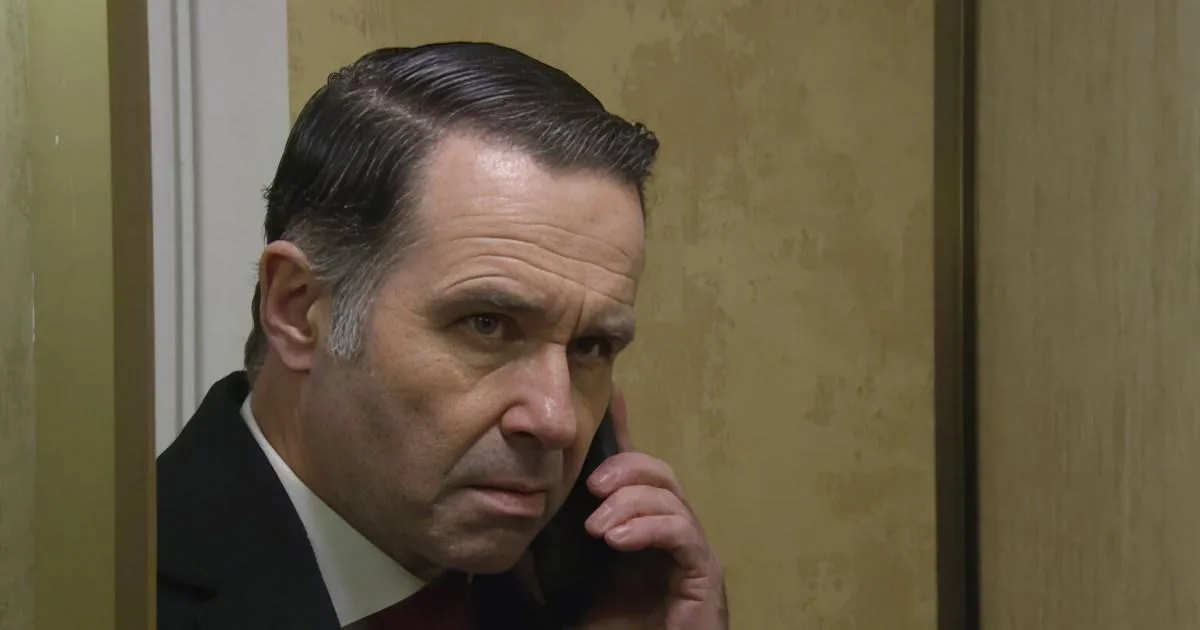
Graham was confirmed to be the culprit, and shared with someone on the phone that he had swapped Kim’s normal tablets for a double dose. He also said that he’d try a different approach in his revenge next, believing he’d find another way to get rid of his ‘pain in the neck’.
Kim returned to Home Farm in today’s episode, and happily followed orders to rest and recover. While she laid on the sofa reading a magazine, Graham approached young Clemmie, who was busy with a school project.
She explained to Graham that she was building a Roman fort and needed to write about a General, but with her brother Lucas writing about Julius Caesar, Clemmie wasn’t sure who to focus on.
Graham sat opposite her and told Clemmie to write about a man called Quintus Fabius Maximus (no, I didn’t think I’d be given you a History lesson in this either), who proved everyone wrong and became one of the most successful Generals in Rome.
The long game (Picture: ITV
As Graham spoke about how Quintus was incredibly clever, and focused on cutting the food supply of his enemies over fighting big battles, it became more and more apparent this was an elaborate way for him to talk about what he’d like to do to Kim, without directly confirming it.
‘Sometimes, it pays to play the long game’, Graham said as he sipped his tea.
Advertisement
Don’t miss a Soaps scoop! Add us as a Preferred Source
As a loyal Metro Soaps reader, we want to make sure you never miss our articles when searching for stories. We have all the latest soaps news, spoilers, videos, and interviews, with a vibrant community of highly engaged readers.
Click the button below and tick Metro.co.uk to ensure you see stories from us first in Google Search.
Playing the long game and keeping his enemy close is working – but how long for?
‘Graham is clearly still incredibly angry that Kim tried to kill him six years ago. This resulted in him faking his own death to escape the hit she put out on him’, star Andrew Scarborough said.
‘He lost Rhona in this process, so he still hasn’t forgiven Kim for that. She took six years of his life away. That is why he just tried to kill her – for revenge. I am not convinced his whole heart was in it because their relationship is complicated. I think if his whole heart were in it, he would have actually made it happen.’
Alistair Brownlee was the first athlete ever to defend the Olympic triathlete title.
Over an 18-year career, he claimed gold at both the London 2012 and Rio 2016 Games, as well as 22 World Series events, two World Championships, a Commonwealth title and four European Championships, to name only a few.
Two years into retirement, Brownlee shows little sign of slowing down. When he’s not working with his brother Jonny on the Brownlee Foundation – their charity encouraging young people into sport – he’s focused on his own business, Truefuels, which sells energy gels and electrolytes.
Advertisement
It’s hard to reconcile all this with the unassuming man who strolls into our office alone on a Thursday in March. It’s not the first time the point has been made. In 2021, he told The Telegraph that he was once told that he’s“an inspiration because he looks so normal it makes everyone think that if he can do it, they could too”.
I caught up with him for our Readers Ask series, where industry specialists answer questions from our Telegraph Recommended Reader Panel.
How old were you when you started to compete professionally? Mary-Grace, East of England
I did my first triathlon when I was eight, but didn’t compete professionally until I was 18.
Advertisement
I won the World Junior Championships, and I did some serious races the year after I was 19. I went to the Beijing Olympics as a 20-year-old the year after.
What advice do you wish you would have received when you considered a career in sports? Ekaterina, London
My parents, my dad in particular, recommended that I studied alongside sport when I was young.
I also had some brilliant advice from my coach Malcolm, who told me to believe that I could win the Olympic games – but only by one stride, which was a great way of saying have faith but not too much, and train really hard.
Advertisement
Endurance sport, although it sounds a bit cliché, is a long game. Don’t rush things, look after your body, focus on the small things: nutrition, sleep, recovery, all of that, and that will pay dividends over a long period of time.
What was it like competing so hard against your brother and could you put the result to one side after the race was over? Caroline, East of England
I didn’t know any different. I’ve competed against my brother since I was really young – six-years-old or probably even younger in the garden at home so it’s very natural to me.
Even at the top level of the sport I think we took it for granted. We would be training side by side at home in Yorkshire one day and competing in the top races in the world the day after.
Advertisement
We basically knew that we were each other’s best training asset and we also knew that we could help each other in racing as well as the training.
We pretty much always put it aside straight after the race, and that was partly about our relationship and partly because we both had that kind of mentality, we were always thinking about the next thing.
Who was your biggest competitor and why? Nicolle, South East
Obviously my brother Jonny was a big competitor throughout the main part of my career.
Advertisement
I also had a very talented, ferocious Spanish competitor called Javier Gómez. I raced him probably 100 times during the same period. He came second at the London Olympics and beat me to the world title quite a few times.
We were very close in physical ability, and well matched in terms of where we were in the race. Quite a few of our races came down to sprint finishes.


















































You must be logged in to post a comment Login