
Security teams log 54% of successful attacks and alert on just 14%. The rest move through your environment unseen.
The Picus whitepaper shows how breach and attack simulation tests your SIEM and EDR rules so threats stop slipping by detection.




As I expand my writing career, it’s becoming increasingly apparent that I need to make a business website to showcase my talent and present my past projects. The problem is, although I love testing gadgets for WIRED, I’m definitely not a coder. Figuring out where to begin when building a website is daunting. How do I know the host is legit? How can I ensure my site is user-friendly? How much are annual costs, really? All of these questions and more have stopped me from taking the plunge and building my own website. That’s where Hostinger steps in to help.
For more than 20 years, Hostinger has made its reputation as a reliable, budget website-building and hosting option that is easy to create and navigate for beginners and small businesses. Its business has withstood massive changes to the internet because of its reliable, fast performance and 24/7 support. If you’re just getting your website started like me, we want to make taking the plunge easier with a Hostinger domain coupon. Plus, we also have a range of Hostinger coupons and various Hostinger promo codes for discounts on nearly all web hosting situations and needs.
The Hostinger Business hosting plan is likely the best plan for a small business and a good choice for small biz owners—and it’s 79% off right now. It has more tools available for everything your business needs to grow, with the ability to create up to 50 websites, five included “vibe coding credits” (more on that below), 50 GB of fast storage, five mailboxes per website (free for one year), and five managed Node.js web apps. Plus, with this advanced tier, you can get even more in-depth tools to get your website up and running. This includes backups to prevent any data loss, AI e-commerce help and an AI agent for WordPress to get your WP site ready in minutes. The Business plan is regularly $18 per month, but now it’s only $4 per month, along with three months free.
Hostinger works like many other online services in a subscription tier plan—the Hostinger Premium web hosting plan is the lowest-tier option that will fit most people, including me, who just need a basic, pared-down service to get started. This service is regularly $12 per month but is now at a 75% discount, bringing it down to just $3 per month—plus three months for free when you sign up. With Premium, you can create up to 3 websites, get five coding credits, 20 GB of storage, and two mailboxes per website (free for one year). On top of that, you’ll also get your domain free for one year, a super-easy drag-and-drop website builder, free SSL, weekly auto backups, and free email marketing for a year. Grab the Hostinger promo code for 75% off this basic plan that’s best for most individuals.
Cloud Startup is the highest tier of the three Hostinger web hosting plans, with 20 times more power for all your website needs with Cloud hosting. It’s now 71% off with a Hostinger coupon, making the expansive service only $8 per month, with three months free—$20 less per month when regularly priced. With this top-tier service, you’ll get all that you get in previous tiers, but with the ability to create up to 100 websites, 100 GB of fast storage, 10 mailboxes per website (free for one year), and 10 managed web apps. Plus, with this top-tier plan tailored for startup businesses with Cloud storage, you’ll also get priority 24/7 support, power boost for a week per month for peak traffic times, a dedicated IP address, 100 PHP workers for busy sites, 2M inodes to scale your files, and included 4 GB RAM for extra-smooth site performance. Be sure to snag this Hostinger discount for 71% off a Cloud Startup plan.
Hostinger can help your website match the overall vibe of the business or feel that you’re trying to create, and they call it your “vibe code.” Hostinger’s AI tools like Hostinger Horizons help AI generate a design similar to the vision you have for your website. With this tool, you can even get a visual mockup of a website with a specific vibe you’ve inputted. The most popular plan of this “vibe code” website and builder is the Starter plan. With this mid-tier plan, you have a 30-day money-back guarantee, 24/7 support, and no-contract cancellation. With a 12-month plan, it’s 30% off—$5 less per month with this Hostinger promo code. With this Starter plan, you’ll get your free domain for one year, two free mailboxes per website for one year, and everything in the previous Explorer tier. Plus, you’ll have the ability to: create up to 25 websites, sell subscriptions, add chatbots and other AI features, sell physical and digital products, track visitors with included analytics, and more text and image editing features.
If you’re a student who’s in need of a website to show off your marketable skills or a place to get that startup off the ground, Hostinger wants to make it easier to make your dreams a reality. All you need to do to get a Hostinger student discount of 25% off, is to verify your student status through Student Beans to unlock the exclusive 25% Hostinger discount. (Offer is only valid for new users).
Here on the WIRED Reviews team, I also dab in sending newsletters and I’ve seen firsthand how valuable email newsletters and marketing can be to grow your business and improve your relationship with both potential and established customers. Hostinger has valuable email services for business, including AI that handles email marketing, from launching newsletters to building layouts and writing copy. Plus, the AI will apply your brand to them, along with giving weekly campaign ideas based on your business, audience, and season. You can start for free and you have a 30-day money-back guarantee if you find that the AI email service isn’t right for your business.
As mentioned above, Hostinger allows you to “vibe code” your website or app—all you have to do is describe what you want and Horizons builds it for you. This is great for beginners or those without prior experience, you don’t need to know how to code, and don’t need tech skills; you can launch it all in just one click. With Horizons from Hostinger, you can build AI-powered web apps in a click. You just need to describe your idea or pick a template, and the AI will build your vision for you. AI can edit almost anything, from text and design, to functionality. But you don’t have to compromise, with the ability to edit texts and images yourself as a content editor. To get started, just pick a professionally designed template, customize it with AI or visual edits, and whether you’re in the e-commerce space, need a portfolio, or want to showcase business and services, Hostinger makes it easy.
WordPress hosting at Hostinger is one of the easiest ways to run your site. With no technical setup, set up is fast and simple, and you’ll get support and AI tools to keep things running smoothly. With every tier beyond Premium, you’ll get access to Kody, WordPress’s AI agent, who can answer questions and help manage things like publishing schedules to managing commerce through a chatbot. With this AI, your requests get put into motion, with things like live site updates and sales reports. Plus, the AI can also help you build (and launch) your site, and optimize your website performance. Hosting a website has never been simpler with WordPress at Hostinger.
Hostinger Ecommerce is an AI-powered platform that helps you manage multiple online stores from just one central business hub, and acts as an assistant to manage products, payments, shipping, and business details—in just one simple place.
There are several Hostinger plans to choose from so you can have the right fit for your business needs. The most popular plan is the “Growth” plan, which is now 50% off! This plan is a fit for sellers whose business sprawls across multiple shops and websites. Regularly $16 per month, and now $8, with this tier, you can sell up to 300 products, manage up to three businesses, and connect up to three sales channels per business. Plus, you’ll get everything in the lower tier, plus you can sell subscriptions with Horizons storefronts, sell custom merchandise with print-on-demand, a free custom domain for one year, branded email, AI storefront creation, centralized inventory and information across shops, and more.

Indian serial entrepreneur Bhavin Turakhia is making a $30 million personal bet that there is still room for another enterprise AI company. His new venture, Neo, is built on a simple premise: workplace software designed before the AI era cannot simply be upgraded with chatbots — it has to be redesigned from the ground up.
Turakhia, 46, is no stranger to ambitious enterprise technology bets. Over the past two decades, he has co-founded companies including Directi, Radix, Titan, and banking software firm Zeta, largely backing them with his own cash before bringing in outside investors. He’s doing the same with Neo.
Turakhia told TechCrunch he is bootstrapping this much money because he believes AI marks a technology shift significant enough to justify rebuilding workplace software from scratch.
“If you want to build an iPhone, you can’t take the parts of a Nokia and somehow convert it into an iPhone,” he said.
Launched internally in April this year, Neo is an enterprise work platform that combines project management, documents, file storage, and AI into a single product. The goal, Turakhia said, is to make AI an active participant in day-to-day work rather than just another assistant employees turn to separately.
Turakhia argued most incumbents face a structural disadvantage when adding AI to products designed before generative AI. Neo, he said, was designed from the ground up for AI and is model-agnostic, allowing enterprises to switch between AI models rather than being tied to a single provider.
He’s not alone in thinking this way. Investor Chamath Palihapitiya initially launched enterprise AI coding venture 8090 with his own capital before raising a $135 million funding round this week.
Still, Turakhia’s bet comes as enterprise AI has emerged as one of the most competitive areas in technology. Microsoft, Google, and Salesforce are embedding AI across their workplace software. Meanwhile every startup from the giant labs like Anthropic and OpenAI, to the productivity companies like Notion and Superhuman are racing to reshape how businesses use AI in their daily workflow.
Turakhia argued enterprise software has never been a winner-takes-all market, saying even a small share of global enterprise AI spending would represent a sizeable company.
“Even if we end up with 2% to 5% market share, that’s larger than anything I’ve built so far,” he said.
For the past few months, Neo has been in internal use across Turakhia’s companies, including Zeta. The company plans to begin rolling out the software to mid-sized businesses in the coming months, initially targeting knowledge workers across technology, consulting, and professional services firms.
Turakhia said Neo’s initial platform was built in three months, with AI extensively used in the development process, work he estimates would have taken more than a year with a much larger engineering team before generative AI.
The Bengaluru-based startup currently employs about 45 people, including 18 engineers. Turakhia told TechCrunch that it expects to grow to around 100 employees by the end of the year, with most new hires focused on AI and software engineering.
When you purchase through links in our articles, we may earn a small commission. This doesn’t affect our editorial independence.

Looking for the most recent Mini Crossword answer? Click here for today’s Mini Crossword hints, as well as our daily answers and hints for The New York Times Wordle, Strands, Connections and Connections: Sports Edition puzzles.
Need some help with today’s Mini Crossword? Read on for all the answers. And if you could use some hints and guidance for daily solving, check out our Mini Crossword tips.
If you’re looking for today’s Wordle, Connections, Connections: Sports Edition and Strands answers, you can visit CNET’s NYT puzzle hints page.
Read more: Tips and Tricks for Solving The New York Times Mini Crossword
Let’s get to those Mini Crossword clues and answers.
The completed NYT Mini Crossword puzzle for July 2, 2026.
1A clue: The “A” of G.P.A.: Abbr.
Answer: AVG
4A clue: Fashion’s Oscar ___ Renta
Answer: DELA
6A clue: Waterways traveled by gondola in 2-Down
Answer: CANALS
8A clue: The Ponte di Rialto in 2-Down, e.g.
Answer: BRIDGE
9A clue: Remove, as nails from a cat
Answer: DECLAW
10A clue: Pair of peepers
Answer: EYES
1D clue: On ___ (how some pranks are done)
Answer: ADARE
2D clue: Italian city that’s the subject of this puzzle
Answer: VENICE
3D clue: “More than happy to!”
Answer: GLADLY
5D clue: Pond scum
Answer: ALGAE
6D clue: Relaxant in some edibles, for short
Answer: CBD
7D clue: Stitches together with needle and thread
Answer: SEWS


Kubota North America Corporation disclosed that hackers had access to some of its network systems for more than a month earlier this year.
Following an investigation into the incident, the company determined that between March 16 and April 20 the threat actor accessed files with personal information for employees and their dependents.
Kubota is a Japanese industrial manufacturer known for its agricultural and construction equipment. It operates in 120 countries, employs more than 52,000 people, and has a reported annual revenue of $20 billion.

Its North American division includes facilities that produce tractors, mowers, and utility vehicles.
According to the announcement posted on the Kubota USA site, the following employee data may have been exposed:
The exact data types exposed vary per individual, and Kubota started sending personalized notifications via email on June 30, informing each individual about the specific impact on them.
The notifications include instructions for enrolling in Kroll identity protection to help victims mitigate the risks arising from the exposure of their sensitive data.
In the letters, Kubota specifically advises recipients to monitor healthcare-related statements, as well as bank accounts, and to immediately report any suspicious activity to the authorities.
Kubota says it has implemented additional security measures to prevent similar incidents in the future.
At the time of writing, no data extortion groups or ransomware gangs have assumed responsibility for the attack at Kubota.
The company did not mention facing any operational or business disruptions as a result of this incident.
BleepingComputer has contacted Kubota to ask for more information about the perpetrators and the nature of the attack, but we have not received a response by publication time.

Security teams log 54% of successful attacks and alert on just 14%. The rest move through your environment unseen.
The Picus whitepaper shows how breach and attack simulation tests your SIEM and EDR rules so threats stop slipping by detection.

Focal is not easing into Q3 2026. The French manufacturer has already made serious noise with the Mu-so Hekla, its ambitious all-in-one Dolby Atmos system that is currently under review, unveiled the $210,000 Diva Alta Utopia wireless flagship, and mounted one of the busiest and most talked-about demonstrations at AXPONA 2026. That is a rather muscular start to the year, even for a company that has never been particularly interested in playing small.
Now comes the Scala Utopia Evo M, a substantial evolution of one of Focal’s defining passive loudspeakers. This is not a cosmetic refresh with a fresh lacquer option and a revised brochure. Built in France and retaining the Scala’s distinctive three-way architecture, the new model introduces Focal’s PRISM tweeter and M-profile W midrange driver, technologies drawn from the company’s newest wireless and professional monitor developments.
The goal is straightforward enough: greater midrange transparency, lower distortion, more controlled treble, and an even more convincing sense of musical scale from a loudspeaker that has long been one of the more recognizable statements in high-end audio.
The Scala Utopia Evo M retains the familiar three-way, bass-reflex architecture of the outgoing Scala, but Focal has reworked almost every part that matters: the drivers, crossover, cabinet tuning, and mechanical structure. The result is still unmistakably a Scala, with its compact-for-Utopia proportions and multi-cabinet silhouette. If you expected anything less from Focal, whose idea of restraint is usually limited to the grille cloth, you have not been paying attention.

At the heart of the update is a new 5-inch reinforced W-cone midrange driver with an M-profile diaphragm, borrowed from Focal’s Utopia Main professional monitor range. The driver combines the company’s composite W sandwich construction with the one-piece M-profile geometry, TMD suspension, a neodymium motor, and an 80mm voice coil.
Focal’s objective is a cleaner, more linear midrange with lower distortion and greater control at higher listening levels. Considering how much of the music lives in the midband, that is exactly where an update to a loudspeaker at this level should begin.
The Scala Utopia Evo M also receives Focal’s new 27mm PRISM M-profile inverted-dome tweeter, first introduced in the Diva Alta Utopia wireless flagship. PRISM, short for Photon-Refined Intelligent Structured Membrane, uses a multi-material diaphragm and micro-structured construction that Focal says provides greater rigidity than beryllium while preserving the low mass and damping needed for refined high-frequency reproduction.
It is paired with Focal’s IAL2 Infinite Acoustic Loading system, which lowers the tweeter’s resonance frequency to 528Hz and allows for a claimed extension to 40kHz.
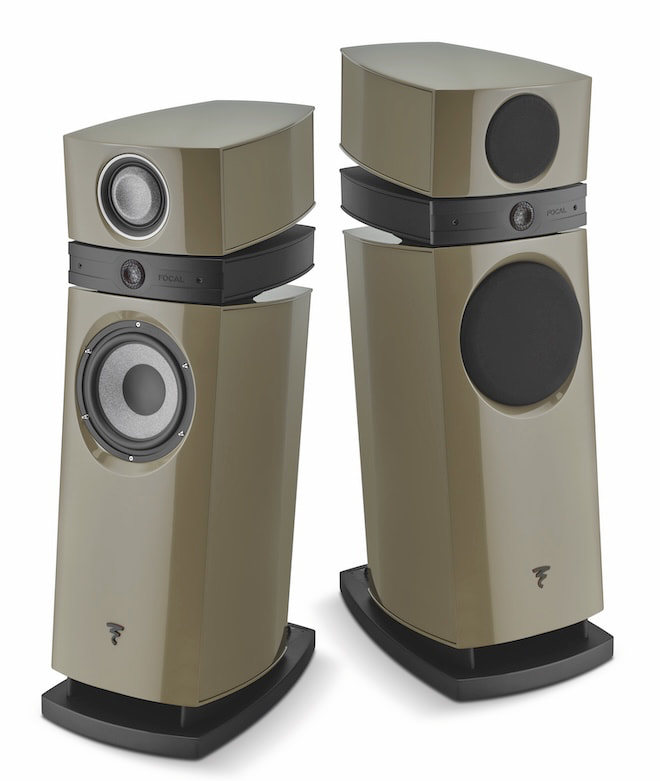
The 11-inch W-cone woofer has also been redesigned, using a 16cm dual-ferrite motor and more precise laser cutting of its composite sandwich diaphragm. It works with a large laminar port intended to move air without the chuffing, compression, and general bad behavior that can undermine bass performance when a speaker is pushed hard.
Focal rates the Scala Utopia Evo M down to 27Hz within ±3dB, with a 24Hz low-frequency point at -6dB. That does not turn a Scala into a Grande Utopia, nor should it. But it suggests real low-frequency authority from a loudspeaker that remains more manageable in a domestic room than the larger models above it in the range. Anyone who has spent time with Focal’s biggest Utopia models already knows that the company does not do bass-light. Croissants may be delicate, flaky, and full of air; Focal’s bass is more cassoulet: dense, substantial, and absolutely not leaving the table quietly.
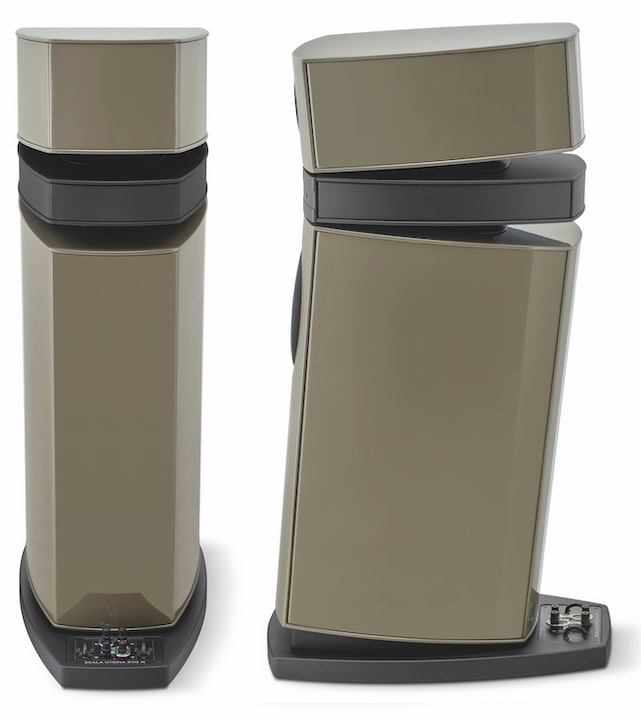
The revised OPC+ crossover uses high-grade components, large-section internal cabling, and four insulated WBT binding posts that support bi-wiring or bi-amping. More importantly, it provides user adjustment for bass, midrange, and treble, with the bass and treble controls offering ±1dB adjustment. That is not room correction, and Focal is not pretending otherwise, but it gives owners a useful way to fine-tune the Scala’s balance without turning the listening room into a laboratory.
Focal has also retained the structural thinking that has long defined the Utopia range. The Gamma structure employs high-density MDF panels up to 60mm thick, with a heavy, vibration-controlled framework shaped through vibration mapping. Focus Time mechanically aligns the drivers toward the listening position to improve time alignment, while the separate cabinet sections help preserve phase coherence between the bass, midrange, and treble drivers.

The Scala Utopia Evo M remains a very French loudspeaker in both execution and attitude. Its cabinets are made by Focal’s cabinetmakers in Burgundy, while the drivers are manufactured in Saint-Étienne. That level of vertical control matters at this price, particularly when a product is relying on very specific driver geometry, cabinet tolerances, crossover settings, and cosmetic execution to justify itself.
Focal will offer five finishes. Black High Gloss, Off White High Gloss, and Warm Taupe High Gloss are priced at $50,000 USD per pair, or $58,000 CAD. Light Walnut with an Off White front panel and Dark Walnut with a Sepia Brown front panel rise to $56,000 USD per pair, or $64,000 CAD. Availability begins in August 2026.
Focal is also positioning the Scala Utopia Evo M as a natural partner for Naim electronics. That makes sense. A speaker with 92dB sensitivity and a 3-ohm minimum impedance is not especially difficult to drive on paper, but it deserves amplification with substantial current delivery and control. Focal recommends amplifiers rated between 50 and 500 watts per channel, which leaves plenty of room for a serious Naim system, or alternatives from the usual high-end suspects with enough grip to keep the redesigned woofer in check.

The Scala Utopia Evo M is not a revolution in the sense of abandoning everything that made the Scala successful. It is a carefully targeted evolution that brings Focal’s newest professional-monitor and wireless-speaker developments into one of its most recognizable passive loudspeakers. At $50,000 per pair, it had better be more than a fresh coat of lacquer; the new PRISM tweeter, M-profile midrange, adjustable crossover voicing, and redesigned dual-ferrite woofer suggest that Focal has taken the assignment rather seriously.
What makes the Scala Utopia Evo M especially interesting is that it offers much of Focal’s latest Utopia thinking in a loudspeaker that is still more realistic for a proper listening room than the enormous Grande Utopia. It is for buyers who want genuine full-range scale, visual presence, and the ability to fine-tune the speaker to the room, but who do not have a ballroom, a dedicated equipment room, and a casual relationship with six-figure system costs.
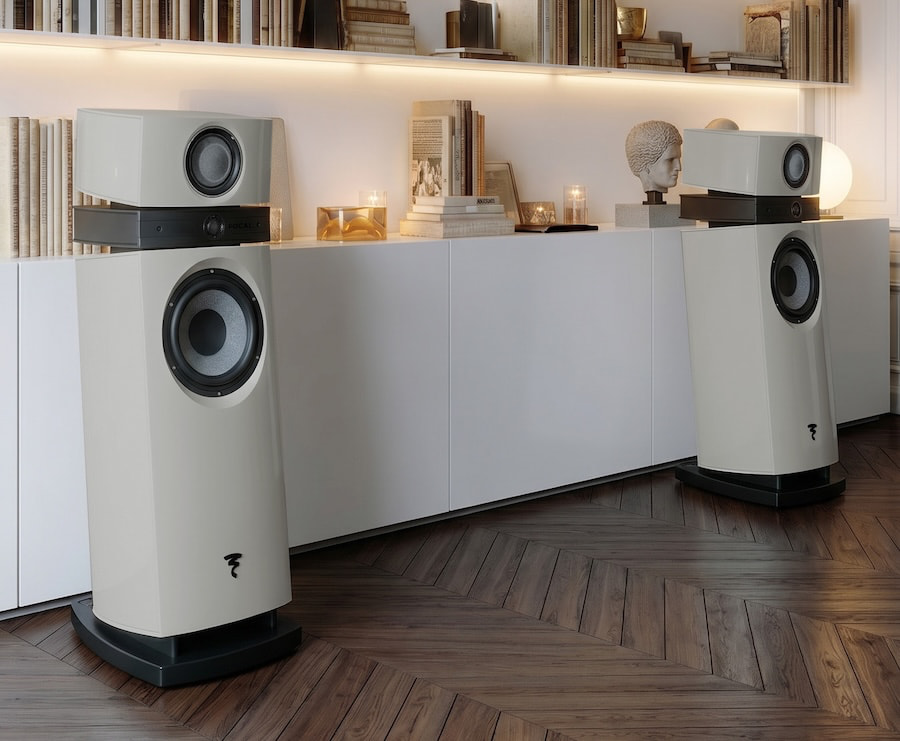
Do not mistake the 92dB sensitivity for an invitation to connect a Uniti Atom and call it a day. The Scala’s 3-ohm minimum impedance and $50,000 price tag demand an amplifier with real current delivery, grip, and refinement. Naim’s New Classic 300 Series, particularly an NSS 333 and NSC 222 with NAP 250 or NAP 350 amplification, is far closer to the intended neighborhood than Naim’s 40-watt Uniti Atom. Focal and Naim may share the same corporate address, but this is not a speaker designed for a compact all-in-one system.
The Scala Utopia Evo M is for established high-end listeners building a serious two-channel system around equally serious electronics. It will appeal to existing Scala owners looking for a meaningful step forward, but also to buyers who want modern Focal technology, hand-built French execution, and bass that behaves less like a feather-light croissant than a cast-iron cassoulet: deep, dense, and not remotely interested in being delicate.
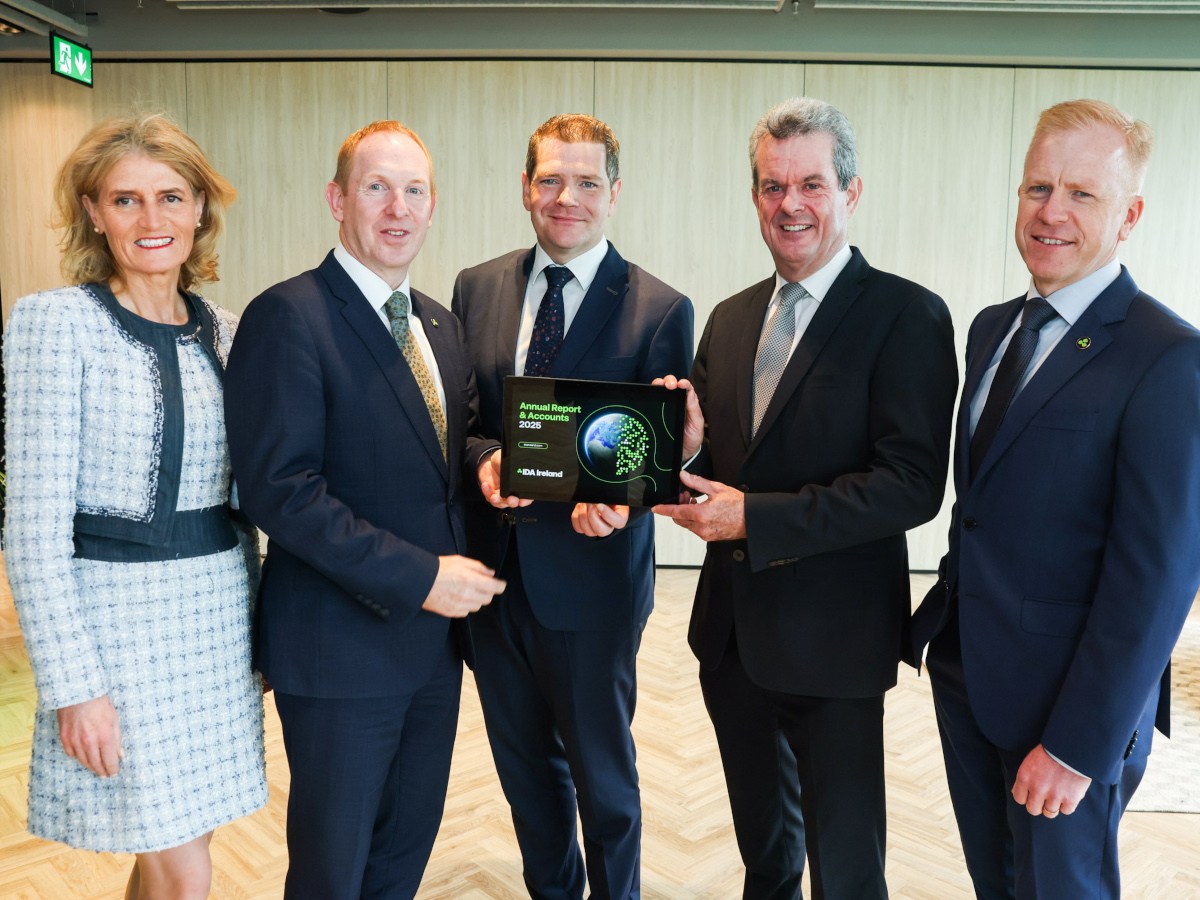

IDA chairperson Feargal O’Rourke said results indicate that the agency’s strategy is working despite an ‘increasingly turbulent world’.
Qualcomm, Apple and Monzo are among the 190 global businesses that made Irish investments in the first half of this year. Collectively, these deals are expected to create nearly 10,500 jobs, according to data from IDA Ireland.
Agency chairperson Feargal O’Rourke said that this quarter’s “very positive results” and last year’s “record performance” indicate that the agency’s five-year strategy ‘Adapt Intelligently’ is “fit for purpose” in an “increasingly turbulent world”.
The agency, which facilitates foreign investments in Ireland, reported that investment activity over H1 pointed to a “strong concentration” of next-generation technology projects.
During that time, companies including Trading 212 and Block selected Ireland as their European launchpad and a base for regional headquarters.
Among the 190 investors, 54 are first-timers, while nearly 40 companies expanded their existing operations, IDA said.
Several hundreds of millions of euros were invested regionally so far this year, including Novo Nordisk’s €432m spend to expand its manufacturing capacity in Athlone and Qualcomm’s €125m investment to further develop its Cork site. 52pc of the total investments made by IDA client companies consist of regional projects.
AI makes an unsurprising appearance in the data, with major investments from Anthropic, which announced 200 jobs as part of its Dublin expansion, and Rippling, which opened a new Dublin office to create 150 jobs to meet demand for AI-native workforce intelligence across EMEA.
Marketing automation company Klaviyo announced in April that it was building out its engineering team in Dublin, after previously announcing 100 jobs. US software company MongoDB also announced 200 jobs in the same month amid a multimillion-dollar push towards agentic AI applications.
Fintech was particularly active in the first half of this year, with investments from Currenxie, Monzo, CoinJar and Qashio. IDA Ireland said that the activity indicated the country’s “clear strength” in fintech and digital finance.
Canadian enterprise data management company OpenText committed €105m to its Cork and Galway sites last month to create 400 new jobs, marking the single largest investment into Ireland by a technology company headquartered in Canada.
Investment activity during H1 2026 was at a faster pace than overall numbers for 2025, when IDA supported 323 investments into Ireland with commitments for more than 15,000 jobs.
“IDA Ireland’s 2025 results and the investment pipeline secured in the first half of 2026 demonstrate the continued strength of Ireland’s FDI proposition and the confidence global companies have in Ireland as a location to establish, scale and transform,” said IDA CEO Michael Lohan.
“The breadth of investment across technology, life sciences, engineering and financial services sectors, alongside strong regional performance and significant transformational undertakings, reflects the depth of Ireland’s talent, capability and enterprise ecosystem.
“Our focus remains on competing strongly for the next generation of investment and ensuring FDI continues to deliver impact across all regions for the Irish economy.”
Don’t miss out on the knowledge you need to succeed. Sign up for the Daily Brief, Silicon Republic’s digest of need-to-know sci-tech news.


Security
Fortunately, they were professional red teamers. Unfortunately, they pwned the network
PWNED Welcome back to PWNED, the column where we document serious security failures in hopes we can all learn from others’ mistakes. This week, we’ll talk about how a lack of physical security can allow threat actors to take control of your network.
Have a story about someone leaving a gaping hole in their network? Share it with us at pwned@sitpub.com. Anonymity is available upon request.
Our story comes to us from two professional red teamers, who get paid to break into offices and networks in order to find holes in the security system. Kristopher Johnson was working as an offensive security consultant at Echelon Risk + Cyber in 2023 and his manager was Dahvid Schloss. We spoke to both.
Johnson and another employee named Michael were called upon to challenge the security at a client’s office while Schloss supervised remotely. It was winter and the maintenance crew had the maintenance door open. They walked through it and into the mail room, where a woman confronted them and asked what they were doing there.
The two intrepid testers talked to the company maintenance crew and told them that they were new IT employees without working badges. They said that they had almost slipped on the ice and offered to help shovel, an offer the maintenance team was happy to take them up on.
While Michael kindly helped the maintenance crew shovel snow, Johnson asked if the maintenance folks could let him in so he could go upstairs and start setting up Michael’s laptop for work. They let him in where he was free to explore the building as his partner brushed away a large section of ice and snow.
Inside the building, Johnson looked for a place to plug in his Raspberry Pi. The idea was to connect this single-board computer to the network, where they could access it remotely and use it to attack the network from afar. He tried plugging his Raspberry Pi into an Ethernet port in the AV closet, but the company had network access control enabled, which prevented it from connecting. The Raspberry Pi had an LTE radio, but it couldn’t connect from the closet either.
So Johnson instead moved his Raspberry Pi into the middle of the conference room and found an active network port that didn’t have network access control enabled on it. However, he realized the Pi would be visible to anyone who entered the conference room, and they might find it suspicious. So he took some trash cans and used them to hide the device.
Johnson had a hard time getting out of the building after that. He tried to go out the front door, but it required him to swipe a badge he didn’t have and strangers would not swipe their badges for him. But when he went back through the maintenance entrance, they were more than happy to swipe him out. He waited in the car while Michael finished his shoveling assignment.
The next day, Johnson found out that his security breach had been detected. When he and Michael came in to meet with their contact at the company, the head of security confronted them. They had been “caught” because someone from maintenance went up to the IT department and wanted to thank the IT team for Michael’s help with the shoveling. However, the IT team had no record of new employees named Michael or Kristopher, so that raised suspicion.
Before learning that they were professional red teamers, the building security had been suspicious and had looked at camera footage tracking their movements. They had even tried to get information on the license plate from Johnson’s rental car. However, they never did find the Raspberry Pi, which remained plugged into the Ethernet port in the conference room for two weeks.
During that time, Johnson’s team was able to connect to the company’s Active Directory, find where the domain controllers were, and start password spraying accounts to see if they could gain access. They tried using the password “winter2023!” and got 50 or 60 hits among the employees.
“So we used those credentials to kind of map out the rest of the network,” Johnson told The Register. “Network shares and things like that and then, towards the end of the test, we enumerated the certificate services – ADCS (Active Directory Certificate Services).”
The red teamers found eight templates that were open to ESC1 and ESC4 vulns. They also found that the certificate authority was vulnerable to ESC8. They were then able to exploit those holes to gain domain administrative access. The janitor found the Raspberry Pi two weeks after they broke in, but by then it was too late.
There are a lot of lessons here, but they start with training every member of the team to be suspicious of people coming from the outside, without badges, no matter what they say or do. Schloss noted that, if someone looks and acts like they belong in a space, most people will treat them that way.
“First and foremost, what most people believe is crime is not crime. It’s a Hollywood myth of what crime looks like,” Schloss told us. “I call it the ski mask bias. Everyone assumes you’re not getting robbed until a person comes in with a ski mask and a gun yelling.”
The maintenance team at this company should have been more suspicious of people calling themselves new employees and asking for a swipe in, even if they were willing to help shovel snow.
The company also should have restricted network access to the port in the conference room so that an unknown device like a Raspberry Pi could not make an Ethernet connection from that spot.
Finally, the company should have enforced a strong password policy that would have prevented our heroes from finding dozens of accounts with “winter2023!” as the password. And they should have enforced multi-factor authentication on those accounts as well. ®

Like other online travel agencies, Booking .com helps you find discount rates for airline tickets, cruises, hotel stays, car rentals, and packages. We at WIRED regularly post updates with the newest Booking .com promo codes for discounts on car rentals, last-minute hotel bookings, and other travel-related expenses, including a deal for 50% off stays and free cancellation when you sign up at Booking .com. Whether you want to grab an apartment in a walkable neighborhood or be bad and bougie in a villa, Booking .com has tons of options for every type of traveler—and we have a Booking .com coupon code to help you save.
Checking out Booking’s deals page is one of the best ways to snag great discounts on rotating and limited-time deals on things like flights and stays. Right now, you can get at least 15% off your next stay with Early 2026 Deals.
Save more by signing up for Booking .com’s loyalty program, Genius, which offers tons of discounts and rewards on pretty much everything travel-related. Loyalty program members can even get up to 20% off stays and up to 15% off car rentals. The program works in tiers: level 1 gets you a 10% discount on select stays and rental cars; level 2 gets you up to 15% off (once you complete 5 bookings in two years); and level 3 gets you up to20% off stays and up to 15% off rental cars (once you complete 15 bookings in two years). Once you sign up for the Genius loyalty program, make sure you’re signed in while you browse to get discounts of up to 50% off stays and free cancellations, along with bonus secret deals from Booking .com.
If you’re someone who travels frequently, it may be a good idea to get a Booking.com Genius Rewards Visa Signature Credit Card so you can get even more rewards on purchases you were already going to make. With this card, you’ll have no fee, and get 6% in travel credits on stays booked in the Booking.com app, and 5% on other travel on Booking.com when you use your card. Plus, you’ll get $150 in travel credits when you spend $1,500 using your card in the first 90 days. The more you use, the more perks you’ll get—when you get to Genius Level 3, you’ll receive rewards like 10-20% off select stays, and 10-15% off select rental cars and priority support.
Glory be! Winter is starting to fade and sunshine is on its way. Make the most of springtime with spring travel deals at outrageously low prices, including stays in Istanbul starting at $18 per night, Paris from $67 per night, Cancun from $32 per night, and Las Vegas from $128 per night. Go ahead, check it out, you deserve a nice vacay from enduring the winter.
A cruise is one of the cheapest ways to have an all-inclusive vacation, while staying on the mainland and partying at sea. If you’ve ever been curious about taking a cruise (or are a returning sailor), now’s a great time to book for so much less. If you book a qualifying sailing departing on or before December 31, 2027, you’ll get up to $1,000 to spend onboard, which counts toward almost anything, like cocktails, specialty dining, spa treatments, and other onboard purchases.
The actual amount you’ll get to spend vary based on total cruise price, and don’t include travel protection, port charges, port expenses, and taxes, and are generally as follows: $25 per $1-$999 booking, $50 per $1,000-$1,499 booking, $75 per $1,500-$1,999 booking, $100 per $2,000-$2,999 booking, $125 per $3,000-$3,999 booking, $175 per $4,000-$5,999 booking, $250 per $6,000-$7,999 booking, $350 per $8,000-$9,999 booking, $500 per $10,000-$14,999 booking, $750 per $15,000-$19,999 booking, and $1,000 per $20,000 or more booking.
Plus, if you don’t have the entirety of the money owed for a cruise now, you can still lock in now for just $25. As long as you pay a small non-refundable $25 fee, Booking will advance your cruise line deposit (up to $500). Your deposit will be automatically charged 10 days before your final payment is due, giving you peace of mind and more time to plan (and save!).
If you have the time off for your next vacation, but don’t know where to go, I’d check out Booking’s seasonal and holiday deals webpage, where there are rotating and flash deals depending on time, seasonality, and location. There are time-specific destinations like Lunar New Year deals, spring holiday deals focused on warm-weather travel destinations, and Carnival deals for places that celebrate in style, like the Big Easy.
If you’re looking to book travel to a destination that requires a car, I’d highly recommend also renting a car through Booking. Booking has access to the most popular rental car companies, like Avis, Budget, Hertz, Enterprise, and more, so that you can book with peace of mind. And when you travel more, you’ll spend less—all you need to do is sign in, peruse car rental options, and look for the blue ‘Genius’ label to save 10% on car rentals. Plus, if you spend using your Genius Rewards Visa you can earn 5% in travel credits on car rentals.
It’s surprising, but one of the most cost effective vacations you can embark on is a cruise. These all-inclusive packages combine travel to new destinations with a non-stop party at sea. Be sure to check out Booking.com’s cruising page for rotating cruise deals and offers, with many under $399 for an all-inclusive package. One of the best ways to score the biggest deals at sea is by signing up for their email newsletter, which will send you the latest and greatest cruise offers. Plus, you can even combine cruise line offers with Booking.com’s cruise exclusives, like up to $1,000 to spend on board, bookings at just $25 per room, and more.
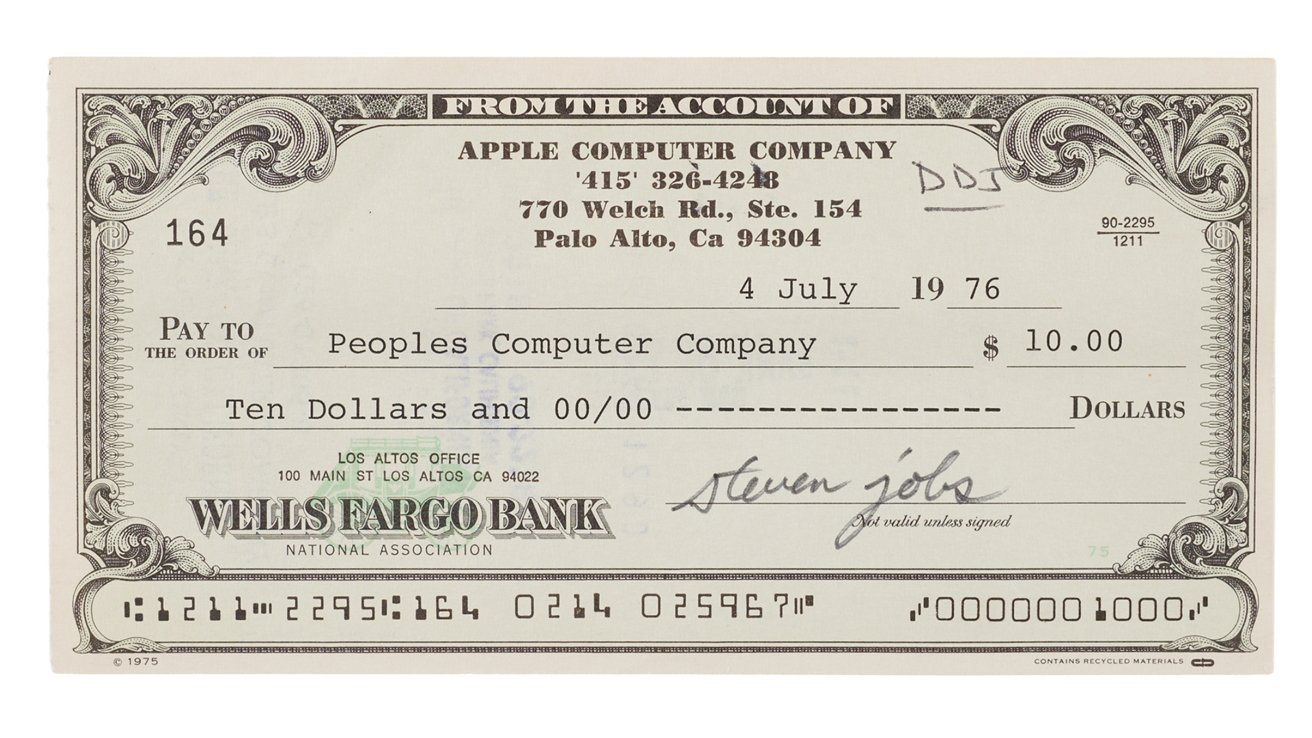
A newly surfaced Steve Jobs-signed check is up for auction, linking the nation’s milestone anniversary with the earliest days of the personal computer revolution.
RR Auction is currently running a Fine Autographs and Artifacts auction, full of signatures from American presidents, political figures, authors, kings, queens, scientists, engineers, innovators, and everyone in between. Among the famous names is Steve Jobs, Apple’s co-founder and former CEO.
It’s hardly the first time Jobs-signed item has made it to the auction block, but this one comes with remarkable timing. The $10 payment to the People’s Computer Company (PCC) is dated July 4, 1976, America’s Bicentennial, just months after Apple was founded.
That date also means that the check was filled out just three months after Jobs and Steve Wozniak founded Apple in Jobs’s family garage. At the time, Jobs and Wozniak would have been building their first product, the Apple-1.
The check bears the letters DDJ, which suggests that it was payment for a one-year subscription to Dr. Dobb’s Journal, a programming magazine spun off from PCC’s newsletter.
At the time of publication, the check has 14 bids and is currently priced at $21,962. RR Auction expects the check to sell for $25,000.
The auction will run until July 15. Interested buyers must place an initial bid by July 15 at 6:00 pm, with final bidding to take place shortly after.
This year, America celebrates its 250th birthday. Apple celebrated a milestone birthday of its own, its 50th, on April 1.
In January, Apple’s 1976 formation papers landed on the auction block. While it was suggested that the papers could fetch up to $4 million, they eventually sold for $2.51 million.
Alibaba and its US payment arm will pay 600 million dollars to resolve a DOJ probe into illegal pharmaceutical sales on its e-commerce platform.
Alibaba and its US digital payment processor have agreed to pay 600 million dollars to resolve a federal investigation into whether they failed to prevent the sale and importation of illegal pharmaceuticals and controlled substances, the Justice Department said on Wednesday. Alibaba entered into a non-prosecution agreement to end a probe of alleged violations of the Federal Food, Drug, and Cosmetic Act between 2016 and 2024. The investigation was led by the DOJ and the US Attorney’s Office in Rhode Island.
Alibaba admitted that overseas customers used its platforms to make roughly 80,000 purchases of products that lacked approvals under US drug, device, or importation laws, with a combined value of more than 200 million dollars. The agreement did not specify the products by name, but the DOJ said they involved pharmaceuticals, regulated chemicals, and drug counterfeiting equipment. US agents conducted more than 40 undercover purchases of drugs and equipment that were illegal for import.
The company acknowledged that it “failed to prevent some third-party sellers from circumventing controls and measures” on its platform and using it to sell and import goods into the US in violation of federal law. Alibaba employees had raised concerns internally about compliance measures and filtering systems that were not catching the illegal sales, the company admitted.
The settlement also involves AUS Merchant Services, a unit of Ant International that operates Alipay. AUS admitted that its anti-money laundering programme “failed to prevent some Alibaba merchants from using its payment processing and settlement services to facilitate the sale and importation of prohibited products into the United States,” the DOJ said.
The deal comes at a difficult moment for Alibaba in Washington. Anthropic accused Alibaba last month of using roughly 25,000 fake accounts and nearly 29 million exchanges to extract capabilities from its Claude AI model, the largest distillation campaign it has disclosed. Alibaba has also sued the Pentagon to remove itself from a roster of Chinese military companies, a designation that has already prompted several lobbying firms to cut ties with the company.
Alibaba said in a statement that the settlement will bring “stricter compliance to the sale of products in the United States by third-party merchants on its e-commerce platforms.” The 600 million dollar penalty is among the largest the DOJ has secured against a Chinese technology company for platform compliance failures, and it adds another front to the regulatory pressure Alibaba faces as it tries to maintain its US business relationships.

Kirsty Lindsay of Northumbria University explores the various ways students can work towards a career in the space industry.
In 2024, I flew on a microgravity, or zero G, parabolic flight with the European Space Agency (ESA). The aeroplane flew big arcs up and down in the sky. At the top of the arc I experienced 22 seconds of weightlessness, just like an astronaut.
On the flight were some of ESA’s newest astronauts, training on the Microgravity Science Glovebox: a see-through box for doing science experiments in space, with gloves to let astronauts use their hands while the box stops the experiment from flying around. I was carrying out research on how to keep astronauts healthy in space.
Piloting us was ESA astronaut Thomas Pesquet, who made floating around look easy: he hung serenely in the cabin while the scientists and trainees crashed about.
My career path to those moments in microgravity looks more like a maze than a straight line. I did an engineering apprenticeship, then an undergraduate degree in physiotherapy, then a master’s degree in space physiology and health. Finally, a PhD on how to keep astronauts’ backs healthy combined all three.
There is no one way to be an astronaut – you can’t go to astronaut school. You need to pick up skills along the way before applying to be an astronaut candidate. The good news is there are many pathways to becoming an astronaut, or to be floating alongside them, like me.
The most obvious and well-known routes are to study science, technology, engineering and mathematics (STEM) subjects, while also becoming a pilot – these paths often intertwine. Exactly which STEM subject, and which kind of flying, counts depends on the space agency or private company you apply to, and on your nationality.
But most of the world’s current astronaut corps took this STEM pathway. Thomas Pesquet is one example: he qualified as an aerospace engineer and a transport pilot before becoming an astronaut candidate in the 2009 class.
The second, and increasingly common option, is the multidisciplinary route. It includes astronauts who have studied two or more fields that might not seem obviously related to each other, or to spaceflight. Combinations of life sciences and physics are popular, as with Canadian astronaut David Saint-Jacques. He trained as a biomedical engineer, astrophysicist and then as a medical doctor before becoming an astronaut.
ESA’s John McFall, who was with me on the 2024 parabolic flight, was a Paralympic sprinter and an NHS orthopaedic surgeon before he became an astronaut in 2022. Some combinations are more unusual still: Jessica Meir brought together marine biology and extreme-environment physiology before joining NASA.
Each of these astronauts offers a unique mix of skills, valued in the complex, problem-solving world of spaceflight. That mix will matter even more on future planetary missions, where one person may need to fill several roles depending on which phase of the mission they are in.
The third path is the exact opposite. Instead of going broad, you dive deeply into one topic and become a world-leading expert. For example, ESA’s Sławosz Uznański-Wiśniewski earned two master’s degrees and a doctorate in radiation-tolerant electronics. He then worked at CERN, where he became responsible for the day-to-day running of the Large Hadron Collider, before being selected by ESA in 2022. Sometimes being a specialist and being really, really good at what you do is itself a pathway to space.
It is worth saying that you don’t always have to decide young. Canadian Jenni Sidey-Gibbons was a combustion engineer and university lecturer before she was selected. Japan’s Makoto Suwa was an Earth scientist and senior disaster risk management specialist at the World Bank before he was chosen by the Japan Aerospace Exploration Agency (JAXA) in his 40s.
There is no expiry date on the dream, and no single moment when you must decide. It is even fine to stumble along the way. Astronaut Scott Kelly had poor grades at school and failed at least one US Navy exam before becoming an astronaut. He never gave up.
Then there is one final route, which none of us knows, because it doesn’t exist yet. When it comes to who they might choose to go into space, commercial spaceflight companies are writing their own rulebooks as they go and are deliberately widening who qualifies as astronauts. We genuinely do not know who the career astronauts of the 2040s will be, or what they will have studied.
However, a strong grounding in mathematics, science, English and another language is a great start. You will train and live alongside international crews as well as solve problems in space. Whatever you study, your hobbies are the final ingredient. Hobbies make you a rounder, happier, more capable person – the kind of person who makes an interesting crew member.
Get that foundation, do it brilliantly and the rest of what you study is up to you.

Kirsty Lindsay is an assistant professor in physiotherapy at Northumbria University, in Newcastle. She studied space physiology and health at King’s College London in 2013 and completed a BHSc (Hons) in physiotherapy from York St John in 2010. She also spent two years at the European Space Agency working with ground-based facilities and human spaceflight as a young graduate trainee, before returning to the UK to undertake her current research. Kirsty’s research interests include using physiology and physiotherapy to help maintain astronaut health and improve clinical care for back pain patients on Earth.
Don’t miss out on the knowledge you need to succeed. Sign up for the Daily Brief, Silicon Republic’s digest of need-to-know sci-tech news.



Weekend Open Thread: Staud – Corporette.com


The House | Manchesterism won’t survive the painful trade-offs unless it gets citizens on board


Strategy authorizes up to $1.25B in Bitcoin sales under new capital plan


Potential 2028er World Cup attendee leaderboard


Asia stock markets slide as tech shares slump


MAJOR BITCOIN & MARKET UPDATE!!!! (MUST WATCH ASAP!!!)


A Look At A Gaggle Of Transputer Boards

Dell (DELL) Shares Tumble Over 5% Following Analyst Downgrade to Hold


Coinbase, Circle Deepen Crypto Stock Losses Despite Resilient S&P 500


Australia treasurer says alleged access of prime minister’s bank data ’incredibly concerning’


Kraken's xStocks Opens Bending Spoons IPO Registration to EEA Retail


FIH Pro League: India defeat Pakistan 7-1, register biggest win of campaign | Other Sports News


Bitcoin Sparks $600M Hourly Liquidations With $65,000 Set To Become Resistance


Bluekit phishing kit adopts browser-in-the-middle for login theft


Anonymous researcher drops 0-day ‘exploitarium’ repo


Russian hackers now target Signal backup recovery keys

Hyperliquid Named on Singapore MAS Investor Alert Register


RTX holders must register wallets before token distribution begins


Broncos roster: OL Ben Powers (No. 74) entering final year of contract

The AI boom won’t burst all at once. It will pop in ‘rolling bubbles’: Macquarie
You must be logged in to post a comment Login