






Connect with us
DAPA Banner
DAPA Coin
DAPA
COIN PAYMENT ASSET
PRIVACY · BLOCKDAG · HOMOMORPHIC ENCRYPTION · RUST
ElGamal Encrypted MINE DAPA
🚫 GENESIS SOLD OUT
DAPAPAY COMING

Business

Britain Suffers Rich World’s Biggest Fall Since Covid

Published

on

Britain Suffers Rich World's Biggest Fall Since Covid

British households have taken the heaviest hit to their wealth of any advanced economy since the pandemic, a sobering benchmark for a country that once prided itself on rising prosperity.

The average Briton is now more than a fifth poorer than five years ago, according to UBS. Of the 37 countries the Swiss bank surveyed, none has seen a steeper decline.

Typical individual wealth has dropped by roughly £28,500 since 2020 once inflation is stripped out, leaving the median adult with assets of just over £95,500 last year. That makes the British marginally better off than the French, but poorer than the Dutch and the Italians, a ranking that would have seemed improbable a decade ago.

Wealth here is measured by the value of assets such as property and shares, and it has been eroded at pace after inflation surged in the wake of the pandemic and Russia’s invasion of Ukraine. Britain absorbed a worse inflation shock than most of its peers as energy costs jumped, a squeeze that continues to shape the wider picture on living standards.

A cooling housing market has deepened the slump. Remarkably, British families have fared worse over the past five years than households in Turkey, Bulgaria, Mexico and Kazakhstan.

Advertisement

The UBS findings underline the scale of the task facing Andy Burnham as he prepares to become the next prime minister. In his first major speech since returning to the Commons, the MP for Makerfield said this week: “We cannot go through another decade like the one we have just had. We need a new determination to raise the living standards of every person in this land.”

Separate figures from the Office for National Statistics, published on Tuesday, showed that Sir Keir Starmer had failed to deliver on his pledge to improve living standards, with families now worse off than they were before he entered Downing Street.

The UBS data show the wealth of a typical individual has tumbled by more than 23 per cent on both the mean and median measures since 2020, ground down by a spike in inflation that peaked at 11.1 per cent in October 2022.

Paul Donovan, chief economist at UBS Global Wealth Management, said: “The UK had a brief period of notably higher inflation than Europe did, and that has distorted the real numbers. You had a couple of years of quite high inflation, partly because of the various peculiarities of our energy pricing structure.”

Advertisement

The housing market has added to the strain. UK house prices have risen by 26 per cent since the start of 2020, according to the ONS House Price Index, but consumer prices have climbed by 32 per cent over the same stretch, meaning the real value of the money tied up in the typical home has been quietly whittled away.

Donovan added: “There is a considerable weight to real estate as a form of wealth because it is the largest asset that most people own. A change in the relative performance of your local real estate market can have a notable bearing on, in particular, the median wealth level over time.”

The fall in wealth has landed alongside incomes that have struggled to keep up with prices, a double squeeze on households. At the same time, the tax burden is set to climb to its highest level since the Second World War, driven in part by the long freeze in income tax thresholds, an issue explored in Business Matters’ coverage of Britain’s record property tax burden.

The picture is not uniformly bleak across the globe. The biggest gains came in South Korea, where average wealth rose 55 per cent, along with Russia and Croatia. Among G7 economies, the largest rise was in Japan, where median wealth climbed 51 per cent.

Advertisement

The data arrived as the Institute of Directors said business confidence fell again in June. Anna Leach, the group’s chief economist, said it pointed to an urgent need for ministers to back economic growth.

“Businesses need to see meaningful improvements in areas like regulatory cost, tax complexity and swiftness and consistency of government decisions to fundamentally unlock spending and get growth going,” she said.

A Treasury spokesman was more upbeat: “We have the right economic plan. Inflation is holding steady, the UK led G7 growth at the start of the year, and the IMF and OECD have both upgraded growth forecasts. Real wages have risen more in the last year than in the first ten years of the previous government.” That claim of steadier prices chimes with the latest ONS inflation reading, though for many households the damage to accumulated wealth has already been done.


Jamie Young

Jamie Young

Jamie is Senior Reporter at Business Matters, bringing over a decade of experience in UK SME business reporting.
Jamie holds a degree in Business Administration and regularly participates in industry conferences and workshops.

When not reporting on the latest business developments, Jamie is passionate about mentoring up-and-coming journalists and entrepreneurs to inspire the next generation of business leaders.

Advertisement

Continue Reading
Click to comment

You must be logged in to post a comment Login

Leave a Reply

Business

Nestle testing Kit Kats with regeneratively farmed wheat

Published

on

Nestle testing Kit Kats with regeneratively farmed wheat

Company part of partnership with Wildfarmed in the UK.

Continue Reading

Business

How to bag a bargain flight

Published

on

How to bag a bargain flight

Is your holiday booked yet?

Finance expert Laura Pomfret shares her top tips for finding cheaper flights, from spotting rare error fares to knowing the best time to book. Plus, why airline bundles aren’t always the bargain they seem.

To watch this with subtitles go to BBC iPlayer and search for Morning Live from 02/07/2026

Continue Reading

Business

Wall St opens higher after June jobs report eases rate-hike bets

Published

on

Wall St opens higher after June jobs report eases rate-hike bets


Wall St opens higher after June jobs report eases rate-hike bets

Continue Reading

Business

113% returns in 13 days! How Vedanta Iron and Steel shares made investors richer since listing

Published

on

113% returns in 13 days! How Vedanta Iron and Steel shares made investors richer since listing
Vedanta Iron and Steel shares have delivered massive returns for investors, more than doubling in just 13 trading sessions since their market debut following the mega demerger from Vedanta.

Shares of the company were listed at Rs 20 apiece on NSE on June 15, as four new Vedanta companies debuted on the stock market to conclude what was one of the biggest corporate restructurings in India’s metals and mining space. The company’s market capitalisation at the time of debut stood at Rs 7,821 crore.

While analysts screamed ‘Buy’ on Vedanta Aluminium shares after the debut, the smallcap counter of Vedanta Iron and Steel quietly began to surge. The sharp rally in Vedanta Iron and Steel shares intensified after Azim Premji-backed Premji Invest’s PI Opportunities AIF V LLP bought shares worth Rs 102 crore after the stock’s market debut. PI Opportunities AIF V LLP, an investment arm of Premji Invest, which is owned by Indian billionaire businessman and Wipro Chairman Azim Premji, bought nearly 4.84 crore shares worth Rs 101.68 crore at Rs 21.02 apiece through a bulk deal.

Also read: Vedanta Iron & Steel shares list at Rs 22 on BSE as mega demerger concludes

Advertisement

Vedanta Iron and Steel shares hit the 5% upper circuit in nine out of its first 10 sessions on Dalal Street. The stock hit the 10% upper circuit for the second consecutive session today to trade at Rs 42.65 apiece on NSE.


This marks a whopping 113% surge from its listing price in just 13 sessions since market debut. The company’s market capitalisation has also more than doubled to Rs 16,677.81 crore.
Also read: Vedanta demerger unlocks 20% value; Aluminium arm becomes most valuable

About Vedanta Iron and Steel

Vedanta Iron and Steel has operations spanning India and Africa, and is focused on iron ore exploration, mining and processing. It also produces high-quality steel, wire rods, TMT bars, pig iron, ductile iron (DI) pipes, ferro-silicon, cement and metallurgical coke.The company on Tuesday said that stock exchanges have asked to clarify any reason for the significant price movement seen in the counter. The company responded by saying that there is no material event, information, or announcement in this regard.

How are the other demerged Vedanta stocks performing?

Vedanta Aluminium Metal shares jumped 4% today, but have declined nearly 10% since listing. Vedanta Oil and Gas shares meanwhile jumped nearly 11%, extending sharp gains after the firm received ICRA AA+ (Stable) rating.

Vedanta Power shares, meanwhile, jumped over 5% today.

Advertisement

Also read: Vedanta Aluminium vs Power vs Oil & Gas vs Iron & Steel | Which stock should you buy?

(Disclaimer: Recommendations, suggestions, views and opinions given by the experts are their own. These do not represent the views of The Economic Times)

Continue Reading

Business

Sentinel strikes $26m Capricorn deal

Published

on

Sentinel strikes $26m Capricorn deal

Capricorn Metals has sold its Big Springs gold project in Nevada to Mark Williams-chaired Sentinel Metals, in a cash and scrip deal worth up to $26 million.

Continue Reading

Business

Positives for North East firms though cost pressures still loom

Published

on

Business Live

The North East Chamber of Commerce has published the findings of its latest quarterly economic survey

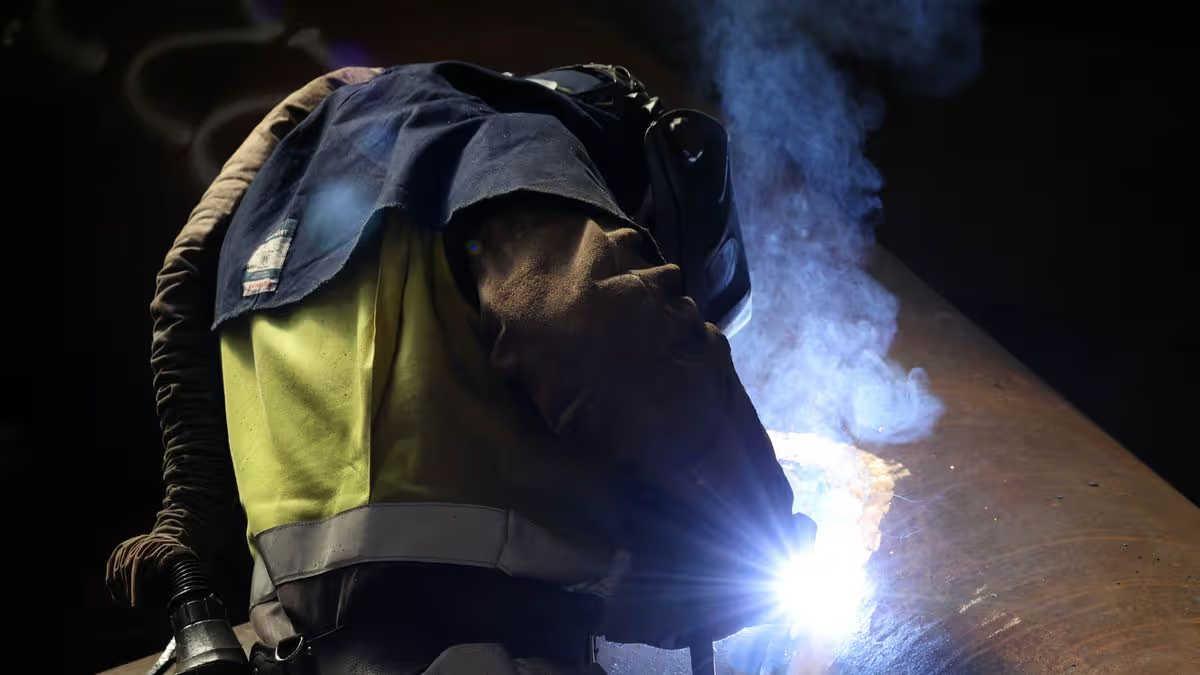
Welders working on a huge steel jacket for Scottish Power's East Anglia TWO offshore windfarm at Smulders yard in Wallsend

Welders working on a huge steel jacket for Scottish Power’s East Anglia TWO offshore windfarm at Smulders yard in Wallsend(Image: Simon Greener/Newcastle Chronicle)

There are encouraging signs for North East businesses with rising sales and hiring intentions, research from a top regional group suggests.

Firms were questioned as part of the established North East Chamber of Commerce’s quarterly economic survey (QES), which pointed to improvements in sales, recruitment and investment in workers. But despite the confidence markers, the Q2 research also showed firms were wary of increased energy costs, wider inflation and weaker profit forecasts.

Business activity was shown to have broadly strengthened with increases in UK sales, UK orders and exporting, while the proportion of firms operating at full capacity also increased. Training investment plans rose strong, up 13.2%, but plant investment declined by 7.6% Profitability expectations were also weakened.

The survey conducted between May 11 and June 8 found future workforce expectations rose sharply, with recruitment across all types of roles. However recruitment challenges increased across all categories but particularly semi and unskilled and clerical roles. Workforce levels also improved slightly on the previous quarter, but remained below Q2 2025 levels.

Advertisement

Deborah Walton, president at the North East Chamber of Commerce, said: “This quarter’s results highlight growing confidence among North East businesses, with significant improvements in sales activity, recruitment intentions and investment in workforce development. Businesses are clearly looking ahead, with future workforce plans reaching their highest level for some time and training investment increasing strongly compared with both last quarter and a year ago.”

Less favourable were concerns about price pressures, which increased across most indicators but most notably fuel, up 23.4%, raw materials, up 18.5%, and utilities, up 9.9%. Researchers said that despite the growth, most cost pressures remained lower than a year ago as labour, finance and other overheads showed annual declines.

Concern about energy prices rose significantly over the quarter, with 58.1% of businesses saying it was an issue. More than half of firms reported taking action to reduce energy costs through efficiency measures and reduced energy usage.

Meanwhile worries around business rates, crime and taxation eased, while concerns about energy prices, inflation and exchange rates all increased.

Advertisement

Rhiannon Bearne, deputy CEO at North East Chamber of Commerce, said: “As businesses and communities face further change on the national political stage, stable policy, investment in infrastructure and support for competitiveness will be critical to sustaining this cautious momentum. The North East Chamber of Commerce will continue to champion the needs of North East businesses and ensure their experiences help shape policy not just regionally but, through our strong partnership with the British Chambers of Commerce, nationally as well.”
Continue Reading

Business

Leeds’ The Malthouse building acquired by tenants following landlord’s collapse

Published

on

Business Live

Occupiers IMA said buying the freehold gives them the flexibility to evolve the space

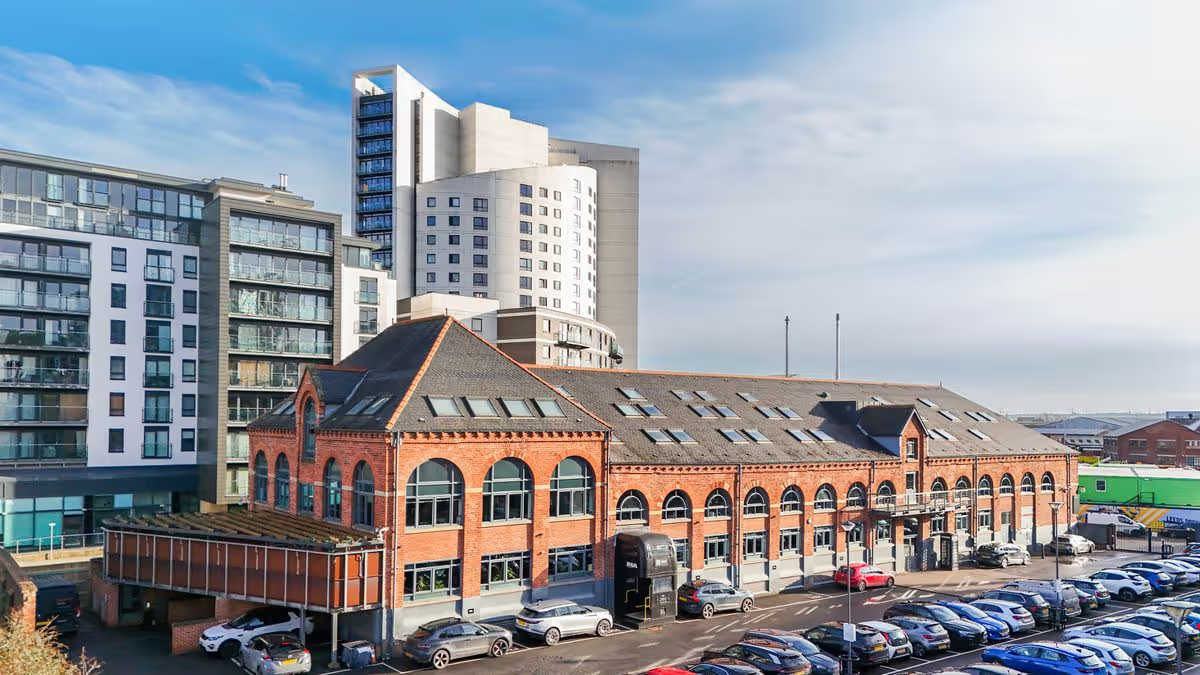
The Malthouse is an 18th century building.

The refurbished Malthouse, in South Bank, Leeds.(Image: Avison Young)

Creative agency IMA has acquired The Malthouse building in a £4m deal.

The global firm has taken freehold ownership of the refurbished 18th century former maltings having acquired it from the administrators of former landlords Leaseco 23 Limited, which collapsed last year. The building, which sits opposite Leeds Dock, provides more than 24,000 sqft of office accommodation, with Leeds city centre and train station only minutes away.

IMA have been based at the Malthouse since 2020, after moving from their location in Headingley, where the company was based for more than 30 years. The Leeds office is one of six, with additional bases in London, Amsterdam, Sydney, New York and Manchester.

Avison Young acted for IMA, which Cushman & Wakefield acted for the seller. The deal is described as reflecting the ongoing momentum of Leeds’s creative and digital industries.

Advertisement

A spokesperson for IMA said: “Leeds Dock has become a real hub for creative and growing industries, and it’s been an inspiring place for us to call home over the past few years. Our workspace plays a big role in shaping how we collaborate and support our clients, so having the opportunity to make it our own is incredibly important.

“Acquiring The Malthouse gives us the flexibility to evolve the space alongside our business and create an environment that truly reflects who we are. The process has been smooth throughout, and we’ve really valued the expertise and support from the Avison Young team.”

Leaseco 23 – formerly known as Leeds Dock Limited – owned 24 ground-floor commercial units at Leeds Dock, and was linked to two buildings there. The property-owning company’s finances deteriorated following the departure of a key anchor tenant in January 2024, leading to a big fall in rental income.

Despite the efforts of directors to refinance, administrators at Interpath were called in and appointed in mid December, 2025. A statement of affairs showed a total estimated deficit of more than £12m.

Advertisement
Continue Reading

Business

WA Museum’s Warriors display called ‘most successful yet’

Published

on

WA Museum’s Warriors display called ‘most successful yet’

The Terracotta Warriors exhibit has been labelled the museum’s most successful display yet, as questions swirl around the state government’s spending on arts and culture events.

Continue Reading

Business

General Mills CEO: ‘Fiscal ’27 will be a better year’

Published

on

General Mills CEO: ‘Fiscal ’27 will be a better year’

Company better-positioned to focus on growth after tough fiscal 2026.

Continue Reading

Business

Bloom Energy's Long-Term Rally Is Just Getting Started

Published

on

Bloom Energy's Long-Term Rally Is Just Getting Started

Bloom Energy's Long-Term Rally Is Just Getting Started

Continue Reading

Trending

Copyright © 2025