





Connect with us
DAPA Banner
DAPA Coin
DAPA
COIN PAYMENT ASSET
PRIVACY · BLOCKDAG · HOMOMORPHIC ENCRYPTION · RUST
ElGamal Encrypted MINE DAPA
🚫 GENESIS SOLD OUT
DAPAPAY COMING

Tech

The Razr Fold now gets along better with iPhones thanks to AirDrop

Published

on

I already had more reasons than expected to keep the Motorola Razr Fold around. While reviewing it, the company’s first foldable genuinely surprised me with its level of polish. A practical outer display, great cameras, strong battery life, and a gorgeous folding screen. All of this made me want to switch to this device as my primary phone.

Now Motorola has added one more reason, and it’s just sweetening the deal for me. The Motorola Razr Fold now supports AirDrop-style sharing through Android’s Quick Share, making it the first Motorola phone to get the feature. That means Razr Fold users can share files directly with Apple devices such as iPhones, iPads, and Macs without relying on cloud links, messaging apps, USB cables, or the usual cross-platform nonsense.

Making life easier between the different ecosystems

Android users do not need every Apple feature. AirDrop, though, has always been one of the annoyingly good ones. It is fast, simple, local, and familiar to people who own Apple devices. The problem is that Android users have long had to work around it. You could upload a file to Google Drive, send it through WhatsApp, compress it over a messaging app, email it like it is 2014, or grab a cable and hate yourself a little.

Quick Share with AirDrop support fixes that. On supported Android phones, you can share locally through Quick Share, while the Apple device receives the file through AirDrop. This was first noticed by Android Authority, who confirmed the feature was working on the Razr Fold with a MacBook.

Why this is big on the Razr Fold

The Razr Fold is not a cheap phone. It is Motorola’s biggest swing at a proper book-style foldable, so it needs more than interesting hardware to justify itself as a daily driver–and this is one of the features that genuinely helps. A foldable is often used as a mini-tablet for editing, reviewing photos, reading documents, multitasking, and handling work files. If you are moving photos from the phone to a MacBook, sending documents to an iPad, or sharing media with an iPhone user nearby, AirDrop support makes the Razr Fold feel far less isolated from the Apple devices around it.

Hopefully, this function rolls out to other recent Motorola phones as well. Other Android brands already have supported models, including Google, Samsung, OnePlus, Oppo, Honor, Vivo, and Xiaomi devices. I already liked the Razr Fold more than I expected, and now, the case for making it my daily driver just got a lot stronger.

Advertisement

Source link

Continue Reading
Click to comment

You must be logged in to post a comment Login

Leave a Reply

Tech

Donald Trump Bought A Bunch Of Tech Stock The Same Day He Announced His AI Action Plan

Published

on

Financial disclosures from 2025 show he purchased stocks in Apple, Amazon, NVIDIA and Meta.

The New York Times has delved deep into Donald Trump’s financial disclosures from the first year of his second presidential term. Without a doubt, it was the most personally profitable period of any president’s term in office, personally netting him a figure north of $2 billion. While much of that largesse was earned via Cryptocurrency sales, Trump has also become an investor in big tech. The paper reports that on July 23, he bought up to $5 million of stock in Amazon, Apple, Meta, Microsoft, NVIDIA and Broadcom. It notes, too, the purchases were made on the same day the White House would release its long-awaited AI Action Plan.

In January, The New York Times reported that brokerage accounts tied to the Trump family made more than 3,600 trades. But while the Trump family does not have its assets in a blind trust, it says it does not have a say in which companies its brokers buy and sell shares in. The paper has reported, however, that Trump has often made “well timed” trades, such as an investment made in Dell shortly before it secured a $9.7 billion defense contract. As the Times reports, Trump was legally obligated to disclose the purchases of stock in Amazon, Apple, Microsoft and the rest, but he did not. As a consequence of his repeated omissions, he has had to “pay a small fine for failing to honor this rule.” It’s likely any future violations may not be so easy to deal with —- in January 2025, Trump said he was in favor of American citizens who are “repeat offenders” being made to leave the US.

Advertisement

Source link

Continue Reading

Tech

Your Living Room Smart TV Just Got a Privacy Boost with MacPaw’s ClearVPN

Published

on

In modern households, the living room has become one of our most connected spaces. We catch live sports, binge-watch trending series, and stream movies. Naturally, smart TVs have become a fixture in our daily entertainment habits. Yet, as people are paying more attention to protecting their privacy on computers and phones, the devices sitting right in front of the couch are often overlooked.

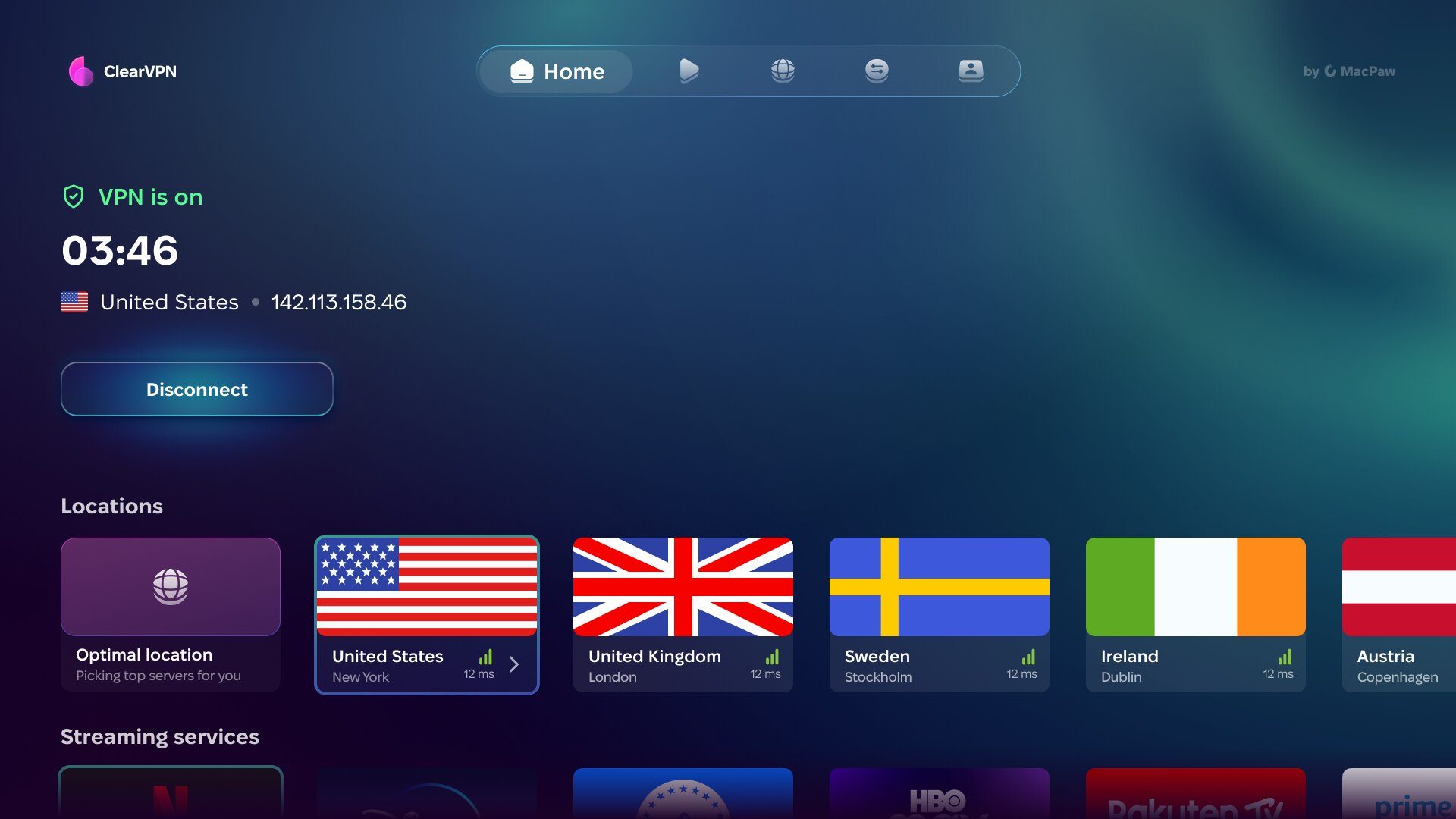
MacPaw’s new ClearVPN expansion fixes this vulnerability by bringing its signature simplicity and security to Apple TV and Android TV platforms. It’s a seamless way to browse privately on the biggest screen in your home, and it works with your existing subscription to protect up to 6 devices at once.

Why Our TVs Need the Same Privacy as Our Phones

The smart TV landscape has shifted dramatically. With adoption surging to more than 900 million units globally, found in over 85% of households, smart TVs have become a permanent fixture of our daily routines.

As they evolve into digital hubs, the privacy conversation is shifting from personal, handheld screens toward the one shared in the living room. Since these units continuously interact with background apps and services, this connectivity introduces new security challenges, underscoring the need for privacy tools that keep pace with modern digital habits. Addressing this, MacPaw’s ClearVPN is now available worldwide and brings essential security to any device running Android TV 6+ or tvOS 18+. To mark the launch, Digital Trends readers can get an exclusive 50% discount on their first purchase. Users can simply use the promo code DIGITALTRENDS at checkout to claim the offer. This promotion is valid for the next three months and can be renewed or extended afterward if required.

Advertisement

What makes it truly appealing is that MacPaw’s ClearVPN is closing this gap by making digital privacy feel a little less complicated. As Tetiana Shokina, Product Manager at MacPaw, explains, the team did not see this as just another feature request.

“We built ClearVPN on one belief: privacy should be effortless,” Shokina says.

Shokina continues, “Bringing it to Apple TV and Android TV was the obvious next step. If simplicity is our promise, it has to work on every screen, including the biggest one.” This update marks a significant shift, delivering the same level of care in how we watch TV that users have long expected on their personal devices.

Designed to Make VPNs Less Complicated

MacPaw’s ClearVPN has focused on simplicity since launching in 2020. Rather than overwhelming users with endless server lists or technical settings, the service removes the friction traditionally associated with using a VPN.

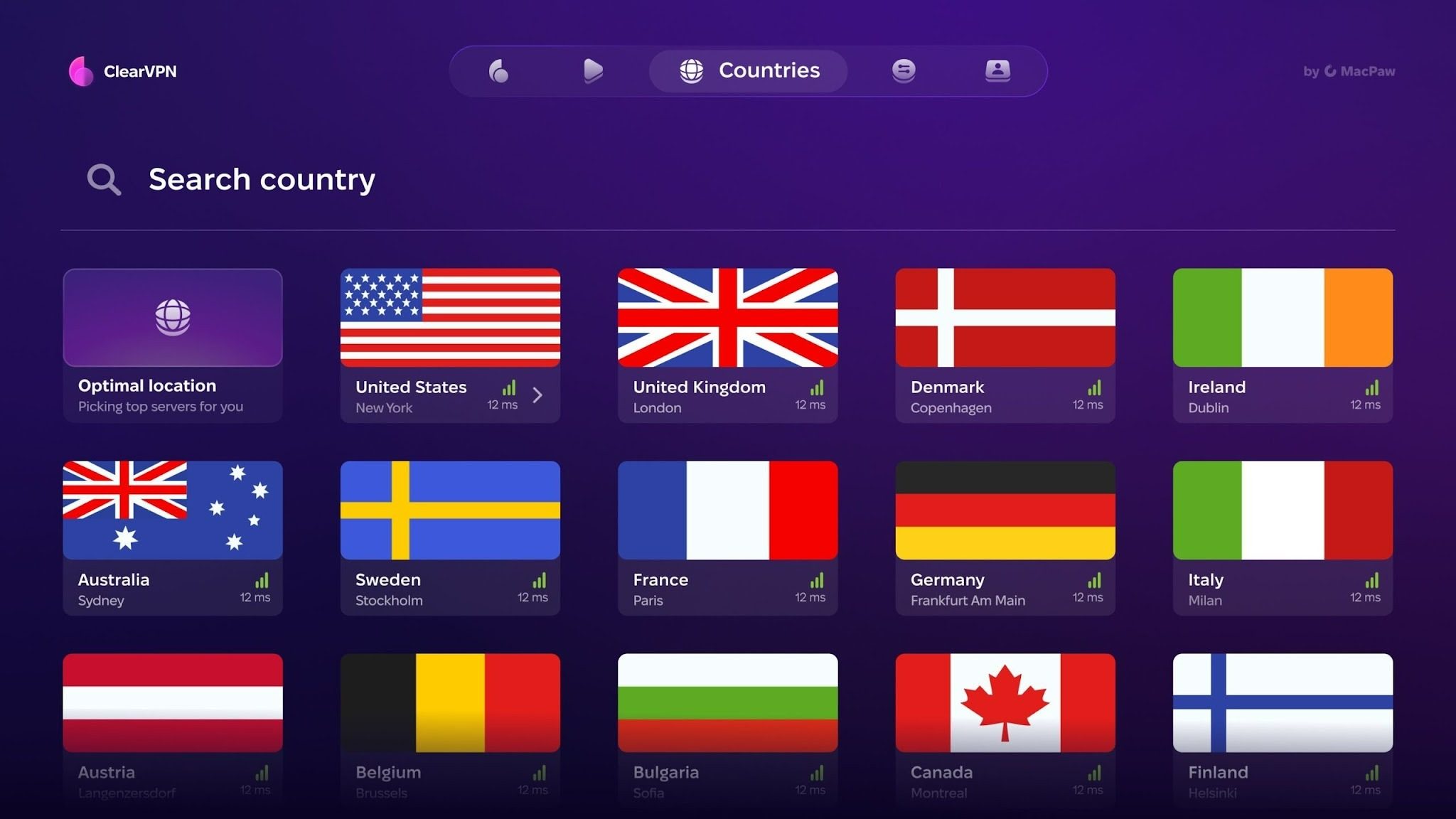
This philosophy applies directly to the smart TV experience. The Optimal Location feature automatically connects the device to the best server so that users never have to sort through a maze of technical configurations. For anyone who wants to settle onto the couch and start watching without a setup headache, this ease of use makes a meaningful difference.

Building on this convenience, the dedicated Streaming mode further removes any guesswork. Rather than searching for the right connection, users can link directly to servers optimized for their favorite platforms, ensuring a smoother stream with just a few clicks.

Advertisement

Furthermore, to ensure that speed matches this simplicity, MacPaw’s ClearVPN relies on industry-leading protocols that enable fast, stable connections without requiring the user to tinker with settings. The goal is to keep protection running quietly in the background so content can be enjoyed without interruption.

The service is built to adapt to a digital lifestyle. A single subscription supports up to 6 devices, allowing users to extend protection well beyond the television. Ultimately, covering everything from smartphones to smart TVs under one account creates a consistent and reliable privacy shield across every screen in the home.

Secure Your Living Room in Seconds

Getting started should be as easy as watching a show, and that is exactly how the setup process for MacPaw’s ClearVPN on TV was built. Anyone who has ever struggled to type a long email address or password using a television remote will appreciate how easy this is to navigate.

Users can activate this service by scanning the QR code displayed on the TV screen with their smartphone to confirm the login. Alternatively, they can use a short activation link and code to authenticate the app on a phone, tablet, or computer. Both methods remove the frustration often associated with logging into apps on smart TVs.

MacPaw’s vision aims to make technology feel intuitive and accessible. The company describes its mission as helping machines help you. Such an approach aligns closely with the service’s focus on simplifying online privacy rather than overwhelming users with technical complexity.

Advertisement

Privacy tools are often perceived as if they are reserved for power users, but products like ClearVPN by MacPaw emphasize making that same level of protection accessible to everyone. This is especially relevant as the number of connected devices in the average household continues to grow.

With the service already available to download across macOS, Windows, iOS, iPadOS, Android, routers, and Chrome browsers, the addition of Apple TV and Android TV extends that protection into the connected home. An extra layer of protection on these platforms is a necessity as smart TVs are no longer passive screens. They have transformed into powerful, internet-connected hubs that play a major role in how we consume content every single day.

For users looking to fortify privacy as part of their daily streaming while maintaining easy access to global content, the ClearVPN expansion offers a straightforward solution. It upholds MacPaw’s broader standard for technology by providing high-level security without requiring users to become VPN experts. It works best when it feels entirely invisible, acting as a background layer so users can focus on what they are really there to do — sit back and enjoy the show.

Advertisement

Source link

Continue Reading

Tech

Know Your Food: Organic Production

Published

on

A few weeks ago we published the first in a new series of articles, Know Your Food. It was born out of the realisation that most people know surprisingly little about what they eat, and to apply a bit of Hackaday curiosity to received opinion on the subject. As we put it then: “To know both how common foodstuffs should be made, as well as how they are made industrially, should be an essential for everyone” We’ll continue in that vein, with a look at organic food.

If you buy your food in a supermarket it’s likely that in the vegetable aisle you’ll be presented with a choice. On one hand you will have the normal vegetable, and on the other and usually for a slightly higher price, the organic version of the same vegetable. What’s going on?

So What Is This Organic Stuff All About?

A watercolour picture of a bucolic scene with a farmhouse surrounded by trees, and some cows in the foreground.
It is unlikely that a typical organic farm in the 2020s will resemble this John Constable painting. John Constable, Public domain.

Organic production is a system of agriculture that emphasises natural fertilisers, pesticides, and farming methods over synthetic or intensive ones. It has its roots in the first half of the 20th century, and as the decades progressed it has become an important sector of agricultural industry. I grew up steeped in organic agriculture because my grandfather was an early adherent in the years following the war, so I’ve seen it from the sharpest end. There is a lot to commend organic production for and plenty of reasons to embrace it, but with that come some problematic aspects, and even dubious claims. Here I’ll try to unpick some of that.

It’s tempting to believe that all organic production is somehow a return to a 19th century rural idyl, complete with the obligatory chickens in the farmyard. Some organic producers do take a slice of this back-to-the-land approach to their craft, but the reality of organic farming is a very modern approach to managing the ecosystem. Organic farmers are not wary of progress, and neither are they reluctant to use pesticides or other chemicals. Instead they do so according to the principles of organic agriculture, so any techniques they use are designed to be beneficial to the ecosystem, and any chemicals have a natural origin.

The rear view of a tractor towing a manure spreader driving away from the viewer while spreading manure onto a grass field. It's a misty winter day, and leafless trees are visible in the distance.
If you spend time around organic agriculture, you become a manure expert. Ray Bird, CC BY-SA 2.0.

An important thing to understand is that the line between organic and non-organic agriculture is not sharply drawn. Crop rotation for example is long established farming practice, as are techniques such as contour ploughing in areas with soil erosion. As for fertiliser, there will be very few farming operations whose work does not include manure in some form, or who do not take advantage of nitrogen fixing crops. Pesticides such as the insecticide pyrethrum – originally derived from chrysanthemum root – or Bordeaux Mixture as a fungicide – a solution containing copper ions, so called because of its origin in French vineyards who applied lime solutions from copper containers – find uses where applicable in both organic and conventional agriculture. The important distinction lies in the organic farmers not going further than this, into synthetic amonium nitrate fertiliser for example, or glyphosate herbicide, which you might know as Roundup.

That’s the organic sales pitch, and it’s a compelling one. Now, we’ll go through the not so positive aspects, both of the movement and of the business.

Advertisement

Organic status is not simply conferred to produce by virtue of being organically grown. Instead it’s a legally protected designation, enforced through a system of certification performed by designated organisations. Where I grew up in the UK for example, organic certification is performed by the Soil Association. This is good because it preserves trust in organic status, but it suffers the flaw that it’s a profitable business for the certifier, and an expensive one for the producer. This in turn favours larger producers who can afford certification, and leaves the smaller producer unable to afford certification and thus unable to label their produce as organic. They can describe it as “Organically grown” of course, but they lose the cachet of the organic label. Since many small producers are by necessity organic, this affects a large number of producers if not a significant sector of the market.

Is Organic Food Really Better?

Then there is the produce itself. Is it better than the non-organic stuff? Here we enter complex territory, because the answer differs depending upon the circumstances.

In terms of what advertising people like to call “goodness”, by which I mean nutrients, vitamins and minerals, and the like, in many cases it’s difficult to make a case for the organic product being superior to the non organic one. There will be exceptions such as apples, where a typical non-organic commercial dessert apple is overwatered to the point of diluting the beneficial properties it might have in search of the elusive “crunch”. But in the more ordinary case, that organic zucchini is unlikely to have more nutritional value than its non organic equivalent. It’s important to note that the organic product will lack any pesticide residues which may be present on its non organic equivalent, however it must be remembered that pesticide residue levels in food are subject to their own stringent regulation.

A sign advertising Wynford Farm Shop, selling local Organic Aberdeen Angus beef.
If you’re looking for the best organic food, seek out places with signs like this. Stanley Howe, CC BY-SA 2.0.

In terms of flavour, yet again it’s a mixed bag. An organic product grown in as intensive a manner as can be got away with under the rules, is not likely to taste better than the equivalent. It’s difficult even to pin down what in the husbandry governs the flavour of the finished product in a scientific sense, however as someone who grew up around organic production I’d offer the view that the longer something took to produce, the better its flavour is likely to be.

The Slow Food movement champions products made in this way, usually traditionally produced foods, heritage varieties, and foods with a particular terroir. If you’re looking for better tasting food then you may not find it with a supermarket organic label, but it’s quite likely that one of those small organic producers will have what you are looking for, simply because their methods are less intensive.

Advertisement

Finally, if you’re looking at the benefit to the environment, it’s likely that in most cases the organic product will impose less stress on the ecosystem and the wider environment than its non organic equivalent. If that’s your concern you should also look further than the means of production and into food miles; how far did the food in front of you travel to your plate? Here in Europe the strawberry is in season from around May to September, so does it make sense to fly them from the other side of the world in January, however nice they taste?

So now I hope you have more of an idea about organic food than you did at the start of this piece. You’ll know something about its benefits and problems, and you’ll know when it’s better than its non-organic equivalent. I hope you’ll find the food you like, and if you do, I hope it’s from a small producer, they need your business. Bon appetit!

Header: MichelM10, CC0.
Advertisement

Source link

Continue Reading

Tech

7 Lesser-Known Google Account Settings You Should Change

Published

on

When you’re jumping between the many different apps Google offers—Gmail, Google Maps, Google Calendar, YouTube, and all the rest—you may not be giving much thought to the Google account that underpins them all or to the myriad settings you can access that help to define your experience across all these apps.

If you’ve never opened up your Google account page on the web or on your phone, there are a host of options to browse through there. They cover everything from data security and browsing history to the backup email Google needs in case you ever get locked out of your account.

Here we’re going to focus on seven of the lesser-known settings: the ones that don’t necessarily get a lot of attention but which are still an important part of how your account and your Google apps operate. It’s worth spending a few minutes to review these and to make sure they’re set up in the way you’d like.

Also pause to consider how much personal information you want to share with Google, or how much of your information you’re making visible on the web. Let your own level of comfort guide your decisions on how you tweak these settings.

Advertisement

The starting point for all these settings is your Google account page on the web.

Set Your Home and Work Addresses

Google will use the information about where you live and work to personalize your experience. This is most useful in Google Maps, because it means you can get directions back home or to your office with a single tap rather than typing in the address each time. (You should see Home and Work shortcuts appear whenever you search for a destination.)

There are benefits for getting more accurate weather forecasts and more relevant search results too. The usual Google privacy policy rules apply: No one else will see the address information you’ve saved, but you might start seeing more ads for sandwich shops in your local area.

To set these addresses from your Google account page, click Personal info and then either Home address or Work address. You can either type out the address manually, or select a location on a map.

Advertisement

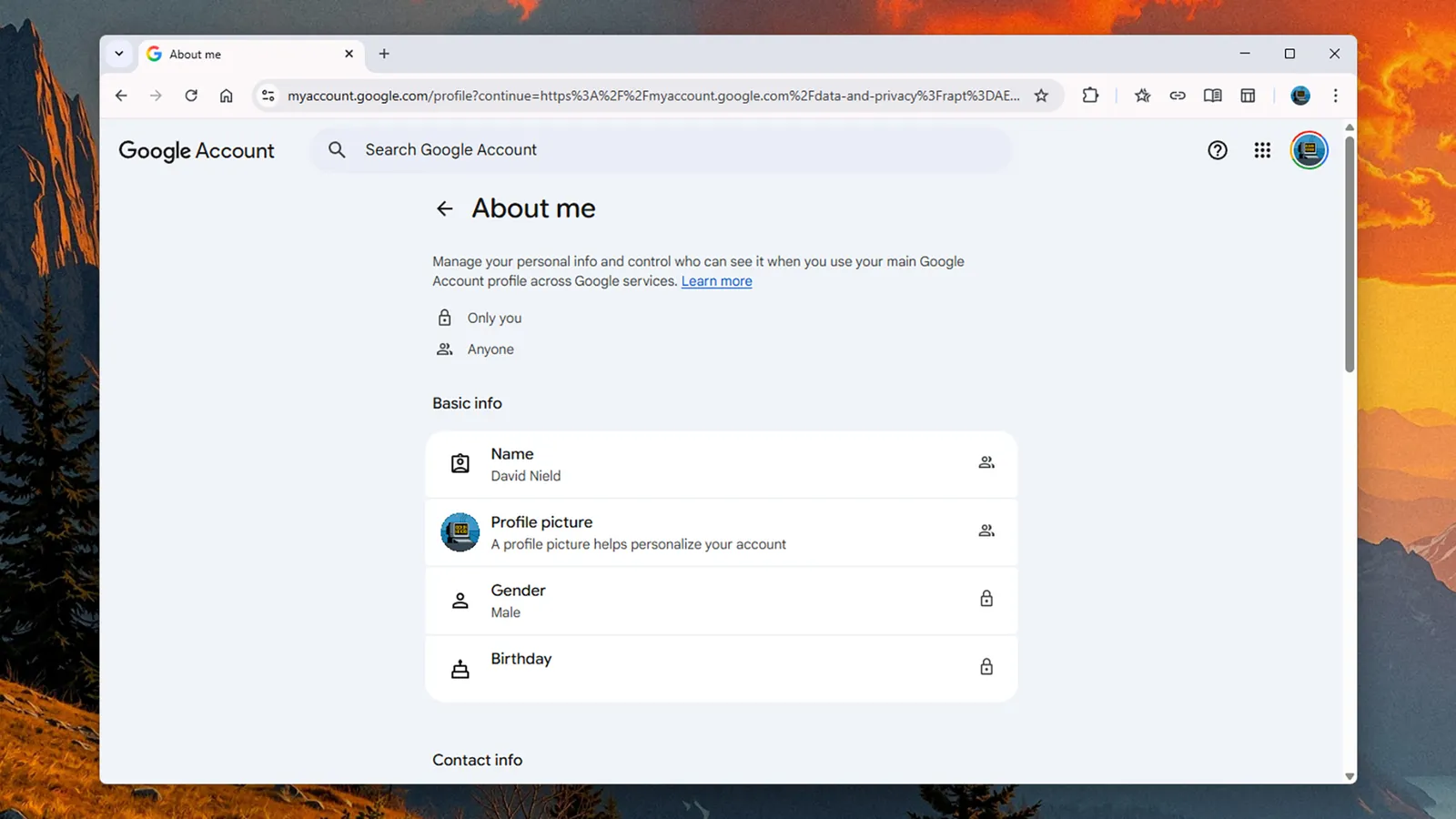
Edit Your Google Profile Information

Settings for your Google Profile Information

Settings for your Google Profile Information

Courtesy of David Nield

You may not think about your Google account in the same way as a Facebook or Instagram profile, but Google does share bits of information about you with other people. If you send someone an email through Gmail, they can click on your profile photo and see whatever’s public on your Google account page. Similarly, if you leave a review on Google Maps, the viewers of that review can tap on your name or picture and see any public information on your Google account page.

Source link

Advertisement
Continue Reading

Tech

Which Connection Is Better For Your Monitor?

Published

on

HDMI excels for media consumption, while PC gamers prefer DisplayPort.

While setting up a new PC monitor, you’ll often find two different video cables in the box. One, a pinched trapezoid shape, connects the monitor to a video source over HDMI. The other, with a connector that looks like a rectangle with a corner chopped off, is a DisplayPort cable. But some newer monitors also have a third port for USB-C, and you’ll often find a USB-C port labeled as a video-out port on laptops, too. While having several connection options is convenient, it’s not always clear which is the best for your monitor.

In general, if you’re connecting your monitor to a PC with a discrete graphics card, or if you want to use multiple monitors, DisplayPort is preferred. On the other hand, if you’re connecting to a Mac or PC with integrated graphics, a TV, home theater equipment, or a gaming console such as an Xbox or PlayStation, HDMI is the safe bet. While DisplayPort has several advantages for gaming and multi-monitor setups, and is also able to run over USB-C on many devices, HDMI is supported across a wider array of A/V equipment and has a number of features which add value for media consumption.

Ultimately, you should use whichever connection standard is best for your particular setup based on which devices you’re connecting your monitor to, as well as which generations of HDMI or DisplayPort they support. Here’s how HDMI and DisplayPort stack up, so you can determine which is best for your monitor.

Advertisement

DisplayPort is great for PC gaming, and runs over USB-C

DisplayPort tends not to show up on TVs, but is widely supported among the best gaming monitors and PC graphics cards. Traditionally, that’s because DisplayPort was designed with variable refresh rates in mind. When you watch a movie, it will display at a consistent frame rate, usually 24 frames per-second (FPS). But when playing a game, the frame rate can swing wildly from moment to moment. To make the experience smoother, variable refresh rate (VRR) technology such as AMD FreeSync and Nvidia G-Sync arrived to help coordinate frame rates between the GPU and monitor in a system. DisplayPort has long supported VRR natively, and while some monitors now support VRR standards over HDMI, DisplayPort remains the more robust choice.

Bandwidth is competitive between the two connection standards. Where HDMI tops out at a hefty 96 gigabits per-second (Gbps) with the latest HDMI 2.2 specification, the more common HDMI 2.1 reaches 48 Gbps. On the most high-end gaming hardware, DisplayPort 2.1 offers 80 Gbps, while 1.4 provides up to 32.4Gbps.

What clinches DisplayPort for many PC users, though, is its inclusion in the USB-C standard. DisplayPort runs over the USB-C Alternate Mode, meaning that, so long as both a video source and monitor support DisplayPort Alternate Mode, you can connect them with a single USB-C cable. Not all USB-C ports or cables support DisplayPort Alt Mode, so be sure to consult your product documentation.

Advertisement

Even if you’re not gaming, DisplayPort is often the better choice for multi-monitor due to its daisy chaining support. So long as your monitor has a DisplayPort out port, you can hook one monitor into another rather than using up multiple video out ports on your computer.

HDMI is best for media consumption

HDMI is best suited to media consumption, such as viewing movies and television shows. It doesn’t really matter whether you’re connecting to a monitor, TV, soundbar, or game console  — nearly every device capable of video output includes an HDMI port. In addition to widespread compatibility, HDMI includes multiple standards needed for premium audio, and to connect home theater equipment, as well as protocols for copyright protected content. All of these advantages make HDMI the default choice for home theaters, but not necessarily for computers.

Standards like Enhanced Audio Return Channel, or eARC, make HDMI key for entertainment systems. eARC allows a source to send pristine audio to an audio receiver or soundbar, which makes it easy to take advantage of HDMI’s robust support for spatial audio formats including Dolby Atmos and DTS:X. At the same time, HDMI Consumer Electronics Control (HDMI-CEC) can let your devices control one another. For example, press the power button on your Roku remote or PlayStation controller, and your TV will turn on and tune into that A/V source.

Advertisement

Lastly, HDMI supports digital rights management (DRM) protected content, a major must-have in the era of streaming. It integrates support for high-bandwidth digital content protection (HDCP), which checks to make sure the content you’re watching is properly licensed. Some 4K content from streaming services such as Netflix won’t stream unless connected via a minimum of DisplayPort 1.4 or HDMI 2.0 with HDCP 2.2 and above. In edge cases, you may not be able to stream content from a video source to your TV at all without at least some form of HDCP support.

Source link

Advertisement
Continue Reading

Tech

Tesla saw a massive sales jump in the second quarter

Published

on

Tesla delivered more than 480,000 vehicles in the second quarter of this year, an increase of more than 120,000 from the first quarter, in a sign that the company is still able to attract new buyers for its EVs despite a downturn in the U.S. market.

The company said Thursday that it built 451,758 in the second quarter, 442,936 of which were Model 3 sedans and Model Y SUVs. It delivered 467,762 of those vehicles, with the remaining 12,364 being “other models” — which includes the Cybertruck and the final production Model S sedans and Model X SUVs. It was the company’s best second quarter by raw delivery numbers ever, and easily outpaced Wall Street’s expectations.

It’s Tesla’s best quarter for overall sales since the third quarter of 2025, when it shipped just shy of 500,000 vehicles around the world. And while the company still has an uphill battle to stop a two-year trend of declining overall sales, the second quarter results show Tesla is finding ways — through geographic expansion, cheaper versions of the Model 3, Model Y, and Cybertruck — to buck that trend.

Source link

Advertisement
Continue Reading

Tech

Mac infostealer confirms stolen passwords before stealing data

Published

on

A newly discovered macOS infostealer verifies Mac login passwords before stealing sensitive data, giving attackers immediate confirmation that compromised credentials will actually work.

Researchers at Jamf Threat Labs have documented a new macOS malware campaign built around an infostealer called PamStealer. PamStealer disguises itself as the Maccy clipboard manager and uses AppleScript alongside a Rust payload to infect Macs.

Jamf found that PamStealer verifies login passwords through Apple’s Pluggable Authentication Modules before stealing additional data. Password verification sets PamStealer apart from most macOS infostealers, which typically capture whatever password a victim enters without confirming that it’s valid.

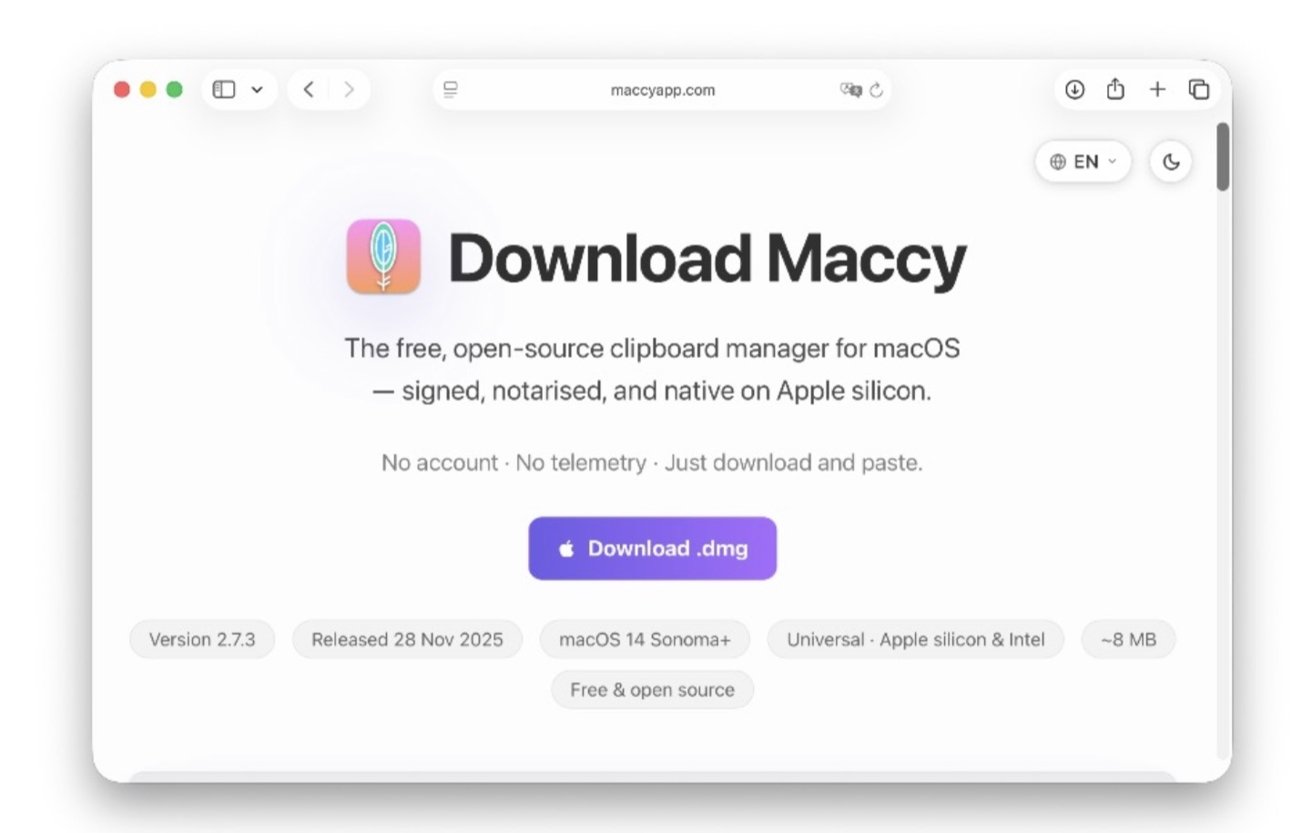
The campaign begins with a fake website that closely imitates the legitimate Maccy clipboard manager. Next, the fake website delivers a malicious AppleScript application disguised as Maccy.

Advertisement

Once a victim opens the download, the malicious application checks the system and retrieves a second-stage Rust payload. PamStealer then establishes persistence before collecting data.

Webpage showing Download Maccy button with text describing a free, open-source clipboard manager for macOS, plus small tags listing version, macOS compatibility, Apple silicon support, license, and file sizeThe campaign begins with a fake website that closely imitates the legitimate Maccy clipboard manager

Jamf also found that PamStealer checks system characteristics, keyboard layout and regional settings before running. System, keyboard and regional checks suggest the operators configured PamStealer to execute only on systems that match their intended targets.

Password verification improves the value of stolen credentials

PamStealer’s most notable feature is the way it captures login credentials. During execution, the malware displays what appears to be a legitimate macOS authorization prompt asking the user to enter a password so Maccy can make changes.

Instead of just recording whatever the victim types, PamStealer validates the password through Apple’s Pluggable Authentication Modules before continuing. Jamf said PamStealer doesn’t replace or bypass Apple’s authentication system.

Instead, the malware abuses a legitimate macOS framework to validate credentials after convincing the victim to enter a password. Attackers can then discard invalid credentials before moving forward with the attack.

Advertisement

Rust payload steals browser data and establishes persistence

After validating the password, the second-stage Rust payload collects a wide range of information from the infected Mac. Jamf said PamStealer targets browser cookies, browsing history, saved credentials, SQLite databases, clipboard contents and cryptocurrency wallet data.

PamStealer also encrypts stolen information before transmitting it to command-and-control infrastructure, making network traffic more difficult to inspect.

PamStealer creates login items through both modern and legacy macOS mechanisms so it relaunches automatically after a user signs in. The malware also impersonates Finder while attempting to convince victims to grant Full Disk Access.

Full Disk Access is a permission that would significantly expand the amount of information it can access without additional prompts.

Advertisement
Two dark-themed code editor windows on a desktop, each showing different JavaScript code snippets with syntax highlighting, toolbar buttons at the top, and a small description area at the bottomPamStealer’s most notable feature is the way it captures login credentials

Jamf said much of PamStealer’s second-stage malware is written in Rust instead of AppleScript. Using Rust makes reverse engineering more difficult because many strings and code paths are resolved only while the malware is running instead of appearing directly in the compiled binary.

Native macOS features help make the attack more effective

PamStealer shows how macOS malware increasingly abuses legitimate operating system features instead of relying solely on malicious code. Jamf said Apple’s authentication framework, Rust and encrypted communications work together to make the malware more difficult to analyze.

The researchers said the combination reflects the continued evolution of macOS-focused malware without relying on previously unknown vulnerabilities.

Jamf recommends downloading software only from trusted sources. The company also urges users to be skeptical of unexpected administrator password prompts and avoid unnecessary Full Disk Access requests.

Organizations using Jamf can configure Threat Prevention, Advanced Threat Controls and Web Protection to help block similar malware before it executes.

Advertisement

How to stay safe

PamStealer still depends on users downloading software from an untrusted source and approving multiple prompts before the malware can complete its attack. Users should download Mac apps only from trusted developers and verify website addresses before installing software.

Unexpected requests for an administrator password deserve extra scrutiny, especially when they appear during an app installation. Users should also review Full Disk Access requests carefully and grant the permission only to applications they trust.

Users should also review requests for Full Disk Access carefully and grant the permission only when it’s necessary for software they trust. Keeping macOS and security software up to date can also help detect or block known malware before it compromises a system.

Advertisement

Source link

Continue Reading

Tech

Z.ai launches ZCode to challenge Cursor, Claude Code and GitHub Copilot in AI coding

Published

on

Z.ai, the Beijing-based artificial intelligence lab formerly known as Zhipu AI, on Wednesday officially launched ZCode, a free desktop application it describes as an “Agentic Development Environment” purpose-built for its flagship GLM-5.2 large language model. The move marks the company’s most aggressive push yet into the fast-growing AI-powered coding tool market, where it now competes directly with Cursor, Claude Code, GitHub Copilot, and Google’s Antigravity.

“Introducing ZCode, the official development environment for GLM-5.2,” the company wrote on X, noting the tool is available on macOS, Windows, and Linux, supports bring-your-own-key (BYOK) configurations for third-party models, and offers a 1.5x usage-quota bonus for subscribers to its GLM Coding Plan.

Read one way, ZCode is simply another entrant in a crowded market. Read another, it is a single product that crystallizes three of the most consequential trends in enterprise software today: the race-to-the-bottom pricing of frontier AI models, the geopolitical balkanization of the AI stack, and the rapid maturation of agentic coding agents into what Gartner now estimates is a roughly $10 billion market.

An AI coding tool designed to think in projects, not prompts

Unlike traditional IDEs that bolt on AI through a chat sidebar or autocomplete extension, ZCode is best understood as an agent-first development environment. Its core design is built around long-horizon tasks: the user describes an outcome, the agent plans the work, edits files, runs checks, reviews progress, and continues across multiple iterations until the goal is met.

Advertisement

ZCode organizes the development experience around the ZCode Agent, deeply tuned for GLM-5.2, with emphasis on deep integration: the model, tools, and execution workflow are tuned together so the Agent fits continuous, multi-step real-world development tasks. The environment supports continuous follow-up across devices: desktop, mobile Remote, and Feishu / WeChat Bot can all keep the same workspace task moving. Sensitive commands, file changes, and high-permission actions go through confirmation before execution.

That remote-control feature — the ability to steer a running coding agent from WeChat, Feishu, or Telegram on a phone — is a differentiator that speaks directly to the Chinese developer market, where those messaging platforms dominate professional communication. You can keep checking progress and adding instructions while long-running work continues, from any device with these messaging apps.

The tool is free to download. Revenue flows through Z.ai’s GLM Coding Plan subscription tiers, which start at $16.20 per month for a “Lite” plan and scale to $144 per month for “Max” — prices that undercut Anthropic’s Claude Code and Cursor’s comparable tiers by significant margins.

Through July 31, ZCode is offering a promotional 1.5x effective quota bonus for Coding Plan subscribers, with off-peak token consumption charged at a 0.67x coefficient. The platform also supports multiple AI models and agents, including Claude Code, Codex, Gemini, and OpenCode — a pragmatic concession to the reality that no single model wins every task.

Advertisement

GLM-5.2, the open-source model trained entirely on Chinese chips, powers the whole experience

ZCode’s value proposition is inseparable from GLM-5.2, the model it was designed to showcase. Z.ai released GLM-5.2 on June 16, first to its Coding Plan subscribers and subsequently as open-source weights under the MIT license on Hugging Face — a sequencing decision that prioritized distribution over the traditional benchmark-led launch.

The model’s specifications are formidable. GLM-5.2 is a 744-billion-parameter mixture-of-experts architecture with 40 billion active parameters, a genuine one-million-token context window — five times the 200K limit on its predecessor — and training on 28.5 trillion tokens. It ranked second globally on Code Arena as of mid-June, trailing only Anthropic’s Claude Fable 5, making it one of the highest-performing publicly available models for coding tasks.

Critically, the model was built entirely without American chips. As Decrypt reported, GLM-5.2 “runs entirely on Huawei silicon.” Stability AI founder Emad Mostaque estimated total training costs at roughly $25 million, with 80 percent spent on post-training — a figure that, if accurate, would make GLM-5.2 extraordinarily cheap relative to Western frontier models.

On benchmarks, GLM-5.2 performs within striking distance of the best proprietary systems. It trails Anthropic’s Claude Opus 4.8 by just one percentage point on FrontierSWE, a benchmark measuring multi-hour autonomous engineering projects, while edging out OpenAI’s GPT-5.5.

Advertisement

Its API pricing — $1.40 per million input tokens and $4.40 per million output — are a cost reduction of up to 82 percent compared to Anthropic’s Claude Opus 4.8 at $5 and $25, respectively. Because ZCode is a first-party tool from the same company that makes the model, it requires no manual endpoint configuration — the model is wired in.

The Anthropic export ban gave Chinese AI its biggest opening yet

ZCode’s arrival cannot be separated from the geopolitical drama that has roiled the AI industry over the past three weeks. On June 12, the U.S. government, citing national security authorities, issued an export control directive suspending all access to Anthropic’s Fable 5 and Mythos 5 models by any foreign national, whether inside or outside the United States, including foreign national Anthropic employees. Enterprise clients in finance, healthcare, SaaS, and critical infrastructure found their core intelligence services abruptly disabled, without exception, prior warning, or effective recourse.

While the Trump administration lifted those controls just yesterday — Anthropic confirmed on June 30 that the Department of Commerce had rescinded the directive — the episode sent shockwaves through the developer community and accelerated interest in open-source, self-hostable alternatives. The government’s crackdown on Anthropic coincided with a swift rise in Chinese open-source models that are proving to be almost as capable and significantly cheaper than some of the most powerful U.S. models.

Z.ai’s timing was surgical. On the same day the Trump administration ordered Anthropic’s most advanced models blocked for foreign nationals, Zhipu announced the open-source release of GLM-5.2 with no usage restrictions. The South China Morning Post reported that GLM-5.2 would be available to all users of Zhipu’s new GLM Coding Plan subscription, “priced at just a tenth of Anthropic’s premium Claude Code and Claude Max tiers.”

Advertisement

The market responded accordingly. Zhipu AI’s market capitalization crossed HK$1 trillion (US$128 billion) on June 22, driven by a 42 percent intraday share surge. JPMorgan raised its 2026–2030 revenue forecast for Zhipu by between 7 and 16 percent following the launch, projecting an over 534 percent revenue surge for 2026 and expecting the AI firm to turn a profit by 2028.

Why vendor lock-in now carries a geopolitical risk that no SLA can cover

The Fable 5 episode did more than embarrass Anthropic. It introduced a new risk category into enterprise AI procurement: sovereign access risk. When a government can disable a commercially deployed AI model overnight, the traditional evaluation criteria of developer experience, benchmark scores, and pricing become secondary to a more fundamental question: Will this tool still work tomorrow?

The event exposed the inadequacy of standard enterprise contract language. An investigation by FifthRow found that almost all standard Data Processing Addenda, SaaS agreements, and procurement SLAs “relied on vague ‘force majeure’ or ‘compliance with law’ catch-alls, not on precise, actionable regulatory suspension or kill-switch clauses.”

ZCode’s BYOK architecture and GLM-5.2‘s MIT-licensed open weights offer a partial answer. A development team can download the model, host it on its own infrastructure, and run ZCode against it without ever touching Z.ai’s cloud — eliminating both American export-control risk and Chinese data-sovereignty concerns in a single move. The catch is that anyone using Z.ai’s cloud API remains subject to Chinese law, a consideration that evaporates only with pure self-hosting.

Advertisement

Gartner analysts have warned that governance, pricing, support, workflows, commercial maturity, and market durability matter as much as developer experience and model capabilities when evaluating coding agent vendors for enterprise-wide adoption. By that measure, ZCode faces a steep climb. It is not open source itself; Linux support remains in beta; and security reviewers have flagged the need for careful evaluation of its credential handling, particularly for remote development over SSH and messaging-platform-triggered tasks — an agent that can be summoned from WeChat involves access paths that should be mapped before trusting it with anything sensitive.

Inside the $10 billion race where model labs are becoming full-stack IDE companies

ZCode enters one of the most crowded and fastest-moving markets in enterprise software. Enterprise AI coding agents are capturing a growing share of enterprise software engineering spend, with the market estimated at roughly $9.8 billion to $11.0 billion annualized as of April 2026, according to Gartner. A defining shift this year, the analyst firm noted, is “the movement of frontier model providers into direct competition with application-layer vendors” — precisely the pattern ZCode embodies.

Gartner codified this evolution in May when it renamed its annual Magic Quadrant from “AI Code Assistants” to “Enterprise AI Coding Agents,” defining the category as “autonomous or semiautonomous software engineering solutions that perceive context, translate human intent into multistep plans, and execute and verify those steps across code, tests and related engineering artifacts.” The 2026 Magic Quadrant names Anthropic, Cursor, GitHub, and OpenAI as Leaders. Z.ai was not among the 12 vendors evaluated — an absence that underscores both the company’s nascent enterprise sales presence outside China and the Western-centric lens through which the analyst community still views the market.

The competitive landscape is daunting. Cursor is the $2 billion ARR IDE that feels like VS Code with a supercharger. Claude Code reached approximately $2.5 billion in annualized revenue by early 2026. Google relaunched Antigravity 2.0 at I/O in May, and Cognition retired the Windsurf brand, relaunching the IDE as Devin Desktop with the Agent Command Center as the default surface.

Advertisement

Against these entrenched players, ZCode’s pitch rests on three pillars: deep first-party integration with GLM-5.2 that no third-party editor can replicate, aggressive pricing that starts at a fraction of Western competitors, and MIT-licensed open weights that allow enterprises to self-host — eliminating the regulatory kill-switch risk that the Fable ban made viscerally real.

Z.ai’s real challenge is turning a $128 billion valuation into a global developer tools business

Z.ai controls the model (GLM-5.2), the subscription layer (the GLM Coding Plan), and the IDE (ZCode) — a tightly coupled stack that optimizes for performance but concentrates switching costs. For the company, the business logic is clear. Its most reliable revenue stream has been on-premises deployments for Chinese government agencies, state-owned banks, and energy conglomerates. In full-year 2025, on-premises deployment revenue reached RMB 534 million, growing over 100 percent year-over-year and accounting for 73.7 percent of total revenue with a gross margin of 48.8 percent. ZCode and the GLM Coding Plan represent the company’s bid to build a comparable revenue engine in cloud-based developer tools — globally, not just in China.

The early signals are encouraging for Z.ai, if anecdotal. Community reception on X was enthusiastic, with one early user calling the tool “super stable” and others clamoring for more Coding Plan capacity. “Bro, can’t snag your family’s Coding Plan? When are you gonna stock up on more cards?” one user wrote in Chinese, suggesting demand is already outstripping supply.

But the hard questions loom large. Can a Chinese AI company build trust with Western enterprise buyers amid escalating technology tensions? Can ZCode’s ecosystem mature fast enough to compete with Cursor’s polished UX, Claude Code’s deep agent primitives, and GitHub Copilot’s unmatched distribution? And can Z.ai sustain a company valued at $128 billion while still losing money? 

Advertisement

What is no longer in question is the competitive dynamic itself. Three weeks ago, a U.S. government directive proved that access to the world’s best coding model can vanish overnight. Today, a Chinese lab is shipping a free IDE, an open-source model trained on zero American chips, and a subscription plan that costs less per month than a single lunch in Manhattan. The AI coding agent market did not just become global this summer. It became a market where the fallback option might be better than the thing it’s falling back from — and that changes the calculus for every engineering leader choosing a toolchain in the second half of 2026.

Source link

Continue Reading

Tech

India tells WhatsApp to pause its usernames feature pending consultations

Published

on

India’s Ministry of Electronics and Information Technology has ordered WhatsApp not to launch its planned usernames feature in the country until further consultations are complete, according to a letter seen by Reuters.

The ministry, known as MeitY, has given Meta three days to explain why regulatory action should not follow the feature’s announcement.

WhatsApp said on 29 June that users would soon be able to reserve a unique username, letting people start conversations without sharing a phone number. Within 48 hours, MeitY had sent a formal notice telling the company to pause the rollout “until the consultation on this point is achieved to the satisfaction of the Government.”

The ministry’s stated worry is fraud. Its notice warns that usernames “may facilitate impersonation and identity spoofing, including impersonation of individuals, public authorities, financial institutions, and government agencies,” by letting people adopt handles that closely resemble those of real institutions.

Advertisement

That concern sits inside a wider run of digital arrest scams and phishing schemes that Indian regulators have spent much of the past two years trying to contain.

A Meta spokesperson said the feature is not yet live in India and that the company has already reserved usernames resembling those of public figures, government entities and verified Meta accounts specifically to head off impersonation.

Whether that safeguard will satisfy MeitY’s objections remains unclear, and the ministry’s letter gives no indication that a reserved-name list alone would be enough to lift the hold. This is not India’s first fight over anonymity features baked into a messaging app.

Telegram challenged a temporary, nationwide block in the Delhi High Court earlier in June, after the government said channels on the app had been used to sell leaked papers for the NEET medical entrance exam, and lost.

During that case, officials specifically flagged how username-based contact and concealed phone numbers made it harder for law enforcement to trace who was actually behind an account.

Advertisement

That argument maps closely onto the objections now raised against WhatsApp. WhatsApp, though, occupies a different place in India’s digital economy than Telegram ever did.

It is one of Meta’s most important markets globally, and the company has spent years trying to turn the app into a commerce platform rather than just a messaging tool, most recently by taking a stake in the fintech firm Cred and installing its founder as WhatsApp’s new head. A prolonged regulatory standoff over usernames would land at an inconvenient moment for that broader ambition.

Not everyone accepts that MeitY has the legal footing to issue this kind of order in the first place. The Internet Freedom Foundation has argued that the ministry is leaning on Section 79 of the Information Technology Act, a safe harbour provision that governs platform liability, to do something closer to product-design oversight, which the group says no statute actually grants it.

The foundation’s position is that fraud and impersonation should be prosecuted under existing criminal law rather than pre-empted by holding back a product feature.

Advertisement

It has raised similar objections before about the ministry’s use of traceability rules to shape how messaging apps are built rather than how they are policed.

The dispute also lands against a backdrop of repeated friction between Indian regulators and WhatsApp over how much visibility the government should have into the app’s design choices.

Officials have previously pushed the company toward making messages traceable to combat misinformation, proposals WhatsApp has resisted on the grounds that they would undermine end-to-end encryption for its entire user base, not just the accounts under suspicion.

As of the letter’s disclosure, WhatsApp’s usernames remain unavailable to users in India, and the three-day clock the ministry set on its notice gives the clearest near-term marker for what happens next.

Advertisement

Source link

Continue Reading

Tech

2026 iPhone Photography Awards show old models still cut it

Published

on

The winners of the 2026 iPhone Photography Awards have been announced, with many of them taken using older iPhones, including an iPhone 8 Plus.

The 2026 IPPA winners were announced after entries from more than 140 countries were submitted. Four overall winners were announced, ranging from Grand Prix to Bronze.

Category winners, runners-up, and honorable mentions were also shared, giving us a wider look at the quality of images that were submitted this year.

Life in the old dog (and cat) yet

The overall winner was Robyn Jenson, who used an iPhone 15 Pro to capture a stunning shot of an erupting volcano. Gold went to Gellert Gombai, whose grayscale shot of two children was taken on an aging iPhone X.

Advertisement
Sidebyside scenes: a dark volcano erupting glowing red lava at night on the left, and a black cat with bright eyes sitting on a doorway threshold on the right

Some winners were more colorful than others – image credit iPhone Photography Awards

Arnold Plotnick captured a cat on an iPhone 16 Pro for silver, while Catherine Wang used an iPhone 16 Pro Max to capture a shot of colorful melons and a bird.

Gombai’s iPhone X wasn’t the only older iPhone to steal the show, either. Barry Mayes used an iPhone 8 Plus to win the “Abstract” category. That phone was released alongside the iPhone X in 2017.

Moving through the list of runners-up and honorable mentions included an even older iPhone. Diego Schutt used an iPhone 7 Plus, while an iPhone 6s and iPhone 6 Plus also made an appearance elsewhere.

Advertisement

While the majority of the category-winners used more modern phones, it’s impressive that older models are still producing such stunning photos. It may also highlight just how small recent iPhone camera upgrades have been.

Source link

Advertisement
Continue Reading

Trending

Copyright © 2025