




Greater Manchester’s economic boom has not increased household incomes across outer boroughs, with earnings remaining stagnant despite regional growth, according to new Oxford Economics research

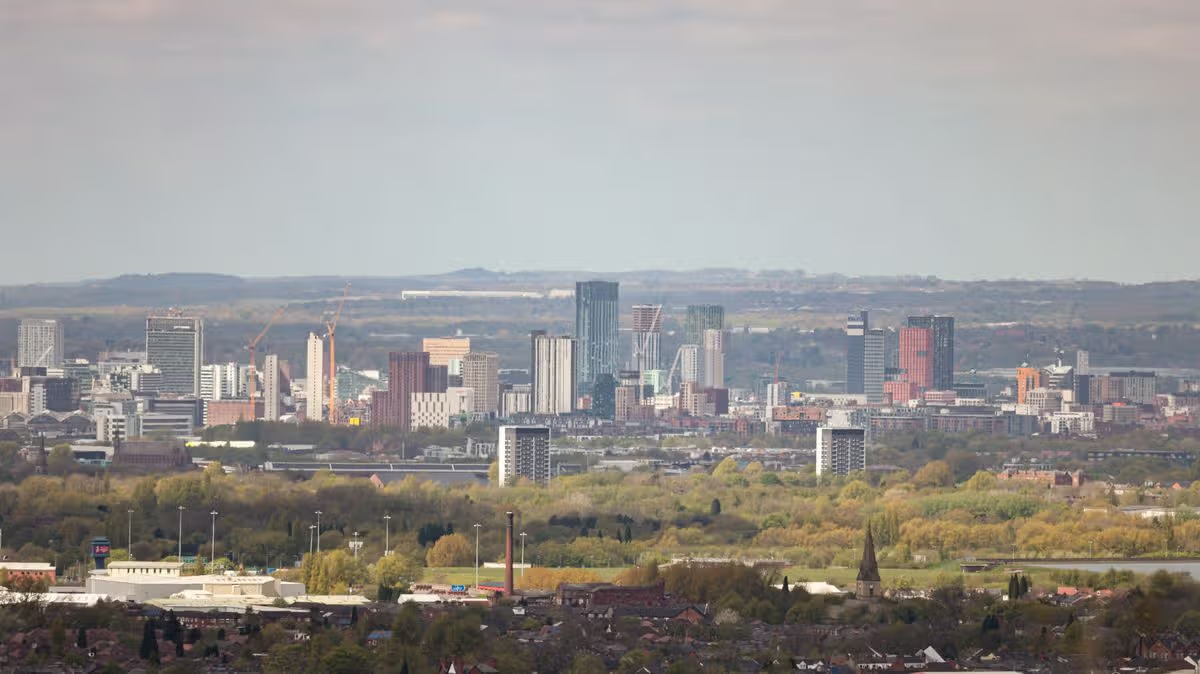
The Manchester skyline viewed from Werneth Low Country Park(Image: Manchester Evening News)
Greater Manchester’s relative economic success has failed to translate into improved wages or earnings for residents in its outer boroughs, according to a new report.
Research by Oxford Economics has indicated that “exceptional economic growth” has not resulted in higher earnings or income growth across the wider region.
Economists noted that elevated levels of economic inactivity and stagnant productivity gains in areas beyond Manchester city centre have constrained household finances.
The report scrutinises the broader narrative unfolding ahead of Andy Burnham’s anticipated move into Number 10, with the former Greater Manchester mayor having claimed credit for the growth achievements recorded in recent years.
He has also leveraged strong growth figures to bolster his calls for greater devolution, while pledging “good growth in every postcode”, as reported by City AM.
Although average disposable income growth in the city has outstripped the national average by approximately 0.6 percentage points between 2008 and 2025, growth in Greater Manchester boroughs Salford and Bolton has trailed 0.7 percentage points behind the country’s benchmark rates.
Bury, Oldham and Wigan have similarly struggled to match the growth witnessed in areas such as Manchester, Trafford and Tameside.
Economists highlighted that these areas have been disproportionately impacted by a significant surge in economic inactivity among working-age residents, with long-term sickness rising by nearly 25 per cent across the entire city region.
The report also indicated that poor transport links and a “relatively small” labour market have prevented Manchester’s growth from filtering through to surrounding areas across the region.
The report noted that sluggish income growth beyond the city centre suggests urban areas “remain too weak, too small, and too poorly connected to spread. growth across the entire region”.
Economists at Oxford Economics also raised questions over the city’s productivity growth, which “has been weak by historical standards”.
While the city benefited from an average annual productivity growth of 2.1 per cent between 1991 and 2007, that figure has since fallen to an average of 1.2 per cent per year following the financial crisis — though this still outpaced levels recorded across the UK and in London.
A separate paper by the consultancy also cast doubt on the data underpinning Manchester’s growth figures, given that the Office for National Statistics has encountered difficulties in publishing reliable labour market statistics.
In contrast, the Centre for Cities, a think tank favoured by Burnham, argued that Manchester’s city centre has strengthened thanks to a sharper focus on buses through the privately operated Bee Network bus and tram services.
It described the new transport frameworks as a “devolution success story”. The report also noted that wages across the city exceeded the national average, though unemployment levels between 2024 and 2025 were equally higher than the UK’s overall rate.






















































You must be logged in to post a comment Login