
Business
Ford eyes level playing field with Toyota, GM imports under new USMCA

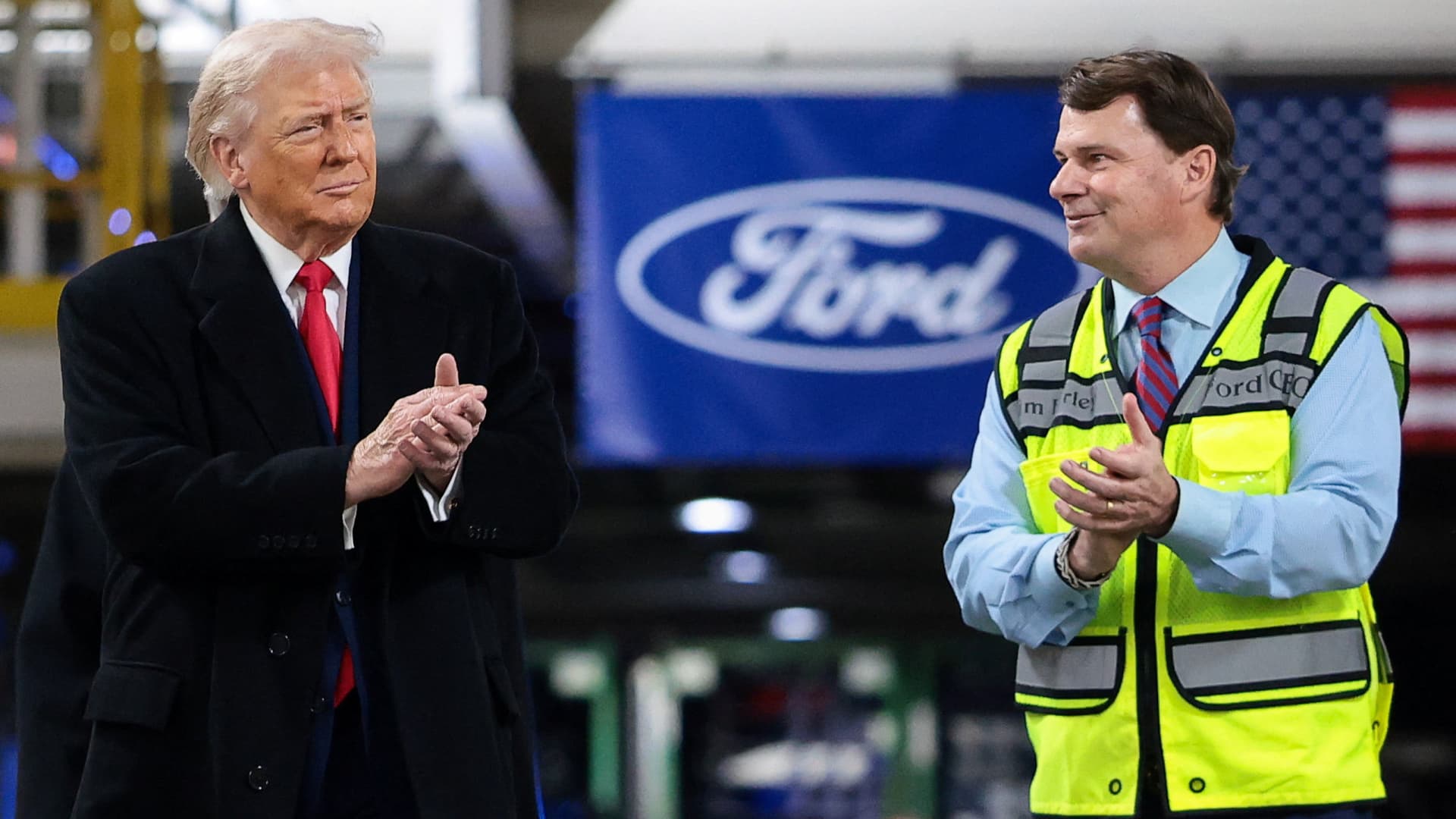
U.S. President Donald Trump and CEO of Ford Jim Farley clap, as President Trump visits a Ford production center, in Dearborn, Michigan, U.S., January 13, 2026.
Evelyn Hockstein | Reuters
DETROIT — As negotiations officially reopen for the USMCA North American trade deal, Ford Motor CEO Jim Farley is clear about what the automaker wants under the new talks: a more level playing field.
He told CNBC he wants automakers such as Ford that largely produce their vehicles domestically to be awarded under the deal. Along with that, Farley said other automakers — such as General Motors and Toyota Motor — that may produce here but also heavily rely on imported vehicles should get more penalties.
“It’s imperative that any new agreement makes it easier, not harder, to compete with U.S. makers who import from Japan, South Korea and global competitors that import from those locations,” Farley told CNBC during a phone interview Wednesday. “That’s the key for us.”
Producing in such countries is typically less expensive due to labor costs.
GM and Toyota are No. 1 and No. 2 in U.S. sales, respectively, while also being the top two importers of vehicles in 2025.
GM imported 1.17 million vehicles, or 41% of its U.S. sales, while Toyota imported more than 1.19 million units, or 47%, of its domestic sales, according to industry data.
Hyundai Motor, which plans to roughly double its amount of U.S.-produced domestic sales to 80% by 2030, was the largest importer of vehicles from South Korea, followed by GM.
Ford, meanwhile, reports it assembled more than 2 million vehicles in the U.S. last year — more than any other auto manufacturer, including 311,000 units for export to more than 60 international markets. It imported 378,000 vehicles, or 17%, of its 2.2 million sales last year.
“Ford’s a leader of U.S. auto production with the most U.S.-built vehicles but, more importantly, we import very few, and we export the most, and we have the most UAW [union] workers here,” Farley said. “So we’re very proud, especially of the ratio between what we build here and what we import.”
Farley’s comments come as the Trump administration has decided not to renew its trilateral trade pact with Canada and Mexico, instead opting to conduct annual reviews of the treaty that could eventually lead to an end to the agreement by 2036.
The auto industry represented about 18% of America’s trading with its neighboring countries last year, according to industry data, making it one of the key sectors in the discussions. Automakers and others watching the talks are concerned that reopening the deal could create additional trade uncertainty that leads to lower investments and fewer jobs.
A consortium of U.S. trade groups representing most automakers, dealers and suppliers on Wednesday voiced support for a trilateral deal like the countries currently have.
“We urge the leaders of the U.S., Canada, and Mexico to swiftly reach consensus on an extension of USMCA that preserves the existing trilateral partnership, returns to preferential treatment for qualifying goods, and continues the stability and predictability that has helped the industry thrive for the past six years,” they said in a statement.


Hungarian companies pivot after Orban’s allies lose political influence

Seven mutual fund NFOs from Kotak, Motilal Oswal, AlphaGrep, JioBlackRock, Edelweiss and Franklin India will open for subscription this week. The offers span index funds, ETFs, a fund of funds and a short-duration debt scheme, with minimum investments ranging from Rs 10 to Rs 5,000.
Business
Mcap of nine of top-10 most valued firms jumps Rs 2.51 lakh cr; Bajaj Finance biggest winner

Last week, the BSE benchmark Sensex climbed 2,034.87 points, or 2.67 per cent, and the NSE Nifty surged 616.15 points, or 2.59 per cent.
“Markets staged a strong rebound during the week, snapping their recent losing streak as easing crude oil prices, improving geopolitical sentiment, encouraging Q1 FY27 earnings, and renewed foreign institutional investor (FII) buying lifted risk appetite,” Ajit Mishra – SVP, Research, Religare Broking Ltd, said.
While Reliance Industries, Bharti Airtel, HDFC Bank, ICICI Bank, State Bank of India, Tata Consultancy Services (TCS), Bajaj Finance, Larsen & Toubro, and Life Insurance Corporation of India (LIC) were the gainers from the top-10 pack, Hindustan Unilever emerged as the only laggard.
The market valuation of Bajaj Finance surged Rs 80,345.97 crore to Rs 7,10,817.51 crore, the most among the top-10 firms. Shares of NBFC Bajaj Finance on Friday ended over 8 per cent higher after the firm reported a 28 per cent year-on-year rise in consolidated profit after tax (PAT) for the June quarter of FY27.

Bharti Airtel’s valuation soared Rs 44,959.5 crore to reach Rs 12,30,005.63 crore.
The market valuation of TCS jumped Rs 40,414.03 crore to Rs 8,55,894.78 crore and that of Reliance Industries climbed Rs 39,447.35 crore to Rs 17,69,108.79 crore.The market capitalisation (mcap) of Larsen & Toubro rallied Rs 21,096.8 crore to Rs 5,41,844.69 crore and that of State Bank of India edged higher by Rs 10,845.97 crore to Rs 9,47,799.81 crore.
HDFC Bank’s mcap advanced Rs 8,164.73 crore to Rs 11,52,150.63 crore.
The valuation of LIC went up Rs 4,427.49 crore to Rs 5,37,435.05 crore and that of ICICI Bank climbed Rs 1,660.37 crore to Rs 10,29,878.30 crore.
However, the mcap of Hindustan Unilever declined Rs 10,326.46 crore to Rs 4,93,602.13 crore.
Reliance Industries remained the most valued firm, followed by Bharti Airtel, HDFC Bank, ICICI Bank, State Bank of India, TCS, Bajaj Finance, Larsen & Toubro, LIC, and Hindustan Unilever.

The latest inflow marks a sharp reversal from the preceding months, when Foreign Portfolio Investors (FPIs) withdrew Rs 49,340 crore in June, Rs 32,963 crore in May, Rs 60,847 crore in April and a massive Rs 1.17 lakh crore in March, according to data from the Central Depository Services (India) Ltd (CDSL).
Prior to the four-month selling spree, FPIs had invested Rs 22,615 crore in Indian equities in February.
Despite the turnaround in July, foreign investors have pulled out a net Rs 2.54 lakh crore from Indian equities so far in 2026, way more than the Rs 1.66 lakh crore withdrawn during the whole of 2025.
Market experts attributed the renewed foreign investor interest to relatively stable domestic markets, reasonable large-cap valuations, improving earnings prospects and a more favourable global environment.
V K Vijayakumar, Chief Investment Strategist at Geojit Investments, said excessive volatility in markets such as South Korea and Taiwan, coupled with concentration risk in the “chip trade”, is prompting FPIs to look for relatively stable markets like India.
The stability of the rupee and fair valuations of India’s large-cap stocks are other factors facilitating renewed FPI inflows into the country, he added.Vedant Gupte, Co-Founder and CEO of investment platform Trackk, said improving earnings prospects also strengthened investor sentiment, with June quarter results showing signs of recovery across key sectors.
IT stocks, in particular, witnessed a sharp re-rating as better-than-expected earnings helped ease concerns over the impact of artificial intelligence on the sector’s growth prospects, he said.
At the same time, easing pressure from the US dollar and expectations that US interest rates are near their peak have improved the investment environment for emerging markets, Gupte added.
Foreign investor interest was not limited to equities, with the debt market continuing to attract significant inflows during the month.
FPIs invested Rs 29,212 crore in debt through the general route and another Rs 3,033 crore through the fully accessible route in July.
Going forward, the trajectory of foreign flows is likely to be influenced by both global developments and domestic triggers.
Pabitro Mukherjee, Deputy Vice President-Research at Bajaj Broking, said investors in the coming month will closely track crude oil price movements and developments in the ongoing US-Iran geopolitical tensions.
On the domestic front, the Q1FY27 earnings season and the RBI’s monetary policy scheduled for August 5 will remain in focus, he added.
Life after Orban: Hungary Inc digs in as new political era takes hold
PepsiCo CEO Ramon Laguarta discusses how the food and beverage giant is seeing massive paybacks after slashing consumer prices on ‘The Claman Countdown.’
Nearly 23,000 pounds of Ukrop’s Homestyle Foods baked spaghetti and chicken cobbler products are being recalled over concerns they may be contaminated with metal slivers, federal regulators said.
The U.S. Department of Agriculture’s Food Safety and Inspection Service (FSIS) said the recalled products were sold in Virginia, North Carolina and West Virginia, as well as through Department of War commissaries and online sales.
According to FSIS, the products may be contaminated with a foreign material, specifically metal slivers.
The recall was initiated after a customer found a piece of metal in one of the products.
FROZEN BURRITOS SOLD AT COSTCO PROMPT PUBLIC HEALTH ALERT OVER UNDECLARED ALLERGEN
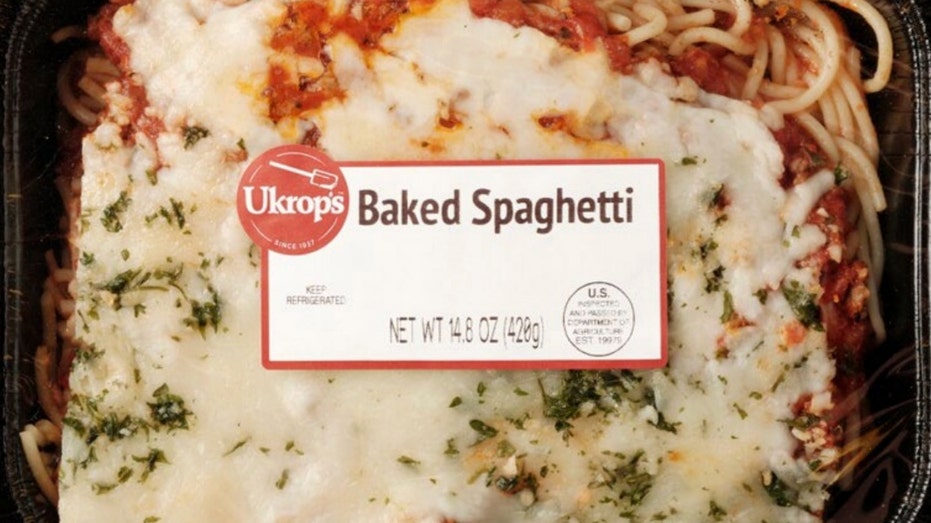
Ukrop’s Baked Spaghetti products are being recalled after federal regulators said they may be contaminated with metal slivers. (U.S. Department of Agriculture / Unknown)
“The problem was discovered after the establishment received a consumer complaint regarding a metal piece found in a fully cooked product,” FSIS said in its recall announcement.
No injuries have been confirmed, according to FSIS.
“Anyone concerned about an injury should contact a healthcare provider,” the agency said.
PUBLIX EXPANDS FROZEN BERRY RECALL AMID E COLI OUTBREAK THAT SICKENED 12
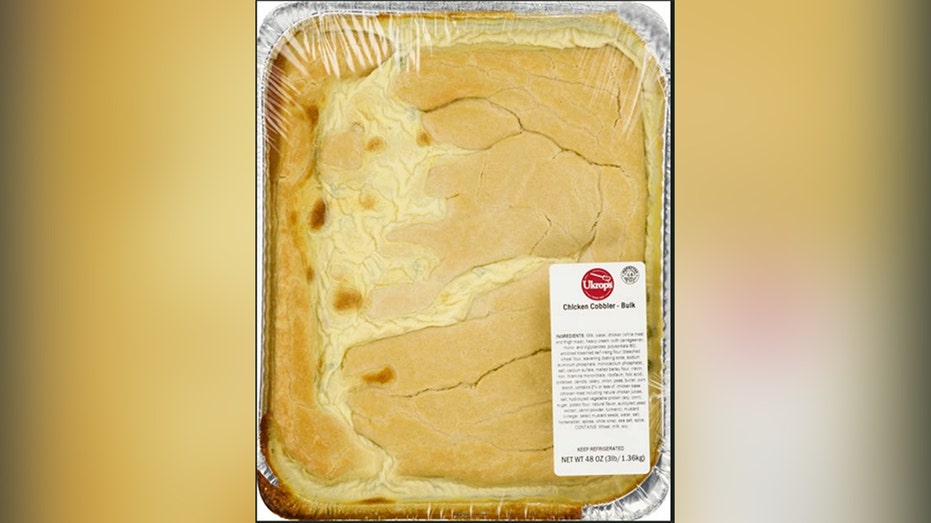
Ukrop’s Chicken Cobbler products are included in a recall over concerns they may contain metal slivers, according to federal regulators. (U.S. Department of Agriculture / Unknown)
The recall affects products manufactured between July 1 and July 29, 2026.
The recalled products include 62.4-ounce bulk pans and 4.8-ounce single-serving trays of Ukrop’s Baked Spaghetti, along with 48-ounce family-size pans and 11.6-ounce single-serving trays of Ukrop’s Chicken Cobbler.
All affected products carry “best by” dates ranging from July 8 through Aug. 5.
Consumers who purchased the recalled products, including those stored in freezers, should throw them away or return them to the place of purchase for a full refund.
CLICK HERE TO DOWNLOAD THE FOX NEWS APP
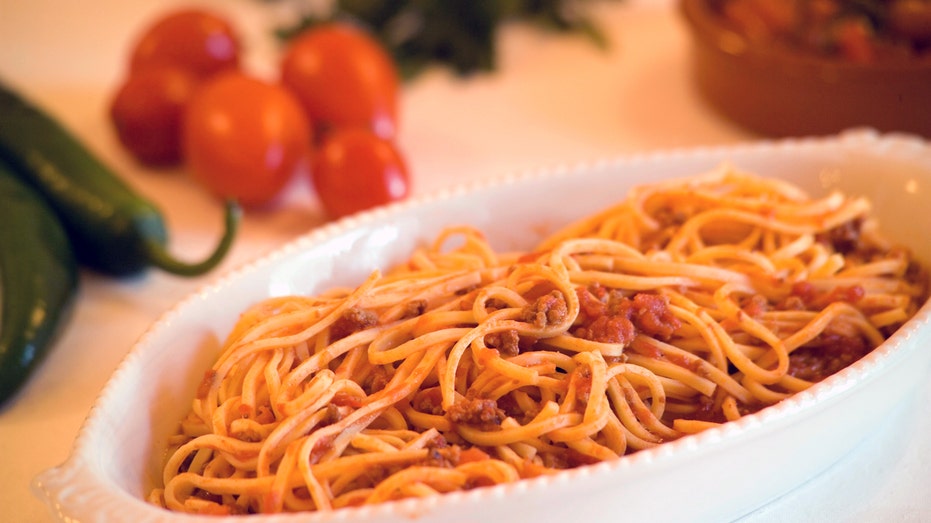
Federal regulators announced a recall of nearly 23,000 pounds of Ukrop’s baked spaghetti and chicken cobbler products over concerns they may contain metal slivers. (Alfio Giannotti/REDA/Universal Images Group via Getty Images / Getty Images)
The recall comes after Rich Products Corp. recalled thousands of cases of its Farm Rich Pizza Cheese Crunchers in June because the frozen snacks may have contained metal pieces.
More than 160,000 pounds of the frozen snacks were recalled across 21 states, according to the U.S. Food and Drug Administration.
FOX Business’ Brie Stimson contributed to this report.
A Credibility Gap at the Fed: Why Bond Yields Are Surging

AI creates two-speed UK jobs market as demand shifts to senior tech roles

UBS explains what it would take for gold prices to turn higher in 2H26
To the Editor:
The reshoring of supply chains and enhancement in domestic manufacturing will also be needed to support ongoing growth in the automotive, defense, and semiconductor industries (“Beyond AI: 10 Ways to Cash In on the Global Building Boom,” Cover Story, July 23). Large foreign corporations like Taiwan Semiconductor Manufacturing and Samsung Electronics are focusing on expanding their onshore semiconductor footprint in the U.S. to avoid 100% tariffs on imported semiconductors and complying with changing global trade regulations.
Hungarian companies pivot after Orban’s allies lose political influence

12 Years Later, Arnold Schwarzenegger’s Agatha Christie Crime Thriller Is Free to Stream

Dallas’ Jonathan Sirois (9 saves) comes up big in draw vs. Galaxy


-
 Sports6 days ago
Commonwealth Games boxing: Jadumani Singh seals dominant 5-0 win over Pakistan’s Sumama Rehman to enter quarter-finals | Commonwealth Games News
-

 Business3 days ago
Why Trees Belong on the Risk Register
-

 Fashion2 days ago
Weekend Open Thread: Wit & Wisdom
-

 Tech6 days ago
Intel is reversing course and bringing hyper-threading back to its server chips
-

 Politics1 day ago
Meta enters AI-training agreement with far-right ‘propaganda rag’ Newsmax
-

 Politics6 days ago
Luke Littler dismantles Gerwyn Price to retain title in Blackpool
-

 Crypto World16 hours ago
MicroStrategy Post-Earnings CLARITY Act Push Could Add New Catalyst for Its Stock
-

 Politics5 days ago
The Part of the Electric Transition Nobody Wants to Discuss
-
 Entertainment4 days ago
‘Stargate’ Creator’s New Sci-Fi Series Returns for Season 3 Tomorrow
-

 News Videos6 days ago
BITCOIN JUST ENTERED THIS CRITICAL ZONE…
-

 Business4 days ago
Major shareholder moves on Canyon
-

 Crypto World7 days ago
XRP Ledger adds $2.6B as RWA inflows rank second
-

 Politics7 days ago
Spain sweeps the board at 2026 World Cup with individual awards
-

 News Videos3 days ago
Bitcoin Enters the 3rd Stage of the Bear Market
-
Crypto World1 day ago
XRP Ledger v3.3.0 brings five institutional features
-

 Crypto World4 days ago
Kraken Enables Retail Access to Jersey Mike’s IPO via Tokenized Shares
-

 Tech5 days ago
New macOS Sequoia & Sonoma security updates for older Macs
-

 News Videos4 days ago
Claude: Build Financial Dashboards in Minutes (2026)
-

 Politics3 days ago
Luke Littler’s dominance sparks GOAT debate
-

 Sports2 days ago
Seema Kaliramna Wins Discus Throw Bronze, Takes India’s CWG Medals Tally To 17
You must be logged in to post a comment Login