

Crypto World
ENS DAO Sunsets Public Goods Working Group After 4.5 Years of Ecosystem Grants



The ENS DAO Public Goods Working Group has been sunset after four and a half years of funding Ethereum infrastructure, working group lead Simona Pop said on X Thursday morning. The group's final term committed $450,000 in USDC and 72.5 ETH, worth roughly $123,000 at current prices, across Builder… Read the full story at The Defiant

The cryptocurrency market has staged an evident rebound over the past 24 hours, with Bitcoin (BTC) rising by 4% and Solana (SOL) surging by 9%.
MemeCore (M), though, has outperformed all top 100 digital assets by skyrocketing 80% in a single day. Following the rally, it has become the third-biggest meme coin and could soon overtake Shiba Inu (SHIB) if it maintains momentum.
Is the Rally Sustainable?
The meme coin is currently worth around $1.50 and has a market capitalization of just under $2 billion, making it the 40th-largest cryptocurrency (according to CoinGecko). It is important to note that the major revival comes just days after M crashed by 76% following allegations of manipulation.
Just hours ago, the team behind the meme coin addressed the issue and informed that following “a comprehensive internal and on-chain review,” it has not found anything suspicious related to the matter.
“Our review confirms:
– No issues affecting the protocol or infrastructure.
– All core systems continue to operate normally.
– No token sales were conducted by the MemeCore Foundation.
– No unusual activity has been identified regarding the Foundation’s treasury or project operations,” the announcement reads.
Perhaps this has become the primary catalyst driving M’s price higher today (July 2). Despite the evident jump, many analysts remain skeptical of the token, warning investors to be extremely cautious.
X user Suf claimed that the price climbed “not because of bullish buyers, but from the traders who shorted, being forced to buy.” For his part, CryptoBuffett said he will short M “to infinity.”
“I will DCA all the way up to $3 and beyond. My whole reputation and net worth will go into shorting this manipulative team and coin to ZERO. It’s worth ZERO; they want to rug you twice. If you’re buying, you will be REKT,” he added.
Additional Red Signals
MemeCore’s Relative Strength Index (RSI) also suggests the price might head south soon. The ratio has risen to 82, representing an extreme overbought condition, which is often a precursor of an impending pullback.

The token has been labeled a scam by numerous well-known analysts in recent months. In April, lockchain investigator ZachXBT openly questioned MemeCore’s valuation and token distribution, claiming that insiders control more than 90% of its supply.
The post Viral Meme Coin Challenges Shiba Inu (SHIB) After Exploding 80% Daily: Details appeared first on CryptoPotato.
Crypto World
eToro Takes Strategic Stake in Onchain Derivatives Exchange Extended, Plans Zengo Tie-Up
EToro has become a strategic investor in Extended, an onchain perpetual futures exchange, and said the funding round marks the start of a partnership between Extended and Zengo, the self-custody wallet eToro acquired earlier this year, according to a post from Extended. Extended said on X that… Read the full story at The Defiant
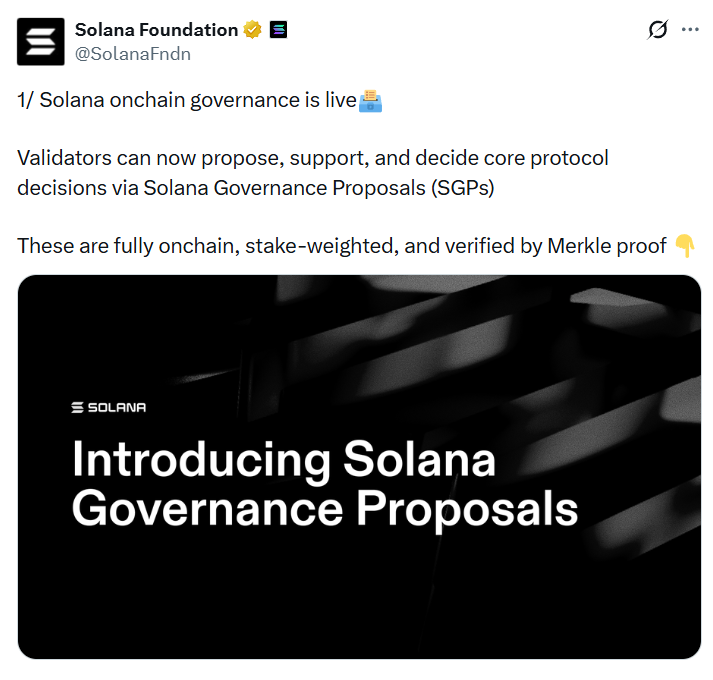
The Solana Foundation, the Swiss organization that supports the Solana network’s development, launched a new framework for protocol-level governance that enables proposing and voting on governance decisions for the Solana blockchain.
The Solana Governance Proposals (SGPs) establish a standard that enables validators to submit core protocol proposals and vote onchain, with voting power based on their delegated Solana (SOL) stake, the Foundation announced in a Thursday X post.
“An SGP captures a stake-weighted directional decision. It records what the community wants. It is not strictly focused on the technical detail of how to build the feature,” according to the GitHub repository, launched on Thursday.
The new framework offers Solana a transparent, community-driven way to make major protocol decisions, reducing reliance on centralized coordination while keeping technical implementations, or Solana Improvement Documents (SIMDs), separate from community governance.
Other blockchain networks with similar stake-weighted governance mechanisms include Polkadot, Cosmos, Cardano, Tezos and Avalanche.
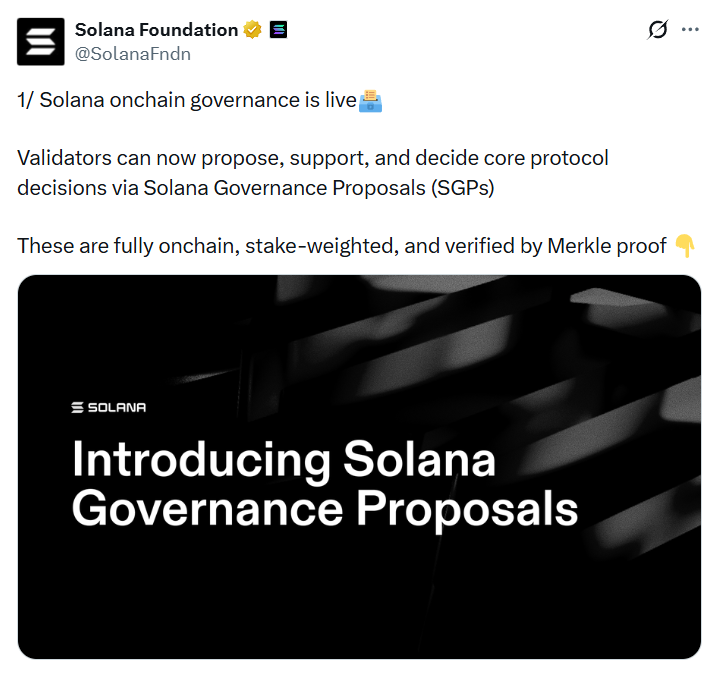
Source: Solana Foundation on X.com
Proposals require minimum 15% support
A proposal must receive endorsements from validators representing at least 15% of actively staked Solana tokens to qualify for a formal onchain vote, a measure that seeks to filter out low-quality proposals.
Validators with at least 100,000 SOL delegated can open a new governance proposal via SGP. SOL stakers can delegate their stake to validators, allowing them to participate in the governance process on their behalf.
Delegators who disagree with how their validator has voted can now override the validator and submit their own vote on the proposal, hence overriding the validator’s vote for that proposal.
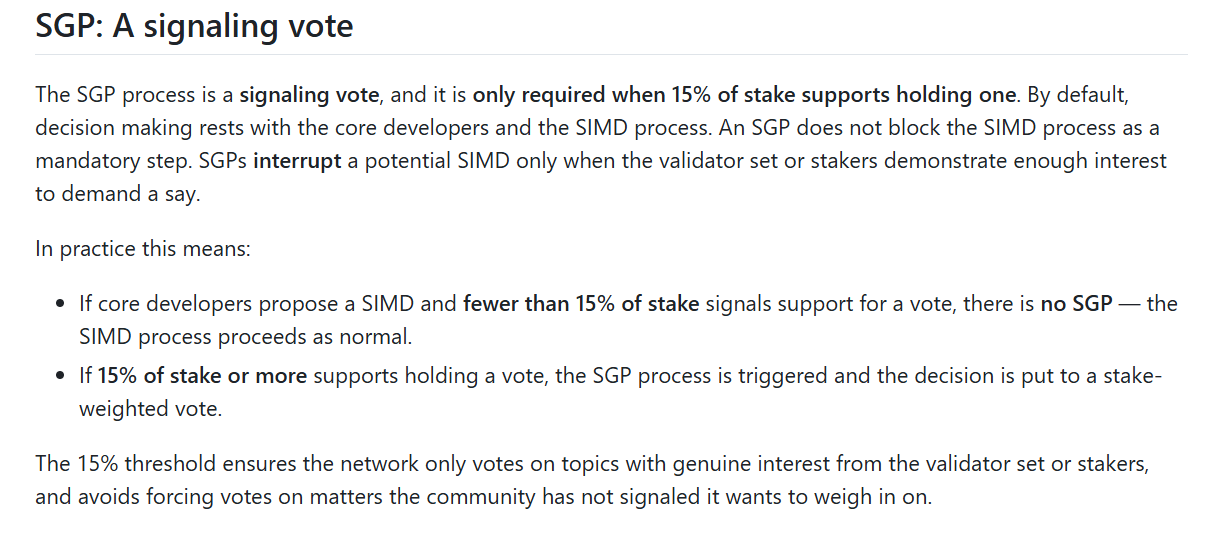
SGP voting information, minimum threshold. Source: GitHub
The Solana Foundation said that governance-level proposals will be SGPs, while smaller SIMD proposals will focus on technical protocol upgrades.
“SIMDs should focus on protocol changes, SGPs should be signals from the ecosystem,” wrote the Foundation.
Related: South Korea’s Shinhan Card taps Solana to test real-world stablecoin payments
In April, the Solana Foundation introduced a new security auditing framework and incident-response network for Solana-based protocols, in partnership with Web3 security firm Asymmetric Research.
The new initiative, the Solana Trust, Resilience and Infrastructure for DeFi Enterprises (STRIDE), is a “structured program for evaluating, monitoring and escalating security across Solana projects,” according to the April announcement.
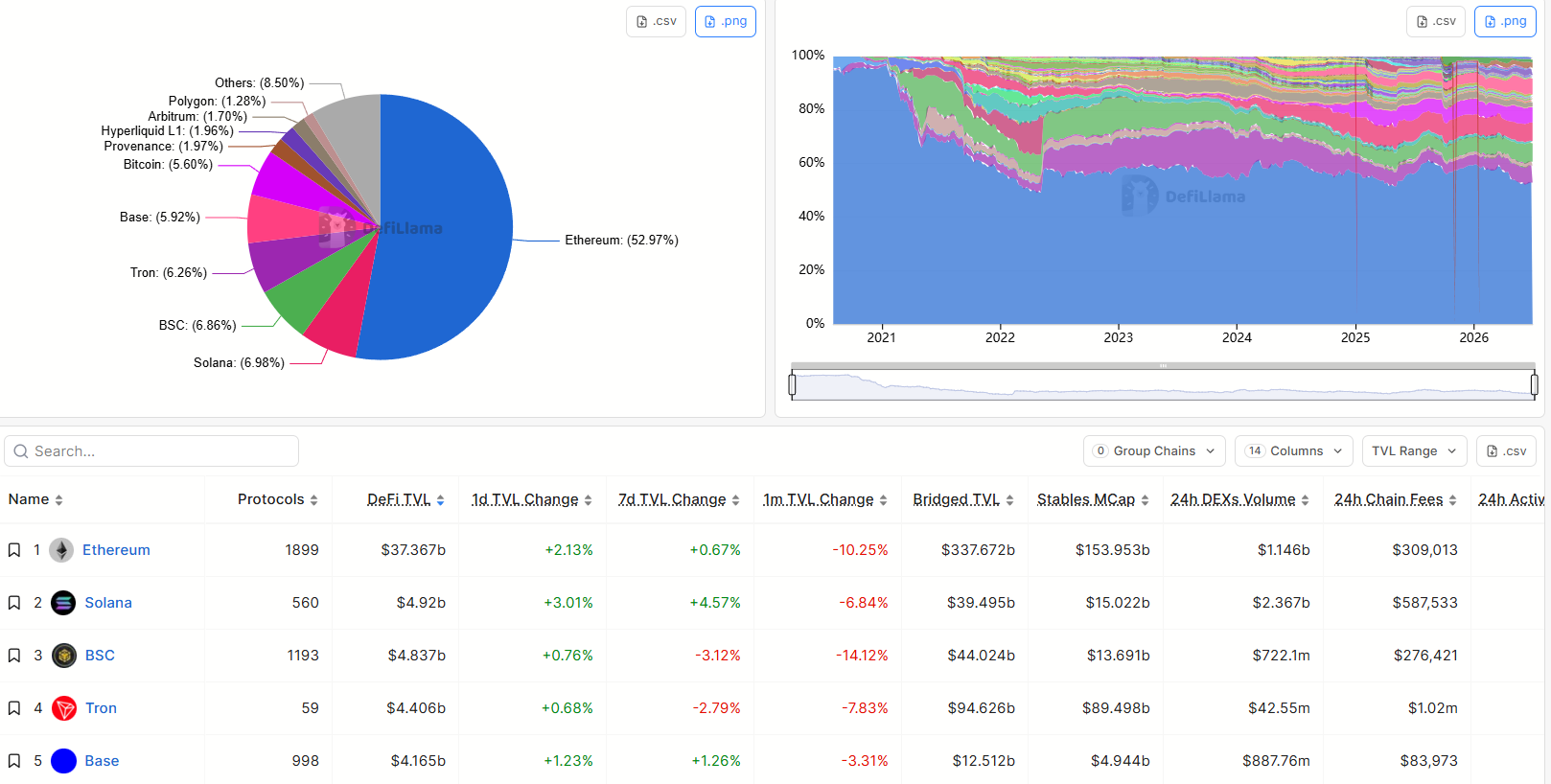
Top blockchain networks by TVL. Source: DefiLlama
Solana ranks as the second-largest blockchain network with $4.92 billion in total value locked (TVL), behind Ethereum’s $37.3 billion. Solana generated over $587,000 in blockchain fees during the past 24 hours, according to DefiLlama at last look.
Magazine: ‘If you want to be great, make enemies’: Solana economist Max Resnick
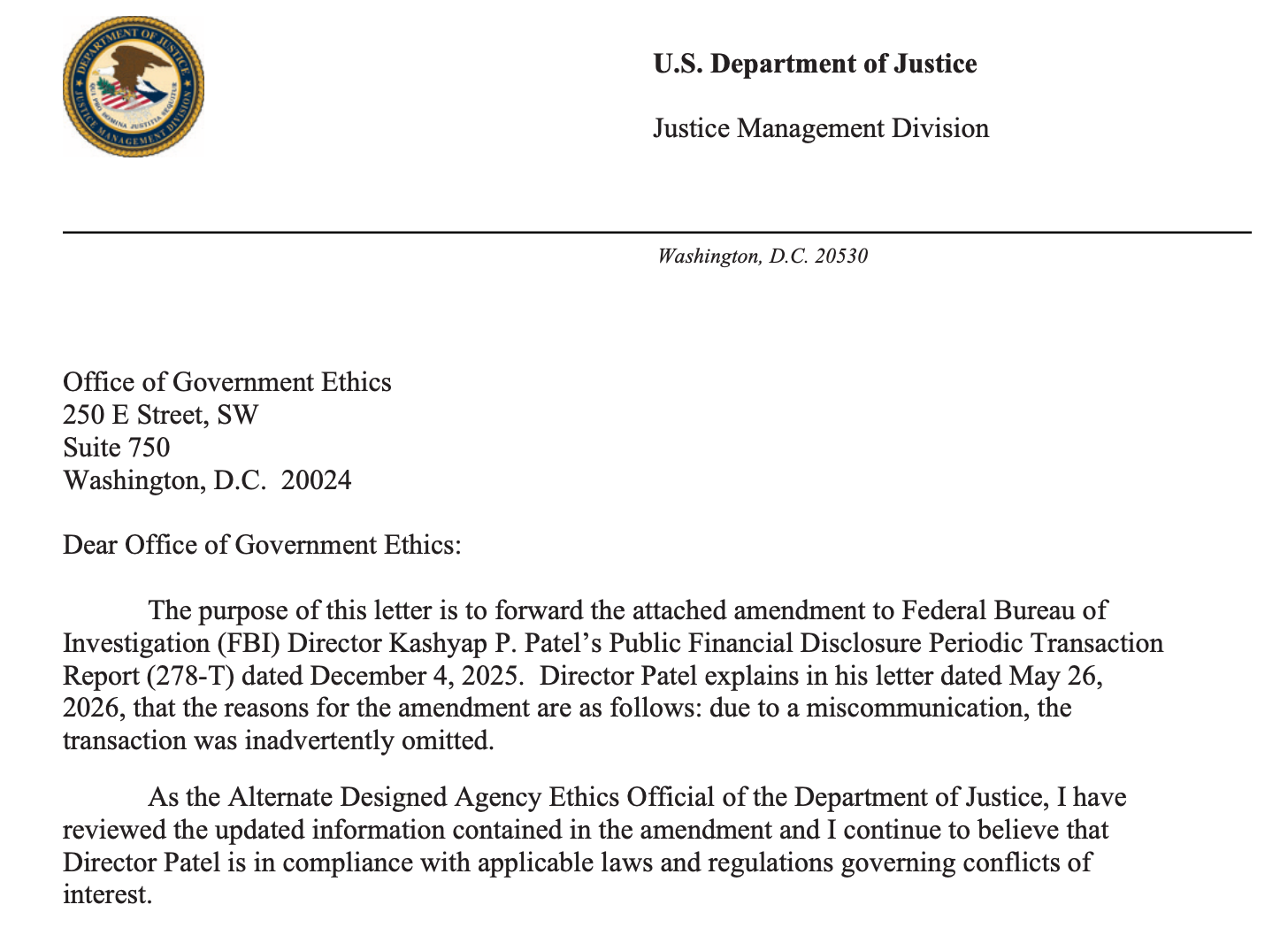
Kash Patel, director of the Federal Bureau of Investigation (FBI) , reportedly omitted reporting exposure to Bitcoin treasury company Strategy, in violation of federal law.
According to a Wednesday report from the nonpartisan nonprofit news agency NOTUS, Patel “inadvertently omitted” a Strategy (MSTR) investment worth as much as $250,000. The purchase, which Patel conducted on Nov. 21, 2025, wasn’t included in his December 2025 financial disclosures, as required for a government official under the Stop Trading on Congressional Knowledge (STOCK) Act.
Source: NOTUS
Patel filed an amended report on May 26, indicating that the Strategy holdings were “inadvertently omitted” and “no current conflict exists” with the investment. Under the STOCK Act, some government officials and lawmakers must disclose financial transactions exceeding $1,000 no later than 45 days after executing the trade. Strategy, formerly known as MicroStrategy, is a registered US government contractor, raising concerns about conflicts of interest with Patel’s investments.
Although signed into law in 2012, the STOCK Act has come under fire from many in Congress who claim that lawmakers and White House officials who violate it do not face severe penalties. First-time violators are only subject to a $200 fine under the law, with additional penalties falling short of the hundreds of thousands and millions of dollars offered in disclosures.
Related: Apple fixes bug that allowed FBI to read deleted Signal messages
Patel isn’t the only member of Congress or policymaker to fall behind in his Strategy investment disclosures. According to Capitol Trades, a website tracking politicians’ investments, Representative Shri Thanedar waited until August 2025 to report a $15,001 to $50,000 investment in Strategy made in June 2024.
Trump discloses $1.4 billion in crypto-related income
The FBI director’s reported late disclosures came in the wake of President Donald Trump’s release of financial records that revealed that his cryptocurrency ventures generated more than $1.4 billion in income in 2025, exceeding that of his real estate businesses.
Many US lawmakers have criticized the president for profiting from his position while in office through his memecoin launch, his family’s crypto platform World Liberty Financial, and his sons’ Bitcoin mining venture.
Magazine: Big Questions: Do we really only need 2–5 cryptocurrencies?
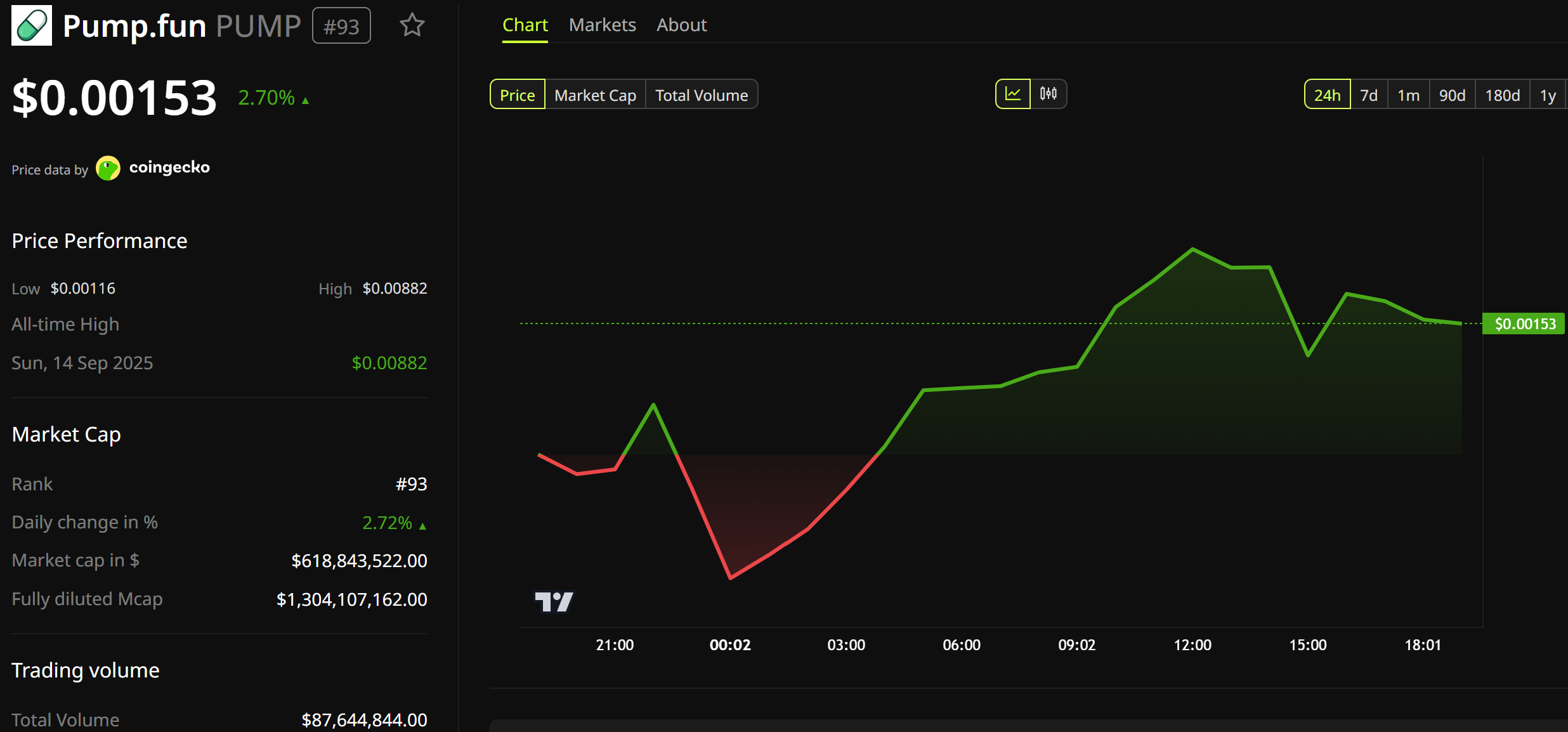
Crypto trader Ansem has urged Pump.fun to launch a PUMP airdrop worth up to $300 million for early users. The demand lands less than two weeks before the platform’s first investor token unlock on July 12.
Pump.fun (PUMP) trades near $0.0015, more than 80% below its September 2025 peak. The debate now centers on whether rewards or burns offer holders better protection when locked tokens hit the market.

Ansem Pushes for a $300 Million PUMP Airdrop
Ansem’s argument is that a large distribution would reward loyal traders and repair public opinion toward the platform, potentially driving price upwards.
“all im saying is if they give the trenches a $250-$300M airdrop stimmy as solana is breaking out & gaining attention again + incentivize future trading volumes, the public opinion towards them would change at breakneck speeds,” Ansem suggested.
His words carry weight in the meme coin community. The ANSEM token gained nearly 20,000% in a week after he pledged weekly creator fee airdrops. The platform, however, has not announced any airdrop plans.
Burns, Buybacks, and the July 12 Unlock
Pump.fun has so far chosen destruction over distribution. In April, the platform executed a $370 million token burn that removed about 36% of the circulating supply. It also committed half of its revenue to automated buybacks and burns for one year.
Critics said those tokens should have gone to users instead. Co-founder Alon Cohen defended the strategy at the time.
“Every dollar not burned is a dollar being put to work toward the same outcome,” Cohen said in a post.
Yet supply reduction has not delivered lasting price gains. An earlier buyback program struggled against sustained whale selling in late 2025.
The July 12 unlock now poses a bigger test. It falls one year to the day after PUMP sold at $0.004 in its initial coin offering.

As the cliff expires, 82.5 billion tokens worth roughly $133 million will vest to existing investors, according to Tokenomist data.
The tranche equals about a fifth of the circulating supply. Moreover, PUMP remains 62% below its ICO price despite gaining almost 20% over the past week.
Pump.fun can answer Ansem with an airdrop, more burns, or silence. Whichever it chooses, July 12 will test whether shrinking supply and renewed attention can cushion its first investor unlock.
The post Can Ansem and a $300M Airdrop Revive Pump.fun Before Its $130 Million Unlock? appeared first on BeInCrypto.


The launch of the Ripple-backed Open USD (OUSD) stablecoin has been overshadowed by a suspected fake issuer account that XRP Ledger validators have warned users not to trust.
Summary
- XRP Ledger validators have warned users about a suspected fake OUSD issuer posing as the newly launched stablecoin.
- Validator Vet said the issuer lacks the official two-way verification needed to confirm its legitimacy.
- The warning follows Open USD’s launch by a consortium backed by Ripple, BlackRock, Visa, Coinbase, and more than 140 companies.
Validators say the listed OUSD issuer cannot be verified
According to XRP Ledger validator operator GrimmReaper, a transaction-monitoring tool connected to his validator recently detected a newly activated issuer using the “Open Standard” name on the XRP Ledger, prompting him to investigate whether it was linked to the newly launched OUSD stablecoin.
GrimmReaper shared a screenshot from Bithomp showing the account, which included the website joinopenstandard.netlify.app and a recently activated XRP Ledger address.
Posting the image on X, he asked fellow XRPL validators Krippenreiter and Vet whether the issuer appeared legitimate. He later explained that his monitoring software tracks incoming validator transactions and automatically flags newly created token issuers using specific names.
The account also displayed advertisements such as “Earn 12% on XRP” and “Play Slots and win 70,000 XRP.” While those ads are not issued by the account itself, they appeared alongside the Bithomp page shown in GrimmReaper’s screenshot and were highlighted as common themes frequently associated with cryptocurrency scams.
Responding to the post, XRPL dUNL validator Vet urged users to assume the issuer was fraudulent until official confirmation was provided by the Open USD project.
According to Vet, a legitimate token issuer should provide what he described as a “2 way pointer,” where the issuer address links to the project’s official website and the project independently publishes the same issuer address. Vet said those verification steps were absent in this case, adding that users should not trust any issuer without confirmation from both sides.
The warning comes as the XRP Ledger community is already discussing issues reported after the rollout of the network’s v3.2.0 upgrade, with validators continuing to monitor suspicious activity across the ecosystem.
OUSD enters a competitive stablecoin market
Open Standard officially launched the OUSD stablecoin on June 30, introducing a revenue-sharing model backed by more than 140 companies. The consortium includes Ripple, Visa, Mastercard, BNY, Standard Chartered, BlackRock, Google, Shopify, Coinbase and Solana.
According to the consortium, OUSD allows businesses to mint and redeem the stablecoin without fees or minimum volume requirements. It also plans to distribute reserve-generated income to participating partners after deducting a management fee, while governance responsibilities will be shared across consortium members.
Ripple’s participation as a founding member has drawn attention from the XRP community, making the project a high-profile target for impersonation attempts shortly after launch.
The stablecoin’s debut has also influenced financial markets. Circle Internet Group shares fell more than 17% on July 1 after investors reacted to the launch of OUSD and its revenue-sharing model, which introduces another institutional-focused competitor in the stablecoin sector.
Circle Chief Executive Officer Jeremy Allaire dismissed suggestions that OUSD poses a major threat to USDC, saying the stablecoin market is large enough to support multiple successful issuers. Still, the decline in Circle’s share price indicated that investors are closely watching how new distribution and revenue-sharing structures could affect competition as stablecoin adoption continues to expand.
Russia’s central bank governor, Elvira Nabiullina, confirmed that the country was prepared to roll out its central bank digital currency (CBDC) in two months, following the timeline it laid out last year.
According to a Thursday report from Russian state media outlet RIA Novosti, Nabiullina said that “everyone is ready” for a Sept. 1 digital ruble launch. The CBDC will launch as a complement to Russia’s fiat currency, the ruble, and will initially be accepted by financial and credit institutions.
“We want the digital ruble to be in demand by people and businesses, to be convenient, and, of course, we’re constantly discussing […] what functionality to develop,” said Nabiullina in a translated statement.
Pile of 5000 ruble banknotes next to a keyboard on a white surface, viewed from above. Source: Polina Tankilevitch, Pexels
The launch of a digital ruble, whose development began in 2021, has already been targeted by preemptive sanctions from European Union authorities, which announced restrictions on the CBDC in April. The European Council said that the sanctions package was in response to Russia’s “war of aggression against Ukraine,” which it started in February 2022.
According to the Bank of Russia’s first deputy governor, Vladimir Chistyukhin, the law allowing the digital ruble will be enacted on Sept. 1 with a transition period until July 2027.
Related: Russia targets British 17-year-old for alleging digital assets were skirting sanctions
Dr. Jack Jarmon, who worked as a USAID technical adviser for the Russian government in the 1990s, said in a February 2025 report that the country could face “structural limitations” should its digital ruble plans fail and it relies on Bitcoin (BTC) and other proof-of-work (PoW) digital currencies as methods of evading sanctions.
“While Russia is replete with a surplus of oil and gas, the rest of its energy infrastructure is not well suited to handle such significant increases in demand for energy,” said Jarmon, referring to PoW mining. “Its power grid is old and in need of investment and upgrade.”
He added:
“The sanctions that Putin seeks to circumvent have cut Russia off from financial capital and technology. It has no domestic semiconductor industry to meet its needs and must rely on the People’s Republic of China (PRC) for components […]”
US President weighing legislation with four-year CBDC ban
In contrast to Russia, the United States is one step away from having a ban on the country’s central bank issuing or creating a CBDC until 2030. This week, US President Donald Trump received the 21st Century ROAD to Housing Act, a housing bill containing a ban on a digital dollar as part of a package of housing affordability laws.
Although Trump has said he will not sign the bill, expecting Republicans to first pass legislation requiring voters to provide proof of US citizenship in person to register, it will automatically become law in 10 days with no action on the president’s part. This timeline would put the law into effect in July.
Magazine: Big Questions: Do we really only need 2–5 cryptocurrencies?
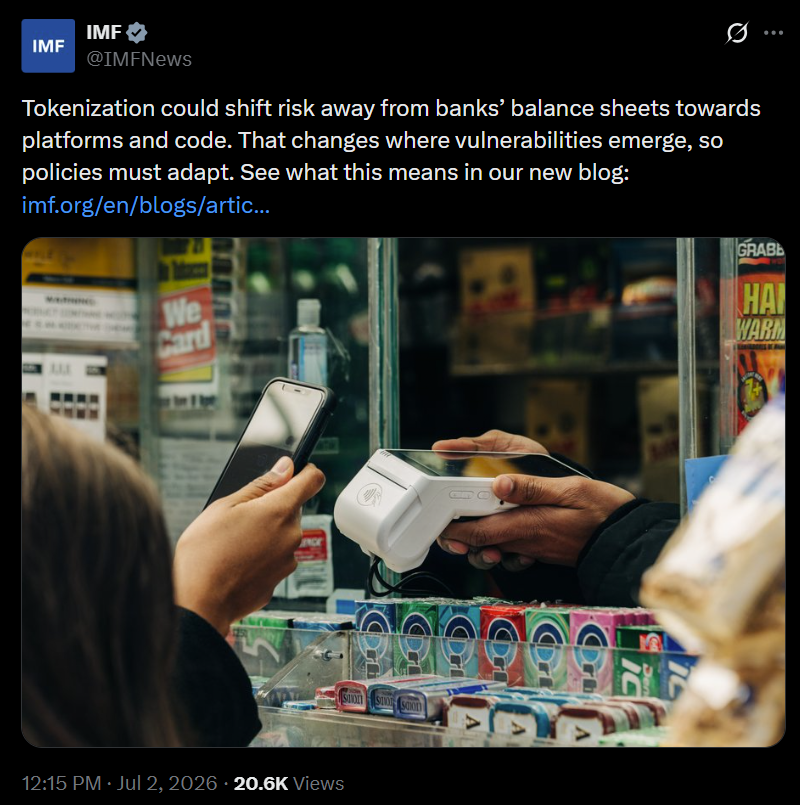
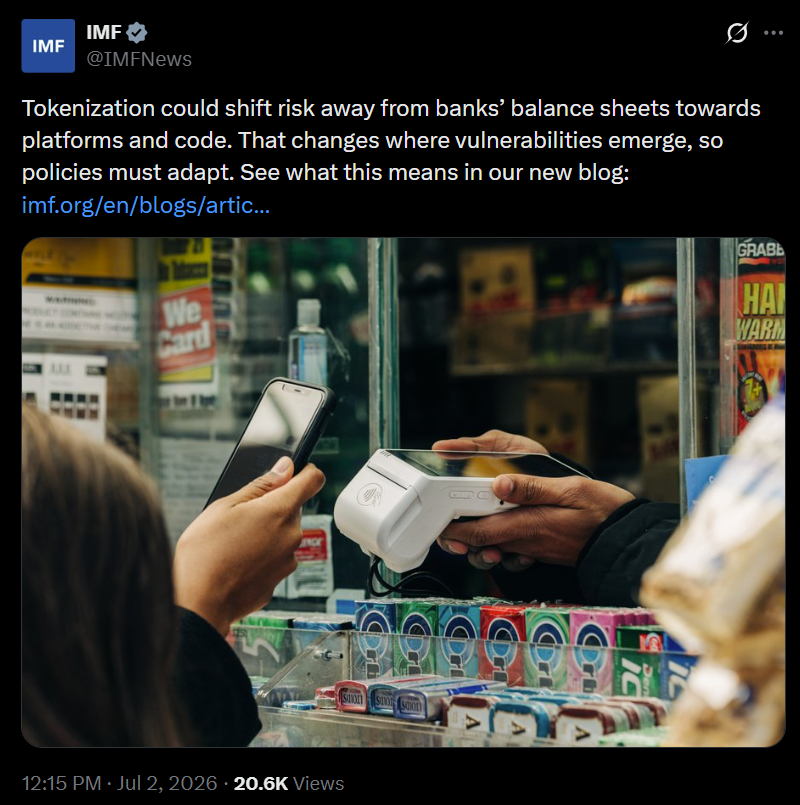
The International Monetary Fund (IMF) says tokenization could fundamentally reshape how financial markets operate, marking one of the strongest acknowledgments yet from a global policymaker that blockchain-based infrastructure is moving into the financial mainstream.
In a blog published Thursday, Tobias Adrian, the IMF’s financial counselor and director of its Monetary and Capital Markets Department, said tokenization is more than a niche crypto innovation. By bringing assets, settlement and recordkeeping onto a shared ledger, tokenization could compress today’s multi-day settlement process into near-instant transactions.
Adrian also warned that tokenization shifts risks away from traditional financial intermediaries and toward the underlying infrastructure, including smart contracts, distributed ledgers and service providers. Without common standards and coordinated regulation, tokenized financial markets could become fragmented across incompatible platforms, creating new sources of systemic risk.
Source: IMF
The report comes as financial institutions accelerate efforts to integrate tokenization into traditional markets. The Clearing House, whose owners include JPMorgan Chase, Bank of America, and Barclays, reportedly plans to launch a tokenized deposit network in early 2027 to keep deposits within the regulated banking system while enabling faster, programmable payments.
The IMF’s assessment aligns with recent research from PwC, which found that tokenization could address longstanding inefficiencies in traditional finance, including payment settlement and the transfer of asset ownership. It also follows a May report from Moody’s showing that traditional financial institutions are actively preparing for a shift toward tokenized finance.
Related: Tokenization makes finance more efficient but introduces risks: IMF
Regulators race to define tokenized finance
The IMF report emphasized the growing role of regulators in shaping tokenized finance. Adrian said policymakers have a narrow window to determine how tokenized markets evolve, arguing that decisions on settlement assets, governance, interoperability and the role of central banks will help determine whether tokenization makes the financial system more efficient or introduces new systemic risks.
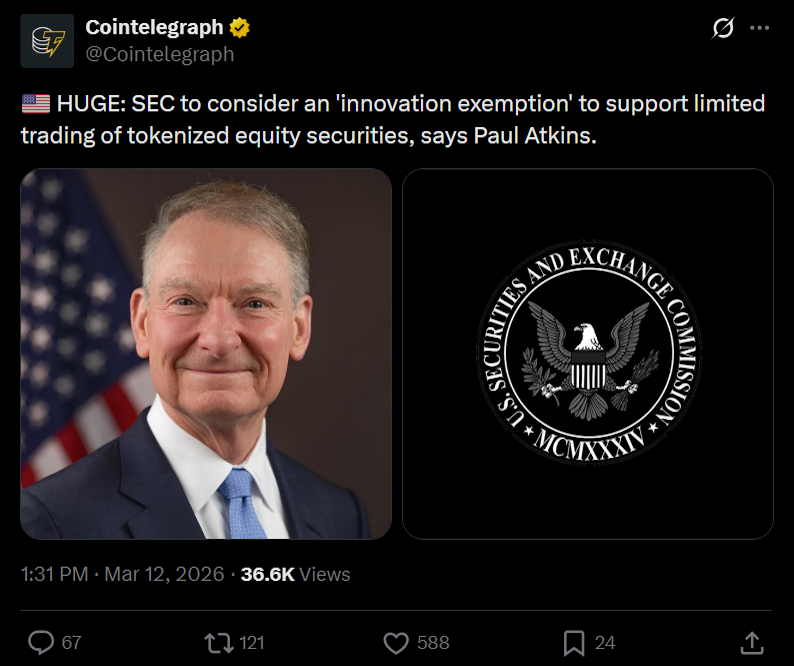
In the United States, the Securities and Exchange Commission has taken steps to clarify how existing securities laws apply to tokenized assets rather than creating a separate regulatory framework.
Source: Cointelegraph
The agency has also signaled it is considering an “innovation exemption” that could allow market participants to test blockchain-based trading platforms for tokenized securities while a longer-term regulatory framework is developed.
Magazine: Can Robinhood or Kraken’s tokenized stocks ever be truly decentralized?
💻 Watch Video… Read the full story at The Defiant
Strategy President and CEO Phong Le acquired 11,000 shares of the company's Series A Perpetual Stretch Preferred Stock, known by its ticker STRC, on June 22, according to a Form 4 filed with the Securities and Exchange Commission. The purchase was made through the Phong Le Revocable Trust, of which… Read the full story at The Defiant

Rybakina produces dominant display to progress to third round

Raffles Medical’s S$600M bet is still struggling to pay off
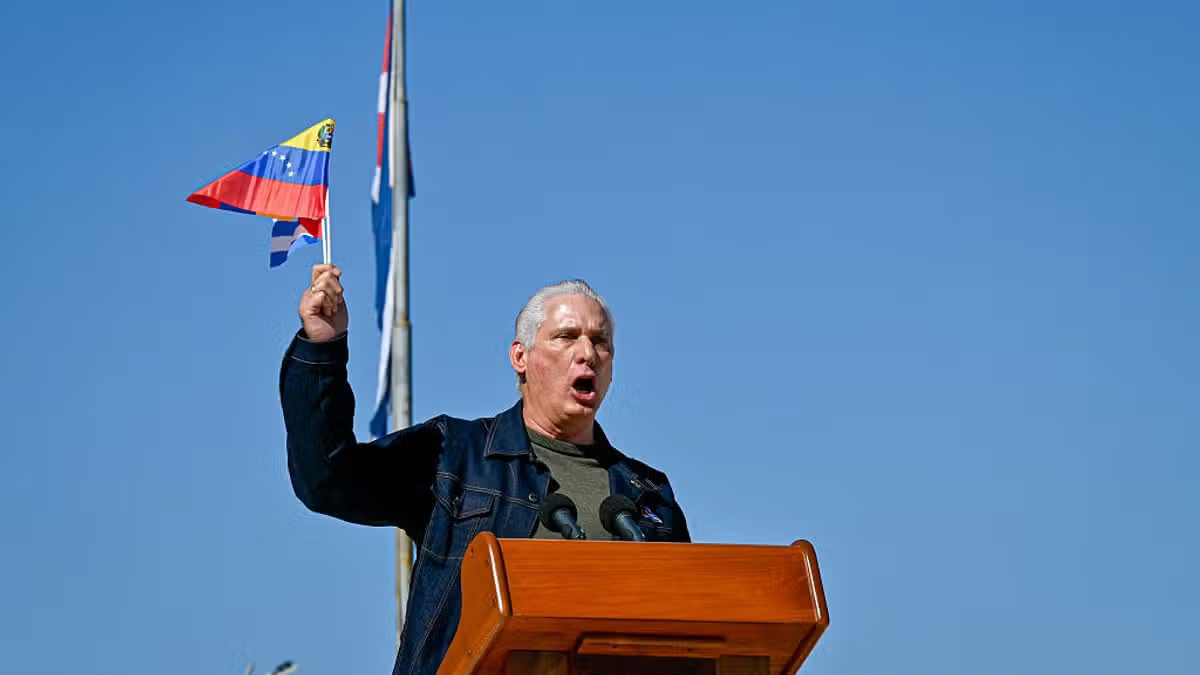
Cuba defies Trump and says it is ‘not afraid’ to go to war with United States


-

 Fashion6 days ago
Weekend Open Thread: Staud – Corporette.com
-

 Politics7 days ago
The House | Manchesterism won’t survive the painful trade-offs unless it gets citizens on board
-

 Crypto World3 days ago
Strategy authorizes up to $1.25B in Bitcoin sales under new capital plan
-

 Politics7 days ago
Potential 2028er World Cup attendee leaderboard
-

 Business7 days ago
Asia stock markets slide as tech shares slump
-

 News Videos4 days ago
MAJOR BITCOIN & MARKET UPDATE!!!! (MUST WATCH ASAP!!!)
-

 Crypto World5 days ago
Coinbase, Circle Deepen Crypto Stock Losses Despite Resilient S&P 500
-

 Tech3 days ago
Anonymous researcher drops 0-day ‘exploitarium’ repo
-

 Business3 days ago
Australia treasurer says alleged access of prime minister’s bank data ’incredibly concerning’
-

 Crypto World6 days ago
Kraken's xStocks Opens Bending Spoons IPO Registration to EEA Retail
-

 Crypto World7 days ago
Bitcoin Sparks $600M Hourly Liquidations With $65,000 Set To Become Resistance
-

 Sports6 days ago
FIH Pro League: India defeat Pakistan 7-1, register biggest win of campaign | Other Sports News
-

 Tech5 days ago
Bluekit phishing kit adopts browser-in-the-middle for login theft
-

 Tech5 days ago
Russian hackers now target Signal backup recovery keys
-
 Crypto World6 days ago
Hyperliquid Named on Singapore MAS Investor Alert Register
-

 Crypto World6 days ago
RTX holders must register wallets before token distribution begins
-

 Crypto World7 days ago
Tether (USDT) Passes Ether in Market Cap as ETH Drops Toward $1.5K
-

 Sports1 day ago
Broncos roster: OL Ben Powers (No. 74) entering final year of contract
-
 Business3 days ago
The AI boom won’t burst all at once. It will pop in ‘rolling bubbles’: Macquarie
-

 Tech5 days ago
Silicon Valley paid to kill AI regulation, now it wants the rules back
You must be logged in to post a comment Login