

Crypto World
Passive Income on Ethereum for All: How Rocket Pool Scales Liquid Staking

💻 Watch Video… Read the full story at The Defiant

JPMorgan warned that MicroStrategy’s new Bitcoin sales policy adds unnecessary risk to the crypto market. The Michael Saylor-led firm may sell up to $1.25 billion in Bitcoin to fund preferred dividends across the coming months.
The warning arrives as Strategy (formerly MicroStrategy) loses ground on both its common and preferred stock across broader financial markets.
Why JPMorgan Sees Two-Way Risk in MicroStrategy’s Plan
A two-way risk is a scenario in which price moves in either direction can create potential losses for market participants exposed to the underlying asset. JPMorgan analysts led by Nikolaos Panigirtzoglou say Strategy’s new Bitcoin sales policy has now introduced exactly that dynamic into the crypto market.
MicroStrategy revealed the option to sell up to $1.25 billion in Bitcoin to strengthen its balance sheet. Furthermore, the company could also authorize preferred stock repurchases and share buybacks. The move follows a period of stress on both MSTR common shares and its preferred series.
Follow us on X to get the latest news as it happens
The company also set a new minimum cash reserve target. Strategy now aims to cover 12 months of preferred dividends and interest expense.
However, its current $2.55 billion in reserves only covers 17 months of obligations, leaving limited flexibility in the coming quarters.
JPMorgan pushed back hard on the approach. Analysts recommended a higher coverage target of 24-36 months. Moreover, they urged MicroStrategy to issue common equity to expand dollar reserves. That would reassure investors that the firm will not need to sell Bitcoin going forward.
Strategy remains the largest Bitcoin buyer globally. The firm has purchased roughly $13.7 billion of Bitcoin in 2026 alone and holds 847,363 BTC.
As a result, whether it buys or sells, the movement now creates significant unnecessary flow risk across the broader crypto market environment.

How Bitcoin and MSTR Are Digesting the Fresh Risks
Strategy’s May Bitcoin sale sent ripples across the market. The company sold 32 Bitcoin for approximately $2.5 million between May 26 and May 31. Furthermore, the move marked its first Bitcoin sale since 2022, a sharp reversal from Michael Saylor’s public “never sell” stance.
JPMorgan flagged the direct market impact of that transaction. The bank noted that MicroStrategy’s sale contributed to Bitcoin’s stress in late May and early June. Moreover, greater price volatility could ultimately hurt the company itself, raising the cost of future equity and debt financings.
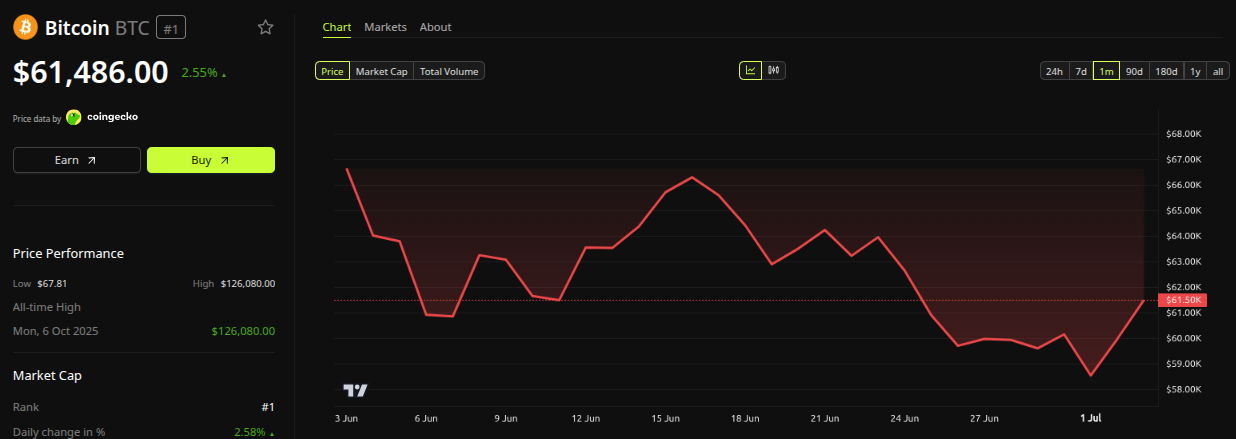
MSTR stock has slid 34% this year to $100.77. Its STRC preferred series follows the same pattern, down 12% at $87.09. Bitcoin also trades under pressure, off 30% year-to-date at $61,486.

However, JPMorgan analysts see a potential contrarian angle. The current bearish sentiment could set up a stronger second half if two conditions align. Strategy must expand dollar reserves. Moreover, the United States must approve the CLARITY Act to unlock renewed institutional flows.
Subscribe to our YouTube channel to watch leaders and journalists provide expert insights
The post JPMorgan Sounds the Alarm on MicroStrategy’s New Bitcoin Sales Policy appeared first on BeInCrypto.

Binance has returned to the Philippine market through a regulatory sandbox route, while its European operations face new limits. The exchange gained access through BlockShoals Technologies, which secured approval from the Philippine SEC. However, Binance also restricted some services in several EU countries after MiCA rules fully took effect.
Binance Re-Enters Philippines Through SEC Sandbox
The Philippine Securities and Exchange Commission approved BlockShoals Technologies to test crypto-related services under its regulatory sandbox. The approval allows the company to operate its Stratbox model with selected products for local users. As a result, Binance gains a regulated pathway back into the Philippine market.
The sandbox approval followed an earlier clearance granted in November 2025, after BlockShoals met the remaining compliance requirements. The SEC said the company will operate under a crypto-asset intermediary model. Therefore, Philippine users can access selected services through a global crypto-asset service provider partner.
Binance acts as the global partner in the approved testing framework. BlockShoals will connect its systems with a local virtual-asset service provider partner during a 90-day rollout. After that, the company will continue testing user onboarding and product access under regulatory supervision.
Philippine Crypto Rules Tighten As Binance Returns
The approval comes as the Philippines continues to tighten its crypto market rules. Regulators have moved to strengthen listing standards and restrict assets that raise oversight concerns. Earlier, the country also pushed restrictions on privacy coins under its broader compliance approach.
This background gives Binance’s return a narrow but important regulatory angle. The exchange does not re-enter through a full open-market relaunch. Instead, it enters through a controlled sandbox with defined products, safeguards, and testing limits.
The structure also gives regulators more room to monitor user access and platform activity. It allows the SEC to test how offshore crypto services connect with local rules. Therefore, the Philippine market becomes a measured entry point for Binance in Southeast Asia.
Binance Limits EU Access After MiCA Deadline
While Binance gains room in the Philippines, it faces tighter conditions in Europe. The exchange has suspended new user registration, deposits, and Earn products in several EU markets. These restrictions affect users in Italy, Spain, France, Poland, Belgium, and Sweden.
The changes followed the end of the European Union’s MiCA transition period on July 1. MiCA created a unified licensing framework for crypto-asset service providers across the bloc. However, exchanges must secure authorization in an EU member state to continue full operations.
Binance had planned to seek authorization in Greece, but later withdrew that application before the deadline. The company said it will now pursue licensing in another EU member state. Meanwhile, it continues to work with regulators to restore compliant services across the region.
Withdrawals Remain Open As Binance Adjusts
Binance said affected users can still withdraw and transfer their assets. The exchange also said product access will vary by country, account status, and available services. Therefore, some users may face broader limits than others, depending on local restrictions.
The company has told users to rely on official communication channels for updates. It also said customer support will handle product access and withdrawal-related questions. This approach aims to reduce confusion as service limits take effect across affected markets.
The contrast between the Philippines and Europe shows Binance’s uneven regulatory path. In one market, the exchange gains access through supervised testing and local partnerships. In another, it pulls back while seeking a license under stricter regional crypto rules.

Russia’s central bank governor Elvira Nabiullina has said the country is prepared to launch its central bank digital currency (CBDC), the digital ruble, by Sept. 1—after the timeline previously outlined for the project. According to Russian state media outlet RIA Novosti, Nabiullina framed the schedule as feasible and suggested that work continues on shaping the system’s functionality.
As the digital ruble heads toward an expected rollout, the project remains entangled with sanctions dynamics. The European Union has already announced restrictions tied to Russia’s CBDC plans, while domestic Russian officials have discussed the legislative pathway and the expected transition period after the law takes effect.
Key takeaways
- Elvira Nabiullina said Russia is ready to launch a digital ruble on Sept. 1, with initial acceptance by financial and credit institutions.
- The digital ruble is intended to function alongside the existing ruble, rather than replace it.
- European Union sanctions included restrictions affecting Russia’s CBDC efforts announced earlier this year.
- Russia’s first deputy central bank governor, Vladimir Chistyukhin, said the enabling law would be enacted on Sept. 1, followed by a transition period until July 2027.
- In the U.S., a separate legislative push would impose a ban on a CBDC issued by the central bank until 2030, reflecting a contrasting regulatory direction.
Digital ruble timetable reaffirmed
RIA Novosti reported that Nabiullina said “everyone is ready” for a Sept. 1 launch of the digital ruble. The central bank governor also emphasized the goal of making the system useful in real-world payments, stating that the authorities are continually discussing what features and functionality should be developed.
In the reporting, Nabiullina described the digital ruble as a complement to Russia’s fiat currency—the ruble—designed to be adopted first through financial and credit institutions. That positioning is important for how the project is likely to be implemented in practice: rather than starting as a consumer-facing token ecosystem, the initial pathway appears geared toward regulated intermediaries.
The digital ruble project has been underway since 2021, and its progress has increasingly been assessed through both technical readiness and the legal timetable. What’s newly underscored by the latest statement is that the central bank is reiterating that the schedule remains on track for a Sept. 1 go-live.
Sanctions pressure and compliance constraints
Russia’s CBDC plans have also been met with preemptive restrictions from the European Union. The EU announced restrictions on the digital ruble in April, as part of a sanctions package described by the Council of the European Union as responding to Russia’s “war of aggression against Ukraine.”
The sanctions framework matters for investors and market participants because it signals how cross-border financial institutions and payment rails may interpret compliance risk around the digital ruble. Even if the CBDC is primarily used within Russia, the broader financial system still connects to global counterparties, correspondent banking, and technology supply chains—areas that sanctions can affect directly or indirectly.
Commentary on the strategy has extended beyond government statements. In a February 2025 report carried by Australian Institute of International Affairs, Dr. Jack Jarmon—described as having served as a USAID technical adviser for the Russian government in the 1990s—argued that Russia could face “structural limitations” if it relies on proof-of-work (PoW) digital assets such as Bitcoin to help evade sanctions. He pointed to energy infrastructure constraints, including the age and upgrade needs of Russia’s power grid, and argued that sanctions cut Russia off from financial capital and technology while leaving the country dependent on external suppliers for components.
While Jarmon’s remarks focused on PoW mining and sanctions circumvention risk rather than the CBDC itself, the broader implication is that Russia’s financial modernization efforts are happening under constraints that can shape implementation speed, technology sourcing, and system design choices.
Law enactment and a multi-year transition
In addition to Nabiullina’s launch timeline, reporting attributed to Russia’s central bank adds specificity on the legal mechanics. RIA Novosti said Vladimir Chistyukhin, the bank’s first deputy governor, stated that legislation enabling the digital ruble would be enacted on Sept. 1, with a transition period extending until July 2027.
This kind of phased structure is often critical for CBDCs because it gives regulators time to define operational rules, settlement responsibilities, and governance frameworks. For market observers, the transition period also suggests that the Sept. 1 date should be viewed as a formal starting point, not necessarily as the end of policy and implementation adjustments.
At the same time, the combination of EU restrictions and an internal transition schedule creates a dual-track environment: the central bank can proceed domestically with regulatory rollout, while external counterparts may apply tighter compliance screening as sanctioned entities and technologies could still be relevant to cross-border processes.
U.S. legislative momentum highlights the global split
Russia’s move stands in sharp contrast to the U.S. approach. While Russia is preparing for a digital ruble rollout, the article notes that U.S. President Donald Trump has received the 21st Century ROAD to Housing Act—a housing bill that includes a ban on a digital dollar as part of housing affordability legislation.
The reported mechanism is notable: the article says Trump expects not to sign the bill, but it would still become law automatically if no action is taken within 10 days. Under that timeline described in the report, the ban would take effect in July. The same reporting indicates that the ban would cover central bank issuance or creation of a CBDC until 2030.
For global observers, this highlights how CBDCs are not treated uniformly across jurisdictions. Instead, regulation is emerging as a policy battleground intertwined with national priorities—financial sovereignty concerns in some cases, and skepticism toward digital-dollar rollout in others. The divergence can affect cross-border planning for fintech providers, banks, and payment infrastructure vendors that operate in multiple regulatory environments.
It also matters for interoperability expectations. Even if CBDCs expand domestically, future integration across borders can be shaped—or limited—by differences in legal authority and political will.
With Sept. 1 now repeatedly referenced by Russia’s central bank leadership, attention is likely to shift from announcements to execution: how the digital ruble will be operationalized through financial and credit institutions, how the transition period to July 2027 unfolds, and how EU restrictions and compliance practices influence any future external access. On the U.S. side, the key watch item is whether the CBDC ban’s effective date and scope become a durable baseline for U.S. digital currency policy through 2030.
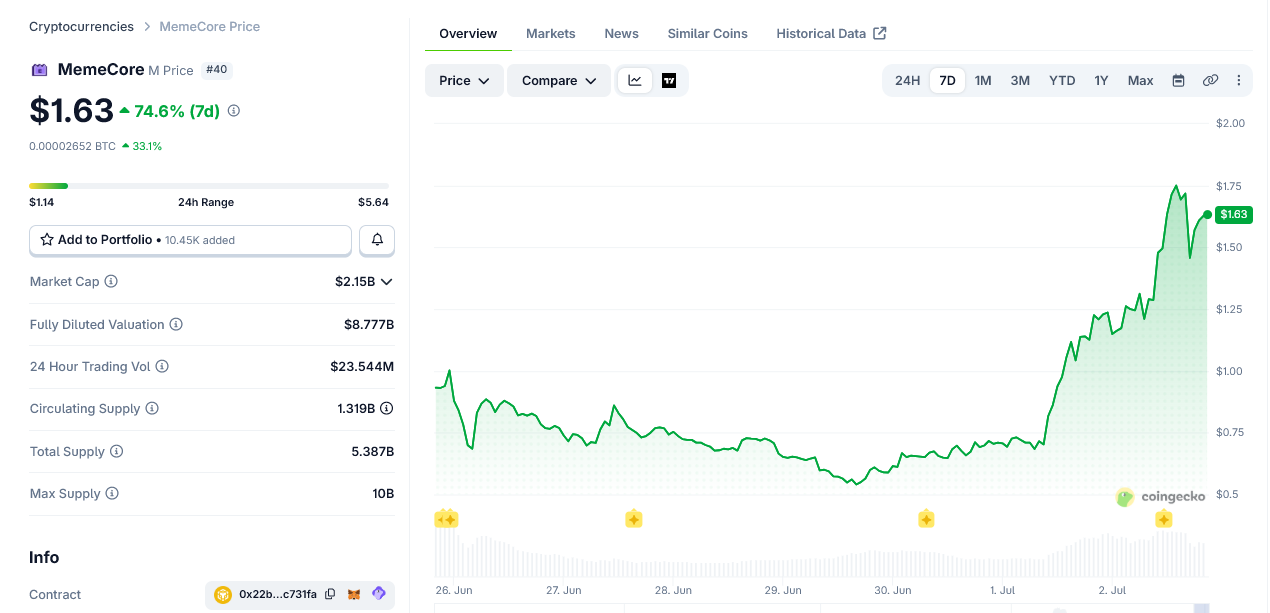
MemeCore (M) rebounds nearly 150% this week and trades at $1.66 after its treasury announced a buyback worth more than $10 million.
The token collapsed 76% on June 25 and briefly traded near $0.50. Weekly and daily charts now show the recovery pressing into resistance zones that could decide the next major move.

A $10 Million Buyback Answers the 76% Crash
MemeCore’s M token fell from $2.66 to an intraday low of $0.50 on June 25, a crash that pushed its market cap from around $3.5 billion to $903 million. The selloff arrived without any confirmed catalyst.
Onchain investigator ZachXBT connected the collapse to structural weaknesses he had flagged months earlier. He cited less than $100,000 in onchain liquidity on BNB Chain against a market cap still near $900 million.
“Myself, Mlm, & Wazz previously highlighted a number of red flags on X about MemeCore with inorganic supply concentration and deceptive practices by its team to boost user numbers,” he said on Telegram.
Meanwhile, trader Ash Crypto estimated that the selloff liquidated around $8 million in long positions. MemeCore responded days later with a treasury buyback worth more than $10 million, as trader rapperr111 noted on X.
The team stated that an internal investigation found no protocol or infrastructure issues. It also denied any selling by the team or foundation and attributed the crash to a single large market sell order. This explanation has not been independently verified.
The announcement coincided with the start of the recovery. M has since climbed back to rank 40 by market cap after falling to 72 during the crash.
MemeCore Rebound Holds the Key Weekly Support Zone
The weekly chart shows the crash candle wicking down to $0.53 before buyers stepped in. Notably, the selloff stopped almost exactly at the support zone between roughly $0.60 and $0.85.
This area acted as resistance from July to August 2025, before the token began its long rally toward the all-time high. Historically, such flipped zones often generate strong demand, and the current bounce fits that pattern.

However, the breakdown also destroyed the long-term ascending trendline that had guided M since mid-2025. That trendline now converges with the horizontal supply zone near $1.80, directly above the current price.
The weekly RSI stands at 45, reset from readings above 80 near the April peak. Therefore, a reclaim of $1.80 could open the path toward the next supply zone between $2.80 and $3.00. In contrast, rejection at $1.80 would signal downtrend continuation toward the $0.60 to $0.85 area.
M Price Prediction as the $2.10 Fib Caps the Bounce
The daily chart confirms the June 25 breakdown, which cut through the 0.5 Fibonacci retracement at $2.63 on record volume. The decline extended for several sessions and bottomed near $0.41.
Since then, buyers have reclaimed the 0.236 Fib at $1.46. M trades at $1.66 at press time, up 54% in 24 hours, according to BeInCrypto Markets data.
The next target is the 0.382 Fib level at $2.10, which is around 27% above the current price. A breakout there would expose the 0.5 Fib at $2.63, which coincides with the descending trendline drawn from the April 24 all-time high of $4.85. This confluence makes $2.63 the decisive barrier for the entire recovery.

Momentum supports the bulls for now. The daily RSI has recovered to 43 after printing oversold readings near 20 during the crash. A previous analysis showed M respecting the same Fibonacci structure in May, before the trend reversed.
On the downside, a break of the 0.236 Fib at $1.46 would invalidate the bullish setup and expose the $0.85 to $0.60 support again. Whether the buyback marks a durable bottom or only a pause in the downtrend now depends on the $2.10 test.
The post MemeCore (M) Rebounds 150% After $10 Million Buyback appeared first on BeInCrypto.


President Donald Trump renewed his pro-crypto message by questioning whether Bitcoin should be taxed like a traditional investment while defending his financial disclosure, which revealed substantial crypto-related earnings.
Speaking to reporters at Joint Base Andrews before departing on Air Force One late July 2 into July 3, Trump also praised the stock market, reaffirmed support for digital assets, and addressed concerns about his business interests.
Trump Says Bitcoin Shouldn’t Face Capital Gains Tax
During the informal press gaggle, Trump argued that Bitcoin has evolved into a form of money and questioned why users should pay capital gains tax on everyday purchases.
Using a coffee purchase as an example, Trump said a friend recently pointed out that Bitcoin transactions should not trigger taxes if the asset functions as money, a view he said he agrees with.
The remarks echo Trump’s campaign-era calls for friendlier crypto regulations and come as his administration continues positioning the United States as a global leader in digital assets.
‘Crypto’s a Big Deal,’ Trump Says
Trump doubled down on his support for the industry, calling crypto “a big deal” and insisting the United States should lead the sector.
“Anything we do, we want to be number one,” Trump said, framing digital assets as a strategic technology race rather than simply an investment trend.
His comments reinforce the administration’s broader pro-crypto agenda, including support for digital asset innovation and efforts to strengthen America’s position against competing financial hubs.
Financial Disclosure Draws Questions
Reporters pressed Trump after his latest annual financial disclosure highlighted significant crypto-related income alongside broader investment gains.
Trump responded by distancing himself from the day-to-day management of his businesses.
“My kids run my business. I’m not involved,” he said, adding that professional managers oversee his investments.
He also defended his wealth, saying he has “always made money” while reiterating that he does not personally manage investment decisions.
Fed, Growth, and Markets Remain in Focus
Beyond crypto, Trump commented on Federal Reserve Chair Kevin Warsh, saying the Fed board is “a little bit hostile” while adding that Warsh “has to do what he has to do.”
The president also praised the stock market and expressed confidence that U.S. economic growth could eventually exceed 4%, suggesting it could reach 12% or 13% under the right conditions.
What’s Next?
Trump’s latest remarks reinforce that cryptocurrency remains central to his economic messaging. While no immediate policy changes were announced, his renewed criticism of Bitcoin taxation is likely to fuel debate over digital asset tax reform in Congress.
Investors will now watch whether the administration translates its pro-crypto rhetoric into concrete legislation, particularly around capital gains rules and broader regulatory reforms that could influence Bitcoin adoption and market sentiment.
The post Trump Defends Crypto Fortune, Says Bitcoin Shouldn’t Be Taxed Like Stocks appeared first on BeInCrypto.
Chris Larsen, co-founder and executive chair of Ripple Labs, was reportedly among those backing the financial venture of US Senator Kirsten Gillibrand’s son as negotiations over a significant piece of crypto-related legislation continue in the Senate.
According to a Thursday Politico report, Larsen was one of a handful of investors backing the American Perpetuals Exchange Corp. (APEC), founded by Theodore Gillibrand. Although Larsen’s exact contribution was not included in the report, the majority of investors contributed between $5,000 to $10,000 each into the derivatives platform, which reportedly raised $30 million.
The investment comes as the New York lawmaker is involved in negotiations over ethics provisions in the Digital Asset Market Clarity (CLARITY) Act, legislation expected to have a significant impact on crypto companies operating in the US, including Ripple. Gillibrand said in May that no one would be voting for the bill without addressing ethics:
“[T]he truth is, is that we cannot allow members of Congress, senior administration officials, presidents or vice presidents, to get rich off of these industries because of their insider status. It is the worst form of pay for play.”
A spokesperson for the senator referred Cointelegraph to her June 18 statement saying that her son was “a grown adult starting his own independent business” and she had “no involvement in it whatsoever.” Cointelegraph reached out to APEC for comment but did not receive an immediate response.
Related: Fed chair nominee pressed on potential conflicts of interest, independence
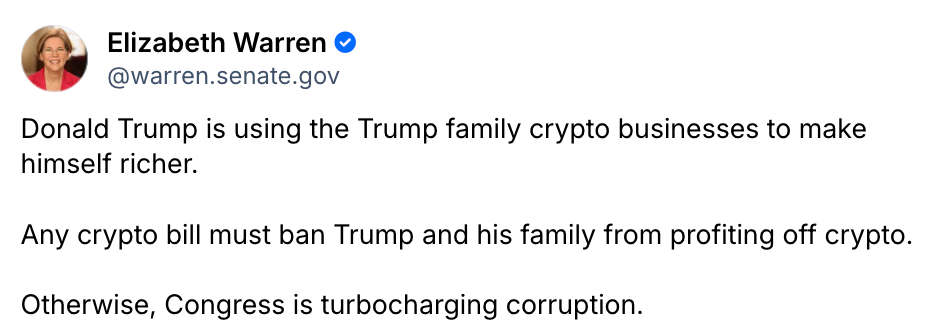
Democratic lawmakers have been pushing Republicans, who hold a majority in Congress, to support efforts to add ethics language to the CLARITY Act, citing US President Donald Trump’s ties to the crypto industry. Republican leaders in the Senate are expecting the bill to pass the chamber in July, with Senator Cynthia Lummis saying in June that lawmakers were “working a little bit on ethics,” decentralized finance and illicit transactions as part of negotiations.
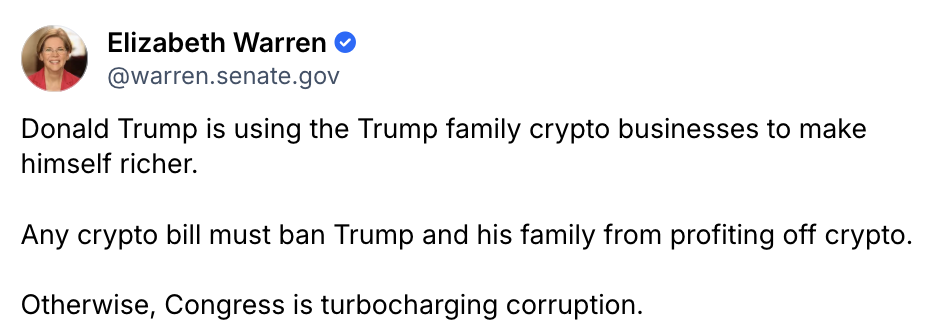
Source: Senator Elizabeth Warren
Senate Republicans hold a slim majority in the chamber, meaning they will need some Democratic support to meet the 60-vote threshold for CLARITY to pass.
Congressional schedule squeezes window for CLARITY bill
Lawmakers in the US Senate are on state work periods for the Independence Day holiday. Scheduled to return to session on July 13 and leave for another month-long state work period in August, the window to pass crypto market structure is closing before US election day, which is expected to result in additional delays.
Magazine: AI is banking the unbanked in Africa… faster than crypto


Securitize began trading on the New York Stock Exchange Thursday under the ticker SECZ and simultaneously put its own newly listed common stock onchain, according to a press release the tokenization firm distributed via PR Newswire. Eligible U.S. investors can access tokenized SECZ through… Read the full story at The Defiant

Ethereum Institutional was announced on Wednesday as a new independent non-profit to serve as a neutral front door for institutions navigating Ethereum, its layer-2s, tokenization, stablecoins, and on-chain markets.
The new organization has been founded by the former Ethereum Foundation Enterprise team, David Walsh, Matthew Dawson, and Marius Smith, with funding coming from Bitmine, Sharplink, and Consensys CEO Joseph Lubin.
It comes at a crucial time for Ethereum, which is under an avalanche of FUD and trading at multi-year lows.
Nevertheless, there is still a great deal of momentum and interest in keeping Ethereum the foundation of future finance.
A Credible Front Door
“What’s been missing is a credible, independent front door: one that represents the full Ethereum ecosystem, without bias, and that institutions can engage with directly,” said the team.
The organization centers on five areas: institutional engagement, intelligence, ETH marketing, requirements discovery, and events, to translate institutional needs into Ethereum deployments during a key period when institutions are making infrastructure decisions.
1/ Announcing Ethereum Institutional
An independent non-profit dedicated to accelerating the institutional adoption of Ethereum, its L2s, applications and overall ecosystem. pic.twitter.com/XUeViH6rrq
— Ethereum Institutional (@ethereuminsti) July 1, 2026
“For years, Ethereum has had the most credible, neutral, liquid, and battle-tested base layer in crypto,” said David Walsh, former Ethereum Foundation Enterprise lead.
“What it lacked was a neutral party responsible for the wider ecosystem’s institutional GTM [Go-To-Market], someone in the room with institutions, representing Ethereum as a whole rather than any single product or vendor.”
“What we heard, again and again, was that institutions valued having an honest, neutral counterpart they could actually call … So we’re scaling it, independently,” he added.
“As institutional adoption accelerates, Ethereum Institutional takes that work and makes it permanent, with long-term backing.”
“Ethereum Institutional will play a central and key role as a neutral entity bringing institutional adoption to Ethereum,” said Bitmine chair Tom Lee.
The move comes just a week after the launch of Ethlabs, another nonprofit founded by Ethereum developers and backed by Ether treasury companies.
EF Publishes Guide For Govts
The Ethereum Foundation — which has seen a funding and staffing crisis recently — published “Ethereum Basics for Governments and Institutions” on Wednesday.
It serves as a non-technical primer explaining Ethereum’s mechanics, governance model, and value as credibly neutral public infrastructure compared to centralized systems prone to outages, breaches, and weaponization.
“Ethereum Basics for Governments and Institutions is our effort to help these stakeholders understand the basics of Ethereum, and how it differs from other infrastructures,” said the EF.
The post Ethereum Execs Launch Non-Profit to Accelerate Institutional Adoption appeared first on CryptoPotato.
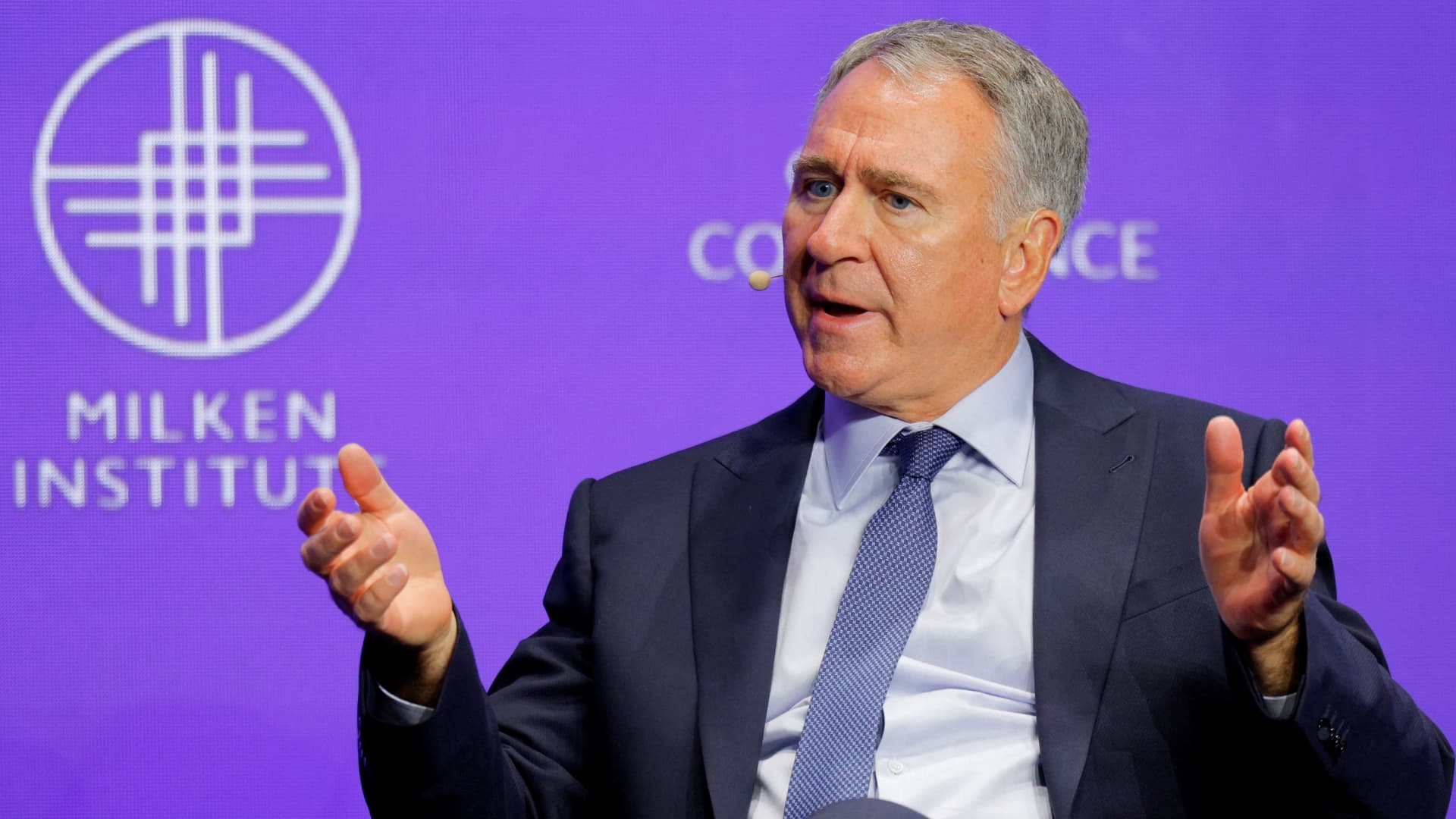
CEO of Citadel Ken Griffin is interviewed Chairman of the Milken Institute Michael Milken (not pictured) during the Milken Institute Global Conference 2025 in Beverly Hills, California, U.S., May 7, 2025.
Mike Blake | Reuters
Ken Griffin’s Citadel posted positive returns across its various hedge fund strategies in the first half of 2026, led by double-digit gains in its tactical trading and equities funds.
The hedge fund firm’s tactical trading fund, which combines discretionary equity investing with quantitative strategies, climbed 14.3% through the end of June after gaining 3.1% in June alone, according to a person familiar Citadel’s returns who asked not to be identified because the information is private.
Citadel’s tactical trading fund also weathered a late-June shakeout in quantitative investing. Quantitative investing relies on mathematical models, statistical analysis, machine learning and algorithms to identify investment opportunities, build portfolios and manage risk.
Earlier this week, Goldman Sachs’ prime brokerage unit told clients that between June 23 and Monday, systematic long-short strategies had just suffered their worst five-day stretch since December 2023, hurt largely by the unwinding of crowded trades and momentum positions on the short side.
Citadel’s tactical trading strategy avoided that latest sell-off, the person familiar said.
Citadel’s equities fund returned 11.2% in the first half after rising 3.5% in June, while its flagship multistrategy Wellington fund, the firm’s largest, gained 5.7% through the end of June following a 1.8% advance in June, the person said.
The firm’s global fixed income fund rose 1.7% in June, leaving it little changed for the year.
Citadel’s gains came during a volatile first half for financial markets. The S&P 500 climbed 9.6% through June, with the benchmark rebounding to fresh record highs after sliding for five straight weeks in February and March.
Investors first grappled with spikes in oil prices during the Iran conflict, questions over whether massive artificial intelligence spending will be sustained and shifting expectations for Federal Reserve policy, before the rally recently broadened out beyond just the largest technology stocks.
Citadel managed about $69 billion in assets as of June 1.
Citadel declined to comment.
Anthropic’s Claude Fable 5 faces growing backlash after its July 1 re-release. Users claim stricter guardrails have crippled the flagship model’s coding, debugging, and agentic performance.
Benchmark group BridgeMind reported steep score drops across its BridgeBench suite. Meanwhile, Anthropic maintains the underlying model is unchanged and attributes the friction to tighter safety classifiers.
Claude Fable 5 Benchmark Scores Collapse After Re-Release
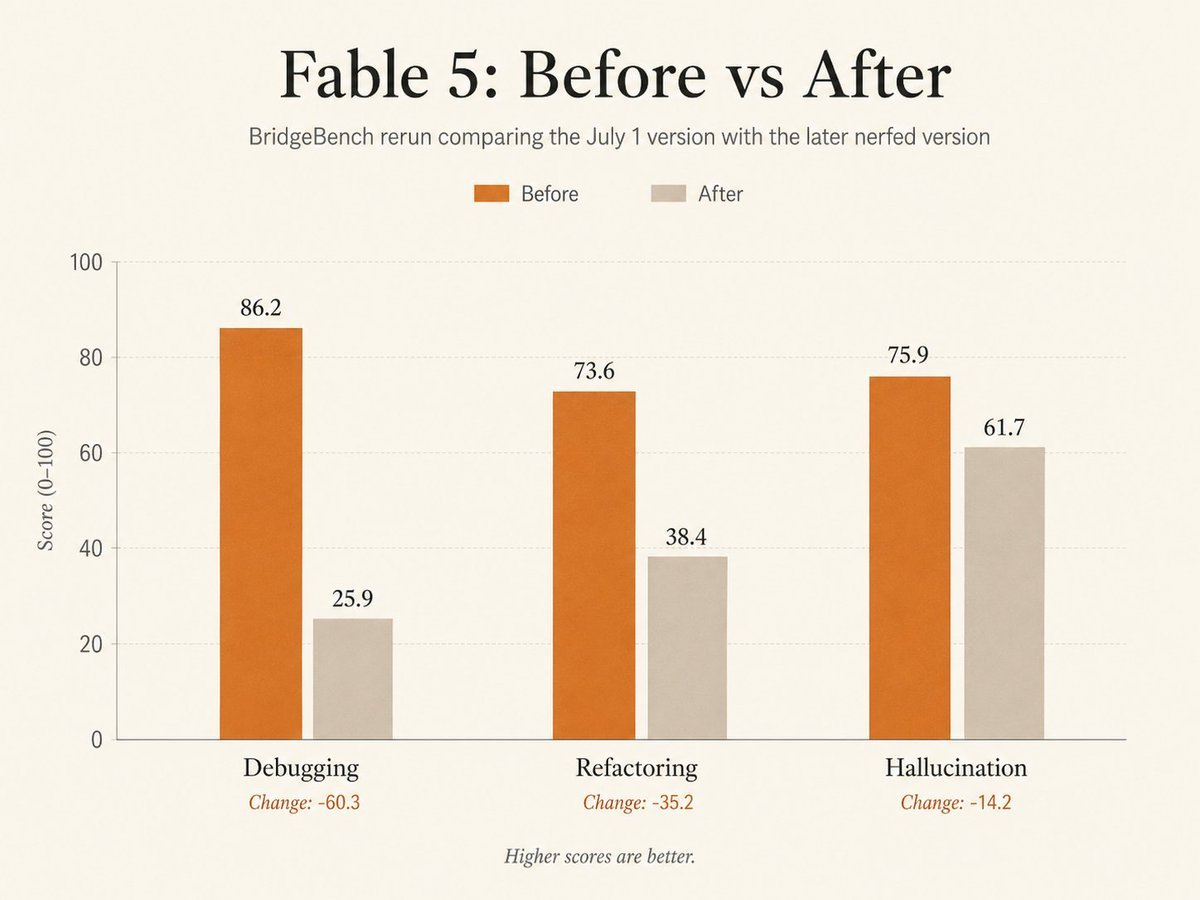
BridgeMind re-ran the July 1 version of Fable 5 and recorded sharp declines. Debugging fell from 86.2 to 25.9, refactoring dropped from 73.6 to 38.4, and hallucination handling slipped from 75.9 to 61.7.

The mechanics behind those numbers matter. Only three of 12 debugging tasks were completed without falling back to Claude Opus 4.8, and every fallback scored zero.
Therefore, the collapse reflects blocked tasks rather than weaker reasoning.
BridgeMind stressed that Fable 5 matches its June form when a task runs to completion.
“The model did not get worse. It got caged,” they indicated.
Follow us on X to get the latest news as it happens
The timeline explains the tension. Anthropic launched Fable 5 on June 9, and Washington pulled it offline three days later. Regulators lifted its export controls on June 30, four days after they restored Mythos 5 access for roughly 100 US institutions.
Restored access also carries limits. Fable 5 draws from just 50% of weekly usage caps through July 7, then shifts to paid usage credits.
Anthropic Defends Its Wider Safety Margin
Anthropic addressed the trade-off in a June 30 statement. The company said it deliberately widened its safety margin, meaning classifiers now block requests that are probably benign. An improved filter stops the bypass technique, Amazon researchers reported in over 99% of attempts.
Blocked requests route to Opus 4.8, and users receive a notification. However, Anthropic conceded the filter flags more legitimate coding and debugging work than before.
Its own tests also showed Fable 5 posed no unique risk. Rival models, including GPT-5.5 and Kimi K2.7, identified the same vulnerabilities.
Anthropic says US Commerce Department researchers tested both safeguard versions and judged them extraordinarily strong.
The stakes reach beyond one product cycle. The suspension pushed Europe to court Anthropic, while Chinese AI models gain ground on US frontier labs.
Anthropic is now drafting a jailbreak severity framework with Amazon, Microsoft, and Google. Whether classifiers shed false positives quickly may determine whether power users stay or defect.
The post Claude Fable 5 Backlash Grows as Users Say Anthropic ‘Caged’ Its Flagship AI appeared first on BeInCrypto.

Uplift Parsons standing desk review

Video in case against Pooh Shiesty shows him pressing for record label release, prosecutors say

Utz potato chip recall upgraded to FDA’s highest risk over salmonella


-

 Fashion6 days ago
Weekend Open Thread: Staud – Corporette.com
-

 Politics7 days ago
The House | Manchesterism won’t survive the painful trade-offs unless it gets citizens on board
-

 Crypto World3 days ago
Strategy authorizes up to $1.25B in Bitcoin sales under new capital plan
-

 Politics7 days ago
Potential 2028er World Cup attendee leaderboard
-

 Business7 days ago
Asia stock markets slide as tech shares slump
-

 News Videos4 days ago
MAJOR BITCOIN & MARKET UPDATE!!!! (MUST WATCH ASAP!!!)
-

 Crypto World5 days ago
Coinbase, Circle Deepen Crypto Stock Losses Despite Resilient S&P 500
-

 Tech3 days ago
Anonymous researcher drops 0-day ‘exploitarium’ repo
-

 Business3 days ago
Australia treasurer says alleged access of prime minister’s bank data ’incredibly concerning’
-

 Crypto World6 days ago
Kraken's xStocks Opens Bending Spoons IPO Registration to EEA Retail
-

 Crypto World7 days ago
Bitcoin Sparks $600M Hourly Liquidations With $65,000 Set To Become Resistance
-

 Sports6 days ago
FIH Pro League: India defeat Pakistan 7-1, register biggest win of campaign | Other Sports News
-

 Tech5 days ago
Bluekit phishing kit adopts browser-in-the-middle for login theft
-

 Tech5 days ago
Russian hackers now target Signal backup recovery keys
-
 Crypto World6 days ago
Hyperliquid Named on Singapore MAS Investor Alert Register
-

 Crypto World6 days ago
RTX holders must register wallets before token distribution begins
-

 Crypto World7 days ago
Tether (USDT) Passes Ether in Market Cap as ETH Drops Toward $1.5K
-

 Sports1 day ago
Broncos roster: OL Ben Powers (No. 74) entering final year of contract
-
 Business3 days ago
The AI boom won’t burst all at once. It will pop in ‘rolling bubbles’: Macquarie
-

 Tech5 days ago
Silicon Valley paid to kill AI regulation, now it wants the rules back
You must be logged in to post a comment Login