Micron and Anthropic announce four-part strategic agreement
Micron will adopt Claude models as both a daily driver and an assistant to oversee parts of its infrastructure stack
Despite billing itself as a full-stack collaboration, the agreement is silent on computational storage and processing-in-memory
Anthropic and Micron Technology have announced a new strategic agreement which will see the latter use Claude AI models to better oversee parts of its infrastructure stack.
However the move does have a curious aspect to it versus most other deals: generally, buyers tend to invest in their suppliers to support them financially while also benefiting in turn from the business they bring in.
We often see capital flowing the other way here, with Micron essentially investing in one of its largest customers for the foreseeable future.
Latest Videos From
AI to optimize memory and storage for AI consumption needs?
Anthropic runs some of the largest and most memory-hungry inference fleets in existence, and its telemetry on how HBM bandwidth, DRAM capacity, and SSD latency actually bottleneck real frontier-model serving is data Micron cannot generate internally, but it could learn how to work around these limitations while leveraging Claude to process said data to generate actionable optimizations across its organization.
Advertisement
Anthropic painted this as a solution to its scaling needs, noting that the agreement allowed it to work closer with Micron across two major segments: memory and storage.
“Our compute strategy depends on getting every layer of the stack right, and memory and storage are central to how efficiently we can train and serve Claude. Partnering with Micron means we collaborate closely on optimizing these systems for our workloads and secure the supply we need. As demand for Claude grows, this is how we scale our compute for the long term,” noted Tom Brown, co-founder and chief compute officer at Anthropic.
(Image credit: Micron)
The arguably more interesting part of this agreement is not what Micron already mentions, but what it chooses to gloss over. Not only do both companies fail to elaborate on the financial terms of their multifaceted agreement, but they also choose to skip mentioning what is increasingly becoming a core theme in AI inference workloads: Computational storage.
Advertisement
Sign up to the TechRadar Pro newsletter to get all the top news, opinion, features and guidance your business needs to succeed!
A growing share of Anthropic’s needs is inference-based, and that share is increasingly bound by memory bandwidth rather than computing power. Nvidia is already a few steps ahead in this department: at CES 2026, it announced the Inference Context Memory Storage Platform, which uses BlueField-4 DPUs to extend GPU KV cache into NVMe SSDs, a solution it calls CMX.
Micron’s (and by proxy, Anthropic’s) silence on the matter feels deliberate: the former benefits considerably from selling HBM to the highest bidder, and such solutions directly undercut or invite unfavorable comparisons to its most lucrative product lineup.
Advertisement
The latter simply has far too many options to tie itself to one particular supplier for all its inference needs; Anthropic currently has deals with AWS, Google, SpaceX, Broadcom, Microsoft, and CoreWeave to guarantee it compute, and by proxy, memory and storage needs, even as it has made strategic commitments with Nvidia to ensure it has access to its solutions.
With Anthropic’s most ambitious consumer-grade AI model, Fable 5, now back on the table, its route seems to be clear-cut: securing as much of Micron’s memory and storage supply as is possible while also making it a stakeholder in its success.
This is even as it turns to a mix of data center companies to address its short-term compute needs for a growing, and increasingly capable suite of AI models it offers to a diverse set of consumers, including governments. Its agreement with Micron is simply one of the strategic stepping stones the AI juggernaut had to take, even as it could look sideways for its computational storage needs.
Advertisement
The agreement, which has multiple facets, has been received well by investors, propped up the stock post-announcement by about 6%, with many factoring in Micron’s stake in one of the world’s most prolific AI companies positively.
Neither of the two companies mentioned the financial nitty-gritty of Micron’s investment or the supply agreement between the two even as they outlined how the planned to co-operate in the future.
This kind of deal, however, is not unique in the AI space, with Microsoft, which provided compute and cash to OpenAI in exchange for a stake in the company, and Nvidia making similar commitments with Anthropic’s rival in addition to a mix of data center and infrastructure companies, many of which are also direct customers of the world’s biggest AI hardware company.
Six new F-35Bs entered service carrying ballast inside their noses instead of radar
The APG-85 delay created stealth fighters without their primary sensor
Lot 17 redesign decisions eliminated compatibility with older radar hardware
The United States Marine Corps has accepted delivery of six newly built F-35B stealth fighters carrying ballast weights where a radar should be installed.
The aircraft left production lines without the AN/APG-85 radar that future F-35 variants are expected to rely upon for combat operations.
Instead of delaying delivery, officials accepted aircraft configured with dead weight occupying the nose section reserved for the missing equipment.
Latest Videos From
A new radar arrives before the aircraft can actually use it
The unusual situation emerged because Lot 17 aircraft were redesigned around the forthcoming AN/APG-85 radar architecture and mounting structure.
Advertisement
Those modifications prevent installation of the older AN/APG-81 radar, leaving no interim option while the replacement remains unavailable.
The radar is to be supplied by Northrop Grumman rather than prime contractor Lockheed Martin, further complicating delivery schedules.
Marine Corps Lieutenant General Gregory Masiello informed lawmakers on June 23 2026 that only six Marine aircraft currently lack installed radars.
Advertisement
Sign up to the TechRadar Pro newsletter to get all the top news, opinion, features and guidance your business needs to succeed!
Acceptance testing for those aircraft began in February 2026 after successfully completing production earlier in the year.
Although the Air Force and Navy have not yet received comparable aircraft, similar deliveries are reportedly expected later this year.
Without radars, the aircraft can support basic flight familiarisation and pilot instruction activities while remaining unsuitable for combat operations.
Advertisement
The Joint Program Office defended the decision, stating the Pentagon “deliberately undertook a highly concurrent development and production program for advanced capabilities.”
“This decision was made with full understanding of the risk of having production aircraft ready ahead of the capabilities.”
Advertisement
Delay exposes larger questions around F-35 readiness
The missing radar arrives amid wider concerns surrounding operational readiness across the broader F-35 fleet during fiscal year 2025.
Aircraft capable of performing at least one assigned mission reached 44.1%, although this remained considerably below historical expectations.
Masiello said he would not “dispute their numbers or how they do it” during congressional testimony discussing the findings.
Advertisement
Using Joint Program Office calculations, he argued the mission capable figure stood closer to 56% across operational fleets instead.
The delayed APG-85 radar forms part of the wider Block 4 modernization package that continues encountering schedule and integration challenges.
Future F-35 models will require more cooling capacity, as new systems will draw between 62 and 80 kilowatts, more than double the 32 kilowatts current hardware consumes.
A next-generation engine that could have addressed this cooling gap was developed but ultimately defunded after proving too costly.
Advertisement
Current plans indicate that the APG-85 will enter service around 2028 but meaningful cooling will not arrive until after 2031.
The sight of stealth fighters carrying lead ballast instead of radars may therefore become an enduring symbol of contemporary defence procurement realities.
The Godot Foundation will stop accepting AI-authored code, agent-submitted pull requests, and AI-generated text in contributor communications after maintainers were overwhelmed by low-effort submissions. “It is time for us to recognize that these problems aren’t going away and therefore we need to take steps to reduce the burden on maintainers while ensuring we still have a pipeline to mentor new contributors to become future maintainers,” the Godot Foundation said in a blog post. Contributors may still use AI for limited “menial things” if they disclose it, but humans must understand, own, and be able to fix the code they submit. PC Gamer reports: The Foundation says the pileup of Godot pull requests pending review isn’t all bad: It’s a sign that interest in using and contribution to Godot is increasing. But the influx of contributions authored or submitted by AI is sapping the projects’ maintainers of their willingness to confront the “already tedious” work of reviewing pull requests. “If your feedback on PRs is just being absorbed by a machine and not going towards mentoring a potential future maintainer, it becomes much harder to justify spending your free time on PR review,” the Foundation said.
As the problem becomes increasingly unsustainable, the Godot Foundation says it’s in the process of updating its contribution policies, focusing on “adding barriers to low-effort slop” contributions, encouraging maintainers to review code, developing new contributors into future maintainers, and crucially, requiring that all contributions come from humans who are accountable for their code — and fixing it if it fails. “AI cannot take responsibility, and we can’t trust heavy users of AI to understand their code enough to fix it,” the Foundation said.
The Foundation says we can expect Godot’s contributing policy to soon include explicit rejections of AI-authored code, noting that contributors should only use AI assistance for “menial things” and must disclose its use. Additionally, the Foundation will reject any AI-generated text in human-to-human communications, saying it’s “a basic principle of respect” — though it says machine translations “are still acceptable” if the original text was human-authored. “Things change every day with respect to the current suite of AI tools available,” the Foundation said. “We will continue taking a conservative approach in our policies towards them, but we will re-evaluate as things evolve.”
Sysdig says it has documented the first ransomware attack carried out end to end by an AI agent, which autonomously exploited exposed systems, stole credentials, established persistence, compromised a production database, and destroyed data. The research team named the attacker “JadePuffer” and said it gained initial access to an internet-facing Langflow instance by exploiting CVE-2025-3248. “The most striking characteristic, however, was the LLM’s behavior,” Sysdig director of threat research Michael Clark said in a blog post. An anonymous reader quotes an excerpt from The Register: JadePuffer’s “self-narrating” payloads “contained natural language reasoning, target prioritization, and the kind of detailed annotations that human operators don’t often write but LLM-generated code produces reflexively,” Clark added. “The operation also adapted in real time, retrying failed steps within refined parameters. In one sequence, it went from a failed login to a working fix in 31 seconds.” After exploiting CVE-2025-3248, a missing authentication vulnerability in Langflow that allows remote, unauthenticated attackers to execute arbitrary Python on the host, the AI agent began scanning for and collecting secrets, including LLM provider API keys, cloud credentials “with explicit coverage of Chinese providers” including Alibaba, Aliyun, Tencent, and Huawei, while also scanning for AWS, Azure and Google Cloud Platform, cryptocurrency wallets, and database credentials.
The AI also installed a crontab entry on the Langflow server to maintain persistence and call back to the attacker’s infrastructure every 30 minutes. JadePuffer’s intended target was a separate internet-exposed production server running a MySQL database and an Alibaba Nacos configuration service, we’re told. Nacos is an open-source service-discovery and dynamic configuration platform developed by Alibaba and used in the cloud provider’s microservices applications. The agent connected to the server’s exposed MySQL port using root credentials, although Sysdig doesn’t know how the attacker obtained them. These credentials weren’t stolen from the victim’s environment.
JadePuffer then attacked Nacos via multiple vectors including an authorization bypass flaw (CVE-2021-29441) and forging a valid JSON web token (JWT) using Nacos’s default signing key. Additionally, using its root database access, the LLM injected a backdoor administrator into the Nacos backing database. It ultimately encrypted all 1,342 Nacos service configuration items using MySQL’s built-in AES encryption function, and created an extortion demand, ransom note, Bitcoin payment address, and a Proton Mail contact […]. However, according to the threat hunters, the victim can’t recover the encrypted data, even if they paid the ransom demand, because the agent escalated “from row-level deletion to dropping entire database schemas, narrating its own targeting rationale,” without backing up any of the encrypted data.
We spend hours testing every product or service we review, so you can be sure you’re buying the best. Find out more about how we test.
I’ve said it before, and I’ll say it again: I have tested a vast number of desks. In fact, I would even be able to venture to say that I’m getting close to the arena of saying I’ve tested most of the key desks in the market.
Uplift has been stepping up their game big time. When I saw the Parsons and realized it came in a 48-inch-wide silhouette with those beautiful four legs and a sleek frame, I knew I needed to get my hands on it as soon as possible.
Advertisement
Personally, I was absolutely drawn to the sleek frame that wraps around the real walnut desktop. I chose a butcher-block walnut desktop, and I am absolutely in love with it. The material feels fantastic, and the quality is spectacular, and that’s coming from somebody who has seen a lot of desks. I have seen a lot of what companies consider their premium desktops, and Uplift stands out among the best.
The soft-touch desk legs and the frame around the desk are also a beautiful touch. Also worth mentioning are the four individual legs. Some desks use four legs for stability, but they are really just the same style as the two-legged, blocky look that everybody knows by now. Uplift chose to use more spindle-type legs that retract into themselves, and they look absolutely stunning, even when on wheels, as I have them. They are still stable and still look just as great.
While this desk really only has one potential flaw, it’s not even really a flaw. It’s simply just something to know. I have found my way around it, and you can as well with just some simple planning on the forefront. Without further ado, we can get into the full review
(Image credit: Collin Probst // Future)
Advertisement
Uplift Parsons Standing Desk: Price and Availability
My desk configuration alone was about $2,000, including the desktop upgrade, the wheels, some power and lighting, and a few other accessories.
Sign up to the TechRadar Pro newsletter to get all the top news, opinion, features and guidance your business needs to succeed!
I specifically chose to get the power inlay from Uplift so that it could mount seamlessly to the frame and not have to be bolted into the beautiful wood desktop. I also chose to get the wheels so that I can move this thing around a little bit more easily.
Advertisement
I chose to get the Bluetooth upgrade so that when I wanted to control my Bluetooth from my phone, or when Uplift decides to upgrade their app to be more integrated with my day-to-day technologies, then I could utilize this to its fullest.
The desk was roped in within just a matter of days and assembled quickly as well. I don’t remember the exact time, but I believe it was just under 30 minutes, and then it took me several hours to set everything up on top just right. I’ve been tweaking ever since I built it, which was now, at this point, a hundred days ago or more.
Uplift Parsons Standing Desk: Unboxing and First Impressions
For most desks, I look at the sizing online, estimate the space I have and the features I want to showcase with this desk, and order that way. For this desk, I actually had a very specific spot I could fit it into, so unlike other desks, I measured more than I normally do to make sure it fits perfectly.
Advertisement
Thankfully, Uplift is very true to size, and their desk is exactly 48 inches wide, not 48 in a hair or just over, just under, but it is exactly 48 inches. When I measured and made room for a 48-inch-wide desk, this was spot on. The frame doesn’t jut out past it, nor does the desk overlay the frame to add more width. The one thing that does extend a little bit past it is the wheels, but I can just have those swivel in and out instead of out and around when moving the desk.
Assembly was incredibly easy and straightforward, as all the Uplift desks are. I was even able to assemble it in the small room where I was going to have the desk, because assembly was so straightforward. I didn’t need a ton of space to spread things out and make a mess. I could do it in a pretty tight space and assemble everything to get it up and running.
It was a quick little build session, and then I spent an absurd amount of time tweaking every little thing about the setup on top of the desk when it came to monitors, placement, docks, and the like.
Since I was going with such a small desk, I wanted to make sure that it was of the highest quality that I could find. That’s where I’m thrilled that I was able to get my hands on the Parsons in such a short time. I chose the Walnut Butcher Block, and when I say that this is some of the most beautiful wood I’ve ever seen, I genuinely mean it. Some desk companies use MDF wrapped in laminate walnut or walnut pieces, but Uplift uses genuine materials and makes an absolutely beautiful desk that you can feel and tell the difference in right away.
This smoke-gray or light-black frame is also fantastic. Feels good in the hand and is made of quality materials. It’s not a plasticky frame or something that you feel like is going to chip away, but it’s metal parts that click together, forming a sturdy frame to support the weight of the desktop and everything you put on top.
One of the things that Uplift does really well is the allowed cutouts for grommets or power inlays at the top corners or the middle of the desk. For this desk, I chose to add one grommet hole in each back corner, allowing me to install a storage cup in one grommet and a power inlay in the other.
Another spot where Uplift has added some holes is the front plate of the frame to allow for an inlay control panel. This lays flat against the front face of the desk, and it is super clean. The buttons are easy to press. There are four presets, a height readout on the screen, and it’s quite aesthetic. All Things considered.
Advertisement
Uplift Parsons Standing Desk: In use
(Image credit: Collin Probst // Future)
I’ll start with the two things I wish were different about this desk and get those out of the way.
First, the ledge of this desk, or more like the frame, will make it hard for some monitor arms to mount. Not all, just some. Depends entirely on how the clamp works and what that shape looks like. I was able to get two different models with it. Clearly this is not an all-or-nothing problem, but something worth noting if you already have the monitor arm picked out.
Second, I wish that this desk could go just a little bit higher. This is an edge case and truly not a need in any way, shape, or form, nor even a negative about the desk. If it could go just a little higher, I could slide my chair completely under the desk to make space in a small office.
Advertisement
This could also be solved by removing the headrest from my LiberNovo Omni Pro chair. Again, not a negative on the desk at all, just one very, very niche and specific wish.
(Image credit: Collin Probst // Future)
Now to talk more about my use case with this desk. I have this as my main desk, which I use some on the weekend and then Monday through Wednesday at the church where I work. Currently, until we finish the renovations, my office is a multi-purpose room used for other things on the weekend as well. The space I had to fit into was unique and only 48 inches wide.
When I saw that the Parsons could fit a 48-inch desk, I was absolutely ecstatic! Even though I didn’t have a ton of room to work with, I knew I would still need this desk to be highly functional because of the nature of what I do both at the church and outside.
This desk needed to be able to house:
Advertisement
Two large monitors
My laptop and iPad or two
Accessories like mouse and keyboard
Chargers
Power
Lighting
Plenty of ports which would require a docking station or two
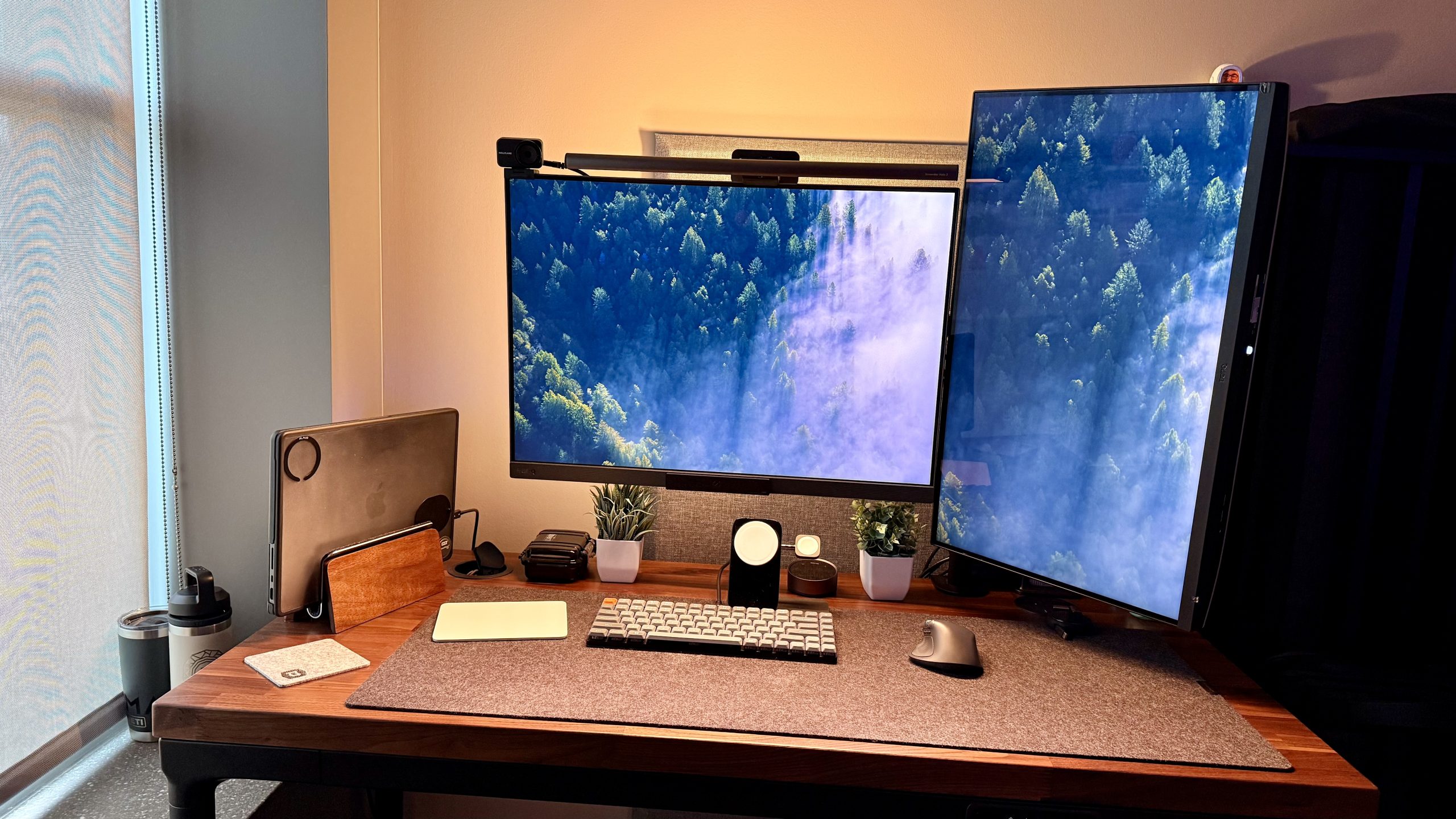
Lastly, I also wanted this to be a hot desk, so a single cable to run it all, with a mouse and keyboard that could switch between whatever was plugged in, which, of course, meant more ports. I chose a Keychron keyboard, the Logitech MX Master 4 mouse, and a Magic Trackpad for some niche scenarios. The keyboard is wired down to a dock that I actually mounted underneath the desk to save space, and so is the dongle for the MX Master 4 mouse. The Magic Trackpad is only used with my MacBook and is wireless over Bluetooth.
Along with those accessories, I have my BenQ RD280UG monitor in landscape on a monitor arm; then I have the brand-new (review coming soon) BenQ MA270UG in portrait off to the right of my main monitor. To the left, I have a Grovemade vertical stand for my MacBook, an air purifier from Uplift, and I still have room for a felt desk pad, and I don’t feel cramped at all.
One thing that helped, of course, was mounting so much underneath the desk and adding a BenQ light bar on top of the main monitor to avoid having another thing on the desk itself.
That’s a lot of material on my desk and a lot more underneath my desk, and still the Parsons shines.
It looks clean and elegant. It’s minimal. It works beautifully. There are absolutely zero issues in my well over a hundred days of testing this desk every single week, at least five to six days a week, with upwards of six to eight hours straight working at this desk, going up and down several times an hour.
Advertisement
If you’re trying to build out an entire workspace, Uplift also has phenomenal shelves, organizers, storage, and other accessories and furniture you should check out. All made from the same incredibly high quality.
Uplift Parsons Standing Desk: Final verdict
(Image credit: Collin Probst // Future)
After 100 days, this is still one of my favorite desks. It’s clean, elegant, simple, and it doesn’t make me feel bad for having a small desk in the slightest. Rather, it makes me feel great about optimizing such a small space to create something amazing, and all that is made possible by the stability and quality of the Uplift desk.
If it weren’t for this quality, I wouldn’t feel comfortable mounting the things I have. If it wasn’t for the slimmest and cleanest design, I couldn’t have put a desk where I did in the first place. Thanks to all of these things, this desk is so incredible.
Advertisement
If you’re looking for a small or simply elegant desk to put in a non-traditional office, or you just care about your design, then you should check out the Uplift Parsons desk in all of its many shades of colors and materials. This desk is high quality. It’s rather pricey, and it holds up to its reputation as a top-tier desk.
The US unemployment rate fell to 4.2% in June largely because 720,000 people left the labor force, pushing participation to 61.5%. Excluding the Covid-era jobs market, that’s the lowest participation rate since June 1976. CNBC reports: The decline in the labor force marks a “massive exodus” driven by multiple factors, said Mike Reid, head of U.S. economics at RBC. “The unemployment rate fell to 4.2% as both the number of unemployed workers and the size of the labor force pulled back,” Reid wrote in a post-report commentary. “This may well be a story of retirements but could also be a story of prior job seekers dropping out of the labor force.”
[…] [T]he rolls of those counted as not in the labor force, a group that includes the unemployed and those not looking for work, jumped by 832,000. And while the establishment survey, which counts jobs filled, showed growth for the month of 57,000, the survey of households, which counts the actual level of those working, tumbled by 507,000. On a year-over-year basis, the labor force is down by just over 1 million, while the level of the employed also has fallen by 1.06 million and the ranks of the unemployed have risen by 40,000. The employment-to-population ratio slipped to 59% in June, the lowest since October 2021. All that has happened while the unemployment rate has risen by just one-tenth of a percentage point to 4.2%.
The drop in participation is sometimes attributed to a shrinking immigrant population and retiring baby boomers and Gen Xers. However, in June the biggest plunge came from what is defined as “prime age” workers, or those between the ages of 25 and 54. That rate fell 0.6 percentage point to 83.3%, its lowest since December 2023. “Looking at the statistics now, that argument doesn’t hold up so well,” North said of the retirement and immigration rationale. “I hate to use the word ‘alarming,’” he added, but said the numbers are cause for concern.
Researchers from LayerX recently unveiled BioShocking, a new type of vulnerability designed to target AI-powered browsers capable of executing autonomous tasks on the open web. The security firm explained that BioShocking can “game” an AI-based browser, causing the system to execute malicious instructions after effectively bypassing its intended security guardrails. Read Entire Article Source link
In the wake of the Sprint T-Mobile merger, wireless carriers immediately stopped trying to compete on price (exactly what deal critics had warned would happen when you reduce sector competition). T-Mobile, which once tried to differentiate itself as the consumer-friendly “uncarrier,” almost immediately began behaving just like AT&T and Verizon, starting with firing 9,000+ people.
It’s how mindless and harmful consolidation always works. We know this, there’s endless evidence of this, and somehow it never seems to matter in a country too corrupt to function.
In the last few years, T-Mobile’s been facing lawsuits and consumer blowback because it’s constantly jacking up the price for customers who believed they were under a “price lock” guarantee thanks to a 7-year-old promotion promising that their price would never change.
More recently, T-Mobile announced it would be kicking roughly 8 million subscribers off of their traditional (and often cheaper plans), and onto more expensive and shittier new T-Mobile plans. These new price hikes have joined a bunch of other price hikes to make everybody’s bills significantly more expensive and all of their connections less feature rich and useful:
Advertisement
T-Mobile frames the current migration as an average $4-per-line adjustment, according to CNET. That sounds modest until you stack it on the $5-per-line hike that already hit many legacy smartphone plans back in April 2025. PhoneArena reports some customers on older grandfathered plans face total increases approaching 60% compared to their original rates. Meanwhile, administrative fees for voice lines climbed from $3.99 to $4.49 per month — raised twice within a single year, according to tmo.report — with mobile internet line fees moving from $1.60 to $2.10.
This must be more of that deregulatory, consolidative innovation my Libertarian friends at “non profit” “free market” “think tanks” have spent years telling me about.
This was, of course, something merger critics warned about, very vocally, for a long time. I wrote repeatedly, at multiple outlets, about how this deal’s pre-merger promises were utterly worthless. It didn’t matter, because the federal government is too corrupt to function in the public interest, antitrust reform no longer exists, and the electorate very clearly has a head full of cottage cheese.
Meanwhile all the folks responsible — whether corrupt politicians, shitty Libertarian free market think tanks, or cocky executives — have long-since moved on to other terrible ideas and memory holed the entire thing, while consumers and labor — as always — are forced to eat all of the real-world costs.
Anthropic is discussing a custom AI chip with Samsung, though the project is early-stage and no design has been finalized.
Anthropic is in talks with Samsung Electronics to explore manufacturing a custom AI chip, The Information reported on Thursday. The project remains at an early stage, and Anthropic has not yet decided what the chip would be used for, how powerful it would be, or how it would fit into a server, according to the report. The company could still abandon the effort entirely.
When asked for comment, Anthropic told TechCrunch that a diversified hardware stack including chips from Google, Amazon, and Nvidia will continue to be central to its compute strategy, and said it had nothing further to add on the Samsung discussions. Samsung already plays a significant role in the AI chip supply chain as a major manufacturing partner for Nvidia, producing chips that power AI training and inference workloads. The two companies are also building an AI chip factory together in South Korea.
The talks follow a Reuters report in April that Anthropic was exploring the idea of building its own chips as Claude’s compute demands outpaced available supply. At the time, the effort was described as preliminary, with no dedicated team assembled and no commitment to a specific design. What has changed since April is that Anthropic has hired Clive Chan, who previously helped build OpenAI’s custom chip programme, a signal that the company is moving from exploration to active development.
Advertisement
The timing also coincides with a move by Anthropic’s main competitor. Last week, OpenAI unveiled its first custom chip, a Broadcom-built inference processor it calls the “Intelligence Processor,” designed to reduce the company’s dependence on Nvidia hardware. Amazon and Google both already offer their own custom silicon through their cloud platforms, and Anthropic currently runs Claude across all three chip families.
Anthropic’s annualized revenue run rate surpassed 30 billion dollars earlier this year, more than tripling from roughly nine billion dollars at the end of 2025, a growth rate that makes the economics of custom silicon increasingly attractive. The company signed a long-term deal with Google and Broadcom in April for roughly three and a half gigawatts of TPU compute starting in 2027, but designing its own chips would give it an additional layer of control over the hardware that runs its models. Whether Samsung or another manufacturer ultimately builds a chip for Anthropic remains an open question, but the direction of travel across the industry, away from total reliance on Nvidia, is now unmistakable.
Microsoft executive Nick Parker at a conference in 2018. (Microsoft Photo)
Nick Parker, a 26-year Microsoft veteran who led the company’s worldwide commercial sales business, is leaving to become Nvidia’s new sales chief — a high-profile talent shift between two of the biggest players in the AI boom.
Parker will join Nvidia as executive vice president of worldwide field operations, effective Aug. 24, according to a regulatory filing. He succeeds Jay Puri, who is retiring after 21 years running Nvidia’s global sales operation and will stay on as a senior adviser.
“Microsoft and NVIDIA are great partners and I look forward to continuing to nurture that fantastic relationship,” Parker wrote in a LinkedIn post announcing the move.
The regulatory filing by Nvidia sets Parker’s base salary in the new role at $1 million, with a $5 million signing bonus and equity grants targeted at $40 million. The bulk of that, $35 million in restricted stock units, vests over roughly four years, while the additional $5 million in shares is tied to Nvidia outperforming the S&P 500 over three years.
The new role puts him in charge of global sales and customer relationships at the center of the AI boom, reporting directly to Nvidia CEO Jensen Huang — one of the most consequential commercial roles in the industry, overseeing the operation that sells Nvidia’s chips to the world’s largest companies.
Advertisement
Parker, 55, rose through OEM, device and partner sales roles at Microsoft before being named president of industry and partner sales in 2022. After a promotion this year, he served most recently as executive vice president and chief business officer of Microsoft Worldwide Sales & Solutions, reporting to Judson Althoff, CEO of Microsoft’s commercial business.
Puri, 71, is credited with helping transform Nvidia from a consumer gaming brand into an AI infrastructure giant, building the enterprise sales operation Parker will now inherit.
On Thursday, Microsoft unveiled a $2.5 billion initiative called the Microsoft Frontier Company, which will embed AI engineers inside customers. It will be led by Rodrigo Kede Lima, a longtime Microsoft sales and enterprise leader, most recently president of Microsoft Asia.
Samsung is plotting to replace your M.2 SSD with a storage chip smaller than a fingernail to improve battery life and supercharge ondevice AI inference
Samsung reveals industry first UFS 5.0 storage: A single fingernail-sized chip that can read at up to 10.8GB/s
With capacities of up to 1TB on offer, it makes a solid case for displacing existing M.2 drives in laptops, handhelds and game consoles amongst other hardware
The chip is also relevant for AI, offering a significant increase in read speeds for on-device AI solutions as a 40% decrease in power consumption versus UFS 4.1
Samsung has unveiled what it says is the industry’s first look at UFS 5.0, a new storage standard for its customers.
The memory and storage giant unveiled its new storage chip on the 23rd of June while positioning its embedded storage standard as an important breakthrough for localized, or on-device, AI solutions.
Samsung claims its chips are based on the standard feature a sequential read speed of up to 10.8 GB/s and a sequential write speed of up to 9.5 GB/s, making them more than twice as fast as the previously mainstream UFS standard, which clocks in at 4.2 GB/s and 2.8GB/s respectively.
Latest Videos From
Faster, less power hungry flash in a more compact package
Samsung’s latest offering isn’t just an iterative upgrade in raw speeds compared to past generations; it sets the stage for devices that have yet to come as the world grapples with the need for on-device AI solutions, even as demand for more localized solutions dwarfs expectations among many manufacturers.
Advertisement
With generative AI often leveraging fast NAND flash as a substitute for relatively more expensive DRAM even as smartphones and computers are increasingly hit by rising prices for both components, Samsung’s UFS 5.0-based offering fills an important gap for many of its OEM customers as well as its own smart devices lineup.
“In the era of on-device AI, storage devices are evolving into a key driver defining AI experiences,” noted Jangseok Choi, head of Memory Product Planning at Samsung Electronics.
“As we successfully move beyond the development stage of the industry’s first UFS 5.0 solution, Samsung is setting a new standard for storage on the go and will continue to drive innovation for the next-generation mobile platform market.”
Advertisement
Sign up to the TechRadar Pro newsletter to get all the top news, opinion, features and guidance your business needs to succeed!
As AI solutions range from hyperscalers to things smaller than smartwatches, Samsung’s offering becomes even more important. The package for its solution is 16.7% smaller than its previous-generation offering, measuring just 7.5mm x 13mm x 0.9mm, or smaller than most people’s fingernails.
Samsung’s most important achievement, however, might be the 40% power efficiency it claims to offer compared to its new chip’s predecessor, while delivering speeds that effectively make its solution viable for most local models to run on.
With Samsung touting 5x faster random read speeds, it is clear that it is aiming to position its upcoming UFS module as a de facto solution for downstream AI inference, and it could pose a very real threat to some of the most powerful NVMe SSD drives out there.



























































You must be logged in to post a comment Login