Connect with us
DAPA Banner
DAPA Coin
DAPA
COIN PAYMENT ASSET
PRIVACY · BLOCKDAG · HOMOMORPHIC ENCRYPTION · RUST
ElGamal Encrypted MINE DAPA
🚫 GENESIS SOLD OUT
DAPAPAY COMING

Business

Polibeli Group Shares Surge 13% on AI Infrastructure Pivot as Small-Cap Trader Eyes Southeast Asia Expansion

Published

on

Polibeli Group Shares Surge 13% on AI Infrastructure Pivot as

Polibeli Group Ltd. shares jumped more than 12% to $9.80 in morning trading Thursday, extending recent gains as the digital supply chain company advances its strategic shift toward artificial intelligence computing infrastructure opportunities in Southeast Asia.

The move comes weeks after the company announced a review of potential AI-related initiatives and follows a non-binding memorandum of understanding signed late June to explore development of a large-scale AI computing center. Investors appeared to reward the pivot, with trading volume elevated as the small-cap stock attracted renewed attention in a market hungry for AI exposure.

Polibeli Group, a Cayman Islands-incorporated holding company with operations centered in Indonesia, provides digital supply chain and distribution services across Southeast Asia, Japan, Hong Kong and beyond. The company operates platforms connecting small and medium-sized retailers with procurement, logistics and marketing solutions, dealing in consumer electronics, household goods, beauty products and other categories.

Its core business has faced challenges, reporting net losses in recent years amid competitive pressures and operational scaling. For the year ended Dec. 31, 2025, revenue stood at approximately $26.42 million with a net loss of $5.97 million. Earlier periods showed similar profitability pressures as the company invested in platform development and regional expansion.

Advertisement

Leadership transitions have also marked recent months. In May, the company announced the resignation of its chief financial officer, followed by the appointment of Meijun Liang to the role in June. Such changes often accompany strategic refocus efforts in small public companies.

Strategic Review Targets AI Growth

On June 12, Polibeli Group disclosed it was evaluating opportunities in AI computing infrastructure services as part of its long-term growth strategy. Management highlighted the global significance of AI trends and the potential to leverage existing regional presence, customer networks and technology capabilities.

The company has been monitoring AI market developments closely. In a recent filing, it signaled intent to identify projects that could complement current operations and create additional value for customers and shareholders.

The late-June MOU with Authaikam Company Limited targets exploration of a potential 100MW AI computing center in Thailand. While non-binding, the agreement marks a concrete step toward infrastructure ambitions in a region benefiting from data center demand driven by cloud computing and AI applications.

Advertisement

Analysts and market watchers note that successful execution could transform Polibeli’s profile from a regional trading and logistics player to one with exposure to high-growth technology infrastructure. However, the capital-intensive nature of data centers and AI facilities presents execution risks for a company with a modest balance sheet and history of losses.

Operational Footprint and Market Position

Polibeli’s Polibeli Platform and related apps serve SMEs by offering one-stop procurement and sales tools. The business model emphasizes efficiency in supply chains spanning multiple countries, with significant sourcing from China and distribution across Asia.

Seasonality affects results, with stronger performance typically in the second half of the year ahead of holiday periods. Competition in digital commerce and B2B services remains intense, requiring continuous innovation and cost management.

The company’s recent SEC filings, including a Form F-1 registration effectiveness in late June, reflect ongoing efforts to maintain compliance as a Nasdaq-listed entity. Public listings provide access to capital markets but also impose reporting and governance standards on smaller firms.

Advertisement

Shares have shown high volatility typical of micro- and small-cap stocks, with a 52-week range reflecting both enthusiasm around strategic announcements and pressures from operational results. Market capitalization stands in the low billions, classifying it as a small-cap issue sensitive to news flow.

Broader AI Infrastructure Boom

Polibeli’s moves align with a global surge in demand for AI computing power. Data centers capable of supporting large language models and inference workloads require substantial energy, land and specialized equipment. Southeast Asia has emerged as an attractive region due to lower costs, improving infrastructure and government incentives in countries like Thailand, Indonesia and Malaysia.

Major technology firms and hyperscalers continue expanding capacity worldwide, creating opportunities for regional players. Success for Polibeli would depend on securing partnerships, financing and technical expertise to compete or collaborate effectively.

Investors should weigh the speculative nature of such pivots. Many small companies announce AI initiatives to boost visibility, but few deliver material revenue or profits in the near term. Polibeli’s track record as a supply chain operator provides some operational foundation, yet infrastructure represents a significant departure requiring new capabilities.

Advertisement

Financial Considerations and Risks

With limited cash reserves relative to potential project scales, Polibeli may need to pursue funding through debt, equity offerings or joint ventures. Dilution risks for existing shareholders remain a concern in capital raises.

The company’s financial statements highlight ongoing losses and negative margins, underscoring the need for improved operational efficiency alongside growth initiatives. Gross margins have been thin, reflecting competitive pricing in trading and logistics.

Broader market risks include regulatory changes in crypto or technology sectors, though Polibeli’s focus appears centered on traditional infrastructure rather than digital assets. Geopolitical tensions in Asia could affect supply chains and investment climates.

Positive developments, such as definitive agreements on the Thailand project or additional AI partnerships, could sustain momentum. Conversely, delays or unfavorable terms might pressure the stock.

Advertisement

Outlook for Small-Cap AI Plays

Polibeli joins a cohort of smaller firms attempting to capitalize on AI enthusiasm. While the sector offers substantial long-term potential, historical patterns show high failure rates for companies shifting business models dramatically.

Market participants will monitor upcoming filings and potential updates on the strategic review. Any concrete progress toward revenue-generating AI projects could significantly re-rate the company’s valuation, currently elevated on a price-to-sales basis given recent losses.

For long-term investors, the story hinges on execution in a competitive landscape dominated by larger, better-capitalized players. Short-term traders, meanwhile, may continue reacting to news catalysts and volume spikes.

As of midday trading, gains appeared supported by retail and momentum interest, though sustainability depends on fundamental progress. Polibeli’s journey illustrates both the opportunities and challenges facing small public companies in rapidly evolving technology sectors.

Advertisement

The stock’s performance underscores investor appetite for AI-themed stories, even at early stages. Whether Polibeli can translate announcements into tangible results will determine if the recent surge marks the start of a sustained rerating or a short-lived trading event.

Continue Reading
Click to comment

You must be logged in to post a comment Login

Leave a Reply

Business

Tibetan man dies after setting himself on fire near UN headquarters, activists say

Published

on


Tibetan man dies after setting himself on fire near UN headquarters, activists say

Continue Reading

Business

Friday’s Puzzle Is One of the Easiest of the Entire Week

Published

on

Nancy Guthrie

Friday’s Wordle puzzle brought welcome relief to players who had struggled through some of the trickier words of the past several days, with puzzle number 1,840 featuring a familiar, commonly used five-letter noun that most players were able to crack well within the six-guess limit.

The answer to today’s Wordle is a word with several distinct meanings across music, sports and law enforcement. Most immediately recognizable as the thin stick wielded by an orchestra conductor to keep rhythm and direct an ensemble, it also describes the short tube passed between runners during a relay race, a staff carried by a drum major or majorette, and a truncheon or club used as a symbol of authority or as a defensive tool. The phrase “passing the ___,” meaning to hand off a responsibility or role from one person to the next, has embedded the word deeply into everyday English usage well beyond its literal contexts.

According to the New York Times’ WordleBot, the average player completes Wordle puzzle 1,840 in 3.6 moves in easy mode or 3.5 if playing by hard rules, making it one of the more accessible puzzles of the week. The answer contains three of the five most common letters in Wordle answers, which helped experienced solvers narrow the field quickly with their opening guesses. Tom’s Guide noted that starting with the popular opener ORATE revealed O, A and T as yellow letters, leaving just 23 possible answers remaining after only the first guess, an unusually helpful first-move outcome.

The word’s letter structure follows a clean consonant-vowel-consonant-vowel-consonant alternating pattern, which players who recognized that sequence early in their guessing process were able to exploit for a rapid solve. It contains no repeated letters and no particularly unusual consonants, two characteristics that kept the puzzle accessible even for players whose opening guesses did not immediately hit multiple yellow or green tiles.

Advertisement

The absence of repeated characters distinguishes today’s answer from several recent puzzles, including PUPPY from earlier this week, which relied on a doubled P, and DEMUR, which introduced less common letters that sent some regular players down misleading paths. The run of unusual and moderately difficult answers leading up to today’s puzzle had tested players’ streaks and patience, making Friday’s more straightforward selection a comparatively gentle close to the working week.

WordSolverX noted that starting with a word like CRANE would have highlighted the A and N positions effectively, setting up a direct path to today’s answer for many solvers. Other effective second-guess words included TALON, which shares multiple letters with the solution and would have helped players confirm positions while clearing additional unknowns from their remaining pool of possible answers.

The word has appeared in a variety of competitive contexts beyond the relay race setting it is perhaps most associated with in the United States. In classical music tradition, the conductor’s baton became a standard tool only in the 19th century, with early orchestral leaders using rolled sheets of paper, violin bows or simply their hands before the modern slender white baton entered common use. In law enforcement contexts, the term covers batons ranging from standard-issue police truncheons to expandable side-handled designs, while in ceremonial contexts, a baton carried by a field marshal or other senior military figure historically served as a physical symbol of rank and authority.

The puzzle was edited by Tracy Bennett, who serves as the New York Times’ primary Wordle editor and is responsible for the daily selection that lands in front of millions of players worldwide each morning at midnight local time. The game was originally created by software engineer Josh Wardle in 2021 as a private project for his partner before going viral globally in January 2022 and being acquired by the Times in early 2022 for a reported seven-figure sum. It has since grown into one of the most widely played daily word games in the world, with the publication maintaining its pledge that the puzzle will remain free to play regardless of subscription status.

Advertisement

For players who missed today’s puzzle or want to revisit previous answers, the ten most recent Wordle solutions before today were MAVEN, DEMUR, PUPPY, CRUDE, EMCEE, SCOOP, ACUTE, UNITY, QUEER and CURRY, reflecting the variety of word types, letter patterns and difficulty levels that the Times’ puzzle team rotates through to keep daily players engaged without allowing any single approach or strategy to dominate across extended stretches of consecutive puzzles.

Continue Reading

Business

ECAT CEF: Dividend May Be Reduced Following Saba Capital Drama (NYSE:ECAT)

Published

on

ECAT CEF: Dividend May Be Reduced Following Saba Capital Drama (NYSE:ECAT)

This article was written by

Financial analyst by day and a seasoned investor by passion, I’ve been involved in the world of investing for over 15 years and honed my skills in analyzing lucrative opportunities within the market.I specialize in uncovering high quality dividend stocks and other assets that offer potential for long term-growth that pack a serious punch for bill-paying potential. I use myself as an example that with a solid base of classic dividend growth stocks, sprinkling in some Business Development Companies, REITs, and Closed End Funds can be a highly efficient way to boost your investment income while still capturing a total return that follows traditional index funds. I created a hybrid system between growth and income and manage to still capture a total return that is on par with the S&P.

Analyst’s Disclosure: I/we have no stock, option or similar derivative position in any of the companies mentioned, and no plans to initiate any such positions within the next 72 hours. I wrote this article myself, and it expresses my own opinions. I am not receiving compensation for it (other than from Seeking Alpha). I have no business relationship with any company whose stock is mentioned in this article.

Seeking Alpha’s Disclosure: Past performance is no guarantee of future results. No recommendation or advice is being given as to whether any investment is suitable for a particular investor. Any views or opinions expressed above may not reflect those of Seeking Alpha as a whole. Seeking Alpha is not a licensed securities dealer, broker or US investment adviser or investment bank. Our analysts are third party authors that include both professional investors and individual investors who may not be licensed or certified by any institute or regulatory body.

Advertisement
Continue Reading

Business

PE-backed skills specialist Leep buys Midlands-based E.Quality Training

Published

on

Business Live

Leep Group has been backed by Palatine’s Impact Fund since 2020

Female Student Raising Hand To Ask Question In Classroom

E.Quality Training Limited, which helps 16 to 19-year-olds who are not currently in education, employment or training(Image: Getty Images)

A private equity-backed skills and development firm has acquired a Midlands vocational training specialist in a move that will see it start working with 16 to 19-year-olds for the first time.

Manchester’s Leep Group won the backing of Palatine’s Impact Fund in 2020 and had already made three acquisitions. It has now acquired Staffordshire ’s E.Quality Training Limited, which helps 16 to 19-year-olds who are not in education, employment or training (NEET) to find work.

E.Quality Training was founded in 1999 by Robert and Majella Cocks and today employs around 30 people, including 18 experienced tutors. It runs Department for Education (DfE)-funded courses in childcare, health and social care, and beauty, from training centres in Hanley, Newcastle-under-Lyme and Stafford.

After a handover period, Following a period of handover, E.Quality Training will be integrated into Leep’s Back 2 Work division that delivers adult employability and training services. The deal will take Leep’s annual revenues to around £33m, with some 470 staff.

Advertisement

Luke Muscat, co-founder and CEO of Leep Group, said: “The E.Quality Training team are doing critically important work helping young people who have disengaged from education and have yet to enter employment build their skills and confidence. Often these young people are hard to help and hard to reach.

“We look forward to bringing our expertise in delivering training in other disciplines, such as digital, tech, AI and green skills, so that E.Quality can expand its reach and do more to help these young people find their way into work — while also supporting sectors of the economy facing major skills shortages.”

James Gregson, Impact Fund partner at Palatine added: “This is another attractive and complementary strategic bolt-on for Leep, which not only increases its regional presence in the Midlands but also brings expertise and understanding of the age 16-19 training market, where we see significant growth potential.

“Most importantly, this latest acquisition will help Leep Group continue to deliver on its mission of powering up potential by transforming lives through skills development and training and making a positive contribution to society.”

Advertisement

The sellers were advised by Lewis Pearson, at accountancy firm DJH.

Continue Reading

Business

Collateral Damage: Proprietary traders feel the squeeze under RBI’s new rules

Published

on

Collateral Damage: Proprietary traders feel the squeeze under RBI's new rules
Mumbai: Proprietary trading desks are bracing for challenging times as the Reserve Bank of India‘s new rules requiring banks to collect 100% collateral against bank guarantees (BGs), effective July 1 is seen increasing funding costs and squeezing profitability.

These firms, which trade with their own capital, use a bank guarantee to put them as collateral with exchanges or clearing corporations for margins. It allows them to meet part of that collateral requirement without parking the equivalent amount of cash with the clearing corporation.

The new framework requires bank financing to capital market intermediaries for proprietary trading to be backed by 100% collateral. Before July 1, proprietary traders could obtain bank guarantees by providing margins covering about 50% of the guaranteed amount. The higher funding costs could not just impact these firms but also trading volumes, industry participants said.

“This is likely to have a dual effect of raising impact costs and reducing trading volumes,” said Ketan Marwadi, managing director, Marwadi Shares and Finance.

Advertisement

Marwadi said volumes have already started declining since the circular was introduced, and some traders have been laid off in anticipation of these norms.


Proprietary traders accounted for 34.3% of cash market turnover and 27.9% and 49% of futures and options volumes, respectively, as of May 30, according to the NSE Market Pulse report.
The RBI issued the circular in February and had initially planned to implement it from April 1 before deferring it to July 1.Since March this year, the share of proprietary traders across the NSE’s cash, futures and options segments has declined marginally. Proprietary firms could access bank guarantees at a commission of roughly 1% per annum, said Amit Khurana, Group CEO at Dolat Capital.

Under the new regime, if they go to NBFCs for funding at 10-11% interest and park those funds in bank fixed deposits, the net cost rises to about 4-5% after adjusting for the 6% earned on the deposit.

“In effect, the new framework could raise trading costs for prop firms by 300-500 basis points,” said Khurana. “For props that were earlier generating post-tax returns in the high single digits, that could compress returns into the mid-single digit range.”

Several proprietary trading firms are expected to approach the Securities and Exchange Board of India (Sebi) to seek a review of their regulatory treatment to soften the impact of the new funding framework. In addition to NBFCs, prop trading firms could also tap commercial papers (CPs), debentures and market-linked debentures (MLDs) to meet their financing needs, though these alternatives are significantly more expensive.

Advertisement
Continue Reading

Business

Rethinking wealth creation: Why a 70:30 portfolio is gaining traction

Published

on

Rethinking wealth creation: Why a 70:30 portfolio is gaining traction
Mumbai: For years, the debate has been whether staying fully invested in equities is the best way to build long-term wealth. A growing number of money managers and wealth advisors now argue that mixing equities with debt may offer a better balance between returns and volatility.

A study by WhiteOak Capital Mutual Fund showed that a portfolio with 70% equity and 30% debt, which is rebalanced whenever the equity allocation falls below 65% or rises above 80%, generated an annualised return of 14.3% over 20 years with a standard deviation-a measure of how volatile an investment’s returns are – of 14.4%. In comparison, the Nifty 500 Total Returns Index (TRI) returned 14.1% annually, but with a standard deviation of 20.1%, indicating higher volatility.

The study allocated the equity portion to the Nifty 500 Multicap 50:25:25 TRI and the debt component to the Nifty 5-Year Benchmark G-Sec Index. The investment portfolio also outperformed over both three- and five-year periods, delivering annualised returns of 13.6% each as against the Nifty 500 TRI’s 13.0% and 13.1%, respectively.

“History has shown that a well-diversified portfolio comprising both equity and debt has the potential to deliver a more balanced investment experience than an allocation solely to either asset class,” said Mitul Kalawadia, senior fund manager at ICICI Prudential Mutual Fund.

A Slice of Debt in Your Portfolio Can Take the Sting Out of Market SwingsAgencies

Balanced Bets As per a study, a 70% equity and 30% debt portfolio delivered better returns over 20 years than Nifty 500 TRI, with lower volatility

Sharp market corrections often test investors’ resolve, prompting many to exit early. By combining equity with debt, it would be easier for investors to stay put through market cycles. Investors looking for a product could consider aggressive hybrid funds

Advertisement


“The category also benefits from disciplined asset allocation through periodic rebalancing, which naturally follows a buy-low, sell-high approach,” said Kirti Dalvi, fund manager at Mahindra Manulife Mutual Fund.
Despite the debt allocation, investors cannot entirely rule out sharp swings in returns in this product”While the debt allocation provides a downside cushion, these schemes have 65-80% equity and therefore remain meaningfully influenced by equity market movements,” said Aditya Agarwal, co-founder of Wealthy.in. He recommends investing through a staggered approach to reduce timing risk and soften the impact of short-term market volatility.

Add ET Logo as a Reliable and Trusted News Source

Continue Reading

Business

Venezuela’s Rodriguez defends government response in wake of criticism

Published

on

Venezuela’s Rodriguez defends government response in wake of criticism


Venezuela’s Rodriguez defends government response in wake of criticism

Continue Reading

Business

Astral’s demerger plan triggers sharp selloff, brokerages trim target prices

Published

on

Astral's demerger plan triggers sharp selloff, brokerages trim target prices
ET Intelligence Group: Shares of Astral, a manufacturer of plumbing products and construction chemicals, have fallen 11% since Monday after the company announced plans to demerge its chemicals business from the core plumbing operations. The fall can be attributed to uncertainty over the standalone valuation and growth prospects of the demerged entity. At present, the chemicals business generates lower margin and slower revenue growth compared with the plumbing segment. Analysts have reduced target prices by 5-9%.

On June 25, Astral announced plans to demerge the adhesives, paints and construction chemicals business into a separately listed company, while retaining its plumbing business in the existing listed entity.

“Adhesive plus paint business valuations will be the tricky part as how much discount it gets versus listed peers is difficult to comprehend,” said Equirus Securities in a report, adding that the smaller scale of this business makes it difficult to estimate the multiple it will command after the demerger.

Doubts over Chemicals Biz Demerger Pull Astral DownAgencies

Off Colour: Anticipated costs, operational disruptions during the process and uncertainty over valuation of demerged entity hurt

The plumbing business has increasingly become Astral’s earnings and cash-flow engine with its Profit Before Interest and Tax (PBIT) rising to ₹686.9 crore in FY26 from ₹605.4 crore in FY24. On the contrary, PBIT of the chemicals business declined to ₹103.4 crore from ₹139.6 crore. As a result, the plumbing division’s contribution to the total PBIT increased to nearly 87% from about 81% during the period.
In FY26, the plumbing business contributed around 71% of the total ₹6,569 crore revenue. Brokerages have retained their ‘buy’ ratings on Astral, although some have cut their target prices by 5-9% following the demerger announcement.

Advertisement


Management expects revenue from the chemical business to grow to ₹4,400-5,000 crore over the next four to five years from ₹1,861 crore in FY26, implying an annual growth rate of 19-22%. The company will disclose separate Profit and Loss statements and balance sheets for both entities along with the June quarter of FY27 results.
“We expect the creation of a separate entity to lead to some cost increases, along with potential operational disruptions during the demerger process,” stated HDFC Securities in a report. The broker maintained a ‘buy’ rating on the stock with a target price of ₹1,740. The stock closed Thursday’s session at ₹1,364.6 on the BSE.

Continue Reading

Business

SpaceX Stock Edges Higher Today Just Days Before Historic Nasdaq-100 Entry as Musk Denies AI Phone Report

Published

on

Tesla CEO Elon Musk speaks at an event in Hawthorne, California April 30, 2015.

SpaceX shares stabilized Thursday after recovering from a sharp intraday drop Wednesday, with the stock edging higher as investors focused on the company’s imminent entry into the Nasdaq-100 index on Monday rather than dwelling on the whipsaw created when founder and chief executive Elon Musk denied a Wall Street Journal report suggesting SpaceX had built a prototype artificial intelligence device using Qualcomm’s Snapdragon chips.

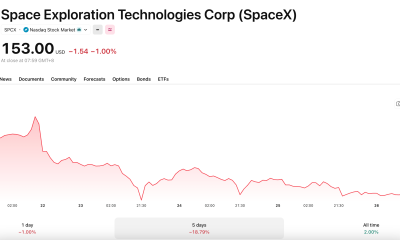
Shares of Space Exploration Technologies Corp., trading under the ticker SPCX, were at $159.23 as of 10:39 a.m. EDT, up $1.69, or 1.07%, on the day. The gain follows a wild Wednesday session during which the stock initially surged on the WSJ report that SpaceX was developing a smartphone-like AI device featuring Snapdragon chips before Musk flatly denied the story on his social media platform X, calling it “utterly false” and sending the stock down roughly 7% to close at $157.54. Thursday’s tentative recovery reflects investors refocusing on the company’s Nasdaq-100 inclusion, now just three business days away.

Nasdaq officially confirmed that SpaceX will be added to the Nasdaq-100 index before the market opens on Monday, July 7, just 25 days after the company completed its initial public offering on June 12. That timeline makes SpaceX one of the fastest companies ever added to the benchmark index following a public market debut, a distinction made possible by a Nasdaq rule change implemented in May that shortened the waiting period for newly listed companies from several months to just 15 days, provided the company ranks among the top 40 Nasdaq-100 constituents by market capitalization. Given SpaceX’s market capitalization of approximately $2.25 trillion as of Thursday, it qualified easily.

Analysts at BNP Paribas have estimated that the Nasdaq-100 inclusion alone could generate approximately $4.3 billion in passive buying from index funds and exchange-traded products that are legally required to hold SpaceX shares in proportion to its index weighting once it enters the benchmark. The QQQ fund, the most heavily traded ETF tracking the Nasdaq-100, will be among the vehicles required to purchase SPCX shares, and the forced mechanical buying associated with index inclusion events has historically provided meaningful short-term price support for newly added companies regardless of their immediate fundamental performance.

Advertisement

In a separate development that could add additional forced demand, SpaceX may also eventually enter Russell 1000 and other FTSE Russell benchmark indexes, a separate process from the Nasdaq inclusion that would trigger another round of index-tracking purchases. That potential additional demand has been cited by some analysts as a further tailwind for the stock’s post-inclusion trading dynamics.

The Wedbush analyst team, which has been among the most prominently bullish voices on SpaceX since the IPO, maintained an Outperform rating and a $190 price target on the stock this week, framing the company as an AI-driven infrastructure play rather than simply a rocket and satellite company. The firm’s analysis emphasized SpaceX’s position at the intersection of three major structural technology trends, including satellite connectivity, launch vehicle economics and artificial intelligence, and described the stock as one of the most compelling long-term holdings available to investors seeking exposure to all three simultaneously.

Daiwa Securities initiated coverage of SpaceX Thursday morning with a Neutral rating, adding a relatively cautious voice to the analyst community even as the broader consensus remains skewed toward Buy. According to data from Investing.com, seven of the eight analysts currently covering SpaceX recommend buying the stock, with one recommending selling, and the average 12-month price target sits at $188.17 per share, implying upside of roughly 18% from Thursday’s trading levels. The high estimate of $310 and the low of $62 reflect the extraordinary spread of opinion surrounding a company that went public just three weeks ago and whose valuation remains deeply unsettled across the professional investor community.

Much of that valuation debate centers on three distinct business segments that SpaceX has consolidated under a single public entity. The Connectivity segment, built around Starlink’s satellite broadband network, is the most immediately visible and financially productive of the three, generating $11.4 billion in revenue and roughly $4.4 billion in operating profit in 2025, with approximately 10.3 million subscribers as of the end of March. The Space segment encompasses the company’s rocket launch operations, including Falcon 9, Falcon Heavy and the still-developing Starship system, while the AI segment, formed around the early 2026 acquisition of xAI from Musk himself, brings the Grok large language model, the Colossus gigawatt-scale data center and the social platform X under the SpaceX corporate umbrella.

Advertisement

SpaceX also announced this week that it is offering discounts to Starlink customers in the Memphis, Tennessee, area, according to a Bloomberg report, a move consistent with a broader strategy of using pricing flexibility to accelerate subscriber growth in markets where internet service provider competition is particularly intense. Analysts following the company have pointed to the U.S. consumer and enterprise subscriber market as an underappreciated growth vector given how much of the current Starlink narrative centers on international and rural deployment.

On the litigation front, Musk and OpenAI chief Sam Altman were reported Thursday to be heading toward mediation in their ongoing legal dispute, a development that could eventually clarify a complicated set of legal relationships involving Musk, xAI, SpaceX and OpenAI that have raised governance questions about potential conflicts of interest among the various technology ventures Musk oversees.

The stock’s current position, roughly 29% below its all-time intraday high of $225.64 reached on June 16 but still above its IPO price of $135 and meaningfully above its all-time closing low of $147.11 hit on June 23, reflects an ongoing process of price discovery for a company that has attracted both extraordinary enthusiasm and substantial skepticism from market participants attempting to determine what one of the most complex and ambitious technology businesses ever taken public is actually worth at this stage of its development.

Advertisement
Continue Reading

Business

Oil Price Today (July 3): Crude oil heads for 4th weekly loss on Hormuz traffic, US-Iran talks. Where is liquid gold headed?

Published

on

Oil Price Today (July 3): Crude oil heads for 4th weekly loss on Hormuz traffic, US-Iran talks. Where is liquid gold headed?
Crude oil prices stayed under pressure on Friday as tanker traffic through the Strait of Hormuz continued to recover and diplomatic engagement between the US and Iran showed signs of progress. Brent crude is also headed for a fourth straight weekly decline, its longest losing streak since August 2024

Crude oil price on July 3

Brent crude hovered near the $71-a-barrel mark after briefly dipping below that level in the previous session, while US benchmark West Texas Intermediate (WTI) traded around $68 a barrel.

The commodity has retreated sharply from the $125-a-barrel highs touched during the peak of the Gulf conflict, as higher output from regional producers and improved supply expectations followed the preliminary memorandum of understanding (MoU) signed by the US and Iran in mid-June.

Saudi Arabia, the region’s largest oil producer, has restored exports to roughly 90 percent of pre-conflict levels for most of this week. A significant share of the kingdom’s crude shipments passes through the Strait of Hormuz.

Speaking to CNBC, US President Donald Trump said negotiations with Iran were still underway and claimed that Tehran “has agreed to just about everything we need.” However, the Wall Street Journal reported that Iran remains unwilling to abandon its demand for control over the Strait of Hormuz and intends to continue charging transit tolls after the 60-day deadline expires.

Advertisement

Supply has increased not only from Saudi Arabia but also from the United Arab Emirates, which is no longer an OPEC member, and from Iran after it secured sanctions relief under the terms of the preliminary MoU.
Read more: Crude oil correction could be India’s next big market trigger: Rohit Seksaria

Worst over?

Macquarie Group has sharply lowered its oil price forecasts for 2026 and 2027, citing expectations of a quicker-than-anticipated normalization of crude flows from the Middle East. Following the interim peace agreement between the United States and Iran, which has allowed oil shipments to resume from the Persian Gulf, the bank now expects brent crude, the global benchmark, to average $77 a barrel in 2026, down from its earlier forecast of $89. It also cut its 2027 Brent outlook to $64 a barrel from $74 previously.
Despite several challenges that could slow the recovery in regional oil production, producers in the Middle East are likely to restore output faster than markets currently anticipate, strategists Peter Taylor, Vikas Dwivedi and others said in a research note.
Tanker movement through the strait has started improving, with U.S. Vice President JD Vance said oil flows had returned to pre-war levels, although he did not provide any figures.

Others argue that despite the improvement, a complete reopening of the Strait of Hormuz is expected to take time, say experts. It will require coordination of vessel movements, restarting oil wells, repairing damaged infrastructure and agreements on de-mining operations. Some shipowners also remain cautious about operating in the strait and the wider Persian Gulf.

Analysts said global oil inventories were depleted during the prolonged disruption to shipping through the Strait of Hormuz and will take time to rebuild. They added that stockpiles could continue to decline before additional supplies from the Gulf start reaching international markets.

Last month, Saudi Aramco Chief Executive Officer Amin Nasser warned that disruptions in the Strait of Hormuz could delay the return of stability to global oil markets until 2027. He said prolonged interruptions could affect nearly 100 million barrels of oil supply every week. Saudi Aramco is the world’s largest oil producer.

Advertisement

Also read: India’s next stock market headache isn’t oil but a bigger storm brewing in the skies

(Disclaimer: Recommendations, suggestions, views and opinions given by the experts are their own. These do not represent the views of The Economic Times)

Continue Reading

Trending

Copyright © 2025