Connect with us
DAPA Banner
DAPA Coin
DAPA
COIN PAYMENT ASSET
PRIVACY · BLOCKDAG · HOMOMORPHIC ENCRYPTION · RUST
ElGamal Encrypted MINE DAPA
🚫 GENESIS SOLD OUT
DAPAPAY COMING

Crypto World

Securitize Debuts on NYSE, Issues Tokenized Stocks

Published

on

Securitize Debuts on NYSE, Issues Tokenized Stocks
Tokenization platform Securitize rallied on its New York Stock Exchange debut on Thursday, as it brought tokenized versions of its shares to two blockchains.

The company, which is backed by BlackRock and Morgan Stanley, began trading on the NYSE under the ticker SECZ on Thursday after merging with a Cantor Fitzgerald-backed special-purpose acquisition company to take it public.

Securitize said Thursday that it simultaneously launched tokenized versions of its shares on the Avalanche and Solana blockchains, which will be available to eligible US investors on its platform.

It marks the first time a newly public company has also offered tokenized stocks, an area of crypto technology that has quickly gained attention among major institutions drawn to the idea that it can bring deeper liquidity and longer trading hours.

Advertisement

Securitize has carved out a lead in the tokenization space for institutions. It partnered with the NYSE in March to create tokenized assets for the exchange’s upcoming tokenized securities platform.

US laws allow for tokenized stocks, Securitize says

Securitize said that tokenizing its stock demonstrates that tokenized securities “can be issued and accessed in the US under existing securities laws and market structure,” adding that access will be subject to onboarding, eligibility, and customer ID and money-laundering checks.

“We have long said that public equities are moving on-chain, and there is no stronger validation of that belief than tokenizing our own public stock on Day 1,” said Securitize co-founder and CEO Carlos Domingo.

“SECZ is not a synthetic token or offshore wrapper. It is issuer-sponsored tokenization of the same common stock trading on the NYSE, made available through regulated infrastructure,” he added. “This is how tokenization should scale: with real ownership, regulatory clarity and the issuer at the center.”

Advertisement

The US Securities and Exchange Commission clarified in January that issuer-sponsored tokenized securities are still subject to US securities laws.

In mid-May, the SEC was reportedly ready to announce an exemption for the trading of tokenized stocks, but delayed the plan later that month after stock exchange officials raised concerns over how it would be implemented.

Securitize shares rise on debut

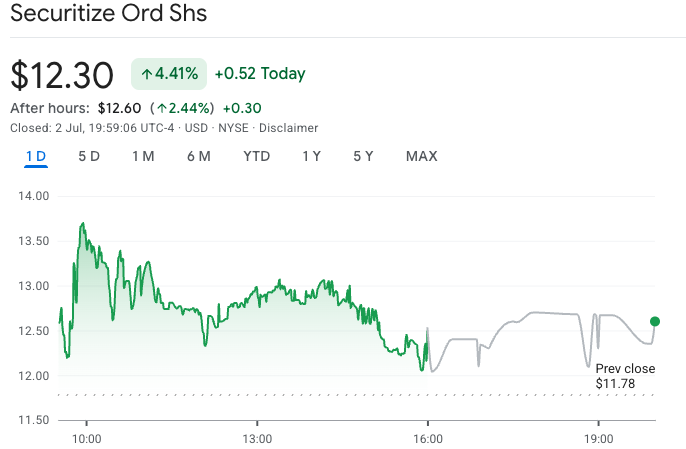
Shares in Securitize (SECZ) hit a high of $13.70 in trading Thursday but retracted slightly and ended the day at $12.30, a gain of 4.4%. The share price continued to climb 2.4% after-hours to $12.60.
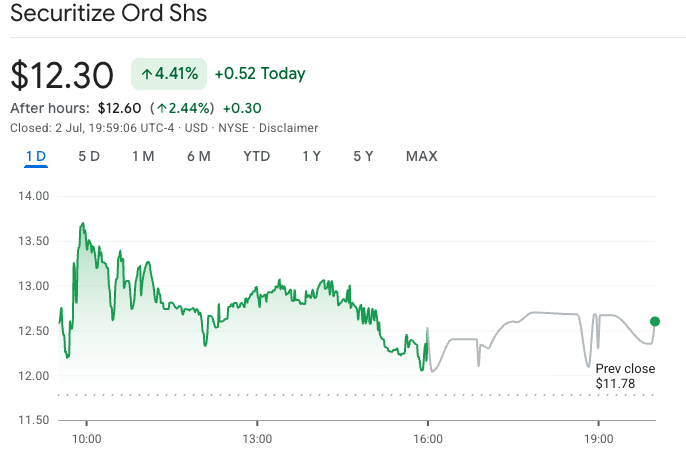
Securitize ended its debut trading day on Thursday at a gain of nearly 4.5%. Source: Google Finance

Advertisement

Securitize raised $400 million from its public offering at a valuation of more than $1 billion.

The market for tokenized real-world assets currently exceeds $43 billion, the majority of which is tokenized money market funds, while tokenized commodities account for nearly $7 billion and tokenized stocks account for $1.6 billion, according to Token Terminal.

Analysts expect the tokenization market to grow quickly in the coming years, with Citigroup predicting last month that it could grow to between $5.5 trillion and $8.2 trillion by 2030.

Big Questions: Do we really only need 2–5 cryptocurrencies?

Advertisement

Source link

Continue Reading
Click to comment

You must be logged in to post a comment Login

Leave a Reply

Crypto World

Binance moves ahead in Philippines as SEC clears BlockShoals sandbox testing

Published

on

Binance reassures EU users as MiCA service changes begin

Binance has moved a step closer to returning to the Philippine market after the country’s Securities and Exchange Commission granted final approval for its local partner BlockShoals Technologies to begin regulatory sandbox testing.

Summary

  • The Philippine SEC has granted final sandbox approval to BlockShoals, moving Binance closer to a regulated return to the local market.
  • BlockShoals will complete a 90 day integration with a licensed local provider before Binance backed user onboarding begins.
  • The approval covers SEC sandbox testing, while separate BSP licensing requirements for crypto services remain in place.

In a post on X, Binance co-founder and Chief Customer Service Officer Yi He said the exchange had officially entered the Philippine market, while an accompanying SEC document showed that BlockShoals Technologies Inc. had received final approval to launch financial product and service testing under the Commission’s Strategic Regulatory Sandbox (Stratbox) framework.

SEC approves sandbox rollout

Under the approval, BlockShoals will operate using a crypto-asset intermediary model that allows users in the Philippines to access selected products and services through its global crypto-asset service provider partner, Binance. 

Advertisement

The SEC document stated that BlockShoals must first complete system integration with a local virtual asset service provider during an initial 90-day phase before proceeding with the approved testing program.

Once that integration is completed, the testing plan will move forward under regulatory oversight and applicable safeguards, including user registration and onboarding through Binance as its global CASP partner, according to the SEC approval.

The final approval follows the SEC’s earlier clearance of BlockShoals’ Stratbox application in November 2025, after the company fulfilled the remaining regulatory requirements set by the Commission.

Advertisement

BSP licensing question remains

The latest SEC approval comes weeks after the Bangko Sentral ng Pilipinas clarified that neither Binance nor BlockShoals currently holds a Virtual Asset Service Provider license required for certain crypto payment and transaction services.

As previously reported by crypto.news, the BSP said participation in the SEC’s Stratbox program does not replace the need for a separate central bank license because the two regulators oversee different parts of the country’s financial sector. The central bank also noted that BlockShoals would need to integrate with a licensed domestic VASP before onboarding users through Binance’s infrastructure could begin.

While Yi He described the development as Binance’s official entry into the Philippines, the SEC approval itself authorizes BlockShoals to begin sandbox testing and identifies Binance as its global CASP partner. The document does not state that Binance has obtained a Philippine VASP license.

Binance has been working to strengthen its regulatory position in several jurisdictions. On July 1, the exchange told affected European Union users that withdrawals and other account options would remain available as MiCA-related service changes took effect, while it continued pursuing authorization to operate under the bloc’s new crypto rules.

Advertisement

Source link

Continue Reading

Crypto World

Will Bitcoin price continue uptrend or succumb once again to ETF outflows?

Published

on

U.S. spot Bitcoin ETF flow data showing consecutive daily net outflows, extending institutional selling pressure into early July.

Bitcoin price has rebounded above $60,000 after easing oil prices and softer U.S. macro expectations lifted risk appetite, though persistent ETF outflows continue to threaten the recovery.

Summary

  • Bitcoin price has reclaimed $60,000 as easing oil prices and improving macro sentiment triggered a relief rally.
  • Persistent U.S. spot Bitcoin ETF outflows continue to weigh on institutional demand despite the rebound.
  • Technical charts show room for further gains above $61,000, but failure to hold $60,000 could revive selling pressure.

According to data from crypto.news, Bitcoin (BTC) price climbed from a low near $58,300 to around $60,600 over the past 24 hours as investors responded to softer inflation expectations and improving sentiment across global markets.

Risk assets also benefited from progress in indirect U.S.-Iran talks, while Brent crude slipped below $71 a barrel after oil shipments through the Strait of Hormuz accelerated and concerns over supply disruptions eased. Lower energy prices reduced inflation worries, giving cryptocurrencies room to recover after June’s sharp sell-off.

Advertisement

The rebound comes after one of Bitcoin’s weakest months in recent years. U.S. spot Bitcoin ETFs recorded another $294.6 million in net outflows on July 1 after losing $222.6 million, $231.1 million and $444.5 million during the previous three sessions, extending a streak of institutional withdrawals that has removed billions of dollars from the sector in recent weeks. Those redemptions have continued to offset improving macro sentiment by forcing ETF issuers to sell underlying Bitcoin into the market.

U.S. spot Bitcoin ETF flow data showing consecutive daily net outflows, extending institutional selling pressure into early July.
Source: SoSoValue

Federal Reserve policy also remains a key obstacle. Although traders welcomed recent dovish remarks, interest rates remain elevated, and expectations for policy easing have been pushed further into the future. Higher Treasury yields continue to compete with non-yielding assets such as Bitcoin, while institutional capital has increasingly flowed toward U.S. technology and artificial intelligence stocks instead of digital assets.

Bitcoin must reclaim $62.7K and $65K to strengthen the recovery

Bitcoin’s 1-day chart shows price rebounding from the 100% Fibonacci retracement near $57,826 after briefly testing the lower boundary of a multi-month decline. The recovery has lifted RSI from deeply oversold territory to around 40, suggesting selling pressure has eased without yet confirming a trend reversal.

Bitcoin daily chart showing a rebound from the $57.8K support zone, with price still trading below major moving averages and a descending trendline.
Bitcoin 1-day price chart — July 2 | Source: crypto.news

Even after reclaiming $60,000, Bitcoin continues to trade below all key moving averages clustered between roughly $62,400 and $75,100, leaving major resistance overhead.

The 4-hour chart paints a more constructive short-term picture. Bitcoin has reclaimed the Supertrend support near $57,700 while the Aroon Up reading has climbed above 78%, with Aroon Down slipping below 43%, suggesting buyers have regained short-term control after the late-June washout.

Advertisement
Bitcoin 4-hour chart showing price holding above $60K after reclaiming Supertrend support, with short-term momentum strengthening.
Bitcoin 4-hour price chart — July 2 | Source: crypto.news

Bitcoin price has also returned above psychological support at $60,000, though sustained buying will still be needed to challenge resistance around $61,000 before the larger moving-average cluster comes into view.

Derivatives positioning shows traders remain heavily focused on nearby liquidation levels. CoinGlass’ 24-hour heatmap highlights dense short liquidation clusters between $61,000 and $61,800, suggesting a move through that range could accelerate buying as bearish positions are forced to close. On the downside, equally large long liquidation pockets sit around $59,500 and $58,000, creating potential downside magnets if Bitcoin loses its recent gains.

Bitcoin liquidation heatmap highlighting dense short liquidation clusters above $61K and long liquidation zones around $59.5K and $58K.
Bitcoin liquidation heatmap | Source: CoinGlass

According to analyst Ted Pillows, the latest advance should still be treated cautiously.

“This is just a relief rally, which often happens after a 30% crash. Bitcoin’s key levels are $62,700 and $65,000, which must be reclaimed for another lower high before a new cycle low.”

Commenting on the shorter-term setup, analyst Altcoin Sherpa noted that Bitcoin looks constructive on lower time frames while price remains above current support, although he added that he would not feel confident until Bitcoin decisively breaks above $65,000 on higher-time-frame charts.

ETF selling and macro risks could quickly reverse the recovery

Several downside risks continue to threaten Bitcoin’s rebound. Continued spot ETF redemptions remain the most immediate concern, particularly if institutional demand fails to return after June’s record wave of outflows. Corporate developments have also weighed on sentiment after Strategy revised its capital policy to permit token sales, raising concerns that one of Bitcoin’s largest corporate holders could eventually add supply to the market.

Advertisement

Macro and geopolitical uncertainty also remain unresolved. While oil prices have retreated on improving U.S.-Iran negotiations, any disruption to talks or renewed tensions around the Strait of Hormuz could quickly push energy prices higher and revive inflation concerns.

On the technical side, failure to defend the $60,000 area would expose the $59,500 and $58,000 liquidation zones, while a break below June’s low near $57,800 would invalidate the current relief rally and reopen the path toward fresh cycle lows.

Disclosure: This article does not represent investment advice. The content and materials featured on this page are for educational purposes only.

Advertisement

Source link

Advertisement
Continue Reading

Crypto World

IMF warns tokenization could remake finance or fracture it

Published

on

IMF warns tokenization could remake finance or fracture it

The International Monetary Fund has said tokenization could change how financial markets settle trades, manage payments, and record ownership.

Summary

  • Tokenization can speed settlement, but weak standards may split liquidity across competing financial platforms worldwide.
  • Major banks are testing tokenized deposits as regulated rails for faster institutional payment settlement systems.
  • Regulators must define ownership, code oversight, and settlement finality before tokenized markets scale globally.

In a July 2 blog post, Tobias Adrian, the IMF’s financial counselor and director of the Monetary and Capital Markets Department, said policy choices made now will decide whether tokenized finance “strengthens or fragments” the financial system.

Adrian said tokenization is more than a tool for faster payments. It moves assets and liabilities onto shared digital ledgers, where execution, clearing, and settlement can happen at the same time. That could reduce delays in markets that still depend on separate systems, manual checks, and later reconciliation after trades close.

Advertisement

Faster markets bring new risks

The IMF said tokenization can make settlement faster and payments cheaper, but it can also change where risk sits. In traditional markets, delays give banks, brokers, and supervisors time to respond to errors or stress. In tokenized markets, smart contracts can move payments, collateral, and ownership within moments.

That speed can remove old buffers. Automated margin calls, instant redemptions, and 24/7 settlement could make liquidity needs appear faster than firms can manage them. Adrian warned that risk could move away from bank balance sheets and toward the platforms, code, and service providers that run tokenized markets.

Banks test tokenized settlement rails

The warning comes as large financial firms move tokenization deeper into regulated finance. As crypto.news reported, major U.S. banks are backing a tokenized deposit network through the Clearing House, with a launch targeted for the first half of 2027. The system would allow banks to settle tokenized deposits around the clock while keeping deposits inside the banking sector.

Advertisement

Recent market activity also shows that tokenization is spreading into securities. As previously reported, Securitize tokenized its own NYSE-listed shares on Solana and Avalanche on the day it began public trading. Ondo Finance also brought BlackRock’s IVV ETF and Micron shares onto Ethereum through a model designed to keep the underlying securities inside regulated U.S. custody.

Regulators weigh ownership and code oversight

The IMF said tokenized finance needs clear rules on settlement assets, platform governance, interoperability, and the role of central banks. It also said legal clarity matters because investors must know whether tokenized records prove ownership, whether settlement is final, and which court has authority when markets cross borders.

In the United States, regulators are already reviewing tokenized securities. As crypto.news reported, the SEC has explored an innovation exemption for tokenized securities that could let some blockchain-based products trade under tailored rules. Later, the agency reportedly delayed the proposal after exchanges raised questions about shareholder rights and ownership verification.

The IMF’s message adds a global policy layer to that debate. Faster settlement may improve market systems, but weak standards could split liquidity across competing platforms. If tokenized assets move across borders in real time, supervisors may also have less time to respond during stress.

Advertisement

Adrian said central banks, regulators, and market operators must decide how tokenized finance should use public and private money. They must also decide how platforms should connect and how critical smart contracts should be supervised. Without common rules, tokenization may stay split across separate systems instead of becoming a safer settlement model for global finance.

Source link

Advertisement
Continue Reading

Crypto World

US Wallets Top Polymarket Political Bets Despite Geoblock: Report

Published

on

US Wallets Top Polymarket Political Bets Despite Geoblock: Report

US-based users are the biggest political bettors on Polymarket, despite the crypto-based prediction market’s efforts to restrict US citizens from using the decentralized platform, according to new research. 

Blockchain research firm Allium estimated in a report published on Thursday that US-based users are the single biggest political market of any country by contracts traded and wallet count on Polymarket — not to be confused with Polymarket US, which is a US-regulated platform that launched in December with a narrower set of markets.

“Blocking access did not end US participation; it made the US the largest single political market on Polymarket by volume,” the report said. “The demand is still there, now offshore and beyond US oversight.”

The data suggests that Polymarket’s efforts to restrict US users from its global platform have not entirely worked, adding to an expanding list of headaches for the company in the fast-growing predictions market sector, which is under legal and political scrutiny.

Advertisement

Polymarket was forced to cut off US users’ access to its global platform as part of a $1.4 million settlement with the Commodity Futures Trading Commission in 2022.

Allium based its figures on the 6% of wallets it tagged with a country, meaning the data should be seen as directional only. Source: Allium

Allium found that US users are more interested in foreign conflict-related markets than the rest of the platform’s users, with five of the US cohort’s top 12 markets by notional volume relating to the Iran war.

It also shows a lesser interest in election-related markets, which is a category of prediction markets allowed on Kalshi and Polymarket US. 

Advertisement

“US money pours into foreign wars, lately Iran, and largely skips the elections the global crowd trades,” said Allium. 

Cointelegraph contacted Polymarket for comment. 

Polymarket’s effort to geoblock US users

Allium’s figures align with another study published in June by Rutgers University statistician Harry Crane, who estimated that 30% of trading volume on Polymarket comes from the US. 

Crane estimated that people based in the US sent between $10.6 billion and $26.7 billion through Polymarket between May 2025 and April 2026, despite Polymarket blocking US-based IP addresses and VPNs, which could be used to skirt the block.

Advertisement

The researcher looked at the times of day the trades were made and the markets in which the trades were made to link certain trades to US users

An excerpt of Polymarket’s FAQ page on its geographic restrictions. Source: Polymarket

Polymarket has reportedly been clamping down on users who use VPNs by blocking certain IP addresses tied to VPN services, The Information reported in May.

Related: Polymarket hit by $2.9M theft, users to be refunded 

Advertisement

Where is Polymarket blocked?

Polymarket is completely blocked in more than 34 countries, the latest being Spain, which blocked local users from Polymarket and Kalshi as a “precautionary measure” as authorities open an investigation into whether the companies are operating without necessary licensing. 

Another four countries, including Singapore, Thailand, Taiwan and Poland, are in “close only,” meaning users in these countries can close existing positions but cannot open new trades. 

There are also four restricted regions, Ontario in Canada, Crimea, Donetsk and Luhansk in Ukraine, where Polymarket is blocked but is available elsewhere in the country. 

Magazine: Bitcoin slides to $58K, XRP hits $1 but onchain data promising: Market Moves

Advertisement

Source link

Continue Reading

Crypto World

Solana Gets NYSE Boost as SOL Jumps 19% on Securitize Listing

Published

on

Securitize became a publicly traded company on the New York Stock Exchange Thursday, July 2, immediately tokenizing its common stock on Solana (SOL).

The move lands alongside a separate governance shift on Solana, where validators gained a formal, stake-weighted voting process for protocol decisions. Both moves come as SOL posted strong gains, up 19.3% over the past week.

Securitize Brings Its NYSE Debut Onchain

Securitize completed its merger with Cantor Equity Partners II and opened trading on the NYSE under the ticker SECZ on Thursday. This is part of its broader tokenized asset expansion across multiple chains.

“We have long said that public equities are moving onchain”

— Carlos Domingo, Founder and CEO of Securitize

Advertisement

Blockchain data from RWA.xyz tracked roughly $295 million in tokenized SECZ shares at launch. Securitize said the tokens represent the same shares trading on the NYSE, not a synthetic wrapper.

Additionally, access is limited to eligible U.S. investors who pass identity checks.

SOL is up nearly 20% over the past seven days
SOL is up nearly 20% over the past seven days. Image Source: BeInCrypto

Validators Gain a Formal Vote

Separately, the Solana Foundation activated Solana Governance Proposals on July 1. Ultimately letting validators with at least 100,000 staked SOL submit proposals.

The framework separates broad directional questions from the technical upgrades developers already handle. Furthermore, it lets individual delegators override their validator’s vote.

Advertisement

Together, the two developments show Solana courting institutional issuers and their own validator bases at once. Whether tokenized SECZ shares draw meaningful onchain trading volume will shape how far this new strategy goes.

The post Solana Gets NYSE Boost as SOL Jumps 19% on Securitize Listing appeared first on BeInCrypto.

Source link

Advertisement
Continue Reading

Crypto World

Burry Called a Bubble Days Ago and Now AI & EV Stocks Are Already Cracking

Published

on

Burry Called a Bubble Days Ago and Now AI & EV Stocks Are Already Cracking

Michael Burry disclosed a fresh basket of shorts against Tesla, Nvidia, Caterpillar, Applied Materials, and the semiconductor sector on June 30. Within days, several of those same corners of the market started cracking.

The Setup: Burry’s Basket Built on One Thesis

Burry laid out his positions in a Substack post titled “Trading Post June 30, 2026.” He framed them as a single bet against an overheated AI cycle, not isolated stock picks. He called the semiconductor index “a pure form of overvaluation” and rolled his SOXX puts out to March 2027.

Michael Burry, the investor, who famously predicted the subprime mortgage crisis in 2008. Image Source: Business Insider

He also disclosed new shorts on Tesla at $416.22 and Caterpillar at $1,060.98, a stock he had never shorted before despite trading it profitably on the long side for years.

The Philadelphia Semiconductor Index was already trading more than 65% above its 200-day moving average when Burry made his call. He compared the stretch to conditions last seen during the dot-com era.

What’s Happened Since

Days later, reports surfaced that Meta is building a business called Meta Compute to lease out its surplus AI data center capacity to outside customers. Investors read the move as a signal that compute supply may be catching up with demand.

Advertisement

On Thursday, July 2, the Philadelphia Semiconductor Index dropped more than 6%, its steepest single-day fall in recent memory. The selloff spread to Samsung and SK Hynix in Asia and briefly triggered a circuit breaker on South Korea’s Kospi.

Memory and storage names took the hardest hits. SanDisk sank almost 20% in the past five session. Seagate and Micron also slid on fears of a supply glut as Samsung and SK Hynix ramp up new capacity. Micron’s fundamentals remain strong, with fiscal third-quarter revenue up 346% year over year. Even so, the stock has given back a chunk of its 2026 gains.

Tesla fell 7.5% that same Thursday, its worst single session in nearly a year. The drop came despite Tesla reporting Q2 deliveries of 480,126 vehicles, well above Wall Street’s consensus estimate. Traders treated the beat as a sell-the-news event. The stock had already run up more than 13% over the four sessions before the report.

A Coincidence Worth Watching, Not Yet a Verdict

None of this proves Burry’s short basket caused the moves. The chip selloff traces to Meta’s compute-leasing plans. Tesla’s drop lines up with a classic sell-the-news pattern around its delivery report, not any catalyst tied to Burry directly.

Advertisement

Still, the timing is notable. Burry’s basket touched nearly every name now under pressure. Caterpillar, his other first-ever short, still trades at a trailing price-to-earnings ratio of 53.

Whether this marks the start of the correction Burry is positioning for, or just a rough week for a handful of stretched valuations, should become clearer as Tesla’s July 22 earnings and the next round of AI capex commentary land.

The post Burry Called a Bubble Days Ago and Now AI & EV Stocks Are Already Cracking appeared first on BeInCrypto.

Source link

Advertisement
Continue Reading

Crypto World

what Claude Mythos 5 changes

Published

on

Oil at $115, Iran war hits BTC

The AI model its own maker says can find and exploit software flaws better than almost any human is back online. It arrives in the middle of crypto’s worst year for hacks. Here is what actually changes, and what the panic gets wrong.

Summary

  • On July 1, 2026, Anthropic restored global access to Claude Fable 5 after the U.S. lifted export controls, while the less-restricted Mythos 5 returned only to a set of vetted U.S. organizations through a program called Glasswing.
  • Anthropic markets Mythos-class models as able to find and exploit software vulnerabilities more effectively than any other model and than all but the most skilled human experts, and says the models surfaced more than 10,000 high-severity flaws in important software.
  • The alarm in crypto is that cheap, fast, AI-driven vulnerability discovery turns unaudited protocols and small forks into easy targets, in a year when hacks have already drained more than $840 million.
  • The skeptical view, shared by some security experts and by Anthropic’s own review, is that the models mostly accelerate known attack types, social engineering, exposed keys, and misconfigurations, instead of inventing new ones, and that weaker models can do much of the same work.
  • The same capability that helps attackers also helps defenders, through faster audits and patching, which is why the near-term risk is real while the long-run balance is contested.

The model built to find software flaws is back, and it landed in the worst possible year for the industry with the most to lose. On July 1, 2026, Anthropic restored access to Claude Fable 5 worldwide after the U.S. Department of Commerce lifted the export controls that had forced the model offline in June, while its more powerful sibling, Mythos 5, returned only to a set of vetted organizations. The timing is what makes it a crypto story. Anthropic describes Mythos-class models as able to find and exploit vulnerabilities better than nearly any human, and crypto is in the middle of a record run of hacks, with billions in assets sitting inside publicly visible code that an AI can read at machine speed.

This piece separates what these models actually change from what the panic gets wrong, and it does so without treating a single headline as the whole picture. The central question is not whether AI makes crypto security riskier; it does. The harder question is where the added risk actually sits, whether it is in smart contracts themselves, bridges, human operations, signing flows, or the speed at which attackers can now move from disclosure to exploit. The answer is less cinematic than the fear, but more useful for anyone holding funds or building protocols.

Advertisement

What came back, and what did not

The distinction between the two models is the first thing to get right, because they are not equally available. Fable 5 is the public, safeguarded member of the Mythos class, released in June 2026 and priced at roughly twice the cost of Anthropic’s prior flagship. It returned to global users on July 1 across Anthropic’s platforms. Mythos 5 is the less-restricted version that carries the full cyber capability, and it did not return to the public.

Anthropic restored Mythos 5 only to a set of vetted U.S. organizations that operate and defend critical infrastructure, through an opt-in program called Glasswing, following government approval in late June. So the model most crypto observers worry about is not the one now sitting behind a consumer subscription. The distinction matters because public access changes the risk surface very differently from vetted critical-infrastructure access. A powerful model in the hands of security teams is not the same thing as a powerful model available to every attacker with a credit card.

The episode that pulled both offline is worth understanding, because it colors the risk debate. In June, researchers at Amazon showed a jailbreak that got Fable 5 to identify software vulnerabilities and write exploit code, and the U.S. government responded with an emergency export-control order that Anthropic complied with by disabling the models entirely, since it could not restrict access by nationality in real time. The controls were lifted at the end of June, and access returned in the first days of July, with Fable 5 global and Mythos 5 limited. Anthropic’s own account of the incident cuts against the loudest fears: its review, conducted with the government, found that the reported technique did not reveal a uniquely Mythos-level capability, and that several weaker models could reproduce the same vulnerabilities.

The company argued the capability had been oversold, and it deployed a new safety classifier it says blocks the specific technique in more than 99% of cases, routing risky cybersecurity prompts to a weaker model in fewer than 5% of sessions. That is the company’s framing, and it matters, but it is not the whole story either. The point for crypto is narrower: even if public access is constrained, the capability exists, it is improving, and weaker models already reproduce parts of it. That means the security problem cannot be solved by focusing on one model alone.

What Mythos-class models can actually do

The capabilities that alarmed the security world are real and documented, not hypothetical. Under its restricted program, Mythos-class models reportedly surfaced more than 10,000 high and critical-severity vulnerabilities in systemically important software, and found critical flaws across more than 1,000 open-source projects, including widely used components such as the Linux kernel and a popular media library. In one cited case, the model generated a working proof-of-concept exploit for a complex issue in under 31 minutes. Cloudflare reported that an earlier Mythos preview chained bugs into working exploits across more than 50 of its code repositories before refusing to produce a live demonstration.

The capability that most changes the math for defenders is speed. Anthropic has warned that the window between a vulnerability being disclosed and being exploited is collapsing, in some cases from days to hours. Its researchers concluded that a single operator with this class of model could turn a month of software patches into working exploits in a single afternoon, for a cost measured in a few thousand dollars. Security practitioners have started describing the shift as moving from an era of N-days, where attackers had weeks or months after a disclosure, to something closer to N-hours.

When a patch ships, it also reveals the flaw it fixes, and a model that can read the patch, understand the bug, and build an exploit in hours compresses the defender’s response window dramatically. None of this is the same as inventing a new class of attack. It is acceleration and scale. The model reads public code, compares versions, summarizes audits, and reasons about weaknesses faster and cheaper than a human team, which lowers the cost and expertise needed to do work that skilled attackers already do.

That distinction, acceleration rather than invention, is the fault line the entire debate runs along. For crypto teams, the practical implication is brutal: slow patching, stale dependencies, and unaudited forks become more dangerous when attackers can automate the boring parts of vulnerability discovery. The frontier model does not need to be magical to change the economics. It only needs to make the existing attack pipeline cheaper and faster.

Advertisement

Why crypto is uniquely exposed

Crypto sits in the blast radius for reasons specific to how it works. Smart contracts are public by design: the code that controls billions of dollars is visible on-chain for anyone, including an AI, to read and analyze. Bridges, the infrastructure that moves assets between blockchains, concentrate the collateral of many chains into a single set of contracts and message-verification systems, which makes them the highest-value targets in the space. An attacker who can scan code at machine speed has an unusually rich, unusually open field in crypto compared with closed corporate systems.

The backdrop is a genuinely bad year. Crypto has lost more than $840 million to hacks in 2026, with some tallies putting the figure past $940 million across more than 120 incidents, and April alone set a record near $600 million. The two largest losses tell the story of where the damage comes from. Kelp DAO lost roughly $292 million when attackers forged a cross-chain message on its bridge, exploiting a setup that let a single compromised node approve fraudulent withdrawals.

Drift Protocol lost about $285 million not to a code bug but to a six-month social engineering operation that ended in compromised administrative keys. Bridges have accounted for the largest share of losses, and North Korean groups have been linked to a large portion of the total. That pattern is the key context for the AI debate, because it shows where crypto actually bleeds. The biggest 2026 losses came less from novel smart-contract bugs than from human error and operational failure: social engineering, exposed keys, flawed signing flows, and misconfigured infrastructure.

Advertisement

Any assessment of what a Mythos-class model changes has to start from that reality, not from the image of an AI writing an exotic new exploit from scratch. The crypto risk surface is not only code. It is bridges, multisigs, admin keys, custody practices, signing devices, deployment scripts, and teams that still operate under startup-style security despite controlling institutional-scale money. AI makes that whole surface easier to search.

The alarm case

The bearish read is straightforward and has serious voices behind it. Simon Dedic, a well-known crypto investor, warned that a public Mythos-class model could sharply lower the cost and expertise needed to find exploitable flaws in smart contracts, and that unaudited protocols would become, in his words, sitting ducks. The argument is about barriers. Finding a subtle vulnerability in a contract used to require rare skill and considerable time.

If a model compresses that to hours and pennies, the population of people capable of attacking a weak protocol expands enormously, and the long tail of small projects, forks, and unaudited contracts becomes far more exposed. The numbers give the argument weight. Analysts have linked part of 2026’s elevated hacking losses to the growing use of advanced AI in identifying vulnerabilities, and the trend line points toward more automated, faster reconnaissance. In this view, even if the very best human attackers gain little, the marginal attacker gains a great deal, and crypto has no shortage of marginal attackers or of weak targets for them to point a capable model at.

Advertisement

The alarm is less about the top of the skill curve and more about how many more people can now operate near it. That is why small DeFi forks, rushed launches, and unaudited protocols are the obvious danger zone. A well-resourced protocol with continuous audits and strong operational controls may use AI defensively. A copy-paste fork with weak key management may simply become easier to attack.

The skeptics’ case

The counterargument is equally serious, and it comes from builders and from Anthropic itself. Michael Egorov, the founder of a major decentralized exchange, argued that smart contracts typically contain only a few thousand lines of code and are already well understood by human auditors and existing AI tools, so a more capable model changes less about direct contract exploits than the panic suggests. In his view, operational security failures and supply-chain attacks are the larger risk, and those are not primarily a smart-contract-analysis problem. That view fits the loss data, where administrative compromises and bridge failures dominate the largest incidents.

Anthropic’s post-incident review reinforces the skeptical case from an unexpected direction. The company found that the jailbreak technique that triggered the export controls did not reveal a uniquely Mythos-level capability, and that weaker models, its own and others, could reproduce the same vulnerability findings. If a capability is broadly available across many models rather than locked inside one frontier system, then restricting or releasing that single system changes less than it appears to. The skeptics do not claim the models are harmless; they claim the marginal danger of any one release is smaller than the headlines imply, because the underlying capability is diffuse and because the hardest part of most real attacks is not finding the flaw.

That is an important distinction for crypto readers. The risk is not “Claude Mythos appears, therefore every DeFi protocol is suddenly doomed.” The risk is that AI-assisted security analysis is becoming normal across many models, countries, and toolchains, which means attackers and defenders alike will have faster vulnerability discovery available. In that world, the question shifts from whether one model should be online to whether crypto teams can patch and harden faster than adversaries can scan and exploit.

Advertisement

The part everyone agrees on

Between the alarm and the skepticism sits a consensus, and it is the most useful part of the debate. Security experts broadly agree that advanced AI will not invent fundamentally new categories of crypto hack, but will dramatically speed up the attacks that already dominate the loss tables: social engineering, exposed keys, and flawed signing flows. A model does not need to hand over a finished exploit to change the economics of an attack. It can read public repositories, compare old and new versions of software, summarize audit reports, and draft convincing messages designed to catch the small operational mistakes humans make.

As one analysis put it, these exploits remain rooted in social engineering and human error; AI did not create that reality, it made it visible and accelerated it to machine speed. That reframing points straight at the 2026 loss data. The Drift and Kelp attacks, the two largest of the year, were an operational compromise and a bridge-verification failure, not clever new contract bugs. A model that accelerates reconnaissance, scans for the weakest key path or the sloppiest signing flow, and helps craft the human-facing part of an attack makes exactly those failure modes cheaper and faster to exploit.

The practical implication is that the defense that matters most is not writing unbreakable contracts, but hardening the human and operational layer where the money actually leaks. That means keys, signing steps, privileged accounts, dependencies, cross-chain message verification, and incident response. It also means treating every public disclosure and every patch as a race. In an N-hour world, yesterday’s slow security process becomes tomorrow’s exploit window.

Advertisement

The defensive flip side

The same capability that worries defenders can also serve them, which is why the long-run balance is genuinely contested. A model that finds vulnerabilities faster than humans is, pointed the other way, an audit tool that finds them before attackers do. Anthropic has argued that AI will eventually favor defenders in cybersecurity, while conceding that the transition will be turbulent, and it restored the restricted Mythos 5 specifically to organizations that defend critical infrastructure through its security program. That is the defensive version of Glasswing: put the best tools in the hands of teams whose job is to patch before adversaries exploit.

One incident has become the reference point for both sides. In early June 2026, a critical vulnerability in a privacy coin’s shielded pool was discovered using Anthropic’s Opus 4.8, a model a generation below the Mythos class. The flaw, if exploited, could have allowed unlimited minting of the token, and it had eluded expert cryptographers for roughly four years. The token dropped more than 35% on the disclosure.

The lesson cuts both ways: a weaker model catching a four-year-old flaw shows how much AI can strengthen defense, and also how much latent, undiscovered risk sits in code that a stronger model could surface, for good or ill. Faster discovery is a defensive gift when a friendly party finds the bug first and a catastrophe when an attacker does. Which side wins any given race depends on who is scanning, how fast teams can patch, and whether defenders adopt the tools as aggressively as attackers will.

What crypto users and teams can actually do

The useful response to all of this is not panic but hardening, and most of it is advice that held before any model returned. For individual users, the recurring guidance from security researchers is concrete: revoke unused token approvals, since every outstanding approval grants a contract permission to move your funds, and tools exist to review and cancel them. Move significant holdings into self-custody and cold storage, so that the keys controlling real money sit somewhere a compromised laptop cannot reach, and treat any unaudited protocol as a higher risk than it looked a year ago. When approving a transaction, use a device with a trusted screen that shows what is actually being signed, because if AI accelerates the scouting phase, the final signing step becomes the moment that matters most.

Advertisement

For teams and protocols, the priorities follow from where the losses come from. Rapid patch management matters more in an N-hour world, because the window between a disclosure and a working exploit is shrinking, so shipping and applying fixes quickly is now a security control in itself. Continuous auditing beats one-time audits, and using AI-driven analysis on your own code before attackers do is increasingly a baseline instead of an edge. Above all, harden the operational layer: secure key management, tighten signing flows, limit privileged access, and scrutinize dependencies and cross-chain message verification, because that is where the year’s biggest breaches actually happened.

Over-reliance on any single external model carries its own risk, so teams are stress-testing multiple tools instead of betting on one. The same caution applies to exchanges and custodians, where exchange security is not just a proof-of-reserves page but a question of controls, custody, liabilities, and operational discipline. For protocols experimenting with AI agents in crypto, the lesson is even sharper: automation expands what software can do, but also expands what must be secured. The more autonomy a system has, the more dangerous weak permissions and signing flows become.

The honest conclusion is that the return of these models changes the tempo of an existing problem more than it introduces a new one. Crypto was already losing record sums to human error, operational failure, and bridge design long before Fable 5 came back online. Capable AI makes the reconnaissance faster, the attacks cheaper, and the response window shorter, which is a real near-term headwind for a chronically insecure industry. It also puts a powerful audit tool in defenders’ hands, which is the reason the long-run outcome is a race instead of a verdict.

The protocols and users who treat the moment as a prompt to fix the operational basics will be the ones best placed whichever way that race runs. The ones still relying on one-time audits, permissive approvals, weak admin keys, and slow patch cycles are the obvious targets. AI did not create those weaknesses. It just made them easier to find.

Advertisement

Frequently asked questions

What is Claude Mythos 5?

Claude Mythos 5 is a frontier AI model from Anthropic that the company describes as its most capable for cybersecurity, marketed as able to find and exploit software vulnerabilities more effectively than any other model and than all but the most skilled human experts. It is the less-restricted version of the Mythos class. Its safeguarded public sibling is called Fable 5. Mythos 5 is available only to vetted organizations, not the general public.

Why did the models go offline and come back?

In June 2026, researchers showed a jailbreak that got Fable 5 to identify vulnerabilities and write exploit code, and the U.S. government issued an emergency export-control order. Anthropic disabled both models globally because it could not restrict access by nationality in real time. The controls were lifted at the end of June, and access returned in early July, with Fable 5 restored globally and Mythos 5 limited to vetted U.S. organizations. The important distinction is that the public model and the restricted cyber model did not come back under the same access rules.

Can these AI models really hack crypto protocols?

They can accelerate the work attackers already do rather than invent new attacks. Mythos-class models reportedly found more than 10,000 high-severity flaws in important software and can build a proof-of-concept exploit in under an hour. In crypto, the larger effect is speeding up reconnaissance and the human-facing parts of attacks, since the biggest 2026 losses came from social engineering, exposed keys, and operational failures instead of novel contract bugs. That makes unaudited protocols, weak bridge setups, and poor key management especially exposed.

How much has crypto lost to hacks in 2026?

Crypto has lost more than $840 million to hacks in 2026, with some tallies exceeding $940 million across more than 120 incidents, and April alone set a record near $600 million. The two largest losses were Kelp DAO at about $292 million from a bridge message forgery and Drift Protocol at about $285 million from a social engineering operation that compromised administrative keys. Those examples matter because they show where the real losses are coming from: not only code flaws, but operational and verification failures. AI makes those weak points easier to find and exploit faster.

Advertisement

Does AI make crypto hacks fundamentally worse?

The consensus among many security experts is that AI accelerates and scales existing attack types instead of creating new ones. It lowers the cost and expertise needed to find flaws, which most exposes unaudited protocols and small projects. Skeptics, including some builders and Anthropic’s own review, argue the marginal danger of any single model is smaller than headlines suggest, since weaker models can do similar work and the hardest part of most attacks is not finding the flaw. The risk is therefore less about one model suddenly changing everything and more about AI-assisted hacking becoming broadly available.

Can AI also help defend crypto?

Yes, and that is the contested part of the debate. The same ability to find vulnerabilities fast makes AI a powerful audit tool when defenders use it first. In one case, a weaker model discovered a four-year-old critical flaw in a privacy coin’s shielded pool before it was exploited. Anthropic argues AI will eventually favor defenders, while admitting the transition will be turbulent, so the outcome depends on who adopts the tools faster.

What should crypto holders do to protect themselves?

Security researchers recommend revoking unused token approvals, moving significant holdings into self-custody and cold storage where keys sit offline, and treating unaudited protocols as higher risk. When signing transactions, use a device with a trusted screen that shows exactly what is being approved. These steps address the human and operational failures that account for most real losses, which AI mainly accelerates instead of replacing. The goal is to reduce the number of places where an attacker can turn a mistake into a transfer.

Is Mythos 5 available to the public now?

No. After the export controls were lifted, Anthropic restored the safeguarded Fable 5 to global users, but the less-restricted Mythos 5 returned only to a set of vetted U.S. organizations that defend critical infrastructure, through an opt-in program. The company says it will work to expand access over time, but the model with the full cyber capability is not behind a consumer subscription. Public users may have access to stronger AI tools than before, but not to the same unrestricted Mythos 5 setup described in the security program.

Advertisement

Disclaimer: This article is for information and educational purposes only and does not constitute financial, investment, legal, or security advice. It describes an evolving situation involving AI capabilities and cybersecurity risk, and details may change. Nothing here is a recommendation to buy, sell, or use any specific model, asset, or service. Always do your own research and consult qualified professionals for security decisions. Information is accurate as of July 2, 2026, and may change.

Source link

Advertisement
Continue Reading

Crypto World

Bitcoin Dominance Tests Key Support: Is the Long-Awaited Altcoin Season Finally Near?

Published

on

BTC.D weekly chart

Bitcoin (BTC) dominance currently trades at 58.55% and tests the floor of a range that has held since August 2025. A confirmed breakdown would target 55.5%, the level many traders link to the start of a broad altcoin rotation.

The Crypto Fear and Greed Index sits predominantly in Extreme Fear recently, while the Altcoin Season Index remains neutral at 45. BeInCrypto reviews the weekly and daily BTC.D charts to assess whether the long-awaited altcoin season is finally near.

Bitcoin Dominance Breaks Its Multi-Year Uptrend

The weekly chart shows a long-term ascending parallel channel that dates back to late 2022. Bitcoin dominance broke down from this structure in August 2025, ending a multi-year uptrend. The breakdown initiated a sideways period that lasted until April 2026.

In May 2026, the metric rallied back to resistance near 61% and faced a firm rejection. BeInCrypto flagged this area when dominance first broke above 60% in April. BTC.D now trades back inside the former range, below the 0.236 Fibonacci retracement at 59.63%.

Advertisement
BTC.D weekly chart
BTC.D weekly chart / Source: Tradingview

The Fibonacci ladder points to downside targets at 55.66%, 52.44%, and 49.23%. A popular trader on X shared a similar roadmap, calling 55% the trigger level for altcoin moves and 46.74% his final target. His last level sits lower because he anchors the retracement differently.

Daily Chart Points to a 55.5% Breakdown Target

Zooming in, the daily chart reveals a horizontal parallel channel between roughly 58% and 60.75% that also goes back to August 2025. Dominance now sits on the channel floor and tests a potential bearish breakdown.

Moreover, an ascending trendline from the September 2025 low broke down in June 2026. BTC.D retested the line as resistance in late June and turned lower. The failed retest adds a third bearish signal and pressures the relative position of altcoins, which have trailed Bitcoin since 2020.

BTC.D daily chart
BTC.D daily chart / Source: Tradingview

If the channel gives way, the measured target sits near 55.5%. This projection converges with the weekly 0.382 Fibonacci support at 55.66%, creating a strong confluence zone. However, the daily Relative Strength Index (RSI) grinds higher near 40 and remains neutral, so the move still needs confirmation.

Extreme Fear Meets a Neutral Altcoin Season Index

Sentiment adds a contrarian layer to the technical picture. The Crypto Fear and Greed Index printed 19 while Bitcoin still hovered between $60,000 and $61,000, up from 11 July 1, and 12 last week. The gauge has spent a full month in Extreme Fear after June’s correction, driven by a hawkish Fed, geopolitical tensions, and record ETF outflows.

Historically, prolonged readings below 20 have clustered near market bottoms. The index hit a record low of five in February 2026.

Advertisement
The Fear and Greed Index / Source: alternative.me

Meanwhile, the Altcoin Season Index from BlockchainCenter stands at 45, almost exactly halfway between Bitcoin season and altcoin season. The index flags altseason only when 75% of the top 50 coins beat Bitcoin over 90 days.

No true altcoin season has arrived since the current dominance structure formed in late 2022. Some experts argue the rotation cannot start until global liquidity expands again.

The Altcoin Season Index
The Altcoin Season Index / Source: Blockchaincenter

Bitcoin trades near $61,616, up 2.4% in the last 24 hours, according to CoinGecko. For altcoin holders, the setup remains binary. A weekly close below 55.66% would validate the rotation thesis, while a reclaim of 59.63% would keep capital parked in Bitcoin.

The post Bitcoin Dominance Tests Key Support: Is the Long-Awaited Altcoin Season Finally Near? appeared first on BeInCrypto.

Source link

Advertisement
Continue Reading

Crypto World

what it means for RLUSD and XRP

Published

on

XRP Ledger deploys bug fixes after security probe uncovers flaws

Ripple signed on to a dollar stablecoin backed by Visa, Mastercard, and BlackRock. It is not Ripple’s coin, and it does not launch on the XRP Ledger. So the question every XRP holder is asking is simple: does any of this actually help the token?

Summary

  • On June 30, 2026, Ripple joined Open USD, or OUSD, a consortium dollar stablecoin backed by more than 140 companies including Visa, Mastercard, Stripe, BlackRock, BNY, Coinbase, and Google, as a day-one integration partner.
  • OUSD is not a Ripple product. It is run by an independent organization called Open Standard, and it launches on Solana, Stellar, Base, and Polygon later in 2026, not on the XRP Ledger.
  • Ripple kept its own stablecoin, RLUSD, and joined OUSD anyway, a hedge that puts the XRP Ledger forward as a possible rail while ensuring Ripple benefits from the traffic whichever stablecoin wins.
  • The bull case for XRP is that a larger stablecoin market means more cross-currency flows for market makers to bridge, a role XRP can fill. The bear case is that OUSD competes directly with RLUSD, does not run on the XRP Ledger at launch, and a win for Ripple the company is not a win for the token.
  • The deeper story is a challenge to Tether and Circle: OUSD shares its reserve income with partners instead of keeping it, inverting the economics that built the stablecoin giants.

Every so often, Ripple turns up somewhere that makes XRP holders pay attention, and the launch lineup for Open USD is the latest. On June 30, 2026, Ripple signed on as a day-one integration partner to a new dollar stablecoin backed by Mastercard, Visa, Stripe, BlackRock, and more than 140 other companies. The headline reads like a win for Ripple, and it may well be one for the company. Whether it does anything for XRP, the token, is a separate and much harder question, and the answer runs through two details most coverage skips: OUSD is not Ripple’s coin, and it does not launch on the XRP Ledger.

This piece works through what Open USD is, why Ripple joined a project that competes with its own stablecoin, and what the move means for both RLUSD and XRP. The same distinction keeps returning across Ripple’s 2026 story: a Ripple win is not an XRP win unless there is a clear transmission mechanism from the company’s progress to token demand. Open USD is one more test of that rule. It is a company-level strategy first, and only a token catalyst if the usage eventually reaches XRP.

Advertisement

What Open USD actually is

Start with the thing itself, because the branding invites confusion. Open USD is a dollar-backed stablecoin created by Open Standard, an independent organization set up to run and govern the coin, with a board drawn from its partners and Zach Abrams as founding chief executive. It is not issued or controlled by Ripple. Ripple is one name on a launch roster that reads like a directory of global finance and technology: Visa, Mastercard, Stripe, BlackRock, BNY, Coinbase, Google, IBM, OKX, Standard Chartered, Shopify, and more than 140 companies spanning banking, payments, technology, and crypto.

The coin is planned to go live later in 2026. The design is where OUSD gets interesting, because it goes straight at the business model that built the stablecoin giants. Businesses will be able to mint and redeem OUSD with no fees and no volume limits. More striking, most of the income thrown off by the coin’s reserves, the interest earned on the dollars backing it, goes to the participating businesses after a small management fee, instead of being kept by a single issuer.

That is close to the opposite of how Tether and Circle operate. Tether earned more than $10 billion in 2025 almost entirely from interest on its reserves, and Circle makes money the same way while handing about half of it to Coinbase for distribution. OUSD hands the float back to the network, which is a direct attack on the issuer-keeps-the-interest model. For readers new to the category, OUSD is still a dollar-backed stablecoin; what differs is who gets the economics.

Advertisement

The launch chains matter for the rest of this analysis, so note them precisely. OUSD is set to go live on Solana, with Stellar, Base, and Polygon in the mix, and Solana is being highlighted as a native day-one chain. The XRP Ledger is not among the launch networks. That single fact reshapes what Ripple’s participation can realistically mean for XRP, and we will return to it.

Why Ripple joined a rival to its own stablecoin

The obvious objection is that Ripple already has a stablecoin. RLUSD launched at the end of 2024 and has grown into a top-ten dollar token. So why would Ripple help build a competitor chasing the same institutional payments customers? The answer lies in how Ripple joined and in a strategy already visible across the industry.

By signing on as an integration partner rather than an issuer, Ripple keeps RLUSD and still positions the XRP Ledger as one of the rails OUSD could eventually run on. In that framing, Ripple wins traffic no matter which stablecoin comes out on top, because its ledger and its payment infrastructure can carry flows for the winner. This fits a pattern the big card networks set over the past year. Mastercard has spent that time settling payments across several blockchains and already handles Ripple’s own RLUSD alongside USDC, positioning itself as neutral infrastructure instead of the backer of any single issuer.

Ripple is doing the same thing: putting itself forward as neutral ground to claim a spot on as many rails as possible. Seen that way, joining OUSD is a hedge, not a contradiction. If OUSD becomes the dominant enterprise stablecoin, Ripple wants to be inside it. If RLUSD holds its ground, Ripple still has its own product. And if the market fragments across several coins, Ripple’s infrastructure can move value between them.

Advertisement

For Ripple the company, that is a sensible bet in every direction. The harder question is what any of it does for the token that XRP holders own. This is where RLUSD versus XRP becomes more than a pricing debate. Ripple can expand its stablecoin reach and its institutional relevance while XRP still waits for direct demand.

The catch: Open USD does not launch on the XRP Ledger

Here is the detail that undercuts the simplest bullish reading. OUSD is launching on Solana, Stellar, Base, and Polygon, not on the XRP Ledger. Ripple joined the consortium, but its own ledger is not among the chains carrying the coin at launch. The crypto analyst who goes by WrathofKahneman flagged this in a July 1 thread, noting that the absence left traders asking what Ripple actually gets from the deal and whether XRP benefits at all.

The gap matters because the standard XRP-benefits argument assumes the XRP Ledger carries the stablecoin’s traffic, generating activity and demand tied to the token. If OUSD does not run on the ledger, that direct channel does not exist at launch. Ripple’s integration-partner status keeps the door open to adding the XRP Ledger later, and Ripple can still route value between OUSD on other chains and RLUSD on the ledger, but the immediate, mechanical link many holders imagined is not there on day one.

This is the recurring problem with reading Ripple corporate news as XRP news. Ripple the company can join a landmark consortium, position its rails, and benefit commercially, all without the token capturing much of the value. The XRP Ledger not being a launch chain for OUSD is the clearest illustration yet that a Ripple win and an XRP win are not the same event. The market will need usage data, not a partner logo, before treating this as an XRP catalyst.

Advertisement

The bull case for XRP

There is still a credible, if indirect, argument that XRP benefits, and it runs through market structure instead of through the ledger carrying OUSD directly. Start with the size of the pie. If OUSD succeeds in bringing a wave of new institutional payment flows on-chain, the total volume of dollars moving across blockchains grows. Larger, more fragmented stablecoin markets create more price gaps between venues, chains, and currency pairs, and those gaps are filled by market makers who arbitrage them.

A fast, cheap bridge asset is useful in that role, and XRP was designed to be exactly that. The mechanism does not require any enterprise to touch XRP directly. An institution can use OUSD or RLUSD for settlement and never think about XRP, while market makers behind the scenes move value between OUSD, RLUSD, fiat pairs, and other assets, sometimes reaching for XRP because it is fast and cheap at the moment they need it. That activity tightens spreads and can lift volumes in XRP pairs tied to the growing stablecoin mesh.

Geography reinforces the point. RLUSD is now available in Japan after regulatory approval and is rolling out to institutions in Turkey through local partners, and those corridors are practical instead of speculative. If OUSD shows up as a settlement coin at global partners while RLUSD deepens in real corridors, the web of rails expands, and each new connection creates small arbitrage windows that a bridge asset can fill. The optimistic reading, then, is that Ripple has bought a seat at the table of the most heavily backed stablecoin ever launched, and that a bigger, busier stablecoin economy is good for an asset built to move liquidity between its pieces.

Advertisement

The bull does not need the XRP Ledger to carry OUSD at launch. The bull needs the overall market to grow and stay fragmented enough that bridging has value. That is the most credible XRP-positive version of the story. It is indirect, but it is not imaginary.

The bear case for XRP

The skeptical case is more concrete, and it starts with cannibalization. OUSD competes directly with RLUSD. Both target institutional payments and settlement, and both chase the same enterprise customers. Ripple joining a rival that goes after its own product’s market is a strange look, and at least one analyst noted the obvious tension: if OUSD competes with RLUSD, where does that leave RLUSD?

A consortium coin with Visa, Mastercard, and BlackRock behind it and a revenue-sharing model is a formidable competitor for a single-issuer stablecoin, even one with Ripple’s regulatory standing. Then there is the ledger problem already covered: OUSD does not launch on the XRP Ledger, so the direct on-chain benefit to XRP is absent at the start. Even if OUSD were added to the ledger later, XRP Ledger transaction fees are tiny, fractions of a cent, so a stablecoin moving across it would consume only a trickle of XRP through the network’s small transaction burn. The value of stablecoin traffic accrues mostly to the issuer, the rails operator, and the partners sharing reserve income, not to the ledger’s native token.

The track record hangs over all of it. Ripple has stacked up regulatory wins, ETF launches, acquisitions, and partnerships over the past year, and XRP has still fallen, trading near a multi-month low. Good news has repeatedly failed to move the token, which suggests the market already prices Ripple’s corporate progress separately from XRP demand. That is why institutional XRP demand matters more than institutional Ripple headlines. If the buyers are buying Ripple’s rails, RLUSD, or OUSD rather than XRP itself, the token’s price still lacks the direct bid holders need.

Advertisement

Finally, the consortium itself is unproven. Coinbase helped found the original USDC governance body, the Centre Consortium, with Circle in 2018, and that arrangement ended in acrimony and a nine-figure buyout by 2023. Whether a 140-member consortium governs any more durably than a two-member one did is an open question, and Ripple’s day-one hedge could look prescient or could look like a bet on a coin that never gains traction.

What it means for RLUSD

The most direct casualty of the OUSD launch may be RLUSD, and the timing is unkind. Ripple’s stablecoin has been contracting rather than growing, slipping from a peak near $1.7 billion in market value toward roughly $1.4 billion, even as Ripple expanded it into Japan through regulatory approval and into Turkey through local partners. Launching a consortium rival backed by the largest names in payments into that softness sharpens the competitive pressure on a coin already losing ground.

RLUSD is not without strengths. It is issued by a Ripple subsidiary under a New York trust charter, carries approvals in New York and Dubai, and has been built around regulatory standing and enterprise payments from the start. It runs on both the XRP Ledger and Ethereum, and Ripple-linked reporting has pointed to billions in RLUSD volume routed through XRP Ledger pairs since launch, which supports ledger activity even if it has not lifted the token’s price. Those are real assets in a market where regulatory clarity and compliance matter to institutions.

Advertisement

The strategic read is that Ripple is refusing to bet everything on RLUSD winning outright. By keeping RLUSD and joining OUSD, it hedges against its own stablecoin losing the institutional race, accepting more competition for RLUSD in exchange for a stake in whatever coin dominates. That is rational for the company and uncomfortable for RLUSD partisans, because it signals that Ripple itself is not certain its stablecoin wins. For the broader market, the more important shift is the revenue-sharing model OUSD introduces, which pressures every issuer, RLUSD included, to justify keeping the float that stablecoins have always quietly earned.

What would make it a real catalyst for XRP

Cutting through the announcements, the question for XRP holders is what evidence would turn OUSD from a headline into a genuine driver of token demand. The first thing to watch is listings and liquidity. If major exchanges roll out OUSD and RLUSD trading pairs widely, and market makers post tight two-sided quotes with XRP sitting in the settlement path, that is a more credible signal than any press release, because it shows XRP actually being used to bridge the new flows.

The second is whether the XRP Ledger gets added as an OUSD rail over time. Ripple’s integration-partner role leaves that possible, and if it happens, the ledger would carry some OUSD traffic directly, a more concrete link than the market-maker channel. The third is real usage rather than announced partnerships: circulating supply growth for OUSD, partner-led mint and redeem activity, merchant payment volume, and sustained peg stability, the metrics that separate a working stablecoin from a launch-day roster. Until those appear, OUSD is a promising structure with famous backers and little proven adoption.

The honest conclusion is that Ripple joining Open USD is a clear positive for Ripple the company and an ambiguous event for XRP the token. It expands Ripple’s footprint, hedges its stablecoin bet, and positions its rails inside the most heavily backed stablecoin project yet attempted. For XRP, the benefit is indirect, contingent on market-maker behavior and future ledger integration, and offset by direct competition with RLUSD and the plain fact that the coin does not launch on the XRP Ledger. As always with Ripple news, the safest move is to separate the company’s progress from the token’s, and to watch usage instead of announcements.

Advertisement

The stablecoin war Open USD just escalated

Zoom out from Ripple, and the launch is best read as a shot in a widening stablecoin war. The market reaction told the story within hours. Shares of Circle, the issuer of USDC that went public earlier in 2026, fell by double digits on the news, as traders priced Open USD as a direct threat to the two incumbents that dominate the market, Tether and Circle. Some analysts pushed back, with William Blair calling the selloff an overreaction and arguing that USDC’s proven liquidity and institutional footprint would be hard for any newcomer to replicate.

The disagreement is itself the point: a launch-day partner list, however impressive, is not the same as adoption, and the market is unsure how much of a threat the consortium really is. The competitive backdrop explains why the roster drew blood. Tether and Circle have built enormously profitable businesses on a simple model, taking in dollars, parking them in safe assets like Treasury bills, and keeping the interest while the coin circulates free to use. That float income runs into the billions of dollars a year for the largest issuer alone.

Open USD aims a revenue-sharing model straight at that economics, returning most of the reserve income to the businesses that drive adoption. If payment networks and platforms can earn a share of the float by supporting a coin, the incentive to promote it changes, and that is what makes a consortium of card networks, banks, and technology firms a different kind of competitor from a standalone issuer. There is a regulatory current underneath all of this. Stablecoin legislation in the U.S. has moved from uncertainty toward a defined framework, giving banks, payment networks, and large enterprises the confidence to enter a market many had watched from the sidelines.

Open USD, with its lineup of regulated financial institutions, is a product of that shift as much as a response to it. The same clarity that let Circle go public and let Ripple pursue trust charters for RLUSD is what makes a 140-member consortium coin plausible in the first place. For XRP, the widening war cuts both ways, and it sharpens the analysis already laid out. A world with more stablecoins, more issuers, and more chains is a world with more fragmentation, and fragmentation is where a bridge asset earns its keep, moving value between coins and currencies that do not settle directly against one another.

Advertisement

That is the structural case for XRP in a multi-stablecoin market. The offsetting risk is that the winners of the stablecoin war may build their own settlement mesh across the chains they favor, and if the XRP Ledger is not among those chains, as it is not for Open USD at launch, XRP could find the bridging work routed around it. The token’s relevance in this new landscape depends less on how many consortiums Ripple joins and more on whether market makers keep reaching for XRP when they move value across an increasingly crowded field of dollar tokens. The launch, then, is a marker of how fast the stablecoin market is maturing from a two-issuer contest into an infrastructure battle among the largest names in finance.

Ripple has positioned itself inside that battle on multiple sides at once. Whether XRP the token shares in the outcome is the question the next year of usage data, not the launch-day roster, will answer.

Frequently asked questions

Is Open USD a Ripple stablecoin?

No. Open USD, or OUSD, is issued and governed by an independent organization called Open Standard, with a board drawn from its partner companies. Ripple is one of more than 140 partners and joined as a day-one integration partner, not as the issuer. Ripple kept its own separate stablecoin, RLUSD, which it issues through a subsidiary under a New York trust charter.

Who is backing Open USD?

Open USD launched with a roster of more than 140 companies spanning payments, banking, technology, and crypto, including Visa, Mastercard, Stripe, BlackRock, BNY, Coinbase, Google, IBM, OKX, Standard Chartered, and Shopify, among others. The coin is run by the independent Open Standard organization and is planned to go live later in 2026 across several blockchains. The size and quality of the partner list are the main reason the launch drew market attention.

Advertisement

Does Open USD run on the XRP Ledger?

Not at launch. Open USD is set to go live on Solana, Stellar, Base, and Polygon, with Solana highlighted as a native day-one chain. The XRP Ledger is not among the launch networks. Ripple’s integration-partner status leaves open the possibility of adding the ledger later, but the direct on-chain link to XRP does not exist at launch.

Why did Ripple join a stablecoin that competes with RLUSD?

Ripple appears to be hedging. By keeping RLUSD and joining OUSD as an integration partner, it positions its infrastructure to benefit whichever stablecoin wins, and it can route value between OUSD on other chains and RLUSD on the XRP Ledger. It mirrors how card networks like Mastercard now settle across many chains and multiple stablecoins instead of backing a single issuer. That is sensible for Ripple the company, even if it complicates the RLUSD story.

Does Open USD help the XRP price?

The benefit is indirect and uncertain. A larger stablecoin market can create more cross-currency flows for market makers to bridge, a role XRP can fill, which could lift volumes in XRP pairs. But OUSD does not launch on the XRP Ledger, XRP Ledger fees are tiny, and Ripple’s past wins have not lifted the token. A win for Ripple the company is not automatically a win for XRP.

How is Open USD different from Tether and Circle?

Open USD inverts the core economics. Tether and Circle keep the interest earned on their reserves, which has made them enormously profitable. Open USD instead shares most of that reserve income with its participating businesses after a small management fee, and lets businesses mint and redeem without fees or volume limits. That model is a direct challenge to the issuer-keeps-the-float approach that built the stablecoin giants.

Advertisement

What does Open USD mean for RLUSD?

It intensifies competition. OUSD targets the same institutional payments and settlement market as RLUSD, and it arrives while RLUSD has been contracting, slipping from a peak near $1.7 billion toward roughly $1.4 billion, even as Ripple expanded it into Japan and Turkey. Ripple keeping RLUSD while joining OUSD signals it is not betting everything on its own stablecoin winning the institutional race outright. It also pressures RLUSD to prove adoption through real payment and settlement volume.

What should XRP holders watch to judge the impact?

Watch for real usage instead of announcements. Key signals include major exchanges listing OUSD and RLUSD pairs with market makers quoting XRP in the settlement path, the XRP Ledger being added as an OUSD rail over time, and adoption metrics such as circulating supply growth, mint and redeem activity, merchant volume, and sustained peg stability. Those separate a working stablecoin from a launch-day partner list. Until those signals appear, the XRP impact remains speculative.

Disclaimer: This article is for information purposes only and does not constitute financial, investment, or trading advice. Cryptocurrency prices are highly volatile, and the success of new stablecoins and consortium projects is uncertain and can change. Nothing here is a recommendation to buy or sell any asset. Always do your own research and verify current figures on reputable data platforms before making financial decisions. Information is accurate as of July 2, 2026, and may change.

Advertisement

Source link

Continue Reading

Crypto World

Solana price clears $80 resistance as technicals point to $90 next

Published

on

Solana daily chart showing a breakout above $80 after reclaiming key Fibonacci levels, with bullish MACD and positive CMF momentum.

Solana price has erased much of June’s decline by reclaiming the $80 level, with record transaction activity and a technical breakout driving fresh optimism.

Summary

  • Solana price has reclaimed the $80 level after record network activity and governance upgrades boosted buying momentum.
  • Technical indicators favor further gains, with the next major resistance and liquidation cluster sitting near $90.
  • Analysts remain divided as bullish momentum strengthens, while some traders warn the rally still faces key resistance.

According to crypto.news data, Solana (SOL) price traded around $81.3 at the time of writing, up nearly 10% over the past 24 hours after breaking above the psychological $80 barrier for the first time in weeks. The recovery followed a series of network milestones that revived investor sentiment, while the broader crypto market also benefited from improving risk appetite after June’s steep correction.

Fresh on-chain data added fundamental support to the rally. Solana recently activated its Governance Proposal (SGP) framework, allowing validators and delegators to vote directly on network decisions. At the same time, the blockchain recorded an all-time monthly high of 3.77 billion non-vote transactions over the past 30 days.

Advertisement

Network activity also continued to dominate tokenized equities, with Solana processing more than $3.31 billion in decentralized stock trading and capturing roughly 95.6% of the sector’s volume. The network has now led all Layer-1 blockchains in decentralized application revenue for nine consecutive quarters.

Speculative demand has also remained elevated around Solana’s expanding ecosystem. Meme coin launchpads continue generating substantial protocol fees, while anticipation surrounding the Alpenglow consensus upgrade has encouraged traders to accumulate ahead of the expected third-quarter mainnet rollout. The upgrade is designed to reduce transaction finality to around 100 milliseconds, one of the fastest settlement targets among major public blockchains.

Technical breakout opens path toward the $89–$90 resistance zone

The daily chart shows Solana rebounding strongly after finding support near the 78.6% Fibonacci retracement around $68.4, where buyers defended the June selloff and formed a double-bottom structure. The latest advance has broken above a descending trendline that capped prices throughout the second half of June while also reclaiming the 61.8% Fibonacci level near $74.8.

Advertisement
Solana daily chart showing a breakout above $80 after reclaiming key Fibonacci levels, with bullish MACD and positive CMF momentum.
Solana daily price chart — July 2 | Source: crypto.news

Momentum indicators have strengthened alongside the breakout. The MACD has completed a bullish crossover with expanding positive histogram bars, while the Chaikin Money Flow has climbed above zero to 0.15, showing capital has returned to the asset after weeks of distribution.

The next technical hurdle sits near the 50% Fibonacci retracement around $79.3, which has already been reclaimed, leaving the 38.2% retracement near $83.8 and the 23.6% level around $89.4 as the next upside objectives before the late-May high near $98.

Derivatives positioning also supports higher volatility. CoinGlass liquidation heatmaps show a dense concentration of leveraged short positions clustered between $82 and $84, with another significant liquidity pocket extending toward $89. A continued push higher could trigger additional short liquidations, accelerating any move toward the $90 region.

Solana liquidation heatmap showing dense short liquidation clusters between $82 and $90 as price pushes above $80.
Solana liquidation heatmap | Source: CoinGlass

Commenting on the market structure, analyst Michaël van de Poppe wrote, “SOL is in an uptrend against BTC… buy the dip territory on this one,” adding that he expects the trend to continue into August and September after Solana broke above key daily moving-average resistance against Bitcoin.

Failure to hold above $80 could revive bearish pressure

Not every analyst expects the recovery to continue uninterrupted. According to crypto analyst BATMAN, Solana is once again testing a major resistance area that has rejected price several times this year. He warned that a bearish divergence on the stochastic oscillator raises the possibility of another rejection if buyers fail to sustain momentum.

Macro conditions also remain a risk. Elevated U.S. interest rates continue to compete with speculative assets for institutional capital, while digital asset investment products have experienced intermittent ETF outflows in recent weeks. Any renewed deterioration in global risk appetite or delays to U.S. crypto legislation could reduce buying interest.

Advertisement

From a technical perspective, losing the reclaimed $79-$80 area would weaken the current breakout and expose support near $74.8, followed by the June demand zone around $68.4. Holding above those levels keeps the recovery structure intact, while a decisive break above $83.8 could open the way for an advance toward the $89-$90 resistance band.

Disclosure: This article does not represent investment advice. The content and materials featured on this page are for educational purposes only.

Advertisement

Source link

Advertisement
Continue Reading

Trending

Copyright © 2025