Connect with us

NewsBeat

More than 2,000 NI families could lose childcare places due to HMRC tax changes

Published

on

Ipso logo

The changes are due to come into effect from April

More than 2,000 families could be impacted by a reduction in the availability of childminders as a result of changes to how the profession is taxed, the head of the Northern Ireland Childminders Association has warned.

Advertisement

Patricia Lewsley Mooney was speaking to Belfast Live after she met with HMRC to raise the concerns of their members regarding changes to the ‘wear and tear’ tax discount as a result of the Government’s introduction of the Making Tax Digital system, which is due to be rolled out from April.

Under the current system, childminders can claim a 10 per cent discount on their tax bill to account for ‘wear and tear’ on their homes caused by operating their businesses.

HMRC have said that those using the new MTD system will be able to see an in-year estimate of how much tax they owe, understand their cash flow better, make more informed financial decisions for their business and reduce the risk of under or overpaying tax and that claiming actual costs may be more beneficial than the flat-rate deduction, ensuring that expenses accurately reflect the valuable work childminders do.

Childminders with a qualifying income of over £50,000 are required to use MTD from April 2026. These childminders, HMRC have said that, like any other business, they can continue to get full tax relief on the business proportion of their expenses when they join MTD, meaning their actual expenses will need to be recorded and deducted.

Advertisement

“Very few childminders in Northern Ireland will be affected this year, because in 26/27 it is anybody earning over £50,000.. Then, from 27/28, it will be £30,000, and by 28/29, it will be anyone earning over £20,000 moving onto the new system. So, while we have had one enquiry from a childminder who earns more than £50,000, it will be next year before we properly start to see the impact,” Patricia said.

“There hasn’t been a good enough lead-in time or understanding of what the process is like.

“We’ve done a UK-wide survey that tells us that 68 per cent of our childminders are still paper-based, so it’s going onto that Making Tax Digital and the cost of that, because many of them won’t have laptops or scanners and some of them don’t even have phones.”

HMRC said that childminders do not currently get a separate allowance from HMRC, and that administrative changes for childminders were announced at the Budget to record keeping and the way some expenses are calculated for childminders in MTD.

Advertisement

They also said that they are aware that childminders are uncertain about how these changes may affect them and may have seen misleading information online. They confirmed that they are supporting customers with a suite of guidance products, direct communications, webinars, live events and social media activity to help them to prepare. and are using targeted paid-for advertising and making direct contact with MTD customers by writing to them to explain the changes and how to prepare.

“Just after Christmas, we were told that the changes were coming in and that they were taking away the 10 per cent ‘wear and tear’ tax discount on childminders without any consultation,” Patricia said.

Patricia Lewsley Mooney refuted the claim by HMRC that childminders will still be able to claim for wear and tear under the new system.

“The only people that will be able to continue are those that are on the different income levels,” she said. “So anybody earning under £50,000 this year can still claim it next January, and those under £30,000 can claim it the following January. That means that anybody earning under 20,000 who will not be in the Making Tax Digital bracket will still be able to continue to claim the 10 per cent.

Advertisement

“My worry is that the majority of our childminders who are maybe earning 20 to £25,000 will decide to lower their capacity and go in under the threshold of £20,000 to be able to claim the 10 per cent wear and tear discount.

“That will put huge strain on a sector which is already straining at the sides with regard to capacity.”

Patricia said that this could have a detrimental impact on the availability of childcare places in Northern Ireland.

“We’ve done our own survey of 833 childminders, asking them how many families they work with. So, if we are saying that half of those decide to leave the sector, which the original survey said, then you’re talking about 2,034 families that would be affected.”

Advertisement

Lagan Valley MLA and member of Stormont’s Education Committee, Michelle Guy, said that the move was “alarming”.

Childminders provide a vital source of childcare for parents in Northern Ireland. This is a sector that’s already under a lot of pressure, and everybody knows there is a childcare crisis. So to introduce a change that would have an impact on childminders to the extent that a number will decide that they can’t afford to be a childminder anymore, it’s something I’m very, very concerned about.

I’m also concerned about how this has been rolled out. They have not engaged at all with our local childminding associations, and they haven’t done any proper impact assessment.

“This seems to have been done v ery quickly on the back of an envelope one day and issued in a statement in December, and that’s not good enough, there’s a real threat in terms of our economy here too with the need for childcare, if you start removing, and losing childminders from the the sector, then that’s going to have an impact on parents and their ability to go to work.

Advertisement

“This may especially impact some parents with kids with special educational needs because the flexibility a nd the type of care they get in a childminding setting will suit a lot of those families a lot better. I’m not sure that the reward they think they’re going to get from it will be worth it, so I just want the HMRC to really meaningfully engage, understand the impact of what they’re doing, and at the very least pause this move right now until we can have more conversations.”

Michelle Guy also expressed concern about the impact this could have on families in rural communities where access to childminders may be limited and called on the Finance and Education Ministers to work together to lobby on behalf of childminders in Northern Ireland.

An HMRC spokesperson said: “All childminders will still be able to claim for the same categories of expenses as they currently do, including wear and tear. Those in MTD may also be able to claim more than they currently do.”

For all the latest news, visit the Belfast Live homepage here and sign up to our politics newsletter here.


Source link

Continue Reading
Click to comment

Leave a Reply

Your email address will not be published. Required fields are marked *

NewsBeat

Super League: York Knights 19-18 Hull KR – York stun defending champions

Published

on

York Knights celebrate

York: Mataafa, Jones-Bishop, Wood, Williams, Galeano, Hingano, Harris, Va’a, McShane, Vaughan, Field, Dee, Thompson.

Interchanges: Balmforth, Martin, Sangare, Griffin.

Hull KR: Mourgue, Davies, Hiku, Gildart, Burgess, Lewis, May, Sue, Litten, Brown, Martin, Batchelor, Minchella.

Interchanges: Broadbent, Luckley, Whitbread, Lawton.

Advertisement

Referee: Liam Rush.

Source link

Continue Reading

NewsBeat

European nations are now being judged not just on how much they spend, but on military credibility – and the UK is falling short | World News

Published

on

European nations are now being judged not just on how much they spend, but on military credibility - and the UK is falling short | World News

The UK and its European allies are scrambling to get serious about their own defences as Donald Trump, Xi Jinping and Vladimir Putin shape a new world order.

You can expect to hear multiple declarations from European leaders, including Sir Keir Starmer, about their respective plans to ramp up spending on defence and security at a major security conference in Munich over the next three days.

But the key indicator to track is evidence of the rhetoric becoming cold, hard fighting reality.

It is certainly what the United States will be looking for – a form of scrutiny that became clear at a separate meeting of defence ministers from the NATO alliance in Brussels on Thursday.

Advertisement

Elbridge Colby, the US under secretary of war policy – a deputy to Pete Hegseth who chose to miss the gathering in what some insiders saw as a signal of the US reducing the priority it places on its NATO membership, though others denied this was the case – delivered a striking speech to allies.

He said Europe must take the lead in defending itself, but – in words that will come as some relief to his counterparts – stressed that the US was not abandoning NATO.

Image:
Elbridge Colby, the deputy of Pete Hegseth, took the US defence secretary’s place. Pic: Reuters

“The world that shaped the habits, assumptions, and force posture of NATO during the so-called ‘unipolar moment’ following the Cold War no longer exists,” Mr Colby said.

“Power politics has returned, and military force is again being employed at a large scale.”

Advertisement

The Trump administration official said his message was about giving a reality check to his partners, about the need to turn a pledge made at a major NATO summit last year to increase total defence and security spending to 5% of GDP into viable military capability.

“For Europe, it means moving beyond inputs and intentions toward outputs and capabilities,” Mr Colby said.

Advertisement

“Defence spending levels matter, and there is no substitute for it. But what matters at the end of the day is what those resources produce: ready forces, usable munitions, resilient logistics, and integrated command structures that work at scale under stress.

“It means prioritising war-fighting effectiveness over bureaucratic and regulatory stasis. It means making hard choices about force structure, readiness, stockpiles, and industrial capacity that reflect the realities of modern conflict rather than peacetime politics.”

'Defence spending levels matter, and there is no substitute for it', Colby said. Pic: AP
Image:
‘Defence spending levels matter, and there is no substitute for it’, Colby said. Pic: AP

These words should be triggering alarm bells in London and other – in particular Western – European capitals that have for too long relied on spin over substance when it comes to talking about defence.

The spending pledge last year comprises a commitment to increase spending on core defence to 3.5% of GDP by 2035, up from a target of 2%, with an additional 1.5% of GDP to be spent on an ill-defined bucket of wider security measures.

Donald Trump applauded the move, which he rightly received credit for forcing through. However, the US president talks as though those levels of defence spending have already been met.

Advertisement

In reality, many allies are planning to take advantage of the full ten-year timespan to reach the target – including the UK, even though it is a leading member of the alliance and a key partner of the United States.

Pic: Reuters
Image:
Pic: Reuters

Mr Starmer’s government is only planning to inch up core defence spending to 2.5% of GDP by next year, lift it to 3% by the next parliament, and only reach the full 5% by 2035.

Defence sources say this is far too slow given the scale of the challenge to rebuild the UK’s armed forces as well as wider national resilience.

It is also, as Mr Colby said, not just about how much money a country spends but what the cash is spent on and whether input translates to credible military output.

Again, on that point, the UK is seen to be falling short.

Advertisement

Read more from Sky News:
Parents speak as ex-nursery worker jailed for sex abuse
Do latest AI resignations mean the world is in ‘peril’?

A plan for defence investment – due to be published last year – is yet to be revealed amid reports of a £28bn hole in the budget over the next four years.

At a press conference following the NATO conference, I asked John Healey, the defence secretary, if the UK was failing to meet the moment.

He strongly pushed back on this suggestion. “The UK has always met its commitments to funding NATO,” he said.

Advertisement

“The UK is putting more money into defence this year than it has done for 15 years – £270bn in this parliament alone. This is the largest increase since the end of the Cold War.”

But given that defence spending across NATO was repeatedly cut following the collapse of the Soviet Union, this is perhaps not the best measure to judge whether what is being spent now is actually enough. And many believe that it is not.

Source link

Advertisement
Continue Reading

NewsBeat

Man City next five fixtures compared to Arsenal after latest Premier League title race twist

Published

on

Manchester Evening News

Man City have been handed a boost in their hopes of chasing Arsenal down in what is turning out to be an intriguing Premier League title race

Manchester City have been handed a boost in the Premier League title race, with midweek results seeing them closing the gap on Arsenal at the top of the table.

Advertisement

City were in action on Wednesday night when they hosted Fulham at the Etihad Stadium. First-half goals from Antoine Semenyo, Nico O’Reilly and Erling Haaland saw them record a comfortable 3-0 win.

Attentions then turned to the Gtech Stadium, where Arsenal took on Brentford 24 hours later.

After a goalless first half, Arsenal thought they had pulled away when Noni Madueke put them 1-0 up. However, Brentford drew level in the 71st minute, much to the delight of City fans.

Both teams had chances to win the game in the added time, but it ended 1-1, with Arsenal dropping two points. It means that City are now just four points behind the Gunners in the table.

Advertisement

It puts more emphasis on the next few weeks as they look to close the gap further. With that in mind, here’s a look at what lies ahead for both sides.

FOLLOW OUR MAN CITY FACEBOOK PAGE! Latest news and analysis via the MEN’s Manchester City Facebook page

Arsenal (1st place, 57 points)

Vs Wigan (H) – Sun 15 Feb (4.30pm) – FA Cup

Vs Wolves (A) – Weds 18 Feb (8pm) – Premier League

Advertisement

Vs Tottenham (A) – Sun 22 Feb (4.30pm) – Premier League

Vs Chelsea (H) – Sun 1 March (4.30pm) – Premier League

Vs Brighton (A) – Weds 4 March (7.30pm) – Premier League

Facing Wigan could give Mikel Arteta a chance to rest some key players ahead of what is a busy few weeks in the Premier League. The clash against Wolves is one Arsenal will target for three points, especially with London derbies following in the next two games.

Advertisement

Ensure our latest sport headlines always appear at the top of your Google Search by making us a Preferred Source. Click here to activate or add us as a Preferred Source in your Google search settings

Man City (2nd place, 53 points)

Vs Salford City (H) – Sat 14 Feb (3pm) – FA Cup

Vs Newcastle (H) – Sat 21 Feb (8pm) – Premier League

Vs Leeds United (A) – Sat 28 Feb (5.30pm) – Premier League

Advertisement

Vs Nottingham Forest (H) – Weds 4 March (7.30pm) – Premier League

Vs West Ham (A) – Sat 14 March (12.30pm) – Premier League

Like Arsenal, the FA Cup weekend could give the chance for City to rest some players. Pep Guardiola’s side also have some extra time by not being in midweek action ahead of the game against Newcastle.

On paper, clashes against Leeds, Nottingham Forest and West Ham, who are all hoping to avoid relegation this season, should be seen as winnable for City.

Advertisement

Buy Carabao Cup Final VIP tickets

This article contains affiliate links, we will receive a commission on any sales we generate from it. Learn more
MANCHESTER, ENGLAND - FEBRUARY 04: Erling Haaland of Manchester City gestures during the Carabao Cup Semi Final Second Leg match between Manchester City and Newcastle United at Etihad Stadium on February 04, 2026 in Manchester, England. (Photo by Kate McShane/Getty Images)

From £1,599

Seat Unique

Buy tickets here

The Carabao Cup Final will see Arsenal v Manchester City at London’s Wembley Stadium this March.

Source link

Advertisement
Continue Reading

NewsBeat

Three decades on from Wales’ biggest oil spill, how the Sea Empress disaster changed shipping

Published

on

Three decades on from Wales’ biggest oil spill, how the Sea Empress disaster changed shipping

I grew up on the beaches of Pembrokeshire in south-west Wales. Visits to Tenby were my family’s summer ritual: sand between our toes, paddling in rockpools, strawberry syrup on ice cream.

But 30 years ago, I vividly remember walking along Tenby’s North Beach with my mother and grandmother. No crowds. No laughter. Just the hush of waves sliding over dark, tar‑smudged sand. The holiday postcards had gone grey.

At about 8pm on February 15 1996, the Sea Empress oil tanker missed her tug escort into port by minutes. The ship veered inside the mouth of Milford Haven and struck rocks near St Ann’s Head.

Over the next stormy week, it grounded and re‑grounded many times, creating more damage to the hull each time. About 72,000 tonnes of North Sea crude oil were spilled. This was Britain’s worst coastal oil disaster in a generation.

Advertisement

The fightback was messy. Weather worsened. Control systems to manage the spill were strained. Nine separate releases of oil stained the sea as wind and tide shoved a wounded tanker around the edges of the Pembrokeshire Coast national park.

Aircraft spread dispersants to try to break up the oil spill. Rough seas helped break oil into smaller droplets. This kept oil suspended in the water (not just floating on the surface), which can increase exposure and toxicity for sea and plant life, even as the visible surface layer declined.

At the same time, because the spilled oil contained a lot of relatively volatile petrol components and the weather was windy and the sea choppy, an estimated 35-45% evaporated in the first two days.

Advertisement

Oil from Tenby’s Harbour Beach is pumped into a tanker for removal in 1996.
Scott Grant, CC BY-NC-ND

In all, 11,000-16,000 tonnes of water-in-oil emulsion are estimated to have reached the shore – far less than the 72,000-120,000 tonnes of emulsion that could have beached. But even so, more than 120 miles (190km) of coastline were oiled. Birds, shellfish, marine and coastal habitats and the local tourism industry all took a hammering.

The UK government’s Marine Accident Investigation Branch found the immediate cause was pilot error – compounded by weak training, poor use of leading marks to help the tanker’s navigation, and no agreed master–pilot plan.

Salvage overseen by the Marine Pollution Control Unit (part of the UK Coastguard Agency) unfolded amid a stormy week. Muddled control was an issue alongside insufficient tug power and limited expert knowledge of the tidal streams. When big ships are in trouble, authority must be clear and tugs must be strong.

What’s changed since the disaster?

A lot has improved since the Sea Empress disaster.

Advertisement

The line of command is now much more direct. The UK created a single, empowered decision-maker – the secretary of state’s representative – to cut through competing interests in a major maritime emergency. The role dates from 1999 and exists because of lessons from the Sea Empress.

There’s also a clearer response plan in place. The national contingency plan for marine pollution incidents sets out who does what from the first call to the last waste bag. It links government, ports, regulators and science advisers, and outlines how to quickly set up a joint response centre for a coordinated approach to complex incidents.

Prevention of oil spills is high on the agenda. The UK government has identified marine environmental high-risk areas, including Pembrokeshire, to warn where a mistake can become a catastrophe.

Ships have also evolved to reduce the risk of big spills like this happening again. After the 1990s, single‑hull tankers were phased out under an amendment to international and national laws. New tankers had to be double‑hulled – designed with two completely watertight layers of steel – to reduce the risk of oil spills as the result of an accident.

Advertisement

By the mid‑2010s, single‑hull tankers were effectively gone from mainstream trade – a quiet revolution that prevented countless spills.

But not everything moved forward in a positive way.

In the 2000s, the UK stationed powerful government‑funded tugs around the coast. But in 2011, this fleet was axed on cost grounds, with a limited Scottish provision later restored and extended. A 2020 government‑commissioned study acknowledged that commercial towage hasn’t filled every gap, and that some sea areas are still at high risk of an oil disaster.

Risk has shifted, not vanished. Milford Haven is now one of Europe’s key liquefied natural gas (LNG) gateways. The South Hook and Dragon terminals, opened in 2009, can together meet up to a quarter of UK gas demand on peak days. That keeps homes warm and industry running. It also concentrates critical energy infrastructure in the same magnificent but exposed seascape that the Sea Empress scarred.

Advertisement
river with dark oil, brown boom stretches across width with boat, houses in background

An oil boom across Tenby Harbour tries to clean up the spill.
Scott Grant, CC BY-NC-ND

Lessons learnt

Three aspects of the handling of this disaster still guide my thinking as an environmental scientist today.

Hitting the oil hard at sea – and early on – can make a big difference. With the Sea Empress’s cargo of light crude in winter, rapid evaporation and dispersant‑aided dilution reduced shoreline oiling dramatically. It is often better to keep oil off beaches than have to scrape it off later – but you need surveillance, and then aircraft and trained people to be ready immediately.

crate of seabirds covered in black oil

Oiled seabirds wait to be cleaned after the Sea Empress spillage.
Scott Grant, CC BY-NC-ND

Coasts need to be cleaned in a methodical way, for as long as it takes. Buried oil re‑emerges. Heavy machinery can drive residues deeper if you rush. Quiet persistence beats flashy photo ops.

The government’s Sea Empress environmental evaluation programme found that, while many habitats recovered faster than feared, some wildlife communities – from limpets to cushion stars – needed continued protection.

Advertisement

Prevention always costs less than compensation. Fines, funds and court cases don’t restore trust or nature quickly. Investing upfront – in trained pilots, rehearsed joint command, powerful tugs in the right places, modern kit and transparent science – is cheaper than rebuilding a reputation for clean beaches, safe seafood and thriving wildlife. That was true in 1996. It is truer now.

Thirty years on, I still see Tenby’s empty beaches when they should have been busy. I can still picture the sad faces of Pembrokeshire’s people. Wales has deep ties to the sea: trade, holidays, food, fun.

With better ships, clearer command and smarter plans, the risk of major oil spills can be minimised. But complacency is a fair‑weather friend. LNG cargoes, bigger vessels, tighter budgets and busier coasts all raise the stakes. Anything can happen after dark in a gale, when radios crackle, information is scarce, and decisions must be made quickly.


Imagine weekly climate newsletter

Don’t have time to read about climate change as much as you’d like?

Get a weekly roundup in your inbox instead. Every Wednesday, The Conversation’s environment editor writes Imagine, a short email that goes a little deeper into just one climate issue. Join the 47,000+ readers who’ve subscribed so far.

Advertisement

Source link

Continue Reading

NewsBeat

York Council Budget- spending plans and tax hikes backed

Published

on

York Council Budget- spending plans and tax hikes backed

Councillors backed the Labour administration’s tax and spending plans for 2026/7 on Thursday, February 12.

York Council’s Labour Leader Cllr Claire Douglas said the drafting of the budget had been arduous as the authority faces challenges including losing £20 million due to national funding changes.

Liberal Democrat opposition leader Cllr Nigel Ayre said Labour had made a mess locally with finances  while the consequences of the Government’s Fair Funding Review for York will be catastrophic.

The passing of the council’s budget comes amid warnings from its officials of an extremely challenging financial outlook.

Advertisement

RECOMMENDED READING:


Budget black holes of £10 million are forecast for 2027-8 and 2028-9.

The council also looks set to lose £20 million over three years from the Fair Funding Review which the Government says aims to redirect cash to areas most in need.

Council officials have warned the consequences for residents will be serious and far-reaching, with services set to be cut or stopped entirely in the coming years.

Advertisement

The 4.99 per cent council tax hike approved on Thursday will see yearly charges for a Band D home rise to £1,817.93, excluding police, fire, mayoral and parish precepts.

Spending plans approved for the coming financial year includes £10 million extra for adult social care, with £2.3 million set to be spent on repairs and improvements to council homes.

Crematorium improvements are set to be funded with £585,000 and £200,000 to improve fire safety in hostels.

Funding worth £12 million was also approved for highway maintenance.

Advertisement

City of York Council looks set to lose £20m due to the Government’s Fair Funding Review

The council’s Neighbourhood Caretakers are set to get £90,000, with £60,000 set aside for 250 new cycle hoops and £50,000 for community events.

Savings worth £4.3 million including from reviews of leisure services, building security, new lighting and using AI tools are also planned.

The council’s Labour finance spokesperson Cllr Katie Lomas said ahead of Thursday’s meeting no cuts to frontline services were planned.

Cuts worth £600,000 from York Explore’s contract to run the city’s libraries are still due to be made after they were approved in 2024.

Advertisement

Speaking on Thursday, Cllr Douglas said the administration aimed to raise revenues, reduce costs and would only cut services as a last resort and continue efforts to soften the blow of the Fair Funding Review.

The Labour leader said: “Our council budget is £187 million, it’s a lot of money but it doesn’t go nearly as far as we’d like it to go, it’s been an arduous task.

“We find ourselves in a challenging position to make the books balance and York hasn’t benefited from the Fair Funding Review.

“We can’t underestimate the impact of council tax rises on households, I know how difficult it is raise it when their budgets are stretched.

Advertisement

“There’s never enough to go around and inflation’s only going in one direction, our task is to improve quality at the same time, hollowing out the council will not achieve this.”

Liberal Democrat Cllr Ayre said the council was receiving very little support from the Government but that was a fig leaf for Labour’s mismanagement of finances.

The opposition leader said: “This budget gambles on the future and does little to address the council’s financial sustainability, the process has also been poorly-managed.

“Three years later the administration has delivered nothing of the huge £600,000 cut to library services, it’s a fitting summary of how the administration is run.

Advertisement

“This budget uses one-off spending to plug year-on-year spending gaps, it promises next to nothing for the coming years.”

Conservative group leader Cllr Chris Steward said Labour were raising council tax by the maximum amount allowed despite previously pledging to freeze it.

Cllr Steward said: “We have a Labour council, Labour MPs, a Labour Government and Labour mayor but we have the worst funding settlement.

“This council has vast amounts of money, councillors from all parties will care passionately about things in the budget.

Advertisement

“But with the administration having a majority of one, opposition councillors don’t matter and the budget is a fait accompli.”

Source link

Advertisement
Continue Reading

NewsBeat

Peter Crouch says Arsenal signing has had ‘no influence’ after Brentford draw | Football

Published

on

Peter Crouch says Arsenal signing has had 'no influence' after Brentford draw | Football
Former England striker Peter Crouch (Picture: Getty)

Arsenal dropped points in the Premier League title race, drawing 1-1 with Brentford, and it was a doubly frustrating evening for Eberechi Eze.

After a cagey and goalless first half, Noni Madueke gave the league leaders the lead on the hour mark with a header from Piero Hincapie’s cross.

An away win would have restored Arsenal’s six-point lead over title rivals Manchester City but Brentford responded superbly after going behind and equalised through Keane Lewis-Potter.

Both sides had chances to seal the three points – Brentford perhaps coming closest to a winner – but a captivating London derby ended all square.

Advertisement

The stalemate was particularly disappointing for Arsenal summer signing Eze, who was subbed off at half-time following an underwhelming opening 45 minutes.

Arsenal supporters had high hopes for the England winger, who grew up supporting the Gunners, but he has scored just four league goals, three of which came in one game against his former suitors Spurs.

Tottenham were on the verge of signing Eze from Crystal Palace only for north London rivals Arsenal to hijack the deal last summer.

Get your football fix

Don’t want to miss the week’s biggest football stories? Metro’s exclusive football newsletter, In The Mixer, is your essential guide.

Advertisement

From the latest transfer rumours and managerial moves to analysis of the biggest games and a lot more, our experts have you covered.

Sign up here, it’s an open goal.

Advertisement
Brentford v Arsenal - Premier League
Eberechi Eze during Arsenal’s clash with Brentford (Picture: Getty)

Eze has in fact not scored since that north London derby hat-trick in late November, going 16 games without a goal in all competitions.

A dip in form has seen Eze often feature from the bench but he started Thursday’s London derby at Brentford.

Arteta opted to sub Eze off at half-time, however, bringing on Arsenal captain Martin Odegaard as his replacement.

Asked whether he understood Arteta’s half-time change, ex-England striker Crouch said on TNT Sports: ‘Yeah, Eze couldn’t get on the ball or make things work, he couldn’t make things tick.

‘Defensively he’s probably not as good as Martin Odegaard either, he doesn’t get around the pitch quick as much.

Advertisement

‘It’s disappointing for Eze, he’s not played many games and no managed to make an influence at all.’

FBL-ENG-PR-BRENTFORD-ARSENAL
Keane Lewis-Potter earned Brentford a point against Arsenal (Picture: Getty)

Arsenal legend Martin Keown, meanwhile, said Eze had a ‘difficult night’ against Brentford.

‘Brentford were on top in the first half,’ Keown said. ‘It’s been difficult for Arsenal and particularly Eze.

‘We’re hearing Martin Odegaard is coming on, he’s probably more familiar with the structure, certainly from a pressing point of view. He’s busier with possession as well.

‘There may be some changes and Arsenal need them because Brentford were in control for a lot of that first half.’

Advertisement

The derby draw leaves Arsenal four points ahead of Manchester City ahead of a weekend in which the Premier League pauses for the FA Cup.

Brentford, meanwhile, stay seventh, just five points outside the top-four places.

Goalscorer Lewis-Potter said: ‘It’s a big point in the end. It could have gone either way at the end. End of the day, we deserve a point, and I’m happy.

‘The squad we have got we can do special things. To play the top teams and take points from them is our aim all the time.

Advertisement

‘The way he [Keith Andrews] speaks to us every single day, the way he holds meetings and training sessions, he speaks so highly of the players and staff around us.

‘We have an unbelievable group. We can definitely do something special this season. That’s the aim.’

For more stories like this, check our sport page.

Follow Metro Sport for the latest news on
FacebookTwitter and Instagram
.

Advertisement

Advertisement

Source link

Continue Reading

NewsBeat

Arsenal slip up at Brentford as Premier League title race takes another twist – 5 talking points

Published

on

Daily Mirror

BRENTFORD 1-1 ARSENAL: Gunners come unstuck in west London as Mikel Arteta’s side are held to a draw and fail to respond to Manchester City’s 3-0 win over Fulham

Arsenal could not restore their six-point lead at the top of the Premier League table as they were held to a draw by Brentford. The Gunners have seen their cushion on Manchester City cut to four points after a bruising encounter in west London.

In a tight first half the best chance fell to Igor Thiago, but his header was kept out by a diving David Raya. Arsenal managed a solitary shot in the first 45 minutes, but improved after the break.

Noni Madueke gave them the lead when he climbed highest to nod Piero Hincapie’s cross into the corner. Keane Lewis-Potter spurned a great chance to make it 1-1 with a header from a deep corner, but made amends soon after as Brentford’s long throw-ins came up trumps.

Advertisement

Michael Kayode’s throw was flicked on by Sepp van den Berg and Lewis-Potter beat Martin Odegaard to the ball to send a diving header into the net. It could have been even worse, had Cristian Mosquera not summoned a perfectly-timed last-ditch tackle to deny Thiago late on and the Brazilian not blasted over another chance in injury time.

In a dramatic end-to-end conclusion, Caoimhin Kelleher had to fly off his line to deny Gabriel Martinelli. Here are the talking points from a pulsating and potentially consequential match.

FOLLOW OUR ARSENAL FB PAGE! Latest Gunners news and more on our dedicated Facebook page

READ MORE: Mikel Arteta gives William Saliba update after Arsenal blow for BrentfordREAD MORE: Raheem Sterling joins new club after talks with 18 teams since Chelsea exit

Advertisement

1. Raya keeps old side out

Brentford had a dominant spell in the first half and looked odds-on to take the lead, only for their former goalkeeper to deny them. Raya was actually guilty of setting up Brentford’s best chance in the first half when his attempted roll out to Declan Rice presented the ball to Mathias Jenson.

Jenson’s cross was perfect for Thiago, whose header appeared certain to ripple the net. Yet Raya read the flight of the ball and flung himself to the left to paw away the Brazilian striker’s header. “My first thought is ‘can be do better?’ But you have to credit Raya for an unbelievable save,” said Peter Crouch on TNT Sports at half-time.

2. Eze flops

Eberechi Eze was handed a huge opportunity in west London. Barring the hat-trick against Tottenham in November, he has struggled to make an impact in the Premier League, more often than not finding himself on the substitutes’ bench.

Advertisement

Handed a first start in nine weeks, since a 2-1 win over Wolves on December 13, he failed to take his chance, with his most notable involvement to pull back Dango Ouattara to halt a possible Brentford break. Arteta didn’t waste time, hauling his summer signing off at half-time to bring on Martin Odegaard.

3. Madueke finds a way

Madueke is not a consistent goalscorer. His first of the Premier League season came when the Premier League intervened to overturn their original decision to award an own goal for Karl Darlow from his inswinging corner. And not many people would have predicted his second would come from a towering header.

But unlike Eze, Madueke took his opportunity. Just as Bukayo Saka was being readied on the Arsenal bench, the England winger produced a timely leap to loop a header into the corner past a helpless Kelleher.

Advertisement

4. Set piece FC

Arsenal are the undisputed best at attacking set pieces, but there is no doubt that in Kayode, Brentford have the best long throw-in taker in the Premier League. While some players struggle to reach into the box with the right trajectory, the Bees right-back is consistently threatening with his delivery.

It was his throw that Van den Berg got on the end of to send the ball dropping perfectly for Lewis-Potter on the edge of the six-yard box. Brentford head coach Keith Andrews is a former set piece coach and his replacement, Stephen Rice, has continued the lineage which has also included Nicolas Jover, who is now at Arsenal.

5. Title race heats up

This was always going to be a difficult assignment for Arsenal, with Brentford strong at home and in decent form. It also didn’t help that Manchester City’s mid-week game came before Arsenal’s – and their most comfortable of win over Fulham turned the screw on Arteta’s side.

They didn’t capitulate against an aggressive and well-organised Brentford, but in the circumstances this was still a slip-up.

Join our new WhatsApp community and receive your daily dose of Mirror Football content. We also treat our community members to special offers, promotions, and adverts from us and our partners. If you don’t like our community, you can check out any time you like. If you’re curious, you can read our Privacy Notice.

Sky Sports discounted Premier League and EFL package

Advertisement
This article contains affiliate links, we will receive a commission on any sales we generate from it. Learn more
Content Image

£49

£35

Sky

Get the deal here

Sky has slashed the price of its Essential TV and Sky Sports bundle ahead of the 2025/26 season, saving members £336 and offering more than 1,400 live matches across the Premier League, EFL and more.

Sky will show at least 215 live Premier League games this season, an increase of up to 100 more.

Advertisement

Source link

Continue Reading

NewsBeat

Iran fortifies underground complex near nuclear site, satellite images show

Published

on

Iran fortifies underground complex near nuclear site, satellite images show

“In the past, Iran has tied the construction to rebuilding an advanced centrifuge assembly plant, but the size of the facility, as well as the protection provided by the tall mountain, raised immediate concern whether additional sensitive activities are planned, such as uranium enrichment,” they said.

Source link

Continue Reading

NewsBeat

Dad gave ‘daughter’s bully’ a slap after confronting him at the school gates | News UK

Published

on

Dad gave 'daughter's bully' a slap after confronting him at the school gates | News UK
Nathan O’Mara, 38, insisted he had not intended to attack the boy but merely wanted to send ‘some sort of message’ (Picture: Chris Fairweather/Huw Evans/REX/Shutterstock)

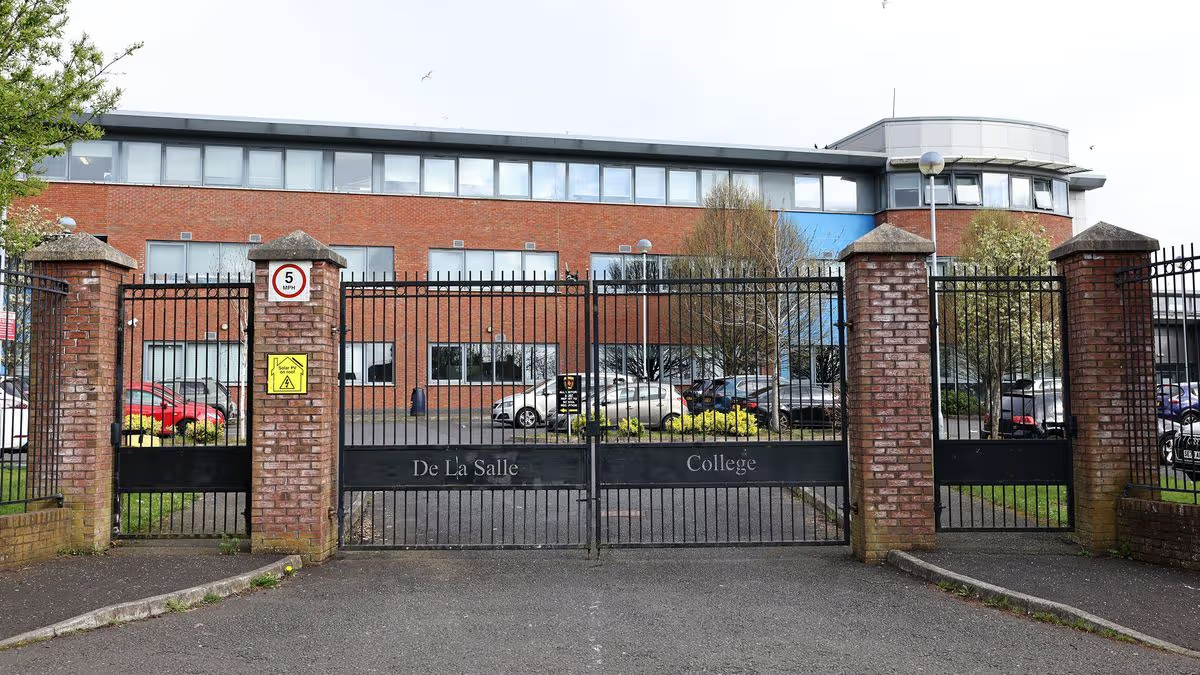
A dad who slapped a teenage boy at the school gates after accusing him of bullying his daughter has been spared jail.

Nathan O’Mara, 38, insisted he had not intended to attack the boy but merely wanted to send ‘some sort of message’ with the confrontation outside the school in Penarth, South Wales.

But he said the ‘red mist’ came down when the boy ‘squared up’ to him.

O’Mara denied assault, claiming he hit the boy in self-defence, but was found guilty following a trial at Newport Crown Court.

Advertisement

He was sentenced to 44 weeks imprisonment, suspended for 18 months, and handed a restraining order.

Sign up for all of the latest stories

Start your day informed with Metro’s News Updates newsletter or get Breaking News alerts the moment it happens.

Advertisement

Recorder Ben Blakemore said: ‘You pulled up in your car, driving unnecessarily aggressively, and approached him in order to threaten him off your daughter.

‘At that point I am not sure you planned to assault him. What changed was something you hadn’t anticipated, he stood up to you.

‘He squared up and he didn’t step backwards when you stepped forwards. Matters heightened the way matters can do when machismo kicks in.

‘You wanted to assert yourself and frighten him off. You struck him with an open hand to the face, that was unnecessary.

Advertisement

‘That occurred because you were raising the heat in the confrontation and trying to get your message across in a different way.’

In a victim personal statement, the schoolboy said: ‘It’s affected my life at school, since the incident I have been isolated from friends and other students spread rumours.

‘They portrayed me to be something I’m not.’

David Pinnell, defending, said O’Mara, of, Sully, near Cardiff had a good relationship with his daughter.

Advertisement

Recorder Blakemore said: ‘You went about things entirely the wrong way. Rather than using channels available to you through school or the police if needed, you decided you’d deal with things yourself and in your own way.’

Get in touch with our news team by emailing us at webnews@metro.co.uk.

For more stories like this, check our news page.

Advertisement

Source link

Advertisement
Continue Reading

NewsBeat

The 9 best fitness apps to download in 2026, according to a fitness editor

Published

on

The 9 best fitness apps to download in 2026, according to a fitness editor

Finding the best fitness app for your particular needs can feel overwhelming. With hundreds of workout apps promising fast results, personalised training plans and more upgrade options, it’s hard to know which ones are actually worth your time and your money.

Whether you’re a beginner looking for a fitness app, something you can use at home, or a training app that fits around a busy schedule, the right platform can make sticking to exercise easier, more effective and more enjoyable. From strength training and Pilates to running, yoga and habit-building, today’s best fitness apps offer expert-led workouts, AI features and flexible programmes you can do anywhere.

As a fitness editor, I’ve learned what makes a decent training tool and which apps aren’t worth the investment. In this guide, I’ve tested and reviewed the best fitness apps in the UK for 2026. Read on for the best apps for your body, goals and lifestyle.

Advertisement

Read more: The best supplements to take, according to experts

The best fitness apps for 2026 are:

Read more: Best women’s gym leggings for every kind of workout

Source link

Advertisement
Continue Reading

Trending

Copyright © 2025