

Business
Bajaj Housing Finance shares rally 5% as Q1 AUM climbs 24% YoY


The company reported gross disbursements of approximately Rs 19,500 crore in Q1FY27, marking a sharp increase from Rs 14,651 crore in the corresponding quarter last year. Sequentially, disbursements also improved from Rs 17,506 crore reported in Q4 FY26.
Assets under management (AUM) rose 24% year-on-year to approximately Rs 1,49,610 crore as of June 30, 2026, compared with Rs 1,20,420 crore a year earlier. On a sequential basis, AUM expanded by around Rs 8,904 crore during the quarter.
The company’s loan assets (AR) also witnessed healthy growth, increasing to approximately Rs 1,31,150 crore as of June 30, 2026, from Rs 1,05,954 crore in the same period last year, reflecting sustained demand for housing finance.
Stock price trend and technical outlook
Bajaj Housing Finance has remained in an uptrend, with the stock advancing nearly 15% over the past three months. It currently commands a market capitalisation of Rs 73,866 crore, while its 52-week high stands at Rs 124.
From a valuation perspective, Bajaj Housing Finance trades at a P/E multiple of 28.85, with a price-to-sales ratio of 5.46 and a price-to-book ratio of 3.28, reflecting its current market valuation relative to its financial performance and net worth.

From a technical perspective, the stock continues to display positive momentum. Its 14-day Relative Strength Index (RSI) stands at 60.8, indicating strengthening buying interest while remaining below the overbought zone of 70. Additionally, the stock is trading above seven of its eight key simple moving averages (SMAs), reinforcing the prevailing bullish trend.
Also read: HCL Tech surges 6% on $1.14 billion AI deal; Mercedes-Benz likely clientThe shareholding pattern showed mixed trends during the March 2026 quarter. Foreign Institutional Investors (FIIs) marginally raised their stake in Bajaj Housing Finance to 0.99%, up from 0.94% in the previous quarter, signalling continued institutional interest. In contrast, mutual funds trimmed their holding to 0.35% from 0.63%, indicating some profit booking. Meanwhile, promoter ownership remained unchanged at a robust 86.70%, reflecting sustained confidence from the company’s promoters.
(Disclaimer: Recommendations, suggestions, views and opinions given by the experts are their own. These do not represent the views of Economic Times)


Ella Loneragan speaks to Nadia Budihardjo about the Old Court House’s 190th anniversary and the potential for heritage buildings to be reused.
Business
Dangerous New Mac Malware PamStealer Disguises Itself as a Popular Clipboard App to Steal Your Passwords

SAN FRANCISCO — A sophisticated new strain of Mac malware is targeting users of one of the most popular third-party clipboard management utilities on macOS, impersonating the app through fake websites and disguised installer files to steal login passwords, according to a threat report published by mobile device management and security firm Jamf Threat Labs.
The malware, which Jamf researchers have named PamStealer, is being distributed through websites designed to mimic the legitimate website of Maccy, a widely used free open-source clipboard history tracker. Users who land on these fraudulent sites and attempt to download what they believe is a legitimate copy of the application instead receive malicious files engineered to compromise their system silently and extract sensitive authentication credentials.
PamStealer’s delivery mechanism relies on AppleScript files disguised as legitimate Maccy installer packages and distributed within disk images, a format Mac users commonly associate with trusted software installations. When a user opens and attempts to run the file, the script triggers a payload chain that begins tracking information on the targeted Mac and transmits collected data to an external threat actor controlling the attack.
The name PamStealer derives from the specific technique the malware uses to extract and validate a victim’s login password through macOS Pluggable Authentication Modules, known as PAM, the system-level authentication framework built into Apple’s operating system that handles credential verification across a wide range of login and privilege escalation scenarios.
What distinguishes PamStealer from earlier generations of Mac malware, according to Jamf’s analysis, is the technical sophistication of its execution chain and its deliberate effort to minimize the signals that conventional detection tools would typically catch. The malware does not use commonly flagged shell commands such as curl or zsh, which many Mac security tools have been trained to treat with suspicion. Instead, the AppleScript payload executes a self-contained JavaScript for Automation downloader that retrieves and stages the malicious payload using native Objective-C application programming interfaces, tools that are part of macOS’s own legitimate software development framework and therefore far less likely to trigger defensive alerts.
A Rust-based second-stage payload follows the initial download, with the combination of techniques producing what Jamf’s researchers described as a notably quiet and difficult-to-detect attack chain.
“Together, these behaviors illustrate how commodity macOS stealers continue to evolve, adopting quieter execution chains and native implementations that reduce traditional detection opportunities while remaining compatible with standard macOS features,” Jamf wrote in its report.
The researchers further noted that while disk images and AppleScript-based malware have both been established components of the Mac threat landscape for years, PamStealer represents a meaningful evolution in how those elements are combined. By pairing them with a local credential validation process through PAM rather than transmitting password attempts outward for external verification, the malware avoids generating the kind of outbound network traffic that endpoint detection tools often monitor for signs of malicious activity. The credential is tested locally against the Mac’s own authentication system before being exfiltrated, reducing the overall noise of the attack and making the infection harder to identify through conventional monitoring.
The Maccy application itself is not compromised. The malware is entirely external to the legitimate software and works solely by exploiting user trust in the Maccy brand and the app’s wide adoption among Mac power users. Maccy has built a following among enthusiasts and professionals because it provides clipboard history functionality that Apple only began offering natively in macOS Tahoe through an update to Spotlight, arriving years after third-party developers had already built dedicated tools to fill the gap. The combination of strong name recognition and a user base comfortable with installing non-App Store software made Maccy a strategically attractive brand for threat actors to impersonate.
To protect themselves from PamStealer specifically, Maccy users should only download the application directly from the official Maccy website, maccy.app, or from the application’s official GitHub repository. Both the official website and the GitHub page carry explicit disclaimers stating that maccy.app is the only official website for the application, a warning that the developer has apparently added in direct response to the emergence of impersonation sites targeting their user base. Any other website distributing a file claiming to be Maccy should be treated as suspect.
More broadly, the threat underscores a set of security habits that Apple, security researchers and enterprise IT teams consistently recommend to Mac users regardless of which application a specific attack happens to target. The safest pathway for obtaining Mac software remains the Mac App Store, where Apple reviews applications before making them available for download and applies a layer of technical sandboxing that limits what even legitimate apps can access on a user’s system. Software obtained directly from a developer through their official website carries somewhat more risk, though that risk is manageable when users take care to verify they are on the correct domain and not a lookalike site.
Users who receive messages containing links to software downloads from unfamiliar or unexpected sources should avoid clicking those links directly. A recommended approach involves Control-clicking any link or button to copy the actual URL before visiting it, then pasting the address into a text editor to inspect the full destination address before proceeding. Links in emails or text messages that claim to lead to known, trusted software download pages are a common vector for delivering malware through exactly the kind of impersonation technique PamStealer employs.
Mac users who want to assess their existing security posture can also consider running one of several reputable third-party Mac security tools that scan for known malware signatures and monitor for unusual system behavior, though Jamf’s report suggests that PamStealer’s design specifically targets detection gaps in conventional tools, making behavioral awareness and careful download hygiene the most reliable defenses for now.
PamStealer’s sophistication reflects a broader and well-documented trend in which Mac-targeted malware has grown significantly more advanced in recent years as the platform’s user base and commercial profile have expanded, attracting greater attention from financially motivated threat actors who once focused almost exclusively on Windows systems. The days when Mac users could rely on relative security through obscurity are long past, and the evolution documented in Jamf’s PamStealer report offers a clear illustration of why.


Kenya private sector activity picks up in June, PMI shows

Europe shares extend record rally on cool U.S. data, geopolitical progress

Shares in Emerald Resources have gone up after the West Perth-based company announced a $562 million deal for its gold project.


The Value Pendulum is an Asian equity market specialist with over a decade of experience on both the buy and sell sides.He is the author of the investing group Asia Value & Moat Stocks, providing ideas for value investors seeking investment opportunities listed in Asia, with a particular focus on the Hong Kong market. He hunts for deep value balance sheet bargains and wide moat stocks and provides a range of watch lists with monthly updates within his investing group.
Analyst’s Disclosure: I/we have no stock, option or similar derivative position in any of the companies mentioned, and no plans to initiate any such positions within the next 72 hours. I wrote this article myself, and it expresses my own opinions. I am not receiving compensation for it (other than from Seeking Alpha). I have no business relationship with any company whose stock is mentioned in this article.
Seeking Alpha’s Disclosure: Past performance is no guarantee of future results. No recommendation or advice is being given as to whether any investment is suitable for a particular investor. Any views or opinions expressed above may not reflect those of Seeking Alpha as a whole. Seeking Alpha is not a licensed securities dealer, broker or US investment adviser or investment bank. Our analysts are third party authors that include both professional investors and individual investors who may not be licensed or certified by any institute or regulatory body.

What History Tells Us About SpaceX Joining The Nasdaq-100

Perth’s northern and south-eastern suburbs have been identified as small business hotspots, with the increased activity linked to population growth.

Moody’s places South32 on downgrade watch after $5.6 bln Alcoa asset sale


EU trade with US hits record despite tariff tensions, study shows

Prediction Markets Reveal Odds for FIFA’s Mystery ‘Super-Mega Top Global Artist’

Ray J Shares Another Health Update With His Fans On Instagram

Prayer to Remove Financial Blockages #affirmations #prayer #financialfreedom #financialmiracle

No Jackpot Winner as $257 Million Prize Rolls Over to $269 Million Monday Draw

Renter of Home in Anne Heche Crash Denies Settlement With Son

Weekend Open Thread: Staud – Corporette.com
Prayer to Remove Financial Blockages #affirmations #prayer #financialfreedom #financialmiracle

How to Look Like You’re Getting Money Before You Actually Are

Krypto Kaufphase hat offiziell begonnen (klare Aussagen, mit Zahlen)
-
 Fashion7 days ago
Weekend Open Thread: Staud – Corporette.com
-

 Crypto World3 days ago
Strategy authorizes up to $1.25B in Bitcoin sales under new capital plan
-

 News Videos5 days ago
MAJOR BITCOIN & MARKET UPDATE!!!! (MUST WATCH ASAP!!!)
-

 Tech3 days ago
Anonymous researcher drops 0-day ‘exploitarium’ repo
-

 Crypto World6 days ago
Coinbase, Circle Deepen Crypto Stock Losses Despite Resilient S&P 500
-

 Business3 days ago
Australia treasurer says alleged access of prime minister’s bank data ’incredibly concerning’
-

 Crypto World6 days ago
Kraken's xStocks Opens Bending Spoons IPO Registration to EEA Retail
-

 Sports6 days ago
FIH Pro League: India defeat Pakistan 7-1, register biggest win of campaign | Other Sports News
-

 Tech5 days ago
Bluekit phishing kit adopts browser-in-the-middle for login theft
-

 Tech6 days ago
Russian hackers now target Signal backup recovery keys
-
 Crypto World7 days ago
Hyperliquid Named on Singapore MAS Investor Alert Register
-

 Crypto World7 days ago
RTX holders must register wallets before token distribution begins
-

 Tech5 days ago
Claude Code turned every engineer into three. Now companies need more product thinkers
-

 Sports2 days ago
Broncos roster: OL Ben Powers (No. 74) entering final year of contract
-
 Business4 days ago
The AI boom won’t burst all at once. It will pop in ‘rolling bubbles’: Macquarie
-
 Crypto World7 days ago
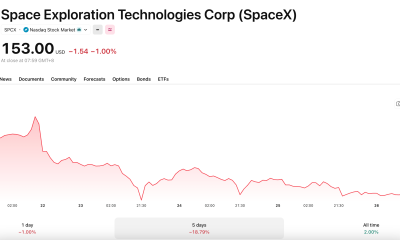
SpaceX Called a Market Top Signal Just 2 Weeks After Its $86 Billion IPO
-

 Tech6 days ago
Silicon Valley paid to kill AI regulation, now it wants the rules back
-

 NewsBeat2 days ago
Presenter Caroline Flack’s brother Paul Flack dies aged 55
-

 Crypto World1 day ago
Binance stock trading tops $1B in first month after launch
-
 NewsBeat23 hours ago
New exhibition reflects five decades of movement between island of Ireland and GB
You must be logged in to post a comment Login