

Crypto World
Ireland Seizes 500 More Bitcoin, Total for 2026 Reaches 1,500 BTC

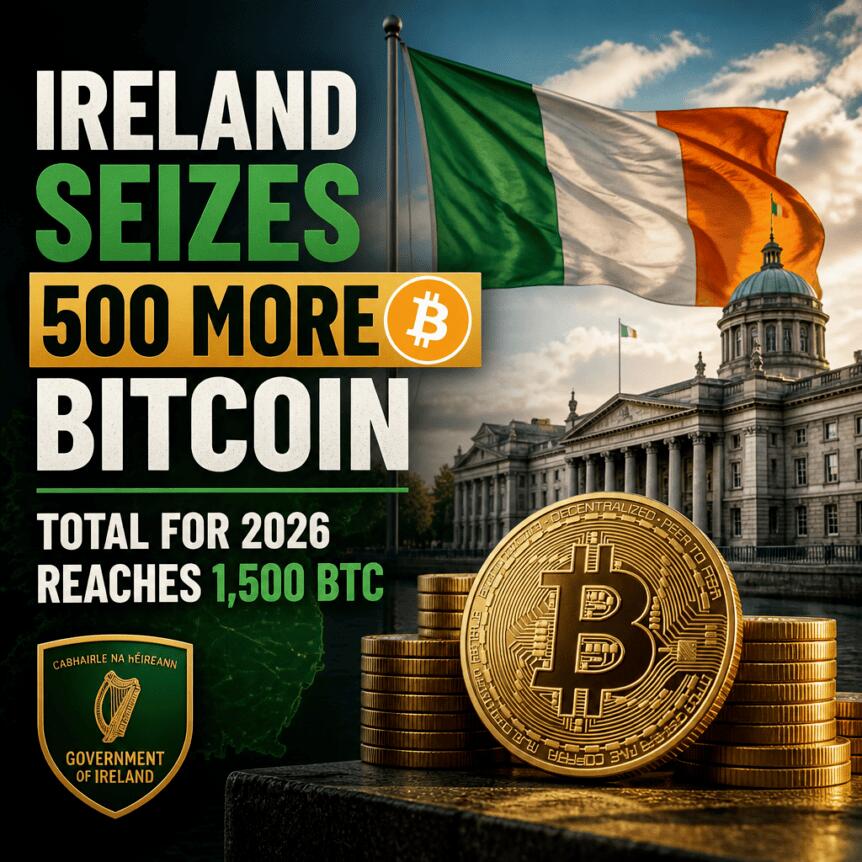
Ireland’s Criminal Assets Bureau (CAB) has confirmed the seizure of an additional 500 Bitcoin, worth roughly €27 million (about $30.9 million), in cooperation with Europol’s European Cybercrime Centre. The agency said the latest action brings CAB’s total Bitcoin seizures for 2026 to 1,500 BTC, valued at approximately $92.4 million.
In its update posted Thursday, CAB said Europol provided operational coordination, technical expertise, and decryption support during the investigation. The bureau did not name the wallet owner or provide further details about how the access was obtained.
Key takeaways
- CAB confirmed a new 500 BTC seizure in cooperation with Europol’s European Cybercrime Centre.
- Total CAB Bitcoin seizures in 2026 now stand at 1,500 BTC, valued around $92.4 million.
- Authorities have not publicly linked this latest wallet action to any specific criminal case.
- Separately, public tracking suggests a wallet address associated with Clifton Collins moved 500 BTC on Thursday.
New seizure brings 2026 total to 1,500 BTC
The bureau’s announcement is the latest in a run of Bitcoin-related enforcement activity. CAB said the seized 500 BTC are currently worth about €27 million and emphasized the cross-border support from Europol’s European Cybercrime Centre, particularly around technical work and decryption.
For investors and users, the key operational signal is not only the size of the seizure but the pattern of international cooperation—CAB’s reference to Europol support underscores how ongoing cryptocurrency investigations increasingly depend on specialized technical capabilities rather than traditional evidence-gathering alone.
Cab also did not offer any additional comment beyond the confirmation, leaving open questions about the nature of the underlying investigation and whether the seized funds come from the same larger case previously discussed in Irish media.
Earlier wallet access set the stage for another 500 BTC
Months earlier, CAB said it had gained access to and seized a cryptocurrency wallet containing 500 Bitcoin. That earlier wallet was reported by Irish media to have been connected to Clifton Collins, a convicted drug dealer.
According to The Irish Times, the March wallet authorities accessed was one of twelve wallets believed to have held about 6,000 BTC once owned by Collins. The paper containing the private keys was reportedly lost, adding a layer of difficulty to how investigators were able to unlock and move the funds.
While CAB did not confirm a connection between Thursday’s seizure and Collins, the timing matters. Public blockchain observers linked to Collins have pointed to movement from an address associated with him around the same day as CAB’s announcement.
Public tracking: Collins-linked address moved 500 BTC
In coverage tied to the earlier Collins-linked wallet, blockchain explorers and analysts have monitored the remaining balances attributed to those holdings. The article notes that an address associated with Collins reportedly moved 500 Bitcoin to an unknown address on Thursday.
As of Friday, wallets still associated with Collins were reported to hold 4,500 BTC, valued at about $277 million. The figure is based on public tracking rather than an official CAB statement, so readers should treat it as observational data rather than confirmed custody or law-enforcement control.
Still, the sequence is notable: the combination of CAB’s 500 BTC seizure announcement and independent reporting of movement from Collins-associated addresses suggests the criminal wallet landscape remains actively contested long after the first tranche of recovered funds.
What authorities previously said about how Collins stored keys
Collins was arrested in 2017 after police searched his car and found cannabis, according to The Guardian. Prosecutors said he used proceeds from his drug operation to purchase about 6,000 Bitcoin in late 2011 and early 2012, spreading the holdings across twelve wallets.
Authorities and reporting described a key-management strategy that relied on a single physical backup: Collins stored the wallet keys on a sheet of A4 paper, hidden inside the aluminum cap of a fishing rod case at his rental home. After his arrest, the landlord allegedly discarded Collins’ belongings. Collins claimed the fishing rod case had been stolen before the landlord entered the property.
That dispute—and the reported loss of the keys—help explain why access to some of the holdings could have taken time. It also highlights a broader lesson for the ecosystem: even when large balances are held securely on-chain, off-chain key handling and physical storage failures can ultimately determine whether funds remain reachable.
With CAB now confirming another 500 BTC seizure in 2026, the open question for the market is how quickly investigators can continue collapsing the gap between wallets once considered “lost” and the funds that ultimately get moved and frozen. Readers should watch for whether CAB’s next updates clarify the relationship—if any—between Thursday’s seizure and the remaining Collins-associated holdings, as well as how Europol’s technical role evolves in future operations.

Crypto World
ARK Invest’s Cathie Wood Pours $41M into Tesla (TSLA), Exits Roku Position Ahead of Holiday

Key Highlights
- ARK Invest acquired 96,935 shares of Tesla totaling approximately $41.2 million distributed across three exchange-traded funds
- The significant Tesla investment followed the electric vehicle manufacturer’s impressive Q2 delivery figures of 480,126 units, exceeding market expectations
- ARK added 91,353 shares of cryptocurrency exchange platform Bullish, valued at approximately $2.3 million
- The firm divested 180,228 Roku shares valued at roughly $25.3 million, extending a recent pattern of position reduction
- Other divestments included positions in Twist Bioscience, Strata Critical Medical, and Iridium Communications
On Thursday, July 2nd, Cathie Wood’s investment management firm ARK Invest executed a series of substantial portfolio adjustments before the Independence Day holiday weekend.
The most significant transaction involved Tesla shares. ARK accumulated 96,935 shares valued at approximately $41.2 million, distributed among the ARK Innovation ETF, ARK Next Generation Internet ETF, and ARK Space Exploration and Innovation ETF.
The strategic timing aligned with Tesla’s recent quarterly performance announcement. The electric vehicle giant had just unveiled second-quarter delivery figures that significantly exceeded Wall Street projections.
Tesla’s Q2 Performance Exceeds Market Expectations
Tesla reported deliveries of 480,126 vehicles during the second quarter of 2026, substantially surpassing analyst consensus estimates of approximately 406,000 units. This impressive performance appears to have reinforced Wood’s conviction in expanding ARK’s exposure to the automaker.
Additional positive momentum came from China. Tesla’s wholesale sales in China climbed for the eighth consecutive month in June, demonstrating sustained consumer demand in a strategically important market.
Tesla maintains its position as ARK’s largest portfolio holding. Despite the stock experiencing roughly a 10% decline year-to-date, Wood’s continued accumulation signals confidence in the company’s long-term prospects.
ARK Expands Positions in Bullish and SoFi
ARK also accumulated 91,353 shares of Bullish, the cryptocurrency exchange platform operator, representing an investment of approximately $2.3 million. This purchase aligns with ARK’s ongoing strategy to build exposure to the digital asset infrastructure company across multiple funds.
Wood’s firm added 54,838 shares of SoFi Technologies valued at roughly $1 million through the ARK Innovation ETF. This acquisition followed SoFi’s recent announcement of launching a small-business lending platform.
Additional purchases included 52,452 shares of X-Energy, alongside minor position increases in Generate Biomedicines and Recursion Pharmaceuticals.
Roku Experiences Largest Position Reduction
Among the sales, Roku represented the most substantial divestment. ARK liquidated 180,228 shares worth approximately $25.3 million across three exchange-traded funds. This transaction continues ARK’s recent pattern of systematically reducing its Roku exposure.
ARK also divested 29,615 shares of Twist Bioscience valued at approximately $3 million, 274,932 shares of Strata Critical Medical worth roughly $1.5 million, and 21,842 shares of Iridium Communications totaling about $1.2 million.
Additionally, ARK sold 100,430 shares of Absci Corp through its ARKG ETF, amounting to approximately $1.1 million, maintaining its recent trajectory of trimming this holding.
These portfolio adjustments demonstrate Wood’s strategy of reallocating capital toward Tesla and high-growth technology companies while scaling back exposure to streaming entertainment and select biotechnology positions ahead of the extended holiday weekend.
Tesla’s exceptional quarterly delivery performance served as the primary driver behind the day’s most substantial acquisition.


TLDR
- Bitcoin whales bought more than 270,000 BTC worth about $16.7 billion over the past two weeks.
- U.S. spot Bitcoin ETFs recorded $4.06 billion in June outflows, marking their worst month since launch.
- The ETF outflows pushed 2026 flows negative before the funds recorded a $221 million inflow on Thursday.
- Bitfinex analysts said whale accumulation and institutional selling have appeared near past Bitcoin cycle lows.
- Solana outperformed major crypto assets after rising about 15% since early June.
Bitcoin whales bought $16.7 billion in BTC during two weeks, even as U.S. spot Bitcoin ETFs lost $4.06 billion in June. The record ETF bleed pushed 2026 flows negative, but Thursday brought a $221 million inflow. Therefore, the market showed a clear split between institutional selling and whale accumulation.
Bitcoin Whales Absorb ETF Selling Pressure
Bitcoin whales added more than 270,000 BTC over two weeks, according to Bitfinex analysts. Bitcoin whales bought while U.S. funds faced their worst month since launch. The buying reached about $16.7 billion at Bitcoin’s $62,055 price.
Bitcoin whales moved against the ETF trend as spot demand stayed weak. Bitfinex said the spot premium remained negative during the buying period. That signal showed U.S. spot desks did not drive the accumulation.
Bitcoin whales often accumulate when weaker holders sell near cycle lows. Bitcoin whales also reduce liquid supply when they move coins into long-term wallets. However, ETF outflows showed institutions still cut exposure during June.
Solana Gains While Bitcoin Whales Build Positions
Solana moved in the opposite direction from most large crypto assets. SOL rose about 15% since early June despite Bitcoin hitting 21-month lows. The token gained support from upgrades and stronger network activity.
Tokenized real-world asset transfers on Solana rose 120% to $8.53 billion. That growth helped SOL outperform while Bitcoin whales focused on BTC accumulation. Bitfinex analysts called the market split a “familiar one.”
They said altcoins often fall before Bitcoin and recover before Bitcoin. Still, Bitcoin whales kept their attention on BTC during the ETF selloff. The pattern showed different groups taking different risks across crypto markets.
Optimism Falls as Bitcoin Whales Signal Market Stress
Optimism and other layer-2 tokens traded near record lows. Base dropped Optimism’s shared technology, and that move weakened the fee-capture case. As a result, traders reduced exposure to several Ethereum scaling tokens.
Meanwhile, Bitcoin whales continued to absorb supply from sellers. Bitcoin whales created a sharp contrast with institutions that exited ETFs. Bitcoin whales have shown similar behavior near past recovery phases.
The next U.S. inflation reading now carries major weight for crypto markets. May inflation reached 4.2%, although Kevin Warsh said inflation risks had eased. A softer print could change rate expectations before the Fed meeting.
Crypto World
Crypto prices stage a weekly recovery, but bears still hold the structural advantage: Crypto Markets Today
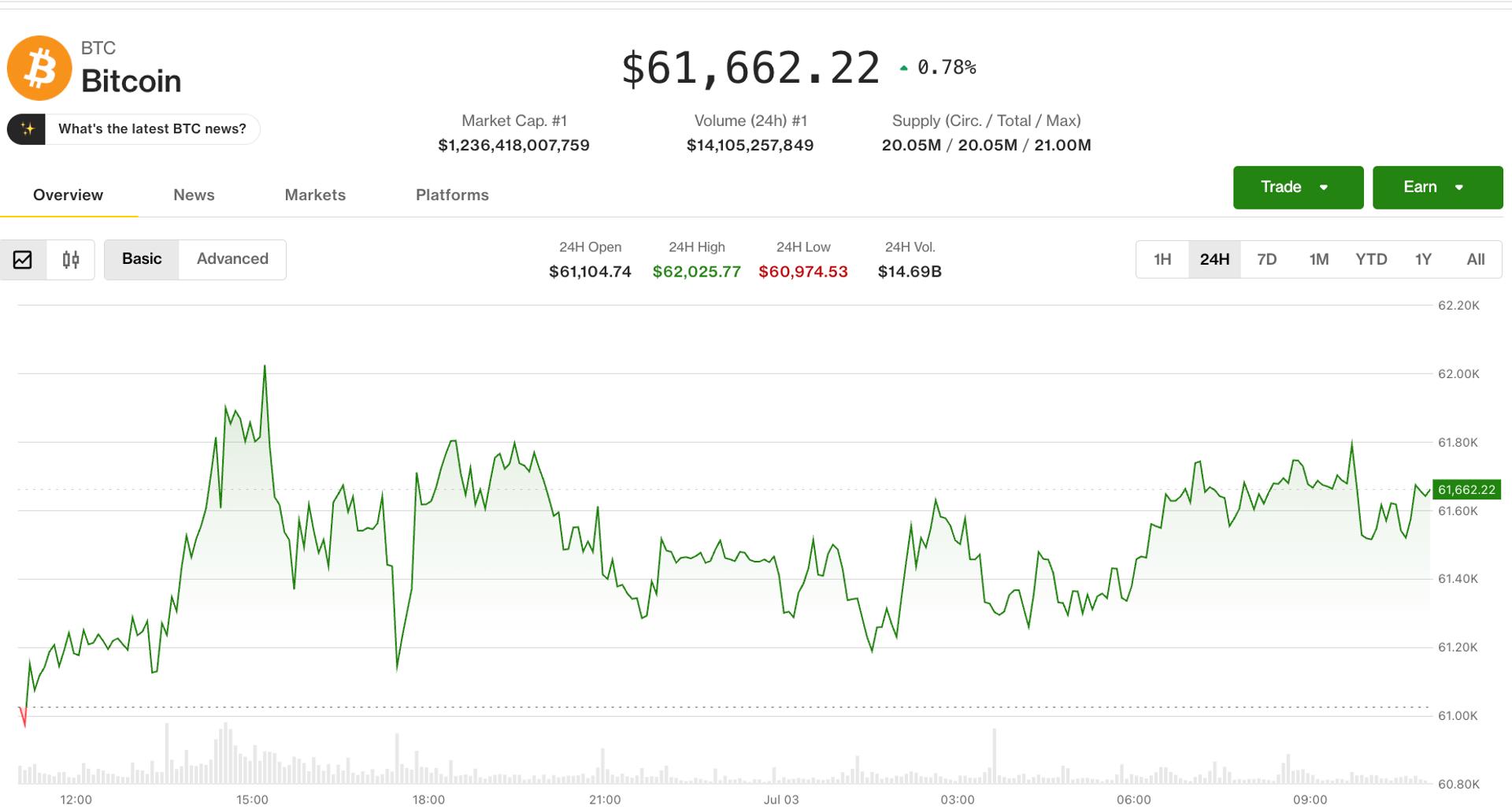
The crypto market is ending the week in a healthier position than where it started, with bitcoin trading at $61,600 after having risen by 6.5% from Tuesday’s almost two-year low of $57,750.
Still, the largest cryptocurrency’s gains on Friday were muted in comparison with Thursday’s 2.6% advance, which benefited from weak U.S. job data that lowered expectations for a Federal Reserve interest-rate increase.
The interest-rate outlook echoed for a second day as the U.S. entered a long weekend with stock markets closed. Ether (ETH) rose for a third straight day to add 11.5% since Tuesday and 2.6% on Friday alone. Other altcoins also advanced, with , zcash (ZEC) and dash (DASH) all gaining between 2.2% and 3.1%.
Still, the broader market structure remains bearish across the majority of crypto tokens following a succession of lower highs and lower lows. For bitcoin to reverse the downtrend, it needs to trade back above $67,000 and then take out $81,000, which was the local high in May.
Derivatives positioning
- Ether replaced bitcoin as the biggest token for 24-hour liquidations. A total of $417 million worth of crypto futures bets were liquidated in 24 hours, of which $160.80 million are from the ether market. BTC, a distant second, notched $97 million. This shows just how bearish positioning on ether was.
- Ether futures’ open interest (OI) still stood at 14.31 million, the most since June 10, with annualized funding rates of nearly 10% and the highest 24-hour cumulative volume delta (CVD) among majors. The combination points to growing demand for bullish exposure in the market, a sign traders are anticipating continued price gains.
- OI in DOGE futures tallied 14.13 billion tokens, the highest since May 16. The number has been growing since June 28, a sign of renewed demand for leverage. The DOGE situation is similar to ether’s bullish picture.
- While ETH and DOGE have led OI growth over 24 hours, futures tied to HBAR and ZEC have seen the opposite. HBAR has the most negative 24-hour CVD among majors, a sign bears are becoming more aggressive in shorting at market orders than passive limit orders.
- Most tokens have positive CVD, a sign of bulls’ leadership in the market.
- Both bitcoin and ether 30-day implied volatility indexes continue to slide, reversing the June pop, signaling market calm and potential for continued bullish price action.
- On Deribit, the most traded BTC options of 24 hours are calls at strikes ranging from $60,000 to $70,000. Call options represent a bullish bet on the market. Ether options show a similar bullish mood, with the $2,500 call seeing the most activity.
- Block flows featured a large BTC long call condor, a strategy betting on a range play between $66,000 and $68,000 till July 17.
Token talk
- Uniswap (UNI) led gains in altcoins following Thursday’s announcement confirming that it will be the primary automated market maker (AMM) for the Robinhood layer-2 blockchain.
- UNI is up by more than 11% in the past 24 hours with daily trading volume doubling to $320 million, still reaping the benefits of its tie-up with Robinhood announced July 1.
- AI tokens FET, RENDER and TAO also demonstrated positive signs on Friday, rising by between 1.5% and 2.3% since midnight UTC after weeks of sell pressure.
- CoinMarketCap’s “Altcoin Season” indicator is at 46/100, still firmly in the neutral zone it has occupied for the past month as the market awaits a return to risk-on sentiment.
- Solana (SOL) is leading the rally among crypto majors. It has now surged by more than 17% over the past week, trading at $80 after dropping to as low as $68 the week before.
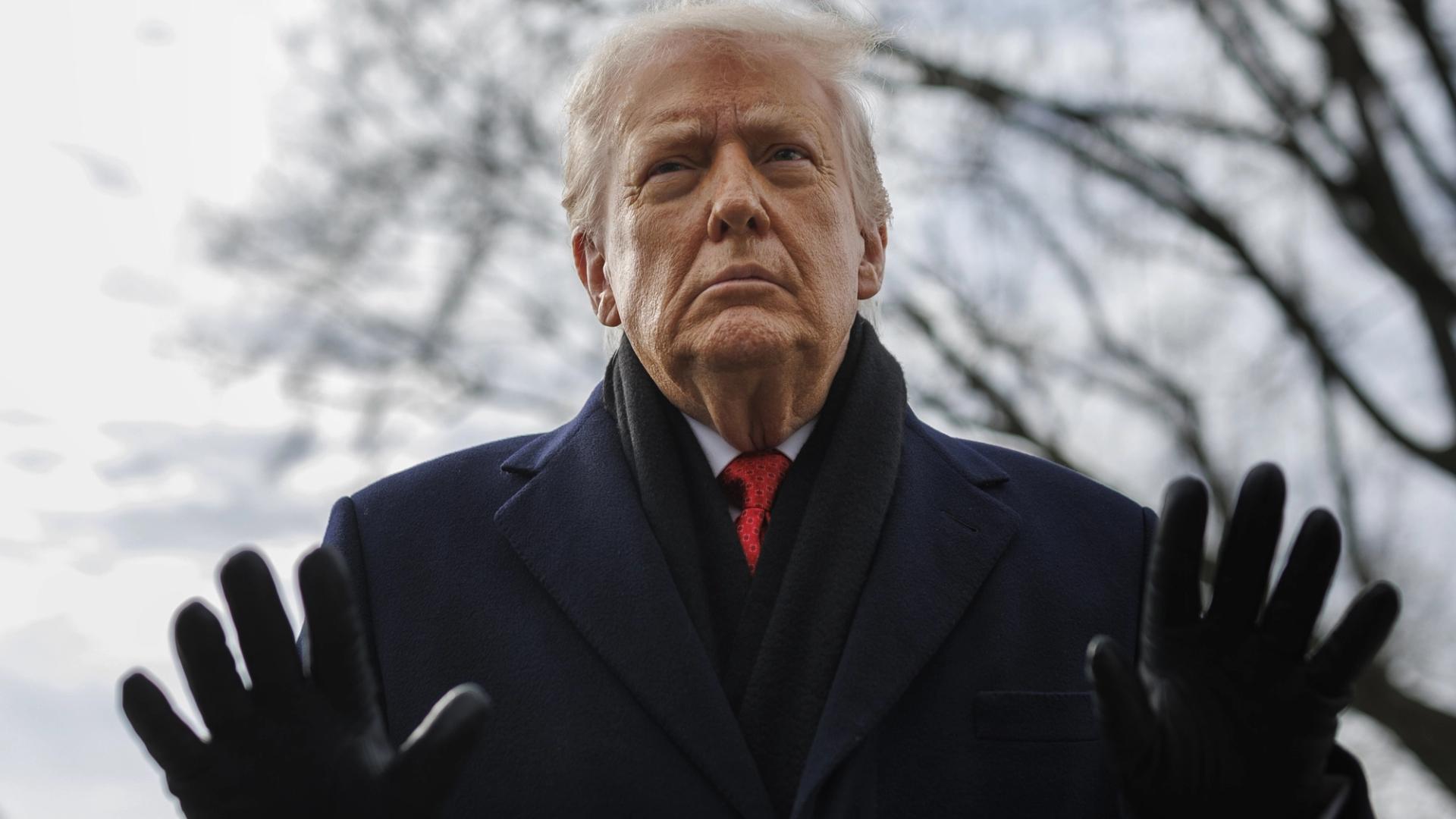
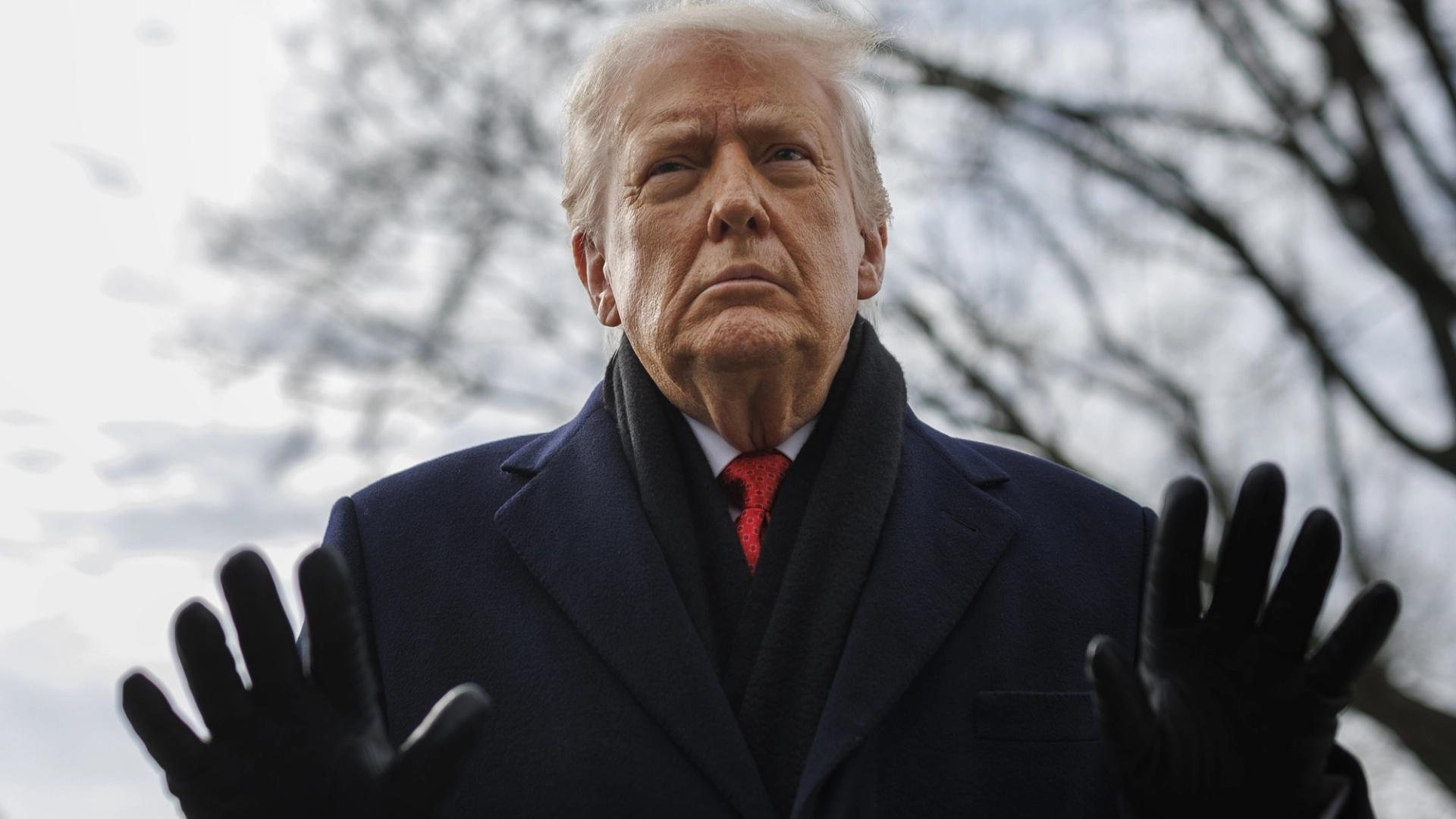
President Donald Trump said there is ‘nothing wrong’ with the money his family has made in crypto, responding to financial disclosures that showed he earned at least $1.4 billion from the industry last year.
Asked in a CNBC interview on Thursday at the White House whether he knew about the ventures, Trump said “I could know about it. I didn’t.” He said that there was nothing illegal about his involvement and that his goal was for the U.S. to lead in crypto.
Trump handed day-to-day control of his businesses to his two eldest sons before taking office, and did not divest his assets.
The disclosure, released this week by the federal Office of Government Ethics, made Trump the largest crypto earner in U.S. politics.
It showed about $636 million tied to his eponymous memecoin, which was launched on the eve of his return to office, roughly $594 million from World Liberty Financial, the crypto firm he co-founded with his sons and nearly $197 million from a stablecoin venture.
Quick Summary
- Bridge obtains MiCA and EMI regulatory clearances for euro stablecoin operations in the EU.
- The Stripe-backed infrastructure provider can now deliver compliant services throughout European markets.
- Regulatory approvals enable companies to create branded euro-denominated stablecoins through Bridge’s platform.
- Financial technology firms gain access to named IBAN accounts and euro banking tools via Bridge.
- MiCA framework drives stablecoin operators toward heightened European regulatory compliance.
Bridge has obtained dual regulatory licenses from Luxembourg authorities, allowing the company to scale its euro stablecoin payment infrastructure throughout the European Union. The fintech firm, which counts Stripe among its investors, received both MiCA crypto-asset service provider authorization and Electronic Money Institution registration. These regulatory clearances provide Bridge with a unified operational framework spanning all 27 EU territories.
Regulatory Clearances Open European Market Access
The Luxembourg regulatory approvals bring Bridge under the European Union’s Markets in Crypto-Assets regulatory regime. The licenses simultaneously authorize the firm to facilitate electronic money operations throughout the trading bloc. Consequently, commercial entities can now access compliant stablecoin infrastructure and euro payment capabilities through a consolidated arrangement.
Bridge stated the authorizations encompass capital reserve requirements, asset custody protocols, and operational security measures. These provisions represent fundamental components of the EU’s emerging cryptocurrency oversight architecture. The company now operates stablecoin services within defined compliance parameters.
The regulatory milestone also bolsters Bridge’s competitive standing in Europe’s digital payments ecosystem. The platform already facilitates conversions between stablecoins and euro currency. With the new licenses, it can broaden those capabilities for software developers, fintech operators, corporate clients, and banking institutions.
Custom Euro Stablecoin Solutions for Enterprise Clients
Bridge will enable commercial clients to launch proprietary euro-denominated stablecoins tailored to their specific use cases. Organizations can deploy these digital tokens for customer rewards programs, loyalty mechanisms, on-ramp services, and application-integrated payments. This eliminates the need for businesses to establish independent reserve management and regulatory compliance infrastructure.
Financial technology providers can leverage Bridge to deliver virtual IBAN accounts issued in end-user names. They can additionally furnish euro-denominated accounts that function seamlessly across every EU jurisdiction. This capability provides firms with a streamlined mechanism for transnational monetary transfers.
Corporate enterprises can utilize custom stablecoins to transfer capital between international subsidiaries. This methodology can minimize dependence on traditional correspondent banking infrastructure. Banking institutions can similarly adopt stablecoin settlement rails to accelerate institutional transaction finality.
MiCA Framework Transforms European Digital Asset Landscape
The licensing achievement arrives as Europe implements stricter supervision of stablecoins through MiCA regulations. The framework’s concluding implementation phase commenced on July 1. Licensed cryptocurrency platforms must now exclusively support stablecoins satisfying the regulation’s established criteria.
Bridge enters a growing cohort of authorized entities pursuing expanded EU market presence under MiCA guidelines. The regulatory framework permits authorized organizations to conduct operations across member nations without obtaining individual country-specific licenses. This arrangement provides stablecoin infrastructure providers with a more transparent pathway to geographic expansion.
The company has simultaneously pursued international growth through strategic payments collaborations. Visa announced in March plans to extend its partnership with Bridge on stablecoin-enabled card products. The initiative aims to reach more than 100 nations by the conclusion of 2026.
Crypto World
Bitcoin, ether traders aren’t fully buying the bounce, options markets show: Crypto Daily


With bitcoin and the broader crypto market showing signs of life, defensive positioning in the market has eased, not disappeared, a sign of continued caution.
This is evident from the BTC and ether (ETH) options markets listed on Deribit, where put options, derivative contracts offering protection against price slides, continue to trade at a premium to calls, or bullish contracts.
Bitcoin’s one-week, 25-delta put-call skew, which measures the difference in volatility for puts relative to calls, was around 16%. It showed puts outpacing demand by a 16% vol point premium. That’s still notably elevated, though significantly lower than the 25% of 10 days ago, according to data source Velo.
The one-, three-, and six-month skews also show put premiums of around 10% or more. The same is true for ether.
The message is clear. Downside fears persist, keeping demand for insurance against price declines intact even though BTC long-term holders and ETF investors appear to have returned to accumulation.
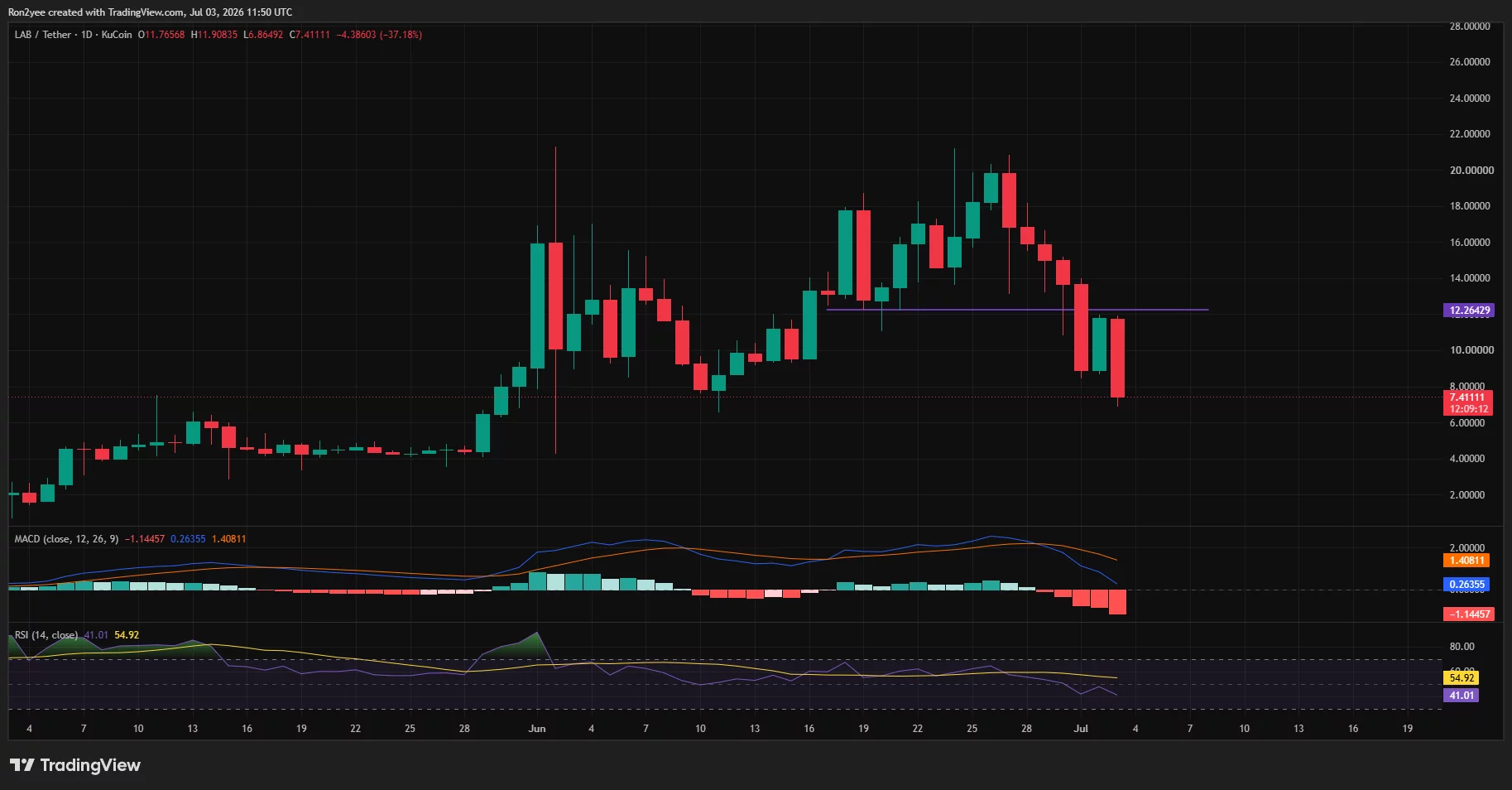
LAB price has suffered one of the steepest collapses in the crypto market this week, losing more than 60% of its value as concerns over insider holdings, token transparency, and heavy derivatives liquidations sparked a wave of panic selling.
Summary
- LAB price crashed more than 60% in a week as insider ownership concerns triggered panic selling.
- Heavy derivatives liquidations and a 23% drop in open interest accelerated the token’s decline.
- Weak crypto market sentiment and uncertainty over token unlocks added to the selling pressure.
According to crypto.news data, LAB (LAB) plunged to an intraday low of $7.50 on July 3, down more than 60% from its recent high near $20 on June 27. The sell-off erased billions in market value in less than a week as investors rushed to exit amid growing uncertainty surrounding the project’s tokenomics and insider ownership.
The biggest catalyst appears to be mounting concerns over LAB’s token distribution. Community discussions intensified after on-chain investigator ZachXBT previously alleged that insiders controlled more than 95% of the token supply, while also raising concerns over token allocation transparency, private OTC agreements, changing vesting schedules, and large insider wallet movements before major price swings.
These remain public allegations that have not been established in court, and the LAB team has disputed or not publicly accepted many of the claims.
Additional attention came from crypto community member Zetoshi, who summarized the controversy and highlighted LAB’s reported institutional backers, including Animoca Brands, OKX, Lemniscap, GSR, Amber Group, Mirana Ventures, Gate, and KuCoin, although Zetoshi’s suggestion that these relationships explain the lack of public action against the project represents personal opinion rather than verified fact.
Why did the LAB sell-off accelerate so quickly?
Once confidence weakened, technical factors amplified the decline. As LAB broke below major support around the $12 region, leveraged long positions began unwinding rapidly, triggering a liquidation cascade across derivatives markets.
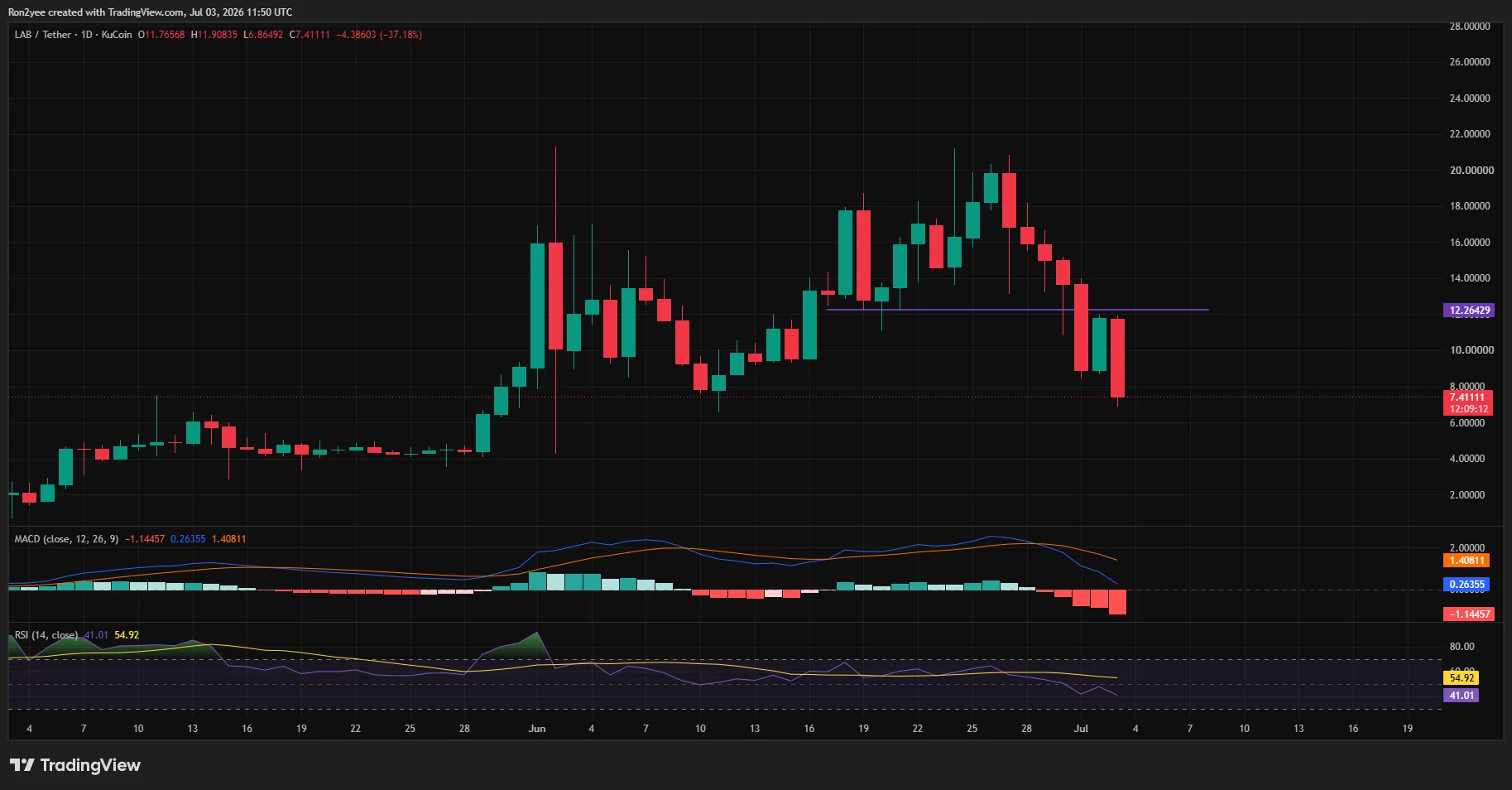
Open interest dropped roughly 23% to $130.39 million, signaling that traders were closing positions instead of adding fresh bullish bets. At the same time, funding rates turned negative across perpetual futures markets, indicating that bearish traders had taken control and that demand for short exposure outweighed buying interest.
Momentum indicators also reflected the sharp deterioration in sentiment. The MACD histogram expanded further into negative territory, reinforcing the growing downside momentum as automated liquidations and stop-loss orders accelerated the move toward the $7.50 support area.
Could broader market conditions have made the decline worse?
The LAB-specific concerns also coincided with a difficult backdrop for digital assets. During late June and early July, investors broadly reduced exposure to riskier cryptocurrencies as global central banks maintained restrictive monetary policies and capital rotated away from speculative altcoins.
The broader market weakness became an additional headwind as corrections in Bitcoin and Ethereum reduced overall risk appetite. With liquidity already thinning across the altcoin market, LAB’s structural concerns left few buyers willing to absorb heavy selling pressure from early investors and whales taking profits after the token’s remarkable rally from roughly $0.10 to nearly $27 earlier this year.
For now, traders will likely watch whether LAB can stabilize above the $7.50-$7.65 support zone. A sustained recovery may depend not only on improving crypto market sentiment but also on greater transparency from the project regarding token ownership, vesting schedules, and future token unlocks.


Large bitcoin holders bought more than 270,000 bitcoin ($16.7 billion) over the past two weeks, stepping in as U.S. institutions pulled money out at a record pace.
U.S. spot bitcoin exchange-traded funds (ETFs) shed $4.06 billion in June, their worst month since listing, past the previous record of $3.56 billion set in February 2025.
The outflows pushed the funds into the red for 2026 as a whole for the first time, and these products finally recorded a $221 million inflow on Thursday.
Large wallets, often called whales, went the other way, analysts at crypto exchange Bitfinex shared with CoinDesk in a Friday note. They added more than 270,000 BTC over two weeks while the spot premium, a gauge of how hard U.S. buyers are bidding, stayed negative, meaning the buying was not coming from spot desks.
Institutions selling and large holders accumulating at the same time is the pattern that has shown up near past cycle lows, where long-term holders take coins off sellers before any recovery reaches the price.
Key Takeaways
- June saw the ECB implement a 25 basis point rate increase, marking its first adjustment upward in nearly three years
- Bank of France Governor Emmanuel Moulin indicates the ECB has reached a favorable position
- Consumer price growth in the Eurozone declined to 2.8% in June from May’s 3.2%
- Crude oil prices have returned to pre-conflict levels following diplomatic breakthrough between Washington and Tehran
- While Barclays forecasts a September rate adjustment, analysts acknowledge declining energy costs may support holding steady
In June, the European Central Bank implemented a 25 basis point interest rate increase, representing its first upward adjustment in approximately three years. This decision followed a surge in energy markets sparked by U.S.-Israeli military operations targeting Iran, which temporarily drove crude oil beyond $110 per barrel.
With diplomatic relations now stabilized and energy prices retreating, certain ECB policymakers are indicating the institution may be approaching the conclusion of its restrictive monetary policy phase.
Central Bank Officials Note Enhanced Risk Balance
Emmanuel Moulin, serving as both Bank of France governor and member of the ECB Governing Council, informed Bloomberg Television that the institution finds itself in a favorable state at present.
During remarks at the Rencontres Economiques conference held in Aix-en-Provence, he noted that declining oil price levels should contribute to moderating price pressures within the services sector. He emphasized the absence of secondary inflationary effects currently.
Moulin made it explicit that the ECB has not embarked on a prolonged tightening campaign. He stated that determinations regarding the July and September policy meetings would be addressed as those dates approach.
ECB President Christine Lagarde, addressing attendees at a central banking conference in Portugal, rejected suggestions that June’s rate adjustment was merely precautionary against price escalation. She maintained it represented the appropriate action across various inflation projections.
Lagarde refrained from providing explicit guidance on future policy direction, noting only that threats to both inflation and economic expansion have achieved greater equilibrium.
Price Growth Moderates Despite Lingering Concerns
Consumer price levels across the Eurozone increased 2.8% over the twelve-month period ending in June, declining from May’s 3.2% reading and falling short of the 3.0% consensus forecast among economists.
Energy expenses climbed 8.7% on an annual basis in June, moderating from the 10.8% pace recorded in May. Core inflation, excluding volatile food and energy components, registered 2.4%, down from 2.6%.
Brent crude prices have now retreated to approximately pre-conflict levels after the diplomatic framework agreement between the United States and Iran concluded last month.
Despite these positive developments, Barclays analysts Silvia Ardagna and Mariano Cena highlighted that selling price expectation metrics from the European Commission continue to show elevated readings, particularly within manufacturing and retail industries.
They cautioned that four straight months of heightened energy expenses may continue to exert upward cost pressure across non-energy sectors in coming weeks.
Barclays Maintains September Rate Hike Forecast
Barclays maintains its projection for an additional ECB rate increase at the September policy meeting. Nevertheless, the analysts observed that retreating oil markets and indications that inflation may have crested could justify a more measured stance.
Additional ECB Governing Council members have indicated that all policy options remain under consideration for forthcoming meetings. Market participants have already reduced expectations for additional rate increases during the current year.
Bloomberg Economics now assesses that Eurozone inflation has probably reached its maximum level.
The ECB’s upcoming scheduled policy meeting occurs in July, followed by another session in September.
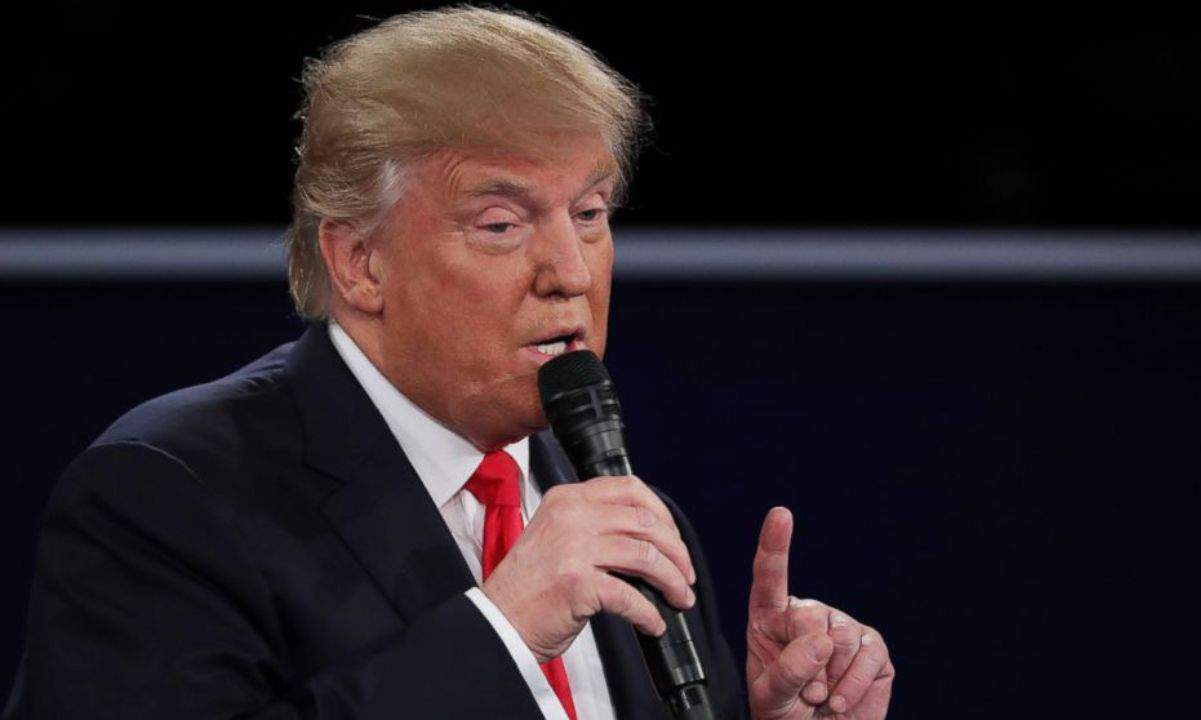
US President Donald Trump defended his family’s crypto earnings during a CNBC interview, saying there was “nothing illegal” and “nothing wrong” with the businesses generating billions of dollars while he serves in the White House.
He made the comments just days after new federal financial disclosures detailed the scale of his digital asset holdings and crypto-related income, renewing debate over whether a sitting president’s private business interests can coexist with public office.
Trump Defends Family Crypto Business After Disclosure
In the July 2 interview with CNBC’s Joe Kernen at the White House, Trump was asked about the massive windfall revealed in his annual financial disclosure.
The 927-page document released by the US Office of Government Ethics showed the president brought in more than $2.2 billion in 2025, with the bulk of it coming from crypto. This included $594 million from World Liberty Financial (WLFI), a DeFi venture he co-founded with his sons, and $636 million from sales of Trump-branded meme coins. He is also reported to be holding more than $50 million in Bitcoin in a cold wallet.
When he was asked whether he knew about the family’s crypto activities, the president replied, “No,” before quickly adding, “I could know about it. I didn’t, I mean, there’s nothing illegal, there’s nothing wrong with it. I could know.”
Trump then pointed out that his assets are managed through trusts overseen by his sons Eric and Donald Jr., as well as outside investment firms that he does not talk to. “I don’t even know who they are,” he said, adding that he doesn’t discuss investment decisions with his sons either, suggesting that almost any business dealing by his children could be construed as a conflict of interest given the expansive nature of presidential policy.
“I tell my kids: stay away from as much as you can stay away from. But they also have a life,” he told Kernen.
The US president also repeated a point he’s made on several other occasions, that crypto is a strategic industry that the United States cannot afford to lose to rivals.
“The way I look at crypto is if we’re not going to do it, China’s going to get it,” he said. “It’s a big deal, and anything we do, I want to be number one in, and we’re number one in crypto.”
The White House had also dismissed the conflict of interest allegations after the disclosure became public, saying Trump and his family have not engaged in conduct that conflicts with the public interest.
Critics Question Whether Presidential Influence Boosted Crypto Earnings
Despite the dismissal of conflict claims, longtime Bitcoin critic Peter Schiff was not convinced. In his latest podcast, which aired on June 3, the economist claimed that Trump’s earnings were closely tied to his presidency and were not just ordinary returns on investment.
According to him, the people buying Trump-branded tokens were paying for access and political influence instead of making conventional investments. A quick check on CoinGecko shows that Official Trump (TRUMP) and Melania Meme (MELANIA) are trading 97% and 99%, respectively, below their peaks, something that Schiff used to justify his influence-buying argument.
“It’s really a way to bribe the president,” he alleged. “You don’t have to give him money directly; just buy his token, because who else would buy the token? It’s a lousy investment.”
The post Donald Trump Defends $1.2B Crypto Earnings: ‘Nothing Illegal, Nothing Wrong’ appeared first on CryptoPotato.

3 Binge-Worthy Netflix Series To Watch This Weekend (July 4-5)

Excitement and concerns over credit card plans in Jersey
ARK Invest’s Cathie Wood Pours $41M into Tesla (TSLA), Exits Roku Position Ahead of Holiday


-

 Fashion7 days ago
Weekend Open Thread: Staud – Corporette.com
-

 Crypto World3 days ago
Strategy authorizes up to $1.25B in Bitcoin sales under new capital plan
-

 News Videos5 days ago
MAJOR BITCOIN & MARKET UPDATE!!!! (MUST WATCH ASAP!!!)
-

 Tech5 days ago
Claude Code turned every engineer into three. Now companies need more product thinkers
-

 Tech3 days ago
Anonymous researcher drops 0-day ‘exploitarium’ repo
-

 Crypto World6 days ago
Coinbase, Circle Deepen Crypto Stock Losses Despite Resilient S&P 500
-

 Business3 days ago
Australia treasurer says alleged access of prime minister’s bank data ’incredibly concerning’
-

 Crypto World6 days ago
Kraken's xStocks Opens Bending Spoons IPO Registration to EEA Retail
-

 Sports7 days ago
FIH Pro League: India defeat Pakistan 7-1, register biggest win of campaign | Other Sports News
-

 Tech5 days ago
Bluekit phishing kit adopts browser-in-the-middle for login theft
-

 Tech6 days ago
Russian hackers now target Signal backup recovery keys
-
Crypto World7 days ago
Hyperliquid Named on Singapore MAS Investor Alert Register
-

 Crypto World7 days ago
RTX holders must register wallets before token distribution begins
-
 Business4 days ago
The AI boom won’t burst all at once. It will pop in ‘rolling bubbles’: Macquarie
-

 Sports2 days ago
Broncos roster: OL Ben Powers (No. 74) entering final year of contract
-

 Tech6 days ago
Silicon Valley paid to kill AI regulation, now it wants the rules back
-

 NewsBeat3 days ago
Presenter Caroline Flack’s brother Paul Flack dies aged 55
-

 Crypto World1 day ago
Binance stock trading tops $1B in first month after launch
-
 NewsBeat1 day ago
New exhibition reflects five decades of movement between island of Ireland and GB
-

 Tech6 days ago
OpenAI mulls delaying IPO over valuation concerns
You must be logged in to post a comment Login