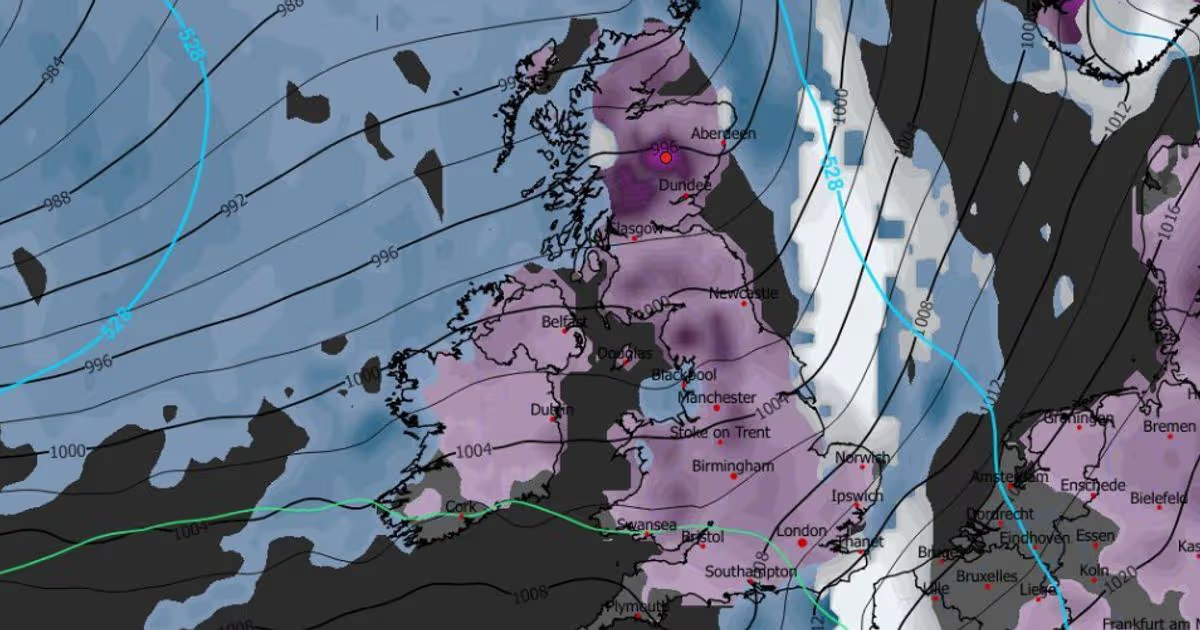
Several inches of snow could settle across the UK this weekend as weather maps reveal a blizzard will bury several major cities including London, Birmingham and Manchester
Shocking new weather maps suggest as much as 95 per cent of the UK could see snow settled on the ground following a blizzard starting on Valentine’s Day this weekend.
At around midnight on Valentine’s Day, snow is seen falling across the entire length of the UK – roughly 600 miles – from the south coast of England to the far north of Scotland. Glasgow, Manchester, Birmingham and Cardiff can all expect flurries around this time.
The storm will then continue eastward, the maps suggest, consuming almost all of central England and parts of the south by 3am. London could face snow from around this time too, although the most intense flurries are expected in Scotland.
At 6am on Sunday, maps show East Anglia and the south-east will face more heavy snow, with wintry showers still impacting London. The Pennines and the north-east appear to be in the firing line as well.
Snow coverage maps show roughly 95 per cent of the UK shaded in purple by 9am on Sunday – showing snow settled on the ground – with only the far south-west of England missing out.
Advertisement
Snow depth charts reveal the greatest accumulations will be in the Scottish mountains, where 24cm (nine inches) is on the cards. Parts of northern England could see 6cm (two inches), with 4cm (1.5 inches) coming in Wales and 2cm (0.7 inches) in the Midlands.
BBC Weather suggests snow could fall in places on both Saturday and Sunday too. Its forecast states: “A crisp, bright day on Saturday, excluding some lingering wintry showers on east coasts in the morning.
“Turning cloudier in the west later in the afternoon and evening. Overnight and into Sunday morning, turning windy as a band of rain moves in from the west, falling as snow initially. Sunday afternoon and Monday will see a mix of sunny spells and showers.”
Advertisement
BBC Weather also expects some snow tomorrow. The forecast adds: “Tomorrow, rain across the south of England and Wales with a chance for snow over the hills. Cold in Scotland and North England with sunny spells and snow showers. Dry and bright for Northern Ireland.”
The Met Office expects snow around the coasts on Friday. It says: “Rain continues to move southwards with Northern Ireland and Scotland seeing some sunshine. Snow showers around the coasts. Staying cloudy and wet across the south but eventually clearing later.”
The national weather agency says “widespread” snow could come on Sunday. Its forecast states: “Bright skies with sunny spells on Saturday but feeling much colder than in recent days. Turing wetter on Sunday with widespread snow likely across the north. Unsettled into next week.”

After magician Henry Moulding triumphed in last year’s series, securing the £250,000 prize and a coveted spot at the Royal Variety Performance, another hopeful will be vying for the same opportunity.
As the 19th series prepares to broadcast this month, Simon has dropped hints that Britain’s Got Talent will mark its 20th anniversary with an all-stars edition, bringing back memorable former acts.
He revealed that “the best of the best” would receive invitations to return for the celebration series, with Susan Boyle—one of the show’s most remarkable success stories—among those expected to feature, reports Belfast Live.
Speaking to The Daily Mail about next year’s plans, Simon said: “The same judges will be back. We are doing a champions show next year as well, the best of the best, which is brilliant.”

He continued: “You get the best contestants from all over the world and you re-compete in a big competition so, I like those kind of things.”
Advertisement
When questioned about whether Susan would make a comeback, he responded: “She has to!”
Back in 2009, Susan left judges Simon, Amanda, and Piers Morgan speechless with her unforgettable audition, which has since become part of television history.
“No one had any expectation, they thought I was a joke…. And then I started to sing,” she once reflected. As she conquered her nerves and “stomped on stage”, neither the judges nor the audience could have anticipated what was about to unfold.
Advertisement
Susan finished as runner-up to Diversity that year, but subsequently achieved extraordinary global recognition, releasing the bestselling debut album of 2009.
She went on to release numerous singles and eight albums, earned two Grammy nominations, and became the first female artist to secure three consecutive number one albums in under two years.
Susan has made several returns to the talent show platform, most recently in 2023, when she performed a duet with X Factor alumna Lucie Jones, singing I Dreamed A Dream, the memorable song from her original audition.
Advertisement
At the time, Susan revealed she had been facing a private health challenge, having experienced a minor stroke, but had “fought to be back on stage”.
Simon’s remarks follow ITV’s confirmation that Britain’s Got Talent will return on Saturday 21 February at 7pm.
An announcement revealed: “Britain’s Got Talent returns in the latest search for the most spectacular entertainers to hit these shores. This year, hundreds of hopefuls will be welcomed by award-winning hosts Ant and Dec before showing their talents to judges Simon Cowell, Amanda Holden, Alesha Dixon and new addition KSI.
“Performers from every corner of the UK and all around the world will be taking to the stage in the hope of not just impressing the judges, but also the voting public in a bid to win the life-changing cash prize of £250,000 and a sought-after slot at the world-famous Royal Variety Performance.”
For the latest showbiz, TV, movie and streaming news, go to the new **Everything Gossip** website
“The judges and hosts hold an extra-special power – the golden buzzer – which can give their favourite acts an instant ticket to the live semi-finals.”
The statement continued: “Expect to be amazed as a wealth of performers bring some of the most jaw-dropping, show-stopping talents to the BGT stage in the incredible new series.”
Advertisement
Britain’s Got Talent returns on Saturday 21 February at 7pm on ITV1 and ITVX.
Teams carried out “extensive and thorough searches”
20260212-20:08:55_PO European Highlander
A search and rescue operation in the Irish Sea has been stood down with “nothing found” following reports of a man overboard from a P&O Ferry
HM Coastguard launched a search and rescue operation at around 1.21pm on Thursday, February 12, following reports of a man overboard from the European Highlander P&O Ferry travelling from Larne to Cairnryan.
Larne and Portmuck Coastguard Rescue Teams and RNLI Lifeboats from Larne and Donaghadee were sent to the incident along with the Coastguard rescue helicopter. The helicopter was seen circling the area off the Larne coast for a number of hours.
The European Highlander was later seen returning to Larne port.
Shortly after 9pm on Thursday, HM Coastguard said the search and rescue operation in the area had been stood down with “nothing found”.
A spokesperson said: “At 1.21pm on 12 February, HM Coastguard responded to reports of a man overboard from a passenger vessel travelling between Larne and Stranraer.
“Larne and Portmuck Coastguard Rescue Teams and RNLI Lifeboats from Larne and Donaghadee were sent, as well as an HM Coastguard rescue helicopter. After extensive and thorough searches, the search has been stood down with nothing found at this time.”
Following the success of magician Henry Moulding, who was crowned the winner of Britain’s Got Talent last year, another act will be looking to win the life-changing £250,000 and the chance to perform at the Royal Variety Performance.
With the 19th season set to air this month, Simon has now teased that Britain’s Got Talent will celebrate its 20th anniversary with a special all-stars series, including former contestants.
He said “the best of the best” would be invited back for the special series, including Susan Boyle, who is one of the show’s biggest success stories.
Teasing next year’s show, Simon told The Daily Mail: “The same judges will be back. We are doing a champions show next year as well, the best of the best, which is brilliant.”
He added: “You get the best contestants from all over the world and you re-compete in a big competition so, I like those kind of things.”
When asked if singer Susan would return, he replied: “She has to!”
Advertisement
In 2009, Susan stunned judges Simon, Amanda and Piers Morgan as she made history with her audition.
“No one had any expectation, they thought I was a joke…. And then I started to sing,” she once reflected.
And as she overcame her nerves and “stomped on stage”, the judges nor audience could have ever imagined what was to come.
Advertisement
Susan came runner-up to Diversity that year, but went on to gain immense worldwide fame, with the best-selling debut album of all time in 2009.
She then released a number of singles and eight records, scored two Grammy nominations, and became the first female artist to achieve three successive number one albums in less than two years.
Susan has returned to the talent show stage a number of times, most recently in 2023, where she sung a duet with X Factor alum Lucie Jones, performing her own memorable audition song, I Dreamed A Dream.
Advertisement
At the time, Susan explained she’d been going through a private health battle, having suffered a minor stroke, but had “fought to be back on stage”.
Simon’s comments come after ITV confirmed Britain’s Got Talent would be returning on Saturday 21 February at 7pm.
An announcement teased: “Britain’s Got Talent returns in the latest search for the most spectacular entertainers to hit these shores. This year, hundreds of hopefuls will be welcomed by award-winning hosts Ant & Dec before showing their talents to judges Simon Cowell, Amanda Holden, Alesha Dixon and new addition KSI.
Advertisement
“Performers from every corner of the UK and all around the world will be taking to the stage in the hope of not just impressing the judges, but also the voting public in a bid to win the life-changing cash prize of £250,000 and a sought-after slot at the world-famous Royal Variety Performance.
For the latest showbiz, TV, movie and streaming news, go to the new **Everything Gossip** website
“The judges and hosts hold an extra-special power – the golden buzzer – which can give their favourite acts an instant ticket to the live semi-finals.”
It added: “Expect to be amazed as a wealth of performers bring some of the most jaw-dropping, show-stopping talents to the BGT stage in the incredible new series.”
Advertisement
Britain’s Got Talent returns on Saturday 21 February at 7pm on ITV1 and ITVX.
Legal professionals on the Northern Circuit, which covers the North West of England, are opposing plans to restrict jury trials.
Their campaign forms part of the ‘Justice needs juries’ initiative, which argues that court delays stem not from juries, but from long-term underinvestment in the system.
Recent government proposals would remove the right to jury trials in cases where the maximum sentence is up to three years.
Advertisement
As part of their campaign, barristers invited MPs to visit courts in Chester and Liverpool to discuss the impact of the proposed changes.
Rebecca Filletti, a criminal barrister at Lincoln House Chambers in Manchester, met Samantha Dixon, MP for Chester North and Neston, during a visit to Chester Crown Court.
The meetings gave MPs the opportunity to speak with barristers, court staff, and other professionals about the Government’s proposals.
Andrew Thomas KC, vice chair of the Criminal Bar Association and barrister at Lincoln House Chambers, joined Martin Reid KC of 7 Harrington Street Chambers in Liverpool, and Kim Johnson, MP for Liverpool Central, on a visit to Liverpool Crown Court.
Advertisement
Northern Circuit barristers later travelled to Westminster to continue discussions with MPs and emphasise the value of jury trials.
Northern Circuit leader, Samantha Hillas KC, said: “The strength of feeling among barristers across the whole of the North West – and indeed the country – is clear: we oppose plans to restrict jury trials for both principled and practical reasons.
“We all want to see the backlog in the courts brought down for the sake of complainants, witnesses and defendants, as well as those working in the system.
“But juries did not cause the backlog and research shows that reducing them is not the answer.
Advertisement
“There is good reason why Liverpool Crown Court gets several mentions in Sir Brian Leveson’s review into efficiency in the Crown Courts and is held up as a court that has managed the backlog successfully – we don’t need to restrict the right to jury trial to get the backlog down, we need to run the courts well.”
Court performance data shows that the backlog in Liverpool grew by 5.9 per cent from 2024 to 2025, while Chester saw an 8.4 per cent rise.
This is compared to the national average increase of 9.3 per cent, bringing the total backlog in England and Wales to 79,619 cases.
Ms Hillas KC said: “I’m proud that barristers practising in the North West have taken the time to meet with their MPs.”
Reform ‘flagship’ local authority passes budget despite warning of ‘recklessness’
Reform UK’s “flagship” local authority in Kent has passed its first budget despite warnings from opposition leaders of “extreme risk” and it being “potentially reckless”.
Kent’s Reform leaders have secured a 3.99 per cent council tax increase, 1% under the limit before a referendum is required, despite promising ahead of their election win not to raise tax.
But opposition bosses have criticised the move for not raising it to the maximum possible, which will leave the council with £10 million less for the next financial year that could have protected services and reserves.
Advertisement
They also pointed to a statement from the council’s head of finance, David Shipton, legally required to be considered for the budget, where he said: “The decision to raise the council tax household charge below the level permitted without a referendum poses a long-term financial risk as a result of the council tax income forgone.”
Bryony Gooch12 February 2026 23:00
Burnham and Rayner join forces to criticise Starmer’s pub tax rates
Both Angela Rayner and Andy Burnham have criticised Sir Keir Starmer’s pub tax grab as the prime minister fights for his leadership.
Advertisement
The two Labour figures, who have been tipped as potential rivals in a future leadership contest, suggested the Sir Keir should cut VAT to ease pressure on struggling businesses.
The former deputy prime minister, speaking at a nighttime economy summit in Liverpool, called for extra help for the sector to help struggling towns and cities.
During a question and answer session after her speech, Ms Rayner, forced from Government last year over a tax row involving her properties, said: “And I think that we’ve got to recognise the, it’s not even the double whammy, it’s not even the triple whammy.
“I mean, I talked about the challenges on business rates, the challenges on VAT. The challenges, yes, the minimum wage going up and the living wage and the costs of energy.”
Advertisement
Mr Burnham later supported a “VAT rate more consistent with what you find in Europe because of the social value that your businesses bring to places and towns that need that life injected into them,” according to The Telegraph.
“I personally would support permanently a lower business rates regime for hospitality businesses for exactly the same reason.”
Bryony Gooch12 February 2026 22:52
Advertisement
Watch: Dorries says Ratcliffe’s claim Britain has been ‘colonised’ by migrants is ‘not hard-right rhetoric’
Dorries says Ratcliffe’s claim Britain has been ‘colonised’ by migrants is ‘not hard-right rhetoric’
Bryony Gooch12 February 2026 22:44
Trade union leader calls for Starmer to stand down if Labour comes third in Gorton and Denton by-election
Sir Keir Starmer should stand down if Labour comes third in the Gorton and Denton by-election, a trade union leader has said as she backed Angela Rayner to replace him.
Maryam Eslamdoust, general secretary of the Transport Salaried Staffs’ Association (TSSA), is the first leader of one of Labour’s affiliated unions to publicly back an alternative to Sir Keir as party leader.
Advertisement
She warned that a leadership challenge could come as soon as the end of the February, after a key by-election in which Labour risks falling behind Reform UK and the Greens.
Ms Eslamdoust told the Daily Telegraph: “If we were to come third, I think Keir’s time will be up.”
Bryony Gooch12 February 2026 22:16
Advertisement
Home Office spent £700k on Palestine Action proscription legal fight
Bryony Gooch12 February 2026 22:00
In pictures: Angela Rayner calls for more support for nightlife sector
Rayner: Government must listen to struggling hospitality sector
Angela Rayner has said the Government must listen to the struggling hospitality sector and recognise its “value not just in rhetoric, but in policy”.
Advertisement
The former deputy prime minister was speaking at Liverpool’s Night Time Economy Summit on “what we need to see from Labour in the future”.
She said: “If we’re serious about recovery, then we must fuel the recovery of them (businesses).
“That means recognising the value not just in rhetoric, but in policy. And this is where we must be candid.
“There is, without doubt, a clear divide between policy that truly understands the night time economy and policy that simply applies a one-size-fits-all approach.
Advertisement
“Too often, policy is done to this sector, not with it. And I recognise clearly and openly that more needs to be done to engage the industry directly and consistently and respectfully, to listen, to co-design, to recognise expertise where it exists.
“Because confidence in politics matters. Businesses need to believe that they will be treated fairly, that the rules won’t shift without warning, that the long-standing structural issues will finally be addressed, not deferred again.”
Bryony Gooch12 February 2026 20:30
Advertisement
John Healey tells Ukraine’s allies to make 2026 ‘the year this war ends’
Ukraine’s allies should make sure 2026 is the year Russia’s war against Kyiv ends, the Defence Secretary has said.
Speaking after a meeting of defence ministers in Brussels, John Healey said Ukraine’s allies were “more united and more determined than ever”.
He said: “We will step up military assistance to Ukraine. We will step up pressure on Russia.
“And we want to make 2026 the year this war ends, the year we secure peace.”
Advertisement
Bryony Gooch12 February 2026 20:00
Rayner calls for a dedicated night-time economy minister
Angela Rayner has called for Sir Keir Starmer to appoint a dedicated night-time economy minister as she warned “more needs to be done” to support the industry.
In a challenge to the Labour government, the former deputy prime minister suggested venues face a “triple whammy” of costs with business rates, VAT and a minimum wage increase, on top of other pressures.
Advertisement
Speaking at a summit on the night-time economy in Liverpool, Ms Rayner said the sector should have a “true champion on the national stage” to represent its interests.
The Labour MP, who served as Sir Keir’s deputy and as local government secretary until resigning last year after a row over her underpayment of stamp duty on a new property, told an event in Liverpool: “We need to do better.
“We need to recognise the value of this industry, economically, culturally, socially.
“We need to design policy with the industry and not for it.”
Advertisement
She added: “I would support the government in having a named minister with responsibility for the night-time economy to champion the sector inside government and ensure that the voices of small and medium businesses are heard loud and clear.”
Angela Rayner said ‘more needs to be done’ to support the night-time sector (PA Wire)
Bryony Gooch12 February 2026 19:30
Exclusive: Reform by-election candidate calls for ‘young girls’ to be given ‘biological reality’ check
Reform UK’s candidate in an upcoming by-election has called for women and young girls to be given a “biological reality” check, as he gave his views on how Britain should tackle its impending “fertility crisis”.
Days after The Independent revealed that Matt Goodwin previously suggested people who don’t have children should be taxed extra as punishment, an unearthed clip posted to his personal YouTube channel in November 2024 has shown the former academic warning that “many women in Britain are having children much too late in life”.
Designation would mean sites are subject to regular water quality testing, giving people a better idea of the state of the water they are swimming, paddling or enjoying water sports in.
Communities and campaigners hope it will increase pressure for efforts to clean up their local rivers and coasts.
The River Swale joins 12 other locations across the UK that have been earmarked as a designated swimming site, including the River Thames in London, Little Shore, Amble, Northumberland, and East Beach at West Bay, Bridport, Dorset, which was used as a filming location for the ITV drama Broadchurch.
The River Swale (Image: LIZ WHELAN)
The Government said the plans would increase the number of England’s official bathing sites to 464 beaches, coastal stretches, rivers and lakes.
Advertisement
Campaigners have welcomed the government’s announcement.
Deborah Meara, chair of Save Our Swale said: “We are really pleased that Defra has passed our DBWS application onto the next stage.
“Getting this far has involved a lot of hard work by our supporters and volunteer team, and we are grateful for all the hours, often spent in pouring rain, sampling at our test sites up and down the Swale.
“If SOS does finally achieve Designated Bathing Water Status, it will be an important benefit to the community, as the location is used by hundreds of people in the summer months, and they deserve to bathe in their local river without risk from raw sewage pollution.
Advertisement
“SOS’s work to clean up our river does not, however, end here. We will continue to fight for a cleaner river downstream of the Falls and campaign, alongside The Sewage Campaign Network, for the return of water to public ownership.”
Water minister Emma Hardy added: “Rivers and beaches are at the heart of so many communities, where people come together, families make memories and swimmers of all ages feel the benefits of being outdoors safely.
“Our plans to designate new bathing water sites show how we are backing local ambition and recognising the pride in places that matter most to people.
“This comes alongside this Government’s generational reform of the water system that will cut water pollution and clean up our rivers, lakes, and seas for good.”
Advertisement
The Government has reformed the designated bathing water system to bring in more flexible dates for monitoring to reflect when people are using sites, and to expand the legal definition of “bather” to include people taking part in water sports such as paddle boarders and surfers.
In 2025, 87 per cent of the country’s designated bathing sites were rated excellent or good, and 93 per cent met at least the minimum grade, but 7 per cent – 32 sites, around England, failed to meet minimum standards for water quality.
Previously, campaigners have raised questions about the safety and pollution of the River Swale in parts of North Yorkshire.
The River Swale (Image: NORTHERN ECHO)
Over the last two years, campaigners from the Save Our Swale group said that a stretch of the Swale poses a ‘significant health risk’ to humans and pets after data revealed that the water was over 100 times the threshold that it needs to be to swim in it safely.
Advertisement
Dr Keith Thomas, a citizen scientist for the group, found that the stretch of the Swale at Brompton contained a ‘worryingly high’ number of bacteria, including E.coli.
According to Dr Thomas’s data, water samples at Brompton contained an average of 101,000 coliform bacteria per 100ml of water – 100 times higher than the 500-1000 coliform bacteria threshold the Environment Agency requires for water to be considered safe to bathe in.
An Environment Agency spokesperson added: “We are determined to improve the quality of our waters and are holding the water industry, farmers and anyone who pollutes our rivers to account on a scale never seen before.
“The River Swale and its surrounding catchments are affected by several complex factors, and our team of specialist local officers works closely with others to address this challenge.
Advertisement
“This includes carrying out inspections of local sewage works and farms to ensure that they are compliant with their permits to prevent pollution from happening.
“Where there is evidence of non-compliance, we will not hesitate to pursue the companies or individuals and take appropriate action.
The UK and its European allies are scrambling to get serious about their own defences as Donald Trump, Xi Jinping and Vladimir Putin shape a new world order.
You can expect to hear multiple declarations from European leaders, including Sir Keir Starmer, about their respective plans to ramp up spending on defenceand security at a major security conference in Munich over the next three days.
But the key indicator to track is evidence of the rhetoric becoming cold, hard fighting reality.
It is certainly what the United States will be looking for – a form of scrutiny that became clear at a separate meeting of defence ministers from the NATOalliance in Brussels on Thursday.
Advertisement
Elbridge Colby, the US under secretary of war policy – a deputy to Pete Hegseth who chose to miss the gathering in what some insiders saw as a signal of the US reducing the priority it places on its NATO membership, though others denied this was the case – delivered a striking speech to allies.
He said Europe must take the lead in defending itself, but – in words that will come as some relief to his counterparts – stressed that the US was not abandoning NATO.
Image: Elbridge Colby, the deputy of Pete Hegseth, took the US defence secretary’s place. Pic: Reuters
“The world that shaped the habits, assumptions, and force posture of NATO during the so-called ‘unipolar moment’ following the Cold War no longer exists,” Mr Colby said.
“Power politics has returned, and military force is again being employed at a large scale.”
Advertisement
The Trumpadministration official said his message was about giving a reality check to his partners, about the need to turn a pledge made at a major NATO summit last year to increase total defence and security spending to 5% of GDP into viable military capability.
“For Europe, it means moving beyond inputs and intentions toward outputs and capabilities,” Mr Colby said.
Advertisement
“Defence spending levels matter, and there is no substitute for it. But what matters at the end of the day is what those resources produce: ready forces, usable munitions, resilient logistics, and integrated command structures that work at scale under stress.
“It means prioritising war-fighting effectiveness over bureaucratic and regulatory stasis. It means making hard choices about force structure, readiness, stockpiles, and industrial capacity that reflect the realities of modern conflict rather than peacetime politics.”
Image: ‘Defence spending levels matter, and there is no substitute for it’, Colby said. Pic: AP
These words should be triggering alarm bells in London and other – in particular Western – European capitals that have for too long relied on spin over substance when it comes to talking about defence.
The spending pledge last year comprises a commitment to increase spending on core defence to 3.5% of GDP by 2035, up from a target of 2%, with an additional 1.5% of GDP to be spent on an ill-defined bucket of wider security measures.
Donald Trump applauded the move, which he rightly received credit for forcing through. However, the US president talks as though those levels of defence spending have already been met.
Advertisement
In reality, many allies are planning to take advantage of the full ten-year timespan to reach the target – including the UK, even though it is a leading member of the alliance and a key partner of the United States.
Image: Pic: Reuters
Mr Starmer’s government is only planning to inch up core defence spending to 2.5% of GDP by next year, lift it to 3% by the next parliament, and only reach the full 5% by 2035.
Defence sources say this is far too slow given the scale of the challenge to rebuild the UK’s armed forces as well as wider national resilience.
It is also, as Mr Colby said, not just about how much money a country spends but what the cash is spent on and whether input translates to credible military output.
Again, on that point, the UK is seen to be falling short.
A plan for defence investment – due to be published last year – is yet to be revealed amid reports of a £28bn hole in the budget over the next four years.
At a press conference following the NATO conference, I asked John Healey, the defence secretary, if the UK was failing to meet the moment.
He strongly pushed back on this suggestion. “The UK has always met its commitments to funding NATO,” he said.
Advertisement
“The UK is putting more money into defence this year than it has done for 15 years – £270bn in this parliament alone. This is the largest increase since the end of the Cold War.”
But given that defence spending across NATO was repeatedly cut following the collapse of the Soviet Union, this is perhaps not the best measure to judge whether what is being spent now is actually enough. And many believe that it is not.
Man City have been handed a boost in their hopes of chasing Arsenal down in what is turning out to be an intriguing Premier League title race
Manchester City have been handed a boost in the Premier League title race, with midweek results seeing them closing the gap on Arsenal at the top of the table.
Attentions then turned to the Gtech Stadium, where Arsenal took on Brentford 24 hours later.
After a goalless first half, Arsenal thought they had pulled away when Noni Madueke put them 1-0 up. However, Brentford drew level in the 71st minute, much to the delight of City fans.
Both teams had chances to win the game in the added time, but it ended 1-1, with Arsenal dropping two points. It means that City are now just four points behind the Gunners in the table.
Advertisement
It puts more emphasis on the next few weeks as they look to close the gap further. With that in mind, here’s a look at what lies ahead for both sides.
Vs Tottenham (A) – Sun 22 Feb (4.30pm) – Premier League
Vs Chelsea (H) – Sun 1 March (4.30pm) – Premier League
Vs Brighton (A) – Weds 4 March (7.30pm) – Premier League
Facing Wigan could give Mikel Arteta a chance to rest some key players ahead of what is a busy few weeks in the Premier League. The clash against Wolves is one Arsenal will target for three points, especially with London derbies following in the next two games.
Advertisement
Ensure our latest sport headlines always appear at the top of your Google Search by making us a Preferred Source. Click here to activate or add us as a Preferred Source in your Google search settings
Man City (2nd place, 53 points)
Vs Salford City (H) – Sat 14 Feb (3pm) – FA Cup
Vs Newcastle (H) – Sat 21 Feb (8pm) – Premier League
Vs Leeds United (A) – Sat 28 Feb (5.30pm) – Premier League
Advertisement
Vs Nottingham Forest (H) – Weds 4 March (7.30pm) – Premier League
Vs West Ham (A) – Sat 14 March (12.30pm) – Premier League
Like Arsenal, the FA Cup weekend could give the chance for City to rest some players. Pep Guardiola’s side also have some extra time by not being in midweek action ahead of the game against Newcastle.
On paper, clashes against Leeds, Nottingham Forest and West Ham, who are all hoping to avoid relegation this season, should be seen as winnable for City.
Advertisement
Buy Carabao Cup Final VIP tickets
This article contains affiliate links, we will receive a commission on any sales we generate from it. Learn more
I grew up on the beaches of Pembrokeshire in south-west Wales. Visits to Tenby were my family’s summer ritual: sand between our toes, paddling in rockpools, strawberry syrup on ice cream.
But 30 years ago, I vividly remember walking along Tenby’s North Beach with my mother and grandmother. No crowds. No laughter. Just the hush of waves sliding over dark, tar‑smudged sand. The holiday postcards had gone grey.
At about 8pm on February 15 1996, the Sea Empress oil tanker missed her tug escort into port by minutes. The ship veered inside the mouth of Milford Haven and struck rocks near St Ann’s Head.
Over the next stormy week, it grounded and re‑grounded many times, creating more damage to the hull each time. About 72,000 tonnes of North Sea crude oil were spilled. This was Britain’s worst coastal oil disaster in a generation.
Advertisement
The fightback was messy. Weather worsened. Control systems to manage the spill were strained. Nine separate releases of oil stained the sea as wind and tide shoved a wounded tanker around the edges of the Pembrokeshire Coast national park.
Aircraft spread dispersants to try to break up the oil spill. Rough seas helped break oil into smaller droplets. This kept oil suspended in the water (not just floating on the surface), which can increase exposure and toxicity for sea and plant life, even as the visible surface layer declined.
At the same time, because the spilled oil contained a lot of relatively volatile petrol components and the weather was windy and the sea choppy, an estimated 35-45% evaporated in the first two days.
The UK government’s Marine Accident Investigation Branch found the immediate cause was pilot error – compounded by weak training, poor use of leading marks to help the tanker’s navigation, and no agreed master–pilot plan.
Salvage overseen by the Marine Pollution Control Unit (part of the UK Coastguard Agency) unfolded amid a stormy week. Muddled control was an issue alongside insufficient tug power and limited expert knowledge of the tidal streams. When big ships are in trouble, authority must be clear and tugs must be strong.
What’s changed since the disaster?
A lot has improved since the Sea Empress disaster.
Advertisement
The line of command is now much more direct. The UK created a single, empowered decision-maker – the secretary of state’s representative – to cut through competing interests in a major maritime emergency. The role dates from 1999 and exists because of lessons from the Sea Empress.
There’s also a clearer response plan in place. The national contingency plan for marine pollution incidents sets out who does what from the first call to the last waste bag. It links government, ports, regulators and science advisers, and outlines how to quickly set up a joint response centre for a coordinated approach to complex incidents.
Prevention of oil spills is high on the agenda. The UK government has identified marine environmental high-risk areas, including Pembrokeshire, to warn where a mistake can become a catastrophe.
Ships have also evolved to reduce the risk of big spills like this happening again. After the 1990s, single‑hull tankers were phased out under an amendment to international and national laws. New tankers had to be double‑hulled – designed with two completely watertight layers of steel – to reduce the risk of oil spills as the result of an accident.
Advertisement
By the mid‑2010s, single‑hull tankers were effectively gone from mainstream trade – a quiet revolution that prevented countless spills.
But not everything moved forward in a positive way.
In the 2000s, the UK stationed powerful government‑funded tugs around the coast. But in 2011, this fleet was axed on cost grounds, with a limited Scottish provision later restored and extended. A 2020 government‑commissioned study acknowledged that commercial towage hasn’t filled every gap, and that some sea areas are still at high risk of an oil disaster.
Risk has shifted, not vanished. Milford Haven is now one of Europe’s key liquefied natural gas (LNG) gateways. The South Hook and Dragon terminals, opened in 2009, can together meet up to a quarter of UK gas demand on peak days. That keeps homes warm and industry running. It also concentrates critical energy infrastructure in the same magnificent but exposed seascape that the Sea Empress scarred.
Advertisement
An oil boom across Tenby Harbour tries to clean up the spill. Scott Grant, CC BY-NC-ND
Lessons learnt
Three aspects of the handling of this disaster still guide my thinking as an environmental scientist today.
Hitting the oil hard at sea – and early on – can make a big difference. With the Sea Empress’s cargo of light crude in winter, rapid evaporation and dispersant‑aided dilution reduced shoreline oiling dramatically. It is often better to keep oil off beaches than have to scrape it off later – but you need surveillance, and then aircraft and trained people to be ready immediately.
Oiled seabirds wait to be cleaned after the Sea Empress spillage. Scott Grant, CC BY-NC-ND
Coasts need to be cleaned in a methodical way, for as long as it takes. Buried oil re‑emerges. Heavy machinery can drive residues deeper if you rush. Quiet persistence beats flashy photo ops.
The government’s Sea Empress environmental evaluation programme found that, while many habitats recovered faster than feared, some wildlife communities – from limpets to cushion stars – needed continued protection.
Advertisement
Prevention always costs less than compensation. Fines, funds and court cases don’t restore trust or nature quickly. Investing upfront – in trained pilots, rehearsed joint command, powerful tugs in the right places, modern kit and transparent science – is cheaper than rebuilding a reputation for clean beaches, safe seafood and thriving wildlife. That was true in 1996. It is truer now.
Thirty years on, I still see Tenby’s empty beaches when they should have been busy. I can still picture the sad faces of Pembrokeshire’s people. Wales has deep ties to the sea: trade, holidays, food, fun.
With better ships, clearer command and smarter plans, the risk of major oil spills can be minimised. But complacency is a fair‑weather friend. LNG cargoes, bigger vessels, tighter budgets and busier coasts all raise the stakes. Anything can happen after dark in a gale, when radios crackle, information is scarce, and decisions must be made quickly.
Don’t have time to read about climate change as much as you’d like?