

Crypto World
Sec Advances Project Crypto For On-Chain Markets

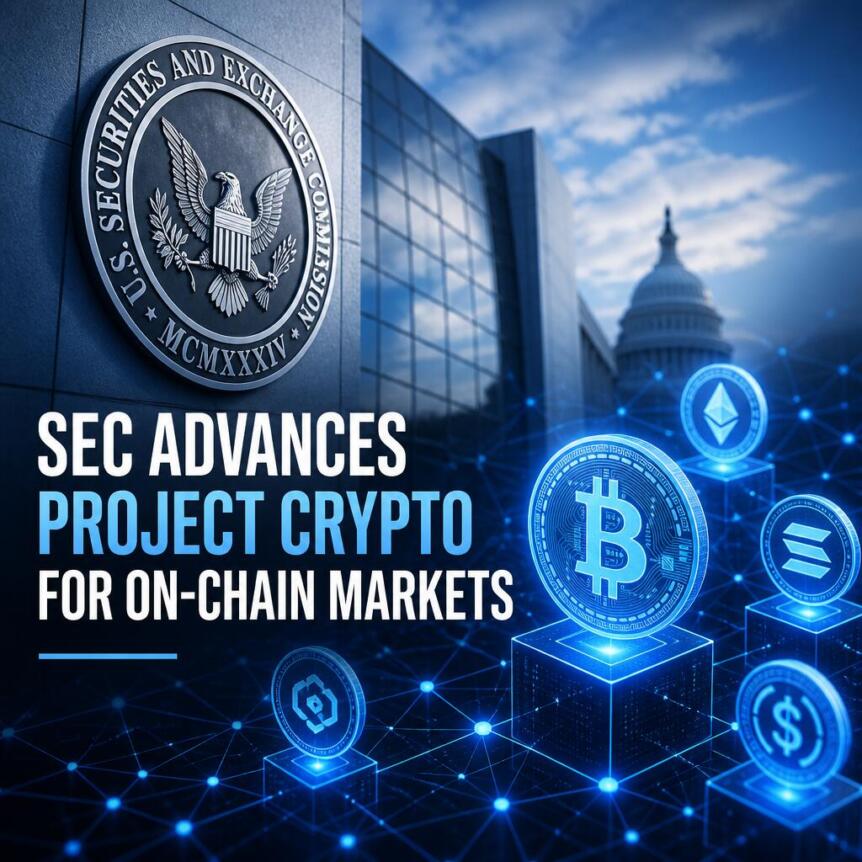
U.S. Securities and Exchange Commission is advancing SEC Project Crypto as Chairman Paul Atkins outlines plans for blockchain-based financial markets. The initiative focuses on modernizing securities rules, improving token classification, and supporting market systems that can operate on-chain. Atkins said the agency has spent the past year adjusting its approach after President Donald Trump called for U.S. leadership in cryptocurrency. The SEC expects several rulemaking steps to continue through mid-2026.
Sec Sets Direction For On-Chain Markets
Atkins said SEC Project Crypto marks a broad effort to prepare existing market rules for blockchain infrastructure. He described the agency’s work as “historic steps” toward modernizing regulations for on-chain market activity. The plan aims to help issuers understand whether a token falls under securities laws before they launch a project. That clarity could reduce legal uncertainty for crypto startups, token issuers, and regulated trading platforms.
The SEC chairman said the initiative does not give the digital asset industry special treatment. Instead, he said the agency wants clear regulations that allow markets to operate under known rules. This approach places disclosure, investor protection, and market integrity at the center of the SEC’s digital asset agenda. It also signals that the agency wants blockchain finance to fit within regulated market structures.
Sec And Cftc Work On Joint Framework
The SEC also plans deeper coordination with the Commodity Futures Trading Commission. Under the current timeline, both agencies expect a Memorandum of Understanding by March 2026. The agreement should help classify digital assets that do not qualify as securities. It also aims to reduce overlap between the two regulators.
Atkins said the goal is to replace a “fragmented regulatory environment” with a more coordinated structure. This matters because many crypto products combine trading, custody, payments, and derivatives features. Clearer coordination could help firms understand which regulator oversees each product. It may also reduce delays for platforms that want to offer compliant digital asset services.
Rule Changes Target Custody And Trading
SEC Project Crypto also includes updates to market structure rules, including Regulation NMS. The SEC wants pathways that allow blockchain-based trading systems to operate alongside traditional exchanges. These changes could affect tokenized securities, settlement systems, and digital asset trading venues. The agency expects key rule updates by mid-2026.
Custody rules remain another major focus for the commission. Updated standards could determine whether banks can hold tokenized securities for clients. The SEC-CFTC framework may also shape crypto derivatives that now operate in a less settled legal environment. As a result, SEC Project Crypto could influence how on-chain markets connect with U.S. financial institutions.
URLS:
https://x.com/SECGov/status/2072745983088160996?s=20

Crypto World
Morpho Secures $175M Funding from Paradigm and a16z to Scale Blockchain Credit Infrastructure

Key Highlights
- Morpho secured $175M in funding to scale its blockchain-based credit infrastructure worldwide.
- Paradigm, a16z crypto, and Ribbit Capital spearheaded the investment round.
- Deel integrated Morpho to deliver stablecoin yield to international contractors.
- Zama introduced confidential USDC deposits to Morpho Vaults shortly after going live.
- Coinbase, BitGo, Juno, HashKey and Huma are expanding Morpho’s ecosystem reach.
Morpho completed a $175 million fundraising round designed to accelerate its open credit infrastructure as blockchain technology penetrates deeper into mainstream finance. The round was spearheaded by Paradigm, a16z crypto, and Ribbit Capital. This capital injection empowers Morpho to construct a comprehensive credit layer serving fintech companies, institutional players, and blockchain-native platforms.
Morpho eyes expansion into broader credit markets
The funding round attracted participation from Apollo Funds, Circle Ventures, VanEck, Ledger, Cathay Innovation, and additional strategic investors. This investment arrives during a period when financial institutions are actively exploring blockchain infrastructure. Importantly, many organizations have shifted from experimental pilots toward implementing real-world applications.
Morpho has developed lending infrastructure that facilitates connections between capital providers and borrowers via open marketplace mechanisms. While the platform currently serves crypto-native lending markets, its ultimate ambition extends to global credit systems. Consequently, the technology aims to eliminate inefficiencies throughout lending, yield generation, and capital deployment.
Coinbase, Robinhood, and Kraken have already integrated Morpho infrastructure to power cryptocurrency-focused financial offerings. These implementations demonstrate how consumer-facing platforms can incorporate credit and yield capabilities directly into their existing applications. Users benefit by accessing blockchain-based financial instruments without departing from familiar platforms.
Deel launches stablecoin yield for global workforce
Deel partnered with the Morpho Network to provide stablecoin-based rewards on contractor account balances. The initial deployment begins in Argentina, with Deel targeting worldwide expansion subsequently. This product enables users to earn dollar-denominated returns within the same application they use for receiving work payments.
This collaboration illustrates how workforce management and payroll platforms can transform into comprehensive financial service providers. Contractors gain the ability to receive compensation, maintain balances, and generate returns without adopting new systems. As such, Morpho obtains another distribution channel through a prominent business-oriented fintech platform.
This approach also represents a broader transformation throughout the financial technology sector. Applications with established user bases now incorporate embedded yield generation, credit facilities, and stablecoin functionalities. Within this framework, Morpho operates as underlying infrastructure while fintech brands control customer relationships and user experience.
Financial institutions advance toward blockchain-based credit offerings
Morpho strengthened its institutional engagement through Vault Summit NYC, co-organized with S&P Global at the New York Stock Exchange. The conference emphasized blockchain-based asset management and enterprise-grade financial products. It also revealed heightened interest from institutions assessing blockchain infrastructure for credit market applications.
Institutional participants require enhanced privacy capabilities before widespread adoption can accelerate. Zama responded to this demand by introducing confidential tokens within Morpho Vaults. This solution allows users to generate yield while protecting wallet information, position sizes, and investment strategies.
Within just four days, users contributed over $10 million in Confidential USDC through Zama-connected vaults. Coinbase’s High Yield DeFi earn product exceeded $100 million in total deposits. Morpho plans further expansion through partnerships with BitGo, Juno by Bitso, HashKey, Huma Finance, and policy initiatives with the Crypto Council.


ESMA has published the first post-transitional update to its EU crypto register under MiCA, adding 37 newly licensed crypto-asset service providers (CASPs) after the regulation’s transition period ended on Wednesday.
In Friday’s update, the EU supervisory body listed 37 additional CASPs—bringing the interim total to 280. Among the additions is Standard Chartered, which received MiCA authorization from Luxembourg regulators on June 25.
Key takeaways
- ESMA’s interim MiCA register now lists 280 CASPs, up from 243 in the previous update dated June 26.
- 37 new CASPs were added after MiCA’s transitional period ended Wednesday, including major banking and digital-asset firms.
- Cyprus led the latest wave of authorizations by jurisdiction, with six of the newly listed CASPs.
- The asset-referenced token (ART) register remains unchanged, with no approved issuers shown.
- The non-compliant entities list continues to stand at 162, according to the update.
ESMA adds 37 CASPs to the MiCA register
ESMA’s update to its register of crypto companies reflects the regulator’s ongoing effort to make MiCA authorizations visible in a single public list. The latest posting was released after the transitional period concluded, which is intended to bridge activity until firms either obtain MiCA permissions or adjust their operations to comply with the new framework.
According to ESMA, the interim MiCA register now totals 280 CASPs. This follows the previous update published on June 26, which listed 243 CASPs—an increase of 37 entries in this first post-transition step.
The newly added CASPs include a range of business models. ESMA’s list now features names such as FalconX (a digital asset prime brokerage), Sygnum Europe, and Ronin EM, alongside financial institutions that can perform MiCA-regulated crypto activities.
Standard Chartered’s MiCA authorization expands—alongside an EMI license
Standard Chartered stands out among the headline additions. In addition to securing MiCA authorization from Luxembourg regulators, the bank also received an Electronic Money Institution (EMI) license, enabling it to issue electronic money and provide payment services.
Standard Chartered said in a Monday announcement that the approvals represent a “key step” in advancing its European digital-asset strategy. The bank also framed its decision as responsive to client demand for regulated access to digital assets in Europe, referencing prior progress including the launch of digital asset custody services in Asia and the Middle East.
ESMA’s register update matters for investors and counterparties because CASP listings provide a visible checkpoint for regulated market access. For banks, prime brokers, and other service providers, MiCA permissions can also be a practical prerequisite for operating under a standardized EU framework rather than relying solely on member-state approaches.
Standard Chartered’s approvals were announced on the bank’s website: https://www.sc.com/uk/2026/06/29/standard-chartered-granted-mica-and-emi-licence-advancing-its-digital-asset-strategy-in-europe/.
New CASPs also include EMT token activity via CACEIS
ESMA’s update was not limited to MiCA’s broader CASP categories. The register of electronic money tokens (EMTs) added Crédit Agricole’s CACEIS, according to the Friday update.
Separately, earlier coverage from Cointelegraph noted Crédit Agricole and CACEIS in the context of EMT-related developments ahead of the updated register entries. That earlier reporting is linked here: https://cointelegraph.com/news/credit-agricole-eurxt-euro-stablecoin-caceis.
Jurisdictional picture: Cyprus leads; Germany still on top
While the ESMA register is EU-wide, authorizations are issued by national authorities. In the latest wave, Cyprus accounted for six of the newly listed CASPs, the largest share among jurisdictions.
France recorded five new entries, as did Italy and Malta. The Czech Republic and Spain each added four new CASPs. Luxembourg listed three and the Netherlands added two. Germany, Liechtenstein, and Latvia each contributed one new entry.
ESMA’s update also provides perspective on the broader accumulation of authorizations. It states that CySEC has now granted 21 MiCA authorizations in total, while BaFin remains the national regulator with the most authorizations at 58.
For market participants, this distribution can be relevant: it highlights where regulatory capacity and licensing pipelines may be moving faster, which in turn can influence where firms choose to apply first.
What did not change: no ART issuers and no movement on non-compliance
ESMA’s post-transition update included no changes to two other register components.
The asset-referenced token (ART) register continued to show no approved issuers. In parallel, the list of non-compliant entities remained at 162, according to the update.
That lack of ART issuer approvals contrasts with the steady progress in CASP licensing and underscores a point many market participants are watching: different parts of MiCA’s ecosystem are moving at different speeds. CASPs can begin positioning under MiCA permissions while token issuers—particularly for categories such as ARTs—may face a longer path to approvals.
Going forward, the next register updates will be important not only for how quickly the CASP count rises, but also for whether the ART register finally changes; until then, investors and counterparties may want to treat MiCA’s service-provider authorizations as a clearer near-term indicator of regulatory readiness than token-issuer approvals.

South Korean crypto exchange Upbit says it will not take part in the issuance of Open USD (OUSD), despite an operator-level connection to the stablecoin project. The clarification comes after Open Standard named Dunamu among more than 140 businesses associated with its new dollar-backed initiative.
In a statement to Cointelegraph, an Upbit spokesperson said the exchange has only “indicated our potential willingness to consider taking part in the future expansion of the OpenStandard ecosystem.” The company’s position follows similar pushback from other South Korean firms that were included in Open Standard’s broader business list.
Key takeaways
- Upbit denies participation in OUSD issuance, limiting its stance to possible future involvement in the OpenStandard ecosystem.
- Open Standard’s public roster includes major South Korean companies, but several say they have not agreed to specific roles.
- Regulatory uncertainty in South Korea persists because the Digital Asset Basic Act has not yet been finalized.
- Open Standard’s “no fees / no volume limits” mint-and-redeem model remains a subject of debate among industry observers.
Upbit’s clarification reshapes how Open Standard’s list is read
Open Standard announced Open USD on Tuesday, describing a framework under which participating businesses would be able to mint and redeem the stablecoin without fees or volume limits. The project also said it plans to distribute earnings generated from its reserves to participating companies.
Open Standard’s announcement listed a broad group of firms—reportedly more than 140—stating they had “signed up to use” the stablecoin. Among those named were global payments and finance brands including Visa and Mastercard, as well as asset management and tech firms such as BlackRock and Google. In South Korea, Dunamu was included, which is the operator behind Upbit.
That inclusion prompted follow-up clarification from Upbit. The exchange said it is not participating in OUSD issuance, and only signaled openness to potentially joining “future expansion” of the OpenStandard ecosystem. Cointelegraph also reported that it reached out to Open Standard for comment but did not receive a response before publication.
The broader implication is that the public business list may represent interest or preliminary alignment rather than committed operational roles. That distinction matters for users and market participants watching whether large incumbents are truly underwriting, distributing, or managing parts of the stablecoin’s reserve and governance.
Other South Korean companies reportedly echo “no formal role” concerns
According to a Friday report by ChosunBiz, Samsung Electronics said it had not held formal discussions with Open Standard and did not know what role it was expected to play. The same reporting also indicated Shinhan Financial Group and KBank had only signaled they would consider the initiative.
These responses highlight a recurring pattern in early-stage stablecoin announcements: companies may be mentioned in promotional materials or participation lists before regulatory processes, commercial terms, and internal approvals are locked down. For investors and builders, the practical question becomes whether these entities will move from “consideration” to concrete deliverables such as issuance participation, redemption access, or reserve-related responsibilities.
It also raises the likelihood that Open Standard’s roster could change as plans are translated into compliance-ready operating structures—especially given South Korea’s still-evolving legal landscape for digital assets.
Why South Korea’s pending stablecoin law complicates commitments
Stablecoin issuance and ecosystem participation in South Korea remain constrained by policy uncertainty. The country has not yet passed the Digital Asset Basic Act, leaving open questions about who can issue stablecoins and what roles non-issuers and participating firms may perform.
Cointelegraph has previously reported that lawmakers are debating whether stablecoin issuance should be limited to banks or opened to qualified non-bank issuers, with the broader regulatory framework still under discussion. As long as that process remains unresolved, companies may hesitate to commit to initiatives that depend on licensing, reserve management rules, and the permitted scope of activities for different types of institutions.
That uncertainty can delay integrations and reduce the reliability of public participation lists. Even when major names are mentioned, compliance timelines and approval hurdles can force a slower, more cautious path—particularly for projects that connect traditional finance and payments infrastructure to on-chain settlement.
Open Standard’s mint-and-redeem model still faces skepticism
Alongside corporate clarifications, industry figures have questioned whether Open Standard’s economics are sustainable. Open Standard previously said participating businesses would be able to mint and redeem OUSD without fees or volume limits, and it also described plans to share earnings generated from reserves with participants.
Cointelegraph noted earlier that Circle CEO Jeremy Allaire challenged the model’s durability, specifically questioning the logic of free, unlimited minting and redemption. Lorenzo Valente, director of research at ARK Invest, also characterized the announcement as a “giant” letter of intent.
While such critiques do not necessarily disprove the project, they underscore that stablecoin economics—especially those involving reserve yields, operational costs, redemption incentives, and governance—are often the deciding factor in whether participation scales beyond initial pilots. The tension here is straightforward: an approach designed to reduce friction for users may shift financial responsibilities elsewhere, requiring careful reserve and risk management to stay viable.
For market participants, Upbit’s position is another reminder to separate marketing claims from operational reality. Even if a project advertises broad participation, the sustainability of the underlying business model and the readiness of the legal framework will likely determine who can actually play active roles.
What to watch next is whether South Korea’s Digital Asset Basic Act—and the specific stablecoin issuance rules it implies—moves from debate toward implementation. In parallel, observe whether Open Standard converts “signed up to use” lists into clearly defined, compliant roles for identified entities, including in South Korea.


Europe’s securities regulator has warned that prediction market contracts offered in the European Union could already fall under existing financial rules, potentially triggering a long-standing retail ban on binary options.
Summary
- ESMA says some prediction market contracts may already fall under MiFID II financial rules.
- Existing EU binary options restrictions could apply automatically if contracts qualify as financial instruments.
- The guidance follows mounting regulatory scrutiny of Polymarket and other prediction market platforms across Europe.
According to the European Securities and Markets Authority (ESMA), firms offering event-based contracts in the European Union must assess whether those products qualify as financial instruments under the Markets in Financial Instruments Directive II (MiFID II). If they do, the regulator said, the EU’s retail restrictions on binary options introduced in 2018 would automatically apply.
The July 3 statement does not introduce new legislation. Instead, ESMA clarified that the existing regulatory framework may already cover some prediction market products currently being marketed in Europe. The guidance is directed both at firms and national regulators responsible for supervising financial markets across the bloc.
Existing MiFID II rules could already apply
Under ESMA’s interpretation, companies cannot simply describe contracts as prediction markets or event contracts without considering whether they meet the legal definition of a financial instrument under MiFID II. Where that threshold is met, the binary options restrictions adopted by the regulator in 2018 would take effect without any additional rulemaking.
The clarification arrives as offshore prediction market operators continue drawing regulatory attention across multiple jurisdictions. Among the largest providers, Polymarket operates from offshore markets, while Kalshi and Crypto.com are regulated by the U.S. Commodity Futures Trading Commission (CFTC) in the United States. None of the major platforms currently operates a licensed prediction market business within the European Union.
The regulatory update also follows recent scrutiny surrounding Polymarket. The platform was recently accused of using deceptive advertising that targeted U.S. users, adding to regulatory pressure already facing prediction market operators in several countries.
European scrutiny has intensified across multiple countries
Before ESMA issued its clarification, several European authorities had already taken action against prediction market platforms.
Spain’s Ministry of Consumer Affairs temporarily blocked Kalshi and Polymarket on May 26 after determining that the platforms did not hold the gambling licenses required under Spanish law.
A few weeks later, on June 19, gambling regulators from nine European countries, including Belgium, France, Germany and Spain, issued a joint statement warning consumers about unlicensed gambling websites operating across Europe. According to the participating authorities, those platforms raised consumer protection concerns ahead of the FIFA World Cup.
Outside Europe, legal challenges have also continued. Last month, the Kentucky government filed a lawsuit against Polymarket and Kalshi, alleging the platforms were facilitating illegal sports betting within the state.
Against that backdrop, ESMA’s latest statement places fresh responsibility on firms considering expansion into the European market. According to the regulator, companies must determine not only whether their contracts qualify as financial instruments under MiFID II, but also whether national laws classify those products as gambling activities.
Because no major prediction market operator currently runs a licensed European business, ESMA’s clarification comes before any large-scale launch rather than after one.
Firms that fail to address both financial market rules and national gambling requirements could face enforcement action similar to the measures already taken by Spanish authorities, based on the regulator’s guidance and recent actions by national authorities.
Bitcoin (BTC) has added another bear-market bottom signal this month as analysis draws comparisons to November 2022.
Key points:
- Bitcoin adds to its list of bear-market bottom signals with a key supply ratio “buy” trigger.
- A bear-market floor could still be some time off, analysis says, with supply held at a loss still relatively low.
- Demand is the missing piece of the puzzle to shore up a bullish rebound.
Bitcoin profit metric echoes 2022 bear-market bottom zone
In a blog post on Friday, crypto analyst Axel Adler Jr., a contributor to onchain analytics platform CryptoQuant, confirmed the return of a key Bitcoin buy signal.
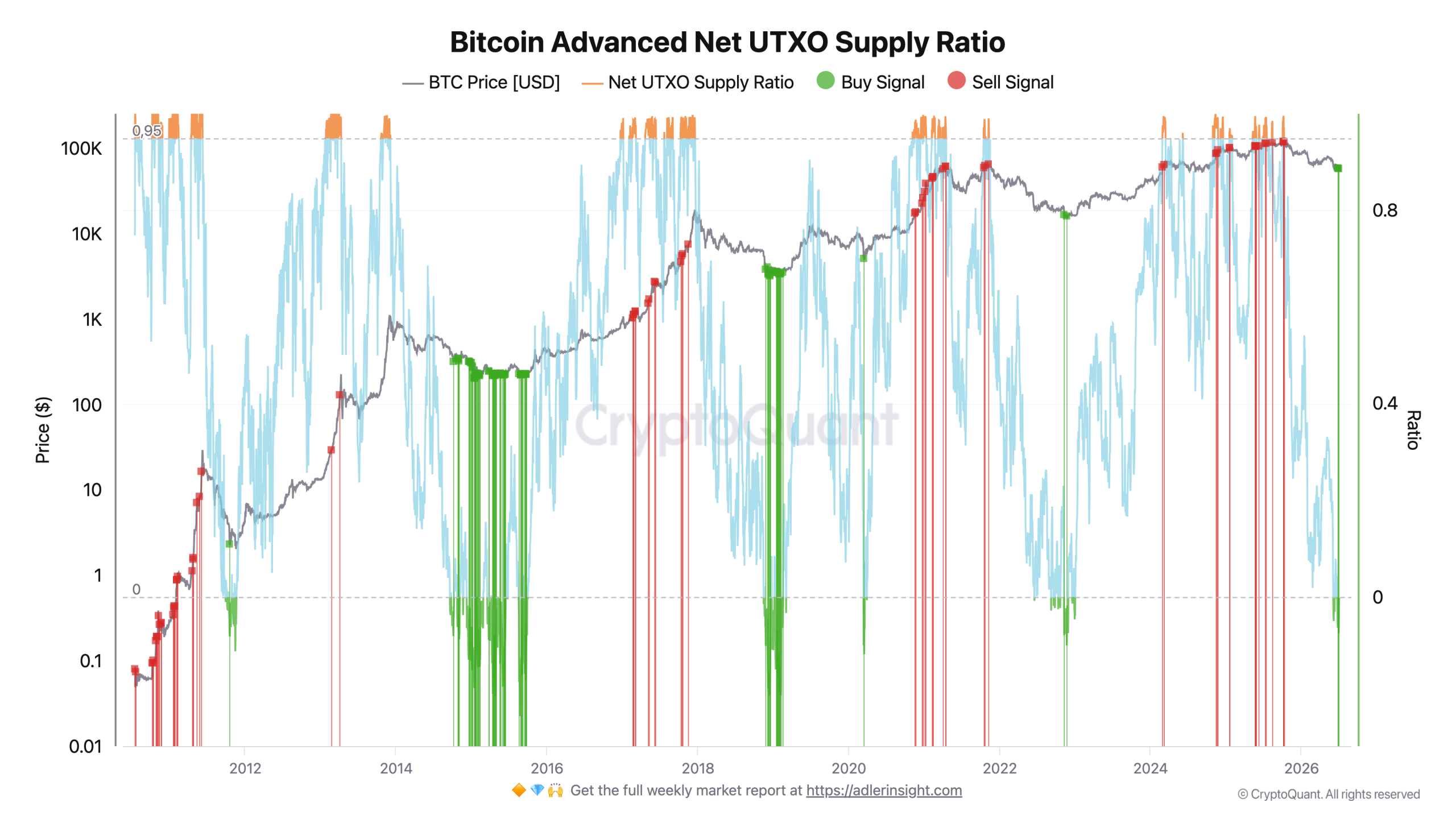
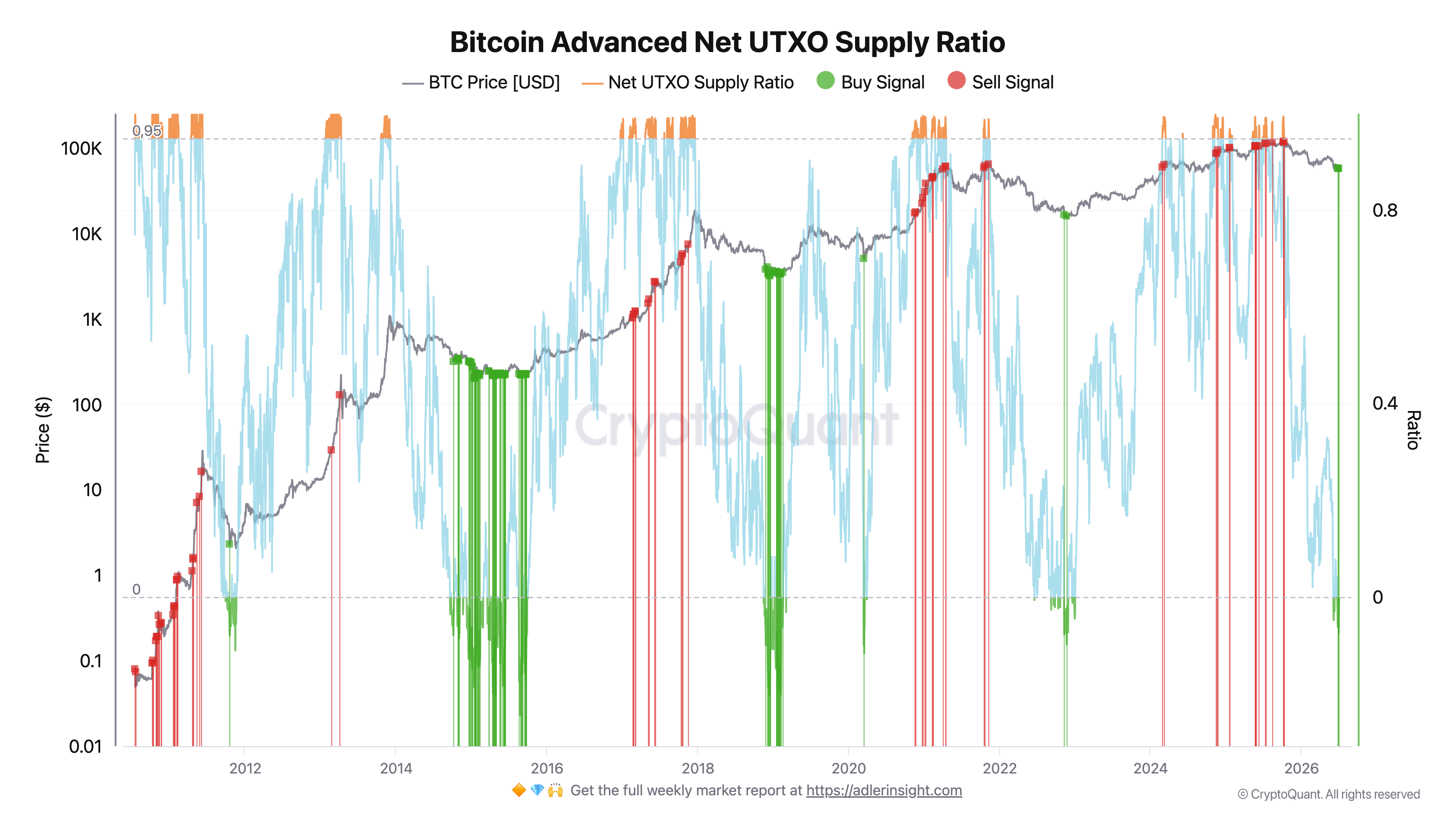
Advanced Net UTXO Supply Ratio, which measures the proportion of the BTC supply which last moved in profit or loss, is back in negative territory for the first time in nearly four years.
“The ratio dropped into deeply negative territory and then crossed back above the signal threshold on the rebound, which caused the model to print BUY on several sessions in late June and early July,” Adler wrote.
“This is the first buy trigger since November 2022, which was the bottom of the previous bear cycle.”
Bitcoin Advanced Net UTXO Supply Ratio. Source: CryptoQuant
UTXO Supply Ratio cues do not imply that a macro bottom has arrived, but occur “near cyclical lows.”
“Confirmation would be the ratio holding above zero together with rising price. The negative scenario is a move back into negative territory without price support,” Adler explained.
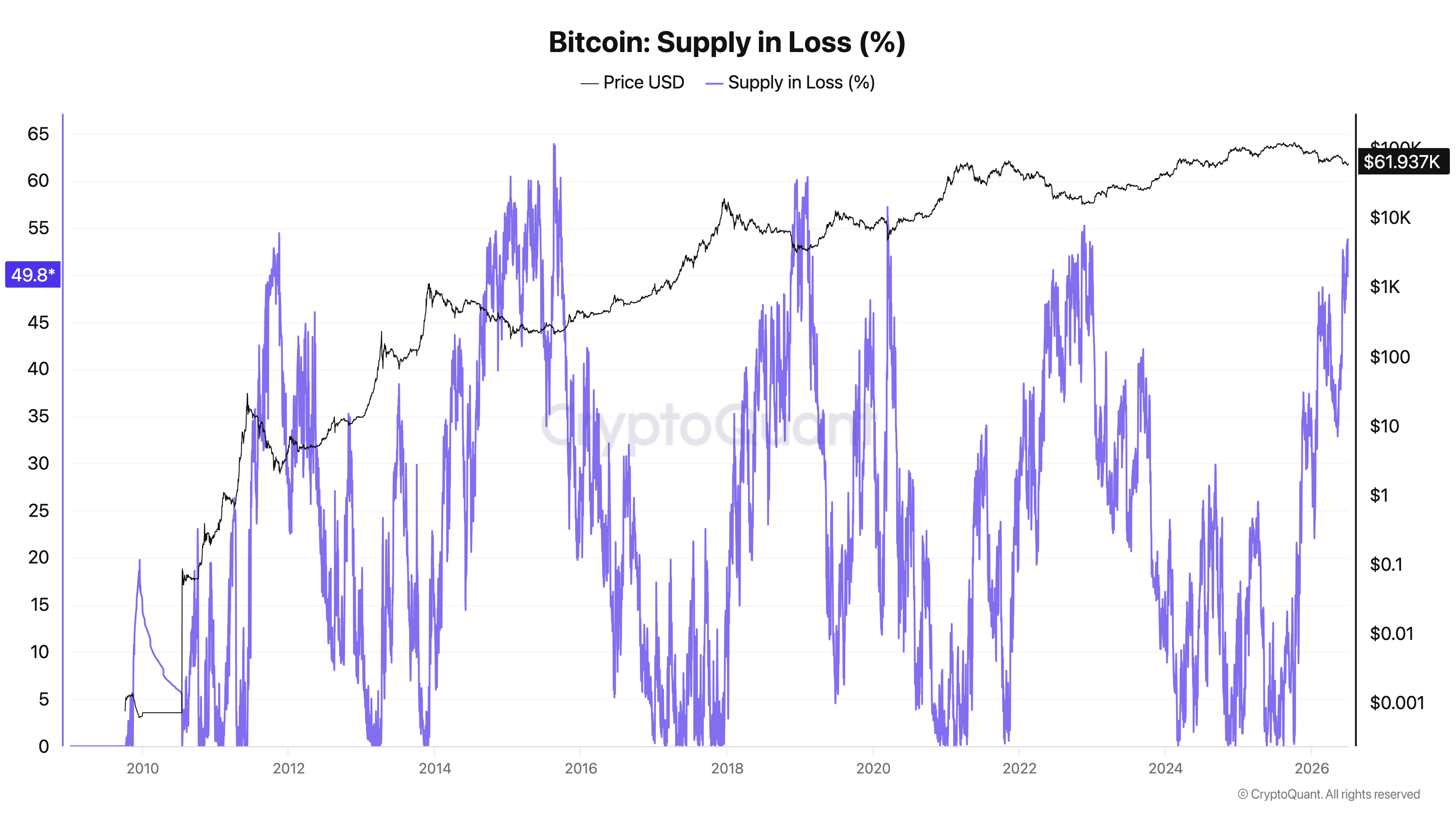
A missing piece of the puzzle involves supply being held at a loss, which has not yet reached the levels seen during previous bear markets.
Adler forecast that the 90-day simple moving average (SMA) of supply in loss should hit its bear-market reversal target within two months.
“Until then, it is more accurate to treat capitulation as a process rather than a completed fact,” he continued.
Bitcoin supply in loss. Source: CryptoQuant
Signals will not “stop BTC from going lower”
On the topic of UTXO Supply, fellow CryptoQuant contributor Darkfost also eyed a potential market inflection point this week.
Related: Bitcoin bear market ‘dead’ after first TD9 reversal signal since July 2022 fires
“Since it depends on the profit and loss of UTXOs, it can very well signal something during either a sharp drop or a sharp rise. That said, in terms of cyclicality, it wouldn’t be inconsistent to think that the end of this bear market could be approaching,” he wrote in a Quicktake blog post on Wednesday.
“This won’t stop BTC from going lower, but we now have several signals pointing to seller exhaustion. The next step is a renewal of demand, and that could take some time.”
As Cointelegraph reported, BTC price expectations tend to favor a bear-market bottom coming in Q3 or later.
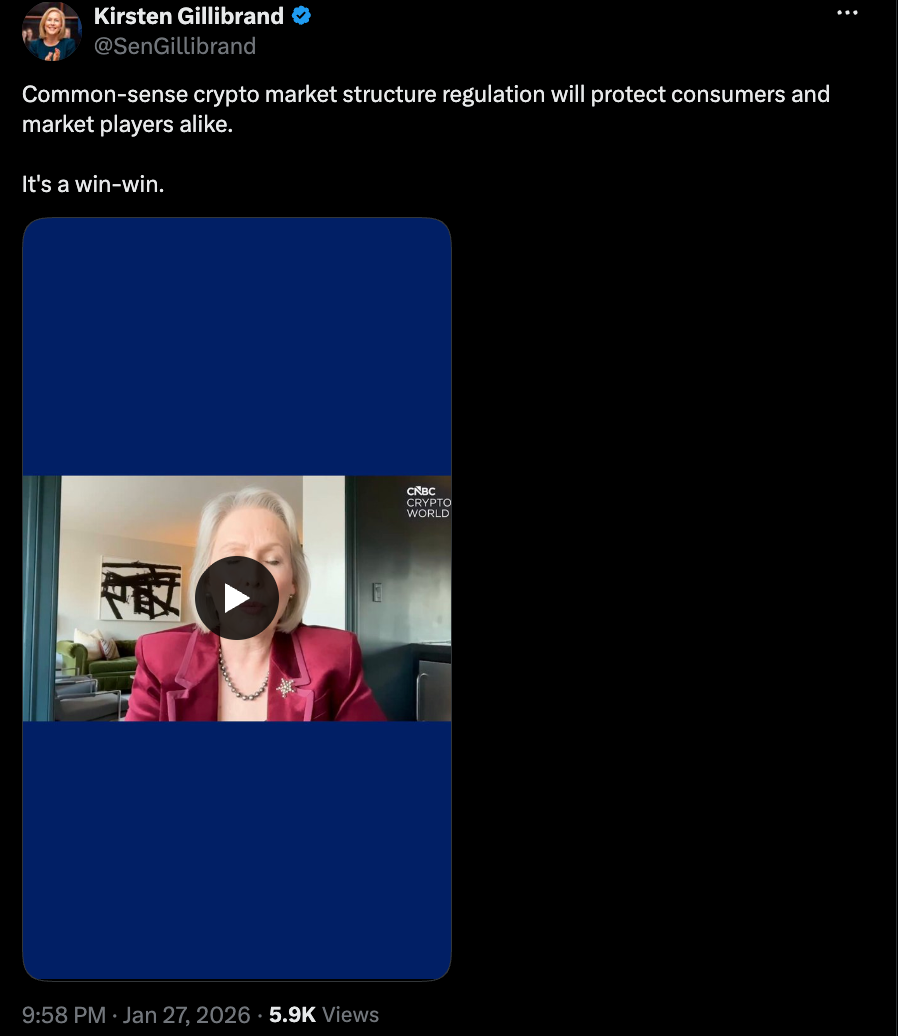
Senator Kirsten Gillibrand, one of the US lawmakers behind negotiations for a digital asset market structure bill in Congress, has proposed barring elected officials and the president from issuing or sponsoring their own tokens, citing President Donald Trump’s and First Lady Melania Trump’s memecoins.
In a Friday notice, Gillibrand said that Congress should support measures barring elected officials and their spouses from “issuing or sponsoring their own digital assets.” The New York lawmaker said that the proposed restriction would include any US president and their spouse, but did not specifically mention extending the provision to the office of the vice president or other members of their families.
“This is a commonsense requirement that should get broad bipartisan support – public officials and their spouses should not be issuing memecoins,” said Gillibrand. “We cannot let self-dealing destroy an opportunity to strengthen consumer protections, crack down on illicit finance, and expand economic opportunity for the millions of Americans our financial system has left behind.”
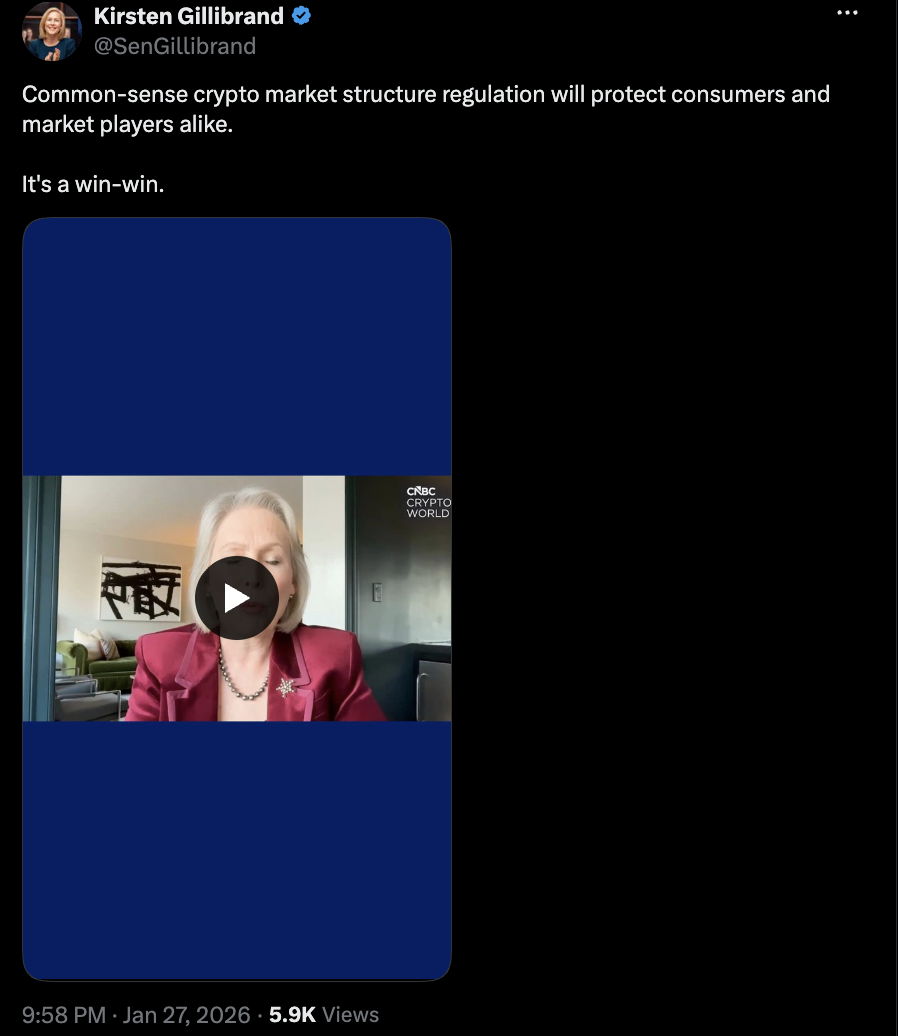
Source: Kirsten Gillibrand
Gillibrand is one of the lawmakers behind negotiations regarding the Digital Asset Market Clarity (CLARITY) Act in the Senate, legislation which has faced delays due to concerns about ethics, tokenization and stablecoin rewards. Although she expected the chamber to vote on the bill by the Senate’s August state work period, she added that no one would vote for the bill without addressing ethics, citing the potential of elected officials “[getting] rich off of these industries because of their insider status.”
Related: Senate Dems urge probe into $500M crypto deal between Trumps, UAE
During consideration of the Guiding and Establishing National Innovation for US Stablecoins Act (GENIUS Act) in 2025, the New York lawmaker said senators had removed provisions specifically targeting Trump’s ties to the crypto industry, including his memecoin Official Trump (TRUMP).
She said at the time that the memecoin was likely “illegal based on current law,” but addressing all of Trump’s ethics problems would make for a “very long and detailed bill.” Trump signed the GENIUS Act into law in July 2025.
Notably, Gillibrand’s proposed memecoin restriction did not appear to extend to other family members. In addition to his personal investments in the crypto industry, Trump has faced criticism over his sons’ involvement in the crypto platform World Liberty Financial and their Bitcoin (BTC) mining company American Bitcoin.
Trump brushes off conflicts of interest concerns with crypto industry
This week, Trump reported that he earned about $1.4 billion from crypto ventures the same year he took office. The financial windfall occurred while he was in a position to influence legislation on digital assets, including the GENIUS Act and the CLARITY Act.
According to Trump, there was “nothing illegal” and “nothing wrong” with profiting from his investments as president, while he did not directly answer questions about perceived conflicts of interest.
Magazine: The end of anonymity? AI could unmask crypto’s hidden identities
Senator Kirsten Gillibrand has renewed her call for a meme coin ban covering the president, members of Congress, and their spouses. The push responds to new filings showing Donald Trump earned $636 million from his TRUMP token in 2025.
The New York Democrat wants Congress to make it illegal for elected officials and their spouses to issue or sponsor digital assets. Her demand lands as her son’s crypto startup faces growing scrutiny in Washington.
Trump’s Windfall Revives the Memecoin Ban Fight
Trump’s 927-page disclosure, released Tuesday by the Office of Government Ethics, reported more than $1.4 billion in crypto income for 2025. The largest single item was $636 million from CIC Digital LLC, linked to the Official Trump (TRUMP) meme coin license.
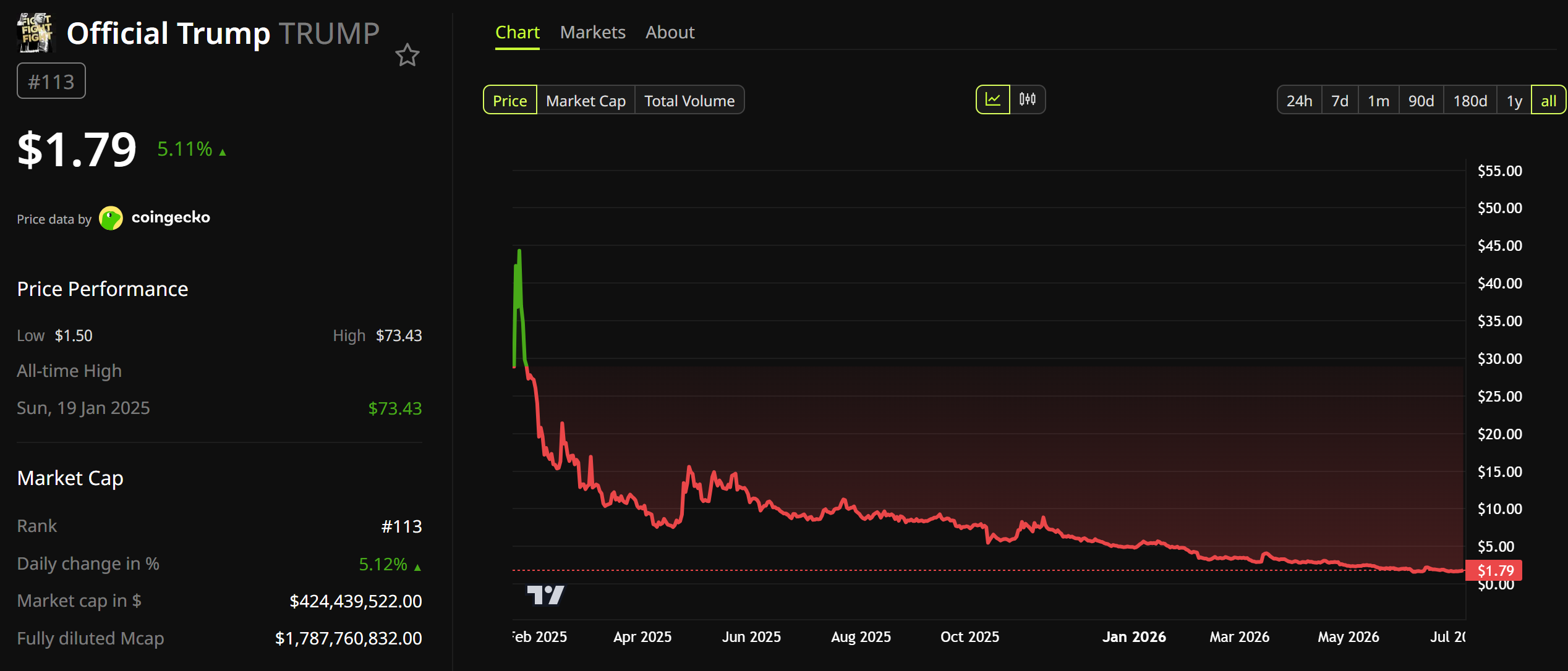
The president has since defended his crypto fortune. Meanwhile, TRUMP trades near $1.80, down more than 97% from its $73.43 peak set days after its January 2025 launch.

First Lady Melania Trump also issued a meme coin and reported $6 million from NFTs and digital collectibles.
Criticism of the president’s token activity has grown louder. Economist Peter Schiff this week called the tokens legal bribes, arguing that buyers pay for access to the president.
In the same tone, Gillibrand shared her renewed demand in an email shared with BeInCrypto.
“This is a commonsense requirement that should get broad bipartisan support – public officials and their spouses should not be issuing memecoins… The time to act is now — and that must include ethics reforms that prohibit members of Congress, the president, and their spouses from cashing in on their office.”
Gillibrand cosponsors the End Crypto Corruption Act, introduced by Senator Jeff Merkley in May 2025. The proposal would bar presidents, lawmakers, senior officials, and their families from issuing or endorsing digital assets, including meme coins and stablecoins.
Son’s $300 Million Venture Tests Her Ethics Message
The senator faces questions of her own. Fortune reported in June that her son, Theodore Gillibrand, raised $30 million in a round led by Lux Capital.
The 22-year-old’s startup, American Perpetuals Exchange Corp, carries a $300 million valuation. It plans to seek approval from the Commodity Futures Trading Commission (CFTC) to list perpetual futures on stocks and indexes.
Gillibrand, a longtime advocate of banning stock trading by lawmakers, says her son runs an independent business without her involvement.
However, critics argue the raise complicates her anti-self-dealing message while she negotiates crypto legislation.
“Gillibrand’s son graduated from undergrad on Sunday. By the following week it’s reported that he’s received $30 million in venture capital funding to launch a derivatives exchange. His mom sat on the Senate Agriculture committee, which has jurisdiction over derivatives, until this past year,” one user stated.
Crypto firms have spent $189 million on 2026 races, roughly 37% of corporate election spending, raising the stakes of the ethics debate.
With Republicans controlling both chambers, the coming weeks may reveal whether ethics language enters market structure negotiations.
The post Senator Demands Trump Meme Coin Ban After $636 Million Windfall appeared first on BeInCrypto.
TLDR:
- Jupiter Trailing Stop Loss uses percentage-based triggers instead of fixed stop prices for limit orders.
- The stop level rises with price gains and never moves lower during an active trading position.
- The feature supports SPL and Token-2022 assets, excluding transfer-fee token standards only.
- SolanaFloor highlighted the launch after Jupiter confirmed zero extra fees for the new trading tool.
Jupiter has introduced a new Trailing Stop Loss feature for its Limit Orders, giving traders a way to protect gains as prices climb. The update replaces fixed stop prices with a dynamic percentage trail that adjusts upward alongside market moves.
The feature aims to reduce the risk of profitable positions turning into losses during sharp reversals. It expands Jupiter’s trading toolkit while keeping the existing limit order experience intact.
Jupiter Trailing Stop Loss Adds Dynamic Protection to Limit Orders
The new feature allows users to set a percentage trail instead of a fixed stop price. Traders can choose any value between 0.5% and 90%. The stop level automatically moves higher whenever the asset reaches a new high.
The trigger does NOT move lower (downward) like a stop loss. This allows traders to stick to the trend when it is rising and still keep some of the profits they have yet to realize. When the market turns the other direction by the selected percentage, the order automatically fills.
Jupiter explained the update through its official X account using a simple trading example. A trader buying SOL at $50 could see the asset climb to $90. Instead of keeping the original stop at $45, the trailing mechanism would move the stop upward to about $81 before a reversal triggered a sale.
According to Jupiter, the feature works across all SPL tokens and Token-2022 assets except transfer-fee tokens. The exchange also said traders will not pay additional fees to use the new functionality within Limit Orders.
Jupiter Expands Solana Trading Tools With Automated Risk Management
The announcement first gained attention after SolanaFloor highlighted the launch on X. The publication noted that the feature focuses on protecting profits rather than only limiting downside risk. That distinction makes the tool different from conventional stop loss strategies.
Traditional stop losses remain fixed unless users manually adjust them. During fast rallies, traders often face the challenge of watching profitable positions return to their entry point or below. A trailing stop automates that adjustment without requiring repeated changes.
Jupiter described the feature as a way to prevent what traders often call “roundtripping.” Instead of allowing gains to disappear during a market reversal, the stop follows the asset higher until the selected percentage threshold is reached.
The order then executes automatically according to the preset conditions. The rollout strengthens Jupiter’s growing suite of on-chain trading tools for the Solana ecosystem.
The update offers traders another automated risk management option while maintaining compatibility with supported Solana token standards. The feature is now available through Jupiter Limit Orders without introducing extra trading fees.
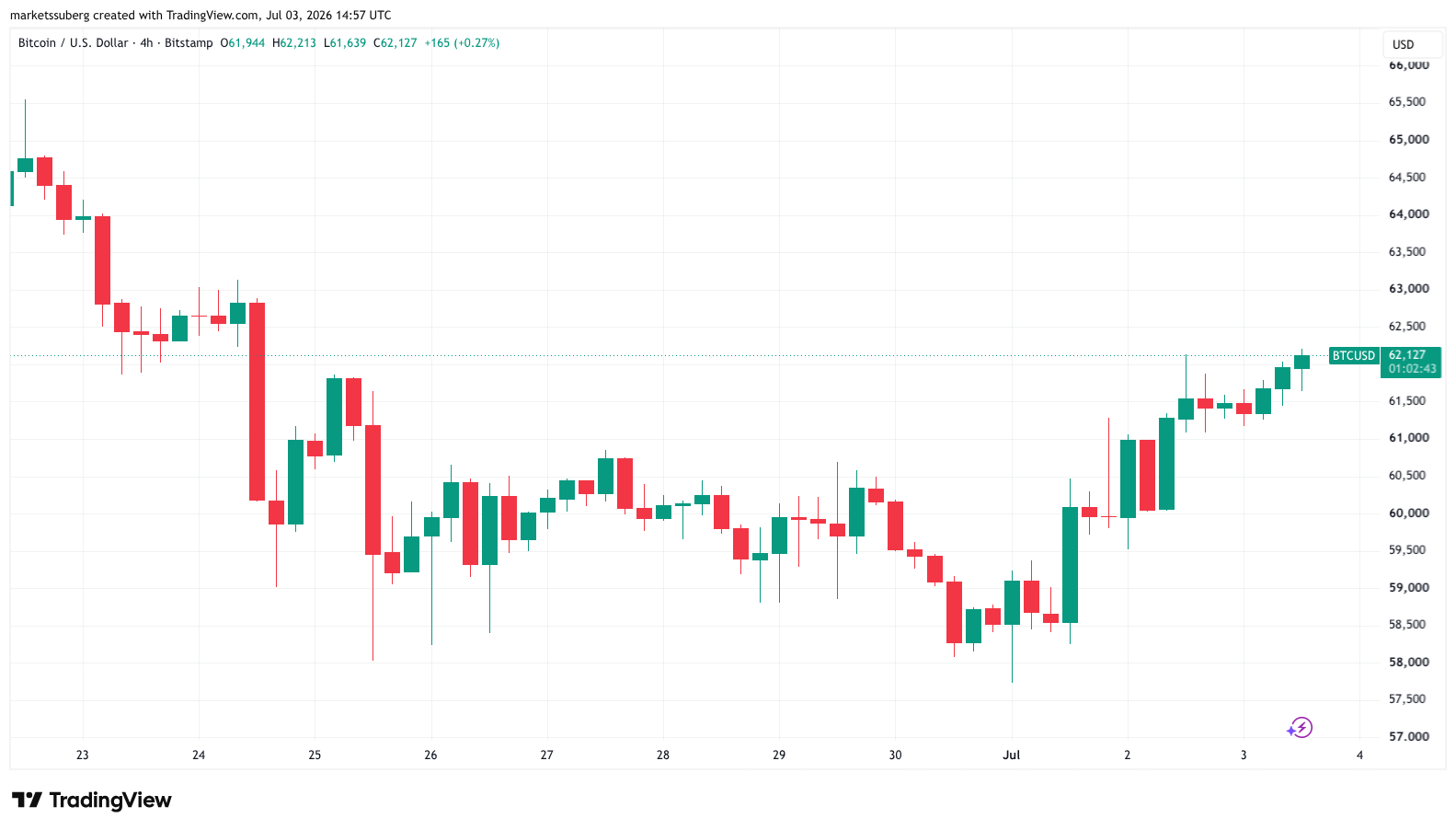
Bitcoin (BTC) saw new July highs on Friday as bulls kept pushing over the US holiday period.
Key points:
- Bitcoin sustains upside momentum as BTC price action nears its 200-week moving average.
- That trend line now forms the centerpoint of a “strong resistance area.”
- Global equities hit record levels as Fed rate-hike odds simmer on weaker jobs data.
Bitcoin buyers “chasing” as BTC price eyes key trend line
Data from TradingView showed BTC/USD reaching $62,295 on Bitstamp, its highest since June 24.
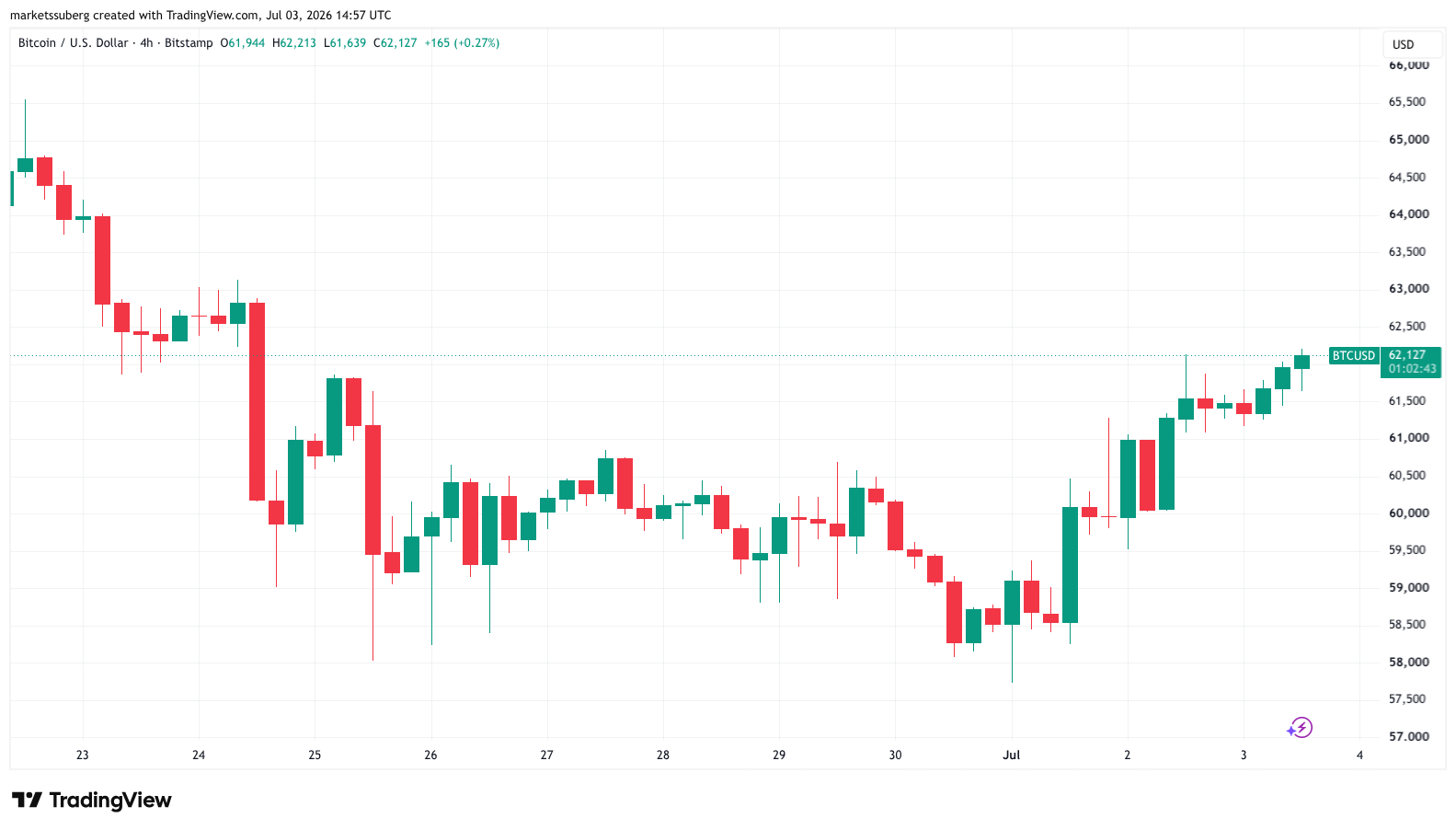
BTC/USD four-hour chart. Source: Cointelegraph/TradingView
US markets were closed for the Independence Day holiday, with the Dow Jones closing at record highs the day prior. As noted by trading resource The Kobeissi Letter, the global stock market cap also hit new all-time highs.
“Global equities are in the midst of one of the most powerful rallies in history,” it wrote in a post on X.
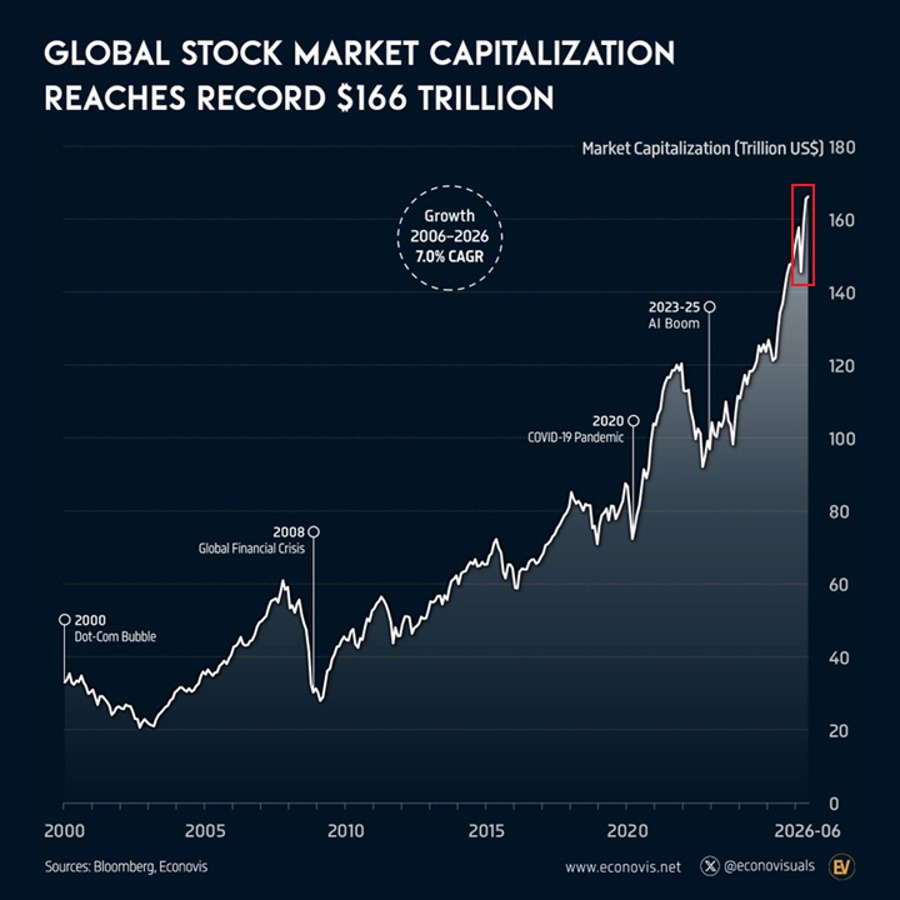
Source: The Kobeissi Letter/X
Commenting on the latest BTC price action, X commentator Exitpump eyed “controlled slow buying” on exchanges.
“Looks good for continuation higher, although keeping in mind 62K – 62.5K as a strong resistance area,” they told X followers.
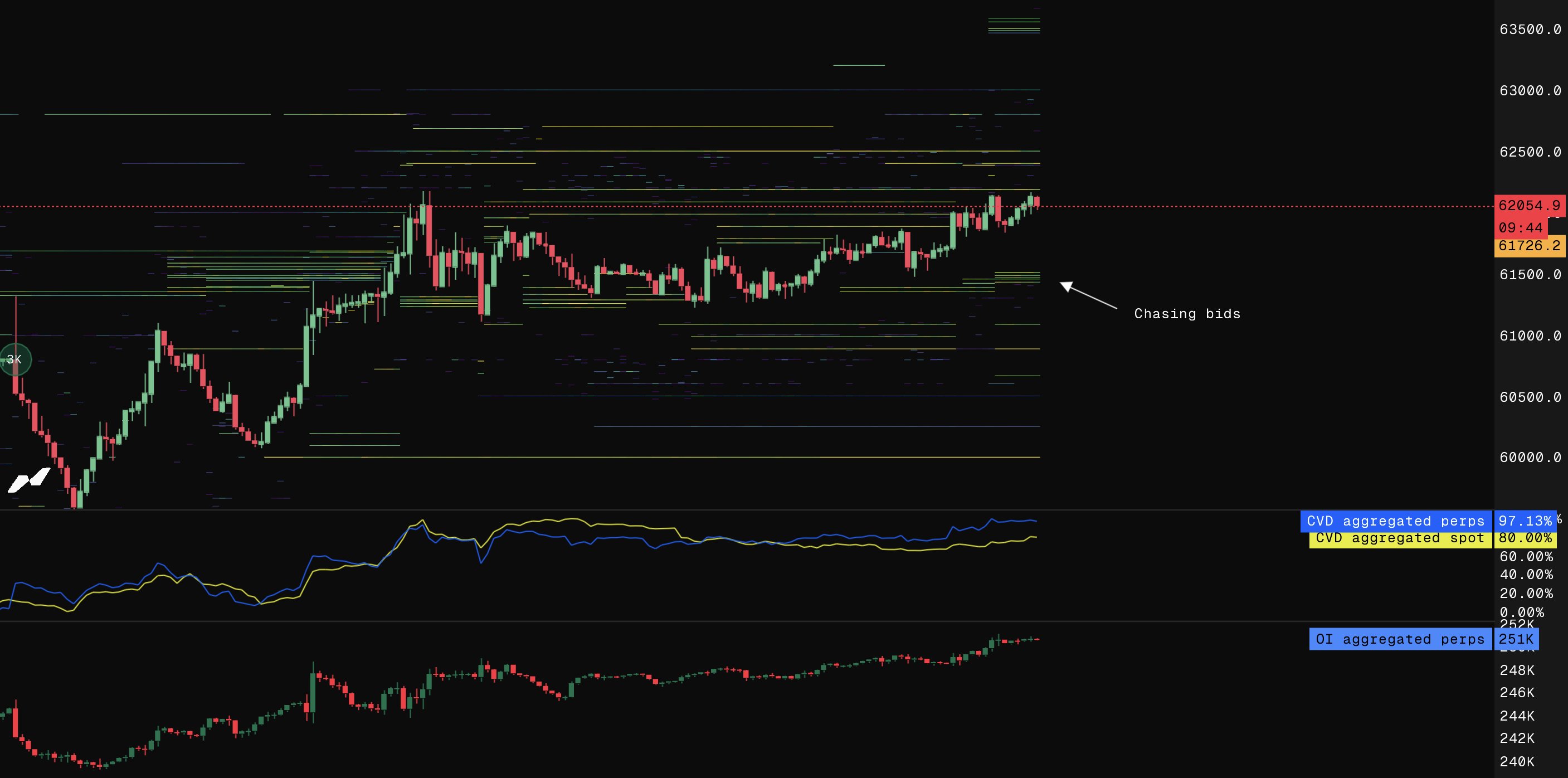
BTC/USD order-book data. Source: Exitpump/X
Trader Daan Crypto Trades focused on the 200-week simple moving average (SMA), currently at $62,652, for the weekly candle close.
“It is key for BTC now to hold this breakout and maintain its low timeframe bullish market structure,” he commented, calling the current trading zone “important.”
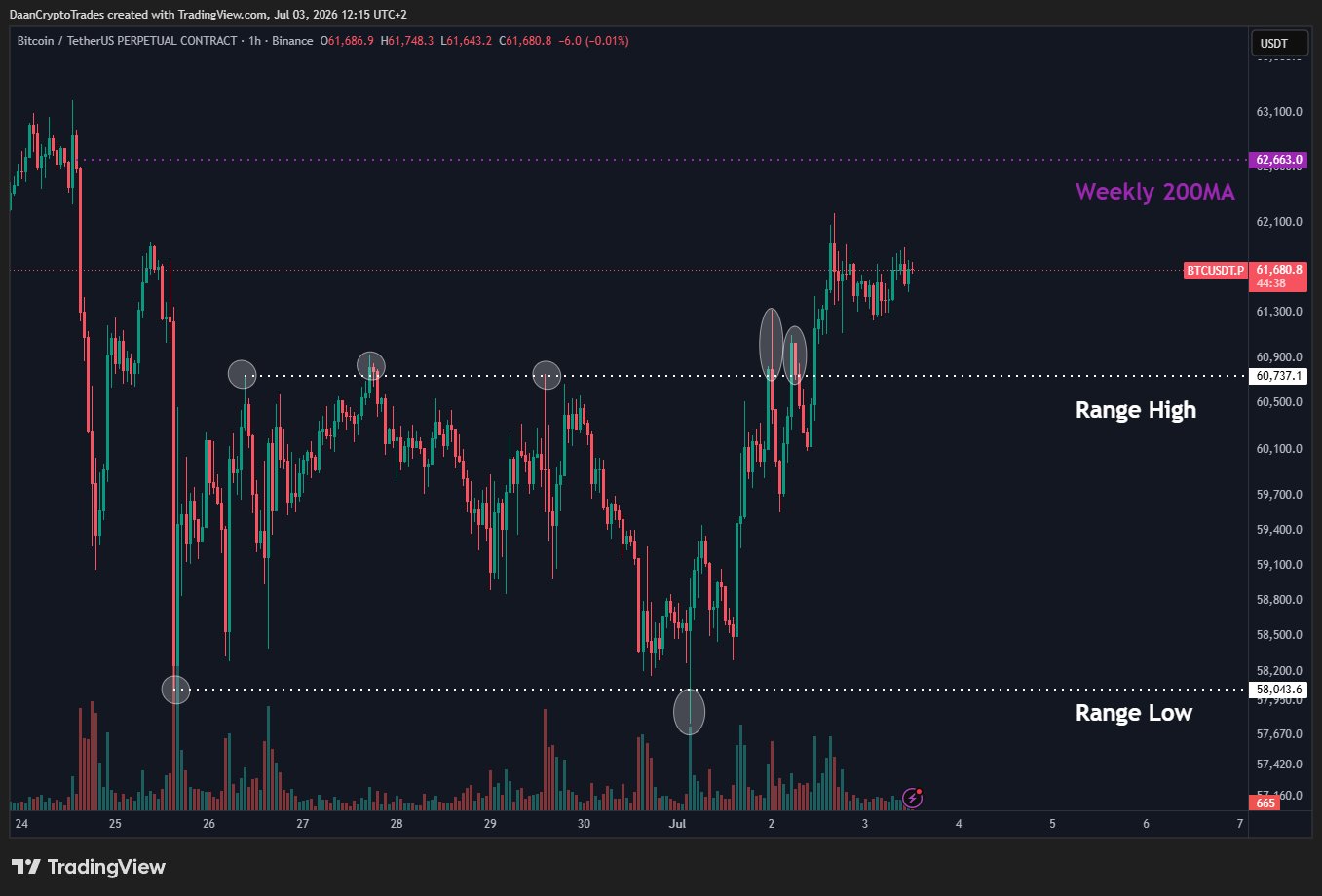
BTC/USDT perpetual contract one-hour chart. Source: Daan Crypto Trades/X
Fed rate-hike headwinds slowly cool
On the back of weak US nonfarm payrolls data, which helped fuel the crypto rebound, trading resource Mosaic Asset Company noted that expectations for Federal Reserve policy remained conservative.
Related: Bitcoin supply metric prints first ‘buy’ signal since late 2022 as bear market continues
“The knee-jerk reaction from investors was to push stock index futures higher, signaling a regime where bad economic news is good for stocks due to the impact on the rate outlook,” it wrote in its latest Mosaic Chart Alerts update.
Mosaic referred to interest-rate changes from the Fed, with potential hikes forming a headwind for crypto and risk assets.
The latest data from CME Group’s FedWatch Tool showed roughly equal odds of a pause or hike at the Fed’s September meeting, with rates staying at current levels until then.
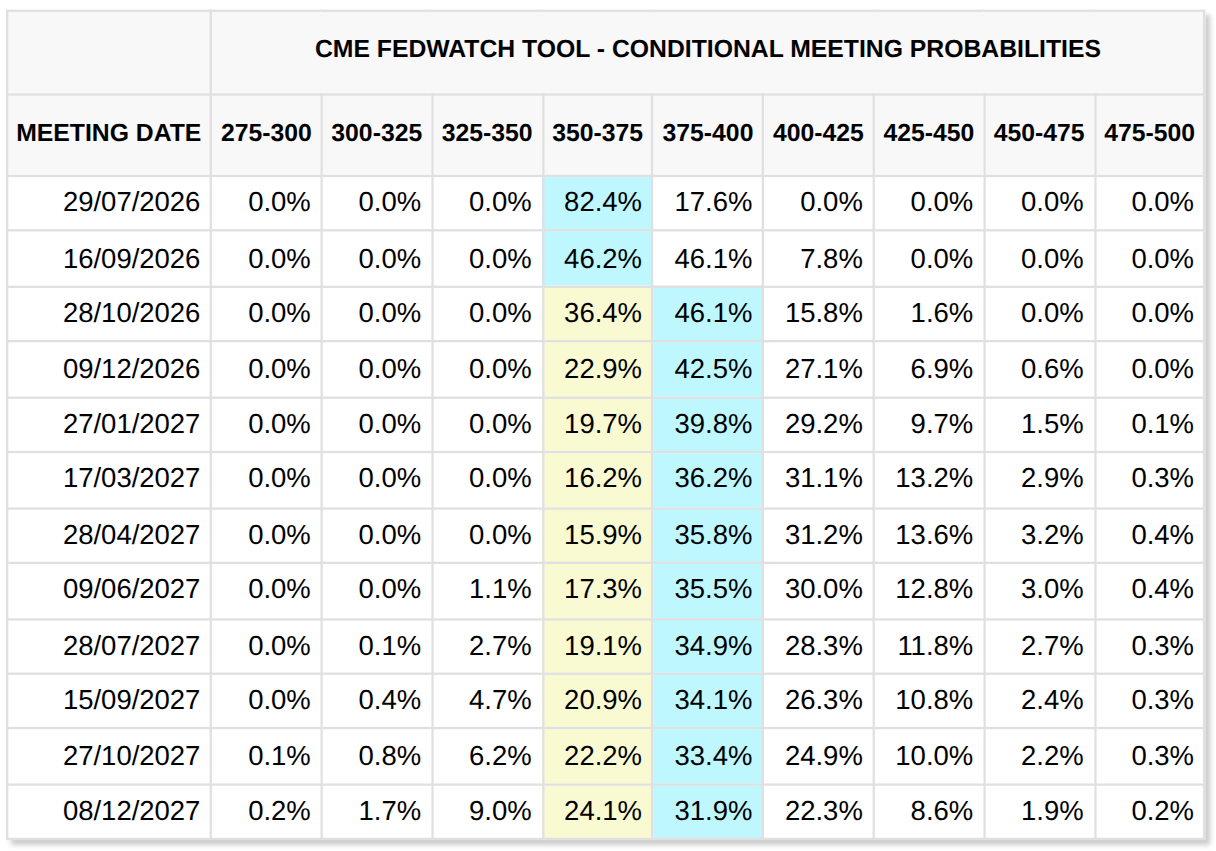
Fed target rate probabilities (screenshot). Source: CME Group
“The reality is that the payrolls report reflects a “Goldilocks” figure for the average stock, which isn’t too cold to stoke growth fears and not too hot to pull additional rate hikes forward,” it summarized about the jobs figures.
Crypto World
Inside the fierce data dispute over whether a sanctioned Russian crypto token is actually working to evade Western blocks


“We truly don’t think there is large-scale, authentic usage of A7A5 outside of A7,” Keegan said in an email, referring to the token’s issuer. He added that transaction volumes routinely collapse on weekends because much of the activity appears tied to business-to-business transfers involving the Russia-linked exchange Grinex.
Meanwhile, Tom Robinson, co-founder of another blockchain analytics firm, Elliptic, also said the token has lost momentum. He said that monthly transaction volumes have fallen by more than 90% since January and are down 96% from their peak last year, following sanctions imposed by the U.S., the European Union and the United Kingdom, as well as the collapse of Grinex earlier this year.
“The cherry-picked trading and transaction figures provided by A7A5 are consistent with Elliptic’s analysis,” Robinson said. “However, they conceal the obvious trend: that A7A5 is failing in its goal of enabling Russian sanctions evasion.”
A7A5’s Ogienko denied these claims and said that because the token’s activity mostly takes place in DeFi, it is not fully captured by major crypto data sites. “These outdated principles and metrics do not provide users around the world with objective information about A7A5,” he told CoinDesk in a statement via Telegram.
He said data providers, including CoinMarketCap, CoinGecko and DeFiLlama rely too heavily on centralized exchange data, creating what he claimed “a generally discriminatory approach, contrary to the principles of the United Nations.”

Fitbit Charge 6 Continues to be the Tracker That Turns Everyday Health Data Into Actionable Habits in 2026

Two Romanians jailed for stabbing journalist on behalf of Iranian regime
Morpho Secures $175M Funding from Paradigm and a16z to Scale Blockchain Credit Infrastructure


-

 Tech6 days ago
Claude Code turned every engineer into three. Now companies need more product thinkers
-

 Crypto World4 days ago
Strategy authorizes up to $1.25B in Bitcoin sales under new capital plan
-

 Politics9 hours ago
The House | “Reframing the debate from a binary discussion of winners and losers”: Yuan Yang reviews ‘We Are Not Machines’
-

 News Videos5 days ago
MAJOR BITCOIN & MARKET UPDATE!!!! (MUST WATCH ASAP!!!)
-

 Tech4 days ago
Anonymous researcher drops 0-day ‘exploitarium’ repo
-

 Crypto World6 days ago
Coinbase, Circle Deepen Crypto Stock Losses Despite Resilient S&P 500
-

 Business4 days ago
Australia treasurer says alleged access of prime minister’s bank data ’incredibly concerning’
-

 Crypto World7 days ago
Kraken's xStocks Opens Bending Spoons IPO Registration to EEA Retail
-

 Sports7 days ago
FIH Pro League: India defeat Pakistan 7-1, register biggest win of campaign | Other Sports News
-

 Tech6 days ago
Bluekit phishing kit adopts browser-in-the-middle for login theft
-

 Tech6 days ago
Russian hackers now target Signal backup recovery keys
-
 Business4 days ago
The AI boom won’t burst all at once. It will pop in ‘rolling bubbles’: Macquarie
-

 Sports2 days ago
Broncos roster: OL Ben Powers (No. 74) entering final year of contract
-

 Tech6 days ago
Silicon Valley paid to kill AI regulation, now it wants the rules back
-

 NewsBeat3 days ago
Presenter Caroline Flack’s brother Paul Flack dies aged 55
-

 Crypto World2 days ago
Binance stock trading tops $1B in first month after launch
-

 Tech6 days ago
OpenAI mulls delaying IPO over valuation concerns
-
 NewsBeat2 days ago
New exhibition reflects five decades of movement between island of Ireland and GB
-

 Crypto World2 days ago
Alibaba-affiliate Ant Group enters the humanoid robot market with 12 deals
-

 News Videos3 days ago
How to Build INSANE Live Financial Dashboards With Claude
You must be logged in to post a comment Login