Security teams log 54% of successful attacks and alert on just 14%. The rest move through your environment unseen.
The Picus whitepaper shows how breach and attack simulation tests your SIEM and EDR rules so threats stop slipping by detection.





Cisco confirmed that attackers are now exploiting a Unified Communications Manager (Unified CM) vulnerability patched in early June.
Unified CM (formerly known as Cisco CallManager) is the central control system for Cisco IP telephony systems, handling call routing, device management, and telephony features.
Threat actors without privileges can exploit the vulnerability (CVE-2026-20230) remotely in low-complexity server-side request forgery (SSRF) attacks by sending a crafted HTTP request.

Cisco said on June 3, when it released security patches to address this issue, that its Product Security Incident Response Team (PSIRT) was aware of publicly available proof-of-concept exploit code for CVE-2026-20230 but had no evidence of active exploitation.
However, roughly three weeks later, on June 22, threat intelligence firm Defused revealed that attackers had begun exploiting the flaw using properly constructed file:// payloads to create files on targeted devices.
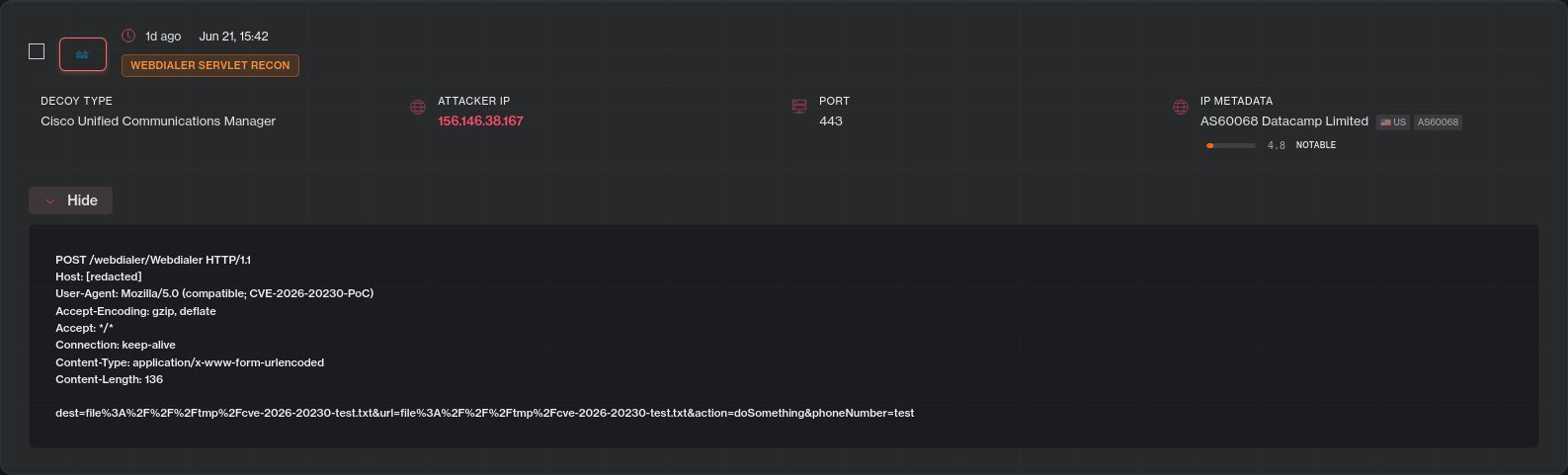
One day later, SSD Secure also published a technical write-up that included a proof-of-concept exploit and explained how the vulnerability works.
BleepingComputer contacted Cisco at the time to ask whether they were also seeing the flaw actively exploited in attacks and whether they could share any IOCs with defenders, but we have yet to receive a response.
The company finally confirmed this Wednesday that attackers are now exploiting CVE-2026-20230 and urged customers to secure their systems against ongoing exploitation.
“The Cisco PSIRT is aware that proof-of-concept exploit code is available for the vulnerability that is described in this advisory,” Cisco notes in an update to the original advisory.
“In June 2026, the Cisco PSIRT became aware of active exploitation of this vulnerability. Cisco continues to strongly recommend that customers upgrade to a fixed software release to remediate this vulnerability.”
Cisco has also shared mitigation measures for admins and security teams who can’t immediately install Cisco Unified CM versions 14SU6 or 15SU5 (Sep 2026 or COP), advising them to disable the vulnerable WebDialer service until a patch is applied to block incoming CVE-2026-20230 attacks.
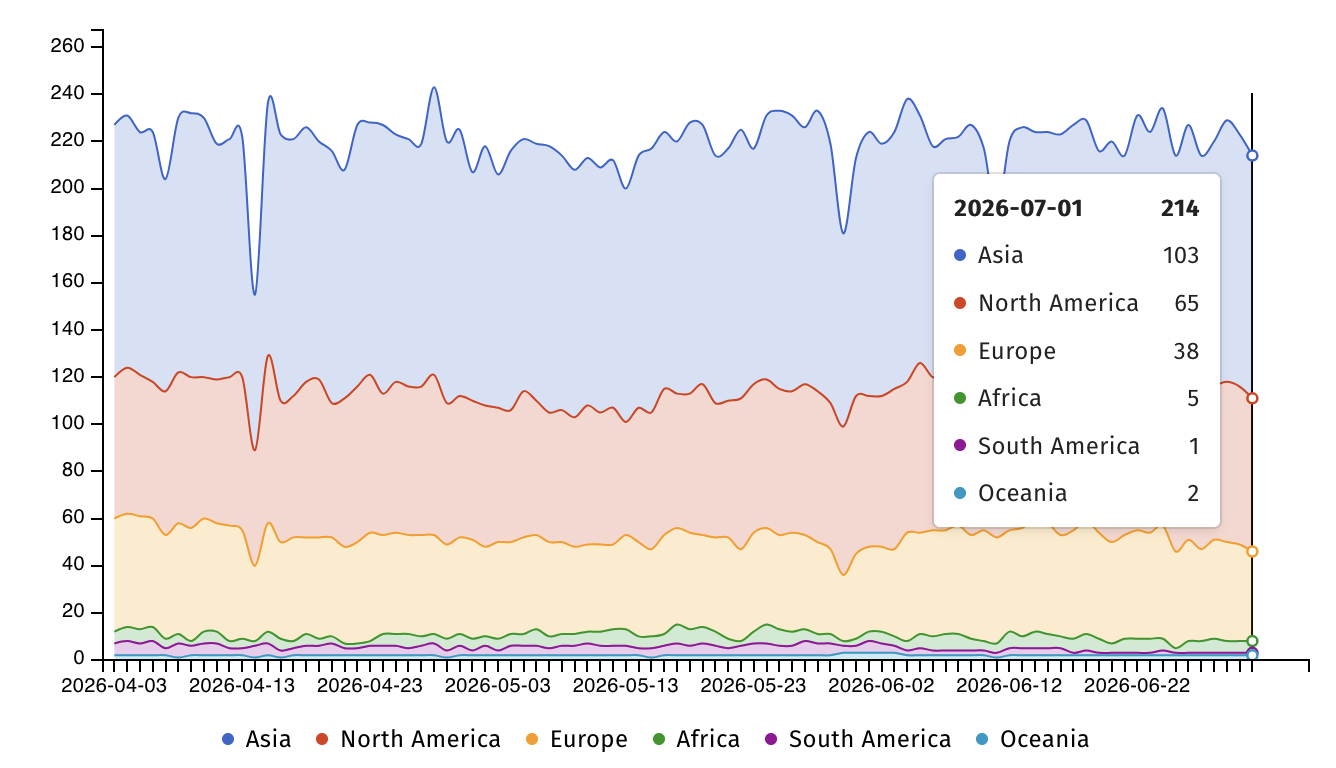
Internet security watchdog Shadowserver is currently tracking over 200 Cisco Unified CM instances exposed online, most of them in Asia and North America, but there are no details regarding how many have been secured against ongoing CVE-2026-20230 attacks.
In recent years, Cisco has also patched two Unified CM flaws (CVE-2024-20253 and CVE-2025-20309) that enabled threat actors to gain root privileges and another Unified CM flaw (CVE-2026-20045) that has been actively exploited as a zero-day to gain remote code execution.
The U.S. Cybersecurity and Infrastructure Security Agency (CISA) tagged 93 Cisco vulnerabilities as actively exploited in the wild since November 2021, six of which have been abused in ransomware attacks.

Security teams log 54% of successful attacks and alert on just 14%. The rest move through your environment unseen.
The Picus whitepaper shows how breach and attack simulation tests your SIEM and EDR rules so threats stop slipping by detection.

Robert Pollard and Guided By Voices (GBV) have again bestowed upon us another excellent new album: Crawlspace Of The Pantheon. A dandy rocker in grand GBV form, this is easily the band’s best since the last best one, which for me was 2025’s Thick Rich And Delicious. And I mean that with all the heart and soul of the deep fan that I am.

While no band likes to be pigeonholed, I sometimes think Guided By Voices deserves its own genre to describe what they do. Initially, I was thinking “Modern Classic Vintage British Rock,” but since GBV are from Dayton, Ohio, perhaps we should just call it “Modern Classic Vintage Rock.”
For me, GBV fills a musical void dating back to my childhood, when everyone anticipated a new Beatles album every six months or so. It was an event. In their own special way, a new GBV release is also an event, chock full of fresh earworms that feel familiar yet new.

Crawlspace Of The Pantheon is another solid sounding, well produced, full studio effort from the band, retaining just enough indie rock aesthetic to make clear that it is a GBV made, self-released, home brewed production. The current GBV is arguably the band’s most consistent lineup, achieving a super appealing balance between its glossier late 1990s and early 2000s first commercial peak, including Do The Collapse and Isolation Drills, and the early LoFi cassette multitrack basement wizardry that first put them on the map in the early 1990s, including Propeller and Bee Thousand.

“Lost In The Sun” kicks off Crawlspace Of The Pantheon echoing The Who and The Cars in the same breath, with Mellotron strings and tight harmonies. Saving its best hook for the very end, the song is one of those tunes I had to immediately play over and over.
“We Outlast Them All” could be a hit single for The Psychedelic Furs. Seriously, I cannot not hear Furs founder Richard Butler singing this song, even though it feels lyrically GBV autobiographical, a grand affirmation of the group’s staying power.

Another single candidate, “Advance Without Dropping,” packs a punch and is elevated by an incredible changeup in its ending bridge sequence: a mesmerizing, rising Doug Gillard guitar solo moment that sends quick chills down the spine.
If “Arthur Square” might be considered a lost cousin to 1969 pre Tommy Who, Mark Shue’s mad bass lines and Kevin March’s rolling drum fills appropriately channel the spirits of John Entwistle and Keith Moon, respectively. Gothic bells, more Mellotrons, and voiceover news reports turn this into a mad, brilliant psychedelic metal meltdown.

“(How Would You Like A) Chariot Ride” riffs on a chord sequence that cleverly echoes “The Punk And The Godfather” from The Who’s Quadrophenia. Try not humming Roger Daltrey’s stuttered “My Generation” melody over that moment.
“When You’re My Clown (Nothing Happens)” is an epic album closer, built around a tremendous chugging communal riff before launching into a beautiful acoustic driven coda. A classic GBV moment.
I think by now you get the idea Crawlspace Of The Pantheon is another shining crazy diamond in a long arc of winning musical gems from Guided By Voices. You can buy it at Amazon on vinyl for $26.39 or on CD for $17.98. Support independent music.
★★★★★★★★★★ Album
★★★★★★★★★★ Sound Quality
★★★★★★★★★★ Pressing Quality
Mark Smotroff is a deep music enthusiast / collector who has also worked in entertainment oriented marketing communications for decades supporting the likes of DTS, Sega and many others. He reviews vinyl for Analog Planet and has written for Audiophile Review, Sound+Vision, Mix, EQ, etc. You can learn more about him at LinkedIn.

Plus, we dive into Sony dumping PlayStation discs.

Valve’s Steam Machine is finally here! But while it lives up to much of the hype, its high price makes us wonder who it’s really for. In this episode, Senior Writer Jessica Conditt joins to talk about her experience with the Steam Machine and how it compares to consoles (which have also gotten very expensive). Also, we discuss Sony’s bombshell announcement about killing physical PlayStation discs in 2028 and Xbox’s confusing array of layoffs.
Hosts: Devindra Hardawar and Jessica Conditt
Producer: Ben Ellman
Music: Dale North and Terrence O’Brien

Looking for the most recent Connections answers? Click here for today’s Connections hints, as well as our daily answers and hints for The New York Times Mini Crossword, Wordle, Connections: Sports Edition and Strands puzzles.
Today’s NYT Connections puzzle has some fun words in the grid. You might recognize the blue category right away. Read on for clues and today’s Connections answers.
The Times has a Connections Bot, like the one for Wordle. Go there after you play to receive a numeric score and to have the program analyze your answers. Players who are registered with the Times Games section can now nerd out by following their progress, including the number of puzzles completed, win rate, number of times they nabbed a perfect score and their win streak.
Read more: Hints, Tips and Strategies to Help You Win at NYT Connections Every Time
Here are four hints for the groupings in today’s Connections puzzle, ranked from the easiest yellow group to the tough (and sometimes bizarre) purple group.
Yellow group hint: Keep at it.
Green group hint: Limerick is another one.
Blue group hint: Cheers!
Purple group hint: Not sour.
Yellow group: Persist.
Green group: Kinds of poems.
Blue group: Tropical drinks.
Purple group: Sweet ____.
Read more: Wordle Cheat Sheet: Here Are the Most Popular Letters Used in English Words
The completed NYT Connections puzzle for July 4, 2026.
The theme is persist. The four answers are continue, last, linger and stay.
The theme is kinds of poems. The four answers are ballad, epic, ode and villanelle.
The theme is tropical drinks. The four answers are hurricane, painkiller, scorpion and zombie.
The theme is sweet ____. The four answers are dreams, nothings, pea and spot.


The U.S. Interstate Highway System began taking shape in the 1920s. However, all those projects were put on hold in 1929 when the Great Depression hit, and remained so for decades. In 1956, President Dwight D. Eisenhower signed the National Interstate and Defense Highways Act in response to the explosion of automobiles taking to the roads during the post-war boom, with a plan to build 41,000 miles of highways that ran from sea to shining sea.
In 1954, 58 million registered motor vehicles were on the road in the U.S. Today, there are over 284 million, and it can sometimes feel like we’re all driving around on those same century-old roads. Enter the infamous work zone, where workers don’t necessarily need to be present for you to get a speeding ticket if you’re caught on camera by an Automated Speed Enforcement (ASE) system. As with standard work zones, state laws vary, so always check local regulations.
For instance, New York state statute 1180-E requires workers to be present, and clear signage leading up to the work zone warning that a photo-monitoring system is being used. Caution is advised in NY as State Police are known to wear hard hats and reflective vests to blend in with road construction crews. Much like New York, the state of Washington also requires signage, and enforcement only happens while workers are present in the zone. In Maryland, however, workers don’t need to be present for a traffic camera to issue a ticket. Florida has stringent work zone laws, but by and large doesn’t currently use ASEs in work zones. However, state law allows them to be at intersections and designated school zones (which are common).

In California, Assembly Bill 289 went into effect in January of 2026. However, it only applies if the appropriate signage stating that it’s “photo enforced” is present and must be located no more than 500 feet ahead of where the system is placed. Furthermore, citations can only be issued when construction workers are present.
Fines associated with these relatively new ASE laws can vary widely depending on the scenario. Going 11 to 15 mph over the posted speed limit in California carries a $50 fine (like in New York) and can escalate to $500 for speeds of 100 mph or greater. In New York, though, a second violation is $75 (if it occurred within 18 months of the first), while subsequent violations are $100 (again, if within 18 months of the first). In Maryland, the current tiered schedule starts at $60 for going 12 to 15 mph over the posted limit and goes up to $500 for driving 40 mph or more over the posted limit; those fines double if workers are present. Beginning on July 1, 2026, Washington drivers can expect a first-time infraction to cost $125, with subsequent infractions increasing to $248. On May 1, the state began requiring initial driver’s license applicants under 25 to pass an online work zone and first responder safety course before receiving their license.
More and more, states are using ASE systems to keep everyone safe because work zones are inherently dangerous due to uneven pavement, narrower lanes, concrete barriers, and strange orange lines on the road. Ultimately, it’s better to be safe than sorry. Stick to the letter of the law when traveling through them because, in the grand scheme of things, it’s a momentary annoyance that’s not worth a lifetime of regret.


Alibaba banned Claude Code after security researchers found Anthropic had embedded steganographic tracking code to identify Chinese users. The ban follows Anthropic’s accusation that Alibaba ran the largest known distillation attack on its models.
TL;DR
Alibaba has banned its employees from using Claude Code, Anthropic’s AI-powered coding agent, after security researchers discovered that the tool contained hidden code designed to identify Chinese users. The ban, effective 10 July, follows weeks of escalating conflict between the two companies over allegations that Alibaba stole Anthropic’s AI capabilities through industrial-scale distillation.
“As Claude Code was recently discovered to carry back-door risks, after comprehensive evaluation, Claude Code has now been added to a list of high-risk software with security vulnerabilities,” Alibaba said in an internal notice reported by the South China Morning Post. The company recommended employees use Qoder, its own coding agent platform, as a substitute.
A Reddit user identified as LegitMichel777 reverse-engineered Claude Code on 30 June and found obfuscated code that had been silently present since version 2.1.91, released on 2 April, with no mention in the release notes. The code checked whether a user’s system timezone was set to Asia/Shanghai or Asia/Urumqi and scanned proxy URLs against a hardcoded list of Chinese domains and AI lab addresses.
Rather than logging the results conventionally, the system used steganography to hide its signals in the system prompt sent back to Anthropic’s servers. If the timezone was Chinese, the date format changed from dashes to slashes, and the apostrophe in “Today’s date is” was swapped with one of three visually identical but technically distinct Unicode characters depending on which flags were triggered.
The alterations are invisible to human users and potentially even to the AI model itself, but they are machine-parseable by Anthropic’s servers. Portions of the detection code were XOR-obfuscated with the key 91, a technique used to prevent plain-text extraction during code analysis.
Thariq Shihipar, an Anthropic engineer on the Claude Code team, said on X that the tracking was “an experiment we launched in March that was meant to prevent account abuse from unauthorised resellers and protect against distillation.” He said the team had been “meaning to take this down for a while” and that the pull request to remove it was merged on 1 July.
The rollback coincided with the restoration of Anthropic’s Fable 5 and Mythos 5 models, which the US Commerce Department had ordered the company to disable for all foreign nationals in mid-June after Amazon researchers found a jailbreak vulnerability. The export controls were lifted on 30 June, and Anthropic restored access on 2 July, saying it would “scale up government collaboration” on frontier AI security.
Anthropic’s justification for the tracking code sits within a broader campaign against what it calls systematic theft of its models’ capabilities. In a letter to the US Senate Banking Committee on 10 June, the company accused operators affiliated with Alibaba’s Qwen AI lab of running the largest known distillation attack on Claude, using roughly 25,000 fraudulent accounts to generate 28.8 million exchanges between April and June.
Alibaba has denied the accusation. Anthropic had previously named DeepSeek, Moonshot AI, and MiniMax in February as perpetrators of similar campaigns, framing distillation as an existential threat to the business models of frontier AI companies.
Distillation, the practice of using a powerful model’s outputs to train a smaller one, occupies a grey area in AI development. Asian AI startups have launched alternatives to Anthropic’s models partly because the export ban on Fable 5 and Mythos 5 left a gap in the market, making the line between legitimate competition and illicit extraction increasingly difficult to draw.
Claude Code requires deep access to a developer’s local file system to read, modify, and execute code, meaning any hidden functionality in the tool effectively has access to everything on the machine. Huorong Security, a Chinese cybersecurity firm, said Anthropic’s tracking was not only a transparency issue but also raised cross-border data compliance concerns.
“Today it’s a timezone check, tomorrow it could be system sabotage or data exfiltration,” one Reddit user wrote. Anthropic’s privacy policy states that it collects the kind of data in question, but critics argue the steganographic method, designed to be invisible to users, crosses a line that a standard privacy disclosure does not.
The episode accelerates China’s push to reduce reliance on American AI tools, which Chinese firms increasingly view as carrying legal, security, and operational risks. Alibaba has been building out its own AI stack aggressively, integrating its Qwen models across products from e-commerce to robotics, and the Claude Code ban gives it further justification to push employees toward domestic alternatives.
Lizzi Lee, a fellow at the Asia Society Policy Institute’s Centre for China Analysis, said the conflict showed how the US-China AI competition has moved beyond technology into access control and sovereignty. “If a US AI coding tool can detect Chinese usage or proxy access, then it’s not surprising for major Chinese tech companies to not want employees using it internally,” she said.
Anthropic’s models have long been officially inaccessible in China, but they remain popular among domestic developers who use workarounds to maintain access. Whether the tracking controversy pushes more of them toward Chinese alternatives or simply confirms what many already suspected about the risks of depending on American AI tools is a question that extends well beyond Alibaba.

The eufy Omni C20 is built for households that don’t want to bother with constant cleaning.
This vobo vac has dropped to £308.99 from its original price of £599, a saving of 48% that brings a fully automated cleaning station within much easier reach.
Save nearly 50% on this Eufy robo vac
A saving of 48% brings Eufy’s fantastic fully automated cleaning station within much easier reach of most budgets.

The station itself does the unglamorous work most robot vacuums leave to their owner, since it empties dust into a 3.1 litre bag, washes the mop pads, and dries them with room temperature air once the C20 docks.
That drying step alone cuts energy use by 57 times compared with heated methods, which matters if you would rather this thing run quietly in the background than announce itself every time it recharges.

None of that automation counts for much if the vacuum itself struggles to get under furniture, and this is where the eufy Omni C20’s 3.35 inch body earns its keep, sliding beneath sofas, beds, and low cabinets at just 90mm tall with room to spare, reaching the strips of floor that upright vacuums and clumsier robots consistently miss.
Suction sits at 7,000 Pa in its strongest mode, enough to lift pet hair, crumbs, and general debris across hard floors and carpet alike without needing a second pass over the same stubborn patch of mess.
Hair wrapping around the brush is one of the more tedious habits of any robot vacuum, so the Pro-Detangle Comb built into the roller exists specifically to stop that problem before it starts.
Mopping gets the same attention to detail, since the dual pads spin at 180 rotations per minute with 6N of downward pressure to lift dried stains rather than just smear them across the floor.
Carpets are handled with equal care, as the C20 detects the change underfoot and lifts its mop by 0.41 inches so rugs and carpeted rooms are vacuumed without getting soaked in the process.
For a broader sense of how the Omni C20 stacks up against everything else worth considering this year, our Best Vacuum Cleaner 2026 guide rounds up the models actually earning their place in a UK home right now.
SQUIRREL_PLAYLIST_10148964

Looking for a different day?
A new NYT Strands puzzle appears at midnight each day for your time zone – which means that some people are always playing ‘today’s game’ while others are playing ‘yesterday’s’. If you’re looking for Friday’s puzzle instead then click here: NYT Strands hints and answers for Friday, July 3 (game #852).
Strands is the NYT’s latest word game after the likes of Wordle, Spelling Bee and Connections – and it’s great fun. It can be difficult, though, so read on for my Strands hints.
Want more word-based fun? Then check out my NYT Connections today and Quordle today pages for hints and answers for those games, and Marc’s Wordle today page for the original viral word game.
SPOILER WARNING: Information about NYT Strands today is below, so don’t read on if you don’t want to know the answers.
• Today’s NYT Strands theme is… Ooh!
Play any of these words to unlock the in-game hints system.
• Spangram has 9 letters
First side: bottom, 4th column
Last side: top, 6th column
Right, the answers are below, so DO NOT SCROLL ANY FURTHER IF YOU DON’T WANT TO SEE THEM.

The answers to today’s Strands, game #853, are…
Talk about a theme that could mean absolutely anything at all.
Totally in the dark, not an entirely unusual feeling to be truthful, I worked my way around the board in search of non-game words to earn a hint. Instead, I saw the spangram FIREWORKS and remembered today’s date.
I went to a fireworks display recently that was underwhelming, in part due to the murky conditions but also because the drones that made up a large part of the display had to be viewed from a particular angle in order to impress; a case of “uh?” rather than “ooh!”.
Meanwhile, it was nice to see a bit of color in Strands for a change. A rare treat.
Strands is the NYT’s not-so-new-any-more word game, following Wordle and Connections. It’s now a fully fledged member of the NYT’s games stable that has been running for a year and which can be played on the NYT Games site on desktop or mobile.
I’ve got a full guide to how to play NYT Strands, complete with tips for solving it, so check that out if you’re struggling to beat it each day.


Palantir CEO Alex Karp has assembled a $200M+ real estate portfolio centred on seclusion, from a 3,700-acre Colorado monastery to a Miami compound. The privacy-obsessed lifestyle contrasts sharply with the surveillance software his company sells to governments.
TL;DR
Alex Karp, the co-founder and chief executive of Palantir Technologies, has quietly assembled a real estate portfolio worth more than $200 million across a reported 20 properties worldwide. The common thread is seclusion: a former monastery in the Colorado mountains, a rural compound in New Hampshire, and a pair of mansions on a gated Miami island.
Karp, whose net worth stood at $14.4 billion as of early July according to the Bloomberg Billionaires Index, has said he never learned to drive because he was once “too poor” and is now “too rich.” The fortune that funds his acquisitions comes from Palantir, whose revenue hit $1.63 billion in Q1 2026, up 85% year over year, driven by surging demand for its AI and data analytics platforms from governments and defence agencies.
In December 2025, Karp paid $120 million for the Saint Benedict’s Monastery ranch, a 3,700-acre property in the Capitol Creek Valley near Snowmass, Colorado, about 15 miles north of Aspen. The deal, transacted through an entity called Espen LLC, set a record for Pitkin County and was one of the largest residential sales in Colorado history.
Trappist monks of the Cistercian Order of the Strict Observance had stewarded the land since 1956, supporting themselves through farming and candy sales. Their numbers dwindled over the decades until only five remained, and the order’s General Chapter voted to close the monastery in the autumn of 2022.
The property was listed for $150 million in April 2024 before selling for $30 million below asking. The compound includes a chapel, monks’ living quarters, a retreat centre, 1,200 acres of irrigated meadows with senior water rights, and three creek systems stretching more than five miles.
Karp is an avid cross-country skier who reportedly trains 12 to 15 miles daily. A 3,700-acre property in the Elk Mountains is a fitting base for someone whose fitness regime is better described as vocational.
In June 2025, a Delaware entity called Hibiscus East LLC purchased a nearly 10,000-square-foot waterfront mansion at 55 East San Marino Drive for $46 million. Business Insider reported that the LLC is linked to a New Hampshire attorney and accounting firm that have appeared on documents tied to Karp’s previous transactions.
Karp then bought the house next door at 29 East San Marino Drive for $28.5 million, bringing his total investment on the island to nearly $75 million. The second property was listed at $30 million and went under contract in eight days.
Together, the two lots total more than 0.8 acres with 265 feet of waterfront, and The Real Deal reported that the acquisitions appear to be the start of a compound. San Marino is one of six man-made Venetian Islands in Biscayne Bay, an exclusive enclave whose past and present residents include basketball player Dwyane Wade and singer Gloria Estefan.
The Miami purchases predated Palantir’s decision to relocate its headquarters from Denver to Aventura, a Miami-area suburb, in February 2026. The company is currently operating from a co-working space while searching for permanent offices in areas including Wynwood, Brickell, and Coral Gables.
Karp’s reported primary residence is a 500-acre estate in Lyman, New Hampshire, part of which he purchased for $825,000 in 2019. He has been known to work from the property’s barn.
Lyman is a rural town in Grafton County with fewer than 600 residents, nearly two hours south of Manchester. Despite running one of the most closely watched companies in the defence technology sector, Karp chose a near-invisible town as home base, a pattern that extends across every significant property in his portfolio.
The seclusion of Karp’s lifestyle is striking because of what Palantir does. The company took over Project Maven, the Pentagon’s AI drone analysis programme that Google abandoned after employee protests, and its platforms power surveillance systems used by ICE, the military, and hundreds of local law enforcement agencies across the United States.
Karp has defended this work as essential to national security, arguing that democracies need tools powerful enough to compete with authoritarian adversaries. The company continues to expand its government footprint, competing for contracts including the FAA’s predictive air traffic AI system, and its stock has risen more than 600% since the start of 2024.
Karp’s net worth fluctuates with Palantir’s share price, which has traded between $106 and $208 over the past year, meaning the Bloomberg figure is a snapshot rather than a fixed number. The reported 20-property portfolio has not been independently confirmed in its entirety.
What is confirmed is the scale of his recent purchases: $120 million in Colorado, $75 million in Miami, and a 500-acre estate in one of the least populated towns in New Hampshire. Together, they form a portfolio designed around a single principle that Karp’s own company has made a $75 billion business out of undermining: the right to be left alone.

With a dual celebration to mark, the 2026 Macy’s fourth of July Fireworks special is all set to light up the sky like never before. If you’ve not managed to score a prime spot to view the display or are away from the Big Apple, you can tune in to catch the show on TV.
The New York institution is now in its 50th year, a landmark which dovetails nicely with this year’s July Fourth celebrations marking America’s 250th birthday. With launch sites on the lower East River in the Seaport District, the lower Hudson River and the iconic Brooklyn Bridge, this year’s display is set to feature over 85,000 shells — its biggest number ever — as well as ground-breaking laser elements.
Read on for details on how to watch the Macy’s 4th of July Fireworks show from anywhere.
The two-hour TV special will air live on Saturday, July 4, at 8 p.m. ET/PT on NBC and Peacock.
Brooklyn Nine-Nine’s Terry Crews will be hosting for the first time, while there’s a star-studded musical lineup that sees Noah Kahan, Post Malone, Salt-N-Pepa, Bebe Rexha, Shaboozey and Blake Shelton all performing.
Rounding out the show will be the much-anticipated fireworks display, which is set to be soundtracked by a score by Grammy Award-winning composer Jason Howland that will feature live vocals by The Voice season 29 winner Alexia Jayy.
For those looking for an alternative to NBC, the event is streaming live as a simulcast on Peacock.
Peacock currently costs $11 per month for the ad-supported Peacock Premium plan and $17 per month for the ad-free Peacock Premium Plus plan.
If you’ve ditched cable, you can still catch this year’s event with a subscription to a live TV streaming service like YouTube TV, Hulu with Live TV, Fubo or Sling. Note that NBC is available only in select cities with Sling Blue or Sling Blue + Orange subscriptions.
If you’re traveling abroad and want to watch the event while away from home, a VPN can help enhance your privacy and security when streaming.
It encrypts your traffic and prevents your internet service provider from throttling your speeds. Additionally, it can be helpful when connecting to public Wi-Fi networks while traveling, providing an extra layer of protection for your devices and logins. VPNs are legal in many countries, including the US and Canada, and can be used for legitimate purposes such as improving online privacy and security.
However, some streaming services may have policies restricting VPN use to access region-specific content. If you’re considering a VPN for streaming, check the platform’s terms of service to ensure compliance.
If you choose to use a VPN, follow the provider’s installation instructions to ensure you’re connected securely and in compliance with applicable laws and service agreements. Some streaming platforms may block access when a VPN is detected, so verifying if your streaming subscription allows VPN use is crucial.
Price $78 for two yearsLatest Tests No DNS leaks detected, 18% speed loss in 2025 testsJurisdiction British Virgin IslandsNetwork 3,000 plus servers in 105 countries
ExpressVPN is our current best VPN pick for people who want a reliable and safe VPN, and it works on a variety of devices. It’s normally $120 a year for its most popular plan (Advanced), but if you sign up for an annual subscription right now, you’ll save $45.


We may receive a commission on purchases made from links.
Amazon’s mid-tier Fire HD 10 tablet just got a surprise refresh. The big news here is that the RAM has increased from 3GB to 4GB. This model has had 3GB of RAM for years and actually launched with just 2GB way back in 2017.
Otherwise, the specs remain the same. It features a 2GHz octa-core processor, a 10.1-inch FHD touchscreen and a battery that lasts for around 13 hours. This new model does seem to charge a bit quicker, as it can juice up in four hours instead of five.
There are a few caveats. The new Fire HD 10 is only available with 32GB of storage, and the old models were available in both 32GB and 64GB. We reached out to Amazon to ask if it plans to add a 64GB model in the future.
Also, it’s 2026. There’s no such thing as a free RAM lunch. This tablet costs $155, which is around $15 more than the previous gen. Finally, you can only buy it with lockscreen ads. I have a Kindle and a Fire tablet and have never found the ads to be that annoying, and I typically loathe that kind of thing.
This isn’t quite a budget tablet, but it doesn’t quite have the juice for intensive creative applications. The Fire HD 10 is a good device for laying in bed and watching stuff and it’s even safe around kids, as these things are pretty durable in my experience.




Claude Code turned every engineer into three. Now companies need more product thinkers


Strategy authorizes up to $1.25B in Bitcoin sales under new capital plan


Bluekit phishing kit adopts browser-in-the-middle for login theft


Weekend Open Thread: High Hopes


The House | “Reframing the debate from a binary discussion of winners and losers”: Yuan Yang reviews ‘We Are Not Machines’


MAJOR BITCOIN & MARKET UPDATE!!!! (MUST WATCH ASAP!!!)


Anonymous researcher drops 0-day ‘exploitarium’ repo


Coinbase, Circle Deepen Crypto Stock Losses Despite Resilient S&P 500


Australia treasurer says alleged access of prime minister’s bank data ’incredibly concerning’


Kraken's xStocks Opens Bending Spoons IPO Registration to EEA Retail


Russian hackers now target Signal backup recovery keys

The AI boom won’t burst all at once. It will pop in ‘rolling bubbles’: Macquarie


Broncos roster: OL Ben Powers (No. 74) entering final year of contract


Silicon Valley paid to kill AI regulation, now it wants the rules back


Presenter Caroline Flack’s brother Paul Flack dies aged 55


Binance stock trading tops $1B in first month after launch


OpenAI mulls delaying IPO over valuation concerns

New exhibition reflects five decades of movement between island of Ireland and GB


Alibaba-affiliate Ant Group enters the humanoid robot market with 12 deals


How to Build INSANE Live Financial Dashboards With Claude


You must be logged in to post a comment Login