

Crypto World
US Law Enforcement Groups No Longer Opposes CLARITY Act

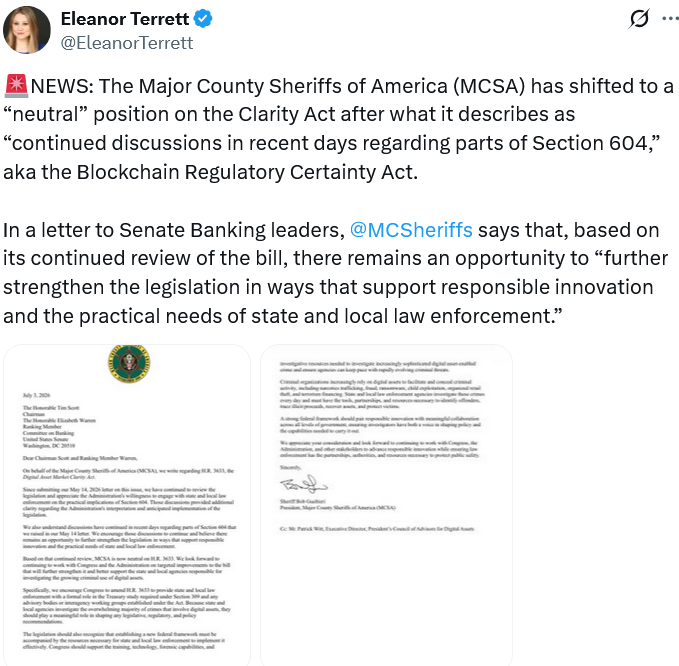
The Major County Sheriffs of America reportedly said it no longer opposes the CLARITY Act after initially raising concerns over how the bill would affect illicit finance investigations.
In a letter to US Senate Banking Committee chair Tim Scott and Senator Elizabeth Warren on Friday, the MCSA said it shifted its stance on the CLARITY Act to “neutral” after some of its concerns in a May 14 letter regarding Section 604 in the bill were addressed.
Section 604 relates to the Blockchain Regulatory Certainty Act, which seeks to protect developers from liability for illicit activity committed by users on their decentralized platforms.
The MCSA previously contended that Section 604 could create a loophole for criminals to exploit, making it tougher for law enforcement to investigate crypto-related crimes.
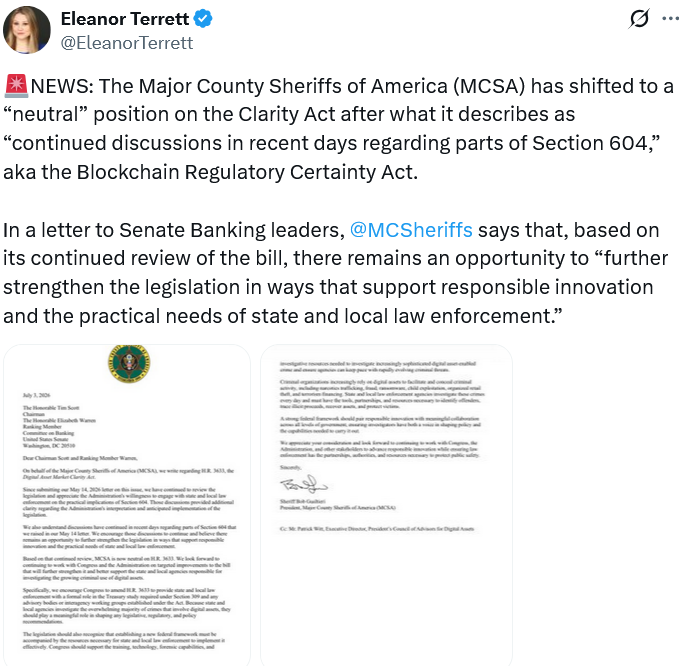
Source: Eleanor Terrett
While the CLARITY Act has bipartisan support, its passage through the Senate has largely been stalled by banking groups seeking to restrict stablecoin yield, which they argue functions like an unregulated deposit product that could drive trillions of dollars in outflows from the traditional banking system.
The bill has been awaiting a full Senate vote since May, when the Senate Banking Committee passed the bill mostly along party lines.
Senators in favor of the bill are pushing for a full Senate vote this month, in hopes that it can be passed and signed into law before the US midterm elections in November.
One of CLARITY Act’s “biggest roadblocks” removed
Crypto investor Mark Chadwick described MCSA’s initial opposition to the CLARITY Act as one of the “biggest roadblocks” in preventing the Senate from passing the bill.
“With that hurdle now out of the way, the path to passage just got a lot clearer,” Chadwick said. “One more major hurdle down.”
MCSA still wants improvements to CLARITY Act
The MCSA said it would like the CLARITY Act to be amended to include state law enforcement in Section 309, which requires the Treasury Department to study decentralized finance and illicit finance risks.
Related: Senate leaders push for July passage of CLARITY Act
MCSA President Bob Gualtieri argued that Congress should provide the training, technology and resources needed to “investigate increasingly sophisticated digital asset-enabled activity” tied to fraud, narcotics trafficking, ransomware, child exploitation, terrorism financing and other crimes.
“State and local law enforcement agencies investigate these crimes every day and must have the tools, partnerships, and resources necessary to identify offenders, trace illicit proceeds, recover assets, and protect victims.”
Magazine: Does ‘Paper Bitcoin’ mean there’s an unlimited supply of BTC?

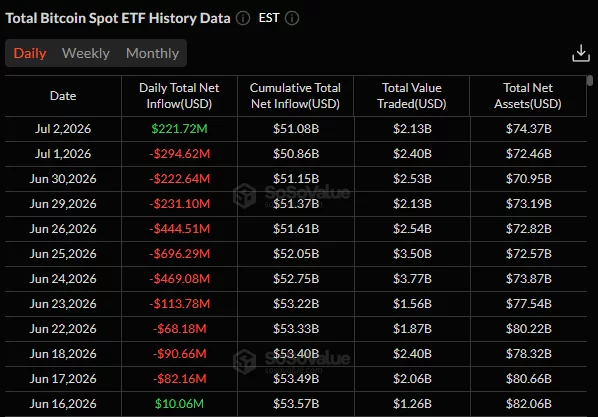
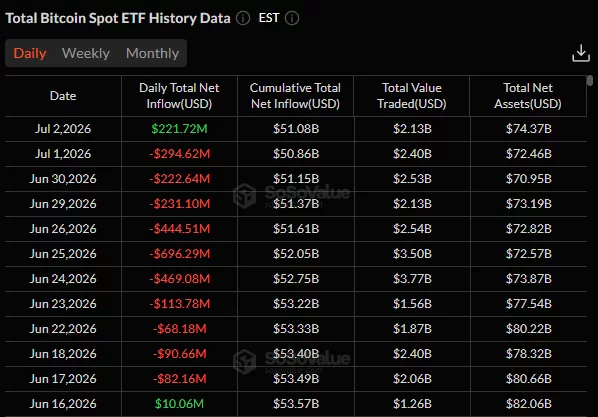
U.S. spot Bitcoin exchange-traded funds have recorded $221.7 million in net inflows, ending a 10-day withdrawal streak as softer U.S. economic data and easing Federal Reserve rate concerns helped Bitcoin recover from this week’s lows.
Summary
- U.S. spot Bitcoin ETFs recorded $221.7 million in inflows, ending a 10-day streak of net withdrawals.
- Weak U.S. jobs data and softer Fed comments helped Bitcoin rebound about 7.7% from its weekly low.
- Analysts pointed to strong historical July performance and late-cycle trends as sentiment improved.
According to data from SoSoValue, Thursday’s inflows were the strongest daily total in about two months after investors pulled nearly $2.7 billion from the funds during the previous 10 trading sessions.
The rebound came as Bitcoin (BTC) climbed back above $61,000 after briefly dropping below $58,000 earlier this week. Per data from crypto.news, the cryptocurrency was recently trading near $62,500, about 7.7% above its weekly low.
Weak economic data revives ETF demand
Fidelity’s FBTC attracted the largest share of new money with $166 million in inflows, while ARK 21Shares’ ARKB added $91.8 million and VanEck’s HODL received $4.4 million. BlackRock’s IBIT remained the only major fund to post net withdrawals, losing $40.4 million and extending its outflow streak that began in mid-June.
The latest buying followed one of the toughest periods on record for U.S. spot Bitcoin ETFs. SoSoValue data showed the products lost roughly $4.5 billion during June, making it their worst monthly performance since launch.
The turnaround came after the U.S. Labor Department reported that nonfarm payrolls increased by only 57,000 in June, far below market expectations of around 110,000. At the same time, Federal Reserve Chair Kevin Warsh indicated that inflation risks had eased, reducing expectations of additional interest rate increases and weakening the U.S. dollar.
The combination of weaker labor market data and a less hawkish tone from the Fed improved investor appetite for risk assets, helping Bitcoin recover alongside renewed demand for spot ETF products.
Ethereum investment products also benefited from the improved sentiment. Notably, U.S. spot Ethereum ETFs attracted $14.9 million in net inflows on Wednesday, followed by another $29.1 million on Thursday.
Historical July trends add to recovery narrative
While the ETF rebound was driven by macroeconomic developments, several market participants pointed to historical price patterns that could support Bitcoin during July.
In a July 4 X post, analyst Cyclop said that Bitcoin has recorded gains exceeding 20% during July in every previous bear market, citing CoinGlass monthly return data. The post suggested the current recovery could resemble earlier bear-market rallies, although it did not predict that history would necessarily repeat.
Separately, crypto analyst Ardi argued that Bitcoin may be entering the final phase of its current correction based on previous market cycles. According to Ardi, earlier Bitcoin bear markets typically spent around one year forming a bottom, while the current correction has lasted roughly nine months.
He estimated this would place the market about three months away from the period that has historically offered the highest probability for a cycle low, although he cautioned that any bottom could arrive earlier or later than that statistical window.
Despite those historical comparisons, Thursday’s ETF inflows were tied directly to changing macroeconomic expectations, with investors responding to fresh U.S. economic data and signs that pressure for additional Federal Reserve tightening may be easing.

European regulators are warning that many “prediction market” products can fall under existing rules for binary options—even when providers frame them as event contracts rather than financial wagers. In a public statement issued this Friday, the European Securities and Markets Authority (ESMA) reminded firms that regulatory classification depends primarily on contract design, not on marketing language.
Meanwhile, the legal fight over prediction markets is intensifying in the United States, where state gaming authorities and the Commodity Futures Trading Commission (CFTC) disagree over whether these offerings should be treated as gambling or as federally regulated derivatives. The parallel developments highlight how quickly prediction market platforms are colliding with established financial services and gaming frameworks.
Key takeaways
- ESMA says event contracts can already be caught by binary options restrictions if they meet the definition of a financial instrument.
- ESMA emphasizes that the assessment is based on contract characteristics—binary outcomes and fixed payouts are likely to trigger the rules.
- Offering qualifying event contracts to professional or institutional clients may still require authorization under MiFID II, ESMA cautions.
- In the US, a growing split between state regulators and the CFTC continues to drive litigation involving major prediction market platforms.
ESMA’s warning: marketing won’t change regulatory classification
ESMA’s statement clarifies that firms cannot bypass financial regulation by rebranding binary-like products as “event contracts.” The regulator pointed out that contracts meeting the definition of financial instruments are already prohibited from being marketed, distributed, or sold to retail investors under national measures implementing ESMA’s 2018 restrictions on binary options.
Importantly, ESMA says providers should not expect outcomes to hinge on how products are described to the public. Instead, regulators will look at the underlying terms and structure of the contract itself. ESMA noted that event contracts featuring binary outcomes and fixed payouts are particularly likely to qualify as financial instruments subject to the restrictions.
ESMA also underscored that the question of authorization does not disappear when retail customers are excluded. Even when a firm limits access to professional or institutional clients, ESMA says offering event contracts that qualify still requires authorization under the EU’s Markets in Financial Instruments Directive (MiFID II).
According to ESMA, the reminder does not introduce new rules. The agency said it issued the warning after observing increased offerings of event contracts and noting the rapid growth of prediction markets. While ESMA’s intervention is framed as an enforcement clarification, its message is direct: where products resemble binary options in substance, the existing compliance and marketing limits from 2018 can be triggered.
ESMA’s public statement is available via the regulator’s website: ESMA35-243228190-8148 Public Statement on the application of the national product intervention measures on binary options to event contracts.
Why this matters for prediction market operators in Europe
For prediction market platforms operating in the EU, ESMA’s key practical implication is that product design and payoff mechanics are likely to be the deciding factors for compliance. Providers that market contracts as “event exposure” rather than as wagers may still face restrictions if contract terms align with binary option characteristics.
That matters because the boundary between “financial instrument” and “permitted market activity” can be narrow. ESMA’s framing suggests that firms should review how settlement works (binary resolution), how payouts are determined (fixed payouts), and how investor access is structured (retail versus professional/institutional). Where those elements resemble a binary outcome with pre-defined payoff mechanics, the products may fall under measures already implemented by EU member states.
While ESMA did not claim the rules are new, its intervention signals an enforcement posture: firms should expect regulators to treat nomenclature as secondary and to focus on contract substance. In practice, this can affect go-to-market strategy, client eligibility, and authorization planning under MiFID II.
US courts and regulators: states versus the CFTC
Across the Atlantic, prediction markets are caught in a different conflict—one tied to jurisdiction. The ongoing dispute pits state gaming regulators against the CFTC, with each side offering a distinct legal characterization of event contracts.
According to Cointelegraph’s earlier reporting, by March authorities in 11 states had taken legal or regulatory action against platforms including Kalshi and Polymarket. Nevada was reported as the first state to temporarily block Kalshi’s operations, while Arizona brought criminal charges alleging Kalshi was running an illegal gambling business.
In April, the CFTC asserted what it described as “exclusive jurisdiction” over prediction markets. The agency argued that Congress entrusted it with sole authority to regulate commodity derivatives markets, including event contracts, and it said it had sued several states and filed court briefs supporting platforms such as Kalshi. The relevant announcement is posted on the CFTC website: CFTC.gov press release.
Litigation escalates, and pressure grows for federal clarification
As the federal-state standoff continues, the legal momentum has not gone quiet. On June 30, a Massachusetts judge reportedly allowed state authorities to file an amended complaint in an ongoing lawsuit accusing Kalshi’s sports-event contracts of constituting illegal gambling under state law. Earlier coverage also highlighted how the litigation expanded as regulators sought to push the case forward under state gambling statutes.
The dispute has also drawn calls for legislative intervention. Last month, the Indian Gaming Association and American Gaming Association—along with tribal and labor groups—urged lawmakers to amend the CLARITY Act. Their position, as described in Cointelegraph coverage, is that sports-related event contracts on prediction market platforms should be explicitly prohibited, arguing they fall outside the CFTC’s authority and should remain subject to state gambling laws. The push reflects a broader attempt to resolve the uncertainty created by competing interpretations of federal versus state oversight.
Some legal experts expect the outcome to depend on how courts ultimately reconcile the federal CFTC role with state gaming authority. Cointelegraph previously noted that the growing conflict could be decided by the US Supreme Court, underscoring that the issue may reach the highest level rather than being settled through routine regulatory filings.
What to watch next
In Europe, the most immediate signal is ESMA’s insistence that contract structure—not marketing labels—will determine whether event contracts are treated like binary options and whether MiFID II authorization is required. In the US, the next developments likely hinge on how courts handle jurisdiction and whether federal legislation steps in to reduce the split between state enforcement and the CFTC’s claimed authority.

If you are trying to learn about crypto in Japanese, YouTube is the best place to do it. Japan has one of the most active crypto communities in Asia, and most people here turn to YouTubers they trust for research, market analysis, and clear explanations far more than they turn to ads or news headlines. It helps that paid crypto ads are heavily restricted across Google and Meta in Japan, which has pushed independent creators to the center of how people find projects and figure out the market.
The tricky part is knowing who is actually worth your time. Crypto YouTube is crowded, and the quality runs the full range from genuinely useful to pure hype. So to save you the digging, here are five of the most-watched Japanese crypto channels in 2026, what each one is about, how they differ, and who each is right for, whether you are opening your first exchange account or fine-tuning a strategy you already have
The five Japanese crypto YouTube channels worth following in 2026 are Coin Exploration Club, CoinSensei JP, Learn Crypto Together, SatoshiLab Japan, and Moshin / ビットコイン. Here is what you get from each.
1. Coin Exploration Club
Channel: Coin Exploration Club
Coin Exploration Club is one of the biggest and most beginner-friendly Japanese crypto channels around, and a great place to start if you are new. It covers weekly crypto news, introductions to trending tokens and projects, airdrop info, and simple tutorials on the practical stuff like signing up for an exchange and setting up a wallet.
The big draw is how approachable it is. The content is made for people who are curious about crypto but do not have the vocabulary for it yet, so things are explained from the ground up instead of assuming you already know the lingo. And because it posts weekly, you get a steady stream of updates without feeling buried, which is exactly what most people need in their first few months.
Focus: Weekly news, token and project introductions, airdrop guides, beginner tutorials Best for: Beginners who want regular news and easy, practical how-tos
2. CoinSensei JP

Channel: CoinSensei JP
CoinSensei JP means “Coin Teacher Japan,” and the name fits both the style and the schedule. It posts almost every day, which very few Japanese crypto channels manage to keep up, and covers Bitcoin, Ethereum, altcoin analysis, airdrop updates, and Web3 education in clear, easy Japanese.
That consistency is what makes it click. When a channel shows up in your feed nearly every day, it becomes part of your routine, and that daily drip is one of the best ways to build your understanding little by little instead of all at once. The teacher angle suits its beginner-friendly, low-jargon approach, so it is easy to keep up with even while you are still finding your feet.
Focus: Bitcoin and Ethereum analysis, altcoin breakdowns, airdrop info, Web3 education Best for: Beginners who want a daily habit and steady, easy-to-follow commentary
3. Learn Crypto Together (緒に学ぶクリプト)

Channel: Learn Crypto Together
Learn Crypto Together, whose Japanese name 緒に学ぶクリプト means exactly that, is the smallest and newest channel on this list, and that is part of the charm. Where the bigger channels feel like polished broadcasts, this one feels more like learning alongside a friend, which some people connect with more easily.
It focuses on market analysis across the three coins most Japanese investors actually hold: Bitcoin, Ethereum, and Solana. As a viewer you get a closer, less crowded relationship with a creator who is earlier in their own journey, and that can make the whole thing feel more relatable than a slick channel with a huge audience.
Since it is newer and smaller, it is worth keeping the usual common sense in mind. Double-check claims yourself, and be careful with any links that try to pull you into private messaging groups until you have a good reason to trust the source.
Focus: Bitcoin, Ethereum, and Solana market analysis in a casual, learn-together style Best for: Viewers who like following a smaller creator and want regular updates on the major coins
4. SatoshiLab Japan

Channel: SatoshiLab Japan
SatoshiLab Japan is one of the most complete Japanese crypto channels in 2026, and probably the best one if you want to learn how to actually think about crypto rather than just keep up with the headlines. The core is Bitcoin, Ethereum, and Solana, and from there it branches into crypto news, market analysis, exchange reviews, hardware wallets, airdrop guides, DeFi, and wider Web3 topics, all in clear, well-organized Japanese.
What sets it apart is that it leans on research and patience instead of hype. It is built to work for everyone from total beginners to experienced traders, and the goal is to help you genuinely understand what you are looking at rather than chase every price move. That tends to leave you a lot more confident and a lot better informed.
It also keeps a clear disclaimer habit, openly reminding viewers to do their own research before making any decision. In a market that gets more scrutiny every year, that kind of honesty is a good sign you are watching someone who respects your judgment instead of trying to rush it.
Focus: BTC, ETH, and SOL analysis, crypto news, exchange and hardware wallet reviews, DeFi and Web3 education Best for: Beginners who want to build good habits, and intermediate viewers who want real depth
5. Moshin / ビットコイン

Channel: Moshin ビットコイン
Moshin / ビットコイン is the most one-of-a-kind creator on this list. Most crypto channels open with charts and numbers, but Moshin opens with his own story, and that honesty has earned him one of the most loyal audiences in Japanese crypto YouTube. The channel is verified and has one of the biggest video libraries of any Japanese crypto creator, so there is plenty to dig through.
His story is a big reason people stick around. By his own account, he went from hitting financial rock bottom, to passing 100 million yen in unrealized gains in 2021, to losing it all by not taking profit, then rebuilding his approach in 2022 and becoming a 億り人 (someone with over 100 million yen in assets) again in 2024. Being that open about the failures as well as the wins is rare in this space, where most creators only show the good parts, and it is a big part of why people trust him on a personal level.
His motto, roughly “serious, sincere, humble,” runs through the whole channel. He talks about Bitcoin, the global economy, and Web3 in plain, down-to-earth language for people who are sick of jargon-heavy explainers. The thumbnails and titles are dramatic, which is just how the format works, so judge him on the analysis itself rather than the packaging.
Focus: Daily Bitcoin analysis, global economy commentary, Web3 updates, personal investing experience Best for: Viewers who want a daily market read and care more about authenticity than polish
What you will learn: Daily Bitcoin analysis, global economy and Web3 commentary, real personal investing experience Best for: Viewers who want a daily market pulse and value authenticity over polish
Frequently Asked Questions
Which Japanese crypto YouTube channel is best for beginners? CoinSensei JP and Coin Exploration Club both serve beginners well. CoinSensei JP posts frequently with accessible market commentary, while Coin Exploration Club focuses on project introductions and step-by-step tutorials. SatoshiLab Japan is also beginner-friendly and teaches better research habits.
Do I need to speak Japanese to follow these channels? These channels are in Japanese, so they are ideal for Japanese speakers and learners. If you do not speak Japanese, YouTube’s auto-translated captions can help, though some nuance in market analysis will be lost.
Which channel is best for daily Bitcoin analysis? Moshin / ビットコイン posts the most frequently, with daily Bitcoin and macro commentary from an active trader. It is the strongest pick if you want a daily market pulse.
Is crypto YouTube content financial advice? No. These channels are educational and informational. None of them, and this article does not, give personalized financial advice. Crypto is volatile and risky, so always do your own research before investing.
How do I choose the right channel for me? Match the channel to where you are. New to crypto? Start with Coin Exploration Club or CoinSensei JP. Want to learn how to research? SatoshiLab Japan. Want daily market reads with a personal voice? Moshin. Prefer a smaller, community-style channel? Learn Crypto Together.
Final Thoughts
Japanese crypto YouTube has grown well past the price-hype days, and these five channels together cover the whole learning curve. Coin Exploration Club and CoinSensei JP are perfect for getting started, SatoshiLab Japan teaches you how to research, Moshin gives you the daily market read, and Learn Crypto Together lets you grow alongside a smaller creator.
And if you are on the other side of the screen, looking to promote your own crypto project in Japan or work with Japanese influencers like the ones above, that is exactly what we do at Satoshi Consulting. We help projects break into the Japanese market the right way, with proper localization, the right creator partnerships, and campaigns built for how Japanese investors actually research and buy. Get in touch to talk through your project.


Nigel Farage has been reported to the UK Parliament’s standards watchdog over allegations that he lobbied the Bank of England on cryptocurrency policy in ways that could benefit one of his largest political backers, a major investor in stablecoin issuer Tether.
Summary
- Nigel Farage has been reported to Parliament’s standards watchdog over alleged Tether-related lobbying.
- Labour MPs have questioned Farage’s meeting with the Bank of England over crypto policy.
- Donations from Tether investor Christopher Harborne remain under separate parliamentary scrutiny.
According to The Guardian, Labour MP Phil Brickell has asked Parliamentary Commissioner for Standards Daniel Greenberg to investigate whether the Reform UK leader breached parliamentary rules by engaging with the Bank of England after receiving financial support from British billionaire Christopher Harborne.
Under parliamentary rules, MPs are barred from lobbying ministers or public officials on behalf of individuals who have paid them within the previous 12 months.
Brickell told The Guardian that Farage publicly supported Tether, criticized proposed limits on stablecoins, and promised to challenge the Bank of England’s position before meeting Governor Andrew Bailey. Brickell also claimed Farage later said he had persuaded the central bank to soften its approach.
Complaint centers on Bank of England crypto meeting
At the center of the complaint is a private meeting held in September 2025 between Farage and Bailey. According to The Guardian, Farage urged the Bank to abandon plans for a UK central bank digital currency, often referred to as “Britcoin,” a proposal he has previously said he would rather go to prison than support.
Soon afterward, Farage publicly claimed he had influenced the Bank’s thinking. Last week, the Bank of England dropped a proposed £20,000 limit on individual stablecoin holdings, a restriction Farage had repeatedly criticized.
Meanwhile, Labour MP Joe Powell has written separately to Bailey seeking details of the meeting. In his letter, Powell argued that decisions affecting the UK’s financial system, including those involving a digital pound, should be made independently and in the public interest rather than through private discussions that could benefit individual investors, according to The Guardian.
The Bank of England said the September meeting formed part of its routine engagement with political figures. The central bank acknowledged that Bailey and Farage held different views on the digital pound but has not released minutes or additional details from the meeting.
Harborne donations draw additional scrutiny
Brickell has argued that the case extends beyond cryptocurrency policy because it raises questions about whether an MP who has received millions from a single donor should promote policies that could increase the value of that donor’s investments.
Harborne, a British businessman based in Thailand, owns a 12% stake in Tether, the company behind the USDT stablecoin, and ranks sixth on the Sunday Times Rich List.
According to The Guardian, Farage accepted an undeclared £5 million ($6.7 million) gift from Harborne before standing in the July 2024 general election. Because Farage had not yet announced his candidacy for Parliament, the payment was not declared to parliamentary authorities at the time.
The report also said Harborne later made two separate £25,000 political donations to Farage in January 2025 and February 2026 to fund trips to the United States and the Chagos Islands. During the same period, Reform UK reportedly received another £15 million ($20.1 million) from Harborne. Greenberg is already conducting a separate investigation into whether the earlier £5 million gift should have been declared.
Farage and Harborne have both said the billionaire expected nothing in return. Farage has described the payment as unconditional and a private matter, although The Guardian noted that his explanation has changed over time, ranging from funding his personal security to rewarding his role in the Brexit campaign before later saying he was free to spend the money as he wished. Reform UK has rejected the allegations as “utter rubbish,” while Labour has accused Farage of avoiding proper scrutiny.
Farage has long positioned himself as a supporter of digital assets, previously calling for the UK to establish a strategic Bitcoin reserve and advocating lower capital gains taxes on cryptocurrency investments.
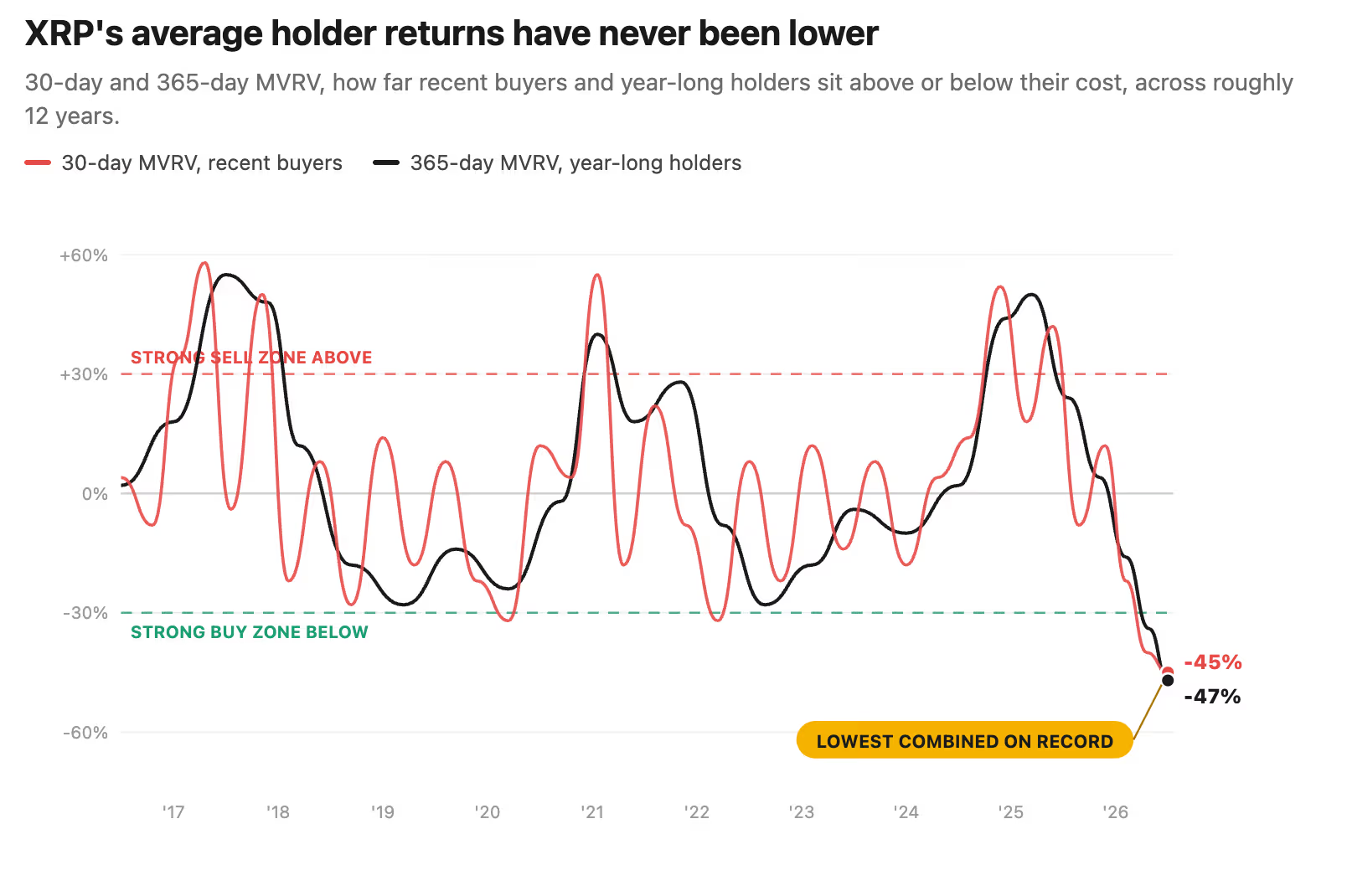
XRP holders are underwater by more, on average, than they have ever been, according to onchain data that some traders treat as a contrarian floor signal.
The reading comes from MVRV, or market value to realized value, a ratio that compares XRP’s price with the average price at which its supply last moved.
When it sits below zero, the typical holder is carrying a loss. XRP’s 30-day MVRV is around -45% and its 365-day version around -47%, so both recent buyers and those who have held for a year are deep in the red.
Combined, the two are at their lowest in XRP’s history, analytics firm Santiment said in a Friday post.
That describes a capitulation, the phase where holders sit on steep unrealized losses and weaker hands sell out to those willing to absorb the coins. Santiment is careful to call this a risk-reward point, instead of a price call.
“The best setups often appear when the crowd is feeling maximum pain,” the firm wrote, stating that so much downside has already been taken on that adding here carries less risk than usual, while noting price can still fall further if the broader market weakens.

XRP has climbed even as that reading stays depressed. The token is up about 8% over seven days to around $1.14, per CoinDesk data, among the week’s stronger majors.


Barstool Sports founder Dave Portnoy has vowed to hold his Bitcoin investment even if it falls to zero after revealing he is down millions on a position bought near $100,000.
Summary
- Dave Portnoy says he will hold Bitcoin even if it falls to zero after losing millions on his investment.
- Portnoy admits years of mistimed Bitcoin trades convinced him not to sell during the current downturn.
- Robert Kiyosaki and Bitwise CIO Matt Hougan continue to offer contrasting long-term outlooks for Bitcoin.
According to an interview with Fox Business host Stuart Varney, Portnoy admitted that his history with Bitcoin has been defined by buying at the wrong time and selling before major rallies.
Speaking about his latest position, he said he purchased Bitcoin at around $100,000 and acknowledged that the investment is now deeply underwater after the asset lost more than half its value from its October peak of $126,080 to about $62,162.
Instead of exiting the position, Portnoy said he plans to continue holding. He told Varney that previous attempts to sell Bitcoin had repeatedly backfired because the cryptocurrency rallied soon afterward. Having experienced that pattern multiple times, he said he would rather keep the asset regardless of how far the price falls.
Portnoy also described himself as someone who has been consistently wrong on Bitcoin trades. Looking back on earlier market cycles, he recalled panic-selling the cryptocurrency during a price decline in 2021 before it recovered sharply, adding that those experiences shaped his decision not to sell this time.
Bitcoin outlook remains divided
Even as Portnoy remains committed to holding Bitcoin, market participants continue to disagree over where prices could move next.
Earlier this week, as reported by crypto.news, Rich Dad Poor Dad author Robert Kiyosaki’s prediction that Ethereum could reach $95,000 by mid-2027 resurfaced across crypto social media. Kiyosaki argued that a severe global financial crisis could trigger a major repricing of alternative assets.
Under that scenario, he said Ethereum could climb to $95,000 within a year of such an event, while Bitcoin could rise to $750,000 alongside gold reaching $35,000 per ounce and silver advancing to $200.
A day later, Bitwise Chief Investment Officer Matt Hougan wrote that Bitcoin appeared to be entering the final stage of its correction after the STRC-related unwind reduced excess leverage. At the time, he said he expected a new Bitcoin bull market to begin in the fall.
Although he cautioned that identifying the exact bottom is impossible in real time, he said the latest developments suggest the market could be entering the final stage of the current cycle.
Hougan also argued that the next Bitcoin rally is likely to rely less on retail traders and more on institutional investors, including banks, pension funds, sovereign wealth funds, asset managers, financial advisers, and endowments. Based on that view, he said he expects a new Bitcoin bull market to begin in the fall.
Portnoy’s crypto record extends beyond Bitcoin
Beyond Bitcoin, Portnoy has been involved with several high-profile crypto projects over the years. He previously promoted the SafeMoon meme coin and publicly identified himself with the Chainlink community, often referred to as the Link Marines.
His trading activity later expanded into Solana-based meme coins. After revealing his wallet address and facing criticism from some traders who accused him of pumping and dumping tokens, Portnoy publicly embraced JAILSTOOL, a meme coin built around imagery of him behind bars. The token later climbed above a $210 million market capitalization and secured a listing on crypto exchange Kraken. Since then, however, it has lost more than 99.5% of its value and now trades at a market capitalization of just over $1 million.

The United States’ Major County Sheriffs of America (MCSA) says it has dropped its opposition to the CLARITY Act, shifting to a “neutral” position after lawmakers addressed concerns it raised in an earlier submission. In a letter sent to US Senate Banking Committee chair Tim Scott and Senator Elizabeth Warren on Friday, the group said revisions to the bill addressed issues it flagged around Section 604.
That change matters for the CLARITY Act’s momentum because the bill has bipartisan backing but has faced delays in the Senate. Its progress has been repeatedly constrained by banking-industry objections, particularly around how stablecoin-related products could affect traditional deposits and broader financial stability.
Key takeaways
- The MCSA moved from opposing the CLARITY Act to a neutral stance after concerns about Section 604 were addressed.
- Section 604 is tied to the Blockchain Regulatory Certainty Act and is intended to limit developer liability for illicit activity committed by platform users.
- MCSA previously argued that the provision could be exploited by criminals and complicate law enforcement investigations.
- Despite the shift, the MCSA says it wants additional amendments—specifically to involve state law enforcement in a Treasury study under Section 309.
- Even with clearer law-enforcement buy-in, the Senate timeline remains uncertain due to objections from banking groups, particularly over stablecoin yield.
MCSA shifts stance after Section 604 concerns are addressed
According to the letter referenced in public reporting, the MCSA told Senators Tim Scott and Elizabeth Warren that its position changed to “neutral” following responses to its May 14 concerns about Section 604. The provision is part of the Blockchain Regulatory Certainty Act and is designed to protect developers from liability for illicit activity that occurs through users on decentralized platforms.
The MCSA’s earlier opposition centered on the risk that Section 604 could be leveraged as a loophole. In its view, criminals might structure behavior around that liability framework in a way that makes it harder for law enforcement to investigate crypto-related offenses.
While the bill’s supporters emphasize clearer rules for decentralized technology, the MCSA’s reversal signals that at least one major law-enforcement coalition believes the revised approach is workable—though it still wants improvements rather than unconditional support.
Why the CLARITY Act has stalled in the Senate
Although the CLARITY Act has bipartisan support, its route through the Senate has been largely blocked. Reporting cited in the source highlights that banking groups have sought limits on stablecoin yield, arguing that the practice can resemble an unregulated deposit product.
That argument, according to the cited coverage, is rooted in potential knock-on effects for traditional banking systems, including the prospect of large outflows if consumers treat yield-bearing stablecoin products as a substitute for bank deposits.
The legislation has been waiting for a full Senate vote since the Senate Banking Committee advanced it in May, with the bill passed mostly along party lines. That combination—committee approval without broader clearance—has left the bill dependent on additional negotiations and political timing.
Advocates have recently renewed pressure for floor consideration, aiming for passage and signature into law before the November midterm elections. Earlier coverage noted that senators backing the bill are pushing for a vote this month, framing it as a window where the bill could clear the remaining procedural hurdle.
Law enforcement still asks for changes: state involvement in Treasury study
Even with the updated position, the MCSA said it wants amendments to the CLARITY Act. Its latest request focuses on Section 309, which would require the Treasury Department to study decentralized finance and illicit finance risks. The MCSA specifically wants state law enforcement included within that framework.
MCSA President Bob Gualtieri argued that Congress should ensure that law enforcement has the training, technology, and resources needed to handle crimes enabled by digital assets. His remarks, as quoted, emphasized that state and local agencies investigate a wide range of offenses—from fraud and narcotics trafficking to ransomware, child exploitation, and terrorism financing—where investigators must be able to identify offenders, trace illicit proceeds, recover assets, and protect victims.
“State and local law enforcement agencies investigate these crimes every day and must have the tools, partnerships, and resources necessary to identify offenders, trace illicit proceeds, recover assets, and protect victims.”
From an investor and industry standpoint, this is more than an internal law-enforcement preference. If the CLARITY Act is intended to provide regulatory certainty while supporting enforcement capacity, then bringing state agencies into the Treasury’s research obligations could affect how risk assessments are conducted and how operational guidance is developed for regulators and policing bodies.
What happens next after the MCSA’s “neutral” shift
The MCSA’s decision to drop opposition may reduce one of the more politically visible sources of resistance to the bill, which supporters have described as a meaningful roadblock. However, the broader timeline still appears tied to unresolved concerns—especially from banking groups regarding stablecoin yield and its relationship to deposit-like products.
With advocates pushing for a Senate vote in the near term, readers should watch whether the amended language addressing Section 604 is treated as sufficient by additional stakeholders, and whether Section 309’s scope is adjusted to include state law enforcement before any floor action.
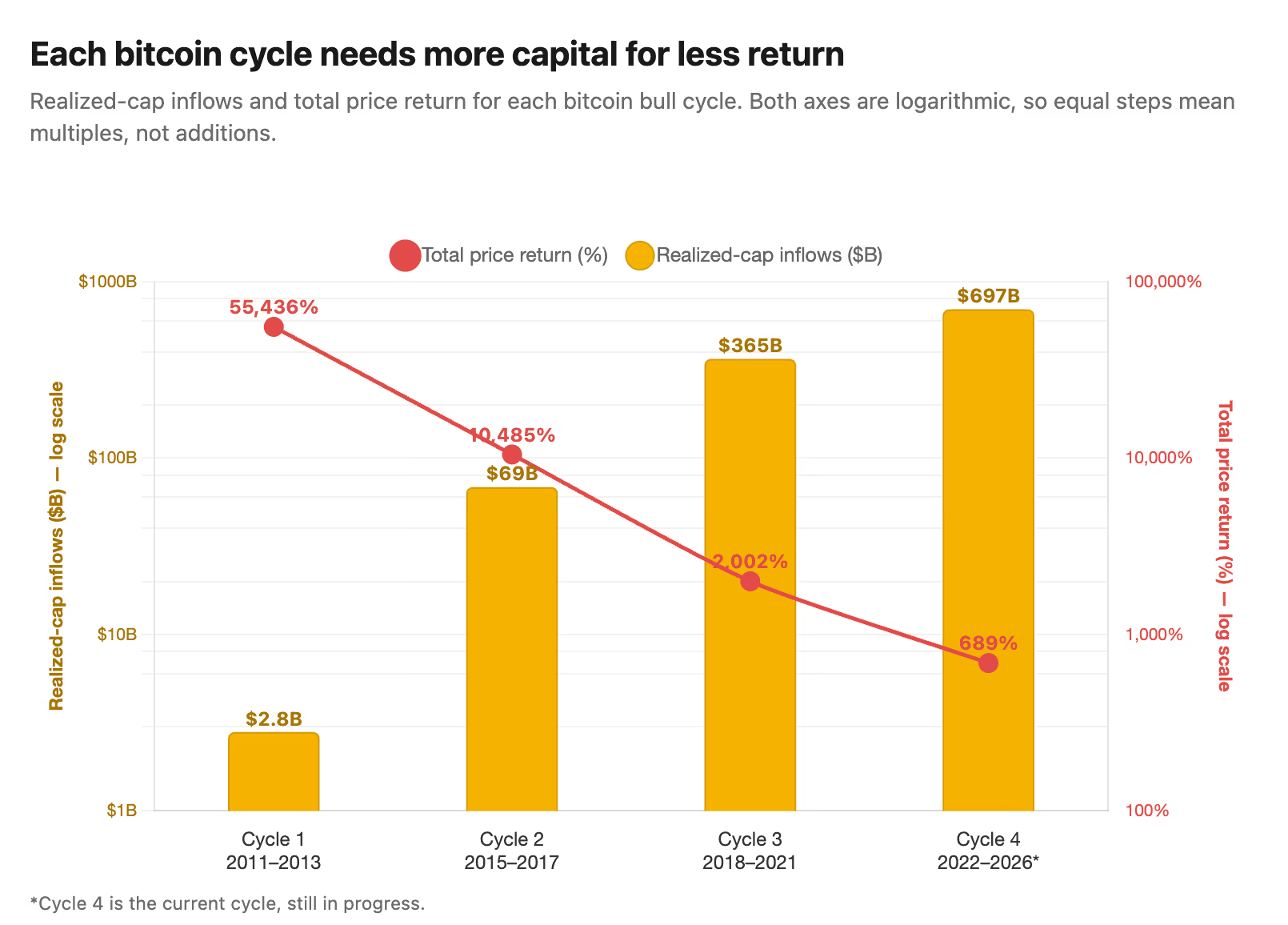
The 2015 cycle took about $69 billion for a gain near 10,000%. The 2018 cycle needed about $365 billion for roughly 2,000%. This cycle, running since 2022, has taken in about $697 billion and returned 689%. The figures track realized capitalization, a measure that values each coin at the price it last moved rather than its current price, a rough gauge of how much money has actually gone into the asset.
The trend holds at every scale. In 2011, roughly $5 million in new money was enough to double bitcoin’s price. This cycle, doing the same took around $101 billion. Each run has demanded exponentially more capital for a smaller percentage move, the arithmetic of an asset that now carries a market value near $1.2 trillion, per CoinDesk data, rather than the few billion it held a decade ago.
CryptoQuant founder Ki Young Ju, who published the data, called it as a case for patience rather than a top. “Bitcoin needs to be a core macro asset, not just a retail-driven ETF trade,” he wrote, arguing that another parabolic run is possible only if bitcoin can absorb more than $1 trillion in fresh capital, which would take institutional adoption well beyond where it sits today.

That argument lands at an awkward moment. U.S. spot bitcoin exchange-traded funds have seen record outflows over the past month, and bitcoin closed a losing first half, so the retail flows the thesis wants to move past are running in reverse rather than building the institutional depth it calls for.

After several weeks of lackluster performance and a slide to its lowest level since 2024, Bitcoin (BTC) has finally staged a decisive comeback.
The popular analyst Ali Martinez highlighted the resurgence and spotted three bullish factors that could push the price beyond $65,000 in the short term.
The Winning Formula
The primary cryptocurrency recently surged past $62,500, fueled by geopolitical de-escalation in the Middle East and a long-awaited return of ETF inflows after several weeks dominated by outflows.
The analyst noted that BTC’s 12-hour chart has flashed a cluster of bullish technical cues across several key metrics, suggesting additional upside may be on the horizon. He first pointed out the Tom DeMark Sequential indicator, which has printed a buy signal.
Earlier this week, the analyst emphasized that this metric (when viewed on the monthly timeframe) triggered a synchronized bullish call across BTC, ETH, XRP, and SOL.
“Historically, when multiple assets lock in concurrent monthly buy signals, it indicates seller fatigue and a high probability of a long-term market bottom,” he explained.
The second positive sign Martinez touched on is BTC’s Relative Strength Index (RSI), which has printed a bullish divergence against the underlying price action, while the third is the SuperTrend indicator, which signaled a trend shift.
“If these combined indicators receive validation through sustained spot volume, the immediate target for BTC sits at $65,400 – aligning with the TD setup resistance trendline,” he concluded.
Other Optimistic Voices
Numerous market observers share Martinez’s bullish outlook, noting that the cryptocurrency has performed quite well in the current month. X user cyclop, for instance, noted that BTC has historically posted double-digit gains in July during bear markets.
The recent whale behavior also reinforces the positive scenario. X user Max Crypto revealed the case of a big investor who opened a $66 million long on BTC that will be liquidated if the price dips to $59.395.
Whales are known as experienced investors who rarely jump on the bandwagon, relying purely on their instincts, and their actions could infuse enthusiasm among smaller players, prompting them to allocate fresh capital to the ecosystem.
Of course, one must tread carefully and keep in mind that the crypto market remains shaky, meaning a renewed pullback in the short term is just as plausible.
The post Bitcoin (BTC) Flashes 3 Bullish Signals: $65K Incoming? appeared first on CryptoPotato.

TL;DR
- Revolut will delist USDT, ending support for the stablecoin on August 31.
- Users can buy USDT until July 6 and deposit it until July 30 before the phased removal begins.
- Any USDT remaining after the deadline will be automatically converted into fiat at the prevailing exchange rate.
- The move reflects the impact of the EU’s MiCA rules, which continue to drive USDT delistings across regulated European platforms.
European fintech giant Revolut has announced that it will discontinue support for USDT, just days after Tether’s freezing move, giving customers until August 31 to withdraw or sell their holdings before the stablecoin is removed from the platform. The move comes as the European Union’s Markets in Crypto-Assets (MiCA) framework continues to reshape the region’s regulated crypto market.
According to notifications sent to users via email and the Revolut app, customers will be able to purchase USDT until July 6, while new USDT deposits will be accepted only until July 30. After that date, users can continue selling the stablecoin or transferring it to external wallets until August 31. Any remaining USDT balances left on Revolut after the deadline will be automatically converted into fiat currency at the prevailing exchange rate.
The announcement adds another major platform to the growing list of European companies ending support for the world’s largest stablecoin.
MiCA Continues to Drive USDT Delistings Across Europe
Revolut’s decision follows the completion of the European Union’s MiCA transition period, which took full effect on July 1, 2026. Under the new regulatory framework, licensed crypto platforms can only offer stablecoins that comply with MiCA requirements.
Rather than seeking authorization as an Electronic Money Token (EMT), Tether chose not to apply for MiCA approval. The company has previously argued that the regulation’s reserve requirements, including rules governing where reserves must be held, are incompatible with its existing reserve management strategy.
As a result, several major exchanges have already removed USDT from their regulated European services. Coinbase, Kraken, Crypto.com, and Binance have all ended or significantly restricted USDT trading for users in the region as the regulatory deadline approached.
The latest move by Revolut further reduces the number of regulated platforms where European customers can access the stablecoin.
Circle Gains Ground as Europe Adopts MiCA-Compliant Stablecoins
This comes as Circle takes the opposite approach by securing regulatory approval that allows USDC and EURC to operate across all 27 European Union member states, as earlier reported.
The shift has prompted exchanges and liquidity providers to increasingly support MiCA-compliant stablecoins, with many rebuilding trading liquidity around USDC after removing USDT trading pairs.
Although USDT is disappearing from regulated European trading platforms, Tether has maintained a presence in the region through technology partnerships. The company continues to support projects developing MiCA-compliant stablecoins using its Hadron tokenization platform, allowing it to remain active in Europe’s digital asset ecosystem without issuing a MiCA-approved stablecoin itself.
Revolut’s latest announcement underscores how the implementation of MiCA is reshaping the European stablecoin market. As regulated platforms align with the new rules, compliant alternatives such as USDC are gaining wider adoption while USDT’s availability across Europe’s licensed crypto services continues to decline.


Jake McCarthy belts leadoff homer, slam as Rockies rout Giants

Beta code hints at AirPods with cameras

Police uncover suspected drugs and guns stash in Openshaw


-

 Tech6 days ago
Bluekit phishing kit adopts browser-in-the-middle for login theft
-

 Fashion14 hours ago
Weekend Open Thread: High Hopes
-

 Tech6 days ago
Claude Code turned every engineer into three. Now companies need more product thinkers
-

 Crypto World4 days ago
Strategy authorizes up to $1.25B in Bitcoin sales under new capital plan
-

 Politics20 hours ago
The House | “Reframing the debate from a binary discussion of winners and losers”: Yuan Yang reviews ‘We Are Not Machines’
-

 News Videos6 days ago
MAJOR BITCOIN & MARKET UPDATE!!!! (MUST WATCH ASAP!!!)
-

 Tech4 days ago
Anonymous researcher drops 0-day ‘exploitarium’ repo
-

 Crypto World7 days ago
Coinbase, Circle Deepen Crypto Stock Losses Despite Resilient S&P 500
-

 Business4 days ago
Australia treasurer says alleged access of prime minister’s bank data ’incredibly concerning’
-

 Tech7 days ago
Russian hackers now target Signal backup recovery keys
-
 Business5 days ago
The AI boom won’t burst all at once. It will pop in ‘rolling bubbles’: Macquarie
-

 Sports3 days ago
Broncos roster: OL Ben Powers (No. 74) entering final year of contract
-

 Crypto World2 days ago
Binance stock trading tops $1B in first month after launch
-

 NewsBeat3 days ago
Presenter Caroline Flack’s brother Paul Flack dies aged 55
-

 Tech7 days ago
Silicon Valley paid to kill AI regulation, now it wants the rules back
-

 Tech7 days ago
OpenAI mulls delaying IPO over valuation concerns
-

 Crypto World2 days ago
Alibaba-affiliate Ant Group enters the humanoid robot market with 12 deals
-

 News Videos4 days ago
How to Build INSANE Live Financial Dashboards With Claude
-
 NewsBeat2 days ago
New exhibition reflects five decades of movement between island of Ireland and GB
-

 Business1 day ago
What a 10 Percent Drop Means for Buyers, Sellers and Renters
You must be logged in to post a comment Login