

Crypto World
Will There Be Another Downturn


Once among the top performers of the 2021 bull run, Shiba Inu (SHIB) continues to face difficulties after shedding over 95% of its all-time high price. The meme currency, which delivered enormous profits for its early investors, has been trading against a backdrop of strong selling pressure for the past few years due to changed market conditions.
While there has been some positive momentum for SHIB in 2024, hopelessness set back again amid increased economic uncertainties. Now, it is unclear whether SHIB is on the verge of hitting rock bottom or another fall can be anticipated. Despite having faith in the project’s future, there are a number of economic and market reasons that are restricting its potential to recover further.
Economic Situation Further Adds to Pressure on Meme Coins
Shiba Inu was able to start off 2024 well, reaching almost $0.00003 by December as the community expected a new bull run. But it did not last long.
As economic conditions worsened in late 2025 and early 2026 due to inflation, tensions, and slow economic growth, investors became less interested in taking risks. As a result, most of them withdrew money from meme coins.
SHIB fell towards the level of $0.000004, which was one of its lowest values in recent years and canceled out all the gains made by the previous rally. The overall crypto market was also affected as the situation with monetary policy worldwide became unclear.
Policy at the Federal Reserve Remains a Major Threat
Macroeconomic factors will continue to influence the forecast of SHIB’s price.
High inflation has been reported in the country, resulting in the Federal Reserve maintaining its tight monetary policy stance. Although interest rates have not seen changes in the latest meetings of policymakers, many participants in the market see interest rates staying high if inflation persists.
Interest rate hikes usually lead to lower liquidity levels in the financial market as investors tend to shift towards safe investments like government securities and cash. Cryptocurrencies become less popular amid higher interest rates due to their speculative nature. Since meme tokens are the most volatile cryptocurrencies on the market, price fluctuations will be higher if market sentiment declines.
High Supply of Tokens Hinders Price Increases
The next major hurdle that Shiba Inu faces is the huge supply of tokens.
At present, there are around 589 trillion tokens of SHIB in circulation. High token supply makes any significant price appreciation difficult compared to other assets with low token supply.
Even though there are increases in buying activity, it needs heavy demand to accommodate the huge amount of tokens that exist in the market. Despite temporary surges in demand, rallies have been challenging due to the high token supply. Community-initiated token burns keep reducing the supply; however, many experts think the rate is too slow to make any significant difference.
Is There Hope for Shiba Inu to Recover
Even with the current bearish trend, there are various elements that may favor the coin in the long run. Economic growth, lower levels of inflation, and a friendlier monetary policy from the Fed could revive demand for riskier assets. A bullish market for cryptocurrencies would also favor the success of meme coins like Shiba Inu.
One of the major strengths of the project is its massive and highly active community. The token continues to enjoy one of the largest communities in the cryptocurrency space, while development of the ecosystem will further bolster the confidence of investors. Nonetheless, there are numerous people who still hold big unrealized losses after buying the token close to its previous all-time high prices. In the event of a price recovery, some of these investors could dump their tokens during rallies.

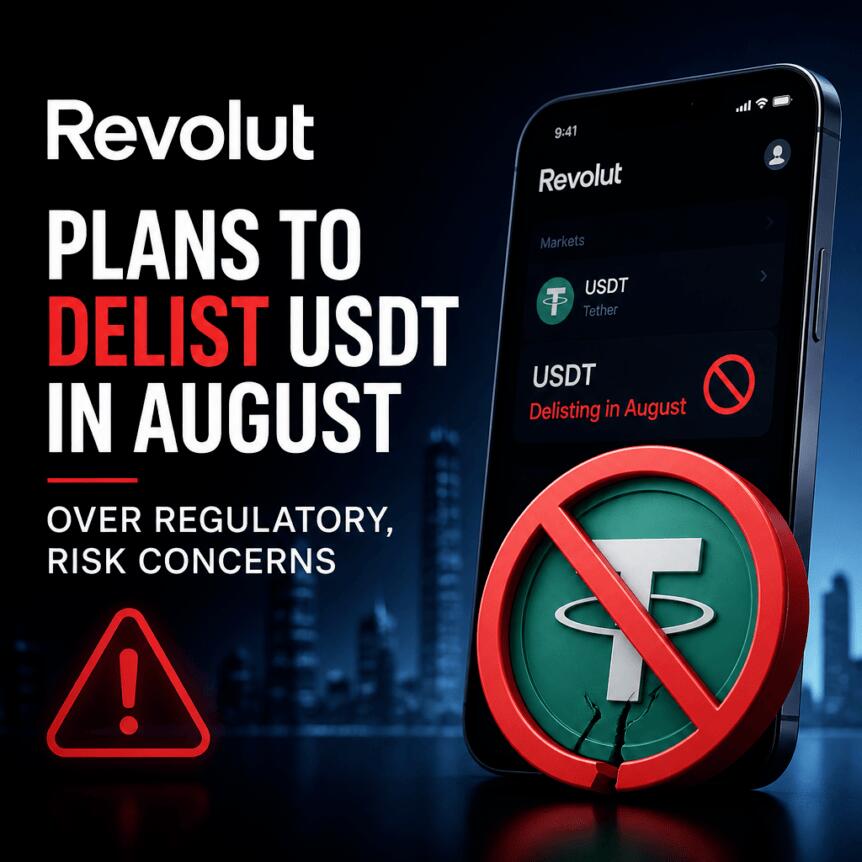
Revolut, the UK-headquartered digital banking platform, has informed some users that it will delist the Tether USDt (USDT) stablecoin starting in July, with the full removal scheduled for Aug. 31, 2026. The company says the decision is driven by “regulatory and risk considerations,” highlighting how stablecoin access is being reshaped across mainstream financial apps as rules tighten.
According to a customer notice reviewed by Cointelegraph, users will stop being able to buy USDT beginning July 6, 2026. Revolut will continue to support USDT until the end of August, but any USDT not sold or withdrawn by then will be automatically converted into the user’s base currency using that day’s exchange rate.
Key takeaways
- Revolut will block USDT purchases from July 6, 2026, followed by full delisting on Aug. 31, 2026.
- USDT deposits will no longer be supported after July 30, 2026, with incoming transfers rejected.
- Users who still hold USDT at the end of August will be converted into base currency at the applicable exchange rate.
- Revolut cited only broad “regulatory and risk considerations,” without specifying which framework applies.
- The move fits a wider European pattern of stablecoin delistings tied to the EU’s MiCA regime.
Timeline for Revolut users
Revolut’s notice lays out a phased exit for USDT within its platform. The first restriction comes earlier than the final delisting: users will no longer be able to buy USDT starting July 6, 2026. That effectively limits new exposure to USDT well ahead of the end date, giving holders time to decide whether to sell or withdraw.
Support for deposits ends later, on July 30, 2026. From that point, any attempted USDT transfer into Revolut’s system will be rejected, narrowing the options for users who might have planned to move stablecoins into their accounts after the purchase restriction begins.
If users do not act before the end of August, Revolut says it will automatically convert remaining USDT holdings into the user’s base currency on the day’s exchange rate. That detail matters for anyone using USDT as a temporary parking asset or settlement tool inside a broader workflow, because it removes the ability to hold stablecoins through the delisting date without triggering conversion.
Revolut’s regulatory rationale remains vague
While Revolut attributes the delisting to “regulatory and risk considerations,” it does not spell out which specific rules or jurisdictions are behind the decision. The notice also does not clarify whether the changes apply globally or only to certain markets where Revolut operates under particular regulatory constraints.
For readers trying to understand the practical impact, the lack of jurisdictional clarity leaves an open question: whether the delisting is limited to particular European locations, or whether the company is preparing a broader policy that could affect users beyond the EU. Cointelegraph reported that it contacted Revolut for comment on affected jurisdictions and the scope of its crypto offering but did not receive a response by publication.
What is clear from public regulatory records is that Revolut received a Markets in Crypto-Assets (MiCA) license as a crypto asset service provider (CASP in November 2025. The authorization was issued by the Cyprus Securities and Exchange Commission (CySEC), according to the European Securities and Markets Authority’s (ESMA) MiCA register. You can review ESMA’s MiCA information through its official page: ESMA’s MiCA overview.
Why Europe’s stablecoin delistings keep accelerating
Revolut’s decision follows a broader European trend in which exchanges and crypto service providers have reduced or removed access to USDT as they adjust to MiCA compliance expectations. Earlier coverage from Cointelegraph noted that exchanges began delisting USDT in Europe in 2024 to align with MiCA requirements, including Coinbase’s preparations to delist USDT in Europe: Cointelegraph report on Coinbase’s move.
The key tension is that MiCA does not only regulate how crypto services are delivered; it also imposes obligations on stablecoin issuers and the stablecoin ecosystem, which in turn affects whether specific products can continue being offered by regulated platforms. In practice, CASPs can decide that the compliance burden—or the perceived regulatory risk—does not justify continuing a stablecoin listing.
Cointelegraph’s reporting also describes the issuer side of this story: Tether has refused to comply with MiCA, and CASPs have gradually delisted USDT across Europe since late 2024. In earlier coverage, Cointelegraph pointed to Tether’s stance, including the issuer’s critique of aspects of the MiCA framework—such as reserve requirements for certain stablecoin issuers and the stipulation that part of reserves be held with EU credit institutions. See Cointelegraph’s related reporting: Tether’s refusal to comply with MiCA.
Tether CEO Paolo Ardoino has publicly argued that the legislation is poorly designed. Cointelegraph previously noted Ardoino’s comments to the outlet, including criticism of the EU rules, as well as his concerns about reserve-related provisions and how they apply. According to Cointelegraph, Ardoino told the publication that MiCA is “very not well thought legislation.”
Market stakes: USDT’s size vs. platform constraints
Even as USDT’s presence shrinks on some regulated platforms, it remains one of the largest stablecoins in the market. Cointelegraph reported that USDT is currently the third-largest crypto asset by market capitalization after Bitcoin and Ether, with a market value of $184 billion at the time of publication. It also cited CoinGecko data indicating that USDC—Circle’s stablecoin—has a $73 billion market cap and ranks as the fifth-largest crypto asset.
This mismatch—USDT’s scale versus the willingness (or ability) of platforms to keep listing it—illustrates how stablecoin distribution increasingly depends on regulatory alignment, not just liquidity or demand. For users, that can translate into operational friction: stablecoin rails that once felt “always available” can change under compliance reviews, leaving customers with forced exits or automated conversions like the one Revolut describes.
It also underlines an important practical point for traders and builders: stablecoin availability on on-ramps and app-based finance is becoming a policy issue. Even when a stablecoin remains liquid in broader markets, individual providers may reduce access based on issuer compliance positions, platform risk assessments, or specific interpretations of regulatory expectations.
For now, USDT’s delisting path on Revolut is scheduled in clear steps, but the broader question is still unsettled—whether Revolut’s actions will remain local to certain jurisdictions or expand across its entire user base. As more CASPs adapt their stablecoin listings to MiCA, market participants should watch for additional platform announcements, potential switches in preferred stablecoins, and whether issuer compliance disputes continue to narrow access on mainstream financial apps.
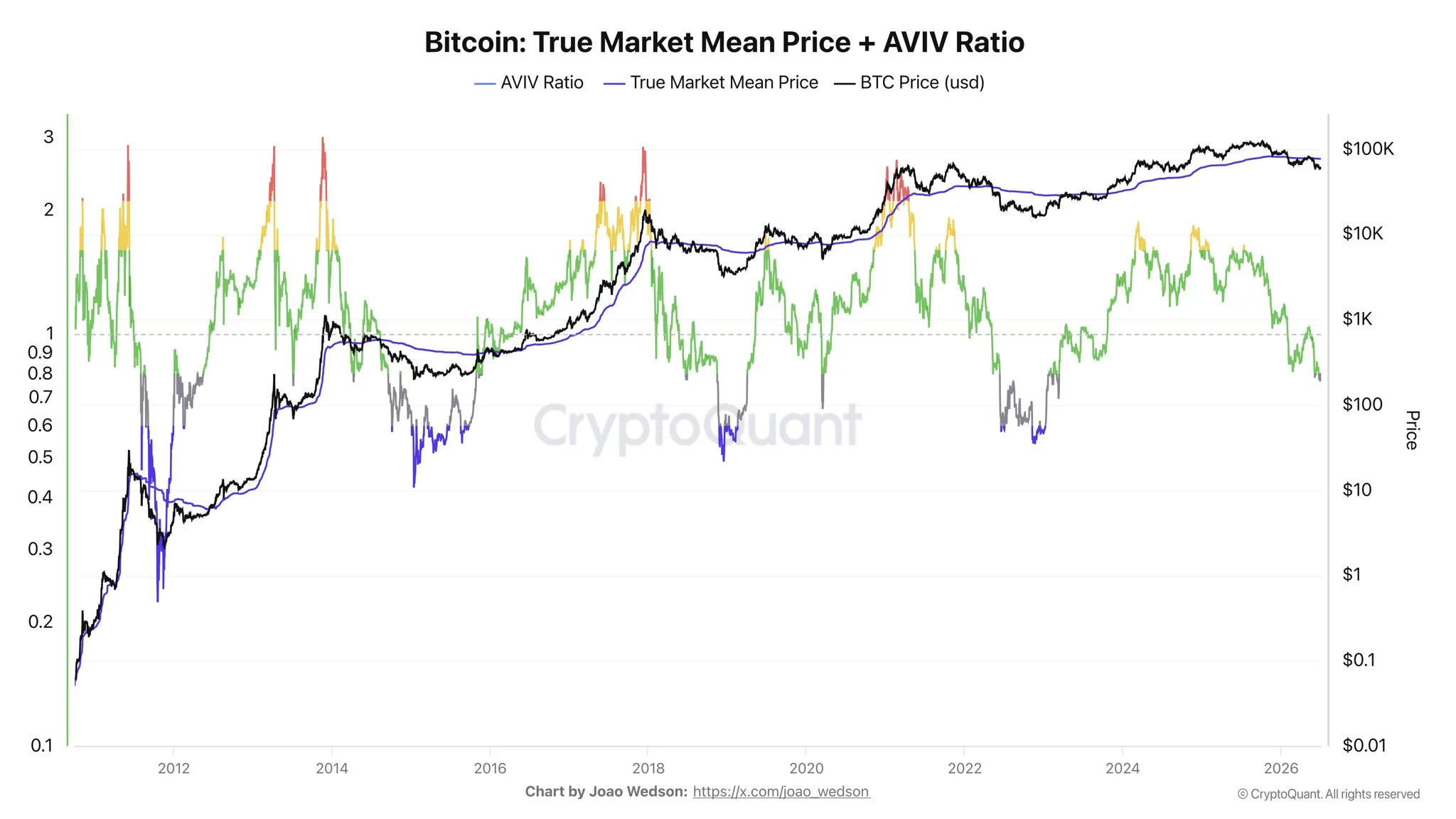
Bitcoin investors have entered an average unrealized loss of about 20%, while a key on-chain cost basis indicator has climbed to roughly $76,700, creating a resistance level that analysts say is weighing on the market.
Summary
- CryptoQuant’s Darkfost says active Bitcoin investors are sitting on an average unrealized loss of about 20%.
- Bitcoin’s True Market Mean near $76,700 has emerged as a key resistance level based on active holder cost basis.
- Despite ETF inflow concerns, the analyst says Bitcoin may recover before reaching past bear-market valuation extremes.
According to CryptoQuant analyst Darkfost, Bitcoin’s True Market Mean (TMM) currently stands near $76,700, a level that represents the average acquisition cost of active Bitcoin holders rather than the entire supply. The indicator excludes long-dormant and partially lost coins, making it a measure of the cost basis for actively traded Bitcoin.
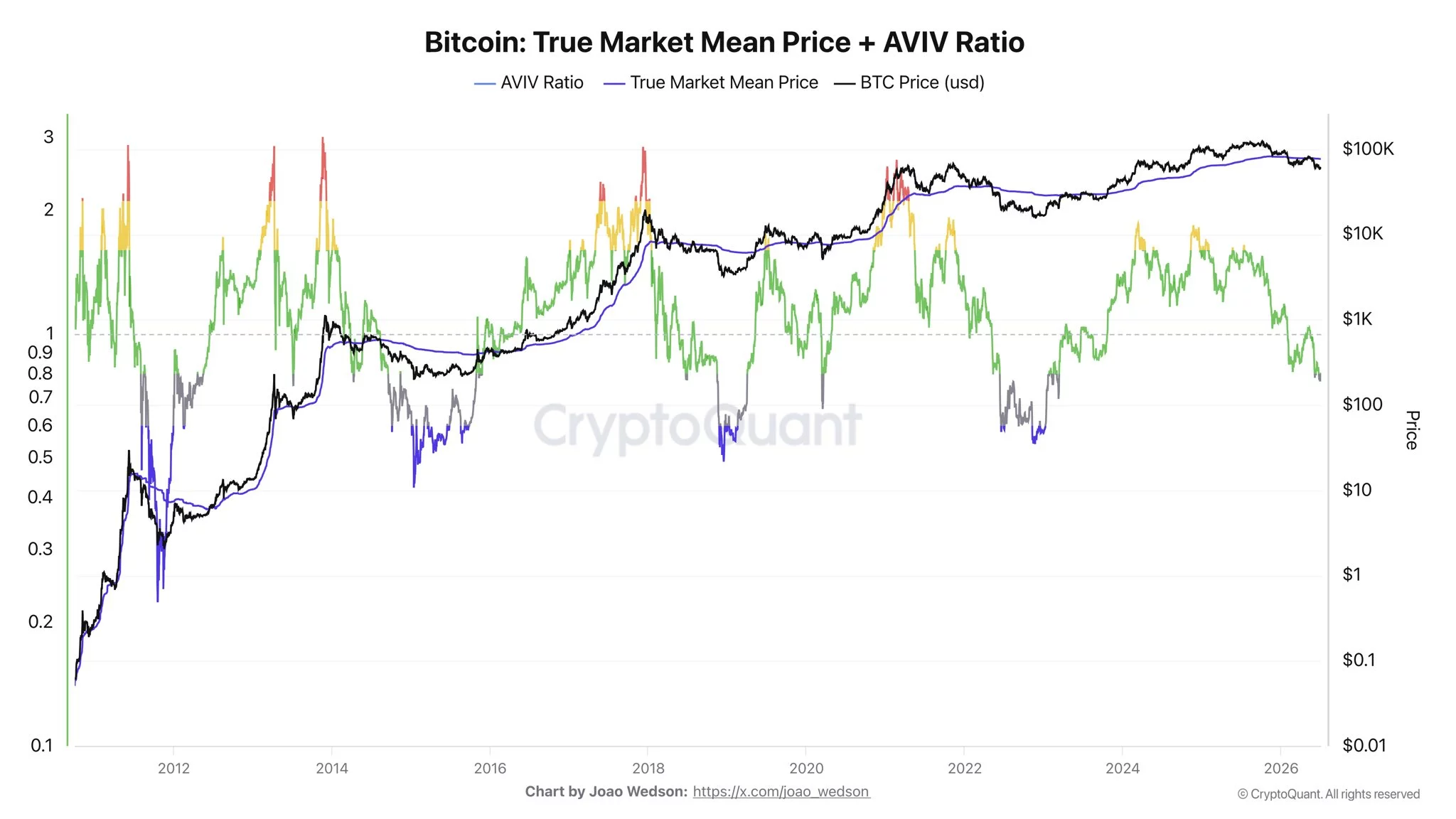
Darkfost said the TMM has become an important resistance level because a similar situation played out in May, when Bitcoin approached the same price area, and many investors chose to sell at break-even instead of continuing to hold.
At the same time, Bitcoin (BTC) traded at $62,596 at press time on July 4, up 1.67% over the previous 24 hours but still well below the TMM level, leaving much of the active investor base underwater.
Active holder cost basis remains above market price
Alongside the TMM, Darkfost examined the Active Value to Investor Value (AVIV) ratio, which compares Bitcoin’s market value with the cost basis of active holders. According to the analyst, the ratio is hovering around 0.8, placing Bitcoin in what he described as a valuation discount zone.
Based on the AVIV reading, Darkfost estimated that active Bitcoin investors are currently carrying an average unrealized loss of around 20%.
Historical data shared by the analyst shows that previous bear-market bottoms pushed the AVIV ratio down to roughly 0.5–0.6, levels associated with average investor losses of 40% to 50%. Although current conditions indicate widespread losses, Darkfost said the market has not yet reached those historical extremes.
Even so, the analyst argued that Bitcoin may not need to revisit such deeply discounted levels before recovering, particularly because the asset has attracted much stronger adoption during the current market cycle.
He added, however, that institutional participation has not changed Bitcoin’s long-term cyclical behavior and said investors should remain cautious despite continued capital inflows over recent years.
Institutional demand faces new test
The on-chain assessment comes as CryptoQuant separately reported that Bitcoin’s next major rally could require more than $1 trillion in additional capital because of the cryptocurrency’s much larger market value.
According to the firm’s research, roughly $697 billion has entered Bitcoin since 2022, producing gains of about 689%, a smaller return than earlier market cycles despite the substantial inflows.
Institutional demand has also softened in recent weeks as U.S. spot Bitcoin exchange-traded funds recorded sustained net outflows, raising questions about whether fresh capital can return quickly enough to support another strong advance.
Corporate adoption, however, continues to expand. Strategy, the largest publicly traded corporate Bitcoin holder with more than 847,000 BTC, is evaluating ways to generate liquidity from its holdings without selling them. Galaxy Digital said the company could potentially earn recurring income through conservative lending or options-based strategies while preserving its long-term Bitcoin position.
Beyond corporate treasuries, blockchain infrastructure is also drawing attention from companies developing artificial intelligence systems. Industry participants have argued that autonomous AI agents will likely require programmable payment networks, with blockchain-based payment systems and stablecoins emerging as possible foundations for machine-to-machine transactions even though large-scale adoption is still expected to take several years.


President Donald Trump’s memecoin has generated a reported $636 million payout for him while nearly 1 million buyers have collectively lost $3.81 billion, according to newly analyzed blockchain data and financial disclosures.
Summary
- Nansen said nearly 989,000 TRUMP memecoin wallets lost a combined $3.81 billion by the end of June.
- Trump’s 2025 financial disclosure reported a $636 million payout from the TRUMP memecoin and at least $1.4 billion in crypto-related income.
- The disclosure has renewed political scrutiny, with Sen. Kirsten Gillibrand pushing for stricter ethics rules in pending crypto legislation.
According to a report by The New York Times, citing blockchain analytics firm Nansen, 988,905 wallets that bought the Official Trump (TRUMP) memecoin had recorded cumulative losses of $3.81 billion through the end of June. Nansen said the figure includes both realized losses and paper losses held by investors who have not yet sold their tokens.
The analysis followed the release of Trump’s 2025 financial disclosure, which showed he received a $636 million payout tied to the TRUMP memecoin. The filing also disclosed at least $1.4 billion in crypto-related income during the reporting period, largely connected to licensing agreements linked to the memecoin and token sales by Trump-backed World Liberty Financial (WLFI).
Unlike retail buyers, Trump benefited from trading activity regardless of whether the token price rose or fell because the venture generated revenue from transactions, The New York Times reported. During the token’s launch, Trump repeatedly promoted the memecoin on Truth Social, encouraging supporters to purchase it.
Three days before his January inauguration, Trump introduced the TRUMP memecoin, describing it on social media as a way for supporters to join his community. Since then, the token has fallen sharply from its peak. Nansen said the memecoin traded at about $1.76 on Friday, roughly 97% below its all-time high of $75.35.
Retail investors absorbed most of the losses
According to Nansen, roughly two out of every three wallets that purchased the TRUMP token have lost money. The firm also found that fewer than 500,000 wallets generated about $4 billion in combined profits, with gains concentrated among a relatively small group of early participants who entered before the price surged.
The report said automated traders and experienced crypto investors typically capitalize on the rapid price swings common in memecoins by buying early and selling into retail demand. Nansen concluded that most profits were captured by this smaller group, while later buyers accounted for the majority of losses.
One investor interviewed by The New York Times, Nicholas Pinto, said he invested roughly $500,000 in the TRUMP token after supporting Trump in the 2024 election and estimated he had lost about half of that investment. Pinto argued that Trump’s public position encouraged confidence among buyers and described the project as “almost a legal scam.”
Responding to criticism, White House spokeswoman Anna Kelly told The New York Times that Trump had made the United States the “crypto capital of the world” and said his actions were taken in the interests of the American people.
Crypto earnings continue to draw political scrutiny
In a recent CNBC interview, Trump said he was unaware that his crypto ventures had generated at least $1.4 billion, adding that he could know the exact amount if he wanted to and insisting there was nothing improper about earning money from digital assets. He also said he had no plans to distance himself or his family from their crypto businesses.
World Liberty Financial has also faced losses among investors. According to Nansen, 85% of the 26,663 WLFI wallets it tracked were underwater, recording combined losses of about $83 million compared with roughly $23 million in profits. The firm noted that the actual losses are likely much larger because many secondary-market transactions on exchanges cannot be traced publicly.
The financial disclosure has also intensified political debate in Washington. Sen. Kirsten Gillibrand recently renewed her call for ethics rules that would prohibit government officials and their spouses from creating or promoting crypto memecoins while Congress considers the CLARITY Act.
According to Gillibrand, Senate negotiations are also examining stablecoin yields, anti-money laundering safeguards, and ethics provisions before lawmakers move the legislation forward.
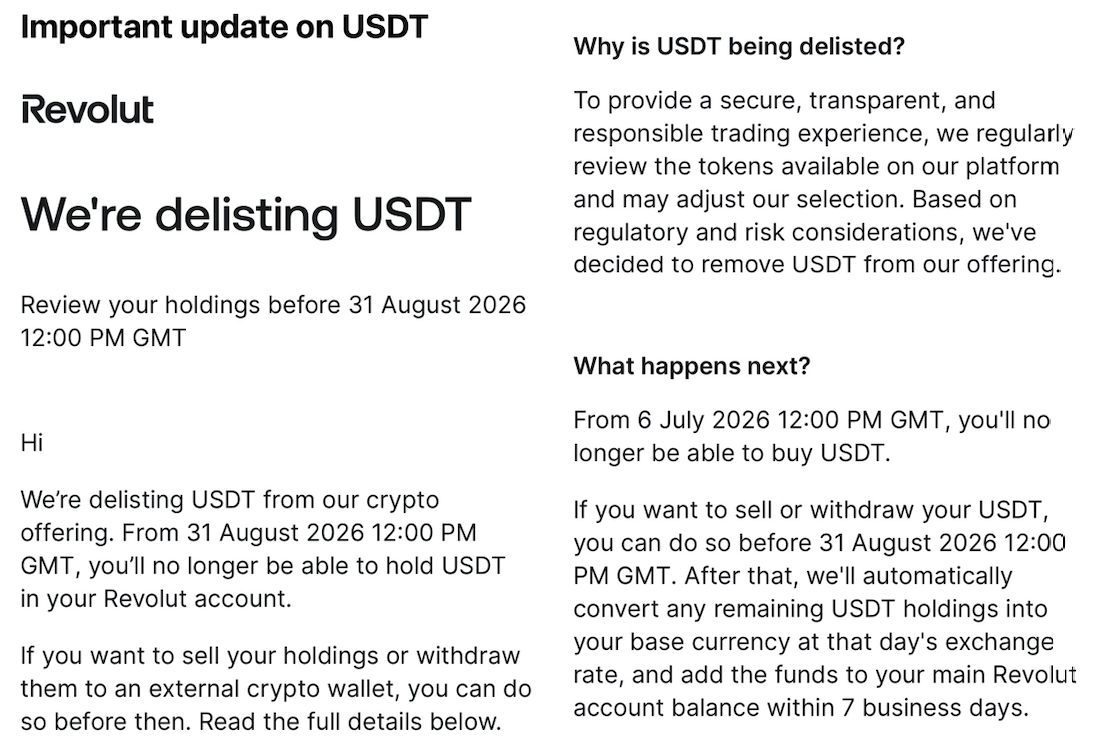
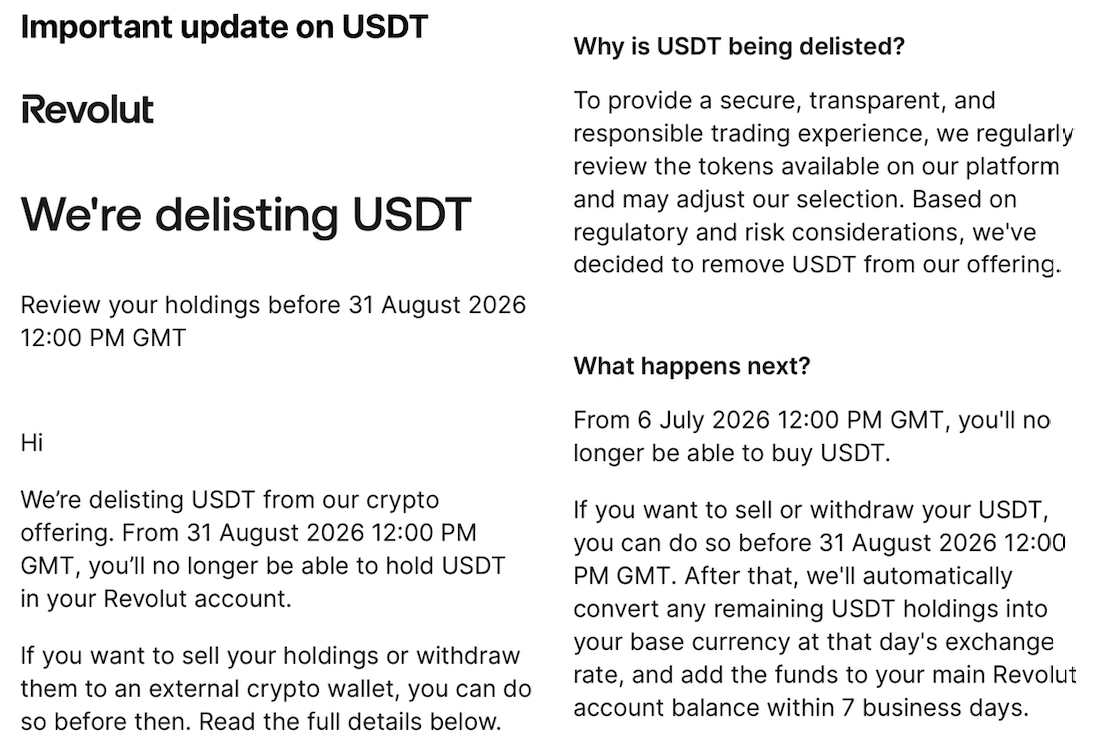
Revolut, a crypto-friendly digital banking platform headquartered in the United Kingdom, notified some users it will delist Tether USDt (USDT) stablecoin in August, citing regulatory and risk concerns.
In a Friday customer notice seen by Cointelegraph, Revolut said users will no longer be able to buy USDT starting July 6, with full delisting scheduled for Aug. 31, 2026.
If users do not sell or withdraw their USDT by the end of August, Revolut will automatically convert any remaining USDT holdings into users’ base currency at the day’s exchange rate, the company said.
USDT deposits will no longer be supported after July 30, 2026, after which any incoming USDT transfers will be rejected, it said.
The move highlights how major fintech companies are adjusting stablecoin access in response to shifting regulatory frameworks. It also raises questions about timing, as exchanges such as Coinbase began delisting USDT in Europe in 2024 to align with EU’s Markets in Crypto-Assets (MiCA) requirements.
Revolut does not cite exact framework for delisting
Revolut has not clarified whether the USDT delisting will apply globally or only in specific jurisdictions.
Addressing the reasons for delisting USDT, Revolut cited “regulatory and risk considerations” without expanding what regulations specifically have triggered the move.
Source: Cointelegraph
The company was granted a MiCA license as a crypto asset service provider (CASP) in November 2025, according to the official register by European Securities and Markets Authority (ESMA). The license was issued by the Cyprus Securities and Exchange Commission (CySEC).
Related: EU crypto rulebook faces enforcement challenge as MiCA transition ends
Cointelegraph approached Revolut for comment on the affected jurisdictions and the scope of its crypto offering but did not receive a response by the time of publication.
Tether refused to comply with MiCA
Tether’s USDT has been gradually delisted by CASPs in Europe since late 2024 as the stablecoin’s issuer refused to comply with the EU’s MiCA regulation.
The company’s CEO, Paolo Ardoino, has repeatedly criticized perceived flaws in MiCA, including reserve requirements that apply to certain stablecoin issuers and require part of their reserves to be held with EU credit institutions.

Source: Cointelegraph
“I think it’s a very not well thought legislation,” Ardoino told Cointelegraph in an interview last year.
At the time of publication, USDT is the third-largest crypto asset by market capitalization after Bitcoin and Ether, with a market value of $184 billion. Its largest competitor, Circle’s USDC, has a $73 billion market cap and ranks as the fifth-largest crypto asset, according to CoinGecko.
Magazine: Crypto wanted to overthrow banks, now it’s becoming them in stablecoin fight

XRP seems to be showing one of the more interesting derivatives setups amongst the large-cap altcoins at the moment. On the surface, the price is climbing slowly, while the open interest is falling.
Normally, this would suggest that traders are stepping away from the market. But when this happens alongside a rising net position delta, it might be time to pay attention.
XRP is Rising, Here’s the Bullish Signal to Watch For
The current uptrend from the past few days seems to be driven more by the closing of short positions rather than by aggressive new buying, according to an analyst. Put in simple terms, bearish traders seem to be exiting the market, and that short-covering pressure is helping push XRP’s price higher.
This can definitely support a steady move upward, but it is far from being enough for a sustained rally. A true acceleration usually tends to happen when new buyers begin entering the market with conviction.
This is why open interest matters a lot. A decreasing open interest suggests that leverage is being reduced – not added – which is typically a sign of waning conviction.
The daily outlook also supports a cautious bullish bias. XRP closed bullish during yesterday’s trading session, but it still needs to hold it to avoid slipping back into weaker territory. This is why a move toward the resistance at $1.13 remains very important, while stronger momentum could help push it even higher.
Shorts Getting Squeezed
That said, the real trigger that traders should watch is the simultaneous increase in both open interest and net position delta. This would suggest that the market is shifting from a state where the increase is driven by closing short positions to one where longs are opening.
If that shift happens, XRP’s price could accelerate even quicker.
Intraday, the cryptocurrency remains relatively volatile and stuck in a range. If it manages to push above and hold $1.18, this could offer an opportunity for buyers to return with force.
For now, the signal remains rather clear. The bears appear to be loosening their grip, but the bulls have not yet stepped in convincingly.
The post Fake Weakness? Could Ripple (XRP) Be Setting Up for a Violent Move? appeared first on CryptoPotato.
JPMorgan just turned cautious on gold in the short term. The bank cut its Q4 2026 forecast by roughly 25% to $4,500 per ounce, down from around $6,000. The recalibration follows weaker demand from key buying sectors.
This move signals fresh caution ahead, even as JPMorgan keeps its longer-term bullish thesis fully intact.
JPMorgan Slashed Its Gold Forecast 25%
A price forecast is an analyst’s projection of where an asset may trade over a defined future period. JPMorgan now projects an average gold price of $4,300 per ounce in the third quarter. Furthermore, it sees the metal rising to $4,500 in Q4.
The cut is significant in scale. The bank previously targeted roughly $6,000 per ounce by the fourth quarter. As a result, the new $4,500 target represents a roughly 25% reduction from prior expectations for the same period.
Follow us on X to get the latest news as it happens.
The recalibration stems from softer demand. Purchasing power has weakened among gold’s major demand centers. Moreover, the metal has become more sensitive to shifts in real interest rates, capping the near-term price ceiling.
The bank described the situation as “range-bound”. As a result, traders should expect sideways price action before any second-half recovery takes hold.
Other institutions remain more bullish. Goldman Sachs sees $4,900 per ounce by the end of 2026, driven by sovereign demand and emerging-market central bank diversification.
Furthermore, UBS targets $5,200 over the next 12 months as markets reassess Fed policy and dollar pressure intensifies. Meanwhile, Morgan Stanley also eyes $5,200 in H2 2026, but warns that gold needs stronger ETF inflows first.
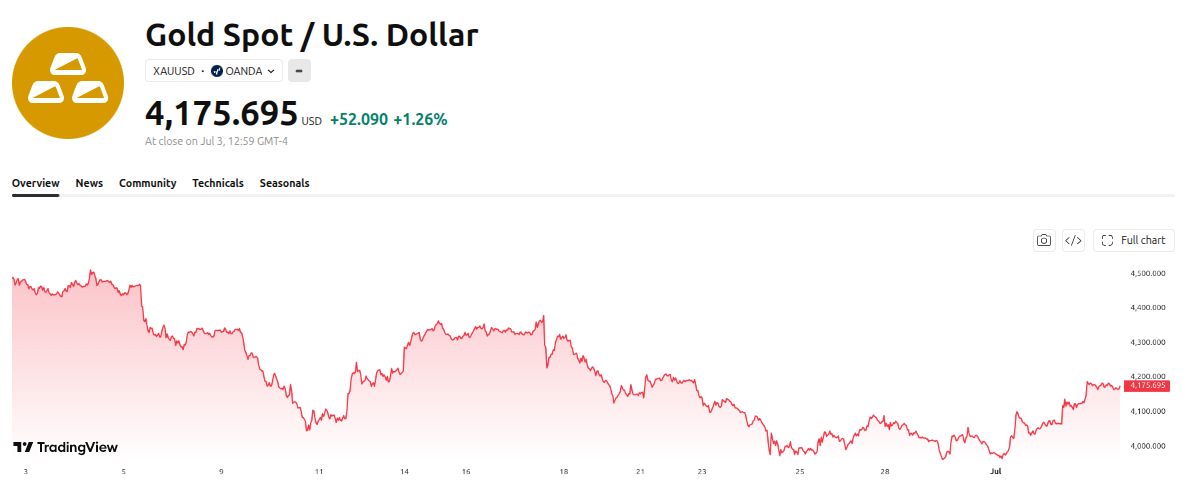
The precious metal is currently trading at $4,175, up 1.26% over the last 24 hours. However, it is now down 26% from its all-time high near $5,600 reached in January 2026, according to TradingView data.

Why JPMorgan’s Long-Term Bullish View Holds
Despite the cut, JPMorgan’s medium- to long-term view remains firmly positive. The bank pointed to two structural forces that could drive gold prices through 2027. Each factor supports demand well beyond the current short-term consolidation phase across global markets.
- First, central banks worldwide continue accumulating gold reserves at an increased pace. Furthermore, physical demand for the precious metal is expected to keep strengthening over the coming months. Both trends provide a durable floor under prices across the entire outlook.
- Second, institutional investors continue to allocate tangible portions of their portfolios to gold for hedging purposes. Moreover, that pattern shows no sign of reversing. As a result, JPMorgan expects gold to retain its role as both a safe-haven asset and an alternative reserve currency.
The JPMorgan forecast also carries implications for crypto markets. Gold and Bitcoin have traded as competing macro hedges throughout 2025 and into 2026. As a result, a “range-bound” gold price could potentially shift some institutional capital toward the crypto market in the short term.
However, the bank’s long-term bullish stance means gold will not lose its importance as a store of value any time soon. The near-term caution simply reflects a temporary pause rather than a structural break in the broader multi-year uptrend.
Subscribe to our YouTube channel to watch leaders and journalists provide expert insights
The post JPMorgan Reduces Its Gold Price Target for Q4 by 25% appeared first on BeInCrypto.


India has opened an investigation after reports alleged that Indian nationals were trafficked into Myanmar and forced to carry out crypto fraud operations inside cyber scam compounds.
Summary
- India has launched an investigation into reports that Indians were trafficked to Myanmar and forced into crypto scam operations.
- Victims allegedly accepted fake overseas job offers before being moved to cyber scam compounds where passports were confiscated.
- Authorities in India, Myanmar and the U.S. have stepped up efforts to disrupt cyber scam networks tied to cryptocurrency fraud.
According to police in the western Indian state of Maharashtra, authorities have registered a criminal case after the wife of a 24-year-old man reported that her husband had been taken to a cyber scam compound near the Thailand-Myanmar border instead of the job he had accepted in Bangkok. Because the case involves an overseas trafficking network, India’s Ministry of External Affairs has been informed, while central agencies are assisting the investigation.
Police said the victim responded to a social media advertisement offering a graphic design and data entry job in Thailand with a monthly salary of Rs 70,000 (about $815) before travelling there in early June.
Investigators alleged that after arriving in Thailand, he was moved to a compound near the Myanmar border, where his passport and travel documents were confiscated.
Reports link victims to forced crypto scams
According to police, the victim managed to contact his family before losing communication and alleged that captives were forced to work 16-18 hours a day in cyber fraud operations, while those refusing orders faced electric shocks and other abuse.
Police also said he claimed that hundreds of Indians were being held in similar compounds, although those allegations have not been independently verified.
Meanwhile, regional outlets reported another case involving a Maharashtra resident who allegedly remains trapped in a similar compound after travelling to Thailand for what was advertised as a call centre job offering pay similar to the earlier job advertisement.
According to the reports, victims said they were later taken into Myanmar and forced to run online investment and cryptocurrency scams, including creating fake social media profiles to lure people into fraudulent investment schemes.
One family also alleged that captors demanded Rs 8 lakh (about $9,300) to secure their relative’s release, while state authorities said efforts to bring those trapped home are underway.
The reports have added to concerns over organised criminal networks operating from Myanmar, Cambodia, Laos and neighbouring countries. According to the reports, these groups allegedly recruit people through fake overseas job advertisements for positions in IT, customer support, digital marketing and data entry before confiscating their passports and forcing them into online fraud operations after they arrive in Southeast Asia.
International action targets scam networks
The latest allegations come as governments increase action against cyber scam networks in the region. As previously reported by crypto.news, the U.S. Treasury’s Office of Foreign Assets Control sanctioned a Myanmar militia, its leader and senior members in May over allegations that they facilitated cyber scam syndicates, cryptocurrency-related fraud, human trafficking and cross-border smuggling.
According to the Treasury Department, U.S. victims lost more than $2 billion to cryptocurrency-related fraud in 2022 and more than $3.5 billion in 2023.
Meanwhile, Myanmar’s military published a draft Anti-Online Scam Bill in May proposing prison terms ranging from 10 years to life for people convicted of operating online scam centres or committing digital currency fraud.
The draft legislation also allows capital punishment for operators who use violence, torture, unlawful detention or cruel treatment to force people into carrying out online scams.
The FBI has separately reported that cryptocurrency-related fraud caused $11.4 billion in losses in its latest Internet Crime Report, with more than half of all internet crime losses linked to crypto schemes. The agency said many of the networks behind those frauds operate from compounds across Southeast Asia.
India has conducted rescue operations in similar cases before. Earlier this year, more than 120 Indian nationals were repatriated from cyber scam centres in Myanmar, following additional rescue efforts carried out during the previous year.

Strategy, the corporate vehicle behind Michael Saylor’s long-running “Bitcoin treasury” approach, has moved further into real-world capital management. The company authorized up to $1.25 billion in Bitcoin sales under a newly defined capital framework—an acknowledgment that even highly committed holders must plan for liquidity, shareholder payouts, and balance-sheet flexibility.
Meanwhile, the crypto industry’s business priorities are widening beyond price narratives: a new coalition is pushing a US dollar stablecoin designed to capture reserve yield, Fidelity is defending Bitcoin’s security model post-halving, and political spending is ramping up ahead of the 2026 US midterms.
Key takeaways
- Strategy authorized up to $1.25 billion in Bitcoin sales to support dividends, cash reserves, and repurchases while maintaining its long-term Bitcoin exposure.
- Strategy raised its STRC preferred dividend rate to 12% and says it has built a dedicated cash reserve of $2.55 billion to cover about 17 months of payments.
- A group of over 140 firms—including Visa, Mastercard, Coinbase, Ripple, OKX, and Bybit—plans an “Open USD” stablecoin that is structured to return reserve earnings to users.
- Fidelity argues Bitcoin’s security is not solely dependent on block subsidies, citing higher daily miner revenue over time.
- Public Citizen reports crypto-linked political spending totaled about $189 million in the 2026 election cycle, with PACs again central to the industry’s influence.
Strategy formalizes Bitcoin monetization and funding priorities
Strategy has adopted a new capital plan that explicitly authorizes Bitcoin sales of up to $1.25 billion. According to Cointelegraph’s reporting, the “Digital Credit Capital Framework” is intended to fund shareholder dividends, reinforce cash reserves, and support stock repurchases while still aiming to preserve the company’s long-term Bitcoin strategy.
Under the framework, the annual dividend on Strategy’s STRC preferred stock rises from 11.5% to 12%. The plan also introduces a structured Bitcoin monetization program and expands capital-return mechanisms that include buybacks of preferred securities and MSTR shares.
Strategy also disclosed that its dedicated cash reserve has grown to $2.55 billion. The company says this level is sufficient to cover roughly 17 months of preferred dividends and interest payments, effectively reducing the need to sell Bitcoin on short notice.
Crucially for investors watching Strategy’s “never sell” messaging, the framework marks a shift from pure accumulation rhetoric to a defined approach for generating liquidity. Strategy previously disclosed its first-ever Bitcoin sale, including the offload of 32 BTC in June, and Cointelegraph notes that the company did not purchase Bitcoin in the prior week referenced in the article.
Strategy’s holdings were reported as unchanged at 847,363 BTC, indicating the recent change is about authorization and planning rather than immediate acceleration of liquidation.
Stablecoin competition heats up with reserve-yield design
The next phase of stablecoin competition appears to be less about simply pegging to the dollar and more about who captures the yield generated by reserves. More than 140 financial and crypto companies have joined to launch a new US dollar-backed stablecoin that is designed to let participants retain the yield from reserves.
Cointelegraph reports the project—Open USD (OUSD)—is backed by major payments players including Visa and Mastercard, as well as crypto firms such as Coinbase, Ripple, OKX, and Bybit. The coalition’s structure differentiates OUSD from traditional stablecoin models: supporters say businesses will be able to mint tokens without fees or volume limits while keeping the reserve earnings.
That model is positioned as a competitive alternative to incumbent issuers, specifically Tether’s USDt (USDT) and Circle’s USDC. If it performs as intended, the ability to keep reserve yield could reduce the effective cost of using stablecoins for businesses and encourage greater adoption—especially in payment and settlement workflows where stablecoin balances function like working capital.
Timing also matters. According to Cointelegraph, Open Standard plans to roll out OUSD later this year. The push arrives as US policy has moved in a more favorable direction following passage of the GENIUS Act, which Cointelegraph links as a key development in stablecoin regulation.
With the article citing a market already worth more than $300 billion and analysts expecting further growth through the rest of the decade, OUSD’s success will likely depend on execution—particularly around reserve management transparency, minting/burning mechanics, and the practical user experience for businesses seeking reserve yield.
Fidelity challenges the “halving weakens security” narrative
Bitcoin’s halving cycle tends to reignite a long-running debate: if block subsidies decline, do miners eventually lose enough economic incentive to keep the network secure? Fidelity Digital Assets is pushing back against that conclusion.
In a research report highlighted by Cointelegraph, Fidelity argues that Bitcoin’s long-term security is not dependent solely on block subsidies. The firm’s framing suggests that other incentives—such as transaction fees, broader market dynamics, and price appreciation—can sustain miner participation even as issuance declines.
Cointelegraph’s summary points to Fidelity research analyst Daniel Gray, who noted a sharp change in the scale of miner revenue over time. Fidelity claims that average daily miner revenue grew from $1.3 million during 2012–2016 to $40.2 million today, despite declining block rewards. The underlying message is that miner economics have evolved beyond the subsidy component.
The report lands as miners face additional pressure following the latest halving. As Cointelegraph notes, many publicly traded mining companies have sought diversification—pivoting into areas such as AI and high-performance computing—while Fidelity maintains that these shifts don’t undermine Bitcoin’s long-term security assumptions.
For readers, the practical question is what happens if transaction fee demand fails to offset subsidy declines. Fidelity’s argument addresses incentive structure, but the real test will come from observing miner revenue composition over time: how much comes from fees versus price-driven valuation, and whether that remains sufficient to sustain hashrate participation through future cycles.
Crypto political spending climbs ahead of 2026 midterms
The business side of crypto is also increasingly visible in US politics. According to a new report by consumer advocacy group Public Citizen, crypto companies have contributed roughly $189 million to the 2026 election cycle so far—estimated at 37% of all corporate political spending during the period covered.
Cointelegraph reports that political action committees are again the main vehicle for the industry’s influence. Fairshake has spent more than $82 million this cycle, while the pro-Trump MAGA Inc. Super PAC—heavily backed by Crypto.com—has spent more than $56 million.
Public Citizen also said the strategy mirrors 2024 tactics by backing candidates from both major parties who align with the industry’s policy agenda. It further notes that crypto spending has already surpassed the roughly $170 million deployed during the 2024 election cycle, even with more than four months remaining before November’s elections.
For market participants, political spending is not just a headline metric. It can shape how regulators define stablecoins, exchange operations, custody standards, and market surveillance expectations—areas that directly affect compliance costs and product design.
What to watch next
Over the coming weeks, investors and builders should track three closely related developments: whether Strategy’s authorized Bitcoin sales translate into actual, more frequent monetization—or remain primarily a liquidity backstop; how OUSD’s reserve-yield mechanics perform against USDT and USDC in real usage; and whether Fidelity’s security thesis holds up in miner economics as fees and market incentives evolve through subsequent halving periods.

TLDR;
- US Stock market rally became Trump’s main economic message as he linked gains in the S&P 500, Nasdaq and Dow to tax cuts and investment.
- Bitcoin’s move near $62,000 showed how weaker jobs data and lower rate fears can quickly support risk assets after heavy volatility.
- The Trump economy narrative now connects traditional markets with crypto market sentiment, especially as traders watch Fed policy signals.
- Policy risk still matters as the CLARITY Act, tariff talks and AI-linked earnings could shape market direction through the second half of 2026.
Donald Trump framed the US Stock market rally as evidence that his economic agenda is gaining traction. He said stronger markets, tax cuts, exports and private investment showed the economy had entered a new growth phase. The comments landed as risk assets also improved.
Bitcoin traded near $62,444, while Ethereum was around $1,624.95 and XRP traded close to $1.059 at last check. The move followed a volatile second quarter, with traders now linking equities, crypto market sentiment and Federal Reserve expectations more closely. It also put Trump’s economic message back at the center of market debate.
US Stock Market Rally Gives Trump A Golden Age Message
Trump said the US Stock market rally had delivered the strongest quarter for major indexes since his previous presidency. He pointed to gains in the S&P 500, Nasdaq Composite and Dow Jones Industrial Average. He also said stronger 401(k) balances were helping households feel the impact of the market rebound.
Market data gives that claim a strong backdrop. According to market data, the S&P 500 gained 14.9% in the second quarter, while the Nasdaq climbed 21.4%. The Dow rose about 13%, marking its biggest quarterly jump since 2022. MarketWatch data shows Dow ended the first half with its strongest performance since 2021.
Trump tied the Trump economy message to tax cuts for working families, rising exports and a smaller trade gap. He also said trillions of dollars in announced investment were supporting factories, jobs and domestic production. His “Golden Age” framing came as the U.S. prepared to mark its 250th Independence Day.
The US Stock market rally also reflected optimism around earnings and economic growth. Technology and semiconductor shares helped drive the second-quarter advance. Still, the rally has carried valuation concerns, especially as artificial intelligence spending shapes investor expectations across Wall Street.
US Stock Market Rally Links Rates, Crypto and Policy Risk
The US Stock market rally received another lift after softer jobs data reduced near-term rate fears. According to reports, the U.S. economy added 57,000 jobs in June, below the 110,000 estimate. Rate-hike expectations for September then fell to 55% from 64.1%, according to CME FedWatch.
That shift also supported the crypto market. Lower borrowing costs usually help risk assets, as traders seek higher-return areas when liquidity expectations improve. Bitcoin’s rebound near $62,000 showed how quickly macro signals can spill into digital assets after a sharp selloff.
A reported 76% correlation between Bitcoin and gold has also kept the hedge debate active. Some investors view both assets as protection against policy uncertainty and inflation risk. Yet Bitcoin still trades with higher volatility than gold, making the comparison useful but limited.
Policy is another driver. Congress is still debating digital asset rules through the CLARITY Act, while institutional crypto adoption expands. The Trump administration has also signaled a friendlier regulatory stance toward the sector. For traders, the next tests include Fed decisions, tariff talks and earnings from AI-linked companies.

Revolut will delist Tether (USDT) for European Union users on August 31. The USDT delisting stems from Tether’s decision not to seek authorization under the EU’s Markets in Crypto-Assets (MiCA) regulation.
Customers can buy USDT until July 6. A staged wind-down then runs through late August, when leftover balances convert to fiat.
Revolut USDT Delisting Runs on a Staged Timeline
Revolut confirmed the change in a July 3 post on X, pointing users to a DefiLlama dashboard of licensed options. The fintech built a $75 billion valuation serving more than 75 million customers.
Follow us on X to get the latest news as it happens
New USDT deposits stop on July 30. Customers can sell or withdraw the token to external wallets until August 31. After that date, remaining balances convert automatically to fiat at prevailing exchange rates.
MiCA moved into full enforcement on July 1, and regulators have expanded the register of licensed providers to 280 firms. Tether stayed out, echoing its absence from earlier approval rounds under the framework.
The rules require significant stablecoin issuers to hold at least 60% of reserves as bank deposits. CEO Paolo Ardoino has argued that structure creates liquidity risks. Tether already retired its euro stablecoin, EURT, in November 2024 rather than adapting it.
Audit Questions Cloud Tether’s Regulatory Standing
For Tether, missing the EU’s licensed lists is unsurprising given its long-running audit controversy. Consumers’ Research recently criticized Tether’s audit record, faulting the issuer for failing to provide an independent review of its reserves.
The group raised the concern in a letter to US governors.
“Tether’s continual failure to undergo an independent audit raises a distressing red flag for the company and its USDT product. Tether has promised that it would conduct a full audit since at least 2017 but has still failed to do so. … Years later, there is still no audit.”
Tether has long relied on quarterly attestations instead of full audits. In an April 2025 interview, Ardoino said the firm was still seeking a top-tier audit partner. He argued that major accounting firms remain cautious about stablecoin clients after crypto’s exchange failures and hacks.
The audit gap could remain a key barrier to any future MiCA authorization.
USDC Extends Its Lead in Europe
The move strengthens Circle’s USDC, which holds MiCA authorization and keeps its listings on licensed venues. Circle has emerged as MiCA’s quiet winner while USDT exits regulated European platforms.
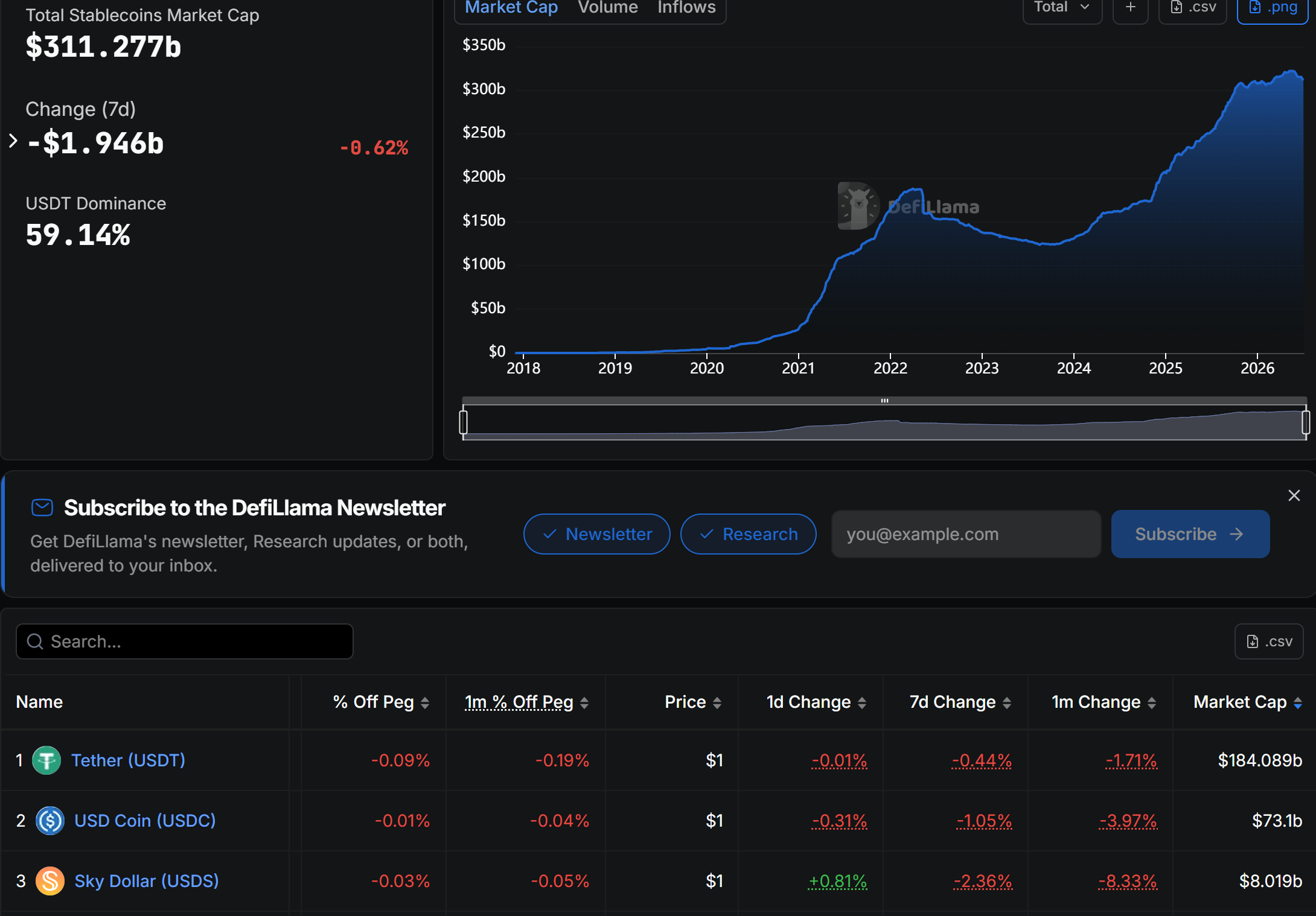
Despite the retreat, USDT remains the largest stablecoin worldwide and the third-largest crypto asset. It trades near $1.00 with a $184 billion market cap and $41 billion in daily volume as of July 4.

USDC’s market cap stands near $73 billion, less than half of USDT’s. The gap suggests that Tether is trading regulated European access for scale elsewhere.
Early Revolut investor Max Karpis said the delisting reverses the fintech’s recent expansion of its stablecoin features.
“Revolut is delisting USDT on 31 Aug 2026 (regulatory/risk reasons). Not long ago, they expanded support to include zero-fee transfers and 1:1 USDT/USDC swaps. Now a reversal. Compliance hits again.”
The coming weeks will show whether Revolut users rotate into USDC or move USDT to self-custody before the cutoff.
The post Revolut to Delist USDT in Europe as Tether Skipped MiCA License appeared first on BeInCrypto.

Where Did Taylor Swift and Travis Kelce Get Married? Details

Victoria Beckham risks Brooklyn’s fury as she extends another olive branch in anniversary post for David – after ‘fuming’ son said he ‘wished they’d stop posting about him’

FatFIRE Addresses Growing Demand for Private Financial Communities Among High-Net-Worth Investors

No Jackpot Winner as $257 Million Prize Rolls Over to $269 Million Monday Draw

Renter of Home in Anne Heche Crash Denies Settlement With Son

Weekend Open Thread: Staud – Corporette.com

From Corporate Life to Financial Freedom Through Investing & Options | Ft. Ravindra Elicherla |EP-73

Trump $2.2 Billion Crypto Real Estate Windfall

The Hobosexual Man Is Everywhere, And He Loves 30-Something Women | Just Getting Good
-

 Fashion18 hours ago
Weekend Open Thread: High Hopes
-

 Tech6 days ago
Bluekit phishing kit adopts browser-in-the-middle for login theft
-

 Tech6 days ago
Claude Code turned every engineer into three. Now companies need more product thinkers
-

 Crypto World4 days ago
Strategy authorizes up to $1.25B in Bitcoin sales under new capital plan
-

 Politics1 day ago
The House | “Reframing the debate from a binary discussion of winners and losers”: Yuan Yang reviews ‘We Are Not Machines’
-

 News Videos6 days ago
MAJOR BITCOIN & MARKET UPDATE!!!! (MUST WATCH ASAP!!!)
-

 Tech4 days ago
Anonymous researcher drops 0-day ‘exploitarium’ repo
-

 Crypto World7 days ago
Coinbase, Circle Deepen Crypto Stock Losses Despite Resilient S&P 500
-

 Business4 days ago
Australia treasurer says alleged access of prime minister’s bank data ’incredibly concerning’
-

 Tech7 days ago
Russian hackers now target Signal backup recovery keys
-
 Business5 days ago
The AI boom won’t burst all at once. It will pop in ‘rolling bubbles’: Macquarie
-

 Sports3 days ago
Broncos roster: OL Ben Powers (No. 74) entering final year of contract
-

 NewsBeat4 days ago
Presenter Caroline Flack’s brother Paul Flack dies aged 55
-

 Crypto World2 days ago
Binance stock trading tops $1B in first month after launch
-

 Tech7 days ago
Silicon Valley paid to kill AI regulation, now it wants the rules back
-

 Tech7 days ago
OpenAI mulls delaying IPO over valuation concerns
-

 Crypto World2 days ago
Alibaba-affiliate Ant Group enters the humanoid robot market with 12 deals
-

 News Videos4 days ago
How to Build INSANE Live Financial Dashboards With Claude
-
 NewsBeat2 days ago
New exhibition reflects five decades of movement between island of Ireland and GB
-

 Business1 day ago
What a 10 Percent Drop Means for Buyers, Sellers and Renters
You must be logged in to post a comment Login