A magnificent cathedral. England’s oldest railway. Miles of beautiful dales and coastline.
And, tucked quietly into its villages, fields, and suburbs, some of the most entertainingly strange place names in the entire country.
Here is a tour of the best of them:
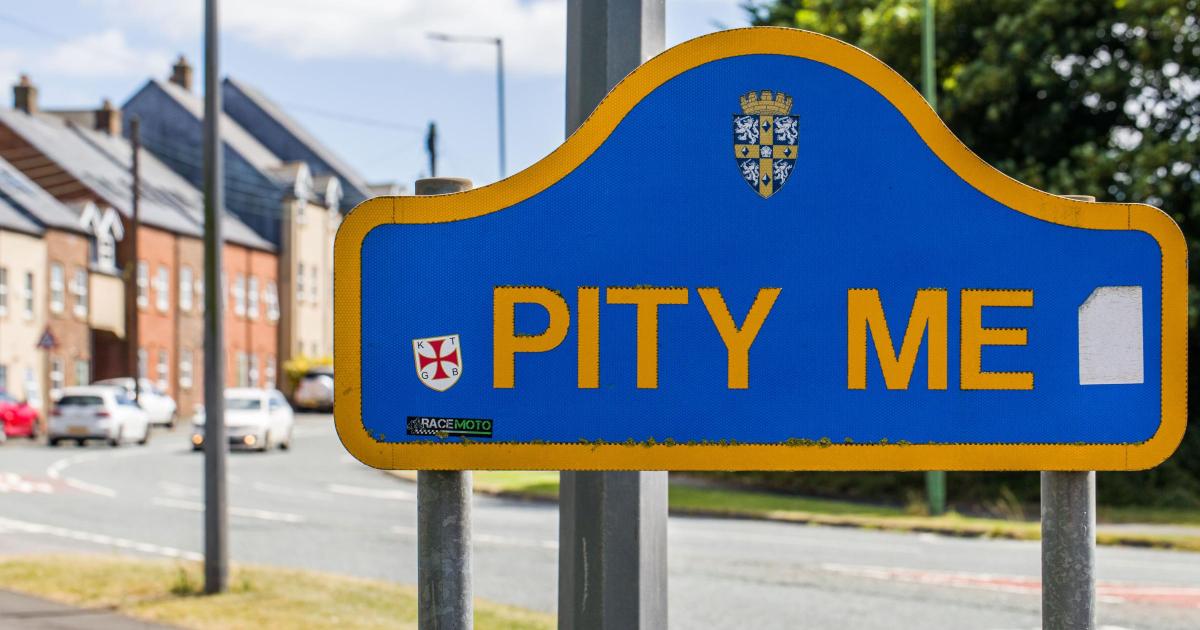
Pity Me
Starting with the most famous. Pity Me is a suburban village just north of Durham city, sitting between Framwellgate Moor and Newton Hall.
The name, according to the Oxford Dictionary of British Place Names, is most likely “a whimsical name bestowed in the 19th century on a place considered desolate, exposed or difficult to cultivate.”
Other theories link it to the Old French “petit mere,” meaning small lake, or to a boggy area known as Pithead Mere.
Whatever the origin, residents have been explaining their postcode to puzzled relatives for generations.
![]() Pity Me, County Durham. (Image: Stuart Boulton)
Pity Me, County Durham. (Image: Stuart Boulton)
Fanny Barks
Near Piercebridge, just west of Darlington, sits Fanny Barks – a small area of woodland that has been raising eyebrows and delighting map-readers for centuries.
The name is entirely innocent: “barks” is a dialect word for birch trees, and “Fanny” is simply a personal name that was once common enough to attach itself to bits of countryside.
No Place
Close to Stanley and within walking distance of Beamish Museum, No Place is a small former mining village that may be the most philosophically troubling address in England.
The origins of the name are genuinely disputed.
Some historians believe it is a shortening of “North Place” or “Near Place.”
Others suggest the original houses stood on a boundary between two parishes, neither of which would claim them — so they ended up in No Place.
There is also a theory that it was a deliberate literary joke on the Greek word for Utopia, which translates as “no place.”
Whatever the reason, No Place has its own pub – the Beamish Mary Inn, dating from 1897 – and a tin chapel.
Which is more than some places have.
![]() No Place is a village with a name that still baffles to this day. (Image: GOOGLE)
No Place is a village with a name that still baffles to this day. (Image: GOOGLE)
Deaf Hill
East of Trimdon Colliery in the east of the county, Deaf Hill is a village whose name has puzzled local historians for years.
The most macabre theory is that it was originally called Death Hill, following a belief that children passed through the fork of a local sycamore tree would be cured of diphtheria — which they were not.
A more prosaic explanation is that “deef” was a dialect word for infertile land that yielded little crop.
The village’s alternative name is Trimdon Station, which rather lacks the poetry of the original.
Philadelphia
On the A182 between Newbottle and Shiney Row sits Philadelphia, a former colliery village named – with impressive confidence – after one of America’s great cities.
The story is that a local colliery owner named it in 1777 to mark the British capture of Philadelphia during the American Revolutionary War.
The village’s cricket ground was subsequently named Bunker Hill, after another battle in the same war.
Quebec
Six miles west of Durham city, on the line of the old Roman road Dere Street, sits Quebec — a former mining village that takes its name from Canada’s most famously bilingual city.
The fields in the area were enclosed in 1759, the year British forces captured Quebec from the French, and it was common practice at the time to give remote or newly enclosed land the names of far-flung places.
The village is now a small, quiet community close to Esh Winning and Langley Park, with little to suggest its connection to North America beyond the sign on the road in.
Toronto
Not to be outdone by Quebec, County Durham also has its own Toronto — a village a mile north-west of Bishop Auckland, sitting on a plateau above a loop of the River Wear.
It was named in 1859 by a mining company owner called W. Stobart, who was visiting the Canadian city of Toronto when he received word that coal had been discovered on his land back home.
In a moment of what can only be described as transatlantic sentimentality, he named the mine — and subsequently the village — after the place where he got the good news.
Stony Heap
Between Burnhope and Greencroft in the north-west of the county, Stony Heap is precisely what it sounds like: a hamlet on a heap of stony ground.
It is not glamorous.
But it is, in its own way, a masterpiece of blunt Northern honesty about the landscape.
Crook
Crook is a market town in mid-Durham that takes its name not from anything criminal but from the Old Norse word “krókr,” meaning a bend or hook — a reference to a curve in the local landscape.
It is the kind of name that makes people do a double-take on road signs and has presumably provided local teenagers with a lifetime of easy material.
Cockfield
Eight miles south-west of Bishop Auckland, Cockfield is a perfectly respectable village on the edge of Teesdale that has been quietly dealing with its name since at least the 12th century.
The name derives from the Old English “cocc,” meaning a woodcock — a bird once common in the area — combined with “feld,” meaning open land.
This explanation is entirely plausible and convinces almost no one on a first encounter with the road sign.
Busty View
Just outside Chester-le-Street, Busty View is a residential street whose name has confused and delighted visitors for years.
Like many seemingly suggestive North East place names, the origin is topographical rather than anatomical — “busty” is a dialect word for a slope or embankment, related to the word “bust” as in a ridge of land.
None of this stops it appearing on national lists of the UK’s rudest place names with impressive regularity.
Are there any places with strange names that we missed?
Do you live in any of these places and get funny looks from outsiders when you say where you’re from?
Let us know in the comments.

































































You must be logged in to post a comment Login