Xbox at a gamescom briefing in 2014. Microsoft is pressing its games division to turn a profit. (Microsoft Photo)
In 2007, Microsoft’s Xbox 360 consoles started dying — overheating until three lights on the front blinked red, a defect gamers came to call the “red ring of death.” Microsoft’s response was to extend the warranty on every machine and take a charge of more than $1 billion to fix the problem, making it one of the costliest product failures in the company’s history.
Microsoft could afford it financially, but the bigger factor was strategy. Xbox was a bet on the living room, and for a company minting money on Windows and Office at the time, losing a billion or so was a justifiable cost of staying in the game.
Nearly two decades later, that patience has run out.
“Going forward, this cannot continue,” the new Xbox CEO Asha Sharma wrote in a memo to employees last month, offering a blunt assessment of a business that has spent more than $20 billion over five years, only to see its core revenue fall by nearly half a billion dollars, running at a thin 3% profit margin, by Microsoft’s own internal measures.
Asha Sharma took over as CEO of Microsoft’s Xbox business in February. In a memo to employees last month, she wrote that the division’s heavy spending and shrinking revenue “cannot continue.” (Microsoft File Photo)
With thousands of layoffs expected to be announced across Microsoft as soon as next week, the Xbox division is likely to be among the hardest hit.
The cuts reach across the company — including sales and consulting — part of a restructuring that has become routine around the close of Microsoft’s fiscal year. But for Xbox, they’re an early step in a broader effort to reset the business, rein in costs, and position the division for healthier profits.
Advertisement
Microsoft CEO Satya Nadella has been blunt about it: the company has spent years subsidizing Xbox rather than profiting from it, and that era is over. The videos and livestreams of people playing Xbox games that fill YouTube generate more money than Microsoft makes from the games themselves, he noted in an appearance on the Hard Fork podcast.
“No one can accuse Microsoft of not having invested for the last 25 years,” Nadella said. “And now we have to turn this into a sustainable business.”
Long-term strategic bet
Turning it around means breaking a pattern that runs through Xbox’s entire history.
Xbox launched in 2001 and lost money for most of its first decade. Microsoft absorbed the losses and stayed in — going up against Sony’s PlayStation and Nintendo — because it saw a strategic prize in owning a piece of the living room, and later of mobile. Online gaming also gave the company early experience running services at scale, which fed its cloud ambitions.
Advertisement
Over time, the goal shifted from selling hardware to selling subscriptions.
Xbox Live, launched in 2002, turned online play into recurring revenue. Game Pass, which arrived in 2017, let players pay a monthly fee — the top tier is about $23 — for a library of games, including Microsoft’s own new releases the day they come out. The idea was to get people paying for Xbox everywhere: consoles, PCs, phones and the cloud.
And when growth stalled, Microsoft doubled down. It paid $7.5 billion in 2021 for Bethesda, the studio behind Fallout and The Elder Scrolls, then $69 billion in 2023 for Activision Blizzard (whose games include Call of Duty, World of Warcraft, Diablo and the mobile hit Candy Crush) the largest acquisition in Microsoft’s history.
A series of economic headwinds
Microsoft could afford to be patient through all of it. Now it’s not so simple. In recent years, almost everything about the economics of gaming has turned against Xbox at the same time.
Advertisement
Hardware loses money, and AI is making it worse. Microsoft sells consoles at or below cost, banking on games and subscriptions to make up the difference. But AI data centers are consuming so much memory and storage that chip prices have spiked. That has forced Microsoft to raise Xbox console prices, most recently a $100-to-$150 hike this summer that it blamed directly on component costs.
Xbox lost the console war. By most estimates, Sony’s PlayStation 5 has outsold the Xbox Series X and S more than two to one. A smaller base means fewer game sales and subscriptions to offset the upfront hardware losses. That has left Xbox a distant second for the entire generation.
Revenue is shrinking. Even setting aside the games it gained from Activision, Xbox’s annual revenue has fallen nearly $500 million over five years — while the money going into the business keeps climbing. It has been investing more to earn less.
Microsoft’s most recent quarterly filing shows gaming revenue of $16.8 billion for the nine months through March, down about $1.1 billion, or 6%, from a year earlier.
Advertisement
Game Pass cuts into sales. Handing subscribers a new game the day it launches undercuts the roughly $70 they would have paid to buy it. The service delivers steady subscription income, but thinner economics on the games themselves.
Activision didn’t fix the margins. Even with one of gaming’s most profitable businesses folded in, Xbox earns only about 3 cents of profit on every dollar — well under the 17 to 22 cents typical in the industry. If the biggest acquisition in company history can’t move the margin, little will.
Every spare billion is flowing to AI. Microsoft is pouring more than $100 billion a year into the data centers and chips behind its AI push, trying to capitalize on the boom. Against a risk and payoff that big, a gaming business that barely breaks even feels like yesterday’s strategic bet.
What’s next for Xbox
The cuts have already started. In recent weeks, Microsoft has signaled plans to close or sell some studios, including Ninja Theory, maker of the acclaimed “Hellblade” series.
Advertisement
Shedding staff, studios and marketing will lift Xbox’s profit margins in the near term. What it won’t do is fix the underlying problem: a business can trim its way to a better number only so much before it has to generate more revenue.
Sharma’s plan, so far, is to concentrate on Xbox’s biggest franchises, funding blockbusters like Halo and Fallout while pulling back elsewhere. It’s leaning on Game Pass and releasing most of its games on PCs and rival consoles from Sony and Nintendo, reaching players well beyond Xbox’s shrinking base, even as it holds back a few new exclusives like Gears of War to give owners a reason to stay.
Microsoft is also rethinking the console itself. In her memo, Sharma described a “hardware component crisis” that has left the company unable to make as many consoles as players want, and called for “a new business model and partnerships” for its hardware.
How far the reset ultimately goes is an open question. The Information reported that Microsoft has weighed making Xbox a standalone subsidiary, a joint venture, or a spin-off, though nothing is imminent.
Advertisement
Microsoft’s response to the Xbox 360 “red ring of death,” July 6, 2007. (Seattle Post-Intelligencer / NewsBank)
Whatever happens next, it’s clear that times have changed. In 2007, as the red ring of death crisis emerged, Peter Moore, who ran the Xbox business at the time, and his boss Robbie Bach went to then-CEO Steve Ballmer to ask for the money to repair and replace the failing consoles.
Told it was $1.15 billion, Ballmer said, simply: “Do it.”
Moore credits that decision with saving Xbox. There would have been no Xbox One, he said, without Ballmer’s willingness to spend more than a billion dollars to protect the brand.
Advertisement
But nearly two decades later, Microsoft is done writing that kind of check for Xbox.
Subsea cables. Ukrainian power stations. Russian oil refineries. Even airports, water-desalination plants and Amazon data centers.
They’ve all become targets in wartime, notes the Wall Street Journal, and around the world now arguments “are already brewing between companies and governments over new regulations and potential costs.”
In Germany, powerful associations representing private companies and municipal utilities have pushed back against new standards for physical protection, warning they could spell financial ruin. New Zealand’s government has faced resistance from industry groups over a proposal to fine critical-infrastructure companies and their directors for cybersecurity breaches… A sign of how lines are blurring: The North Atlantic Treaty Organization’s 32 countries last year agreed that as part of a pact to spend 5% of economic output on defense and security, 1.5% would go to military-adjacent needs including protecting critical infrastructure and networks. Spending targets range from cybersecurity and industrial capacity to railroads, bridges and ports needed for military logistics… “We need a wide concept of defense — defense is no longer just military,” said Italian Adm. Giuseppe Cavo Dragone, NATO’s top military adviser.
Adding to the complexity, companies now need to protect the data networks that serve as gateways to critical infrastructure. Hackers increasingly target not just computer files to steal information but also systems managing vital functions like building access and factory control, remotely causing physical damage or enabling espionage. U.S. authorities in April warned that Iranian hackers were trying to disrupt American drinking-water systems by targeting computer equipment that connects hardware with software. A year earlier, suspected Russian hackers remotely manipulated valves on a Norwegian hydroelectric dam…
Advertisement
Another challenge will be parsing jurisdictions and liability for assets that cross international waters or are damaged in combat — such as subsea data cables or energy pipelines. Turf battles between law enforcement and militaries are already complicating efforts… “The private owner can invest in redundancy, monitoring, and repair capacity, but only governments and militaries can really deter, patrol, attribute, or respond to hostile state activity,” said Marc Glasser, who worked on cybersecurity and infrastructure security for three decades at the U.S. Department of Transportation and the Department of Homeland Security…. Companies say they need greater clarity from governments on what protections they will provide and subsidies to help them defend privately owned assets that provide a public good. Most governments don’t provide incentives for companies to invest more than the minimum legal resilience requirements. The article notes that in May the chief executive of California’s Port of Long Beach “launched a cyber-defense operations center to thwart tens of thousands of cyberattacks daily, which jeopardize computer systems and all equipment connected to them.”
The article also points out that the EU adopted new regulations requiring countries to reduce vulnerabilities, and new laws proposed in the U.K. now “seek to increase penalties for subsea sabotage, updating codes that date to when telegraph cables were first laid in the 19th century.”
Engine ignition occurs only after the rocket clears the launch platform safely
Chinese aerospace startup Z-Trak Space is exploring an unusual launch system using carbon dioxide (CO₂) commonly associated with fizzy drinks rather than rocket exhaust.
The proposal centres on supercritical CO₂, a state achieved when the gas remains above specific temperature and pressure thresholds simultaneously.
Developers believe the approach could lower infrastructure requirements while supporting faster launch schedules for China’s expanding commercial space sector.
Latest Videos From
A cold launch system could reduce dependence on expensive ground facilities
The technology ejects rockets using rapidly expanding high-pressure gas before igniting engines only after reaching a predetermined altitude overhead.
Advertisement
That sequence differs sharply from conventional hot launches where engines ignite directly on launch pads before the vehicle begins climbing skyward.
Because combustion occurs later in flight, scorching exhaust gases never strike the launch platform or surrounding support infrastructure below.
Traditional launch facilities require extensive protection systems because exhaust streams exceeding 3,000°C can damage structures rapidly during operations.
Advertisement
Sign up to the TechRadar Pro newsletter to get all the top news, opinion, features and guidance your business needs to succeed!
Launch towers and deep flame trenches therefore require substantial repairs and maintenance after missions involving repeated exposure to extreme temperatures.
According to the company, those requirements increase costs and slow launch frequencies whenever operators pursue swift response commercial missions.
“In commercial space launch scenarios requiring high frequency and rapid response, this incurs high time and financial costs, directly affecting launch pacing and response speed,” the company said.
Advertisement
Z-Trak Space believes eliminating those burdens could increase launch pacing while reducing dependence upon permanent launch infrastructure considerably over time.
China’s commercial sector sees cold launch technology as a possible advantage
The initiative combines efforts from Hunan based Zhiyu Aerospace Technology and Chiyang Space Power Technology Company through a recent collaboration agreement.
Advertisement
Z-Trak Space founder Zhang Zihan, who studied aerospace engineering at Hong Kong Polytechnic University, described the concept as potentially transformative.
Zhang said the method would “fundamentally change the model for small liquid-fuel launch vehicles” if implemented successfully at commercial scale.
The company also argued that supercritical CO₂ launches could reduce fuel use during lower altitude portions of flight operations.
Because supercritical CO₂ is non-toxic, developers also claim launches would avoid generating harmful emissions near ground facilities locally.
Advertisement
Z-Trak described the system as offering “high safety, low costs, clean environmental performance and low ablation” during launch procedures.
China’s commercial space industry recorded 50 launches during the previous year, representing more than half of national missions completed overall.
Whether CO₂ launches become commercially practical remains uncertain, although the proposal reflects experimentation occurring throughout China’s rapidly changing space industry.
To get the most out of an AI chatbot these days, you have to pay up. The free tiers of the most popular chatbot options are decent, but those looking to take advantage of all the features will be forced to pay a premium. A couple of years ago, the idea of actually paying for AI seemed absurd, but that’s not the case now.
A recent CNET survey revealed that US adults pay an average of $111 on subscriptions per month and lose up to $252 annually on unused subscriptions annually, with millennials and Gen Z wasting the most. The AI chatbot you once hoped to get more out of — but may no longer use — could be one of them.
If you’re looking to pay for an AI chatbot, you have options, and not all subscriptions are equal. Some just give you higher access to better models, where others offer a lot more. Paying for AI also doesn’t guarantee an ad-free experience. Below, we’ll break down what you actually get when you pay up for some of the most popular chatbots.
Advertisement
By the numbers
Here’s a price breakdown of the most popular chatbots.
Chatbot premium pricing
Chatbot
Tier
Monthly | annual price
ChatGPT
Go
$8 | No annual pricing
ChatGPT
Plus
$20 | No annual pricing
ChatGPT
Pro
$100 | No annual pricing
ChatGPT
Pro
$200 | No annual pricing
Gemini
Plus
$8 | $80 per year
Gemini
AI Pro
$20 | $200 per year
Gemini
AI Ultra
$100 | No annual pricing
Gemini
AI Ultra
$200 | No annual pricing
Claude
Pro
$20 | $200 per year
Claude
Max
$100-$200 | No annual pricing
Perplexity
Pro
$20 | $200 per year
Perplexity
Max
$200 | $2,000 per year
Copilot
Personal
$10 | $100 per year
Copilot
Family
$13 | $130 per year
Copilot
Premium
$20 | $200 per year
Grok
SuperGrok
$30 | $300 per year
Grok
SuperGrok Heavy
$300 | $3,000 per year
ChatGPT Go, Plus and Pro
ChatGPT’s premium pricing is straightforward and is easy to understand what its features and limitation are.
Advertisement
Anadolu/Contributor/Getty Images
OpenAI’s first paid tier, Go, is its newest plan. For only $8 a month, you’ll get higher limits and more access across the board. That said, if you’re looking to avoid ChatGPT’s ads, you won’t be able to do so with this plan and will need to bump up to the next tier to go ad-free.
The second premium plan is ChatGPT Plus, which opens the doors to extended GPT-5.5 access and higher limits on messaging, uploads, data analysis and image generation. You’ll also get advanced voice mode with video and screensharing and the ChatGPT agent.
If you want more, you can opt for one of ChatGPT’s Pro plans, which cost $100 or $200 a month. The $100 plan will net you 5x usage, and the $200 plan gives you 20x more usage. The Pro plans will provide Pro reasoning with ChatGPT 5.5 Pro, Maximum Codex tasks, and unlimited file uploads and image generation. The plans also give users maximum memory, deep research and agent mode. Those on the Pro plans will also get first dibs on trying out new features for ChatGPT.
(Disclosure: Ziff Davis, CNET’s parent company, filed a lawsuit against OpenAI, alleging it infringed Ziff Davis copyrights in training and operating its AI systems.)
Advertisement
Google AI Plus, Pro and AI Ultra
Google’s Gemini may be the most accessible chatbot of them all, and its premium pricing tiers fall in line with the competition.
Thomas Fuller/SOPA Images/LightRocket/Getty Images
With Gemini, Google is integrated at the heart of the chatbot experience, making it a great option for Google users.
Despite the abundance of features in the Google AI Pro plan, Gemini’s free tier offers plenty for most people. Like ChatGPT, Google also introduced a $8 plan. The Plus plan offers 200GB of storage and more access to the latest Gemini models. Once you start shelling out some cash for Google’s AI plans, higher usage access and more features follow.
Advertisement
Google’s AI Pro offers more features across the board than the free and Plus version, unlocking Gemini in Google Workspace apps, 1,000 credits for the Flow filmmaking tool and more advanced models in Search’s AI Mode. It doesn’t stop at Gemini, though. You’ll also get 5TB of storage for Google Photos, Drive and Gmail, along with a YouTube Premium Lite plan. This plan also includes a 10% credit on purchases from the Google Store.
During Google I/O 2026, the AI subscriptions got shaken up once more. There are now two AI Ultra plans that unlock different features and higher usage limits.
The newest plan is AI Ultra ($100), offering 5x higher usage limits compared to the AI Pro Plan. The $100 option gives access to Gemini 3.5 Flash, priority access to Google Antigravity and a YouTube Premium Individual plan. Google says this plan was specifically tailored for developers, technical leads, knowledge workers and advanced creators.
The highest tier of Google’s AI subscriptions is the now-$200 plan, down $50 from when it was introduced. This plan offers 20x higher usage limits compared to the $100 plan.
Advertisement
Both AI Ultra plans offer access to Gemini Spark, Google’s 24/7 agent that can act on your behalf and perform tasks for you. It can tap into other Google products and get things done for you in the background — as long as you’re willing to give it even more of your data.
Lastly, the $200 AI Ultra plan gives subscribers access to Project Genie, an advanced generative AI model that can build 3D worlds for just about anything you want.
Copilot
Microsoft’s Copilot has the advantage of being preinstalled on a ton of Windows computers, making it incredibly accessible (like Gemini on Android). Although it’s based on ChatGPT models with Microsoft Graph, Copilot feels different enough to be its own thing.
To my surprise, Copilot produced the most interesting images when I compared it to the other chatbots. Sometimes Gemini and ChatGPT generated similar images, but Copilot nearly always produced something more distinct. Even if I don’t do it all that often, I still consider it a go-to feature.
Advertisement
Much like Google, Copilot integrates well with Microsoft 365 apps, though some of its features are locked behind Microsoft 365 for Business, like its NotebookLM competitor, Copilot Notebooks. Without jumping into 365 for business, Copilot offers three plans that give you access to higher limits and allow you to use it in select Microsoft 365 apps. The upgraded plans will also give you access to Deep research models and Actions, which allow Copilot to fill out forms for you or assist in shopping.
Perplexity
Higher tiers of Perplexity’s premium bundles in its AI Comet browser
Joseph Maldonado/CNET
Perplexity is our favorite chatbot for research, but the free version limits you to three Pro searches and Research uses per day. That might be fine for casual users, but those really trying to tap into Perplexity’s capabilities will want a bit more of everything, and you’ll need to pony up $20 a month to really get going with it.
Advertisement
Perplexity Pro will give you unlimited Pro Searches and unlimited file uploads, and more file uploads per Space. It will also unlock image generation and access to more advanced models than the standard “best” model in the free version.
Perplexity also has Comet, its limited-access web browser with AI baked right in. Pro and Max subscribers receive Comet Plus included in their subscription.
Claude Pro and Max
Premium Claude plans have vague limitations.
Advertisement
James Martin/CNET
The paid version of Anthropic’s Claude is in line with the competition, costing $20 a month, and it boasts a 5x boost in usage per session versus the free version during peak hours, though limits are still in place. Basically, if you send basic inquiries of up to 200 English sentences, each roughly 15 to 20 words, you’ll be able to send about 45 messages every 5 hours with Claude Pro.
Despite taking the top spot on our best chatbot list, Anthropic’s pricing page for Claude’s Pro and Max plans feels a bit dry compared to others on the list. The $20 Pro plan’s first feature with “more usage” is immediately followed by an asterisk that references the limits in place for the Pro plans. Such limits are to be expected for anything that’s not the top plan, but they seem to depend on how you’re using Claude. In addition to more usage, the Pro plan will unlock Claude Code, unlimited Projects, access to Research mode and more Models.
The Max plan offers even more usage than the Pro plan, increases the output limits on all tasks, provides priority access during peak traffic times and offers early access to new Claude features. This bump is likely helpful for the Claude power users out there and costs $100 per person per month.
One note on usage here: Anthropic was just sued for being intentionally misleading about how much usage its users actually get. The lawsuit filed in June alleges that the usage cap for its more advanced models is significantly less than advertised. It might be something to consider before shelling out $100 or $200 for its most expensive plans.
Advertisement
Grok
Grok is the most expensive chatbot of the lot.
Future Publishing/Getty Images
Grok’s premium tiers are the most expensive for personal use, whether on a monthly or annual basis. The first premium tier, SuperGrok, will increase access to both Grok 3 and 4, extend token limits to 128,000, give you priority voice access, and include the Imagine image model. It costs $30 a month, or $300 for a year. This tier also opens access to Ani and Valentine AI companions.
The next tier up is SuperGrok Heavy, and is mostly “more” of what you get from SuperGrok for $300 a month or $3,000 per year. This tier will give you preview access to Grok 4 Heavy, extend access to Grok 4, and provide unlimited access to Grok 3. SuperGrok Heavy has a higher token count and early access to new features.
Advertisement
If you’re interested in trying Grok, you might be able to get it at a discount. At the time of this writing, both SuperGrok and SuperGrok Heavy are at a 67% discount for the first three months. This makes SuperGrok $9.90 a month for three months, and SuperGrok Heavy $99. If you don’t mind spending at least some cash and want to see if Grok is worth it to you, the discounted price is definitely a good time to consider it.
Looking at theingredient labels on foods lining supermarket shelves, it’s common to see names such as “potassium sorbate,” “citric acid,” and “L-ascorbic acid (vitamin C).” These substances are food additives used to prevent spoilage and preserve quality, and they are widely incorporated into industrially produced processed foods. According to Open Food Facts, the world’s largest open food database, more than 20 percent of the processed foods and beverages in its database contain at least one preservative.
Against this backdrop, a research team led by scientists at Sorbonne Paris Nord University and Université Paris Cité analyzed data from the large-scale NutriNet-Santé cohort study, which followed 112,395 participants for a median of 7.9 years, to investigate the relationship between dietary preservative intake and the risk of developing hypertension and cardiovascular disease.
“Experimental studies suggest that some preservative food additives may be harmful to cardiovascular health, but we have not had enough evidence on the impact of these ingredients in humans,” said Anaïs Hasenböhler, the doctoral researcher who led the study, in a press release. “As far as we know, this is the first study of its kind to investigate the links between a wide range of preservatives and cardiovascular health.”
8 Preservatives Linked to Hypertension Risk
The researchers divided preservatives into two broad categories. The first consisted of non-antioxidant preservatives, such as sorbates, nitrites, and sulfites, which inhibit the growth of mold and bacteria. The second consisted of antioxidant preservatives, including ascorbic acid, citric acid, and erythorbates, which prevent oxidation and discoloration in foods. According to the researchers, nearly every participant (99.5 percent) consumed at least one preservative during the first two years of the study.
Advertisement
The analysis found that participants with the highest intake of non-antioxidant preservatives had a 29 percent higher risk of developing hypertension than those with the lowest intake. They also had a 16 percent higher risk of overall cardiovascular disease, including heart attack, stroke, and angina. Participants with the highest intake of antioxidant preservatives likewise showed a 22 percent higher risk of hypertension.
The researchers also examined the 17 most commonly consumed preservatives individually. Of these, eight were associated with an increased risk of hypertension: potassium sorbate (E202), potassium metabisulfite (E224), sodium nitrite (E250), ascorbic acid (E300), sodium ascorbate (E301), sodium erythorbate (E316), citric acid (E330), and rosemary extract (E392). Among these, ascorbic acid was also associated with an increased risk of cardiovascular disease.
During the follow-up period, researchers recorded 5,544 cases of hypertension and 2,450 cases of cardiovascular disease, including 1,142 cerebrovascular events and 1,308 cases of coronary artery disease. The study also found that approximately 16 percent of the association between non-antioxidant preservatives and cardiovascular disease was mediated indirectly through hypertension. In other words, the findings suggest that preservatives may contribute to hypertension, which in turn may increase the risk of cardiovascular disease.
Calls to Reevaluate Food Additive Regulations
The researchers emphasize that these findings come from an observational study and do not establish a causal relationship between food preservatives and hypertension or cardiovascular disease. The study also has important limitations. Women accounted for 78.7 percent of participants, and the cohort included a relatively high proportion of highly educated individuals, meaning it does not perfectly represent the general population.
Advertisement
Even so, the statistical models accounted for a wide range of potential confounding factors, and the results remained consistent across multiple sensitivity analyses.
“These results suggest we need a reevaluation of the risks and benefits of these food additives by the authorities in charge, such as the EFSA in Europe and the FDA in the USA, for better consumer protection,” said Mathilde Touvier, research director at the French National Institute of Health and Medical Research, in a press release. “In the meantime, these findings support existing recommendations to favor nonprocessed and minimally processed foods, and avoid unnecessary additives.”
The possibility that preservatives long regarded as safe could affect cardiovascular health raises important questions about current regulatory approaches. For additives that are consumed continuously through multiple foods without numerical limits on their use, the findings suggest it may be time to reopen the debate over whether existing regulations are adequate.
This story originally appeared onWIRED Japanand has been translated from Japanese.
Two hundred and fifty years after the signing of the Declaration of Independence, a new commercial from Google asks: What if the Founding Fathers had access to Google Workspace?
With the tagline “Group project, but make it 1776,” the ad depicts a largely unseen Thomas Jefferson mid-draft when he gets a nagging text from Ben Franklin, leading to a very Google-centric collaboration process. Edits are suggested in Google Docs, a meeting gets scheduled in Google Calendar and conducted remotely via Google Meet (with every single attendee apparently turning their camera off?), then the whole thing is finalized with e-signatures; cue the fireworks.
Of course, since this is an ad from a tech company in the year 2026, AI has a role to play. The fictionalized founders use Google’s “help me visualize” AI tool to try out different animals on the national seal, Gemini takes notes on the meeting, and the founders also ask the chatbot for advice before declining King George III’s document access request.
The whole thing is very tongue-in-cheek (at one point, Sam Adams asks, “Can we settle this over beers?”), and the AI evangelism is relatively discreet when compared to many other recent ads. And unlike that infamous Google commercial in which a father uses Gemini to write a fan letter for his daughter, this one shies away from any suggestion that the actual text of the Declaration of Independence would be improved with AI. Perhaps the most AI-forward element of the ad is the footage itself, which to my eye has the uncanny glow of AI-generated video.
Advertisement
While viewer comments on YouTube and Instagram appear to be mostly positive, you may not be surprised to learn that the response on Bluesky has been far more critical. Posters declared the commercial “cringey” and “stunningly tone deaf,” and the AI angle was the biggest target — even as many users, including historian Angus Johnston, noted that it’s “amazing how little of this is actually AI.”
“Even in a corny fantasy joke, it’s impossible to make the case that AI is a useful tool for political organizing, writing, or human collaboration,” Johnston said.
When you purchase through links in our articles, we may earn a small commission. This doesn’t affect our editorial independence.
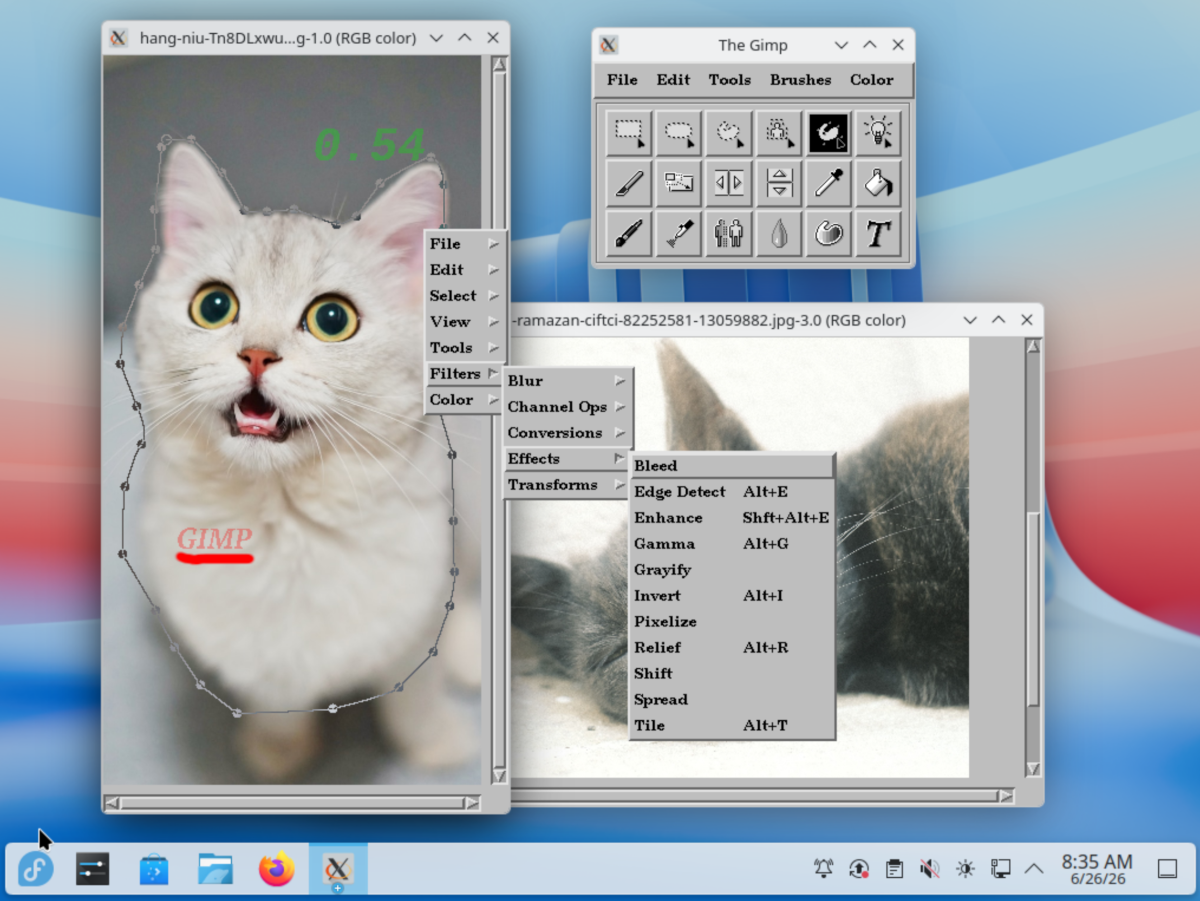
Although there’s probably no good reason to want to run image editing software from 1996 other than for nostalgia’s sake, if you ever wanted to run the GIMP version 0.54 from back when Windows 98 was still called Windows 97, you can do so now from the comfort of a modern-day Linux desktop. What enables this is a Flatpak version of a beta release, assembled by [balooii] for everyone’s enjoyment.
It wasn’t a simple matter of compiling the old software’s code and packaging it up, with the repository for the project containing a series of patches that were required to make this possible. Also of note is that this is the first version of GIMP with full surviving source code. Back then, GIMP used the Motif widget toolkit. Later on, it switched to the GIMP Toolkit (GTK).
Bundled with this Flatpak release are a lot of plugins and tutorials that were created at the time, making it a veritable time capsule of a more innocent era. As noted by [balooii], this version of GIMP was very much Beta software, with all of the UI quirks you’d expect. It also features the multiple unconnected windows (not MDI) approach to its UI – dropped in more recent GIMP releases — that has enraged proponents of the single window approach, as used by all commercial competitors, including Paint Shop Pro and Photoshop.
Modi has inaugurated commercial production at CG Semi’s $870m OSAT plant in Sanand, Gujarat, which will initially package 200 million chips a year and scale to 500 million. It is the third packaging plant to come online under the India Semiconductor Mission, after Micron and Kaynes Semicon.
Prime Minister Narendra Modi has inaugurated commercial production at CG Semi’s chip assembly and testing plant in Sanand, Gujarat. The facility will initially turn out 200 million chips a year, according to ANI, with plans to scale to 500 million.
Advertisement
The plant is an outsourced semiconductor assembly and test, or OSAT, facility. That covers the packaging and testing end of the chip supply chain rather than fabricating silicon from scratch.
CG Semi is a joint venture between Mumbai-listed CG Power and Industrial Solutions, Japan’s Renesas Electronics, and Thailand’s Stars Microelectronics. CG Power holds 92.3% of the venture, which is investing INR 7,600 crore (around $870m) over five years.
The 💜 of EU tech
The latest rumblings from the EU tech scene, a story from our wise ol’ founder Boris, and some questionable AI art. It’s free, every week, in your inbox. Sign up now!
Chips packaged at Sanand will go into cars, scooters, and industrial equipment, with a significant share exported to Japan, the US, and Europe. The plant is expected to create around 5,000 direct and indirect jobs over the next five years, according to local reports.
Third plant off the line
CG Semi is not India’s first packaging plant to fire up. Micron’s Sanand facility began operations in February and Kaynes Semicon followed in March.
Six semiconductor projects worth a combined $14.7bn have now been approved in Gujarat, including ventures from Tata Electronics and Suchi Semicon. Sanand is emerging as the country’s first chip packaging cluster.
Advertisement
At full ramp, CG Semi has said the site could handle 15 million units a day, a peak annual capacity of roughly 4.7 billion chips. It will produce legacy packages such as QFN and QFP alongside advanced FC BGA and FC CSP formats for automotive, consumer, industrial, and 5G customers.
Speaking at the inauguration, Modi called semiconductor growth the next phase of “Make in India” and pledged to build out the entire electronics value chain. Whether Sanand’s packaging lines can anchor that ambition is the question the next few years will answer.
Imagine if you could bring 250 people together in a massive room and have them discuss and debate an important issue, arguing the points and counterpoints, and converging on answers that accurately reflect their collective knowledge, wisdom, values, and sensibilities.
Now imagine that you convened this debate on America’s 250th birthday and asked 250 randomly selected Americans to come up with the top three innovations that America has contributed to the world over the last 250 years.What would they come up with?
I know – this all sounds impossible.
After all, you can’t get more than a dozen people to have a productive conversation on anything. At large scale, nobody would get enough airtime to express their views or respond to others. This is why typical business meetings or focus groups never have more than 8 to 10 people. Thoughtful real-time conversations just don’t scale.
Advertisement
To solve this, a new category of AI technology called “hyper-communication” is greatly expanding the size, scope, and efficiency of large-scale deliberations. It uses specialized AI agents to connect groups in real-time, allowing people to discuss and debate issues at any scale. The goal is to enable hundreds or even thousands of participant to hold thoughtful discussions where they can express their views and argue the merits of any issue.
I first wrote about this emerging technology in VentureBeat two years ago in an article about “Collective Superintelligence.” In that piece, I explain how large human groups can be hyper-connected by AI agents in ways that greatly amplify the group’s collective intelligence. You can check out the science behind hyper-communication in that prior VentureBeat piece. Here I am focusing on the debate among 250 Americans on America’s birthday.
To do this, I asked the team at Unanimous AI to field a randomly selected group of at least 250 Americans (with a broad distribution from every region in the country and diverse mix of political and social demographics) and invite them to a twenty-minute online debate inside a hyper-communication platform called Thinkscape that enables massively scalable discussion by text, voice, or video.
Once connected, we asked the group to come up with the top three contributions that America has made to the world over the last 250 years – not a survey of opinions, but deliberation of ideas, arguments, evidence, and reasoning. The group converged on a set of top answers that surprised me – but on reflection, they were sensible and well-reasoned.
Advertisement
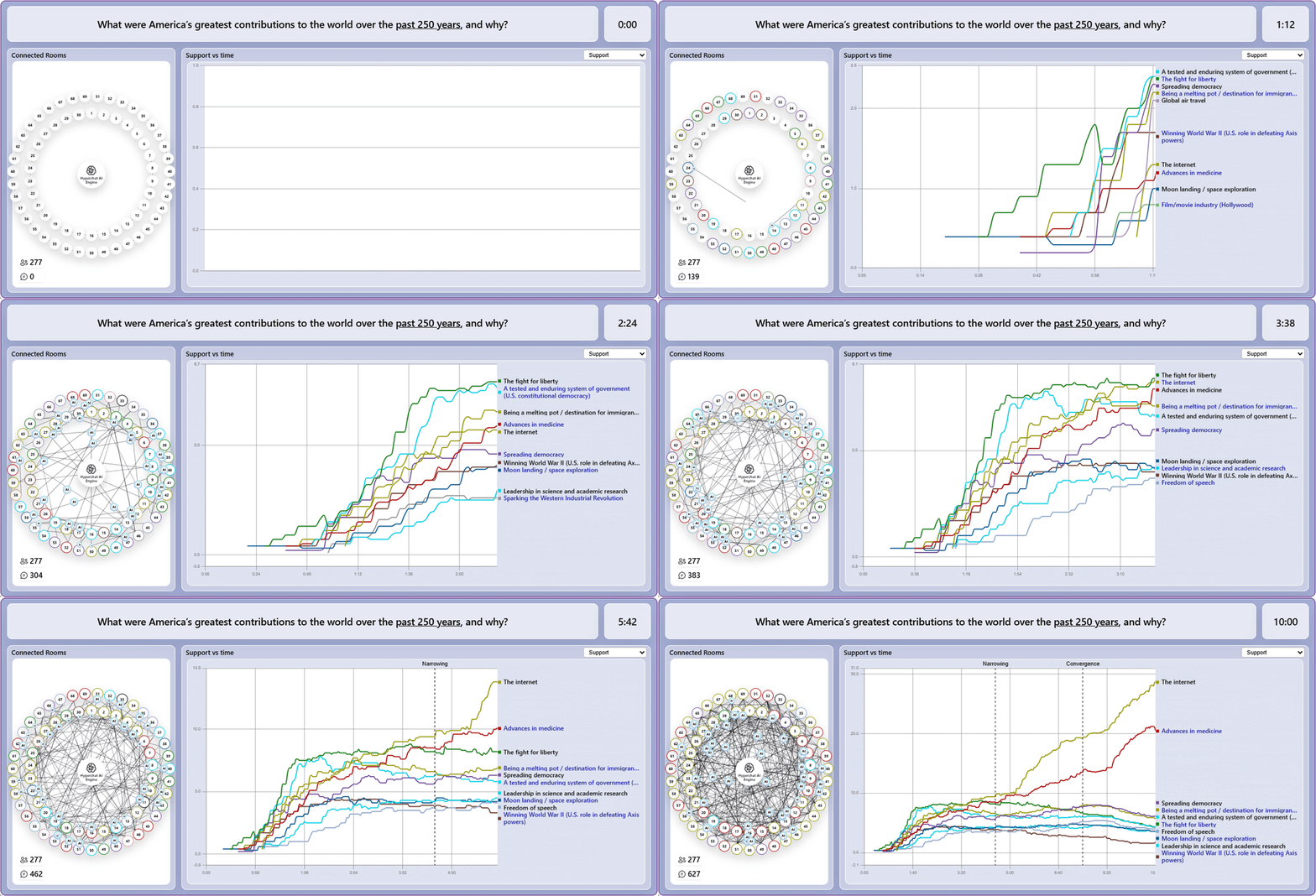
Before getting into the answers, let me show you what the debate looks like behind the scenes. There were 277 people, each of them debating the issues with four or five other people in parallel discussion spaces. The magic is the swarm of AI agents that connect all the small groups together into a single real-time deliberation.This is what it looks like at high speed:
In the debate above, the group of 277 people came up with 94 different ideas and then narrowed it down to a top 10, then a top 3. In the gif above, we just plot the top ten ideas as they emerged and battle for support during the live conversational debate.
The most interesting part of a large debate like this is not the answers, but the reasons that emerge to justify the answers. Here is the group’s reasoning behind the “top three innovations” that America has given to the world over the last 250 years:
#1: The Internet:“Our collective perspective is that America’s greatest contribution to the world over the past 250 years is the internet. It was born exclusively in the U.S. through academic and government research and was scaled globally with profound impact. It transformed communication, democratized information and education, enabled commerce, medicine, research and cultural exchange, and amplified soft power and civic organizing. We also acknowledged significant harms (misinformation, addiction, privacy loss) and arguments that it’s recent, global, or not uniquely American.”
#2 Advances in medicine: “Our collective perspective is that the United States has saved and prolonged hundreds of millions of lives worldwide. American-developed vaccines have successfully eradicated or controlled once-deadly diseases, significantly extending life expectancy and enabling broader societal and technological progress. From major breakthroughs in cancer research and treatments to cutting-edge medical technologies that have revolutionized hospital safety and procedures, U.S. ingenuity has redefined healthcare. Ultimately, while the global diffusion of affordable medicines and vaccines has extended these benefits across borders, the U.S. remains a premier medical destination where people from around the world travel to receive the most advanced treatments.”
Advertisement
#3: Spreading democracy: “Our collective perspective is that one of America’s most significant global contributions is the nation’s system of governance. The US has long demonstrated democracy in practice as an enduring global model. The U.S. Constitution provided a vital blueprint for representative government, inspiring democratic movements and revolutions worldwide while actively promoting human rights and individual liberties internationally. By empowering citizens with the fundamental power to vote and choose their own leaders, this framework has served as a foundational framework for broader societal advances and directly helped establish thriving democracies around the world.”
It’s important to remember, this is 100% human intelligence — a pure reflection of the collective knowledge, wisdom, and values of 277 randomly selected Americans. That’s because the role of the AI agents in a hyper-communication system is to connect people, not replace them. The agents work to enable scalable human deliberation in which every participant is given optimized ability to express their views, respond to others, and converge on solutions based on their merits. The only question left is — what should we ask next?
Louis Rosenberg earned his PhD from Stanford University, was a professor at California State University (Cal Poly) and has been awarded over 300 patents for his work in human-computer interaction, AI, and collective intelligence.
Welcome to the VentureBeat community!
Advertisement
Our guest posting program is where technical experts share insights and provide neutral, non-vested deep dives on AI, data infrastructure, cybersecurity and other cutting-edge technologies shaping the future of enterprise.
Read more from our guest post program — and check out our guidelines if you’re interested in contributing an article of your own!
It’s called Assistive Access. Introduced with iOS 17, Apple designed it for those with cognitive disabilities. If you’ve never encountered or stumbled across it, it’s a distinctive iOS experience: fewer options, more focused features, easier to navigate. The aesthetic is ideal for kids: large, friendly tiles for the apps replace the smaller icons of the “normal” Apple interface.
Here’s how you set it up: Head into Settings, tap Accessibility, scroll down to the General section at the very bottom, and tap Assistive Access. Now, tap Set Up Assistive Access, then Continue. It will then ask you to select your preferred appearance: rows or a grid. I suggest choosing a grid. This is how you get those super-large tiles. Now the OS will ask you to select allowed apps—tap the green plus icon next to the apps you want to allow.
Crucially, this is where, unlike with Apple’s standard child screen-time restrictions, you can choose to completely block internet browsing by simply not allowing Safari, Chrome, or any other similar app. And, unlike with those screen-time restrictions, if someone texts your child a link, it won’t work. Why? Assistive Access is designed to prevent accidental navigation, so the system restricts unexpected web browsing.
Advertisement
Even though Assistive Access on Apple devices allows internet access, it is heavily restricted by design, and it’s turned off by default. In this mode, the phone treats any link in a message as plain text, preventing the user from accidentally leaving the simplified interface.
Made for caregivers or trusted supporters, the user must specifically add internet-enabled apps like Messages, Safari, or third-party web apps to the Assistive Access interface. And once you add, say, Messages or Calls, you then choose whether your child can contact or be contacted by everyone, their contacts only, or just selected favorites.
Building your ideal hi-fi setup is no small task. Depending on your specific goals, you could be in for buying a lot of different gear to perfect your sound and make sure you have everything you need to listen to what you love, how you’d love to. That’s an expensive endeavor — and sometimes, a confusing one. It’s sometimes difficult to tell what different devices can do, or how they differ from one another.
Deciding how to play vinyl is similarly difficult, yet vital. If you’re interested in vinyl, then there’s a good chance that you’re already committed to achieving the best sound you can at home. So, naturally, you’ll want to make sure you pick up the most suitable gear possible. There’s a great turntable out there at almost any budget, but there’s a crucial difference to be aware of before you splash the cash: whether you need a record player or a turntable.
Although the two phrases are used interchangeably, they’re actually different equipment. Generally speaking, a record player is an all-in-one device that has everything you need to play vinyl, including built-in speakers. Turntables, on the other hand, only play records themselves, with no speakers. That means you need to hook turntables up to amps and speakers if you want to hear anything. That offers invaluable flexibility if you’re an audiophile crafting your dream listening experience, even if it can be a little inconvenient.
Advertisement
A turntable offers more flexibility
kopi std/Shutterstock
When you pick a turntable, you’re just choosing the device that spins your records and the stylus that translates the grooves into electrical signals, not your speakers, amplifier, subwoofer, or anything else. As a result, you can build the exact setup you want by picking up a turntable instead. Think of it as a modular system, where the turntable makes up one part of the wider hi-fi setup. Meanwhile, when you pick a record player, you’re also often picking the amplifier, speakers, and anything else it comes with.
For many audio lovers, selecting the equipment to get the sound they want is a big part of the fun. Audiophilia is a hobby, after all. With that in mind, using ready-out-of-the-box audio equipment — like a record player with a built-in amplifier and speakers — can take some of the joy out of the process. Using a turntable, on the other hand, opens up a world of possibilities, since you can use it with other components you may be interested in.
Advertisement
While it’s convenient to grab a record player and be able to use it straight away without needing other equipment, that convenience comes with a compromise: you’re generally restricted to the components it comes with, at least to some extent. That’s not always the case, though, as some record players do essentially double up as turntables, allowing you to hook them up to other equipment like speakers. But you’re still going to be somewhat restricted by the player’s internals and overall capabilities.
Advertisement
All-in-one record players don’t always offer the best sound
New Africa/Shutterstock
Being stuck with the amplifier and speakers that your record player comes with isn’t only a problem of limited customizability. Unfortunately, sometimes whatever’s built into your all-in-one record player just doesn’t sound that good to start with. These decks have to spin the records, amplify the sound, and push it through the built-in speakers, and this all-in-one nature can lead to sonic compromises. If you can’t enjoy the sound, it defeats the purpose of investing time and money into your setup.
Generally speaking, all-in-one record players don’t offer the best sound quality. They can sound tinny and lack clarity, stopping you from getting the most out of your collection’s potentially high-fidelity capabilities. Instead, you run the risk of getting a listening experience you could just as easily get from a small radio, speaker, or even your phone. For that reason, some opt to skip all-in-one options in favour of turntables designed to work with proper hi-fi equipment.
Interference is also a common problem with all-in-one record players. That happens when the stylus picks up vibrations from the built-in speakers as it’s playing a record. Usually, this happens with a slight delay, which can lead to a messy, discordant, and even distorted sound. This can happen with any vinyl setup, but the proximity of the speakers to the turntable’s stylus means it’s much more common with record players.
Advertisement
Issues are easier to deal with
Josefephotography/Getty Images
When a record player breaks, you could be looking at anything from a duff speaker to a busted amplifier and a good few things in between. That’s because of all the functions they perform. In some cases, a broken part could even be the end of the line for that record player altogether, leaving you to pick up an entirely new one.
Turntables, on the other hand, are typically a little more straightforward. Sure, there is still plenty that can go wrong — including the belt (or drive motor), cartridge, arm, or power supply — but it’ll be something specific to the vinyl-spinning process itself. Pretty much everything else that makes up your setup is separate, meaning that replacing a busted speaker is a matter of buying some new speakers rather than opening up your player to see what’s inside, or replacing the player altogether.
One related area where record players are at a significant disadvantage compared to turntables is the stylus or needle. Styluses wear down over time, and you should replace them to reduce the risk of damaging your records. However, some record players are designed in a way that means you can’t replace the stylus. So, that means that when your needle reaches the end of its life, your record player does as well. That’s a lot of waste, and a fair amount of risk for your records.
Advertisement
Some record players can even damage your records
Tatiana Dyuvbanova/Getty Images
Even with all their faults, an all-in-one record player might still tempt some with its ease of use and affordability. However, that convenience and cost could quickly turn into an expensive and awful ordeal if it ends up damaging your records. There are a couple of culprits behind this, but one of them is down to the placement of your record player’s speakers.
All sound is vibration. That means that when your record player’s speakers blare out whatever you’re spinning, your deck is also vibrating. Your record spins on top of the deck, while it’s being read by the player’s needle. Except that the vibrations will cause all of it to move slightly. In turn, the player’s stylus might move around more than it should, and it may skip across the record and scratch it. Some slight scratches on records can go unnoticed, but damage builds up over time, and deeper scuffs can cause audible imperfections or even skips. Nobody wants that, audiophile or otherwise.
That isn’t the only time that needles can cause damage to your records. Records can wear down over time, and this can happen on any system, regardless of whether it’s a record player or turntable. However, budget all-in-one record players may also have budget needles, which could cause more damage in the long-term compared to a finer needle. Another thing to keep in mind is that you won’t have much room to adjust settings like the tracking force.
Advertisement
Record players can have tonearm limitations
Taigi/Shutterstock
All-in-one record players are at a particular disadvantage compared to turntables when it comes to the tonearm. The tonearm is a crucial part of any record deck, as it holds the cartridge in place, allowing it to follow grooves on a vinyl record and for the turntable to produce sound. It also ensures the needle is stable and that the pressure (or tracking force) is consistent, reducing the risk of damaging your records while reproducing the music as clearly as possible. Overall, being able to adjust the tracking weight is important for playback, ensuring your records sound great, don’t skip, and don’t wear out too quickly. Despite that, it’s not an option on many popular all-in-one record players.
In some cases, the arm is set to the wrong weight altogether, so the tonearm places far too much pressure on the record. That’s no big deal if you can adjust the weight, but if you can’t, you’re stuck with a significant risk of your LPs getting damaged over time. That’s the last thing anyone would want, but it’s probably going to be a deal-breaker if you’re especially invested in enjoying the highest fidelity sound possible, or if you collect rare records. As a result, any gear that doesn’t offer tonearm adjustability is inherently less appealing than gear that does.





















































You must be logged in to post a comment Login