

Crypto World
Moonbeam Pivots From Polkadot to Base to Build AI Agents


Polkadot-based interoperability protocol Moonbeam said it is pivoting to Ethereum layer 2 Base to launch an AI agent communication and settlement network, aimed at capturing a share of the emerging market.
“This is a pivot to the most exciting frontier in crypto: autonomous AI agents that find each other, negotiate work, and pay each other entirely on-chain, without a middleman,” Moonbeam said in a statement announcing the Moonbeam Protocol on Friday.
“We believe AI-native on-chain coordination represents a significant long-term opportunity. This transition allows us to focus resources around that direction,” Moonbeam added.
Moonbeam didn’t provide a launch timeline for the Moonbeam Protocol.

Source: Moonbeam
Agentic development has seen considerable adoption in the crypto industry, with Coinbase CEO Brian Armstrong and Circle CEO Jeremy Allaire among the executives predicting that AI agents will become the dominant users of blockchain-based payments in the coming years.
Coinbase’s x402 payments protocol has been one of the biggest drivers behind that push, while layer 1 blockchains Aptos and Near have also rolled out infrastructure to support agent-driven onchain activity.
Adoption in blockchain-based payments space has struggled to take off, however, with data from Artemis showing that only $2 million in trading volume has been facilitated through the x402 protocol over the past 30 days.
AI agent development is progressing slowly in Big Tech too, with Meta CEO Mark Zuckerberg stating on Thursday that the technology hasn’t accelerated the firm’s workflows as quickly as expected.
Moonbeam pivot a blow to Polkadot
Several members of the crypto community said Moonbeam’s pivot marked a major setback for the Polkadot ecosystem, with one X user calling Moonbeam Polkadot’s “flagship project.”
“That’s a real pain in the ass for Polkadot,” another X user said.
Moonbeam launched as a Polkadot parachain in January 2022, providing developers the ability to build Ethereum Virtual Machine-compatible applications directly in the Polkadot ecosystem.
Moonbeam users instructed to migrate tokens
Moonbeam (GLMR) holders will need to bridge their tokens from Moonbeam’s Polkadot parachain to Base before July 31, 2026, including GLMR tied in lending markets, staking contracts and other decentralized finance protocols, Moonbeam said.
Related: Why a ‘safe’ AI can turn dangerous in the wrong company
Those holding the token on a centralized exchange won’t need to take any action, Moonbeam said.
Moonbeam said it will continue providing its cross-chain interoperability services on the Polkadot parachain through the transition period and is not abandoning its existing builders or infrastructure providers.
Magazine: Bitcoin decouples from tech stocks, Ether eyes ‘selling wave’: Market Moves

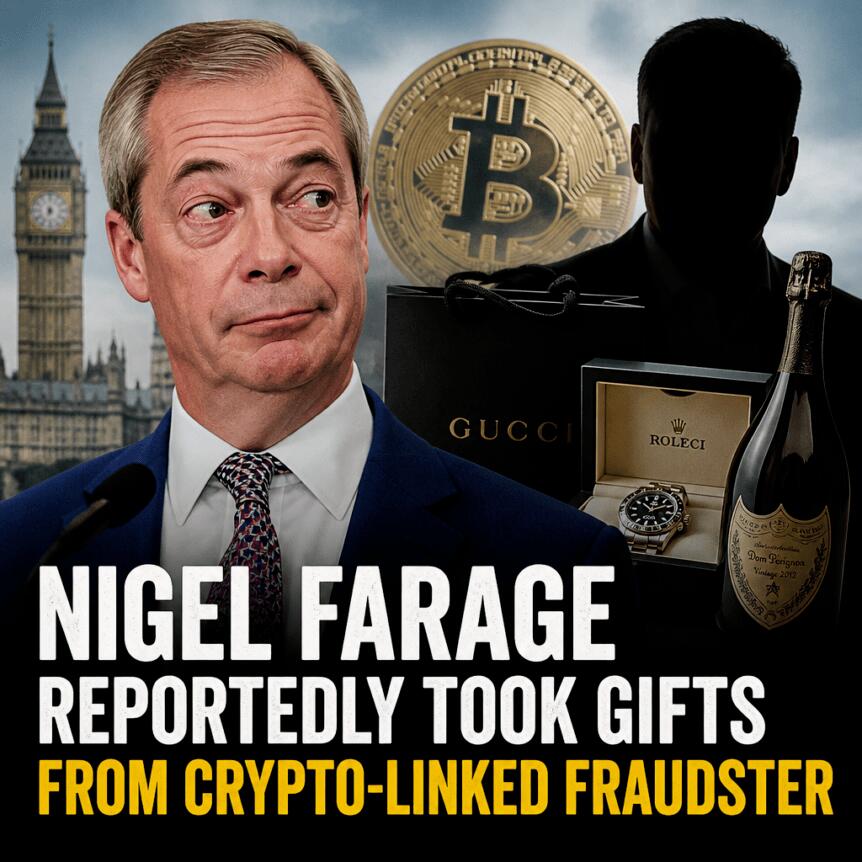
Reform UK leader Nigel Farage has denied wrongdoing after The Sunday Times alleged that he accepted undisclosed gifts from a US-convicted fraudster tied to the offshore crypto gambling world. The report says the gifts included staff support, security, and travel and accommodation provided by George Cottrell, an adviser to Farage for more than a decade.
Farage said in a statement that he “followed the rules,” adding that the story amounts to a “hit job.” The controversy arrives as UK crypto policy faces rising scrutiny, including tighter controls on political donations involving digital assets.
Key takeaways
- The Sunday Times reports Farage received additional undeclared support from George Cottrell, an associate connected to an offshore crypto casino.
- Farage denies he broke disclosure rules, with the gifts reportedly dating back to before he became an MP in July 2024.
- The allegations add to a pattern of scrutiny around Farage’s links to wealthy crypto-linked figures and political finance.
- UK crypto regulation pressure is intensifying, including a ban on cryptocurrency donations announced earlier this year.
- Ongoing complaints and inquiries show the debate is not just about crypto markets, but also about political integrity and conflicts of interest.
New allegations center on George Cottrell
In its Saturday report, The Sunday Times said Farage was gifted services that were not publicly disclosed. The gifts were attributed to George Cottrell, described as an aristocrat and a close adviser to Farage for more than 10 years.
According to the outlet, Cottrell provided access to security and drivers, including personnel described as former soldiers. The report also alleges Cottrell recruited and paid staff members to assist with the Reform leader’s social media. It further claims that, following Farage’s election, he was allowed to use a rented five-story house near Buckingham Palace, although a Reform source told The Times that Farage primarily stayed at his own home and did not routinely use that property.
The story also says Farage registered only a single benefit from Cottrell when he entered Parliament—described as less than £9,300 (about $12,400) for travel, security and accommodation related to an event in Belgium.
Farage’s response, published Sunday, disputed the implication that he failed to follow requirements. As reported by The Guardian, he said he “followed the rules” over the gifts from Cottrell.
Criminal case in the US links Cottrell to fraud allegations
The credibility of the allegations rests heavily on Cottrell’s prior legal history. The Sunday Times report states that in 2016 Cottrell was arrested and charged in the United States with 21 offenses connected to a money-laundering plot. The report adds that he pleaded guilty to a single wire fraud charge after a plea deal and served eight months in prison.
The article also ties Cottrell to an offshore gambling site, Tether.bet, which uses Tether’s USDT stablecoin. While the specific operational details of that venture are not addressed in the provided coverage, the overall framing connects his crypto involvement to the controversy over political support and disclosure.
Broader scrutiny: donations, lobbying claims, and prior watchdog action
This latest development follows a separate set of concerns around Farage and crypto-linked donors. A parliamentary standards watchdog opened an inquiry in May into whether Farage failed to declare a £5 million gift from crypto billionaire Christopher Harborne, a figure reported to have stakes in Tether. Farage has previously argued that some gifts did not require disclosure because they were provided for security arrangements before he became an MP, according to earlier reporting referenced in the original coverage.
The Sunday Times claim also comes after The Guardian reported earlier this week that Farage was accused of lobbying the Bank of England regarding its digital currency plans. In that report, Phil Brickell, a Labour MP and chair of a parliamentary anti-corruption group, was quoted describing a complaint to the standards commissioner.
Brickell’s allegation, as relayed in the cited coverage, was that Farage claimed credit for influencing the Bank’s stance on a central bank digital currency. Brickell also argued that Harborne would benefit if a state-backed digital currency were softened—particularly because it could compete with private stablecoins.
For investors and users, the significance goes beyond personal politics. It highlights how governance choices—such as how central bank digital currencies may be structured—can affect the competitive position of stablecoins and the broader crypto market ecosystem. When political figures are linked to substantial crypto-related wealth, regulators and watchdogs typically treat transparency and conflict-of-interest rules as central, not peripheral.
UK policy pressure on crypto political financing continues
The episode unfolds against a backdrop of tightening UK scrutiny of crypto-related political activity. The original coverage notes that the UK Treasury temporarily banned political donations made in cryptocurrencies in March, a step aimed at reducing the influence of opaque funding channels.
Reform’s own agenda has positioned the party as one of the more pro-crypto forces in UK politics. The coverage states that Reform published draft legislation last year intended to make the UK “the world’s premier hub for cryptocurrency.” It also notes that Reform was the first UK political party to accept donations in Bitcoin. Farage has supported proposals including cutting capital gains tax on crypto and calling for a Bank of England Bitcoin reserve.
In that context, repeated disclosures and investigations around how crypto-linked individuals fund political activities take on added weight. The central question for regulators and voters is whether existing rules are being followed—and whether policy advocacy can be separated from the financial interests of large backers.
Readers should watch whether the standards investigations advance toward formal findings, and whether new disclosure obligations—especially those affecting crypto-related political donations—continue to expand. Another open point is how any alleged lobbying over central bank digital currency plans will be evaluated in light of the relationships and benefits described in the reporting.

Ripple’s cross-border token has gained over 9% in the past week and now sits near $1.15 after bottoming (for now, at least) at $1.01 a few weeks ago.
Such a notable resurgence in a relatively short timeframe has given wings to the perma-XRP-bulls, as new predictions of bigger rallies and peaks emerged over the weekend.
XRP to $4 or $5?
Crypto trader Nehal outlined the 1-week trading chart for the token, which clearly demonstrates the downhill price action that began a year ago when it peaked at $3.65. However, XRP is now testing the upper boundary, located at around $1.12-$1.15. A successful breakout could be the necessary push to start a new run.
The trader believes a major 250% rally could follow, sending the altcoin to a new all-time high of over $4.
Fellow analyst Mikybull Crypto shared a similar opinion, indicating that “something massive is coming for XRP.” Although they focused on XRP’s performance against BTC, which shows an identical declining move, their target against the greenback was even more bullish – $5.
Seeing this chart, it gives you a clue that something massive is coming for XRP
$5 will be the minimum conservative target for what is coming pic.twitter.com/G3jHwhau52
— MikybullCrypto (@MikybullCrypto) July 6, 2026
It’s worth noting that such major price predictions of $4 or ‘at least’ $5 sound quite unreasonable at the moment, given the current market conditions and sentiment. However, XRP has proven in the past that it’s capable of similar moves, such as the one in late 2024 and early 2025, in which it rocketed from $0.50-$0.60 to $3.40 in just a few months.
Major Moment Arrives
Celal Kucuker also observed XRP’s price moves against the market leader, suggesting that the altcoin has reached a major moment. They explained that the red descending channel (seen in the tweet below) is close to breaking, which has been able to withstand all of XRP’s breakout attempts in the past few months.
They were significantly more bullish on Ripple’s altcoin, indicating that such a move would allow XRP to “outperform Bitcoin by 10x.” Their ultimate price target for the cross-border token is $12, which would coincide with the time “BTC is printing new ATH.”
The XRP/BTC chart is approaching a major moment.
The red descending channel is close to breaking.
When that breakout happens, I expect Ripple to outperform Bitcoin by 10x from here.
By the time $BTC is printing new ATH, $XRP will likely already be trading above $12
Save this… pic.twitter.com/OIzLaM0w0C
— Celal Kucuker (@CelalKucuker) July 5, 2026
SUNCOAST joined the other analysts above in predicting that XRP is at “a massive decision point.” Its multi-month falling wedge is “compressed to the absolute max,” which would mean a massive move ahead. However, they didn’t provide a precise price target, but noted that the “expansion will be violent” once the breakout is confirmed.
The post XRP Reaches Major Decision Point as Analysts Expect a Huge Move: Here Are the Targets appeared first on CryptoPotato.


The CLARITY Act did not become law by July 4, despite earlier hopes from White House crypto adviser Patrick Witt. Attention has now moved to Aug. 7, the Senate’s final session day before its summer break and the campaign season.
Summary
- July 4 passed without enactment, leaving Senate negotiators under pressure before the Aug. 7 break.
- Staff still need to merge Banking and Agriculture versions before any full Senate floor vote.
- Backers gained law enforcement support, but ethics, AML and vote math remain open Senate issues.
The bill remains one of the most watched U.S. crypto market structure proposals. Crypto.news reported that the CLARITY Act has passed the House, cleared the Senate Banking Committee, and sits on the Senate calendar. It still needs a full Senate vote before it can move closer to the president’s desk
Staff work continues on Senate text
Senate staff are still working to reconcile the Agriculture and Banking Committee versions. That step matters because both committees have jurisdiction over parts of digital asset policy. A single Senate text must be ready before floor action can move cleanly.
Recent crypto.news coverage said Senator Bill Hagerty revived hopes after outlining a new Senate roadmap for the CLARITY Act. The report said the Senate could release final text before lawmakers return from recess, while Bloomberg Intelligence placed the bill’s chance of passing this month near 60%.
Senator Cynthia Lummis has also pushed lawmakers to keep the bill moving. Crypto.news reported that Lummis said the bill would “lay the foundation for the financial services of the 21st century.” She also said, “The Clarity Act is this generation’s contribution to that legacy. Let’s finish the job.”
Vote math and policy disputes remain
The bill still faces a hard Senate vote count. Crypto.news has reported that the CLARITY Act likely needs 60 votes on the floor, meaning Republicans must secure Democratic support to overcome Senate rules. That requirement keeps negotiations active.
TD Cowen warned that the bill’s timeline remains uncertain before the November midterm election. Crypto.news reported that the firm pointed to ethics rules, anti-money laundering concerns, and questions over political support as issues that could slow a vote.
The bill would divide digital asset oversight between the SEC and the CFTC. Crypto.news also reported that the CLARITY Act would add exchange safeguards, customer fund rules, and funding for crypto fraud investigations.
Law enforcement language has been one of the most debated areas. Critics have focused on Section 604, which covers some non-custodial developers and software providers. Supporters say it protects builders who do not control customer funds.
Law enforcement shift gives backers room
Backers gained some room after the Major County Sheriffs of America moved to a neutral stance on the bill’s decentralized finance section. Crypto.news reported that the group withdrew its objection to the CLARITY Act’s DeFi provision while asking for more state and local law enforcement input.
The National Organization of Black Law Enforcement Executives also endorsed the bill. Crypto.news reported that NOBLE said the measure “contains several provisions” that could help law enforcement while keeping current criminal powers in place.
The next test is scheduling. If the Senate does not move before Aug. 7, the bill could face a much harder path after lawmakers return to campaign work. For now, supporters remain active, but the calendar has become the main barrier.
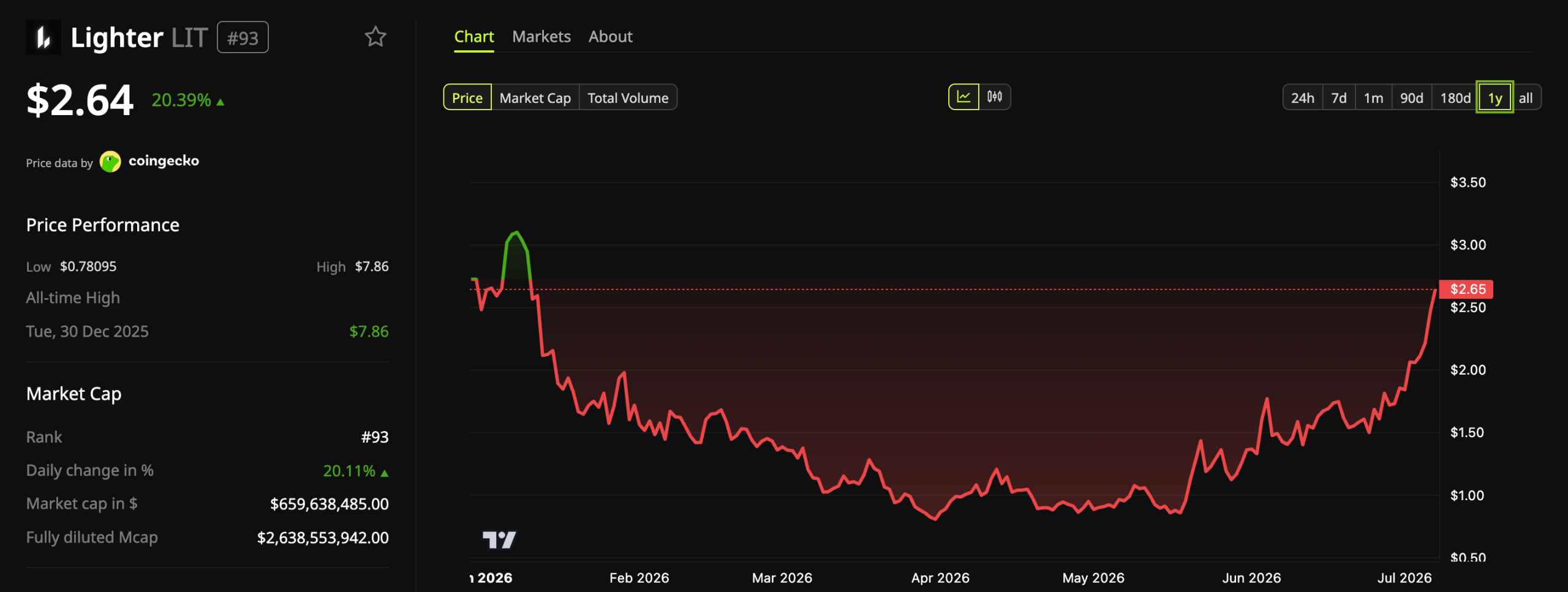
Lighter (LIT) surged more than 20% on Monday to $2.6, its highest level since January, after the perpetuals exchange unveiled a tokenomics overhaul that adds permanent burns and a revamped staking model.
The move made LIT the top gainer among the 100 largest cryptocurrencies. It extended a rally that has lifted the token roughly 40% over the past week, far outpacing the broader market.

Follow us on X to get the latest news as it happens
Lighter Introduces Tokenomics Update
Lighter has bought back LIT with exchange revenue after its token launch. The exchange said it has repurchased about 15.5 million LIT, or roughly 6.3% of the circulating supply. Lighter said it plans to use the buybacks to permanently reduce the LIT supply through burns.
The burns will run by sending LIT to a burn address on the Ethereum (ETH) mainnet. Lighter plans its first burn in the weeks after the second quarter closes. It noted it may burn undistributed LIT rather than the exact repurchased tokens.
“This is economically equivalent for LIT holders and allows Lighter to manage treasury operations efficiently and avoid unnecessary costs,” the exchange said.
Staking Rewards Shift to Reserve
Lighter also changed how it funds staking rewards. Since launching its staking program in January, it has distributed about 3.72 million LIT using pre-TGE revenue, including roughly 170,000 LIT through its fee credits program.
That approach is ending. The exchange will now fund staking rewards using its remaining ecosystem tokens, which total 250 million LIT.
The protocol is targeting a 6% annualized staking yield. With about 125 million LIT currently staked, that would distribute roughly 7.5 million LIT per year.
LIT still trades well below its $7.86 record set in December. Whether the new model sustains demand may hinge on trading revenue holding up in the months ahead.
Subscribe to our YouTube channel to watch leaders and journalists provide expert insights
The post Lighter Jumps 20% to Seven Month High After Tokenomics Overhaul appeared first on BeInCrypto.
The gradual price recovery that began in early July continued over the past 12 hours or so, as bitcoin jumped to $64,000 for the first time in almost two weeks.
Although it was stopped there for now, analysts seem more confident that the overall market environment has improved and outlined the cryptocurrency’s next big resistance lines.
What’s Next?
It was less than a week ago, on July 1, when the largest digital asset slipped below $58,000 for the first time in nearly two years as the bear-dominated price moves continued to dominate. However, after losing roughly $25,000 in a month and a half, the bulls finally reemerged and halted the freefall.
Bitcoin rebounded in the following days, which culminated earlier this morning with a jump to $64,000 on most exchanges. This $6,000 increase in days meant that BTC had tapped its highest price tag since June 23.
Michaël van de Poppe weighed in on the asset’s performance over the weekend, calling it “solid price action.” He believes bitcoin needs to paint a higher low and reassured that even another correction to $59,000 would be considered mild and weak at this point. However, BTC’s breakout could begin if it maintains above $61,000-$61,500, which could open the door for a run toward $70,000.
Merlijn The Trader outlined $67,000 as the most crucial level for BTC. He explained that the cryptocurrency needs to decisively reclaim it, which would solidify the escape from its bear market phase. If reclaimed, the analyst said he will turn bullish as the trend will flip. However, another rejection there would probably mean more downside first.
One Bitcoin level separates the bear market from the reversal: $67K.
A bullish falling wedge is pressing against resistance right now.
Break and close above: I turn bullish. The trend flips.
Rejection: more downside first and I’ll say it just as loud.
No guessing. No hoping.… pic.twitter.com/qMlVw3yYAE
— Merlijn The Trader (@MerlijnTrader) July 5, 2026
Fear and Greed Index Improves
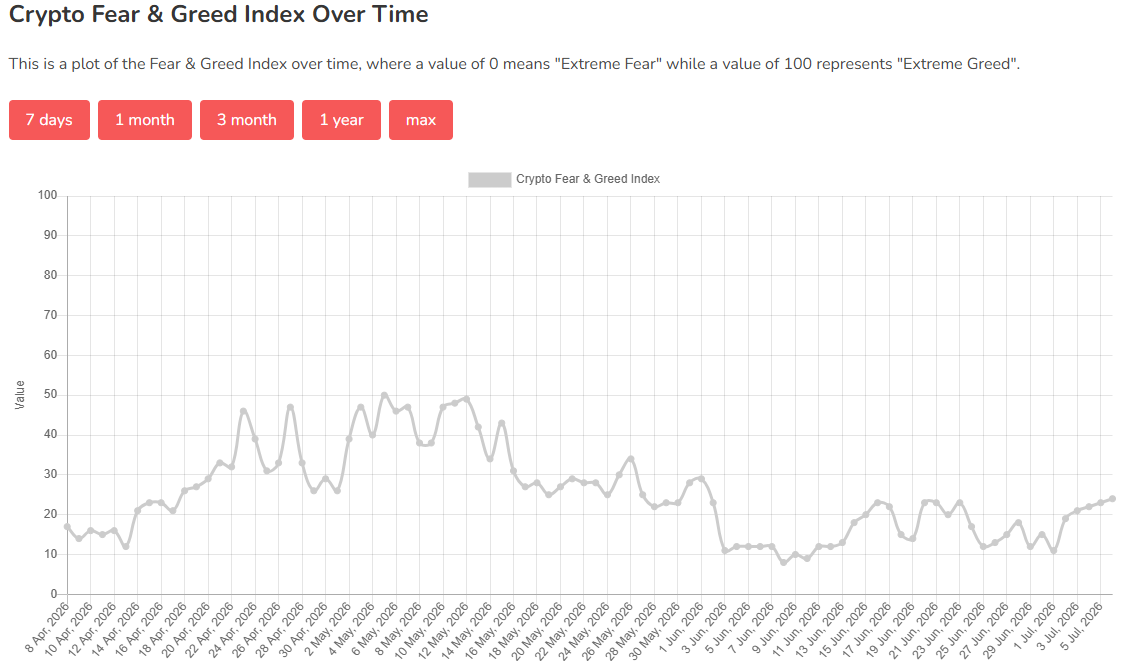
The metric measuring the overall market sentiment toward BTC dropped hard over the past few weeks alongside the asset’s price. It dumped to ‘extreme fear’ levels of around 11 on July 1 when the cryptocurrency bottomed (for now) at $57,700.
However, it has followed bitcoin’s gradual price recovery and now sits at 24. Although fear continues to dominate investors’ feelings, the swift rebound highlights early signs of potential market reversal, as the metric hasn’t been at 24 or above in over a month.
The post Bitcoin Price Hit a 2-Week Peak, but Bigger Tests Lie Ahead appeared first on CryptoPotato.
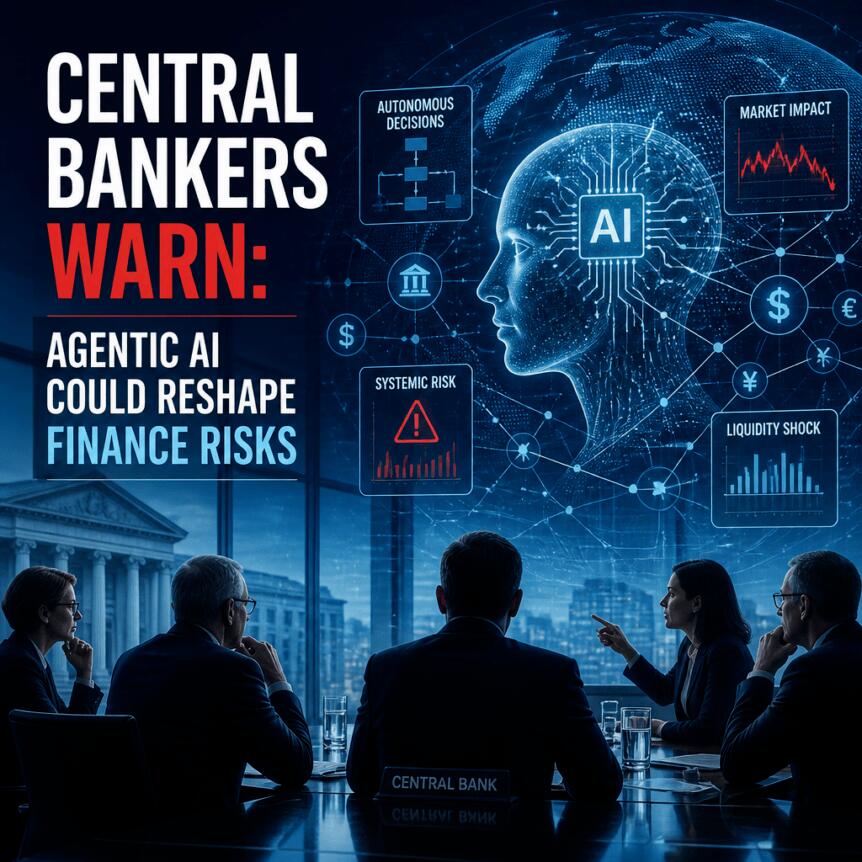
European regulators and central bankers are pressing for faster, more practical guardrails as agentic artificial intelligence (AI) moves from research into real-world finance. Several senior officials argued that conventional rulemaking timelines may be too slow to manage risks that can emerge within weeks or months—especially during periods of market stress.
Speaking at the European Central Bank’s annual meeting in Sintra, Portugal, Bank of England deputy governor Sarah Breeden warned that agentic systems could amplify volatility when markets are already under strain. She also raised the possibility that policymakers may need circuit-breaker-style interventions if faulty AI behavior threatens to cascade into broader market disruptions, according to her remarks at the ECB event.
Key takeaways
- Bank of England deputy governor Sarah Breeden said agentic AI could heighten volatility during market stress and floated the idea of “circuit breaker” protections for faulty models.
- Christine Lagarde, President of the European Central Bank, called AI a “major risk,” citing cybersecurity and defense gaps that have not kept pace with model acceleration.
- UK Financial Conduct Authority CEO Nikhil Rathi argued traditional rulemaking cycles are too slow for AI, urging a more collaborative approach with markets.
- The BIS warned on June 28 that AI “exuberance” could trigger boom-bust dynamics, potentially feeding into disruptive macro-financial loops.
Circuit-breaker thinking for agentic AI
Breeden framed the core policy challenge around speed and systemic consequences. At the ECB Forum on Central Banking 2026, she questioned whether guardrails should be designed to function like “circuit breakers or kill switches” that could limit or stop market-wide trading if AI systems malfunction and contribute to a broader meltdown, according to her speech.
The underlying concern is not only that AI may be wrong, but that agentic AI—systems that can take actions toward goals with limited human oversight—could behave in ways that interact with market microstructure. During calm conditions, such effects may be muted. In stress, however, the same automation can potentially intensify feedback loops, making volatility harder to contain.
Why European policymakers worry about both security and system stability
ECB President Christine Lagarde tied the regulatory discussion to a familiar set of themes—cybersecurity, hacking, and data theft—but stressed that the pace and depth of modern AI changes the threat environment. In an interview with French outlet Les Echos, she said the risk has become more serious because it is “happening very, very quickly,” while the resources needed for defenses have not yet been found.
Lagarde’s warning underscores a dual risk lens. First, AI can expand the scale and sophistication of cyber threats. Second, defenders often require time and funding to catch up—creating a window where vulnerabilities may be exploited faster than institutions can mitigate them.
In parallel, Nikhil Rathi, CEO of the UK’s Financial Conduct Authority, told CNBC’s Squawk Box that regulatory processes built for slower technological cycles do not translate cleanly to AI. He said some AI technologies move in weeks or months, and the “traditional cycle of rulemaking simply doesn’t work in that way,” adding that regulators need “new tools and a different way of working with the market in a more collaborative way,” according to his comments on July 3, 2026.
Accountability timelines may not match AI’s deployment pace
What connects these remarks is a shared critique of timing. Conventional regulation often depends on consultation, impact assessment, and phased implementation—steps that can be incompatible with rapid iteration and deployment common in the AI frontier. That mismatch creates a practical problem for both regulators and market participants: rules may arrive after the risky behavior has already spread.
Breeden’s circuit-breaker framing suggests one answer—designing operational limits that can be triggered dynamically, rather than relying solely on ex ante compliance requirements. Rathi’s call for collaboration points to another: working with markets to develop expectations and monitoring approaches while the technology evolves.
The European policy challenge is heightened by how investment capital is allocated. The article notes that US companies have been leading in AI investment and frontier model development, and that Europe’s financial system provides fewer capital channels into AI than US equity markets. It also warns that if regulation becomes overly cautious, AI firms may look for jurisdictions with lighter compliance burdens, potentially widening the gap further.
IMF, BIS: leverage, maturity mismatch, and boom-bust risk
Beyond operational guardrails, central banking authorities are also focusing on financial stability risks linked to AI-driven cycles. The Bank for International Settlements (BIS) warned on June 28 that AI “exuberance” could carry major financial consequences. According to the BIS, if policymakers tighten monetary policy to contain inflation, it could lead to a sharp pullback in AI-related asset prices after a prolonged period of exuberant risk-taking.
The BIS cautioned that such a correction could trigger “disruptive macro-financial feedback loops,” suggesting a scenario where falling asset values tighten financial conditions, which then feeds back into broader economic stress.
Breeden also pointed to rising debt financing as a factor that could increase the stability consequences of a decline in AI-related asset prices, according to her remarks. In an interview with Bloomberg dated June 30, IMF Monetary and Capital Markets Department director Tobias Adrian similarly highlighted a “potential maturity mismatch” between the duration of physical assets and the duration of debt—an issue that can become especially problematic when cash flows weaken or refinancing conditions deteriorate.
What investors and builders should watch next
The immediate takeaway is that European regulators appear to be moving from broad warnings toward specific mechanisms—whether circuit-breaker-style interventions, faster collaborative oversight, or stability-focused monitoring of leverage and market dynamics. Market participants should watch for how authorities operationalize these ideas: whether guardrails become technical standards, supervisory expectations, or risk monitoring frameworks designed to respond in real time as AI systems and market behavior change.
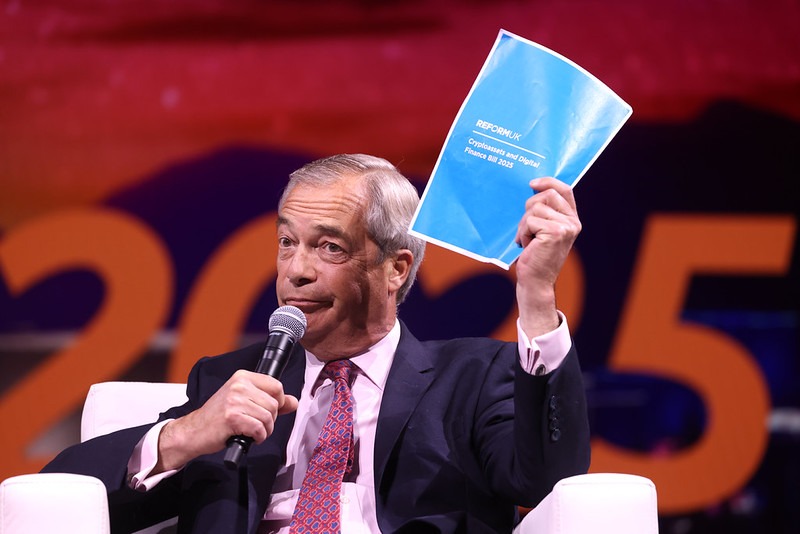
Reform UK leader Nigel Farage reportedly accepted gifts that he did not publicly disclose from a crypto entrepreneur convicted of fraud in the US, according to The Sunday Times.
The news outlet reported on Saturday that Farage was gifted staff, security, transport and accommodation by George Cottrell, an aristocrat involved in an offshore crypto casino who has been a close adviser to Farage for more than 10 years.
Farage said in a statement on Sunday that he “followed the rules” over the gifts from Cottrell, which he received before he was elected a member of parliament in July 2024, and called The Times’ report a “hit job.”
It is the second time Farage has faced reports of undeclared gifts from wealthy figures tied to crypto, an industry he has advocated for while in parliament that is facing increasing regulatory scrutiny, with the Treasury having temporarily banned political donations made in cryptocurrencies in March.
A parliamentary standards watchdog opened an inquiry in May over whether Farage failed to declare a 5 million British pounds ($6.7 million) gift from crypto billionaire Christopher Harborne, who partly owns stablecoin giant Tether.
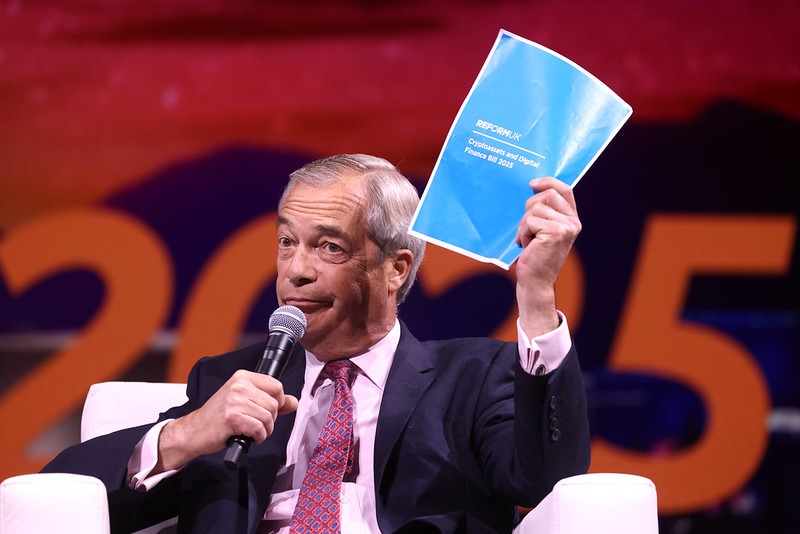
Nigel Farage appears at the Bitcoin 2025 conference holding his party’s draft crypto legislation. Source: Gage Skidmore
Farage has argued he does not need to declare Harborne’s gift, as it was given to him to pay for personal security before he was an MP.
Cottrell’s reported gifts include security, use of house
The Sunday Times reported that Cottrell, who is involved in a gambling site called Tether.bet that uses the Tether (USDt) stablecoin, provided Farage with drivers and security made up primarily of former soldiers.
Cottrell also reportedly recruited and paid for three staff members to help with the Reform leader’s social media and, since the election, has let Farage use a rented five-story house near Buckingham Palace. A Reform source told The Times that Farage almost always stayed at his own home and did not routinely use the property.
Farage registered only one benefit from Cottrell upon entering Parliament, a benefit of less than 9,300 British pounds ($12,400) for travel, security and accommodation to attend an event in Belgium.
In 2016, Cottrell was arrested and charged in the US with 21 offenses for his role in a money laundering plot. He pleaded guilty to a single wire fraud charge after a plea deal and spent eight months in prison.
Farage reported over alleged crypto lobbying
The Times’ report follows a report in The Guardian on Friday that the standards commissioner was urged to investigate whether Farage lobbied the Bank of England to drop its digital currency plans.
Related: Crypto billionaires bankroll Nigel Farage’s pro-crypto party
Labour MP and chair of a parliamentary anti-corruption group, Phil Brickell, reported Farage to the commissioner, saying he “claimed credit for persuading the Bank to soften its position” on a central bank digital currency.
Brickell said that Harborne “stood to benefit from opposition to a state-backed digital currency that could compete with private stablecoins.”
“This is not simply a debate about cryptocurrency. It is about whether an MP who has received millions from one individual should be lobbying for policies that could increase the value and profitability of that [Reform] donor’s investments,” said Brickell.
Farage and Reform have championed crypto, with the party publishing draft legislation last year with the goal of making the UK “the world’s premier hub for cryptocurrency.”
Reform was also the first UK political party to accept donations in Bitcoin (BTC). Farage has also proposed cutting capital gains taxes on crypto from 24% to 10% and called for the Bank of England to create a Bitcoin reserve.
Magazine: Guide to the top and emerging global crypto hubs: Mid-2026


Spot Bitcoin ETFs recorded $527 million in net outflows from June 29 to July 2, extending their weekly withdrawal streak to eight weeks. The latest data shows that demand for Bitcoin funds remains weak, even after some products returned to daily inflows.
Summary
- Bitcoin ETFs extended their outflow streak as investors pulled $527 million over four trading days.
- Ethereum ETFs also stayed negative, showing weak demand across the two largest crypto assets.
- XRP, SOL and HYPE funds drew inflows, pointing to selective demand beyond Bitcoin and Ethereum.
Crypto.news reported that U.S. spot Bitcoin ETFs lost $527 million over the four trading days ending July 2. The same report said the streak is now the longest weekly outflow run since the funds launched.
The weekly loss came despite a positive daily session on July 2. Bitcoin ETFs recorded $221.7 million in net inflows that day, ending a 10-day daily withdrawal run. Fidelity’s FBTC led the rebound with about $166 million in inflows, while ARK 21Shares’ ARKB added about $91.8 million.
BlackRock’s IBIT remained a main source of pressure. The fund recorded outflows on each trading day from June 29 through July 2. The pattern showed that one strong daily inflow was not enough to reverse broader weekly selling.
Ethereum ETFs remain under pressure
Spot Ethereum ETFs also ended the same period in negative territory. The products recorded $13.67 million in net outflows from June 29 to July 2, marking their eighth straight week of withdrawals.
Crypto.news reported that Ethereum ETFs posted positive daily flows on July 1 and July 2, but the gains did not fully offset earlier redemptions. BlackRock’s ETHA recorded about $29.7 million in inflows on July 2, helping the group recover part of its earlier losses.
The weak weekly result followed earlier pressure across Ethereum funds. Crypto.news recently reported that Ethereum ETFs faced large weekly withdrawals while traders watched whether ETH could hold key price levels.
The data shows that Bitcoin and Ethereum funds still face uneven demand. Investors returned on some days, but weekly figures continue to show net selling across the two largest crypto ETF groups.
XRP, SOL and HYPE funds buck the trend
Altcoin-linked funds moved in the opposite direction. Spot SOL ETFs recorded $5.75 million in net inflows from June 29 to July 2. XRP ETFs added $17.19 million, while HYPE ETFs brought in $4.32 million.
The inflows were smaller than the Bitcoin ETF outflows, but they showed that investors did not leave all crypto funds. Some capital moved into products tied to assets outside Bitcoin and Ethereum.
Crypto.news has tracked this trend in recent weeks. In May, XRP ETFs beat Bitcoin and Ethereum funds with $131.94 million in monthly inflows, while Bitcoin and Ethereum products recorded heavy withdrawals.
Bitwise also said its XRP ETF inflows topped $200 million year to date across U.S. and European products. Crypto.news also reported that HYPE ETFs crossed $100 million in inflows within their first 10 trading sessions.
ETF market shows divided demand
The latest ETF data points to a divided market. Bitcoin and Ethereum products continue to lose money on a weekly basis, while smaller crypto funds attract selective inflows.
Crypto.news has also reported on a wider XRP ETF rotation from Bitcoin funds, noting that the move remains smaller in size than Bitcoin’s outflows. The trend still shows that some investors are seeking exposure outside BTC during weak market conditions.
Solana funds have also seen steady interest this year. Crypto.news reported that Solana ETF assets crossed $1 billion by mid-May, even as SOL’s price remained under pressure.
For now, ETF flows show no broad recovery across major crypto funds. Bitcoin and Ethereum ETFs remain in weekly outflows, while XRP, SOL and HYPE products continue to attract smaller but positive demand.


In the never-ending battle between bitcoin , the digital gold, and the traditional yellow metal, veteran trader Peter Brandt has picked a side, and it’s not the one bitcoin bulls would have hoped for.
Brandt, CEO of Factor LLC and widely followed chart analyst, said on X that he is mulling liquidating some of his BTC and using the proceeds to buy gold, as he sees the yellow metal outperforming BTC.
“I am contemplating selling some of my Bitcoin and going to Gold with the money. Looks to me that Gold is going to gain substantially on Bitcoin,” Brandt told his followers on X.
Both BTC and gold have recently taken a beating, though bitcoin has fared noticeably worse than the traditional safe haven metal. The leading cryptocurrency by market value slid 20% in June to below $60,000, marking its worst monthly performance in four years. Gold, by comparison, dropped 11.7% to nearly $4,000 per ounce.
The divergence looks even starker on a year-to-date basis, with BTC down 28% in 2026 versus a 3.9% decline for gold.
Bucking the trend
Brandt’s view flies directly in the face of the popular market narrative among crypto bulls’ that anticipates a massive rotation of money back into BTC and digital assets.
Thousands of crypto wallets are at risk of being drained due to the use of weaker-than-intended recovery phrases, an exploit that Blockchain security research firm Coinspect has dubbed “Ill Bloom.”
The wallets at risk span Bitcoin, Ethereum, Polygon, Rootstock, Tron and Solana, Coinspect said in a disclosure on Sunday, with the issue related to weak randomness — an insecure pseudorandom number generator — used during recovery phrase generation on certain software wallets.
“If funds recently moved without your permission, this vulnerability may be why,” Coinspect said.
The vulnerability has impacted wallets generated as early as 2018 and more often occurs in lesser-known mobile software wallets. At least $5 million has been drained from exposed wallets since May 27, though there could have been exploits on additional networks and addresses, meaning the number of wallets at risk may be much higher.
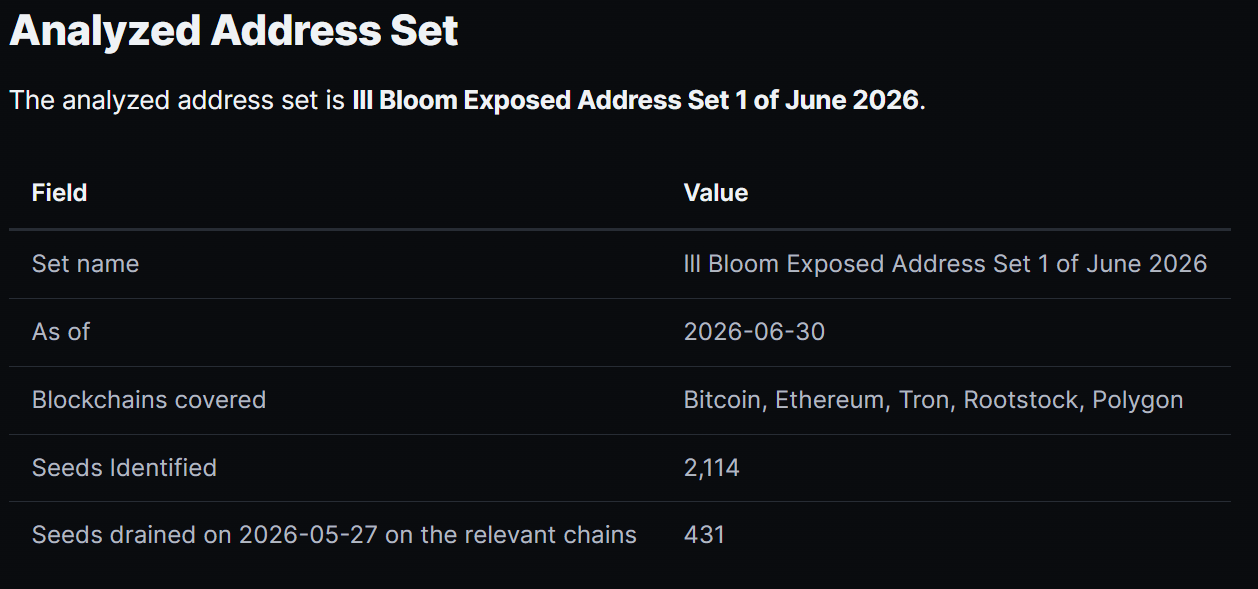
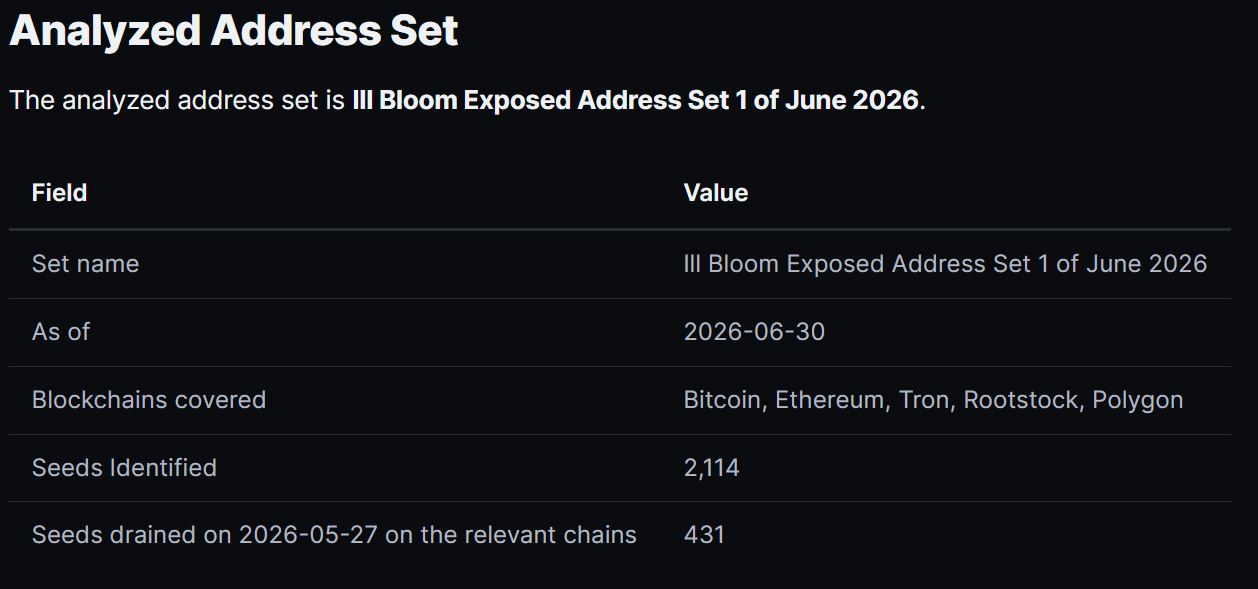
A snapshot of one analyzed address set as of June 30. Source: Coinspect
Coinspect said it was not publishing details of the active exploit at this stage, but has released a wallet-checking tool for users to see whether their address is potentially exposed.
“We’re closely monitoring the Ill Bloom wallet weak randomness risk alert from Coinspect,” SlowMist posted to X on Monday.
Data shows that an attack on May 27 affected 431 wallets out of 2,114 vulnerable wallets, draining a total of $3.1 million in cryptocurrency. Another $2 million was moved on Sunday from exposed wallets.
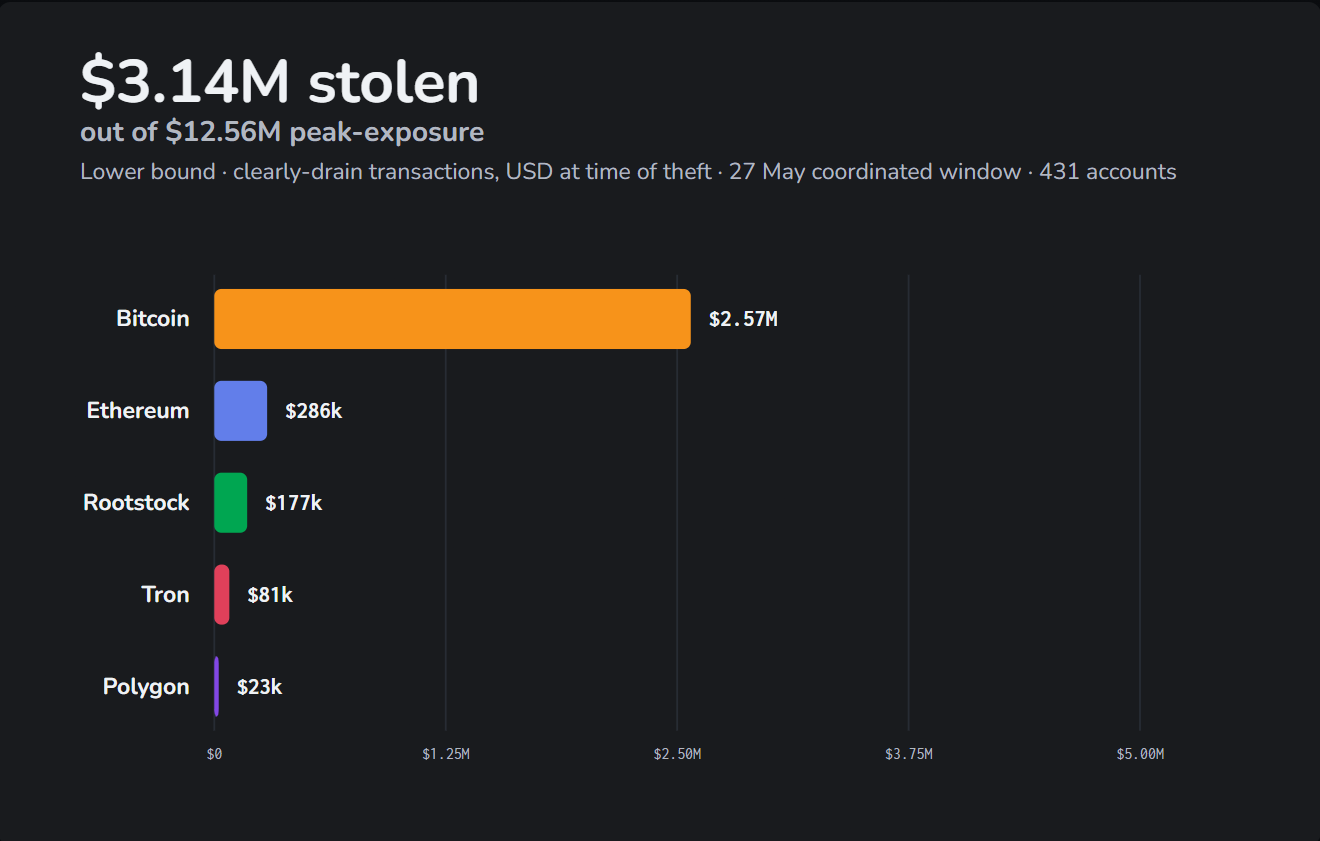
The historical sum of stolen amounts per chain in the May 27 attack. Source: Coinspect
“Current evidence tells us that users that generated their seed with a hardware wallet are not affected,” said Coinspect.
“Further research indicates that most current software wallets are also not vulnerable,” it added. “The strongest candidates are users who generated their seed in less widely used mobile software wallets.”
Related: Taiko reopens bridge after $1.7M exploit, says users made whole
Weak wallet seeds cause headaches
This type of vulnerability has emerged several times in the past. In 2023, Ledger’s security team discovered that wallet seeds generated by the Trust Wallet browser extension were vulnerable to brute-force attacks.
The flaw resided in the wallet’s entropy generation for new addresses, which limited the total possible mnemonic combinations to roughly four billion and could allow a motivated attacker to run an attack in less than a day with just a few GPUs. Trust Wallet patched the bug before any funds were stolen.
In the same year, a vulnerability in the Libbitcoin Explorer crypto wallet led to $900,000 in crypto being stolen through private key brute forcing.
Magazine: Bitcoin slides to $58K, XRP hits $1 but onchain data promising: Market Moves

Finance Minister Nirmala Sitharaman’s 5 Financial Tips Everyone Must Follow

Who is Arthur Fery? The British wildcard taking Wimbledon by storm

Plans for new Devizes Tesco superstore in ‘parkland setting’ with lakes and trees unveiled


-

 Fashion3 days ago
Weekend Open Thread: High Hopes
-

 Politics3 days ago
The House | “Reframing the debate from a binary discussion of winners and losers”: Yuan Yang reviews ‘We Are Not Machines’
-

 Crypto World6 days ago
Strategy authorizes up to $1.25B in Bitcoin sales under new capital plan
-

 News Videos6 days ago
How to Build INSANE Live Financial Dashboards With Claude
-

 Tech6 days ago
Anonymous researcher drops 0-day ‘exploitarium’ repo
-

 Business6 days ago
Australia treasurer says alleged access of prime minister’s bank data ’incredibly concerning’
-
 NewsBeat1 day ago
Taylor Swift and Travis Kelce wedding staffer hilariously struggles to keep her cool while checking in megastars
-
 Business7 days ago
The AI boom won’t burst all at once. It will pop in ‘rolling bubbles’: Macquarie
-

 Sports5 days ago
Broncos roster: OL Ben Powers (No. 74) entering final year of contract
-
 Crypto World5 days ago
Airdrop Registration Becomes Key Focus For Remittix As RTX Launch Updates Approach
-

 Crypto World4 days ago
Binance stock trading tops $1B in first month after launch
-

 NewsBeat5 days ago
Presenter Caroline Flack’s brother Paul Flack dies aged 55
-

 Crypto World4 days ago
Alibaba-affiliate Ant Group enters the humanoid robot market with 12 deals
-
 NewsBeat4 days ago
New exhibition reflects five decades of movement between island of Ireland and GB
-

 Crypto World17 hours ago
South Africa proposes crypto tax guidance under existing rules
-

 Tech19 hours ago
Lenovo laptops are now shipping with YMTC SSDs, a sign of Chinese NAND entering the mainstream
-

 Business3 days ago
What a 10 Percent Drop Means for Buyers, Sellers and Renters
-

 Business4 days ago
Meta Platforms Stock Jumps 7% Today as Bloomberg Reports Company Plans to Enter the Cloud Business
-

 Crypto World3 days ago
Standard Chartered Secures MiCA License as ESMA Adds 37 New Crypto Firms
-

 Crypto World3 days ago
Binance Re-Enters Philippines As EU MiCA Rules Restrict Access
You must be logged in to post a comment Login