Noble Audio is a major player in the hi-fi arena. Founded in 2013, Noble’s vast and varied work in the IEM market has helped shape much of what we now take for granted. From CNC-machined aluminum shells to sophisticated driver configurations, there are few parts of the modern IEM scene that Noble has not influenced in some way.
Today, we’re taking a look at one of Noble’s newest and most affordable earbuds: the true wireless Noble Osprey. At $199, this hybrid TWS undercuts flagship offerings from established brands like Bose and Sony on price. But does Noble have what it takes to match them in the realm of modern tech features and quality-of-life refinement? Let’s get into it.
Photo credit: Resonance Reviews
About My Preferences: My impressions are inevitably influenced by my personal preferences. While I try to mitigate that as much as possible during the review process, I’d be lying if I said my biases are ever completely erased. So, for you, my readers, keep the following in mind:
My ideal sound signature includes competent sub-bass, textured mid-bass, a slightly warm midrange, and extended treble.
Advertisement
I also have mild treble sensitivity.
Testing equipment and standards can be found here.
Noise control: Active Noise Cancellation and Hearing Through/Transparency mode
Microphones: Dual microphones with cVc noise reduction
Multipoint: Yes
TrueWireless Mirroring: Yes
Battery life: Up to 7 hours with ANC off; up to 5 hours with ANC on
Quick charging: Approximately 2 hours of playback from a 10-minute charge
Charging case: 500mAh aluminum case
Charging: USB-C
Included accessories: Aluminum charging case, USB-C cable, ear tips, and user documentation
Tech & Features
The Osprey supports Bluetooth 6.0, along with a suite of high-quality audio codecs. LDAC, AAC, and SBC are onboard, with the only notable exclusions being aptX HD and aptX Low Latency. This appears to be a concession to keep the price low, as aptX is a proprietary suite of codecs licensed by Qualcomm.
Pairing the Osprey with my Google Pixel 10 Pro was quick and easy. A brief jaunt through the user manual confirmed that the Osprey automatically launches into pairing mode when new, which was convenient. I was able to pair the Osprey seamlessly with all of my devices, including my Windows 10/11 desktop, Linux PC, and Nintendo Switch 2. The Osprey also supports multipoint connectivity, allowing it to juggle multiple active connections without requiring user intervention.
Advertisement
The Osprey features haptic touch controls on both earbuds and supports single, double, triple, and long-press gestures. They are fine for the most part, but can be inconsistent when trying to quickly pause or play audio. As a general rule, I prefer buttons on true wireless earbuds, and the Osprey is no exception. Being forced to tap my earbuds to pause music or adjust the volume is disruptive, especially when some of those taps are not recognized.
Further, the Osprey’s hollow construction transmits a ton of noise into my ears when using the touch controls, which is a less-than-fun experience. Thankfully, you can adjust which gestures map to which functions through the app, barring the press-and-hold control for ANC modes.
Advertisement. Scroll to continue reading.
I appreciate the app’s lightweight, zero-account approach. You can update the Osprey’s firmware, select an EQ preset, or create your own using its 10-band equalizer.
Advertisement
While that minimalism is good for performance and storage footprint, it comes with some functional downsides. Mainstream rivals like Sony, Bose, and JBL offer more advanced features, including location-based profiles, find-my-device tools, and ear-health monitoring — useful extras that power users may miss.
The austere Noble app reflects the company’s priorities: Noble remains primarily focused on sound, leaving much of the more elaborate tech experience to the established names in the true wireless earbud space.
Build
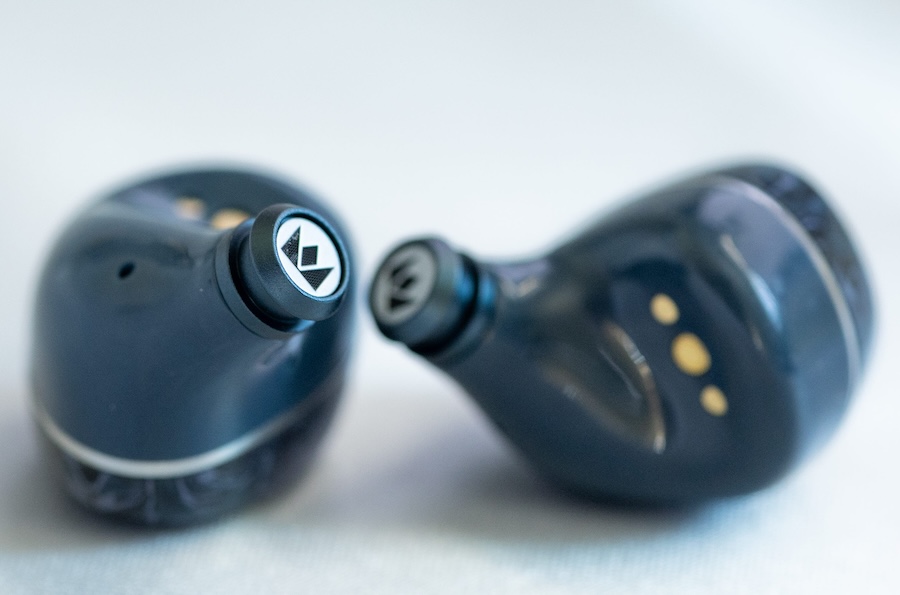
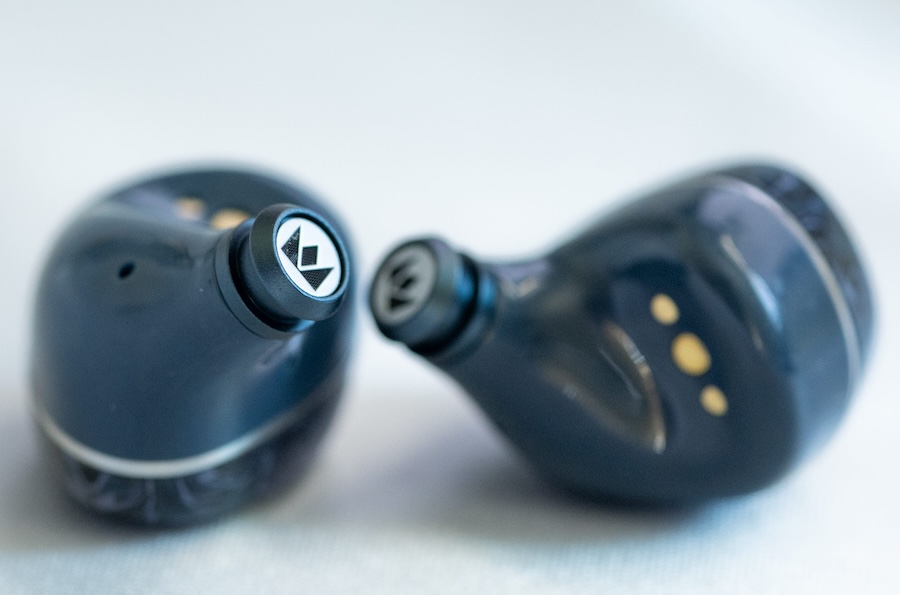
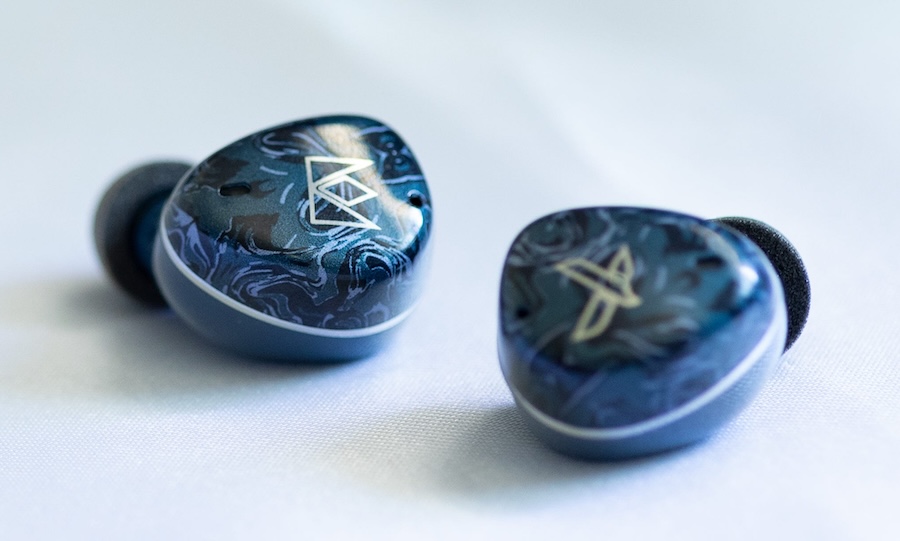
As is tradition with Noble Audio’s IEMs, the Osprey places a major emphasis on aesthetics. It features a four-piece chassis comprising a resin faceplate, plastic middle ring, resin inner face, and short aluminum nozzle. The nozzle is machined from aluminum and topped with a metal debris filter.
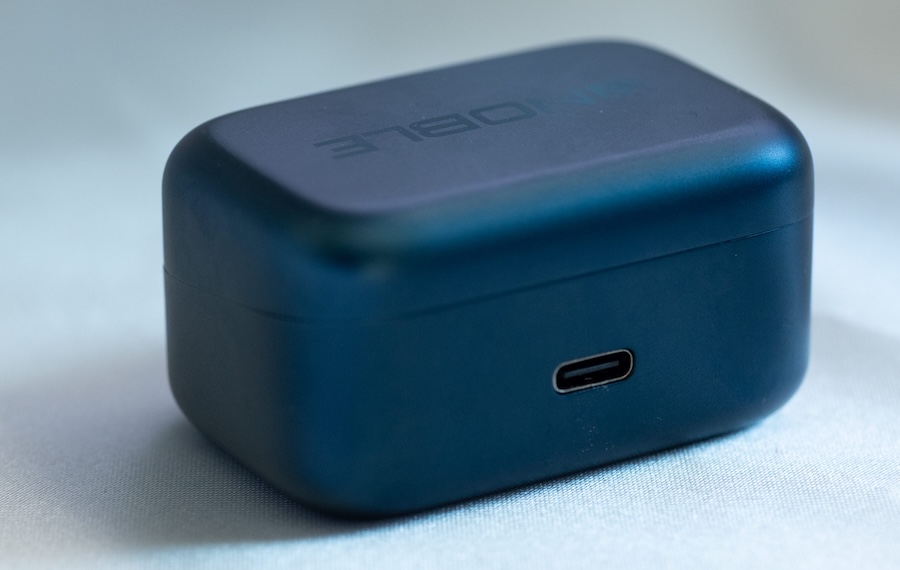
The Osprey’s aluminum charging case features a solid, spring-loaded lid. A charging-status LED is located on the front of the case.
Advertisement
Photo credit: Resonance Reviews
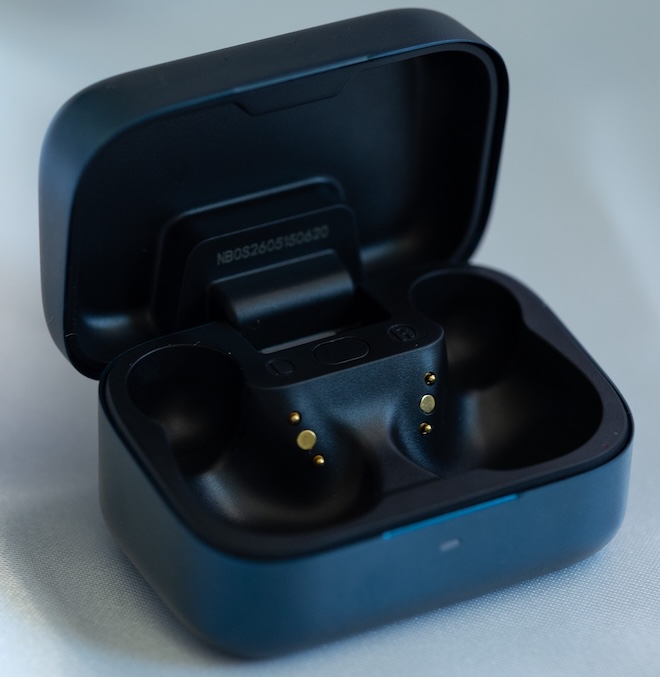
The rear of the Osprey’s case features a USB-C charging port that supports quick charging. It works with any USB-C cable that meets the USB PD standard, so aftermarket options are viable. Inside, the Osprey’s case features molded recesses for each earbud, complete with standard charging pins and magnetic attachment points.
Comfort
Comfort is a metric that depends heavily on your individual ear anatomy, so mileage will vary.
The Osprey is a lightweight, compact wireless earbud. Its shorter nozzles result in a shallower fit, but I was still able to achieve a solid passive seal with the stock eartips. The foam tips worked best for me, though the silicone options were similarly comfortable. I was able to listen comfortably for multiple consecutive hours, making the Osprey a competent companion for long days in the office.
Accessories
Photo credit: Resonance Reviews
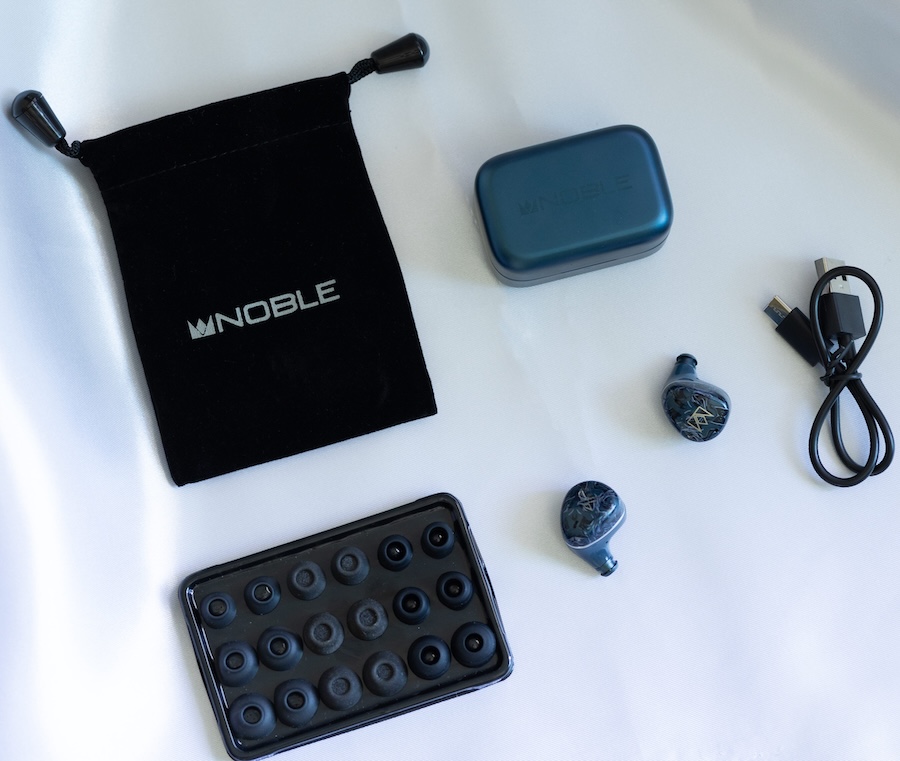
1x Aluminum charging case
1x Felt baggie
3x Pairs of double-flanged eartips
3x Pairs of foam eartips
4x Pairs of standard silicone eartips
1x USB-C to USB-A charging cable
For what amounts to an entry-level pair of wireless audiophile earbuds, this is a solid accessory package. You get a high-quality aluminum charging case, a felt baggie in which to store it, and ten pairs of eartips. The Osprey includes both silicone and foam options, along with three pairs of double-flanged tips.
The included charging cable is short and basic, though functional. I ended up swapping to a different USB-C cable, as the stock cable is too short for my use case and terminates in USB-A rather than USB-C. The case supports quick charging over USB-C, so make sure to use a quality aftermarket cable should you go that route.
Listening
The Noble Audio Fokus app supports onboard EQ, but I did not use it during this portion of the sonic analysis. Should you wish to tweak the Osprey’s sound, you can select a genre-based preset or adjust the 10-band EQ manually.
Advertisement
Noble’s sonic intent with the Osprey is clear: deliver a stock tuning that lives up to the audiophile promise of clear, robust sound. It features a gently V-shaped sound signature, with lifted and well-extended sub-bass, mild warmth through the lower midrange, a slight upper-midrange lift for instrumental clarity, and bright, but not sharp, treble.
Advertisement. Scroll to continue reading.
Precise, Atmospheric Bass
Noble gave the Osprey’s bass a full-bodied but nimble presentation. Its sub-bass sits just behind the mid-bass, delivering depth and articulation without becoming messy.
The Osprey’s lower register is textured and quick, allowing it to convey an excellent sense of atmosphere on “The Dark” by Thrice. The track’s mix of synthetic bass lines and plucky bass guitar plays well with the Osprey’s expressive mid-bass.
Advertisement
The weighty drums at the beginning of “Better Strangers” by Royal Blood land with body and authority, decaying precisely into the soundstage’s black background. The gritty, filtered drop-D guitars in the foreground carry an addictive bassy undertone, giving them a physicality the track desperately needs.
Electronic tracks play well with the Osprey, leveraging its solid extension to generate tactile but respectful punch and rumble. On “The People” by Uppermost, the Osprey rendered the bass line with a robust, substantial timbre.
Beyond simple extension and speed, the Osprey’s bass tuning gives it the ability to sound complete and organic without thinning out the bottom end. That said, some tracks could really use additional bass presence. “Drunk Wishing (Hairitage Remix)” relies on a wall-of-bass effect that the Osprey’s more moderate low end does not quite produce.
You can crank the bass through the EQ to get a little closer to a basshead’s preferences, but ultimately, the Osprey does not seem interested in producing much more sub-bass than it delivers by default.
Advertisement
Hearty, But Lightweight, Midrange
The Osprey’s midrange sits a little north of neutral, delivering mild warmth and an overall clean tonality. Noble balances the upper and lower mids well, allowing it to give harmonically complex elements their proper weight. Acoustic guitar is particularly synergistic with the Osprey’s midrange, pulling a fantastic sense of presence and completeness from tracks like “Life of Illusion” by Foo Fighters. Electric guitar is likewise well-toned and textured. The gritty distortion in “I Got” by Young the Giant streaks from the Osprey’s drivers, staging both guitars with realism and precision.
Even during busy passages, the Osprey maintains its composure, presenting a deep array of layers. It nails the cascading, contrasting layers of instrumentation in the outro of “Endless” by Slow Hours. Each strike of the piano hammer against its strings carries distinction and air, standing apart from the bittersweet violin breathing gently in the background.
Clear & Energetic Treble
The Osprey’s treble tuning is excellent. Combined with a carefully selected, high-performance driver setup, there are not many IEMs, wired or otherwise, at this level of treble refinement.
The Osprey’s single balanced-armature driver works overtime, delivering impressive texture alongside fine-grained control over its deeply layered treble. I was particularly impressed by its ability to manage treble-heavy elements under pressure. The dense soundstage of “Weak” by Seether is a tough mix to render, but the Osprey captures the metallic slam of the hi-hats and tambourines with aplomb. It also beautifully stages the ringing bells at 1:58 in “Wish You Were Here” by Incubus, a fragile micro-detail buried deep in the track and easy to smudge.
Advertisement
The Osprey’s treble is clear and energetic without stepping beyond the bounds of comfort, even with my treble sensitivity. There is no hint of sharpness or sibilance, even on roughly mastered tracks like “Satisfy” by Nero.
Mic & Phone Call Quality
While I’m stoked on the Osprey’s sonic performance, its microphone performance is not quite as impressive. The dual onboard mics work well in quiet spaces, but struggle to pick up my voice when I take calls in environments with considerable background noise. The built-in noise-isolation technology also seems to struggle with vocal clarity in noisier settings, sometimes introducing harsh or unnatural artifacts.
Advertisement. Scroll to continue reading.
You will also need to position each earbud carefully to maintain the proper angle for the microphones. Otherwise, the Osprey can struggle to pick up your voice when speaking quietly. Other Bluetooth IEMs offer larger microphone arrays while delivering clearer, more intelligible call audio.
Advertisement
Competitors like the Sony WF-1000XM4, WF-1000XM5, and WF-1000XM6, along with the Bose QuietComfort Ultra, offer materially better experiences for standard calls and PC meetings, especially when you are trying to keep your voice down.
Noise Cancelling
I’m not a big ANC guy, but I recognize its utility when trying to take an important call in a loud space. I also frequently make use of ANC when traveling by plane, especially if there’s a perturbed child onboard.
The Osprey’s ANC is middling at best, however. It can reduce interference from a TV in the next room or kitchen noise from down the hall, but it is not especially useful in crowded coffee shops or on busy streets. Top-tier ANC from true wireless IEMs like the Sony WF-1000XM6 provides a profoundly different experience, and if you rely heavily on ANC day to day, I would stick with an offering like that.
Thankfully, I rarely, if ever, use ANC in my daily routine, so this is a downside I’m willing to tolerate.
Advertisement
While not exactly a noise-cancelling feature, the Osprey also supports Ambient Mode, a kind of inverse ANC that pipes environmental sound into the IEMs. Parents, or anyone who needs to maintain sonic awareness of their surroundings, will be happy to know that Ambient Mode works well, even in crowded or busy places.
Photo credit: Resonance Reviews
The Bottom Line
The Noble Osprey is an audiophile true wireless earbud designed with a clear sense of purpose. Rather than chasing every app feature, wellness metric, and ANC trick in the book, Noble has focused its efforts on the part that matters most to listeners who actually buy audiophile earbuds: the sound.
Its hybrid driver setup delivers a balanced, well-extended presentation with textured bass, a clean and articulate midrange, and unusually refined treble for $199. Detail retrieval is excellent, and the Osprey avoids the brittle, overcooked treble that often passes for “resolution” in this category. Add a compact fit, aluminum charging case, generous tip selection, LDAC support, and onboard 10-band EQ, and Noble has put together a genuinely compelling audio-first package.
That focus comes with obvious compromises. ANC is merely serviceable, microphone performance falls short in noisy environments, and the Noble Fokus app is stripped down compared with Sony, Bose, and JBL. There is no aptX support, no elaborate ecosystem of location-based profiles or device-finding features, and no illusion that these are meant to replace a top-tier mainstream travel earbud.
Advertisement
The Osprey is unique because it treats true wireless as a vehicle for serious portable listening rather than a feature checklist with drivers attached as an afterthought. It will not win the airport, the conference call, or a fight with a screaming espresso machine. But for listeners who value musicality, detail, comfort, and a properly sorted tuning above all else, it is one of the more persuasive options at its price.
Siri has never been the smartest virtual assistant, but what is especially disappointing is how it has refused to evolve despite Apple’s aggressive push for Apple Intelligence. Two major versions of iOS have come and gone without the supercharged Siri that Apple originally promised. Apple finally announced an improved version of Siri in its WWDC 2026 keynote, and it would appear that the virtual assistant is finally living up to the expectations the company set years ago. We went hands-on with Siri AI and found it to be actually useful in answering complex queries and carrying out chained commands.
Only devices compatible with Apple Intelligence will be receiving Siri AI later this year. This includes every iPhone released since the iPhone 15 Pro, alongside iPad and Mac models powered by Apple silicon. The 2024 iPad mini is also supported since it uses the same SoC as the iPhone 15 Pro. Launch the Settings app, scroll down a bit, and if you spot the Apple Intelligence & Siri section, your iPhone is on track to receive the AI-powered Siri upgrade when the stable release of iOS 27 rolls out this fall.
Interestingly enough, Apple says the new assistant will initially be released as a beta. Users will likely need to manually opt in to access Siri AI, much like those testing the iOS 27 developer beta had to hop on a waitlist. Fortunately, compatibility with iOS 27 should not be a cause of concern, given how Apple is extending support all the way back to the iPhone 11.
Advertisement
Newer iPhones get a more customizable Siri AI
Siri is now better equipped to handle personal requests — it understands context and can reference information from your notes, messages, emails and photos. It is powered by newer Apple Foundation Models that are stored on-device, which should help with both response times and privacy. More complex prompts are offloaded to the bigger models stored on the cloud through Private Cloud Compute, which Apple claims ensures your data is inaccessible to anyone else besides you.
If you own an iPhone 17 Pro, 17 Pro Max or the iPhone Air, Siri AI will be able to take advantage of an even more powerful on-device model. This should improve the overall experience, but more importantly, it enables expressive voices for Siri, improved speech recognition and more accurate dictation.
Advertisement
The upcoming iPhone 18 Pro and rumored iPhone Fold will also enjoy powerful on-device AI models, but it’s uncertain if the base model iPhone 18 will too. Analyst Ming-Chi Kuo reported that Apple is looking to bump up the memory in the non-Pro iPhones to 9GB. However, Apple mentions that its most powerful on-device AI models require at least 12GB of RAM.
We must admit, much of the Apple Intelligence suite so far has been sloppy AI features that don’t meaningfully improve the iPhone experience. Siri AI seems to be genuinely useful, though. Even on the beta builds we’ve tried, the virtual assistant has been fast and accurate.
As the country marks its 250th birthday this week, Microsoft is rolling out an unlikely summer project: a six-part series of short videos, hosted by Microsoft President and Vice Chair Brad Smith, that look to American history for lessons relevant to technology and innovation today.
The premise is that every technology debate of the moment — over such issues as patents, privacy, and who gets to shape AI — has a precedent somewhere in the country’s past, and that we’d all benefit from remembering how we got here in the first place.
“We felt that the 250th anniversary of the country deserved some added reflection about the lessons of history, the role of technology, and the questions that we’re facing as a country,” explained Smith, a well-known history buff, in an interview with GeekWire this week.
In the first episode, for example, he stands in Philadelphia’s Independence Square to explain how a steamboat demonstration on the Delaware River in 1787 helped inspire the Constitutional Convention to give Congress the power to grant patents. This was the basis for the intellectual property framework that Smith describes as a bedrock of American innovation.
Savvy viewers may see some irony in a company extolling the virtues of IP protections even as Microsoft and OpenAI defend themselves against a New York Times copyright suit over the material used to train their AI models.
Advertisement
Asked about that, Smith made it clear he doesn’t see a contradiction.
“Every generation of technology has required a new round of legal thinking, legislation and oftentimes lawsuits, so that courts can sustain the balance that has always been needed between new innovation and the protection of things created already,” he said.
He also noted that Microsoft is often the party going to court to protect customers, pointing as one example to the company’s move this week to intervene before Europe’s top court in defense of the European Union and U.S. data-protection framework.
The six-part series was overseen by Smith’s longtime chief of staff, Carol Ann Browne, a Microsoft vice president; and produced by Kirkland, Wash.-based Trifilm. The episodes, around 3 or 4 minutes each, will roll out in the coming weeks. Smith said they recorded during existing travel plans, working the shoots into stops on trips he was already taking.
Advertisement
The series travels next to a Boston courtroom for the birth of privacy rights, Henry Ford’s Detroit assembly line for the spread of new technology, Cincinnati for Tocqueville’s take on nonprofits, Great Falls, Md., for George Washington’s early infrastructure ambitions, and the Lewis and Clark expedition in Montana for the value of uniting competing viewpoints.
“The 250th anniversary of the country is quite rightly an occasion to honor the past, celebrate the past,” Smith said, explaining the motivation for the series. “But let’s make sure we get something out of the past that helps us be more successful in the future.”
A new Quordle puzzle appears at midnight each day for your time zone – which means that some people are always playing ‘today’s game’ while others are playing ‘yesterday’s’. If you’re looking for Saturday’s puzzle instead then click here: Quordle hints and answers for Saturday, July 4 (game #1622).
Quordle was one of the original Wordle alternatives and is still going strong now more than 1,500 games later. It offers a genuine challenge, though, so read on if you need some Quordle hints today — or scroll down further for the answers.
Enjoy playing word games? You can also check out my NYT Connections today and NYT Strands today pages for hints and answers for those puzzles, while Marc’s Wordle today column covers the original viral word game.
Advertisement
SPOILER WARNING: Information about Quordle today is below, so don’t read on if you don’t want to know the answers.
Latest Videos From
Quordle today (game #1623) — hint #1 — Vowels
How many different vowels are in Quordle today?
• The number of different vowels in Quordle today is 3*.
* Note that by vowel we mean the five standard vowels (A, E, I, O, U), not Y (which is sometimes counted as a vowel too).
Advertisement
Quordle today (game #1623) — hint #2 — repeated letters
Do any of today’s Quordle answers contain repeated letters?
• The number of Quordle answers containing a repeated letter today is 2.
Quordle today (game #1623) — hint #3 — uncommon letters
Do the letters Q, Z, X or J appear in Quordle today?
• No. None of Q, Z, X or J appear among today’s Quordle answers.
What letters do today’s Quordle answers start with?
• P
• S
• T
Advertisement
• P
Right, the answers are below, so DO NOT SCROLL ANY FURTHER IF YOU DON’T WANT TO SEE THEM.
Quordle today (game #1623) — the answers
(Image credit: Merriam-Webster)
The answers to today’s Quordle, game #1623, are…
Sign up for breaking news, reviews, opinion, top tech deals, and more.
Today felt like a Greatest Hits of Quordle game, with two very familiar words in PINTO and PINEY making their third appearances of 2026.
Advertisement
Meanwhile, it was nice to see SWOON. It’s one of my favorite words — the sound is nice, the meaning is great, and for a bonus it’s also the title of an excellent album by Prefab Sprout.
Daily Sequence today (game #1623) — the answers
(Image credit: Merriam-Webster)
The answers to today’s Quordle Daily Sequence, game #1623, are…
Two hundred and fifty years after the signing of the Declaration of Independence, a new commercial from Google asks: What if the Founding Fathers had access to Google Workspace?
With the tagline “Group project, but make it 1776,” the ad depicts a largely unseen Thomas Jefferson mid-draft when he gets a nagging text from Ben Franklin, leading to a very Google-centric collaboration process. Edits are suggested in Google Docs, a meeting gets scheduled in Google Calendar and conducted remotely via Google Meet (with every single attendee apparently turning their camera off?), then the whole thing is finalized with e-signatures; cue the fireworks.
Of course, since this is an ad from a tech company in the year 2026, AI has a role to play. The fictionalized founders use Google’s “help me visualize” AI tool to try out different animals on the national seal, Gemini takes notes on the meeting, and the founders also ask the chatbot for advice before declining King George III’s document access request.
Advertisement
TechCrunch call it “very tongue-in-cheek,” noting that at one point Samuel Adams even asks, “Can we settle this over beers?” And they argue that “the AI evangelism is relatively discreet when compared to many other recent ads.”
A new NYT Strands puzzle appears at midnight each day for your time zone – which means that some people are always playing ‘today’s game’ while others are playing ‘yesterday’s’. If you’re looking for Saturday’s puzzle instead then click here: NYT Strands hints and answers for Saturday, July 4 (game #853).
Strands is the NYT’s latest word game after the likes of Wordle, Spelling Bee and Connections – and it’s great fun. It can be difficult, though, so read on for my Strands hints.
Want more word-based fun? Then check out my NYT Connections today and Quordle today pages for hints and answers for those games, and Marc’s Wordle today page for the original viral word game.
Advertisement
SPOILER WARNING: Information about NYT Strands today is below, so don’t read on if you don’t want to know the answers.
Latest Videos From
NYT Strands today (game #854) – hint #1 – today’s theme
What is the theme of today’s NYT Strands?
• Today’s NYT Strands theme is… Barking up the right tree
Advertisement
NYT Strands today (game #854) – hint #2 – clue words
Play any of these words to unlock the in-game hints system.
POLITE
SPRITE
LIVER
HUNGER
TINGE
SPEEDING
NYT Strands today (game #854) – hint #3 – spangram letters
How many letters are in today’s spangram?
• Spangram has 13 letters
NYT Strands today (game #854) – hint #4 – spangram position
What are two sides of the board that today’s spangram touches?
• First side: bottom, 1st column
Advertisement
• Last side: top, 6th column
Right, the answers are below, so DO NOT SCROLL ANY FURTHER IF YOU DON’T WANT TO SEE THEM.
Advertisement
NYT Strands today (game #854) – the answers
(Image credit: New York Times)
The answers to today’s Strands, game #854, are…
POINTER
SPANIEL
TERRIER
HOUND
RETREIVER
SPANGRAM: HUNTINGBREEDS
My rating: Easy
My score: Perfect
My immediate thought was that the theme had to have something to do with dogs, but I was wary, of course, of falling into a trap and barking up the wrong tree.
Sign up for breaking news, reviews, opinion, top tech deals, and more.
Advertisement
After spotting POINTER it seemed clear that we were looking for dog breeds, but my canine knowledge was not good enough to know that we were searching out HUNTINGBREEDS until after I had connected SPANIEL and TERRIER and then the spangram.
Beyond the game itself there was also an interesting crop of lengthy non-game words. It’s rare that I’ll find many over five-letters long but today the board was loaded with them.
Advertisement
Yesterday’s NYT Strands answers (Saturday, July 4, game #853)
BRIGHT
COLORFUL
DAZZLING
EXCITING
SPARKLING
SPANGRAM: FIREWORKS
What is NYT Strands?
Strands is the NYT’s not-so-new-any-more word game, following Wordle and Connections. It’s now a fully fledged member of the NYT’s games stable that has been running for a year and which can be played on the NYT Games site on desktop or mobile.
I’ve got a full guide to how to play NYT Strands, complete with tips for solving it, so check that out if you’re struggling to beat it each day.
Modern technology didn’t just spring up overnight; it often has roots reaching far into the past. The history of GPS navigation actually began during the cold war, marking several milestones in the subsequent decades. In terms of automobiles, GPS didn’t break out of its niche status until the 2000s.
In a significant moment for consumer GPS, Google Maps debuted in 2005 in the U.S., though there are now several Google Maps alternatives on Android. The navigation process couldn’t be simpler, you search for a business name or enter an address, and a route is calculated with step-by-step instructions. However, you might be surprised to learn that not only are paper maps and atlases still around, but they’ve actually experienced a bit of a renaissance in the last decade.
Vice president of Rand McNally, Kendra Ensor told USAToday that by 2015, the map making company began to see increases in the sale of Road Atlases. In the U.K., map maker Ordnance Survey saw a 144% uptick in custom paper map sales in 2020, then another 28% rise in 2021. Both AAA and Rand McNally continue to offer updated physical maps, with the former still making TripTik route books, which include custom printed directions. Lost signals and a more active navigation experience are just a few of the reasons why would anyone opt for this old-school approach.
Advertisement
A paper map can’t lose signal
ANDRANIK HAKOBYAN/Shutterstock
Travelers have relied on physical maps for thousands of years, but GPS has become the dominant option in the 21st century. According to a UTires.com survey, certain parts of the country, such as Bakersfield, CA, have more than 55% of respondents declaring they’re extremely reliant on the technology. The problem is, while convenient, GPS requires you have a signal, whether it be through a mobile carrier or satellite. You can utilize offline GPS apps, however that’s dependent on you downloading the information beforehand, when internet is available. It’s also noteworthy that most navigation software, like Google Maps, downloads an entire route when you first start navigating, so if you lose signal along the way, you can keep going. But if you need to start navigating without internet, that’s when you run into trouble.
In early 2026, those residing in Moscow and St. Petersburg, Russia faced intermittent and even failing mobile internet across major swaths of the cities for days. Suddenly, smartphones couldn’t access or run applications properly, with navigation being one of them. As a result, demand tripled for atlases and paper maps of these areas.
Advertisement
In another more anecdotal instance, a couple traveling from Canada to North Carolina found themselves amidst the chaos of Hurricane Helene which knocked out several services including internet. Fortunately, they were able to navigate and guide several travelers out of the affected area using physical paper maps.
Advertisement
GPS navigates for you, and can limit perspective
Patryk_kosmider/Getty Images
One of the issues with a navigation app, is that it largely does the thinking for you. After selecting a destination, your role in the navigation process is simply following on-screen prompts. Conversely, a physical map keeps you more active in the navigation process and aware of your surroundings.
In addition, research has shown that the sensory experience of using a paper map helps the brain create a mental picture of the surrounding environment. Old school maps also provide a much greater overall perspective, reaching well beyond your selected route.
This “big picture” view can often be lost when using GPS in the car, which typically displays only the immediate area around your vehicle. If you must adjust your route using GPS, it can be more challenging on the go, as you may not understand where you’re located in relation to other landmarks or your destination. Miller Edwards, a retired detective, explained to CBS News with regard to printed maps, “They give me a general idea of a larger area that I need to go to see. They have different cities and different points of view.”
A robotic spacecraft called LINK will soon tug the telescope to a higher orbit.
NASA
The NASA Swift Boost mission has launched from Marshall Islands on July 3 at 4:36AM Eastern time after a couple of delays, and the agency has started preparing it for its ultimate goal: To rescue the Neil Gehrels Swift Observatory, which is falling faster than anticipated. Swift Boost’s ground teams have already established communication with LINK, the robotic spacecraft designed by Arizona company Katalyst Space to dock with the observatory and to tug it back into a higher orbit.
It wasn’t your typical rocket launch. LINK was attached to a Northrop Grumman Pegasus XL rocket, which was in turn attached to the belly of a plane called Stargazer. The plane took off from Kwajalein Atoll, Marshall Islands and then released the Pegasus XL rocket in the air at an altitude of around 40,000. After free falling for a few seconds, the rocket’s engines fired up to deliver LINK to space.
NASA says making contact with LINK was the mission’s first objective, and it was successful in doing so. LINK has already powered on and will undergo health checks by Katalyst over the next several weeks to assess its propulsion, sensor and navigation systems. After its health checks are done, LINK will head towards the Swift observatory to survey it.
Advertisement
LINK will then capture Swift, dock with it using its three robotic arms and then tug it upwards until they reach an orbit with an altitude of approximately 370 miles, which will extend its life by a decade or so. Delivering the observatory to a higher orbit is expected to take 10 to 12 weeks. While all spacecraft will eventually fall, recent solar activity caused the observatory’s orbit to decay much faster. Without the help of LINK, the Swift telescope would be falling from orbit by the end of the year.
The Neil Gehrels Swift Observatory has been studying gamma ray bursts for over two decades. Brad Cenko, Swift’s principal investigator, describes gamma ray bursts as “short-lived flashes of high-energy light that release more energy in just a few seconds than the sun will in its entire lifetime.” These bursts are thought to be created by exploding and colliding stars. Cenko says data from Swift confirmed that the “heaviest elements in the periodic table, including the gold and platinum in our jewelry, are forged in these systems.” Scientists now also use Swift as a “dispatcher” or a “first responder” to gather critical information when a sudden cosmic event takes place.
Sarla Aviation just finished a full round of flight tests with its Sylla 1.0. The 700-kilogram machine with a 7.5-meter wingspan became the heaviest electric aircraft ever to take off vertically in India. Engineers put it through more than 500 tests and over 18 hours of flight time during a six-month campaign in southern India.
Sylla 1.0, built as a half-scale tech demo, is essentially a shrunken version of what the business envisions for the full-size passenger aircraft. It has a novel dispersed propulsion system, with electric motors sticking out along the wing. These are fueled by a 400-volt grid that keeps everything running smoothly. This is critical because the entire structure just lifts off vertically and hovers steadily in the air, with no runway necessary.
Due to platform compatibility issue, the DJI Fly app has been removed from Google Play. DJI Neo must be activated in the DJI Fly App, to ensure a…
Lightweight and Regulation Friendly – At just 135g, this drone with camera for adults 4K may be even lighter than your phone and does not require FAA…
Palm Takeoff & Landing, Go Controller-Free [1] – Neo takes off from your hand with just a push of a button. The safe and easy operation of this drone…
The goal of the test phase was to get all of the individual components to communicate with one another. For example, electric propulsion, battery systems, flight control software, the aircraft itself, and the landing gear were all tested to see how well they operate together in practice. First up, get off the ground and hover. Not that difficult, it turned out… Sylla 1.0 just repeated this section several times, obtaining a wealth of relevant flight data along the way.
Advertisement
The entire project moved at quick pace to say the least, with this group going from the start of developing Sylla 1.0 to actual flying in just under a year, which isn’t bad considering the project’s complexity. To top it all off, the project only cost them around 13 million dollars. When compared to some of the major global eVTOL projects now in development, the difference is clear.
Sarla Aviation opened its doors in Bengaluru in 2023 and now employs a team of engineers, many of which had previously worked for Lilium, Volocopter, Wisk, Beta, and Joby Aviation. They pulled all of that international know-how back together with some quick execution to get the place off the ground. Sarla Aviation is named after Sarla Thukral, India’s first woman pilot in the 1930s.
Sylla 2.0, on the other hand, will have to figure out how to fly forward rather than just hovering. We all know how important this is, since it dictates how efficiently these birds will be able to transport passengers or cargo from A to B. They’ve already started collecting important data from Sylla 1.0 and are incorporating it into the next level of testing.
Of course, the long-term goal is to reach Shunya at full capacity. This is the real deal: an aircraft capable of carrying a pilot and six passengers, or four in a more spacious configuration, as well as cargo variants capable of carrying around 680 kg. Oh, and they’re also looking into hybrid power with some sustainable aviation fuel, which should help increase the range to about 800 kilometers. They plan to reach a top speed of roughly 250 km/h using seven ‘propulsion units’ and two batches of separate batteries.
Sarla sees these aircraft fitting in similarly to how ride-hailing apps are used today, as a way to travel from A to B in the air. Early routes can link big cities, such as Bengaluru to Mumbai or Delhi to Pune, or just shuttle passengers between airports and city centers. The real goal, however, is to see what they can do to help India’s push for cleaner transportation while simultaneously increasing their own digital industry. [Source]
Many don’t think of the Fourth of July as a mattress-shopping holiday, but they probably should. Black Friday, Memorial Day, and even Presidents’ Day get a lot of attention when it comes to mattress sales, but many brands offer some of their biggest discounts for Independence Day as people tackle summer moves, home projects, and long-overdue bedroom upgrades. If you’ve been putting off replacing an old mattress, now’s a smart time to put down the grill tongs and shop.
The WIRED Reviews team has spent years testing mattresses in our own homes, and we evaluate everything from long-term comfort and cooling to motion isolation and durability, so the recommendations below are mattresses we’ve actually slept on and continue to recommend. Note that all prices are for queen-size models.
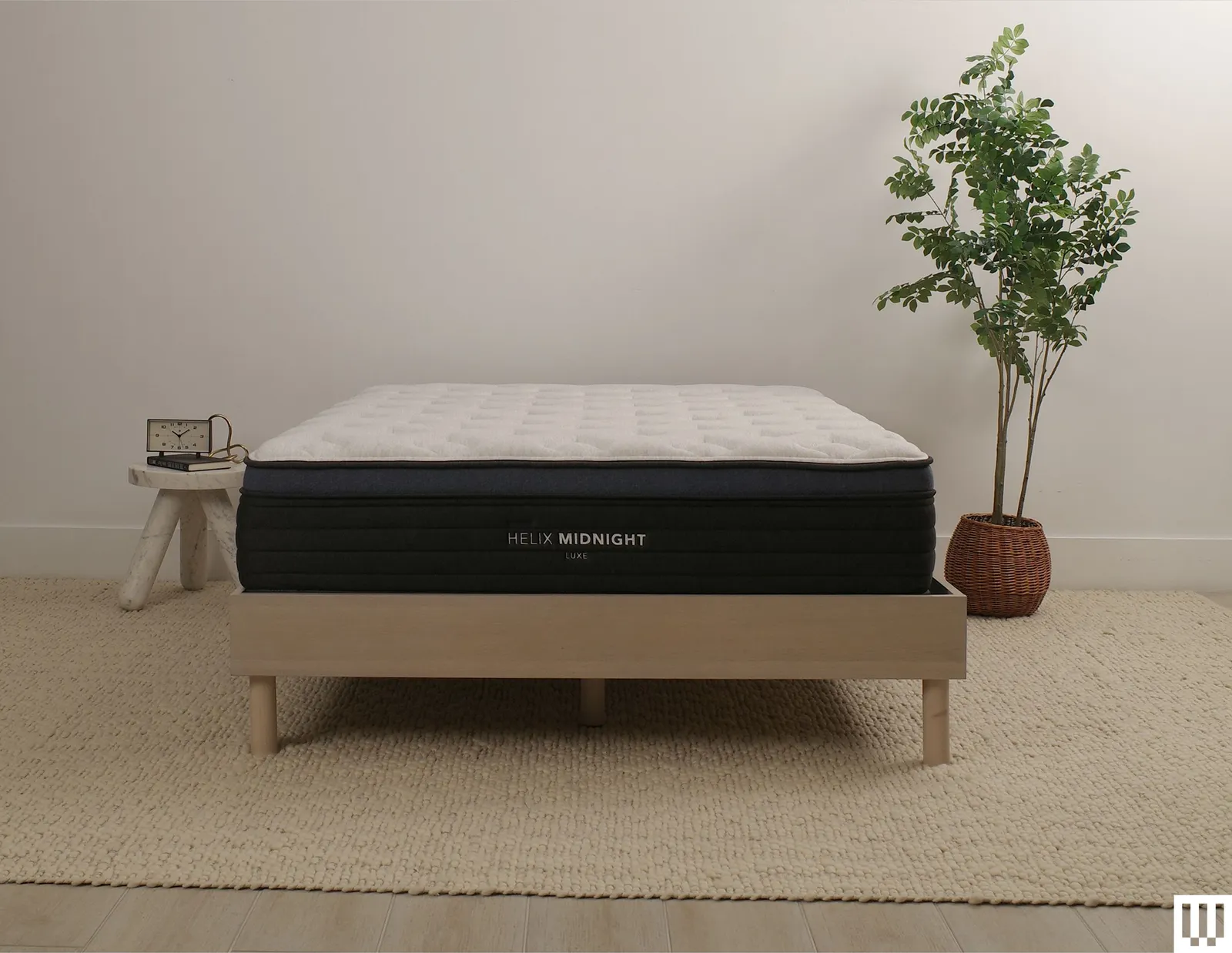
We’ve tested dozens of mattresses over the years, and the Helix Midnight Luxe continues to earn the top spot, ranked as the best overall mattress of 2026 so far. Its medium-firm feel, zoned support coils, and excellent pressure relief work for nearly every sleeping position, but especially for side sleepers, and it is surprisingly cool for the amount of plush that it has. Fourth of July brings one of the best prices we typically see for this mattress outside of Black Friday, making this an excellent time to buy.
Leesa
Advertisement
The Leesa Sapira Chill is one of our favorite mattresses because it tackles two of the biggest sleep struggles: waking up sore and waking up hot. Its medium-firm hybrid design gently cushions the shoulders and hips without sacrificing support, while the cooling cover regulates temperature throughout the night. When former WIRED director Martin Cizmar tested it, he found it to be the best cooling mattress he’s tried for side sleepers, making this deal especially worth a look, especially in this heat wave.
Avocado
The Avocado Green has remained one of our top organic mattress picks over the years. Its hybrid construction hits a sweet spot between plush comfort and sturdy support, making it a great option for couples with different firmness preferences and combination sleepers who tend to toss, turn, and switch sleeping positions throughout the night. Its individually wrapped coils also do a great job minimizing motion transfer, and after nearly three years of use, WIRED operations manager Scott Gilbertson has reported virtually no sagging or signs of wear. Avocado doesn’t offer discounts as aggressively as many competitors, making this 15-percent-off sale one of the better opportunities you’ll get all year.
Designed with side sleepers in mind, the Nolah Evolution pairs zoned foam and pocketed coils to cushion the shoulders and hips and support the lower back. We also found it comfortable for both side and stomach sleeping, thanks to its hybrid design that makes it easy to roll over without feeling like you’re stuck in your mattress. Nolah’s Fourth of July sale takes 35 percent off site-wide, matching one of the brand’s strongest promotions of the year.
Naturepedic
Advertisement
The Naturepedic EOS Classic Organic Mattress stands out for its customization. Its modular design lets you fine-tune its firmness by swapping out latex layers, and each side of the mattress can be configured independently, making it another great mattress for sleeping partners with different sleep preferences. We also appreciate that you can exchange the latex layers for free during your first 100 nights, so you don’t have to cross your fingers and hope you picked the right firmness the first time. The Fourth of July sale knocks 20 percent off site-wide with code JULY4 and includes a free muslin blanket with qualifying mattress purchases.
Bear
If back pain has you shopping for a new mattress, the Bear Elite Hybrid is 35 percent off with code JULY35. Multiple WIRED reviewers with conditions including scoliosis, spondylosis, sciatica, and chronic back pain have found that this mattress’s zoned coil support helped keep their backs happy while the quilted pillow top provided enough cushioning to prevent sore shoulders and hips. It feels pretty firm right out of the box, but our testers found it cushioned up over time while maintaining the support they needed.
As part of an ongoing legal dispute with three Hollywood studios, AI startup Midjourney is seeking to compel those studios to reveal how they use AI themselves.
The startup argues that training its AI models on images of copyrighted characters is permitted under fair use.
The current dispute revolves around the documentation the studios will need to produce during the discovery process. A judge previously ruled that the studios would indeed have to provide information about their generative AI usage – but only when it led to “consumer-facing” videos and images.
Advertisement
In its latest filing, Midjourney seeks to overturn that limitation, arguing that it “unfairly” allows the studios “to cherry-pick only those documents they believe support their market harm claims while depriving Midjourney of documents that would support its defenses.”
Midjourney goes on to claim that the “documents [the studios] are withholding are precisely those that would reveal whether, behind closed doors, they are doing exactly what they are suing Midjourney for doing.”
For example, the startup says that if the studios are developing image-generating AI models “for internal use in storyboarding or ideating content for film or TV, that evidence would equally demonstrate that it is an industry custom, even among the studios themselves, to download and train AI on unlicensed copyrighted content.”
In the filing, the startup also argues that the studios should reveal all the prompts they used in Midjourney, as well as the resulting outputs, not just the prompts that produced the allegedly infringing images.
He also said the studios “do not seek to stop AI technology or even shut down Midjourney’s business,” but rather “simply want Midjourney to stop copying their movies and TV shows and to stop distributing, publicly displaying, publicly performing, and creating derivative works that include copies of [their] famous characters without authorization.”
When you purchase through links in our articles, we may earn a small commission. This doesn’t affect our editorial independence.






















-Reviewer-Photo-SOURCE-Wired.png)
.png)






































You must be logged in to post a comment Login