
Connect with us
DAPA Banner
DAPA Coin
DAPA
COIN PAYMENT ASSET
PRIVACY · BLOCKDAG · HOMOMORPHIC ENCRYPTION · RUST
ElGamal Encrypted MINE DAPA
🚫 GENESIS SOLD OUT
DAPAPAY COMING

Tech

New Google Ad Imagines America’s ‘Declaration of Independence’ Written With AI Help

Published

on

An anonymous reader shared this report from TechCrunch:

Two hundred and fifty years after the signing of the Declaration of Independence, a new commercial from Google asks: What if the Founding Fathers had access to Google Workspace?

With the tagline “Group project, but make it 1776,” the ad depicts a largely unseen Thomas Jefferson mid-draft when he gets a nagging text from Ben Franklin, leading to a very Google-centric collaboration process. Edits are suggested in Google Docs, a meeting gets scheduled in Google Calendar and conducted remotely via Google Meet (with every single attendee apparently turning their camera off?), then the whole thing is finalized with e-signatures; cue the fireworks.

Of course, since this is an ad from a tech company in the year 2026, AI has a role to play. The fictionalized founders use Google’s “help me visualize” AI tool to try out different animals on the national seal, Gemini takes notes on the meeting, and the founders also ask the chatbot for advice before declining King George III’s document access request.

Advertisement

TechCrunch call it “very tongue-in-cheek,” noting that at one point Samuel Adams even asks, “Can we settle this over beers?” And they argue that “the AI evangelism is relatively discreet when compared to many other recent ads.”

Source link

Continue Reading
Click to comment

You must be logged in to post a comment Login

Leave a Reply

Tech

Researchers built a tiny diving suit for cyborg cockroaches to survive underwater

Published

on


These systems have already been tested in search-and-rescue scenarios and for inspecting infrastructure, but only in dry conditions. That’s because insects like cockroaches rely on oxygen from the air, which limits where they can go. In real disaster sites, especially after flooding, that’s a major drawback.
Read Entire Article
Source link

Continue Reading

Tech

‘STEM is not just about formulas and calculations, it is also about creativity’

Published

on

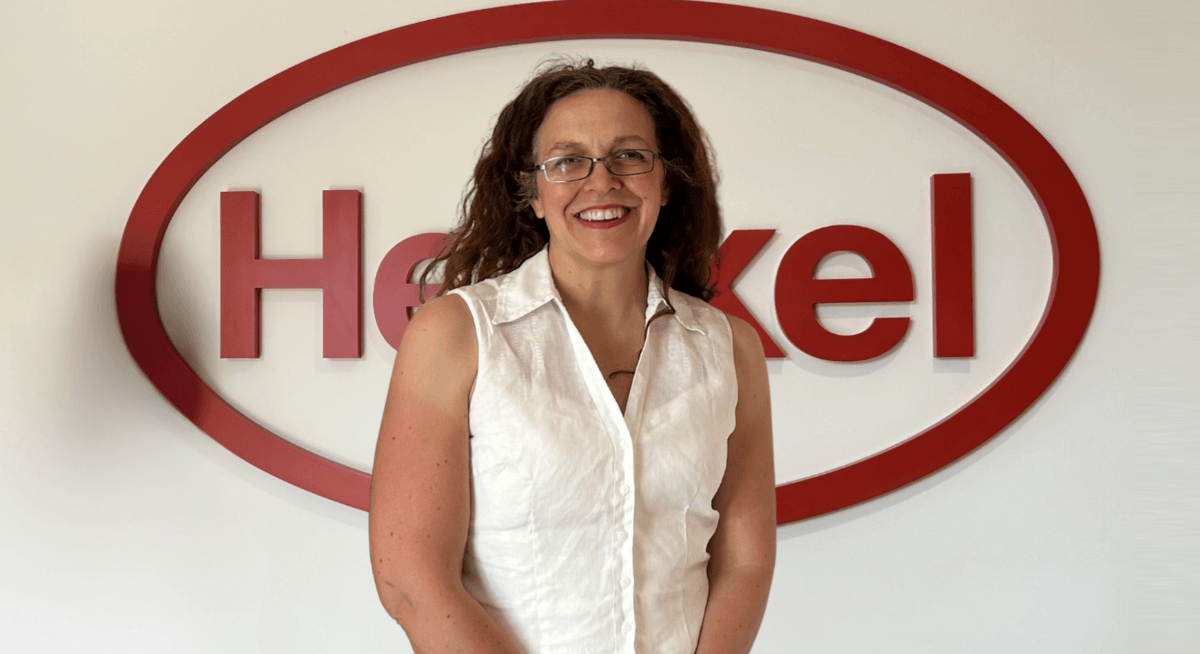
Henkel’s Julie Joseph explores the aspects of the sector she would change and the personality traits most suited to a career in this space.

“What drew me towards this career area was my enjoyment of problem solving and understanding how things work. I have always been naturally curious, so I could easily have ended up in many different STEM careers,” explained Julie Joseph, a technology specialist at Henkel.

Particularly interested in chemistry and how it combines scientific thinking with practical applications that can make a real difference in industry and manufacturing, she went on to complete a PhD in polymer chemistry and developed specialist technical knowledge.

She said, “After finishing my studies, I initially worked in research and development for many years. Those roles suited my background well because they involved experimentation, innovation and continuous learning. I enjoyed investigating scientific problems and helping develop new materials and technologies. 

Advertisement
What drew you to this career area?

Later in my career, I was given the opportunity to move into a more customer-focused role, where I now work with customers to solve design and production issues involving Henkel’s adhesives. That move was a major turning point for me because it allowed me to combine technical problem solving with communication and collaboration. One of the things I enjoy most is that I work with many different people and industries and no two challenges are exactly the same. There is often a stereotype that STEM careers involve sitting alone in a laboratory, but my experience has been very different. I regularly work with engineers, manufacturers and customers and I enjoy helping people find practical solutions to complex problems.

What do you enjoy most about your job?

The thing I enjoy most about my job is the variety. Every day is different, which means the work never becomes repetitive. I help current and potential customers solve technical and manufacturing problems, so there is always a new challenge to investigate and a different solution to develop. I enjoy the satisfaction that comes from helping someone overcome an issue and improving the way a product or process works. Another part of the role that I enjoy is meeting and working with different people. Some meetings take place in person while others happen online through Microsoft Teams, but communication is always a huge part of my work. 

Technical knowledge is important, but it is equally important to explain ideas clearly, listen carefully and collaborate effectively. I enjoy that balance between science and communication because it makes the role much more dynamic and rewarding.

I also enjoy the fact that I am constantly learning. STEM industries evolve quickly, with new technologies, materials and manufacturing methods being introduced all the time. There is always something new to understand, which keeps my brain active and makes the work interesting.

Advertisement
What’s the most exciting development you’ve witnessed in your sector since you first started?

There have been many exciting developments since I started working in the sector, particularly in materials science and computing. New adhesive technologies have allowed manufacturers to create stronger, lighter and more efficient products across industries such as automotive and electronics. However, the biggest development I have witnessed has been the continued rise of computing and digital technology. When I first started working in research and development, many processes were slower and more manual. Today, advanced software, modelling systems and digital communication tools have completely changed the way scientists and engineers work. We can now analyse data more quickly, collaborate globally and solve problems far more efficiently than before. 

More recently, generative AI has created another major shift in the industry. AI tools can help generate ideas, process information and improve productivity at incredible speeds. I find this development particularly fascinating because it is transforming the way people work with technology. At the same time, human judgement and expertise remain essential.

If you had the power to change anything within the STEM sector, what would that be?

If I could change one thing within the STEM sector, it would be the perception that scientists and engineers lack communication skills or creativity. In reality, successful STEM careers require much more than technical knowledge alone. Collaboration, innovation and communication are all extremely important. In my own role, communication is essential. I work closely with customers to understand their challenges and help them find practical solutions. That means I need to explain technical concepts clearly, listen carefully and build strong working relationships. Without effective communication, even the best technical ideas may not succeed.

I would also like people to recognise how creative STEM careers can be. Problem solving often involves thinking differently, experimenting with new ideas and developing innovative solutions. STEM is not just about formulas and calculations, it is also about creativity and imagination.

Advertisement
Which personality traits make you best suited to your job and this sector?

I think curiosity is one of the personality traits that makes me best suited to my role. I enjoy learning about new technologies, understanding how products are manufactured and finding ways to improve processes. In STEM careers, curiosity is extremely important because industries are constantly evolving. Adaptability is another key trait. Throughout my career I have moved from research and development into a more customer-focused role, which required me to develop new skills and approaches. STEM careers change rapidly, so being willing to adapt and continue learning is essential. I also believe communication skills are important. I enjoy working with people, discussing ideas and helping customers solve problems, which makes the work both engaging and rewarding.

What advice would you give to someone thinking about a career in your area?

My main advice would be to stay curious, adaptable and open to opportunities. STEM careers are constantly changing because technology and scientific knowledge continue to evolve. Being willing to learn and develop new skills is extremely important. I would also encourage people not to think of STEM careers as purely technical. Modern STEM roles often involve teamwork, communication and collaboration with many different people and industries. Developing interpersonal skills can therefore be just as valuable as developing technical expertise. Finally, I would encourage people not to be discouraged by challenges. STEM careers often involve solving difficult problems, but overcoming those challenges is also what makes the work rewarding. For anyone who enjoys learning, problem solving and innovation, STEM can be an exciting and fulfilling career path.

Don’t miss out on the knowledge you need to succeed. Sign up for the Daily Brief, Silicon Republic’s digest of need-to-know sci-tech news.
Advertisement

Source link

Continue Reading

Tech

This Samsung OLED gaming monitor is down to its lowest price

Published

on

Samsung’s OLED gaming monitors are some of the best in the business, and the Odyssey OLED G8 is easy to recommend at this low price.

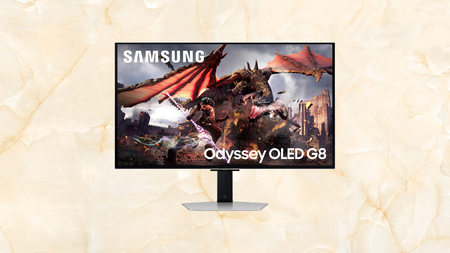
The Samsung Odyssey OLED G8 is down to £649 from £899.99, a saving of 28% on a 32-inch panel that competes at the sharp end of the gaming monitor market.

This is the lowest ptice this product has dropped to on Amazon since it was released.

Samsung Odyssey OLED G8 on a yellow stone backgroundSamsung Odyssey OLED G8 on a yellow stone background

This Samsung OLED gaming monitor is down to its lowest price

Advertisement

If competitive response times and beautiful colours are what you are after, this Samsung Odyssey OLED G8 offer the kind of deal for you.

View Deal

Advertisement

A 240Hz refresh rate paired with a 0.03ms response time means fast-paced games render with almost no perceptible lag between input and motion on screen, which matters most in the split-second reactions that separate a win from a respawn.

That speed is backed by genuine 4K resolution across the full 3840 by 2160 panel, so detail holds up whether you are tracking enemies at range or simply enjoying a slower, more cinematic title.

Advertisement

Colour and contrast benefit from OLED’s self-emissive pixels, which produce true blacks without the light bleed that liquid crystal panels still struggle to fully eliminate during darker scenes.

Advertisement

Samsung has paired that panel technology with Glare Free coating that cuts reflections from windows and room lighting, keeping the picture readable even in a bright room without forcing you to close the curtains.

The Whatsapp LogoThe Whatsapp Logo

Get Updates Straight to Your WhatsApp

Join Now

Advertisement

Burn-in has traditionally been the trade-off with OLED displays, so the G8 includes Safeguard Plus, a system that manages heat and dims static elements like taskbars automatically to protect the panel over years of use.

G Sync compatibility keeps the monitor synced with compatible graphics cards to eliminate screen tearing and stutter, which becomes especially noticeable during fast camera pans or high frame rate competitive play.

Connectivity also runs through HDMI 2.1 and DisplayPort, both included in the box along with the cables needed to get set up without a separate trip to buy adaptors or extra leads.

Advertisement

Advertisement

If competitive response times and genuine 4K clarity matter more to you than maximum brightness, isn’t the Samsung Odyssey OLED G8 at 28% off exactly the kind of gaming monitor deal worth acting on right now?

SQUIRREL_PLAYLIST_10148964

Source link

Advertisement
Continue Reading

Tech

5 Worthwhile Ways To Use Your Smartphone’s Dual SIM Feature

Published

on


Do you have a phone with either a dual SIM tray or eSIM support? You obviously know that it allows you to get a second phone number, but a second SIM opens a world of possibilities you may not have realized. Let’s look at some real-life, meaningful use cases beyond the obvious stuff like having a backup number.

If you have a recent phone, there’s a very good chance it has both a physical SIM card and eSIM support. Otherwise, everything below should work whether you have a dual SIM tray or eSIM — and users of an eSIM-only phone can also likely try these recommendations. Of course, you’ll need an unlocked phone, since providers like Verizon will prevent you from adding a secondary plan that’s not with them or their partners. Consider using your second SIM for the following to make your phone just a tad more useful.

Advertisement

Keep an international travel-only SIM

When traveling abroad, one of the items on your checklist when arriving in your destination country is probably to drop by an airport kiosk and buy a temporary SIM card with a preloaded data plan for the duration of your stay. There’s really almost no need to do that anymore. Instead, you can keep a travel-only SIM that you activate when abroad and then disable when you get back home, buying data plans as needed for whichever country you visit. It’s likely going to be much cheaper than the often expensive rates at the airport, and it means you’ll have data the instant your plane touches down to catch up on messages and start booking a taxi.

One that I’ve personally used in multiple countries with no issue is Ubigi, an eSIM-only carrier offering affordable data plans for a long list of destinations. Once you install the eSIM, all you have to do is buy a data plan for wherever it is you’re going and then activate the eSIM when you arrive. It’s a data-only plan, so there won’t be an extra number on your phone getting calls and texts. Ubigi is just one option in a sea of competitors that provide a nearly identical service, so definitely shop around.

What if you’re looking for an actual physical SIM card for your dual SIM tray, or you need to free up your eSIM for something else? There are other companies that offer physical SIMs, too. We recommend OneSimCard, which has high ratings on Trustpilot — though again, shop around if you see better rates.

Advertisement

Get better coverage wherever you go

Although cellular reception over the years has improved in the U.S., it’s still totally normal to have a phone plan with a dead zone where other carriers give strong coverage. You can use CoverageMap to see your own. Anyway, dead zones can be more than just an annoyance if you need to stay connected for work or be reachable during an emergency when traveling from city to city or state to state. That’s where a second phone plan can really come in handy.

There’s no need to go with an expensive plan. Grab a cheap phone plan from one of the many U.S. budget carriers, ideally finding something that overlaps with those weaker areas and dead zones. Some carriers let you customize your plan by stripping it down to a bare-bones data-only or voice-only configuration. $6 is not bad at all if it helps extend your coverage and give you peace of mind.

Advertisement

Aside from the extra cost, there’s one downside to keep in mind: Your battery will drain a little faster when running two SIMs. That battery drain may be exacerbated when your phone is in a poor-signal area for that secondary network, even though the primary one gets great coverage. To mitigate this, you might temporarily disable that secondary SIM when it’s not needed. Setting up Wi-Fi calling may also help in situations where the signal is weak.

Advertisement

Keep a burner number

A burner number (a secondary, throwaway number) seems like something exclusively for a drug dealer, a spy, or a womanizer. We’d argue that in this day and age, with incessant robocalls and increasing AI voice cloning scams, having a number that you can give to anyone you don’t trust is actually the smart choice. So anytime a website you know will send you marketing text messages asks for your number, or an account requires it during sign-up, or someone you don’t like is hitting on you, you’ll be glad you had it. Then, you can reserve your real number for your close inner circle of friends, bank accounts, and anything else that’s of supreme importance, keeping it “clean” of spam and scams.

Again, go for a cheap-as-dirt plan here. Tello allows you to build a 300-minute, no-data plan for only $5 a month. Since Tello uses eSIMs, it’s easy enough to burn a number and restart with a fresh one if necessary. Tello also offers physical SIM cards. Just be aware that Tello only allows you to change your number once for free.

Advertisement

Use your personal phone for work (without losing your sanity)

Ideally, you’d have a work phone with work contacts and work apps that’s entirely separate from your personal phone. Not all of us are that fortunate. We all know at least one person who’s unable to fully detach from work off the clock because their personal phone and work phone are one and the same. A second SIM card or eSIM (and just a few changes to your settings) can create a pretty effective wall between personal and work life on a single device without making you any more of an unwilling workaholic.

Obviously, having two separate numbers naturally separates your life into two halves. But on both Android and iOS, there are settings that let those two numbers coexist in the same space while establishing clear digital boundaries. Both Android and iOS let you choose the default number to use for texts and calls; both also let you (on Android, this depends on your flavor) choose which SIM to use before every call or text.

Further, both Android and iOS support Focus modes that can control how and when notifications arrive, making it easy to silence work contacts during off hours. Depending on the phone you have, you may also have access to intelligence features that let “important” notifications pierce the veil and reach you in your free time. Android has an additional leg up here with the option to create a second user profile (and dedicated work profiles) on the same phone, further confining your work to its own little unobtrusive box. The point is, software-based work/personal separation features are so good these days that a separate work device almost seems like overkill.

Advertisement

Live abroad as if you were at home

Anyone who has lived abroad knows that getting your visa, exchanging money, and buying the right gadgets for remote work is the easy stuff. It’s the little things you don’t think about that creep up on you and cause the biggest headaches. For example, the fact that many online accounts (like bank accounts) require you to have a phone number based in your home country and reject app-based VoIP numbers like TextNow. It’s made worse by the fact that major carriers may charge an exorbitant amount to use an existing number abroad. The secret to avoiding those costs and still having a working phone number for occasional OTP codes and customer service calls is using Wi-Fi calling on a second SIM.

Basically, Wi-Fi calling is when your SIM card routes texts and calls over the internet rather than through a cell tower, giving you full access regardless of which Wi-Fi network you’re connected to or where you are. Just make sure you have a carrier that supports it and doesn’t impose restrictions on using texts and calls internationally. Usually, all it takes to activate it is a simple “Wi-Fi Calling” toggle in your mobile network settings. Since you’re probably paying for a mobile data plan in your current country of residence, purchase a cheap plan (Tello’s $5/month plan supports international Wi-Fi calling, for example) just to get your calls and texts.

Based on my own personal experience, this is the best way to live abroad while maintaining a fully functional number. I’ve had mixed success with services like Google Voice. My only big recommendation is that you set up the SIM in your home country before traveling abroad, as setting it up internationally can be dicey — perhaps impossible.

Advertisement


Source link

Advertisement
Continue Reading

Tech

Alibaba Gets A Reprieve From US Chinese Military Ban

Published

on

The decision comes after Alibaba sued the government for violating its constitutional rights.

A judge has ruled that the Pentagon must not treat Chinese online retailer Alibaba as a Chinese military company with respect to new lobbying restrictions, Bloomberg reported. The decision comes after Alibaba sued the US government for being placed on the Pentagon’s 1260H entity list, asserting that the decision had no “basis in fact or law” and violated its right to speech and constitutional due process. 

The 1260H list is not the same as the US government’s OFAC sanctions list that completely prevents companies like DJI from doing business in America, but it now has greater consequences than before. A recent legislative change prevents the DoD from entering into contracts with any company that engages lobbyists or lobbying firms representing any 1260H list company.

That new clause, said Alibaba, is preventing it from hiring representation that that could help it challenge the government, in turn violating its constitutional right to free speech. On Sunday, US District Judge Eumi K. Lee ordered the Pentagon not to treat Alibaba as a Chinese military company with regard to the lobbying rule, until she resolve’s the company’s motion or 60 days after a court hearing on the matter, whichever comes first. Her decision could affect current and future companies placed on the list.

Advertisement

In its lawsuit, Alibaba said it didn’t work with the Chinese military and should be removed from the list. The company argued that the new restrictions caused it to lose “its voice across the whole of its dealings with the federal government — on legislation, on regulation, on the policies that shape its business.” Alibaba noted that all of its more than two dozen registered lobbyists withdrew their registrations in recent after it was added to 1260H. 

While arguing that the lobbying restriction was constitutional, the Pentagon recognized that “it will benefit both the parties and the court to enter into a stipulation for a limited period of time so the court can assess” the complaint. At the same time, US House China select committee members recently urged defense chief Pete Hegseth to carry out “strict implementation” of the lobbyist ban. “It is critical that the Department’s contractors avoid partnering with firms and lobbyists that simultaneously advance the interests of companies executing the military ambitions of the Chinese Communist Party,” representatives John Moolenaar and Elise Stefanik wrote. 

Advertisement

Source link

Continue Reading

Tech

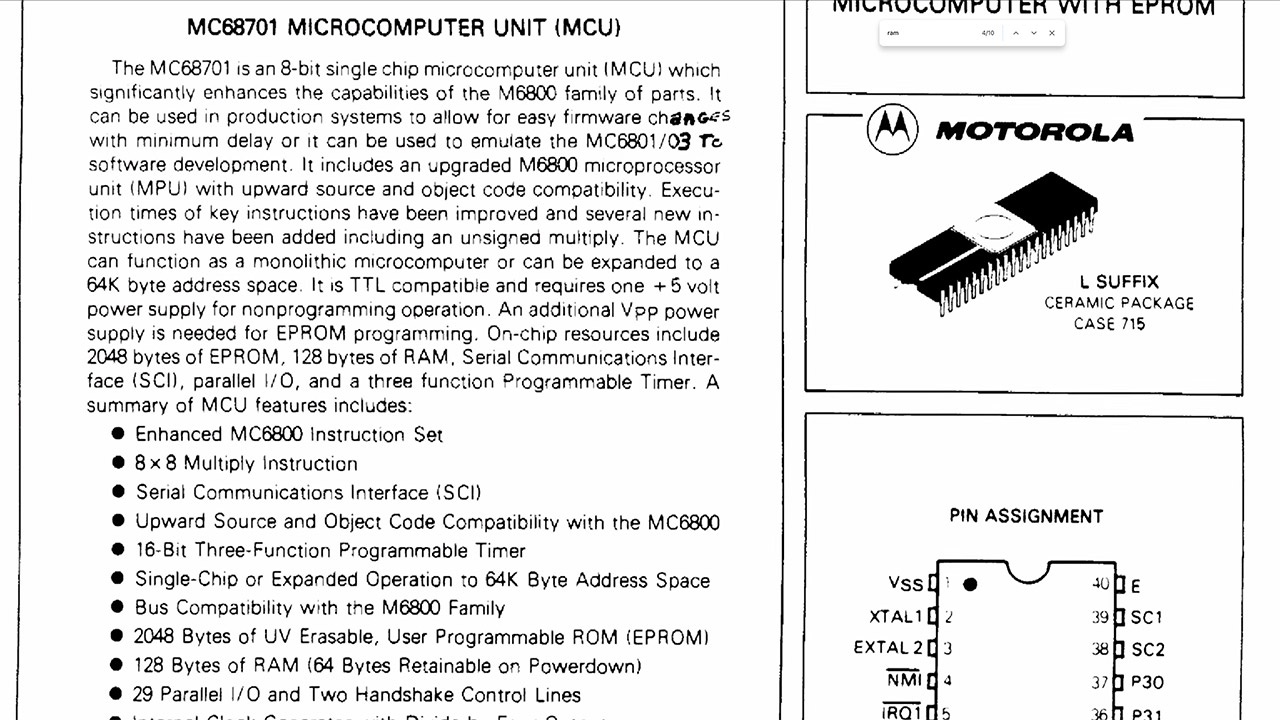
What a Restored Nikon Microscope Showed Inside a 1980s Motorola Microcontroller

Published

on

1980s Motorola Microcontroller Up-Close Microscope
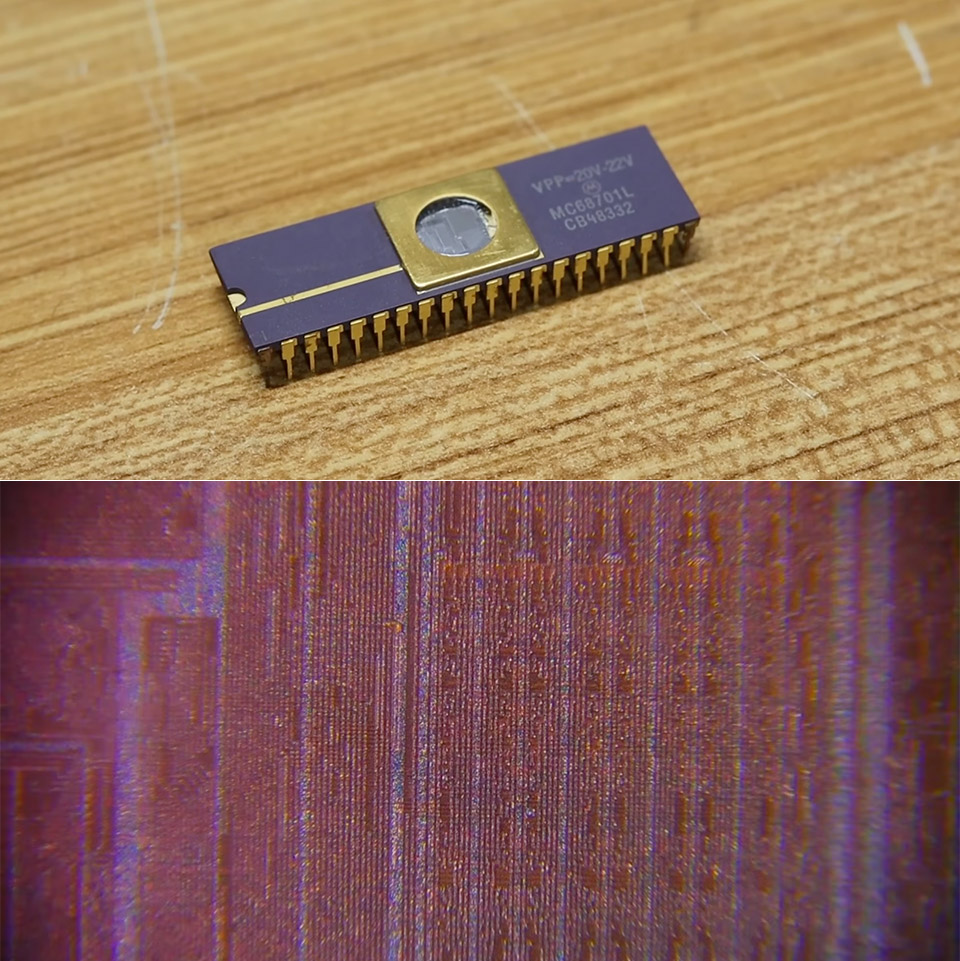
A single chip bought on a whim during a late-night scroll turned into an excuse to rescue an old laboratory microscope and finally see what its silicon actually contains. The part in question is a Motorola MC68701, a microcontroller built in the early 1980s. It packs an enhanced 6800-family processor, 2 kilobytes of ultraviolet-erasable program memory, 128 bytes of RAM, a serial interface, a programmable timer, and 29 input/output lines all onto one piece of silicon. In its day that counted as a complete small computer in a single package, and it could even reach out to external memory to grow beyond its on-chip limits.


The chip’s ceramic container contains a small quartz window that directly covers the silicon. That window exists so that UV radiation can wipe the program memory as needed. It also allows anyone with the proper optics to see the die without having to open the packaging or use harsh chemicals. That feature was what made the entire endeavor possible.

Sale


Motorola Moto G Stylus – 2025 | Unlocked | Made for US 8/256GB | 50MP Camera | Pantone Gibraltar Sea
  • Unlocked: Compatible with all major U.S. carriers, including Verizon, AT&T, T-Mobile and other major carriers.
  • Premium built-in stylus. Effortlessly jot notes, edit photos, sketch artwork, and navigate on the only phone in its class with a built-in stylus***.
  • Striking design with advanced protection. Make a statement with an ultrathin design, modern colors, and a vegan leather finish plus outstanding water…

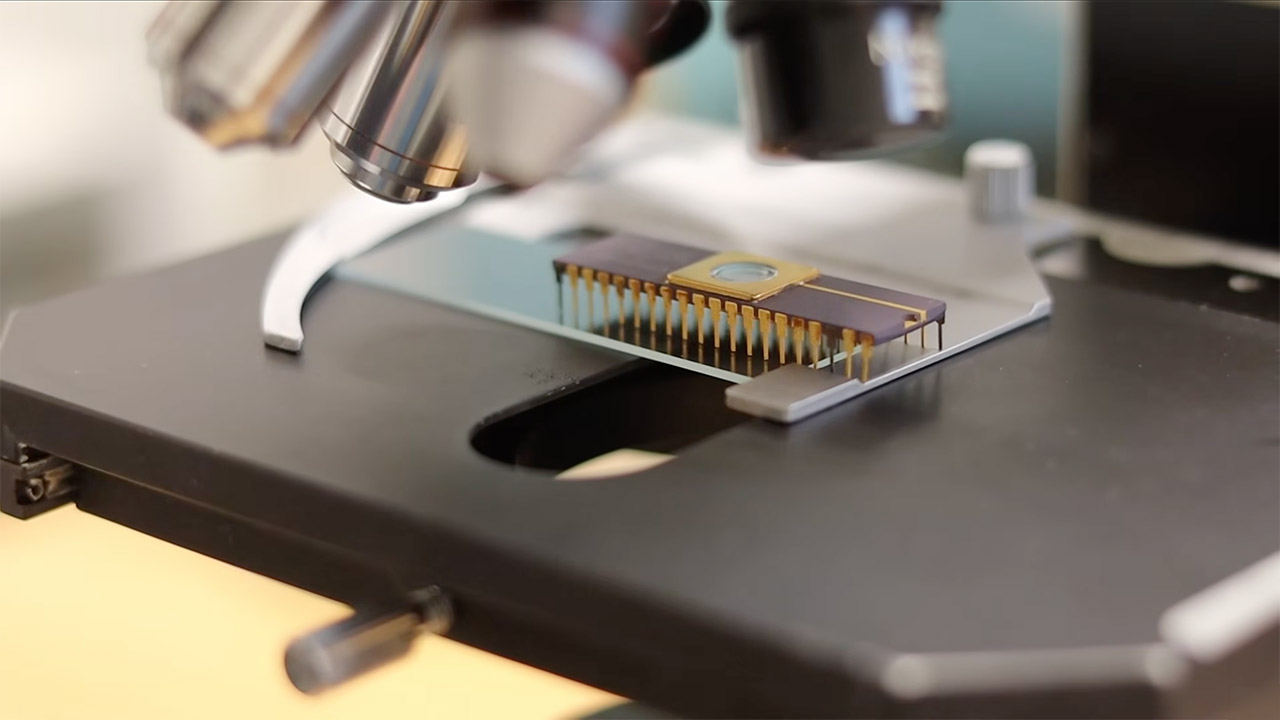
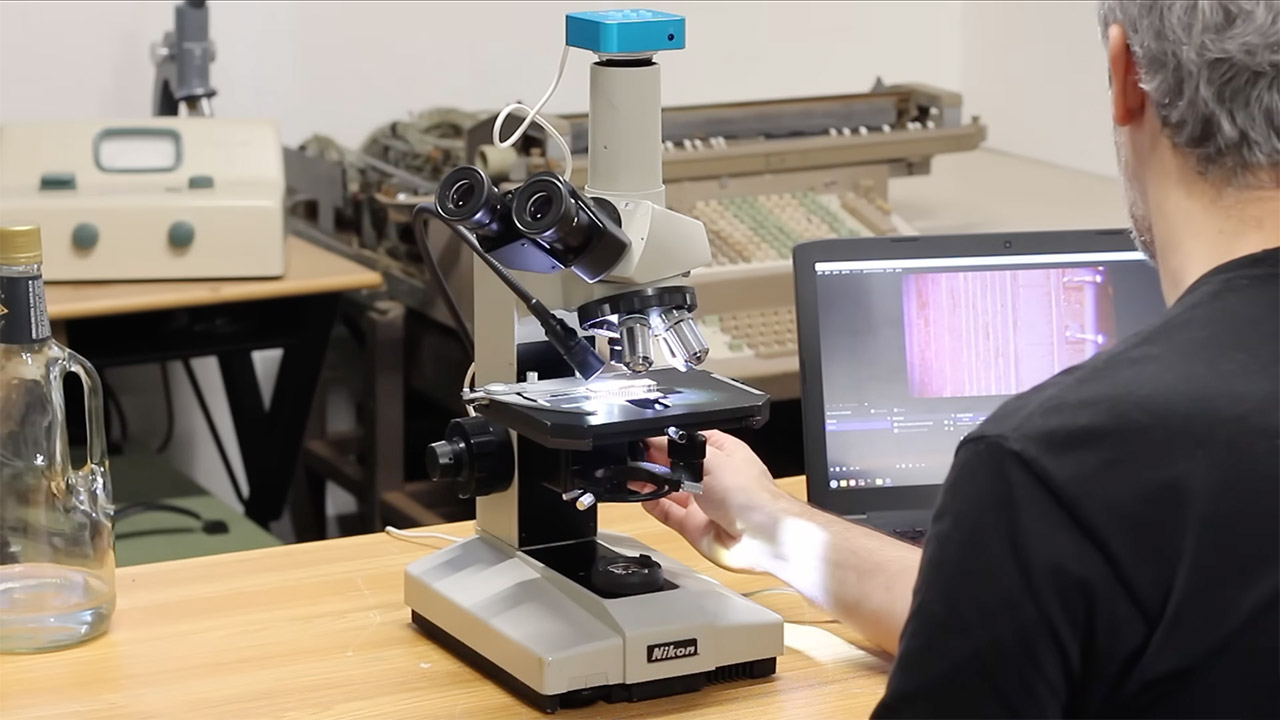
The person who ended up with the chip realized that a simple microscope would suffice to begin exploring. An affordable Nikon Labophot trinocular model appeared on eBay, complete with the original lighting system but in poor condition. Bringing it back to working order required numerous procedures. The power supply required maintenance since a transformer had become loose within its housing. Once fastened and tested, the optics were meticulously cleaned with high-purity alcohol and soft swabs to eliminate decades of dust and haze. A flexible LED light source was added to the top for reflected illumination, and a standard microscope camera required a special adapter manufactured on a small CNC mill to fit firmly over one of the eyepiece tubes.

Advertisement

1980s Motorola Microcontroller Up-Close Microscope
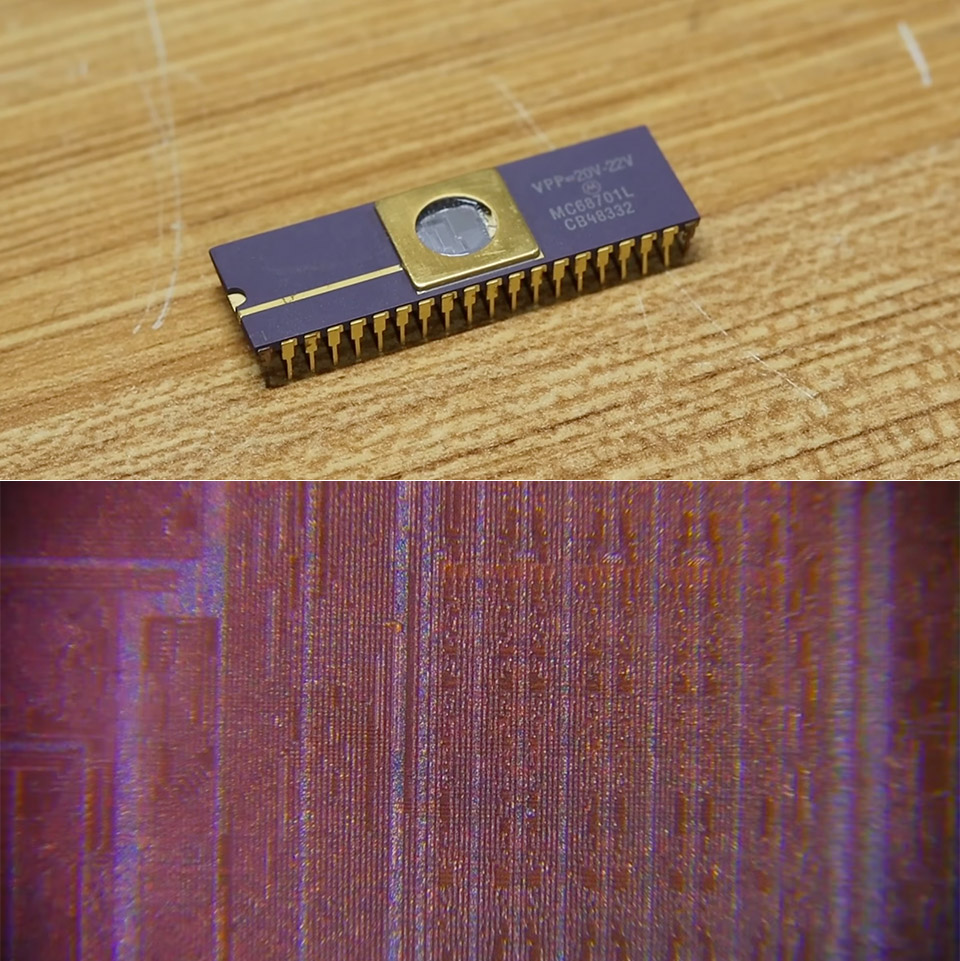
He placed the MC68701 under the microscope. Even at low magnification, the bond wires that connect the silicon to the package pins were visible; they were simply thin gold strands arching from tiny pads on the die’s edge to the chip’s legs. Moving on to the 4x objective (approximately 40x total when you include the eyepieces), you can see the surface details. The largest visible structure is the program memory array, which is a vast, regular grid that covers a large region, with each little compartment looking nearly identical to its neighbor. Not bad for read-only memory, which is designed to be dense and simple.

1980s Motorola Microcontroller Up-Close Microscope
There are line-driver transistors nearer the die’s edges, near the bond pads, because these are the circuits that generate the signals required to connect the device to the outside world. The transistor forms differ from the dense logic in the core, and faint squiggles of metal trace extend all the way up to the pads where the gold wires are connected. When you see those drivers in action, it becomes evident how the chip sends and receives information. Multiple layers of metal traces run over the surface, some horizontal, some vertical, and some on a higher plane, allowing signals to cross over without shorting. Even without delying the chip, you can see the stacking effect, demonstrating how meticulous they were in fitting everything into such a little space.

1980s Motorola Microcontroller Up-Close Microscope
Other functional blocks can be found elsewhere on the die. There are three components: one for instruction decoding, one for arithmetic and logic tasks, and a small piece for the on-chip RAM. None of these blocks required labeling because their sizes and locations indicated exactly what they were intended to perform. Once the microscope is focused, the entire active surface fits comfortably into the field of view, but all of the features are so small that you need steady illumination and a bit of care with the focus knob to discern the minute details.

Source link

Continue Reading

Tech

He Comes To Bury Segmented Memory, Not To Praise It

Published

on

[BillPg] has been designing a fantasy 1980s-era home computer. As part of the exercise, he’s reevaluating all the assumptions that have grown organically over time in the small computer landscape. Hindsight is, so they say, 20/20, but sometimes hindsight can also be colored by modern thinking. Sometimes an idea that seems stupid today made sense in the context of its time. In particular, [Bill] has thoughts on the much-maligned 8086 memory segments.

If you haven’t run into it before, the 8086/8088 had a problem. It wanted to be more or less conceptually software compatible with the 8080 and Z80 computers, which had 16-bit addresses, leading to a limit of 64K of memory. When Intel was designing the next generation of chips, it knew that 64K had to go, but telling developers that code would require huge reengineering was a non-starter. So the idea was to provide multiple 64K spaces broken up into segments.

As with most things, there is theory, and there is practice. In theory, a 16-bit segment provided four extra address bits to add to the existing 16-bit address, producing a 32-bit address, even though the CPU only had 20 bits of address bus. Code that fit in 64K could pretend like that was the whole world, and a tricked-out system could have 16 worlds. Future systems could, in theory, have had more.

In practice, Intel made the segment the top 16 bits of a 32-bit address and then added it to the ordinary 16-bit address. So address 0000:0010 (segment=0, address=10 hex) is the same memory location as 0001:0000. Address 0010:0010 is the same as address 0000:0110 and 0001:0100. This wasn’t really the intent, just a byproduct of how the chip worked.

Advertisement

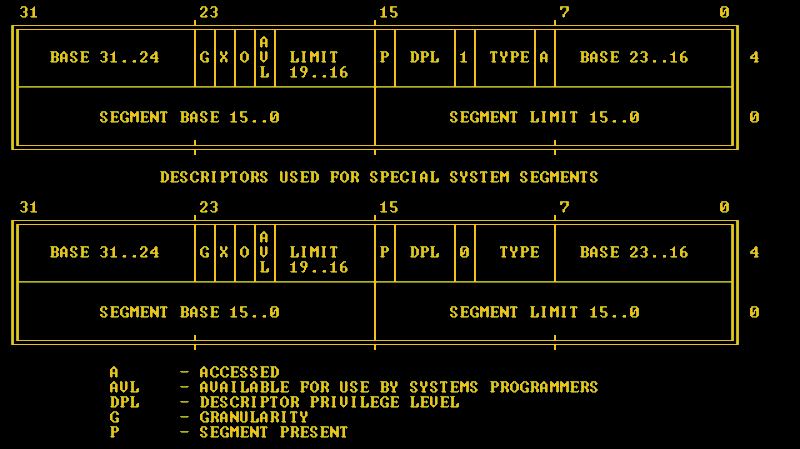
Eventually, the segments would become indices into a table (like the title graphic), but by then, bad practices wiped out a good idea. It is doubtful that the original designers thought anyone would take advantage of the overlapping address, but, of course, they did.

By the time the 80286 and beyond produced segments that were really keys which defined a block of memory, everyone was already in the mode of using the segment and offset as a large pointer. C compilers even had “modes” that let you treat the segment as just more address bits. Because of that, even on newer processors, people had a tendency to build a “flat” segment and use it. That is, make a segment that starts at 0, ends at the end of memory, and then forget about segments.

In fact, many people independently discovered that you could define a flat segment in protected mode, return to real mode, and then enjoy a flat address space. This was later christened unreal mode, and a topic we’ve covered a few times before.

We agree with [Bill]. Segments were a good idea at the time and might have been more important if people had used them the “right” way. Of course, there would have been ups and downs. Proper segments might have allowed for easy virtual memory, for example. But at the price of possibly swapping in and out huge segments instead of relatively small pages. Today, most of what segments were supposed to do is part of the memory management unit and is mostly hidden from the application developer. Still, interesting to reflect on why Intel made that choice and how we got to where we are today.

Advertisement

Source link

Continue Reading

Tech

Home Broadband Is 5G’s Surprise Killer App

Published

on

5G telecommunications, according to industry hype when 5G first launched in 2019, was going to be all about buzzy applications like mobile augmented reality and autonomous vehicles. But the surprise plot twist came when replacing home cable internet turned into 5G’s most widely adopted new application.

Fixed wireless access (FWA) now serves over 14 million U.S. customers, and contributes 28 percent of worldwide wireless traffic. Fixed wireless access is what the term sounds like: broadband internet delivered over a cellular radio link to a stationary location—no cable, no fiber, no trenching, no satellite broadband antenna pointed at the sky. What makes FWA distinctive is that it repurposes the same towers, spectrum, and 5G infrastructure that was built for mobile devices.

One U.S. Federal Communications Commission commissioner has called FWA 5G’s killer app. And that’s true not just in the United States either. Jio, India’s largest carrier, is also one of the world’s largest FWA providers, with over 9 million customers as of last year.

Carriers discovered they could repurpose surplus 5G capacity, while also exploiting a usage pattern quirk: mobile traffic starts to drop after 8 p.m., just when home internet usage peaks. The result is broadband, delivered via traditional cellphone towers, at a lower cost than fiber deployment. For these reasons, FWA provides real price competition to cable broadband, while reaching underserved rural and suburban communities.

Advertisement

Fixed Wireless Access Repurposes Ambitious 5G Infrastructure

FWA is cheaper to deploy than fiber, and for most homes and small businesses, fiber’s gigabit speeds are overkill anyway. And since FWA uses the same wireless networks built for cellular service, FWA works anywhere that receives a steady cellular signal.

As cellular networks extend into areas with minimal service, FWA’s coverage map expands with them. In these remote locales, the other main viable broadband alternative typically comes from satellite services like Starlink—which are, compared to FWA, more expensive, with higher delays, and lower bandwidth.

While most FWA deployments use currently underused microwave bands, some FWA deployments use electromagnetic spectrum that 5G launched but that mostly failed with mobile users. Millimeter waves operate at frequencies 10 to 40 times higher than 4G’s spectrum, offering high data rates from their wide available bandwidth.

However, there are good reasons 5G mobile users today don’t generally use millimeter-wave spectrum. Millimeter waves can’t penetrate buildings. Plus, they lose signal strength within a kilometer or two of the transmitter. Millimeter-wave antennas are also a real drain on cellphone batteries compared to microwave and radio-wave tech.

Advertisement

Yet none of these challenges applies to a fixed station with a clear line of sight to a nearby tower. FWA home units (called customer premise equipment or CPEs) outperform 5G handsets by a significant margin. That’s mostly because of hardware. CPEs carry larger, more sensitive antennas than a typical cellphone, paired with more capable transceivers. CPEs also tend to be plugged into wall outlets, making battery concerns a nonissue.

Another 5G technology that did not gain traction in mobile wireless is multi-user multiple-input multiple-output (MU-MIMO). A base station with MU-MIMO uses an array of antennas to serve multiple users on the same frequency simultaneously.

However, maintaining a MU-MIMO signal involves tracking each user individually—a problem that quickly becomes overwhelming with enough mobile users. FWA is different, however. Static CPEs, with their steadier downlink traffic loads, are an ideal match for MU-MIMO technology.

So, FWA internet service not only uses mostly fallow spectrum but also uses 5G spectrum more efficiently than do 5G mobile users—for whom, of course, these 5G technologies were originally designed!

Advertisement

How FWA Became 5G’s Surprise Killer App

Not long ago, the high-bandwidth use cases for 5G made for an impressive list: millisecond latency for autonomous vehicles, mobile augmented reality headsets with extensive high-speed data needs, and massive machine connectivity for an expanding internet of things (IoT).

These applications have all stalled. Autonomous vehicles pose challenging—and still unsolved—problems unrelated to spectrum allocation. Augmented and virtual reality technologies have yet to create meaningful spikes in bandwidth demand. And the IoT has, to date at least, fragmented across an array of competing standards.

Mobile carriers had built dense 5G networks for mobile customers whose needs rarely saturated the network’s capacity. Home broadband usage peaks in the evening hours, precisely when cellular networks are quietest.

FWA sits at cellular networks’ crossroads of supply and demand.

Advertisement

The Advent of 6G Will Only Expand FWA’s Reach

In December, the telecom standards body, the Third Generation Partnership Project (3GPP), issued its latest 5G specification—Release 20, the final “5G only” update. So, although 6G is still years away (its first specifications are expected in early 2029), engineering decisions that will define 6G are being made today. And FWA is not on the margins of that conversation; FWA is currently considered an established day-one use case.

6G wireless technology promises to expand FWA’s reach—not only via spectrum but also via geometry. Instead of following 4G and 5G’s connectivity model—strong signals near towers and weak signals far away—future 6G networks will let homes connect to multiple towers simultaneously, using a technology called distributed MIMO (multiple-input, multiple-output).

Where 5G’s version of MIMO (a.k.a. massive MIMO) concentrates user communication with dozens of antennas at a single tower, distributed MIMO uses antennas across multiple base stations and coordinates them to deliver signals to your home from multiple directions simultaneously.

The practical result: Because no single tower is responsible for any given connection, the “edge” of a cell network—that outer boundary where signal strength falls off and service degrades—no longer represents a hard limit on who gets well served. A home that would once have been too distant from a tower, or blocked by terrain, could now be within reach of several base stations working together.

Advertisement

6G may eventually adopt distributed MIMO technology for mobile users, when synchronization challenges and other signal engineering hurdles are solved and deployed for real-world cellular networks. The jury, as of 2026, is still out on whether the full distributed MIMO problem will be solved once the 6G standards start to be set in place, within three years.

As demand for FWA grows, carriers will also deploy increasingly capable millimeter-wave infrastructure for fixed customers first—the stationary CPE use case that millimeter wave best suits. The dense millimeter-wave antenna infrastructure that FWA requires is the same infrastructure that future mobile applications will eventually inherit. AR glasses, AI-powered wearables, and other bandwidth-hungry applications originally promised for 5G are not canceledthey are waiting for the infrastructure to arrive.

The pathway to FWA is being prepared at lower frequencies, too. There is growing interest today in the largely unoccupied FR3 band, which spans roughly 7 to 24 gigahertz, situated between crowded low/mid-bands and the much higher millimeter-wave frequencies.

Recent field trials by Nokia have demonstrated FR3’s viability for both cellular and FWA applications. FR3 is emerging as one of the more promising near-term frontiers for extending FWA coverage beyond its current footprint.

Advertisement

None of this was the plan. No carrier executive in 2020 stood on a stage and announced that 5G’s defining achievement would be delivering living room broadband to rural homes and suburban subdivisions underserved by cable.

FWA became 5G’s killer app because the engineering economics made it happen. Surplus wireless capacity met unmet consumer broadband demand, with the physics of a stationary receiver doing the rest.

That is not a criticism of the engineers or the carriers. It is simply how technology sometimes advances—sideways, through gaps nobody was trying to fill.

But FWA’s model of prioritizing unconnected users may in the end prove to be telecom’s on-ramp to everything else. Fix the digital divide first. Tomorrow’s sci-fi future appears set to follow close behind.

Advertisement

From Your Site Articles

Related Articles Around the Web

Source link

Advertisement
Continue Reading

Tech

Tesla launches a longer six-seat Model Y to replace the Model X for many buyers

Published

on


Tesla has taken this approach before. Instead of launching brand-new cars, the EV giant has focused on new versions of the Model Y and Model 3 to support demand. Tesla rolled out the longer Model Y L in China last year, where it lifted sales even as local rivals like…
Read Entire Article
Source link

Continue Reading

Tech

Shampoo and cookies get an AI makeover as consumer giants rewire their labs

Published

on

The AI story has mostly been told through chips, data centres, and the companies building the models. It is now being told through the shampoo aisle.

The world’s largest makers of everyday goods, the businesses behind the bottles and packets in most kitchens and bathrooms, say they are using artificial intelligence to design products and run the campaigns that sell them, turning a technology associated with software into a fixture of the consumer-goods lab.

It is the same wave of enterprise adoption that has pulled AI tooling into corporate software stacks, arriving now in categories as unglamorous as body wash and biscuits.

Procter & Gamble offers the clearest example of what this looks like inside research and development.

Advertisement

The 💜 of EU tech

The latest rumblings from the EU tech scene, a story from our wise ol’ founder Boris, and some questionable AI art. It’s free, every week, in your inbox. Sign up now!

The company says it used AI to screen tens of thousands of peptides in developing a formula for a Pantene product, drawing on an internal database of more than 8,500 formulations to predict how a mixture would feel on skin or hair before anyone mixed it.

The point is not novelty for its own sake. It is time. Steps that once required rounds of physical testing can be narrowed down computationally, which pushes candidates toward consumer trials faster.

Advertisement

Mondelez, the snacking company behind a long list of familiar biscuit and chocolate brands, describes a similar shift on the food side.

It says an AI product-development tool has helped it generate dozens of new formulations, and that the software lets developers move between two and five times faster than conventional methods.

The same generative systems are being pointed at marketing, producing personalised images, text, and video at a pace traditional studios cannot match.

Unilever has leaned hardest into the campaign side. Its Dove brand ran a cookie-scented body-care line in partnership with Crumbl, with AI involved across the effort, from product direction to the selection of influencers and the creative itself.

Advertisement

The company reported the campaign drew billions of impressions and brought a large share of new buyers to the brand. Whatever one makes of a cookie-scented soap, the mechanics are instructive: a single AI-assisted pipeline running from formulation to feed.

What ties the examples together is compression. In consumer goods, the traditional cost of experimentation is measured in months of lab work and test batches, and the traditional cost of a campaign is measured in agency hours. AI attacks both.

Reformulation becomes a search problem over known ingredients, and content becomes something generated and varied on demand, an approach that mirrors the advertising ambitions on display when OpenAI pitched AI-made ads at Cannes.

The claims deserve some caution. Most of the specific figures come from the companies themselves, and consumer giants have every reason to present their AI programmes as further along than they are.

Advertisement

Product development still ends with human tasting panels and dermatological testing, and a formula an algorithm likes is not the same as one a shopper buys twice.

The industry’s own researchers have flagged that AI-generated marketing often drifts toward the generic, missing the brand-specific character that makes a campaign land.

Still, the direction is consistent across firms that rarely agree on much. The reallocation of enterprise budgets toward AI agents and tooling has become a general feature of large companies, from Tencent’s enterprise agents to the consumer-goods R&D described here, and the packaged-goods sector is not sitting it out.

For shoppers, the visible result will be mundane: more variants, faster refreshes, scents and textures that arrive and vanish more quickly than they used to.

Advertisement

The machinery behind the shelf is changing even where the products look the same. A bottle of shampoo is, increasingly, the output of a search.

Source link

Advertisement
Continue Reading

Trending

Copyright © 2025