

Crypto World
‘Something Is Brewing’ for Dogecoin (DOGE) as Network Activity Explodes


Meme coin momentum has far evaporated from the peaks of a couple of weeks ago, even though there are some that are still making waves. However, most turn out to be owned by a few wallets that later dump on unsuspecting investors.
The situation with the leader of this niche is quite interesting. It continues to be a major cryptocurrency with a multi-billion-dollar market cap, but it has fallen out of investors’ grace as interest in it has diminished. Or has it?
Something Is Brewing
Popular crypto analyst Ali Martinez, citing data from Glassnode, indicated earlier today that the network activity on Dogecoin has risen by almost 50,000 active addresses. The chart below demonstrates the rapid increase at the end of June and early July, going from under 40,000 to the aforementioned number.
Martinez noted that ‘something is brewing’ for DOGE just a day after he posted that the TD Sequential metric had flashed a major buy signal for the asset. The OG meme coin is up by 3% weekly, but it has slipped by 11% in the past month alongside most of the crypto market. However, the TD Sequential and the growing network activity could be the beginning of something more lasting.
Dogecoin $DOGE network activity has exploded to nearly 50,000 active addresses!
Something is brewing. https://t.co/yQZwPEPGGK pic.twitter.com/FCf1m8D3oV
— Ali Charts (@alicharts) July 5, 2026
Anyone Still Cares?
Fellow analyst Daan Crypto Trades also weighed in on DOGE’s price moves and admitted that “no one really cares about this coin right now.” However, he said he is still watching it closely, especially if it heads toward its long-term support area within the $0.05 range.
He added that other crypto assets will perform better in this (or the next) cycle, but DOGE is “still one that tends to be reliable for a decent bounce once a bear market bottom is set.”
Meanwhile, Celal Kucuker was a lot more bullish, indicating that DOGE has “one of the cleanest charts in crypto.” The analyst predicted that the meme coin could explode to $1.00, representing a new all-time high, since it couldn’t reach those levels during the Musk-led 2021 hype cycle.
The post ‘Something Is Brewing’ for Dogecoin (DOGE) as Network Activity Explodes appeared first on CryptoPotato.

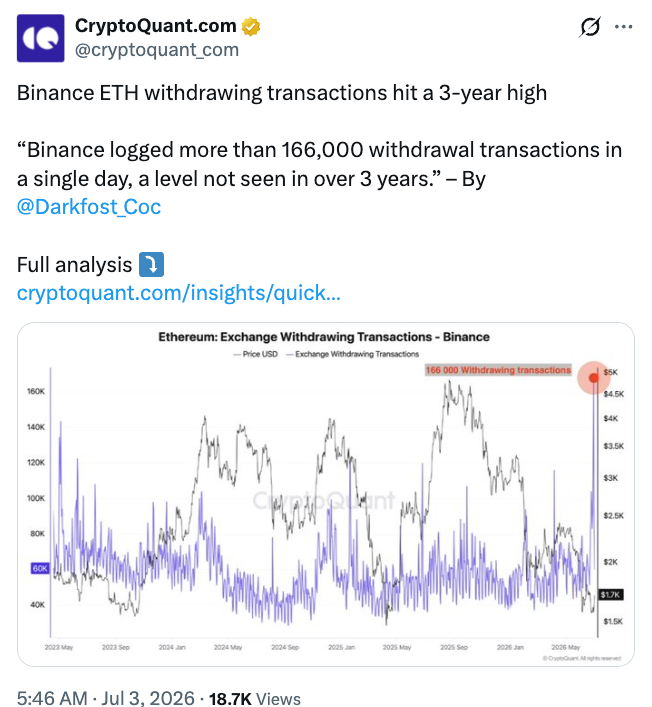
Binance, the world’s largest crypto exchange by trading volumes, recorded a sharp surge in weekly outflows as Ethereum withdrawal activity climbed to a multi-year high.
According to DefiLlama data viewed by Cointelegraph on Sunday, Binance saw $1.23 billion in net outflows during the week beginning June 29, a 207% increase from roughly $400 million the week prior, while monthly net outflows totaled about $3.2 billion.
Separately, blockchain analytics platform CryptoQuant on Friday reported that Binance’s Ethereum withdrawal transactions hit their highest level in more than three years, with over 166,000 withdrawal transactions in a single day.
While some of the movement may reflect accumulation behavior, CryptoQuant analysts pointed to regulatory uncertainty stemming from the European Union’s Markets in Crypto-Assets (MiCA) regulation and short-term market positioning as possible drivers.
ETH outflows vs price rebound
Binance’s ETH withdrawals marked the sharpest increase in withdrawal transactions recorded on Binance since March 2023, coinciding with Ether posting a modest rebound of around 10% over a two-day period, CryptoQuant said.
“This surge in withdrawals could reflect genuine demand building around the $1,500 level, with investors choosing to take exposure and pull their funds off the exchange, a pattern that typically points toward longer-term accumulation rather than short-term trading,” the analysts said.
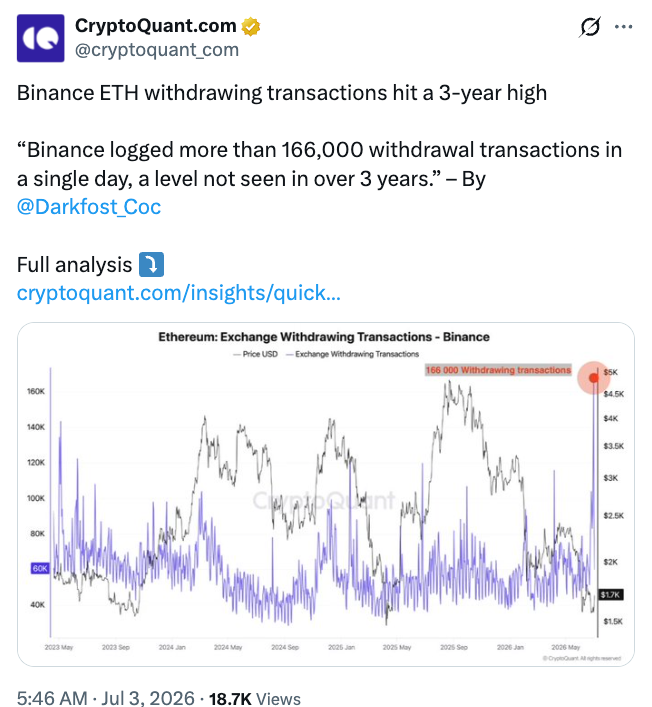
Source: CryptoQuant
Ether prices showed a broader recovery over the past week. According to Coingecko data, ETH rose about 12.5% over the past seven days, trading at $1,766 at the time of publication.
Related: Bitcoin profit and loss ratio falls to 43-month low
Bitcoin, the largest cryptocurrency by market capitalization, also edged up 4.3% over the same period, trading at $62,925 at the time of publication.
Outflows dominate CEXs while inflows remain fragmented
Apart from Binance, several other centralized exchanges (CEXs) also recorded outflows over the past week.
Bitfinex saw $407.5 million in outflows, followed by Gate at $214.3 million. OKX recorded $87.1 million in outflows, while Bybit posted $78.4 million, according to DefiLlama data.
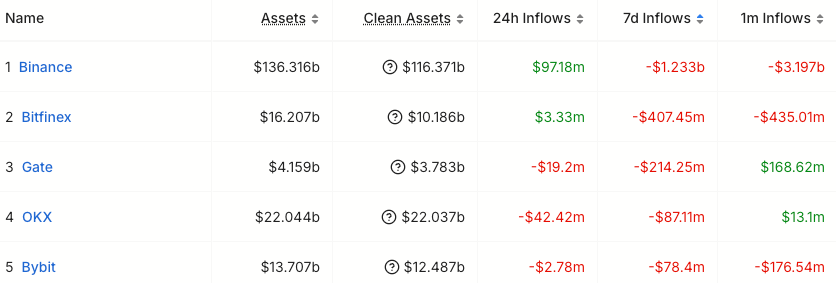
Top five exchanges sorted by weekly net flows. Source: DefiLlama
On the inflow side, Crypto.com and HashKey Exchange led gains over the past week, recording around $63 million and $53.3 million in net inflows, respectively.
Smaller inflows were also seen across KuCoin at $22.1 million, Gemini at $17.4 million, and Bitvavo at $15.8 million over the same period.
Magazine: Bitcoin copying 2022 ‘almost perfectly,’ Ether to $4K in 2026: Market Moves
Bitcoin’s gradual price recovery that began after the early July correction continues, as the asset briefly exceeded $63,000 yesterday and now stands around that level.
Most larger-cap alts remain relatively sluggish on a daily scale, aside from SOL, HYPE, and XLM, which have dropped by up to 4%, and ADA and BCH, which have posted notable gains.
BTC Eyes $63K
June was quite painful for the primary cryptocurrency, as it dropped by over 20%. July began on a similar note, as the asset dipped below $58,000 to chart a new multi-year low. However, the bulls finally intervened at this point and didn’t allow another leg down.
Just the opposite; bitcoin started to recover some ground and quickly reclaimed the $60,000 mark. After a brief dip below that line, the bulls went on the offensive once again, pushing the asset to $62,000 as the net withdrawals from the ETFs eased and investors poured some money in on Thursday.
BTC remained calm at above $61,000 and jumped once again on Saturday and earlier this morning, going to a multi-week peak of $63,400. Although it was stopped there, it now trades close to $63,000, posting a near 5% increase on a weekly scale.
Its market capitalization has risen to $1.260 trillion on CoinGecko, but its dominance over the altcoins remains well below 57%.

LAB Rockets
Ethereum was stopped at $1,800 yesterday and now sits at just over $1,760. BNB’s run couldn’t reclaim $580, and the asset trades below that level now. XRP is under $1.15, while SOL is testing the $80 support after a 2.4% daily decline.
HYPE and XLM have dropped even harder, with a 4% decrease from the former and a 3.4% dip from the latter. In contrast, ADA continues its recovery with another 9% surge to well over $0.19. BCH is up by around 6% and sits at $240.
LAB is by far the top gainer today, having skyrocketed by 80%. The asset, which has seen some intense volatility as of late, now trades at over $16.
The total crypto market cap has increased slightly from yesterday and now sits at $2.230 trillion on CG.

The post Viral Altcoin Skyrockets by 80% Daily, Bitcoin (BTC) Flirts With $63K: Market Watch appeared first on CryptoPotato.

Key Highlights
- Ethereum’s co-founder Vitalik Buterin has announced the “Lean Ethereum” initiative, a comprehensive upgrade plan spanning 2026 through 2029 with changes comparable to the 2022 Merge
- Quantum defense has been significantly elevated as a priority concern, with immediate focus on developing quantum-resistant blob architecture
- Privacy features are transitioning from optional add-ons to fundamental layer-1 protocol components
- Developers are considering implementing a secondary virtual machine—either leanISA or RISC-V—to complement the current EVM
- Skeptics express concern about the Ethereum Foundation’s track record of meeting projected deadlines
Vitalik Buterin, Ethereum’s co-creator, has released an extensive strategic roadmap dubbed “Lean Ethereum” that outlines the network’s evolution through the end of the decade. The comprehensive blueprint addresses fundamental protocol changes across multiple technical layers.
The announcement came via X on Saturday, with Buterin outlining a three-to-four-year implementation timeline. He drew parallels to the transformative September 2022 Merge that transitioned Ethereum from proof-of-work to proof-of-stake consensus.
This strategic vision emerged from collaborative discussions at a Berlin research summit, where core developers and technical researchers convened to reassess the network’s long-term trajectory.
Quantum Threats Drive Accelerated Defense Timeline
A notable recalibration in priorities involves quantum computing resistance. Buterin emphasized that quantum defense “has shifted up a LOT in priority,” characterizing the development of quantum-resistant blob infrastructure as “urgent.”
The strategic blueprint mandates elimination of all quantum-susceptible elements throughout the protocol stack. Engineers have already initiated development on quantum-secure blob architecture.
Additionally, the roadmap introduces recursive STARKs as fundamental layer-1 infrastructure, superseding the existing direct re-execution verification methodology.
Privacy Elevated to Protocol Foundation
Privacy capabilities have been promoted from supplementary features to essential layer-1 objectives. Buterin noted this now encompasses critical areas including mempool architecture and state tree structure.
This represents a fundamental architectural transformation. Historically, privacy functionality within Ethereum existed primarily at the application tier rather than being embedded in the base protocol.
The roadmap also contemplates introducing an alternative virtual machine. Buterin suggested Ethereum might deploy leanISA or RISC-V parallel to the existing EVM, ultimately aiming for a more streamlined and efficient protocol foundation.
Regarding consensus mechanisms, the plan aims to achieve one- to two-round finality by separating the availability chain from finality processes. This approach seeks to enhance security while minimizing latency.
For state management, Buterin indicated Ethereum will maintain its current dynamic state architecture while incorporating additional state categories to boost scalability. Projections suggest that by 2030, Ethereum will manage 2 TB of dynamic state alongside 100 TB of newer state formats. Transitioning applications such as tokens and NFTs to these new state structures could reduce transaction costs by over tenfold.
Implementation Timeline Faces Scrutiny
The proposed timeline has generated skepticism within the community. Researcher Dankrad Feist, while endorsing the strategic direction, argued that the three-to-four-year timeframe is unnecessarily prolonged, proposing that AI-assisted development tools could compress delivery to one year.
Crypto analyst Ignas Fiodorovas similarly supported the roadmap’s objectives but questioned the Ethereum Foundation’s capacity to honor its commitments, citing historical precedents of missed deadlines.
Fiodorovas also identified a critical omission: enhanced tokenomics for Ether itself, which has experienced sustained price depreciation throughout recent market turbulence.
This roadmap follows the Ethereum Foundation’s decision last month to reduce headcount by approximately 20%, part of a broader 40% budget contraction. Several prominent contributors have also exited recently, including protocol developers Tim Beiko and Barnabé Monnot.

TLDR:
- Ripple XRP donation support is tied to America250s Giving 4th campaign, with the company matching eligible gifts in XRP up to $10,000.
- Donors can contribute through cash, stock or crypto, while XRP and RLUSD are listed among the accepted digital assets for the campaign.
- The Call of Duty Endowment says CODE4Vets supports groups that prepare veterans for civilian jobs and raise employer awareness.
- The campaign connects July 4 charitable giving with veteran employment, as the Endowment targets 200,000 job placements by 2030.
The Ripple XRP donation campaign has placed crypto philanthropy in the Independence Day spotlight. Ripple joined America250s Giving 4th effort on July 4 and pledged to match eligible donations in XRP, up to $10,000. The campaign supports the Call of Duty Endowment and its CODE4Vets initiative, which focuses on helping veterans enter civilian careers.
Donors can give cash, stock or crypto, with XRP and RLUSD accepted for eligible contributions. America250 launched Giving 4th in June as a national effort to turn July 4 into a broader day of charitable giving.
Ripple XRP Donation Match Ties July 4 to Veteran Jobs
Ripple announced its Giving 4th participation as the U.S. marked its 250th Independence Day. The move links a civic campaign with a veteran employment fundraiser rather than a direct market update for XRP.
The Ripple XRP donation match applies to contributions made through the Call of Duty Endowment campaign page. Ripple said it would match donations in XRP until the total match reaches $10,000. The campaign page also lists XRP and RLUSD among accepted crypto options.
CODE4Vets is powered by the Call of Duty Endowment. Its stated work centers on funding effective nonprofits that help veterans return to work. It also raises awareness among employers about the skills veterans bring after service.
The Endowment says it has funded more than 165,000 veteran job placements. It has also set a goal of reaching 200,000 placements by 2030. That target gives the fundraiser a measurable employment angle beyond a one-day giving push.
Ripple XRP Donation Adds Crypto Utility to Giving 4th
The Ripple XRP donation pledge also gives XRP and RLUSD another real-world use case through charitable giving. Donors are not limited to crypto, since the campaign also accepts cash and stock. Still, crypto support allows digital asset holders to take part without first converting funds elsewhere.
America250 described Giving 4th as a nationwide initiative designed to support nonprofits around Independence Day. The group said the campaign responds to the summer slowdown many nonprofits face in midyear fundraising.
For Ripple, the campaign arrives as blockchain firms continue pushing digital assets into payments, donations and tokenized finance. The company has already worked with crypto donation platforms and promoted RLUSD for charitable use in past campaigns.
The Ripple XRP donation match remains capped at $10,000, so the final company contribution depends on donor activity. The fundraiser had a stated $10,000 goal, while progress will move through the campaign page as eligible donations come in.
TL;DR
- Dogecoin active addresses have surged to nearly 50,000, signaling renewed network activity.
- Whale traders are increasing long positions while closing shorts, boosting bullish sentiment.
- DOGE has fallen below a key support zone, keeping the technical outlook under pressure.
- Analysts are watching the $0.05–$0.06 support area unless bulls reclaim the $0.118 resistance.
Dogecoin is showing mixed signals as on-chain activity accelerates while its price continues to face technical pressure. The meme coin has recorded a sharp rise in network participation, with active addresses climbing to nearly 50,000, even as critical support levels remain under threat.
The contrasting data suggests that although market interest in DOGE is increasing, traders remain divided over its near-term direction.
Fresh on-chain data indicates that Dogecoin’s daily active addresses have surged to almost 50,000, marking one of the strongest increases in network activity in recent months. Rising active addresses are often viewed as a sign of growing user engagement and can reflect increasing transaction activity across the blockchain.
The spike comes as broader crypto markets attempt to stabilize following recent volatility, putting Dogecoin back on investors’ watchlists.
Whale Positioning Turns More Optimistic
Sentiment among larger market participants also appears to be shifting.
According to market data shared by analysts, whales have started reducing their short positions and increasing long exposure for the first time since Bitcoin began its decline from around $82,000. Among the assets attracting the strongest institutional-style signals are XRP and Dogecoin.
A separate market sentiment dashboard also showed DOGE carrying one of the highest short concentrations among major cryptocurrencies, while its risk score moved into an elevated zone. Such positioning can create conditions for heightened volatility if prices move sharply against heavily leveraged traders.
Dogecoin Price Technical Picture Still Calls for Caution
Despite improving network metrics and changing whale behavior, Dogecoin’s chart continues to reflect a bearish structure.
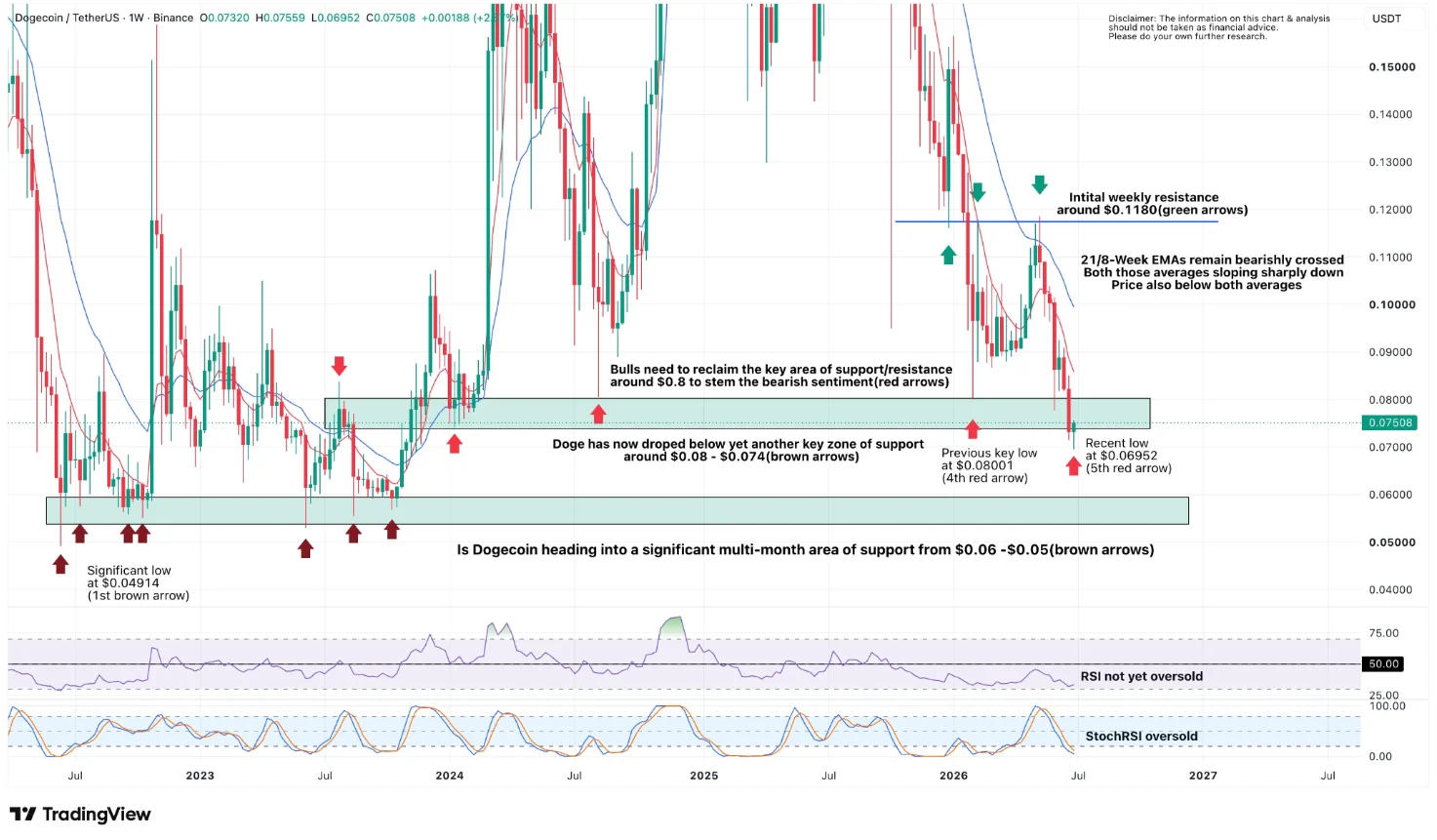
Recent price action shows DOGE falling below another major support zone between $0.074 and $0.08. The token also remains below both the 8-week and 21-week exponential moving averages, which continue trending downward, a sign that sellers still maintain control.
Bulls would need to reclaim the $0.118 resistance area to weaken the current bearish outlook or establish a convincing bottom before sentiment can shift meaningfully. If selling pressure continues, attention could turn to the long-term support region between $0.05 and $0.06, an area that has historically attracted buyers during previous market cycles.
Momentum indicators present a mixed picture. While the Stochastic RSI has already entered oversold territory, the Relative Strength Index (RSI) has yet to reach comparable levels, suggesting there could still be room for additional downside before a stronger reversal develops.
For now, Dogecoin presents conflicting signals. Rising network activity and improving whale positioning hint at renewed interest, but technical indicators continue to point toward caution until key resistance levels are reclaimed and the broader trend begins to improve.
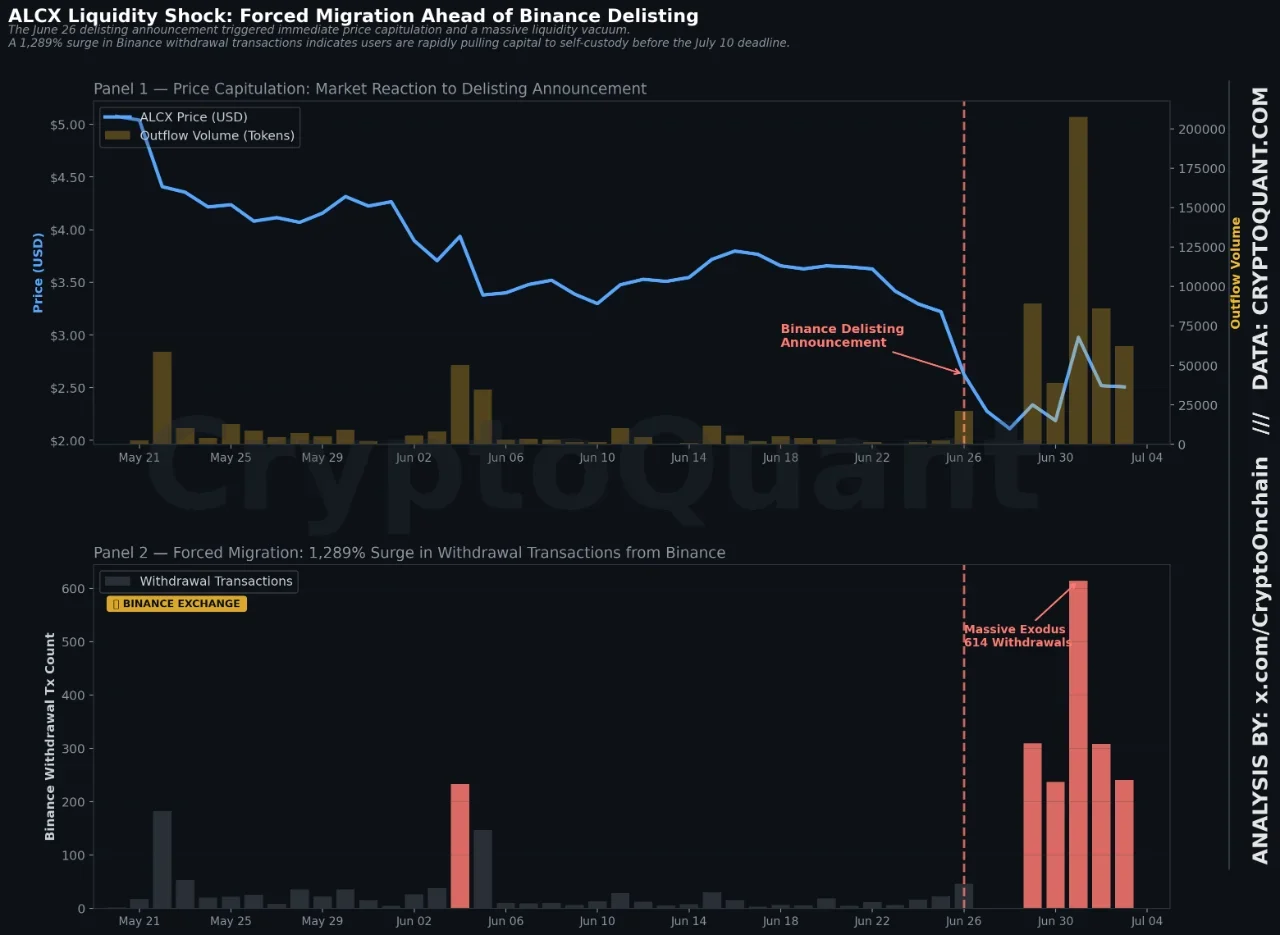
TL;DR
- ALCX price fell around 30% after Binance announced it would delist the token on July 10.
- Binance withdrawal transactions surged 1,289%, reaching 614 withdrawals on July 1 as users moved funds.
- Exchange inflows and outflows spiked, signaling a large-scale migration of liquidity away from Binance.
- Despite higher network activity, negative netflows suggest the surge reflects defensive repositioning rather than renewed demand.
ALCX price came under heavy pressure after Binance announced plans to delist the token, triggering a sharp decline in value and a dramatic shift in on-chain activity as traders rushed to reposition ahead of the exchange’s July 10 deadline.
According to on-chain data, the June 26 delisting announcement was followed by an immediate 30% drop in ALCX price, while Binance withdrawal activity surged to levels far above normal. The data suggests investors are rapidly moving tokens off the exchange as liquidity begins to migrate elsewhere.
Binance Delisting Triggers Massive Withdrawal Activity
The attached on-chain data highlights a sharp increase in user withdrawals immediately after Binance confirmed it would remove ALCX trading pairs. Withdrawal transactions from Binance jumped 1,289% week-over-week, climbing from a typical daily baseline of fewer than 20 transactions to 614 withdrawals on July 1, the highest level recorded during the period.
At the same time, exchange flows accelerated in both directions. Binance inflows climbed 3,856%, while outflows increased 1,484%, illustrating intense repositioning ahead of the delisting.
This pattern reflects what analysts describe as a forced migration. Some holders appear to be sending tokens back to Binance to exit their positions before trading ends, while others are withdrawing ALCX to self-custody or alternative exchanges where the asset will remain available.
The result has been a significant shift in where liquidity is concentrated, reducing the amount of tradable liquidity remaining on Binance.
Network Activity Climbs Despite Price Weakness
Although ALCX price declined sharply following the announcement, overall network activity moved in the opposite direction.
The data shows active addresses increasing 107%, while total token transfers surged 510% after the delisting news.
Rather than pointing to renewed adoption or stronger demand, the spike appears to reflect users reorganizing their holdings in response to the upcoming exchange removal. Investors are actively transferring assets between wallets and platforms as they prepare for trading to cease on Binance.
Meanwhile, persistent negative net flows of 285% indicate that more capital continues leaving Binance than entering it, reinforcing the view that liquidity is steadily migrating away from the exchange.
Liquidity Reorganization May Drive Short-Term Volatility
The current on-chain picture suggests ALCX is undergoing a significant redistribution of liquidity rather than experiencing normal market activity.
With Binance serving as one of the token’s major trading venues, its removal creates a temporary liquidity vacuum as traders relocate funds and market makers adjust their inventories across other platforms.
As the July 10 delisting date approaches, this transition could continue to produce elevated volatility while the market adapts to a new trading environment.
Although the data confirms substantial selling pressure and large-scale fund movements, it also indicates that much of the recent network activity has been driven by defensive positioning instead of organic growth. The longer-term impact on ALCX price will likely depend on how quickly liquidity stabilizes across the exchanges that continue supporting the token after Binance completes the delisting.
Crypto World
Vitalik Buterin Unveils ‘Lean Ethereum’ Roadmap With Focus on Quantum Security and Scalability
TL;DR
- Vitalik Buterin has introduced the Lean Ethereum roadmap, with upgrades planned over the next three to four years.
- The roadmap prioritizes quantum-resistant cryptography, native STARK verification, and improved network scalability.
- Ethereum also plans to expand programmable privacy and introduce a scalable state architecture capable of handling up to 100TB by 2030.
- The upcoming Glasterdam upgrade is expected to raise Ethereum’s gas limit, boosting the network’s transaction capacity.
Ethereum’s long-term development roadmap is taking center stage after co-founder Vitalik Buterin unveiled a sweeping vision for the network’s next phase of evolution.
Dubbed “Lean Ethereum,” the roadmap lays out a series of protocol upgrades expected to unfold over the next three to four years. The initiative aims to strengthen Ethereum’s security, improve scalability, expand privacy capabilities, and prepare the blockchain for future technological threats, including quantum computing.
The proposal comes as Ethereum continues refining its post-Merge architecture while developers work toward making the network more efficient and resilient for long-term adoption, a move that has had quite some effects on its price.
Lean Ethereum Prioritizes Quantum Security and Network Efficiency
One of the biggest priorities outlined by Buterin is making Ethereum resistant to future quantum computing threats. He proposed replacing the network’s remaining quantum-vulnerable cryptographic components with post-quantum alternatives, reflecting what he described as a growing urgency around quantum security.
Another key objective is integrating recursive STARKs as a native verification component. STARKs are cryptographic proofs designed to verify computations efficiently while improving scalability and security. Making them native to Ethereum could simplify verification processes across the network.
The roadmap also introduces a new “scalable state” architecture capable of expanding to roughly 100 terabytes by 2030. According to Buterin, the approach could reduce transaction costs for certain token types by more than tenfold while allowing Ethereum to handle significantly larger amounts of on-chain data.
Network capacity is also expected to improve through the upcoming Glasterdam upgrade, which Buterin said should substantially increase Ethereum’s gas limit. A higher gas limit would allow more transactions and computational work to fit into each block, improving throughput without fundamentally changing the network’s architecture.
Privacy Becomes a Core Ethereum Goal
Beyond scalability and security, the roadmap elevates privacy to one of Ethereum’s central development goals.
Buterin said the project will explore RISC-V or leanISA virtual machine designs to support programmable privacy while maintaining scalability. Rather than treating privacy as an optional feature, the roadmap positions it as a core part of Ethereum’s long-term evolution.
The proposed changes extend across multiple layers of the protocol, making the roadmap comparable in scope to previous landmark upgrades such as The Merge, which transitioned Ethereum from proof-of-work to proof-of-stake in 2022.
While the roadmap presents an ambitious technical vision, its implementation will likely depend on Ethereum’s ability to deliver complex upgrades over several years.
The proposal arrives during a period of organizational change at the Ethereum Foundation, which has recently undergone restructuring aimed at streamlining operations. Those changes have prompted broader discussions within the community about how quickly major protocol improvements can be delivered.
Crypto World
How white hat hackers with a $3,000 server found a flaw that could’ve put $70 billion in crypto at risk


Meanwhile, Grego AI, which independently verified Hexens’ proof-of-concept, calculated that approximately $250 million in Aptos-native TVL was directly at risk based on the near-90% success rate, separate from broader cross-chain exposure.
The $70 billion risk
The vulnerability, discovered by Vahe Karapetyan, CTO and co-founder of Hexens, could, if left unchecked, have exposed a far larger systemic risk surface across bridges, stablecoins, DeFi protocols and centralized exchanges, costing billions and creating a crisis far beyond Aptos itself.
And all it would’ve taken was a few thousand dollars’ worth of servers.
The total cost to spin up the infrastructure needed to run this experiment was approximately $3,000 for a server that simulated an environment designed to approximate Aptos mainnet conditions. Although if a malicious attacker were to actually go through the exploit, it would have required considerably less, without requiring validator access, insider knowledge or privileged protocol permissions.
The team ran the exploit path roughly 20 times in a simulated environment and succeeded 17 or 18 times. The two or three failed attempts didn’t stop the network, meaning the attacker could have simply had another window to try again.
The simulation was built to closely approximate real network conditions, using a cluster of more than 30 validator nodes, a mainnet-shaped stake distribution, organic transaction traffic and heavy execution contention. The Hexens team also tested what they call “non-armed calibration techniques”: dry runs that measured mempool and block-construction conditions before committing to an armed attempt. The firm said those steps materially reduced the uncertainty introduced by the exploit’s probabilistic elements, making the attack path more reliable in practice.


Barstool Sports founder Dave Portnoy said this week that he will hold his bitcoin all the way down to zero if necessary, while admitting his struggle with timing the market.
“I’m holding. I’ll hold this thing down to zero,” Portnoy told FOX Business’ Stuart Varney on Varney & Co. “I know if I sell it, it’s going to go nuclear again. I’d rather go down with the ship this time.”
Portnoy said he snapped up bitcoin at $100,000 and is now sitting on millions of losses. BTC peaked above $126,000 in October last year, and has since halved to $63,000, CoinDesk data show.
“Yeah, I got regrets. I bought the thing at $100,000. There’s nothing I’ve been wrong about more than Bitcoin. Every time I sell it, it goes nuclear. Every time I buy it, it tanks,” Portnoy noted. His exact BTC holdings are not publicly known.
Being an entrepreneur and investor means I sit on the other side of many pitches. I get decks on my desk built around roadmaps and teams that swear their traction is real.
My job is to figure out which parts of those pitches survive contact with the blockchain. So when I tell you the detection side of this industry has genuinely improved, I’m not repeating a vendor’s pitch deck.
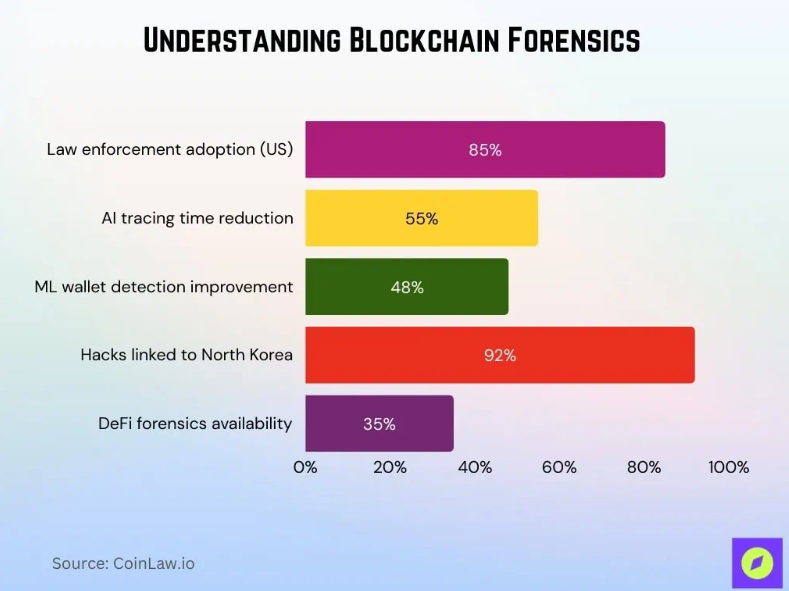
Blockchain forensics platforms like Chainalysis, TRM Labs, and Elliptic have frozen or recovered an estimated $34 billion in illicit funds. More than 45 regulators worldwide now use these tools as standard practice. They help recover stolen money, traced through wallet clustering and entity attribution that are good enough to hold up in court.

Thanks to AI, newer generations of these tools do more than trace money after it’s already moved. Today, there are predictive platforms that claim to flag a wallet before it acts at all.
They score behavior against 50+ features and retrain daily. One vendor claims a 98% accuracy score across 14 million wallets. We’ve got rug-pull scanners sitting directly inside AI trading agents, checking liquidity locks, freeze authority, and deployer history in about five seconds.
One such service reported scanning over 881,000 token addresses and flagging 271,000 as high-risk. There are even wallet-clustering tools that spot a “sleeper” address that sat dormant for years and only sprang to life right before a liquidation — the digital version of noticing someone’s been casing your street.
So if you only read the vendor pages, you’d walk away thinking crypto fraud is basically solved, because we now have this small army of machine-learning models watching every chain, every wallet, and every transaction around the clock.
Then you check what that same machine-learning era has done to the other side of the ledger.
The Numbers Behind AI Crypto Scams
According to Chainalysis, total crypto scam and fraud-related losses for 2025 sit at roughly $17 billion, up from $9.9 billion the previous year. The FBI’s own figure for crypto fraud over the same period is $11.36 billion in the US alone, a 22% jump year-on-year.
Those are the numbers that make it onto a panel slide. But the one that actually changed how I run due diligence is this: Chainalysis found that AI-powered scams were 4.5x more profitable than traditional ones.
Same con, same target, but with AI, scammers can manufacture fake support agents, fake investors, or trusted insiders at scale.

Lior Aizik, co-founder and Chief Operating Officer at crypto exchange XBO, has publicly warned that impersonation scams are increasing and becoming more sophisticated industry-wide. His rule of thumb is simple: never transfer your crypto to anyone you can’t verify, especially if the request comes wrapped in urgency and secrecy.
Impersonation fraud — criminals posing as a bank, an investor, or a crypto influencer — posted 1,400% year-on-year growth. Scammers now use AI to run expensive, targeted cons on people they’ve profiled first, rather than the cheap, high-volume spray-and-pray approach they used before.
That pushed the average payment size sharply higher, from $782 in 2024 to $2,764 in 2025, a 253% increase. I take this personally, because investors and operators with any public profile are exactly who gets cloned.
Here’s the uncomfortable part: while defensive tooling has gotten dramatically better, the offensive results have gotten better too.
It’s like a generative adversarial network, where the generator and discriminator share a rivalry that improves the whole model continuously.
Both offensive and defensive tools draw from the same well of AI capability. Right now, that well favors the first mover, not whoever builds the better model in isolation.
Why Better Detection Keeps Losing the Race
The honest answer is that forensic tools are built for detective work, not prediction. For an investigation to happen, a crime needs to have been committed.
You need a victim who has already lost money before you can trace a pattern visible enough to flag. Even the predictive models that claim to catch a rug pull before it happens are trained on yesterday’s scams — and tomorrow’s scam is being designed by someone who read the same training data.
This became clear to me in real time with the FBI’s NexFundAI sting: the fake honeypot token federal agents created to catch wash traders.
A day after the DOJ announced arrests tied to the operation, someone cloned the exact smart contract and launched a copycat token, making $127,000 in a single day using the same tactics the FBI had just exposed in court documents.
Any LP who asked me whether “the worst behavior in this market was finally getting cleaned up” would have had their answer within twenty-four hours.
The FBI operation became the blueprint for the attacker. Every disclosure that helps the defender also hands the attacker a working template — and attackers read faster than regulators patch.
The Attack Side Just Got Cheaper and Faster
You can see the same asymmetry in how little effort an attack now takes. Software developer Peter Steinberger built a popular open-source project that lets you run an AI assistant on your computer with full system access via apps like Telegram, WhatsApp, and Discord.
The product had to be rebranded after a trademark dispute.
Within minutes of the rebrand announcement, someone had hijacked his old GitHub and X accounts and used them to launch and pump a token that reached a $16 million market cap before crashing over 90%.
No malware, no stolen keys. Just someone fast enough to exploit a gap in attention that no forensic tool was watching for. The tools weren’t watching because nothing illegal had happened yet.
When the AI Agent Is the One Getting Rugged
It’s not just humans falling for this that worries me, because so many of the pitches I get are some version of “let our AI agent trade for you.” Those agents can lose money on your behalf too.
A developer described how an AI agent on Solana bought a token that rugged 94% after twenty minutes, costing the agent’s wallet $12,000.
On investigation, the token had freeze authority enabled, the top 10 holders controlled 91% of the supply. The deployer had already launched three previous scam tokens.
Every one of those red flags was supposed to be checkable in seconds by the detection tools I’ve described here. But the agent didn’t check. It simply saw a token and a price and bought it — because nobody wired the safety layer to the decision layer.
That’s the exact failure mode I now stress-test in every agent-based fund pitch that crosses my desk.
The Part No Tool Can Fix
What worries me most is that some of this damage never touches a smart contract at all. I have a public profile and a following, which makes me exactly the kind of face that gets cloned.
In May, it was reported that a woman in Guelph, Ontario, lost $14,000 to scammers after thinking she was speaking with YouTuber Mr Beast about a crypto investment. She wasn’t. Mr Beast has been fighting AI-generated videos that use his likeness to push fake giveaways for years.
Forensic tools don’t flag these interactions, because nothing about them touches the chain until the money is already moving. The fraud happens in a video call, in a moment of trust. By the time a transaction exists for an analytics platform to score, the decision that costs the victim has already been made.
AI has gotten better at manufacturing that false trust faster than it has gotten at flagging it. And that’s where most of the $17 billion actually went.
AI Crypto Scams: So Who’s Actually Winning?
Neither side.
That’s the most honest answer I can give. Both sets of tools, forensic and predictive, are real. The recoveries are real. Dismissing them because fraud has also grown would be its own kind of dishonesty.
But “real and improving” isn’t the same as “ahead.” The 2025 data is clear: in dollar terms, offense has improved faster than defense.
If there’s one reason for that, it’s this. Detection tools mainly answer the question “is this wallet suspicious?” — and that question is only asked after someone decides to check.
Then there are cases like Guelph, where there’s no wallet to scan in the first place. AI has made those cases more common, which is why I’ve stopped treating AI as a selling point in any pitch and started treating it as the first thing I want to stress-test.
The blockchain can confirm a wallet’s history. It can’t confirm a phone call,
The post Crypto Forensics Got Smarter, But AI Scammers Got There First appeared first on BeInCrypto.

Earn 4X rewards points on Fairway Jockey purchases this weekend

Meta's Pocket app lets you vibe-code games with zero coding knowledge

Money laundering #johnkiriakou #usa #viral #america #money #laundering

No Jackpot Winner as $257 Million Prize Rolls Over to $269 Million Monday Draw

Renter of Home in Anne Heche Crash Denies Settlement With Son

Weekend Open Thread: Staud – Corporette.com
Money laundering #johnkiriakou #usa #viral #america #money #laundering

Yahoo Finance Live: Daily Market Coverage – July 2, 2026 9AM-11AM (ET)

Absolute Chaos calebhammercomposer #money #finance #fyp #finance101 #financialaudit
-

 Fashion2 days ago
Weekend Open Thread: High Hopes
-

 Politics2 days ago
The House | “Reframing the debate from a binary discussion of winners and losers”: Yuan Yang reviews ‘We Are Not Machines’
-

 Crypto World5 days ago
Strategy authorizes up to $1.25B in Bitcoin sales under new capital plan
-

 News Videos7 days ago
MAJOR BITCOIN & MARKET UPDATE!!!! (MUST WATCH ASAP!!!)
-

 Tech5 days ago
Anonymous researcher drops 0-day ‘exploitarium’ repo
-

 Business5 days ago
Australia treasurer says alleged access of prime minister’s bank data ’incredibly concerning’
-
 NewsBeat5 hours ago
Taylor Swift and Travis Kelce wedding staffer hilariously struggles to keep her cool while checking in megastars
-
 Business6 days ago
The AI boom won’t burst all at once. It will pop in ‘rolling bubbles’: Macquarie
-

 Sports4 days ago
Broncos roster: OL Ben Powers (No. 74) entering final year of contract
-

 NewsBeat4 days ago
Presenter Caroline Flack’s brother Paul Flack dies aged 55
-

 Crypto World3 days ago
Binance stock trading tops $1B in first month after launch
-

 News Videos5 days ago
How to Build INSANE Live Financial Dashboards With Claude
-

 Crypto World3 days ago
Alibaba-affiliate Ant Group enters the humanoid robot market with 12 deals
-
 NewsBeat3 days ago
New exhibition reflects five decades of movement between island of Ireland and GB
-

 Business2 days ago
What a 10 Percent Drop Means for Buyers, Sellers and Renters
-

 Business3 days ago
Meta Platforms Stock Jumps 7% Today as Bloomberg Reports Company Plans to Enter the Cloud Business
-
Crypto World4 days ago
Airdrop Registration Becomes Key Focus For Remittix As RTX Launch Updates Approach
-

 Crypto World2 days ago
Binance Re-Enters Philippines As EU MiCA Rules Restrict Access
-

 Tech6 days ago
The attack that hijacked Claude Code came through Sentry. Datadog, PagerDuty, and Jira have the same exposure.
-
 Business5 days ago
PRISM’s IPO filing mentions Zostel case, CCI investigation
You must be logged in to post a comment Login