Real Housewives of Orange County‘s Vicki Gunvalson has defended her former castmate Jeana Keough after Keough started a GoFundMe page to help pay for personal expenses while battling cancer.
Keough’s daughter Kara Bosworth launched the GoFundMe on July 19 after her realtor mom, 70, started treatment for tongue cancer.
While the GoFundMe has already reached over $70,000, many fans of the Real Housewives franchise – which follows the lives of affluent women in exclusive social circles – have criticized the fundraising move due to Keough’s apparent wealth.
Defending her co-star and friend on SiriusXM’s Jeff Lewis Live last week, Gunvalson insisted that Keough isn’t as rich as some people think she is.
‘Jeana owns two houses in Florida,’ Gunvalson explained.
‘When she sold the house next to me she bought two houses, rental property. It doesn’t have a lot of equity, the real estate in Florida has gone down,’ she continued.
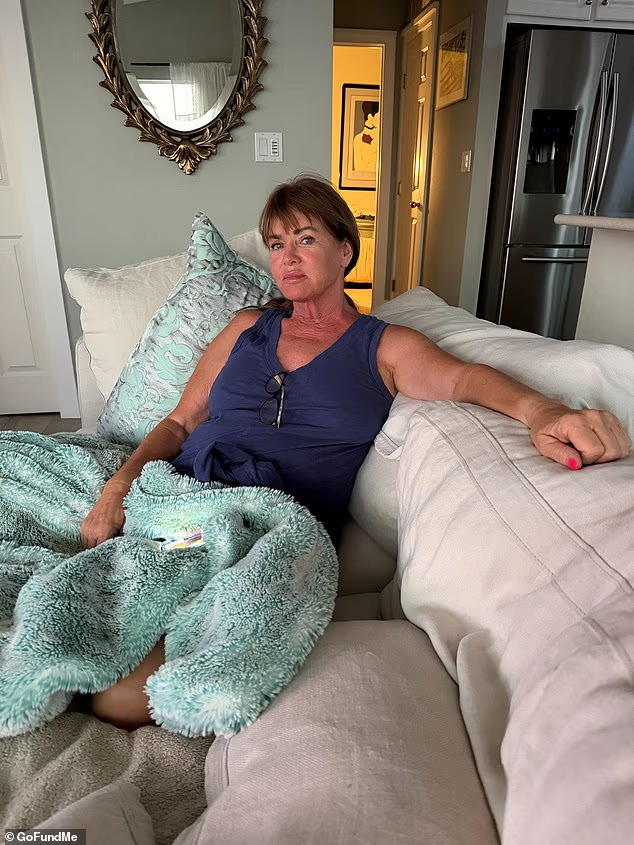
Real Housewives of Orange County star Jeana Keough is receiving backlash online for using GoFundMe to pay for her personal expenses while battling tongue cancer
Keough shot to fame as an original cast member on Bravo’s Real Housewives franchise, which follows affluent groups of women in exclusive social circles
‘She is getting a small pension from [ex-husband] Matt [Keough], she’s getting her social security. It’s not enough to support her rent in Coto de Caza, she rents a house there, and her life.’
Both Gunvalson and Keough currently live ‘two doors down’ from each other in Coto de Caza, an exclusive, gated community where the Real Housewives of Orange County was originally filmed.
Gunvalson also pointed out that Keough is a commission-based realtor and has been unable to work during treatment, so her ‘income stopped’.
She clarified that Keough’s ‘medical care is covered’, and that the GoFundMe is to help with other expenses.
On the official GoFundMe page, Keough’s eldest daughter states, ‘Any funds raised will go directly toward expenses, everyday living costs, nutrition, and the additional support she needs while undergoing treatment.’
The fundraising goal was originally set at $50,000, but it has since been raised to $90,000 following a flood of generous donations from both fans and Bravo stars alike.
The top donor to the GoFundMe is currently ‘Andrew Cohen’, who contributed $5,000.
Real Housewives of Orange County newcomer Carmella Garcia is also listed as having donated $1,000.
Daily Mail has contacted both Keough and her daughter Kara Bosworth for comment.
Defending her friend and fellow Housewife on SiriusXM’s Jeff Lewis Live last week, RHOC star Vicki Gunvalson insisted that Keough isn’t as rich as some people think she is
Keough’s GoFundMe was started by her daughter Kara Bosworth and has so far raised over $70,000
Keough family’s full statement
Keough’s daughter Kara Bosworth, who launched the GoFundMe, issued a statement to Daily Mail about the online backlash.
‘Some folks have been pretty aggressive and hateful regarding Jeana’s financial struggles, and even about her getting cancer in general, but it doesn’t surprise me in the slightest. I unfortunately have seen it firsthand – there were people who found ways to be hateful after my newborn son died, so it doesn’t come as a shock that they’d do the same in this situation,’ she said.
‘I warned my mom when she asked me to start the GoFundMe that she would have to reveal that, despite her best efforts to put up a happy facade, she would have to admit publicly that she is struggling,’ she continued.
‘Some were outraged that I was “asking people less fortunate” than me for help, but I can sleep at night knowing the truth: that I reached out via my personal Instagram to my village —people that were asking me how they could help support Jeana— and they responded with their own free will.
‘I found it to be the best way to reach people that love my mom, and want to help. A wider population found out about her cancer journey via the media, and for the most part their responses have been beautiful.
‘Unfortunately, there are also haters. In general, most people are being supportive, kind, and helpful — sending advice, encouragement, and prayers.
‘My mom has always been great at focusing on the good in any situation, and she’s doing that now – joyfully ignoring the haters and basking in the love and support from those that actually know her situation and her spirit.’
She added, ‘Here’s to hoping I can do the same someday! In the meantime, lots of blocking and deleting.
<!- – ad: https://mads.dailymail.co.uk/v8/de/tvshowbiz/none/article/other/mpu_factbox.html?id=mpu_factbox_1 – ->
Keough originally lived in a large mansion in Coto de Caza, but she sold it in 2016 for $3.4 million to downsize to a smaller home in the area and to buy property in Florida.
The former 1980 Playboy Playmate of the Month was one of the founding cast members on The Real Housewives of Orange County, lasting on the reality series for its first five seasons before stepping back and making sporadic guest appearances in the following years.
She returned to the franchise this year for RHOC’s landmark 20th season for a cameo at a party featuring various past cast members, which will be shown on an upcoming episode.
Keough, a staunch conservative, occasionally shared her political viewpoints in early seasons of the series.
Earlier this week, Bosworth took to Instagram with an update on how her mother is dealing with her tongue cancer treatment and confirmed that she currently cannot speak.
‘Right now, Jeana isn’t talking,’ Bosworth said. ‘The tongue and throat pain, paired with the mucus from radiation on the area, is just brutal. Poor mama has to spit into tissues all day.’
Bosworth thanked the company Blow Tissues for sending tissues for Keough to use, adding, ‘She’s never needed a delivery more.’
Keough, 70, is unable to speak as she undergoes treatment for tongue cancer
Keough recently filmed a cameo on the Real Housewives of Orange County’s 20th season, which is airing now
Keough, a regular on the first five seasons of the Real Housewives of Orange County, is also mother to sons Shane, 39, and Colton, 34, with late ex-husband Matt Keough.
Bosworth on July 19 detailed her mother’s health woes in a statement on GoFundMe, saying that Keough had complained about ‘a painful spot on her tongue’ for almost a year’s time.
‘A biopsy confirmed our worst fear: squamous cell carcinoma of the tongue,’ Bosworth said, adding that she underwent a pair of surgeries to remove the cancer and then her lymph nodes.
She said her mother has continued with a ‘relentless’ regimen of ‘chemotherapy, radiation, and immunotherapy’ which has left her ‘exhausted’ and ‘malnourished’ due to related pain.
Bosworth said that each day ‘is a battle just to get enough nutrition and hydration to continue treatment.’
She noted that the ailment had left her mother ‘unable to work,’ as ‘the loss of income has created an enormous financial burden at the very time she needs to focus all of her energy on healing.’
Keough first shot to fame as a Playboy model and was named the Playmate of the Month for the November, 1980 issue of the magazine
A young Keough is pictured on an episode of the ’80s variety show Pink Lady
In subsequent updates to the fundraising page, Bosworth said July 21 that her mother had experienced more complications, as she had been slated to be set up with a feeding tube known as a G-tube to help with nutrition as she had been unable to eat for two weeks.
Doctors had to pause their plans due to the discovery of a deep vein thrombosis (DVT) blood clot in her leg which presented further danger, Bosworth said.
In a pair of updates last week, Bosworth said that her mother was cleared for surgery to receive a ‘PEG feeding tube placed so she can receive the nutrition her body desperately needs.
‘This will allow us to bypass the painful swallowing and choking that happen every time she tries to eat or drink.’
Keough was a fulltime cast member on the first five seasons of the Real Housewives of Orange County
She still keeps in touch with her fellow RHOC stars and is pictured enjoying a lavish lunch with Jo De La Rosa and Alexis Bellino in 2024
Following the procedure, Bosworth said that her mother had been ‘recovering’ and ‘able to stay on track with her treatment despite the setbacks from the blood clot and infection.’
Bosworth said in a Friday update that her mother had been ‘finally feeling a little more like herself’ after she ‘gave her the full “spa treatment” at the hospital’ consisting of washing her hair with a shampoo cap and shaving her legs.
‘She’s still very weak, and her mobility is limited, but we’re hopeful that now that she’s finally able to get the nutrition her body desperately needs, she’ll begin to regain her strength,’ Bosworth said.
Bosworth thanked the people who have ‘checked in, prayed, donated, shared your own experiences as patients or caregivers, and lifted our family up.’
She added, ‘Every message, every prayer, and every act of kindness has meant more than you know. Your positivity is healing.’



















































You must be logged in to post a comment Login