England security reveal Mexico fans’ noisy late-night hotel siege FAILED to rattle Thomas Tuchel’s side ahead of crunch last-16 World Cup clash – as amused players joke the atmosphere is more hostile at Everton!
England‘s security team have insisted Mexican fans’ attempts to disturb the Three Lions’ sleep ahead of their World Cup last-16 showdown have had little to no impact on the squad.
Hundreds of supporters gathered outside England’s team hotel on the eve of Monday’s clash at the Azteca Stadium in a bid to create a hostile atmosphere, chanting, singing and revving engines in scenes designed to unsettle Thomas Tuchel‘s players.
Advertisement
But an England security official dismissed suggestions the squad’s preparations had been disrupted when speaking to Daily Mail Sport outside the hotel at midnight.
Instead, he insisted the players found the whole spectacle amusing rather than intimidating and suggested they were well used to it.
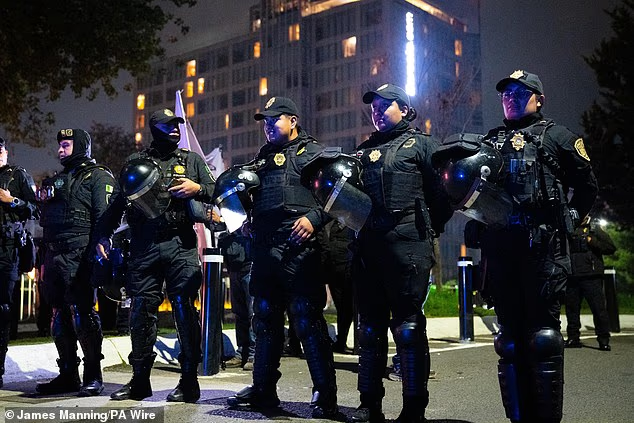
By Saturday evening, barriers surrounded the hotel perimeter while security personnel lined the railings keeping watch over the growing crowds outside.
Riot police and local authorities eventually intervened, moving around 200 fans approximately 300 metres away from the hotel entrance, allowing the area to calm considerably.
Advertisement
Police were on guard to protect the England team hotel from disruption from Mexico fans
The police presence was high after Mexico’s previous opponents Ecuador had complained fans had tried to disrupt their team with fireworks on the eve of their match
A Mexico fan with a drum is ordered by police to move away from the England hotel
Advertisement
The England security official, who spent the evening monitoring the situation from outside the hotel, said the noise could initially be heard from inside the building but stressed it was never particularly loud or problematic.
Once the supporters had been pushed further down the street, he said the players could no longer hear the commotion from their rooms.
The official praised the efforts of the Mexican authorities, saying the government, local police and security services had been ‘incredibly helpful’ throughout England’s stay and had gone out of their way to ensure the team’s preparations remained unaffected.
He also insisted the players’ mentality had not changed despite the attempts to create an intimidating atmosphere.
Advertisement
‘They’re used to playing for Real Madrid, Barcelona and the biggest Premier League clubs,’ he said. ‘This isn’t their first experience of something like this.’
He added that some players regularly experience more hostile atmospheres in domestic football, joking that ‘sometimes the atmosphere at Everton is worse.’
According to the security official, England’s experienced squad have taken everything in their stride and, if anything, the reception has only sharpened their focus ahead of the knockout tie, which takes place at 1am on Monday UK time.
An England security official praised the efforts of the Mexican authorities, saying the government, local police and security services had been ‘incredibly helpful’
Advertisement
Once supporters were ushered away down the street, England players were no longer hear the commotion from their rooms
The official played down reports surrounding England’s arrival at the hotel earlier this week, insisting the process had been ‘very smooth’ and ‘nothing of note’ happened
The official also played down reports surrounding England’s arrival at the hotel earlier this week, which attracted large crowds of supporters and widespread attention on social media.
He described the team’s arrival as ‘very smooth’ and said there was ‘nothing of note’ from the perspective of those responsible for security as it was all a bit of ‘fun’.
Advertisement
He added that members of England’s travelling party were surprised by the scale of the media coverage afterwards because they did not view the scenes as anything out of the ordinary.
Despite the noisy scenes outside on Saturday night, England remain confident their preparations have not been compromised as they look to book their place in the World Cup quarter-finals at the Azteca on Monday.
How much is David Beckham set to pocket from his World Cup brand deals? Take on our quiz in our newsletter HERE
Advertisement
Share or comment on this article:
England security reveal Mexico fans’ noisy late-night hotel siege FAILED to rattle Thomas Tuchel’s side ahead of crunch last-16 World Cup clash – as amused players joke the atmosphere is more hostile at Everton!
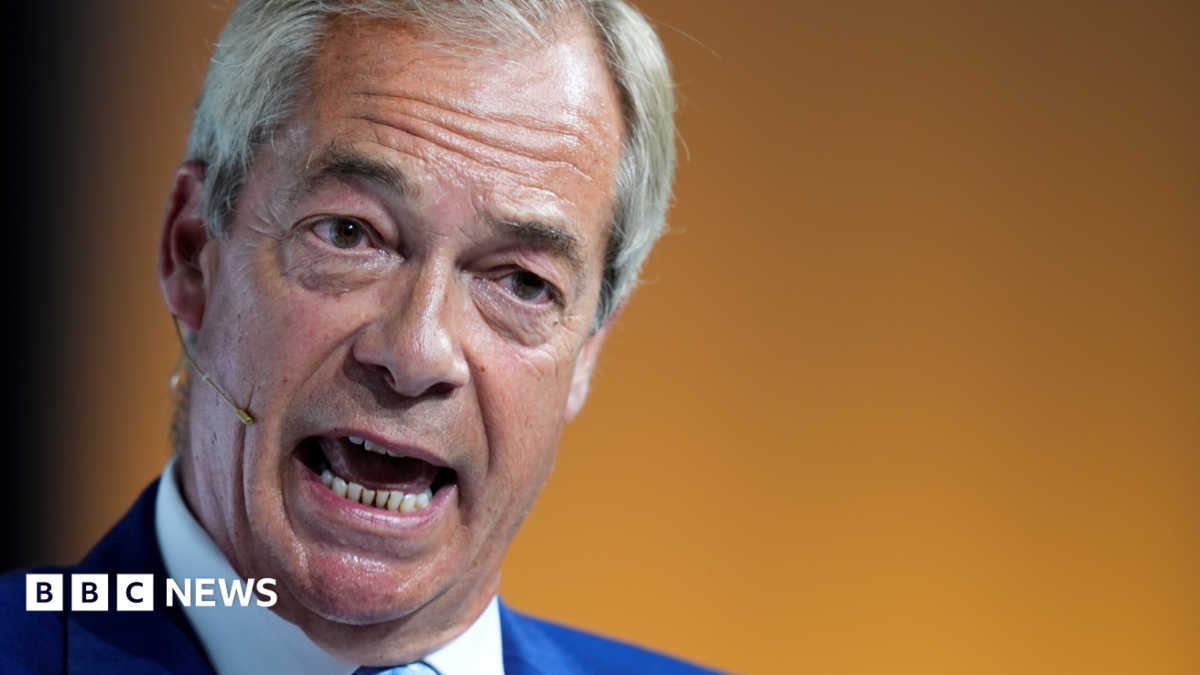
When he became an MP, Farage registered a £9,253 trip to Belgium donated by Cottrell in April 2024, before the election. He went on to register a £15,276 donation from Cottrell for a US domestic flight in December 2024.
However, he has not declared any further support from Cottrell, or the £5m he received from Harborne, arguing he was not required to do so under the rules.
In interviews towards the end of June, the Reform UK leader said he had chosen to earmark the £5m sum from Harborne for his future security costs, arguing he would require protection “for the rest of my life”.
However, he stressed the gift was “unconditional” and how he spends it was “entirely up to me”. Speaking to ITV, he said he was yet to spend the money.
Advertisement
In an interview after the Sunday Times story was published, Reform Treasury spokesman Robert Jenrick said Cottrell had contributed towards Farage’s staffing and security costs before he was an MP.
“You’re allowed to accept a gift, support, whatever you want to call it, from a personal friend before you’re a Member of Parliament if it’s in a purely personal capacity,” he added.
Farage is yet to face media questions about support provided by Cottrell detailed in the Sunday Times report. In a statement, he said he had “followed the rules” and was the victim of an “establishment hit job”.
Lawyers for Cottrell say he disputes “allegations and assertions” in the Sunday Times report, and he was reviewing the matter with legal representatives.
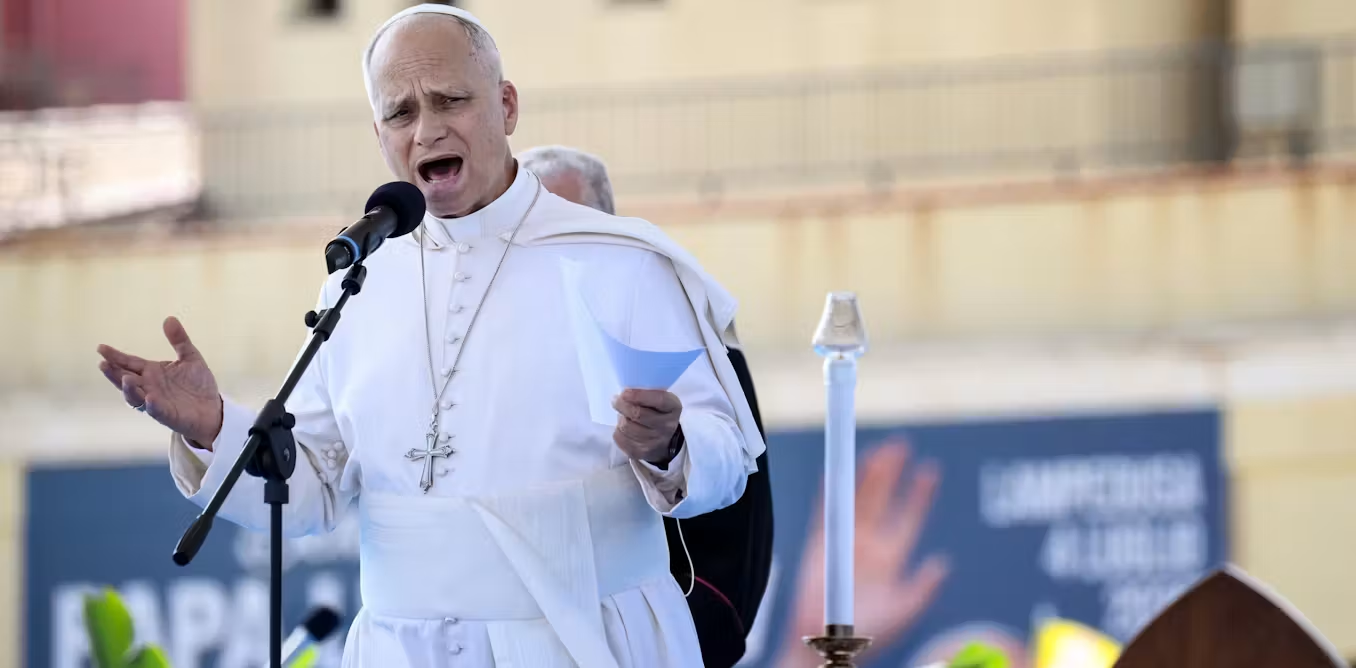
As the US celebrated its 250th anniversary, Pope Leo XIV decided instead to visit the Sicilian island of Lampedusa.
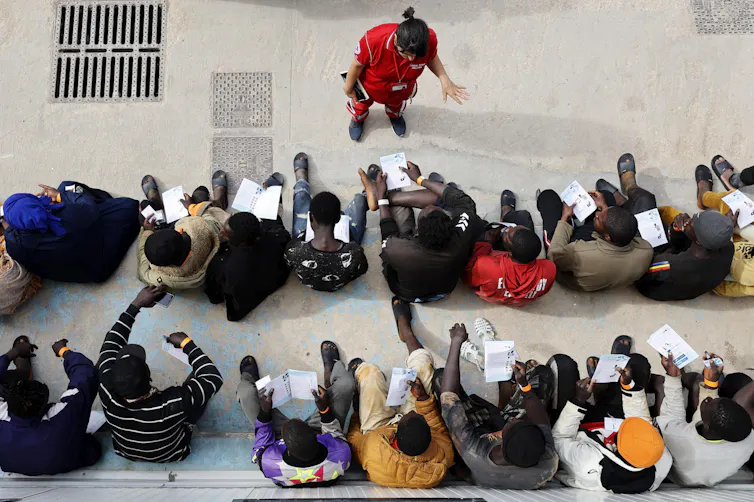
Closer to Africa geographically than to Italy, the island is known as a place of sbarchi (sea landings) for thousands immigrants and asylum seekers journeying from Africa to Europe, and a place where thousands of others have died. While there, the pope visited the Door of Europe memorial for migrants who have died on the journey, and prayed at some of their graves.
His homily called on European leaders to rise to the “momentous challenge” of addressing migration. This, he said, should include “receiving, protecting, supporting and integrating migrants” and a move away from “emergency” policies.
Many anticipated the visit would further sour the already tense diplomatic relations between the Trump administration and the Holy See. Leo has already called Trump’s treatment of immigrants “inhuman”.
Advertisement
In June, the pontiff visited the Canary Islands, where he spoke to migrants, telling them “You are not numbers or files, you are people”. Migration and human dignity were also central to his message to Americans on receiving the National Constitution Center’s Liberty Medal: “The moral greatness of a nation is manifested, above all, in its capacity to support, protect and cherish the lives of all, especially the most vulnerable and those whose worth is questioned.”
His letter to Americans on the 250th anniversary of the US said that the Catholic principle of “defending human life also includes welcoming, protecting and assisting immigrants”.
In visiting Lampedusa, Pope Leo explicitly signalled the continuity of his pontificate with that of Pope Francis. Although Lampedusa is in Italy, Pope Francis’ visit to the island in 2013 was regarded as his first “international” trip. The flow of people, cultures and religions traversing this tiny piece of land is truly global, and so are the policy responses that are needed to address it.
Pope Francis made a series of visits to borderlands and areas of crossing and displacement along the Mediterranean. This included trips to migrant and refugee reception and identification centres in Lesbos (2016 and 2021) and to the busy multicultural port-city of Marseille, in 2023.
Advertisement
As Francis pointed out on a 2014 visit to the European parliament, the Mediterranean – once the cradle of civilisation – has become a massive graveyard. According to the Missing Migrants Project, more than 35,000 people have died or been recorded missing attempting to cross the Mediterranean since 2014.
The pope prayed at the graves of migrants who had died on the journey to Lampedusa. Ciro Fusco/EPA-EFE
Throughout his pontificate, Francis insisted on the need to overcome divisions, othering, tribalism and the “globalisation of indifference” around human life.
The parable of the Good Samaritan, the stranger who tended the wounds of the traveller mugged on the road, featured prominently throughout Francis’s pontificate. Francis also hosted 12 Syrian refugees in the Vatican after his Lesbos visit in 2016.
Popes and migration
Catholic and other faith traditions have a long history of assisting those on the move, whether war refugees, slaves, economic migrants. Francis’s novelty was twofold: the frequency and emphasis of his appeals for the dignity of migrants, and the approach of visiting those on the margins while also speaking up in the international diplomatic context.
Advertisement
Leo XIV has continued Francis’s approach of standing with those on the margins and discarded from society. This is typical of the personalist Catholic tradition that emphasises the importance of human relations.
Leo signalled the centrality of migration to his pontificate when he visited Spain in June, meeting migrants, activists and professionals in Tenerife. He condemned human trafficking and appealed to “human conscience” and “responsibility” to respond from all sectors of society – not just religious or humanitarian bodies.
Pope Leo has also expressed his support for the rights of migrants in relation to US domestic politics. He appointed several bishops who came to the US as migrants, and backed the US bishops who stood up against round-ups by Immigration and Customs Enforcement.
His speech in Lampedusa made reference not just to the dignity of migrants, but also the potential of international economic, political and diplomatic solutions: “Europe is capable of addressing the crisis — in this region — in a comprehensive manner … This is a task not only for public institutions but also for civil society as a whole and for the Church.”
Migration is a global issue, intertwined with conflict, politics and climate change, that cannot be solved by countries individually. The pope’s visit to Lampedusa is therefore not just an example of “compassion” towards others at a time of emergency. It is a message of “serving together” for our common human family, in the imperfect reality of the present.
“God needs no passport”, wrote American sociologist Peggy Levitt in a pioneering book on religion and migration in America. By wearing his hat as head of a global universal faith (and the largest religious institution in the world) and by going to meet those that have crossed perilous waters and borders fleeing violence and insecurity, Leo is bypassing – not countering – the logic of diplomacy and of the state system. When popes go to Lampedusa, the international community should heed the message.
Balogun was shown a straight red card during the United States’ last-32 victory over Bosnia and Herzegovina for a challenge on Tarik Muharemovic in which he appeared to scrape his studs down the calf of the defender before landing on, and twisting, his ankle.
The forward has been an influential player for the World Cup 2026 co-hosts and would have missed the last-16 clash with Belgium due to a one-match ban following his dismissal.
But it came as a surprise to see the independent Fifa Disciplinary Committee invoke Article 27 of the disciplinary code – which states: “The judicial body may decide to fully or partially suspend the implementation of a disciplinary measure” – and suspend Balogun’s red card penalty for a year meaning he can play in the game.
Advertisement
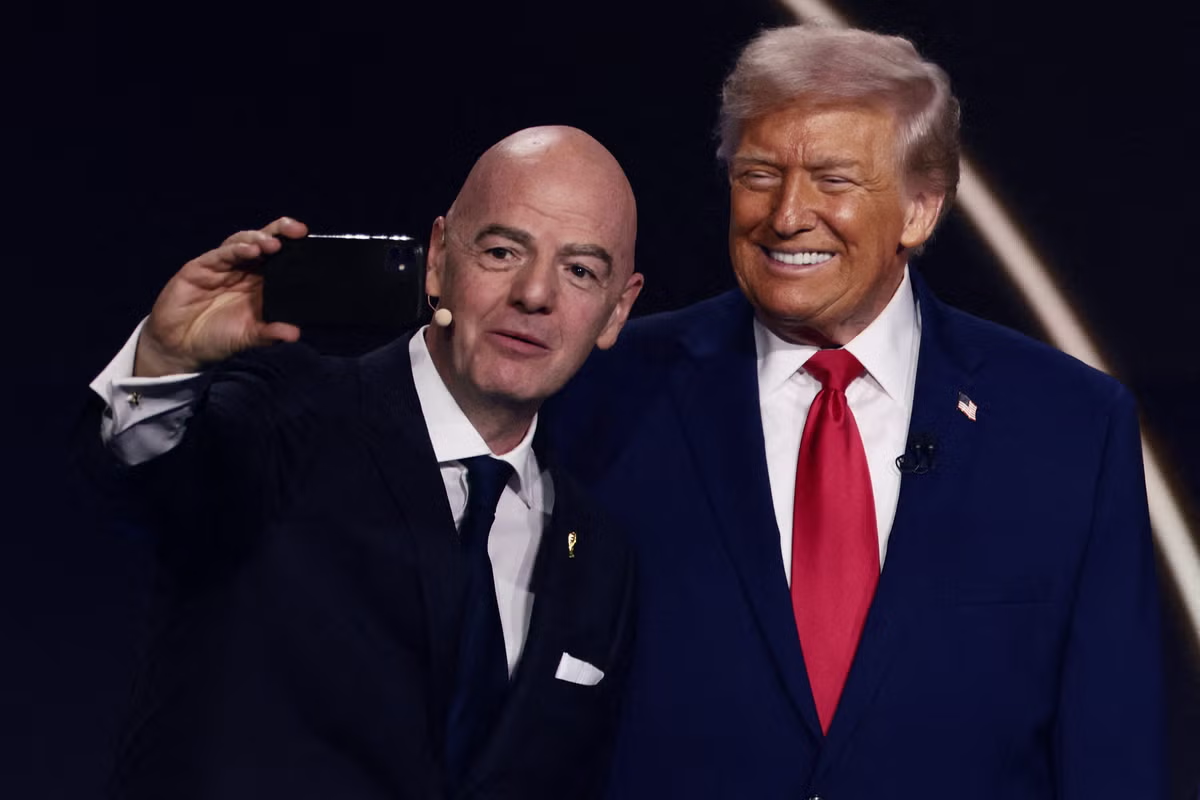
That decision followed a conversation between Trump and Infantino leading to widespread rumours of the US president influencing and impacting on the World Cup.
However, Infantino defended his conversation with Trump and explained how the process had remained an independent judgement.
On Monday he released a statement which reads: “I have seen the public comments regarding the decision of the independent FIFA Disciplinary Committee related to the suspension of Folarin Balogun, and I would like to reiterate a fundamental principle of FIFA’s governance.
“FIFA’s judicial bodies are independent. They operate autonomously, apply the FIFA Disciplinary Code, and decide cases based on the applicable regulations and the specific facts before them. Their independence is essential to the credibility and integrity of football, and this must always be respected.
Advertisement
Folarin Balogun has had his red card suspended and will be able to play for the United States against Belgium (Getty)
“Yes, I regularly discuss matters related to the FIFA World Cup with the President of the United States, and on this matter, I did receive a call from President Donald Trump, just as I receive calls from heads of state, government officials, football stakeholders and business executives from around the world on many different issues. During our conversation, I explained that there was an ongoing legal process involving FIFA’s independent judicial bodies and that the case would be decided in due course by the competent bodies. That is how FIFA’s system works, and it is a principle that I will always uphold.
“I read the decisions of the FIFA Disciplinary Committee when they are issued. Sometimes I am surprised by them. Sometimes I agree with them, and sometimes I disagree.
“What I always do, however, is respect those decisions and the autonomy of the bodies that make them. Whether we personally like a decision or not is irrelevant. Respect for independent institutions and the rule of law is what protects the integrity of our competitions and the credibility of FIFA at all times.”
President Donald Trump‘s trip to a NATO summit in Ankara, Turkey, this week has European allies scrambling to keep him happy.
But the United Kingdom is showing up without a definite plan for reaching an important defense spending benchmark, according to Politico, who wrote that European leaders were desperate to avoid a Trump ‘blow-up.’
The US President is expected to leave Monday evening for the two-day summit, where leaders from all 32 member countries will be there.
He is expected to meet with Turkish President Tayyip Erdogan, Ukrainian President Volodymyr Zelensky, and Syrian President Ahmad al-Sharaa during the summit.
Advertisement
Trump will also be looking to evaluate NATO’s progress on defense spending goals, a point of long-standing friction between Trump and Europe.
NATO countries have committed to spending 3.5 percent of GDP on defense by 2035.
UK Defense Secretary Dan Jarvis told Politico that making a plan for the benchmark was ‘mission critical,’ adding that while in Ankara he would emphasize his desire to make a plan.
Advertisement
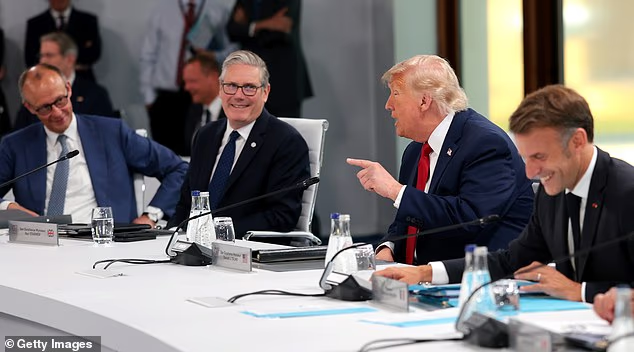
(L-R) German Chancellor Friedrich Merz, UK Prime Minister Keir Starmer, US President Donald Trump and French President Emmanuel Macron during theJune G7 Summit in France
NATO Secretary General Mark Rutte (L) meets with US President Donald Trump in the Oval Office in June
Starmer, who is about to leave office, handed down a difficult defense spending situation to his successor
Advertisement
But a research fellow at King’s College London was unimpressed by Jarvis’s assurances.
‘Our allies want us to have fully funded, accelerated plans to reach the 3.5 percent commitment,’ Sophia Gaston told Politico of the NATO summit. ‘They also want consistency and clarity of leadership. We will be bringing neither.’
Just last week, the President renewed his criticisms of Europe’s defense spending when he posted a chart comparing several countries’ defense budgets to that of the US.
‘Ridiculous for the USA to continue along this one sided path when the relationship is not reciprocal,’ he captioned the post.
Advertisement
The spending numbers in his chart appeared similar to those in a NATO release based on data through last June that projected 2025 defense spending by NATO countries.
Total US defense spending dwarfs that of NATO allies, though it is not the largest as a percentage of GDP.
The President has also sharply criticized the alliance for its relatively hands-off approach to the war in Iran, telling multiple news outlets earlier this year that he was considering withdrawing the US from the alliance.
NATO Secretary General Mark Rutte has flattered Trump in an effort to preserve US involvement with the alliance while touting progress towards NATO spending goals.
Advertisement
Rutte arrives at Ankara Airport on Monday ahead of the summit
The President also suggested that he had seriously considered not attending this week’s summit.
He credited Turkey’s President Tayyip Erdogan with getting him to come.
‘Except for the fact that [the summit] was being held in Turkey by President Erdogan,’ Trump told reporters before a June meeting with Rutte, ‘I don’t think I would have gone to it.’
Advertisement
Share or comment on this article:
Panicked European leaders scramble to stop Trump ‘blow-up’ as one big NATO ally turns up without a plan
Scots deserve clarity on the SNP’s currency plans now if the party is serious about an IndyRef2, says Chris McCall
17:02, 06 Jul 2026Updated 17:15, 06 Jul 2026
Advertisement
Cash may no longer be king in the age of banking apps on smartphones, but coins and banknotes still grip the imagination when it comes to the debate over Scottish independence.
Last year, it was reported Kate Forbes had told SNP members not to talk about the party’s currency policy.
The then deputy first minister’s comments were found in minutes of a summer meeting of the SNP’s Skye branch, leaked by a party activist, in which she was recorded as saying “we must avoid publicly talking about currency”.
So why the reluctance?
Advertisement
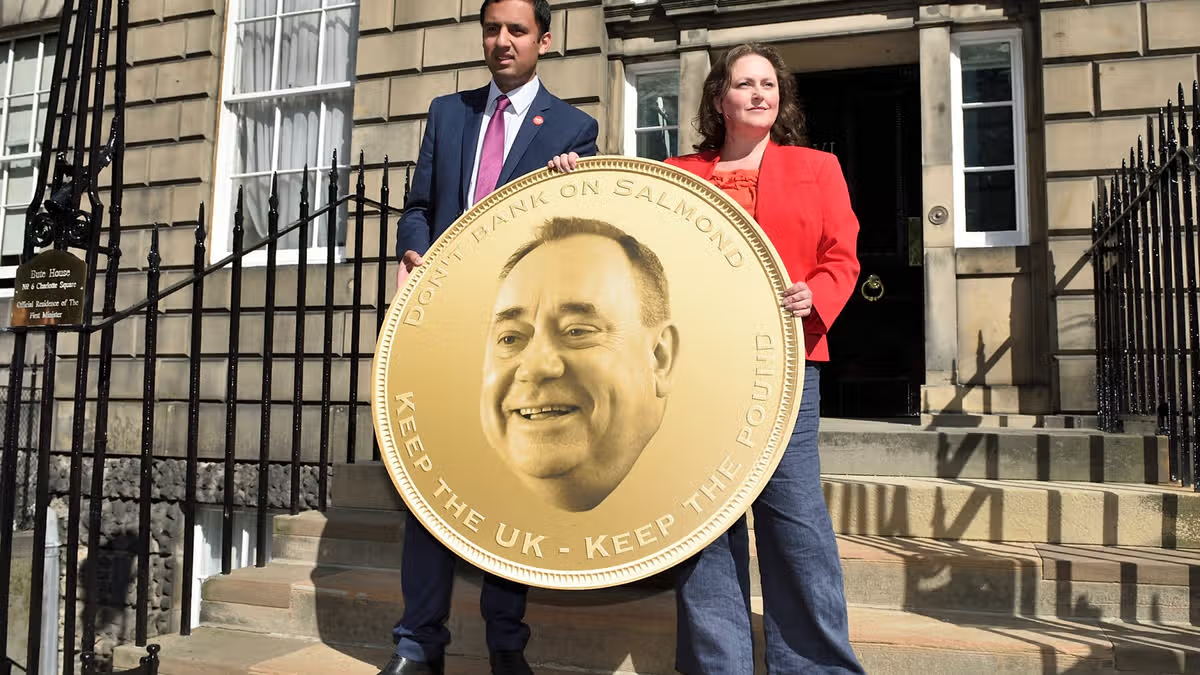
You may recall that during the run-up to the 2014 referendum, Anas Sarwar stood outside Bute House with a large mock-up of a pound coin with Alex Salmond’s face emblazoned on it.
The not-so-subtle point was the Yes campaign was perceived to be struggling to convince voters on what currency would be used in the event of independence.
Salmond, the then first minister, had called for Scotland to enter into a formal currency union with the remainder of the UK. This would mean Scots would continue to use the pound sterling, with Holyrood having a say on monetary policy set by the Bank of England.
He told MSPs at the time: “It’s Scotland’s pound and we are keeping it.”
Advertisement
But George Osborne, the then Tory Chancellor, effectively told Salmond to take a hike. The UK Government would not agree to a currency union, under any circumstance, he said. Osborne insisted independence would mean Scotland “walking out of the UK pound”.
It wasn’t the most memorable line of the campaign, but enough voters understood the gist. And they didn’t like the sound of it.
Salmond then floated the idea of sterlingisation. This means Scotland would carry on using the pound regardless, in the same way many smaller nations use the US dollar as their official currency.
Other prominent independence campaigners were openly hostile to the idea, Jim Sillars among them. He argued forcefully that an independent Scotland should launch its own curency.
Advertisement
He said in 2014: “We have a viable alternative, and it’s a Scottish currency with our own central bank, printing Scottish notes which we will peg one-to-one with Sterling, so there’s no difference whatsoever.”
But that was then. So what’s the position now?
In one of its many white papers on independence, the Scottish Government explained in 2022: “We propose that, on independence, Scotland would continue to use the pound sterling for a period before moving to our policy of adopting a Scottish pound.
“The change would take place as soon as practicable through a careful, managed and responsible transition, guided by criteria and economic conditions rather than a fixed timetable.
Advertisement
“While Scotland is still using sterling, many aspects of monetary policy would continue to be set by the Bank of England.”
How long is “a period”? It’s one of several unanswered questions. Another might be, is Scotland really achieving independence if the Bank of England is still calling the shots, potentially for years?
Steringisation would also present other issues, many of them complex but worth repeating. The Economics Observatory has a detailed run-down of the currency options available to an independent Scotland.
It noted: “The continued use of sterling post-independence – either under a monetary union or sterlingisation – would require a strict macroeconomic regime be put in place. This would demand short-term adjustments to Scotland’s fiscal and balance of payments position. If not, retaining sterling would be a poor anchor for an independent Scotland.”
Advertisement
It also warned: “A second challenge with sterlingisation is that any balance of payments deficit would see sterling reserves draining out of the system, along with the deflationary consequences of this.
“But with limited – and finite – inherited reserves, an independent Scottish central bank under sterlingisation would be constrained in how much leeway it would have to combat this.”
A core foundation of the SNP’s independence plan is Scotland being admitted to the European Union as quickly as possible. But it’s a well-known condition of EU membership that member states commit themselves to joining the Euro.
Sweden joined the EU in 1995 – four years before the Eurozone was launched – and is legally committed to joining the single currency. But in reality, it has no plans to do so.
Advertisement
Independence supporters believe this sets a precedent which Scotland could follow. But the reality might be different.
Alyn Smith, a former SNP MEP and now MSP, said as much in an interview with BBC Scotland today. He said: “There is a commitment to participate in economic and monetary union, yes, but there is no timescale attached to that.”
Smith also suggested a referendum would be required on whether Scots wanted to join the Euro at all.
So that’s three currency options already – the pound, controlled by the Bank of England; a new Scottish pound, which could be pegged to sterling; or the Euro, which may require a referendum.
Advertisement
If the SNP is serious about staging an IndyRef2 in the coming years, it must offer a clear answer on what it considers the best way forward and the costs involved.
Korcula island in the Adriatic Sea in Croatia (Picture: Getty Images)
Ask Metro
Use AI to go deeper into the stories you care about – powered by Metro and trusted publications.
A spokesperson for Saga Holidays said the factors were weighted to create the final ranking, ‘with green space accounting for 45%, weather 35% and food and drink availability 20%’.
Advertisement
Archipelago scores were calculated using the average score of the islands within each group, they added.
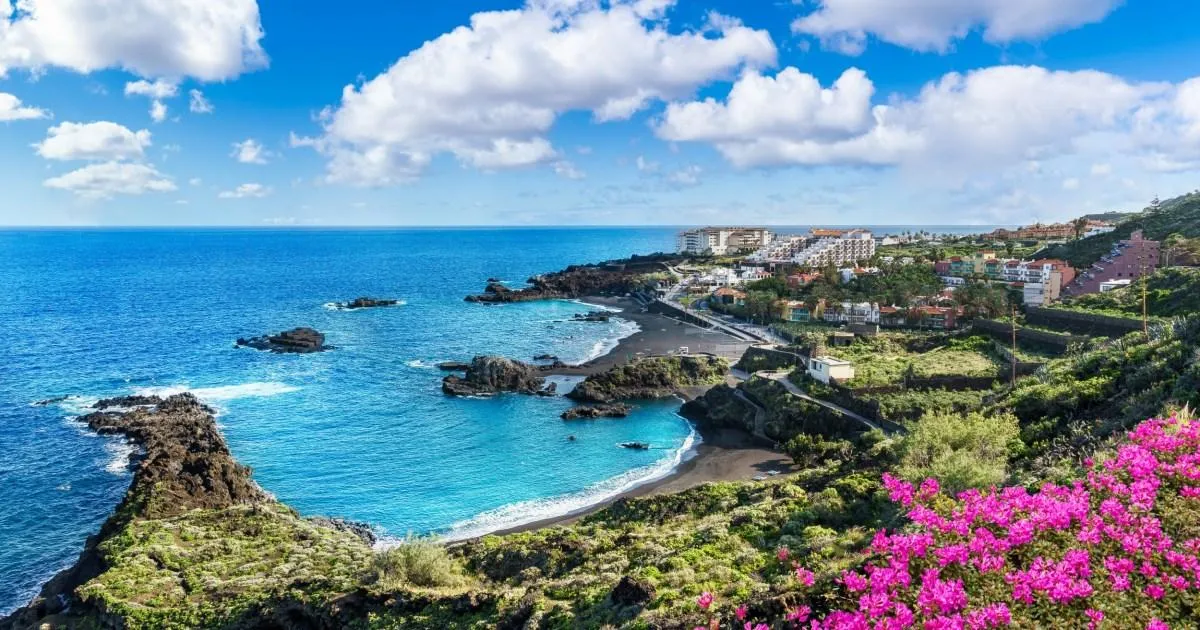
The largest of the eight Canary Islands, Tenerife is home the volcano Tedie, over 3,000 meters above sea level. Tedie National Park is a UNESCO World Heritage Site.
Due to its colossal size, Mount Teide is known to cast the largest sea shadow in the world.
The clock tower of Nossa Senhora de Fatima chapel in Sao Vicente, Madeira (Picture: Getty Images)
It is home to the world’s largest telescope, the Gran Telescopio Canarias and to Spain’s first airport powered entirely by wind energy.
It should be noted that both of these destinations – but particularly Tenerife – struggle with overtourism.
The Canary Islands received over 7.8 million international visitors in the first half of 2025, leading to it being named on Fodor’s ‘No List’ this year.
The Canaries have seen massive protests from locals, who say that unregulated mass tourism and the spread of short-term holiday lets are making life unaffordable.
Advertisement
Zlatni rat (Golden horn) on Brač, Croatia (Picture: Shutterstock / Dreamer4787)
Further down the list in third position is Madeira in Portugal.
Rounding out the top five are two Islands in Croatia: Korčula and Mljet.
The central Dalmatian island of Korčula is the sixth-largest island in the Adriactic sea with a population of less than 15,000.
Advertisement
It has been inhabited since the prehistoric times, and was later settled by the Greeks in 6th century BC, before later being conquered by the Romans in 1st century BC.
Known as ‘Croatia’s greenest island’, 70% of Mljet is pine and oak forests. In the middle of Veliko Jezero lake is a tiny islet, home to an ancient 12th-century Benedictine monastery.
Like Korčula, Mljet has ties to classical history. Legend has it that it was the island where the nymph Calypso lived and held Odysseus for seven years.
Advertisement
This has led to a local cave being nicknamed ‘Odysseus Cave,’ where boat companies offer trips.
Mljet is ‘relatively under the radar’ compared to Dubrovnik and Split, Saga said, making it a ‘great addition to your Croatian holiday.’
The St.Mary benedictine monastery on the Mljet island (Picture: Shutterstock / Renata Sedmakova)
In sixth place, it’s back to Spain, but the Balearic Islands this time, to Majorca.
Like Tenerife, this island has a a museum dedicated to its greatest sporting hero, 22 time grand-slam winner, tennis icon Rafael Nadal.
In seventh place is the island of Losinji, part of the Kvarner Islands in Croatia.
Kvarner is a European Region of Gastronomy for 2026, so Losinji is a great place to visit if your a foodie. The Museum of Apoxymenos is another draw, showcasing the islands’ ancient Greek history.
Advertisement
Cathedral of Santa Maria in Palma, Majorca’s capital, features the world’s second-largest Gothic rose window (Picture: Getty Images)
It also has a natural harbour and is popular for nearby dolphin watching and hiking trails.
Known as ‘The Island of Vitality’, Losinji is a popular wellness destination thanks to its rich biodiversity and being home to over 1,200 therapeutic herbs.
Next on the ranking is Brač in Croatia (you might be sensing a pattern here).
It is also one of the sunniest Dalmatian Island with 2,700 hours of sun annually, and home to more than 100 churches despite only having a population of 13,900.
Brac Island is the longest and most elevated island in central Dalmatia, 48km long, 14 km wide, covering 394 square kilometres. Despite its proximity to Split, Brac is less touristed than the glittering islands of Hvar and Korcula further south. No celebrities or tycoons glide their yachts into Brac harbors nor do politicians stroll village steets. For that reason, it provides an excellent window into authentic island life, particularly in the interior. Brac also has an extensive and fascinating history as it has been inhabited since Neolithic times. The olives are of a rare variety called buhavica and there’s over a half-million trees. Olive cultivation dates back to the Venetian years. Back in 1655 the Venetian senate insisted that the island be carpeted with olive trees and imposed fines upon anyone with the temerity to damage the trees. The highest peak on Brac Island is Vidova Gora at 778m which is the highest peak on the Adriatic islands. The interior of Brac is mostly small valleys and fields while on higher ground, north of Vidova Gora you’ll find an endemic species of pine. Along the coast the woods are mainly Aleppo pine. Bol is a small village that hosts a big, beautiful beach. Zlatni Rat or Golden Beach is one of Croatia’s best beaches. It’s a beach that changes from shallow and shady to sunny and deep, depending on the time of day and the wind. #croatia#croatia🇭🇷#croatiatiktok#brac#island#islandlife#holiday#summer#summervibes#travel#traveltiktok#travellife#traveltok#traveling#traveltips#travelbucketlist#fyp#foryou
One of its most striking geological features is the Caldera de Bandama, a volcanic crater measuring 1,000 meters in diameter and 200 meters deep.
Advertisement
It is a popular golfing destination, and holds seven different courses, with its year round warm weather making it ideal for the outdoor sport.
Aguimes town in Gran Canaria, Canary Islands, Spain (Picture: Shutterstock / DaLiu)
Compared to the other Canary Islands, La Gomera is quiet and unspoilt. You would be hard pressed to find a British pub or bar strip.
Rather than huge resort hotels, hotels are more boutique and locally run. This lesser known Canary Island is a short ferry trip from Tenerife, as it does not have an airport. It is known for its scenic hiking trails, rain forests, and tiny villages.
La Gomera earned the nickname ‘la Isla Colombina’ because it was Christopher Columbus’s final port of call in Europe before setting out across the Atlantic in 1492.
Marina at Valle Gran Rey, La Gomera, Canary Islands, Spain (Picture: Shutterstock / trabantos)
What were the other categories?
Europe’s top three islands for sunny weather
1. Tenerife, Canary Islands, Spain: 88/100
2. La Gomera, Canary Islands, Spain: 86/100
3. Gran Canaria, Canary Islands, Spain: 85/100
Saga Holidays called the Canary Islands the best ‘all-rounder.’
Europe’s top three islands for food
Advertisement
1. Capri, Italy: 75/100
2. Sardinia, Italy: 66/100
3. Santorini, Greece: 65/100
Europe’s top three islands for greenery and nature
1. Mljet, Croatia: 86/100
2. Madeira, Portugal: 85/100
3. Korčula, Croatia: 83/100
Alternative islands for you to explore
Need more European island inspo? Metro‘s got you covered.
Manchester United have made contact over a shock swoop for Andrey Santos, who Chelsea could sell for the right price. United are still on track to sign Ederson despite claims in Brazil that the transfer has now collapsed, while they are also looking at the likes of Aurelien Tchouameni, Alex Scott, Felix Nmecha and Ayyoub Bouaddi. Chelsea are pushing for both Maxence Lacroix and Pep Chavarria, though have called off their pursuit of Granit Xhaka and agreed for Tyrique George to join Everton permanently.
Means-testing the state pension could help fill the defence budget blackhole left behind by Keir Starmer – but would be “unjust”, a leading tax expert has said.
In a list of 37 options given help fund Sir Keir’s Defence Improvement Plan, tax expert Dan Niedle said the move barring the wealthiest would raise around £1bn.
But he said any chancellor would be unlikely to do this because while looking like “a slam dunk” it “just feels unjust” and would represent 10 per cent of many people’s wealth.
Instead, the top suggestion from Mr Neidle is to continue the fiscal drag on things like freezing income tax thresholds so more people are included in the higher rates of 40p and 45p as well as the basic rate of 20p.
Advertisement
Mr Neidle said: “A pension of £12,500 per year, updated with the ‘triple lock’, is actually a highly valuable asset.
“It would cost the average 66-year old somewhere over £250,000 to buy an asset like that. A family ‘just’ in the wealthiest 1 per cent has average assets of £1.9m per adult. So removing their pension would effectively expropriate over 10 per cent of their wealth. That feels unjust. I doubt any chancellor would do this.”
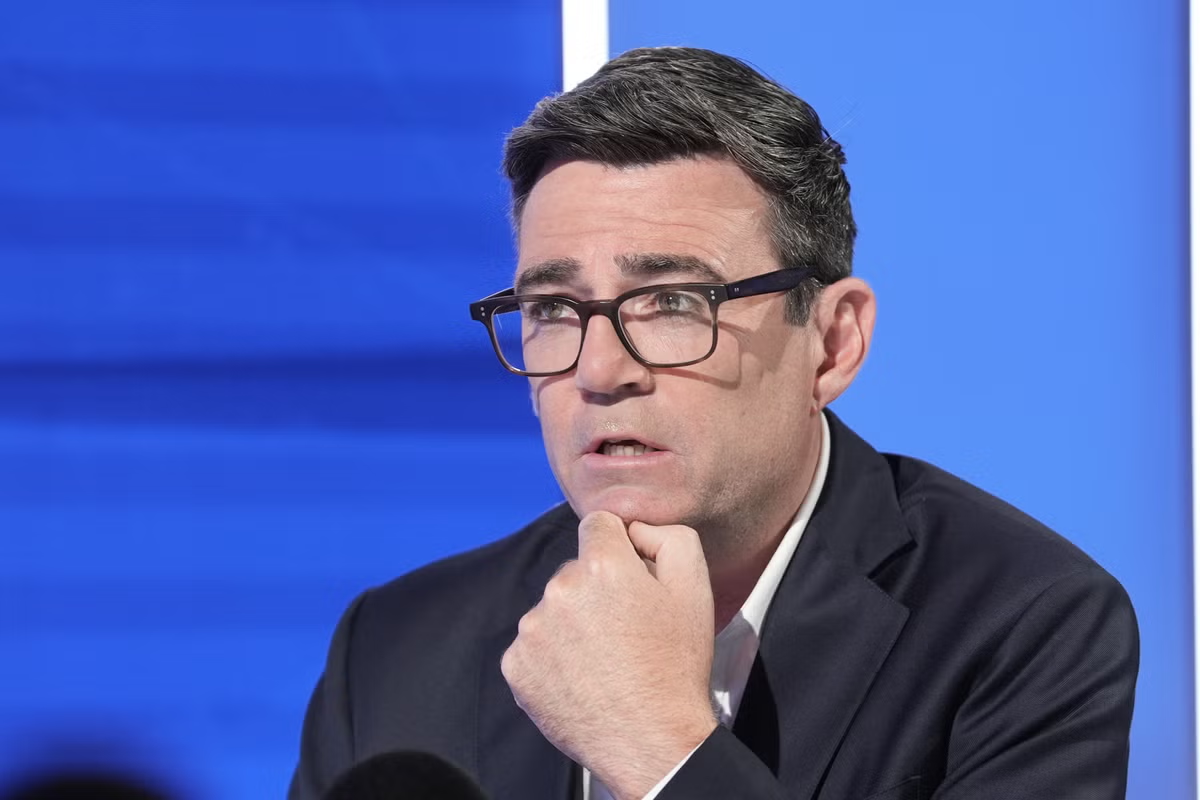
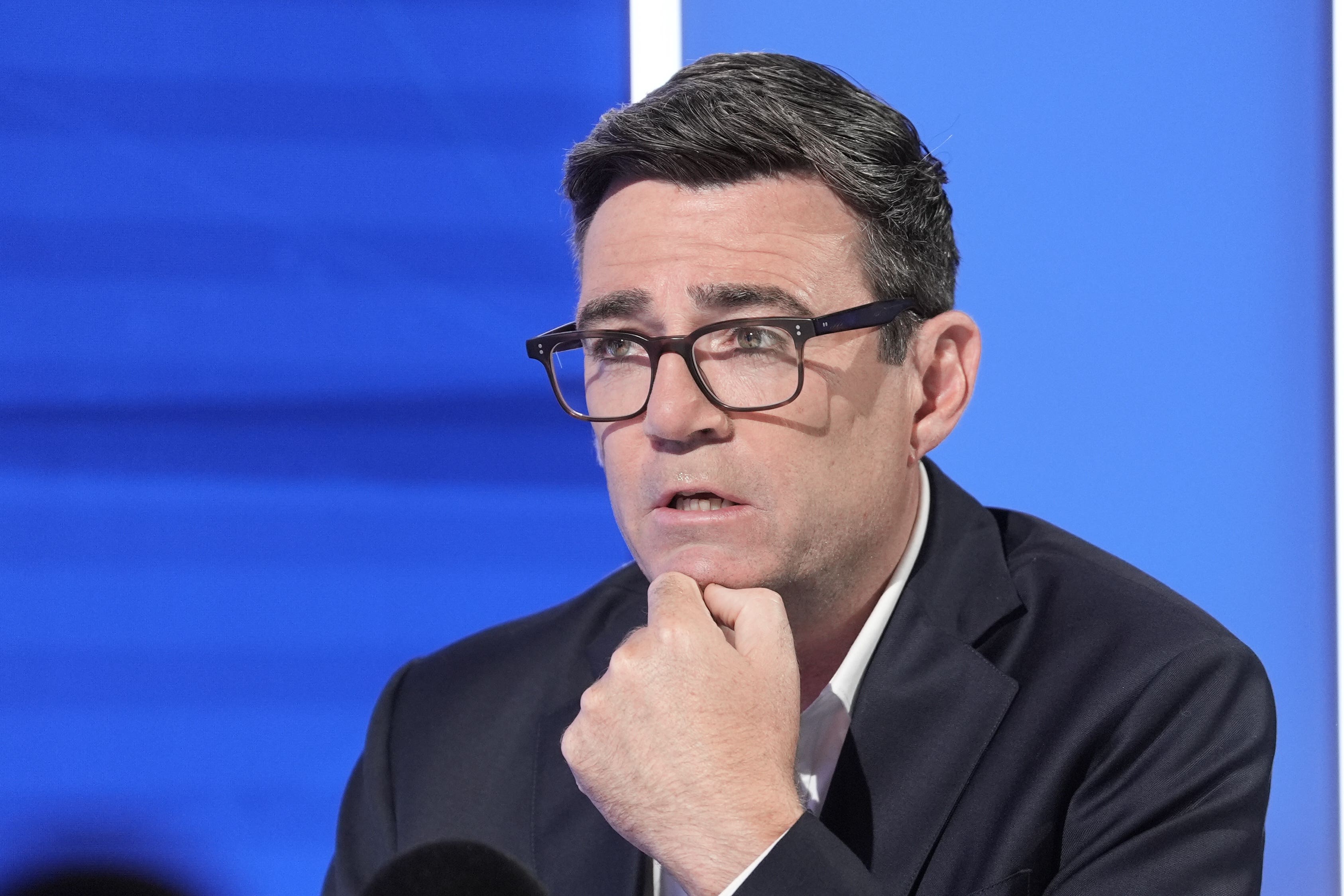
Andy Burnham has to fill a £4.7bn blackhole in the defence budget (PA Wire)
Means testing he state pension would break the link between it being a universal benefit funded by National Insurance which was established when David Lloyd-George created it in 1908.
Mr Burnham has ruled out breaking Labour’s 2024 manifesto promise to not raise income tax, VAT or personal contributions to National Insurance, which in theory fund the state pension.
He has discussed changing business rates in a way which would target large online retailers like Amazon that rely on huge warehouses.
Advertisement
But he has also recommitted to the triple lock on the state pension rising each year by 2.5 per cent or the highest rate of inflation which adds to the burden of the bill.
However, he has to find at least £4.7bn to fund the black hole in the defence package and may need to find another £13bn if he is to meet the amount which military chiefs claim is required to prepare the UK for an increasingly dangerous world.
Listing means-testing the state pension as option 37, Mr Neidle noted: “The state pension pays out about £12,500 per year. It’s easy to think that’s an irrelevant amount to wealthy retirees, and we should means-test the pension to stop them benefiting.
“Given the government spends over £150bn each year on pensioner benefits, blocking even just the wealthiest 1 per cent from pensions would raise over £1bn. It seems a slam dunk.”
Advertisement
The top suggestion from Mr Neidle is to continue the fiscal drag on things like freezing income tax thresholds so more people are included in the higher rates of 40p and 45p as well as the basic rate of 20p.
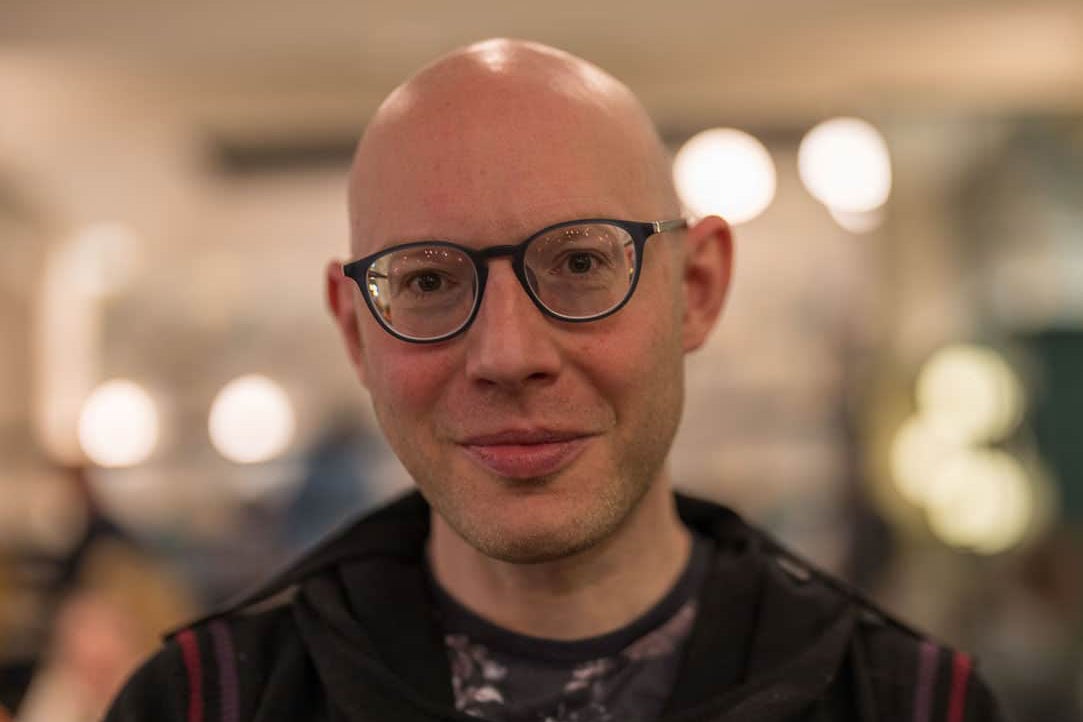
Dan Neidle came up with 37 options on tax (Dan Neidle/CC BY-SA 4.0)
“Inflation and earnings growth mean we’re all earning more in cash terms, but not in real terms – however tax thresholds have stayed the same for years. The Johnson and then Sunak governments raised very large amounts with fiscal drag – over £29bn by 2027/28. This has only a limited effect on median earners, but represented a significant tax increase for higher earners. Rachel Reeves extended the freeze to April 2031. It seems likely that we will get another extension from Mr Burnham, raising around £5bn in 2031/32 and more in subsequent years.”
Mr Neidle also suggested that a proposal aired by one of Mr Burnham’s key lieutenants Louise Haigh recently of raising capital gains tax could bring in £6bn.
He noted: “It’s obvious from the charts above that capital gains tax is the single largest way to raise tax without breaking pre-election promises.”
But he warned: “However, it comes with a large catch. A simple rate increase will, on the basis of HMRC figures, lose revenue, not raise it.”
Advertisement
Other suggestions include an exit tax for wealthy people leaving the UK, capital gains tax on top of inheritance tax when people die, an increase in inheritance tax and forcing law firms to start paying employer national insurance. Currently they are exempt because lawyers have partner not employee status.
He also wants Mr Burnham to look at eliminating the loophole on stamp duty for commercial property, introducing a tax for large gifts and force the Bank of England to stop paying interest on its own reserves.
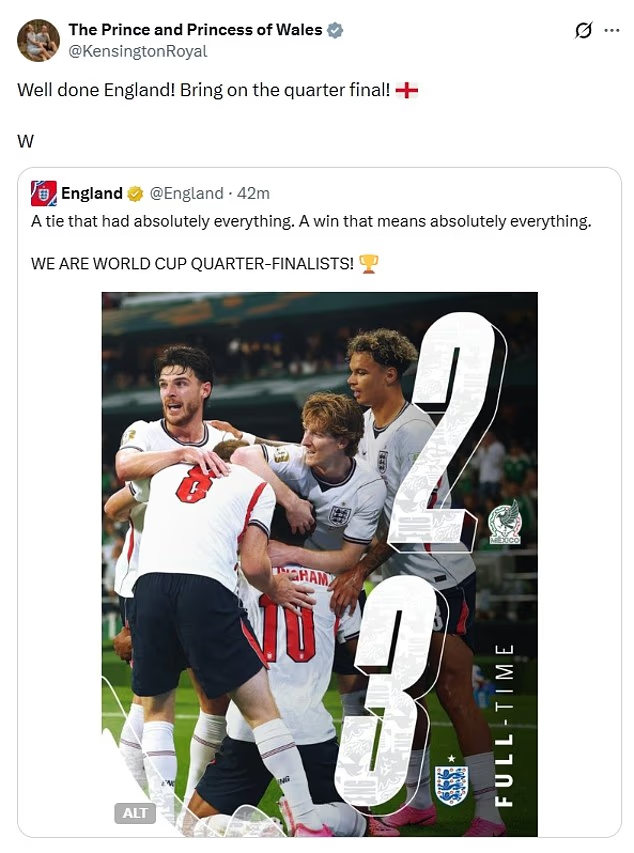
The Prince of Wales was among the first to congratulate England after they stormed to a 3-2 victory in their World Cup clash with Mexico.
Prince William urged the team on to the quarter-finals as he was joined by millions of fans across the country who pulled an all-nighter to watch the match.
There were jubilant scenes both at home and in the Azteca Stadium after Thomas Tuchel‘s side managed to cling onto their lead despite being down to ten men.
They will now take on Norway for a place in the final four in Miami on Saturday after Erling Haaland‘s side knocked out five-time champions Brazil.
Advertisement
The prince wrote in a social media post: ‘Well done England! Bring on the quarter final!’
He was joined by a number of politicians who stayed up late to watch the match, that kicked off at 2am following a thunderstorm delay.
Reform MP Robert Jenrick said: ‘So proud of this England team. Heroes, each and every one of them.’
Advertisement
Prince William said ‘well done’ and ‘bring on the quarter final’ in a post on X just after 4am on Monday
Prince William (pictured with Thomas Tuchel) urged the team on to the quarter-finals as he was joined by millions of fans across the country who pulled an all-nighter to watch the match
Harry Kane celebrates scoring his team’s third goal with Jude Bellingham
In a post on X, Labour MP Stella Creasy added: ‘I have no idea how I do the school run this morning after a red card and a penalty.
Advertisement
‘Like having had ten espressos and a red bull chaser.’
In the stadium, England fans spontaneously broke out into Sweet Caroline as the players celebrated on the pitch.
Meanwhile, scores of jubilant supporters at Boxpark Wembley in London jumped into the air, with some becoming emotional.
CO2 cannons at the fan zone blasted white fog, as fans embraced one another and threw their hands into the air.
Advertisement
In Britain, millions of England fans are expected to be late or absent from school and work on Monday, with employers braced for a ‘mass sickie’.
There were already tired faces in pubs up and down the country as fans waited for kick-off to begin – with some resting their heads on tables surrounded by pints of beer.
Speaking at a watch party in Wembley, northwest London, Lorcan Finn, from Devon, said he had already taken the day off work to stay up for the early-hours kick-off.
The 22-year-old engineer said: ‘I think it’s stupid not to take the day off, unless you work from home.’
Advertisement
England fans at Wembley Box Park, London, react as their team take on Mexico in the World Cup round of 16
Fans celebrate following a screening of the FIFA World Cup match between England and Mexico
Jude Bellingham and his teammates celebrate after England secured victory against Mexico
Harry Becks, 27, from Ruislip, west London, also said there’s ‘no chance’ he will go to work on Monday, adding: ‘I already booked the day off.’
Advertisement
Matt, 27, from Richmond, south-west London, who was at the fan zone with his father Terry, 62, from Preston, is also taking annual leave on Monday.
His father Terry said: ‘I’m older, I do not work. I will wake up tomorrow at home, if I’m not dead!’
The match kicked off at 2am UK time after a one hour delay due to thunderstorms – with bars due to stay open until 5am on Monday.
Fans across the country went wild when Jude Bellingham netted two goals just a couple of minutes apart.
Advertisement
However, crowds were silenced moments later when Julian Quinones scored for Mexico, in what was the game’s third goal in just six minutes.
Jubilant scenes broke out again when Harry Kane scored England’s third goal of the match after Anthony Gordon won a penalty.
It came after the crowd had been quietened minutes earlier when defender Jarell Quansah was sent off following a VAR check over a high tackle.
The mood dipped once more after Mexico reduced the deficit to 3-2 through a Raul Jimenez penalty after Harry Kane was adjudged to have committed a foul in the box, following another VAR check.
Advertisement
After an agonising 11 minutes of extra time in the second half, the final whistle signalled England’s return to the quarter-finals of the tournament.
Homeowner who erected section of Berlin Wall in his garden without planning permission is ordered to tear it down after council warned it created an ‘oppressive sense of enclosure’
A council has called on a homeowner to tear down the Berlin Wall – or at least the chunk of it in his back garden – because it is ‘oppressive’.
Steven Thorpe, 65, bought a section of the notorious wall from a German farmer and put it up behind his Herne Hill, south London, home earlier this year.
But irate neighbours – who said they could see the top of the wall from their properties – complained to Southwark Council, which said tearing down the wall was the ‘only option available’.
A planning case officer wrote to Mr Thorpe on July 2 saying the wall’s installation was ‘unacceptable’ and caused ‘planning harm’.
Advertisement
They added the section of wall, which the officer said was 3.6m tall and weighed 2.75 tonnes, ‘significantly exceeds the two-metre height limit for gates, fences, walls or other means of enclosure’ under planning regulations.
A planning enforcement notice ‘is likely to require the removal of the works’, it concluded.
Mr Thorpe could face a fine of up to £20,000 if he refuses to remove the wall.
But the property developer said he would appeal the officer’s decision and added he disagreed with the measurements quoted in the letter, claiming the wall was 3.1m tall.
Advertisement
Property developer Steve Thorpe, 65, bought a piece of the Berlin Wall to bring home to the UK
But he may be forced to remove the section of wall by Southwark Council, who said it caused an ‘oppressive sense of enclosure’
‘I totally disagree with that,’ he said. ‘They’ve described a large reinforced concrete structure rather than a heritage artefact or sculpture.’
Advertisement
‘I think that framing’s important, it underpins their conclusion simply as an unauthorised structure, when I consider it to be a historical artefact.’
The officer said no planning application had been submitted or approved, adding the development caused ‘material harm’ to neighbours because of its ‘overbearing scale, oppressive sense of enclosure and stark industrial appearance that is made worse here due to the massive scale and unnecessary siting of the wall so close to the garden boundary’.
But Mr Thorpe claimed the wall was 97cm from the boundary of his garden, rather than the 60cm quoted by the officer.
He said it was ‘not a wall’ but an ‘artefact’.
Advertisement
‘It’s not enclosing any land, it’s a free-standing, historic artefact. There’s no explanation whatsoever of the alleged planning harm.
‘My neighbour can barely see the top of it now I’ve got Red Robin [shrub] planted along the fence.
‘They simply assert it causes planning harm without any backup. One would have thought they’d come to visit the site before sending this letter.’
The officer also said an application may be accepted if the wall were moved elsewhere in the garden and there was ‘evidence of neighbour consultation’.
Advertisement
He had the segment transported to his home in Herne Hill, south London, after buying it from a German farmer
The 65-year-old said he would appeal the planning officer’s conclusions which found its ‘overbearing scale’ caused ‘material harm’
The Berlin Wall – pictured with the Brandenberg Gate – was built in August 1961 by the former East Germany
But it added: ‘Absent any alternative proposals the only option available to the local planning authority is to issue a planning enforcement notice.’
Advertisement
Mr Thorpe said: ‘If I really have to move it, I’ll move it, but I don’t consider it’s doing any harm to my neighbour.
‘I’m taking some advice from friends of mine in planning.’
Southwark Council previously said: ‘We have received a planning complaint about a section of wall installed in Dulwich.
‘We will investigate the complaint and take any appropriate action in line with the national planning process.’
Advertisement
The Berlin Wall was a 155km (96mi) barrier built by East Germany in August 1961 to prevent its citizens from fleeing to the West.
It stood until November 1989 when a new travel law was mistakenly announced, which saw crowds rush to the border.
The wall was opened under the onslaught of people and ultimately dismantled.


















































You must be logged in to post a comment Login