Connect with us
DAPA Banner
DAPA Coin
DAPA
COIN PAYMENT ASSET
PRIVACY · BLOCKDAG · HOMOMORPHIC ENCRYPTION · RUST
ElGamal Encrypted MINE DAPA
🚫 GENESIS SOLD OUT
DAPAPAY COMING

Tech

Microsoft and Amazon Commit Billions to New AI Implementation Units for Businesses

Published

on

Microsoft is investing $2.5 billion in a new group “assisting clients with AI implementations,” reports CNBC:

[Microsoft] said Thursday that 6,000 employees will be embedded with clients, in a practice that’s become known as forward deployed engineering [or FDE]… The announcement comes two days after cloud rival Amazon said it was putting $1 billion behind an FDE initiative to support fast-paced AI engagements. Leading AI labs Anthropic and OpenAI both established FDE groups in May, partnering with private equity firms, banks and consulting firms.

Alongside its technology peers, Microsoft has sunk tens of billions of dollars into building data centers that run generative AI models. Microsoft has also released a variety of AI services, with mixed results. The Microsoft 365 Copilot AI assistant has yet to gain anything approaching ubiquity in the business world, and the GitHub Copilot coding agent has ceded market share to newer players. Microsoft’s stock has slumped 21% this year, by far the worst performance among the mega-cap tech companies. One concern on Wall Street is that AI models that quickly compose code might threaten mature software companies…

Advertisement

Microsoft has for years provided support and implementation services to customers. The company generated about $2.1 billion in revenue from enterprise and partner services in the March quarter, up 2.5% from a year earlier.

Source link

Continue Reading
Click to comment

You must be logged in to post a comment Login

Leave a Reply

Tech

Apple’s Q3 results on July 30 could be Cook’s last

Published

on

Apple has confirmed that its financials for the third quarter of 2026 will be reported on July 30. It certainly will be an event with a lot of talking points from the quarter, and it might be the last one with Tim Cook in attendance.

Every three months, Apple issues a quarterly report revealing how well it’s performed during the period. The third quarter results arrive at the end of July.

In a notification to investors and analysts, Apple states that it will be bringing out the third quarter results on July 30. The results will be followed by Apple’s usual conference call at 5 p.m. EDT, featuring both current CEO Tim Cook and CFO Kevan Parekh to talk about the numbers.

As always, AppleInsider will be analyzing the results as they are released, as well as reporting on the questions and answers in the conference call.

Advertisement

Apple’s Q3 expectations from Q2

As part of Apple’s quarterly financial results for Q2, Parekh provided some forward-looking statements for the third quarter figures.

That included expectations of revenue growth at between 14% and 17% year-over year. That would translate into revenue going from $94 billion in Q3 2025 to a possible $110 billion for Q3 2026.

At the same time, the gross margin is anticipated to reach between 47.5% and 48.5%. Operational expenditure should lie between $18.8 billion and $19.1 billion.

Cook’s last hurrah?

The second quarter results were unusual for having a large number of events happening during the three-month period. One that was spiced up with the revelation that John Ternus will become Apple’s next CEO as Tim Cook steps down

Advertisement

That means the Q3 results will be the last that Cook will be fielding in the role as CEO. The Q4 results will happen in October, after the CEO transition takes place.

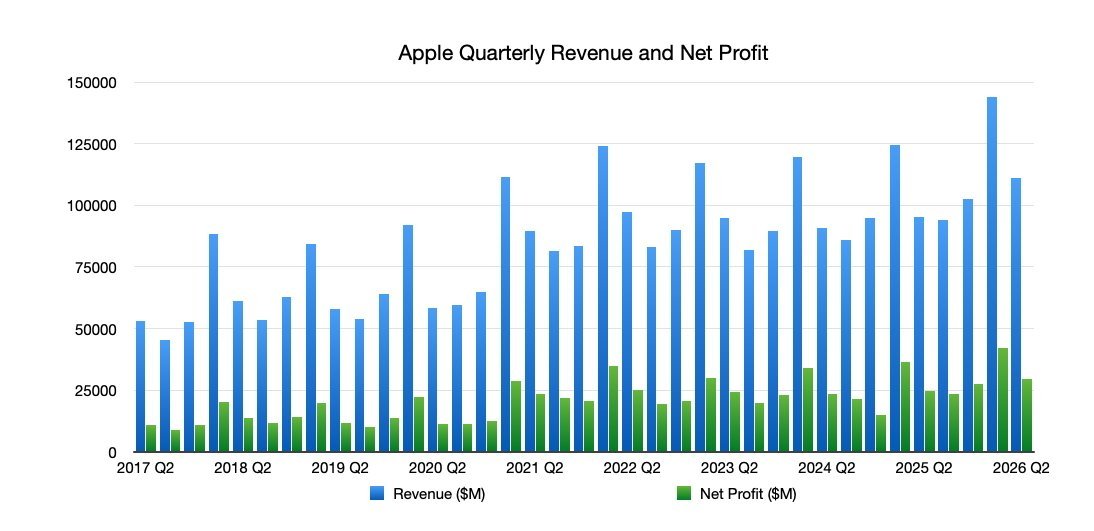
Bar chart of Apple quarterly revenue and net profit from 2017 to 2026, showing generally rising blue revenue bars and smaller green profit bars with noticeable seasonal peaks

Apple quarterly revenue and net profit, as of Q2 2026

It is unclear if Cook will hang around for the Q4 figures due to being CEO for two of those three months. But you can expect there to be some discussion about Cook’s departure from the hot seat and the expectations of the inbound Ternus.

The call will be Cook’s 90th, which would be a nice round number.

Advertisement

Product Changes

There have not been any notable product launches in Q3 that will rock the balance sheet. The only real one of note are the AirPods Max 2, but that won’t set the finances alight.

That said, it will be the first full quarter of availability for products Apple launched in March, late in the quarter. That list includes:

There is also the problem of the price rises, which Cook warned about in June. During an interview, he admitted that the price rises were “unavoidable.”

While Apple had tried to shield consumers from the increases, Cook said the situation regarding memory price rises was “unsustainable.”

Advertisement
Bar chart of Apple quarterly revenue from 2015 to 2016 showing iPhone dominating, followed by Services, then Mac, with iPad and Wearables lowest but gradually increasing over time

Apple unit revenue as of Q2 2026

Cook’s warning became a reality days later. On June 25, Apple raised the prices of its products significantly, across the range.

This included the MacBook Air going from a starting price of $1,9099 to $1,299, while the MacBook Neo jumped from $599 to $699. The MacBook Pro saw a $300 jump for its base price, with iMac going up $200 as well.

The Mac Studio was hit hard, with the base M4 Max version going from $1,999 to $2,499. The M3 Ultra version started at $3,999, but now costs from $5,299, due to its massive RAM capacity.

Advertisement

While other products also got hit, including a $200 hike on the Apple Vision Pro and $30 on the HomePod mini, it wasn’t the case for the iPhones. For the moment at least.

With the switch to the iPhone 18 generation a few months away, analysts will be keen to get hints as to what those models will cost consumers at launch.

Source link

Advertisement
Continue Reading

Tech

Uber’s European expansion plans may have hit a speed bump

Published

on

Back in February, Uber announced ambitious plans to launch in seven new European markets in 2026 — but now the Financial Times reports that five of those launches are on hold. Country launches that have been paused include Austria, Norway, and Greece.

Uber seemed to confirm the decision to the FT, saying that recent launches in Finland and Denmark had been a “huge success,” so now it wants to “focus on continuing the momentum” in existing markets.

Another likely factor in the decision: Uber’s continuing efforts to acquire Delivery Hero, a European company that rejected Uber’s 10 billion euro takeover bid in May.

It seems Uber is still hoping to make the deal a reality. An industry source said that putting a pause on further expansion could help alleviate antitrust concerns around a potential acquisition, especially since Delivery Hero operates delivery services in several of the target countries.

Advertisement

Source link

Continue Reading

Tech

Why Does a Bank Need a Chief Scientist?

Published

on

This article is brought to you by Capital One.

After five years leading natural language understanding and eventually the entire Alexa AI organization at Amazon, Prem Natarajan made a nontraditional move: He became Chief Scientist at a bank. Not just any bank: Capital One, a financial institution serving over 100 million customers, helping everyday Americans manage their financial lives.

For Natarajan, a veteran of DARPA-funded research and academia who had watched machine learning evolve from task-specific applications to foundation models, the logic was clear. Some of the most interesting advances in AI research and deployment were shifting from big tech’s horizontal platforms to industry verticals like finance, where the most complex problems aren’t just building models but making AI work under the constraints of real-world customer problems, contextual business knowledge, continuous learning, with an incredibly high bar for accuracy and privacy.

That’s also what made Capital One the right place to do it. For decades, the company has been recognized as one of the most data- and analytics-driven financial institutions in the industry. Its business model from the very beginning was built around using data and technology to personalize financial products for customers. A decade ago, Capital One went all in on the cloud and rebuilt its data ecosystem, creating a unified environment for data, compute, and AI and machine learning experimentation. Today, its modern infrastructure, disciplined approach to governance, and deep bench of talent form the foundation that allows it to lead in enterprise AI.

Advertisement

Advances in AI research and deployment are shifting from big tech’s horizontal platforms to industry verticals like finance.

So, why does a bank need a Chief Scientist? The answer lies in a fundamental misconception about AI in financial services. Most financial institutions still view AI as a technology to deploy – leveraging the latest large language model, deploying it through APIs, and integrating it into existing workflows – rather than a scientific discipline. Capital One is doing something different: building a scientific community and research organization to solve real-world customer problems and invent impactful AI solutions that don’t yet exist.

While widely available foundation models can handle general tasks, they can’t yet solve many domain-specific challenges, such as detecting fraud in real-time across billions of transactions, or providing state-of-the-art conversational tools so customers can engage when, how, and where they want to.

These challenges of making AI reliable, scalable, and well governed require original research and scientific innovation that is funneled back into the business to create real-world applications to address customer needs.

Advertisement

The Constraints That Demand Innovation

Headshot of a suited man against a blue gradient background.Prem Natarajan, an IEEE Fellow, is Chief Scientist at Capital One. “If you want to solve really important problems in AI and see your work come to life, this is one of the few places you can do that,” he says.Capital One

Because banks are dealing with people’s finances, there is an incredibly high bar for getting it right when it comes to AI. Take fraud, for example. Even a minor fraud event can have a devastating impact on certain customers. The best fraud models and platforms can detect and help mitigate fraud in the time it takes someone to tap their card, which is table stakes for protecting customers and their financial information with accuracy and speed. Looking at these types of challenges, Capital One and Natarajan saw that serving millions of customers meant solving AI problems at a scale and complexity that many enterprises don’t encounter. These same constraints create a unique research environment.

At Capital One, the approach to building AI is to provide value to customers in ways never possible before, improving their financial lives and meeting them where they are with services they actually need. That focus, combined with massive scale and world-class risk management requirements, makes the scientific problems both harder and just as consequential as those found in most big tech labs.

Advancing AI Through “Destination-Back Thinking”

Capital One’s approach to AI research and innovation starts with what Natarajan calls “destination-back thinking.” Rather than asking what’s possible with current technology, the team envisions the customer experience they want to deliver – perhaps a car buyer who works long days and can only research the options at 10 p.m., or a customer facing an unexpected expense who needs immediate, personalized guidance – and then works backward to identify the scientific breakthroughs required to get there.

“You’re thinking back from where you’re providing incredibly valuable services,” Natarajan explains. “Once you have that vision clearly, you work back and say, what are the gaps? What are the things we need to invent?” This ensures that when problems are solved, the impact is essentially guaranteed, because the team has already identified what will make a tangible difference in customers’ lives.

Advertisement

But methodology alone isn’t enough. Capital One’s nearly 15-year bet on cloud-first architecture created something rare in financial services: a unified data and compute ecosystem that can support the kind of scientific experimentation typically seen in big tech research labs. As the only major U.S. bank to go all-in on public cloud infrastructure, Capital One eliminated the legacy systems that can constrain AI research at most financial institutions. This modern tech stack enables rapid iteration, large-scale model training, and what Natarajan calls “continuous learning,” systems that improve after deployment rather than degrading over time. This unique approach to infrastructure is a critical component in making new categories of research possible.

Agentic AI: From Research to Production

The research agenda manifests in systems already serving customers. Early last year, Capital One launched what may be the first fully agentic AI customer service experience built entirely in-house by a bank: a car buying tool that takes actions on behalf of customers based on their requests, not just answers questions. Behind it lies extensive research into multi-agentic AI reasoning systems that can navigate real-time data, business knowledge, constraints, and guardrails, with various agents that can work together to accomplish complex tasks.

Capital One has launched a fully agentic AI customer service experience powered by extensive research into multi-agentic reasoning systems that can navigate real-time data.

The team is also working on solving things like tokenization challenges, protecting sensitive data while enabling model training. To accelerate this cutting-edge work, Capital One has established partnerships with Columbia University, the University of Southern California, and the University of Illinois, and became the only bank funding NSF’s national AI research centers in 2025, investing millions in initiatives that span mental health, materials discovery, science, technology, engineering, and mathematics education, human-AI collaboration, and drug development.

Advertisement

In the spring of 2026, the company hosted its inaugural AI Symposium to deepen connections and foster insight-sharing between the scientific AI community, leading AI labs, startups, and its own technology, science, and AI leaders and partners.

Building a World-Class AI Organization

External validation suggests the strategy is working. Evident AI ranked Capital One as the leading bank in AI talent and a global leader in AI innovation for three consecutive years, noting the bank accounted for 38 percent of all AI patents filed by the top 50 financial institutions. Capital One was also recognized by IFI Insights as the only financial institution among the top U.S. patent leaders in agentic and generative AI in 2025, alongside the likes of Google, NVIDIA, DeepMind, IBM, Microsoft, Intel, Adobe and Samsung. Capital One’s AI team – which has experience from leading AI labs and top universities – represents expertise rarely found outside Silicon Valley.

But recruitment requires a mission. “If you want to solve really important problems in AI and see your work come to life, this is one of the few places you can do that,” Natarajan says. The pitch is consistent: Capital One isn’t just optimizing algorithms for niche financial applications like high frequency trading, it’s using science to enhance financial experiences for over 100 million everyday Americans, expanding engagement and real-time insights, personalization, and access to their personal finances and products like never before.

Capital One was recognized as the only financial institution among the top U.S. patent leaders in agentic and generative AI in 2025, alongside the likes of Google, NVIDIA, DeepMind, and Microsoft.

Advertisement

The frontiers Natarajan is most excited about – agentic AI systems that can dramatically improve performance by reframing how problems are solved, and domain-specific reasoning that understands contextual and financial nuance – represent the next phase of innovation. “By just casting the problem in an agentic framework, you can actually get way more performance” from the same underlying models, he explains.

It’s this kind of applied research, like translating general capabilities into production systems for millions of customers, that defines the Chief Scientist’s mandate. When recruiting talent to his AI team, a group comparable only to the most sophisticated tech companies in caliber, Natarajan frames the opportunity around a mission. He invokes Steve Jobs’ famous challenge to John Sculley: “Do you want to spend the rest of your life selling sugared water, or do you want to change the world?” For Natarajan, the parallel is clear. Building AI systems that transform financial services for millions of everyday Americans – that’s changing the world. And it requires the kind of scientific rigor that only a Chief Scientist can lead.

Source link

Advertisement
Continue Reading

Tech

NYT Strands hints and answers for Monday, July 6 (game #855)

Published

on

Looking for a different day?

A new NYT Strands puzzle appears at midnight each day for your time zone – which means that some people are always playing ‘today’s game’ while others are playing ‘yesterday’s’. If you’re looking for Sunday’s puzzle instead then click here: NYT Strands hints and answers for Sunday, July 5 (game #854).

Strands is the NYT’s latest word game after the likes of Wordle, Spelling Bee and Connections – and it’s great fun. It can be difficult, though, so read on for my Strands hints.

Want more word-based fun? Then check out my NYT Connections today and Quordle today pages for hints and answers for those games, and Marc’s Wordle today page for the original viral word game.

Advertisement

Source link

Continue Reading

Tech

Hackaday Links: July 5, 2026

Published

on

Happy belated July 4th to all the readers from the United States — hopefully you aren’t reading this from a hospital bed after losing a hand or burning off your eyebrows. While we suspect amateur firework shows and their related injuries will be around for many years to come, we did note that many major cities switched over to drone shows this year.

At least on paper, the appeal is obvious. Beyond the fact that drones are safer and quieter than pyrotechnics, they’re also capable of far more complex displays. Good luck trying to draw George Washington’s face in the sky with exploding rockets. But even if it’s a little more than nostalgia, there’s still something about the sights and sounds of fireworks that enthrall audiences. For many, the whole “rockets’ red glare” thing is a bit more meaningful than the “drones’ red LEDs.”

Earlier this week, we brought you news that Sony would stop producing physical PlayStation discs in January 2028. Many gamers are understandably concerned about the long-term implications such a move will have for software ownership, and while the negative reactions online haven’t bothered Sony enough to get them to amend their plans, they have clarified the situation with developers by explaining that games published before the cutoff date aren’t impacted. So if a developer has a hit title that drops in the summer of 2027 and they want to keep cranking out discs, additional orders can still be placed. Not much of a reprieve, but it will give the community a little more time to figure out what comes next.

While plenty would argue that the death of physical media has been exaggerated, the same can’t be said about 3D TV. Engadget has a piece that goes over what went wrong with 3D home media, and not all of it is on the technical side. Of course, a big part of the problem was the glasses — they were goofy and added per-viewer expenses that consumers weren’t thrilled with. But some of the blame also has to be put on Hollywood and the content they were producing. There were a few big-name movies like Avatar that were filmed in 3D, and computer-generated films could be rendered to take advantage of the third dimension, but the rest were lazy at best. Getting folks to spend thousands on a 3D-capable home theater was tricky enough, but asking them to do it if there were only a handful of movies worth watching on the thing was simply asking too much.

Advertisement

Speaking of tech heading off into the sunset, it looks like the end may be near for Amazon’s Mechanical Turk service, as they’ve announced they’ll no longer be taking new customers after this month. For those unaware, Mechanical Turk connected bored humans with customers that had repetitive tasks they needed completed. Think of somebody spending an afternoon sorting images and making a few cents a pop.

When the service launched 20 years ago, tasks like this were difficult to automate, and it made sense to pay humans to do it. But in the age of AI, it comes as no surprise to hear Amazon is looking to wind things down. Existing Mechanical Turk users will be able to continue using the service after July, but with no new jobs coming in, the writing is clearly on the wall.

Finally, things seem to be going well so far for the Neil Gehrels Swift Observatory rescue mission. On July 3rd, the robotic LINK spacecraft that will eventually link up with the Observatory and push it into a higher orbit was successfully air-launched aboard a Northrop Grumman Pegasus XL rocket. Teams on the ground have already made contact with the rescue vehicle and are performing health checks on it before committing to a rendezvous with the ailing Swift.

LINK will attempt to push the Neil Gehrels Swift Observatory into a higher orbit.

Once it has attached itself to Swift, LINK will push it up to an altitude of around 640 km (400 miles), which should keep it from burning up in the Earth’s atmosphere for another decade or so. We’ve had our eye on this ambitious mission for some time now, and will keep you updated as it progresses.


See something interesting that you think would be a good fit for our weekly Links column? Drop us a line; we’d love to hear about it.

Advertisement

Source link

Continue Reading

Tech

After the failed launch of the Google Home Speaker, here’s what needs to happen for the company to be taken seriously in the smart home space

Published

on

There was a point where Google could, seemingly, do no wrong. It did surprising things, and it would often launch products carefully. Take the launch of Gmail, which came into existence as a beta product on April 1, 2004.

It remained a beta service until July 7 2009, even though it was much better than that status suggested and quite possibly the best email service available. How things have changed, as the launch of the Google Home Speaker has demonstrated. 

In my review, I like the hardware, but its voice assistant, Gemini For Home, is bad beyond belief in so many ways, and the service is so sluggish. On the /rgooglehome Reddit, there have been a lot of complaints about how slow the speaker is to respond to even simple things. 

Google even commented: “We’re aware of an issue causing increased latency or timing out. We are working on a fix ASAP and will circle back once this is resolved. Thanks for your patience.”

Advertisement

It’s nice to know that something is being done about one issue, but the speaker and Gemini for Home have other, bigger issues. I documented some of the problems I’ve had with Gemini for Home already, but here’s what I think Google needs to do if it’s to be taken seriously in the smart home space.

Advertisement

Properly test

I’ve run into lots of problems with Gemini for Home. It gets information wrong, it misunderstands what’s been asked of it, or it says plain crazy things back. It seems almost unbelievable that it has been rolled out in this state.

In fact, it feels very much like Google was worried about the onslaught of alternative AI systems, including Alexa+ and ChatGPT, and rushed out its own LLM-based voice assistant too quickly.

Advertisement

A few of the issues I encountered are right there at the start, so why are they there? Someone at Google Home needs to get a grip on quality control fast.

Improve regionalisation

One of the first things that Gemini for Home suggested was to set my thermostat to 72°C. I didn’t, because that’s a wild temperature in Celsius; it makes a lot more sense if you use Fahrenheit, but that’s a very US way of looking at things.

Gemini for Home knows where I’m located, and the speaker is located, so it should know which units make sense. If it doesn’t, it’s a failure of the testing process.

When Amazon launched Alexa+ in the UK, it went through a big job getting the regionalisation right, even getting the smart assistant to recognise and understand the UK’s diverse range of regional accents.

Advertisement

Advertisement

Google Gemini for Home needs the same process, so that it can understand and speak in a way that makes sense in this (and other) countries.

Add features

Want to create a routine with your voice using the Google Home Speaker? Tough, you can’t. You can use Gemini in the app, but you can’t create an automation using your voice.

How about sending a PDF to Gemini, getting it to read the contents and then sort out things like schedules, or simply remember an instruction PDF (appliance, board game, whatever) so that you can query it later? Tough, you can’t. The best you can do, according to Gemini’s own response, is to read the PDF aloud to the smart assistant. No, thanks.

Advertisement

How about booking a table at a restaurant? Nope, not yet.

What about getting Gemini to remember details about you, such as who’s a vegetarian in your family or which football team you support? Yes, you can do that. Only, Gemini seems to forget to use any of this information after a period of time, until you remind it.

Advertisement

There’s so much more that Gemini should be able to do, and Google needs to ramp up the features, and make sure that they work.

Advertisement

Make the app better

The day I moved away from Google speakers and the Google Home app was the day I reviewed new Nest cameras and wasn’t allowed to use the Nest app. The Nest app was clean, functional and perfect for cameras.

The Google Home app is worse. I get why Google would want everything in one place, but why make the experience worse? If you want a good example of how everything can be included in one app, then the Apple Home app is excellent, as is the Homey app.

While the Alexa app is a bit clunky, the good news is that when Amazon bought Ring (or Blink), it didn’t ruin its acquisitions and allowed the companies to continue doing what they do well, and improve their apps. The Ring app today is better than it was a few years ago, and Amazon has just built on that with tight Alexa+ integration, without compromising the experience. 

Advertisement

Source link

Continue Reading

Tech

Big Companies That Invest Heavily in AI Also Hire More People, Report Suggests

Published

on

“Companies spending heavily on AI are growing headcount faster, even in the entry-level roles that many fear are doomed,” writes TechCrunch. That’s the conclusion of new report tracking AI spending from Ramp’s corporate card/bill pay data as well as Revelio Labs’ workforce records from 21,599 U.S. firms:


According to the report, “high-intensity adopters” — firms that spend on average $30 per employee per month on AI in the first three months — saw headcount increase 10.2%. Headcount also rose across functions, including engineering, sales, administration, customer service, finance, marketing, and scientist roles. The strongest job growth among high-intensity adopters was in the information sector, which includes software, internet, media, and tech-adjacent firms.

Despite these positive signals, the data isn’t as rosy as it seems. It skews heavily toward tech-forward, knowledge-work firms — ones that might have VC-backing and are growing fast anyway, making it difficult to say whether AI is contributing to the hiring or just showing up at companies that are expanding anyway. “This paper does not show that AI universally creates jobs,” the paper’s authors admit, “but it does counter claims that AI will lead to broad job losses.”

It also counters claims that AI is killing all junior jobs. Recent research from Goldman Sachs found that AI has already erased about 16,000 net jobs per month over the past year, with Gen Z and entry-level workers taking the brunt of the burden. But in tech-forward firms, the report finds that entry-level headcount actually rose by 12%… “For software and technology firms, AI can make core output cheaper or faster to produce: writing code, debugging, building internal tools, producing technical documentation, and supporting product development,” the report reads. “Lower production costs in these workflows can raise the return to expanding the whole firm, not just the engineering team.”

Advertisement

But companies that buy subscriptions and run pilots, yet did not go on to make sustained investments, don’t tend to see any gains in headcount, per the report. That sets up the potential for a widening gap between firms that have the resources — like capital, technical staff, founder networks, and management bandwidth — to turn AI adoption into actual business gains and those that are stuck experimenting with subscriptions. In other words, this report suggests that firms that already have the resources are the ones that will see the largest gains.
CNBC argues another AI “narrative” was challenged this week: that open source can’t make money. “The assumption was that giving your model away for free meant no business. That’s breaking too, as open-model companies start posting real revenue and enterprises move from renting AI to running their own.”

Source link

Continue Reading

Tech

Sony Says It Will Still Make Physical Discs After 2028, As Long As The Game Came Out Before Then

Published

on

Anything released after 2028 will still be digital-only.

Sony’s move to abandon physical game discs may have elicited the “Everyone disliked that” response from the gaming world, but there’s a small consolation for game developers. As reported by Game File, Sony shared a private message to PlayStation developers and publishers that said they “will still be able to place re-orders for existing PlayStation disc games.”

Sony’s post on the PlayStation blog mentioned that its discontinuation of physical game discs would have “no impact on games that already released, or will be releasing, prior to January 2028 in disc format,” but this latest report makes clear that publishers can still continue ordering physical versions of their PlayStation games so long as it’s released before the cut-off date. According to Game File, Sony said that its ordering process for discs will change, but didn’t yet detail how. However, this is expected considering Sony has reportedly already invested millions of dollars into repurposing its disc factory in Salzburg, Austria to manufacture optical microlenses instead.

Game File also reported that Sony said in its message to publishers that it will “provide publishers with the opportunity to release new games at retail using digital codes,” but similarly didn’t reveal details yet. While that does address the concern of gamers being limited to purchasing games through Sony’s online store ecosystem, the overall loss of physical discs is still expected to have major implications for the industry.

Advertisement

Source link

Advertisement
Continue Reading

Tech

Stats, iPhones, and AI devices are still a threat

Published

on

In this week’s “Sunday Reboot,” scientists somehow say iPhones lowered birthrates, and Musk’s AI prototype story shows that specialist hardware is coming, even if we don’t necessarily want it.

Sunday Reboot is a weekly column covering some of the lighter stories within the Apple reality distortion field from the past seven days. All to get the next week underway with a good first step.

iPhones up, birthrate down, “research” questionable

The iPhone is a mere 19 years old this week, first going on sale on June 29, 2007. It’s old enough to drink in the UK, if not quite in the United States.

Before it flies across the Atlantic to buy a brew from a bar in Basingstoke, some pesky scientists have tried to spoil the party.

Advertisement

Raised on July 1, a working paper from the National Bureau of Economic Research proposes “Is the iPhone Birth Control?” If we follow Betteridge’s law of headlines, the answer is “No.”

The paper proclaims “National-survey evidence on time use and sexual behavior is consistent with the iPhone reducing in-person interactions, increasing pornography use, and reducing sexual frequency” in the United States

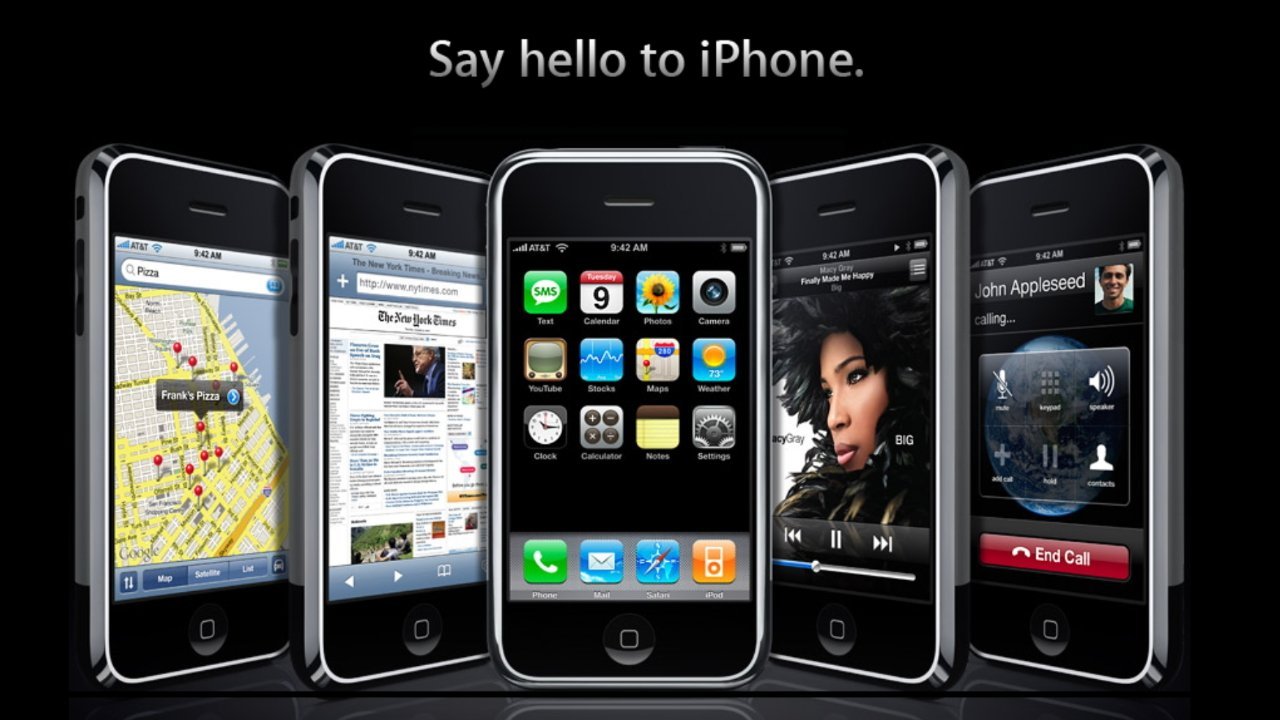
Five firstgeneration iPhones standing side by side on a black background, each displaying different screens such as maps, web browser, home screen, music, and phone call, with text Say hello to iPhone

Apple launched the iPhone in 2007. Scientists say it was too hot for the U.S. Birth Rate – image credit: Apple

Hearing that for the first time, you’d nod and agree with it. That song from the puppet musical “Avenue Q” is right, and so is the abstract.

Advertisement

However, AppleInsider William Gallagher looked into the report and realized that there are some catches to this assumption.

First, that it’s not really a phenomena associated with just the iPhone. I recall there were many different other devices on the market at the time that were capable of being used in illicit ways.

However, the writers decided to focus on data of AT&T users between 2005 and 2011. That’s two years before the iPhone and the years when it was exclusive to AT&T.

Except it doesn’t really take into account the fact that AT&T also sold many other early smartphones too. Blackberries, the HTC-based AT&T Tilt, the Nokia N75, and others were all buyable from the carrier, not just iPhones.

Advertisement

Even the report writers acknowledge this, saying they don’t claim the iPhone was the sole cause of the post-2007 decline.” Indeed, they say the estimates imply that the modern smartphone played a “sizable role” in the decline of US births.

But, before the puritan complainers can get a word in about how smartphones are evil, and demand retribution from the House of Jobs, the report goes on to work against the implied statement.

Line graph titled Search interest in porn, showing Google Trends index rising from 2004, peaking around 2013 near 100, then gradually declining and stabilizing between 40 and 60 by 2024

A graph used as proof the iPhone affected the U.S. birth rate. Except it doesn’t… – Image credit: National Bureau of Economic Research

Searches for “porn” shot up in 2014, but have gone down to almost 2009 levels again by 2024. Almost as if society had the novelty of trying to access specialist content wherever they want, then the novelty wore off.

Advertisement

It’s an odd report that tries to prove a point, but works against itself in many ways, and with too many asterisks to really be taken seriously.

In which case, was it really a clickbait way to try and secure some grant funding during some downtime? Or maybe some scientists placed bets that they could get it published.

Maybe it was an excuse to get to look at adult material while working without needing to face an investigation from HR.

Either way, Betteridge’s law is maintained once again.

Advertisement

Don’t stop believing in AI devices

People working in the tech editorial space, such as this very publication, are all too familiar with the notion of prototypes being shown to others. Especially if it’s for a future product in a category where there’s no real dominant option.

Cue a story about one of the Elon Musk companies supposedly sharing a prototype with investors for an AI device. SpaceX’s xAI apparently did that, though Musk has since called the claim “utterly false.”

Your mileage may vary on whether or not to blame the extremely rich man, but he did threaten to go all Futurama Bender on the iPhone in 2022. As someone in charge of tech companies with massive resources capable of doing just that, there was every chance that Musk would do it.

He didn’t, but the opportunity was there.

Advertisement

What the modern-day report provides in detail is minimal. It was shown to investors and was thinner than an iPhone.

While Musk’s insistence that it’s not happening puts a downer on things, it does, however, mean that there’s still an appetite for something to happen in that area.

Three small square wearable camera devices, one white in front and two black behind, each with rounded corners and a horizontal pill-shaped lens area featuring a yellow accent on the left

The Humane AI pin failed. Won’t stop others from doing the same thing – Image Credit: Humane

After the Humane AI pin’s crash and burn and the Rabbit R1’s lack of popularity with consumers, companies should be treading carefully. Those were two high-profile AI device failures, and no-one wants to pay for the third.

Advertisement

Rumors and patents certainly point to Apple continuing down the path of a more AI-focused future. Sure, there’s the questionable pendant, and the ever-present smart glasses, but it’s also looking at non-standalone items too.

We have had rumors insisting that the AirPods will get cameras, providing an environmental view for Apple Intelligence running on an iPhone.

The key bit here is that it’s all feeding back to an iPhone. Something that is obviously a device that has a lot of AI prowess, and could do the same job as Humane’s pin if you push it.

The only difference is that AirPods with cameras, or smart glasses with cameras, would enable that sort of functionality without needing to touch the iPhone at all.

Advertisement

The AirPods don’t have to be “smart” in their own right. They only have to pass along data to the iPhone as the actual “brain” of the operation.

You don’t really need a dedicated device, just a way to interface with what already exists.

So, with the hardware side “solved,” there’s the actual AI bit to cover. Again, Apple Intelligence on the iPhone comes to the rescue, but there is another way.

Humane was painful, particularly since you had to pay a $24 per month subscription for the AI bit. We may not have liked paying a subscription for questionable AI back in 2023, but in 2026, we’re intimately aware of how much people are spending on access to ChatGPT and Claude.

Advertisement

Weirdly, it only took a few years and society is perfectly fine with one of the biggest stumbling blocks that Humane ran into.

It’s not hard to imagine OpenAI releasing hardware that taps into ChatGPT’s paid services. You don’t even have to imagine, as your friendly LLM can tell you about the hardware work with Jony Ive.

Humane flopped so OpenAI and others can walk, run, or be a patronizing yes-man that really wants to explain your assumptions back at you with a more academic style.

Musk may deny the existence of an xAI hardware prototype now, but it would be astounding if one wasn’t being actively developed.

Advertisement

Putting Grok access on a device like that isn’t hard to imagine. For Musk, with an eye staring at his finance teams, it seems like a natural progression of the form, and he gets his own iPhone rival to boot.

Just hope that we don’t get headlines in 20 years time about Musk’s prototype lowering the birth rate again.

Last week’s Sunday Reboot talked about Apple TV and its fear of gameshows. That, and a reminder that it is also bad at making gameshows.

Advertisement

Source link

Continue Reading

Tech

Does It Apply Automatically At Checkout?

Published

on


Even without any additional discounts, Harbor Freight is already a great option for budget-conscious shoppers, with dozens of brands on its shelves that cater to everyone from novice DIYers to demanding professionals. Shop carefully though, and there are even more ways to save money as a Harbor Freight customer. One of the easiest ways is to sign up for the retailer’s Inside Track Club membership program, which offers additional discounts on sale items as well as promotional prices that are unique to members of the scheme.

According to Harbor Freight, members who were signed up to its program saved a combined $250 million in 2025. As an individual shopper, the amount you save will vary considerably based on the number of discounted items you buy, but we’ve previously estimated that shoppers who go only a few times a year should still save enough that their membership pays off.

Advertisement

Claiming those additional savings is an easy process too. If you shop online, your membership is attached to your Harbor Freight account, so you’ll automatically have any Inside Track Club savings added to your cart when you checkout. If you’re shopping in-store, you’ll need to provide either your phone number or email address at checkout. You’ll then have any additional savings applied straight to your bill, without needing to worry about coupons or membership cards.

Advertisement

How much does Inside Track Club membership cost?

Pricing and promotional deals surrounding Harbor Freight’s Inside Track Club membership can vary, but as of July 2026, a single year’s membership for both new and renewing members costs $29.99. Anyone who signs up for two years of membership will pay even less annually, with Harbor Freight offering 50% off the second year’s price. That means a two-year membership can be bought for as little as $44.99.

Shoppers can sign up for a membership either in-store or online. There is one caveat though: You shouldn’t try to sign up online if you’re already standing in a store, since Harbor Freight says that the details of new online members can take up to 3 hours to sync with the servers it uses in-store. If you purchase an online membership while you’re walking to the checkout counter, your details most likely won’t be recognized.

If you find you’re no longer using your Inside Track Club membership, you can cancel at any time. Anyone who cancels their membership within 90 days of initially signing up will receive their membership fee back in full. With such an easy registration process and a 90-day refund guarantee, avid Harbor Freight shoppers have little to lose and potentially a lot to gain by signing up. If you’re looking for other cash-saving tips, we’ve put together a roundup of the most common mistakes Harbor Freight customers make so you don’t miss out on any hidden promotions.

Advertisement


Source link

Advertisement
Continue Reading

Trending

Copyright © 2025