

Crypto World
Solana price remains on recovery path as on-chain activity reaches new high

Solana price has held above key technical support even after slipping 1.7%, while U.S.-listed spot Solana ETFs have continued attracting fresh inflows as Bitcoin and Ethereum funds recorded weekly withdrawals.
Summary
- Solana held above key support as $5.75 million in spot ETF inflows contrasted with Bitcoin and Ethereum fund outflows.
- Solana ranked second in weekly spot trading volume, while non-vote transactions topped 1 billion for the first time.
- Rising active users, strong DApp revenue, and bullish technical indicators continue to support Solana’s recovery.
After climbing more than 15% last week, Solana (SOL) price met selling pressure near the $80 level, where traders again defended resistance amid the broader market pullback. Even after the recent recovery, the token remains about 73% below its all-time high of $294.33 reached on Jan. 19, 2025.
Meanwhile, Bitcoin fell 1.65% during the same period, dragging the total cryptocurrency market capitalization down 1.47% to $2.14 trillion.
ETF demand has stayed positive despite market weakness
Fund flow data showed Solana diverging from the two largest cryptocurrencies during the latest reporting period. Spot Bitcoin ETFs recorded net outflows of $527 million between June 29 and July 2, extending their losing streak to eight consecutive weeks. Spot Ethereum ETFs also registered net outflows totaling $13.67 million.
By contrast, U.S.-listed spot Solana ETFs attracted $5.75 million in net inflows over the same period. The inflows indicated that investors continued adding exposure despite weakness across the wider digital asset market.
Capital also moved into several other altcoin investment products. XRP ETFs recorded $17.19 million in net inflows, while HYPE ETFs added another $4.32 million during the week.
Away from fund flows, on-chain activity continued to strengthen. According to SolanaFloor, Solana ranked second in global spot crypto trading volume for the second consecutive week, processing $12.25 billion across centralized and decentralized exchanges. That total remained ahead of Bybit’s $10.57 billion, although Binance retained the top position among exchanges during the reporting period.
SolanaFloor also reported that weekly non-vote transactions surpassed one billion for the first time. Unlike validator voting activity, non-vote transactions represent actual network usage generated by users, decentralized applications, and traders. The sharp rise at the beginning of July points to heavier activity across the ecosystem.
Technical structure still favors buyers above key support
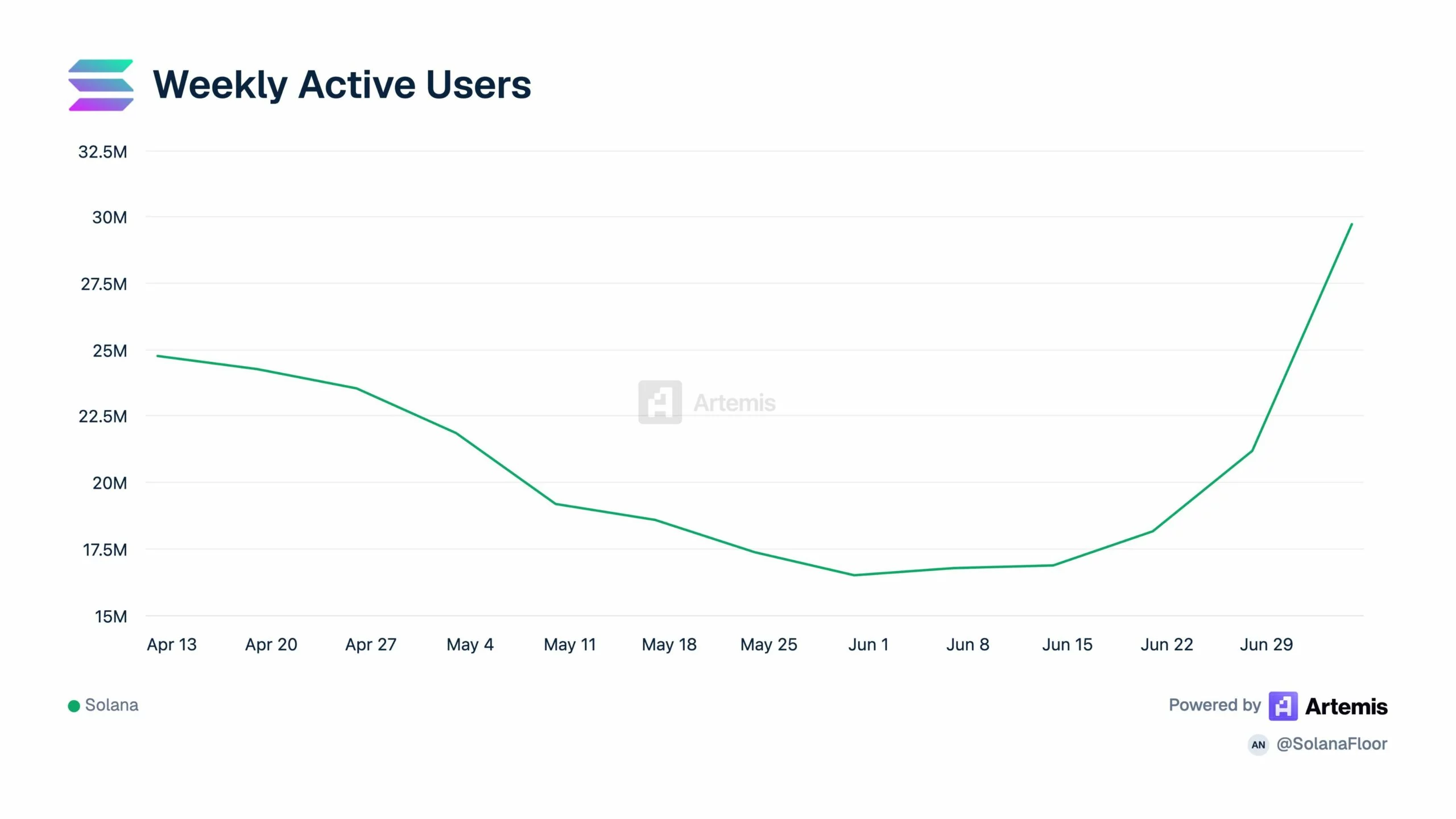
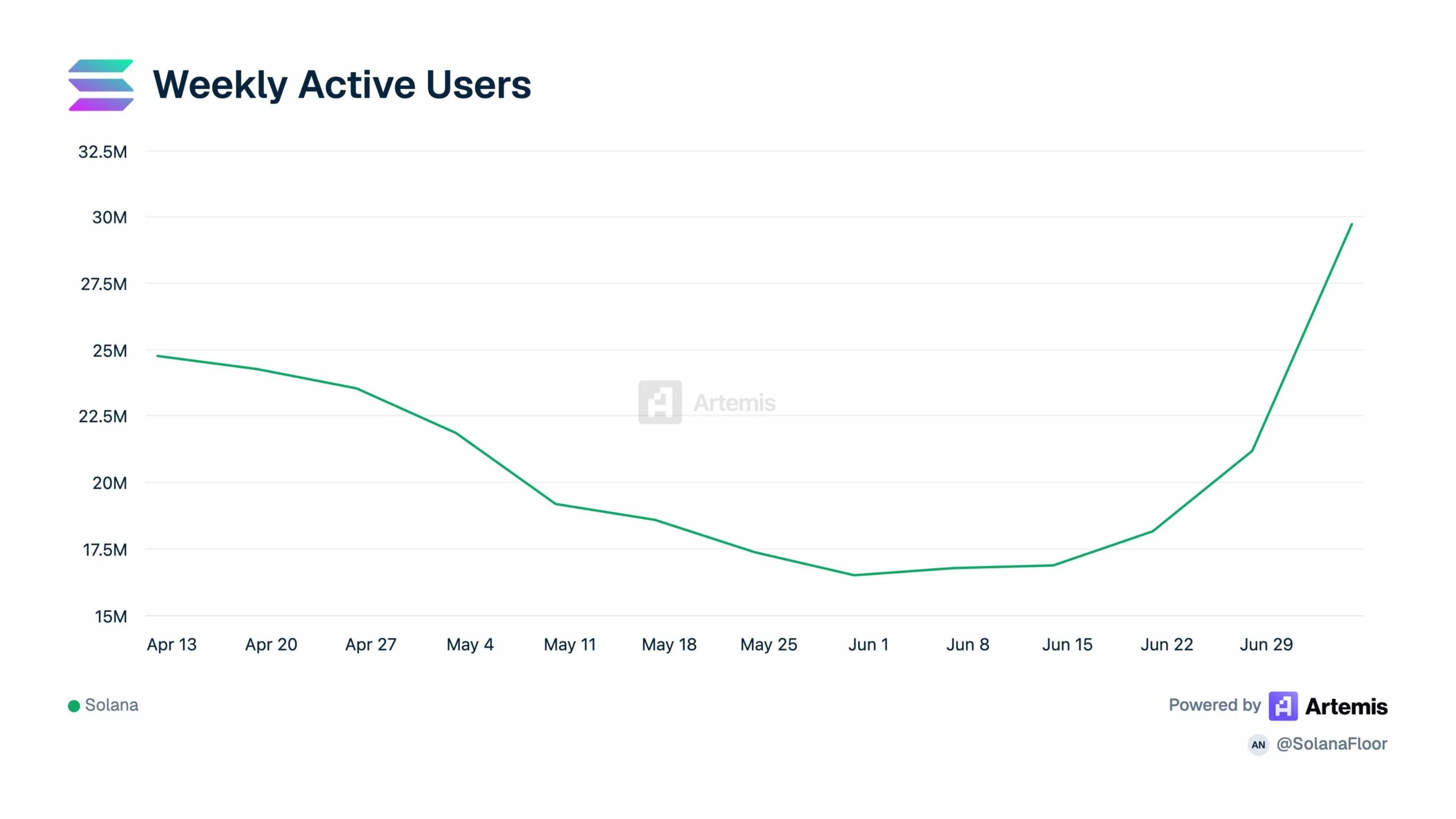
Network participation has accelerated alongside the recovery. According to Artemis data, Solana’s weekly active addresses climbed from 16.8 million to 29.7 million in just two weeks, an increase of roughly 12.9 million wallets, or about 76.8%. The rebound followed slower activity during June as users returned to decentralized applications across the network.
Separate ecosystem rankings also kept Solana at the top of several blockchain activity metrics. The network led all Layer 1 and Layer 2 chains in both 24-hour and seven-day decentralized application revenue while also recording the highest decentralized exchange trading volume over those periods. Polygon, Ethereum, Base, BNB Chain and Hyperliquid followed behind across the tracked categories.
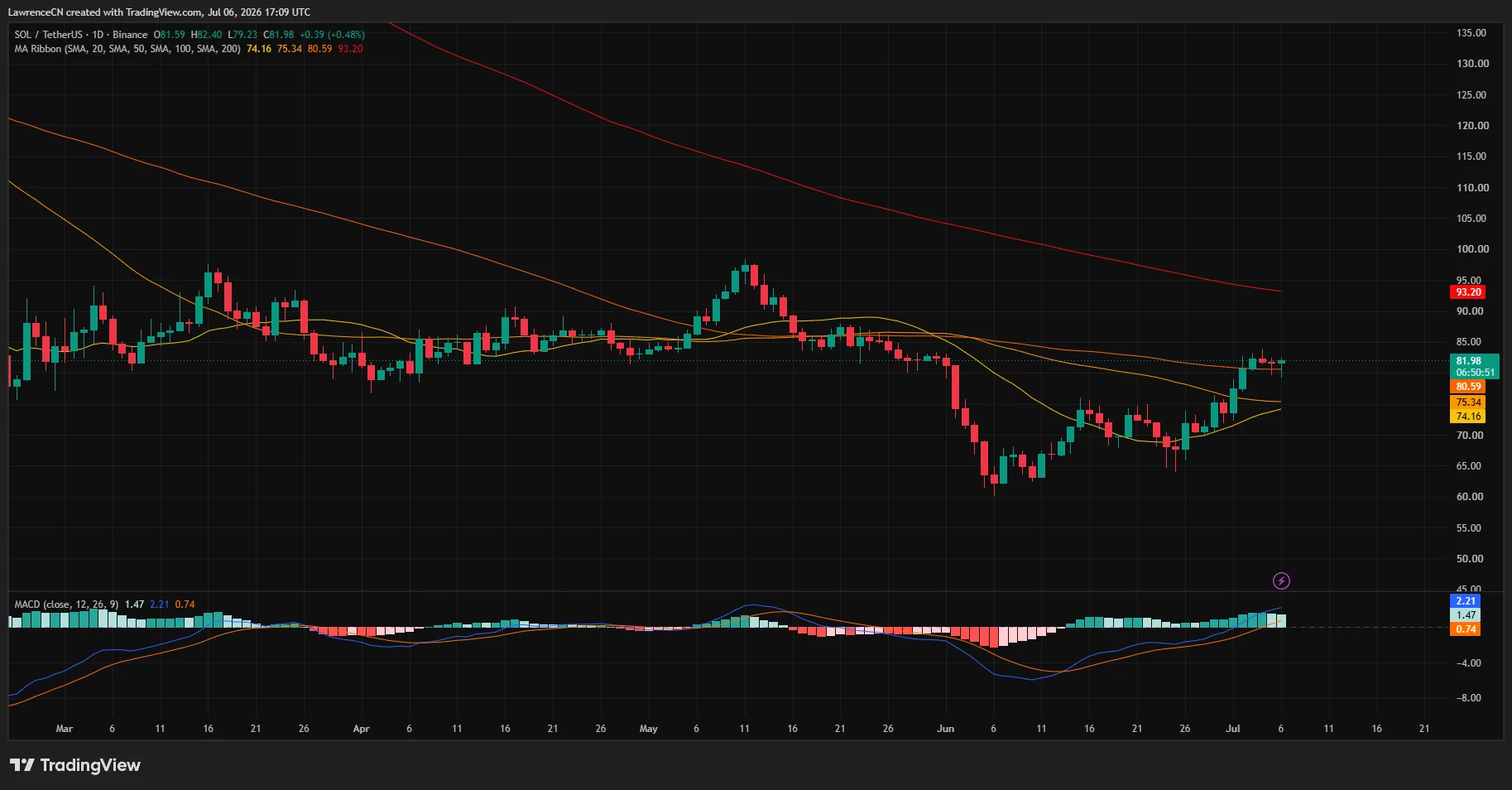
Price action continues to support the improving network data. On the daily chart, Solana remains above its 20-day, 50-day and 100-day moving averages, while the MACD indicator is still in bullish territory despite momentum easing after last week’s rally.
On the 4-hour chart, the Supertrend indicator continues to hold below price near $78.30, and Chaikin Money Flow has stayed slightly above zero, indicating modest buying pressure.
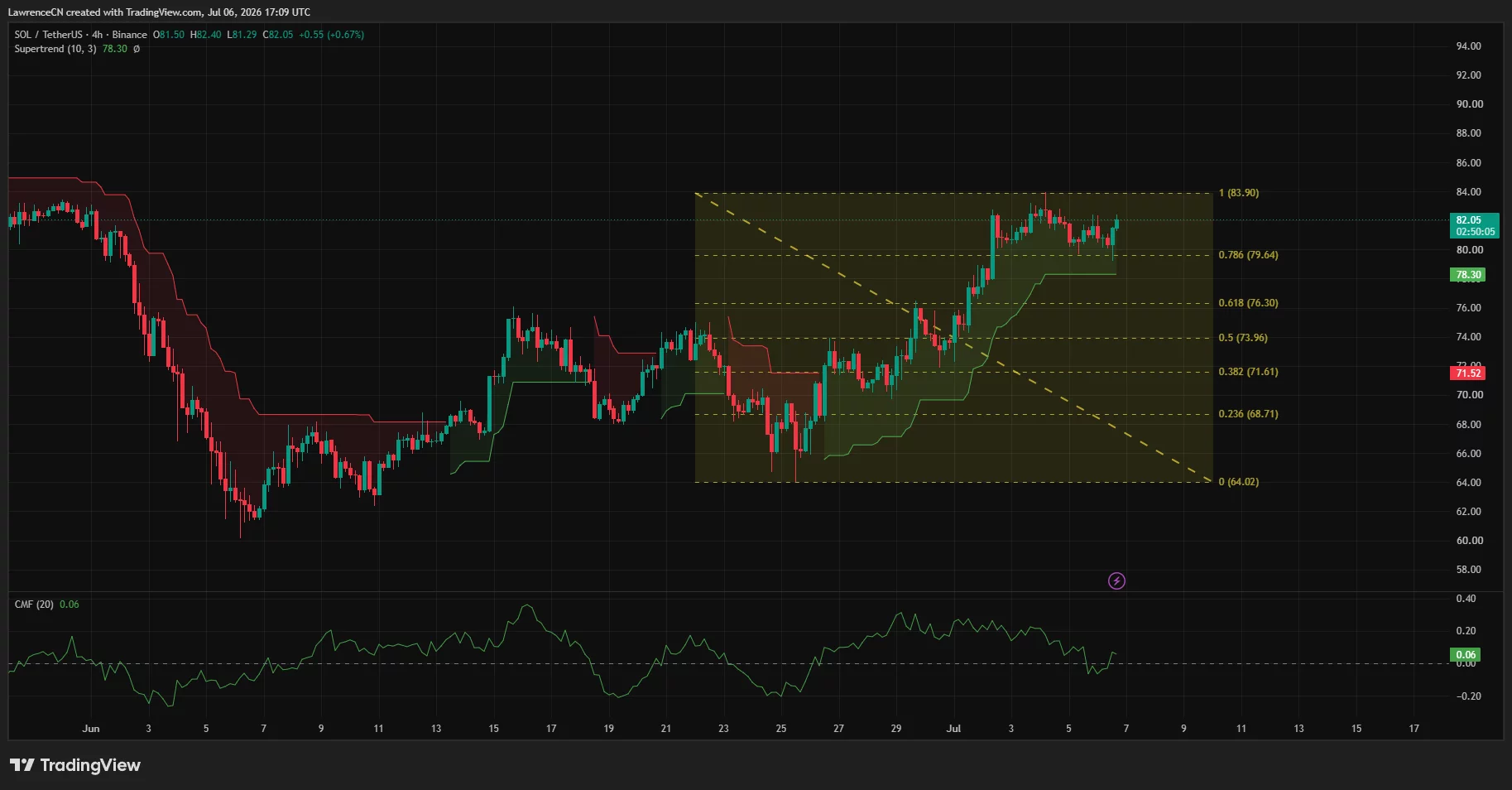
The latest consolidation has left immediate resistance around the recent high near $84, while the Supertrend level near $78 and the Fibonacci support around $76 remain the first areas buyers may need to defend if selling pressure returns. Together with steady ETF inflows and rising network activity, those technical levels suggest Solana’s recovery remains intact unless those support zones give way.
Disclosure: This article does not represent investment advice. The content and materials featured on this page are for educational purposes only.


US President Donald Trump says he got involved in crypto “for politics” and became pro-crypto after seeing how much money the industry was making.
At a press conference in the Oval Office on Monday to announce “Trump Accounts,” an investment account for children under 18, Trump was asked whether the accounts would allow for Bitcoin (BTC).
“I’ve become a big crypto guy only for one reason: If we don’t have it, China’s going to have it,” Trump answered. “I’m a fan, I wasn’t initially, I didn’t know much about it, but, for some of my first term, I wasn’t much involved, and I watched it grow, and it’s a huge industry.”
“I got involved in it a little bit for politics,” Trump added. “I realized there are a lot of people that love crypto.”
The comments shed new light on why Trump pivoted his stance towards crypto. In his first term, Trump said he was “not a fan” of crypto and called Bitcoin “a scam.” Since then, he and his family have built deep business interests in crypto, and Trump has faced criticism for his pro-crypto stance while being connected to the industry.
“As a businessman, I see a lot of money starting to come in with Bitcoin and, you know, the different forms, and I said: ‘This thing’s got a lot of life,’ and then I hear China was going to make a heavy move on it,” he added. “If we didn’t do it, China would do it.”
Trump’s pro-crypto pivot attracted the help of the crypto lobby, which spent around $170 million in the 2024 election to help elect mostly Republicans, and is set to spend even more backing pro-crypto candidates in the November midterms.

Donald Trump speaks to reporters about “Trump Accounts” at the White House on Monday. Source: YouTube
Trump says he doesn’t talk to family about crypto interests
Trump said he doesn’t talk to his family about their involvement in crypto, an area that made him more than $1.4 billion last year, according to financial disclosures released June 30.
Trump and his sons are listed as co-founders of World Liberty Financial, a crypto platform that generated a large portion of Trump’s crypto-related income last year, but the president said his interest in crypto is “not a question of a personal thing.”
Related: Donald Trump says ‘nothing wrong’ with $1.4B crypto windfall while in office
“I let my kids do whatever the hell they do. I don’t talk to them, ever, talk to them about it,” Trump said.
Trump claimed that the Biden administration “dropped all investigations” related to crypto when he “went very pro-crypto.”
However, under the Trump administration, the Securities and Exchange Commission stopped multiple investigations and withdrew or settled enforcement actions filed against crypto companies, some of which had donated to Trump.
“Every time I see a crypto guy where they dropped an investigation, I said: ‘You’re lucky I’m president,” Trump said.
Magazine: SBF will never get a pardon, Trump peace deal boosts Bitcoin: Hodlers Digest


The United Nations Development Programme has expanded its partnership with the Stellar Development Foundation after blockchain payment pilots cut aid distribution costs from 10% to 2% and kept payments running during network outages.
Summary
- UNDP has expanded its Stellar partnership after blockchain pilots lowered aid payment costs and improved payment resilience.
- Syria’s pilot cut distribution costs from 10% to 2%, while Haiti maintained payments during a cellular outage.
- Recent MoneyGram and DTCC partnerships have strengthened Stellar’s role in payments and tokenized assets.
The United Nations Development Programme announced Monday that it has signed a new agreement with the Stellar Development Foundation (SDF) following 16 months of blockchain payment pilots across multiple countries.
According to UNDP, the agreement creates a framework for its country offices to use blockchain-based payments across more development programs after testing the technology in Haiti, Syria, Kenya, Guatemala, and The Gambia, with additional projects completed in Colombia and Papua New Guinea.
During the pilot phase, UNDP reported measurable operational improvements. In Syria, a Cash for Work program that recorded payments onchain reduced distribution costs from 10% to 2%.
In Haiti, another pilot continued processing aid payments despite a cellular network outage, showing that the system could keep operating even when conventional communications infrastructure was disrupted.
According to UNDP, the agency will now move from country-specific trials toward a standardized process that allows local offices to deploy blockchain payments where appropriate. The organization said the initiative is intended to improve the delivery of financial assistance while supporting development programs in regions with limited banking access.
Why is UNDP increasing its use of blockchain?
Alongside the payment expansion, UNDP has continued building internal expertise around blockchain technology. Last month, the agency launched a Blockchain Advisory Group during the Proof of Talk conference in Paris to guide future blockchain adoption across its development work.
According to UNDP, the group will examine applications beyond digital payments, including digital public infrastructure and public service modernization.
The latest agreement comes as blockchain payment networks, particularly those using stablecoins, continue gaining attention for cross-border transfers and remittances in markets where banking services remain difficult to access. International organizations and private companies have increasingly explored blockchain as an alternative settlement rail that can reduce costs and improve payment speed.
Speaking at the World Economic Forum annual meeting in January, former UN under-secretary-general Vera Songwe said digital payment systems have become increasingly important for developing economies.
Songwe told attendees that stablecoins are becoming “more important than aid” in some countries because they provide financial access where traditional banking services remain unavailable. She added that around 650 million people in Africa do not have bank accounts but can still access digital financial services through smartphones.
How is Stellar strengthening its payments network?
The UNDP agreement adds to a series of recent developments that have expanded Stellar’s presence in financial infrastructure.
Earlier this month, as previously reported by crypto.news, MoneyGram introduced its U.S. dollar stablecoin, MGUSD, on the Stellar blockchain. The token is issued by Bridge, a Stripe-owned company operating under the GENIUS Act framework, while M0 manages the smart contract infrastructure for minting and burning the stablecoin.
MoneyGram said the rollout will begin in the United States before expanding internationally through its network of more than 60 million active customers, with Fireblocks providing custody infrastructure.
Institutional adoption has also continued. In May, the Depository Trust & Clearing Corporation (DTCC) partnered with the Stellar Development Foundation to develop DTC custody asset tokenization services on the Stellar public blockchain.
The partners said the first tokenized assets are scheduled to go live during the first half of 2027, making Stellar part of DTCC’s multi-chain strategy for issuing and settling tokenized real-world assets.

South Korea’s Broadcasting, Media and Communications Review Committee has opened a formal review process involving Polymarket, signaling that regulators are preparing to assess whether the prediction market platform violates local gambling rules. The committee said it will first hear Polymarket’s position before deciding on a corrective request tied to gambling-related concerns.
According to a machine-translated version of the committee’s statement, the regulator chose to “provide an opportunity for Polymarket to submit its opinion to thoroughly verify the legality of Polymarket and the way the service is operated.” The outcome could determine whether additional enforcement steps follow, depending on how regulators view the platform’s operating model under Korean law.
Key takeaways
- South Korea’s media and communications review body will hear Polymarket’s response before deciding on corrective action over alleged gambling concerns.
- The review reframes scrutiny from individual users to the platform’s legality and operating practices.
- South Korea’s National Gambling Control Commission Act gives authorities power to monitor and combat “illegal gaming businesses,” including certain online speculative gambling services.
- Polymarket reports geoblocking restrictions across 33 countries, including major markets such as the US, UK, and several EU states.
Regulators focus on how the platform operates
The committee’s decision to request Polymarket’s input marks a notable shift in how the issue is being handled. Earlier attention in South Korea centered on whether local users had engaged with Polymarket markets in ways that could be considered illegal gambling.
Instead, the committee’s current process targets the platform itself—specifically, whether its service and operations align with South Korean legal standards. That distinction matters for Polymarket and other prediction-market operators because a platform-focused action can affect access, compliance obligations, and how services are structured at a system level, not only how individual participants behave.
South Korea’s National Gambling Control Commission Act defines “illegal gaming business” broadly enough to cover online services that enable speculative gambling, granting regulators authority to monitor and take steps against such activity. In practice, that means regulators are likely to evaluate factors such as user access, the presentation of outcomes, and the nature of what participants can wager or trade.
What the law implies for prediction markets
South Korea’s legal framework distinguishes between individual gambling activity and operating gambling venues. Under the Criminal Act referenced in prior reporting, gambling can be punishable by a fine of up to 10 million won (about $6,500). More severe penalties can apply for habitual gambling, with punishment potentially including up to three years in prison or a fine of up to 20 million won.
Operating a gambling venue for profit carries even heavier penalties, including up to five years in prison or a fine of up to 30 million won. While prediction markets aren’t automatically categorized the same way in every jurisdiction, regulators may still treat certain features—such as speculative participation tied to real-world outcomes—as overlapping with gambling definitions.
For platforms like Polymarket, this creates a compliance challenge: even if a service frames itself as a prediction market, regulators may examine whether the user experience functions like betting. As South Korea’s committee moves to verify “legality” and “the way the service is operated,” the practical question becomes how regulators interpret those features under existing statutes.
Background: earlier probe into local users
The review arrives after an earlier police investigation involving Polymarket users in South Korea. On June 5, the Gangwon Provincial Police launched what local reporting described as the country’s first illegal gambling probe into local Polymarket users, with the request reportedly coming from South Korea’s National Police Agency.
That user-focused investigation set the stage for broader scrutiny. Now, the committee’s plan to hear Polymarket indicates that regulators may seek to connect any alleged gambling concerns to the platform’s design and operating practices—an approach that could lead to corrective measures if the service is deemed noncompliant.
Polymarket says it already restricts access
Polymarket says its restrictions are designed to meet a range of compliance requirements, including sanctions-related rules, local financial regulations, gambling and prediction market laws, anti-money laundering obligations, and Know Your Customer (KYC) procedures.
The company also states that it applies geofencing not only at the country level but within some regions that would otherwise be accessible. Its documentation indicates that Polymarket’s platform is restricted in 33 countries, including the United States, the United Kingdom, France, Germany, Brazil, Singapore, Japan, and Australia. Polymarket’s materials also list additional restricted areas within those accessible jurisdictions, such as parts of Canada and regions in Ukraine.
For investors and users, this matters because regulators often assess whether geoblocking and compliance controls are sufficient—and whether they are implemented consistently. If South Korea concludes that existing restrictions do not adequately prevent gambling-like participation or otherwise violate local rules, Polymarket may face pressure to adjust its service availability, verification steps, or market mechanics.
At the same time, the presence of geoblocking elsewhere does not guarantee freedom from enforcement in a specific country. The committee’s review suggests that South Korea intends to evaluate the legality of Polymarket on its own terms, regardless of how other jurisdictions approach similar platforms.
What to watch next in South Korea
With the committee set to review Polymarket’s response before issuing a final decision, the next key signal will be what arguments the platform presents and how the regulator frames any potential corrective request. Observers should also pay attention to how South Korea’s actions align with its earlier police probe—specifically whether enforcement shifts further toward platform-level restrictions or remains focused on individual compliance.

French authorities have uncovered a $1.8 million crypto fraud involving a fake real estate deal targeting a wealthy couple.
Authorities have also arrested a mother and her son in connection with the fraud after a year-long investigation.
Modus Operandi
According to the authorities, the suspects stole $1.8 million in cryptocurrency through an elaborate yet fraudulent real estate transaction. The mother and son duo were arrested at a rented property in southern France on June 25. Investigators said they targeted a wealthy couple who had listed a $10 million villa for sale in the spring of 2025.
The fraudsters claimed to represent an Italian billionaire and invited the seller to Milan for further negotiations. They made a substantially higher offer than the listed price but asked the seller to prove they owned sufficient crypto assets to cover the $1.8 million in transaction fees.
The suspects gained access to sensitive wallet information, account details, and private keys during a second meeting in Milan. According to the authorities, they requested access to the cryptocurrency wallet under the guise of verifying assets. Unbeknownst to the victim, the fraudsters used hidden cameras to record sensitive information, including the private keys. Once the private keys were compromised, the fraudsters quickly transferred the crypto assets from the wallet.
Prompt Action
The suspects used false identities and frequently moved across the country to throw authorities off their trail and complicate the investigation. They also have prior criminal records related to fraud. However, they denied all allegations against them during questioning. The suspects are scheduled to appear before the Draguignan Criminal Court on September 1 and will likely be charged with organized fraud and inability to account for the source of funds.
Attacks On Cryptocurrency Holders Rising
While this specific case has been classified as a “rip-off” scam rather than violent extortion, it highlights the growing risks faced by cryptocurrency holders and how fraudsters are using real estate fraud to target them. France’s Interior Ministry has recorded 77 crypto-related cases in 2026, including extortion, kidnapping, and unlawful detentions; this is a substantial increase from 45 recorded in 2025.
French Interior Minister Laurent Nuñez called the cases “serious in nature” but reiterated that emergency security measures implemented over the past year are starting to show results. Nuñez added that law enforcement agencies have arrested 200 individuals, while over 724 industry figures have joined France’s immediate identity verification platform.
Disclaimer: This article is provided for informational purposes only. It is not offered or intended to be used as legal, tax, investment, financial, or other advice.
As crypto adoption expands beyond early retail users and into institutional channels—and as agentic AI finance begins to introduce new expectations for “always-on” throughput—Layer-1 blockchains are likely to face a familiar trade-off: delivering more speed and capacity may tempt builders to centralize parts of their systems. Injective CEO Eric Chen warned that this pressure is coming, and that the industry will have to find scaling paths that do not undermine what makes a blockchain a blockchain.
Speaking on Cointelegraph’s Chain Reaction podcast, Chen framed the challenge as an effort to increase performance while protecting the core guarantees users associate with decentralized networks: resilience, credibility, and the absence of a single controller.
Key takeaways
- Scaling demands are increasing as institutional adoption and AI-driven finance push networks toward higher throughput and faster finality.
- Centralization can look like the simplest route to performance, but it also introduces single points of failure.
- Chen argues there are scaling opportunities that improve capacity without necessarily reducing block time.
- The blockchain trilemma remains a practical constraint: improving scalability too aggressively can come at the expense of decentralization or security.
Why speed and capacity could pull chains toward centralization
Chen said the market is effectively asking Layer-1 networks to provide “faster speeds” or “more block space” to support higher transaction volumes. That demand, he suggested, will test whether blockchains can scale in ways that preserve their foundational principles rather than trading them away for efficiency.
In his view, the goal is not to reject performance improvements, but to “find scaling opportunities” that do not compromise the “fundamental pillars” defining decentralized blockchains.
This tension matters because one of crypto’s original selling points was replacing trust in intermediaries with systems that can operate without a central party coordinating transactions. When throughput becomes the top priority, the temptation to consolidate control—whether operationally, infrastructurally, or at the protocol level—tends to rise.
The operational risks of “the easy way out”
Chen cautioned that centralized design is often the fastest engineering solution. He described scenarios in which all users rely on a shared data warehouse or where a small set of entities effectively determine network behavior.
The problem, according to Chen, is that such an architecture can create a single point of failure. If one critical server or decision-making component encounters a fault, it can cascade into broader service outages—potentially stopping the chain’s activity instead of allowing it to continue under independent validation.
For networks that market themselves on resilience and distributed control, that trade-off becomes especially consequential as usage grows and operational dependencies expand.
Injective’s framing: optimize the whole system, not just block time
Chen discussed Injective, which he described as an interoperable Layer-1 blockchain built for DeFi applications. For his team, the focus is on “figuring out ways to optimize the entire chain,” while exploring other scaling routes that do not necessarily require reducing block time.
One such approach he pointed to is what he called “scaling venues.” The basic idea is to create “dedicated zones” and use Layer-2 scaling to route or process high-demand transactions so the most active traffic can still get through without forcing the entire base layer into the most extreme performance configuration.
That distinction is important for investors and users evaluating roadmap narratives: if performance gains come primarily from architectural layering (and traffic management) rather than from concentrating control, the result can be a better match between throughput expectations and decentralization goals—though the actual implementation details determine how much decentralization is retained.
The blockchain trilemma still limits how much can be “optimized at once”
Chen’s comments also echoed the long-standing blockchain trilemma: the ideal network is expected to provide security, decentralization, and scalability, but maximizing all three simultaneously is difficult.
In the classic framing, decentralization means there is no single point of control and many independent parties validate the network. Security means the system is resistant to manipulation, fraud, and attacks. Scalability means the network can handle high transaction volumes quickly.
Chen warned that pushing too hard on scalability can force compromises elsewhere—particularly decentralization. In other words, if a blockchain’s design prioritizes throughput so aggressively that validation participation narrows, performance improvements may arrive alongside reduced network independence, even if the chain appears faster on the surface.
The takeaway is less about whether scalability is achievable and more about what form it takes. A network can increase capacity by adjusting how transactions are processed, how consensus is supported, and how load is managed. But each path tends to impose trade-offs that only become visible under real demand conditions.
Where the tension is heading next
Chen’s warning suggests that the next phase of Layer-1 competition may not be won solely by raw throughput metrics, but by how effectively teams scale while sustaining distributed validation and minimizing systemic dependencies. As institutional adoption and agentic AI finance intensify expectations for capacity, builders—and users—will likely watch closely for whether performance improvements come with a shift toward centralized control, or whether “scaling without compromise” can remain more than a slogan.

Layer-1 blockchains will come under increasing pressure to sacrifice decentralization for speed and efficiency as adoption of the technology grows, according to Injective CEO Eric Chen.
This pressure will come from the need to satisfy users’ desire for faster speeds or more block space for higher throughput, Chen told Cointelegraph’s Chain Reaction podcast on Monday.
“In our mind, it’s essentially about finding scaling opportunities without compromising the fundamental pillars that define what a blockchain is,” he said.
With blockchain adoption accelerating due to institutional adoption and agentic AI finance, this tension is about to be tested on a much larger scale. Part of crypto’s original pitch was to create a “trustless” financial system in which individuals could transact without relying on traditional intermediaries.
Centralization comes with risks
Chen said centralizing is the easy way out — “it might be a very, very easy choice to move everyone in the same data warehouse, or literally have a leader validator that calls all the shots for everyone” — but warned this creates a single point of failure: “If that one server has a certain fault, the entire chain goes down.”
Related: DAOs may need to ditch decentralization to court institutions

Eric Chen chats with Ciaran Lyons on the Chain Reaction. Source: Cointelegraph
Chen added that for Injective — an interoperable layer-1 blockchain designed for DeFi applications — it’s about “figuring out ways to optimize the entire chain,” and there are other opportunities to do this without reducing block time.
One option he suggested was “scaling venues,” where there are “dedicated zones” and layer-2 scaling to ensure that all the high-demand transactions can make it through.
“It’s always a constant tug-of-war, and it’s about keeping the fundamental pillars and then kind of seeing where the space moves.”
The blockchain trilemma remains a challenge
It is said the perfect blockchain boasts three elements: security, decentralization and scalability. The principle of the blockchain trilemma is that it is only possible to fully optimize two of the three properties at once.
Decentralization means no single point of control, with many independent participants validating the network. Security means resistance to attacks, fraud and manipulation. Scalability means the ability to handle high transaction volumes at speed.
Pushing too hard on any one, such as scalability, will result in sacrificing another, such as decentralization, Chen said.
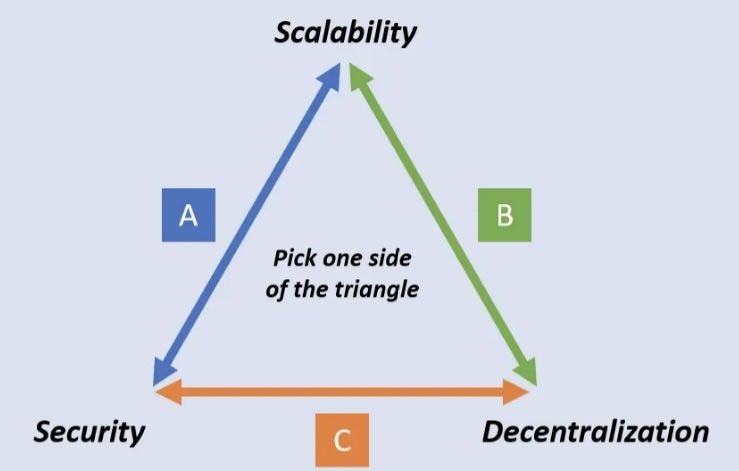
The blockchain trilemma. Source: OKX
Magazine: AI is banking the unbanked in Africa… faster than crypto


Binance has added spot trading for Strategy’s STRC perpetual preferred stock after the Bitcoin treasury firm sold 3,588 BTC for $216 million and increased its USD reserves to $2.55 billion.
Summary
- Binance has launched spot trading for Strategy’s STRC preferred stock alongside several new stock listings.
- Strategy sold 3,588 BTC for $216 million to fund Digital Credit dividends while retaining 843,775 BTC.
- STRC and MSTR climbed in premarket trading as Bitcoin held near $62,900 after a recent rebound.
According to an official announcement published on July 6, Binance Stocks has listed Strategy’s STRC perpetual preferred stock for spot trading, allowing users to trade the security through the exchange’s stock platform. The listing extends Binance’s lineup of tokenized stock offerings and follows the recent launch of perpetual futures linked to the same security.
New Stock Listing
Trade: ANTA, CBRS, DISK, FOTO, KMEM, QNT and STRC 24/5 access. $0 commission, low platform fees and 7,000+ stocks to choose from
Exchange the World, one market at a time.
Read more 👉 https://t.co/SqdKFYwjf0 pic.twitter.com/Hws1zxYCl1
— Binance (@binance) July 6, 2026
The exchange said fully paid securities lending (FPSL) will become available once stock trades are fully settled. Binance stated that the addition is intended to offer users more trading choices on Binance Stocks.
Alongside STRC, the platform also listed Adapti Inc. (ADTI), Antalpha Platform Holding Co. (ANTA), Astronics Corp Class B (ATROB), Cerebras Systems (CBRS), Tema Memory ETF (DISK), Tuttle Capital Pure Play Photonics ETF (FOTO), PLUS Korea Defense Industry Index ETF (KDEF), Kurv Memory Select ETF (KMEM), and Quantinuum Inc. (QNT).
Strategy continues raising capital for its Bitcoin treasury
The listing comes as Strategy continues using its preferred securities to finance its Bitcoin acquisition strategy. According to a Strategy press release issued on July 6, the company sold 3,588 Bitcoin for $216 million to fund dividend payments tied to its Digital Credit securities rather than to reduce its long-term Bitcoin exposure.
Executive Chairman Michael Saylor said on X that Strategy now holds 843,775 BTC alongside $2.55 billion in U.S. dollar reserves following the transaction. The company described the sale as part of its funding plan for dividend obligations linked to its credit products.
Earlier this year, Strategy also sold 32 BTC to support preferred stock distributions. As previously reported by crypto.news, that transaction was relatively small but attracted attention because the company has consistently promoted a long-term Bitcoin accumulation strategy. The latest sale is considerably larger, making it more closely watched by market participants given Strategy’s position as the world’s largest publicly traded corporate Bitcoin holder.
STRC and MSTR extend gains before the opening bell
Trading activity has remained positive for Strategy’s securities despite the recent Bitcoin sale. STRC closed 0.47% higher at $87.87 in the previous session after climbing nearly 22% last week. Premarket data on Monday showed the preferred stock rising almost 2% to $89.57, although it continued trading below its $100 par value.
The recent strength follows Strategy’s decision to raise its USD reserve balance to $2.55 billion, announce a buyback program for MSTR shares, and increase the annual dividend on STRC to 12%, developments cited by the original market report as supporting investor demand.
Meanwhile, MSTR shares gained more than 3% in premarket trading to $104.35 after advancing 21% over the previous week.
In the crypto market, Bitcoin gave back part of its earlier rally as traders booked profits following the recent rebound. The cryptocurrency was trading near $62,900 at the time of the report, while 24-hour trading volume had increased by 23%, indicating higher market activity as investors monitored both Strategy’s capital actions and the company’s continued use of preferred securities to fund its Bitcoin treasury.
Bitcoin (BTC) fell to $61,391 after Strategy confirmed a large Bitcoin selloff, then rebounded to a high of $64,529.61 in under 24 hours, and the recovery seems to be holding into Wednesday’s Federal Reserve minutes.
Options traders and exchange-traded fund flows are both turning bullish, adding to signs the bounce has more support than the initial squeeze suggested.
Options Traders Bet on Higher Prices Into the Fed Minutes
Bitcoin’s broader options market is running call heavy, with open interest split 60.15% calls to 39.85% puts across all expiries, per CoinGlass data. Deribit’s max pain gauge for near-term expiries, including July 8, sits around $63,000.
The July 8 expiry is one of the smaller dates on the board, dwarfed by open interest stacked up for July 31 and later months, leaving more room for a Fed-minutes surprise to move price.
The minutes cover the Federal Reserve’s June 16 to 17 meeting, the first led by new Fed Chair Kevin Warsh, who held rates at 3.50% to 3.75% for a fourth straight hold. Warsh’s tone came in more hawkish than expected. The Fed dropped its easing bias, and nine of 18 officials projected a rate hike later in 2026.
ETF Flows Show Early Signs of Stabilizing
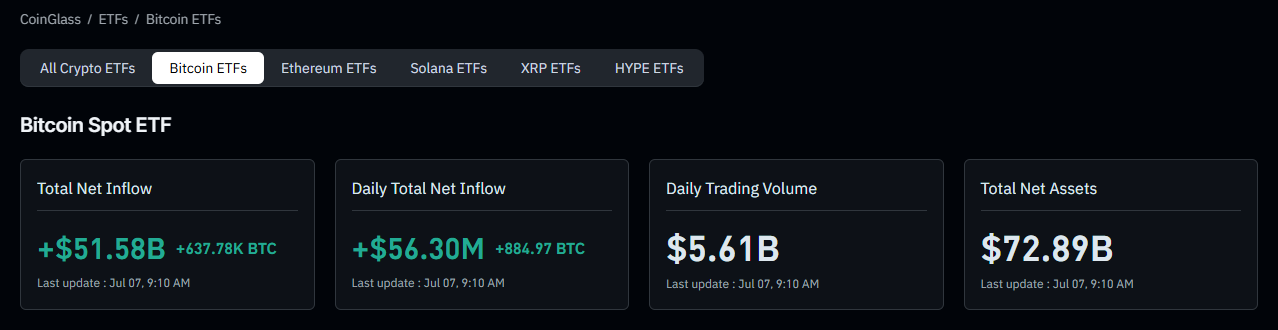
Even after the selloff by Strategy, Spot Bitcoin ETFs added $56.3 million, or 884.97 BTC, on July 6, per CoinGlass data. That extends the rebound from the 10-day outflow streak that ended July 2 with a $222 million inflow.

Total net assets across US spot Bitcoin ETFs stood at $72.89 billion, with cumulative net inflows since the 2024 launch reaching $51.58 billion, or 637,780 BTC, per CoinGlass data.
The Sale That Started the Dip
Strategy confirmed selling 3,588 BTC for $216 million to fund dividends on its Digital Credit securities, exceeding an earlier 491 BTC rumor sevenfold. The company still holds 843,775 BTC, the largest corporate Bitcoin treasury in the world.
Whether Bitcoin holds above $64,000 may depend less on Strategy’s next move than on how traders read Wednesday’s Fed minutes and whether ETF inflows keep pace.
The post Bitcoin Rebounds to $64,000 After Strategy Selloff as Options and ETFs Turn Bullish appeared first on BeInCrypto.


SpaceX has been scheduled to enter the Nasdaq-100 Index on July 7, a move that JPMorgan estimates could generate about $4.3 billion in automatic buying from passive investment funds.
Summary
- SpaceX is set to join the Nasdaq-100 on July 7, with JPMorgan estimating $4.3 billion in passive fund buying.
- Index-tracking ETFs and mutual funds are expected to buy SpaceX shares automatically during the benchmark’s rebalancing.
- Investors are also watching SpaceX’s Bitcoin holdings, ARK Invest’s purchases, and its recent $25 billion bond sale.
According to a Nasdaq announcement, SpaceX will join the Nasdaq-100 before the market opens on July 7 after becoming eligible under updated index rules that allow some of the largest newly listed companies to qualify after just 15 trading days.
The accelerated inclusion follows the company’s June 12 public market debut and places it among the benchmark’s constituents with an index weighting expected to remain below 1%.
Passive index funds are expected to drive billions in demand
JPMorgan estimates that exchange-traded funds and index funds tracking the Nasdaq-100 will need to purchase roughly $4.3 billion worth of SpaceX shares once the company joins the index.
The largest of those vehicles, including the Invesco QQQ Trust, must rebalance their portfolios to match the updated benchmark regardless of their view on the company’s valuation or future earnings.
Most of that buying activity is expected to take place around the July 6 market close and the July 7 opening as index-tracking portfolios complete their scheduled rebalancing. The purchases are mechanical rather than discretionary because passive funds are required to mirror the index composition.
The planned addition drew attention across financial and crypto markets after DogeDesigner highlighted the inclusion on X while citing JPMorgan’s estimate of approximately $4.3 billion in passive inflows. Nasdaq separately confirmed the upcoming index change in its official release.
SpaceX’s inclusion follows changes to Nasdaq’s eligibility framework that allow certain top-ranked companies to qualify more quickly after listing. The revision enabled the aerospace company to bypass the longer waiting period that many newly public firms previously faced.
Bitcoin exposure adds another layer to investor interest
Trading in SpaceX shares has remained volatile since the IPO. After retreating by more than 18% from earlier highs, the stock has recovered to around $158 in recent sessions as investors continue to assess its valuation following the public debut.
Buying activity from institutional investors has also attracted attention. Cathie Wood’s ARK Invest has accumulated tens of thousands of SpaceX shares while simultaneously adding to positions in crypto-related companies including Coinbase, Circle, and Robinhood. The purchases suggest ARK has continued to treat the post-IPO weakness as a buying opportunity despite elevated volatility.
Not all developments have been viewed positively. Market participants have closely watched SpaceX’s recent $25 billion bond offering, with some analysts warning that large debt sales can temporarily pressure equity sentiment even when the underlying business remains financially strong.
Another factor distinguishing SpaceX from most Nasdaq-100 constituents is its digital asset treasury. The company reportedly holds 18,712 Bitcoin on its balance sheet, making it one of the few index members with direct exposure to the cryptocurrency. Some equity analysts have cited that Bitcoin position as one factor supporting a $190 price target on the stock ahead of its Nasdaq-100 debut.
For crypto investors, the upcoming index inclusion could also increase institutional exposure to companies holding Bitcoin as a treasury asset. Market observers have compared the dynamic to previous index additions involving companies with large Bitcoin reserves, where passive fund inflows increased the visibility of corporate crypto holdings even though the purchases were tied to index rebalancing rather than direct investment in digital assets.


Robinhood shares have climbed more than 2% after the Trump administration officially launched the Trump Accounts savings program, even as the broader crypto market turned lower.
Summary
- Robinhood gained over 2% as the Trump Accounts program officially launched.
- Wall Street firms kept Buy ratings and lifted Robinhood price targets.
- Trump hinted Bitcoin could join the program in the future, but not yet.
The White House officially launched the Trump Accounts initiative on Monday with a ceremony attended by President Donald Trump, who rang the opening bells at both the Nasdaq and the New York Stock Exchange. The program has also gone live on Robinhood’s platform, with the brokerage and BNY Mellon serving as the U.S. Treasury’s official partners for the rollout.
Robinhood traded near $114 following the announcement, gaining over 2% on the day and extending its five-day advance to more than 13%, according to data from Yahoo Finance. The move stood out against weakness across digital assets, with Bitcoin slipping below $62,000 during the same session.
Wall Street keeps raising expectations for Robinhood
The Trump Accounts launch arrives as Wall Street analysts continue to grow more optimistic about Robinhood’s long-term outlook despite the stock’s recent rally.
As previously reported by crypto.news, Piper Sandler reaffirmed its Buy rating on Robinhood and maintained a $135 price target, indicating the firm believes additional upside remains. BTIG also reiterated its Buy rating while keeping a $125 target price.
Meanwhile, Mizuho increased its price target to $130 from $115 while maintaining a Buy rating, making it one of the latest brokerages to lift expectations for the online trading platform.
The Trump Accounts program provides a federally funded $1,000 starting contribution for eligible children born between 2025 and 2028. Families can make additional contributions over time, creating long-term investment accounts designed to grow alongside the beneficiaries.
Speaking during the White House ceremony, Michael Dell said that he and Susan Dell are contributing $6.25 billion for 25 eligible American children through the initiative. The launch also coincides with celebrations surrounding the 250th anniversary of the United States.
Bitcoin remains outside the program despite crypto support
Although President Trump has repeatedly expressed support for digital assets, cryptocurrencies are not currently included in the Trump Accounts program.
During the launch event, Trump indicated that future changes remain possible. Asked whether Bitcoin could eventually become part of the accounts, the president replied, “Something could happen.” He also reiterated that he is a supporter of cryptocurrencies and repeated his goal of making the United States the global crypto capital.
Not everyone welcomed the program. Economist and longtime Bitcoin critic Peter Schiff argued in a post on X that the government-funded contributions are financed through additional federal borrowing rather than new revenue.
According to Schiff, each $1,000 contribution effectively comes with additional public debt, meaning the same children receiving the benefit will also inherit part of that debt burden in the future. He added that reducing government spending would be a better policy than expanding borrowing to finance the initiative.
The criticism follows Schiff’s recent comments on Strategy’s reported $216 million Bitcoin sale, where he argued the company exited part of its holdings at a loss. While the Trump Accounts program currently focuses on traditional investment savings, Trump’s latest remarks suggest the administration has not ruled out adding digital assets at a later stage if policy develops in that direction.

Someone Finally Walked Off Financial Audit

Rio Ferdinand’s reaction to FIFA rescinding Folarin Balogun’s red card was nauseating. The one-time Man United legend has reduced himself to a Gianni Infantino shill – and this should be the nail in the coffin for his punditry career

Sensex rises over 150 points, Nifty above 24,450 as market extends gains for the 5th consecutive day


-

 Fashion3 days ago
Weekend Open Thread: High Hopes
-

 Politics4 days ago
The House | “Reframing the debate from a binary discussion of winners and losers”: Yuan Yang reviews ‘We Are Not Machines’
-

 Fashion12 hours ago
Open Thread: What Great Books Have You Read Recently?
-
 NewsBeat2 days ago
Taylor Swift and Travis Kelce wedding staffer hilariously struggles to keep her cool while checking in megastars
-

 News Videos7 days ago
How to Build INSANE Live Financial Dashboards With Claude
-
 Crypto World6 days ago
Airdrop Registration Becomes Key Focus For Remittix As RTX Launch Updates Approach
-

 Sports6 days ago
Broncos roster: OL Ben Powers (No. 74) entering final year of contract
-

 Crypto World5 days ago
Binance stock trading tops $1B in first month after launch
-

 NewsBeat6 days ago
Presenter Caroline Flack’s brother Paul Flack dies aged 55
-

 Crypto World5 days ago
Alibaba-affiliate Ant Group enters the humanoid robot market with 12 deals
-

 Crypto World3 days ago
Standard Chartered Secures MiCA License as ESMA Adds 37 New Crypto Firms
-

 Crypto World2 days ago
South Africa proposes crypto tax guidance under existing rules
-

 News Videos13 hours ago
Best Time to Enter Small Caps Right Now? Another Bull Run? | Financially Free
-

 Business5 days ago
Meta Platforms Stock Jumps 7% Today as Bloomberg Reports Company Plans to Enter the Cloud Business
-
 NewsBeat5 days ago
New exhibition reflects five decades of movement between island of Ireland and GB
-

 Tech2 days ago
Lenovo laptops are now shipping with YMTC SSDs, a sign of Chinese NAND entering the mainstream
-

 Business4 days ago
What a 10 Percent Drop Means for Buyers, Sellers and Renters
-

 News Videos15 hours ago
Avoid entering in FOMO #bitcoin #cryptocurrency #trading #scalping
-

 Crypto World4 days ago
Binance Re-Enters Philippines As EU MiCA Rules Restrict Access
-

 Crypto World4 days ago
Alibaba bans Claude Code over alleged backdoor security concerns
You must be logged in to post a comment Login