
Crypto World
French Authorities Bust $1.8 Million Fraud Involving Crypto Assets


French authorities have uncovered a $1.8 million crypto fraud involving a fake real estate deal targeting a wealthy couple.
Authorities have also arrested a mother and her son in connection with the fraud after a year-long investigation.
Modus Operandi
According to the authorities, the suspects stole $1.8 million in cryptocurrency through an elaborate yet fraudulent real estate transaction. The mother and son duo were arrested at a rented property in southern France on June 25. Investigators said they targeted a wealthy couple who had listed a $10 million villa for sale in the spring of 2025.
The fraudsters claimed to represent an Italian billionaire and invited the seller to Milan for further negotiations. They made a substantially higher offer than the listed price but asked the seller to prove they owned sufficient crypto assets to cover the $1.8 million in transaction fees.
The suspects gained access to sensitive wallet information, account details, and private keys during a second meeting in Milan. According to the authorities, they requested access to the cryptocurrency wallet under the guise of verifying assets. Unbeknownst to the victim, the fraudsters used hidden cameras to record sensitive information, including the private keys. Once the private keys were compromised, the fraudsters quickly transferred the crypto assets from the wallet.
Prompt Action
The suspects used false identities and frequently moved across the country to throw authorities off their trail and complicate the investigation. They also have prior criminal records related to fraud. However, they denied all allegations against them during questioning. The suspects are scheduled to appear before the Draguignan Criminal Court on September 1 and will likely be charged with organized fraud and inability to account for the source of funds.
Attacks On Cryptocurrency Holders Rising
While this specific case has been classified as a “rip-off” scam rather than violent extortion, it highlights the growing risks faced by cryptocurrency holders and how fraudsters are using real estate fraud to target them. France’s Interior Ministry has recorded 77 crypto-related cases in 2026, including extortion, kidnapping, and unlawful detentions; this is a substantial increase from 45 recorded in 2025.
French Interior Minister Laurent Nuñez called the cases “serious in nature” but reiterated that emergency security measures implemented over the past year are starting to show results. Nuñez added that law enforcement agencies have arrested 200 individuals, while over 724 industry figures have joined France’s immediate identity verification platform.
Disclaimer: This article is provided for informational purposes only. It is not offered or intended to be used as legal, tax, investment, financial, or other advice.

Michael Saylor says the $5 billion Bitcoin sale story that tore across X (Twitter) this weekend was never news at all. Every dollar of it, he says, was made public a month ago.
The claim spread fast. MicroStrategy (now Strategy) had just won approval to sell up to $5 billion in Bitcoin (BTC), the posts said. Saylor called it old news in a new wrapper.
Where the $5 Billion Number Came From
MicroStrategy announced a new capital plan on June 29, 2026. Inside it sits a BTC Monetization Program. The program lets the company sell Bitcoin. It never makes it.
The plan set four spending limits.
- $1.25 billion to rebuild its cash reserve
- $1 billion to buy back preferred shares
- $1 billion to buy back common stock
- About $1.76 billion a year in dividend and interest bills
Add them up and you get $5.01 billion. That is the viral number. It went public five weeks ago.
Why did the cash reserve need rebuilding? It had shrunk to $871 million by May 25. MicroStrategy had just spent $1.38 billion of cash clearing debt.
BeInCrypto covered the shift toward active management when the plan landed.
The Never Sell Rule That Never Existed
So why did anyone think MicroStrategy would never sell?
Because Saylor said so. He posted “Never sell your Bitcoin” in February 2025. Followers treated the line as law.
The company had already moved on. Chief Executive Phong Le said on May 26 that selling Bitcoin was part of the toolkit. He said investors heard it on the first quarter earnings call.
That was five weeks before June 29. MicroStrategy’s first sale since 2022 came days later, to cover a dividend.
Saylor now separates his own advice from company policy.
Follow us on X to get the latest news as it happens
We have never had a “never sell” policy. The program does not require any BTC sale, and we expect to remain a net buyer of Bitcoin over time.
Watcher Guru, the account behind the viral post, has since deleted it.
What the Numbers Actually Show
Timing is the whole fight. MicroStrategy reported an $8.22 billion loss on July 30. Almost all of it was on paper. Bitcoin fell, so the value of its stack fell too.
Calling a June decision a reaction to a July loss gets the order backwards.
The trading says plenty. MicroStrategy bought 85,296 Bitcoin between April and June. It sold 1,395. That is 61 bought for every one sold. The stack still grew 11% to 846,000 BTC.
Sales this year hit $218.4 million by July 26. All of it paid dividends. That is 0.4% of a stack worth $54.8 billion.
Selling is picking up, though. Roughly $135 million of that came in July alone. That beats the whole second quarter. MicroStrategy has also paused its Bitcoin purchases for five weeks.
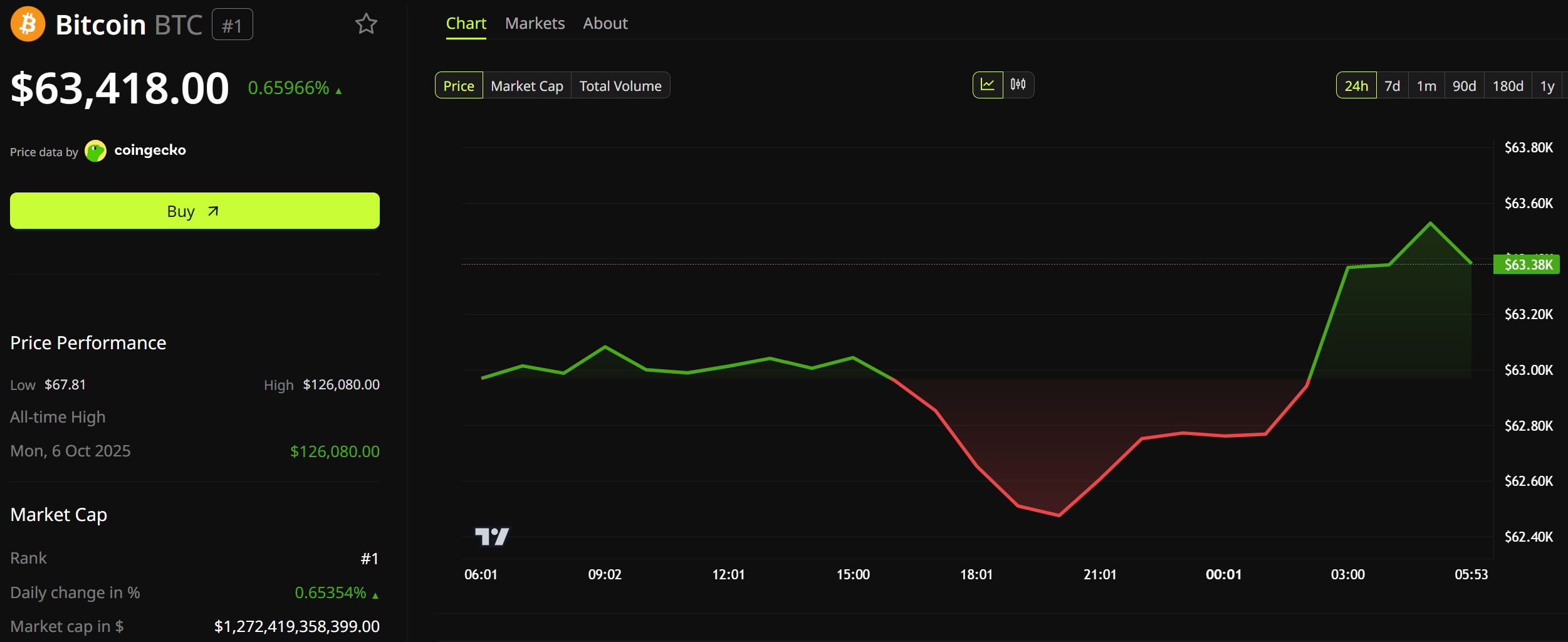
Bitcoin traded near $63,378 on Sunday, about half its October record. Staying a net buyer now rests on cheap money, not belief.

The post Michael Saylor Shuts Down Viral $5 Billion MicroStrategy Bitcoin Sale Claims appeared first on BeInCrypto.


A crypto industry-aligned political action committee has pushed its spending above $2 million in Michigan’s 13th Congressional District, according to final-week Federal Election Commission disclosures.
Summary
- Protect Progress spending surpassed $2 million backing Thanedar and opposing McKinney before Tuesday’s primary vote.
- $884,240 in new advertisements supported Thanedar, while more than $150,000 targeted McKinney with opposition messaging.
- August 4 voters will decide the Democratic nominee after over one million Michiganders voted early.
Protect Progress is supporting Democratic incumbent Shri Thanedar and opposing challenger Donavan McKinney before the Aug. 4 primary.
Protect Progress is affiliated with the Fairshake network, which has received major funding from companies including Coinbase and Ripple. The latest filings added $884,240 in media supporting Thanedar and more than $150,000 in spending against McKinney. The additions effectively doubled the amount reported about a week earlier.
Crypto PAC spending tops $2M before Michigan vote
Protect Progress is registered with the FEC as an active independent expenditure-only committee, commonly called a super PAC. Its spending supports or opposes candidates but does not represent money transferred directly to their campaigns. The latest expenditure notices are available through the committee’s official FEC filings.
The committee’s processed FEC summary may not immediately show every last-minute purchase. The agency states that its independent expenditure table excludes separate 24-hour and 48-hour notices, which committees use to disclose spending close to an election. One of the latest Michigan notices was filed through this FEC disclosure.
The scale is notable beside the candidates’ own finances. McKinney’s campaign reported $1.23 million in total disbursements through July 15. Protect Progress’s outside spending has exceeded that amount, although the figures cover different reporting periods and forms of political activity.
Thanedar’s crypto votes drew industry support
Thanedar voted for the stablecoin-focused GENIUS Act and the Digital Asset Market Clarity Act in the House. In an official statement, he described the measures as steps toward clearer rules, consumer safeguards and wider financial access, while acknowledging that the bills were “not perfect.”
The House-approved CLARITY Act remains under consideration in the Senate. Protect Progress has not stated in its FEC notices that any specific vote caused its spending decision. However, the committee generally supports candidates viewed as favorable toward digital asset legislation.
As previously reported, Protect Progress had disclosed more than $986,000 in Michigan spending by July 23. The latest filings pushed the total above $2 million during the final two weeks of the primary.
McKinney makes the spending a campaign issue
McKinney has used the outside funding to criticize Thanedar’s crypto policy record. In a July 21 statement, he alleged that “the crypto lobby is paying my opponent back” for votes that benefited President Donald Trump’s digital asset interests.
That statement represents a campaign allegation. FEC records confirm that Protect Progress paid for independent advertisements, but they do not establish McKinney’s claimed motive or demonstrate coordination with Thanedar’s campaign. Federal rules require super PAC expenditures to remain independent of supported candidates.
The Michigan spending forms part of a broader national strategy by Fairshake and its affiliates. Public Citizen estimated that crypto companies had supplied about $189 million during the 2026 election cycle, with Fairshake-linked groups accounting for more than $82 million in expenditures. Those totals represent the watchdog’s analysis rather than an FEC finding that every dollar came from one industry source.
Aug. 4 result will test the spending strategy
Michigan voters will choose the Democratic nominee on Tuesday, Aug. 4. More than 1.03 million residents had voted by the morning of July 31, according to the Michigan Department of State. Statewide early voting continued through Aug. 2, with some jurisdictions offering voting on Aug. 3. Completed absentee ballots must arrive by 8 p.m. on election day.
The result will offer a near-term test of whether Protect Progress’s final advertising surge helped Thanedar. However, it will not prove that PAC spending alone determined the outcome because turnout, candidate organizations and local concerns also shape congressional elections.
Additional FEC notices or amendments may appear after voting ends. The official canvass will confirm the nominee, while later campaign-finance reports should provide a fuller account of the committee’s total Michigan spending. No verified crypto market reaction has been tied to the race.
Trump Media & Technology Group, the company behind Truth Social, has made another major move involving its Bitcoin holdings, extending a series of recent sales.
The company sold 2,628 Bitcoin (BTC) worth about $165 million through transfers to Crypto.com, blockchain analytics platform Lookonchain said in a Sunday X post, citing data from Arkham.
Lookonchain said Trump Media bought 11,542 BTC at an average price of $118,522 before beginning to sell portions of its holdings seven months ago.
The Bitcoin sales come as Trump-linked crypto ventures face broader scrutiny, with lawmakers debating the Digital Asset Market Clarity (CLARITY) Act and questions around ethics and digital asset ownership.
Trump Media’s Bitcoin holdings shrink 63%
The latest transfers bring Trump Media’s total reported Bitcoin sales over the past seven months to 7,281 BTC, worth about $545 million, according to Lookonchain’s analysis, which calculated an average selling price of $74,855 per BTC.
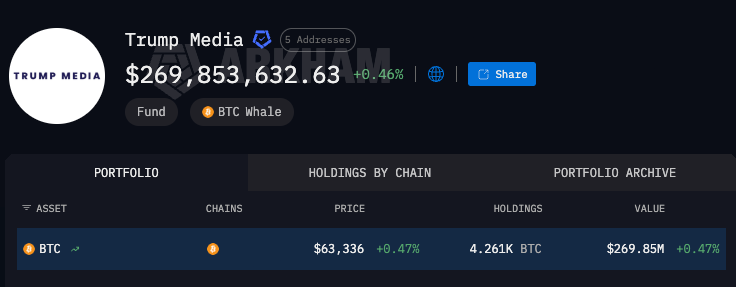
According to Arkham, the company’s remaining Bitcoin holdings stood at 4,261 BTC at publishing time, worth $269.8 million.
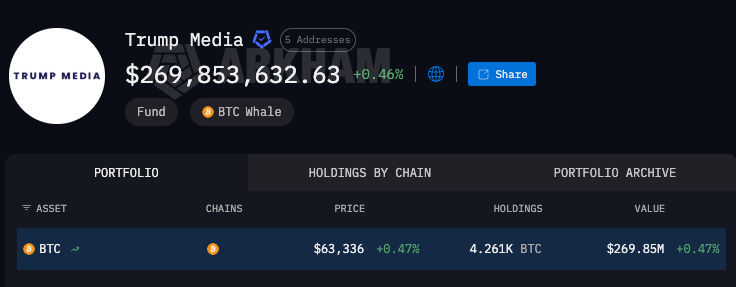
Source: Arkham
Arkham’s wallet data showed two recent transfers from Trump Media-linked wallets to Crypto.com, including one transaction of 2,429 BTC and another of 198.9 BTC.
The latest transfers follow two earlier Bitcoin movements to Crypto.com recorded on May 22, when Trump Media-linked wallets transferred a combined 2,650 BTC worth about $205 million.
Trump-linked crypto interests face ethics scrutiny
The Bitcoin sales come as lawmakers debate the CLARITY Act, which has drawn scrutiny over ethics rules, digital asset ownership and potential conflicts of interest involving public officials, including concerns raised by critics about US President Donald Trump’s crypto ventures.
Critics have pointed to Trump-linked crypto ventures, including the Official Trump (TRUMP) and Melania (MELANIA) memecoins, as well as World Liberty Financial’s WLFI governance token and USD1 stablecoin, in discussions over the overlap between political influence and private crypto interests.
Related: Senator Schumer proposes agency to address corruption, including Trump’s crypto ventures
Recent CLARITY Act discussions have focused on tightening ethics provisions, including rules around officials issuing or sponsoring digital assets, but the legislation remains under consideration and does not require companies to sell existing crypto holdings.
Magazine: Here’s why the CLARITY Act’s ethics deal may be so hard to reach


At least $676 million in crypto moved from an unlicensed Dubai exchange onto Binance since May 2024, Reuters reported. Investigators say the exchange, Shelbit, sits at the center of an Iranian sanctions evasion network.
About $540 million of that moved after Dubai regulators cracked down on Shelbit in January 2025. Binance says it cannot match that number.
The Warning That Changed Nothing
Rich Sanders is an independent blockchain researcher who tracks Iran. He said he warned Binance about Shelbit in October 2025.
The money kept coming. Funds moved from Shelbit to Binance after that warning, the data reviewed by Reuters shows.
Binance did not say what it did about the warning. It said Shelbit never held an account and has never been sanctioned.
“When users associated with Shelbit interacted with our platform, our compliance program operated as it should have: it investigated, froze the relevant accounts, and reported them to law enforcement,” Reuters reported, citing Binance.
The exchange also said an outside analytics firm did not flag the flows as risky. It did not name the firm.
That defense meets an awkward record. Binance pleaded guilty in November 2023 to breaking US money-laundering and sanctions laws. It paid $4.3 billion, one of the largest corporate penalties in US history.
Prosecutors found something specific. Binance had let more than $898 million in trades pass between US and Iranian users. Those trades ran from January 2018 to May 2022.
The deal came with conditions. Binance had to hire an independent compliance monitor for three years.
Shelbit started up about six months into that term. Its cooperation with US investigators has since become a point of dispute.
Watches, an Empty Office and $4 Billion
Shelbit has no website. There is no visible way for the public to trade on it.
Its listed Dubai address sits behind a locked door. The sign reads “Velorix Watches Trading LLC.” That firm belongs to Shelbit’s founder, Siavash Kayvanpour.
A Reuters reporter visited the three-room office in early July. Inside were 13 battered watches, a cash-counting machine and three staff. None had heard of Kayvanpour. The watches were not for sale.
Investigators still traced at least $4 billion through Shelbit since May 2024. Roughly $125 million came straight from Iran’s central bank.
Shelbit also dealt with wallets Israel links to Iran’s Islamic Revolutionary Guard Corps (IRGC). Another counterparty was Nobitex, Iran’s biggest exchange.
Washington sanctioned Nobitex in June, using the legal power reserved for terrorist financiers. Treasury said Nobitex handled over half of Iran’s crypto inflows in 2025. It also helped regime insiders reach global exchanges.
Shelbit is accused of the same job, from outside Iran.
Where the Money Starts
The cash begins with gambling. Shelbit’s biggest customers were more than 2,000 Farsi-language betting sites.
Reuters mapped that network with cybersecurity firm Infoblox. Gambling is illegal in Iran and carries prison and lashes. The law was updated in 2023 to cover online betting.
The sites still plug into Iran’s domestic payment system. Iran’s central bank controls that system.
“When it comes to gambling, the IRGC learned the Islamic Republic’s most lucrative lesson early: declare something illegal, then control both the prohibition and the black market,” the report read, citing Miad Maleki, former associate director at the US Office of Foreign Assets Control (OFAC).
Dubai has now acted. A July 24 notice from the Virtual Assets Regulatory Authority (VARA) cites the UAE’s anti-money-laundering and terrorism-financing law. It says Shelbit threatens the integrity of the country’s financial system.
The regulator has moved this way before. It ordered KuCoin to halt operations in March.
What Nobody Has Proven
One big question stays open. Reuters could not establish who inside Iran controlled Shelbit.
It also could not say where most of the crypto ended up. Blockchain records showed the route. They did not show the driver.
Pressure is building anyway. Washington already pushed Binance over Iran in May. OFAC listings this year have triggered stablecoin freezes within hours. Treasury says it is taking the Shelbit claims seriously.
Binance did not immediately respond to BeInCrypto’s request for comment.
The post $676 Million Reached Binance From an Iran-Linked Exchange Dubai Had Already Fined appeared first on BeInCrypto.
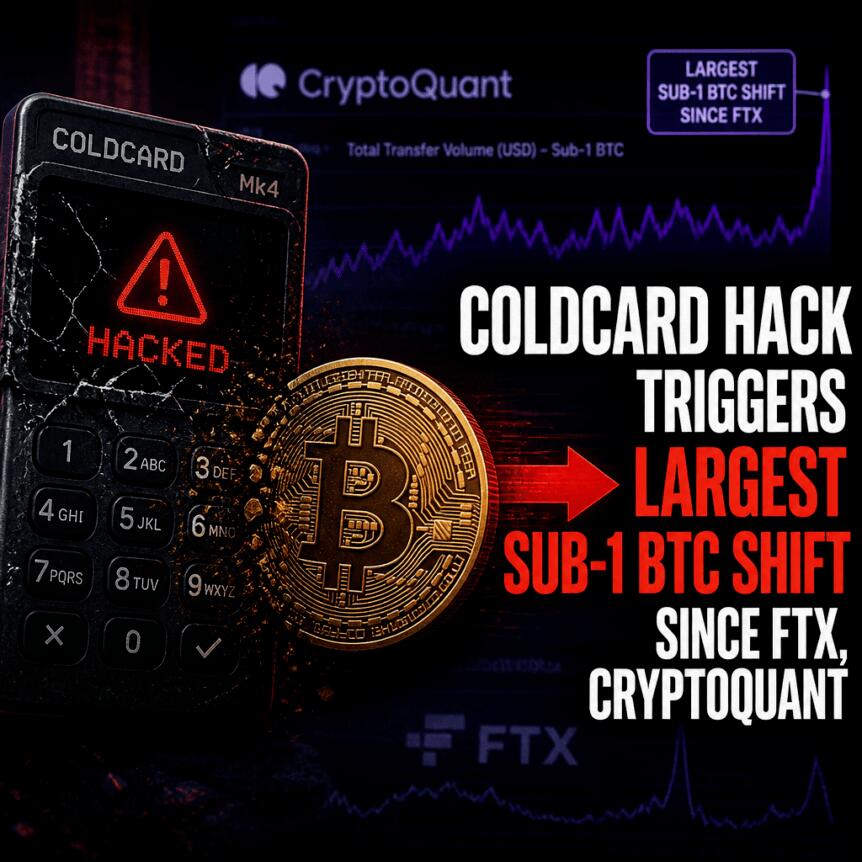
Bitcoin appears to be seeing a renewed pattern of rapid, smaller transfers—an on-chain behavior not observed at similar levels since the immediate aftermath of the FTX collapse. On Friday, transfers below 1 BTC surged to the highest daily level since November 2022, totaling 39,600 BTC, according to research shared by CryptoQuant head of research Julio Moreno on Saturday.
Moreno’s comparison is stark: the figure sat just 300 BTC under the 39,900 BTC moved on Nov. 16, 2022, days after FTX filed for bankruptcy. “The Bitcoin plebs had not moved this amount of BTC in a day since the FTX collapse,” Moreno said, adding that he viewed the uptick as encouraging activity rather than passive exposure.
Key takeaways
- Daily transfers under 1 BTC reached 39,600 BTC, the highest since November 2022, per CryptoQuant’s Julio Moreno.
- Galaxy Research says the suspected Coldcard hack added a further 207.7 BTC drained from victim addresses, pushing estimated losses higher.
- Galaxy reports cumulative figures of 1,367 BTC estimated losses across 4,585 addresses tied to the incident.
- Executives and researchers are using the event to renew debate over whether self-custody is safer than third-party custody.
Smaller transfers spike as users react
Moreno’s data focuses on movement of less than 1 BTC at a time—a slice of network activity often associated with people reallocating funds quickly rather than executing large, institutional transactions. Reaching levels last seen in late 2022 suggests heightened urgency across segments of the market.
The timing aligns with an ongoing suspected Coldcard hack, which first came into view in late July. As new victims were reportedly identified, the incident has increasingly framed itself as a stress test for how quickly users can respond when self-custody systems are believed to generate compromised receiving addresses.
Galaxy Research tracks additional drained funds
While on-chain movement is one signal, Galaxy Research says the theft itself has continued in identifiable stages. In a report posted Saturday, Galaxy Research said it observed an additional attack wave that drained 207.7 BTC—worth about $13.2 million at the time of reporting.
With that update, Galaxy Research estimated total losses at 1,367 BTC (about $88.6 million), across 4,585 addresses. The firm’s tracking also indicates the attackers’ activity is not a one-off event, but an evolving process with multiple waves that continue to surface as investigators connect addresses to victims.
Galaxy Research’s post also referenced the continuing discovery of new addresses tied to the suspected scheme, reinforcing the idea that the full scope may still be expanding as researchers refine their identification methods.
Attack still ongoing, warning to move funds
Alex Thorn, head of firmwide research at Galaxy Digital, warned in an X post on Sunday that the attack was still ongoing. Thorn urged users to move funds from Coldcard-generated addresses immediately if they had not already done so.
Thorn said his team continued to identify both victim addresses and attacker addresses. He also added that reports from users were helping investigators and authorities track the stolen funds—highlighting the role of community reporting alongside on-chain analysis.
The repeated “ongoing” language matters for users because it suggests the situation is dynamic: even if some victims have already moved funds, more affected addresses may still be discovered. That is also consistent with the broader pattern reflected in the day’s spike in small transfers.
Self-custody debate resurfaces
The suspected Coldcard hack has renewed debate over the safety and practicality of Bitcoin self-custody—one of the sector’s foundational principles that allows users to control funds without depending on centralized intermediaries.
Nick Neuman, CEO of Bitcoin security company Casa, pushed back against claims that self-custody is “over.” Neuman argued that self-custody’s distributed nature provides users with time to react once suspicious activity becomes apparent. He also said he “estimated” that potentially 10 times more Bitcoin was protected through self-custody than was stolen and identified so far in the attack.
The exchange also drew responses from people more aligned with traditional finance. Eric Balchunas, a senior ETF analyst at Bloomberg, argued on X that Bitcoin ETFs may offer a safer and more convenient route for many investors, citing the longer operating history of the ETF industry.
Not everyone agreed with that framing. Other observers suggested the incident should be viewed as a failure attributable to a wallet provider rather than as evidence that self-custody as a concept is fundamentally broken—an important distinction for readers assessing risk.
In practical terms, the disagreement reflects two realities that can coexist: individual wallet implementations can fail, while self-custody still reduces reliance on centralized exchanges. The Coldcard case, as described through public tracking, becomes a test of how resilient users are when compromised address generation is detected and when timely migration is possible.
What investors should watch next
Watch for two signals in the coming days: whether the number of newly identified victim addresses continues to grow (which would imply the blast radius is still being uncovered), and whether the elevated level of small transfers under 1 BTC sustains or fades as affected users complete migration. The more those patterns stabilize, the clearer it will become whether the incident is trending toward containment or still expanding.
An analyst argues XRP could help Japan escape its yen carry-trade trap without triggering a disorderly global sell-off, though the proposal faces substantial practical obstacles.
The idea targets liquidity efficiency rather than debt, and that distinction matters enormously.
The Prefunding Problem XRP Claims It Could Solve
The yen carry trade involves borrowing cheap yen to fund higher-yielding assets abroad.
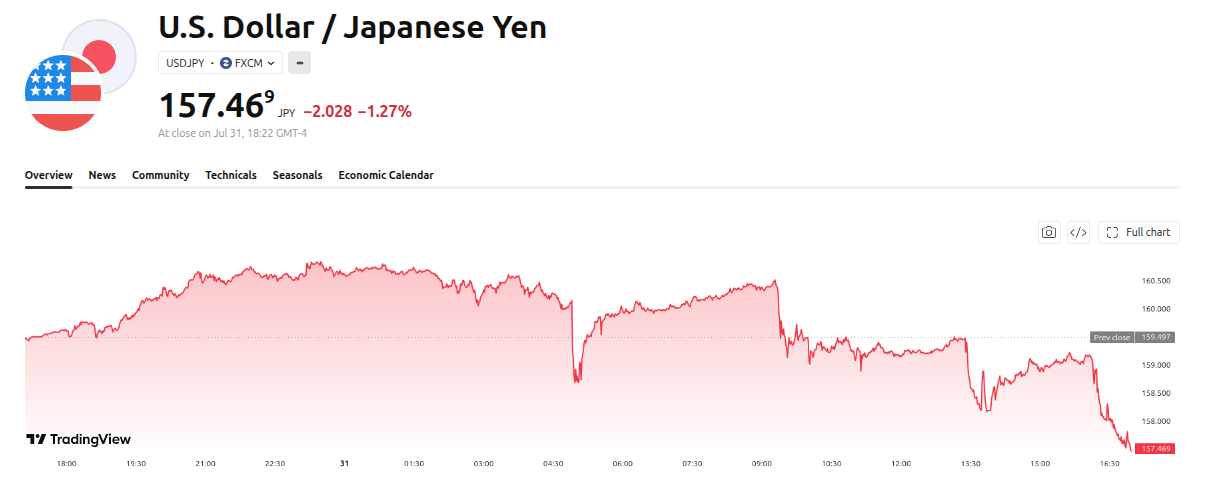
Years of ultra-low rates pushed the currency toward multi-decade lows near 157 against the dollar.
Both governments recently intervened. Washington bought yen for the first time in nearly 30 years, joining the Bank of Japan to stabilize the currency.
The underlying dilemma persists. Japan must either tolerate a weaker yen or risk destabilizing its enormous bond market through aggressive rate hikes or forced capital repatriation.
Follow us on X to get the latest news as it happens.
Crypto analyst EGRAG CRYPTO outlined an alternative in a detailed thread. His argument centers on payment infrastructure, not monetary policy.
The starting point is prefunding. Japanese institutions park capital in foreign currencies across correspondent banks to ensure payments clear, immobilizing capital that could support the domestic economy.
XRP would function as a neutral bridge asset. A payment moves yen into XRP, crosses the ledger in seconds at near-zero cost, then converts into the destination currency, or reverses for repatriation.
Finality arrives in three to five seconds. That speed sharply reduces counterparty risk, settlement delays, and the need to keep permanent foreign balances idle abroad.
The proposed benefit follows logically. On-demand liquidity, rather than permanent prefunding, would allow Japanese banks and corporations to retain more capital in yen.
“…XRP cannot eliminate the interest-rate differential that created this incentive. However, it could help reduce a different source of structural yen weakness: the need for Japanese institutions to maintain large foreign-currency balances for international settlement…,” EGRAG CRYPTO said on X.
Export revenues, investment income, and remittances could be converted back faster and more cheaply. That continuous settlement flow might gradually support the currency without liquidating hundreds of billions in Treasuries.
Is the XRP Proposal Actually Viable?
Freed working capital could also help. Domestic capacity to absorb Japanese government bonds would improve as the Bank of Japan steps back from its bond-buying program.
The analyst limits his own expectations, and reasonably so. XRP would serve as a transactional bridge, not a reserve currency or legal tender, with exposure lasting only seconds.
“Its contribution would be infrastructural. XRP could improve how money moves, how quickly transactions settle and how efficiently institutions use liquidity. That could give Japan more room to manage its monetary transition. But technology cannot substitute for economic policy…,” the crypto analyst noted.

That framing sidesteps the harder question. Prefunding is a symptom of Japan’s imbalances, not its cause, and faster settlement does nothing to close the interest-rate gap that drives capital abroad.
The technical claims themselves hold up. The XRP Ledger’s speed and cost advantages are documented. Whether that inefficiency matters at this scale is another question.
Japan’s carry trade involves trillions in cross-border positions, while prefunded balances represent a far smaller slice.
The list of prerequisites grows quickly. Deep XRP-to-yen liquidity, clear regulation, licensed providers, custody solutions, and banking integration would all need to arrive first.
None of that exists today. No large-scale Japanese integration is underway, and XRP’s volatility sits awkwardly alongside the stability such flows demand.

Central bank interest offers thin support. The Bank of Japan has explored tokenized settlement through Agorá, but never endorsed XRP, and its research points toward central bank infrastructure instead.
What Comes Next for the Yen?
Washington told several banks to stand ready for further action. Japan’s top currency diplomat said the support went beyond psychological backing, while South Korean authorities reportedly sold dollars alongside Tokyo. The Bank of Japan held short-term rates at 1% on Friday, as expected.
Policymakers warned underlying inflation could exceed the target, signaling further hikes without committing to timing.
Traders now watch one level closely. SBI FX Trade advisor Yuji Saito said the key question is whether authorities keep pushing until the dollar breaks below 155 yen.
Commerzbank expects roughly semiannual hikes, placing the next move around December.
Markets currently price that path, though stronger data could pull it forward.
Subscribe to our YouTube channel to watch leaders and journalists provide expert insights.
Coming sessions will hinge on intervention risk and Fed expectations rather than settlement technology.
Thin liquidity amplifies every move, and even the possibility of official buying keeps traders defensive.
The post Analyst Claims XRP Could Ease Japan’s Yen Crisis: Is It Realistic? appeared first on BeInCrypto.

July was a very eventful month for the company behind XRP, and we will explore some of the major developments, such as growing the stablecoin business, institutional infrastructure, and the XRP Ledger ecosystem, which saw a major milestone that included AI agents.
This article will focus primarily on Ripple, not the native token or its price moves. If you are more interested in XRP, then you should check this article.
RLUSD Enters New Markets
Although this was technically announced at the end of June, it became a major news story in early July. Ripple expanded the reach of its dollar-pegged stablecoin RLUSD by becoming one of the first partners to integrate OpenUSD. It said that the move reinforces the team’s commitment to multichain infrastructure supporting institutional adoption across the entire crypto industry.
In addition, Japan’s Financial Services Agency (JFSA) approved RLUSD for use in the country through SBI VC Trade. The two developments marked another step in what Ripple has been trying to do for years: to position RLUSD as a regulated stablecoin for global payments and tokenized finance.
The company joined the 4th of July celebrations in the United States by highlighting the Giving4th campaign. It donated RLUSD to nonprofits as part of its broader effort to showcase real-world stablecoin utility.
Earlier this week, one of the execs behind the stablecoin at Ripple noted that RLUSD had launched on the four largest exchanges in South Korea – Upbit, Bithumb, Korbit, and Coinone.
The asset continues to grow in terms of usage and market capitalization, with the latter reaching $1.6 billion on August 1.
Expanding Enterprise Infrastructure
The company also introduced a platform designed to help financial institutions issue, manage, and redeem RLUSD more effectively, called Ripple Mint. The launch complements its growing payments ecosystem and reflects the firm’s increasing focus on serving banks, fintech firms, and enterprise clients entering the cryptocurrency space.
Separately, Ripple announced a strategic investment in Notabene, a company specializing in compliance and payment infrastructure. The collaboration aims to improve regulated cross-border payments while supporting broader adoption of Ripple’s stablecoin.
Once again in July, Binance extended support for RLUSD by providing new promotions for the asset and increasing its visibility across the platform.
AI Activity Rises on the XRPL
Data provided by on-chain analytics resources indicated on July 22 that the XRP Ledger had surpassed 1.4 million transactions initiated by AI agents. According to analysts and experts, this highlights the growing experimentation with autonomous applications and machine-to-machine payments.
Although the sector remains in its early stages, the milestone demonstrates that developers are increasingly exploring the XRPL for use cases beyond traditional payments and token transfers.
The post July’s Biggest Ripple (XRP) Stories: RLUSD Expansion, AI, and Institutional Adoption appeared first on CryptoPotato.
Galaxy Research raised its estimate of Bitcoin drained from addresses linked to the Coldcard firmware flaw to 1,367.05 BTC, worth about $88.6 million, on Aug. 1.
Summary
- 1,367.05 BTC was drained across 4,585 addresses in three suspected Coldcard attack waves, Galaxy reported.
- July 30’s first wave removed 1,082.65 BTC from 1,196 addresses in just 41 minutes total.
- Firmware updates fix new seed generation but cannot repair vulnerable seeds created on earlier releases.
The research unit identified 4,585 affected addresses across three suspected attack waves, replacing its earlier estimate of 1,082.65 BTC from 1,196 addresses.
The revised figure means the $70.2 million estimate reported after Galaxy’s first analysis is no longer current. Galaxy described the total as its “estimated observed size,” leaving open the possibility that further transactions could be found. The company has not proved that every address came from a vulnerable Coldcard seed.
Galaxy raises Coldcard estimate after third wave
Galaxy’s first mapped wave occurred between 1:10:20 a.m. and 1:51:26 a.m. UTC on July 30. It traced 1,082.65 BTC from 1,196 addresses across blocks 960,183 through 960,191. The transactions appeared about 30 hours before Coinkite issued its initial public advisory.
A second wave on July 31 drained 76.16 BTC from another 1,478 addresses. Galaxy later identified a third wave that removed 207.7294 BTC from 1,912 addresses. Together, the three groups brought the observed total to 1,367.05 BTC across 4,585 addresses.
The first wave used the same 30 satoshis per virtual byte fee and transactions without change outputs. Those traits helped researchers identify the related movements onchain. Galaxy warned that later attacks might use different patterns, making the complete loss harder to measure.
Three waves used different transaction patterns
Galaxy said the first two waves shared collector addresses, destination types and derivation-path behavior. The events also occurred about 27 hours apart. Those similarities suggested one operator may have conducted both sweeps, although the blockchain cannot establish the attacker’s identity.
The third wave behaved differently. Funds from each victim moved to separate pay-to-witness-script-hash destinations, while several victims were grouped into each sweep transaction. The activity also checked only the default derivation path. Galaxy said it was confident each wave represented one operator, but would not claim that one attacker controlled all three.
Therefore, descriptions of a single hacker remain an inference rather than a confirmed fact. Galaxy called the third group “what we suspect are hacks of Coldcard-generated addresses.” The wording reflects the limits of onchain attribution.
Coinkite said a series of firmware integration errors prevented the intended hardware random-number generator from contributing properly to seed creation. A MicroPython software fallback supplied predictable output after a March 2021 code change. Block’s independent technical report described the same random-number-generator path and said active exploitation was underway.
Coinkite estimated about 40 bits of effective search space for affected Mk2 and Mk3 seeds. Later Mk4, Q and Mk5 models included extra secure-element entropy, but the company estimated roughly 72 bits rather than the intended 128 bits. These figures remain technical estimates and may change as testing continues.
The affected Mk2 and Mk3 range covers firmware 4.0.1 through 4.1.9. Seeds created on Mk4 and Mk5 before standard version 5.6.0, and Q seeds created before version 1.5.0Q, are also affected. Separate fixed Edge releases are available.
Existing seeds require migration, not only updates
Coinkite released hotfixes for every affected model and said it takes “full accountability” for the bug. However, installing new firmware only corrects future seed generation. It cannot add entropy to a recovery phrase that already exists.
The official Coldcard advisory tells users to install the fixed firmware, generate a completely new seed, verify its backup and receiving address, and send a small test transaction before moving the remaining balance. Users should keep the previous backup until the migration is confirmed.
Coinkite said seeds created with at least 50 fair, independent and private dice rolls are not considered exposed by this issue alone. A strong, unique BIP-39 passphrase adds another barrier, but the company still advises migration. Short, reused or predictable passphrases may not provide adequate protection.
However, the 594.48 BTC sweep identified by AnchorWatch’s Rob Hamilton. In related coverage, a later technical review examined how the firmware build error weakened Coldcard seeds for more than five years.
Coinkite’s investigation remains open, and the company has promised a formal technical review. Galaxy may also revise the observed loss again if new address patterns emerge. Until those reviews are complete, $88.6 million is the latest public estimate, not a final confirmed total. No verified Bitcoin price reaction has been attributed to the Coldcard incident so far.
Trump Media has sold another 2,628 Bitcoin (BTC) worth roughly $165 million, deepening losses on a treasury it assembled near record prices.
The disposal arrived as the company switched on Truth API, a paid feed selling institutions faster access to President Donald Trump’s Truth Social posts.
A Treasury Bought High, Sold Low, and Locked the Rest
Lookonchain, an on-chain analytics account that tracks large wallet flows, puts total sales at 7,281 BTC.
Trump Media originally bought 11,542 BTC for about $1.37 billion, averaging $118,522 a coin.
The company’s own quarterly filing supports that entry price. It listed 9,542.16 BTC against a $1.13 billion cost basis on March 31, plus 2,000 BTC pledged against options.
Those exits have averaged $74,855, far below cost. Lookonchain estimates the combined realized and paper shortfall at roughly $555 million.
What remains is not free to move. The same filing shows 4,260.73 BTC pledged against convertible notes, with restrictions lifting no later than maturity on May 29, 2028. That block closely matches the balance Lookonchain implies is left.
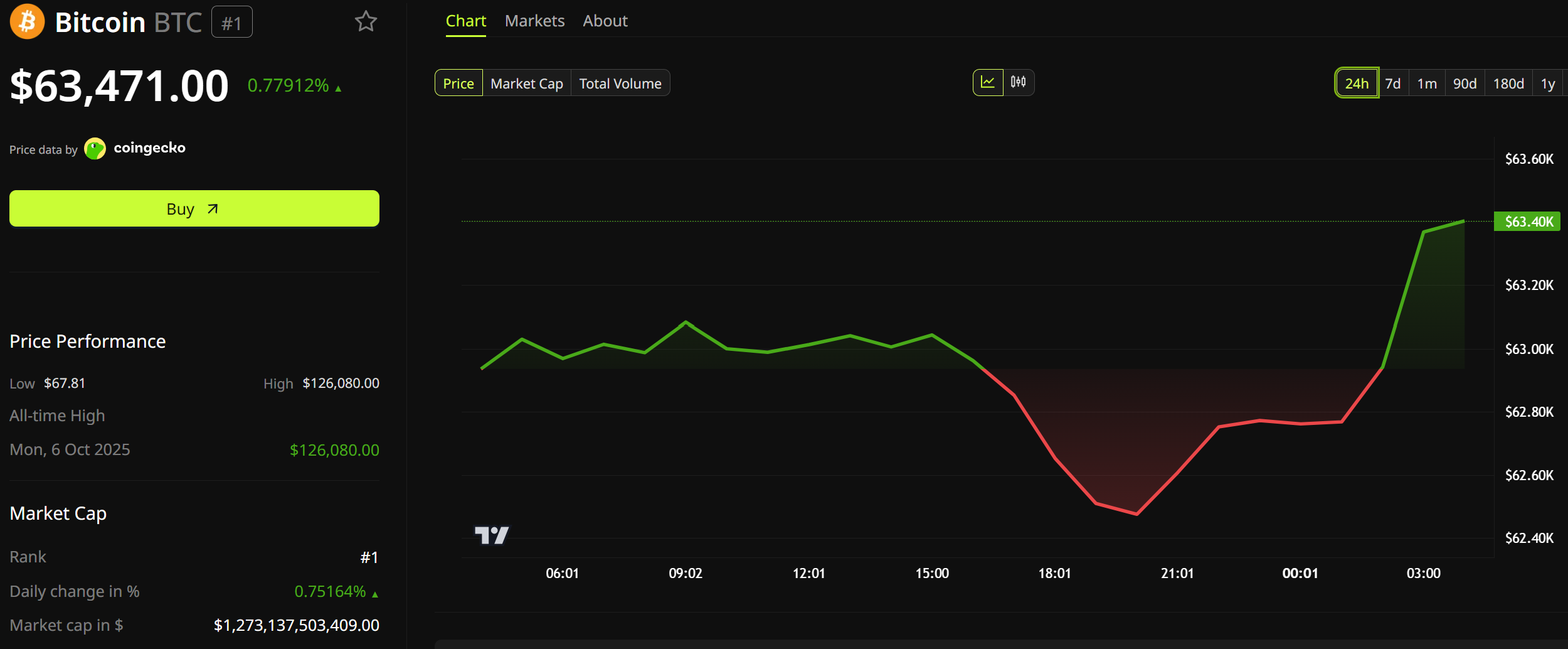
Meanwhile, Bitcoin trades near $63,471, roughly half its October 2025 record of $126,080.

A $243.96 million mark-to-market hit on digital assets helped drive a $405.9 million quarterly net loss, the same math that has soured corporate Bitcoin bets elsewhere.
Truth API Turns Presidential Posts Into Revenue
Truth API opened to institutional customers on August 1 as the company’s first data licensing product.
Reported pricing reaches $100,000 a month, falling to $60,000 under a three-year commitment.
Follow us on X to get the latest news as it happens
Scale explains the appeal. Trump Media booked $871,200 of revenue in the first quarter, up 6% from a year earlier.
One subscription at list price would generate $1.2 million a year.
“Markets already move on Truth Social posts… Truth API delivers a direct, licensed, real-time feed of the platform’s most market-moving Truths,” Kevin McGurn, Interim Chief Executive Officer of Trump Media, in the company’s release.
The feed covers the 10 highest ranking Truth Social accounts and delivers posts in milliseconds.
Those posts already carry weight. In July, Trump’s statement that the memorandum of understanding with Iran had collapsed sent Bitcoin sharply lower within minutes.
Warren and Schiff Want an SEC Investigation
Senators Elizabeth Warren and Adam Schiff wrote to Securities and Exchange Commission (SEC) Chair Paul Atkins on July 28.
They asked for an immediate probe into whether the product breaks securities law.
“This appears to be an outrageous abuse of the President’s office for his personal benefit that undermines everyday investors and the integrity of our markets,” Warren and Schiff, in their letter to the SEC.
The senators put Trump’s stake at about 41%. They cited his June 10 post praising Citigroup by ticker at the opening bell, after which the bank outperformed a falling market.
That request now sits with an agency led by a Trump appointee.
For now, the Trump family crypto empire is monetizing political proximity faster than it can exit a Bitcoin position it is no longer free to sell.
The post Trump Media Sells More Bitcoin as Truth Social Plans Subscription Fees appeared first on BeInCrypto.


Russia will extend its regional crypto mining ban to Moscow, the Moscow Region and parts of Kursk Region from Aug. 15, 2026.
Summary
- August 15 restrictions cover Moscow, Moscow Region and nine designated territories within Russia’s Kursk Region.
- Resolution 936 bars cryptocurrency mining and mining-pool participation through December 31, 2032, citing grid risks.
- Mining demand already totals one gigawatt in Moscow’s power system, according to regional energy officials.
The prohibition will remain in force through Dec. 31, 2032, under Government Resolution No. 936.
Prime Minister Mikhail Mishustin signed the measure on July 25. The government published it on the official legal information portal on July 31. It amends Resolution No. 1869, the December 2024 order that established territorial mining restrictions.
Russia crypto mining ban covers mining pools
The decree prohibits digital currency mining and participation in mining pools across Moscow and the entire Moscow Region. In Kursk, it applies to the Belovsky, Bolshesoldatsky, Glushkovsky, Korenevsky, Lgovsky, Rylsky, Sudzhansky and Khomutovsky municipal districts, plus the city of Lgov.
The measure expands a regional list rather than creating a nationwide mining ban. Resolution No. 936 adds Moscow, Moscow Region and the designated Kursk territories as entries 14 through 16 in the existing restriction order.
Power capacity concerns drove the expansion
The Energy Ministry’s explanatory material warned that operating without a year-round restriction could create “risks of a shortage of power capacity” as energy-intensive mining facilities connect to regional grids. Moscow Region energy authorities had requested the ban before the government adopted it.
Regional officials estimated that mining consumes about one gigawatt within the Moscow power system. Meanwhile, data-center capacity in Moscow and the surrounding region could reach 3.6 gigawatts by 2032, equal to 17% of the system’s maximum load, according to figures reported by Interfax. The 2032 figure remains an official projection rather than measured current demand.
Kursk officials sought restrictions in eight districts and Lgov amid concerns about pressure on local electricity infrastructure. The final decree adopted the same locations included in the earlier government proposal.
Russia has widened regional restrictions since 2025
The new order extends a policy that followed Russia’s legalization of cryptocurrency mining in 2024. Authorities subsequently introduced regional restrictions to manage electricity shortages and seasonal demand.
Existing rules cover several North Caucasus republics and other territories through March 15, 2031. The government also imposed year-round restrictions across parts of Buryatia and Zabaykalsky Krai from April 1, 2026. The Russian Energy Ministry said those restrictions cover 20 areas of Buryatia and 31 areas of Zabaykalsky Krai.
As previously reported, a Russian power-industry commission supported the Moscow and Kursk proposal in May. That recommendation moved the plan toward Cabinet approval while lawmakers considered separate penalties for unregistered mining.
Russia had introduced a mining registry intended to identify unregistered operators and equipment. The system supports a broader policy that permits registered mining while targeting unauthorized facilities.
Miners face an Aug. 15 shutdown deadline
Mining businesses operating in the newly restricted areas must stop local activity by Aug. 15 or move their equipment. The deadline falls 15 days after the decree’s July 31 publication. The restriction covers pool participation as well as direct cryptocurrency mining.
The prohibition is scheduled to expire after Dec. 31, 2032, unless the government amends the order. The decree does not provide an official estimate of the mining capacity affected or the amount of equipment that must relocate.
Therefore, claims that the Moscow ban will materially alter Bitcoin’s global hash rate remain unverified. The next confirmed development will be the restriction’s implementation on Aug. 15 and any later enforcement guidance issued by Russian energy or regional authorities.

Mountaineer Nirmal Purja’s body recovered after Pakistan avalanche, rescuers say

Full Hints, Clues and the Complete Answer for Sunday, August 2, 2026, Puzzle No. 1,870

Michael Saylor Shuts Down Viral $5 Billion MicroStrategy Bitcoin Sale Claims


-
 Sports7 days ago
Commonwealth Games boxing: Jadumani Singh seals dominant 5-0 win over Pakistan’s Sumama Rehman to enter quarter-finals | Commonwealth Games News
-

 Business4 days ago
Why Trees Belong on the Risk Register
-

 Fashion2 days ago
Weekend Open Thread: Wit & Wisdom
-

 Tech6 days ago
Intel is reversing course and bringing hyper-threading back to its server chips
-

 Politics2 days ago
Meta enters AI-training agreement with far-right ‘propaganda rag’ Newsmax
-

 Politics6 days ago
Luke Littler dismantles Gerwyn Price to retain title in Blackpool
-

 Crypto World19 hours ago
MicroStrategy Post-Earnings CLARITY Act Push Could Add New Catalyst for Its Stock
-

 Politics5 days ago
The Part of the Electric Transition Nobody Wants to Discuss
-
 Entertainment5 days ago
‘Stargate’ Creator’s New Sci-Fi Series Returns for Season 3 Tomorrow
-

 News Videos7 days ago
BITCOIN JUST ENTERED THIS CRITICAL ZONE…
-

 Business4 days ago
Major shareholder moves on Canyon
-

 Politics7 days ago
Spain sweeps the board at 2026 World Cup with individual awards
-

 News Videos3 days ago
Bitcoin Enters the 3rd Stage of the Bear Market
-

 Crypto World1 day ago
XRP Ledger v3.3.0 brings five institutional features
-

 Crypto World4 days ago
Kraken Enables Retail Access to Jersey Mike’s IPO via Tokenized Shares
-

 Tech5 days ago
New macOS Sequoia & Sonoma security updates for older Macs
-

 News Videos5 days ago
Claude: Build Financial Dashboards in Minutes (2026)
-

 Politics3 days ago
Luke Littler’s dominance sparks GOAT debate
-

 Sports2 days ago
Seema Kaliramna Wins Discus Throw Bronze, Takes India’s CWG Medals Tally To 17
-

 Business5 days ago
Johnson & Johnson agrees to $5.5B settlement over talc cancer claims
You must be logged in to post a comment Login