
Crypto World
Bitcoin Open Interest at 2024 Lows: Is TradFi Abandoning BTC?


Bitcoin has struggled to stay above the $72,000 mark over the past week, as traders weigh whether a renewed institutional bid is at hand or merely a temporary pause in a broader risk-off cycle. While price action remains choppy, a dramatic shift sits in the derivatives market: aggregate open interest on Bitcoin futures fell to $34 billion in USD terms—the lowest level in months and the steepest decline since November 2024. Yet when measured in BTC, open interest sits around 502,450 BTC, suggesting that the appetite for leverage hasn’t collapsed and that the unwind is not uniform across asset denominations. Over the past two weeks, forced liquidations totaled about $5.2 billion, underscoring the fragility of long bets in a mood of caution and uncertainty.
Key takeaways
- BTC futures open interest dropped to $34 billion, a 28% decline from 30 days earlier; BTC-denominated open interest remains roughly flat at BTC 502,450, implying ongoing leverage demand despite lower USD exposure.
- Bearish leverage signals surfaced as risk appetite cooled: forced liquidations of roughly $5.2 billion in the last two weeks point to sustained volatility and risk management pressure.
- Weak US job data fed concerns about the macro backdrop: the US Labor Department reported 181,000 jobs added in 2025, a number seen as soft against expectations, while gold reclaimed the $5,000 level and equities sit near highs, complicating the narrative for Bitcoin.
- Bitcoin options markets flashed caution: the 30-day delta skew for BTC jumped to about 22%, with put options trading at a premium, signaling a clear tilt toward downside hedging among professional traders.
- On the demand side, Bitcoin ETFs continued to trade thousands of BTC daily, with roughly $5.4 billion of average daily volume across US-listed funds, underscoring that institutional interest remains visible even amid uncertainty.
Bitcoin (BTC) has faced repeated hesitations around the $72,000 level as investors await clearer catalysts from the macro environment. The sheer contrast between price stability in select risk assets—gold rebounding past the $5,000 threshold and the S&P 500 hovering near record territory—and the weakness seen in BTC’s derivatives environment has intensified questions about whether Bitcoin is decoupling from traditional markets or simply pausing before the next leg of a broader risk-off cycle. The immediate concern is whether weak job data will push the Federal Reserve toward earlier or more aggressive easing, which would, in turn, influence capital flows across risk assets, including cryptocurrencies.
The data on open interest paints a nuanced picture. While USD-denominated OI has slid, the BTC-denominated measure suggests that market participants still seek leverage, albeit with tighter risk controls. Some traders attribute part of the USD OI decline to liquidations that amplified through the market in recent weeks, highlighting a landscape where risk management tools are actively trimming exposure. The tension between a calmer price backdrop and a more defensive sentiment in the derivatives space underscores the complexity of the current setup for Bitcoin.
In the background, the labor market remains a critical flashpoint. The US Labor Department’s latest weekly data indicated softer payroll growth, with an uptick in initial claims not far from pandemic-era levels of uncertainty. While the White House has argued that immigration policy has reduced the number of job openings the economy needs to fill, the broader narrative remains that slower growth could push the Fed toward rate cuts sooner than anticipated. This potential for looser financial conditions could, in theory, be supportive for risk assets, including Bitcoin, but the actual market reaction has been restrained and uneven across sectors.
From a historical perspective, the market’s sensitivity to macro indicators is not new for Bitcoin. The 52% drawdown seen in March 2020 occurred amid a broad global shock to economic activity and a surge in uncertainty, and the subsequent policy response helped restore liquidity and drive a notable risk-on phase. Today’s environment—where equities have held near highs while volatility remains elevated—presents a similar but more nuanced backdrop. If growth risks intensify and the Fed signals an accommodative stance ahead of expectations, the cost of capital for both companies and consumers could ease, potentially raising the odds of a renewed appetite for riskier assets, including BTC. The current mix suggests that traders are weighing both macro signals and on-chain indicators as they look for directional clarity.
The options market paints a more conservative picture than equity traders might prefer. The BTC options delta skew at Deribit climbed to approximately 22% on Thursday, indicating that put options are trading at a premium. Historically, a skew in that range signals a protective stance among market participants and a greater reluctance to embrace upside risk without sufficient hedges. By contrast, the lack of a clear appetite for bullish leverage reinforces the sense that the market remains vulnerable to negative catalysts, even as some investors watch for reasons to re-engage with long positions.
Another critical data point is the appetite for exchange-traded products tied to Bitcoin. Despite the volatility signals from the futures market, US-listed Bitcoin ETFs have maintained solid daily volumes, averaging around $5.4 billion. This level of activity suggests that institutional demand has not dried up, even if price action and the structure of the futures market reflect a more cautious stance. The divergence between robust ETF trading and weaker leverage indicators highlights the complexity of the current market regime and the difficulty of predicting the next major inflection point for Bitcoin.
In sum, the market’s current stance combines a cautious, risk-off tilt with ongoing, albeit selective, institutional participation. The near-term trajectory of Bitcoin will likely hinge on evolving macro data—particularly the pace of payroll growth and inflation trends—and how effectively the Fed communicates its policy path. Traders who expect a rapid reacceleration in risk appetite may face headwinds if macro data disappoints further, while any shift toward clearer economic strength or dovish policy cues could catalyze a re-pricing in both equities and crypto.
Why it matters
The divergence between price performance and leverage demand is a meaningful signal for market participants. If Bitcoin can sustain a movement higher with steady or improving leverage demand, it could point to renewed institutional confidence and a potential re-rating of BTC as a risk-on asset, especially if macro conditions align with looser financial conditions. Conversely, persistent weakness in the labor market and a cautious options market could keep downside risk elevated, making downside hedges a persistent theme for professional traders. For developers and ecosystem participants, the current climate emphasizes the need for robust risk management tools, clearer on-chain signals, and improved liquidity infrastructure to withstand a more volatile macro backdrop.
For traders and investors, the key takeaway is to monitor the interaction between macro signals and market microstructure. The presence of solid ETF trading volumes indicates that institutions remain engaged, even as futures markets signal caution. This dynamic could lengthen the time needed for a decisive breakout, suggesting a period of range-bound activity with sharp snaps if new data or policy developments shift sentiment abruptly.
What to watch next
- Upcoming US payroll data releases and inflation metrics that could alter rate-hike expectations and liquidity dynamics.
- Comments from Federal Reserve officials or changes in policy guidance that might signal a shift in monetary conditions.
- Changes in BTC futures open interest and funding rates across major platforms, to assess whether leverage appetite is re-emerging or remaining subdued.
- Bitcoin ETF flow developments and any notable shifts in daily volumes that could indicate persistent institutional involvement.
- Derivatives metrics, including delta skew and implied volatility, to detect evolving risk sentiment among professional traders.
Sources & verification
- Open interest and price data for BTC futures from CoinGlass.
- BTC annualized funding rate data from Laevitas.ch.
- Deribit 30-day options delta skew (via Laevitas) showing a 22% premium to puts.
- US job data from the US Labor Department; payroll figures referenced in the article.
- US policy and immigration-related labor discussions as reported by BBC.
Bitcoin leverage signals and macro cues
Bitcoin (CRYPTO: BTC) has faced a careful balance between resilience in some sectors of the market and caution in others. The latest readings show a split:USD-denominated open interest has retreated, while BTC-denominated exposure remains comparatively steady, underscoring ongoing demand for leverage even as risk sentiment throughout broader markets has cooled. The pullback in futures open interest comes amid a backdrop of soft payroll data and a policy backdrop that could tilt toward looser financial conditions if growth falters. In this environment, the direction for Bitcoin will hinge on whether macro developments translate into clearer catalysts for risk-taking or a renewed risk-off impulse that drives profits to the sidelines. The dynamic illustrates why traders are paying close attention to how traditional markets behave in response to economic data, and why the crypto market remains highly sensitive to liquidity and risk sentiment changes.
Market participants should note that ETF volumes remain a meaningful barometer of institutional involvement. While futures markets may show caution, the sustained level of average daily trading in Bitcoin-linked ETFs points to a persistent base of liquidity and a willingness among large players to maintain exposure. This dichotomy—between derivatives signals and ETFs activity—helps explain why Bitcoin’s near-term path remains uncertain, with potential for both pullbacks and selective strength depending on how macro data evolves and how policy expectations shift in response.



Cryptocurrency use for transactions involving human trafficking surged 85% in 2025.
Summary
- Cryptocurrency use in human trafficking transactions surged in 2025 through cryptocurrencies like Bitcoin, XMR and stablecoins.
- Telegram-based escort networks and CSAM vendors accounted for a large share of tracked crypto flows.
- Payments were primarily routed through stablecoins, laundering networks, and escrow platforms based in Southeast Asia.
According to a Feb. 13 Chainalysis report, which tracked cryptocurrency-facilitated human trafficking payments tied to escort services, labor recruiters connected to Southeast Asian scam compounds, and child sexual abuse material, among other categories, the networks comprised cryptocurrency transactions valued at “hundreds of millions of dollars across identified services.”
Chainalysis said that the various payment methods involved ranged from Bitcoin and alternative Layer 1 tokens to stablecoins. Meanwhile, platforms involved with facilitating these transactions included Chinese-language money laundering networks and various Telegram-based services that operated guarantee and escrow mechanisms to coordinate and confirm payments.
Large transactions were primarily centered around Telegram-based international escort networks, with 48.8% of each transaction exceeding $10,000. These platforms were mostly reliant on stablecoin payments, per the report.
Transactions in connection with CSAM were smaller in size, with an average value under $100. However, one platform tracked by Chainalysis had reportedly used over 5,800 cryptocurrency addresses and accumulated over $530,000 since July 2022. These platforms, which previously operated primarily using Bitcoin (BTC), were found to be using privacy-focused Monero (XMR) to launder the proceeds.
“Instant exchangers, which provide rapid and anonymous cryptocurrency swapping without KYC requirements, play a crucial role in this process,” Chainalysis said.
Meanwhile, Scam compounds use a combination of Telegram-based recruitment channels, guarantee platforms like Tudou and Xinbi, and stablecoin payment rails to coordinate and process payments.
As previously reported by crypto.news, these organizations lure in victims through fake job offers before forcing them to operate various crypto-linked scams under inhumane conditions.
Chainalysis was able to trace the flow of funds from several different countries like the United States, United Kingdom, Brazil, Spain, and Australia, to Chinese-language services that processed large-scale stablecoin transactions and facilitated laundering through Southeast Asian trafficking networks.
“While traditional trafficking routes and patterns persist, these Southeast Asian services exemplify how cryptocurrency technology enables trafficking operations to facilitate payments and obscure money flows across borders more efficiently than ever before,” Chanalysis said.
Cryptocurrency technology has long been criticized for supporting criminal activity by helping bad actors circumvent traditional financial controls and oversight. Recently, there has been renewed scrutiny over its role in ransom demands and alleged links to early crypto investments associated with Jeffrey Epstein.
However, Chainalysis notes that the underlying blockchain technology can be leveraged to detect and disrupt trafficking operations, as it offers visibility that is not possible with cash transactions.
It urged compliance teams and law enforcement to adopt proactive monitoring strategies and track key risk indicators.
Crypto World
Record Protocol Secures $3.2M Sony Innovation Fund Investment to Build IPFi Infrastructure on Soneium

TLDR:
- Record Protocol raised $3.2M exclusively from Sony Innovation Fund to expand blockchain entertainment.
- The platform converts fandom contributions into verifiable onchain assets through the $REC token economy.
- IRC APP successfully onboarded major Japanese idol groups including AKB48, Nogizaka46, and FRUITS ZIPPER.
- Record establishes IPFi infrastructure on Soneium, creating liquid assets tied to intellectual property.
Record Protocol has closed a $3.2 million funding round led by Sony Innovation Fund. The investment supports YOAKE entertainment’s blockchain infrastructure development for entertainment intellectual property finance.
The company will expand collaboration with Sony Block Solutions Labs on Soneium. This connects traditional entertainment properties with blockchain technology through fandom-driven models.
Sony Innovation Fund Backs Blockchain Entertainment Platform
YOAKE entertainment received 500 million JPY from Sony Innovation Fund to advance Record Protocol’s technological capabilities.
The company converts fan engagement into verifiable onchain assets. Sony Block Solutions Labs deepens involvement as a key contributor.
The partnership positions Record Protocol as foundational infrastructure for Intellectual Properties Finance on Soneium. The funding enables Record to scale its protocol across multiple entertainment sectors globally.
Kaz Hadano, CEO at Sony Ventures Corporation, expressed confidence in the partnership. “YOAKE entertainment’s efforts to deliver Japanese creativity to the world will broaden the possibilities of entertainment in the future,” Hadano stated.
He anticipates results from their collaboration with Soneium and their challenge to create new entertainment connecting intellectual property, technology, and global fan communities.
Record Protocol measures and rewards fandom contributions previously unmeasured in traditional entertainment economics.
Social media activity, community building, and content amplification now translate into verifiable demand signals onchain. The $REC token financializes these contributions, creating liquid assets tied to intellectual property growth.
This approach integrates directly with official intellectual property ecosystems, leveraging authentic fandom passion rather than financial incentives alone.
Proven Implementation Through Japan’s Idol Entertainment Sector
IRC APP demonstrates Record Protocol’s application as the official onchain platform for IDOL RUNWAY COLLECTION Supported by TGC.
The application employs Generative AI to evaluate fandom activities. Record Protocol verifies support onchain and distributes exclusive official experiences as rewards.
The platform has onboarded Japan’s most prominent idol groups. AKB48 brings over 60 million singles sold and more than 60 number-one Oricon hits.
Nogizaka46 contributes over 30 million album sales and international concert presence across France, Singapore, Hong Kong, Shanghai, and Taiwan.
FRUITS ZIPPER achieved 3 billion TikTok views and 64 million YouTube views for their hit song. CANDY TUNE recorded 100 million streams and maintained the number one position on TikTok charts for nine weeks. CUTIE STREET’s debut song surpassed 200 million streams with 7 billion total TikTok views.
Sota Moriyama, CEO at YOAKE entertainment, emphasized the role of fandom in entertainment economics. “Fandom has always been the beating heart of the entertainment economy,” Moriyama commented.
He explained their approach does not disrupt content but updates the operating system behind it. “We are committed to establishing Record as the universal standard on Soneium, proving that passion is the ultimate form of value,” he added.

TLDR:
-
- CFTC appoints 35 industry leaders to Innovation Advisory Committee for derivatives oversight
- Committee includes executives from Coinbase, Kraken, Gemini, CME Group, and Nasdaq platforms
- Chairman Selig aims to future-proof markets through collaboration with diverse stakeholders
- Academic experts and venture capital firms join traditional finance leaders on advisory panel
The Commodity Futures Trading Commission announced the members of its Innovation Advisory Committee on February 12, 2026.
Chairman Michael S. Selig nominated 35 industry leaders representing cryptocurrency platforms, traditional exchanges, and clearing organizations.
The committee will advise the agency on emerging technologies, including artificial intelligence and blockchain. Michael Passalacqua was named as the designated federal officer for the panel.
Diverse Industry Representation Across Financial Sectors
The newly formed committee brings together executives from various segments of the financial markets. Cryptocurrency exchange leaders include Brian Armstrong from Coinbase, Arjun Sethi from Kraken, and Tyler Winklevoss from Gemini. Traditional market operators such as Terry Duffy of CME Group and Adena Friedman of Nasdaq also joined the panel.
The CFTC shared the announcement through its official social media channels. The agency posted details about the committee formation and member appointments. The communication emphasized the collaborative approach between regulators and market participants.
Prediction market operators received representation through Shayne Coplan of Polymarket and Tarek Mansour of Kalshi. Sports betting platforms gained seats with Jason Robins from DraftKings and Christian Genetski from FanDuel.
Blockchain infrastructure providers include Hayden Adams of Uniswap Labs and Anatoly Yakovenko of Solana Labs.
Academic perspectives will come from Professor Harry Crane and Professor Carla Reyes. Venture capital representation includes Chris Dixon from a16z crypto and Alana Palmedo from Paradigm.
Clearing and settlement infrastructure leaders such as Frank LaSalla from DTCC round out the diverse membership roster.
Forward-Looking Regulatory Framework Development
Chairman Selig described the committee formation as marking an important moment for the agency. “Today marks an important and energizing moment at the CFTC as the Innovation Advisory Committee takes shape,” he stated.
The chairman added that the group’s work would help ensure decisions reflect market realities and future-proof markets.
The committee will focus on helping the Commission adapt to rapid technological changes. Members will provide expertise on how innovations are reshaping derivatives and commodity markets.
Chairman Selig emphasized the goal of developing clear rules for what he called the Golden Age of American Financial Markets.
Maintaining America’s position in global financial markets represents a key priority for the Commission. “America is home to the most transparent and well-regulated financial markets in the world, but we cannot assume that this will always be the case,” Chairman Selig cautioned. He stressed the importance of continuous modernization efforts to preserve this status.
The chairman highlighted the value of diverse market perspectives in regulatory development. “By bringing together participants from every corner of the marketplace, the IAC will be a major asset for the Commission,” Selig explained.
The agency aims to modernize rules and regulations for current and future innovations through this collaborative approach.
TLDR
- Xiaomi’s YU7 SUV outsold Tesla’s Model Y in January with 37,869 units sold.
- The YU7’s competitive pricing and extended driving range give it an edge over Tesla.
- Tesla’s Model Y saw a significant drop in January, falling to 20th place in sales.
- Xiaomi aims to expand its electric vehicle offerings internationally, including in Europe by 2026.
- Xiaomi’s strong performance came despite a general slowdown in China’s electric car market.
Xiaomi has surpassed Tesla in electric vehicle sales in China in January. The Xiaomi YU7 SUV achieved strong sales, making it the top-selling electric car model in the country and placing Tesla behind in the rankings.
Xiaomi launched the YU7 as its second electric car model in the summer of 2025. It has quickly gained traction in the competitive electric vehicle market. The company strategically priced the YU7 at 10,000 yuan below Tesla’s Model Y, claiming its car outperforms Tesla’s in key areas, including driving range on a single charge.
Xiaomi’s YU7 SUV Leads in January
According to CNBC, the YU7 secured first place in China’s electric car sales in January. With 37,869 units sold, it nearly doubled Tesla’s sales of the Model Y, which sold 16,845 units.
This achievement marks a shift in the dynamics of China’s electric vehicle market, where Tesla had previously dominated. Xiaomi’s aggressive pricing strategy, offering the YU7 at a starting price lower than the Model Y, may have contributed to its success.
The car’s longer driving range on a single charge also gives it an edge over Tesla in this competitive segment. As a result, the YU7 has drawn attention as a strong contender in the market.
Tesla’s Model Y Drops in January Rankings
Tesla’s Model Y, which was the best-selling electric vehicle in China in December, experienced a dramatic fall in January. It dropped to 20th place in sales, behind several other models, including Xiaomi’s YU7.
The Model Y also slipped from first place in the new energy vehicle category to seventh place. This shift in rankings highlights the volatility of the electric car market, especially with new entrants like Xiaomi gaining ground
Despite its strong performance in previous months, Tesla’s position in China has weakened as local competitors expand. However, monthly sales figures are often subject to fluctuation, and Tesla remains a major player in the industry.
Xiaomi’s Growth Despite Market Slowdown
Xiaomi’s strong performance in January came amid an overall slowdown in China’s electric car market. While many companies have seen their sales figures drop, Xiaomi’s YU7 has captured consumer attention.
The company’s earlier sedan model, the SU7, faced challenges but still contributed to Xiaomi’s growing market presence. Despite the market’s slow pace, Xiaomi plans to expand its electric car offerings further.
Xiaomi intends to enter international markets, including Europe, in 2026. This expansion could help Xiaomi build on its early success in China and challenge global electric vehicle giants like Tesla.
Crypto World
Bitcoin Volatility Climbs as Investors Deploy Strategic Solutions Amid Market Uncertainty
TLDR:
- Bitcoin volatility spiked significantly on October 10 and remained elevated through November and February.
- Nexo received nearly 1,500 BTC in November, triple the previous month, totaling over 43,000 BTC deposited.
- Excess leverage in derivatives markets amplifies liquidations that mechanically intensify price movements.
- Investors increasingly use collateralization platforms to generate yield while preserving capital exposure.
Bitcoin volatility continues to climb as the cryptocurrency undergoes an ongoing correction phase. Market observers note increased stress within the fragile crypto ecosystem. Investors now face a choice between enduring turbulent conditions or deploying strategic solutions.
Some platforms report growing inflows as traders seek yield-generating opportunities during uncertain times. The pattern reveals how behavior shifts when price swings intensify across digital asset markets.
Volatility Surge Marks Recent Market Conditions
Bitcoin volatility has accelerated since late summer, creating challenging conditions for market participants. The cryptocurrency experienced a notable spike on October 10 during a historic liquidation event.
This event affected the entire crypto market and led to heightened volatility. Since then, price swings remained pronounced throughout November, late January, and early February.
Macroeconomic uncertainty compounds the existing market fragility. Incomplete data following recent economic disruptions adds to investor concerns.
Heightened geopolitical tensions further contribute to an unstable trading environment. These factors combine to create additional stress on an already weakened market structure.
Derivatives markets exhibit excess leverage that amplifies price movements. Chain liquidations occur mechanically when positions reach critical thresholds.
These liquidations intensify downward price action and reinforce volatility patterns. The feedback loop between leverage and liquidations creates cascading effects across exchanges.
According to analyst @Darkfost_Coc, this environment reflects logical market behavior given prevailing conditions. The combination of factors produces expected stress responses in crypto markets.
Traders navigate these conditions with varying strategies and risk tolerances. Market dynamics continue to evolve as volatility remains elevated.
Platform Activity Reflects Strategic Positioning
Nexo, a platform offering CeFi services, demonstrates a correlation between volatility and Bitcoin inflows. November recorded approximately 1,500 BTC transferred to the platform.
This figure represents nearly triple the previous month’s deposit activity. The trend suggests investors actively seek collateralization and yield-generation solutions during volatile periods.
January saw roughly 1,100 BTC flow into Nexo as market stress continued. February has already accumulated over 630 BTC in new deposits.
The sustained pattern extends across multiple months of heightened volatility. Platform data reveals consistent investor interest in these financial strategies.
Nexo currently holds more than 43,000 BTC deposited by users. The total represents over $2.7 billion in Bitcoin value.
Cumulative deposits illustrate a strong appetite for leveraging existing holdings productively. Investors utilize these services to optimize exposure while maintaining capital preservation.
Near-term sentiment around Bitcoin remains cautious among market participants. However, the longer-term outlook maintains a constructive perspective on the asset.
Solutions offered by platforms allow investors to navigate uncertainty strategically. These approaches enable capital optimization without requiring complete position liquidation during turbulent market phases.
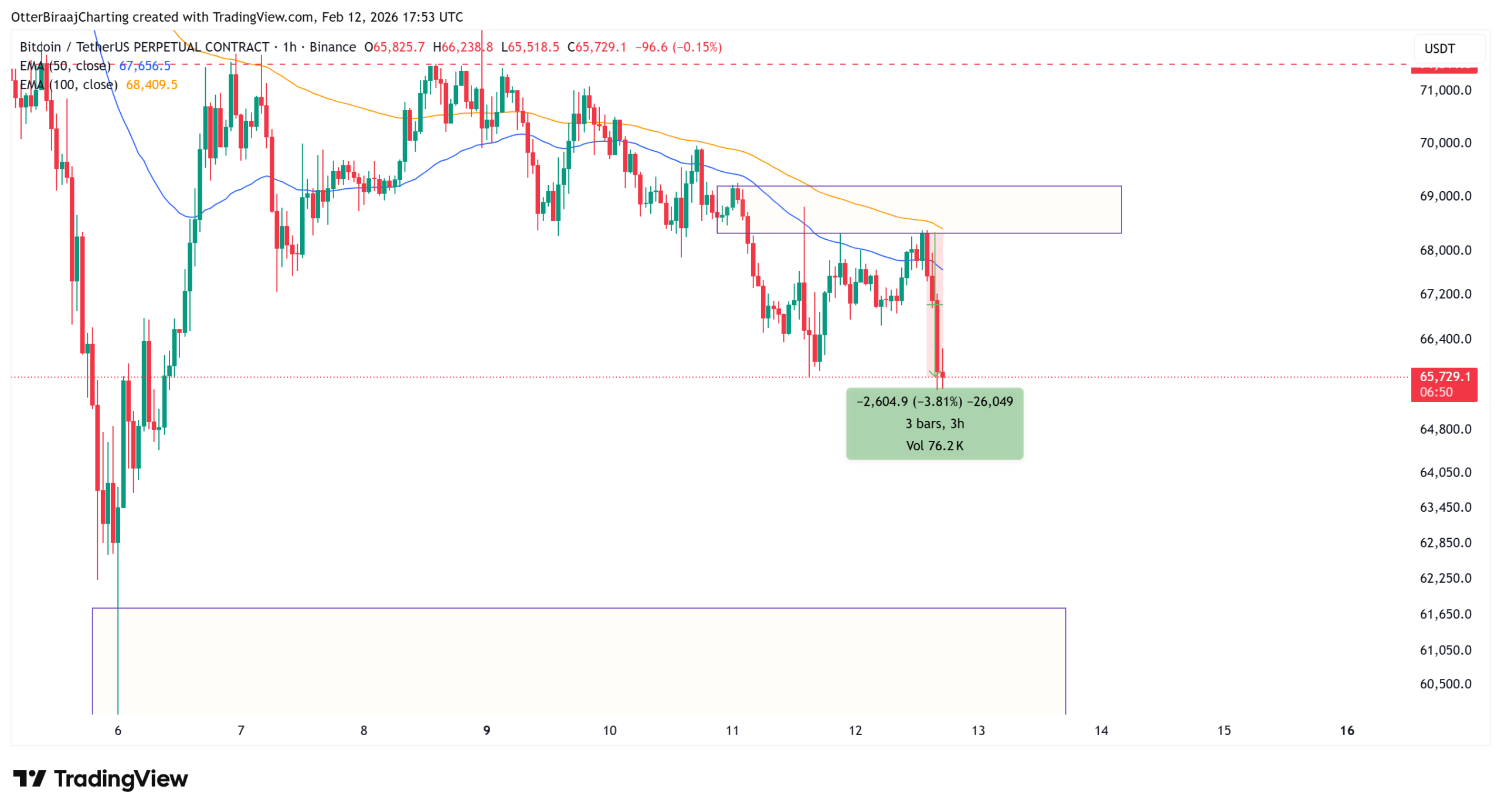
Bitcoin (BTC) formed a new weekly low at $65,500 on Thursday, as the price has continued to trend lower over the past four days. Derivatives data also indicate that traders are heavily positioned to the downside.
Analysts said that this setup may lead to a sharp move higher that forces sellers to close their positions, even as other indicators hint that the move may not be straightforward.
Key takeaways:
-
The seven-day average funding rate for Bitcoin has turned strongly negative for the first time since March 2023 and November 2022.
-
Bitcoin liquidity and stablecoin flow data show renewed capital outflows, reducing the odds of a sustained squeeze.

Bitcoin funding stays red as short positions rise
Bitcoin’s daily funding rate has remained in deep red territory since the beginning of February, marking its most negative period since May 2023. The seven-day simple moving average (SMA) has flipped negative for the first time in nearly a year.

The funding rate is a periodic payment between the traders in futures markets. When it is negative, the short sellers pay long traders, signaling that the bearish positions are crowded, and vice versa.
Crypto analyst Leo Ruga said the current “red funding rate for days” signals that the bearish or short trade may be getting overcrowded. Ruga added:
“This is the kind of negative funding that typically appears during bottoming phases. Not because shorts are wrong, but because extended negative funding often marks exhaustion of selling pressure.”
Similarly, market analyst Pelin Ay highlighted that the funding rate recently dropped near -0.02 last Friday, with sharp negative spikes. Ay added that when sharp price declines coincide with negative funding, it can set the stage for a short squeeze, particularly if $58,000 holds as the local support.
Related: Bitcoin must close week at $68.3K to avoid ‘bearish acceleration:’ Analyst
The last time Bitcoin’s daily funding rate stayed deeply negative for 10 to 20 days after a bullish phase was in May 2021 and January 2022. In May 2021, BTC corrected for nearly two months before breaking out to new highs. In January 2022, the negative stretch preceded a broader bearish cycle. Thus, extended negative funding has not consistently produced an immediate reversal in the past

Onchain data supports a cautious view. Bitcoin researcher analyst Axel Adler Jr. noted that the SSR oscillator, which measures Bitcoin’s strength relative to stablecoins, has mostly stayed in negative territory since August 2025.
A brief move into positive territory in mid-January (+0.057) coincided with a rally above $95,000, but the oscillator has since dropped to -0.15 as the price pulled back toward $67,000.

Stablecoin flows tell a similar story. The 30-day change in USDt (USDT) market cap turned positive in early January (+$1.4 billion), but it has since reversed to -$2.87 billion, signaling a period of capital outflows.
Until liquidity trends and the SSR oscillator turn sustainably positive, Adler Jr. said that the BTC market remains in a “risk-off” phase.
Related: Binance completes $1B Bitcoin conversion for SAFU emergency fund
This article does not contain investment advice or recommendations. Every investment and trading move involves risk, and readers should conduct their own research when making a decision. While we strive to provide accurate and timely information, Cointelegraph does not guarantee the accuracy, completeness, or reliability of any information in this article. This article may contain forward-looking statements that are subject to risks and uncertainties. Cointelegraph will not be liable for any loss or damage arising from your reliance on this information.

The Decibel Foundation said it will introduce a protocol-native stablecoin, USDCBL, issued by Bridge, ahead of the February mainnet launch of its Aptos-based decentralized derivatives exchange.
According to an announcement shared with Cointelegraph on Thursday, the US dollar-denominated token will serve as collateral for onchain perpetual futures trading, allowing the platform to internalize reserve-related economics rather than rely on third-party stablecoin issuers.
Decibel, incubated by Aptos Labs, plans to launch later this month with a fully onchain perpetual futures venue using a single cross-margin account. The exchange said its December testnet attracted more than 650,000 unique accounts and exceeded 1 million daily trades, though those figures have not been independently verified.
At launch, users will deposit USDC (USDC) and convert it into USDCBL as part of the onboarding process. USDCBL will be issued through Bridge’s Open Issuance platform, which enables projects to create regulated, fully collateralized stablecoins with integrated on- and off-ramps. Bridge was acquired by Stripe in late 2025.
According to an X post on Thursday from Decibel, the foundation said USDCBL reserves will be backed by a mix of cash and short-term US Treasurys, with yield generated from those assets retained within the protocol.
It added that capturing reserve income could reduce reliance on trading fees or incentive programs as primary revenue sources, allowing value to be reinvested into protocol development and ecosystem initiatives.
“This is not about launching another stablecoin,” the foundation wrote, describing USDCBL as core exchange infrastructure rather than a standalone retail token.

Related: US credit union regulator proposes stablecoin licensing path
Rise of ecosystem-native stablecoins across crypto and banking
The shift toward ecosystem-aligned dollar tokens spans both crypto and traditional finance, as platform operators increasingly issue stablecoins tailored for use within their own networks rather than relying solely on external issuers.
The closest comparison to Decibel may be Hyperliquid, a decentralized perpetual futures exchange that launched its native stablecoin, USDH, in September after a fierce bidding war for issuance rights.
The dollar-pegged token is minted on the platform’s Ethereum-compatible execution layer, HyperEVM, and is designed to serve as collateral across the exchange while reducing reliance on external issuers.

The trend extends beyond crypto-native platforms. In November, JPMorgan Chase introduced JPM Coin for institutional settlement on its blockchain infrastructure, representing tokenized US dollar deposits held at the bank.
The deposit token was piloted on Coinbase’s Base network, giving institutional clients access to 24/7 blockchain-based transfers. Unlike publicly circulating stablecoins, JPM Coin is permissioned and available only to the bank’s institutional clients.
Fintech platforms have also participated. PayPal launched PYUSD in 2023 as a dollar-backed stablecoin embedded directly into its payments system, giving the company greater control over settlement flows within its own network.
In 2025, the company introduced a 3.7% annual rewards program for US users holding PYUSD in PayPal or Venmo wallets, further embedding the stablecoin into its consumer payments ecosystem.
Magazine: IronClaw rivals OpenClaw, Olas launches bots for Polymarket — AI Eye
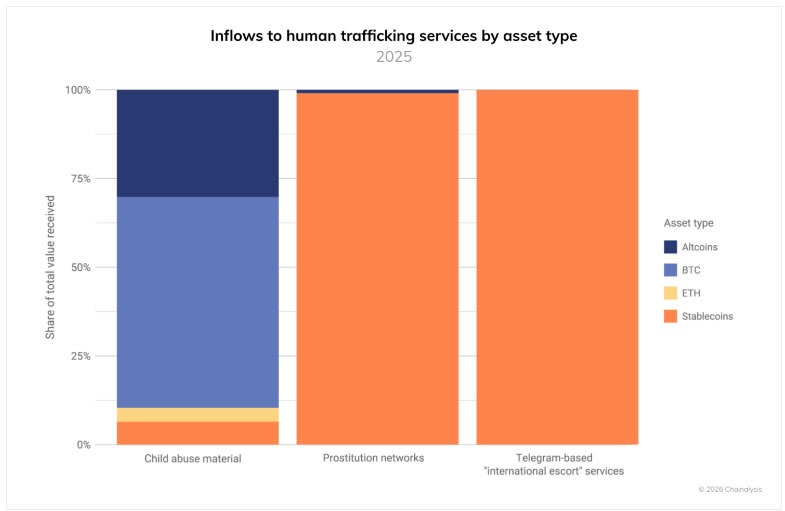
Crypto flows to suspected human trafficking networks increased 85% year over year in 2025, but crypto analytics firm Chainalysis said blockchain transparency could help disrupt the operations.
Chainalysis said in a report on Thursday that the total transaction volume to suspected trafficking networks, largely based in Southeast Asia, reached “hundreds of millions of dollars across identified services.”
It added that the services are “closely aligned” to scam compounds, online casinos, and Chinese-language money-laundering networks, which have recently grown in popularity.
Chainalysis said the crypto-facilitated human trafficking it tracked included Telegram-based services for international escorts, labor placement agents that kidnap and force people to work at scam compounds, prostitution networks, and child sexual abuse material vendors.
Crypto payment methods varied significantly, with international escort services and prostitution networks operating almost exclusively using stablecoins.

Blockchain could help track traffickers
Chainalysis said that the blockchain could help law enforcement detect and disrupt trafficking operations by identifying transaction patterns, monitoring compliance, and targeting strategic chokepoints at exchanges and illicit online marketplaces.
“Unlike cash transactions that leave no trace, the transparency of blockchain technology provides unprecedented visibility into these operations, creating unique opportunities for detection and disruption that would be impossible with traditional payment methods,” it said.
Related: Crypto launderers are turning away from centralized exchanges: Chainalysis
Chainalysis said compliance teams and law enforcement should monitor for large, regular payments to labor placement services, wallet clusters showing activity across multiple categories of illicit services, and regular stablecoin conversion patterns, among others.
Chainalysis said law enforcement scored several wins against traffickers last year, including German authorities taking down a child sexual exploitation platform, which it added was aided by blockchain analysis.
Magazine: Is China hoarding gold so yuan becomes global reserve instead of USD?
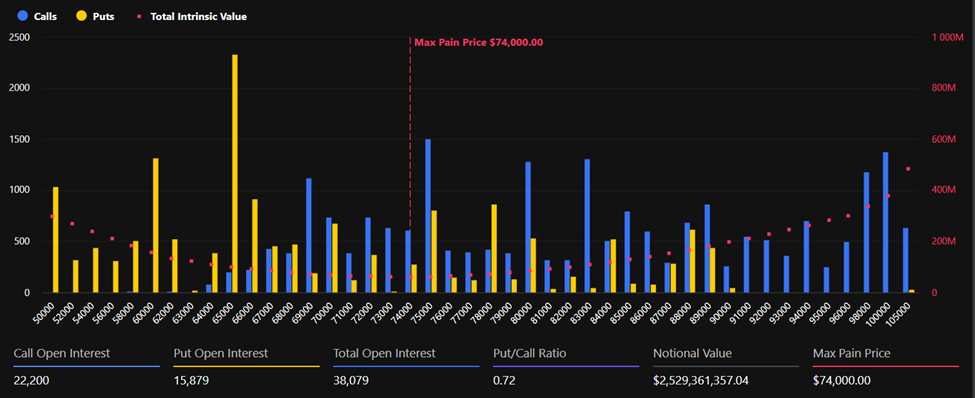
Nearly $3 billion in Bitcoin and Ethereum options expire today at 08:00 UTC on Deribit, placing derivatives markets under intense scrutiny.
Going into today’s options expiry, interest will be on whether the recent price stabilization marks a temporary pause or the beginning of a new directional move.
Sponsored
Sponsored
$3 Billion Bitcoin and Ethereum Options Expiry Tests Market Nerves After Liquidation Shock
As of this writing, Bitcoin was trading at $66,372, with a max pain around $74,000 and total notional open interest exceeding $2.53 billion.
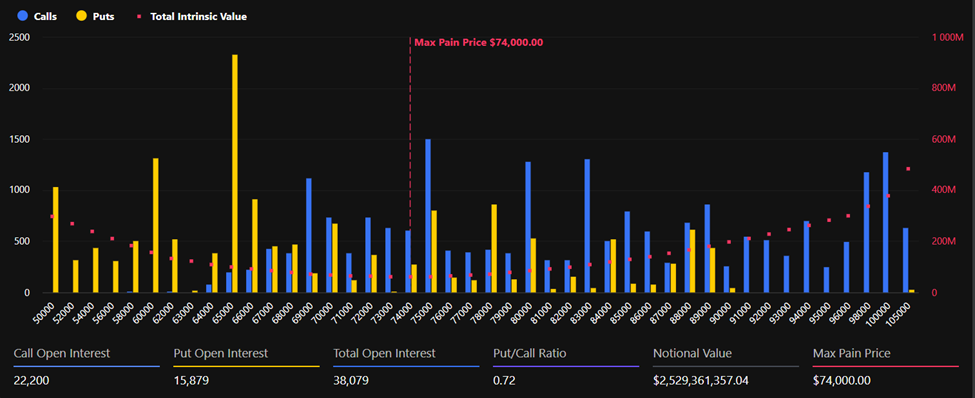
Ethereum, meanwhile, is trading near $1,950, with approximately $425 million in notional open interest and a max-pain level around $2,100.
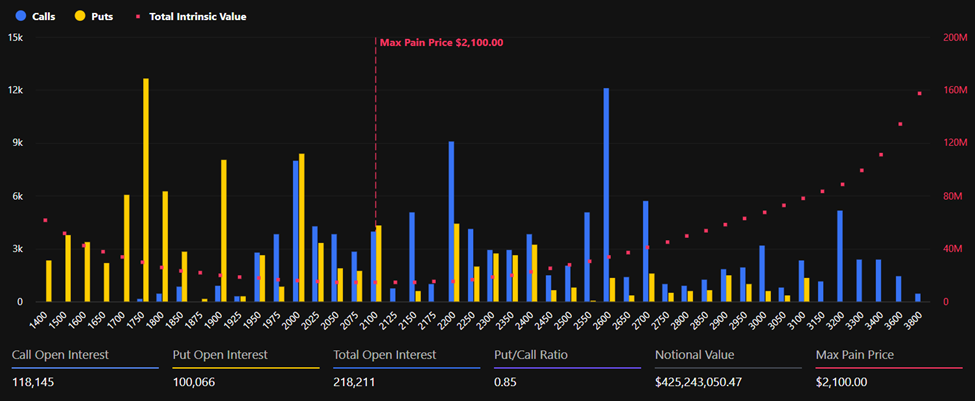
These figures suggest that a large share of open positions would benefit if prices drifted higher toward max pain levels, but sentiment in the options market remains cautious.
Despite the recent rebound from last week’s sharp sell-off, options metrics suggest traders are still hedging against downside risk.
Analysts at Laevitas noted that Bitcoin’s risk reversals remain heavily skewed toward puts.
Sponsored
Sponsored
“BTC 1-week and 1-month 25-delta RRs have recovered from extreme lows but remain notably negative at approximately −13 and −11 vols, respectively, indicating persistent demand for downside protection,” the derivatives analyst stated.
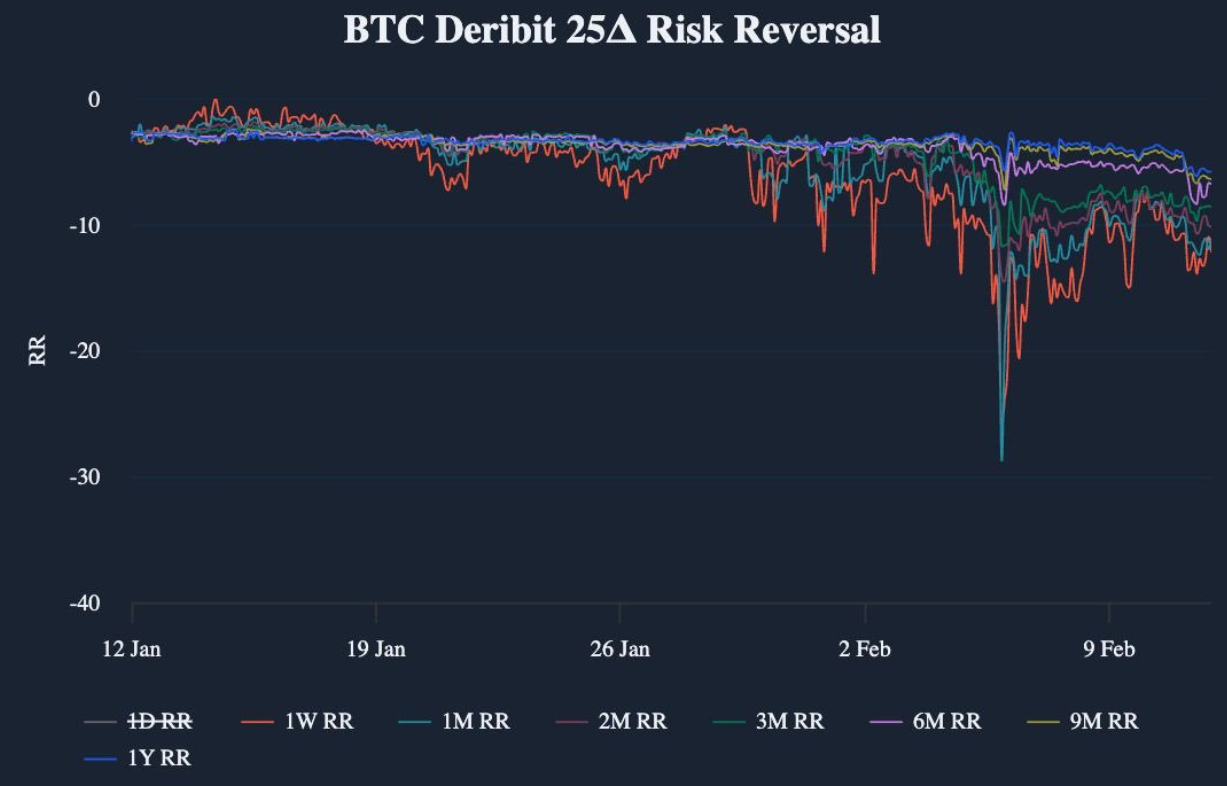
Risk reversals are widely used to gauge sentiment in derivatives markets. Meanwhile, sustained negative readings typically signal that traders are paying a premium for protective puts, often reflecting fears of further declines.
Liquidations, Put Skew Shock, and a Fragile Shift Toward Calls as Expiry Nears
The current cautious tone follows a dramatic market event in which Bitcoin briefly fell below $70,000, triggering widespread liquidations and extreme derivatives imbalances.
Analysts at Deribit said the move caused one of the most pronounced shifts toward put (sales) demand seen in years.
Sponsored
Sponsored
“BTC broke $70K last week, triggering cascading liquidations, and one of the most extreme put skew moves in years before bouncing back toward the 67K range,” Deribit analysts said.
Such events often leave a lasting psychological impact on markets, with traders remaining defensive even after prices stabilize.
More recently, however, derivatives positioning has begun to shift, with some traders rotating back into call (purchase) options as volatility declines from panic levels. Deribit analysts observed that the market is now at a critical inflection point.
Options expiries of this size can sometimes exert short-term gravitational effects on price, especially when large clusters of open interest are concentrated near specific strike levels.
Sponsored
Sponsored
While short-term positioning has improved, some indicators suggest institutional traders remain skeptical about the medium-term outlook.
Analysts at Greeks.live reported that put options continue to dominate activity in Bitcoin derivatives markets.
“Put options continue to dominate the market, with over $1 billion in BTC put options traded today, accounting for 37% of the total volume. The majority of these are out-of-the-money options priced between $60,000 and $65,000,” the analysts said.
This indicates that institutions have a negative outlook for the medium- to long-term market trajectory. According to the analysts, there is a strong expectation of a bearish trend within the next one to two months
The settlement of today’s options expiry could relieve pressure and stabilize markets. However, it could also be the catalyst for another bout of volatility heading into the weekend.

Chainalysis has released a detailed assessment showing a notable uptick in crypto flows tied to suspected human trafficking networks, with an 85% rise in 2025 and transaction volumes reaching hundreds of millions of dollars across identified services. The report highlights networks largely rooted in Southeast Asia and intertwined with scam compounds, online casinos, and Chinese-language money-laundering rings that have gained momentum as crypto adoption broadens. Notably, the study emphasizes that the choice of asset varies by service, with some operators leaning on stablecoins for cross-border payments. While the numbers are concerning, Chainalysis argues that the transparency of blockchains also creates actionable choke points for enforcement.
Among the opaque channels identified are Telegram-based services that facilitate international escorts, labor-placement schemes that allegedly coerce victims into work at scam compounds, prostitution networks, and vendors distributing material related to child sexual abuse. The research underscores that, in practice, payment methods diverge across illicit networks: international escort services and prostitution networks have shown a pronounced reliance on stablecoins, while other segments employ a broader mix of on- and off-ramp techniques. The report’s granular look at asset-type inflows and wallet behavior aims to give investigators and compliance teams new signals to pursue.
Chainalysis stresses that blockchain’s traceability can be a powerful tool for law enforcement. By identifying transaction patterns, monitoring compliance at exchanges, and pinpointing chokepoints in the ecosystem, authorities can disrupt bad actors in ways that cash or traditional remittance systems cannot. This is particularly relevant as illicit online marketplaces and money-laundering networks continue to adapt to shifting regulatory landscapes and evolving crypto offerings. The report also points readers to related work on the broader crypto-laundering landscape and how on-chain analytics are changing the enforcement playbook.
As a case in point, the firm notes several enforcement successes last year, including German authorities dismantling a child sexual exploitation platform, an operation that Chainalysis said was aided by blockchain analysis. The finding illustrates how coordinated usage of on-chain data can assist in tracing the flow of funds across multiple layers of a criminal network, from on-ramps to marketplaces to end-services. Chainalysis also emphasizes the need for ongoing vigilance by compliance teams and law enforcement to monitor for patterns such as high-frequency transfers to labor-placement entities, wallet clusters that operate across multiple illicit categories, and stablecoin conversion activity that appears routine rather than incidental.
Key takeaways
- 2025 crypto flows to suspected human trafficking networks surged by 85%, with total transaction volume reaching hundreds of millions of dollars across identified services.
- Southeast Asia emerges as a central hub for these networks, which are tied to scam compounds, online casinos, and Chinese-language money-laundering networks.
- Seemingly disparate services—Telegram-based international escorts, labor-placement agents, prostitution networks, and vendors supplying illicit content—rely on a mix of assets, with stablecoins favored for cross-border payments in several cases.
- Blockchain’s transparency is framed as a diagnostic and disruption tool: it can reveal transaction patterns, flag large or anomalous activity, and help block or slow illicit flows at exchanges and at online marketplaces.
- Law enforcement achievements, such as the German takedown of a child exploitation platform aided by blockchain forensics, demonstrate the practical leverage of on-chain analytics in complex investigations.
- The report calls for heightened monitoring by compliance teams—watching for regular, large-payments to labor-placement services, wallet clusters spanning illicit categories, and recurring stablecoin conversions—as part of a broader AML framework.
Market context: The findings sit against a backdrop of growing regulatory interest in on-chain analytics, the expanding use of stablecoins, and ongoing scrutiny of cross-border crypto payments. As governments and financial institutions seek robust AML controls, analytics firms and exchanges are increasingly integrating sophisticated tracing tools to deter illicit finance while balancing user privacy and legitimate use cases. The evolving regulatory environment underscores the value—and the limits—of blockchain transparency in addressing criminal finance without stifling legitimate innovation.
Why it matters
The report illustrates a fundamental tension in the crypto economy: the same technologies that enable rapid, borderless financial activity can also facilitate harm if left unchecked. For users and investors, the message is clear—transparency tools are becoming a standard part of risk assessment, and due diligence now increasingly hinges on on-chain behaviors and counterparties. For builders and product teams, the emphasis on compliance signals a growing demand for wallet- and exchange-level controls, better KYC/AML workflows, and clearer disclosures around illicit-risk indicators.
For policymakers, the analysis reinforces the need for clear guidelines on stablecoins and cross-border settlements, as these instruments appear in multiple illicit-use cases. The data also supports continued investment in cross-agency cooperation and international information sharing, given that many of these networks operate across different jurisdictions and platforms. At a technical level, the findings encourage further development of attribution methodologies that preserve user privacy while enabling lawful investigators to trace criminal flows. In short, the study adds to a growing body of evidence that on-chain data can augment traditional investigative methods, but it must be integrated within a broader, well-governed framework.
For the broader crypto ecosystem, the emphasis on chokepoints and wallet clusters highlights practical avenues for disruption: exchanges can improve real-time monitoring, on-chain analytics can be used to flag risky counterparties, and marketplaces can adopt stricter seller verification and payment-processing controls. The convergence of enforcement and technology is likely to shape how illicit activity is funded and how quickly it can be identified and neutralized, potentially reducing the latency between crime and detection in a space historically challenged by anonymity and speed.
What to watch next
- Follow-up updates from Chainalysis on 2026 data and trend analysis, including any revisions to the 2025 figures.
- Regulatory actions targeting stablecoins and cross-border crypto payments, particularly in Southeast Asia and Europe.
- Adoption of enhanced AML controls by exchanges and online marketplaces in response to on-chain‑driven findings.
- Investigations and public disclosures related to large wallet clusters that span multiple illicit services or jurisdictions.
- Further enforcement actions demonstrated or inspired by blockchain-forensic capabilities, such as high-profile takedowns and asset-tracing successes.
Sources & verification
- Chainalysis blog post: crypto-human-trafficking-2026
- Crypto-launderers turning away from centralized exchanges: Chainalysis coverage
- Blockchain forensics and asset tracking explainer
- Related investigative reporting on enforcement actions and policy context
Blockchain visibility and illicit finance: what the findings imply
Chainalysis’s report underscores how on-chain visibility can illuminate the pathways by which crypto assets are moved to support trafficking and exploitation. By charting flows into labor-placement operations, escort services, and adult services that rely on cross-border payments, investigators can identify recurring patterns that mark a network’s lifecycle—from onboarding to monetization. The emphasis on stablecoins in particular reflects how certain assets are chosen to minimize friction across borders, optimize settlement times, and obscure the origin and destination of funds in less-regulated corridors.
Yet the study also warns against overreliance on any single signal. Illicit actors adapt, and the same tools that reveal patterns can be misapplied if not paired with traditional investigative methods and robust governance. The combination of blockchain analytics with proactive compliance, inter-agency collaboration, and targeted enforcement represents a pragmatic approach to mitigating on-chain risks without dampening legitimate innovation in the crypto economy.

A66 from Bowes to Brough closed both ways due to snow

AI-led selloff weighs on markets, but earnings revival could shift mood: Vinit Sambre

Crypto-linked human trafficking payments surged 85% in 2025, Chainalysis report finds

Smart energy pays enters the US market, targeting scalable financial infrastructure

Software stocks enter bear market on AI disruption fear with ServiceNow plunging 10%

Wikipedia volunteers spent years cataloging AI tells. Now there’s a plugin to avoid them.


-

 Politics5 days ago
Why Israel is blocking foreign journalists from entering
-
 Sports6 days ago
JD Vance booed as Team USA enters Winter Olympics opening ceremony
-
 Business5 days ago
LLP registrations cross 10,000 mark for first time in Jan
-

 NewsBeat3 days ago
Mia Brookes misses out on Winter Olympics medal in snowboard big air
-

 Tech6 days ago
First multi-coronavirus vaccine enters human testing, built on UW Medicine technology
-

 Sports1 day ago
Big Tech enters cricket ecosystem as ICC partners Google ahead of T20 WC | T20 World Cup 2026
-

 Business4 days ago
Costco introduces fresh batch of new bakery and frozen foods: report
-

 Tech2 days ago
SpaceX’s mighty Starship rocket enters final testing for 12th flight
-

 NewsBeat4 days ago
Winter Olympics 2026: Team GB’s Mia Brookes through to snowboard big air final, and curling pair beat Italy
-

 Sports4 days ago
Benjamin Karl strips clothes celebrating snowboard gold medal at Olympics
-
Sports6 days ago
Former Viking Enters Hall of Fame
-

 Politics5 days ago
The Health Dangers Of Browning Your Food
-
Sports7 days ago
New and Huge Defender Enter Vikings’ Mock Draft Orbit
-

 Business5 days ago
Julius Baer CEO calls for Swiss public register of rogue bankers to protect reputation
-
 NewsBeat7 days ago
Savannah Guthrie’s mother’s blood was found on porch of home, police confirm as search enters sixth day: Live
-
 Crypto World1 day ago
Pippin (PIPPIN) Enters Crypto’s Top 100 Club After Soaring 30% in a Day: More Room for Growth?
-

 Video1 day ago
Prepare: We Are Entering Phase 3 Of The Investing Cycle
-

 Crypto World3 days ago
Blockchain.com wins UK registration nearly four years after abandoning FCA process
-
 NewsBeat4 days ago
Residents say city high street with ‘boarded up’ shops ‘could be better’
-
 Crypto World3 days ago
U.S. BTC ETFs register back-to-back inflows for first time in a month