Connect with us
DAPA Banner
DAPA Coin
DAPA
COIN PAYMENT ASSET
PRIVACY · BLOCKDAG · HOMOMORPHIC ENCRYPTION · RUST
ElGamal Encrypted MINE DAPA
🚫 GENESIS SOLD OUT
DAPAPAY COMING

Business

Netflix Stock Rebounds Slightly as Shares Trade Near 2026 Lows Ahead of Important July 16 Earnings Report

Published

on

Netflix

Netflix shares rose Tuesday, trading at $77.33, up $1.31, or 1.72 percent, offering a modest bounce for a stock that has fallen sharply this year and remains not far from levels last seen before 2025, even as the company prepares to report second-quarter earnings later this month.

Note: This article is intended to provide factual context and does not constitute financial advice. Readers should consult a licensed financial advisor before making investment decisions.

Tuesday’s gain comes after a difficult stretch for Netflix stock, which closed at $76.05 on Monday following a 2.06 percent decline, according to Yahoo Finance. The stock is down roughly 21 percent so far in 2026 and has fallen approximately 42 percent from its high last summer, according to a Motley Fool analysis published this week, marking one of the steepest pullbacks among major media and technology companies over the past year.

Much of Netflix’s volatility this year traces back to a high-profile, ultimately abandoned effort to acquire Warner Bros. Discovery’s studio and streaming operations. Netflix and Warner Bros. Discovery had entered into a definitive agreement valuing the media company at $27.75 per share, structured as a combination of cash and Netflix stock and later amended to an all-cash transaction, with a total enterprise value of approximately $82.7 billion. The deal was designed to combine Warner Bros.’ extensive film and television library, including HBO and HBO Max, with Netflix’s global streaming platform.

Advertisement

That agreement unraveled in February after rival bidder Paramount Skydance sweetened its own offer for Warner Bros. Discovery to $30 per share in cash, a bid Warner Bros. Discovery’s board determined constituted a “Superior Proposal” under the terms of its existing agreement with Netflix. Faced with the choice of matching Paramount’s higher offer, Netflix opted to walk away. In a joint statement, Netflix co-CEOs Ted Sarandos and Greg Peters said the transaction the company had negotiated “would have created shareholder value with a clear path to regulatory approval,” but added that “at the price required to match Paramount Skydance’s latest offer, the deal is no longer financially attractive.” The two thanked Warner Bros. Discovery’s leadership, including chief executive David Zaslav, for what they described as “a fair and rigorous process.”

Netflix shares initially rallied on the news, rising nearly 10 percent in after-hours trading immediately following the announcement, as investors welcomed the company’s decision to avoid what some analysts had characterized as an increasingly expensive and complex transaction. According to the Motley Fool, Netflix received a $2.8 billion termination fee as part of the collapsed deal, funds the company has said contributed to its cash position alongside organic free cash flow generation of approximately $2.3 billion in the most recent quarter. Netflix management has projected full-year free cash flow of $12.5 billion for 2026, including the termination fee payment.

Despite that initial positive reaction, Netflix shares have since given back those gains and more, falling to levels not seen since before 2025, according to the Motley Fool’s analysis. The stock’s decline has coincided with a broader deceleration in the company’s projected revenue growth for 2026, a trend that has weighed on investor sentiment even as the company’s underlying cash generation has remained strong.

Netflix’s current stock price reflects the aftermath of a significant corporate action completed late last year. On October 30, 2025, the company announced a 10-for-1 forward stock split, which took effect on a post-split basis on November 17, 2025, reducing the per-share price from roughly $1,100 to approximately $110 at the time. The move was intended to make Netflix shares more accessible to retail investors and employees, though it did not change the company’s underlying market capitalization or intrinsic value. Since the split, Netflix shares have declined further amid the Warner Bros. Discovery saga and broader market volatility, falling well below the roughly $110 level at which the stock began trading on a split-adjusted basis.

Advertisement

Wall Street analysts remain divided on Netflix’s near-term trajectory following the stock’s decline. According to the Motley Fool, the median analyst price target of $115 per share implies significant potential upside from current trading levels, with some individual forecasts reaching as high as $138 to $150 per share, reflecting continued optimism about Netflix’s advertising business and subscriber growth potential. Netflix’s advertising tier revenue grew 150 percent to $1.5 billion in 2025, according to company disclosures, with management projecting that business to roughly double again in 2026.

Netflix is scheduled to report its second-quarter 2026 financial results on July 16, an event analysts say will provide important clarity on the company’s growth trajectory following the collapsed Warner Bros. Discovery deal. Wall Street currently projects second-quarter earnings per share of $0.79 and revenue of approximately $12.57 billion, according to Yahoo Finance. The upcoming report comes as Netflix continues to face heightened scrutiny over its growth outlook, with investors weighing the company’s strong free cash flow generation and advertising momentum against a broader deceleration in projected revenue growth for the year.

Beyond the financial and corporate developments, Netflix has continued to lean on its content pipeline to drive subscriber engagement. The company has announced plans for a sequel to its animated hit “KPop Demon Hunters,” along with a new animated entry set in the “Stranger Things” universe, part of a broader strategy the company has said is central to attracting and retaining subscribers amid intensifying competition from rivals including Disney+ and Amazon.

With Netflix shares trading well below both their pre-split highs and the levels reached immediately after the Warner Bros. Discovery deal collapsed, investors are likely to watch the company’s upcoming earnings report closely for signals on whether recent price increases, continued advertising growth, and the absence of the now-abandoned acquisition’s associated costs and complexity can help stabilize the stock’s performance for the remainder of 2026.

Advertisement
Continue Reading
Click to comment

You must be logged in to post a comment Login

Leave a Reply

Business

Form 4 Kodiak Gas Services Inc For: 7 July

Published

on


Form 4 Kodiak Gas Services Inc For: 7 July

Continue Reading

Business

Chip Stocks Drive Market Rally as Nasdaq Futures Jump

Published

on

Barron's

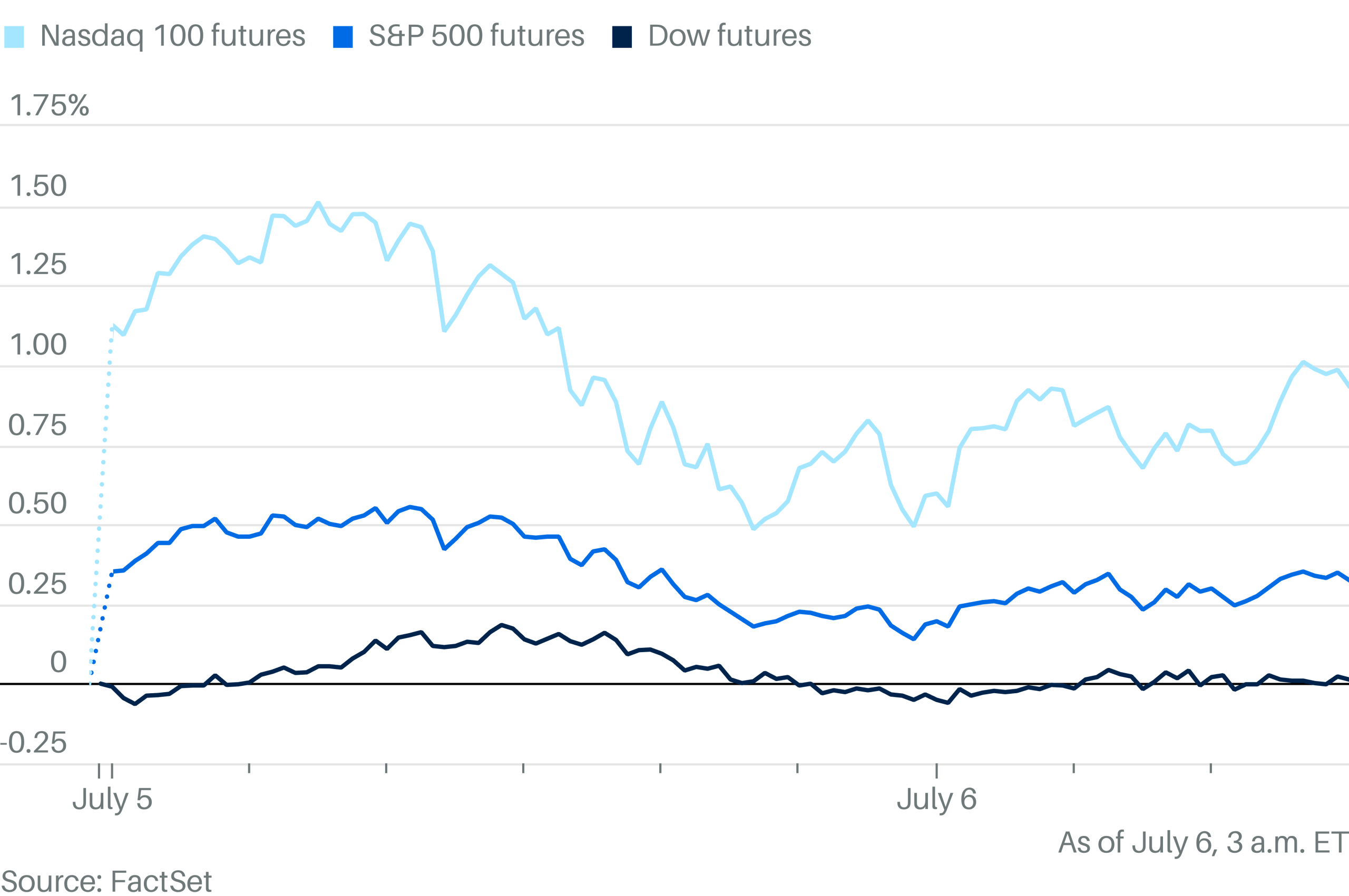
U.S. stock futures looked set to open in the green early Monday, with the technology sector driving the gains.

Corporate news is set to dominate the headlines in a light week for economic data, with the exception of Wednesday’s release of the Federal Reserve’s minutes from its June monetary-policy meeting.

Nasdaq 100 futures were gaining 1.1%, S&P 500 futures were rising 0.5% and Dow Jones Industrial Average futures were slipping 28 points, or 0.1%.

Continue Reading

Business

Berkshire Hathaway: Poised To Reclaim $540 Record High (Rating Upgrade) (NYSE:BRK.B)

Published

on

Berkshire Hathaway: Poised To Reclaim $540 Record High (Rating Upgrade) (NYSE:BRK.B)

This article was written by

Envision Research, aka Lucas Ma, has over 20+ years of investment experience and holds a Masters with in Quantitative Investment and a PhD in Mechanical Engineering with a focus on renewable energy, both from Stanford University. He also has 30+ years of hands-on experience in high-tech R&D and consulting, housing sector, credit sector, and actual portfolio management.He leads the investing group Envision Early Retirement along with Sensor Unlimited where they offer proven solutions to generate both high income and high growth with isolated risks through dynamic asset allocation. Features include: two model portfolios – one for short-term survival/withdrawal and one for aggressive long-term growth, direct access via chat to discuss ideas, monthly updates on all holdings, tax discussions, and ticker critiques by request.

Analyst’s Disclosure: I/we have no stock, option or similar derivative position in any of the companies mentioned, and no plans to initiate any such positions within the next 72 hours. I wrote this article myself, and it expresses my own opinions. I am not receiving compensation for it (other than from Seeking Alpha). I have no business relationship with any company whose stock is mentioned in this article.

Seeking Alpha’s Disclosure: Past performance is no guarantee of future results. No recommendation or advice is being given as to whether any investment is suitable for a particular investor. Any views or opinions expressed above may not reflect those of Seeking Alpha as a whole. Seeking Alpha is not a licensed securities dealer, broker or US investment adviser or investment bank. Our analysts are third party authors that include both professional investors and individual investors who may not be licensed or certified by any institute or regulatory body.

Advertisement
Continue Reading

Business

Teva Pharmaceutical Industries Limited (TEVA) Discusses Anti-IL-15 Antibody Phase Ib 24-Week Efficacy Results in Vitiligo and Planned Advancement to Phase 2b Transcript

Published

on

OneWater Marine Inc. (ONEW) Q1 2026 Earnings Call Transcript

Teva Pharmaceutical Industries Limited (TEVA) Discusses Anti-IL-15 Antibody Phase Ib 24-Week Efficacy Results in Vitiligo and Planned Advancement to Phase 2b July 7, 2026 8:00 AM EDT

Company Participants

Christopher Stevo – Senior Vice President of Investor Relations & Competitive Intelligence
Richard Francis – President, CEO & Director
Eric Hughes – Executive VP of Global R&D and Chief Medical Officer

Conference Call Participants

Advertisement

Yuchen Ding – Jefferies LLC, Research Division
Matthew Dellatorre – Goldman Sachs Group, Inc., Research Division
Jason Gerberry – BofA Securities, Research Division
David Amsellem – Piper Sandler & Co., Research Division
Louise Chen – Scotiabank Global Banking and Markets, Research Division
Christopher Schott – JPMorgan Chase & Co, Research Division
Di Zhao – UBS Investment Bank, Research Division
Umer Raffat – Evercore ISI Institutional Equities, Research Division

Presentation

Operator

Advertisement

Hello, and welcome to the IL-15 vitiligo Phase Ib 24-week Efficacy Results Conference Call. My name is Alex, and I’ll be coordinating today’s call.[Operator Instructions] I’ll now hand it over to Chris Stevo, SVP, Investor Relations. Please go ahead.

Christopher Stevo
Senior Vice President of Investor Relations & Competitive Intelligence

Thanks, Alex. Good morning and good afternoon, everyone. Before I turn the call over to our CEO, Richard Francis, I want to remind everyone that we will be making forward-looking statements on this call. The company cautions investors that any forward-looking statement involves risks and uncertainties and is not a guarantee of future performance. Actual results may differ materially from those expressed or implied in the forward-looking statements due to a variety of factors.

Advertisement

These factors are described in our earnings press release and our most recent 10-Q and 10-K filed with the SEC. And any statements we make are only as of today, and we undertake no obligation to update these statements subsequently. And with that, Richard Francis.

Richard Francis
President, CEO & Director

Advertisement
Continue Reading

Business

eToro Group Ltd. (ETOR) Discusses AI-Driven Transformation in Investment Access and Intelligence Prepared Remarks Transcript

Published

on

OneWater Marine Inc. (ONEW) Q1 2026 Earnings Call Transcript

Jonathan Assia
Co-founder, Chairman of the Board & CEO

Hi, everyone. Welcome to our event of unveiling a huge amount of work that our team has been working on for the past six months. It’s amazing to see so many people, so many familiar faces eTorians from across the globe. Thank you, everyone, for coming here. Our Pro investors that have joined us here to showcase their apps upstairs after the speech. Our partners are here, everywhere from SpaceX AI to Alpine to many other partners or investors. And of course, thank you to my family joining me here as well. And also welcome to the audience on X on YouTube, on our live stream across the globe.

We’ve started eToro with a vision of opening the markets for everyone to trade and invest in a simple and transparent way. But always, there has been a gap between the people who really have access to everything in the market and those who don’t. Initially, at eToro, it was really about lowering the friction, fractional shares in dollar amounts, enabling commission-free stock trading in U.S. shares, bringing crypto to retail and then bringing in a lot of the knowledge that we have in eToro through social, through connecting everybody in eToro to one another.

Today is really about how AI completely levels the playing field between retail investors and the most sophisticated investors across the globe. If I look at the past almost 20 years since me and my brother founded eToro, the first 10 years was really about lowering the barriers to entry. The next 10 years about how

Advertisement
Continue Reading

Business

Reminder: Thailand requires foreign visitors to show proof of funds upon entry

Published

on

Asian Currencies Slide as Iran Conflict Escalates

The Tourism Authority of Thailand reminds visitors to have proof of sufficient funds for entry. This has been an existing requirement since 1980, varying by visa category, and excludes children under 12.

Entry Requirements for Thailand

As of July 6, 2026, the Tourism Authority of Thailand (TAT) advises visitors to prepare evidence of sufficient funds for entry screening. This is a reminder rather than a new measure. The proof-of-funds requirement has been in effect since 1980 under the Ministry of Interior, with updates in 2000. This rule is supported by the Ministry of Foreign Affairs and enforced by the Immigration Bureau.

Proof of Funds and Entry Guidance

Depending on their entry category, visitors may need to provide evidence of funds in Thai Baht or equivalent foreign currency. Categories and required amounts are as follows: Transit Visa and certain visa-exempt cases require 10,000 Baht per person; Visa on Arrival and Tourist Visa require 20,000 Baht per person. Non-Immigrant Visas also require similar amounts. Children under 12 are exempt. Visitors using the Tourist Visa Exemption Scheme should verify specific requirements based on nationality.

Additional Entry Information

Visitors are urged to verify the latest entry requirements by consulting with relevant authorities such as the Immigration Bureau or Royal Thai Embassies. The Immigration Bureau officers have the final say on entry eligibility, assessing based on current laws and regulations. For further details, travelers can access the Immigration Bureau’s website or contact their call center, which offers English-language support at 1178.

Advertisement

Source : Thailand entry reminder on proof of funds for foreign visitors

Continue Reading

Business

Why the Best Decision-Makers Judge the Process, Not Just the Result

Published

on

Pound rallies after Donald Trump considers limits to tariffs plan

Every SME owner has made a call that turned out badly despite being the right decision at the time, and a call that worked out despite being reckless.

Confusing the two is one of the quietest ways good judgement erodes in a growing business. There’s a surprisingly clean illustration of this problem in, of all places, a simple card game. In FreeCell Solitaire, the overwhelming majority of deals are mathematically solvable — so a loss is rarely bad luck and almost always a process failure. That distinction between outcome and process is worth borrowing for any business that makes decisions under uncertainty, which is to say every business.

The Trap of “Resulting”

Poker players have a word for the mistake of judging a decision purely by how it turned out: resulting. It’s an easy trap to fall into, because outcomes are visible and immediate, while the quality of the reasoning behind a decision is much harder to inspect after the fact. A leadership team that hires a strong candidate who later underperforms, or backs a sound pricing strategy that gets undercut by an unforeseen competitor move, can end up punishing good process because the scoreboard says “loss.”

The trouble compounds over time. Teams that get rewarded and punished purely on outcomes learn, quite rationally, to optimise for outcomes rather than sound reasoning — which often means avoiding well-judged risks and gravitating toward safe, low-variance choices that look better on a quarterly report but compound worse over years.

This isn’t just a psychological quirk to note and move past. It shapes real incentive structures inside a business. A sales director who gets criticised for a well-reasoned bet that didn’t land, while a colleague gets praised for a reckless call that happened to pay off, is watching the organisation teach the wrong lesson in real time. Left uncorrected, that dynamic quietly trains a team to prefer comfortable mediocrity over calculated risk.

Advertisement

Why FreeCell Makes the Point So Cleanly

Most games that involve cards or dice let players blame the shuffle when things go wrong, and plenty of business decisions get the same excuse: market conditions, timing, forces beyond anyone’s control. FreeCell removes that excuse almost entirely. The entire board is dealt face-up from the first move, and independent analysis of the game’s standard deals has found that well over 99% are winnable with correct play. Only a small handful of deals have ever been confirmed unsolvable.

That means a lost game of FreeCell is close to a controlled experiment in decision quality. The deal wasn’t the obstacle; the sequence of choices was. It’s a rare case where the gap between “bad outcome” and “bad process” nearly disappears, because the puzzle was solvable and the player simply didn’t find the solution. Business decisions are messier and rarely offer that kind of clarity, but the underlying question is identical: was this a good decision that ran into bad variance, or a decision that deserved to fail?

Building the Distinction Into How a Team Reviews Decisions

A few practical habits help separate process quality from outcome quality when reviewing how a business decision played out:

  • Write the reasoning down before the outcome is known: A brief note on why a decision was made, made before the result comes in, is the only reliable way to later judge process rather than hindsight.
  • Ask what information was available at the time: Judging a past decision against information that only emerged afterward is judging a different decision than the one that was actually made.
  • Separate “wrong call” from “bad luck” explicitly: Teams that build this distinction into post-mortems tend to make better decisions over time, because they’re rewarding the right behaviour rather than the right dice roll.
  • Revisit losing decisions the same way you’d revisit winning ones: A good process that happened to lose deserves the same scrutiny, and often the same praise, as a good process that happened to win.

None of this eliminates bad luck from business, and it shouldn’t try to. It simply stops bad luck from being mistaken for bad judgement, or good luck from being mistaken for skill.

The Takeaway for Growing Businesses

Uncertainty isn’t a flaw in decision-making; it’s the entire environment decisions get made in, whether the stakes are a card game or a hiring choice. The businesses that improve fastest tend to be the ones that get comfortable evaluating the reasoning behind a call independently of how it turned out, rather than treating every result as a verdict on the decision itself. FreeCell happens to make that lesson unusually visible, because it strips away nearly every excuse. Most business decisions won’t offer that clarity. The discipline of asking the question anyway is what separates teams that genuinely improve from teams that just get lucky or unlucky on repeat.

Advertisement

Continue Reading

Business

PepsiCo and more: Jim Cramer says market rotation is creating buying chances, picks 4 stocks

Published

on

PepsiCo and more: Jim Cramer says market rotation is creating buying chances, picks 4 stocks
CNBC’s Jim Cramer on Monday said that investors should not be afraid of the latest rotation in the market, arguing that the move has created chances to buy good companies that have fallen because of institutional selling.

Cramer, a former hedge fund manager and the host of CNBC’s Mad Money, said Monday’s market action was linked to last week’s June jobs report, which showed hiring had slowed from the previous month. That data appeared to push large money managers to adjust their portfolios.

According to Cramer, institutional investors often trade baskets of stocks based on a broader economic theme. When that happens, even strong companies can fall along with weaker names, despite no major change in their business.

“These rotations create dislocations that seem to come out of nowhere. And sometimes those dislocations can give you incredible opportunities to buy high-quality companies at a discount,” Cramer said. “Today we got a bunch of them.”

Advertisement

Cramer pointed to PepsiCo as one such opportunity. He said the recent fall in the stock has given back much of the rally that followed the company’s strong earnings last quarter. With PepsiCo set to report results on July 9, Cramer said the pullback could offer investors a better entry point.


He also highlighted Starbucks, saying investors are finally getting a chance to buy the stock after its recent decline. Cramer said CEO Brian Niccol is still working on the company’s turnaround, and the fall in the stock has made the risk-reward more attractive. Starbucks is also held by Cramer’s Charitable Trust, the portfolio used by the CNBC Investing Club.
For investors willing to take more risk, Cramer mentioned Constellation Brands. He said the alcohol company’s latest results showed signs that its beer business may be stabilising, even though concerns remain around its spirits segment.Cramer was also positive on TJX Companies, another CNBC Investing Club holding. He said a weaker consumer can help off-price retailers as shoppers look for cheaper options. At the same time, excess inventory at traditional retailers gives TJX more discounted products to sell in its stores.

Outside consumer stocks, Cramer said Monday’s market also showed another pattern. Some artificial intelligence-linked winners rebounded, while healthcare stocks that had recently performed well came under pressure.

One of those healthcare names was Johnson & Johnson, also held by the CNBC Investing Club. Cramer said the company has become more focused after spinning off Kenvue, its consumer health business. He also noted that Johnson & Johnson is planning to move away from orthopedics, which could make the company more attractive as a pure-play pharmaceutical business.

Johnson & Johnson is scheduled to report earnings on July 15. Cramer said the recent weakness could give investors a chance to look at the stock before the results.

Advertisement
Continue Reading

Business

NCDEX revives black pepper futures to boost India’s price discovery

Published

on

NCDEX revives black pepper futures to boost India's price discovery
NCDEX has relaunched black pepper futures, reviving one of its oldest commodity contracts after more than a decade and seeking to re-establish India as a global benchmark for price discovery in the spice.

The exchange said India remains one of the world’s largest producers, consumers and processors of black pepper, but has lacked an active regulated derivatives contract despite the commodity’s significance. With no active global derivatives benchmark for black pepper currently in existence, the relaunch is expected to provide farmers, traders, exporters and processors with a transparent platform for hedging price risks and discovering market-driven prices.

The contract will be traded in lots of one tonne, quoted in rupees per kilogram, with compulsory delivery at warehouses in Kochi, India’s principal pepper trading and processing hub. Kochi has been designated as the sole delivery centre, with deliveries permitted within a 60-km radius of the city’s municipal limits.

Historically, black pepper futures on NCDEX witnessed strong participation from market participants across the value chain, with delivery at contract expiry consistently touching or nearing 100%, reflecting the contract’s close linkage with the physical market.

Advertisement

The relaunch comes at a time when commodity markets are witnessing heightened price volatility amid changing global supply chains and weather-related production risks. Industry participants believe a regulated domestic benchmark could improve price transparency and offer an effective risk-management tool for the spice trade.


“India is one of the world’s largest producers and consumers of black pepper, yet we have gradually ceded our role in global price discovery for the commodity,” said Arun Raste, managing director and CEO of NCDEX. “The relaunch of Black Pepper Futures is an effort to bring that benchmark home by creating a transparent, credible and India-centric reference price for the trade. A robust derivatives market will help farmers, processors, exporters and traders manage volatility more effectively while strengthening India’s position in the global spice ecosystem.”
Kedar Deshpande, Chief Business Officer at NCDEX, said the absence of an active global derivatives benchmark had left a significant gap in the market. “The relaunch provides the entire pepper value chain—from growers to exporters—with a regulated platform for pricing and risk management, while reinforcing India’s position in global spice trade,” he said.

The launch is also part of NCDEX’s strategy to deepen its presence in southern India and expand its commodity offerings linked to regional agricultural value chains.

Continue Reading

Business

Why the US and China need Latin America for space

Published

on

Why the US and China need Latin America for space

Space may emerge as a new arena for geopolitical rivalry as China extends its influence into Latin America. This expansion could shift the dynamics of international power, with nations competing for dominance in space-related activities and technological advancements, highlighting the growing significance of space in global strategic interests and regional influence.


The United States and China view Latin America as a crucial region for expanding their space ambitions. Latin America’s strategic location offers advantageous launch opportunities, reducing costs and increasing efficiency for space missions. Countries like Brazil possess potential launch sites that could serve as gateways for global space exploration efforts.

Furthermore, Latin America presents valuable scientific opportunities, including access to unique orbital positions and collaborations in space research. Developing partnerships in the region can help both powers share technological advancements and foster regional growth, making space activities more sustainable and inclusive.

Advertisement

Ultimately, the US and China recognize Latin America’s importance in their space strategies. By engaging with Latin American nations, they can secure better launch infrastructure, foster international cooperation, and extend their influence in the emerging era of space exploration. This dynamic positions Latin America as a crucial player in future space endeavors.

source

Advertisement
Continue Reading

Trending

Copyright © 2025