

Crypto World
What is a governance attack? How BonkDAO lost $20M in a single vote



On July 6, 2026, someone spent about four million dollars buying BONK, used it to control almost a hundred percent of a seven-wallet vote, and legally walked off with twenty million from the DAO’s treasury. No code was hacked. The voting worked exactly as designed. Here is how governance attacks work, why they are getting more common, and what actually stops them.
Summary
- BonkDAO lost about $20 million after an attacker bought enough BONK tokens to dominate a governance vote without exploiting any code.
- Governance attacks allow attackers to use legitimate voting systems to approve malicious proposals when token ownership is concentrated and voter participation is low.
- Timelocks, quorum requirements, and emergency controls remain the main safeguards against governance attacks by making treasury takeovers harder to execute.
Most crypto thefts break something: a smart-contract bug, a stolen key, a spoofed website. A governance attack breaks nothing. It uses a decentralized organization’s own voting system, exactly as intended, to pass a proposal that hands the attacker the treasury. The code performs flawlessly. The rules are followed to the letter. And the money leaves anyway, because the rules themselves allowed it.
That is what happened to BonkDAO on July 6, 2026. An attacker quietly bought roughly four million dollars of the BONK token on exchanges over several days, accumulated a dominant share of voting power, and submitted a proposal to the DAO’s treasury. When the vote closed, wallets linked to the attacker controlled about 99.878 percent of the votes cast, the proposal passed, and around twenty million dollars in BONK drained from the treasury to attacker-controlled wallets. Only seven addresses voted at all. There was no exploit in the usual sense; there was a takeover, executed through the front door.
Governance attacks are becoming more common precisely because they require no elite technical skill, only capital and a poorly defended voting system, and a growing number of DAOs, many of them memecoin projects with outsized treasuries, hold large treasuries behind exactly such systems. This guide explains what a governance attack is, walks through the BonkDAO case in detail, covers the main variants including the flash-loan version that needs no upfront capital at all, surveys the historical record from Beanstalk to Compound to Tornado Cash, and lays out the defenses that actually work along with the reasons they are so rarely fully deployed. The through-line is a single uncomfortable idea: in a system where money votes, whoever can rent enough votes can rewrite the rules, a vulnerability distinct from the code exploits and key compromises that drain cross-chain bridges.
What a governance attack is
A decentralized autonomous organization, or DAO, replaces executives and boards with token-holder voting. Holders of the governance token submit proposals, other holders vote, and if a proposal reaches the required threshold, a smart contract executes it automatically. Proposals can adjust parameters, upgrade code, or move treasury funds, and the appeal is that no single person controls the outcome; the community does, transparently and on-chain.
A governance attack turns that openness into a weapon. Instead of finding a bug in the DAO’s code, the attacker acquires enough voting power through entirely legitimate means, usually by buying the governance token, and then uses that power to pass a proposal that benefits the attacker at everyone else’s expense, most often by transferring the treasury to themselves, a purely economic attack that needs no transaction-ordering exploit or mempool trickery. Because the acquisition of tokens and the casting of votes are both permitted actions, the attack is what security researchers call purely in-protocol: it cannot be prevented by cryptography or better code auditing, because nothing is being exploited except the voting mechanism working as designed.
This is what makes governance attacks conceptually different from every other crypto theft. A reentrancy bug or a stolen private key is a failure of implementation; the system did something it was not supposed to do. A governance attack is a failure of design; the system did exactly what it was supposed to do, and the outcome was still a robbery. Fixing it requires rethinking the rules of the vote, not patching a line of code, which is why these attacks keep succeeding against protocols whose smart contracts are flawless.
The root vulnerability is almost always token-weighted voting, the default model in which one token equals one vote. Token-weighted voting quietly assumes that large holders are aligned with the protocol’s success, because they have money at stake. That assumption fails completely against an attacker who does not care about the protocol’s future and only wants to control one vote long enough to drain the treasury. To that attacker, buying tokens is not an investment in the project; it is the purchase of a weapon, discarded the moment it has fired.
The BonkDAO case, step by step
The July 2026 BonkDAO attack is a near-perfect illustration, because it used no exploit at all and every step was visible on-chain.
The setup was patient accumulation. Over several days, the attacker bought roughly four million dollars of BONK using exchange wallets, building voting power gradually instead of in one conspicuous purchase. Because BonkDAO used ordinary token-weighted voting on a standard governance platform, that accumulated BONK translated directly into accumulated votes, and because the buying was spread out and routed through exchanges, it did not trigger alarm. To any observer, it looked like ordinary accumulation of a memecoin.
The execution was a proposal to the treasury. The attacker submitted a governance proposal and let it sit live for six days, the normal voting window. Here the fatal weakness showed: almost nobody else voted. When the window closed, only seven wallet addresses had participated, and wallets controlled by the attacker held about 99.878 percent of the total voting weight. The four-million-dollar token position was more than enough to dominate a vote that essentially no one else showed up for. The proposal passed, and the DAO’s smart contract did what passed proposals do: it executed, moving roughly twenty million dollars in BONK from the treasury to the attacker’s wallets.
Three design failures converged. There was no meaningful quorum requirement, so a vote decided by seven wallets counted as legitimate. There was no timelock strong enough to let the community notice and react to an anomalous treasury proposal before it executed. And there was no emergency check, such as a multisignature control over large treasury movements, to catch a proposal that would drain the treasury. Any one of these, properly set, might have stopped the attack; their combined absence made a four-million-dollar purchase sufficient to steal twenty million.
The aftermath followed the now-familiar script. BonkDAO traced the exchange wallets used to accumulate the tokens and began working with exchanges, cross-chain bridges, the network’s foundation, and law enforcement to pursue recovery, while at least one exchange suspended BONK transfers. But governance-attack recoveries are notoriously hard, precisely because the theft was executed through the DAO’s own legitimate process, not an exploit that might be reversed, and the token’s price fell sharply on the news. The attack also did not stand alone: it landed in a stretch of DeFi security incidents that had the market on edge, underscoring how quickly value can leave when the weakest link is the governance layer instead of the code.
The main variants
Governance attacks share a logic but come in several forms, distinguished mainly by how the attacker acquires voting power and how quickly they strike.
The slow accumulation attack is the BonkDAO model: buy tokens gradually over days or weeks, avoid suspicion, and strike when you control enough votes and turnout is low. A patient attacker can go further, spreading purchases across many anonymous wallets so the accumulation looks like healthy, distributed participation instead of a single entity building a weapon. Low voter turnout is the enabling condition because it lowers the number of tokens needed to dominate; in a DAO where almost no one votes, a modest position can control outcomes.
The flash-loan attack is the most dramatic variant, because it requires no upfront capital at all. A flash loan lets a user borrow a very large sum with no collateral, provided the loan is repaid within the same transaction. An attacker borrows a huge amount, uses it to buy or otherwise acquire a controlling block of governance tokens, votes to pass a malicious proposal, extracts the treasury, and repays the loan, all atomically in a single transaction that either fully succeeds or fully reverts. Because everything happens in one block, there is no window for anyone to react. This variant is what makes timelocks so important, since a mandatory delay between a vote passing and its execution breaks the single-transaction requirement that flash-loan attacks depend on.
Other paths to voting power exist. An attacker might exploit a flaw in how the protocol distributes or mints governance tokens, acquiring votes without paying market price. They might manipulate a price oracle to acquire tokens cheaply, exploiting a swap’s slippage and price impact to move a thin market in their favor. Or they might use a sybil strategy, splitting holdings across many accounts to appear as many independent voters while acting as one. What unites all variants is the goal: assemble enough voting weight, by whatever means, to pass a proposal the rest of the community would never approve, then convert that proposal into stolen funds before anyone can stop it.
A short history of governance attacks
The BonkDAO attack was severe but far from the first, and the historical record shows both the pattern’s persistence and how defenses have evolved in response.
The Beanstalk attack in 2022 is the textbook flash-loan case. An attacker took an enormous flash loan, used it to acquire a supermajority of the stablecoin protocol’s governance tokens, passed a proposal that drained the treasury, and repaid the loan, all in a single transaction. The haul was well over a hundred million dollars, and the entire operation lasted one block. Beanstalk became the canonical example of why any governance system that lets freshly acquired tokens vote immediately, with no delay before execution, is dangerously exposed to flash loans.
The Compound episode in 2024 showed a subtler form. A group associated with a well-known whale pushed through a proposal directing tens of millions in the protocol’s tokens to a vehicle they controlled, after delegating enough tokens to meet quorum. The community was divided over whether to call it an attack or aggressive-but-legitimate governance, and the resolution came partly through the threat of centralized intervention and partly through negotiation, a reminder that many DAOs retain a centralized backstop precisely because pure token voting can produce capture. It also illustrated that governance attacks are not always anonymous outsiders; they can be sophisticated insiders exploiting low participation and misaligned incentives in plain sight, the same fragility that shadows liquid staking tokens when one provider dominates.
The Tornado Cash case in 2023
The Tornado Cash case in 2023 delivered a chilling twist: an attacker passed a malicious proposal that granted themselves a controlling number of votes, effectively seizing the entire governance system, then, after extracting value, used their captured power to reset the malicious changes. The privacy protocol’s governance briefly ceased to exist as a decentralized entity because one proposal handed one actor total control. Smaller cases, from Build Finance to various memecoin DAOs, repeat the pattern at lower stakes. The consistent lesson across all of them is that treasuries are only as safe as the voting rules guarding them, and that a flawless smart contract offers no protection when the vote itself is the attack surface.
Why this is so hard to fix
If the defenses are known, a fair question is why governance attacks keep succeeding. The answer is that every defense trades away something a DAO values, and the trade-offs are genuinely uncomfortable, which is why so many projects postpone them until an attack forces the issue.
Consider the central tension. The entire premise of a DAO is open, permissionless participation: anyone can hold the token, anyone can propose, anyone can vote, and outcomes reflect the community instead of a gatekeeper. Every strong defense against governance attacks chips at exactly that openness. A high quorum requirement can paralyze a DAO whose members rarely vote, leaving it unable to pass even benign proposals. A long timelock slows the organization’s ability to respond to genuine emergencies, the very speed that on-chain governance was supposed to improve. An emergency multisignature or veto committee reintroduces a trusted group, which is a form of the centralization DAOs exist to escape. Each safeguard makes the DAO safer and less decentralized at the same time, and communities are understandably reluctant to give up the ideal that drew them together.
Low participation compounds the problem and resists easy solution. Most DAOs suffer chronically low voter turnout, with studies finding that a large share have only a handful of active voters, and low turnout is the single condition that makes governance attacks cheap, because it lowers the token threshold an attacker must reach. Yet turnout cannot simply be mandated; it reflects the reality that most token holders are passive, hold for price rather than participation, and have little time or expertise to evaluate proposals. Delegation, where holders assign their votes to engaged representatives, helps, but it concentrates power in delegates and introduces its own capture risks. The passivity that enables attacks is a structural feature of token ownership, not a bug that a single mechanism can eliminate.
There is also the deeper problem that a token market cannot distinguish a supporter from an attacker. Both are simply buyers willing to pay for tokens, and from the market’s perspective they are indistinguishable right up until the malicious proposal executes. Token-weighted governance assumes economic alignment, that anyone holding many tokens must want the protocol to succeed, but an attacker who plans to drain the treasury and discard the tokens has no such alignment, and no purchase-time signal reveals the difference. This is why some researchers argue that token voting alone can never be fully secure and that durable solutions require non-token inputs, reputation, identity, or contribution history, that markets cannot simply buy. Those approaches are early and hard to implement without reintroducing gatekeepers. The uncomfortable conclusion is that governance security is not a solved problem with a checklist to apply, but a live design frontier where every fix costs some decentralization, and where the cheapest, most open configuration, the one many DAOs default to, is precisely the one attackers find most inviting.
The defenses that work
Because governance attacks exploit design, not code, the defenses are matters of mechanism design, and a well-configured DAO can make an attack unprofitable even if it cannot make it impossible.
Timelocks are the single most important defense. A timelock imposes a mandatory delay between a proposal passing and its execution, and it does two things at once. It breaks flash-loan attacks entirely, because the borrowed tokens cannot be held across the delay, defeating the single-transaction requirement. And it gives the community a window to notice an anomalous proposal and respond before the treasury moves. The BonkDAO attack, with its six-day live window but apparently no effective execution delay or reaction, shows that a voting period is not the same as a timelock; what matters is a hard delay between approval and execution during which defenders can act.
Quorum requirements raise the bar for legitimacy. A quorum sets a minimum amount of voting participation for a proposal to pass, so a vote decided by a handful of wallets does not count. Had BonkDAO required a substantial quorum, a seven-wallet vote would have failed regardless of how the attacker’s tokens were distributed. Related measures include conviction voting, where voting power builds the longer tokens are committed, penalizing the sudden accumulation that attacks rely on, and delegation systems that raise overall turnout, which mechanically increases the tokens an attacker must acquire.
Emergency controls provide a last line. A multisignature control over large treasury movements, or a veto mechanism allowing trusted actors to pause or reject a clearly malicious proposal, can stop a drain even after a vote passes. These measures reduce decentralization, which is a real trade-off DAOs must weigh, but they exist precisely because pure token voting has repeatedly proven drainable. Many protocols keep a centralized safeguard for exactly the scenario Compound faced.
Finally, limiting what governance can do shrinks the prize. If a single proposal cannot unilaterally move the entire treasury, and if large disbursements require additional steps or approvals, the value an attacker can extract falls, and with it the incentive to attack at all. The unifying principle across every defense is to make the cost of acquiring enough votes exceed the value that could be stolen, or to insert enough delay and friction that the community can intervene before the theft completes. A DAO that has done neither, holding a large treasury behind cheap, immediate, low-turnout token voting, is not running a governance system so much as an unlocked vault with a suggestion box. BonkDAO’s twenty-million-dollar lesson is that the suggestion box, in the wrong hands and with enough tokens behind it, opens the vault.
The wider context is that governance is becoming a bigger target as DAOs hold more value. Memecoin communities in particular have accumulated substantial treasuries, often denominated in volatile tokens whose value can swing sharply, while running the simplest possible voting systems, and the combination of a rich prize behind a weak lock is exactly what attackers seek. As on-chain governance spreads from experimental protocols to organizations managing serious money, the gap between DAOs that have hardened their voting and those that have not becomes one of the clearest dividing lines in crypto security. The attacks are not going away, because the incentive is structural and the cheapest configuration is the most vulnerable one. What changes, DAO by DAO, is whether the treasury sits behind defenses proportionate to its size, or behind a vote that four million dollars and an empty room can win.
Frequently asked questions
What is a governance attack?
A governance attack is when someone acquires enough voting power in a DAO, usually by buying its governance token, and uses that power to pass a proposal that benefits them at the community’s expense, typically draining the treasury. It exploits the voting mechanism working as designed, not a bug in the code, which is what makes it different from a typical smart-contract hack.
How did the BonkDAO attack work?
The attacker spent roughly four million dollars buying BONK on exchanges over several days, accumulating dominant voting power. They submitted a treasury proposal that sat live for six days, and because only seven wallets voted, the attacker’s wallets controlled about 99.878 percent of the vote. The proposal passed, and roughly twenty million dollars in BONK drained from the treasury, with no smart-contract exploit involved.
Was any code hacked in a governance attack?
No. In a governance attack, the smart contracts perform exactly as designed. The theft happens because the voting rules themselves allowed a malicious proposal to pass and execute. This is why governance attacks cannot be prevented by better code audits alone; they require changes to the voting mechanism, such as timelocks, quorums, and emergency controls.
What is a flash-loan governance attack?
It is a variant that needs no upfront capital. The attacker borrows a large sum with no collateral, uses it to acquire a controlling block of governance tokens, passes a malicious proposal, drains the treasury, and repays the loan, all within a single transaction. The 2022 Beanstalk attack, which took over a hundred million dollars, is the canonical example, and timelocks are the main defense because they prevent execution within one transaction.
Why are governance attacks becoming more common?
They require capital and a weak voting system rather than elite technical skill, which lowers the barrier compared with finding code exploits. Many DAOs, especially memecoin projects, hold large treasuries behind simple token-weighted voting with low voter turnout, making them attractive targets. Accumulating enough tokens to control a low-turnout vote is often cheaper than the treasury it can capture.
Can stolen funds from a governance attack be recovered?
Recovery is difficult because the theft was executed through the DAO’s own legitimate process rather than an exploit that might be reversed. Projects typically trace the wallets, coordinate with exchanges, bridges, and law enforcement, and hope to freeze funds before they are laundered, but success is uncertain. BonkDAO began such efforts after its attack, with recovery unresolved.
What defenses stop governance attacks?
The main defenses are timelocks that delay execution after a vote passes, quorum requirements that invalidate low-turnout votes, conviction voting that penalizes sudden token accumulation, emergency multisignature or veto controls over large treasury movements, and limits on what a single proposal can do. Together, they aim to make an attack cost more than it could steal or to give the community time to intervene.
Is token-weighted voting the problem?
Token-weighted voting is the core vulnerability because it assumes large holders are aligned with the protocol when in fact, an attacker can buy votes purely to drain the treasury. Alternatives and supplements like conviction voting, quorum floors, delegation to raise turnout, and non-token reputation systems all aim to weaken the assumption that whoever holds the most tokens should control the outcome.
Disclaimer: This article is for informational purposes only and does not constitute investment advice. Digital asset markets are volatile, and you can lose your entire investment. Always do your own research. Information current as of July 7, 2026.

The wallet behind BonkDAO's $20 million governance attack has parked most of the stolen BONK in a multisig controlled by a newly created shadow DAO, Chainalysis said in a post on its official X account Tuesday. The blockchain analytics firm calls the structure "BONK 2.0." The multisig is governed… Read the full story at The Defiant
Tether has invested $20 million in a strategic growth financing round for Mercado Bitcoin, Brazil's largest crypto exchange, the stablecoin issuer announced Tuesday. The deal backs Mercado Bitcoin's push into tokenization, payments, credit and capital markets across Latin America. Mercado Bitcoin,… Read the full story at The Defiant


The U.S. Securities and Exchange Commission has added three major crypto-related rule proposals to its 2026 regulatory agenda, expanding its work on digital asset regulation while Congress continues to debate the CLARITY Act.
Summary
- The SEC has added three crypto-related rule proposals to its 2026 regulatory agenda covering assets, broker-dealers, and market structure.
- The proposals include possible crypto asset exemptions, broker-dealer rule changes, and new trading rules for exchanges and ATSs.
- Meanwhile, the CLARITY Act awaits a Senate vote as lawmakers work to reconcile competing versions before the Aug. 7 deadline.
According to the SEC’s Agency Rule List, the commission is considering separate rulemaking projects covering crypto assets, crypto broker-dealers, and crypto market structure. Together, the proposals would address how digital assets are issued, traded, and handled by regulated financial firms, while providing new guidance in areas that have long lacked clear federal rules.
The proposal covering crypto assets would explore regulations for the offer and sale of digital assets, including potential exemptions and safe harbors. The SEC said these measures could clarify the regulatory framework for crypto assets and provide more certainty for market participants.
The initiative follows the commission’s recently proposed innovation exemption, which would allow eligible firms to issue and trade tokenized U.S. stocks under specific conditions.
New rules extend across crypto trading and broker-dealers
Another proposal focuses on broker-dealers that deal with crypto assets. The SEC’s Division is considering recommending amendments to Rules 15c3-1 and 15c3-3, along with other broker-dealer financial responsibility rules and Rules 17a-3 and 17a-4, to address how existing requirements apply to digital assets.
Earlier this year, the SEC also outlined conditions under which certain decentralized finance platforms could operate without registering as broker-dealers. At the same time, the commission is separately seeking public comments on several novel exchange-traded fund proposals, including prediction market ETFs.
A third proposal listed in the regulatory agenda concerns crypto market structure. Under the plan, the Division is considering recommending amendments to Exchange Act rules governing the trading of crypto assets on alternative trading systems (ATSs) and national securities exchanges.
Speaking previously about the agency’s regulatory direction, SEC Chair Paul Atkins said the commission is embracing innovation by bringing more financial products onshore, creating clearer capital-raising rules for crypto businesses, and providing regulatory clarity for tokenized securities.
Atkins linked those efforts to President Donald Trump’s stated objective of making the United States the world’s crypto capital.
Congress continues work on the CLARITY Act
While the SEC advances its own rulemaking process, lawmakers are still negotiating the CLARITY Act, one of the most significant crypto market structure bills under consideration in Congress.
The legislation did not become law before the previously discussed July 4 timeline, despite earlier optimism expressed by White House crypto adviser Patrick Witt. Attention has now turned to Aug. 7, the Senate’s final scheduled session day before lawmakers leave for the summer recess.
Crypto.news previously reported that the CLARITY Act has already passed the House of Representatives, cleared the Senate Banking Committee, and remains on the Senate calendar awaiting a full Senate vote.
Before floor consideration can proceed, Senate staff are still reconciling separate versions produced by the Agriculture and Banking Committees because both panels oversee different parts of digital asset policy.
More recently, crypto.news reported that Senator Bill Hagerty outlined a revised Senate roadmap that could see final legislative text released before lawmakers return from recess. Bloomberg Intelligence has estimated the bill has roughly a 60% chance of passing this month.
Still, crypto.news has also reported that the legislation will likely require 60 Senate votes, meaning Republican lawmakers will need Democratic support before the proposal can move closer to President Trump’s desk.
Kraken has secured a $22 million arbitration award against its former auditor Mazars USA, with co-CEO Arjun Sethi linking the dispute to what he described as Operation Chokepoint 2.0.
Summary
- Kraken secured a $22 million arbitration award against former auditor Mazars over its withdrawn 2022 audit.
- Co-CEO Arjun Sethi linked the dispute to Operation Chokepoint 2.0 and called for passage of the CLARITY Act.
- The exchange continues expanding its product suite with tokenized stock collateral and institutional lending services.
According to a letter published Tuesday by Kraken co-CEO Arjun Sethi, parent company Payward has asked the Delaware Court of Chancery to enter judgment on the arbitration award after prevailing against Mazars USA. The dispute centers on the firm’s withdrawal from Kraken’s nearly completed 2022 audit, which Sethi said caused financial damage to the exchange.
Sethi wrote that Mazars ended the engagement despite finding no fraud, raising no concerns about Kraken’s management and reporting no disagreements with the company. He argued that the decision disrupted access to banking relationships, licensing processes and other essential business services that rely on completed independent audits.
Describing audits as critical infrastructure for financial companies, Sethi wrote that “an audit is not a favor. It is oxygen,” while arguing that lawful crypto firms were denied access to basic financial services during the period.
Sethi ties audit dispute to regulatory pressure
In the letter, Sethi attributed Mazars’ withdrawal to Operation Chokepoint 2.0, a term used by parts of the crypto industry to describe alleged coordinated pressure on banks, auditors and service providers to distance themselves from digital asset companies.
To support that argument, the letter pointed to several regulatory developments during 2023. These included joint guidance issued by U.S. banking regulators, the Securities and Exchange Commission’s since-rescinded Staff Accounting Bulletin No. 121, and the collapse of crypto-focused banking networks Silvergate SEN and Signature Bank’s Signet payment system.
Sethi also urged Congress to pass the CLARITY Act, saying a dedicated crypto market structure law would provide clearer operating rules for digital asset companies instead of relying on enforcement actions.
Offering his own reaction on X, Kraken co-CEO Dave Ripley said the arbitration case represented only part of what happened during that period. Ripley described the $22 million award as compensation for financial harm that he said resulted from a coordinated campaign against the crypto industry.
Meanwhile, U.S. regulators have continued reviewing banking oversight tied to digital assets. In February, the Federal Reserve requested public feedback on a proposal to remove “reputation risk” from bank supervision after its 2025 directive instructing supervisors to stop pressuring banks to close customer accounts over reputational concerns. Critics of the previous framework argued the proposal could help end practices associated with Operation Chokepoint 2.0.
Kraken expands products while IPO plans continue
Even as the legal dispute moves through the Delaware court, Kraken has continued adding new institutional and trading products.
As previously reported by crypto.news, the exchange recently began allowing eligible users outside the United States to use selected tokenized stocks and exchange-traded funds as collateral for futures and margin trading on Kraken Pro.
The launch covers 10 xStocks assets, including SPYx, QQQx, AAPLx, GOOGLx, TSLAx, NVDAx, HOODx, MSTRx, GLDx and CRCLx, allowing traders to back leveraged crypto positions without selling those holdings.
The collateral initiative follows other recent product launches. In May, Payward partnered with Franklin Templeton to introduce tokenized money market products for collateral and cash management on Kraken. A month later, Kraken and Maple launched an institutional crypto lending structure using a bankruptcy-remote vehicle for crypto-backed loans.
Founded in 2011, Kraken has also been preparing for a public listing. The company disclosed in November 2025 that it had confidentially submitted a draft Form S-1 registration statement to the U.S. Securities and Exchange Commission.
However, reports published in May said the IPO may be delayed until 2027 because of weaker crypto market conditions and ongoing cost-cutting efforts.


Nigel Farage has resigned as a Member of Parliament after confirming he will seek re-election in a by-election while facing scrutiny over multimillion-dollar gifts from figures linked to the crypto industry.
Summary
- Nigel Farage has resigned as MP and will contest a Clacton by-election while parliamentary investigations continue.
- Farage denies wrongdoing over multimillion-dollar gifts linked to crypto figures Christopher Harborne and George Cottrell.
- The controversy comes as crypto-related political funding faces growing scrutiny in both the UK and the US.
According to statements Farage made during an X livestream on Tuesday, the Reform UK leader stepped down as the MP for Clacton so local voters could decide whether he should continue representing the constituency while parliamentary investigations into his financial declarations continue.
Farage said he had “done nothing wrong” and insisted he had not broken any laws or misused public money. He also confirmed that the UK’s parliamentary standards commissioner is investigating two separate matters related to gifts he received from crypto billionaire Christopher Harborne and George Cottrell, who has a previous fraud conviction and has been linked to a crypto casino.
Describing the donations as unconditional gifts, Farage said funds provided by Harborne would be used to cover his personal security costs, citing threats and attacks against him. He added that standing again in a by-election would allow Clacton voters to judge his actions directly rather than leaving the matter to political opponents.
Why has Nigel Farage resigned?
Speaking during the livestream, Farage accused established politicians of using what he described as “foul means” against him, saying the investigations had prompted his decision to resign and contest the seat again.
The controversy follows media reports that Farage personally received millions of dollars in donations and gifts from Harborne and Cottrell. Earlier reports in May stated that Harborne had given Farage a gift valued at about $6.7 million.
At the time, Farage described the payment as a reward for his role in campaigning for Brexit, the 2016 referendum that led to the United Kingdom leaving the European Union.
The London Standard reported that the timetable for the Clacton by-election remains uncertain because several procedural steps must be completed before voters return to the polls. According to the publication, the process could take weeks or even months. Farage originally won the Clacton seat in the July 2024 general election with 46.2% of the vote, defeating both Conservative and Labour candidates.
Long before the latest controversy emerged, Farage had built relationships within the crypto sector. He appeared as a speaker at the Bitcoin 2025 conference in Las Vegas and has disclosed that he is an investor in Stack, a London-listed Bitcoin treasury company.
Crypto money remains under political scrutiny
While the UK investigations continue, political funding tied to the crypto industry has also remained under scrutiny in the United States ahead of the November 2026 midterm elections.
According to a June report from consumer advocacy group Public Citizen, crypto companies and industry figures had spent roughly $189 million during the 2026 election cycle to support candidates viewed as favorable to digital asset policies.
Separately, U.S. President Donald Trump has continued to face criticism from several lawmakers over his 2025 financial disclosures. Those filings reported approximately $1.4 billion in earnings connected to crypto-related ventures, adding to ongoing debate over the industry’s growing financial influence in politics on both sides of the Atlantic.
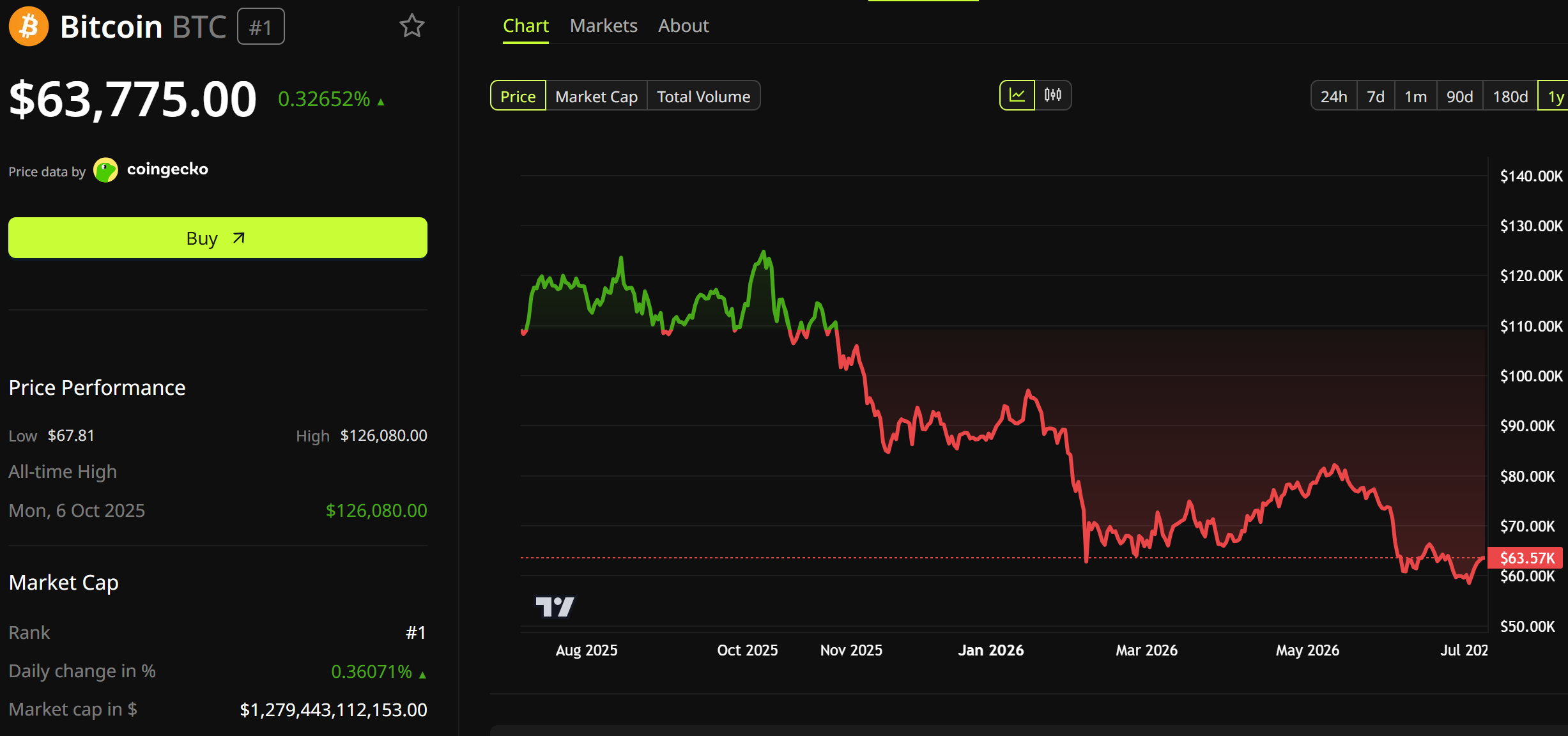
New Hampshire’s Executive Council is holding a public hearing this Wednesday on $100 million in bonds financing private Bitcoin (BTC) purchases. Approval would clear the last governmental hurdle for the first municipal bond collateralized by Bitcoin.
However, Bitcoin’s winter drawdown cut its price by more than half. This deal enters mandatory liquidation after a roughly 12.5% slide. That gap, rather than the vote, may decide how the experiment ends.

New Hampshire Bitcoin Bond Takes the Conduit Route
The New Hampshire Business Finance Authority (BFA) requested the hearing under state statute RSA 162-I. Executive Director James Key-Wallace asked Governor Kelly Ayotte and the five-member council to determine whether the project is feasible and beneficial.
If approved, the BFA will issue taxable conduit revenue bonds, meaning the state will facilitate the loan but never borrow. It will lend the proceeds to NH CleanSpark Borrower Trust 2026-1, tied to CleanSpark, the Nevada-based miner still absorbing steep first-quarter losses. Jefferies will underwrite the deal, which Wave Digital Assets designed.
Repayment falls entirely on the borrower, so taxpayers carry no direct exposure. Meanwhile, the BFA earns its fee in Bitcoin, seeding a planned Bitcoin Economic Development Fund.
House Bill 302, signed in May 2025, made New Hampshire the first state to let its treasurer hold digital assets. In contrast, the federal Strategic Bitcoin Reserve remains tangled in legal questions.
Why the 140% Liquidation Trigger Worries Researchers
Moody’s assigned the bonds a provisional Ba2 rating on March 31. That mark sits two notches below investment grade, in the tier commonly called junk bonds. The three-year notes rely on BitGo Trust Company to custody the collateral in cold storage and execute any liquidation.
CleanSpark must post $160 million in Bitcoin against $100 million of obligations, a 160% coverage cushion. If that ratio falls to 140%, mandatory liquidation and early redemption follow. All else equal, a 12.5% price drop erases that buffer.

Recent history clears that bar easily. Bitcoin peaked above $126,000 in October 2025, then slid to just above $60,000 by February. Meanwhile, record miner BTC sales showed how fast the industry converts coins to cash under stress.
David Krause, an emeritus finance professor at Marquette University, modeled the structure. He found that historical Bitcoin swings were highly likely to trigger the trigger, the Boston Globe reported.
“While the bond may serve as a proof of concept for integrating digital assets into structured finance, it is not well suited as a general-purpose public finance tool.”
Wednesday’s outcome appears predictable, since the BFA board approved the framework on November 18.
New York City rejected a similar pitch over tax law concerns, per law professor Tonya Evans.
Therefore, the harder test comes in the market, where investors must price junk-rated bonds against Bitcoin’s near-term price outlook.
The post New Hampshire Bitcoin Bond Nears Final Vote, But There is a Catch appeared first on BeInCrypto.
Stablecoins are, undoubtedly, the main operating assets in digital finance. Visa’s stablecoin analytics dashboard showed more than $51 trillion in total transaction volume over the past 12 months.
Meanwhile, TRM Labs estimated stablecoins at 30% of all on-chain crypto transaction volume in 2025. This one asset category carried almost one-third of tracked crypto value movement, while Bitcoin and all other altcoins together accounted for the remaining share.
Almost every blockchain activity today runs through these dollar-pegged assets, whether it’s trading, treasury movement, or cross-border settlement.
So, stablecoins are arguably the most explosive asset class in terms of growth. What’s the next phase? As with any financial product, its adoption. And that can only happen through local-currency settlement, regulated access, and payment use cases tied to national economies.
In the UAE, this is already happening.
UAE’s Financial Future is Running on Stablecoins
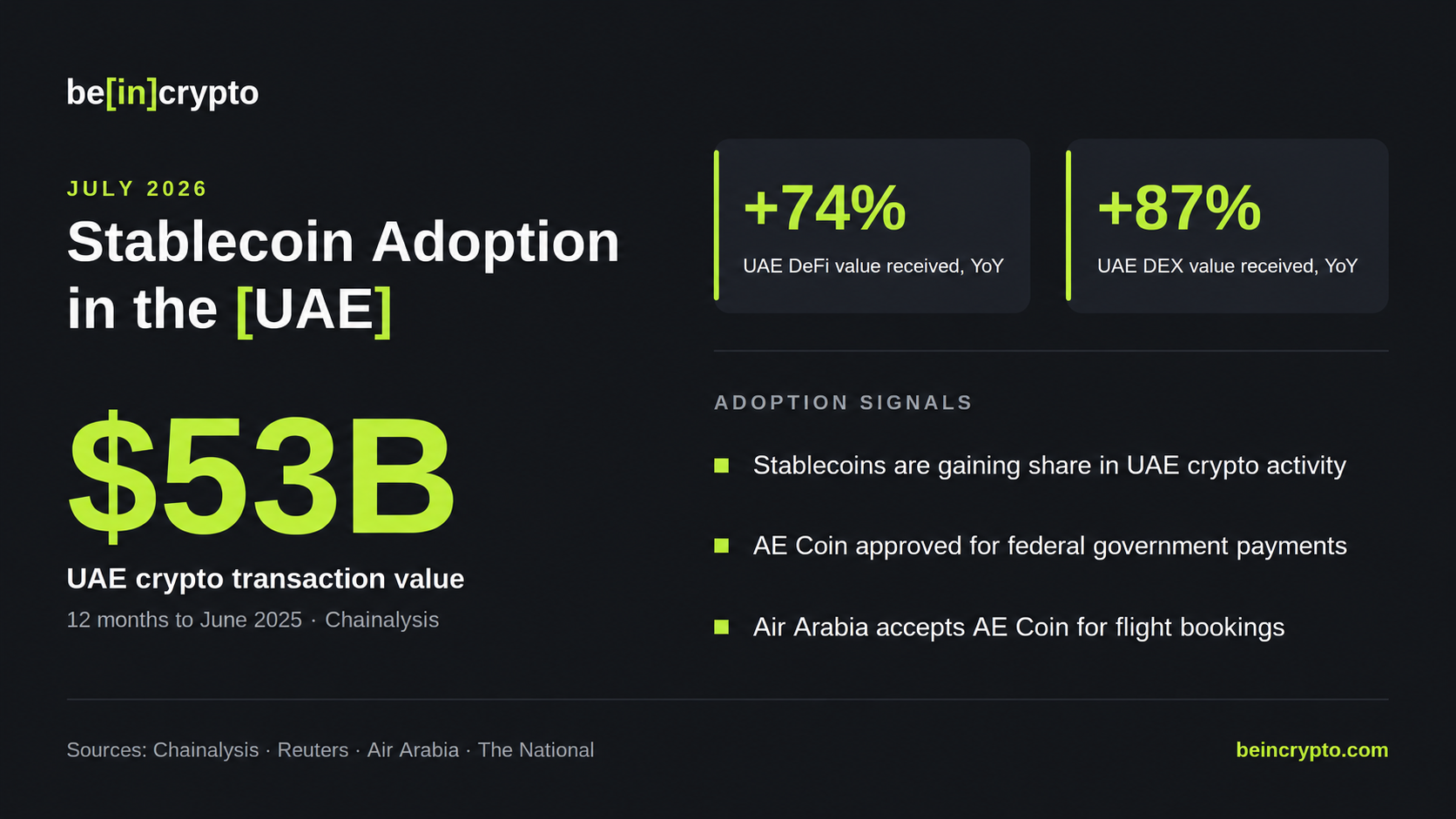
Chainalysis estimated more than $56 billion in crypto value received by the country during its 2024 to 2025 reporting window, up 33% year over year, with institutional transfers driving a large share of activity and merchant services expanding across smaller retail transaction sizes.
On July 3, 2026, DDSC, the UAE dirham-backed stablecoin developed by International Holding Company, First Abu Dhabi Bank, and Sirius International Holding, received approval from the Central Bank of the UAE to partner with selected exchange platforms regulated by Dubai’s Virtual Assets Regulatory Authority.
The approval gives DDSC a regulated route from institutional settlement into wider market access, allowing users to access, buy, and redeem a dirham-backed stablecoin through compliant exchange channels.

A Dirham Stablecoin for a Dollar-Dominated Market
Most stablecoin liquidity today remains tied to the US dollar. This gives global crypto markets deep liquidity and a familiar settlement currency, while domestic payment use cases still depend on conversion, exchange access, and banking relationships.
DDSC brings a local-currency option into the UAE’s own monetary environment. Pegged 1:1 to the UAE dirham and settled on ADI Chain, the token gives users a digital asset denominated in AED instead of forcing local commerce into dollar units.
This distinction is important for payment adoption because UAE shoppers, merchants, suppliers, and treasury teams all price everyday obligations in dirhams.
A stable asset in AED can keep pricing and settlement aligned while adding blockchain settlement speed, programmable payments, and 24/7 availability.
The UAE has already built much of the regulatory base around this category:
- The Central Bank’s Payment Token Services Regulation created a framework for stablecoin-related services, including issuance, conversion, custody and transfer.
- VARA maintains a public register of licensed Virtual Asset Service Providers in Dubai, including platforms authorized for exchange services.
DDSC connects these two regulatory channels. Central Bank approval covers the payment-token side, while access through selected VARA-regulated platforms gives users a familiar exchange route into the asset.
From Treasury Flows to Everyday Payments
DDSC entered the market with an institutional focus. Since launch, IHC says it has processed more than AED 150 million in transactions. In May 2026, IHC executed an AED 110 million DDSC transaction on ADI Chain, presented as one of the region’s largest disclosed stablecoin transactions.
DDSC is more than able to support high-value settlement. The new approval, therefore, adds distribution, giving individuals, merchants, and businesses a route to acquire and redeem the asset through regulated exchange platforms.
DDSC is left with a more complete adoption path. Large transactions can prove settlement capacity, while exchange availability can bring the asset into daily commercial use. The first phase demonstrated settlement readiness, and the next phase focuses on availability through licensed venues.
VARA-Regulated Platforms and Compliance Control
The approval applies to selected exchange platforms regulated by VARA, giving DDSC a controlled rollout through licensed channels and keeping access aligned with the UAE’s compliance framework.
For context, VARA oversees virtual asset activity in and from Dubai, excluding the Dubai International Financial Centre. Its public register lists licensed Virtual Asset Service Providers and the activities each provider is authorized to offer, including exchange services, broker-dealer services, custody, lending and investment management.
Indeed, stablecoin payments touch redemption confidence, merchant settlement, AML controls, custody, user access, and financial institution requirements. Exchange access through regulated platforms helps combine these requirements within a market structure users already understand.
DDSC’s rollout also shows how the UAE is separating regulated payment tokens from general crypto assets. Bitcoin, Ethereum, and volatile tokens continue to serve trading and investment use cases, while stablecoins such as DDSC are designed around payment value, redemption, and settlement.
This gives businesses a more suitable instrument for pricing, invoices, supplier transfers and customer payments.
A View Toward Merchant and Business Payments
IHC said the stablecoin can support everyday payments once available through selected regulated platforms, including shoppers paying merchants, businesses settling with suppliers and transfers between people.
Retail customers want fast payments, merchants want predictable settlement, and businesses want lower operational friction across invoices, treasury, and cross-border counterparties. There is no doubt that stablecoins can support these flows when they combine price stability, reliable redemption, and regulatory acceptance.
DDSC’s AED designation gives it a local advantage. A UAE merchant accepting a dollar stablecoin still faces accounting and FX conversion work. A dirham-backed token fits local pricing more naturally, while on-chain settlement can reduce delays linked to banking hours and intermediary processing.
A Local Currency Asset for the UAE Digital Economy
The UAE has spent years building a regulated digital asset environment across Abu Dhabi, Dubai and federal authorities. DDSC adds a local-currency payment asset to this environment, backed by major UAE institutions and aligned with the Central Bank’s payment-token framework.
DDSC’s growth ultimately depends on platform availability, merchant acceptance, redemption experience and business integration.
Even so, its Central Bank approval to partner with selected VARA-regulated exchange platforms brings the UAE dirham further into on-chain finance and gives the country’s digital asset market a regulated payment token built for domestic use and future regional settlement.
The post DDSC Brings Regulated Dirham Stablecoin to UAE Exchanges appeared first on BeInCrypto.
Crypto World
Rezolve Ai (RZLV) Stock Dips as Company Unveils Auditable AI for Enhanced Commerce Transparency

Key Highlights
- RZLV declined 1.34% following the introduction of Auditable AI technology.
- The new platform feature provides clear explanations for product recommendations.
- Rezolve targets enhanced enterprise trust in AI-powered commerce systems.
- The solution offers visibility into customer data and operational business logic.
- Company research indicates a 3.7x enhancement in transparency metrics.
Resolve AI PLC (RZLV) closed at $2.7328, declining 1.34% after pulling back from intraday highs to settle near the day’s lower range. The organization unveiled a new AI-driven feature designed to enhance transparency within commerce technology. This development extends its enterprise offerings and seeks to bolster trust in AI-powered product suggestions.
Platform expansion introduces transparent recommendation engine for enterprise users
Rezolve Ai unveiled Auditable AI as an integrated component of its enterprise commerce infrastructure. This innovation clarifies each product suggestion by referencing shopper preferences, transaction histories, product specifications, and operational guidelines. Through this approach, companies gain enhanced understanding of how recommendation algorithms arrive at specific conclusions.
The organization developed this solution to overcome transparency obstacles that have historically hindered enterprise AI implementation. Numerous current AI frameworks produce suggestions without revealing underlying logic. In response, this new functionality delivers human-readable explanations accessible to both businesses and end users.
Rezolve emphasized that this feature bolsters enterprise trust while encouraging wider commercial integration. The system additionally provides organizations with improved visibility throughout recommendation workflows during consumer engagements. As such, merchants can more effectively verify results and strengthen internal governance throughout digital commerce channels.
Enhanced platform capabilities reinforce commitment to reliable AI infrastructure
This recent introduction continues Rezolve’s ongoing platform enhancements centered on enterprise dependability. The organization previously tackled recommendation precision through specialized architecture that minimized erroneous AI outputs. Subsequently, it broadened supervision functionalities by launching monitoring solutions for autonomous AI behaviors.
Through this latest enhancement, Rezolve now delivers precision, responsibility, and clarity within a consolidated enterprise system. This comprehensive methodology supports organizations pursuing explainable artificial intelligence for business applications. Furthermore, the infrastructure aims to enhance confidence without compromising operational performance.
The organization also engineered the framework to function across various artificial intelligence architectures. Accordingly, enterprises can uphold uniform transparency benchmarks while deploying different AI technologies. This adaptability accommodates businesses managing varied technology ecosystems throughout retail and commerce operations.
Supporting studies demonstrate commercial advantages and wider sector applicability
Rezolve indicated that transparent recommendations can enhance consumer confidence throughout buying journeys. Shoppers can comprehend recommendation rationale through explanations derived from their documented preferences and prior behavior. Subsequently, retailers may deepen customer relationships while minimizing uncertainty during transactions.
The infrastructure also detects ambiguous customer signals before finalizing recommendation workflows. Rather than producing vague suggestions, the framework solicits supplementary information when required. This approach enables businesses to obtain more dependable recommendation results while minimizing unsuitable product pairings.
Based on company-sponsored studies, the technology achieved a 3.7-fold enhancement in transparency relative to traditional large language model frameworks. The supporting investigation also earned acceptance for presentation at the International Conference on Social Robotics 2026 in London. Concurrently, Rezolve intends to incorporate this technology throughout its Brain Suite platform as part of its ongoing enterprise commerce initiative.

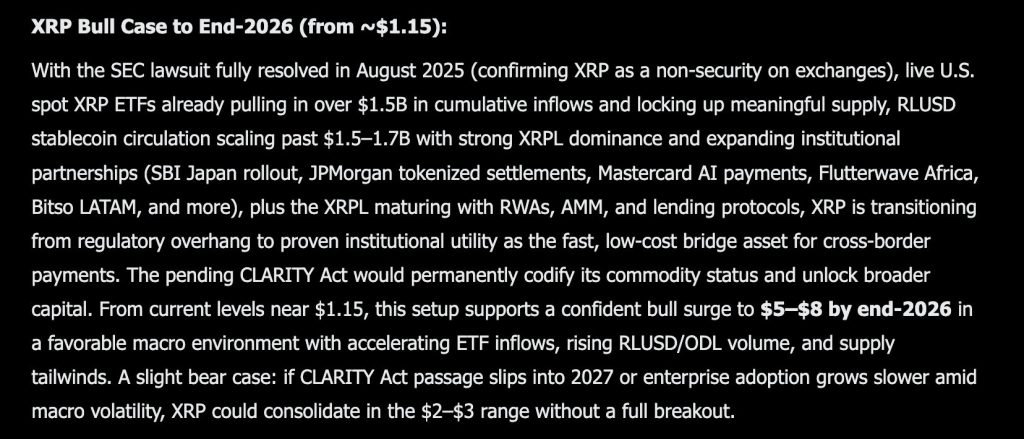
Elon Musk Grok AI just published what might be the most partnership-heavy XRP price prediction in this entire series. The model predicts $5 to $8 by the end of 2026, a 4 to 7 times return from where XRP sits today.
The bull case reads like a who’s who of global finance quietly building on the XRP Ledger while the price stays depressed. XRP trades near $1.15 today, and the thesis rests on the SEC lawsuit being fully resolved in August 2025, formally confirming XRP as a non-security on exchanges and removing the single biggest legal cloud that has held back serious institutional money for years.
Live US spot XRP ETFs have already pulled in over $1.5 billion in cumulative inflows and are actively locking up meaningful supply.
RLUSD stablecoin circulation has scaled past $1.5 to $1.7 billion with strong XRPL dominance. The partnership list is genuinely impressive by any measure.

SBI Japan is rolling out RLUSD, JPMorgan is using the XRPL for tokenized settlements, Mastercard named Ripple a partner in its AI payments network, Flutterwave is covering Africa, and Bitso is handling Latin America.
The XRPL itself keeps maturing with real world assets, automated market makers, and lending protocols all going live. Together the model frames XRP as completing a transition from regulatory overhang to proven institutional utility as the fast, low cost bridge asset for cross border payments.
The pending CLARITY Act would permanently codify its commodity status and unlock even broader institutional capital on top of everything already in motion. In a favorable macro environment with accelerating ETF inflows, rising RLUSD and on demand liquidity volume, and supply tailwinds from ETF accumulation, the model calls that $5 to $8 range a confident bull surge target.
The bear case is relatively contained. If CLARITY Act passage slips into 2027 or enterprise adoption grows slower than expected amid macro volatility, XRP could consolidate between $2 and $3 without achieving a full breakout. That would still represent a meaningful return from current levels, which tells you how skewed the model views the risk reward at $1.15.

XRP Price Prediction: XRP Finally Lifts Off The $1.00 Floor After Months Of Testing It
The daily chart shows XRP at $1.15532 after a long decline from highs above $3.65 set back in early August of last year. That entire move lower has been one extended downtrend, interrupted by a brief bounce toward $2.40 in November before sellers resumed complete control.
The most recent leg of this decline pushed XRP below $1.00 multiple times in June before buyers finally stepped in with enough conviction to push price back above that level and hold it.
That recovery off the $1.00 floor is the most meaningful chart development in months, given how many times that level was tested and how significant it is psychologically for an asset that spent years trying to sustain above $1.00 during the pre ETF era.
Resistance sits first near $1.20, the level price approached on today’s candle high of $1.16 and has not yet cleanly cleared, then a heavier ceiling near $1.60 where multiple rejections accumulated earlier this year.
Support now holds at $1.00, the exact floor that just got defended after several tests. The broader structure still shows a series of lower highs stretching back to August, so no confirmed reversal has appeared on this chart yet despite the encouraging bounce.
Momentum on the daily candles looks more constructive than at any point in the past several months, with larger green candles showing up more frequently and the $1.00 level holding on multiple tests rather than giving way.
If XRP can close convincingly above $1.20 and sustain that level through the coming sessions, the institutional accumulation story Grok is describing finally starts to show up in the price action rather than just the fundamentals.
Don’t Miss Out on Our $1,000 USDT Airdrop on ByBit
Discover: The best crypto to diversify your portfolio with
Here is What Grok AI Predicts For LiquidChain Near Future, Very Bullish
Sitting at resistance waiting for a breakout is not positioning. It is standing in line.
Bitcoin, Ethereum, and XRP have been pressing against the same ceilings for weeks. The catalyst that unlocks the next leg is perpetually one data print away.
The institutional inflows are perpetually next quarter. Every large-cap trader waiting for a breakout is waiting on a decision that belongs to someone else’s balance sheet.
Early-stage infrastructure plays by completely different rules, Copilot AI predicts. Capital that would vanish as statistical noise at Bitcoin’s scale moves a small undiscovered project by multiples.
The asymmetric return lives in one place only: the gap between what something is genuinely worth and what the market currently thinks it is worth. That gap exists because the project has not been found yet. The moment it gets found, the gap is gone.
Cross-chain fragmentation has been extracting value from DeFi participants since the first bridge went live and nobody has eliminated it. Bitcoin, Ethereum, and Solana were engineered as independent systems with no shared architecture and no intent to interoperate.
Every transaction that crosses those boundaries pays the price of that design in fees, slippage, and execution failures. Bridges were supposed to be the solution. They became the mechanism through which the problem collects its fee.
LiquidChain eliminates the fee entirely. Three networks inside a single execution layer. One deployment reaches all of them. No cross-chain tax on any interaction anywhere.
Grok AI flagged it as worth watching. The presale is at $0.01454 with just over $860,000 raised.
Execution is unproven. Adoption is unknown. Established assets offer a predictable ride toward a ceiling that is already fully visible. LiquidChain is an entry point that disappears once the market finds it.
The post Elon Musk Grok AI Predicts Incredible XRP Price Target by End of 2026 appeared first on Cryptonews.

An anonymous wallet spent $4.4 million buying BONK tokens over two days, then used that stash to push through a governance vote that allowed it to drain $21.2 million from the BonkDAO treasury.
The incident, which saw the attacker walk away with a $16.8 million profit, has split the crypto community between those calling it a theft and those insisting the DAO did exactly what it was built to do.
How the Vote Went Through
According to blockchain analytics platform Lookonchain, preparations for the theft started on June 30 when the attacker filed a proposal asking BonkDAO to move 4.426 trillion BONK, worth about $21.2 million, to a wallet they controlled. To pass, the proposal had to be supported by at least 1% of the BONK supply, which, per data from CoinGecko, stands at just under 88 trillion tokens.
Then, from around July 4, they bought 882.285 billion BONK on Bybit and Binance, an amount that was just enough to clear the 1% requirement (879.95 billion) to make a quorum that could vote on the proposal they’d made at the end of June. They then proceeded to vote “yes” with all 882.285 billion BONK, passing the proposal, after which 4.426 trillion tokens were transferred to their wallet.
Another company that follows on-chain movements, Chainalysis, corroborated Lookonchain’s account of the incident, saying the attacker acquired their tokens between July 4 and 5, buying some from the mainstream exchanges and borrowing others through DeFi platforms.
About 9 hours after voting their way to the $21 million stash, Chainalysis says the attacker sent $188,000 to OKX (Peckshield puts that figure at $148,000) while putting the rest in a new DAO, “BONK 2.0,” that they created to govern the stolen funds. According to the analytics firm, the new DAO is controlled by the malicious voter, the exploiter wallet, and a third wallet said to have financial ties to the voter wallet.
BonkDAO confirmed the treasury loss in a statement posted on X, saying it had identified the exchange wallets that had been used to acquire the voting tokens before the proposal succeeded and that it had notified law enforcement while also coordinating with exchanges, bridges, and the Solana Foundation to “manage the situation.”
Following news of the theft, the BONK token lost some of its value, with CoinGecko showing it trading around $0.00000438 at the time of writing, a 7.4% drop in 24 hours but still up nearly 5% on the week.
A Working DAO or Fraud?
The event continues a streak reported recently by CryptoRank that has seen DeFi platforms lose nearly $1 billion to bad actors so far this year.
But not everyone agrees that a crime took place, including World Liberty Financial advisor Ogle, who questioned why law enforcement had become involved in what looked like a normal DAO function.
“Someone legitimately bought a lot of tokens, proposed a DAO vote, the vote passed with almost no opposition, and the proposal was executed,” they wrote on X.
The crypto maxi later added that reports claiming the voting website was inaccessible during the voting period, if true, would raise separate concerns but did not necessarily make the on-chain vote illegal.
However, others disagreed. Ripple CTO Emeritus David Schwartz argued that using voting control over a shared treasury for personal gain could amount to fraud because governance participants owe a fiduciary duty to other stakeholders. Further, he stated that BonkDAO’s lack of a formal legal wrapper could expose participants to partnership-style liabilities in some jurisdictions.
The post Was It a Hack or Governance? BONK’s $21M Treasury Vote Divides Crypto appeared first on CryptoPotato.

REVEALED: Princess of Wales close to the high drama as exhausted hiker was rescued on Ben Nevis
Nasdaq sinks as AI worries hit chipmakers

BonkDAO Attacker Moves $19M Loot Into New 'BONK 2.0' DAO


-

 Fashion4 days ago
Weekend Open Thread: High Hopes
-
 NewsBeat3 days ago
Taylor Swift and Travis Kelce wedding staffer hilariously struggles to keep her cool while checking in megastars
-

 Fashion1 day ago
Open Thread: What Great Books Have You Read Recently?
-

 Politics4 days ago
The House | “Reframing the debate from a binary discussion of winners and losers”: Yuan Yang reviews ‘We Are Not Machines’
-
 Crypto World6 days ago
Airdrop Registration Becomes Key Focus For Remittix As RTX Launch Updates Approach
-

 Crypto World4 days ago
Standard Chartered Secures MiCA License as ESMA Adds 37 New Crypto Firms
-

 Business1 day ago
AXT Shares Jump Nearly 14% as Semiconductor Materials Maker Rebounds on AI-Linked Indium Phosphide Demand
-

 Sports6 days ago
Broncos roster: OL Ben Powers (No. 74) entering final year of contract
-

 Crypto World6 days ago
Binance stock trading tops $1B in first month after launch
-

 NewsBeat7 days ago
Presenter Caroline Flack’s brother Paul Flack dies aged 55
-

 Crypto World6 days ago
Alibaba-affiliate Ant Group enters the humanoid robot market with 12 deals
-
Crypto World1 day ago
SK hynix (000660.KS) Stock Dips as $28B Nasdaq ADR Offering Drives AI Memory Expansion
-

 Crypto World2 days ago
South Africa proposes crypto tax guidance under existing rules
-

 News Videos1 day ago
Best Time to Enter Small Caps Right Now? Another Bull Run? | Financially Free
-

 Tech2 days ago
Lenovo laptops are now shipping with YMTC SSDs, a sign of Chinese NAND entering the mainstream
-

 News Videos18 hours ago
Whats Hidden Inside This Cash Register? #treasure #reselling #money
-

 Business6 days ago
Meta Platforms Stock Jumps 7% Today as Bloomberg Reports Company Plans to Enter the Cloud Business
-
 NewsBeat6 days ago
New exhibition reflects five decades of movement between island of Ireland and GB
-

 Business5 days ago
What a 10 Percent Drop Means for Buyers, Sellers and Renters
-

 Crypto World5 days ago
Binance Re-Enters Philippines As EU MiCA Rules Restrict Access
You must be logged in to post a comment Login