

Crypto World
Analyst Predicts 2-3 Years of Crypto Gains as Risk-On Environment Emerges


Crypto analyst Matthew Hyland says the macro backdrop that punished digital currencies for four straight years is finally turning, pointing to patterns that came before crypto’s two biggest bull runs.
In a pair of posts on X, he argued that the market is entering a two- to three-year stretch of what he calls “max opportunity,” with risk appetite moving back toward crypto for the first time since 2016 and 2020.
A Repeating Four-Year Pattern
Hyland’s case rests on comparing three stretches he labels macro risk bear markets: 2014 to 2016, 2018 to 2020, and 2022 through 2026. In each of them, he says, crypto performed poorly while the wider risk backdrop stayed hostile, only for conditions to flip and set off the sector’s strongest runs. He’s now betting the current cycle is following the same script.
“Macro-Risk is now exiting the Bear Market for the first time since Mid-2016 & Mid-2020,” he wrote, adding that this kind of setup produced “max opportunity for the long term” both previous times it showed up.
He also pointed to two chart signals he sees as confirmation. Bitcoin dominance just posted a death cross for the first time since 2016 and 2020, which he treats as an early marker of the shift. He also expects altcoin dominance to follow with a golden cross this fall, something that he says would repeat what happened in those earlier cycles.
According to the market watcher, his own macro risk ratios turned at the same points in 2016 and 2020, and are turning again now, which is why he’s calling the next two to three years “the most optimal time” for crypto. However, his forecast should be taken as a market thesis and not a certainty, especially since crypto cycles have also historically been influenced by liquidity, investor sentiment, and broader economic conditions.
Wider Markets Still Sending Mixed Signals
Hyland’s call landed with Bitcoin (BTC) trading near $63,000 after earlier hitting a two-week high above $64,000, even after Strategy sold 3,588 BTC on Monday to fund dividends.
Analytics firm Swissblock described the price action as showing “signs of stabilization,” although it cautioned that a genuine recovery still needs buyers to keep showing up.
Elsewhere, analyst Credible Crypto has argued that altcoins trading 80% to 90% below their highs could outperform BTC if sentiment turns, pointing to long-term holders now controlling close to 80% of the flagship cryptocurrency’s supply. On Ethereum, trader Michaël van de Poppe said over the weekend that “the worst period for ETH is over” and cited a possible higher low against Bitcoin after three straight quarterly losses of more than 20% each.
Another market observer, Merlijn The Trader, separately flagged ETH’s dip to 0.026 against BTC, a level that foreshadowed a 230% run against Bitcoin last time it showed up. While none of these calls directly tie to Hyland’s thesis, the timing, with all landing within the same week, is hard to ignore.
The post Analyst Predicts 2-3 Years of Crypto Gains as Risk-On Environment Emerges appeared first on CryptoPotato.


European Parliament lawmakers have adopted a formal policy position on digital assets, urging the European Commission to examine whether key areas of the crypto ecosystem should be brought more clearly within the EU’s regulatory framework following the rollout of the Markets in Crypto-Assets (MiCA) regime.
The Parliament’s stance, approved Tuesday in a vote on the report “Digital assets – challenges for the competitiveness and integrity of the European Union’s financial system,” does not itself amend MiCA or impose new direct legal duties on market participants. Instead, it signals the direction EU legislators want regulators and the Commission to consider as MiCA’s initial implementation period concludes.
Key takeaways
- Parliament calls for clearer regulatory coverage of activities such as DeFi, crypto lending and borrowing, staking, and NFTs, subject to an EU-wide review.
- Lawmakers stress the need for consistent MiCA application across member states to avoid fragmented rules for the digital asset market.
- The vote turns the report into the Parliament’s official policy position, without directly changing MiCA legislation.
- MiCA’s transitional period for covered providers ended on July 1, increasing the importance of how regulators treat activities outside the current framework.
Policy position after MiCA’s rollout
MiCA provides a licensing and conduct framework for crypto-asset service providers and issuers of certain token types. However, the Parliament report reflects an ongoing debate in Brussels about how the EU should approach parts of the sector that are not fully addressed under the current scope of MiCA.
In particular, lawmakers asked the European Commission to assess whether activities including decentralized finance (DeFi), crypto lending and borrowing, staking, and non-fungible tokens (NFTs) should be brought more explicitly into the EU’s regulatory perimeter. The report also raises the question of how tokenized financial assets fit within the broader regulatory architecture.
Beyond expanding the regulatory gaze, the paper warns against the emergence of national rules that could break the EU’s single market for digital assets into separate regimes. That point matters for companies operating cross-border: inconsistent interpretations across member states could complicate compliance planning and product rollout, even where MiCA is formally meant to harmonize rules.
DeFi, staking, lending and NFTs remain central questions
Although MiCA established baseline requirements for certain crypto actors, policymakers have continued to discuss how to regulate or classify decentralized and hybrid models—especially where services are offered through protocols rather than clearly identifiable intermediaries. The Parliament’s push to examine DeFi, staking, and crypto lending suggests lawmakers want a more structured approach to these activities as market participation grows.
The report also signals that NFTs and other tokenized forms of digital assets remain politically salient. While tokenized assets can span everything from collectibles to financial representations, the Parliament’s call for an assessment indicates that legislators want clarity on when existing rules adequately protect users and when regulatory gaps remain.
Commission review and the stability-stablecoin debate
The European Commission has already been exploring whether MiCA should be adapted. In May, the Commission opened a public consultation on potential changes to the framework, including whether additional crypto activities should fall within scope. The consultation also covered whether restrictions on interest-bearing stablecoins should be revisited.
By adopting Tuesday’s position paper, Parliament effectively adds legislative weight to that review. The report’s emphasis on expanding the regulatory perimeter where needed—and keeping implementation consistent—fits the broader narrative that MiCA is both a foundation and a starting point rather than a final endpoint.
Lawmakers also framed the discussion in terms of EU competitiveness. The Parliament’s report takes a more supportive tone toward tokenization and euro-denominated stablecoins, arguing that well-regulated digital assets could strengthen the competitiveness of EU financial markets if rules are applied consistently across the bloc.
What MiCA transition ending changes for compliance
One practical driver behind the timing is MiCA’s implementation timetable. According to Cointelegraph’s earlier coverage, MiCA’s transitional period ended on July 1, meaning crypto-asset service providers covered by MiCA can no longer rely on the transition to continue operations across the EU without authorization under the new licensing framework.
This matters in the policy debate because authorization processes and conduct rules already create immediate compliance obligations for covered providers. At the same time, activities that sit outside MiCA’s current scope—such as parts of the DeFi stack or certain token types—can become more controversial as regulated entities seek clarity and as market participants test the boundaries of existing rules.
Parliament’s warning about fragmented national approaches therefore lands with particular force as companies navigate both the MiCA licensing regime and unresolved questions about how the framework will treat broader categories of crypto activity.
Over the coming months, market participants should watch for how the European Commission responds to the consultation process and to Parliament’s newly adopted position—especially around whether DeFi, staking, lending, and NFTs move closer to MiCA’s regulatory perimeter, and how Brussels plans to maintain consistent application across member states as providers transition fully to the authorization model.

Vanguard is hiring a head of digital assets to lead the asset manager’s strategy on tokenization, stablecoins, blockchain infrastructure and client-facing digital asset products, signaling a broader push into the sector after years of resisting crypto investment offerings.
According to the job description on Vanguard’s website, the executive will be responsible for determining how Vanguard participates in digital assets, including evaluating client-facing products, tokenization, stablecoins, custody models, blockchain-based settlement and digital asset operating infrastructure. The role will also represent Vanguard in discussions with regulators, clients and industry groups.

Hiring announcement for Vanguard head of digital assets. Source: Vanguardjobs.com
The move marks a notable shift for the asset manager, which has long resisted crypto investment products. In August 2024, CEO Salim Ramji said the company would not launch crypto exchange-traded funds, arguing Vanguard would not “copy competitors” despite the rapid adoption of spot Bitcoin ETFs.
ETF analyst Nate Geraci highlighted the contrast in an X post on Tuesday, noting Vanguard had previously blocked customers from purchasing spot Bitcoin and Ether ETFs through its brokerage platform. “Life moves pretty fast,” he wrote.
Founded in 1975, Vanguard manages approximately $12.5 trillion in global assets, according to the company.
Related: Broadridge rolls out crypto, tokenized asset platform for Canada wealth managers
Asset managers expand into tokenized finance
Vanguard’s hiring comes as asset managers push deeper into tokenization. According to RWA.xyz data, the tokenized real-world asset market has grown to $33.5 billion, including $14.9 billion in tokenized US Treasury products.
Franklin Templeton manages about $2.5 billion in tokenized assets, BlackRock oversees roughly $2.3 billion and WisdomTree’s tokenized Treasury fund has grown to more than $700 million.
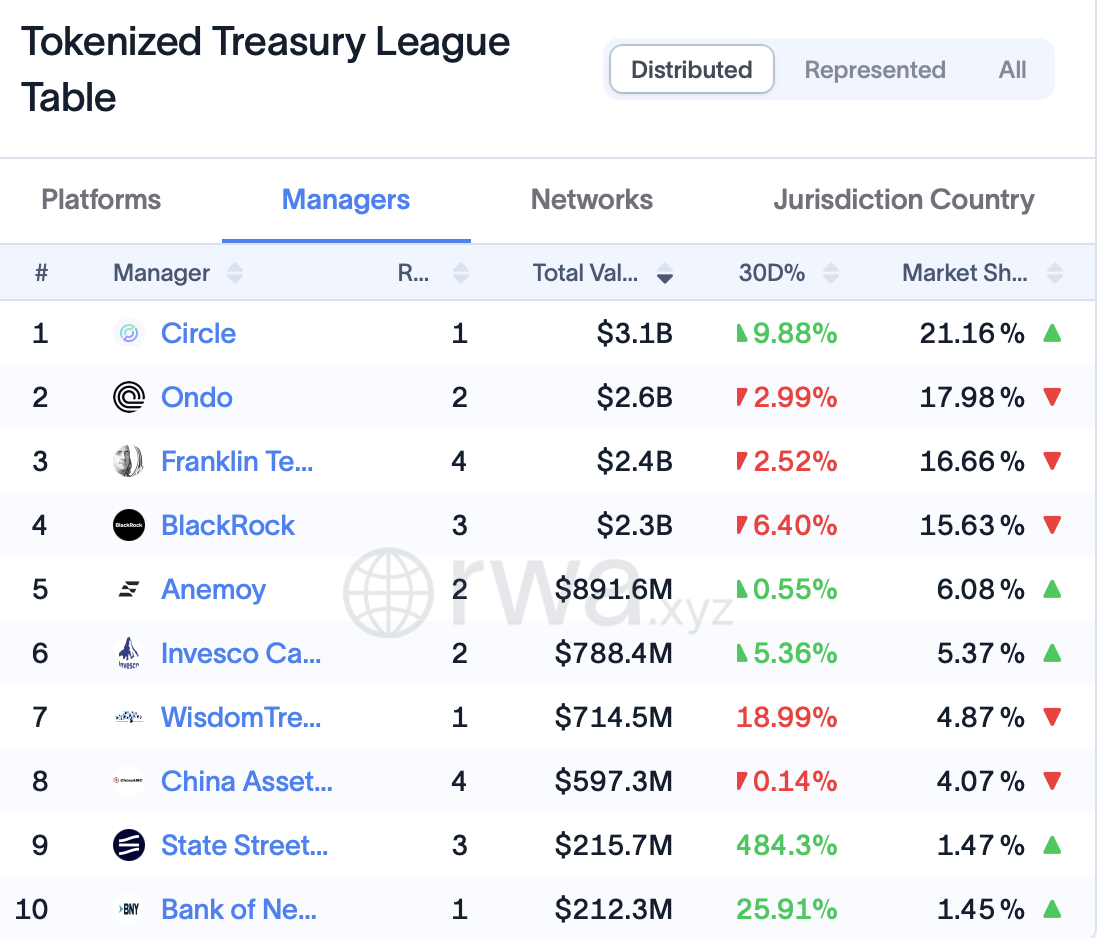
Top tokenized treasury managers. Source: RWA.xyz
In March, Franklin Templeton partnered with Ondo Finance to offer tokenized versions of its ETFs accessible through crypto wallets, and then launched a dedicated cryptocurrency investment division following its acquisition of crypto asset manager 250 Digital.
JPMorgan and State Street have also entered the market for tokenized cash products. JPMorgan filed in May to launch a tokenized money market fund for stablecoin issuers, while State Street introduced a government money market fund for stablecoin reserves and a tokenized liquidity product the following month.
Also in May, Fidelity launched a blockchain-based liquidity fund, which received its first crypto-native investment last month after Theo allocated $20 million to the product.
Magazine: AI is banking the unbanked in Africa… faster than crypto
Bitcoin is trading near $64,000 and is still down sharply from its most recent cycle high above $126,000 reached in October 2025. The drawdown is less dramatic than in earlier cycles, but the rally that followed the 2025 post-halving momentum and exchange-traded fund (ETF) inflows has clearly cooled—leaving analysts to debate not only where the market will go next, but what “a cycle bottom” even means in a market increasingly shaped by traditional finance.
As bearish and bullish camps clash, the common thread is that Bitcoin’s current moves are harder to interpret using old playbooks. Several analysts argue that liquidity and macro conditions are still driving outcomes, while others say ETF-linked institutional demand has shifted the dynamics enough that standard cycle signals may not fully reset. Meanwhile, one view increasingly framed the question as an issue of global capital allocation—whether crypto can again attract marginal risk capital versus AI and equities.
Key takeaways
- Bitcoin’s decline from the October 2025 peak has not triggered a clear consensus on whether a durable bottom is already in.
- One camp links downside risk to macro liquidity and expected retests of lower ranges, rather than crypto-native cycle indicators.
- Another camp points to sell-side exhaustion signals and suggests downside may be limited, even if the final bottom remains unconfirmed.
- A structural perspective argues that ETFs and the growing role of derivatives mean Bitcoin may build a broader base rather than print a sharp V-shaped low.
Why bulls and bears disagree on the meaning of “bottom”
In the run-up to the October 2025 high, Bitcoin’s strength was tied to a mix of post-halving momentum and renewed institutional demand, with spot Bitcoin ETF flows playing a prominent role. Since then, price action has turned downward, but the magnitude of the pullback—roughly half from the cycle peak—has been enough to keep both sides engaged.
Standard Chartered and other bullish institutional desks have suggested Bitcoin may have already found a cycle bottom, citing improving long-term capital flows and structural ETF-related demand. In contrast, Galaxy Research argued in June that traditional cycle signals may not have fully reset, meaning investors should not assume the worst is over simply because the market has declined materially.
That tension has become more pronounced because Bitcoin’s trading environment is now different. ETFs increase off-chain participation, macro liquidity affects risk appetite more directly, and the way derivatives markets feed into day-to-day pricing can blur the signals that historically defined cycle turning points.
Downside scenarios: Bitcoin still tied to macro liquidity
On the more cautious end, Russell Thomson, chief investment officer at Hilbert Capital, told Cointelegraph that Bitcoin remains in a downcycle and could break below recent lows before forming what he considers a durable base.
Thomson’s path is explicit: he expects Bitcoin to first revisit the $56,000 to $52,000 area, which corresponds to summer 2024 lows. If that range does not stabilize the market, he pointed to a further extension toward approximately $40,000 to $45,000, which he associates with prior consolidation phases early in 2024.
He also framed timing in terms of the broader cycle rhythm, suggesting a potential low around October 2026, while emphasizing that macro policy changes could move that timeframe earlier. Thomson singled out Fed rate cuts and the potential passage of the CLARITY Act as examples of developments that could bring the bottom forward.
Importantly, his argument is not that Bitcoin is insulated by institutional participation—it is that institutional capital may have increased Bitcoin’s sensitivity to global liquidity. In his characterization, Bitcoin behaves less like a detached, crypto-native asset and more like a “high-beta macro instrument.”
That framing aligns with research coverage from Citibank. Reuters reported on July 1 that Citi cut its 12-month Bitcoin price target to $82,000 from $112,000, citing ETF flows turning negative and broader market dynamics. Reuters also emphasized that the growing integration of Bitcoin into traditional markets may have strengthened correlations with risk assets and macro liquidity rather than reducing volatility.
Late-stage bear market view: exhaustion signals, but confirmation lacking
André Dragosch, head of research (Europe) at Bitwise, offers a middle position: he sees the environment as consistent with a late-stage bear market, where multiple indicators already point to downside exhaustion.
Dragosch told Cointelegraph that sentiment deterioration has reached levels last seen after the collapse of FTX in 2022, a period often associated with seller fatigue. However, he stopped short of declaring that the cycle bottom is definitively in place, saying he does not believe the final bottom has been confirmed—though the market is probably “very close.”
He also cautioned against treating any single indicator as definitive for identifying a cycle bottom, especially as the market structure evolves. With ETFs and institutional participation increasing off-chain trading, Dragosch argued that some historical cycle indicators may be less reliable than they were in prior cycles.
Even with that uncertainty, he suggested that risks may be increasingly limited at current levels. He added that Bitcoin could potentially outperform artificial intelligence equities over the coming months if macro conditions stabilize—an observation that reinforces the broader theme: the next stage may depend less on internal crypto metrics and more on whether the macro backdrop shifts in favor of risk assets.
Galaxy Research’s base-case scenario, referenced in the same discussion, similarly points to the possibility of further downside—projecting a range of roughly $40,000 to $46,000—depending on how liquidity and macro conditions evolve.
Structural shift: derivatives and ETF-era competition complicate cycle calls
Dean Chen, an analyst at Bitunix Exchange, approached the debate from a structural angle. He told Cointelegraph that Bitcoin remains in a downcycle, but that the decline is increasingly defined by global liquidity competition rather than internal crypto market structure.
Chen argued that the approval of US spot Bitcoin ETFs in 2024 created a structural capital base that supports Bitcoin’s valuation range, even if price is still trending downward. In his view, ETFs have made institutional demand more persistent, but they have also placed Bitcoin into direct competition with other major global narratives for incremental liquidity—particularly artificial intelligence and equities.
This is a key distinction. If Bitcoin is competing for marginal capital rather than acting as a self-contained asset within crypto-specific cycles, then “bottom calling” may need to shift. Chen said the more important question is not simply when Bitcoin bottoms, but when crypto once again becomes the most attractive destination for global risk capital.
He further noted that derivatives markets play a larger role in price discovery now than in previous cycles. With funding rates and open interest increasingly influencing short-term volatility, Chen argued that Bitcoin may not print a sharp, single-moment V-shaped bottom. Instead, he suggested it could spend a prolonged period building a structural base.
A cycle that may not fit the old template
Taken together, the competing views highlight a deeper disagreement than just where prices might land. Thomson emphasizes macro-driven downcycle risk and expects additional retests before a durable base. Dragosch points to late-stage bear market characteristics and seller fatigue signals, but stresses that the final bottom still isn’t confirmed. Chen argues that ETF-era structure, derivatives-driven volatility, and competition for liquidity make historical “cycle bottom” frameworks increasingly incomplete.
In this cycle, the dispute appears to be shifting from “what price is the bottom?” to “whether a bottom still behaves like a single, discrete event.”
For investors and traders, the next signals to watch may be less about finding a precise turning-point label and more about whether macro liquidity conditions improve, how ETF-linked flows behave, and whether derivatives positioning stabilizes. Until those forces align, the question of a confirmed bottom is likely to remain open—even if downside exhaustion is already visible in sentiment.

Ripple’s Chief Legal Officer Stuart Alderoty has criticized Politico over its interpretation of a recent opinion poll, where the publication framed support for crypto legislation as “only 27%,” arguing that the figure actually represents 67 million American adults who already own digital assets.
According to him, that same percentage cited as a sign of weak public backing for crypto regulation reflects one of the country’s biggest voter groups, therefore challenging the idea that crypto supporters are a niche audience.
Polls Tell A Different Story Than That Suggested By Headlines
In a July 6 opinion piece on RealClearMarkets, Alderoty argued that the 27% from the Politico survey was about the same number as that quoted in the National Cryptocurrency Association’s 2026 State of Crypto Holders Report of 1 in 4 adults who own crypto in the country. That translates to about 67 million people.
“The framing of ‘only 27 percent’ treats a quarter of the American adult population as a rounding error,” Alderoty wrote. “That is a mistake. Sixty-seven million people are not asking Washington to do them a favor. They are asking their government to do its job.”
He pointed out that the number that had joined crypto in the past year, about 12 million per the NCA’s report, was as big as the combined populations of New York City and Los Angeles, moving the ratio from last year’s 1 in 5 to the current 1 in 4.
He also noted the demographic changes stated in the 2026 industry study, saying 42% of new holders are women, which pushed female ownership up by 10% year over year. That growth alone, in his opinion, makes it difficult to dismiss the industry as politically insignificant.
According to Politico, 45% of Americans believe digital currencies are not worth the risk, while 25% considered it worthwhile. Only 9% of respondents said they would trust a crypto platform over traditional banks with their money, compared to 47% who were in support of the traditional financial institutions.
But Alderoty claimed that those findings did not suffice as evidence of public rejection.
“A majority of Americans think the stock market is risky…Risk aversion is not the same as rejection,” he explained, adding that “69% of holders say they trust crypto, a higher share than the 65% who say the same of traditional banking.”
CLARITY Act Talks Continue
The debate comes as the CLARITY Act missed the White House’s July 4 signing target, leaving lawmakers with limited time before the August recess to complete work on the crypto market structure legislation.
As CryptoPotato reported previously, the Senate Banking Committee approved the measure in a 15-9 vote on May 14, but the bill still requires a full Senate vote and must be reconciled with a separate legislation advanced by the Senate Agricultural Committee before any version can move to the House and finally reach President Donald Trump’s desk.
The post Ripple CLO Stuart Alderoty: 67 Million Crypto Owners Are Not a ‘Rounding Error’ appeared first on CryptoPotato.

Key Highlights
-
eToro introduces Tori AI assistant for real-time portfolio analysis and market alerts.
-
ETOR stock declines 0.46% following the company’s comprehensive platform overhaul.
-
Sub-account feature enables traders to compartmentalize investment strategies and objectives.
-
eToro Edge platform delivers professional-grade desktop trading capabilities.
-
Self-custody wallet integration strengthens eToro’s cryptocurrency and DeFi offerings.
Shares of eToro Group Ltd. (ETOR) closed at $41.12, declining 0.46%, following the firm’s announcement of a comprehensive platform transformation centered around its new AI assistant, Tori. The rollout represents eToro’s ambitious effort to integrate artificial intelligence, enhanced account management, and cryptocurrency self-custody into its trading ecosystem. This strategic initiative positions the company as a more competitive player in the evolving retail investment landscape.
Tori AI Assistant Powers Redesigned Mobile Platform
During its Intelligence in Motion conference held in London, eToro presented its completely redesigned mobile application. The refreshed platform prioritizes speed, intuitive navigation, enhanced portfolio visualization, and comprehensive asset information pages. Additionally, traders now have access to sophisticated charting capabilities and customizable interface options tailored to individual preferences.
At the heart of this transformation sits Tori, an intelligent AI assistant engineered to proactively deliver portfolio analytics and market trend notifications. The system interprets significant price fluctuations and presents contextual explanations in real time. Consequently, traders receive actionable intelligence without actively searching for updates.
Beyond the primary mobile application, eToro intends to extend Tori’s availability across multiple platforms. The firm confirmed that traders will soon interact with Tori via WhatsApp messaging and Apple Watch integration. This multi-platform approach enables position monitoring and rapid response to market developments from virtually anywhere.
Multiple Account Framework and Professional Desktop Solution
eToro rolled out a sub-account infrastructure designed for investors pursuing multiple financial objectives simultaneously. These segregated accounts accommodate distinct strategies for home purchases, retirement planning, education funding, and other long-term aspirations. The framework enables parallel management of diverse investment portfolios within a single platform.
The company simultaneously launched eToro Edge, a comprehensive desktop solution targeting sophisticated traders. This platform delivers institutional-quality charting tools and analytical capabilities suited for high-volume trading operations. It addresses the requirements of users demanding granular market analysis and execution tools.
As part of the platform evolution, eToro introduced AI-driven portfolio management features. Traders can now construct original AI trading strategies or replicate existing ones within dedicated sub-accounts. Meanwhile, Tori maintains organizational oversight while preserving user autonomy over investment decisions.
Developer Marketplace and Cryptocurrency Custody Solutions
eToro simultaneously enhanced its App Store ecosystem, which hosts third-party trading tools and analytical applications. Through the newly established Builders’ Portal, external developers, quantitative analysts, partners, and community members can create custom applications. This gateway provides standardized API access and comprehensive development documentation.
The company integrated seamless self-custody wallet creation directly through the Tori interface. This feature leverages Zengo’s technology, which eToro recently acquired. The wallet solution grants users complete control over digital assets while facilitating participation in decentralized finance protocols.
This comprehensive platform transformation arrives amid intensifying competition among trading platforms emphasizing automation, data intelligence, and cryptocurrency integration. eToro established its market presence through social trading features before expanding into digital assets. The company now leverages Tori to unify social trading insights, portfolio management capabilities, and AI-enhanced trading functionality into a cohesive ecosystem.


Kraken’s parent company, Payward, says it has secured a $22 million arbitration award against its former auditor, Mazars USA, and has moved to have the award entered as a judgment in Delaware’s Court of Chancery. The update comes via a letter published Tuesday by Payward co-CEO Arjun Sethi.
Payward’s filing characterizes the dispute as compensation for financial harm tied to what Sethi described as pressure campaigns aimed at lawful crypto firms—an issue that has remained central to broader debates over banking access for the digital-asset industry.
Key takeaways
- Payward says it won a $22 million arbitration award against Mazars USA and is seeking court judgment to formalize it.
- Payward claims Mazars withdrew from Kraken’s nearly completed 2022 audit despite stating it found no fraud or issues with management integrity.
- Sethi links the auditor departure to “Operation Chokepoint 2.0”—a wider alleged effort to pressure banks and service providers away from crypto.
- The letter points to 2023 U.S. regulatory developments and banking network collapses to support the broader narrative.
- Kraken executives continue to frame auditor access as vital, while U.S. regulators work on “debanking” supervision concerns.
Payward pursues judgment in Delaware after arbitration win
In Sethi’s Tuesday letter, Payward stated that it has won an arbitration award totaling $22 million against Mazars USA. Payward then asked the Delaware Court of Chancery to enter judgment on the award, according to the co-CEO’s publication.
Payward’s account emphasizes the context of the nearly completed 2022 audit. The company said Mazars withdrew from the engagement even though it had purportedly concluded there was no fraud, raised no concerns about management’s integrity, and reported no disagreements with Payward.
Sethi used the moment to underscore what he described as the practical importance of independent auditing. “An audit is not a favor. It is oxygen,” he wrote, arguing that audits are often required to maintain the trust and documentation banks and regulators expect—particularly for obtaining banking services, licenses, and other business relationships.
Why Payward says the auditor exit matters
For crypto businesses, an auditor is more than a compliance checkbox. Audited financial statements can influence how banks assess risk, how counterparties evaluate legitimacy, and how regulators gauge transparency. Payward’s narrative therefore turns a specific arbitration dispute into a broader case study about how access to traditional financial rails can hinge on third-party relationships.
Sethi further argued that Mazars’ withdrawal was connected to “Operation Chokepoint 2.0,” which he described as a campaign that pressured banks, auditors, and other institutions to cut ties with crypto companies despite their lawful status.
In support of that claim, the letter cited a range of 2023 developments. These included:
- Joint guidance from U.S. banking regulators.
- The Securities and Exchange Commission’s Staff Accounting Bulletin No. 121, which Payward noted has since been rescinded.
- The collapse of crypto-focused banking networks including Silvergate SEN and Signature’s Signet.
While Payward’s letter uses these events to bolster its framing, the key factual point for readers is Payward’s assertion that the auditor’s departure occurred even after Mazars found no fraud and did not flag integrity or reporting concerns. The implication is that the exit was not driven by a conventional audit-based failure—at least as Payward describes it—making the arbitration outcome and the court step to enter judgment particularly significant to the company.
Kraken executives connect the case to broader “debanking” concerns
Payward’s leadership also addressed the arbitration win publicly. Kraken co-CEO Dave Ripley posted on X that the story is “worth surfacing” despite being “PTSD-inducing,” arguing that only “a fraction of the stories from that era have ever been told.”
Ripley described the $22 million award as compensation for financial harm he linked to what he called a coordinated campaign against the crypto industry. Payward’s executives thus position the arbitration award not just as a private dispute resolution, but as an example of how crypto firms can face structural obstacles from the traditional institutions they rely on.
At the same time, regulators in the U.S. have continued to confront complaints about “debanking”—the risk that banks terminate or restrict accounts for reputational reasons rather than concrete misconduct. According to earlier coverage, in February the Federal Reserve sought public feedback on a proposal to formally remove “reputation risk” from bank supervision. The move was described as following a 2025 directive to stop pressuring banks to close customer accounts over reputational concerns, and critics argued the change could help bring an end to Operation Chokepoint 2.0.
For crypto stakeholders, the practical question is whether regulatory supervision adjustments translate into measurable improvements in banking access—especially for firms that need auditors, custodians, and intermediaries to operate at scale.
What else the company has been signaling: IPO plans and timing uncertainty
Beyond the arbitration, Payward and Kraken have continued to discuss broader corporate milestones. Kraken, founded in 2011, has been widely expected to pursue an initial public offering.
In November 2025, Kraken said it had confidentially submitted a draft Form S-1 registration statement to the U.S. Securities and Exchange Commission. However, reporting in May suggested the timeline for a public debut may extend to 2027, citing weaker crypto market conditions and the exchange’s ongoing cost-cutting efforts.
While the auditor dispute is a separate development, it fits into the same investor-relevant theme: how traditional finance gatekeepers—auditors, banks, and regulators—can shape the cost of doing business and the path to market participation. If Payward’s framing is accurate, arbitration outcomes may serve not only as recovery for past harm but also as leverage in future negotiations with institutional counterparties.
As Payward seeks Delaware court confirmation, readers should watch whether the judgment process proceeds smoothly and whether the dispute’s narrative—no fraud found, yet audit withdrawal occurred—finds echoes in other similar cases. In parallel, attention will likely remain on how U.S. banking regulators handle “reputation risk” and whether that guidance meaningfully reduces the operational friction crypto companies report when trying to retain or replace auditors and banking relationships.


KAST, a stablecoin-powered card and neobank that raised $80 million in a Series A round in March at a $600 million valuation, spent the past week defending itself on Crypto Twitter after ether.fi co-founder and CEO Mike Silagadze called the company "Kasthole scammer" in a post that had gathered… Read the full story at The Defiant
Gold trades near $4,140 on Tuesday, down 26% from January’s record high of $5,598 per ounce. This gold price prediction for July 2026 examines why the metal keeps falling and where it could bottom.
Five fundamental forces continue to weigh on the metal. Meanwhile, the weekly and daily charts point to deeper downside targets.
Why is Gold Going Down?
Gold’s decline started with the Strait of Hormuz. Iran has blocked the waterway since late February, driving up energy prices worldwide. As a result, US inflation reached 4.2% in June, its highest level in three years.
That inflation spike flipped the Federal Reserve narrative. Markets no longer expect rate cuts and now lean the other way.
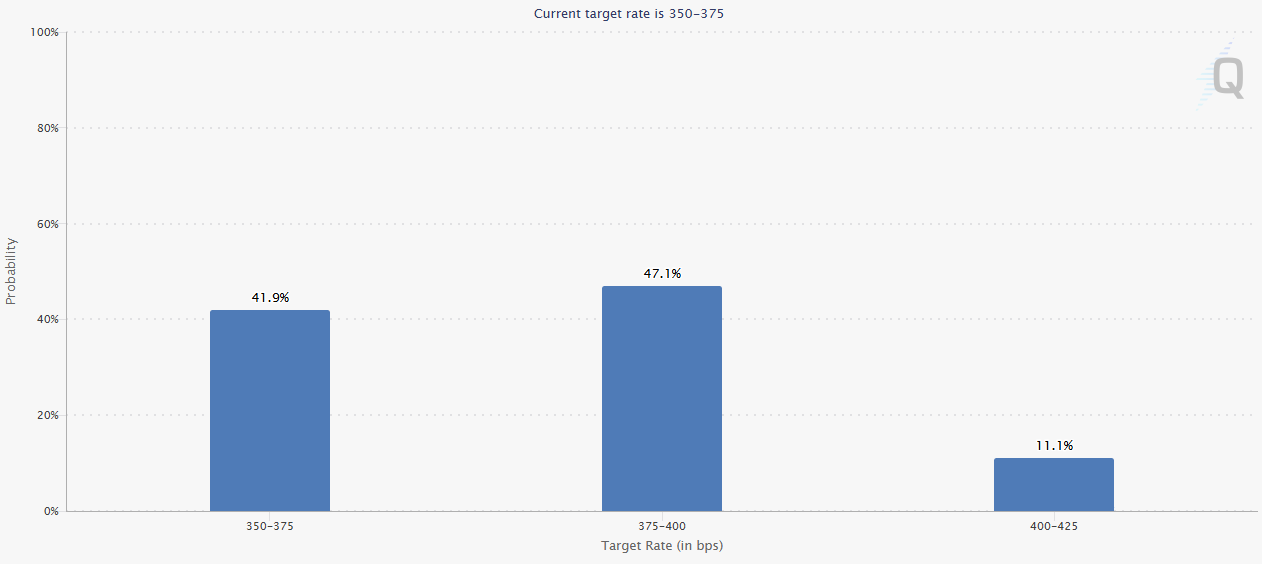
According to CME FedWatch data, traders are pricing a 47.1% chance of a 25-basis-point hike in September. Another 11.1% expect a 50-basis-point move, so tightening odds total roughly 58%.
Higher rates hurt gold because the metal yields nothing. Therefore, every rise in hike expectations lifts the cost of holding it.

The second and third drivers reinforce the first. The Iran conflict strengthened the US dollar, and gold usually moves against it. In addition, progress on a US-Iran peace deal keeps draining the safe-haven premium built into January’s record.
Exchange-traded fund (ETF) investors add a fourth layer of pressure. World Gold Council data shows gold ETFs lost 16 tonnes in May, with redemptions continuing into June. Around 298 tonnes of ETF gold are now in the red by nearly $4,000, which may cap any rallies.
The chart below captures that reversal in demand. Rolling 90-day flows peaked near $30 billion in late February. They have since fallen to between minus $5 billion and minus $10 billion.

Finally, investors have rotated back into technology stocks, pulling capital away from defensive assets.
However, the picture is not entirely one-sided. Central banks bought a net 244 tonnes in the first quarter, above their five-year average.
Fed Chair Kevin Warsh also signaled no rush to raise rates after weak June jobs data. JPMorgan still sees $4,500 by the fourth quarter, while Goldman Sachs targets $4,900 by year-end.
Five Key Factors Impacting Gold Price
| Fundamental factor | Current reading | Impact on gold |
|---|---|---|
| Fed rate hike repricing | 58% odds of a September hike (CME FedWatch) | Strongly bearish |
| Stronger dollar and yields | Dollar lifted by the Iran conflict | Bearish |
| Fading safe haven premium | US-Iran deal progress | Bearish |
| ETF outflows | 16 tonnes out in May; 298 tonnes held at a loss | Bearish |
| Risk-on rotation | Capital moving into tech stocks | Bearish |
| Central bank buying | Net 244 tonnes in Q1 2026 | Supportive |
Weekly Chart Shows a Head and Shoulders Breakdown Risk
Gold has printed lower highs and lower lows since the January peak. On the weekly chart, that decline formed a head-and-shoulders pattern. The left shoulder was priced at around $4,500 in October 2025. The head marks the $5,598 record, and the right shoulder topped near $4,850 in April.
The pattern’s neckline rises from the November 2025 lows toward $4,200, and the price trades right at that line. If a weekly candle closes decisively below it, the measured target sits between $2,575 and $2,750.
That zone lies roughly 35% below current levels and remains the deepest bearish target for now.

Before that, the $3,300 to $3,400 area offers strong support. Gold accumulated there for four months in 2025 before its parabolic advance. A previous BeInCrypto gold prediction discussed a potential breakout that never materialized.
Momentum adds to the bearish case. For the first time since 2024, gold trades below its 20-week moving average. That average supported the entire uptrend. However, it rejected the recovery bounce in May and now slopes downward.
Gold Price Prediction Hinges on the $4,300 Resistance
The daily chart tells a similar story. Since the record high, gold has respected a declining parallel channel. The channel’s midline currently acts as temporary support near $4,141.
That midline has already failed twice, in February and in March. Each failure sent the price to the channel’s lower band. A third breakdown could repeat that path. By late summer, the lower band is expected to cross the $3,300 to $3,400 support zone, about 20% below the current price.
Resistance is clearly defined. The $4,300 to $4,400 zone supported gold from January until early June. It then flipped into resistance and rejected the mid-June recovery attempt.
The supertrend indicator has also remained red since the all-time high, a setup that BeInCrypto’s earlier channel analysis identified in a prior downtrend.

Two catalysts could decide July’s direction. The Fed releases its June meeting minutes this week, and September hike odds will move with each data print. Meanwhile, a signed US-Iran deal could cut energy prices and revive rate cut bets.
The July outlook, therefore, reduces to two levels. A daily close above $4,400 would break the channel and challenge the bearish structure.
In contrast, a weekly close below the neckline would trigger the head-and-shoulders target near $2,575.
The post Gold Price Outlook For July 2026 appeared first on BeInCrypto.


Bitcoin Suisse has secured full regulatory approval in Abu Dhabi, allowing the Swiss crypto firm to expand its regulated digital asset business across the United Arab Emirates.
Summary
- Bitcoin Suisse has secured a full ADGM license, allowing it to offer regulated crypto services across the UAE.
- The approval follows the firm’s recent MiCA license in Liechtenstein, expanding its regulated presence in Europe and the Middle East.
- Abu Dhabi continues attracting major crypto firms as it strengthens its position as an institutional digital asset hub.
ADGM approval opens regulated crypto services across the UAE
According to a July 7 announcement, Bitcoin Suisse’s Middle East subsidiary, BTCS (Middle East) Ltd., has received full Financial Services Permission (FSP) from the Financial Services Regulatory Authority (FSRA) of Abu Dhabi Global Market (ADGM).
The authorization allows the company to provide regulated digital asset services to institutional clients throughout the UAE.
Under the license, BTCS (Middle East) Ltd. can offer spot trading in approved virtual assets, institutional-grade custody services, and hedging products, including derivatives. The approval follows a multi-stage regulatory review conducted by ADGM before granting the final authorization.
Bitcoin Suisse said it currently safeguards about $3.7 billion in crypto assets globally. The company also ranks as the world’s fourth-largest staking operator by assets, adding an established institutional business to Abu Dhabi’s regulated crypto ecosystem.
Speaking about the approval, ADGM Chief Market Development Officer Arvind Ramamurthy said the arrival of Bitcoin Suisse further strengthens Abu Dhabi’s position as a destination for institutional digital asset infrastructure.
The company added that its Abu Dhabi business is also preparing to support clients seeking access to tokenized real-world assets as that market continues to develop.
Multiple licenses strengthen Bitcoin Suisse’s regulated footprint
The Abu Dhabi approval follows another regulatory milestone secured only weeks earlier. On June 22, Bitcoin Suisse obtained a Markets in Crypto-Assets Regulation (MiCA) Crypto-Asset Service Provider (CASP) license from Liechtenstein’s Financial Market Authority.
The European authorization gives the company passporting rights across the European Economic Area, allowing it to serve institutional investors and high-net-worth clients throughout eligible markets. Together with its existing regulatory approvals, the latest license expands Bitcoin Suisse’s presence across multiple regulated jurisdictions.
Abu Dhabi has continued attracting established crypto firms through its licensing framework. Earlier, Binance secured an ADGM license alongside multiple FSRA authorizations covering trading and custody services, while Kraken also received regulatory approval to operate in the emirate.
The development comes as several jurisdictions across Asia and the Middle East continue building formal crypto regulatory systems. As crypto.news previously reported, Dubai’s Virtual Assets Regulatory Authority recently granted its 50th virtual asset service provider license to Tribe Tokenisation FZE, placing the emirate ahead of Hong Kong and Singapore by reported licensing totals, although those figures do not necessarily indicate the number of active firms or business volumes.
Regulatory approaches across the region remain mixed. Dubai and Abu Dhabi have expanded licensing frameworks designed for digital asset companies, crypto.news previously reported that countries including India and Russia continue to keep state oversight at the center of their digital asset policies.
For Bitcoin Suisse, the Abu Dhabi approval adds another regulated operating base as the company expands its institutional services across Europe and the Middle East under established financial regulatory frameworks.
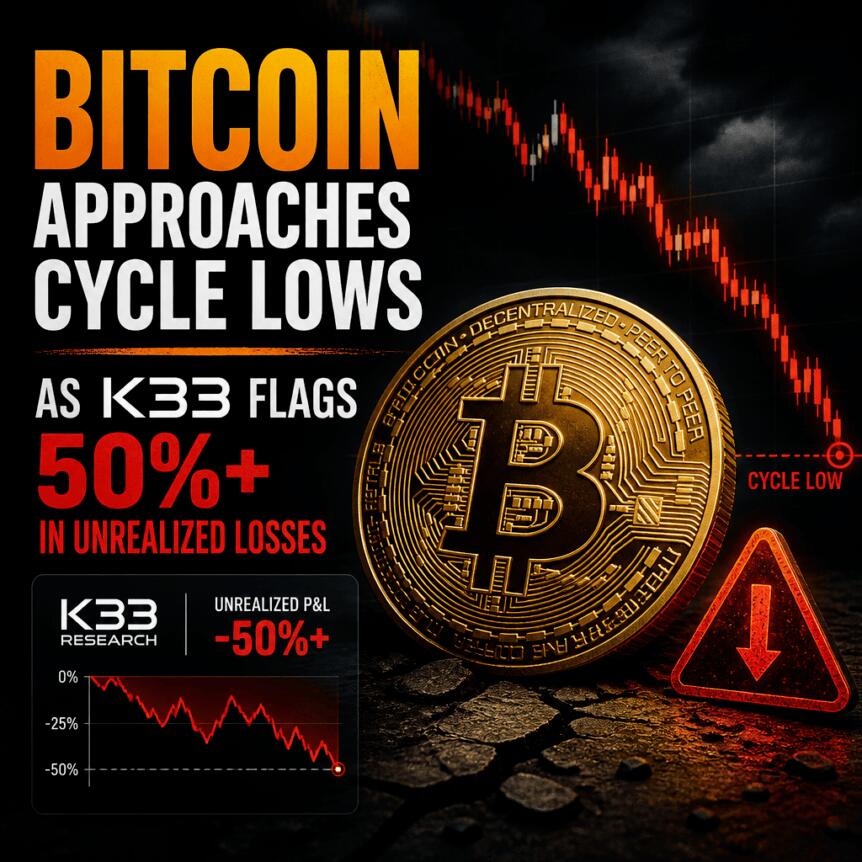
Bitcoin’s “underwater” ratio—the share of circulating supply held at a loss—has climbed above the 50% mark, a threshold that K33 says has often aligned with late-stage bear-market conditions. In its latest research note released Tuesday as part of its H1 2026 roundup, the digital asset brokerage estimated that more than half of all Bitcoin is currently underwater.
K33 also cautioned that this cycle may not mirror prior ones exactly. Because the most recent bull run appeared less extreme than earlier downturn-and-recovery cycles, the firm suggests the drawdown that followed could be comparatively milder. For investors, the key question is what happens after this kind of capitulation-style stress—whether selling pressure truly fades and how quickly “late bear” dynamics translate into renewed risk appetite.
Key takeaways
- Over half of circulating Bitcoin is held at a loss, according to K33—an indicator the firm links to the late stages of bear markets.
- In prior cycles, the sell-off tended to exhaust within weeks of the ratio crossing 50% (with one notable exception in 2014).
- K33 expects this cycle may differ because earlier bull-market extremes were less pronounced this time.
- Spot Bitcoin ETF flows were mixed: two consecutive inflow days followed by record-high June outflows, per Farside Investors data.
- Other gauges point to improving momentum, including Block Scholes’ Risk Appetite Index, which has historically preceded positive 100-day spot returns.
Why the “underwater supply” metric matters
K33’s central observation is straightforward: when a majority of holders are underwater, the market is often closer to the point where forced selling and widespread disillusionment start to ease. Historically, analysts treat the metric as a proxy for the distribution of realized gains and losses across the circulating base—essentially a measure of how much of the ownership is experiencing negative mark-to-market performance.
As K33 framed it in the report, Bitcoin has tended to be in late bear-market phases when more than half of circulating supply is held at a loss. While no single statistic can perfectly time a bottom, the underwater ratio remains popular because it captures a broad ownership reality rather than only short-term price action.
What earlier cycle data suggests about timing
In the report, K33 described how prior bear markets generally bottomed relatively soon after the 50% underwater threshold was reached. The pattern was consistent across multiple cycles:
- 2017 bear market: Bitcoin bottomed 31 days after more than half of supply was held at a loss.
- November 2018: Bitcoin bottomed 23 days after the same condition.
- November 2022: Bitcoin bottomed roughly 13 days after 50%+ supply was underwater.
K33 also highlighted that the 2014 cycle deviated from the pattern. In that earlier period, Bitcoin bottomed 101 days after half the supply was held at a loss, and the asset ended up lower one year after the signal—down about 25%. That outlier matters because it underscores that “underwater majority” can coincide with different macro and liquidity regimes, not just investor psychology.
For current market participants, the most actionable takeaway is not the exact number of days implied by past cycles, but the idea that the 50% threshold has historically marked a phase where the downside momentum has often started to slow. Investors still need to watch whether the current market follows the more typical timing—or whether today’s conditions resemble the 2014-style lag.
ETF flows add a complication to this cycle
K33 flagged that large, structurally different sellers could shift how this cycle behaves compared with earlier ones. Spot Bitcoin exchange-traded funds (ETFs), in particular, can influence price by channeling flows through a regulated wrapper rather than only through traditional trading behavior.
The report pointed to a notable sequence in ETF demand: spot Bitcoin ETFs recorded two consecutive days of inflows, including $265 million on Monday. But according to Farside Investors, those gains were outweighed by $4.51 billion in net outflows in June, which the data described as the worst month on record.
This combination—short bursts of inflow against a still-negative longer trend—can be important for how quickly the market transitions from “stress” to “turn.” Even if the underwater ratio suggests selling pressure may be nearing exhaustion, ETF flow dynamics can reinforce either stabilization or renewed pressure depending on whether June’s outflows continue or reverse.
Risk appetite gauges point to a possible turn
Beyond realized-loss metrics, K33’s report also aligns with other momentum-style indicators. One such tool referenced in the article is Block Scholes’ Risk Appetite Index, which tracks bullish versus bearish momentum across digital assets.
According to the report, Bitcoin’s risk appetite measure fell to -1.27 on July 3 and has since moved higher. Block Scholes tied this kind of rebound to outcomes in past episodes: in the eight prior instances it identified, the median spot return over the subsequent 100 days was 12%.
A Block Scholes spokesperson told Cointelegraph that historically, the move “has preceded a more bullish outperformance in spot prices” and could support additional allocation toward risk assets such as crypto.
What makes this useful for readers is the cross-check. If the underwater ratio is telling you the market is late in the bear phase, and risk appetite is showing an improvement from a low, the combination suggests conditions may be shifting from widespread pain toward more constructive positioning—though it still doesn’t eliminate volatility risk.
What to watch next
With more than half of circulating Bitcoin estimated to be held at a loss, the market is approaching a historically meaningful decision point. Traders and investors should focus on whether ETF flow trends continue to stabilize after June’s record outflows and whether risk appetite measures keep rising—signs that would support a faster transition away from bear-market selling pressure rather than a prolonged, 2014-like lag.
Future Hall of Fame CB Forecasts Big Things for Kyler Murray

Quantum targets electric drone air speed record with 434 mph flight

Bauzinsen aktuell – 60% Finanzierung Juli 2026 #baufinanzierung


-

 Fashion4 days ago
Weekend Open Thread: High Hopes
-
 NewsBeat3 days ago
Taylor Swift and Travis Kelce wedding staffer hilariously struggles to keep her cool while checking in megastars
-

 Fashion1 day ago
Open Thread: What Great Books Have You Read Recently?
-

 Politics4 days ago
The House | “Reframing the debate from a binary discussion of winners and losers”: Yuan Yang reviews ‘We Are Not Machines’
-
Crypto World6 days ago
Airdrop Registration Becomes Key Focus For Remittix As RTX Launch Updates Approach
-

 Crypto World4 days ago
Standard Chartered Secures MiCA License as ESMA Adds 37 New Crypto Firms
-

 Business1 day ago
AXT Shares Jump Nearly 14% as Semiconductor Materials Maker Rebounds on AI-Linked Indium Phosphide Demand
-

 Sports6 days ago
Broncos roster: OL Ben Powers (No. 74) entering final year of contract
-

 Crypto World6 days ago
Binance stock trading tops $1B in first month after launch
-

 NewsBeat7 days ago
Presenter Caroline Flack’s brother Paul Flack dies aged 55
-

 Crypto World6 days ago
Alibaba-affiliate Ant Group enters the humanoid robot market with 12 deals
-
Crypto World1 day ago
SK hynix (000660.KS) Stock Dips as $28B Nasdaq ADR Offering Drives AI Memory Expansion
-

 Crypto World2 days ago
South Africa proposes crypto tax guidance under existing rules
-

 News Videos1 day ago
Best Time to Enter Small Caps Right Now? Another Bull Run? | Financially Free
-

 Tech2 days ago
Lenovo laptops are now shipping with YMTC SSDs, a sign of Chinese NAND entering the mainstream
-

 News Videos17 hours ago
Whats Hidden Inside This Cash Register? #treasure #reselling #money
-

 Business6 days ago
Meta Platforms Stock Jumps 7% Today as Bloomberg Reports Company Plans to Enter the Cloud Business
-
 NewsBeat6 days ago
New exhibition reflects five decades of movement between island of Ireland and GB
-

 Business5 days ago
What a 10 Percent Drop Means for Buyers, Sellers and Renters
-

 Crypto World5 days ago
Binance Re-Enters Philippines As EU MiCA Rules Restrict Access
You must be logged in to post a comment Login