










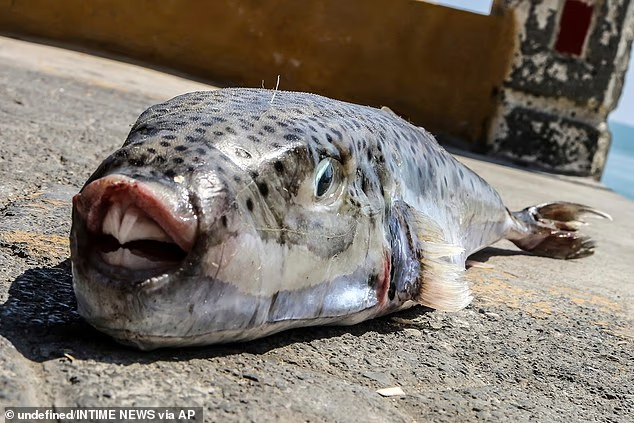
Alarm is growing over the presence of a marine menace that could throw holiday plans into chaos for those heading to the Mediterranean.
The silver-cheeked pufferfish has been spotted off the coasts of Greece, Spain, Italy, Turkey and even as far as Israel.
The toe-chomping creature appeared in the Mediterranean via the Suez Canal, adding to the woes of holidaymakers already dealing with jellyfish and sea urchins in the region.
The fish, also known as the silver-cheeked toadfish, has incredibly sharp teeth and a bite so powerful that it can sever a finger in one chomp.
It also has a powerful neurotoxin called tetrodotoxin, a poison that can cause heart and lung failure – making the silver-cheeked pufferfish unsuitable for human consumption.
The fish was first seen in the eastern Mediterranean in 2003 and in Greek waters in 2005.
But recent years have seen an explosion in their population size and range, spreading towards Italy, Spain and the rest of the western Mediterranean.
Scientists believe this spread has been caused by climate change, which has resulted in warmer waters and rising salinity in the sea.
The dangerous silver-cheeked toadfish has been spotted across the Mediterranean, with fang-like teeth that can tear through bone, wood and metal

Fishermen have complained of the pufferfish decimating their catch and their nets, while reports of attacks on humans are becoming more common
The silver-cheeked toadfish has been spotted across Greece, where panicked officials are rushing to erect extensive sea barriers to keep them away from swimmers.
With fang-like teeth that can tear through bone, wood and metal, the Greek Red Cross issued an urgent alert over the aggressive invasive species.
Their brutal bite has been felt by humans, with increasing reports of attacks on swimmers.
Just last week, an elderly Greek woman was left needing stitches after one of the fishes unexpectedly lunged at her in Varkiza, near Athens.
‘If one of them bites you, it will simply cut off your finger. They destroy the sea. They don’t leave anything behind,’ a Greek fisherman, Alexis Charalampakis, reportedly said.
‘It’s an omnivorous fish that eats everything it encounters,’ added 65-year-old fisherman Giannis Giankakis.
‘Nothing seems to bother it, because it has no natural predators among other fish,’ he added.
Videos have surfaced online showing how strong the animal’s bite is, with its teeth tearing through coca cola and beer cans.
Their beak-like mouth has also left many fisherman’s nets in tatters, with one saying: ‘If this wasn’t my boat, I’d quit this profession for good. ‘The situation is dire…we cannot survive.’
‘It took me two days to fix these nets. I took them out this morning, another 20 holes.’
‘The job gets worse every year,’ said 53-year-old fisherman Kostis Zevelekakis.
The Greek Red Cross have said that victims should seek emergency care if they are bitten as they can cause severe wounds.
Clean water and soap should be used to clean the wound and to apply heavy pressure with a piece of gauze or clean cloth, before seeking professional medical help.
Already, 2.5km of a floating barrier has been installed in some bays along Evia, Greece’s second largest island.
While the nets – the first floating barrier to be installed in Greece – were initially implemented to deal with the thick swarms of jellyfish that blighted the beaches last summer, the nets ‘killed two birds with one stone’, Chalkida’s vice mayor Antonis Spanis reportedly said.

Videos have surfaced online showing how strong the animal’s bite is, with its teeth tearing through coca cola and beer cans

Their brutal bite has been felt by humans, with increasing reports of attacks on swimmers

Their beak-like mouth has also left many fisherman’s nets in tatters
‘Our duty and primary concern has to be the safety of our citizens,’ he was reported to have said, but added that they promised a ‘carefree summer’.
A further seven kilometres of floating barriers with thickly woven netting are set to be delivered from Athens and experts are hoping that this should be strong enough to deter the creatures.
Cypriot authorities first introduced financial incentives in 2024 to encourage fishermen to help support a government-backed eradication scheme by removing them from the waters.
Since its introduction, more than 100 tonnes of the pufferfish – which has no natural predators – has been destroyed.
Athens announced a similar scheme last week where £4.56 (€5.33) was up for grabs for every kilogram of the fish surrendered to authorities, who would later incinerate it.
Fishermen want the state to subsidise them to hunt pufferfish, with one saying: ‘The state isn’t doing enough to help us deal with these fish (…) We can control their numbers if we’re given the right framework to hunt them.’
‘They should give us an incentive to round them up,’ said 25-year-old Babis Doriakis.
‘I have taken on my father’s fishing boat, but I won’t be able to continue without assistance,’ he said.
Areas in the southern Aegean Sea and around Crete are also being offered fuel-subsidies as part of the EU-funded scheme.
Nota Peristeraki of the Hellenic Centre for Marine Research said that these pufferfish can contribute to £7,270 (€8,500) worth of damage and lost income, per France24.
However, the Initiative to Save Pufferfish has been reported criticising the eradication efforts, instead arguing that the fish require ‘protection and respect’, according to The Guardian.
Ioannis Batjakas, a marine biologist based in Lesbos, said the reports of attacks are exaggerated and that, like most fish, they would only lash out if provoked, per the newspaper.
Greece is not the only place affected, with pufferfish being spotted on beaches across the Mediterranean.
Turkey’s southern coastline has also seen a series of particularly serious incidents, including attacks on children and swimmers.
Meanwhile, scientific monitoring has gradually expanded westwards, confirming that the species has now spread to the waters off Spain and Italy.
Historical records also show the silver-cheeked pufferfish has long maintained a stable presence along the coasts of countries including Libya and Syria.

Fishermen in the Mediterranean have already warned that the pufferfish have been heavily damaging their nets

The silver-cheeked pufferfish (pictured) has appeared in the Mediterranean via the Suez Canal
One dog became violently sick after licking the invasive species on a beach in Netanya, Israel.
‘She could barely walk, was disoriented and began showing symptoms of neurological damage,’ the owner recalled in an interview to Ynet News.
The dog was brought to the vet and sedated and placed on a ventilator. According to veterinarians, she arrived in time and survived the poisoning.
The owner said she had spotted ‘many dead pufferfish along the shore during our walk.’
According to medical professionals, at the beginning of poisoning vomiting, weakness and muscle tremors can occur, but in severe cases, the toxin progresses quickly and can cause paralysis of the respiratory muscles and immediate life-threatening danger.
The silver-cheeked fish is spreading rapidly along Israel’s coastline and is being caught in fishing nets, after which fisherman just dispose of them on the sand.
‘There is a phenomenon where fishermen come to the beach, catch rabbitfish or pufferfish,’ the Nature and Parks Authority said.
‘These fish are not prohibited to catch but they are not attractive for consumption so fishermen simply leave them on the sand. It often happens that a child or a dog touches them and gets hurt.’
Israeli authorities are asking fishermen to ensure they do not leave fish on the shoreline where dogs or children may come across them.
‘If you caught a fish that is prohibited for fishing or you do not want it for any reason, it should be thrown back into the water if still alive or into a trash bin if dead,’ they warned.






















































You must be logged in to post a comment Login